




No CrossRef data available.
Organizing a remote state of incipient talk: Push-to-talk mobile radio interaction
Published online by Cambridge University Press: 02 May 2006
Abstract
This study investigates the organization of conversational interaction via push-to-talk mobile radios. Operating like long-range walkie-talkies, the mobile radios mediate a remote state of incipient talk; at the push of a button, speakers can initiate, engage, disengage, and reengage turn-by-turn talk. Eight friends used the mobile radios for one week; 50 of their conversational exchanges were analyzed using conversation analytic methods. The findings describe the contour of their conversational exchanges: how turn-by-turn talk is engaged, sustained, and disengaged. Similar to a continuing state of incipient talk in copresence, opening and closing sequences are rare. Instead, speakers engage turn-by-turn talk by immediately launching the purpose of the call. Speakers disengage turn-by-turn talk by orienting to the relevance of a lapse at sequence completion. Once engaged, the mobile radio system imposes silence between speakers' turns at talk, giving them a resource for managing a remote conversation amid ongoing copresent activities.We are grateful to Mimi and her friends for making it possible to collect this data. We also thank Jim Thornton, Marilyn Whalen, Paul Drew, Bob Moore and Luke Plurkowski for their helpful insights.
Keywords
Information
- Type
- Research Article
- Information
- Copyright
- © 2006 Cambridge University Press
INTRODUCTION
When Schegloff & Sacks 1973 first discovered a continuing state of incipient talk, they were examining the talk-in-interaction of copresent parties – travelers seated next to each other on an airplane, or family members gathered around their dining-room table. Schegloff & Sacks 1973 described a continuing state of incipient talk as consisting of two elements: a form of overall structural organization of conversation, and an interactional circumstance. Structurally, in a continuing state of incipient talk, turn-by-turn talk occurs, then lapses, then occurs again. Unlike single, bounded face-to-face encounters, speakers in an incipient state of talk do not use greetings to initiate talk, nor do they issue goodbyes prior to a lapse in talk. In a continuing state of incipient talk, once talk has been engaged, further turn-by-turn talk is relevant and may be initiated at any time. The interactional circumstance includes the participants' copresence and other contingencies for the parties' actions that are independent of the overall structural organization of the participants' talk. For example, contingencies such as a plane's arrival at its destination may cause the continuing state of incipient talk to cease for adjacent passengers, or the configuration of a family's home setting may offer particular opportunities for talk to occur. However, even in the absence of other contingencies, copresence – people's ability to observe and experience the actions of others who are also able to observe and experience them – affects people's actions (Goffman 1963). This mutual monitoring in copresence “renders persons uniquely accessible, available, and subject to one another” (Goffman 1963:22). People manage this availability by engaging in either unfocused or focused interaction. Unfocused interaction refers to the management of mere copresence, such as a momentary glance toward a passerby. Focused interaction occurs when “persons gather close together and openly cooperate to sustain a single focus of attention, typically by taking turns at talking” (Goffman 1963:24).
Technological developments have enabled some of the mutual “accessibility” and “availability” characteristic of copresence to be supported remotely. Since the 1870s, the invention of the telephone has enabled people virtually to gather closely and engage in conversational interaction. A hundred years later, mobile telephones gave people the potential ability to reach each other anytime, anywhere. And now, with the widespread use of push-to-talk (PTT) mobile radios which operate like long-range walkie-talkies, people are incipiently connected at the push of a button. How is this technology-enabled, remote state of incipient talk organized? How is turn-by-turn talk engaged, sustained and disengaged? This article examines the structural organization of conversational interaction via PTT mobile radios and shows that the participants of this study orient to this technology-mediated communication as a remote continuing state of incipient talk.
TECHNOLOGY-MEDIATED COMMUNICATION
The body of literature on conversation analytic research describes how copresent talk-in-interaction is organized and, comparatively, how a communication technology's capabilities constrain the ways participants organize their remote talk-in-interaction. In copresence, to establish mutually ratified participation, speakers use an array of vocal and nonvocal actions to solicit and engage the attention of a desired recipient; for example, eye gaze is a particularly important feature of an attending recipient, and speakers work to maintain this gaze throughout the course of one's turn-at-talk (Goodwin 1979, 1981). The mutual visibility of copresent parties is a resource for participants to show that they are available to receive talk or temporarily unavailable because of involvement in another activity. Moreover, in copresence, talk, in the form of “outlouds” or talk for oneself, can show one's availability for talk-in-interaction and provide a resource for overhearing members to initiate reengagement (Szymanski 1999).
Face-to-face conversational practices are adapted in several ways to establish mutually ratified participation via the telephone (Schegloff 1968, 1972, 1986; Whalen & Zimmerman 1987; Zimmerman 1992; Hopper 1992; Hutchby 2001). Schegloff (1986:116) describes how the lack of a visual channel on the telephone results in opening phases that consist of one or more of the following sequences: summons-answer, identification/recognition, greetings, and initial inquiries or “how-are-yous.” Speakers connect with, identify, greet, make initial inquiries about each other, and exchange how-are-yous in order to place the call in the anchor position for introduction of a first topic (Schegloff 1986).
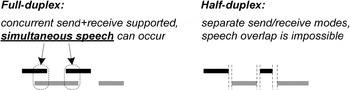
Technologically, PTT mobile radio differs most dramatically from conventional telephony in the type of channel that connects its users. Conventional telephony is full-duplex,1
The meanings of “full-duplex” and “half-duplex” given here are those used in the telecommunications industry. Confusingly, “half-duplex” has a very different meaning for conventional radio operators (e.g., in the “ham” radio community); for consistency, we adopt the telecommunications usage throughout.

Speech over full-duplex and half-duplex channels
Conversational interaction via PTT mobile radio is characterized by two fundamental characteristics. First, because the channel is half-duplex, the current speaker has complete control over the conversational floor and autocratically selects when to end his or her turn-at-talk. Listeners do not have the opportunity to use continuers to show that they are attending to the speaker or to interrupt the speaker at the moment when a disagreement or misunderstanding occurs. The floor is visibly available to recipients by an “over” beep which signals the current speaker's surrender of the channel. Second, because speakers must operate the push-to-talk mechanism, each turn-at-talk is followed by a technologically imposed silence, usually less than 3 seconds long. These silences contribute to the way in which speakers organize their conversational interaction both within a conversational exchange and across exchanges.
Excerpt (1) is a representative conversational exchange over PTT mobile radios. Alexis is searching for a place that sells coconut rum cheesecake. Prior to this, Mimi and Alexis had a conversational exchange to discuss the places that might carry the cake, and then Alexis called one of those proposed bakeries, using a landline telephone. The transcription conventions are Jefferson's as outlined in the Appendix and described in Atkinson & Heritage (1984:ix–xvi). Talk that is audible over the PTT mobile radio channel is highlighted in boldface. Comments in italic indicate short, distinct beeping sounds generated by the user's handset. For example, there are separate beeps for a new incoming connection (“new connection”) which is audible by the initiator and recipient, for the start of transmission (“connect”) which is audible only to the initiator, and for the end of transmission (“over”) which is audible only to the recipient(s).

Alexis, instead of summoning Mimi in an opening sequence, initiates the conversation by launching into a story about how the store does not carry the desired cake. Similarly, instead of initiating a closing sequence to end the exchange, Alexis dials the next store on her list with her landline telephone as Mimi is responding to her telling over the mobile radio. After 8 seconds of silence, Mimi produces another turn about how to find the dessert. Mimi's last two turn construction units, I wonder … in lines 22–24 and I bet … in lines 27–28, are syntactically constructed as if she were thinking out loud; although she deliberately broadcasts them to Alexis, they do not strongly implicate a response, unlike her earlier first pair part question. Talk lapses as Alexis speaks on the phone and Mimi does not produce another turn-at-talk.
The conversational practices highlighted in the discussion of (1) differ from those reported in conversation analytic studies of conventional two-way radio communication (as well as from those of telephone conversation). This is largely a result of the settings in which such studies have taken place. There have been a number of empirical studies of the use of conventional two-way radios outside the workplace – for example, Gibbon's (1981) functional variation analysis of amateur radio language, Orr's (1995) ethnographic study of handheld radio use by mobile service technicians, Strub's (1997) ethnographic study of handheld radio use by teens at a weekend-long rock concert, and Bogdan's (2003) ethnographic study of the amateur radio community. However, studies applying conversation analytic methods have almost exclusively been in the context of highly task-oriented workplace communication, usually in a very structured institutional setting – for instance, Mellinger's (1992) work on paramedic/emergency room communication, Goodwin & Goodwin's (1996) work in airport ground operations centers, Luff & Heath's (2002) work in railway control stations, and Nevile's (2004) work in commercial aircraft cockpits. The organization of the very spontaneous and sociable interactions described here was often quite different from that predominating in more focused, task-oriented settings. As we shall see, even the organization of sociable interaction over maritime two-way radio (Sanders 2003) has notable differences.
METHODS & APPARATUS
The data for this study were collected to inform the design of a new mobile voice communication system (described in Aoki et al. 2003 and Woodruff & Aoki 2004) aimed at supporting communication within established social groups, especially those comprised of young adults. To gain access to this target demographic, a relative of one of the authors who was attending an American university served as our liaison with her undergraduate-aged established social group. The author's relative, Mimi,2
All names are pseudonyms.
Each of the eight participants was given the use of a PTT mobile radio for one week. They received no explicit directions except that they were to use (or not use) the radios as they saw fit. Before the study began, participants received a questionnaire on demographics and their use of communication technology, and semi-structured interviews were conducted before, during, and after the study.3
See Woodruff & Aoki 2004 for the analysis and findings related to the interview data.
The mobile radios were Motorola i1000 phones, rented from a wireless service reseller.4
PTT mobile radio is a feature supported by certain telecommunications service providers, generally (but not exclusively) using specialized mobile telephone handsets. The PTT mobile radio traffic is carried on what is essentially an enhanced cellular telephone network. Hence, users can communicate with each other at arbitrary physical distances, so long as they are each within an area covered by the service provider's cellular network.

Speakerphone method of PTT mobile radio use.
This particular mobile radio service provides private connections between individuals. The user employs a push-to-talk protocol to establish the connection and speak to another user. Specifically, if person A wishes to say something to person B, A selects B's name from a “phonebook” menu and holds down a button to initiate a connection. After a brief delay (variable, but generally under 1 second), a “go ahead” beep is heard by A and a “new connection” beep is heard by B, and speech can be transmitted. B hears A's speech as it is produced, with a network delay identical to that of a mobile phone call. When A releases the button, the connection ceases and the transmission stops; the recipient, B, is alerted to this disconnection by an “over” beep. After an initial connection has been made, either user may simply push the button on her radio to initiate a next connection; a “previous call” button reselects the last person who transmitted. After 8 seconds have passed without a connection between users, the radios reset and speakers must use the phonebook menu to select a new addressee. Unlike conventional radio, the mobile radio system technologically ensures that only one user speaks at a time.5
In conventional radio, half-duplex operation is a matter of established operator practice; it is technically possible for multiple conventional radios to transmit at the same time on the same frequency, but this interferes with intelligibility so severely that radio operators use elaborate verbal protocols to avoid it. Because the PTT mobile radio traffic is carried on a computer-controlled cellular network, the network itself can ensure that only one participant in a given conversation is transmitting at a time.
In addition to private connections, group connections can be used to communicate within prespecified groups of mobile radio users. For example, if A wishes to transmit a message simultaneously to all members of group X, A selects group X's name from the same “phonebook” menu previously described and holds down the button to initiate a connection. This mechanism is similar to a shared channel in a handheld radio, except that the cellular network allows access only to its group members. From the perspective of a recipient, its usefulness is limited, since users can “tune in” to only one group at a time, and being tuned in is prerequisite to receiving any group channel transmissions.
Mimi successfully brokered the researcher's membership in the established social group and provided her with privileged access to the group members' daily activities. The researcher, in addition to participating as a user of the PTT mobile radios, lived in the rented house with four of the participants and observed all study participants at various times of the day and night in both public and private settings. The seven participating students attended summer school and engaged in leisure activities; some also held part-time jobs.
In addition to the questionnaire and interviews, the researcher took extensive ethnographic notes and recorded audio data. Using a clip-on microphone and a Sony MiniDisc recorder, the researcher was able to record transmissions made and received (on speaker) by copresent parties, as well as transmissions made and received by herself. In total, approximately 50 hours of audio was recorded during the week, including face-to-face conversational interaction, conversational exchanges that occurred via the mobile radios, and interviews. The data corpus for this study consists of 50 conversational exchanges consisting of more than 63 minutes of audio. The data were transcribed and analyzed using conversation analytic methods.
ANALYSIS
The analysis of the structural organization of conversational interaction with push-to-talk mobile radios focuses on the contour of the conversational exchange. The findings are divided into three sections: (i) how conversational exchanges are successfully engaged, (ii) how conversational exchanges are sustained, and (iii) how conversational exchanges are disengaged or how turn-by-turn talk lapses.
Engaging a conversational exchange
A successful conversational exchange occurs when two or more speakers engage in turn-by-turn talk. The problem facing speakers using the PTT mobile radio system is how to design an engaging turn-at-talk when the availability and attention of the recipient(s) is completely unknown. In contrast to conventional telephony, speakers using PTT mobile radio do not have the prominent mechanical summons of the phone's ring to draw the attention of their recipient and implicate an answer as the first turn-at-talk6
The PTT mobile radios produce a low-volume beep which is audible by the targeted recipient prior to the initiating speaker's turn-at-talk; however, because this sound is so subtle, many recipients may not hear it or respond to it as a summoning action.
Engaging a conversational exchange by launching the purpose of the call
Overwhelmingly, conversational exchanges via PTT mobile radio are initiated with engaging turns which are designed to launch directly into the first topic. Instead of issuing a summons or a greeting, speakers engage turn-by-turn talk by introducing the purpose of the call. Many of these calls originate from the activities of the speakers themselves or the activities of those around them. For example, in (2), Alexis is walking to meet her friend on campus; on the way, she periodically solicits directions from her friend.

Once connected, Alexis directly reports her location and solicits the next direction. A little over a minute has passed since Alexis and this recipient were in contact, and they both have the context for the current exchange because this is a subsequent exchange, an exchange in a series (Button 1991), about meeting each other on campus.
Similar engaging turn designs also occurred when the purpose of the call was other people's activity. In (3), Randy and Stan are pretending to be pilots on the mobile radios; Mimi is copresent with Randy and can overhear his activities, and Mimi's recipient, Alexis, is in the apartment with Stan and may be able to overhear him.

In (3), Mimi initiates the conversational exchange to share something funny. Once connected, Mimi launches into a noticing (Sacks 1992:87–97) about Randy's activity, which Alexis can also experience via Stan's activity. Intermittent exchanges such as this were common and enabled the group to stay informed about one another's daily events.
Sometimes conversational exchanges are initiated as a continuation of prior ongoing activity. In (4), Alexis and Stan enter a restaurant to buy cheesecake while two others wait in the car. After the clerk notifies her that they do not carry the requested coconut rum cheesecake, Alexis contacts Mimi with the update.

Once connected, Alexis launches into the purpose of the call, prefacing her turn with the connector so which links the turn-at-talk with a prior turn or turns in a sequence, in this case positioning it as a conversation in a series. According to Raymond (2004:186), “people regularly use ‘so’ prefaced turn constructional units that articulate the upshot of prior talk to mark the completion of complex turns or activities and thereby pursue a limited range of actions from their recipients.” In this case, unable to buy the coconut rum cheesecake, Alexis solicits Mimi and Randy's advice about alternatives.
The conversational exchanges in (2–4) all contain engaging turns which immediately launch the purpose of the call. In addition, these calls occurred within 5 minutes of a prior contact with that same person. In this context, launching the purpose of the call in the first turn-at-talk, without prefacing it with a summons to call the recipient to attention, shows that these speakers are orienting to their recipient's continued availability after a prior contact has recently occurred. When contact is temporally proximate, speakers share a sense of each other's state of activity and their talk reflects this recent knowledge. How do participants manage to engage turn-by-turn talk when recipiency is less certain?
Engaging a conversational exchange when time has elapsed
After a significant amount of time has elapsed (30 minutes or more), speakers orient to the fact that their recipient(s) may not be so readily available to receive their talk. One way speakers show themselves to be orienting to the possible lack of a ready recipient is their use of a greeting form prior to launching the purpose of the call. In (5), Mimi checks to see if Randy has finished with his meeting:

In (5), Mimi initiates her turn with a greeting form before inquiring about Randy's meeting. Although Mimi uses a greeting form, she does not accomplish a summoning action that would show her orientation to the lack of a ready recipient. The use of the greeting is structural (e.g., greetings occur in turn initial position when engaging) and not functional (does not summon Randy) because her continued use of the half-duplex channel does not provide Randy with a place to respond to it as a sequence-initiating action.
Extended greeting forms may include the recipient's name. Prior to (6), Tracy and Alexis were both at the rental house discussing lunch plans; Tracy decided to eat out and Alexis stayed home.

In formulating her engaging turn, Alexis proceeds as if she is leaving a message on Tracy's answering machine, for although she knows that Tracy is at lunch, she does not know about her availability to receive talk. The present progressive form of the information solicitation (are you having fun instead of did you have fun) is one indication that Alexis is orienting to the possibility that Tracy may respond momentarily if she is available.
After 30 minutes or more have elapsed, speakers addressing multiple recipients on the group channel also use a greeting form prior to launching the purpose of their call:

The use of a greeting form or a direct address prior to launching the purpose of the call previews upcoming substantive talk for the recipient(s). However, it does not guarantee that the recipient is ready to receive the upcoming message, because no place is provided to respond to the utterance and confirm one's availability for further talk. When speakers orient to the issue of recipiency, especially when their recipient's availability is less certain, stronger engaging methods are used.
Initiating a conversational exchange when recipiency is uncertain
Recipiency in the PTT mobile radio system is inherently one of doubt – doubt about whether the recipient is available to receive talk, and once a turn has been initiated, doubt about whether he is actually receiving the talk.7
In fact, recipients may have heard a turn-at-talk and be available to engage in conversation, and still may not respond. See Woodruff & Aoki 2004 for a description of users' reactions to this reduced interactional commitment afforded by PTT mobile radio technology.
In our data set, however, instances in which the speaker initiates a conversational exchange with a summoning action are extremely rare. Of the 50 conversational exchanges analyzed, only seven were initiated with a summons; six occurred after more than 30 minutes had elapsed since the speaker and recipient had last been in contact. One conversation, (8), was initiated with a summons in the form of a greeting. Stan's summons targets any one of the multiple recipients who may be listening to the group channel:

The way in which talk is engaged in (8) is somewhat similar to an opening in a conventional telephone call. Mimi responds to Stan's summons with a greeting. Stan follows up with a return greeting, followed by a direct address which shows that he recognizes her. Then, instead of launching the purpose of the call, Stan makes an initial inquiry into Mimi's day. Mimi responds to the inquiry and initiates a sequence that solicits Stan's confirmation of identity. Once both speakers have resolved the recognition issue, Mimi reciprocates the current status inquiry and the conversation continues.
This type of extended opening phase was not seen in any other conversation in the data set. Stan produces his engaging turn for the members of the group channel. Without a targeted recipient, Stan designs a generic engaging turn. And without a purpose for the call or an announcement that would be appropriate to broadcast over the group channel, Stan is unable to do more than summon a person(s) who may be available at the moment. After Mimi responds, giving Stan the first opportunity to launch the purpose of the call for which he is accountable as the caller (Schegloff 1986), he instead makes an inquiry about Mimi's activities. Stan produces a summons to engage in lieu of the purpose of the call, because he seems not to have a noteworthy purpose for the call. Thus, two features of this conversational exchange contribute to the shape of its opening sequence: the caller does not have a noteworthy purpose for the call, nor does he select a particular recipient.
When producing a summons for a targeted recipient, direct address is often used. In (9), Alexis is contacting Gaby after more than a half hour's lapse:

Alexis establishes Gaby's recipiency prior to launching her reason for the call, an invitation to meet later that evening. Engaging a conversational exchange with a summons-answer sequence rather than with the purpose of the call gives the speaker information about a recipient's availability without having to invest in producing substantive talk that the recipient may not be available to receive.
The greater the time elapsed since the last connection was made, the less information the caller has about the recipient's state of activity, and the greater the doubt about his or her availability to receive talk. In (10), the speaker orients to this uncertainty in the repair of her engaging turn, which is initially designed for a recipient who had been recently contacted.

Alexis packages her engaging turn with a greeting plus direct address and a self-identification preceding the launch of the purpose of her call. Then, just as she is about to produce substantive talk about the purpose of the call, she halts her in-progress utterance and restarts by issuing a summons. This shows that she is oriented to the ambiguity surrounding the recipient's state of readiness to receive talk. Once Gaby responds, she restarts and launches the purpose of the call.
While the caller's challenge is to determine whether the recipient is available to engage in a conversational exchange, the recipient's challenge is to recognize the caller when identification-recognition sequences are often absent (Schegloff 1979). It is possible for recipients to recognize callers from the “voice samples” provided by the first turn (Schegloff 1979); however, poor audio quality, inattention, or environmental noise can hinder such recognition. An additional resource made available by the mobile radio handset is a visual display of the name of the most recent caller; because this display is shown only briefly, it is useful mainly if the phone is close at hand.
This issue of speaker recognition is especially difficult when the caller is addressing the group channel. For calls received on the group channel, the handset display lists only the name given to the group channel (e.g., “house”), not the particular person making the call. Consider how Alexis handles the recognition issue when Gaby issues an engaging turn on the group channel in (11) (an extended version of ex. 7):

In response to Gaby's group channel announcement, Alexis produces several actions. She responds to the engaging turn by inquiring about the speaker's identity, offering her understanding of the speaker's identity (is that Gaby) and labeling her the slacker in response to the content of the announcement. Once Gaby confirms her identity, Alexis responds directly to the announcement by echoing Gaby's laughter in line 10. It is interesting to note how speakers, prevented by the half-duplex channel from laughing together, instead sequentially accomplish the coordinated social activity of laughing (Glenn 1995, Jefferson, Sacks & Schegloff 1987); Alexis conveys her solidarity with Gaby by imitating the number of beats and the prosody of Gaby's initial laughter (Sanders 2003).
To summarize, in conversational exchanges via PTT mobile radio, the first turn-at-talk often launches the purpose of the call. Unlike the organization of telephone calls, actions such as summoning, identification-recognition, and the exchange of greetings or initial inquiries are rare. If a significant amount of time has elapsed since the speakers were last in contact (often 30 minutes or more), speakers may insert a greeting form before they launch the purpose of the call to alert the recipient to upcoming talk. When recipiency is in doubt, however, PTT users revert to telephone practice and issue a summons and wait for a response before initiating topic talk.
Sustaining a conversational exchange
The half-duplex operation of the PTT mobile radio system affects the way in which conversational exchanges are produced. Most important, because speakers do not maintain a joint channel, they are precluded from closely coordinating their turns at talk to minimize gap8
Jefferson 1988 found that the standard maximum silence between turns at talk in American phone conversational interaction is approximately one second, and silences longer than that often result in a repair initiation. For example, on the telephone, noticeable silence by one party causes the other to produce a summons, “Are you there?”
Because speakers know that the operation of the mobile radios imposes gaps between each turn-at-talk and that this silence is not directly accountable to a particular speaker, it becomes a resource for speakers to manage their participation in a conversational exchange. For recipients, the gap extends their response time, which in turn reduces the intrusiveness of an engaging turn produced at an inopportune moment and increases the likelihood that a response will be forthcoming when the engaging turn does interrupt an in-progress activity. This is the case in (12), where Stan summons Mimi while she is working with Alexis to resolve a printing problem. Following Stan's engaging turn, Alexis, in copresent conversation with Mimi, identifies the caller:

When Stan's engaging turn in line 4 goes unanswered, he must assume that Mimi is not there or available. Stan's only recourse is to reissue the summons or abort his effort to engage her in a conversational exchange.9
Stan does not have the option of leaving a message here because the PTT mobile radio system does not include a message persistence feature analogous to voicemail. However, had the system enabled him to leave a message, it is interesting to note that Mimi would be more accountable for responding to the message than she is for responding to Stan's (non-persistent) vocal summons. In this way, the technology mitigates what would otherwise be a potentially intrusive audio environment (resulting from the general use of the speakerphone feature) by maintaining the ambiguity regarding one's recipiency.
Mimi coordinates the copresent printing activity and the engaging turn in parallel; Mimi's talk to Alexis in copresence overlaps with her activity to open the channel to respond to Stan in lines 15–16. The operation of the PTT mobile radios enables recipients (as well as overhearing, copresent participants) to juggle ongoing copresent activities with their participation in a conversational exchange. Because PTT's half-duplex system gives the speaker sole access to the transmittable channel, he or she can autocratically regulate two aspects of turn-taking that are usually collaboratively managed in real time: (i) speaker change, and (ii) the length of a turn-at-talk (Sacks, Schegloff & Jefferson 1974). Because recipients do not have to collaboratively manage speaker change or negotiate when the current speaker should terminate his turn-at-talk, they can continue to engage in ongoing copresent activities while they monitor for content and for the technology to signal the end of the current speaker's turn with the “over” beep.
With PTT mobile radios, pauses and gaps between turns-at-talk are not treated as problematic, as they potentially would be in copresent or telephone interaction. In (13), Mimi responds to Alexis's initiating turn on the group channel. Alexis initially launches into a story, then restarts to establish Mimi's recognition of one of the story's main characters. Mimi's trouble recognizing the person results in extended phases of silence preceding her turns:

The 3.0-second gap in line 11 foreshadows Mimi's difficulty in identifying Gary. The 10.0-second gap in line 16 is another indication of her trouble. But Alexis does not treat the silence as problematic, attempting to intervene in line 17 after 10 seconds of silence. The silence occurs within the structure of a sequence of action which has a projected completion; that is, Mimi is accountable to respond to the recognition inquiry or to produce an action that is prerequisite to her responding to the recognition inquiry if need be, which she does in line 18.
Silent phases within a sequence of action can be substantial. In one conversational exchange, the recipient delays several minutes before responding, yet the initiating speaker does not pursue a response. In (14), Mimi contacts Randy at work to ask him a question:

After Mimi has posed a question to Randy, a phase of more than three minutes of silence ensues. In the absence of a response, Mimi does not pursue it. Mimi knows that Randy is at work and may momentarily need to focus on something more important than her question. She may also be allowing the conversation to lapse because the answer to the question is not time-sensitive.
In sustaining a conversational exchange, speakers overwhelmingly treat silent phases as unproblematic. Because the speakers do not conjointly maintain an open audio channel, plausible deniability enables them to delay responses (or not to respond) and reduces late responders' accountability. Speakers can participate in a conversational exchange as they juggle ongoing copresent activities, and because speakers know that their recipient is likely doing something else in addition to engaging in a conversational exchange, silences are often unproblematic.
This treatment of silences is related to a phenomenon found in a study of boaters socializing over maritime two-way radio (Sanders 2003). In these encounters, “prolonged gaps are almost always tolerated and not oriented to as breaches” because members understand that having “a hand free [at all times to operate a radio] is not something one can count on from anyone currently operating a vessel” (Sanders 2003:313, 314). However, boaters can assume that anyone in an exchange over maritime two-way radio is in a boat (and usually in one of a few specific locations in a boat); by contrast, mobile PTT radio can be operated anywhere and does not necessarily give speakers insight into a recipient's circumstances. Even knowing that Randy is at work (itself an assumption) is not necessarily a strong indicator of competing copresent activity.
Disengaging a conversational exchange
Once a conversational exchange has been initiated, speakers face the problem of closing the interaction or recognizing when a lapse in turn-by-turn talk is implicated. In a telephone call, or when people take leave of one another when face to face, speakers collaborate to produce a closing sequence (Schegloff & Sacks 1973). This closing sequence provides a place for either party to raise other topics or unmentioned mentionables and to reopen the conversation. If no other topic is raised, speakers agree to close the conversation and depart or disconnect. The existence of a full-duplex channel in telephone communication necessitates the coordinated closing of the conversational interaction; without a coordinated closing, one party would be in effect “hanging up” on the other. However, the PTT mobile radio is a half-duplex system, and in our corpus, closing sequences akin to those of a telephone call are rare.10
It is not necessarily the case that closings must be rare in the use of any half-duplex system. For example, a study of maritime two-way radio (Sanders 2003) did not observe that closings were rare, which may be due in part to regulatory differences – users are supposed to follow formal, specified procedures for ending an exchange (though in practice they often appear not to do so). However, it is critical to recognize that maritime two-way radio exchanges almost always start with an initial exchange on a common hailing channel, continue with a switch to a less-used channel, and end with the users switching back to the hailing channel. This medium therefore has a technological equivalent of hanging up the telephone; if one party switches back to the hailing channel, the parties will be unable to communicate further until both somehow arrive at the same channel. Hence, while parties in maritime two-way radio may orient more frequently to the “potential for discontinuation” (Sanders 2003:316) than do parties in a telephone conversation, it is not surprising that closings would be common.
Disengaging a conversational exchange at sequence boundary
Instead of producing a separate sequence to close the exchange, speakers orient to the potential close of a conversational exchange at sequence completion. Upon completion of a sequence of action, participants have several options: (i) to extend the prior sequence and continue turn-by-turn talk, (ii) to treat the prior sequence as complete and initiate a new sequence, or (iii) to treat the prior sequence as complete and not produce further talk implicating a lapse in turn-by-turn talk. For example, in a minimal two-turn conversational exchange, closing is relevant once the second pair part has been produced.
In (15), Mimi's response to Gaby engages the conversational exchange and at the same time implicates the exchange's close pending a next turn-at-talk:

Here Gaby contacts Mimi to announce her leaving. Mimi acknowledges receipt of the announcement and assesses her plan of action. Mimi's response is sequence-closing and lapse-implicative. Her turn functions as a possible pre-closing (Schegloff & Sacks 1973); she shows that she has nothing new to say, breaks with the prior topic, and gives the next speaker a turn either to raise a new topic or to initiate a closing. In this case, Gaby does not produce another turn, and talk lapses.
Most PTT mobile radio conversational exchanges consist of more than two turns at talk or a single sequence of action. In longer conversational exchanges, speakers monitor for the completion of the initiated sequence(s) to determine when an exchange can possibly be complete. The activity-based nature of turn-by-turn talk via PTT mobile radios enables speakers to project the completion of a sequence-in-progress (Lerner 1995). In (16), Mimi contacts Alexis to announce her arrival at the lab. Alexis responds by initiating another question-answer sequence in which she inquires about the weather:

At the completion of each turn in (16), the speakers can project what it will take to complete the action(s) that have already been produced. At the end of Mimi's turn in lines 4–6, the completion can be projected as one action, the response to her announcement. At the end of Alexis's turn in line 8, the completion of the conversational exchange is projected to be two more actions – the answer to the question and a response to the announcement. In this case, Alexis acknowledges receipt of Mimi's answer in line 13 before producing the responsive action to the announcement in line 14. At this point, the speakers may treat the sequence as complete and go on to initiate a new sequence, or they may refrain from producing any further talk and allow the conversational exchange to lapse.
In (17), a similar two-sequence conversational exchange is occasioned by the mobile radio's channel connection signal. Alexis hears her phone signal an upcoming transmission, but she does not receive any talk, so she attempts to resolve the trouble and successfully initiates a conversational exchange:

Mimi's technological connection to Alexis in (17) serves as a summons that recruits Alexis into participating in a conversational exchange. Alexis responds to the summons by verbally initiating the conversational exchange. The first sequence deals with the trouble of having received a signal for transmission without a forthcoming message. Upon completion of Mimi's response in lines 7–8, talk could have lapsed. Instead, Alexis initiates another sequence, a greeting sequence. Mimi completes this sequence with a return greeting, and again a lapse is implicated. Note that it is the completion of the in-progress sequence(s) of action that implicates a lapse in the conversational exchange, not the particular actions of the sequence itself; here, the completion of a greeting sequence, typically used to initiate turn-by-turn talk, causes talk to lapse.
Because most participants use the PTT mobile radios with the speaker audio, the conversation is an interactional resource for copresent persons to participate in the conversational exchange. In (18), an extension of (16), this participation does not occur until the primary conversationalists have reached a point when a lapse in talk would be relevant. Here, Randy and Stan, in copresence with Mimi and Alexis respectively, produce a post sequence (Sacks et al. 1974) which implicates and results in a lapse in turn-by-turn talk.

After having overheard Alexis and Mimi talk about the weather, Randy produces a weather announcement which Stan acknowledges. Randy and Stan, who witness Mimi's and Alexis's exchange, accomplish several actions with their sequence of talk. First, they show that they overheard the prior exchange by producing further talk about the weather. Second, the form of Randy's turn, a weather announcement, shows him orienting to PTT mobile radio as if it were a commercial broadcast radio show. Third, Randy's and Stan's exchange shows the fluidity of the closing boundary of a PTT mobile radio conversational exchange; just as the conversational exchange lapses for Alexis and Mimi, turn-by-turn talk continues by two other speakers.
Disengaging a conversational exchange in the absence of a next turn-at-talk
The completion of one or more already initiated sequences is one of two features of a conversational exchange that implicate closing. The other feature is the lack of a next turn-at-talk. Even when all initiated sequences have been completed, a speaker may elect to produce another turn-at-talk and extend the conversational exchange. In (19), an extended version of (3), Mimi and Alexis complete a noticing-response sequence in the first two turns, which implicates a lapse, but Mimi extends the exchange by producing another sequence and one more turn-at-talk before talk lapses:

In (19), talk lapses as turn-by-turn talk fades. Alexis verbally responds (lines 6–7) after Mimi's initial noticing. Then Mimi extends the conversation by detailing Stan and Randy's activity in lines 9–11; Alexis vocally responds by performing her laughter in line 13, as evidenced by her increase in volume when she is transmitting to Mimi. Mimi produces another comment emphasizing the humor of the situation, and this time Alexis laughs to herself.
This analysis of PTT mobile radio use shows that conversational exchanges rarely lapse with a coordinated closing sequence, as do bounded conversations such as telephone calls, because the end of the call does not coincide with a break in the technological connection. Instead, a “break” occurs at the end of every single turn-at-talk. What remains for the speakers to coordinate with PTT mobile radio is the social action being accomplished through the conversational interaction. A lapse is the byproduct of the recognizable completion of a course of action. A lapse occurs when, at a completed sequence boundary, a next turn-at-talk is not forthcoming.
DISCUSSION
This study shows that the ways in which speakers organize their conversational interaction via PTT mobile radios is similar to the ways in which they organize a continuing state of incipient talk in copresence. As in copresence, speakers using PTT mobile radios do not use greetings to engage turn-by-turn talk or exchange goodbyes to disengage. Instead, to engage talk, they immediately launch the purpose of the call. By design, the PTT engaging turn subordinates the interactional work accomplished by the conventional telephone opening sequences (summons-answer, greeting-greeting, etc.) to the conversational interaction commonly identified with the body of the conversation. That is, by producing the engaging turn, the speaker accomplishes three actions: summoning the recipient, providing a voice sample so identification can be made, and launching the first topic of talk. To disengage turn-by-turn talk, PTT mobile radio users do not typically coordinate the production of a closing sequence; instead, they monitor for the projected completion of a sequence-in-progress which makes relevant a lapse. Projecting the completion of an in-progress sequence of talk is facilitated by the activity-based nature of the speakers' turn-by-turn talk; speakers commonly engage in conversational exchanges to update their location (I'm at Tenth and Atlantic…), report a current activity (Randy and Stan just keep playing pilot…), or solicit some targeted information (Hi Tra:cy, are you having fun at lunch?).
The operation of the PTT mobile radio technology enables its users to sustain a remote continuing state of incipient talk. Speakers can incipiently connect with each other at the push of a button. The members of the established social group participating in this study oriented to their continuing recipient status; they received and promptly responded to incipient engaging turns, even those issued after more than a 30-minute lapse. Without the ability to see if a targeted recipient is available to engage in conversation, speakers in a remote continuing state of incipient talk act based on the notion of plausible deniability, which accounts for delayed or absent responses without invoking unfavorable social consequences. In addition, the technologically imposed silent phases between each turn-at-talk help speakers manage a remote continuing state of incipient talk amid ongoing copresent activity. This silent space is an interactional buffer; because every next turn-at-talk is mechanically delayed, speakers may extend this existing silence to accommodate other activities.
In a remote continuing state of incipient talk, speakers orient to the time elapsed as they do to timing in copresence. As Goffman 1963 noted, initial engagements are easily made upon coming into copresence, so strangers on a train car will typically exchange greetings upon meeting. This initial exchange invokes a continuing state of incipient talk, enabling them subsequently to reengage turn-by-turn talk rather than producing a delayed initial engagement. In a remote continuing state of incipient talk, in the design of their engaging turn, speakers orient to how long it has been since the last conversational exchange occurred. Overwhelmingly, speakers immediately launch into the purpose of the call if the recipient had been contacted within the last 10 minutes. When more than 30 minutes has elapsed, speakers work to differing degrees to establish an available recipient. When a recipient's availability is more certain, the speaker launches the purpose of the call preceded by a greeting form, and when recipiency is less certain, the speaker initiates a summons-answer sequence to confirm the recipient's availability prior to launching the purpose of the call.
The mobility of the PTT radio enabled the members of the study's established social group to use it to extend their copresence in a remote continuing state of incipient talk. For example, Alexis immediately connected to notify those waiting for her in the car that the store did not have any coconut rum cheesecake. And both Alexis and Stan used their PTT mobile radios to transition into copresence: Alexis initiated a series of direction-giving conversations before meeting up with Mimi, and Stan intermittently contacted Mimi on his walk home from class until he arrived to greet her at their house.
This study describes how a small, established social group used PTT mobile radios, a communication technology seemingly impoverished when compared to copresent talk-in-interaction or conventional telephony. Yet the findings show that the technology supports turn-by-turn talk which is structurally organized in ways that are similar to a context-rich, copresent, continuing state of incipient talk. Specifically, the ways in which speakers engage, sustain, and disengage turn-by-turn talk show that the structures of social action, especially sequence organization, compensate for the PTT mobile radio's half-duplex channel, which prohibits interactants from closely coordinating their talk-in-interaction and disconnects them at the completion of each turn-at-talk. Further research is needed to understand the structural organization and interactional circumstances of other emergent technologically mediated remote continuing states of incipient talk.
APPENDIX

References
REFERENCES
Aoki, Paul M.;
Romaine, Matthew;
Szymanski, Margaret H.;
Thornton, James D.;
Wilson, Daniel; &
Woodruff, Allison
(2003).
The Mad Hatter's cocktail party: A social mobile audio space
supporting multiple simultaneous conversations. In
Proceedings of the ACM SIGCHI Conference on Human Factors in
Computing Systems,
425–32.
New York:
ACM Press.
Atkinson, J. Maxwell, &
Heritage, John
(1984) (eds.).
Structures of social action.
Cambridge:
Cambridge University Press.
Bogdan, Cristian
(2003).
IT design for amateur communities.
Dissertation,
Royal Institute of Technology (KTH),
Stockholm, Sweden.
Button, Graham
(1991).
Conversation-in-a-series. In
Deirdre Boden &
Don H. Zimmerman (eds.),
Talk and social structure: Studies in ethnomethodology and
conversation analysis,
251–77.
Cambridge:
Polity.
Gibbon, Dafydd
(1981).
Idiomaticity and functional variation: A case study of international
amateur radio talk.
Language in Society
10:21–42.Google Scholar
Glenn, Phillip J.
(1995).
Laughing at and laughing with: Negotiations of participant
alignments through conversational laughter. In
Paul ten Have &
George Psathas (eds.),
Situated order: Studies in the social organization of talk and
embodied activities,
43–56.
Washington, DC:
University Press of America.
Goffman, Erving
(1963).
Behavior in public places.
New York:
Free Press.
Goodwin, Charles
(1979).
The interactive construction of a sentence in natural
conversation. In
George Psathas (ed.),
Everyday language: Studies in ethnomethodology,
97–121.
New York:
Irvington.
Goodwin, Charles
(1981).
Conversational organization: Interaction between speakers and
hearers.
New York:
Academic Press.
Goodwin, Charles, &
Goodwin, Marjorie Harness
(1996).
Seeing as a situated activity: Formulating planes.
Yrjö Engeström &
David Middleton (eds.),
Cognition and communication at work,
61–95.
Cambridge:
Cambridge University Press.
Hopper, Robert
(1992).
Telephone conversation.
Bloomington:
Indiana University Press.
Hutchby, Ian
(2001).
Conversation and technology: From the telephone to the
Internet.
Cambridge:
Polity.
Jefferson, Gail
(1988).
Notes on a possible metric which provides for a ‘standard
maximum’ silence of approximately one second in conversation.
In
Derek Roger &
Peter Bull (eds.),
Conversation: An interdisciplinary perspective.
Clevedon, UK:
Multilingual Matters.
Jefferson, Gail;
Sacks, Harvey; &
Schegloff, Emanuel
(1987).
Notes on laughter in the pursuit of intimacy. In
Graham Button &
John R. E. Lee, (eds.),
Talk and social organisation,
152–205.
Clevedon, UK:
Multilingual Matters.
Lerner, Gene
(1995).
Turn design and the organization of participation in instructional
activities.
Discourse Processes
19:111–31.Google Scholar
Luff, Paul, &
Heath, Christian
(2002).
Broadcast talk: Initiating calls through a computer-mediated
technology.
Research on Language and Social Interaction
35:337–66.Google Scholar
Mellinger, Wayne M.
(1992).
Talk-as-work: The case of paramedic calls for emergency field
orders. In
Gale Miller (ed.),
Human service occupations and professions
(Current research in occupations and professions, 7),
77–108.
Greenwich, CT:
JAI Press.
Nardi, Bonnie A.;
Whittaker, Steve; &
Bradner, Erin
(2000).
Interaction and outeraction: Instant messaging in action.
In
Proceedings of the ACM Conference on Computer Supported Cooperative
Work,
79–88.
New York:
ACM Press.
Nevile, Maurice
(2004).
Beyond the black box: Talk-in-interaction in the airline
cockpit.
Aldershot, UK:
Ashgate
Orr, Julian E.
(1995).
Ethnography and organization learning: In
pursuit of learning at work. In Cristina
Zucchermaglio
Sebastiano Bagnara &
Susan U. Stucky (eds.),
Organizational learning and technological change,
47–60.
Berlin:
Springer.
Raymond, Geoffrey
(2004).
Prompting action: The stand-alone ‘so’ in sequences of
talk-in-interaction.
Research on Language and Social Interaction
37:185–218.Google Scholar
Sacks, Harvey
(1992).
Lectures on conversation,
vol. 2.
Oxford:
Blackwell.
Sacks, Harvey;
Schegloff, Emanuel A.; &
Jefferson, Gail
(1974).
A simplest systematics for the organization of turn-taking in
conversation.
Language
50:696–735.Google Scholar
Sanders, Robert E.
(2003).
Conversational socializing on marine VHF radio: Adapting laughter
and other practices to the technology in use. In
Phillip J. Glenn
Curtis D. LeBaron &
Jenny S. Mandelbaum (eds.),
Studies in language and social interaction,
309–26.
Mahwah, NJ:
Lawrence Erlbaum.
Schegloff, Emanuel A.
(1968).
Sequencing in conversational openings.
American Anthropologist
70:1075–95.Google Scholar
Schegloff, Emanuel A.
(1972).
Notes on a conversational practice: Formulating place. In
David Sudnow, (ed.),
Studies in social interaction,
75–119.
New York:
Free Press.
Schegloff, Emanuel A.
(1979).
Identification and recognition in telephone conversation
openings. In
George Psathas (ed.),
Everyday language: Studies in ethnomethodology,
23–78.
New York:
Irvington.
Schegloff, Emanuel A., &
Sacks, Harvey
(1973).
Opening up closings.
Semiotica
7:289–327.Google Scholar
Strub, Henry B.
(1997).
ConcertTalk: A weekend with a portable audio space. In
Proceedings of the IFIP TC13 International Conference on
Human-Computer Interaction,
381–88.
London:
Chapman & Hall.
Szymanski, Margaret H.
(1999).
Re-engaging and dis-engaging talk in activity.
Language in Society
28:1–23.Google Scholar
Whalen, Marilyn R., &
Zimmerman, Don H.
(1987).
Sequential and institutional contexts in calls for help.
Social Psychology Quarterly
50:172–85.Google Scholar
Woodruff, Allison, &
Aoki, Paul M.
(2004).
Push-to-talk social talk.
Computer Supported Cooperative Work
13(5–6):409–41.Google Scholar
Zimmerman, Don H.
(1992).
The interactional organization of calls for emergency
assistance. In
Paul Drew &
John Heritage (eds.),
Talk at work,
418–69.
Cambridge:
Cambridge University Press.
Speech over full-duplex and half-duplex channels

Speakerphone method of PTT mobile radio use.
 You have
Access
- 2
- Cited by