One out of four adults in the United States reports having had at least three adverse childhood experiences (e.g., child abuse or neglect, incarceration of a family member, family dissolution), with the highest rates of adversity among people in the lowest income and education brackets (Merrick, Ford, Ports, & Guinn, Reference Merrick, Ford, Ports and Guinn2018). Decades of research have shown that people who experience such childhood adversities, and particularly those who grow up in poverty, tend to score lower on a wide variety of cognitive tasks, such as measures of IQ, language, and executive functioning (e.g., Duncan, Magnuson, & Votruba-Drzal, Reference Duncan, Magnuson and Votruba-Drzal2017; Ursache & Noble, Reference Ursache and Noble2016). These findings have reinforced the persistence of deficit models in research on young people exposed to adversity, suggesting that chronic stress impairs brain structure and function in ways that undermine mental abilities.
Deficit perspectives are central in prominent theories of stress and development such as cumulative risk (e.g., Evans, Li, & Whipple, Reference Evans, Li and Whipple2013), diathesis stress (e.g., Monroe & Simons, Reference Monroe and Simons1991), allostatic load (Lupien et al., Reference Lupien, Ouellet-Morin, Hupbach, Tu, Buss, Walker, Mcewen, Cicchetti and Cohen2006; McEwen & Stellar, Reference McEwen and Stellar1993), and the dimensional model of adversity (e.g., McLaughlin, Sheridan, & Lambert, Reference McLaughlin, Sheridan and Lambert2014). Deficit-based assumptions about the harmful effects of early adversity have guided social policy and practice toward mitigating risk (e.g., poverty reduction, improving the quality of parent–child relationships in stressful contexts, providing safe places for children such as Boys & Girls Clubs), and/or ameliorating deficits (e.g., fostering executive function skills, improving literacy and numeracy skills, enhancing social and emotional learning). These intervention strategies are important and, in some cases, have achieved meaningful success in improving the circumstances and outcomes of adversity-exposed children and families (e.g., Blair & Raver, Reference Blair and Raver2014; Deming, Reference Deming2009; Durlak, Weissberg, Dymnicki, Taylor, & Schellinger, Reference Durlak, Weissberg, Dymnicki, Taylor and Schellinger2011; Reynolds, Ou, Mondi, & Giovanelli, Reference Reynolds, Ou, Mondi and Giovanelli2019).
Despite this achievement, deficit-based approaches to research and intervention are imbalanced with respect to recognizing strengths as well as weaknesses that may arise in the context of adversity. Consequently, we know much more about the vulnerabilities of adversity-exposed people than we know about their strengths. This imbalance affects how the general public, policy makers, educators, and others view people with a history of adversity, including how adversity-exposed people see themselves. Such perceptions can be disrespectful as well as distressing to members of marginalized and low-income communities with a history of adverse experiences. As one community stakeholder noted, “there is a tendency to look at people from underserved communities as somehow inferior” (Acosta et al., Reference Acosta, Whitley, May, Dubowitz, Williams and Chandra2016, p. 40). Moreover, the widely publicized research on the deleterious effects of early adversity on brain development may bias teachers’ perceptions of the capacities and potential of stress-exposed students, viewing them already as “damaged goods” when they enter school, and thus promoting a remedial rather than a growth-based mindset and approach.
Deficit-based approaches, however, are incomplete because they critically miss the social and cognitive skills that develop in response to adversity (Ellis, Bianchi, Griskevicius, & Frankenhuis, Reference Ellis, Bianchi, Griskevicius and Frankenhuis2017; Frankenhuis & de Weerth, Reference Frankenhuis and de Weerth2013). We refer to these skills as hidden talents—hidden because they have been largely invisible to scientists, teachers, social workers, and other community-engaged professionals operating within a deficit framework—and thus have been mostly overlooked in theory, research, and measurement models focusing on the effects of early adversity. We propose that hidden talents are the outcome of adaptive developmental processes that function to improve the fit between individuals and their lived environments.
The scientific goal of the hidden talents research program is to uncover a high-resolution map of the intact, or even enhanced, skills that emerge in harsh, unpredictable environments (i.e., stress-adapted skills), their development, and their manifestation in different contexts (Ellis et al., Reference Ellis, Bianchi, Griskevicius and Frankenhuis2017; Frankenhuis & de Weerth, Reference Frankenhuis and de Weerth2013). Although some potentially stress-adapted skills are socially undesirable (e.g., fighting, stealing), an assumption of the hidden talents model is that there are stress-adapted skills with practical value that can be leveraged for positive ends. Thus, the applied goal of the hidden talents approach is to work with positive stress-adapted skills to inform efforts and programs that potentiate success in education, employment, and civic life among adversity-exposed people.
The hidden talents model is rooted in a larger evolutionary–developmental framework focusing on developmental adaptation to stress (Belsky, Steinberg, & Draper, Reference Belsky, Steinberg and Draper1991; Ellis & Del Giudice, Reference Ellis and Del Giudice2014, Reference Ellis and Del Giudice2019). In this framework, the term adaptive denotes the effect of a trait on biological fitness (survival and reproduction); it does not imply that a trait is socially desirable or conducive to subjective well-being. All adaptations have fitness costs as well as benefits. To be adaptive, a trait does not have to be cost free, but its benefits must outweigh its costs (such as when the benefits of persistent vigilance in a dangerous environment outweigh the costs of increased risk for stress-related mental illness). Such tradeoffs illustrate how early adversity can prompt the development of costly but adaptive strategies that increase fitness under stressful conditions (reviewed in Ellis & Del Giudice, Reference Ellis and Del Giudice2014, Reference Ellis and Del Giudice2019).
We view the development of stress-adapted skills as functionally specialized for harsh, unpredictable environments (see below, Hidden Talents as Adaptive Intelligence). In turn, people who grow up under harsh, unpredictable conditions can be conceptualized as stress-adapted, rather than just “vulnerable” or “at-risk,” even though there is marked variation in the outcomes of people exposed to such conditions, and the costs of adaptation can result in genuine pathology or dysregulation. Stress has always been part of the human experience. Indeed, almost half of children in hunter–gatherer societies—the best model for human demographics before the agricultural revolution—die before reaching adulthood (e.g., Kaplan & Lancaster, Reference Kaplan, Lancaster, Wachter and Bulatao2003; Volk & Atkinson, Reference Volk and Atkinson2013), making childhood an intensive window for natural selection to operate on neurobiological adaptations to stress. From an evolutionary–developmental perspective, therefore, stressful rearing conditions should not so much impair neurobiological systems as direct or regulate them toward patterns of functioning that are adaptive under stressful conditions (Belsky et al., Reference Belsky, Steinberg and Draper1991; Ellis & Del Giudice, Reference Ellis and Del Giudice2014, Reference Ellis and Del Giudice2019), including development of stress-adapted skills. Following this logic, we use the term “stress-adapted” as shorthand for individuals or phenotypes that have (presumably) undergone developmental adaptation to stress, as mediated by adversity exposures. As discussed below, such adaptations instantiate tradeoffs with potentially risky outcomes.
In the hidden talents framework, stress-adapted skills are considered to be a subset of all potential developmental adaptations to stress, with this subset limited to skills in which performance can be evaluated against objective benchmarks (i.e., agreed upon standards that indicate skill level), such as speed, accuracy, or success versus competition (e.g., athletic competition, artistic competition). This focus on criterion-referenced skills delimits the hidden talents domain and distinguishes it from other models focusing on developmental adaptation to stress (e.g., Belsky, Reference Belsky2019; Belsky et al., Reference Belsky, Steinberg and Draper1991; Del Giudice, Ellis, & Shirtcliff, Reference Del Giudice, Ellis and Shirtcliff2011; Ellis, Figueredo, Brumbach, & Schlomer, Reference Ellis, Figueredo, Brumbach and Schlomer2009; Nettle, Frankenhuis, & Rickard, Reference Nettle, Frankenhuis and Rickard2013; Richters & Cicchetti, Reference Richters and Cicchetti1993). These other models focus on phenotypic outcomes that are not included in the hidden talents domain, such as physiological adaptations to stress (e.g., early puberty, accelerated biological aging); stress-adapted attitudes or values (e.g., hostile attribution bias, future discounting); and stress-adapted behavioral dispositions (e.g., insecure attachment, opportunistic interpersonal orientation, high impulsivity or aggression, early sex and reproduction). For example, hostile attribution bias (the tendency to systematically over-attribute hostile intent in ambiguous social situations) does not meet the definition of a skill, even if this bias is adaptive under harsh conditions, whereas the ability to accurately infer the intentions of others does meet this definition.Footnote 1 Other models focusing on developmental adaptation to stress do not explicitly address criterion-referenced stress-adapted skills.
Despite this demarcation of the hidden talents domain, we expect stress-adapted skills to be associated with other developmental adaptations to stress; indeed, an evolutionary–developmental perspective clearly implies that such adaptations will be integrated and coherent. Along these lines, hidden talents have previously been conceptualized within a life history framework (Ellis et al., Reference Ellis, Bianchi, Griskevicius and Frankenhuis2017). Life history theory addresses how organisms allocate their limited time and energy to the various activities—physical and cognitive development (growth), self-maintenance (health, survival), and mating and parenting (reproduction)—that comprise the life cycle (e.g., Del Giudice, Gangestad, & Kaplan, Reference Del Giudice, Gangestad, Kaplan and Buss2015). Since all of these activities contribute to fitness, devoting time and energy to one will typically involve benefits as well as costs, engendering trade-offs between different fitness components. Such tradeoffs are central to developmental adaptations to stress—one system is diminished so that another can be enhanced or preserved—as evidenced by the growing empirical literature on the physical health costs of positive psychosocial adjustment in the context of childhood adversity (Hostinar & Miller, Reference Hostinar and Miller2019). Developmental life history models have proposed that early exposures to harsh, unpredictable environments induce tradeoffs that increase the probability of developing “fast” life history strategies (e.g., earlier age at reproduction, more risky and aggressive behavior) that are, or once were, adaptive under stressful conditions (Del Giudice et al., Reference Del Giudice, Gangestad, Kaplan and Buss2015; Ellis et al., Reference Ellis, Figueredo, Brumbach and Schlomer2009). Tradeoffs incurred by a fast strategy include reduced health, vitality, and longevity (e.g., Belsky, Reference Belsky2019; Hill, Boehm, & Prokosch, Reference Hill, Boehm and Prokosch2016; Mell, Safra, Algan, Baumard, & Chevallier, Reference Mell, Safra, Algan, Baumard and Chevallier2018). Ellis et al. (Reference Ellis, Bianchi, Griskevicius and Frankenhuis2017) hypothesized that fast life history strategies may instantiate stress-adapted skills that are specialized for harsh, unpredictable environments.
A widespread idea in developmental psychopathology is that, although behaviors or physiological responses that develop in response to early adversity may have short-term survival advantages (e.g., heightened vigilance to threat), such behaviors and responses are poorly suited to more normative (e.g., safe, stable) environments and have long-term mental and physical health costs (e.g., McCrory & Viding, Reference McCrory and Viding2015). The hidden talents approach converges with this idea, but extends it by going beyond the notion of short-term advantages. Childhood adaptations to stress may eventuate in long-term adaptive changes in biobehavioral systems that regulate development over the life course (reviewed in Ellis & Del Giudice, Reference Ellis and Del Giudice2014, Reference Ellis and Del Giudice2019), including development of stress-adapted skills, despite the tradeoffs.
Developmental adaptations to stress occur in adversity-exposed children. The question is what to do about it. A central goal of deficit-based approaches is to try to change these adaptations—to get children and youth from harsh, unpredictable environments to act, think, and feel more like children and youth from safe, stable environments. In contrast, the hidden talents approach is to work with, rather than against, stress-adapted skills. The goal is to utilize the hidden talents of stress-adapted children and youth as building blocks for success, opening up opportunities that enable a wider range of individuals to achieve their full potential. In advocating this approach, it is important to emphasize that the goal is not to reinforce fast life history strategies or better prepare stress-adapted people to live their lives in harsh, unpredictable environments. Rather, the goal is to enable people who have experienced significant adversity to utilize their hidden talents in positive ways—not only in domains valued by society, but in contexts that matter to them.
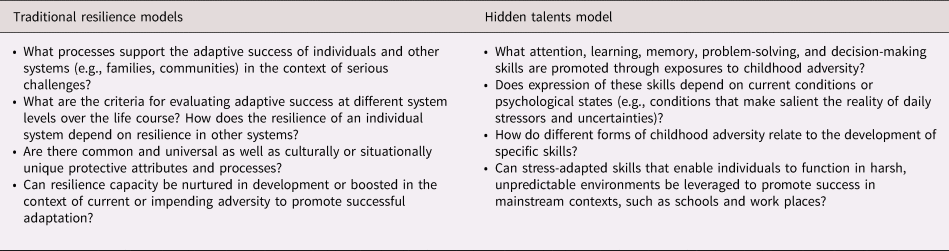
We see this goal as complementary to, rather than in conflict or competition with, more traditional intervention goals of mitigating risk and ameliorating deficits. Indeed, the hidden talents approach is a natural ally of these more traditional approaches. Together they are well-positioned to provide balanced strategies—both addressing stress-mediated vulnerabilities and building on stress-mediated adaptations—for promoting positive development in the context of adversity. For example, it is well-documented that interventions designed to enhance social and emotional skills, improve IQ, improve academic performance and outcomes, build character traits (e.g., perseverance, sociability), reduce problematic behavior (e.g., bullying), and prevent mental and physical health problems (e.g., depression, obesity) are reasonably effective in children but decline in efficacy in adolescents (reviewed in Heckman & Kautz, Reference Heckman and Kautz2013; Yeager, Dahl, & Dweck, Reference Yeager, Dahl and Dweck2018). Yeager et al. (Reference Yeager, Dahl and Dweck2018) propose that “traditional interventions fail when they do not align with adolescents’ enhanced desire to feel respected and be accorded status” (p. 101). Because the hidden talents model recognizes and appreciates stress-adapted people for their skills, it aligns well with heightened sensitivity to status and respect among adolescents. Thus, the hidden talents approach may help to fill a void where more traditional intervention approaches have faltered (see further discussion below, The Hidden Talents Approach Compared with Traditional Models of Resilience).
Overview
In this article, we survey the growing theoretical and empirical literature that has contributed to our understanding of hidden talents. Although we begin with a selective empirical review of research on stress-adapted skills across social and cognitive domains (see Ellis et al., Reference Ellis, Bianchi, Griskevicius and Frankenhuis2017, for a full review), our goal is to situate this research within a larger interdisciplinary framework. Drawing on cultural approaches to cognitive development, we propose that hidden talents are a form of adaptive intelligence that enables individuals to function within the constraints imposed by harsh, unpredictable environments. We then discuss the effects of growing up under such environmental conditions on the developing brain. Changes in neurobehavioral phenotypes following early adversity provide evidence of developmental adaptations to stress in the form of hidden talents across multiple domains. Next we consider the implications of the hidden talents approach for policy and practice in two applied areas: school settings, focusing on teaching and learning strategies that leverage stress-adapted skills, and the social work field, focusing on intervention strategies for adjudicated youth. We conclude that hidden talents may be transferable and valuable for success in many normative contexts. Finally, we compare and contrast the hidden talents approach with contemporary resilience science. While building on resilience science, we contend that theory and research on hidden talents has unique, innovative features and translational implications for stress-adapted children and youth.
Current Evidence for Hidden Talents
The study of hidden talents is an emerging research area; we know little and have much to learn. Current findings still need to be replicated, and we need to explore boundary conditions and generalizability. That said, the approach is promising. It has led to novel theory, empirical findings, and ideas for applications (Ellis et al., Reference Ellis, Bianchi, Griskevicius and Frankenhuis2017; Frankenhuis & de Weerth, Reference Frankenhuis and de Weerth2013). In this section, we highlight findings congruent with the concept of hidden talents, as well as mixed and negative evidence. These initial studies provide valuable clues, but are not conclusive.
The hidden talents approach draws on a larger body of evidence from nonhuman animal studies. Consistent with the specialization hypothesis (Figure 1), research in birds and rodents indicates that developmental exposures to stress can improve specific forms of attention, perception, learning and memory, and problem solving that are ecologically relevant in stressful environments (reviewed in Ellis et al., Reference Ellis, Bianchi, Griskevicius and Frankenhuis2017; Eyck, Buchanan, Crino, & Jessop, Reference Eyck, Buchanan, Crino and Jessop2019). Further, as per the sensitization hypothesis (Figure 1), some of these abilities are manifest only in stressful contexts, where they would provide the greatest advantages. That is, some enhancements occur only when developmental specializations are activated by current experiences or psychological states of stress/uncertainty. For instance, when tested under basal conditions, rodent pups that received low maternal care show lower performance in a contextual fear-conditioning paradigm than pups that received high maternal care. However, when tested under stressful conditions (characterized by elevated glucocorticoid levels typical of an active stress response), the low-maternal care pups showed enhanced performance (Bagot et al., Reference Bagot, van Hasselt, Champagne, Meaney, Krugers and Joëls2009; Champagne et al., Reference Champagne, Bagot, van Hasselt, Ramakers, Meaney, De Kloet and Krugers2008).
The hidden talents model. All paths are positive, except where indicated by (—). (A) Specialization hypothesis (Frankenhuis & de Weerth, Reference Frankenhuis and de Weerth2013): Developmental exposures to harsh/unpredictable environments enhance skills for solving problems that are ecologically relevant in (i.e., specialized for) such environments. (B) Sensitization hypothesis (Ellis et al., Reference Ellis, Bianchi, Griskevicius and Frankenhuis2017): Hypothesized advantages in cognitive abilities—stress-adapted skills—result from the interaction between early life and current conditions (i.e., developmentally specialized skills are manifest primarily under current conditions or psychological states of stress/uncertainty). (C) Costs of adaptation: Developmental exposures to harsh/unpredictable environments can induce tradeoffs that undermine certain skill sets. (D) Potential outcomes: The central applied question of the hidden talents model is whether stress-adapted skills that enable individuals to function in harsh/unpredictable environments can be leveraged to promote success in normative contexts (dashed line), such as schools and work places.

Initial studies of hidden talents in humans focused mainly on threat and negative experiences. A body of research has shown that children who experience maltreatment tend to exhibit enhanced abilities for detecting and memorizing anger relative to other emotions, a skill set that is presumably adaptive under hostile conditions (e.g., McLaughlin et al., Reference McLaughlin, Sheridan and Lambert2014), such as by enabling one to detect threat at an earlier stage in a social interaction. As this research is nuanced and complex, we present only a selection of key findings here. Children who have been physically abused appear to orient relatively rapidly to angry faces and angry voices (Pollak, Reference Pollak2008; Pollak, Messner, Kistler, & Cohn, Reference Pollak, Messner, Kistler and Cohn2009). They may also preferentially attend to angry faces and show increased sensitivity in the detection of anger (Gibb, Schofield, & Coles, Reference Gibb, Schofield and Coles2009). Consistent with having specialized skills, physically abused children may be more accurate than nonmaltreated children at identifying angry (but not other) facial expressions from degraded pictures (Pollak, Reference Pollak2008) and at recalling distracting aggressive stimuli (e.g., knives, guns; Rieder & Cicchetti, Reference Rieder and Cicchetti1989). These effects are dose-dependent: children who have experienced more severe abuse identified anger the earliest from the degraded stimuli (Pollak et al., Reference Pollak, Messner, Kistler and Cohn2009). At the same time, maltreated children may display an attribution bias toward anger, ascribing this emotion to situations where it is not fitting (Pollak, Cicchetti, Hornung, & Reed, Reference Pollak, Cicchetti, Hornung and Reed2000; see also Frankenhuis & Bijlstra, Reference Frankenhuis and Bijlstra2018). An integrative review concluded that maltreatment enhances attention and memory for negative emotionally laden or stressful information in most people, but results in attention and memory deficits for negative or traumatic experiences in others (Goodman, Quas, & Ogle, Reference Goodman, Quas and Ogle2009).
Other developmental research suggests that children exposed to early adversity (e.g., poverty, maternal disengagement, unstable family environments) may develop enhanced abilities for extracting resources from harsh, unpredictable environments in terms of obtaining fleeting rewards (Sturge-Apple, Davies, Cicchetti, Hentges, & Coe, Reference Sturge-Apple, Davies, Cicchetti, Hentges and Coe2017; Suor, Sturge-Apple, Davies, & Cicchetti, Reference Suor, Sturge-Apple, Davies and Cicchetti2017), though it is unclear to what extent this skill is based on reward-oriented problem-solving versus sensitivity to punishment. Maltreated children and adolescents tend to be more loss-avoidant than their nonmaltreated peers (e.g., choosing safe options on a risky decision-making task, making risky choices to avoid losses; Guyer et al., Reference Guyer, Kaufman, Hodgdon, Masten, Jazbec, Pine and Ernst2006; Weller, Leve, Kim, Bhimji, & Fisher, Reference Weller, Leve, Kim, Bhimji and Fisher2015). Further, physically abused children are more likely than nonabused children to respond to probabilistic positive feedback (rewards in an associative learning paradigm) as if it were largely random or unreliable (Hanson et al., Reference Hanson, van den Bos, Roeber, Rudolph, Davidson and Pollak2017). Although these decision-making and learning strategies have been interpreted from a deficit perspective (Guyer et al., Reference Guyer, Kaufman, Hodgdon, Masten, Jazbec, Pine and Ernst2006; Hanson et al., Reference Hanson, van den Bos, Roeber, Rudolph, Davidson and Pollak2017; Weller et al., Reference Weller, Leve, Kim, Bhimji and Fisher2015), such strategies may be adaptive in adverse ecologies, where stress-adapted children have limited “reserve capacity” (Gallo & Matthews, Reference Gallo and Matthews2003), making losses especially costly, and where rewards are unpredictable. The notion of adaptive risk-taking and response biases in the context of adversity is discussed further below (see Neural Plasticity Enables the Development of Hidden Talents).
Another set of studies suggests that people from lower socioeconomic status (SES) backgrounds display greater attunement to other people and social information/relationships. Lower SES ecologies are relatively harsh and unpredictable. People inhabiting such ecologies are not only more likely to face resource scarcity, physical dangers, fleeting opportunities, and threats without warning, but also have relatively little personal control over these environmental conditions (Kraus, Piff, Mendoza-Denton, Rheinschmidt, & Keltner, Reference Kraus, Piff, Mendoza-Denton, Rheinschmidt and Keltner2012). Developmental adaptation to lower SES environments, therefore, may preferentially regulate attention toward “external, uncontrollable social forces and other individuals who influence one's life outcomes” (Kraus et al., Reference Kraus, Piff, Mendoza-Denton, Rheinschmidt and Keltner2012, p. 546). Such contextualist tendencies may function to promote behavioral prediction/management in a context of low resources and social rank.
Research in this area has varied in terms of operationalizing SES as subjective social class versus more objective measures of income, education, and occupational prestige; in some cases, results vary across these different forms of assessment (e.g., Bjornsdottir, Alaei, & Rule, Reference Bjornsdottir, Alaei and Rule2017). Lower SES people may show greater empathic accuracy, compassion, and attentiveness to others (reviewed in Kraus et al., Reference Kraus, Piff, Mendoza-Denton, Rheinschmidt and Keltner2012; Piff, Kraus, & Keltner, Reference Piff, Kraus and Keltner2018); develop a more nuanced understanding of uncertainty and change in social relationships (Brienza & Grossmann, Reference Brienza and Grossmann2017); do better at working collaboratively to achieve collective outcomes (Dittmann, Stephens, & Townsend, Reference Dittmann, Stephens and Townsend2020); and display greater skill at detecting subtly changing visual information (Grossmann & Varnum, Reference Grossmann and Varnum2011), categorizing perceptually ambiguous groups (Bjornsdottir et al., Reference Bjornsdottir, Alaei and Rule2017), and decoding nonverbal cues (Bjornsdottir et al., Reference Bjornsdottir, Alaei and Rule2017). In addition, people who are more anxiously attached (a profile that is more common in adversity-exposed populations) appear to be better at detecting deceit (Ein-Dor & Perry, Reference Ein-Dor and Perry2014). In one study, post-institutionalized, adopted youth were more accurate in choosing whether to trust their peers, and were more sensitive to both social reciprocation and defection, than never-institutionalized, non-adopted youth (Pitula, Wenner, Gunnar, & Thomas, Reference Pitula, Wenner, Gunnar and Thomas2017).
The evidence is mixed, however, for adults memorizing the structure of social environments. Whereas more current exposure to violence predicted intact or even enhanced memory for social-dominance relationships, childhood exposure to violence predicted impaired memory for social-dominance relationships (Frankenhuis, de Vries, Bianchi, & Ellis, Reference Frankenhuis, de Vries, Bianchi and Ellis2020a). This contrast between current and childhood experiences raises a central question for the hidden talents model: To what extent does enhanced performance of stress-adapted individuals, whether in children or adults, depend on developmentally calibrated traits (e.g., early biological embedding of adversity) versus current experiences/states? This question is visually depicted in Figure 1. In a study of adults who did not report any significant traumatic experiences in childhood, trauma-exposed criminal scene investigator police, relative to a control group, showed enhanced performance on a simple discrimination task in the presence of high-intensity aversive pictures (e.g., facial expressions of fear) but impaired performance in the presence of low-intensity aversive pictures (Levy-Gigi, Richter-Levin, Okon-Singer, Kéri, & Bonanno, Reference Levy-Gigi, Richter-Levin, Okon-Singer, Kéri and Bonanno2016); moreover, greater on-the-job trauma exposure was associated with better performance in the high-intensity condition (r = .42). Thus, as in Frankenhuis et al. (Reference Frankenhuis, de Vries, Bianchi and Ellis2020a), current experiences in adulthood appeared to calibrate stress-adapted skills.
Studies of executive functioning have explicitly addressed the question of developmentally calibrated traits versus current experiences/states, using experimental designs to test the specialization and sensitization hypotheses (presented in Figure 1). Much of this work has focused on executive function components that, theoretically, should enable individuals to take advantage of fleeting opportunities, avoid unpredictable threats, and update changing information in chaotic/unstable environments. Some work in this area has found that young adults who grew up in unpredictable home environments display enhanced abilities for flexibly switching between tasks or mental sets and for tracking novel environmental information, particularly when in an experimentally induced mindset of stress/uncertainty (Mittal, Griskevicius, Simpson, Sung, & Young, Reference Mittal, Griskevicius, Simpson, Sung and Young2015; Young, Griskevicius, Simpson, Waters, & Mittal, Reference Young, Griskevicius, Simpson, Waters and Mittal2018). Another study, which did not manipulate psychological states, found that adults who had greater lifetime trauma exposure were better at dynamically regulating cognitive control in response to changing contexts (Steudte-Schmiedgen et al., Reference Steudte-Schmiedgen, Stalder, Kirschbaum, Weber, Hoyer and Plessow2014). The juxtaposition of these results with the established finding that people from harsh environments tend to perform worse on executive function tests (e.g., Duncan et al., Reference Duncan, Magnuson and Votruba-Drzal2017; Ursache & Noble, Reference Ursache and Noble2016) offers a more balanced picture of development in the context of adversity.
Other work testing for sensitization effects on learning and memory has focused on socioeconomic disadvantage or crime exposure. Under primed conditions of high financial demand, people from lower SES backgrounds displayed enhanced procedural learning (acquiring stimulus–response associations) but reduced performance on cognitive functions that rely more heavily on working memory (Dang et al., Reference Dang, Xiao, Zhang, Lin, Jiang and Mao2016; Mani, Mullainathan, Shafir, & Zhao, Reference Mani, Mullainathan, Shafir and Zhao2013). Among children residing in high-poverty, high-crime neighborhoods, living in proximity to a recent violent crime predicted faster but marginally less accurate cognitive processing, indicating a shift toward more automatic responding (McCoy, Raver, & Sharkey, Reference McCoy, Raver and Sharkey2015). Future research should replicate these findings and clarify the extent to which performance enhancements depend on current experiences/states. A study that did not manipulate psychological states found enhanced working memory, but not enhanced attention shifting, in a sample of deprived Nigerian children living in institutional homes and foster families (Nweze, Nwoke, Nwufo, Aniekwu, & Lange, Reference Nweze, Nwoke, Nwufo, Aniekwu and Lange2020).
This emerging body of work on potential enhancements in cognitive abilities needs to be more systematically integrated with the well-developed program of research in neuroscience showing that stress affects different memory systems in different ways. High levels of acute stress may cause a shift from top-down explicit (hippocampal-prefrontal dependent) memory systems to bottom-up procedural (striatum-dependent) systems (Leonard, Mackey, Finn, & Gabrieli, Reference Leonard, Mackey, Finn and Gabrieli2015; Schwabe & Wolf, Reference Schwabe and Wolf2013; Vogel, Fernández, Joëls, & Schwabe, Reference Vogel, Fernández, Joëls and Schwabe2016). Could this shift explain the finding that, on procedural memory tasks, people currently living in poverty perform just as well (Leonard et al., Reference Leonard, Mackey, Finn and Gabrieli2015), or even better (Dang et al., Reference Dang, Xiao, Zhang, Lin, Jiang and Mao2016), than higher SES individuals?
In sum, people who grow up under adverse conditions might not perform worse on all social and cognitive tasks; rather, compared with people from more stable or supportive environments, their performance may be enhanced on tasks that reflect significant challenges within the constraints imposed by harsh, unpredictable environments (Ellis et al., Reference Ellis, Bianchi, Griskevicius and Frankenhuis2017; Frankenhuis & de Weerth, Reference Frankenhuis and de Weerth2013). This conclusion is striking in relation to the broader developmental literature, which has emphasized deficits in people with significant exposures to adversity (though with notable exceptions; e.g., developmental resilience models, work in cultural psychology, as discussed below). Nonetheless, the current evidence base for hidden talents is limited, findings still need to be replicated, and the extent to which stress-adapted skills represent specialization versus sensitization needs to be delineated. Toward this end, well-powered, preregistered studies with socioeconomically diverse populations are currently underway.
Finally, the foregoing review of current evidence for hidden talents does not directly address the right side of Figure 1, which represents applications: the hypothesized relations between stress-adapted skills and success in different environmental contexts. The dashed line depicts the potential role of stress-adapted skills in promoting success in normative contexts—a role that has not been empirically tested. As discussed in the remaining sections of this paper, describing and evaluating this applied role is critical to guiding efforts and programs for leveraging hidden talents to potentiate success among adversity-exposed people.
Neural Plasticity Enables the Development of Hidden Talents
The hidden talents approach aligns with emerging neuroscience research on developmental adaptation to stress. The study of neural plasticity, at its core, concerns developmental adaptation to the environment. Indeed, the human brain has been described as the ultimate organ of adaptation, changing in structure and function with experience, including developmental exposures to stress (McEwen, Reference McEwen2009). Growing evidence on neurobiological adaptations to harsh environments has begun to elucidate developmental processes leading to stress-adapted skills. Although this research should be seen as a promissory note, as it was not designed to test for hidden talents and mostly focuses on potential short-term survival advantages, it provides an initial picture of the neural bases of emerging stress-adapted skills under highly stressful early life conditions.
Human brain development begins prenatally yet continues for at least another two to three decades (e.g., Fox, Levitt, & Nelson, Reference Fox, Levitt and Nelson2010; Tottenham, Reference Tottenham2014). This protracted period of immaturity supports extended learning from and about the environment, providing numerous opportunities to developmentally adapt to local environmental conditions. This process tends to promote adaptation in context. That is, children tend to develop in ways that are adaptive within the constraints of their experienced environments, even if the early social-emotional context is harsh or unpredictable (reviewed in Ellis & Del Giudice, Reference Ellis and Del Giudice2019). Several studies have shown that early-life stress increases the risk for atypical development of neurobiological circuits involving the amygdala, prefrontal cortex, striatum, and hippocampus (McLaughlin, Weissman, & Bitrán, Reference McLaughlin, Weissman and Bitrán2019; Teicher, Samson, Anderson, & Ohashi, Reference Teicher, Samson, Anderson and Ohashi2016), although such neural differences do not, in and of themselves, imply deficits (see Ellwood-Lowe et al., Reference Ellwood-Lowe, Sacchet and Gotlib2016, Reference Ellwood-Lowe, Whitfield-Gabrieli and Bunge2020). Despite the increased risk for mental health problems associated with these atypical neurobiological patterns, an emerging literature suggests that these patterns may still constitute developmental adaptations to stress.
Amygdala hyperactivity is frequently associated with child maltreatment (see meta-analysis in Hein & Monk, Reference Hein and Monk2017) and has been observed following various forms of poor caregiving (Callaghan, Sullivan, Howell, & Tottenham, Reference Callaghan, Sullivan, Howell and Tottenham2014). For example, children and youth with a previous history of institutionalization—a form of abandonment and extreme caregiving neglect (emotional and physical)—tend to display amygdala hyperactivity to fearful faces (Gee et al., Reference Gee, Gabard-Durnam, Flannery, Goff, Humphreys, Telzer and Tottenham2013; Tottenham et al., Reference Tottenham, Hare, Millner, Gilhooly, Zevin and Casey2011). Although the amygdala plays a central role in internalizing problems associated with early-life stress, high amygdala reactivity following early adversity has been linked to better goal-directed behavior when the goal is compatible with threat-detection (Silvers et al., Reference Silvers, Goff, Gabard-Durnam, Gee, Fareri, Caldera and Tottenham2017). Specifically, previously institutionalized youth with higher amygdala reactivity exhibited both higher anxiety symptoms and better performance (i.e., faster search times) when spatially locating fearful faces in an array of neutral ones.
A substantial research literature has also linked amygdala volume to early-life stress, though the findings are complex (see McLaughlin et al., Reference McLaughlin, Weissman and Bitrán2019). Teicher and Kahn (Reference Teicher and Khan2019) conclude that smaller amygdala volumes are most often observed in older adolescents or adults who have experienced multiple forms of child maltreatment across development, whereas larger amygdala volumes are found primarily among individuals with early exposure to emotional or physical neglect. One study compared previously institutionalized children who spent more time in orphanage care (late adoption) with peers who spent less time in orphanage care (early adoption) and a never-institutionalized comparison group (Tottenham et al., Reference Tottenham, Hare, Quinn, McCarry, Nurse, Gilhooly and Thomas2010). Children who were adopted at later ages had larger amygdala volumes, were biased toward false alarm errors when responding to negatively valenced faces in an inhibitory control task, and had increased anxiety. The false alarms—specifically in response to facial expressions of negative emotions such as fear and anger—could be interpreted as enhanced threat sensitivity, which generally characterizes previously institutionalized children (Gunnar & Reid, Reference Gunnar and Reid2019). The larger picture that emerged from these two studies (Silvers et al., Reference Silvers, Goff, Gabard-Durnam, Gee, Fareri, Caldera and Tottenham2017; Tottenham et al., Reference Tottenham, Hare, Quinn, McCarry, Nurse, Gilhooly and Thomas2010) was that early institutional care, as mediated by morphologic and neurofunctional changes in the amygdala, regulated children's development toward heightened threat vigilance, which was expressed phenotypically in terms of stress-adapted skills (faster search times), response biases (false alarm errors), and personality dispositions (anxiety). These phenotypic responses to early-life stress were coherent and integrated; over evolutionary time, such responses may have promoted survival in adverse childhood environments.
Higher anxiety levels in individuals with a history of institutional care are also associated with decision-making strategies that appear specialized to harsh, unpredictable conditions. For example, when deciding whether to explore environmental cues (increasing both the opportunity for larger rewards and the threat of punishment) or exploit them (by securing a small but reward-promising outcome), children with a history of institutional caregiving use more exploitative strategies relative to peers without such a history (Humphreys et al., Reference Humphreys, Lee, Telzer, Gabard-Durnam, Goff, Flannery and Tottenham2015; Kopetz et al., Reference Kopetz, Woerner, MacPherson, Lejuez, Nelson, Zeanah and Fox2019; Loman, Johnson, Quevedo, Lafavor, & Gunnar, Reference Loman, Johnson, Quevedo, Lafavor and Gunnar2014). Humphreys et al. (Reference Humphreys, Lee, Telzer, Gabard-Durnam, Goff, Flannery and Tottenham2015) found that the exploitive strategy increased youths’ earnings as a function of context: It proved detrimental under forgiving experimental conditions (when punishing feedback was slow to come), but beneficial when conditions become harsh (i.e., when parameters of the task changed to hasten punishment).
Another behavior commonly observed in children with a history of institutional care, and more broadly among children exposed to poor-quality caregiving (Love, Minnis, & O'Connor, Reference Love, Minnis and O'Connor2015), is disinhibited social engagement (DSE). DSE is characterized by age-inappropriate approach behavior and/or intimacy directed at unfamiliar adults including strangers. Once children are in a stable caregiving environment, this behavior can be disturbing to families and put the child in danger. Functional neuroimaging has shown that DSE behaviors in children with a history of institutional care are correlated with the amygdala's indiscriminate response to both parents and strangers (Olsavsky et al., Reference Olsavsky, Telzer, Shapiro, Humphreys, Flannery, Goff and Tottenham2013). Importantly, this lack of differential responding to parents and strangers was the result of previously institutionalized youth exhibiting overly heightened responses to the strangers. Although this behavior is highly unusual under conditions of typical caregiving, it may be an adaptive response to early neglect (Lawler, Hostinar, Mliner, & Gunnar, Reference Lawler, Hostinar, Mliner and Gunnar2014). For a young child who experiences caregiving neglect and/or instability, maintaining openness to nonparental adults is a potentially important survival skill (which may function to recruit potential new/replacement caregivers). DSE behavior may thus be an enhanced sociability skill in young children that develops in response to poor caregiving. In this context, the amygdala may develop in a way that maintains strong motivational value representations for unfamiliar adults in anticipation of future caregiving instability.
Motivated by a growing animal literature identifying accelerated development of emotion-related neurobiology following early life stress, Callaghan and Tottenham (Reference Callaghan and Tottenham2016) proposed a “stress-acceleration” hypothesis and reviewed several examples of neurobehavioral adaptations related to changes in developmental pacing. The foundation for this hypothesis is evidence from animal models indicating that stress-related neurobiology developing in young animals often exhibits more “adult-like” characteristics in response to stressful cues from the environment. For example, early life stress in various forms (e.g., maternal separation/deprivation, premature weaning, insufficient bedding, physical abuse models) has been associated with earlier structural and functional development of the hippocampus, amygdala, and connections between the amygdala and medial prefrontal cortex (mPFC) (Bath, Manzano-Nieves, & Goodwill, Reference Bath, Manzano-Nieves and Goodwill2016; Honeycutt et al., Reference Honeycutt, Demaestri, Peterzell, Silveri, Cai, Kulkarni and Brenhouse2020; Moriceau, Shionoya, Jakubs, & Sullivan, Reference Moriceau, Shionoya, Jakubs and Sullivan2009; Ono et al., Reference Ono, Kikusui, Sasaki, Ichikawa, Mori and Murakami-Murofushi2008). Earlier development of these regions is central to emotional learning and produces faster-maturing learning behaviors (e.g., earlier onset of adult-like fear learning, fear extinction, and context conditioning) (Bath et al., Reference Bath, Manzano-Nieves and Goodwill2016; Callaghan & Richardson, Reference Callaghan and Richardson2011). At the same time, these stress-mediated phenotypes induce tradeoffs that increase the risk of later emotion dysregulation (reviewed in Callaghan et al., Reference Callaghan, Sullivan, Howell and Tottenham2014). Within an evolutionary–developmental framework, these behavioral adaptations may function to accelerate independence (e.g., earlier assessment of and reckoning within unsafe environments). Such adaptations may confer survival advantages in harsh, unpredictable early environments, but have longer-term costs (e.g., truncated developmental plasticity, internalizing problems) that may manifest when environments change or as the individual ages.
Paralleling the rodent literature, initial human research suggests that mPFC-limbic circuitry may also exhibit accelerated development following early caregiving-related stress (Bernier et al., Reference Bernier, Dégeilh, Leblanc, Daneault, Bailey and Beauchamp2019; Gee et al., Reference Gee, Gabard-Durnam, Flannery, Goff, Humphreys, Telzer and Tottenham2013; Lee et al., Reference Lee, Poh, Wen, Tan, Chong, Tan and Qiu2019; Mareckova, Marecek, Andryskova, Brazdil, & Nikolova, Reference Mareckova, Marecek, Andryskova, Brazdil and Nikolova2020; Posner et al., Reference Posner, Cha, Roy, Peterson, Bansal, Gustafsson and Monk2016; Thijssen et al., Reference Thijssen, Muetzel, Bakermans-Kranenburg, Jaddoe, Tiemeier, Verhulst and van IJzendoorn2017, Reference Thijssen, Collins and Luciana2020), though evidence for accelerated development of amygdala–mPFC connectivity is mixed (reviewed in McLaughlin et al., Reference McLaughlin, Weissman and Bitrán2019). In a community-based study in Singapore, insensitive caregiving correlated with both larger hippocampal volume in infants (Rifkin-Graboi et al., Reference Rifkin-Graboi, Kong, Sim, Sanmugam, Broekman, Chen and Gluckman2015) and better performance on a hippocampus-based relational memory task (Rifkin-Graboi et al., Reference Rifkin-Graboi, Quan, Richmond, Goh, Sim, Chong and Qiu2018). Further, postnatal maternal anxiety was positively associated with hippocampal growth from birth to six months of age (Qiu et al., Reference Qiu, Rifkin-Graboi, Chen, Chong, Kwek, Gluckman and Meaney2013). To our knowledge, this is the first study to test for potentially stress-adapted skills in relation to accelerated development of emotion-related neurobiology. Although the animal literature has provided strong support for the stress acceleration hypothesis, much more longitudinal evidence is needed to confidently support this hypothesis in humans.
In total, research on early brain development in the context of adversity is consistent with the notion of developmental adaptation to stress in the form of hidden talents (e.g., faster-maturing learning behaviors, better goal-directed behavior in ecologically relevant contexts, stress-adapted decision-making strategies) and other related phenotypes (e.g., disinhibited social engagement, heightened anxiety, threat sensitivity). Although changes in neurobehavioral phenotypes following early adversity involve tradeoffs, with some costs to function (e.g., lower cognitive control, increased morbidity and mortality risk later in life), these changes appear to be adaptively calibrated to harsh, unpredictable environments. To better understand such tradeoffs—and their implications—extant datasets and published neurobehavioral findings on early life stress highlighting deficits could be reexamined to consider whether impairments in one domain are offset by enhancements in another. In turn, new studies could incorporate appropriate measures to specifically test for the neural bases of hidden talents and their development. Both of these approaches could help move the field toward a more balanced understanding of neurobehavioral adaptations to early life stress.
Hidden Talents as Adaptive Intelligence
Theory and research in the areas of neural plasticity, human intelligence, and evolutionary biology share an explanatory focus on how individuals adapt to their environments. A widely held assumption in evolutionary biology is that, in most species, single “best” strategies for survival and reproduction are unlikely to evolve. This is because the best strategy varies as a function of the physical, economic, and social parameters of one's environment, and thus a strategy that promotes success in some environmental contexts may lead to failure in others (Ellis & Del Giudice, Reference Ellis and Del Giudice2019). Selection pressures therefore tend to favor adaptive phenotypic plasticity, the capacity of a single genotype to support a range of phenotypes that promote survival and reproduction under different ecological conditions. Hidden talents—the development of an adaptive suite of physical, social, and cognitive skills that are specialized for harsh, unpredictable environments—may represent the outcome of adaptive phenotypic plasticity (Ellis et al., Reference Ellis, Bianchi, Griskevicius and Frankenhuis2017; Frankenhuis & de Weerth, Reference Frankenhuis and de Weerth2013).
Convergent with the concept of plasticity, intelligence is typically defined at least in part as “adaptation to the environment” (i.e., adaptive intelligence; Sternberg, Reference Sternberg2019, Reference Sternbergin press). In the 20th century, adaptation to increasing academic, technological, and other demands of modern society contributed to large increases in conventional intelligence test scores (Flynn, Reference Flynn2016). We propose that developmental adaptation to harsh, unpredictable environments shapes adaptive intelligence by presenting the individual with daunting challenges and problems to solve; hidden talents develop as adaptive solutions to such problems and challenges. But are hidden talents “intelligence”? Obviously it depends on one's definition. If one defines intelligence as what IQ tests measure, the answer generally may be “no.” But if one defines intelligence more broadly as adaptation to the environment as it varies over space and time (Greenfield, Reference Greenfield and Sternberg2020; Sternberg, Reference Sternberg and Glaveanu2017), the answer almost certainly is “yes.” Adaptive intelligence can be understood as one's ability to accomplish tasks that reflect significant challenges within the constraints posed by one's lived environment.
This conceptualization of adaptive intelligence informs measurement of hidden talents. The hidden talents approach seeks to capture the abilities of stress-adapted people using test settings and materials that are ecologically relevant to their lives, as conventional instruments and assessment methods may not be suited to measuring stress-adapted skills. For instance, standard cognitive tasks typically require prolonged sustained attention (e.g., Raven's Progressive Matrices), which is likely to disadvantage people who have adapted to unpredictable conditions. Indeed, in rapidly changing conditions, people might benefit from the opposite attention profile—heightened attention shifting—in order to monitor the environment for threats and take advantage of fleeting opportunities (Mittal et al., Reference Mittal, Griskevicius, Simpson, Sung and Young2015).
The significance of adaptive intelligence has been documented in cultural research (see extended discussion in Ogbu, Reference Ogbu1981). Experience-based knowledge relevant to solving practical problems in a given domain (e.g., folk medicine, hunting) is particularly important to adaptive intelligence (and may be distinctive from what is captured by IQ tests). For example, rural Kenyan children who had more adaptive procedural knowledge—for self-medicating with natural herbal medicines used to combat parasitic illnesses—actually had less academic declarative and procedural knowledge (as shown by slightly lower IQ scores and school achievement) (Sternberg et al., Reference Sternberg, Nokes, Geissler, Prince, Okatcha, Bundy and Grigorenko2001). Likewise, in a study of Native American Yup'ik people in Alaska, rural adolescents surpassed urban adolescents in tests of practical adaptive intelligence (with items covering topics such as hunting, gathering, and location-finding), whereas the urban adolescents performed better on conventional measures of fluid and crystallized intelligence (Grigorenko et al., Reference Grigorenko, Meier, Lipka, Mohatt, Yanez and Sternberg2004). Such conventional intelligence tests were presumably better matched to significant challenges and opportunities faced in more urban environments (involving more abstract, analytical problem solving). The measure of adaptive practical intelligence predicted acquisition of Yup'ik-valued practical skills (as rated by adult community members) in ways that were complementary to, and in some cases incremental to, the prediction provided by the conventional intelligence test scores.
The point here is not that intelligence as measured by IQ tests lacks value, or is not relevant to adaptation, but rather that its measurement is partly through tests of acculturation and socialization that reflect the experiences of children who are primarily middle-class and growing up in a “modernized” society (Flynn & Sternberg, Reference Flynn, Sternberg and Sternberg2020). Indeed, a recent meta-analysis of 142 effect sizes across 42 data sets involving over 600,000 participants found that formal education itself boosts IQ scores (Ritchie & Tucker-Drob, Reference Ritchie and Tucker-Drob2018). Thus, it is not surprising that people from developing countries tend to perform worse on conventional tests of intelligence, such as the Wechsler Intelligence Scales or the Stanford–Binet Intelligence Scale, than do people from developed Western countries (Sternberg, Reference Sternberg and Glaveanu2017). In many developing countries, children grow up with more survival-challenging experiences. They may see far less of Western-style schooling (the kind that promotes abstract analytical thinking), or be given fewer opportunities to learn from it, thereby disadvantaging them on IQ tests. As in the Kenyan and Yup'ik examples, young people may instead display their intelligence—including stress-adapted skills and knowledge—in more practical ways that are adaptive in their own contexts (consistent with the often harsh, unpredictable demands of their lived environments). The myriad capabilities of street youth, such as heightened creativity (Dahlman, Bäckström, Bohlin, & Frans, Reference Dahlman, Bäckström, Bohlin and Frans2013; Fry, Reference Fry2018), is a case in point (Bender, Thompson, McManus, Lantry, & Flynn, Reference Bender, Thompson, McManus, Lantry and Flynn2007; Malindi & Theron, Reference Malindi and Theron2010; Panter-Brick, Reference Panter-Brick2002). (See further discussion of creativity as a stress-adapted skill below, in Leveraging Hidden Talents in Education.) The same logic applies to individuals from lower SES backgrounds in Western societies, who tend to score lower on IQ tests than their higher SES peers (e.g., Heberle & Carter, Reference Heberle and Carter2015; von Stumm & Plomin, Reference von Stumm and Plomin2015), but may display adaptive intelligence in relation to challenges in the environments that they encounter (see above, Current Evidence for Hidden Talents).
The concept of adaptive intelligence is also relevant to understanding skill sets in children growing up in collectivist societies. In that context, children are accustomed to confronting problems in groups rather than individually; taking an intelligence test without consultation with others may seem strange and unnatural. Dominant Western values are not collectivist. Within our individualist culture, people from many nondominant collectivist communities, such as children from a number of Indigenous-heritage communities of the Americas, are often viewed from a deficit perspective because they do not perform well in mainstream, middle-class institutions such as schools (Rogoff et al., Reference Rogoff, Coppens, Alcalá, Aceves-Azuara, Ruvalcaba, López and Dayton2017). Consistent with the notion of hidden talents, however, such children display enhanced skills that are relevant in their experienced environments. These skills include enhanced collaborative abilities (e.g., working together in particularly fluid and skilled coordination) and attentiveness to surrounding events (e.g., skillfully and simultaneously attending to multiple events that do not directly involve the child) relative to peers who have had greater exposure to Western mass schooling (reviewed in Rogoff et al., Reference Rogoff, Coppens, Alcalá, Aceves-Azuara, Ruvalcaba, López and Dayton2017).
Differences in conceptions of intelligence around the world are common (Sternberg, Reference Sternberg and Glaveanu2017). A conception of intelligence in rural Kenya, for example, involves elements of creative, practical, and wise thinking, which differs from viewing intelligence in terms of IQ tests (Grigorenko et al., Reference Grigorenko, Geissler, Prince, Okatcha, Nokes, Kenny and Sternberg2001). Indigenous conceptions of intelligence, in general, tend to be much more practically oriented, often reflecting the ability to engage and cope with typically stressful, nonacademic challenges that are posed by local environments (Sternberg, Reference Sternberg and Glaveanu2017). From this perspective, hidden talents can be understood as a form of adaptive intelligence, reflecting particular skills and forms of knowledge that enable one to function (e.g., survive, obtain resources, navigate significant challenges) within the constraints imposed by harsh, unpredictable environments. Unlike the broader concept of adaptive intelligence, however, the development of hidden talents is specific to adversity; it is conceptually distinct from more general processes involved in the acquisition of locally relevant skills and knowledge, which may not involve any stress-adapted functions at all (see further discussion below, Leveraging Hidden Talents in Education). Hidden talents can be understood as solutions to adaptive problems posed by developmental exposures to adversity.
If growing up in harsh environments fosters adaptive intelligence in the form of hidden talents, then it becomes important to consider how these talents can be harnessed to promote success in other (mainstream) contexts, including institutional settings that prepare young people for success in work and civic life. We next consider how leveraging hidden talents in stress-adapted children and youth could provide an important pathway to success in school.
Leveraging Hidden Talents in Education
The hidden talents approach conceptualizes stress-adapted children and youth as socially and cognitively intact or even enhanced for functioning in harsh, unpredictable environments. Instead of recognizing these capabilities, however, and using them as building blocks for success, stress-adapted skills are rarely measured or understood in Western school systems. That is a lost opportunity in our view, and the goal of this section is to begin filling this void.
Educational interventions targeting adversity-exposed populations have increasingly become grounded in neuroscience. A growing empirical literature suggests that neural differences between high and low SES children are associated with disadvantages in neurocognitive functioning in low SES children across multiple domains (e.g., language, memory, executive functioning; Ursache & Noble, Reference Ursache and Noble2016; cf., Ellwood-Lowe et al., Reference Ellwood-Lowe, Sacchet and Gotlib2016, Reference Ellwood-Lowe, Whitfield-Gabrieli and Bunge2020, who argue that such neural differences do not indicate deficits). In turn, performance on these neurocognitive skills correlates significantly with school performance and conventional IQ test scores (e.g., Arffa, Reference Arffa2007; Son, Choi, & Kwon, Reference Son, Choi and Kwon2019). Various intervention strategies attempt to address this issue. One approach is to increase cognitive stimulation or provide other environmental enrichments for low-SES children (e.g., Rosen et al., Reference Rosen, Hagen, Lurie, Miles, Sheridan, Meltzoff and McLaughlin2019; Yousafzai et al., Reference Yousafzai, Obradovic, Rasheed, Rizvi, Portilla, Tirado-Strayer and Memon2016). Another approach is to implement school curriculum that directly targets neurocognitive skills, with the goal of improving the academic performance of low SES students (e.g., Blair & Raver, Reference Blair and Raver2014). Complementing this strategy are programs designed to foster appropriate classroom behavior in underprivileged students (e.g., SLANT: Sit up, Listen, Ask and answers questions, Nod your head, and Track the speaker; see Calarco, Reference Calarco2018).
Although these kinds of interventions—aimed at getting children from harsh, unpredictable environments to have experiences, and to think and act, more like children from safe, stable environments—are one key approach, we argue that this strategy represents only part of the solution. Leveraging hidden talents is another potential strategy, shifting the emphasis toward adaptive intelligence. Development under stressful conditions necessitates trade-offs, which are apparent in both the costs and potential benefits of adaptations to adversity. The hidden talents approach attempts to work in concert with, rather than against, such potentially beneficial adaptations.
The application of the hidden talents model to educational practice builds on a central tenet of learning theory: that individuals acquire new information more readily when prior knowledge and abilities serve as the foundation for learning (Committee on Developments in the Science of Learning, 1999). Leveraging hidden talents in educational contexts should provide a valuable path to learning in stress-adapted students that, unlike more traditional approaches, is not based on the Sisyphean task of changing stress-adapted skills and habits (see Calarco, Reference Calarco2018; Ellis et al., Reference Ellis, Bianchi, Griskevicius and Frankenhuis2017). The poor fit between the background and skills of stress-adapted students and standard curriculum and instructional practices can lead to adverse outcomes (see Jennings, Reference Jennings2019), such as students being punished, excluded, or labeled as underachievers. The hidden talents approach may mitigate these issues. It does not stigmatize students who have grown up under challenging conditions; indeed, the hidden talents model recognizes stress-adapted students for their skills, rather than calling attention to their deficits.
Here we suggest ways to incorporate hidden talents into teaching and learning strategies, using teaching of mathematics as an integrative example. We both highlight existing pedagogy that is consistent with a hidden talents approach and suggest new teaching and learning strategies inspired by this approach. Our goal is to guide future research by describing the contours of the hidden talents approach to education, rather than to articulate fully developed strategies that are ready to implement in the classroom.
Implementing instructional strategies that leverage hidden talents
The most straightforward application of the hidden talents approach is to employ instructional strategies that capitalize on stress-adapted skills. Children raised in poverty are unlikely to have a quiet room where they can work undisturbed on school assignments. They may instead need to efficiently shift their attention back and forth between their homework and other pressing family and environmental demands while tracking changing information. Adapting to such challenging contexts may foster the development of particular skills, which could be harnessed to maximize performance of stress-adapted children and youth.
For example, if stress-adapted people tend to display deficits in sustaining attention but are adept at shifting their attention between different tasks (Mittal et al., Reference Mittal, Griskevicius, Simpson, Sung and Young2015; Pope, Fagot, Meguerditchian, Washburn, & Hopkins, Reference Pope, Fagot, Meguerditchian, Washburn and Hopkins2019; though see Nweze et al., Reference Nweze, Nwoke, Nwufo, Aniekwu and Lange2020), then redesigning instructional practices to leverage attention shifting skills could potentiate their learning. This translates into rethinking standard approaches (e.g., focusing on completing single school assignments in a quiet room, displaying content in static print) relative to alternative approaches (e.g., studying in a room with more background noise, regularly changing focus and switching between assignments, displaying content on dynamic touch-screens).
Likewise, if stress-adapted students tend to display deficits in working-memory capacity but are especially good at tracking information in their environment and replacing older information that is no longer relevant with new, updated information (Young et al., Reference Young, Griskevicius, Simpson, Waters and Mittal2018), this enhanced working-memory updating ability could lead them to excel when learning in information-rich environments that are frequently changing. This again translates into rethinking standard approaches (e.g., learning through rote memorization, retaining information even when it is not situationally relevant, providing feedback days after completing an assignment) relative to alternative approaches (e.g., creating learning environments that are more fluid and allow students to apply skills in changing contexts; providing students with real-time feedback regarding performance on tasks, so as to leverage their efficient working-memory updating capacity to replace incorrect strategies and responses with correct ones).
At the same time, the success of these strategies may depend on classroom environments. People from more stressful, chaotic backgrounds appear to elevate their performance on attention shifting and working-memory updating tasks in contexts that make salient the reality of daily stressors and uncertainties (Mittal et al., Reference Mittal, Griskevicius, Simpson, Sung and Young2015; Young et al., Reference Young, Griskevicius, Simpson, Waters and Mittal2018). This context-dependent performance converges with research showing that assessment of executive functions in a naturalistic classroom setting better predicts later academic achievement than does assessment in more controlled, conventional one-on-one settings (Obradović, Sulik, Finch, & Tirado-Strayer, Reference Obradović, Sulik, Finch and Tirado-Strayer2018). Other research, investigating culturally responsive teaching methods, has more broadly demonstrated the effects of classroom context on learning, particularly in minority students. For example, past research has documented a variety of ways to structure classroom environments to improve the academic performance of ethnically diverse students (e.g., multicultural curriculum content, use of motion and movement, music, frequent variability in tasks and formats, dramatic elements in teaching; reviewed in Gay, Reference Gay2018). Comparable research is needed to determine how to create more effective classroom environments for stress-adapted students.
How could these ideas inform instructional practices, such as how to teach algebra? Conventional teaching methods favor students who have strong working memory capacity and are good at sustaining attention. Such safe-adapted skills tend to be enhanced in higher SES students growing up under stable conditions (Ellis et al., Reference Ellis, Bianchi, Griskevicius and Frankenhuis2017). What if, instead, we taught algebra in ways that leveraged attention shifting and working-memory updating abilities, potentially under conditions that are closer to the lived environments of stress-adapted students (e.g., not overly quiet or controlled)? That could allow teachers to work with, rather than against, the capacities of stress-adapted students, reducing the mismatch between the skills possessed by such students and the skills needed to function well in school. This underscores a critical direction for future research: Testing strategies for effectively leveraging stress-adapted skills and the environmental contexts that facilitate their expression.
One promising line of work builds on research showing that lower SES students display greater empathic accuracy, compassion, attentiveness to others, and interdependence (Kraus et al., Reference Kraus, Piff, Mendoza-Denton, Rheinschmidt and Keltner2012; Piff et al., Reference Piff, Kraus and Keltner2018), which tends to make lower SES students uncomfortable with the goal of outperforming others in academic contexts (Crouzevialle & Darnon, Reference Crouzevialle and Darnon2019). This discomfort underscores the importance of motivational context when assessing socioeconomically disadvantaged students. Simply focusing students on the importance of mastery (improving abilities and the quality of learning, increasing and consolidating knowledge) as opposed to performance (distinguishing yourself by performing better than other students) has been found to eliminate the performance gap between lower and higher SES college students on complex arithmetic problems and exams (Jury, Smeding, & Darnon, Reference Jury, Smeding and Darnon2015; Smeding, Darnon, Souchal, Toczek-Capelle, & Butera, Reference Smeding, Darnon, Souchal, Toczek-Capelle and Butera2013). Further, having college students work collaboratively (where they must work together to achieve a shared goal) versus individually tends to boost the performance of students from working-class backgrounds (Dittmann et al., Reference Dittmann, Stephens and Townsend2020). In some cases, problem-solving tasks that require students to work together to perform well even confer a performance advantage to working-class students relative to their middle-class peers (Dittmann et al., Reference Dittmann, Stephens and Townsend2020).
Anchoring Curriculum in Skills and Concepts that are Ecologically Relevant in Harsh Environments
To enhance learning in stress-adapted students, curricular content could be anchored in skills and concepts that are ecologically relevant in harsh, unpredictable environments. For example, because perceptions of social rank are especially relevant to youth from low SES backgrounds (Kraus et al., Reference Kraus, Piff, Mendoza-Denton, Rheinschmidt and Keltner2012; Piff et al., Reference Piff, Kraus and Keltner2018), such youth may be particularly motivated and able to solve reasoning problems related to social status and dominance. Consider the following logical reasoning problem: Adam is older than Bart, and Bart is older than Chris; who is older, Adam or Chris? The hidden talents approach suggests that stress-adapted students will be better at solving this problem when the content concerns status and rank. For example, Adam is dominant over Bart, and Bart over Chris; who is more dominant, Adam or Chris? Recent research provided partial support for this hypothesis, finding that young adults who had more recent exposure to violence displayed intact or enhanced memory for social dominance, but finding no evidence of enhanced reasoning about social dominance (Frankenhuis et al., Reference Frankenhuis, de Vries, Bianchi and Ellis2020a). We assume that the relevance of social-dominance content increased levels of interest, and hence attention and motivation, especially for participants who currently live in hostile conditions.
As we move toward uncovering a high-resolution map of hidden talents, there should be many opportunities to anchor instruction and curricula in ecologically relevant skills and concepts. This idea has already been implemented in some culturally responsive teaching methods used in marginalized and low-income communities exposed to harsh conditions. Among rural Yup'ik Alaska Native people, for example, hunting and gathering over difficult-to-travel tundra in often extreme weather conditions requires many adaptive skills. The Adapting Yup'ik Elders’ Knowledge math curriculum uses construction of fish racks (an ecologically relevant skill in rural Yup'ik communities) to teach plane-geometry concepts of area and perimeter. Anchoring instruction in this cultural context increased performance among Yup'ik sixth-graders (relative to other sixth-graders who received conventional textbook-based instruction; Sternberg, Lipka, Newman, Wildfeuer, & Grigorenko, Reference Sternberg, Lipka, Newman, Wildfeuer and Grigorenko2006). The efficacy of teaching math to Yup'ik children based on cultural knowledge has been supported in a randomized controlled trial (Kisker et al., Reference Kisker, Lipka, Adams, Rickard, Andrew-Ihrke, Yanez and Millard2012). Most critically, improved understanding of math concepts transferred beyond the cultural context; students in intervention schools performed significantly better than students in control schools on standard math questions that did not make use of any graphics or content contained in the culturally based curriculum.
Comparable research is needed to determine how to anchor curriculum in skills and concepts that facilitate learning among stress-adapted students. At the same time, such methods would need to be thoughtfully implemented and evaluated, as the use of ecologically-relevant stimuli and concepts could potentially undermine performance in some contexts by capturing, distracting, or narrowing attention (e.g., Anderson, Laurent, & Yantis, Reference Anderson, Laurent and Yantis2011; Duquennois, Reference Duquennois2019).
Building on hidden talents to extend knowledge
Learning in stress-adapted students could be enhanced by using hidden talents as a foundation to extend knowledge, building on skills that stress-adapted students use to solve challenging problems in their lived environments. Consider child street vendors in Brazil and India, who generally live in substantial poverty. Research has shown that these children, who perform poorly on abstract math problems, as typically presented in school, do well when asked to perform equally complex computations (such as computing discounts) in the context of market transactions (Banerjee, Bhattacharjee, Chattopadhyay, & Ganimian, Reference Banerjee, Bhattacharjee, Chattopadhyay and Ganimian2017; Carraher, Carraher, & Schliemann, Reference Carraher, Carraher and Schliemann1985). This enhanced math performance in the marketplace was not explained by memorizing combinations of prices and quantities. Furthermore, street vendors were able to generalize their arithmetic skills to correctly carry out market transactions involving other goods they did not sell (Banerjee et al., Reference Banerjee, Bhattacharjee, Chattopadhyay and Ganimian2017). The mathematical skills of street vendors provide another example of children developing hidden talents (outside of school), which can transfer (to some extent) to other kinds of nonfamiliar mathematical problems, particularly if pedagogy is designed to leverage these talents.
This approach to teaching mathematics has been implemented successfully in a school-based intervention. Teachers of adversity-exposed (minority, low SES) first-graders were trained to use instructional practices that build on the informal knowledge and invented processes that children already possess for solving addition and subtraction problems (e.g., use of fingers to directly model the action in a word problem; Villaseñor & Kepner, Reference Villaseñor and Kepner1993). Students in intervention classrooms, who were taught in ways that leveraged their mathematical thinking, performed much better in solving word problems and completing number facts (50% and 73% correct, respectively) than did students in control classrooms (11% and 15% correct, respectively), who received conventional textbook-based instruction. These large effects on mathematics achievement obtained in school districts serving disadvantaged students (Clements, Sarama, Spitler, Lange, & Wolfe, Reference Clements, Sarama, Spitler, Lange and Wolfe2011; Villaseñor & Kepner, Reference Villaseñor and Kepner1993) contrasted with small (though still positive) effects obtained in school districts serving middle-class students (Carpenter, Fennema, Peterson, Chiang, & Loef, Reference Carpenter, Fennema, Peterson, Chiang and Loef1989). This underscores the importance—specifically for stress-adapted students—of designing programs of instruction to build on the prior knowledge and cognitive processes.
Building on hidden talents could also be relevant for improving literacy. If stress-adapted students display language deficits based on standard assessments (e.g., vocabulary, phonological awareness), but have other highly developed language skills, such as oral narrative fluency and narrative comprehension (e.g., Gardner-Neblett, Pungello, & Iruka, Reference Gardner-Neblett, Pungello and Iruka2012; Miller & Sperry, Reference Miller, Sperry, Fiske and Markus2012), these skills could be leveraged to build mastery in language that will promote reading comprehension and related proficiencies. For example, strong narrative skills among low-income African American children could be scaffolded to “support their use of more complex semantics, syntax, and morphology and promote higher order thinking and narrative comprehension that will prove helpful when the children encounter academic content” (Gardner-Neblett et al., Reference Gardner-Neblett, Pungello and Iruka2012, p. 222). This culturally responsive instructional practice—building on rich oral narrative traditions in African American culture to teach literacy—illustrates the principle of building on prior skills to promote and extend learning in stress-adapted students.
At the same time, many locally relevant skills and forms of knowledge, such as enhanced collaborative abilities among children from some Indigenous-heritage communities of the Americas or knowledge of construction of fish racks among the Yup'ik, are not necessarily stress adapted. Although general processes involved in the acquisition of locally relevant skills and knowledge are relevant to understanding the development of hidden talents, these processes are conceptually distinct from adaptations to stress (which occur, for example, when developmental exposures to adversity give rise to durable changes in tissues, organs, or brain systems). We have conceptualized hidden talents as solutions to adaptive problems posed by harsh, unpredictable environments. This conceptualization is nicely illustrated by the remarkable survival skills of homeless youth (Bender et al., Reference Bender, Thompson, McManus, Lantry and Flynn2007; Malindi & Theron, Reference Malindi and Theron2010; Panter-Brick, Reference Panter-Brick2002). For example, in a Bolivian study comparing homeless boys with other equally socioeconomically disadvantaged boys living in houses, the homeless boys scored markedly higher on creativity tests (but not on other cognitive tests) (Dahlman et al., Reference Dahlman, Bäckström, Bohlin and Frans2013).Footnote 2 Heightened creativity in the context of homelessness is presumably a stress-adapted skill for solving problems relevant to surviving on the street—a genuinely harsh and unpredictable environment. We view creativity as part of a coherent set of skills that may emerge as a function of developmental adaptation to stress. This distinguishes hidden talents from the larger and relatively unconstrained array of specialized skills and forms of knowledge that may arise in the context of any given cultural system. That said, many adaptations to stress, including development of hidden talents, involve individual as well as social learning and thus are unlikely to occur independent of culture. Relations between hidden talents and cultural systems are a critical area for future theory and research.
Moving forward
The algebra, social dominance, street vending, fish rack, mathematical thinking, and oral narrative examples each demonstrate the value of orienting instruction and curriculum around concrete, contextually-relevant problems that stress-adapted students are already motivated to solve. Such students tend to be drawn to real-world thinking and problem-solving situations and “have a pragmatic outlook that encourages their preference for concreteness in learning, for practical applications of knowledge in their world, and for examples that both come from and harken back to their world” (VanTassel-Baska, Reference VanTassel-Baska2018, p. 69). Applying these ideas to mathematics education, we have suggested three teaching and learning strategies: (a) modify instructional practices to directly leverage stress-adapted skills (e.g., working memory updating), (b) anchor curriculum in skills and concepts that are ecologically relevant in harsh environments (e.g., building fish racks, negotiating social dominance hierarchies), and (c) build on hidden talents to extend knowledge (e.g., mathematical skills in street economies, mathematical thinking). Each of these methods should improve motivation and performance among stress-adapted students, regardless of subject area, and reduce the mismatch between stress-adapted skills and classroom environments. Such mismatch could be further reduced by employing assessment strategies that focus students on the importance of mastery as opposed to performance and require collaborative work to achieve goals. This latter method is already commonly used in Japanese schools, which often assess achievement based on how well student work groups perform on collective assignments (Cave, Reference Cave2004; Holloway, Reference Holloway1988).
The differentiated classroom (Tomlinson, Reference Tomlinson2014) provides a strong model for implementing the kinds of teaching and learning strategies that we have discussed here. Differentiated instruction was originally developed to provide alternatives for gifted students who were not adequately challenged by standard content and to allow inclusion of students with learning disabilities in mainstream classrooms. Differentiated instruction is now widely used in primary and secondary educational setting (e.g., Dixon, Yssel, McConnell, & Hardin, Reference Dixon, Yssel, McConnell and Hardin2014) to modify curriculum and instruction to provide alternatives for students who learn in different ways and have different prior knowledge, skills, and interests. Tomlinson (Reference Tomlinson2000, Reference Tomlinson2014) describes how to implement differentiated instruction in terms of information content, teaching process and activities, products/assignments, and learning environment. The idea is to recognize and build on the different talents that students bring to the classroom by creating a variety of paths toward achieving learning goals within a single classroom (rather than segregating students). In the differentiated classroom, teaching methods used to enhance learning among stress-adapted students can differ from methods used with other students. At the same time, tailoring teaching methods to stress-adapted students (e.g., orienting instruction and curriculum around real-world thinking and problem-solving) may in some cases benefit all students (see Kisker et al., Reference Kisker, Lipka, Adams, Rickard, Andrew-Ihrke, Yanez and Millard2012), thus supporting a universal approach that obviates the need for differentiated instruction—even if the benefits are greater for stress-adapted students (as has been found in many different kinds of universal interventions; Greenberg & Abenavoli, Reference Greenberg and Abenavoli2017).
Incorporating Hidden Talents into Social Work Theory and Practice
In addition to educational applications, there are translational implications of the hidden talents approach for professions that work with children and families facing adversity. As an example, we focus on the field of social work, which is the largest provider of behavioral and mental health services in the United States, working with children and families across many systems of care (Bureau of Labor Statistics, 2014). Social work has a widely accepted ethos as a strengths-based profession that is geared toward being client-led, emphasizing self-determination, and viewing clients as resourceful and resilient rather than as a sum of their deficits (Saleebey, Reference Saleebey1996). Despite this ethos, the strengths-based approach in social work has been criticized for various shortcomings. There is a lack of empirical basis related to “working with strengths,” ambiguity regarding if and how social workers actually employ strengths-based practices in various contexts, and uncertainty regarding the efficacy of strengths-based approaches for improving outcomes (Gray, Reference Gray2011). The strengths-based perspective often ends up focusing on deficits regardless of the label or discourse (Gray, Reference Gray2011), and there remains a chasm between the “theory of strengths-based work” and how it is operationalized in research and practice.
The hidden talents model offers a potential empirical approach to measuring and identifying stress-adapted skills, and then to developing interventions that actually harness these capacities. This approach is distinct from, yet related to, the traditional social-work diagnostic and treatment model. For example, there are two primary approaches to social work intervention with troubled children (Garbarino, Reference Garbarino2017). The first is to try to fix the child's behavior in order to conform to the environment (such as the school classroom) so that their behavioral problems are less disruptive to the surrounding people and context. In a school classroom, for example, this could involve interventions to promote higher levels of student-teacher trust. The second is to modify the environment, resources, or setting to mitigate the problem. For example, a social worker might set up a student with learning disabilities in an inclusion classroom that employs differentiated instruction to attend to the student's strengths or needs. This second approach is closer to our current focus on leveraging stress-adapted skills. However, the hidden talents model does not rely on identifying unique (idiosyncratic) weaknesses or strengths of different people; rather, it targets identifying a coherent set of skills that are promoted through exposures to adversity and thus are typically enhanced in stress-adapted youth, relative to their other skills.
This hidden talents approach could be applied to many intervention contexts, and may be particularly useful in settings that work with adjudicated youth. There is a long, dominant tradition in the juvenile justice field of assuming that youth who come into contact with the law possess a variety of deficits. The risk–needs–responsivity (RNR) model (Hoge, Reference Hoge2002) has dominated assessment and case planning for youth who are adjudicated as delinquent. The RNR model is an evidence-based method of using assessment to classify risk, address deficits, and create targeted plans for intervention. Some assessments stemming from RNR evaluate strengths, but more often there is a strong focus on the essential question of how to remedy deficits in youth so that they can become law-abiding citizens. In this sense, the juvenile justice field—particularly in practice—is often focused on “fixing” pathology and only identifying individual strengths in order to help mitigate the pathology.
Qualitative research has identified potential hidden talents that arise from living in harsh, unpredictable environments; however, in this work, they are not labeled as such. For example, Abrams and Terry's (Reference Abrams and Terry2017) study “Everyday Desistance” identifies how formerly incarcerated youth are able to manage a host of complex daily decisions, reading the environment for safety or danger cues and reacting promptly, reading people quickly for integrity or genuineness, and exercising great resourcefulness in the face of hardships (see also Abrams & Terry, Reference Abrams and Terry2014). Similarly, the work of sociologist Elijah Anderson, who coined the termed “code of the street” (Anderson, Reference Anderson1999), illustrates the nuances of how those affected by neighborhood disorganization are able to “code switch” for self-protection. These are hidden talents related to adapting to harsh, unpredictable environments that are not captured in the traditional RNR paradigm.
The hidden talents approach thus has the potential to locate and assess skills that qualitative work has discovered but not measured in a concrete way. Rather than asking what risk and protective factors do adjudicated youth possess, we could address alternative questions: What do these youth do well (i.e., what skills have they developed to deal with significant challenges within their lived environments)? How can employers develop career opportunities that utilize these hidden talents? Addressing these questions could help to locate concrete jobs and skills for youth, identify appropriate educational settings, and transform settings that offer rehabilitation.
In sum, the hidden talents approach moves beyond a generic risks and strengths perspective to offer alternative but specific and potentially scalable intervention strategies for young people in juvenile justice and other practice domains of social work. At the same time, this model clearly shares some concepts and goals with social work and other disciplines of research and practice concerned with positive development among young people who have experienced adversity.
The Hidden Talents Approach Compared with Traditional Models of Resilience
The hidden talents model converges in a number of ways with more traditional resilience models that have emerged and evolved over the past five decades in developmental and clinical sciences. Yet the hidden talents approach has unique features that distinguish it from other research on resilience, raising new questions and directions for research with translational implications. In this section, we compare and contrast the hidden talents model with more traditional approaches to the science of resilience (see overview in Table 1).
Key questions guiding traditional resilience models and the hidden talents model

There are significant similarities in the goals, concepts, and assumptions delineated in the hidden talents approach (Ellis et al., Reference Ellis, Bianchi, Griskevicius and Frankenhuis2017; Frankenhuis & de Weerth, Reference Frankenhuis and de Weerth2013) and resilience models articulated by developmental and clinical scientists (Aburn, Gott, & Hoare, Reference Aburn, Gott and Hoare2016; Cicchetti, Reference Cicchetti2013; Luthar, Crossman, & Small, Reference Luthar, Crossman, Small, Lerner and Lamb2015; Masten & Cicchetti, Reference Masten, Cicchetti and Cicchetti2016; Ungar, Ghazinour, & Richter, Reference Ungar, Ghazinour and Richter2013). Resilience science emerged as researchers studying risk for psychopathology recognized that many people were developing well despite exposures to acute and chronic adversity (Luthar, Cicchetti, & Becker, Reference Luthar, Cicchetti and Becker2000; Masten, Reference Masten2001; Rutter, Reference Rutter1987). The hidden talents model extends this approach by recognizing that many people develop specialized abilities because of exposures to adversity. From the outset, the goal motivating resilience research was to uncover processes underlying positive adaptation in contexts of risk, in order to inform efforts to promote the success and health of children, their families, and societies. The hidden talents approach has similar goals: to identify strengths and ultimately promote the success and well-being of stress-adapted individuals in ways that benefit children and youth, their families, and society.
Both models focus on strengths and adaptive capabilities, departing from deficit-based and diathesis-stress models that dominated practice models in psychiatry, psychology, education, and other applied social sciences earlier in the 20th century. Resilience science has had a transformative influence on intervention research and practice models in multiple disciplines concerned with child and family welfare (Masten, Reference Masten2018). Models broadened to include positive goals, measures of strengths and resources, and strategies for mitigating risk, promoting assets, and mobilizing adaptive processes, in direct counterpoint to deficit models that emphasized risks, vulnerabilities, deficiencies, symptoms, and interventions to address these problems. Both hidden talents and traditional resilience models offer a more positive and hopeful perspective on the challenges encountered by individuals, families, and communities in the face of adversity. Both approaches confront the discouraging and one-sided messages arising from narrow discussions of research on “toxic stress” or “adverse childhood experiences” that focus on risks to health or well-being—messages conveyed to teachers, social workers, and others who work with children experiencing substantial social and economic adversity—and neglect the marked variation in outcomes observed among individuals exposed to such adversities.
Despite these similarities, there also are notable differences between traditional resilience models and the hidden talents model. First and foremost, the two approaches focus on substantively different questions (Table 1). Further, reflecting their different theoretical origins, the hidden talents model and traditional resilience models differ in their conceptualizations of adaptation. The hidden talents model is rooted in an evolutionary–developmental framework and related concepts of adaptive intelligence; it emphasizes developmental adaptation to harsh, unpredictable environments, focusing on specific and measurable skills that are shaped by adversity in ways that enable individuals to function adaptively (e.g., survive, control resources) under stressful conditions (Ellis et al., Reference Ellis, Bianchi, Griskevicius and Frankenhuis2017; Frankenhuis & de Weerth, Reference Frankenhuis and de Weerth2013). Although not all stress-adapted skills are socially desirable, a key assumption of the hidden talents approach is that a subset of stress-adapted skills have practical value that can be leveraged for positive ends, even if those skills are not currently being applied to outcomes or goals valued by the dominant culture or society.
In contrast to the focus of the hidden talents model on developmental adaptations to adversity (which encompass negative as well as positive traits), resilience models focus on the subset of individuals who display positive adaptation despite experiencing significant adversity. The criteria for positive adaptation in resilience studies are normative (reflecting the values of the dominant culture) with respect to the community or population under study, ranging from mental health to competence in developmental tasks expected for individuals of different ages in the context of a given society, culture, and time in history (Masten, Reference Masten2018). People who experience significant adversity but do not show positive adaptation by normative standards are not described as manifesting resilience, even though such individuals may display stress-adapted skills. The difference between these approaches is underscored in situations where youth are doing “poorly” (or not participating at all) in mainstream contexts such as school or formal employment (where their behavior is viewed as maladaptive according to dominant cultural values), yet they are functioning well in alternative contexts, such as dangerous neighborhoods, threatening or unstable home environments, gangs, the schoolyard, or street economies.
Research on hidden talents highlights positive and potentially unique capabilities of people adapted to harsh, unpredictable environments, in an effort to identify and measure skills honed by their experiences that may be transferable to success in other contexts. This approach both converges with and diverges from other approaches within the resilience field that have examined positive changes that can result from exposures to adversity. One area of work has focused on posttraumatic growth: “The extent to which survivors of traumatic events perceive personal benefits, including changes in perceptions of self, relationships with others, and philosophy of life, accruing from their attempts to cope with trauma and its aftermath” (Tedeschi & Calhoun, Reference Tedeschi and Calhoun1996, p. 458). Another line of research has examined steeling effects (e.g., Rutter, Reference Rutter2012): The potential for moderate stress exposures to enhance one's capacity to adapt to and cope with subsequent stressors, strengthening resilience-related psychological resources (e.g., self-efficacy, optimism) in a manner analogous to pathogen exposures improving immune function. Both of these positive responses to stress—personal growth and enhanced psychological resources—are conceptually distinct from hidden talents in terms of target domain (i.e., criterion-referenced skill levels are not focal variables) and their criteria for judging positive adaptation (adhering to normative standards used in resilience models).
In the hidden talents framework, youth who would have been viewed as “maladaptive” in many past studies of resilience (e.g., because of their conduct at school) are studied in relation to cognitive and behavioral adaptations to their lived environments and the skills they develop in that context (i.e., adaptive intelligence). Some of these skills may be shared by adversity-exposed youth who have been studied in resilience models because they also function well in normative contexts. However, the study of stress-adapted youth has the potential to uncover and highlight the competencies of young people often viewed as maladjusted, even by youth themselves, many of whom have been marginalized in society. This effort to address a key “white space” in our knowledge about adversity effects on development offers fresh directions for research, with the potential to inform interventions tailored to leverage the skills of stress-adapted people. As a step in this direction, Barbarin, Tolan, Gaylord-Harden, and Murry (Reference Barbarin, Tolan, Gaylord-Harden and Murry2020) have proposed combining the hidden talents approach with more traditional models of positive youth development and resilience to advance research and interventions for African American boys and young men.
Although resilience-based interventions target change at many points across the lifespan, there has been considerable focus on nurturing the foundational development of resilience in early childhood during periods of rapid social and neuropsychological development, when change can have cascading effects on future human and social capital (Cicchetti, Reference Cicchetti2013; Masten & Cicchetti, Reference Masten, Cicchetti and Cicchetti2016). The hidden talents approach, by contrast, is not currently focused on early childhood; it is better suited to people who have come of age in harsh, unpredictable environments and developed stress-adapted skills in that context. Further, the hidden talents approach does not attempt to build resilience capacity by targeting change in stress-adapted skills; it focuses on leveraging such skills for positive ends or changing the context to take advantage of these skills. In the future, interventions could work with the skill sets of stress-adapted young people to afford them expanded opportunities for academic and occupational success, as well as for achieving personal success in contexts that matter to them. Without such interventions, hidden talents may be underutilized at a cost to individuals and society.
Conclusion
In this paper, we present a hidden talents approach to understanding human development in the context of adversity, emphasizing the skills that children develop when growing up in harsh, unpredictable environments. Although hidden talents is still an emerging field with various theoretical and methodological challenges (see Frankenhuis, Young, & Ellis, Reference Frankenhuis, Young and Ellis2020b), the model extends more traditional approaches to stress and development by identifying, valuing, and seeking to utilize stress-adapted skills. This approach affords a well-rounded view of people who live with adversity that avoids stigma and communicates a novel, distinctive, and strength-based message.
A guiding assumption of the hidden talents approach is that growing up under conditions of adversity induces developmental tradeoffs, which are apparent in both the potential costs and benefits of developmental adaptations to stress. Tradeoffs are instantiated in patterns of brain development following exposures to early adversity; the juxtaposition of stress-adapted skills (e.g., faster-maturing learning behaviors, better goal-directed behavior in ecologically relevant contexts, stress-adapted decision-making strategies) and other stress-mediated phenotypes (e.g., increased anxiety, reduced cognitive control, truncated developmental plasticity) express such tradeoffs. As represented by the two arrows pointing toward “success in normative environments” in Figure 1, our view is that hidden talents can offset many potential costs of adversity, if environments are structured to actualize stress-adapted skills and leverage them toward positive ends. Traditional approaches to theory and practice in child-serving settings have mostly failed to acknowledge hidden talents—what stress-adapted children and youth can do—because of the focus on perceived misbehavior and what they are not doing.
Although the current empirical evidence base is modest, with some mixed findings and null results, children who grow up in more harsh and unpredictable environments appear to develop enhanced attention and memory for negative emotionally-laden or stressful information; greater attunement to other people and social information/relationships; heightened creativity; enhanced cognition for extracting resources from harsh or unpredictable environments in terms of obtaining fleeting rewards; and enhanced abilities for flexibly switching between tasks or mental sets and tracking novel environmental information. Future research is needed to determine the extent to which the expression of these skills is dependent on current levels of stress or uncertainty. In addition, cultural research suggests that members of some nondominant groups in Western societies, who tend to perform poorly in school settings, have especially strong collaborative abilities, display enhanced attentiveness to surrounding events, and have strong narrative language skills. These skill sets may be just the tip of the iceberg. Although diverse data sources support the hidden talents approach, much more research is needed to uncover a high-resolution map of stress-adapted abilities.
The hidden talents model has its roots in developmental, cognitive, evolutionary, educational, and cultural psychology as well as neuroscience and animal behavior. That is to say, it is multidisciplinary in nature. Applications of the hidden talents approach are well-positioned to foster interdisciplinary and transdisciplinary collaboration across diverse sectors and disciplines, including psychology, psychiatry, pediatrics, school counseling, social work, marital and family counseling, and other fields concerned with child and family welfare. This approach has implications for instruction, assessment, and intervention, not only for children and youth growing up in harsh environments, but for all young people. Children and youth need to be assessed in ways that take into account their adaptive intelligence—their ability to accomplish tasks that reflect significant challenges within the constraints of their lived environments. Such assessments could help locate concrete jobs and skills for youth, identify appropriate educational and classroom contexts, and transform settings that offer rehabilitation in ways that potentiate the success of stress-adapted people. Teaching and learning strategies could be redesigned to build on the specific talents that students bring to the classroom, such as by anchoring instruction in concrete, contextually-relevant problems that stress-adapted children and youth are already motivated to solve. Employing such strategies to promote success in people with adverse life experiences fits into a broad resilience framework, but brings a unique focus on leveraging stress-adapted skills.
In total, the hidden talents approach opens new perspectives for educators, policy makers, families, and youth themselves to reframe the effects of adversity. Societies can scarcely afford to waste the hidden talents of their children and youth; capitalizing on these strengths could help stress-adapted individuals achieve their full potential and lead more satisfying and productive lives.
Acknowledgments
We thank Jay Belsky, Marco Del Giudice, Patricia Jennings, Katie McLaughlin, Joanna Weaver, and Ethan Young, for their comments on earlier drafts of this manuscript.
Funding
Development of this paper was supported by the Robert Wood Johnson Foundation (73657) Research Network on Adaptations to Childhood Stress (Directors: Ellis & Frankenhuis).