INTRODUCTION
Long-term in situ soil and water conservation experiments are rare in sub-Saharan Africa, particularly in Eastern Africa. The food shortages in Eastern Africa are largely due to the insufficient and erratic nature of precipitation and increasing soil degradation that causes deterioration of soil physical quality (Stroosnijder, Reference Stroosnijder2009). In Ethiopia, conventional farming practices based on repeated tillage, removal of crop residue at harvest, intensive aftermath grazing in croplands, burning of crop residue, use of crop straw and animal dung for fuel leave soils unprotected and reduce soil organic matter and thus aggravate soil losses through erosion and the decline of agricultural water (Gebregziabher et al., Reference Gebregziabher, Mouazen, Van Brussel, Ramon, Nyssen, Verplancke, Behailu, Deckers and De Baerdemaeker2006; Stroosnijder, Reference Stroosnijder2009). Also the recurrent occurrence of droughts in northern Ethiopia reduces primary productivity (Tilahun, Reference Tilahun1999) and limits the biomass that can be returned to the soil. Traditionally, fallowing from one to five continuous years was practiced by farmers in the study area to restore soil fertility (Corbeels et al., Reference Corbeels, Shiferaw and Haile2000). Almost a century ago, Grabham and Black (Reference Grabham and Black1925) reported that the agricultural systems in northern Ethiopia were characterized by a fallowed area that was nearly twice as large as that under crop and consequently, that only about one-third of the land around villages was cultivated. However, in the last two decades fallowing has been significantly reduced because of population increase.
The rationale for intensive tillage using a plough locally known as mahresha is to provide a fine seedbed, control weeds, and loosen the soil to improve infiltration (Astatke and Jabbar, Reference Astatke, Jabbar, Syers, Penning de Vries and Nyamudeza2001). Such excessive soil manipulation leads to a deterioration of soil structure, accelerates soil erosion and runoff, and as a result, reduces crop yields (Lal, Reference Lal1989). Human labour and animals draught power are the main sources of power of the small-holder farming (83%) that dominates agriculture in Ethiopia. The primary reason for keeping large numbers of cattle in the crop producing areas of Ethiopia is for animal traction (Gebregziabher et al., Reference Gebregziabher, Mouazen, Van Brussel, Ramon, Nyssen, Verplancke, Behailu, Deckers and De Baerdemaeker2006). Zinash (Reference Zinash, Paulos, Asgelil, Asfaw, Gezahegn and Abebe2000) estimated that about 6 million oxen are used to plough close to 10 million ha of land annually in Ethiopia. Additionally, farmers use straw as livestock fodder and fuel and allow a free grazing of livestock after harvesting leaving no residues as soil cover. Trampling associated with free grazing causes soil compaction, which is typically addressed by ploughing.
Conservation agriculture (CA) – whereby tillage is reduced and (part of the) crop residue is retained as surface mulch – has been adopted by farmers in the USA, Latin America, Europe and certain parts of South Asia, to improve soil and water conservation, reduce labour and energy needs, and increase crop yield (Derpsch et al., Reference Derpsch, Friedrich, Kassam and Hongwen2010). CA adoption is low in Ethiopia largely due to livestock interference, lack of smallholder CA equipment to seed in an unploughed field, lack of residues for enough surface mulch, lack of suitable CA entry points, lack of input support and training (Baudron et al., Reference Baudron, Tittonell, Corbeels, Letourmy and Giller2012; Giller et al., Reference Giller, Witter, Corbeels and Tittonell2009; Tesfay et al., Reference Tesfay, Cornelis, Nyssen, Govaerts, Getnet, Bauer, Raes, Amare, Haile and Deckers2012). Therefore, introducing resource-conserving agriculture (RCA) using the local ard plough mahresha that integrates the use of bed and furrows (terwah and derdero) to conserve soil and water with minimum residue retention might be a good approach. RCA can reduce water erosion, draught power demand, time and labour, production costs and improve soil fertility and crop yield (1) by minimizing soil disturbance, (2) by retaining crop residue, (3) by using profitable local crop rotations and (4) by adding in situ soil and water conservation tillage practices (terwah and derdero) in crop fields.
Indigenous in situ soil and water conservation practices such as derdero and terwah are practiced by some farmers in the Tigray highlands of northern Ethiopia. Terwah (which means ‘furrow’ in the local language) is traditionally used for teff (E. tef) production, and consists of contour furrows at 2–4 m intervals. The furrows trap some of the runoff and allow it to infiltrate into the soil (Nyssen et al., Reference Nyssen, Govaerts, Araya, Cornelis, Bauer, Mitiku Haile, Sayre and Deckers2011).
The derdero system is commonly practiced in the south of the Tigray region and in the Lasta highlands of the adjacent Amhara region, specifically for fenugreek (Trigonella foenum-graecum), wheat (Triticum sp.), teff and lentil (Lens culinaris) on Vertisols. In the derdero system, farmers prepare beds and furrows along the contour after surface broadcasting of seeds at planting. In both terwah and derdero systems, the bed structures serve as physical barriers against runoff, and the furrows provide a temporary storage for water ponding. The derdero system has a larger capacity for excess water storage than the terwah system. Crops grown on the ridges are protected from water-logging because of drainage of excess water towards the furrows (Nyssen et al., Reference Nyssen, Govaerts, Araya, Cornelis, Bauer, Mitiku Haile, Sayre and Deckers2011). In both traditional systems, however, all straw is harvested, the stubble grazed and the furrows and beds are destroyed and reshaped yearly by tillage.
Research on the effects of RCA practices with a local crop rotation of wheat, hanfets (mixture of wheat and barley) and grass pea in the sub-humid agro-ecological zone of northern Ethiopia (Tesfay et al., Reference Tesfay, Cornelis, Nyssen, Govaerts, Getnet, Bauer, Raes, Amare, Haile and Deckers2012) shows that soil losses and runoff were significantly higher in conventionally tilled systems. These authors also reported that significant improvements in crop yield were observed after a period of at least five years of cropping. However, before RCA can be introduced throughout northern Ethiopia, long-term experiments need to be conducted under the prevailing conditions of subsistence farming in the semiarid agro-ecological zone. RCA in this study includes the bed and furrow structures of terwah and derdero as integral elements of CA. Derdero+ (DER+) and terwah+ (TER+) were a modification to the local tillage practices of derdero and terwah to incorporate the CA principles and tested for all crops under experimentation on experimental plots established since 2005.
Evaluation of RCA under long-term conditions is crucial and lacking in sub-Saharan Africa. Therefore, the current paper compares RCA (DER+ and TER+) systems with conventional practices on crop yield, weed infestation, runoff, soil and nutrient loss and soil fertility at the long-term under a semi-arid climate for the local crop rotation of wheat–teff–barley–grass pea in a relatively level, stone-free Vertisol area in northern Ethiopia. Moreover, this study assesses the sustainability and socio-economic feasibility of these alternative practices. We hypothesized that the RCA practices of DER+ and TER+ will also under these circumstances result in reduced runoff, soil and nutrient loss; and in increased crop yield and economic productivity compared with CT.
MATERIALS AND METHODS
The study area
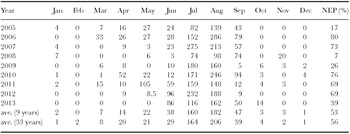
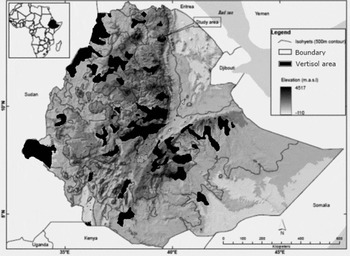
For the study area, rainfall characteristics and treatments are described in detail in Tesfay et al. (Reference Tesfay, Cornelis, Nyssen, Govaerts, Gebregziabher, Oicha, Getnet, Raes, Haile, Deckers and Sayre2011). Field studies were conducted under rain fed conditions from 2005 to 2013 in Gum Selasa (13°14′N, 39°32′E) in Tigray, northern Ethiopia at an altitude of 2100 m asl (Figure 1). Tigray is characterized by a cool tropical climate with recurrent droughts. Mean annual rainfall over 33 years (1971–2013) in Adi Gudom town (3 km away from the experimental plot) is 498 mm with more than 89% falling from June to September (Table 1).
Monthly rainfall (mm) distribution (33 years) at experimental site during the study period from the weather station of the nearby town of Adi Gudom (Ethiopian National Meteorological Services Agency) and yearly calculated non-exceedance probability (%). NEP: non-exceedance probability.

Location map of the study area at Gum Selasa in Tigray and FAO (1988) Vertisols map of Ethiopia. Note that all distribution of Vertisols of Ethiopia are not indicated in the map due to cartographic generalization.

The most common crops include teff, barley (H. vulgare), wheat, hanfets and grass pea (L. sativus). Farmers generally grow wheat, barley if the rains are late, and teff and grass pea when the rains are very late. Therefore, in addition to crop rotation for soil fertility management, the actual cropping pattern is highly dependent on the onset of the rainy season.
Rainfall characteristics in the study area
The rainfall non-exceedance probability (%) for the experimental years was calculated using the RAINBOW software (Raes et al., Reference Raes, Willems and Gbaguidi2006) with 33 years of rainfall data from Adi Gudom town on which a log10 transformation was carried out to obtain a normal distribution of rainfall. A rainfall non-exceedance probability of 50% corresponds to a ‘normal’ year in terms of rainfall amount. The wettest year with the highest rainfall non-exceedance probability was 2006 followed by 2010 and 2007 (Table 1). To the reverse, 2008 followed by 2005 and 2009 were dry years. 2011, 2012 and 2013 were closest to a ‘normal’ year.
The field experiment
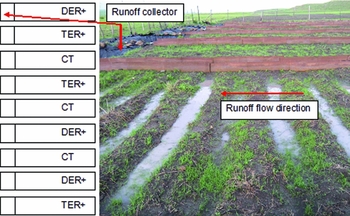
The experimental layout was a randomized complete block design with three replications (Figure 2). The plot size was 5 m × 19 m with a slope gradient of 3%.
The lay-out of experimental plotat Gum Selasa in Tigray, Ethiopia. DER+ is derdero+ (treatment shown in the foreground of the photograph), TER+ is terwah+ and CT is conventional tillage practice.

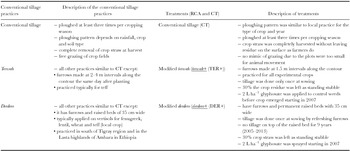
Three treatments were used as described in Table 2: conventional tillage (CT), TER+ and DER+, all using the local ard plough mahresha. Following the local crop rotation practice, the cropping sequence from the first to the ninth year was: wheat–teff–wheat–barley–wheat–teff–grass pea–teff–wheat. Wheat and barley were planted with a seed rate of 150 kg ha−1. The teff seed rate was 30 kg ha−1, while grass pea was planted at a rate of 60 kg ha−1. The same fertilizer (di-ammonium phosphate and urea) rate of 100 kg ha−1 was applied to wheat, barley and teff, following national recommendations by the Office of Agriculture in the study area. Urea fertilizer was not applied to grass pea while di-ammonium phosphate fertilizer was applied at a rate of 50 kg ha−1. The method of seed and fertilizer application was by broadcasting manually for all treatments except for teff in 2012. Teff in 2012 was planted in row by bringing up to 2–3 cm soil depth to avoid teff seed being washed from bed to the furrow. The same treatment was retained in each plot during the nine years of study. Weed control was done only by hand weeding in the first two years in TER+ and DER+, whereas from 2007 onwards non-selective herbicide glyphosate (N-(phosphonomethyl) glycine) was sprayed at a rate of 2 L ha−1 three to four days before planting to control pre-emergent weeds, mainly, Digitaria species and by supplementing hand weeding to weeds grown after planting. Weed control in CT was done by a combination of frequent tillage and hand weeding.
Description of in situ soil and water conservation local tillage practices, conventional tillage and resource-conserving agricultural treatments.

The first treatment used was DER+ which is a new planting system developed from the traditional in situ soil and water conservation practice derdero. In the DER+ planting system, one tillage operation was conducted at planting only by refreshing the furrows; the beds were kept permanent without any tillage on the raised bed for nine years (2005–2013) with retention of 30% crop straw. The average bed width of DER+ in our study was 0.33 m and the average depth of the furrow was 0.1 m. The average width of the furrow on top was about 0.25 m. The length of the beds and furrows was 5 m, corresponding to the width of the experimental plots.
In the second treatment, as described in Tesfay et al. (Reference Tesfay, Cornelis, Nyssen, Govaerts, Gebregziabher, Oicha, Getnet, Raes, Haile, Deckers and Sayre2011), the traditional local tillage practice terwah was applied without modification from 2005 to 2007. However, starting from 2008, the practice was replaced by TER+ which is another minimum tillage system modified from the traditional in situ soil and water conservation local tillage practice terwah. The distance between furrows in the TER+ plots was adjusted on contour at regular intervals of ca. 1.5 m. In the TER+ system, only one ploughing operation was carried out per cropping season (at planting), in combination with the retention of 30% of the crop straw standing stubble. In TER+, broad seedbeds were made using the mahresha ard plough which is only practiced during teff cropping by farmers in northern Ethiopia.
In this study, the derdero and terwah tillage were modified to combine the CA principles. The ‘plus’ in TER+ and DER+ stands for the adjustments made (as indicated in Table 2). Unlike wheat and barley, leaving 30% of the crop residue from teff and grass pea was not feasible in view of teff being too short and grass pea being harvested close to the ground to ensure grain collection. More than 60% of the soil surface was covered by the 30% of the barley and wheat crop residue retained and about 20% of the soil surface was covered during teff cropping while the soil was not covered at all during grass pea cropping.
A third treatment used was CT, which was the control in our experimental setup. In this treatment, three tillage operations per year were carried out and crop residues were completely harvested which was similar to the farmers practice in the study area. Terwah was applied in the CT plot in 2010, as it is the conventional practice in teff.
Runoff, soil loss and nutrient loss
Runoff and soil loss were determined following Tesfay et al. (Reference Tesfay, Cornelis, Nyssen, Govaerts, Gebregziabher, Oicha, Getnet, Raes, Haile, Deckers and Sayre2011, Reference Tesfay, Cornelis, Nyssen, Govaerts, Getnet, Bauer, Raes, Amare, Haile and Deckers2012). The runoff coefficient (RC in %) was calculated as the percentage of total runoff depth (RD, in mm) to total rainfall (RF, in mm):
 $$\begin{equation}
{\rm RC} = \frac{{{\rm RD}}}{{{\rm RF}}}100\end{equation}
$$
In addition to the samples for soil loss determination, 2 L samples were taken after each runoff event to quantify nutrient loss from each treatment which includes organic carbon (C), total soil nitrogen (N) and available phosphorus (P). The samples were filtered to determine soil loss. C, N and P were determined by Walkley and Black (Reference Walkley and Black1934), Kjeldahl method (Bremner and Mulvaney, 1982) and Olsen method (Olsen et al., Reference Olsen, Cole, Watanabe and Dean1954) methods, respectively.
Soil fertility
Disturbed composite soil samples of 20 cores per plot per depth were taken at three soil depths of 0–10, 10–20 and 20–30 cm at the end of August in 2009 and 2011, and at 10 cm soil depth in 2006 for determining C, N and P. These elements were quantified in each treatment using the same methods as for nutrient loss determination.
Agronomic data
Grain and straw yield were determined yearly at harvest from a sub-plot of 1 m × 1 m in three replicates per plot.
Broad leaved and grass weed species were counted separately from areas of 1 m × 1 m in three replicates per plot in August 2008, 2009, 2010 and 2011 to determine the level of weed infestation. Weed abundance (WA), weed dominance (WD) and weed similarity index (WSI) were calculated for the data collected in 2010. WA is the population density of a weed species expressed as the number of individuals of weed plants per unit area:
 $$\begin{equation}
{{\rm WA}}_i = \frac{{\sum w }}{n}\end{equation}
$$
w is the number of individuals of a species per unit area per sample, n is number of samples and i is the weed species.
WD is the abundance of an individual weed species in relation to the total WA:
 $$\begin{equation}
{\rm WD} = {\rm WA}_i \frac{{{\rm 100\% }}}{{\sum_{i = {\rm 1}} {{\rm WA}_i } }}\end{equation}
$$
WSI is the similarity and diversity of weed communities between CA and CT treatments and was calculated as:
 $$\begin{equation}
{\rm WSI} = \frac{{Ep}}{{({\it Ep} + {\it Epa} + {\it Epb})}}{\rm 100\% }\end{equation}
$$
where Ep is number of weed species found in both locations (CA and CT), Epa is number of weed species found only in the CA treatment and Epb is number of weed species found only in the CT treatment (Tessema and Lemma, Reference Tessema and Lemma1998).
Economic analysis
A gross margin analysis was carried out to compare the economic performance of the different planting systems. A gross margin was calculated as the difference between the gross income and the variable costs incurred (Makeham and Malcolm, Reference Makeham and Malcolm1986). The percentage of gross margin was calculated as:
 $$\begin{equation}
{\rm GM(\% )} = \frac{{{\rm GM}}}{{{\rm GI}}}{\rm 100\% }\end{equation}
$$
where GM (%) is percentage of gross margin, GM is gross margin and GI is gross income.
The crop grain and straw yield values formed the gross income, while the variable costs included land preparation, crop residue retained, glyphosate, seed, fertilizer, hand-weeding, harvesting, and threshing costs. Thirty percent of barley and wheat straw, 10% of teff straw and 0% grass pea straw weights of the total were considered as variable cost. The gross margin was calculated on a per plot-basis (95 m2 plots) during 2005–2013. The primary and subsequent tillage in CT were estimated at nearly 12 oxen-span days per ha, while for teff this was 16 oxen-span days per ha. In the RCA systems, only 1 oxen-span days per ha was considered in DER+, against 2 oxen-span days per ha in TER+. The cost of a pair of oxen per day and total labour cost for the other agricultural activities in the study area was estimated for each year based on informal surveys. The labour requirement for weeding was estimated from the total time spent to remove the weeds by hand per plot (95 m2). The labour requirement for spraying herbicide was also estimated from the time spent for applying them in CA treatments. Costs of seed, harvesting and threshing were estimated to be the same for all treatment systems. Costs of harvesting and threshing can slightly increase with an increase in yield but the difference is negligible. Although the differences were not significant at the level of our experimental plot, manual harvesting in the CA based systems (especially for barley and wheat) is more ergonomic as compared to the CT system. The market price of each crop grain was obtained from the Agricultural Office in Adi Gudom documented on monthly basis. The yearly average price was taken for calculation in our study. The price of each crop's straw was obtained from buyers in Adi Gudom.
Statistical analysis
Differences in runoff, soil and nutrient loss, C, N and P nutrient status, crop yield and economic returns between the different treatments were tested by ANOVA using SAS statistical software (JMP version 5.0) (SAS, 2002). The standard error of treatment means was used for separation of means. Comparison of means was carried out by Student t-tests at α = 0.05.
RESULTS
Agronomic performance
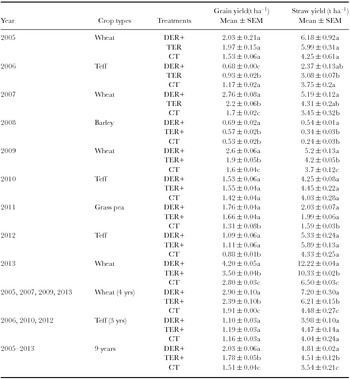
Grain and straw yield differences between treatments became significant after a period of three years of cropping, i.e. from 2007 onwards (Table 3). In 2006, teff grain and straw yields was significantly lower in DER+ compared to CT. In 2010, the difference was not significant. In 2012, straw and grain yield of teff was significantly higher in TER+ followed by DER+ compared to CT. Wheat, barley and grass pea grain and straw yields were significantly higher in DER+ than in TER+ and CT (Tables 3 and 8). The mean of three years teff grain and straw yield was higher in TER+ compared to CT with lowest values in DER+. On the other hand, the mean of four years of wheat grain yield was highest (p < 0.05) in DER+ followed by TER+ (Tables 3 and 8). Although the percentage increment among treatments is the same with other varieties of wheat, the kekeba (picka flor) wheat variety in 2013 have shown the maximum increment, from 2.8 t ha−1 in CT to 4.2 t ha−1 in DER+. The mean 4 yrs of wheat, 1-yr barley and 1-yr grass pea grain yields were higher by 52, 30 and 34% in DER+ compared to CT, respectively, while 3-yrs mean teff grain yield was lower by 5% in DER+ and by 3% in TER+. The mean of 9-yr grain and straw yields of all crops was 2 and 4.8 t ha−1 in DER+, 1.8 and 4.5 t ha−1in TER+, and 1.5 and 3.5 t ha−1 in CT (Table 3). The order of overall performance of the crops in terms of grain and straw yield was thus DER+>TER+>CT.
Grain and straw yield from 2005–2013 (n = 3) for the experimental site in Gum Selasa, Ethiopia (p < 0.05). DER+ is derdero+, TER+ is terwah+, CT is conventional tillage practice, SEM is standard error of mean (p < 0.05). Data followed by different letters indicated significant differences.

Means with a same letter in a same column and year are not significantly different.
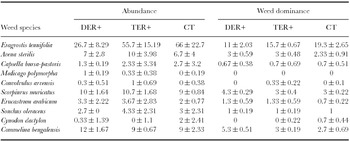
Weed abundance and dominance comparisons between treatments in 2010. DER+ is derdero+, TER+ is terwah+, CT is conventional tillage practice, SEM is standard error of mean (p < 0.05). Glyphosate was sprayed at 2 L ha−1 to DER+ and TER+ treatments since 2007.

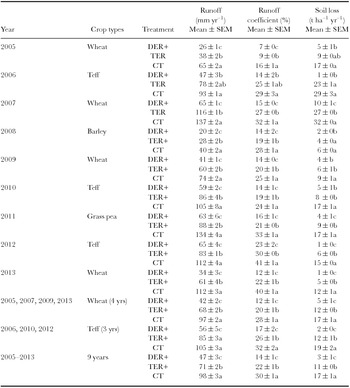
Mean yearly runoff, runoff coefficient and soil loss from each treatment throughout the growing period (n = 3) from 2005–2013. DER+ is derdero+, TER+ is terwah+, CT is conventional tillage practice, SEM is standard error of mean (p < 0.05).

Means with a same letter in a same column and year are not significantly different.
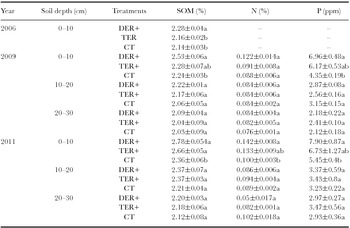
Mean (n = 3) soil chemical properties for the three treatments at different soil depths. DER+ is derdero+, TER+ is terwah+, CT is conventional tillage practice, SEM is standard error of mean (p < 0.05).

Means with a same letter in a same column and year are not significantly different.
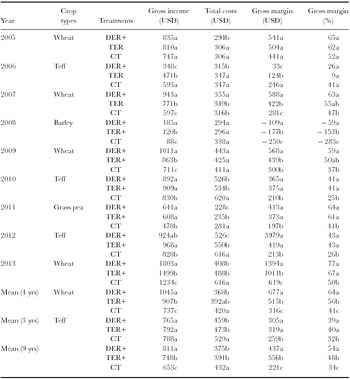
Total cost, gross income, gross margin and % gross margin for the three treatments from 2005–2013. DER+ is derdero+, TER+ is terwah+ and CT is conventional tillage practice.

Means with a same letter in a same column and year are not significantly different.
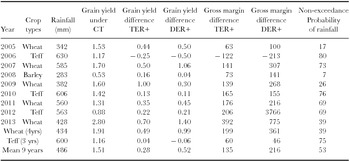
Summary of crop grain yield, gross margin, yearly rainfall and non-exceedance probability from 2005–2013. DER+ is derdero+, TER+ is terwah+, CT is conventional tillage practice and NEP is non-exceedance probability.

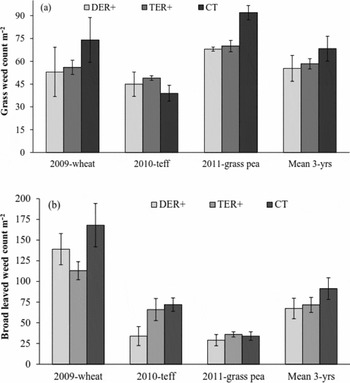
The weed counts showed that the 4-yrs (2008–2011) mean of total weed number was higher in CT (139 m−2) as compared to TER+ (112 m−2) and DER+ (108 m−2). The fresh and oven dried weed weight from lowest to highest were 0.71 and 0.13 t ha−1, 0.76 and 0.16 t ha−1, and 0.78 and 0.18 t ha−1 in DER+, TER+ and CT, respectively. Abundance of Eragrostis tenuifolia, Capsella bursa-pastoris, Sonchus oleraceus and Commelina bengalensis was lower in RCA treatments compared to CT. On the other hand, the abundance of Avena sterilis, Convolvulus arvensis, Scorpiurus muricatus and Erucastrum arabicum was slightly higher in RCA treatments compared to CT. The WD was negligible for Medicago polymorpha, Convolvulus arvensis, Sonchus oleraceus and Cynodon dactylon in all treatments (Table 4). WSI between DER+ and CT treatments was 75%, while it was 71% between TER+ and CT treatments.
Runoff, soil loss, nutrient loss and soil fertility
Runoff was significantly different between the treatments during the 9-yrs study period irrespective of crop type, with the largest record from CT, followed by TER+ (Tables 5 and 8). Annual runoff depths averaged over the 9-yrs were 47, 71 and 98 mm from DER+, TER+ and CT, respectively (Table 5). The corresponding mean runoff coefficients over the 9 yrs of the study were 14, 22 and 30% in DER+, TER+ and CT, respectively (Table 5). The mean 3-yrs runoff coefficient during teff cropping was 17, 26 and 32% in DER+, TER+ and CT, respectively, whereas the mean 4-yrs runoff coefficient during wheat cropping was 12, 20 and 28% in DER+, TER+ and CT, respectively.
Similarly to runoff, soil loss was affected by treatment. Soil loss in teff (3-yrs mean) and wheat (4-yrs mean) cropping seasons was 2 and 5 t ha−1in DER+, 12 and 12 in TER+, 19 and 17 t ha−1 in CT planting systems. The 9-yr mean soil loss was 3, 11 and 17 t ha−1 was from DER+, TER+ and CT, respectively (Table 5).
The concentration of C lost by water erosion was the highest in CT (1.9%) followed by TER+ (1.6%) and DER+ (1.5%). These differences are statistically significant. Similarly, N loss was significantly highest in CT (0.18%) followed by TER+ (0.16%) and DER+ (0.14%). Unlike C and N, P loss was higher in TER+ (9.64 ppm) by 10% and in DER+ (9.50 ppm) by 12% as compared to CT (8.64 ppm). The reduction of N and C loss in DER+ was −26% and −21% and in TER+ was −13% and −18%, respectively.
Significantly greater concentrations of C, P and N nutrients were observed in the DER+ followed by TER+ plots in the 0–10 cm soil depth since 2006 for C, 2009 for P and 2011 for N compared to CT. Although results follow a trend similar to the 0–10 cm soil depth, none of the treatments showed differences for the 10–20 and 20–30 cm soil depths (Table 6).
Economic performance
The gross margin was higher in DER+ followed by TER+ compared to CT (Table 7). Unlike in 2006, teff had significantly higher gross margin in DER+ in 2010. Gross income was highest in teff in 2010 due to a higher price of teff grain (0.56 USD kg−1) and straw (0.04 USD ha−1) in the market, though its gross margin was lower in each corresponding treatment when compared with grass pea and wheat due to the higher labour requirements of teff production. The gross margin of teff in 2012 was significantly higher in TER+ followed by DER+ compared to CT due to the higher yield and price of teff grain (0.59 USD kg−1) and straw (0.1 USD kg−1) compared to 2006 and 2010. Grass pea gross margin in RCA treatments was greater compared to CT as there was no crop residue left in the RCA treatments which reduced the total cost. The percentage of gross margin was significantly higher in DER+ after three years of implementation in 2007. In 2008, the percentage of gross margin was negative for all treatments (Tables 7 and 8) because of low and poorly distributed rainfall (Table 1). The 4-yrs mean gross margin for wheat was higher in DER+ followed by TER+ compared to CT treatments, while the 3-yrs mean teff gross margin was significantly higher in RCA systems compared to CT. Overall, the 9-yrs mean gross margin was higher in DER+ with similar trend in the 4-yrs wheat performance.
DISCUSSIONS
Agronomic effect
This study revealed that RCA systems DER+ and TER+ are promising land management systems for the farmers in northern Ethiopia on Vertisols with equivalent or higher crop yields in the RCA systems compared to CT during the nine years of study (except for teff in the second year in 2006) (Table 3). A period of three years was needed before the difference between RCA and CT became significant, which was faster than what was observed by Govaerts et al. (Reference Govaerts, Sayre and Deckers2005) in CA on a Cumulic Haplustoll in Mexico or by Tesfay et al. (Reference Tesfay, Cornelis, Nyssen, Govaerts, Getnet, Bauer, Raes, Amare, Haile and Deckers2012) on Vertisols in the sub-humid zone of northern Ethiopia. In the latter study, significantly higher crop yields in DER+ and TER+ were observed only after five years.
Unlike 2006 and 2010, the yield of teff was significantly higher in RCA systems compared to CT in 2012. The first reason for lower teff yield in RCA planting systems in 2006 was the absence of chemical weed control which resulted in higher weed infestation. Application of glyphosate herbicide started in our study as of 2007. The use of glyphosate together with the mulching effects of crop residue in RCA plots declined both broad and grass weed species infestation over time which might be related to reduction of the weed seed bank in the soil. Population of broad and grass weed species were reduced in DER+ by 35% and 23%, respectively, as compared to CT (Figure 3). The only broad leaf herbicide which has been widely available in Tigray for more than two decades was 2,4-D, whereas no herbicides were available until recently to control grass weed species. Broadleaf weed species were reduced as compared to grass weeds when the broad leaved grass pea crop was grown. On the contrary, grass weed species were reduced during teff and wheat cropping due to the competition for light and nutrients. The WA and WD were affected by treatments indicating a weed population change due to glyphosate application and leaving crop residue in RCA treatments. Determination of weed types and population are important to improve the weed control methods. WSI between DER+ and CT was 75% while 71% between that of TER+ and CT indicating that the weed population changes between RCA treatments and CT (Figure 3 and Table 4). WSI between DER+ and TER+ was 86%. As all crops in our experiment except teff were grown on the raised bed of DER+, most of weeds were growing in the crop free furrow area. Thus, the extra advantage of DER+ is that raised beds and furrows facilitate weeding, as weeds grow mainly in the furrow.
Grass weed (a) and Broad weed (b) count population dynamics for each treatment for from 2009–2011. DER+ is derdero+, TER+ is terwah+, CT is conventional tillage practice. Glyphosate was sprayed at 2 L ha−1 to DER+ and TER+ treatments since 2007. The bars shown represent standard error of mean (p < 0.05).

Teff, which has very fine seeds, is broadcasted after the last ploughing operation to avoid deep burying and to enhance emergence. Therefore, the second major problem observed in teff planting in the DER+ was that the teff seed was washed from the bed to the furrow. In addition, some seeds of teff were spread in the furrow during the manual broadcasting at planting over freshly tilled soil. As a result, most of the teff crop was growing in the furrow with yellowish leaf colour, indicating water-logging in the DER+. This was only observed for teff and not for other crops. This phenomenon may explain the yield penalty in teff with DER+ in 2010. However in 2012, teff yield was significantly higher with teff in DER+, as the crop was planted in rows at a depth of 2–3 cm, avoiding yield loss associated with water-logging (Tables 3, 7 and 8). Erkossa et al. (Reference Erkossa, Stahr and Thomas2005) found higher grain yields of teff in reduced tillage compared to CT practices in Vertisols of central Ethiopia with application of a non-selective herbicide. Fufa et al. (Reference Fufa, Tesfa, Hailu, Kibebew, Tiruneh, Aberra, Seyfu, Hailu, Getachew and Sorrells2001) reported that reduced tillage can be an option in teff production and particularly on Vertisol (Habtegebrial et al., Reference Habtegebrial, Singh and Haile2007). Sasakawa Global (2002) also substantiates that CA for teff in Ethiopia was more profitable than traditional tillage, if herbicide, fertilizer and mulching are applied. The RCA systems implemented by these authors did however not ‘focus’ on furrows as we did in the current semi-arid study area.
Crop yield losses often occur on Vertisols in the study area due to the combination effects of periodic droughts and water-logging in the same cropping season. Intensive rainfalls in August usually cause water-logging problems while the rains in June, July and September are usually accompanied by short and long dry spells. In the DER+ planting system, excess rain water drains to the furrow storage, protecting wheat, barley and grass pea crops grown on top of the raised beds from water-logging problems. Teff however is affected as seeds are washed to the furrow. A possible solution to avoid the washing of teff seed from the raised bed into the furrow may consist in enhancing the contact between seeds and seedbed by manually sweeping rigid branches over it as is traditionally done in the study area.
The DER+ planting system performed best, both under favourable and unfavourable weather conditions. For instance, despite a poor performance of barley in 2008 due to the unfavourable rainfall distribution, which started late in July and stopped earlier than normal, grain and straw yields were highest in DER+ (Tables 3, 7 and 8). The consistently higher crop yield in DER+ (except in 2006) is attributed to the presence of the bed and furrow physical structures in combination with crop residue retained to conserve soil moisture, providing benefits for the crop during dry spells and avoiding water-logging problems on top of the bed where the crop grows by draining the excess rain water to the furrow (Sayre, Reference Sayre1998). In addition, the improvement in SOC, N and P was faster in DER+ as compared to TER+ due to no-till practice on top of the bed, although the crop residue retained was the same in both DER+ and TER+. Further, in line with observations by Rockström (Reference Rockström2000) on water stress as the main limiting factor for crop production in semi-arid regions, crop yields in our study have shown to increase from 1.51 t ha−1 in CT to 2.03t ha−1 in DER+ planting system due to the long-term (9-yrs mean) impacts of RCA. However, 4-yrs mean wheat yield was higher by 0.99 t ha−1 in DER+ compared to CT. The higher wheat, barley and grass pea yields in DER+ and TER+ compare with CT demonstrated the potential of these land management systems for in situ soil and water conservation in northern Ethiopia.
The past and current free grazing practices on cropland in Ethiopia have caused land degradation by overgrazing (Gebregziabher et al., Reference Gebregziabher, Mouazen, Van Brussel, Ramon, Nyssen, Verplancke, Behailu, Deckers and De Baerdemaeker2006). The Tigray regional government in northern Ethiopia has set out the need for introducing zero-grazing by smallholder farmers as a new policy issue. This recent policy shift in Tigray, favours stubble management and the abandonment of free grazing in croplands. However, the practice is not adopted by the farmers due to various reasons amongst which feed shortage is the most mentioned. The major challenges for implementation of RCA as revealed by farmers was abandoning free grazing of livestock to protect the 30% crop residue cover to be left on their land and improved weed control practices.
Effects for soil and water conservation
The quantifications of runoff and soil loss during nine consecutive years demonstrated that runoff, runoff coefficients and soil loss were significantly lower (p < 0.05) in DER+ and TER+ compared with CT (Table 5). Avoiding repeated tillage, retention of crop residues and the capacity of the furrows to retain a large proportion of runoff as depression storage in DER+ contributed to the consistent smaller soil loss and runoff coefficients in DER+, as compared to CT. Similar findings were also reported by Erenstein (Reference Erenstein2002) and Sayre (Reference Sayre1998). The tillage system using the mahresha ard with two oxen in DER+ keeps raised bed undisturbed. However, when refreshing the furrow by the mahresha, some soil was moved from the furrow to the top of the raised bed together with the seeds that were dropped in the furrow by manual broadcasting at planting, burying the seeds on top of the raised bed. All crop seeds except those of teff were thus covered with the soil from the furrow which protected them against rodents and birds. However, teff is planted by broadcasting over freshly tilled soil in all treatments except in 2012.
The standing stubble crop residue of wheat and barley was retained on top of the permanent raised bed, which might be important to minimize splash erosion by rain drops and thus, increase infiltration (Govaerts et al., Reference Govaerts, Sayre, Lichter, Dendooven and Deckers2007). Crop residue is less abundant when teff and grass pea occur in the farmers’ rotation but this is inherent to RCA for such crops. In addition to the differences in terms of the amount of rainfall, length of dry spell (soil moisture) and type of crops grown each year, the amount of standing stubble crop residue retained in the plots might contribute to the variation in runoff and soil loss across the years. In addition, the no-till condition on raised beds and the absence of frequent tillage in DER+ could improve the soil's physical condition which leads to an enhancement in water infiltration, thereby reducing runoff coefficients in each rainfall event (Table 5). Tesfay et al. (Reference Tesfay, Nyssen, Govaerts, Deckers and Cornelis2015) reported that the soil water storage (0–80 cm soil depth) during the growing season was always highest in DER+ followed by TER+ and CT treatments.
Soil loss reduction in DER+ was much greater for teff as compared to wheat probably due to the uniform growth of teff in furrows and beds. Unlike soil loss, runoff was higher when teff was grown as compared to wheat in the DER+ planting system in both years (2006 and 2010).
The other benefits of RCA were the significantly reduced C and N losses as compared to CT. Although not significant, the percentage loss of P was higher in RCA treatments compared to CT. This study further showed that addition of crop residue in combination with minimum tillage and bed planting systems significantly reduced nutrient loss and improved the soil nutrient status of C, N and P (and thus improved crop yields). However, further research is required to separate the effects of each factor, by applying a factorial design combining the effect of physical structure (beds and furrows versus flat), tillage (conventional versus minimum) and biomass management (residue retention versus residue removal).
Economic performance
Economic analysis can provide information about the sustainability of a practice for increased productivity and enhanced resource use efficiency over a given period (Senkondo et al., Reference Senkondo, Msangi, Xavery, Lazaro and Hatibu2004). RCA implies higher capital input in the form of weed control and opportunity costs of crop residue normally used as livestock feed. However, RCA also implies lower labour investment due to reduced tillage and less need for oxen as sources of draught power. Gross margin was significantly higher in the DER+ planting system from 2007 onward compared to TER+ and CT, following a similar trend as grain yield. RCA requires additional external inputs in the form of herbicide. Due to the low marginal productivity of labour and weak yield responses to the strong water limitation of crop yield productivity, fertilizers in this moisture-stressed environment, extension and credit programs promoting fertilizer have often low impacts on crop yields (Pender and Gebremedhin, 2004). However, crop production and farmers income in the North Ethiopian Highlands can efficiently increase using low-external input investments and practices such as stone terraces and reduced tillage (Pender and Gebremedhin, 2004). The RCA systems in this study reduced land preparation and labour for weed control costs which compensates for the low external input of herbicide (Pender and Gebremedhin, 2004).
Gross margin in 2008 was negative for all treatments as a result of low rainfall in that year. However, the economic performance of DER+ during this dry year (2008) remained nonetheless greater due to a reduction in ploughing frequency and labour required for weeding and higher crop grain and straw yields. The cost of ploughing was found higher than the cost of retaining 30% of the crop straw produced.
In order to realize the anticipated benefits, farmers have to retain crop residue to cover at least 30% of the soil surface every year. As discussed before, crop residue left during teff cropping was less than 10%, as teff varieties grown in the area have short straw and hence need to be nearly fully cut in order to harvest all the grain. Similarly, no crop residue was left during grass pea cropping since pods containing grains are present on the lower part of the stems. This resulted in RCA treatments having higher gross income and lower total costs (Table 7).
The abandonment of frequent tillage, the fast ploughing pace while refreshing the furrows and the overall softening of cropland soil over time in CA treatments (Tesfay et al., Reference Tesfay, Nyssen, Govaerts, Bauer, Deckers and Cornelis2014) lead to a reduction of labour and draft power demand. Both repeated tillage and RCA systems can soften the cropland but softening in repeated tillage is only a temporary phenomenon until there is crust formation after 2–3 heavy rainfall events (Tesfay et al., Reference Tesfay, Nyssen, Govaerts, Bauer, Deckers and Cornelis2014). An average of three to four tillage practices using the oxen drawn mahresha ard plough is common for most crops grown in the area. The first and the subsequent tillage require an average of 10–12 oxen-span days per ha, depending on the strength of the soil. However, unlike other crops, the CT planting system of teff requires nearly 16 oxen-span days per ha. This resulted in a significant reduction of total costs in the DER+, as compared to CT for teff cropping in 2006 and 2010. The tillage at planting was four times faster in DER+ system (one oxen-span days per ha) compared to the CT system (four oxen-span days per ha). RCA treatments - especially DER+ will also constitute cheaper technologies for resource-poor households. This can encourage farmers with one ox to labour their land by sharing their oxen with other farmers who have one ox. Furthermore, RCA and the concomitant weed reduction strongly decrease the need for women's and children's labour in weeding. Acceptance and diffusion of CA in the study area have further been demonstrated to be partially based on such economic analysis (Lanckriet et al., Reference Lanckriet, Araya, Derudder, Cornelis, Bauer, Govaerts, Deckers, Haile, Naudts and Nyssen2014): knowledge of the technique and spatial proximity to the innovation source are important, besides the perceived costs and benefits. However, CA acceptance remains difficult in a traditional society where oxen are considered as primordial and where multiple ploughing is an ancient tradition.
Finally, although not quantified in our study, several farmers in the study area restricted one of their kids from school access for the purpose of labour required to keep animals in free grazing condition. However, with the introduction of RCA, abandonment of free grazing can be followed by keeping livestock on-farm with in-door feeding and controlled grazing pasture lands which could favour access for education.
Generally, cereal residues represent the main organic input available for African smallholders to maintain long-term productivity of their soils. Our study demonstrated that cereal residues can reduce runoff and soil loss and thus, increase water use efficiency. However, cereal residues also represent a major source of feed for livestock. Therefore, hard trade-offs in the allocation of this scarce resource exist in areas where there is dominancy of crop-livestock mixed small holder farming systems. More than 96% of the livestock populations in the northern highlands of Ethiopia are kept to meet the power demand of the current CT system which also contributes considerably to land degradation by heavy grazing (Gebregziabher et al., Reference Gebregziabher, Mouazen, Van Brussel, Ramon, Nyssen, Verplancke, Behailu, Deckers and De Baerdemaeker2006). A form of intensification having minimum negative consequences for the environment and leading to minimum social inequity is required, i.e. sustainable intensification. RCA adoption in Ethiopia requires further work in improving awareness of smallholder farmers to abandon free grazing system, add biomass to their soil that enhances land productivity and change the livestock farm orientation from draught power to other benefits such as using cows for milk as well as for ploughing. The reduction in draught power requirement would enable a reduction in oxen density and crop residue demand for livestock feed, which would encourage smallholder farmers to increase biomass return to the soil. The more biomass is added to the soil, the higher will be the land productivity and thus this would increase crop biomass productivity and the carrying capacity of the land for livestock and humans in the long term.
CONCLUSIONS
The results of this study indicate that DER+ and TER+ planting systems which link CA principles with indigenous conservation practices can be an alternative to the CT system to reduce runoff and soil loss, and increase wheat, barley and grass pea yield on Vertisols. Compared to CT, gross margin was significantly higher in DER+ followed by TER+. The DER+ planting system potentially results in additional benefits such as faster land preparation and cheaper technology for resource-poor households that can encourage disabled and women-headed households to farm their land themselves instead of renting it out. Thirty percent of the households in Tigray region are women-headed households, characterized by labour constraints, and most of them are forced to rent their cropland due to the high labour demand of the conventional farming system. SOC, N and P were significantly higher in the RCA treatments. A higher SOC content could lead to the reduction of runoff and an increase in infiltration rate. Compared to the other treatments, the DER+ planting system performed better even during unfavourable weather conditions. The full benefit of DER+ can only be expected after several years. However, even during that transition period RCA was more profitable than CT. Therefore, farmers in northern Ethiopia can reduce runoff and soil loss, improve crop yields and economic benefits in Vertisols by adopting DER+ and TER+. However, adoption of RCA systems in the study area requires further work to improve smallholder farmers’ awareness on benefits, to guarantee high standards during implementation and to design appropriate weed management strategies.
Acknowledgements
This research was funded by the Institutional University Cooperation (IUC) Project in Mekelle University through the Flemish Interuniversity Council (VLIR, Belgium) and CRP (CGIAR Research Program) WHEAT. The authors are sincerely grateful to Aklil Gebremedhin and Alemu Gebremedihn for their unreserved assistance during the field work. Many local farmers provided useful insights and assistance to the researchers. We are grateful also to all staff of Mekelle University Institutional University Cooperation program office as well as to two anonymous reviewers for their useful comments on an earlier of this paper.