Introduction
The coffee berry borer (CBB), Hypotenemus hampei, is the most economically important pest of coffee worldwide (Murphy & Moore, Reference Murphy and Moore1990). The development of resistance in H. hampei to insecticides, and the detrimental impact of these on beneficial insects as well as in the environment (Brun et al., Reference Brun, Marcillaud, Gaudichon and Suckling1994) have generated great interest in alternative control strategies for H. hampei. Cephalonomia stephanoderis and Porops nasuta are two solitary larval koinobiont ectoparasitoids that attack primarily H. hampei immature stages. Parasitoid females usually enter an infested coffee berry via perforation made by CBB. Both parasitoid species have been introduced to several Latin American countries as biological control agents; therefore, they could serve as an important component in integrated pest management for CBB (Infante et al., Reference Infante, Mumford and Baker2005). Understanding the chemical ecology of the parasitoids may enhance this effort (Colazza et al., Reference Colazza, Salerno and Wajnberg1999; DeLury et al., Reference DeLury, Gries, Gries, Judd and Khaskin1999).
Parasitoids use diverse chemical cues to locate their hosts. Typically, they exploit cues that reliably indicate the presence of a suitable host (Vet & Dicke, Reference Vet and Dicke1992). These cues may originate from the host habitat or from the host itself (host frass, cuticle, silk and oral secretions) (Godfray, Reference Godfray1994; Vinson, Reference Vinson1998). Bethylid wasps that attack CBB are attracted to volatiles from host immature stages and dust and frass during host habitat location (Felipe-Silvestre et al., Reference Felipe-Silvestre, Gómez, Barrera and Rojas2005; Chiu-Alvarado & Rojas, Reference Chiu-Alvarado and Rojas2008; Chiu-Alvarado et al., Reference Chiu-Alvarado, Barrera and Rojas2009), but it remains to be known if parasitoids use other cues during the last phases of the host location process. Thus, in this study, we investigated the role of contact chemical cues from CBB dust and frass on the locomotory behaviour of P. nasuta and C. stephanoderis females.
Materials and methods
Biological material
Parasitoids were obtained from a colony maintained at the El Colegio de la Frontera Sur reared according to procedure described elsewhere (Infante et al., Reference Infante, Mumford and Baker1995). Briefly, parasitoid cultures were performed on ripe coffee berries exhibiting the characteristic entry hole bored by CBB females. CBB-infested coffee berries were collected regularly by hand from coffee plantations near Tapachula, Chiapas, Mexico. These fresh berries were placed for 3–4 days on trays lined with tissue paper to reduce humidity. Using circular plastic jars (10 cm in height and 22 cm in diameter) with a ventilated mesh lid, cultures of parasitoid were then established at a ratio of one female parasitoid per 1.5 CBB-infested coffee berries. To avoid proliferation of saprophytic fungi, only a single layer of berries was placed in each jar (approximately 200 coffee berries). Four weeks after the cultures were started, frass and dust were removed, and the jars were placed under fluorescent lights where they were checked several times per day to collect parasitoids that emerged from the cultures. The laboratory cultures were maintained under a cycling temperature regime, ranging from 18 to 30°C, RH from 60 to 85% and 12:12 h light:dark photoperiod. Newly emerged females, 1–2 days old, which were used in all experiments, were collected and kept in plastic containers (15.5×9.0×6.5 cm) until being bioassayed.
CBB dust and frass was obtained from infested, ripe coffee berries collected regularly in coffee plantations. The dust and frass produced is a mixture of faeces, residues of coffee and other waste products from CBB activity. Dust and frass used in experiments (except in one experiment) was 20–30 days old with moisture content unknown.
Experimental arena
The bioassays were performed in an experimental arena consisting of a 9.0 cm diameter glass Petri dish. The Petri dish was fitted with a filter paper disc (Whatman, No. 1, Whatman, Brentford, UK) placed on the base of the dish. A circular area, 3 cm in diameter, was lightly drawn with a pencil in the centre of the filter paper. The extract chosen was applied to the midpoint of this circular zone using a Hamilton syringe (Supelco, PA, USA). Drops of the extract were applied until the solvent front roughly reached the edge of the marked zone or patch. Pure solvent was used as a control. After 40 min and once the solvent had evaporated, one parasitoid was introduced in the centre of the treated zone. An observation started when a parasitoid started to walk on the treated zone and ended when the wasp left it or flew away. The insects were observed for 5 min and tested once. All tests within a group of experiments were carried out on the same day, using six parasitoids per treatment per day, and tests were repeated on consecutive days until a total of 30 females per treatment was completed.
Recordings were done using the Noldus video tracking system (Noldus Information Technology, Leesburg, VA, USA). The system consisted of a monochrome CCD camera (Panasonic model WV-BP 330, Panasonic Consumer Electronics Co., Secaucus, NJ, USA) fitted with a 3.5–8.0 mm/F1.4 zoom lens (CBS America Corp., Commack, NY, USA) and a personal computer running Ethovision version 2.1 software (Noldus Information Technology) installed under Windows 98 (Microsoft Corp., Redmond, WA, USA). A fibre optic light (Fiber-Lite PL-750, Dolan-Jenner, MA, USA) made the experimental area clearly visible and improved the accuracy of the system by eliminating reflections and shadows. All experiments were performed in an environmentally controlled room between 10:00 and 15:00 h, at 26±2°C and 60±10% RH.
Ethovision detected the insect's position using the subtraction method after applying each extract type. Settings were left according to the manufacturer's defaults, except for ‘duration’, ‘sample rate’ and ‘detection method.’ The patch retention time, the total time from when a parasitoid was placed in the centre of the patch until it left the area, was recorded in all experiments. More emphasis was given to patch retention time since it is better in representing behaviour towards kairomonal stimuli (Boo & Yang, Reference Boo and Yang2000).
Experiments
In the first experiment, we evaluated what type of solvents could extract the chemical cues from dust and frass that influence the locomotory behaviour of both parasitoids. The extracts were prepared by dipping 1 g of dust and frass for 1 min in 20 ml of either hexane (95% purity, HPLC grade, Aldrich), acetone (99.6% purity, HPLC grade, J.T. Baker) or methanol (99.9% purity, HPLC grade, J.T. Baker). The extracts were evaporated at room conditions and concentrated to the equivalent of 100 mg dust and frass equivalent per millilitre. Behavioural experiments were performed with crude extracts and tested in the experimental arena described above. One hundred microlitres of each extract was applied into the filter paper, and each extract was tested in a random order.
In the second experiment, we evaluated the influence of fractions of hexane extracts of dust and frass on the locomotory behaviour of both parasitoids. Hexane extracts (prepared as described above) were fractionated by adsorption chromatography on a silica gel column (275 mg, Mallinckrodt Baker, Phillipsburg, USA). Initially, the column was washed with 1 ml of hexane and then 500 μl of hexane extract was applied. Extract components were eluted by using 1 ml hexane, 1 ml hexane-dichloromethane, 1 ml dichloromethane, 1 ml dichloromethane-methanol and 1 ml methanol. One hundred microlitres of each fraction was tested in the bioassays.
In the third experiment, we compared the response of parasitoids to methanol extracts of CBB dust and frass to methanol extract of dry coffee, and methanol control. The extracts were prepared by dipping 1 g of dust and frass or 1 g of coffee bean flour for 1 min in 20 ml of methanol (99.9% purity, HPLC grade, J.T. Baker). Dry coffee beans were ground to produce fine flour. The extracts were evaporated at room conditions and concentrated to the equivalent of 100 mg dust and frass or ground coffee equivalent per millilitre. One hundred microlitres of extracts or methanol was applied into the filter paper, and each treatment was evaluated in a random order.
In the fourth experiment, we tested the influence of concentration of the methanolic extracts of dust and frass on the locomotory behaviour of P. nasuta and C. stephanoderis females. A methanol extract of dust and frass was diluted with MeOH at the following concentrations: 0.001, 0.01, 0.1, 1.0, and 10 mg dust and frass per 100 μl of solvent. One hundred microlitres of each concentration was tested in the bioassays; each concentration was evaluated in a random order.
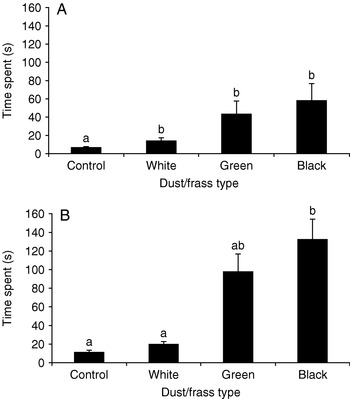
In the fifth experiment, we evaluated the influence of extracts made with dust and frass from berries with different degrees of colonization by CBB on the locomotory response of P. nasuta and C. stephanoderis. The types of dust and frass used in this experiment were catalogued as follows: (i) white dust and frass, which consists of faeces and fragments of material expelled from the berry by the adult female that colonized the berry; (ii) green dust and frass, which contains mainly of berry material which has turned green because of the oxidation process, and also contains excrement of early instar larvae and adult female; and (iii) black dust and frass, which contains mainly excrement produced by an entire CBB population living inside the berry (Rojas et al., Reference Rojas, Castillo and Virgen2006). All samples of dust and frass were extracted with MeOH as described for experiment 1.
In the sixth experiment, to identify other behavioural descriptors and gain a deeper understanding of the mechanisms underlying the response of C. stephanoderis and P. nasuta, data from the methanol extract from the first experiment were re-analyzed. The following parameters were analysed: total distance moved (cm), mean velocity (cm s−1), mean absolute angular velocity (unsigned degrees s−1) and mean absolute meander (unsigned degrees cm).
Statistical analysis
Data from experiments 1, 2, 3, 4 and 5 were Ln (x+0.5) transformed and analysed using one-way ANOVA. When significant differences were found using ANOVA test, a Tukey HSD test was used to compare means. Data from experiments 6 were analyzed using a Kruskal-Wallis test. The statistical analyses were performed with the Statistica Software Program (release 6.1, StatSoft, Inc.).
Results
Influence of solvent in the extraction of contact chemical cues
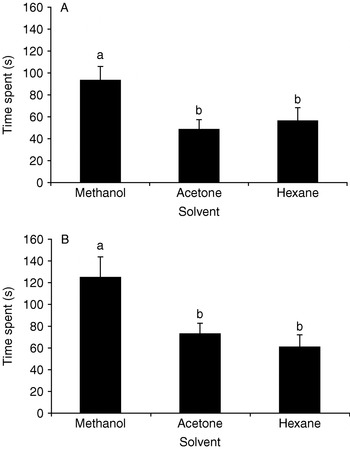
Parasitoids of both species spent significantly more time on the patches treated with the dust and frass extracts than on the solvent controls (P<0.05). Cephalonomia stephanoderis spent 56.90±6.95, 52.32±8.33 and 93.74±12.74 s on the patches treated with hexane, acetone and methanol extracts, respectively; whereas females remained on the patches treated with hexane, acetone and methanol controls for 4.42±0.65, 4.49±1.44 and 5.68±1.02 s, respectively. Prorops nasuta females spent 60.92±9.96, 72.91±10.26 and 124.86±17.82 s on the patches treated with hexane, acetone and methanol extracts, respectively; whereas females remained on the patches treated with hexane, acetone and methanol controls for 4.52±1.57, 7.05±2.31 and 5.22±1.22 s, respectively. The locomotory behaviour of C. stephanoderis (F=5.02; df=2, 87; P<0.01) and P. nasuta (F=6.26; df=2, 87; P<0.01) females was affected by the solvent used for preparing the extracts. Parasitoid females spent more time on methanol extracts than on acetone and hexane extracts (fig. 1).
Behavioural response of parasitoids (a) Cephalonomia stephanoderis and (b) Porops nasuta to methanol, acetone and hexane extracts from dust and frass of Hypothenemus hampei. Bars with the same letter are not statistically different from each other, P<0.05 (Tukey HSD). Values are mean+SE.

Activity of fractions of hexane extracts of dust and frass
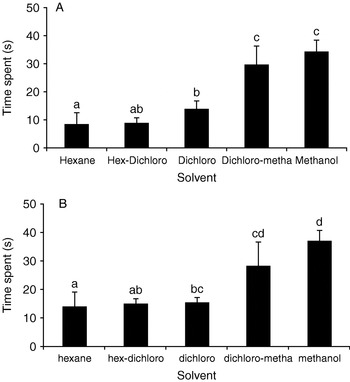
The behaviour of C. stephanoderis was influenced by the type of fraction tested (F=18.35; df=4, 145; P<0.001). Females spent more time on patches treated with the dichloromethane-methanol and methanol fractions of hexane extract of dust and frass than on the hexane, hexane-dichloromethane and dichloromethane fractions (fig. 2).
Behavioural response of parasitoids (a) Cephalonomia stephanoderis and (b) Prorops nasuta to fractions of hexane extracts from dust and frass of Hypothenemus hampei. Bars with the same letter are not statistically different from each other, P<0.05 (Tukey HSD). Values are mean+SE.

The behaviour of P. nasuta was affected by the type of fraction tested (F=18.35; df=4, 145; P<0.001). Parasitods remained longer on patches treated with the methanol fraction than on the hexane, hexane-dichloromethane and dichloromethane fractions. There were no differences in the time spent by females on patches treated with the dichloromethane-methanol and methanol fractions (fig. 2).
Response of parasitoids to dust and frass, dry coffee and methanol
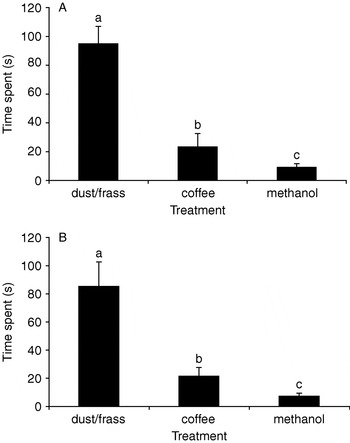
The type of treatment affected the locomotory behaviour of C. stephanoderis (F=34.57; df=2, 87; P<0.001) and P. nasuta (F=17.80; df=2, 87; P<0.001). Parasitoid females spent more time on the patch treated with the methanol extract of dust and frass than on the patches treated with the methanol extract of dry coffee and methanol control (fig. 3).
Behavioural response of parasitoids (a) Cephalonomia stephanoderis and (b) Prorops nasuta to methanol extracts from dust and frass of Hypothenemus hampei and dry coffee (Coffea arabica), or control. Bars with the same letter are not statistically different from each other, P<0.05 (Tukey HSD). Values are mean+SE.

Influence of dose of dust and frass extract on the locomotory activity of parasitoids
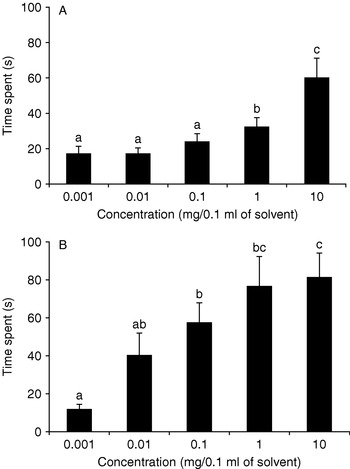
The concentration of the methanol extracts from dust and frass influenced the locomotory activity of C. stephanoderis (F=9.02; df=4, 145; P<0.001) and P. nasuta (F=6.51; df=4, 145; P<0.001). In general, females of both species spent longer on the patch treated with the concentrations of 1 and 10 mg ml−1 of dust and frass extract (fig. 4).
Behavioural response of parasitoids (a) Cephalonomia stephanoderis and (b) Prorops nasuta to different concentrations of methanol extracts from dust and frass of Hypothenemus hampei. Bars with the same letter are not statistically different from each other, P<0.05 (Tukey HSD). Values are mean+SE.

Influence of extracts made with dust and frass from berries with different degrees of colonization by CBB on the locomotory activity of parasitoids
The behaviour of C. stephanoderis (F=3.60; df=3, 116; P<0.05) and P. nasuta (F=9.45; df=3, 116; P<0.05) was affected by the type of extract evaluated. Cephalonomia stephanoderis females spent more time on patches treated with black, green and white dust and frass extracts than on control treatment (fig. 5a). In the case of P. nasuta, parasitoids spent significantly more time on patches treated with extract from black dust and frass than on patches treated with white dust and frass extract, and control. The time that parasitoid spent in patches treated with green dust and frass extract was intermediate and not significantly different between black dust and frass extract and white dust and frass extract, and control (fig. 5b).
Behavioural response of parasitoids (a) Cephalonomia stephanoderis and (b) Prorops nasuta to methanol extracts from dust and frass of berries with different degree of colonization of Hypothenemus hampei (see text for explanation). Bars with the same letter are not statistically different from each other, P<0.05 (Tukey HSD). Values are mean+SE.

Analysis of locomotory behaviour of parasitoids
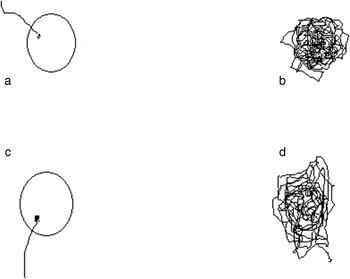
Parasitoid females of both species spent more time, covered more distance, turned more (per unit time and per unit distance) and decreased their speed when they contacted patches treated with methanol extracts of dust and frass in comparison to patches treated with methanol control (tables 1 and 2). Parasitoids drummed the patch treated with extract with their antennae and touched it with their front tarsi, alternating between movements and resting periods. They also moved their wings often, but they did not attempt to fly. Typical tracks of both species in response to methanol extracts of dust and frass and methanol control are shown in fig. 6.
Typical examples of recorded tracks of (a, b) Cephalonomia stephanoderis and (c, d) Prorops nasuta females in an experimental arena (9 cm diameter, inner circle, 3 cm diameter) over a 5-min run. Zones treated with (b, d) methanol extracts from Hypothenemus hampei dust and frass and (a, c) solvent control.

Locomotory activity of Cephalonomia stephanoderis females in patches treated with methanol extract of Hypothenemus hampei dust and frass or methanol.

Values are mean±SE.
Locomotory activity of Prorops nasuta females in patches treated with methanol extract of Hypothenemus hampei dust and frass or methanol.

Values are mean±SE.
Discussion
The present study showed that extracts of CBB dust and frass influenced the locomotory behaviour of C. stephanoderis and P. nasuta. CBB parasitoids searched patches more intensively where host products were present in comparison to patches where host products were lacking. In fact, parasitoids spent only a short time on patches without host product extracts before walking off. Short-range foraging movements, involve walking on host-infested substrates once the parasitoid is in close proximity to host (Powell & Poppy, Reference Powell, Poppy, Woiwod, Reynolds and Thomas2001). Prorops nasuta and C. stephanoderis spend most of their life associated with H. hampei inside of infested coffee berry (Waterhouse & Norris, Reference Waterhouse and Norris1989; Murphy & Moore, Reference Murphy and Moore1990). Coffee berry borers produce most of their dust and frass when already established inside the fruit, and the accumulation of dust and frass is an obvious indication of their presence. Previous studies have shown that volatiles from CBB immature stages and dust and frass are used by C. stephanoderis and P. nasuta as long-range cues during the host location process (Felipe-Silvestre et al., Reference Felipe-Silvestre, Gómez, Barrera and Rojas2005; Chiu-Alvarado & Rojas, Reference Chiu-Alvarado and Rojas2008; Chiu-Alvarado et al., Reference Chiu-Alvarado, Barrera and Rojas2009).
Our results showed that three types of solvents used extracted the chemical cues that influenced the locomotory behaviour of C. stephanoderis and P. nasuta. However, parasitoids remained longer on the patch treated with methanol extracts than on patches treated with acetone and hexane extracts. In a further experiment that evaluated the influence of fractions of hexane extracts of CBB dust and frass, we found that females of both parasitoids spent more time on patches treated with the dichloromethane-methanol and methanol fractions of hexane extracts of dust and frass than on the hexane, hexane-dichloromethane and dichloromethane fractions. These results suggest that compounds affecting locomotory behaviour of both parasitoids are medium to polar in nature. Hexane extracts of frass of Heliothis virescens larvae (Lepidoptera: Noctuidae) affected behaviour of its parasitoid Eucelatoria bryani, but acetone and ethanol extracts from frass did not (Nettles, Reference Nettles1982). In contrast, females of Exorista japonica spent more time searching in the methanol extracts from frass of Mythimna separata larvae than on acetone, ether and hexane extracts (Tanaka et al., Reference Tanaka, Kainoh and Honda2001). Compounds such as cuticular hydrocarbons, wax esters, aldehydes, secondary alcohols, fatty alcohols, fatty acids and triterpenoids (Howard, Reference Howard, Stanley-Samuelson and Nelson1993; Eigenbrode & Espelie, Reference Eigenbrode and Espelie1995) can be extracted with non-polar solvents. In contrast, organic acids, free amino acids, polypeptides and soluble carbohydrates may be extracted with polar solvents (Deshpande & Jamil, Reference Deshpande and Jamil1997; Zalucki et al., Reference Zalucki, Clarke and Malcolm2002; Gauthier et al., Reference Gauthier, Mandon, Renault and Bénédet2004). Few studies have identified the contact chemical cues that mediate host location behaviour of parasitoids. In her revision, Rutledge (Reference Rutledge1996) reported the identification of compounds that elicited arrestment or a klinotactic response in parasitoids in 12 tritrophic systems. In several systems, chemical classes that do not volatilize, such as sugars, amino acids, and long chain alkanes are used. More recently, Steidle & Ruther (Reference Steidle and Ruther2000) found that hexane extracts of faeces of Sitophilus granarius affected the behaviour of the parasitoid its Lariophagus distinguendus. After fractionation of the hexane extracts by adsorption chromatography, activity was only found in the dichloromethane fraction. The compounds identified in this active fraction included α-tocopherol, β-tocopherol, β-tocotrienol, cholesterol, ergostenol and β-sitosterol. A synthetic mixture of these compounds elicited drumming behaviour of L. distinguendus.
Our results showed that the presence of herbivore hosts is critical for the production of chemical compounds affecting the locomotory behaviour of C. stephanoderis and P. nasuta. Extracts of dry coffee affected parasitoid behaviour less than the dust and frass extracts. In general, compounds that affect the behaviour of parasitoids during host location stage are produced by the herbivore host, although in some cases they can originate from host plants (Rutledge, Reference Rutledge1996). Cues from the host and the host plant are present in the herbivore faeces and are used for host recognition in the system wheat-S. granarius-L. distinguendus (Steidle & Ruther, Reference Steidle and Ruther2000). Stewart-Jones et al. (Reference Stewart-Jones, Hodges, Farman and Hall2005) found that the predator Teretrius nigrescens spent more time in zones treated with extracts of dust and frass of Prostephanus truncatus than the zone to which an extract of maize flour had been applied. Further, they analyzed the extracts of maize flour and P. truncatus dust and frass, and they found that P. truncatus infestation increased the free fatty acid content in the dust and frass. Despite, these compounds have some additive or synergistic effects, but other, as yet unidentified, compounds produced by P. truncatus are key to T. nigrescens recognition of its host (Stewart-Jones et al., Reference Stewart-Jones, Stirrup, Hodges, Farman and Hall2009). In support of the idea that arrestant chemicals come from CBB rather than coffee, we have found that extracts from immature stages and adults of H. hampei affect the locomotory behaviour of C. stephanoderis and P. nasuta (Chiu-Alvarado, Reference Chiu-Alvarado2007). However, if the kairomones present in the dust and frass are the same as those present in immature stages and adults of CBB remains to be investigated. Jones et al. (Reference Jones, Lewis, Bowman, Beroza and Bierl1971) identified 13-methylhentriacontane in the frass, larvae, saliva and hemolymph of Helicoverpa zea as a kairomone for its parasitoid Microplitis croceipes. Contact chemicals that arrest Apanteles kariyai females were isolated from the faeces, feeding traces and exuviae of its host, Pseudaletia separata (Takabayashi et al., Reference Takabayashi, Noda and Takahashi1985). The chemical structures of the arrestants were identical for each of the three sources and were 2, 5-dialkyltetrahydrofuran homologs (Takabayashi & Takahashi, Reference Takabayashi and Takahashi1986).
Area-restricted searching to contact chemicals from dust and frass can be modified by quality and quantity of dust and frass. Prorops nasuta and C. stephanoderis were arrested by the contact chemicals present in dust and frass in a dose-dependent manner. Also, the parasitoid behaviour was affected by the quality of dust and frass. Area-restricted searching to contact chemicals from frass in a dose-dependent manner occurs in Exorista japonica Townsend (Tanaka et al., Reference Tanaka, Kainoh and Honda2001), Pholetesor bicolour (Hern & Dorn, Reference Hern and Dorn1999) and Cephalonomia waterstoni (Howard & Flinn, Reference Howard and Flinn1990). Exorista japonica restricted its searching in response to the quantity and quality of the host patch and regulates the number of eggs it lays accordingly (Nakamura, Reference Nakamura1997).
In conclusion, during host location, C. stephanoderis and P. nasuta use contact chemical cues present in the dust and frass of H. hampei. Upon entering a patch treated with an extract from dust and frass, parasitoids moved more slowly, covered less area, paused more frequently and their rate of turning increased. The active compounds can be extracted with methanol, acetone and hexane. Subsequent fractionation of the hexane extracts by adsorption chromatography showed that highest activity was recovered in dichlorometane-methanol and methanol fractions, which suggests that compounds affecting locomotory behaviour of both parasitoids are medium to polar in nature. Future studies are necessary to identify the chemical compounds that influence the locomotory behaviour of C. stephanoderis and P. nasuta. The identified compounds could be used to improve the efficiency of bethylid wasps as biological control agents through behavioural manipulation.
Acknowledgements
We thank Juan Barrera and Armando Virgen (both at ECOSUR) for encouragement during the course of this study and technical assistance, respectively. This study was supported by Consejo Nacional de Ciencia y Tecnología (Mexico) through grant 40338Q to JCR and a graduate scholarship to P. Ch.-A.