

What follows is not a researched article in the usual sense, but a narrative that I happened to hear 10 years ago or thereabouts, when I was a guest researcher at the Institute of Legal History of the Chinese Academy of Social Sciences at the invitation of my good colleague and friend Su Yigong. He is now a professor of legal history at Tsinghua University, and I consider him to be the best specialist in Qing law on the China mainland. As a historian in the same field, I was so enthralled to hear how a specialist in a legal system officially foregone for more than a century had been called as an expert to the Hong Kong High Court for resolving a pending litigation that I asked him to write it down in some detail. The resulting text appeared in 2008 in Études Chinoises, the main French sinological journal, in an adapted and annotated French translation of my own. I am presenting now a new version of this former article, with some supplementary reflections inspired by the letters I exchanged with Su Yigong during the rewriting.
An enjoyable moment of the narrative happened on the first day of the hearing, when our Beijing historian recognized in the expert hired by the other party one of his good colleagues, who was the best historian of Qing law in Taiwan! This is, therefore, a narrative about an argument between two highly competent experts, which is presented from the point of view of the Beijing expert.
For the sake of clarity and relevance to the general theme of “expertise at court,” I subdivided the seamless narrative into four sections: the first is a historical retrospective intended to define what has been called “custom” and “customary law” in Hong Kong, and how their appearance in court happened to be entrusted to “experts.”Footnote 1 Then the particular status and mode of intervention of these experts in the particular case my friend was involved in will be presented. A third section will be devoted to the litigation itself, with attempts at a good understanding of its origins and logics. The final section will examine the mode of the experts’ argumentation, and what it reveals about the nature of their expertise. A short conclusion will deliver some personal reflections that this confrontation inspired in me.
The Status of Custom and Customary Law in Hong Kong: A Historical Retrospective
As soon as they seized the island of Hong Kong, in January 1841, Charles Eliot, the British to-be governor and James John Gordon Bremer, the counter-admiral of the navy, certified that the Chinese “laws and customs” would remain in force.Footnote 2 Various cases turned into precedents confirmed this position, which was consistently upheld until the Basic Law of the Hong Kong administrative region perpetuated it formally after the retrocession of the territory to the People's Republic of China,(PRC) in its Article 8: “The laws previously in force in Hong Kong, that is, the common law, rules of equity, ordinances, subordinate legislation and customary laws, shall be maintained, except from any that contravene this Law, and subject to any amendment by the legislature of the Hong Kong Special Administrative Region.”Footnote 3
Quite soon, however, doubts were raised about the exact nature of customs as a source of law and their citation at court. A committee aimed at clarifying this point in 1953 had to acknowledge that Chinese customary law “is subject to divergences not only from province to province but sometimes also from clan to clan in the same neighbourhood.” This of course raised questions about how such elusive customs should be considered at court. In a precedent of 1962, the court thus expressed the judiciary current position: “If Chinese law and custom is to be so accepted then surely its existence is a matter of which judicial notice is to be taken, and if the court should require any assistance on points of this, or any other law of this colony, then surely the proper procedure is to consult written authorities on the subject, if necessary with the assistance of learned counsel and translators.”Footnote 4
It may be useful to recall that “judicial notice” is a rule in the law of evidence that allows a fact to be introduced into evidence if the truth of that fact is so notorious or well known that it cannot be refuted. This is done upon the request of the party seeking to have the fact at issue determined by the court. Matters admitted under judicial notice are accepted without being formally introduced by a witness or other rule of evidence, and even if one party wishes to lead evidence to the contrary. Indeed, Chinese customs were never conferred this status, and therefore remained in the domain of facts to be evidenced by witnesses, with appropriate qualification and knowledge.
Here, a new problem appeared, which was clearly stated in the same precedent of 1962:
Here in Hong Kong, or anywhere else, there is obviously nobody now living who has had any practical experience of the Chinese law of 1843, and there must be comparatively few who have had practical experience of it immediately prior to the Revolution of 1911, yet the practice prevails in our courts of calling as witnesses learned ‘experts’ in such law; it may well be that such practice originated in by-gone days when lawyers experienced in Chinese law of 1843 were available, at all events it obviously has not stopped when, in the course of time, they ceased to become available.Footnote 5
Consequently, the current practice has been, for decades, to call as witnesses “qualified experts,” who were mostly British law professors teaching at Hong Kong University or elsewhere, the most notable being Anthony Dicks, Queen Counsellor (1994) and now emeritus professor at the School of Oriental and Asiatic Studies. Since the 1990s, in view of the retrocession, and more systematically since 1997, the experts have been recruited in the People's Republic of China, and this is how my friend and colleague became involved in 2006.
The Status of Experts at Court, and Their Mode of Intervention
Su Yigong was first contacted in late 2006 by a letter from the High Court of Hong Kong demanding whether he would assist the defense attorney of a plaintiff about a “familial litigation”; indeed, about the management of a lineage assets, as will be discussed subsequently. On receiving his report, the attorney specified that he would have to appear at court only if the defendant presented a counter-report written by his own expert. This happened finally after some months, and the attorney asked him, first, to “assess” (pinggu 評估) the other expert's report, and finally to come to Hong Kong, for the trial, which lasted 10 days from November 1, 2007.
The first day was devoted to the accreditation of the two experts, for which each had to read aloud a formal oath that “his testimony would respect the fact, without falsification.” “If I were a Christian, I would have had to recite an oath with Christian set phrases,” Su Yigong adds, with perceptible wonder, as this kind of oath is deeply foreign to the Chinese tradition, which always cultivated doubts about the relationship between language and truth, particularly in a judicial context.
More importantly, the court specified the language to be employed in testimonies. Although all participants—judges, attorneys, experts, and the parties—were Chinese who, whatever their native language (Cantonese, Taiwanese, Northern Chinese) were all fluent in Mandarin (whose Chinese name, putong hua, significantly means “the common language”), the court stated that all the debates would have to be in English. This was in blatant contradiction to the Basic Law of Hong Kong, Article 9 of which states clearly: “In addition to the Chinese language, English may also be used as an official language by the executive authorities, legislature and judiciary of the Hong Kong Special Administrative Region.” In reality, the priority was reversed, or more exactly, English was held to be the only official language at court. This reveals clearly the colonial nature of Hong Kong “customary law,” which can be heard and judicially registered only by taking place in a series of precedents that cannot include other languages, lest its inherent logic would be breached. Each expert was therefore to testify in Chinese, and then have his words translated into English by a court interpreter. This apparent equality was indeed unfair, because the PRC expert's bad English barely allowed him to follow the hearings, whereas the Taiwan expert, who had spent years in the United States and was graduated from Yale and Harvard law schools, was able to correct the interpreter's translation and even quite often took the liberty of making a point directly in English.
A third expert appeared when, at the opening of the audience, the defendant produced a genealogical register in support of B branch rights to administer the lineage. The study of these kinds of documents is a particular field in itself, so various and intricate are the ways that they were composed according to time and place, so much so that Su Yigong felt unable to valuably testify on this point. The plaintiff's attorney then hired an expert in genealogical registers. The defendant's expert, however, had no such inhibition, so the audience continued with two experts on the plaintiff's side, and only one on the defendant's side.
The Case on Trial: A Litigation Over the Succession to a “Customary Land Trust” Manager Position
The “familial litigation” was indeed a dispute over the right to manage a “tsu,” which is the local name for a lineage corporate estate. This well-known institution allowed a set of families with a common ancestor to maintain in common the wealth of the lineage through a corporate ownership of lands and buildings, which were devoted to the ancestors’ shrine and temple maintenance and, in the most advantageous cases, to a school training the youth for official examination. Hong Kong Common Law jurists labelled it a “customary land trust,” on the presumption that tsu were subject to unambiguous customary rules, which proved as delusive as other speculations about “customary law.” Obviously, a crucial point was the management of the trust, which in most cases was operated in turn by the families involved. This was precisely the point in litigation.
The case involved two opposing members of a Deng lineage, called “A” and “B” (jia 甲 and yi 乙 in Chinese), each being a representative of a branch of the lineage. In 2006, the representative of B branch who had managed the trust for many years died, and his son pretended to succeed him “naturally,” as the function seemed to have stayed in the B branch since time immemorial. Then, the representative of the A branch claimed that it was his branch's turn to manage the estate and, after the other party's refusal, he filed a suit at Hong Kong High Court. The court asked that the file be accompanied by a report written by an expert in Qing law, as the lineage estate and the rules supposed to regulate its management resorted to this foregone legal system. This was how Su Yigong became the adviser of the A Branch representative, who will be called “the plaintiff” hereafter.
The tricky aspect of the case, indeed, was that none of the parties had a clear right to manage the estate. The Deng lineage had in fact been extinct since the 1920s! Neither of the two branches, A or B, were direct heirs of the original ancestor, but were remote “collaterals.” The experts’ mission, therefore, was to ascertain the connection of their respective party's branch with the lineage, and have it acknowledged by the court. There was an additional stress on the defendant's expert, because he had to prove that branch B had a superior right to keep management permanently, instead of allowing the A branch to assume it in turn. Therefore, the debate took the form of the Taiwanese expert putting forward positive arguments in favor of the B branch's permanent right, which were then conscientiously torn apart by his PRC colleague for the sake of the plaintiff and the A branch.
The Mode of the Experts’ Argumentation, and the Nature of Their Expertise
Now I will focus on some points of the arguments that I hold to be the most revealing of the kind of expertise we deal with, and how it was acknowledged as evidence by the court.
The first point of the debate bore on an oddity in the genealogical register of the Deng lineage. It appeared that branch B managers had transmitted the charge from father to son through generations under a same and unique appellation: father and son bearing the same surname and personal name.Footnote 6 For the Taiwanese expert supporting the defendant, there was nothing surprising there, because according to the Shihui juli, an identical name for father and son had been a common practice in various periods in Chinese history, in particular during the Five Dynasties and Ten Kingdoms (907–60).Footnote 7 For Su Yigong, this hinted at an imposture: the precedents quoted actually dated from the even more remote period of the Wei-Jin dynasty (265–420), which was for him, as for most Chinese historians, a time of complete decadence in Confucianism and Chinese civilization, consecutive to the fall of the Han dynasty and the split of the antique empire into several competing kingdoms. Among many other norms, the rules of succession and the basic relationships between father and son had been deeply altered. Even then, however, the names of father and son could not be completely identical, because they differed at least by one written character, even though the pronunciation might be the same. Either, for example, father and son had only one common character in their name, as was the case for the greatest calligrapher of all time Wang Xizhi 王羲之 (303–361) and his son Wang Xianzhi 王獻之 (344–86), or, at the very worst, a father and a son could have names that sounded the same, but differed in writing by the use of different characters, as had happened with two emperors of the half-barbarous dynasty of the Northern Wei, who had for a personal name Hong, written 弘 for the father, and 宏for the son.Footnote 8 But no case was recorded of father and son bearing exactly the same name, as was the case in the Deng register.
These precedents were contested by the Taiwanese expert as having a mere historical or literary significance, testifying at best to local or familial customs, when no law explicitly forbade that father and son share a same name. For Su Yigong, this was a major mistake: the Tang code, which became the template of all consequent legislation until the end of imperial times, had a particular article in the “administrative functions” section, which read:
Art. 121 Violating Name Taboos in Administrative Designations and Officials Titles
All cases involving those who hold posts whose administrative designations or official titles violate their father's or paternal grandfather's name taboos, or those whose paternal grandparents are aged or infirm and are not cared for (…) or who seek office during the period of mourning for them, are punished by one year of penal servitude.
Moreover, article 20 in the section “rules and definitions” defined the crime of “holding posts that violate paternal ancestors’ name taboos,” and ordered immediate resignation from the post.Footnote 9 As it appears, Su went on to state that the confusion of names between father and son was prohibited by law, to such an extent that even a mere similarity in the designation of the post or function occupied by the son with the name of his father or grandfather was considered an outrage to filial piety, comparable to not caring for parents in their old age. In support of this claim, he recalled the sad misadventure that befell the great poet Li He (791–817). This child prodigy famously improvised his first verses when he was barely 7 years of age to welcome Han Yu (768–824), the leading Confucian scholar of the time who was visiting his family. Li He passed the Jinshi or Doctorate, the highest degree of the imperial examination system, before he was 20, but he was deprived of this title by the examiner, under pretext that the first character of Jinshi 進士 had the same pronunciation as the first character of his father's personal name (Jinsu 晉肅)! That an examiner, whatever malevolent motives may have spurred his zeal, could infer such a dubious similarity between an official title and the personal name of a candidate's father as a reason for refusing him the major official title gave insight into how strictly the provisions tabooing fathers and other ancestors’ name were applied.
At this point, the judge took out from under his desk a modern edition of “A Critic of Tabooing the Names” that the aforementioned Han Yu had written in support of Li He.Footnote 10 As this work was mentioned in the memoir that both experts had transmitted to the court before the hearing, the judge had taken the precaution of buying it, and he started to read aloud the passage related to the case. Finally, the judge turned toward the Taiwanese expert and asked whether he maintained his claim that father and son frequently bore the same surname and personal name throughout Chinese history? The expert had then to admit his error. “It can happen with Westerners, though” said the judge. “Yes, but in this case, the terms ‘Senior’ and ‘Junior’ must be added to tell the son from the father,” the wronged expert replied. This learned excursus had the result of ruining the relevance of the genealogical register as evidence of the legitimate continuity of B branch from the original Deng lineage.
Then, the debate turned to the assessment of the degrees of kinship as presumption of legitimacy to manage the Deng “tsu.” The Taiwanese expert attempted to justify the transmission to the collateral B branch by asserting that, in Chinese lineages, nephews and sons were interchangeable in terms of succession rights. He relied on two main references: the first was a passage of the classics of the rites (Liji), which read: “As for wearing mourning, elder and younger brother regard each other's son as his own.”Footnote 11 As this passage started with a clear allusion to “mourning clothes,” it led directly to the Taiwan expert's second reference: the charts headed “Five Degrees of Mourning” (Wufu 五服) that had been located in the first pages of the Chinese penal code since the Tang dynasty. These charts represent a codification of the clothes a mourner must bear to honor a deceased close relative, and the length of time he had to wear such clothes (see Appendix). The highest degree was mourning for the death of a father or mother, involving the wearing of a harsh eremitic cloth for 27 months; a lower degree involved the wearing of a hemp short robe for 12 months for the death of an uncle or grand uncle and their wives. The charts of the Five Degrees of Mourning were a comprehensive representation of the kinship interrelations, which Su Yigong regarded as “an equivalent of the seven degrees of kinship in the Christian Canon law of the West.” The argument of the Taiwanese expert relied on the fact that, in this chart, sons and nephews are in two adjoining boxes, just under the central box representing “ego” or oneself, the individual from whom the boxes representing kin in decreasing closeness are radiating (see the chart in the Appendix). Indeed, in Chinese lineages, it was common to substitute a nephew for a dead son, as an “instituted heir” continuing a particular branch. But this did not mean, Su contended, that nephews and sons were interchangeable, because a son's mourning for a father was incomparably higher than that of nephew for an uncle (27 months vs. 12 months, as mentioned).
Running short of arguments, the Taiwan experts and the defendant's lawyer undertook to contest the effectiveness of the chart and the mourning system it represented: “These charts could not be used to decide whether the degree of kinship is close or remote, since their function was just to decide the length of the mourning and the clothes to wear, not the closeness of kinship,” the Taiwan expert said. The defendant's lawyer went one step further: “Although it was included in the Qing code, this chart was not given legal force, therefore it is groundless to assess degrees of kinships according to it.” Su Yigong fiercely replied: “If this chart has no legal force, why insert it at the opening of the penal code from the Tang to the Qing? If there is no relation between mourning degrees and kinship degrees, on which ground will you assess the latter? If the Court or the other party doubt of this, just provide me with a concrete case, and I will calculate the kinship degrees with the Five mourning degrees chart!”
These technicalities about the Five Degrees of Mourning chart indeed were preparation for the pivotal argument on succession rules: was a lineage absolutely free in the choice of a successor, as long as he was drawn from the same pool of descendants including sons (direct descendants) as well as nephews (collaterals)? This was the position of the Taiwanese expert, intending to justify branch B takeover and long-term control over the management of the Deng lineage, when no direct descent line could be evidenced. Moreover, the expert “postulated” that this takeover had been supported at one point by a formal adoption of a collateral nephew taken into B branch by the last representative of the main line of the Deng lineage. This postulation relied on a reductio ad absurdum of a kind: the main line being extinct, the lineage should have disappeared; if it was still there, with a Branch B member as the manager of its assets, this was obviously because a formal adoption had taken place at one moment of the past: QED. As a matter of fact, many precedents testified how easy it was to have one son pass from one branch to one another in a same lineage in order to provide the latter with an “instituted heir.” Take for example the “ingenious adjudication of an inheritance litigation” by Yu Chenglong.Footnote 12 In this case, the famous magistrate did not hesitate to provide an heir to the deceased sonless elder brother of a lineage by having each of the four other brothers shift his son to his immediate elder's family as heir. Each having only one son, except for the last one who had two, the next generation was therefore equipped with one heir per branch; and to prevent all recrimination, the magistrate also redistributed the wealth to reach a good balance among the five branches. Was it not evidence of the great flexibility of inheritance customs, which actually verged on having no rule at all?
Su Yigong opposed two arguments to this reasoning. The first one was factual: the genealogical register bore no mention at all of an adoption, when such event should have been notified as a primary issue! The other argument invoked the spirit of Chinese law: all change in the succession line, such as the adoption of a nephew, was regulated by strict rules strictly stipulated in one section of the imperial code, which required in particular a general agreement among the parties involved, after prolonged negotiation. At any rate, an adoption commanding the succession of a lineage main branch could not result from a mere manipulation in a register. In support of this, Su invoked the “Rites Great Controversy,” a major crisis that opposed the Ming emperor Jiajing (1522–67) to his bureaucracy. The former emperor had died sonless, while issuing a decree ordering that one younger cousin succeed him on the throne. As this succession from elder to younger sibling of a same generation did not conform to ritual laws, the ministers required from the postulant emperor that he would honor the ancestors of the dead emperor as his own, while hereafter regarding his father as an uncle. This was nothing else than the imperial version of the aforementioned adoption of a nephew by shifting to a collateral branch of the lineage. However, the young emperor decided instead to raise his father to imperial dignity posthumously. This ignited a protracted conflict with the high bureaucracy, resulting in floggings and executions by the hundreds while the emperor went on strike, refusing to sign official appointments and other public orders. This momentous crisis, regarded by some historians as an omen of the Ming downfall, was for Su Yigong evidence that inheritance was regulated by strict procedure, which even an absolute monarch could not play fast and loose with.
Conclusion: Some Remarks About “Cultural Expertise” and the Cultural Experts’ Commitment to Their Field
By way of conclusion, I will venture to add a few remarks to my friend's narrative.
I hope the reader enjoyed this story as I did. It offers a refined and at times fascinating entertainment, which is somewhat futile, however, as the Hong Kong High Court never delivered a judgment. In 2012, a famous legal journal of Hong Kong considered publishing an English translation of the French article, putting as a condition for publication that the narrative be completed with the legal conclusion of the trial. To Su Yigong's request, the plaintiff he had assisted then replied that the case had been “privately settled” without any judicial conclusion. Consequently, all that remains is this personal narrative about a case of “cultural expertise,” deprived of any palpable legal effect. In 2015, Su was called for another case, the assessment of a marriage contract validity, which this time was concluded by a High Court decision. He plans to write again on this case, and more generally on his experience as an expert, but for now, we have to be content with the unresolved case. A consolation, if one is needed, is that this case is much more interesting than the later one, according to Su, because it digs much deeper into the Chinese legal tradition.
In the French article, and also in the talk that I gave in the workshop preparing this forum, I interpreted these exchanges before the prestigious Hong Kong high court as a sign that experts, lawyers, and judges communed with the spirit of ancient Chinese law for a rare privileged moment. I imagined this judicial reference to the past as cultural cement for educated Chinese of different countries and vernacular languages. “Su yigong's narrative conveys a shared excitation at the evocation of this or that quote from a Classic, a poetry, etc., while the colonial structure of the supreme court hall vibrates with echoes of the ancient jurisprudence of the Qing,” I wrote with some lyricism. Letters exchanged with my friend have dampened my enthusiasm. For him, the episodic interest of one judge in an ancient treatise on the “taboo of the names” contrasted with the sheer ignorance and contempt that magistrates, lawyers, and even the parties, displayed toward the Chinese legal tradition. They always preferred the colonizer's law, and still do; hence their preference for using English at court, even though the highest jurisdiction this way breaches the Basic Law, Su asserts in substance.
Without forgetting that we have only one version of the argument, I would construe it as a confrontation between two kinds of “cultural experts,” which I would call the skeptic and the believer. With all his degrees in law and the decades he devoted to study and publishing on Chinese legal history, the Taiwan expert is not a true believer in it, in the sense that he does not firmly believe in its inherent value as a coherent set of norms, endowed with enough internal logic to offer enforceable rules plainly efficient for resolving conflicts. At any rate, maybe for the necessity of the cause he had to defend, his consistent trend was to cast suspicion over the validity of any rule evoked by the other party, and to substantiate the hold over the lineage management by B branch as a mere fait accompli, supported by the dubious evidence of a most likely cooked genealogical register. By contrast, Su Yigong systematically endeavored to show that the facts invoked by the other party could not be taken at face value, when they contradicted or fell short of Qing law principles and rules. A most revealing moment, in this regard, happened when the Taiwan expert contested the legal validity of the “Five Degrees of Mourning” chart. This positively upset his Beijing colleague who burst into anger: “If this chart had no legal force, why insert it at the opening of the penal code?” In sum, Su's narrative makes us attend a duel between an expert who has but an external knowledge over his field, and an expert who is deeply committed to the object of his expertise. That the believer belongs to post-communist mainland China, in a context of rediscovery and celebration of the imperial past and legal culture, while the skeptic comes from Taiwan, once the sanctuary of the Chinese tradition, now more centered on the search for its own identity as a national democracy, and more open to Western—mainly United States—influence, is an interesting scenario, which can be only hinted at in this conclusion.
Let us leave the last words to Su Yigong, who concludes his narrative thusly:
“My testimony achieved, I was upon to go, when the expert of the other party came and shook hands with me. All the arguments we had debated had been conveyed before the court through the mediation of the attorneys, to the effect that we had never talked to each other directly. The argument that had opposed us bore only on erudite matters, so that it had not affected the cordiality of our relation. I still have for this colleague the highest respect, and we have conserved the best rapport.”
Appendix
Chart of the “Five Degrees of Mourning” Extracted from the Qing Code
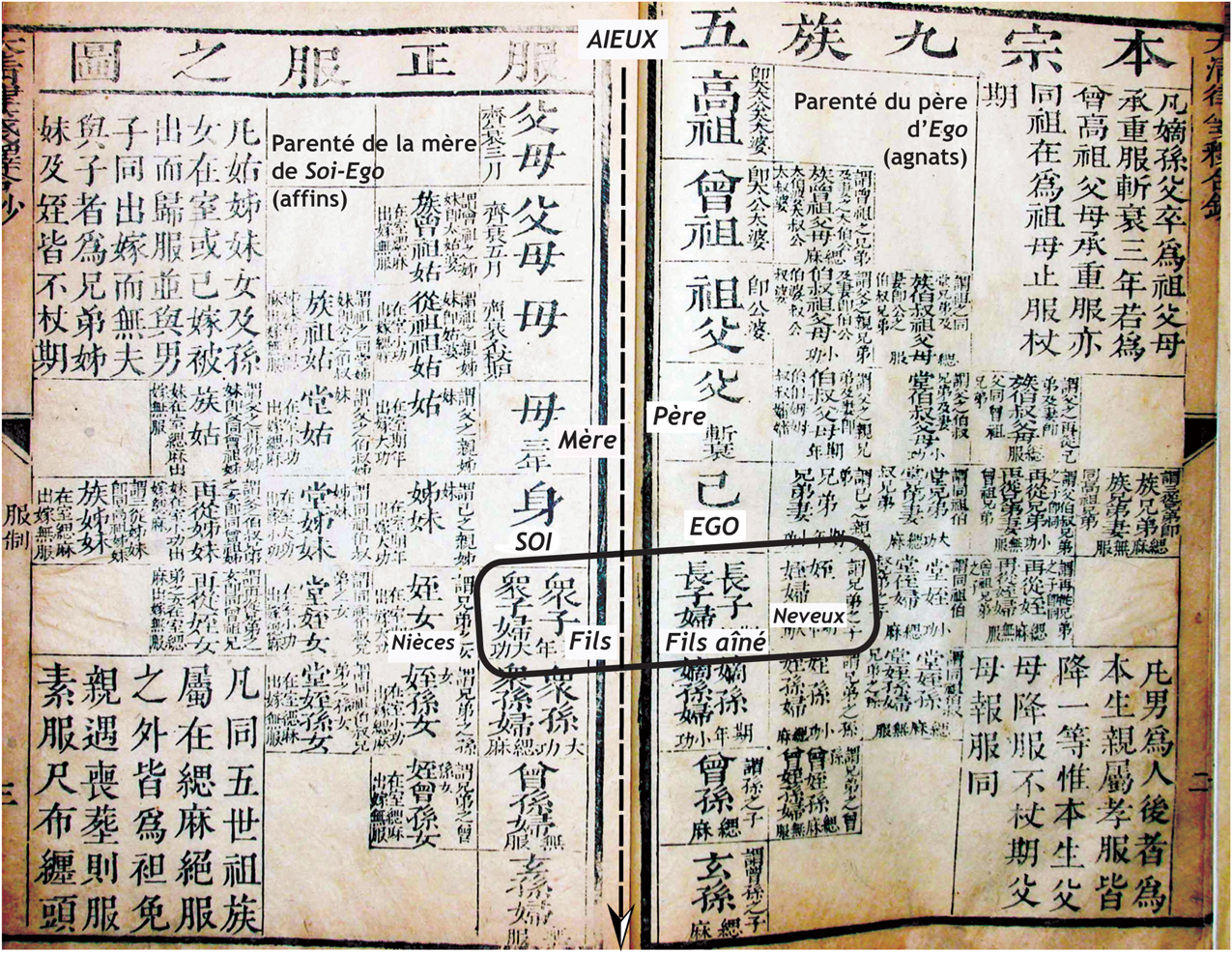
On a double page placed at the beginning of the Qing code, from top to bottom, are represented nine generations of ancestors (“aieux”), from great-grandparents to great-grandchildren, with “ego” or “self” in the central position—“ego” if he is the older son continuing the agnatic line (“parenté du père d'Ego, agnats,” right page); “self” if he is a younger brother starting a new collateral line (“parenté de la mère de Soi-Ego, affins”). Kinship is split into two sides: the agnatic main line (right page), from father to elder son leading to “ego” and his descendants and the affinal line derived from ego-self's mother's ascendance (on the left page). The experts’ argument bears on the position of sons (“fils”-“fils aîné”) and nephews (“neveux”), situated in adjoined boxes under “ego-self” (thick black rectangle), which the Taiwan expert regarded as a sign that nephews and sons were substitutable for any inheritance purpose, by shifting horizontally, whereas the Beijing expert stressed the ascendency line, linking sons to fathers vertically, which made this horizontal shifting of heirs an exception, subject to strict rules and protracted negotiations.


