Generalised anxiety disorder (GAD) is described as a chronic condition (Yonkers, Warshaw, Massion, & Keller, Reference Yonkers, Warshaw, Massion and Keller1996), commonly associated with other disorders (Brown & Barlow, Reference Brown and Barlow1992), which leads to significant impairment in the everyday life of its sufferers (Kessler, Walters, & Witchen, Reference Kessler, Walters, Wittchen, Heimberg, Turk and Mennin2004), and has a low probability of spontaneous recovery (Wittchenn & Hoyer, Reference Wittchen and Hoyer2001). GAD has attracted increasing research interest over the past few decades (Boschen, Reference Boschen2008). While CBT is suggested as a preferred type of therapy for GAD (Ballenger et al., Reference Ballenger, Davidson, Lecrubier, Nutt, Borkovec, Rickels and Wittchen2001) and several meta-analyses have supported its effectiveness in reducing general anxiety symptoms and pathological worrying in GAD sufferers (e.g., Borkovec & Ruscio, Reference Borkovec and Ruscio2001; Covin, Ouimet, Seeds, & Dozois, Reference Covin, Ouimet, Seeds and Dozois2008; Gould, Safren, Washington, & Otto, Reference Gould, Safren, Washington, Otto, Heimberg, Turk and Mennin2004; Westen & Morrison, Reference Westen and Morrison2001), the percentage of GAD individuals who do not respond optimally to CBT is larger than for other anxiety disorders (Brown, Barlow, & Liebowitz, Reference Brown, Barlow and Liebowitz1994). For instance, Newman and colleagues noted that CBT demonstrated the smallest average effect size for GAD in comparison with effect sizes of CBT for other anxiety disorders (Newman, Castonguay, Borkovec, Fisher, & Nordberg, Reference Newman, Castonguay, Borkovec, Fisher and Nordberg2008); and generally, only around 50% of GAD individuals reach high end-state functioning after treatment (Erikson & Newman, Reference Erickson and Newman2005).
In order to address these limitations and further enhance the outcomes for GAD individuals, a number of novel CBT-based approaches have been developed, including acceptance and commitment therapy (ACT; Hayes, Strosahl, & Wilson, Reference Hayes, Strosahl and Wilson1999; Hayes, Reference Hayes2004). Research has demonstrated that the application of ACT to mixed-anxiety disorders (including GAD) led to improvements that were comparable to CBT (e.g., Arch et al., Reference Arch, Eifert, Davies, Vilardaga, Rose and Craske2012). At the same time, the expansion of ACT has triggered numerous debates around how different or similar ACT is to traditional CBT (Herbert & Forman, Reference Herbert and Forman2013). Researchers have suggested that the main difference between the two approaches lies in their theoretical explanations of psychopathology (Forman et al., Reference Forman, Shaw, Goetter, Herbert, Park and Yuen2012). ACT places an emphasis on psychological flexibility and argues that experiential avoidance — either struggle with, or an attempt to control, aversive internal experiences (e.g., thoughts, feelings and sensations) — is a central reason for developing psychopathology (Hayes et al., Reference Hayes, Strosahl and Wilson1999). As a result, in order to increase psychological flexibility, the treatment focuses on present moment awareness, acceptance of unpleasant internal experiences, and promoting valued actions in areas that are important for a particular individual (Hayes et al., Reference Hayes, Strosahl and Wilson1999). On the other hand, CBT pinpoints dysfunctional cognitions, arising from flawed information processing, as one of the main contributors to psychopathology (Forman et al., Reference Forman, Shaw, Goetter, Herbert, Park and Yuen2012). Forman et al. (Reference Forman, Shaw, Goetter, Herbert, Park and Yuen2012) in their study that investigated unique and common mechanisms of change for ACT and CBT, concluded that ‘psychological acceptance strategies’ facilitated outcome for ACT, while ‘cognitive and affective change strategies’, such as cognitive restructuring, facilitated the outcome for CBT. Furthermore, the same authors noted that people's ability to distance themselves from their thoughts and not perceive them as absolute truths was a common factor in both interventions.
Currently, apart from a pilot study investigating ACT and CBT for GAD in older individuals (Wetherell et al., Reference Wetherell, Liu, Patterson, Afari, Ayers, Thorp and Petkus2011), there are no published, randomised controlled trials of ACT and CBT focusing exclusively on GAD. However, another acceptance-based approach, developed specifically for GAD — acceptance-based behavioural therapy (ABBT; Roemer & Orsillo, Reference Roemer, Orsillo, Orsillo and Roemer2005) — has been investigated in an open trial (Roemer & Orsillo, Reference Roemer and Orsillo2007), a randomised wait-list controlled trial (Roemer, Orsillo, & Salters-Pedneault, Reference Roemer, Orsillo and Salters-Pedneault2008), and a randomised controlled trial of ABBT and applied relaxation (Hayes-Skeleton, Roemer, & Orsillo, Reference Hayes-Skelton, Roemer and Orsillo2013). Results of a randomised controlled trial of ABBT for GAD using a wait-list control demonstrated its efficacy and indicated that 77% of participants achieved high end-state functioning at post-assessment, with these gains being maintained at both 3-month and 9-month follow-up (Roemer et al., Reference Roemer, Orsillo and Salters-Pedneault2008). Similarly, Hayes-Skeleton et al. (Reference Hayes-Skelton, Roemer and Orsillo2013) found that between 63.3% and 80% of participants in ABBT demonstrated clinically significant change, which was comparable to changes in applied relaxation. Nevertheless, the recommendations from Roemer et al. (Reference Roemer, Orsillo and Salters-Pedneault2008) and Powers, Zum Vörde Sive Vörding, and Emmelkamp (Reference Powers, Zum Vörde Sive Vörding and Emmelkamp2009) that further research is necessary to determine the generalisability of the findings, and in particular to further compare the acceptance based therapies to active treatments for GAD, remains. While there is now evidence that ACT can be effectively used for anxiety problems, research is still required comparing ACT with CBT to establish any advances in using ACT over CBT (Öst, Reference Öst2008; Powers et al., Reference Powers, Zum Vörde Sive Vörding and Emmelkamp2009).
With the aim to address the lack of comparisons of ACT to gold standard active treatments, the current study compared a group-based ACT with a group-based CBT. Furthermore, as the successful treatment of GAD often requires the individuals to attend around 16 individual sessions, providing prolonged psychological interventions in communities or clinical settings is often difficult because of limited resources or people's inability to afford costly sessions (Glaser, Blackledge, Shepherd, & Deane, Reference Glaser, Blackledge, Shepherd, Deane, Blackledge, Ciarrochi and Deane2009). Therefore, the current research also investigated whether a brief group therapy would lead to significant improvements in symptoms and the quality of life of GAD sufferers for both groups. Finally, the research also examined the processes theorised to underline GAD, such as experiential avoidance, cognitive avoidance, intolerance of uncertainty and positive believes about worrying.
Based on previous research (e.g., Arch et al., Reference Arch, Eifert, Davies, Vilardaga, Rose and Craske2012; Hayes-Skelton et al., Reference Hayes-Skelton, Roemer and Orsillo2013), it was hypothesised that both treatments would lead to significant and comparable improvements on symptom measures and quality of life and that these gains would be maintained at the follow-up. Furthermore, it was predicted that the ACT group would demonstrate greater changes on measures of experiential avoidance and intolerance of uncertainty compared to the CBT group, while equivalent results between the groups were expected on measures of cognitive avoidance and positive beliefs about worrying. We also hypothesised that applying a short, 6-week group therapy would lead to significant changes in outcome and process measures for both groups.
Method
Participants
Participants were individuals who met diagnostic criteria for GAD. They were recruited through community advertising (e.g., newspapers and flyers) and via emails at Griffith University, Queensland, Australia. Telephone screening interviews using the Anxiety Disorders Interview Schedule for DSM-IV (ADIS-IV; Di Nardo, Brown, & Barlow, Reference Di Nardo, Brown and Barlow1994) were undertaken to confirm a GAD diagnosis according to the DSM-IV criteria (Diagnostic and Statistical Manual of Mental Disorders, Fourth Edition; American, Psychiatric Association, 1994). Participants with comorbid disorders, such as major depressive disorder (MDD) or other Axis 1 disorders, were included in the study, provided that GAD symptoms were in the clinical range and identified as being the primary problem. A decision about a principal diagnosis was based on the Clinical Severity Ratings (CSRs) and was determined by the study interviewers. Participants with psychotic symptoms, major deficits in neurocognitive functioning (e.g., learning disability), substance abuse or dependence, and current suicidal intent were excluded from the study.
Those eligible to participate were randomly assigned to either ACT or CBT group therapy interventions. Based on CONSORT guidelines for running and reporting randomised controlled trials (Moher, Schulz, & Douglas, Reference Moher, Schulz and Douglas2001), Figure 1 shows the flow of participants throughout the study. Out of 64 individuals who met GAD diagnostic criteria and expressed interest in receiving therapy for their difficulties, 60 agreed to take part in the group treatments, while three participants decided to seek individual therapy. Furthermore, 10 participants, although initially agreeing to continue, withdrew from the study prior to the groups commencing. Various reasons were given, such as being away for the majority of sessions, transportation difficulties, or having other commitments. There were no significant differences between participants who withdrew from the study and those who commenced the group treatment on any demographic, outcome or process measures. These participants were not included in further analyses.
Flow of participants in a randomised controlled trial of acceptance and commitment therapy (ACT) and cognitive-behavioural therapy (CBT) for GAD.

The remaining 51 participants (34 females and 17 males), aged between 19 and 69 years (M = 36.17, SD = 13.1), were randomly allocated either to the ACT group (n = 25) or CBT group (n = 26). More than half of the participants (57%) were employed either full or part time, 27% identified themselves as students, and 16% of participants reported being unemployed. The percentage of participants in a relationship compared to those who were single was similar (43% vs. 45%) with around 12% of participants separated or divorced. A majority of individuals taking part in the study (62.7%) claimed to have had previous psychological treatment. Among those, 46.9% reported having multiple treatments in the past, including counselling, CBT and mindfulness. In addition, 37.5% of participants reported having counselling only, 6.2% had CBT only, and 9.5% received counselling in combination with mindfulness. One participant did not specify the type of therapy she had received in the past. Around half of the participants were taking psychotropic medication (49%). Those individuals were allowed to take part in the interventions if they were on a stable dose and agent for at least 1 month for benzodiazepines and beta blockers, and 3 months for serotonin reuptake inhibitors (SSRIs), serotonin norepinephrine reuptake inhibitors (SNRIs), and heterocyclics. Participants were required not to change their medication intake until the study was finalised. The most commonly taken medication was SSRI antidepressants (60%). Four participants reported using a benzodiazepine (16%), while an equivalent number of participants were taking either SNRIs (8%) or tricyclic antidepressants (TCAs; 8%). One participant (4%) was using tetracyclic antidepressants (TeCAs) and one other individual was taking beta blockers (4%).
Nine participants discontinued their therapy during the study period, three from the ACT group (12%) and six from the CBT group (23%). Four participants, even though completing treatment, did not return their post-assessment questionnaires (three from the ACT group and one from the CBT group). Thus, with 13 participants either not completing the group interventions or not returning their questionnaires, complete data from 38 participants was available at post-assessment, 19 in the ACT group and 19 in the CBT group. While the number of people who dropped out of therapy across both interventions was high (25.5%), this attrition rate is similar to other studies, such as Arch et al. (Reference Arch, Eifert, Davies, Vilardaga, Rose and Craske2012). Participants who dropped out of therapy did not differ from those who completed treatment on any characteristics (demographics or clinical variables) or study measure.
Diagnostic Measures
Anxiety Diagnostic Interview Schedule
(ADIS-IV; Di Nardo et al., Reference Di Nardo, Brown and Barlow1994). This ADIS-IV is a widely used semi-structured clinical interview that provides a comprehensive assessment of anxiety disorders. In addition to anxiety disorders, the ADIS-IV includes screening for mood disorders, substance use disorders, psychotic disorders and medical problems. It also provides a Clinical Severity Rating (CSR) for each diagnosis. This is a 9-point Likert scale with a range from 0 = none to 8 = extreme interference/distress. Ratings of 4 or higher indicate significant distress and impairment and allow for a diagnosis of GAD. The reported inter-rater reliability for principal GAD diagnosis is k = .67 (Brown, Di Nardo, Lehman, & Campbell, Reference Brown, Di Nardo, Lehman and Campbell2001). In this study, the inter-rater reliability was not calculated as the ADIS-IV interviews were conducted over the phone and not recorded to allow a comparison between the assessors.
Outcome Measures
Penn State Worry Questionnaire (PSWQ; Meyer, Miller, Metzger, & Borkovec, Reference Meyer, Miller, Metzger and Borkovec1990)
The PSWQ is a 16-item, self-reported measure of trait worry. It measures the degree to which worry is excessive, uncontrollable, and pervasive. Items are rated on a 5-point Likert scale ranging from 1 = not at all typical of me to 5 = very typical of me, with higher scores indicating higher levels of worry. The PSWQ has demonstrated good to very good internal consistency (coefficients alpha ranging from .86 to .93. across clinical and college samples) and adequate to good test-retest reliability (r = .74 to .93 across periods ranging from 2 to 10 weeks (Molina & Borkovec, Reference Molina, Borkovec, Davey and Tallis1994). In the current study, the internal consistency was very good, with α = .90.
Depression, Anxiety and Stress Scale — 21 (DASS-21; Lovibond & Lovibond, Reference Lovibond and Lovibond1995)
Participants’ levels of depression, stress and anxiety were assessed using the DASS-21. The DASS is a self-reported questionnaire with items rated on a 4-point Likert scale ranging from 0 = did not apply to me at all to 3 = applied to me very much, or most of the time. Higher scores suggest greater levels of depressive, anxiety and stress symptoms. The DASS has been found to have good internal consistency (α = .91, .84, .90 for depression, anxiety and stress, respectively; Lovibond & Lovibond, Reference Lovibond and Lovibond1995). In the current study, the DASS-21 subscales demonstrated good internal consistency (α = .90 for depression, α = .81 for anxiety and α = .84 for stress).
Quality of Life Inventory (QOLI; Frish, Cornwell, Villanueva, & Retzlaff, Reference Frish, Cornwell, Villanueva and Retzlaff1992)
The QOLI measures participants’ satisfaction with 16 areas of life (e.g., health, work, relationships, goals and values, romantic relationships, recreation). It is calculated in terms of its importance (0 = not important; 1 = slightly important, and 3 = extremely important) and levels of satisfaction (ranging from −3 = very dissatisfied to 3 = very satisfied). These results are then multiplied for each domain, giving an average satisfaction level across domains with a range from −6 to 6. The QLI demonstrated good internal consistency (α = .79 in a community sample) and good test-retest reliability over a 2-week period, r = .73 (Frish, Reference Frish1994). The internal consistency for the current study was good, with α = .83.
Ratings Recorded During the Group Interventions
Self-reported ratings of distress and interference
To measure participants’ perception of any changes in their levels of distress or interference of worrying on their everyday life over the course of treatment, a 9-point Likert scale was used. The scale range was from 0 = none to 8 = extreme interference/distress. The higher score indicated greater distress and interference. Similar to CSR, ratings of 4 or above were considered as an indication of significant difficulties. The ratings were recorded at the beginning of treatment (Session 1), at mid-treatment (Session 3) and at the end of treatment (Session 6).
Process Measures
Acceptance and Action Questionnaire (AAQ; Hayes et al., Reference Hayes, Strosahl, Wilson, Bissett, Pistorelo, Toarmino and McCurry2004)
The AAQ was used to measure the construct of experiential avoidance. The questionnaire measures the extent of participants’ accepting attitude toward negative feelings and experiences and ability to take action even when feeling uncertain. A 19-item version of AAQ was used. This allowed calculation of the single factor 9-item solution (AAQ-9) and 16-item dual factor solution — Action and Willingness factors (Bond & Bunce, Reference Bond and Bunce2003). Participants rated items on a 7-point Likert scale ranging from 1 = never true to 7 = always true, with higher scores indicated greater acceptance of negative feelings and experiences. The AAQ has demonstrated acceptable internal consistency (α = .70) and test-retest reliability (r = .64) over a 4-month period (Hayes et al., Reference Hayes, Strosahl, Wilson, Bissett, Pistorelo, Toarmino and McCurry2004). In the current study, internal consistency was similar with α = .70 for AAQ-9, and α = .69 for both action and willingness subscales.
Intolerance of Uncertainty (IUS; English translation: Buhr & Dugas, Reference Buhr and Dugas2002)
The IUS is a 27-item, self-reported measure designed to assess several aspects of intolerance of uncertainty, such as ideas that uncertainty is not acceptable and leads to frustration, stress and inability to take action. Items are rated on a 5-point Likert scale ranging from 1 = not at all characteristics of me to 5 = entirely characteristic of me. Higher scores indicate greater intolerance of uncertainty. The English translation of the IUS has demonstrated very good internal consistency in a sample of college students, α = .94, and good test-retest reliability over a period of 5 weeks, r = .74 (Buhr & Dugas, Reference Buhr and Dugas2002). Similar results for internal consistency were obtained in the current study with α = .96.
Cognitive Avoidance Questionnaires (CAQ; English translation: Sexton & Dugas, Reference Sexton and Dugas2008)
Cognitive avoidance was measured by the CQA, a 25-item, self-reported measure that includes five cognitive avoidance strategies: suppressing worrisome thoughts, substituting neutral and positive thoughts for worry, avoidance of threatening stimuli, distraction, and transformation of images into thoughts. The items are rated on a 5-point Likert scale and range from 1 = not at all typical to 5 = completely typical. The CAQ has shown very good internal consistency (α = .95) and good test-retest reliability over a 4- to 6-week period, r = .85 (Sexton & Dugas, Reference Sexton and Dugas2008). In the current study, the internal consistency for the scale was very good with α = .96.
Why Worry-II (WW-II: English translation: Holowka, Dugas, Francis, & Langesen, Reference Holowka, Dugas, Francis and Laugesen2000)
To measure perceived positive consequences of worry, the WW-II was administered. The WW-II is a 25-item revised version of the earlier Why Worry scale (WW). Participants indicate how much they agree with each statement on a 5-point Likert scale ranging from 1 = not at all characteristic of me to 5 = entirely characteristic of me. Holowka et al. (Reference Holowka, Dugas, Francis and Laugesen2000) reported very good internal consistency for the total WW-II (α = .93). Similar results were obtained in the current study, with α = .95 for the total scale.
Procedure
The study was approved by the Griffith University Human Research Ethics Committee. Participants who met criteria for GAD were invited to take part in GAD group treatment at Griffith University, Queensland, Australia. Diagnostic interviews were conducted over the phone by a clinical psychologist not otherwise involved in the current study, and a registered psychologist and doctoral level student in clinical psychology. Participants were also required to complete a questionnaire booklet that was mailed to them. Participants were randomly assigned to either CBT or ACT condition using simple randomisation. The randomisation process was conducted by the first author with the leading group therapist blind to the randomisation procedure. The current study did not use a wait-list control group. The decision was based on a suggestion that the comparison of a relatively new treatment and a well-established one does not need to include a control group (Kazdin, Reference Kazdin2002).
Each treatment condition was delivered in a group format and conducted across 6 weeks. Sessions lasted for 2 hours. Participants were assessed before starting the group treatment (pre-assessment), after completing the program (post-assessment) and then again at 3-months’ follow-up. A total of 12 groups (6 ACT and 6 CBT) were conducted. The groups were small in size and included between four and six participants per group. For individuals who missed a group session, an individual meeting was scheduled to go through missed material and exercises. Participants received treatment free of charge. No incentives were given to participants for taking part in the study.
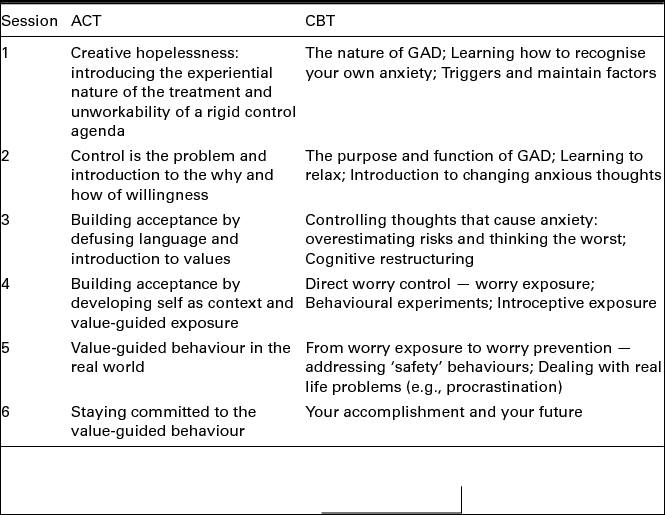
Both groups followed previously developed anxiety treatment manuals. The CBT group was based on Zinbarg, Craske, Barlow, and O’Leary's (Reference Zinbarg, Craske, Barlow and O’Leary1993) manual for GAD, while the ACT group was founded on Eifert and Forsyth's (Reference Eifert and Forsyth2005) and Forsyth and Eifert's (Reference Forsyth and Eifert2007) anxiety manuals. The ACT group also followed a 6-week session group structure proposed by Glaser, Blackledge, Shepherd, and Deane (Reference Glaser, Blackledge, Shepherd, Deane, Blackledge, Ciarrochi and Deane2009). Table 1 briefly outlines the session content for both interventions across 6 weeks.
A Brief Outline of ACT and CBT Group Protocol for GAD
The CBT group focused on targeting cognitive biases, physiological arousal and avoidance behaviour (Zinbarg et al., Reference Zinbarg, Craske, Barlow and O’Leary1993), while the ACT group protocol placed an emphasis on accepting thoughts and feelings and living a life consistent with one's values (Forsyth & Eifert, Reference Forsyth and Eifert2007). In both groups, participants were required to practise relevant skills between the sessions (e.g., progressive muscle relaxation and challenging unhelpful thinking in the CBT group, and mindfulness and cognitive defusion in the ACT group).
Therapists
To control for therapist effect confounds, each session for both groups was conducted jointly by the same therapists. Author (SM) is a practising clinical and health psychologist and academic, with over 25 years’ experience in CBT and has also undertaken training in ACT. Author (EA), a registered psychologist and doctoral level student in clinical psychology, was trained and supervised in CBT at Griffith University as a part of her degree requirement. She has also completed ACT training (2-day introductory and 2-day advanced workshops) between 2008 and 2010. Supervision sessions were provided weekly in 2-hour sessions.
Treatment Fidelity and Competence
The Drexel University ACT/CBT Therapist Adherence and Competence Rating Scale (DUACRS: McGrath et al., Reference McGrath, Forman, del Mar Cabiya, Hoffman, Marques, Moitra and Zabell2005) was used to assess treatment fidelity
The DUACRS is designed to assess therapist practices specific to ACT and CBT, as well as some general therapist behaviours. For the purpose of the current study, only practices related specifically to ACT and CBT, as well as the therapist competence subscale, were evaluated rather than general therapist behaviours. The ACT and CBT subscales showed very good inter-rater reliability, as measured by the intra-class correlation coefficient (ICC = .96 for ACT and ICC = .94 for CBT) and internal consistency (α = .93 for ACT and α = .91 for CBT). The inter-rater reliability for the competence subscale was found to be good with ICC = .86, while the internal consistency was very good with α = .95 (McGrath et al., Reference McGrath, Forman, del Mar Cabiya, Hoffman, Marques, Moitra and Zabell2005). In the current study, the internal consistency of the competence subscale and intra-class correlation were good (α = .83 and ICC = .86). Furthermore, the inter-rater agreement relating to whether specific ACT- or CBT-related skills were used within a particular session was assessed using kappa. The inter-rater reliability for the current study was good with a kappa value of .74.
In the current study, 20% of randomly selected, digitally recorded sessions were rated by two independent clinical psychologists who were trained both in ACT and CBT and who had no other involvement with the current study. The independent ratings indicated a 100% adherence to treatment protocols for each of the groups. The therapist's competence was assessed in relation to five skills: ‘knowledge of treatment’, ‘skill in delivering treatment’, ‘appropriate application of treatment components within the context of session’, ‘relationship with the client’, and ‘overall performance’. Each skill was rated on a 5-point Likert scale. Similar scores were obtained for each group treatment. For the ACT group, the knowledge of treatment was rated as 4.8, the skill in delivering treatment as 4.5, the appropriate application of treatment components as 4.4, and the relationship with participants as 4.2. The CBT received the following ratings: 5 for the knowledge of treatment, 4.8 for the skill in delivering treatment, 4.6 for the appropriate application of treatment components, and 4.2 for the relationship with participants. Finally, the overall competence was judged to be 4.4 for the ACT group and 5 for the CBT group.
Results
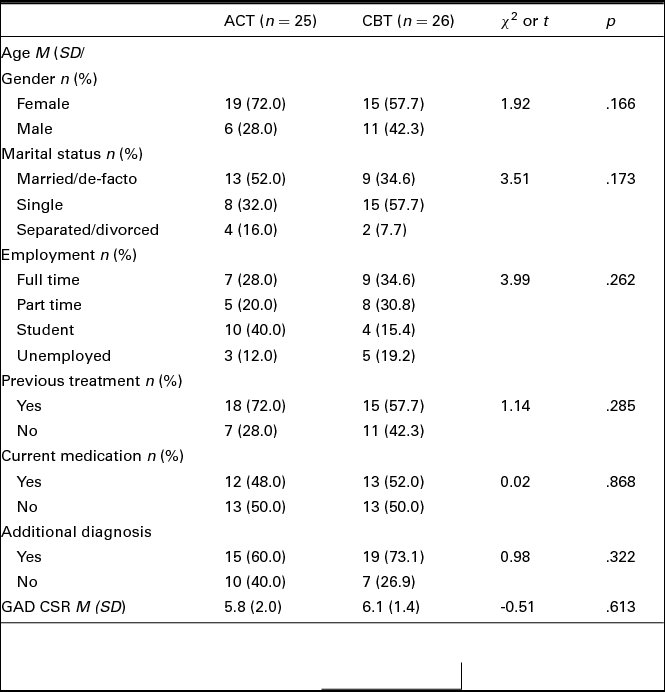
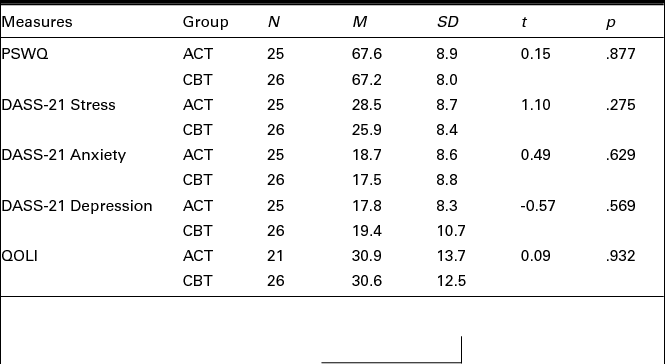
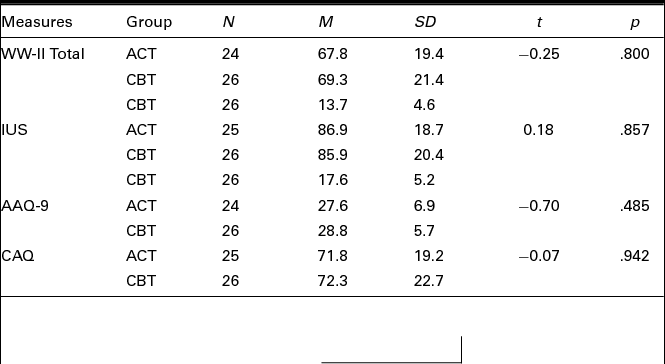
Data were analysed using Statistical Package for the Social Sciences (SPSS) Version 20 for Windows. To check the comparability of participants in the ACT and CBT group at pre-assessment, a series of independent group t tests and chi-square tests were conducted. As indicated in Tables 2, 3 and 4, no significant differences between the groups on any demographic characteristics, clinical ratings, outcome or process measures were found.
Comparisons of Demographic and Clinical Characteristics at Pre-Assessment for ACT and CBT Groups
Note: GAD (CSR) = Generalised Anxiety Disorder (Clinical Severity Rating)
Comparisons of Outcome Variables at Pre-Assessment Between ACT and CBT Groups
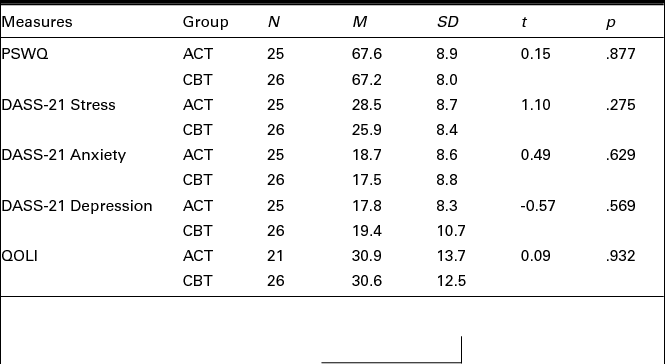
Note: PSWQ = Penn State Worry Questionnaire, DASS = Depression, Anxiety and Stress Scale, QOLI = Quality of Life Inventory.
Comparisons of Process Measures at Pre-assessment Between ACT and CBT Groups
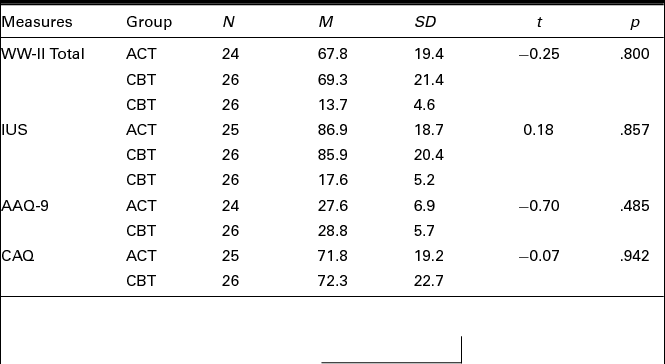
Note: WW-II = Why Worry — II Questionnaire, IUS = Intolerance of Uncertainty Scale, AAQ = Action and Acceptance Questionnaire, CAQ = Cognitive Avoidance Questionnaire.
Pre- to post-assessment analyses were performed in two ways: using only completion data with 38 participants and on an intent-to-treat (ITT) basis including all 51 participants. ITT analyses were conducted using the last-observation-carry-forward method. This method is based on the conservative hypothesis that individuals who discontinued treatment experienced no change. The effects of treatment type on symptoms (worrying, anxiety, stress, and depression), process measures (positive beliefs about worrying, experiential avoidance, intolerance of uncertainty, cognitive avoidance, and fear of experiencing emotions) and quality of life of GAD individuals, was analysed using a series of 2 (group: ACT vs. CBT) × 2 (time: pre-assessment and post-assessment) mixed factorial analyses of variance (ANOVA). Another set of 2 × 2 mixed factorial ANOVAs were conducted to examine changes from the post-assessment to 3-month follow-up in order to identify any maintenance of treatment effects. In addition, to investigate changes in ratings of distress and interference over the course of therapy, 3 (time: Session 1, Session 3, and Session 6) × 2 (group: ACT vs. CBT) mixed factorial ANOVA was performed.
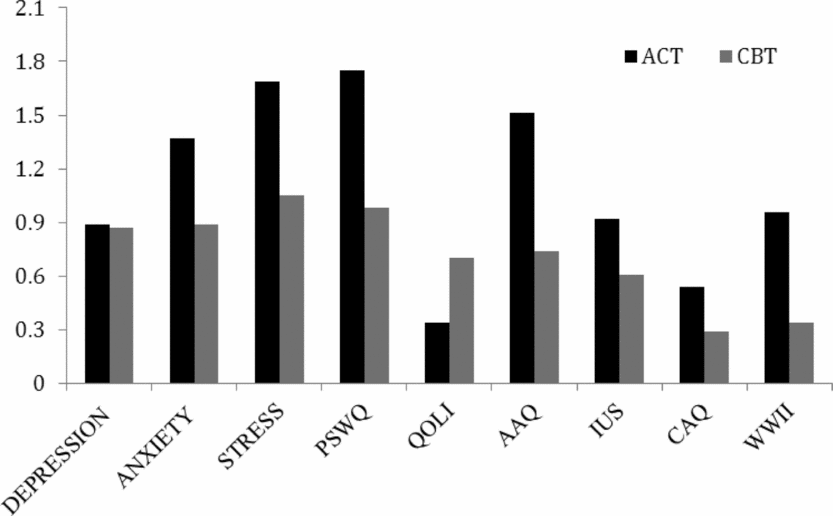
Effect sizes were calculated using partial eta squared (η2), which indicates the proportion of variance accounted for by the main effect or interaction. In addition, to facilitate comparison with other efficacy studies, Cohen's d was also computed (Figure 2) for within-group repeated measures effects using the Effect Size Generator for Windows: version 2.3 (Devilly, Reference Devilly2004).
Effect sizes (d) comparing ACT and CBT from pre- to post-assessment on all study measures.
Comparison Between the ACT Group and CBT Group From Pre- to Post-Assessment
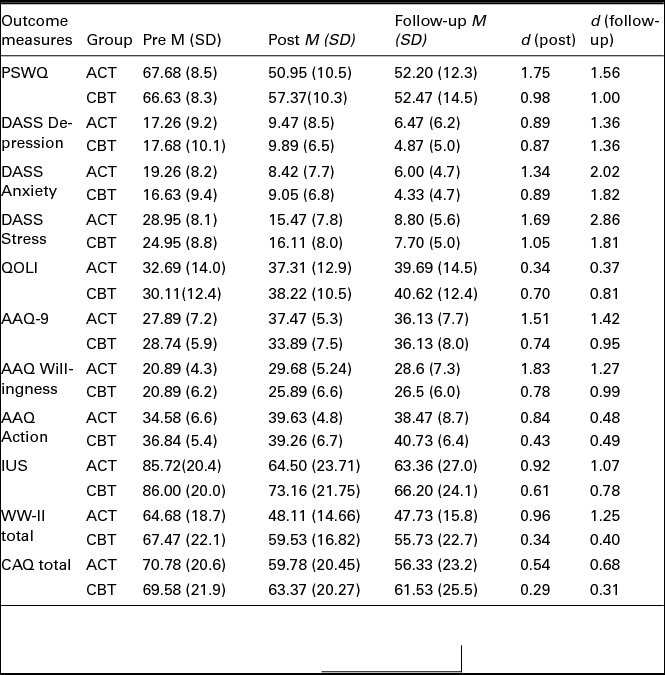
Table 5 provides a summary of means and standard deviations for all measures at each assessment point. It also presents within-group effect sizes (d) for completers at post-assessment and follow-up for each intervention group.
Means, Standard Deviations and Within Group Effect Sizes for All Measures (Completers Data)
Note: PSWQ = Penn State Worry Questionnaire, DASS = Depression, Anxiety and Stress Scale, QOLI = Quality of Life Inventory, AAQ = Action and Acceptance Questionnaire, IUS = Intolerance of Uncertainty Scale, WW-II = Why Worry II Questionnaire, CAQ = Cognitive Avoidance Questionnaire, ACS = Affective Control Scale.
Outcome Measures
Worrying (PSWQ; Meyer et al., Reference Meyer, Miller, Metzger and Borkovec1990)
For the PSWQ there was a significant main effect of time, indicating significant reductions in pre- to post-levels of worrying across both groups, F(1, 36) = 59.90, p < .001, partial η2 = .625. Furthermore, a significant interaction was found between the group and time, F(1, 36) = 4.95, p = .032, partial η2 = .121. Simple effect analysis showed a greater reduction of worrying at post-assessment for the ACT intervention compared to the CBT intervention; however, the found difference did not reach statistical significance, F(1, 36) = 3.64, p = .064, partial η2 = .092.
PSWQ: ITT
Similar results for the PSWQ were obtained using the ITT analysis. A significant reduction in worrying symptoms from pre- to post-assessment was found across both groups, F(1, 49) = 42.54, p < .001, partial η2 = .465. While time × group interaction only approached statistical significance, F(1, 49) = 3.97, p = .052, partial η2 = .075, the effect size of the difference was moderate and suggested a sharper decline in worrying from pre- to post-treatment for the ACT group compared to the CBT group. No main effect of group was found, F(1, 49) = 1.51, p = .289, partial η2 = .023.
Depression, Anxiety, and Stress (DASS-21; Lovibond & Lovibond, Reference Lovibond and Lovibond1995)
The results showed a significant main effect of time from pre- to post-assessment, suggesting that participants across the two groups reported significantly lower levels of depression, F(1,36) = 31.75, p < .001, partial η2 = .469, fewer anxiety symptoms, F(1, 36) = 53.55, p < .001, partial η2 = .600, and fewer stress symptoms, F(1, 36) = 64.68, p < .001, partial η2 = .642, after completing the group treatments. No significant time × group interaction and no main effect of group were found for any of the DASS subscales.
DASS-21: ITT
The ITT analyses also revealed significant main effect of time for each of the DASS subscales across both group. Participants reported significantly lower levels of depressive symptoms, F(1, 49) = 26.31, p < .001, partial η2 = .349, anxiety, F(1, 49) = 39.65, p < .001, partial η2 = .447, and stress, F(1, 49) = 45.12, p < .001, partial η2 = .479 from pre- to post-assessment. There was no significant main effect of group, and no interaction effect found for the DASS subscales.
Quality of Life (QOLI; Frish et al., Reference Frish, Cornwell, Villanueva and Retzlaff1992)
A significant improvement in quality of life was noted across both groups from pre- to post-assessment, F(1, 32) = 10.71, p = .003, partial η2 = .251. There was no main effect of group F(1, 32) = .048, p = .828, partial η2 = .001 and no interaction between group and time F(1, 32) = .803, p = .377, partial η2 = .024.
Quality of Life: ITT
Comparable results were obtained using the ITT sample. Participants reported better quality of life at post-assessment across both interventions, F(1, 45) = 7.81, p = .008, partial η2 = .148. No main effect of group, F(1, 45) = 0.00, p = .985, partial η2 = .000, and no interaction between group and time, F(1, 45) = .078, p = 0.78, partial η2 = .002, was found.
Ratings of Distress and Interference (ITT)
The results of a 3 × 2 mixed factorial ANOVA revealed a significant main effect of time on distress ratings, F(2,98) = 24.96, p = .000, partial η2 = .337, indicating that participants’ levels of distress lowered over the course of treatment across both groups. There was a significant time × group interaction, F(2, 98) = 3.50, p = .038, partial η2 = .067. Also, a significant main effect of group was found, F(1, 49) = 4.93, p = .031, partial η2 = .091. Simple effect analysis showed that the groups differed at reported distress levels in the last treatment session, with the ACT group showing significantly lower levels of distress compared to the CBT group, F(1,49) = 8.44, p = .005, partial η2 = .147.
A second 3 × 2 mixed factorial ANOVA for ratings of interference of GAD symptoms on participants’ everyday life was calculated. Significant main effect of time was also found, F(2, 98) = 26.15, p = .000, partial η2 = .348, showing that participants, across both groups, reported lower levels of interference of their symptoms with everyday life activities over the course of therapy. There was no main effect of group, F(1, 49) = 2.85, p = .098, partial η2 = .055. The results indicated a significant interaction effect, suggesting a steeper changes in interference for the ACT group compared to the CBT group, F(2, 98) = 5.60, p = .003, partial η2 = .109. Simple effect analysis demonstrated a significant difference between the groups in Session 6, F(1, 49) = 8.82, p = .005 partial η2 = .153, with participants in the ACT group reporting lower levels of interference compared to the CBT group.
Process Measures
Experiential avoidance (AAQ: Hayes et al., Reference Hayes, Strosahl, Wilson, Bissett, Pistorelo, Toarmino and McCurry2004)
The results showed a significant main effect of time for the AAQ-9, (1, 36) = 42.8, p < .001, partial η2 = .543, indicating greater experiential acceptance across both groups at the end of treatment. Similar results were obtained for the action and willingness subscales, whereby participants reported a significant increase in their acceptance of unwanted experiences from pre- to post-assessment across both groups; action subscale, F(1, 36) = 30.63, p < .001, partial η2 = .460; and willingness subscale, F(1, 36) = 52.31, p < .001, partial η2 = .592.
Even though no significant time × group interaction was found for the AAQ-9, F(1, 36) = 3.85, p = .057, partial η2 = .097; action subscale, F(1, 36) = 3.80, p = .059, partial η2 = .095; or willingness subscale, F(1, 36) = 3.95, p = .055, partial η2 = .099, the obtained effect sizes were moderate, suggesting greater magnitude of change from pre- to post-assessment for the ACT group compared to the CBT group. There was no main effect of group for either the AAQ-9 scale or the action and willingness subscales.
AAQ: ITT
The mixed factorial analysis for the AAQ-9 using the ITT data showed the main effect of time, F(1, 48) = 45.79, p < .001, partial η2 = .488, with greater experiential acceptance across both treatment interventions from pre- to post-treatment. A similar trend of steeper increase in acceptance and action subscales for the ACT group compared to the CBT group was noted for the ITT sample as well.
Positive beliefs about worrying (WW-II; English Translation: Holowka et al., Reference Holowka, Dugas, Francis and Laugesen2000)
A significant main effect of time for the total score on the WW-II was found, demonstrating a significant decrease in positive beliefs about worrying from pre- to post-assessment across both groups, F(1, 36) = 25.39, p < .001, partial η2 = .414. There was no significant time × group interaction, F(1, 36) = 3.14, p = .085, partial η2 = .080, and no main effect of group, F(1, 36) = 1.73, p = .197, partial η2 = .046. Nevertheless, while the interaction effect was not significantly different, a trend of steeper decrease on this measure was found for the ACT group relative to the CBT group.
WW-II: ITT
The results of the ITT analysis for the WW-II total showed the main effect of time, F(1, 49) = 22.57, p < .001, partial η2 = .320, with participants across the groups reporting reduced beliefs in positive benefits of worrying from pre- to post-assessment. There was no main effect of group, F(1, 49) = .94, p = .335, partial η2 = .019, and no time × group interaction, F(1, 49) = 3.37, p = .073, partial η2 = .066. Once more, the interaction effect size was moderate, suggesting steeper changes for the ACT group.
Intolerance of Uncertainty (IUS; English translation: Buhr & Dugas, Reference Buhr and Dugas2002)
The results demonstrated a significant main effect of time, F(1, 35) = 68.21, p < .001, partial η2 = .661, showing participants’ greater ability to handle uncertainty after treatment completion compared to pre-assessment across both groups. Time × group interaction approached significance, F(1, 37) = 4.13, p = .050, partial η2 = .106, indicating greater increase in tolerating uncertainty for participants in the ACT group as opposed to the CBT group. No main effect of group, F(1, 35) = .440, p = .511, partial η2 = .012 was found.
Intolerance of Uncertainty: ITT
Correspondingly, the mixed factorial analysis on the IUS, using the ITT data, showed a significant main effect of time, F(1, 48) = 45.79, p < .001, partial η2 = .488, whereby a greater tolerance of uncertainty was reported by participants from pre- to post-assessment across both groups. While the ACT group demonstrated a steeper improvement with moderate effect size, the difference found did not reach statistical significance, F(1, 48) = 3.05, p = .087, partial η2 = .060. There was no main effect of group, F(1, 48) = .21, p = .651, partial η2 = .004.
Cognitive avoidance
The results on the CAQ showed a significant main effect of time, F(1, 35) = 11.39, p = .002, partial η2 = .245, suggesting that both treatment groups demonstrated a significant reduction in using cognitive avoidance strategies at treatment completion. There was no significant time × group interaction, F(1, 35) = .882, p = .354, partial η2 = .025, and no main effect of group, F(1, 35) = .035, p = .852, partial η2 = .001.
Cognitive Avoidance: ITT
Similar results were obtained in the ITT analysis, with a significant main effect of time, F(1, 49) = 12.14, p = .001, partial η2 = .199, and no significant time × group interaction and no main effect of group.
Maintenance of Treatment Effects: Comparisons Between ACT and CBT from Post- to 3-Month Follow-Up
Treatment benefits were maintained at 3-month follow-up for both worrying and quality of life, while further significant improvements were found in relation to depression, F(1, 28) = 6.25, p = .019, partial η2 = .183, anxiety, F(1, 28) = 8.92, p = .006, partial η2 = .242, and stress symptoms, F(1, 28) = 47.26, p < .001, partial η2 = .628, across both groups. No significant time × group interactions or main effect of group was found for any of the outcome measures at the follow-up assessment. Similarly, significant treatment gains reported on process measures at post-assessment were sustained at the follow-up.
Clinical Significance and Reliable Change
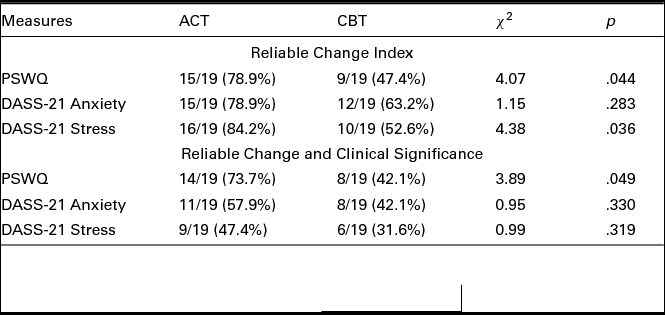
To investigate whether clinically significant and/or reliable change occurred for individual participants, as suggested by Jacobson and Truax (Reference Jacobson and Truax1991), the Reliable Change Index (RCI) and clinical significance change (CS) were calculated. Jacobson and Truax's (Reference Jacobson and Truax1991) formula for calculating the RCI was used (RCI = [pre-test – post-test score]/standard error of measurement). To achieve RCI, participants needed to improve more than two standard deviations on any particular measure (cut-off score > 1.96). In addition, clinically significant change was reached if participants’ scores at post-assessment were more likely to belong to functional than to dysfunctional population and was calculated using Jacobson and Truax's (Reference Jacobson and Truax1991) formula. The same formulae were used for determining change at 3-month follow-up. The RCI and CS for each of the symptom measures at post-assessment are presented in Table 6.
Reliable Change and Clinical Significance at Post Assessment
Note: PSWQ = Penn State Worry Questionnaire, DASS-21 = Depression, Anxiety and Stress Scale.
In relation to worrying, at post-assessment 78.9% of participants from the ACT group reached reliable change (RCI > 1.96) compared to 47.4% of participants in the CBT group. Furthermore, 73.7% of participants in the ACT group achieved both reliable change and clinical significance relative to 42.1% of participants in the CBT group. However, there were no differences between the two interventions at the follow-up assessment, with both groups achieving reliable change rates of 60%.
Discussion
The study investigated the relative efficacy of the group ACT intervention compared to the group CBT for GAD. The results suggested that each treatment condition demonstrated significant improvements on all measures from pre- to post-assessment. Furthermore, the obtained benefits were maintained at 3-month follow-up, with further gains on the DASS-21 for both groups. These findings imply that a short, 6-week group therapy, either ACT or CBT, can lead to significant progress in outcomes among GAD individuals. Apart from the measure of quality of life, whereby a moderate effect size was recorded (d = 0.5), the changes on the outcome measures indicated large effect sizes. The results might be particularly relevant for community settings where psychological resources are often limited and longer therapy is often not feasible.
When compared to each other, both groups showed similar improvements in participants’ reported levels of depression, stress, anxiety, and quality of life from pre- to post-assessment. These results are comparable to other randomised controlled trials of ACT and CBT, such as Forman, Herbert, Moitra, Yeomans, and Geller (Reference Forman, Herbert, Moitra, Yeomans and Geller2007) and Arch et al. (Reference Arch, Eifert, Davies, Vilardaga, Rose and Craske2012). Both of these studies found that ACT and CT/CBT interventions achieved similar improvements at treatment completion on either anxiety specific measures or broader outcomes (e.g., quality of life). In addition, the above treatment benefits obtained in the current study at the end of the group interventions were either maintained or further improved at 3-month follow-up, with no significant differences between the two groups.
Furthermore, participants in both groups reported a significant reduction in their worrying symptoms from pre- to post-assessment. However, the ACT group demonstrated significantly steeper gains over the course of treatment, with moderate interaction effect size (d = .79), compared to the CBT group. While the ACT group initially achieved greater improvements in participants’ worrying symptoms, this difference was not evident at the follow-up, with both groups showing comparable results on the PSWQ. Equally, the changes in distress and interference over the course of therapy were greater for the ACT than for the CBT condition. Similar results were achieved in relation to reliable change and clinical significance rates. While a larger number of participants in the ACT group were considered improved or recovered at the end of treatment compared to the CBT groups, no differences between the groups were recorded at the follow-up, with participants in the CBT group continuing to improve from post- to follow-up assessment. These findings might suggest that ACT delivered in a group format can lead to rapid clinical changes for individuals with GAD in a short period of time, especially in relation to worrying. While the CBT group achieved comparable results at the follow-up, it seemed that the clinical changes in CBT were more gradual compared to ACT, and that participants in the CBT group needed more time to practise the CBT skills. This might also be the case due to conducting worry exposure exercises in the CBT group towards the end of the intervention (week 4 and week 5), and thus not allowing enough practice for participants to report greater changes at the post-assessment.
In relation to process measures, and consistent with the hypotheses, the findings indicated that although both groups reported greater acceptance of distressing thoughts, sensations and feelings, and increased tolerance of uncertainty at the end of treatment, a trend towards a steeper increase on these measures with moderate effect sizes was recorded for the ACT group compared to the CBT group. Equivalent improvements were found on a measure of cognitive avoidance, whereby participants in both groups reported less avoidance of cognitive and emotional materials. These results are consistent with the proposition that ACT might achieve changes through decreasing experiential avoidance and that CBT results might be attributable to affective and cognitive changes (Forman et al., Reference Forman, Shaw, Goetter, Herbert, Park and Yuen2012). All treatment gains on process measures were maintained at the follow-up assessment.
The main limitation of the current study is a small sample size that makes it hard to detect possible significant differences between the groups due to limitations of statistical power. Unfortunately, even the preparation strategies to overcome this problem did not achieve the wanted effect, due to the fact that this was research was conducted for a postgraduate degree, with limited resources that did not allow the continuation of participants’ recruitments until predetermined numbers were met. Another limitation was in not calculating inter-rater reliability for ADIS interviews. However, all interviews were performed by either an experienced clinical psychologist or registered psychologist with at least 2 years of clinical practice. In addition, regular daily discussions were scheduled, particularly around those interviews that raised some uncertainty regarding a diagnosis. Those cases were discussed in detail and mutual agreement about a diagnosis was made. Furthermore, the ADIS-IV and CSRs were not administered at post-assessment. As the groups’ treatment included only six sessions, we believed that insufficient time had passed since their initial interview for the ADIS-IV to be readministered. However, we did measure possible changes in severity of symptoms and their interference with everyday life, using a self-reported measure that was administered in Session 1, Session 3, and Session 6. While we acknowledge the limitations in using self-report measures, this is common practice in much psychological research. Inclusion of longer follow-up (e.g., 12 months) would provide important information about the long-term efficacy of both treatment interventions. While therapists’ allegiance with either ACT or CBT was not assessed, adherence ratings evaluated by the independent assessors indicated 100% adherence to each of those treatment conditions. Furthermore, there were no statistically significant differences in therapists’ competences between the treatment groups, suggesting that therapist variables did not influence the study results.
In summary, to add to the limited number of published data comparing ACT to other active treatments, such as traditional CBT, the current randomised controlled trial explored the efficacy of the group ACT to the group CBT for GAD. The study also investigated whether satisfactory outcomes can be achieved in a group format and over a short period of time. Overall, the study demonstrated that ACT for GAD is as efficacious as the gold-standard CBT treatment for GAD. The excellent outcomes with large effect sizes that were achieved in a short-term group format should encourage the use of this cost-effective treatment approach. This was particularly evident for the ACT group, whereby the majority of participants showed clinical improvements at the end of treatment. Similar improvement rates were achieved at 3-month follow-up for the CBT group, suggesting that the CBT group might have needed more time to practise the skills in order to reach similar outcomes.
Despite the pleasing outcomes from this study, the results do need to be interpreted with caution due to the small, well-educated sample size. The study needs to be replicated with a greater number of participants with more diverse demographic characteristics. A larger sample will allow further opportunity to investigate mechanisms of change, and to ascertain which of these evidence-supported therapies might work best for whom, and whether the benefits such as those obtained in this study can be sustained over a longer period of time (e.g., 12 months).