Introduction
In recent decades, a small group of scholars of policy analysis has shifted its attention to examine policies dealing with morally charged problems (Tatalovich and Daynes Reference Tatalovich and Daynes1998; Mooney Reference Mooney2001a; Engeli et al. Reference Engeli, Green-Pedersen and Thorup Larsen2012; Knill Reference Knill2013; Johnson Reference Johnson2015). Typical examples are the regulation of abortion, euthanasia, sexual conduct and prostitution (Minkenberg Reference Minkenberg2003; Crowhurst e al. Reference Crowhurst, Outshoorn and Skilbrei2012; Johnson Reference Johnson2015; Knill et al. Reference Knill, Adam and Hurka2015). These policies are least-likely cases for patterns of private governance. Considering the cultural relevance of morality policies, it is very unlikely that the state delegates its monopoly in defining and enforcing the moral order of a country to private actors that lack democratic legitimisation (Baldwin and Cave Reference Baldwin and Cave1999, 130). Nevertheless, research has pointed to private governance as one phenomenon of morality regulation (Engeli and Varone Reference Engeli and Varone2011; Engeli and Rothmayr Reference Engeli and Rothmayr2016). This empirical paradox, however, is rarely examined in a systematic way and across different value-loaded policies – neither in morality policy literature (but see Engeli and Rothmayr Reference Engeli and Rothmayr2015) nor in the literature on private governance. The latter field is dominated by studies on the regulation of telecommunication, transport, environmental or internet policy. Against the backdrop that we observe large variance of private governance across morality issues (Engeli and Varone Reference Engeli and Varone2011), this phenomenon is even more interesting.
One prominent example is the varying involvement of private actors in German prostitution policy and the regulation of assisted dying. The German medical association, the Bundesärztekammer (BÄK), has defined explicit rules for the provision of euthanasia since 1979; these rules and sanctions serve to offset the vague public policies and legal grey zones. In German prostitution policy, however, the extent of private involvement in governance is smaller. Private actors are not involved in the rule-making process, but after the permissive reform in 2001 they became engaged in the formulation of implementation guidelines.Footnote 1 Thus, we find in one and the same country very different patterns of private governance with regard to typical morality issues. This raises the questions of what conditions stimulate private actors’ involvement in governing morality policies and what conditions account for diverging patterns across regulatory spaces and time.
By exploring these research questions and focussing on the empirical puzzle in Germany, we introduce a new analytical angle in the morality policy research. Existing studies on morality policy change examine primarily regulatory activities by governmental actors and ignore other governance patterns (Minkenberg Reference Minkenberg2003; Schmitt et al. Reference Schmitt, Euchner and Preidel2013; Studlar et al. Reference Studlar, Cagossi and Duval2013; Knill et al. Reference Knill, Adam and Hurka2015). They aim at explaining changes in the scope, timing and direction of legislation. Thereby, scholars disregard the fact that morality policy change occurs in an additional actor-specific dimension, during which state or nonstate actors take over rulemaking or implementation tasks.
The interdisciplinary research of public and private governance in international relations and public policymaking in the European Union (EU) (Knill and Lehmkuhl Reference Knill and Lehmkuhl2002; Börzel and Risse Reference Börzel and Risse2005; Héritier and Eckert Reference Héritier and Eckert2008; Héritier and Lehmkuhl Reference Héritier and Lehmkuhl2008) offers a starting point for understanding governance modes and setting expectations for the evolution and change of private governance in morality policies.
The second section provides a brief review on both literature streams, followed by an elaboration of the theoretical framework and the research design (see third and fourth sections). The empirical analysis in the fifth section reveals, on the one hand, that the extent of private involvement is determined by the private actors’ capacity to govern. On the other hand, it shows that the policy-specific context matters: the state’s ability to make decisions and private actors’ interests. As elaborated in the concluding remarks in the sixth section, the study makes an important empirical contribution to the regulatory governance literature by exploring a policy field, which is a kind of least-likely case for private governance, and hence offering a particular hard test of existing theoretical explanations. Moreover, the findings add to the morality policy literature by showing that policy change is not only a question of scope, timing and direction, but also one of the type of governing actors.
Morality policy analysis meets governance research: merging two distinct fields
The regulation of issues such as abortion, euthanasia or homosexuality is commonly discussed as morality policy. Compared with classical types of regulatory policies, the distinctive feature of morality policies is that societal value conflicts rather than material interests shape political processes (Mooney Reference Mooney2001b; Engeli et al. Reference Engeli, Green-Pedersen and Thorup Larsen2012; Knill Reference Knill2013). Scholars of this specific policy type analyse the scope, timing and direction of change and related legislative processes, both at the national (Bleiklie et al. Reference Bleiklie, Goggin and Rothmayr2004; Engeli Reference Engeli2009; Crowhurst et al. Reference Crowhurst, Outshoorn and Skilbrei2012; Knill et al. Reference Knill, Adam and Hurka2015) as well as the state level (Haider-Markel Reference Haider-Markel1998; Jensen Reference Jensen2003; Debus et al. Reference Debus, Knill and Tosun2013). Thereby, they disregard patterns of indefinite state rules and moments of state inactivity in policymaking or implementation, which are typical for the field of morality policy. It is quite common in the regulation of life and death issues that the state does not regulate every single aspect, but dedicates the final decision to the physicians and patients. For example, in terms of abortion policy, physicians are not obliged to perform abortions, and Catholic hospitals often refuse to prescribe abortion pills or perform abortions in legitimate cases. In other areas of morality policy, such as gambling and prostitution, the state does not always prosecute illegal behaviour – for instance, in the case of online gaming or hidden sex establishments.
Only a few studies in Europe have examined this interplay of state action, state passivity and private engagement for single morality policies (McCann Reference McCann2014; Engeli and Rothmayr Reference Engeli and Rothmayr2016), most often at the local level (e.g. Wagenaar and Altink Reference Wagenaar and Altink2012; Johnson Reference Johnson2015). In the United States, more researchers investigate this aspect, however, often under the heading of implementation (see Meier Reference Meier1994). Systematic cross-policy comparisons and studies that analyse the driving forces of this additional actor-specific dimension are still lacking. As a result, the conditions that push private actors to become involved are still unknown in the morality policy literature. Therefore, the reasons behind the varying extent of private governance across the German cases of euthanasia and prostitution policy are unclear. After the Second World War, the state governed both issues on its own. However, in 1979, the state delegated governing tasks to private actors in the field of euthanasia policy by cooperating with the medical association in setting and enforcing rules. This form of collaborative governance has been maintained until now (Preidel and Nebel Reference Preidel and Nebel2015; Preidel and Knill Reference Preidel and Knill2015). In prostitution policy, by contrast, the expansion of private involvement was somewhat smaller and started later. After a comprehensive reform in 2001, however, private actors became increasingly involved in the implementation stage (Euchner Reference Euchner2015a).
This research gap in morality policy can profit from the interdisciplinary work on private governance, which examines the role of nongovernmental actors in providing public goods on the national and international level on their own or under the supervision of the state (Börzel and Risse Reference Börzel and Risse2005; Bell Reference Bell2008; Héritier and Eckert Reference Héritier and Eckert2008; Héritier and Lehmkuhl Reference Héritier and Lehmkuhl2008; Nevers Reference Nevers2010). Many scholars explore the motives of and the most appropriate conditions for private self-regulation in fields such as communication, transport, environment or industry regulation. Thereby, actor-specific factors such as the governance capacity of private and public actors are identified as central explanatory variables (Héritier and Lehmkuhl Reference Héritier and Lehmkuhl2008; Börzel and Buzogány Reference Börzel and Buzogány2010). Börzel and Buzogány (Reference Börzel and Buzogány2010, 158) detect, for instance, that the weak government capacity of private actors impedes collaborative forms of regulation in new European Member States with regard to the implementation of EU environmental policies. Others scholars illustrate that it is very likely that private actors receive regulatory tasks if they can compensate for the lack of public competence (e.g. in form of expertise or uniform policy positions) and the state is able to maintain a certain amount of control (Heritiér and Lehmkuhl Reference Héritier and Lehmkuhl2008, 5).
These actor-centred approaches possess a limited capacity for explaining varying governance patterns across policy issues and time. In line with the idea of a regulatory space (Hancher and Moran Reference Hancher and Moran1989), we can assume that private actors act within a specific context that moderates and mediates their governance engagement, respectively. This includes, for instance, issue complexity and multilevel interdependences (Héritier and Lehmkuhl Reference Héritier and Lehmkuhl2008) and the organisation of interests in the regulatory space (Streeck and Schmitter Reference Streeck and Schmitter1985). Additional elements are the historical institutionalisation of industrial regulatory relations and the congruence in policy aims between private and public actors (Tosun et al. Reference Tosun, Koos and Shore2016).
Both sets of explanatory factors – regulatory capacity of private actors and the policy context – from the interdisciplinary literature on private governance are promising for explaining different extents of private governance in morality policies. They seem to vary among private actors dealing with the provision of morally loaded services (cf. Engeli and Rothmayr Reference Engeli and Rothmayr2015). In consequence, both concepts offer a fruitful starting point for explaining the diverging patterns of private governance across the two morality policies in Germany. Hereby, the article conducts a very hard test of existing theoretical explanations in the field, because morality policies can be considered as least-likely cases for private governance. It is less likely that the state delegates a societally substantial issue – namely, the moral order of a country – to private actors that lack democratic legitimisation. Before outlining the research design of the study in more detail, we next conceptualise a measurement scheme of the extent of private involvement and propose a unique explanatory framework. It is the first framework that merges the field of morality policy analysis with the research on regulatory governance.
Explaining the extent of private governance in morality policies
In order to capture the degree of private governance in morality policy, we use a broad definition of the term “governance” that includes political guidance and steering actions of governments, as well as corresponding activities by societal actors (Mayntz Reference Mayntz1998; Schuppert Reference Schuppert2008). Against this background, we consider NGOs, religious communities and medical chambers as private actors.
Assessing the extent of private governance
On the basis of this definition, we assess the main dependent variable – the extent of private governance – on a continuum between extremes of pure public and pure private governance, as illustrated in Figure 1. The concept relies on recent findings, illustrating that the ideal mode of pure private governance is seldom observable in practice. Private engagement is most often embedded in a hierarchical structure and occurs under a so-called “shadow of hierarchy” (Héritier and Eckert Reference Héritier and Eckert2008; Héritier and Lehmkuhl Reference Héritier and Lehmkuhl2008; Börzel and Risse Reference Börzel and Risse2010; Fredriksson et al. Reference Fredriksson, Blomqvist and Winblad2012). This concept builds on the paradox that private actors only engage in steering activities if the state grants a certain extent of control in order to overcome collective action problems. The state, on the other hand, engages in the supervision of private actors’ involvement in order to prevent agency loss and agency capture.
Measuring the extent of private governance. Source: Own illustration.

Departing from this logic, we propose that a private actor’s governance power increases by the extent to which the state withdraws its control and delegates autonomy in implementing and setting rules to private actors (Börzel Reference Börzel2008). Thereby, we assume that private actors’ influence is higher when they are not only involved in implementing state-defined policies but also in setting rules (Börzel and Risse Reference Börzel and Risse2005). We measure the dependent variable on the basis of an in-depth document analysis. In terms of the dimension of rulemaking, we take into consideration laws, decrees or official policy documents of private actors. With regard to policy implementation, we systematically analyse court decisions, implementation guidelines, cooperative agreements and policy briefs of commissions at the national and local level.
Theoretical expectations
To explain the varying extent of private actors’ involvement across morality policies and changes over time, we draw on the principal-agent theory (Akerlof Reference Akerlof1970). We assume that the state acts as a utility maximiser. It delegates governing tasks to private actors during the stages of rulemaking and implementation when it lacks expertise or is confronted with patterns of multilevel complexity and decision gridlocks (Héritier and Eckert Reference Héritier and Eckert2008, 113).
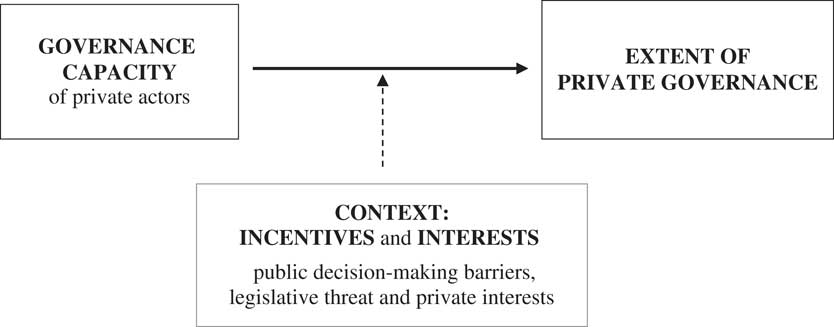
Building on the existing regulatory governance literature, we take an integrative approach and argue that the extent of private governance in morality policies results from the governance capacity of private actors and the barriers of public decisionmaking as well as the interests of private actors. The latter two aspects shape the way public and private actors interact with each other in the regulatory space. More specifically, they determine the degree to which private actors are able and willing to overcome possible collective action problems and to draw on their organisational capacities for assuming responsibility in rulesetting and enforcement (see Figure 2) (Streeck and Schmitter Reference Streeck and Schmitter1985; Hancher and Moran Reference Hancher and Moran1989; Saurwein Reference Saurwein2011).
Theoretical Framework. Source: Own illustration.
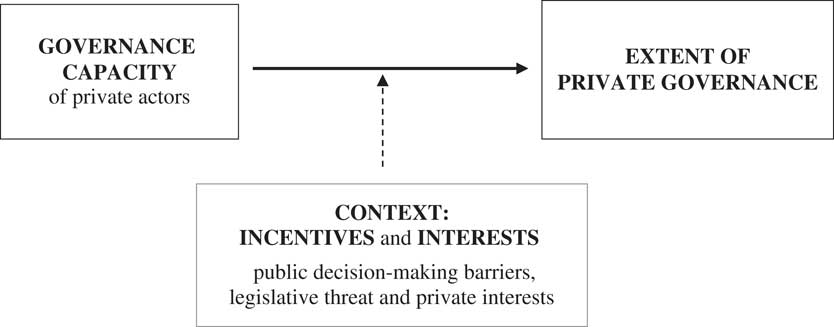
In the following, we specify our general argument in two concrete hypotheses. At first, the extent of private actors’ involvement is a question of capacity (Börzel and Buzogány Reference Börzel and Buzogány2010). Nonstate actors are capable of taking over public responsibilities if they possess sufficient expertise, broad human capital and comprehensive financial resources (Bell Reference Bell2008; Torfing et al. Reference Torfing, Peters, Pierre and Sorensen2012). According to the research on administrative capacity (Peters Reference Peters2010), a suitable and centralised organisational structure to plan and coordinate their duties is also critical to their ability to participate in regulation (Whitehead Reference Whitehead2007; Saurwein Reference Saurwein2011). This concerns not only the internal structure of private actors but also the structure of the respective regulatory space. A low level of fragmentation facilitates the development of uniform policy positions and a coherent implementation of regulatory tasks (Mayntz Reference Mayntz1987, 103; Döhler and Manow Reference Döhler and Manow1997). These factors do not only promote nongovernmental involvement but also decrease the state’s need to control private actors and prevent typical delegation problems of agency loss or capture (Baldwin and Cave Reference Baldwin and Cave1999, 129). The underlying logic is that, first, organisational capacity increases the private actors’ trustworthiness to act as a competent agent of the state and, second, communication with the state and the allocation of responsibilities in collaboration with the state is executed more smoothly, when the private actor has a centralised structure (cf. Baldwin and Cave Reference Baldwin and Cave1999, 135; Kersbergen and Waarden Reference Kersbergen and Waarden2004, 156). All these conditions influencing private actors’ governance capacity vary among policy sectors and might change within one sector over time (Döhler and Manow Reference Döhler and Manow1997). Therefore, we propose the following more generally:
H1: The higher the nonstate actors’ capacity in undertaking governance tasks of the state, the larger the extent of private governance.
Private actors’ governance capacity alone does not sufficiently explain the extent of private governance. A context is needed that first promotes public actors to delegate regulatory tasks and second provides incentives for private actors to step in. First of all, we assume states are more willing to delegate tasks to private actors when they lack the capacity to adopt regulatory measures (Héritier Reference Héritier2002). Such decision gridlocks are highly likely in morality policies, characterised by struggles on first principles. Two different situations may drive nondecisions: a scenario in which the moral attitudes deviate substantially between the majority of citizens and the policymakers in office. Morally charged issues, which are declared as taboo and regularly ignored in politics, might be approved by the general public, but not by government parties. As voteseekers, policymakers in office avoid these issues in order to minimise their risk of losing political power (Mooney Reference Mooney2001b; Engeli et al. Reference Engeli, Green-Pedersen and Thorup Larsen2012). The second situation that may lead to a decision gridlock is a wide divide among the policymakers in office. Because of electoral considerations, members of government avoid contentious issues, because an internal discussion would weaken the unity of the governing parties and, thereby, their perceived ability to govern efficiently.
In both situations, decisionmakers follow a strategy of venue shifting or blame shifting (Lodge Reference Lodge2008, 283) and delegate rule-setting tasks to alternative arenas or private actors directly (Engeli and Varone Reference Engeli and Varone2011). Only when de-moralising the issue, decision barriers decrease, and policymakers are able to agree on a procedural policy design (Engeli and Rothmayr Reference Engeli and Rothmayr2016; Littoz-Monnet Reference Littoz-Monnet2015). Often this includes a legal framework characterised by nonbinding instruments, vague legal terms and negotiation procedures at different venues, which facilitate the involvement of private actors given a certain extent of public control (Engeli and Varone Reference Engeli and Varone2011).Footnote 2
Besides the willingness of the state to delegate regulatory tasks, one must also consider the interests of private actors to take over these tasks. An important incentive for private actors’ engagement is the legislative threat a private actor perceives to its autonomy. This argument draws on studies of industry participation in EU governance (Héritier and Eckert Reference Héritier and Eckert2008; Héritier and Lehmkuhl Reference Héritier and Lehmkuhl2011). For instance, Héritier and Eckert (Reference Héritier and Eckert2008) show how plastic industry enterprises agreed voluntarily on common environmental standards when NGOs were campaigning intensively and the regulatory pressure was high. We suggest that these mechanisms hold for the field of morality policies as well, although economic interests are probably secondary for private actors. In detail, regulatory initiatives of public or other societal actors, which legitimate a specific set of values, may put private actors under pressure when these initiatives challenge the actors’ autonomy and moral order.
Besides the perceived legislative threat, it is essential that private actors have a strong interest in taking over regulatory responsibility and formulating a uniform policy strategy (Börzel and Buzogány Reference Börzel and Buzogány2010). We assume that this is particularly likely when the legal framework is so vague or outdated that a smooth service delivery becomes impossible or very difficult for private actors (cf. the discussion on assisted dying, McCann Reference McCann2014). Therefore, we hypothesise the following:
H2: If the barriers for decisionmaking among policymakers are high and private actors have strong policy interests, the extent of private governance increases.
Research design, methods and data
Our study is motivated by an empirical research puzzle – namely, the varying extent of private governance in the regulation of euthanasia and prostitution in Germany. Thereby, the study intends to answer two empirically interesting research questions: What conditions stimulate private actors’ involvement in governing morality policies? And what conditions account for diverging patterns across policies and time? Generally, morality policies can be considered as a least-likely case for strong private governance, as one would expect that the definition of a country’s moral order lies exclusively in the hands of public actors. Hence, the investigation of morality policies offers a particularly strong test of prominent theoretical explanation of the literature on private governance.
We conducted an in-depth comparative case study of two morality policies. As sources of information serve primary and secondary documents (e.g. policy statements, press articles), external databases capture public opinion and party preferences and semistructured interviews with key players. We conducted in total four telephone interviews with different private actors in the field of prostitution policy, because here primary sources are difficult to access, particularly in retro-perspective. Instead of drawing a systematic sample of a larger population, we selected the experts on the basis of what they might know to help us fill in pieces of the remaining puzzle, which is a common procedure for case-study designs (Aberbach and Rockman Reference Aberbach and Rockman2002, 673). Nevertheless, we selected one expert for each key group of private actors to do justice to the diversity of actors in the field (i.e. sex workers’ organisations, sex industry, and organisations of social workers working in the wider field of prostitution). In detail, this includes interviews with speakers of the two oldest sex workers’ organisations in Germany (i.e. Hydra e.V. and Madonna e.V.), an interview with the association of the German sex industry [Unternehmerverband Erotik Gewerbe Deutschland (UEDG e.V.)] and, finally, an interview with a representative of the Deutsche Aidshilfe e.V. This expert has been working as a social worker for more than 20 years in the field, and hence could provide valuable historical knowledge on the development of the involvement of private actors.
In the pre-interview period, an introductory letter was prepared describing the research project, the time frame and the key questions (Goldstein Reference Goldstein2002, 671). The key questions defined the areas to be explored but left room to diverge in order to pursue an idea or response in more detail. This mix of open and closed questions allows to discover and elaborate on what is important to participants but may not have previously been thought of as pertinent. All interviews are audiotaped with a portable taping machine and a speakerphone, and later on transcribed in line with the guidelines proposed by Dresing and Pehl (Reference Dresing and Pehl2011).
The analysis of one country and two morality policies enables to control for important confounding factors. Germany operates under a specific political system with many institutional hurdles (e.g. coalition governments, federal structure) that challenge decisionmaking and add to the obvious obstacle of the moral load of these policies. Thereby, the likelihood of private actors’ involvement in regulating citizens’ behaviour might increase. We see, however, that institutional characteristics of the national political system seem to have limited explanatory capacity as we discover considerable differences between prostitution and euthanasia policy. In addition, the comparison across policies allows to control for important explanatory factors from the literature on private governance, such as government stability and administrative capacity (Börzel and Buzogány Reference Börzel and Buzogány2010; Héritier and Lehmkuhl Reference Héritier and Lehmkuhl2011), because these factors are constant across policies and within Germany. Finally, the qualitative method of analysis allows us to trace carefully the deduced expectations.
The third section introduced yet the conceptualisation and operationalisation of the dependent variable (extent of private governance). The first independent variable, private actor’s governance capacity, is assessed with five different factors. It increases by the comprehensiveness of financial and human resources, by the total number of members, by a high degree of internal cohesiveness, the centralisation of the organisational structure and decreases with the fragmentation of regulatory space. The information is gathered from the websites of the involved private actors and semistructured interviews (see elaborations in the former passage). We measure the second independent variable, barriers for state decisionmaking, via the level of conflict on policy solutions between the general public and the decisionmakers, as well as via the extent of intragovernmental heterogeneity in the relevant policy field. The higher the disagreement at both levels, the larger the impediments for public policymaking. The policy preferences are gathered from findings of earlier studies (Euchner Reference Euchner2015a; Preidel and Knill Reference Preidel and Knill2015) and public opinion surveys of the German “Institut für Demoskopie Allensbach” (IfD) (2015), as well as the European Values Study (2011). The concepts of policy interests of private actors are assessed on the basis of position papers as well as semistructured expert interviews, and complemented by findings of previous studies (Euchner Reference Euchner2015a; Preidel and Nebel Reference Preidel and Nebel2014).
Governing the provision of death and sex in Germany
Before examining the theoretically guided expectations, we outline the extent of private governance and its evolution over time in the two German cases. Euthanasia policy – the first field under study – covers the regulation of the service to assist someone who is dying. This regulatory space is influenced by questions on human dignity and patient autonomy at the end of life. The governance mode accomplished a comprehensive transition from pure state regulation to public-private cooperation for rule-setting and enforcement at the end of the 1970s. How did this change work out in detail? In Germany, the legal regulation of euthanasia began with the rules of the penal code, directly prohibiting active euthanasia. Hence, the state was the primary actor in this field. From the 1960s onwards, a continuously increasing life expectancy and improvements in intensive care altered the ethical beliefs surrounding euthanasia and its specific forms (passive euthanasia or assisted suicide, which were not regulated at that point in time) (Preidel and Knill Reference Preidel and Knill2015). As a response, the social–liberal government coalition, which held office from 1969 until 1982, delegated parts of the rule-setting and implementation phases to the BÄK, initiating thus a cooperative style of regulatory governance (see Figure 3) (cf. Benzenhöfer Reference Benzenhöfer2009; Preidel and Knill Reference Preidel and Knill2015). The BÄK adopted explicit guidelines that prohibited all forms of euthanasia (BÄK 1979). Later on, in 1998, the BÄK even adopted guidelines for living wills, which resulted in the permission of passive euthanasia (BÄK 1998, 2011, 2014b). In the 2000s, the state followed with law reforms in terms of living wills [Bundesgesetzesblatt (BGBl.) I 2009, 2286] and the prohibition of organised, commercial assistance for suicide in 2015 (BGBl. I 2015, 2177). As a result, the state and the BÄK share until today competences in rule-setting. However, in the implementation stage as well, the medical association and state courts cooperated in monitoring and prosecuting noncompliant behaviour of healthcare professionals(e.g. Bundesgerichtshof, XII ZB 2/03; Verwaltungsgericht Berlin, AZ. 9K 63.09; cf. Benzenhöfer Reference Benzenhöfer2009).
Private governance in German morality policy. Source: Own illustration.

Prostitution policy – the second field under study – covers the regulation of the supply and the demand of sexual services. In contrast to the case of euthanasia, private actors received regulatory responsibility much later and exclusively in the implementation stage (see Figure 3). Germany has a long history of regulating prostitution policy via direct public intervention specified in the penal code or through court rulings (e.g. the Reichsgericht in 1901 outlawed prostitution as “asocial”) (Euchner Reference Euchner2015b). This governance mode departed from pure public intervention to a limited cooperation with private actors at the implementation stage in the early 2000s. In 2001, the first government coalition between Social Democrats and the Green party abandoned the legal tradition of stigmatising prostitution as an “immoral” activity and recognised the offer of sexual services as a “regular” profession (BGBl. I 2001, 3983). Many legal terms remained vague or not specified at all, and therefore offered room for private actors to engage in the implementation stage (Euchner Reference Euchner2015a). In so-called “round tables”, street-level bureaucrats and private actors, such as organisations by and for sex workers, as well as representatives of the sex industry, negotiated and formulated concrete implementation guidelines (e.g. registration guidelines for prostitutes and sex establishments, health checks, etc.) (Speaker Madonna e.V. 2014; Speaker UEDG e.V. 2015; for the Netherlands see Wagenaar Reference Wagenaar2006). Dortmund, Berlin and Frankfurt are pioneering cities where we find close cooperation and broad agreement on policy solutions between public bureaucrats, police and private actors (Speaker Madonna e.V. 2014).
When comparing the different governance movements in both fields over the last few decades, it is unclear whether the factors outlined in Chapter 3 – private actors’ capacity, public decision-making barriers and legislative threat – determine the observed variance in private actors’ involvement. The subsequent analysis of the two hypotheses reveals that the larger expansion of private governance in euthanasia policy was supported by the presence of an organisationally strong private actor. The negative effects of the actor’s internal heterogeneity in the last few years could be compensated by favourable contextual conditions. This includes strong legislative pressure with which the medical profession was confronted and high decision-making barriers among public actors. In prostitution policy, the settings were less favourable for private actors. Even though organisations by and for sex workers gained more regulatory capacity in the last few decades because of their expertise, they suffered from conflicting policy preferences as well as somewhat smaller decision gridlocks among policymakers. In the following sections, the diverging settings of both policy fields are elaborated in more detail.
Governance capacity of the private actors
In Hypothesis 1, we suggest that the higher the nonstate actors’ capacity in undertaking governance tasks, the larger the extent of private governance. Comparing the organisational strength and internal heterogeneity of private actors in prostitution and euthanasia policy, we find certain evidence for this explanation. However, the factor alone cannot account for all the variances across time and both policies.
In the field of euthanasia policy, the BÄK is the most powerful player because of its centralised internal structure, comprehensive resources and its representative function. The BÄK includes 17 state medical chambers on the federal level and has been representing the interests of the German medical profession since 1947. By creating additional guidelines to supplement existing professional law and reporting the quality of medical service on a regular basis, this centralised and increasingly cohesive private actor effectively influenced and monitored physicians’ behaviour in the absence of public regulation. With around 400,000 members, a 10-figure budget and an office with about 90 members (referring to the numbers of 2004 and 2008), the association has considerable financial and human resources, and hence a prominent mobilisation capacity (BÄK 2004, 2008). These factors strengthened the BÄK’s organisational decision-making ability and competence, and as a result its trustfulness and governance capacity.
However, the BÄK’s capacity to effectively steer euthanasia was not always equally strong. It diminished at the beginning of the 2000s. A crucial factor was the federal structure associated with increased multilevel complexity. A growing polarisation among the medical profession towards the justification of euthanasia (BÄK 2010) provoked that most of the medical chambers at the state level reformed their ethical guidelines, repealing the explicit prohibition of physician-assisted suicide. Simultaneously, on the federal level, the BÄK fluctuated between relaxing and strengthening the prohibition of assisted suicide in a biannual cycle, losing its nationwide cohesiveness (BÄK 2011, 2014b). In consequence, the trust of public actors in the BÄK’s governance capability decreased – especially regarding the regulation of assisted suicide. For instance, in 2011, the administrative court in Berlin denied the medical association’s competence to prohibit physician-assisted suicide. Likewise, the government coalition of Christian Democrats and Liberals, which held office from 2009 until 2013, proposed to regulate suicide in a more comprehensive manner. In 2015, the subsequent grand coalition of Christian and Social Democrats adopted a new law. However, in contradiction to Hypothesis 1, the law did not extend public governance, but strengthened the physicians’ autonomy in regulating their engagement in assistance of suicide. This is bewildering: Why did the extent of private governance remain constant over time even though the main private actor lost parts of its regulatory capacity in the recent years?
In prostitution policy, the picture is less puzzling. First, drawing a comparison with the BÄK, we observe that private actors started to institutionalise much later in time and were less organised, resulting in a smaller governance capacity. For a long time, these private actors have been lacking the organisational strength and trustworthiness to take up public tasks. In the late 1970s, the first so-called organisations by and for sex workers (e.g. Hydra e.V., HWG e.V.) were founded. Only after the recognition of prostitution as a “regular” job in 2001, the sex industry established lobby organisations (e.g. UEDG e.V.), whereas German sex workers took even more time for organising themselves into a union in 2013 (i.e. Berufsverband erotische und sexuelle Dienstleitungen).
Although one would expect the lobby organisations of the sex industry to be powerful and well-resourced actors that rely on the enormous financial gains of the branch, the contrary is true in these cases. For instance, the activities of the UEDG e.V. are managed by two full-time and one part-time employee. The organisation includes about 150 members, including managers of sex establishments paying a monthly fee between 50 and 150 euros depending on the size of their establishment (Speaker UEDG e.V. 2015). According to the speaker of the UEDG e.V. (2015), it is very challenging to gain new members, as the benefits of a membership remain unseen. Other organisations in the field struggle with internal disagreements and proximity to criminal scenes (Obst Reference Obst2014). Against this backdrop, these organisations are not considered as trustworthy and competent agents in terms of public tasks.
Unexpectedly, in the case of sex worker organisations, the picture looks somewhat different. Hydra e.V. was the first private, nonprofit organisation supporting prostitutes in their daily lives and lobbying for more rights in the legislative arena; HWG e.V. followed in 1984. In 1985, Hydra e.V. organised the first national conference (Hurenkongress) to bring together different organisations established across different cities in Germany (e.g. Dona Carmen e.V. in Frankfurt, Madonna e.V. in Bochum, etc.). Subsequently, in the late 1990s, these projects were strengthened by the creation of an umbrella organisation called “Bufas”, which sought to coordinate across projects and develop a cohesive lobbying strategy (Speaker Hydra e.V. 2014). Despite this coordinated strategy, “Bufas” lacks any capacity to monitor or sanction their members and disposes of few financial and human resources. Compared with all the other private actors, however, organisations by and for sex workers have close ties with local bureaucracies and receive a certain amount of trust (Speaker Madonna e.V. 2014). More precisely, they regularly obtain public funding for single projects (e.g. “train the trainer” for sex workers in terms of health issues or social security) (Speaker Deutsche Aidshilfe e.V. 2014), and hence are considered a responsible partner and expert for regulating the very complex field of sex work. These long-established ties between single sex worker organisations with street-level bureaucrats and their comprehensive expertise illustrates their increased regulatory capacity in the last few decades (cf. Speaker Deutsche Aidshilfe e.V. 2014; Speaker Hydra e.V. 2014).
This development explains why these private actors became involved in the formulation of implementation guidelines. Despite the limited resources and less centralised and fragmented structure, compared with the BÄK, their expertise and long-established ties reinforced their trustworthiness to carry out state responsibilities in policy implementation. In consequence, it is necessary to conceptualise governance capacity more comprehensively, not limiting it exclusively to human and financial resources but considering also the historical establishment of regulatory arrangements and policy expertise.
In sum, our examination of euthanasia and prostitution policy reveals considerable explanatory power of private actors’ organisational capacity and trustworthiness for governing (Hypothesis 1). We are able to explain the differences in private governance between both morality policies, as the BÄK is a long-established and better-equipped actor than the sex worker organisations. However, the explanatory power of the capacity factor is limited because the extent of private regulation in assisted dying did not change substantially when the BÄK suffered from intraorganisational heterogeneity and decreasing trustworthiness. Therefore, it is necessary to look at the incentives of public actors in delegating regulatory competence and the interests of private actors.
Decision capacity of the state and interests of private actors
Following Hypothesis 2, we expect that a context is needed that first promotes public actors to delegate regulatory tasks and second provides incentives for private actors to step in. Both fields of studies have been exposed to decision gridlocks among policymakers. Besides serious value conflicts among policymakers and within political parties, the policymaking process suffers from the multilevel complexity of the German federal system. In euthanasia and prostitution policy, the Länder has a say. However, when comparing both fields, decisionmakers’ struggles were stronger in euthanasia policy because of higher levels of conflict among citizens and politicians as well as among coalition partners. Moreover, the BÄK succeeded in formulating uniform policy interests in contrast to the varying preferences of private actors in the field of prostitution policy.
First of all, in reaction to the German Nazi past (Benzenhöfer Reference Benzenhöfer2009), policymakers are interested in preserving the prohibition of active euthanasia and avoiding any discussion on the issue. This is not only indicated by German political parties refusing to take a position on the issue in election manifestos, but also by regular “venue shifts”, independent of the governmental composition. In the 1970s and 1980s, as well as more recently, the topic was delegated to parliamentary commissions or expert groups. Prominent examples are the parliamentary legal committee in the 1980s and the parliamentary commission of enquiry “Medical Ethics and Rights” (Preidel and Nebel Reference Preidel and Nebel2015; Preidel and Knill Reference Preidel and Knill2015). Not only the German history but also strong intraparty heterogeneity challenged public decisionmaking (Preidel and Knill Reference Preidel and Knill2015). Indifferent of the party colour, governments in office were rarely capable of formulating one coherent legislative proposal or adopting it; if so, reforms needed several attempts until they resulted in a final decision. The debate on reforming passive euthanasia took, for example, 11 years till a final decision was made in 2009.
These decision-making barriers are reflected in the discrepancy between law and public opinion today. At the beginning of the 1970s, 53% of citizens in Germany approved the legalisation of active euthanasia. Until 2014, support grew stronger: 67% of interviewees approve active euthanasia. Similarly, a much higher proportion of interviewees (78%) supported the permission of ending life-prolonging medical treatment, called passive euthanasia, and 60% supported commercial assistance for conducting suicide (IfD 2001, 2014). Only in the last few years, we observe declining decision-making barriers in euthanasia policy, because German policymakers define the issue as a matter of conscience, hence abandoning party discipline (Preidel and Nebel Reference Preidel and Nebel2015). This development increased to some extent the legislative pressure for private actors because the adoption of laws conflicting own values became more likely. Nevertheless, legislative procedures on conscience issues still can be considered as unattractive for government parties, because they require collaboration with members of opposition parties, undermining their power position and policy profile. Therefore, a shift of responsibility to the BÄK is still a welcomed alternative for policymakers.
Besides strong decision-making barriers and intermediate levels of legislative pressure, the medical community had a strong interest in taking over regulatory responsibility. They needed to clarify the vague legal situation in order to cope with the numerous demands from patients in their daily work and to cope with new competitors (i.e. private organisations of assisted suicide). They were supported by courts, single experts and governments at the state level who also asked for clearer public steering activities in response to the legal chaos caused by the circulation of several forms of living wills without legal basis (Preidel Reference Preidel2015; Preidel and Knill Reference Preidel and Knill2015). In consequence, the federal leader of the medical association, Frank Ulrich Montgomery, advocated for a consensus and successfully united all state medical associations regarding the prohibition of physician-assisted suicide (BÄK 2014a). In sum, the BÄK was able to overcome its capacity problems because of high public decision-making barriers, increased levels of legislative pressure and a strong interest to clarify the vague legal situation.
In the field of prostitution policy, decision gridlocks were less extensive, particularly in the late 1990s when the Green Party participated for the first time in government. The Green Party is a political agent of many morality policies, and it is especially prone to mobilise around prostitution policy (Euchner Reference Euchner2015a). The issue stands at the interface of two important objectives of the Green electorate: first, disrupting and abandoning old-fashioned structures and policies and, second, strengthening women’s position in society (Party Manifesto Green Party 2001). As the Green Party governed together with the Social Democrats in a government coalition, they had to negotiate hard for suitable policy solutions with the stronger partner (Euchner Reference Euchner2015a; Euchner and Knill Reference Euchner and Knill2015). Furthermore, the veto power of the second chamber limited the decision-making capacity of the national government because all changes that affected shared competencies of the nation state and the Länder were rejected (e.g. ideas regarding locational restrictions and catering law). In the end, however, the national government was able to reduce these gridlocks by creating an internal working group and tabling one bill that concerned exclusively the competences of the nation state (Euchner Reference Euchner2015a). Today, the ruling grand coalition of Social Democrats and Christian Democrats is confronted with the consequences of vague laws, which resulted in some practices at the local level that are considered immoral (e.g. “Flat-rate brothels”; Euchner Reference Euchner2015a). In consequence, the legislative pressure to revise the prostitution law increased in the late 2000s. Very recently, in July 2016, the coalition partners succeeded in adopting a new prostitution law that specifies now many of the remaining vague legal terms. These lower decision-making barriers in prostitution policy are reflected in smaller discrepancies between law and public opinion. Parallel to the political discussion, citizens have been increasingly accepting the offer of sexual services. Although in the 1980s 39% of the German population said that they would never justify prostitution, the number decreased to 28% in 2008 (European Values Study 2011).
Besides lower decision-making barriers in prostitution policy, we find more diverse policy interests among private actors compared with the field of euthanasia. There are numerous civil actors defending very different problem solutions. One group believes that prostitution is entirely wrong and should be abolished in order to protect women from degradation. However, the other groups consider sex work as legitimate activity requiring better working conditions (Euchner Reference Euchner2015a). This fragmentation of interests is known in other countries as well (Wagenaar Reference Wagenaar2006; Crowhurst et al. Reference Crowhurst, Outshoorn and Skilbrei2012) and obviously weakens the position of private actors, especially when they do not have one representative organ fighting for a consensus among members. This is one reason why we find only in some cities collaborative forms of governance in the implementation stage (e.g. Dortmund, Frankfurt). In these cities, the involved actors are more open to negotiate common implementation guidelines (Speaker Hydra e.V. 2014; Speaker Madonna e.V. 2014).
In sum, the barriers for decisionmaking were lower in the case of prostitution policy in the late 1990s owing to the consensus between political parties and society, and the Green Party’s success in facilitating an agreement among public actors. In euthanasia policy, by contrast, the hurdle for agreeing on a coherent governance scheme was already very high in the 1970s and 1980s. Therefore, the governments were keen on delegating steering tasks to the BÄK. Moreover, the BÄK was strongly engaged in formulating a uniform policy proposal because of increased legislative pressure in the late 2000s and serious challenges in their daily work. In the field of prostitution policy, by contrast, the diverse policy interests could not be united through one representative organ.
All in all, the section shows that not only the governance capacity of private actors but also the decision capacity of the state and (uniform) interests of private actors determine the extent of private governance. In other words, contextual factors heavily shape room for private actors’ engagement.
Conclusion
When studying morality policies, it becomes clear that the state is not an isolated actor governing the field. Instead, private actors regularly step up in order to complement vague laws and deficient implementation guidelines. This phenomenon is puzzling because democratically nonlegitimated actors regulate key questions of moral order within a society. In general, we observe different extents of private involvement across morality policies and over time, whereby the shadow of hierarchy remains relatively strong. In Germany, the medical association has been cooperating intensively with public actors in regulating euthanasia since the 1970s, whereas prostitution policy has not been exposed to private governance before 2001, and to a more limited extent under stronger public control. The present study explains this interesting empirical puzzle by combining the literature on regulatory governance and morality politics.
Existing research on morality policies does not provide explanations for different extents of private involvement in regulating morality issues, because patterns of private governance or public-private coregulation in value-driven policies are generally disregarded (see Engeli et al. Reference Engeli, Green-Pedersen and Thorup Larsen2012; Knill et al. Reference Knill, Adam and Hurka2015). The present article fills this research gap by drawing on the broad literature on regulatory governance in international relations and EU public policy analysis for capturing the German puzzle of euthanasia and prostitution policy.
First, we introduce a continuum of governance modes that conceptualises the scope of private and public actors’ engagement in steering morality issues at the policy formulation and implementation stages. Furthermore, we propose an explanatory framework that integrates two aspects: first, the governance capacity of private actors and, second, the regulatory context shaping public actors’ willingness to delegate regulatory tasks as well as the interests of private actors to step in.
The comparative case study on policy developments for prostitution and euthanasia policy in Germany provides broad evidence for our expectations. We observe that the governance capacity of private actors explain to a large extent the difference in private governance between the two policies. Moreover, we discover that contextual factors heavily shape the opportunities and the incentives for private actors to engage. This includes the decision-making barriers of the state and the uniform policy interests of private actors. In detail, as long as the government is not able to agree on explicit rules or implementation guidelines, it has an increased incentive to delegate governance tasks to competent private actors. This is, however, only successful when nonstate actors have their own (uniform) interest in compensating public inactivity. More precisely, private actors are particularly engaged when legislative threat is high and they are negatively affected by the vague regulatory status quo. In these situations, they are increasingly motivated to overcome low heterogeneous policy interests.
All in all, the study makes an important empirical contribution to the literature on regulatory governance by exploring a policy field that is a kind of least-likely case for private governance and offers therefore a hard test of prominent explanatory factors. Moreover, the findings add to the morality policy literature by showing that policy change is not only a question of scope, timing and direction but also one of the types of governing actors. By focussing on this additional dimension, we finally point to a new spectrum of factors that drive the regulatory variance across morality policies and time. Besides the classical determinants, such as party colour, religious composition, state–church relationship, public opinion or the political representation of societal groups, we pronounce the explanatory power of context factors that are inherent to the regulatory space and vary across morality policies: governmental decision capacity and private actors’ interest. Moreover, the proposed typology offers an appropriate instrument to assess private governance across countries and in relation to different morality policies during the phase of policy formulation as well as implementation.
Future research should continue to analyse morality policy change not only from the classical perspective of state interventionism but also from a governance perspective. This allows us to understand regulation in legal grey zones, which are typical for morally loaded policies. Similarly, the research on private governance would profit from the examination of additional morality policies in two ways: first, a novel set of private actors will find attention; and, second, such studies would advance the theoretical debate on issue complexity and legal vagueness and its impact on private actors’ engagement.
Acknowledgement
This article is part of the research project MORAPOL (Comparative Analysis of Moral Policy Change), funded by the ERC (European Research Council) Advanced Grant (Grant No. 249388) and led by Professor Christoph Knill (LMU). The authors are very grateful for the valuable comments of our colleagues, Professor Edgar Grande, two anonymous reviewers and the editorial team of the JPP.