Creating a stark dichotomy, Aka Gündüz (1886–1958), an intellectual of the Kemalist regime and former Unionist, created two characters in Dikmen Yıldızı (the Star of Dikmen), set in the Greco-Turkish War of 1919–22 and the entrance of the Kemalist army into Smyrna (Izmir). Nazlı is a snobbish young woman who deeply admires western values, to the point of decadence, while Yıldız is Nazlı's idealized opposite. Nazlı often complains that after the Great Fire in September 1922, Smyrna has lost all its beauty and allure; she deplores of the changes that took place after the expulsion of the Ottoman Greeks (Rums). She is a Europeanized (alafranga) Muslim in her demeanour and speech, upsetting Yıldız so much that she even doubts her friend's ethnic purity.Footnote 1 Yıldız would like even the foundations of the buildings to be removed in order to convert the city from its ancient Christian past. As a canonical text of Kemalist nationalism, this novel claims from its very beginning to portray the national struggle against the Ottoman Christians. Crucially, when Yıldız spots two people on a ferry speaking Greek, she rebukes them and threatens to jettison them into the sea if they continue. They respond to her in a parodied half-Turkish half-Greek: ‘Why?’ (Giati kuçuk hanumi?) but Yıldız slaps and beats them to the applause of the crowd.Footnote 2
The victory of the Kemalist army in September 1922 constituted one of the final episodes in the disintegration of Ottoman society. After an ill-conceived Greek offensive into the interior begun in the summer of 1920, the Greek troops were defeated and forced to leave Asia Minor in the late summer of 1922. This paved the way for attacks on Christian communities in Asia Minor by irregular forces (çetes) and nationalist troops in retaliation for earlier hostilities committed by Greek troops. Smyrna, the principal Ottoman port city, was destroyed by a gargantuan fire and the Ottoman Christian communities in Asia Minor, Orthodox Greeks and Armenians, suffered a series of systematic massacres and were compelled to leave their homes. Although the whole of Asia Minor was overwhelmed by mass violence in autumn 1922 and governed a compulsory population exchange between Greece and Turkey under the Lausanne peace negotiations in January 1923, the destruction in Smyrna was by far the most striking.Footnote 3
With the dissolution of the three large continental empires in Eastern Europe (Austro-Hungary, Imperial Russia, and the Ottoman Empire), a paradigm of ethnically homogeneous nation-states and the implementation of demographic engineering policies in the form of resettlements, exile, forced migration, and massacres were commonplace in Eastern Europe and the Middle East.Footnote 4 State-sponsored mass violence brought nationalism into the lives of ordinary people and into their sense of belonging and identity, and ultimately forced migrations and massacres. By the same token, Ottoman Christian communities experienced a dramatic decrease in their population during the first quarter of the twentieth century.Footnote 5 Devastation in Smyrna and its surroundings was so shocking that the ‘Asia Minor Disaster’ of autumn 1922 came to be engraved in Greek collective memory as the usual term for evacuation to Greece.
With the turn of the new millennium and the centennial of World War I, scholarship on the violence of the early twentieth century and the social groups that fell victim to it—ethno-religious minorities, children, etc.—came into prominence.Footnote 6 Joanna Bourke sought to break some of the taboos associated with this war by suggesting that many of the participants in this war indeed enjoyed the bloodbath.Footnote 7 Her insightful book examines, from a wider perspective, Anglo-American experiences of the two world wars, and reveals what those who participated in these rituals of violence imagined and suffered and what coping strategies they developed. Dealing with World War I, Nazan Maksudyan has demonstrated how children and youth suffered ethnic violence, forced migration, and mass murder in an ‘age of extremism’ of competing nationalist ideologies in the late Ottoman context.Footnote 8
In the last two decades, a significant number of studies have also been produced on the history of World War I which focus on the Ottoman coastline, especially on the Aegean littoral, and centring on cosmopolitan Smyrna, referred to by many Turkish speakers as Gâvur Izmir (Infidel Smyrna). In her pioneering article published in the first decade of the new millennium, Biray Kolluoǧlu-Kırlı argued that the fire marked the rupture of spatial continuity from Ottoman Smyrna to Izmir.Footnote 9 Hervé Georgelin's book, which contributed to the literature through the use of previously overlooked sources, dealt with the political and social aspects of fin-de-siècle Smyrna.Footnote 10 When it comes to twentieth-century Armenian literature, Marc Nichanian has investigated how mass violence influenced certain literary works.Footnote 11 To commemorate the centennial of the Great Fire of Smyrna and the population exchange between Greece and Turkey, a series of significant studies have been carried out in recent years on the trauma and memoirs of Ottoman Christian communities.Footnote 12 Nonetheless, studies dealing with the perceptions of Muslim witnesses of the destruction of the city and the ensuing humanitarian catastrophe have remained scarce.
The first part of this article explores the discourses produced by their Muslim compatriots on the destruction of the city and expulsion of Ottoman Christians, and particularly the Greeks (Rums). I examine the writings of Muslim locals and refugees (muhacirs), and compare how both local and migrant Muslims crafted narratives about the expulsion of their Christian neighbours from their burnt and ethnically-cleansed homeland, and how these narratives have been subjected to reinterpretation, negotiation, and subversion. In the second part, the article examines the reflections of three distinctive features in the imagination of the locals and how the Great Fire, the population exchange and the misery experienced were portrayed from the perspective of the late 1920s and early 1930s. To do that, I intend to take a more holistic approach about former Ottoman citizens’ perception of their relations with their lost neighbours and the overall humanitarian catastrophe experienced in Asia Minor, and the impressions and narratives that derived from these complex connections.
The end of cosmopolitanism and reflections of a humanitarian catastrophe in an Ottoman port city
The Great Fire of Smyrna and the subsequent population exchange had fatal consequences for Ottoman Christian communities. Following the imposition of the compulsory population exchange and the proclamation of the Republic of Turkey in October 1923, the political, social, and cultural patterns of everyday life in the former Ottoman lands changed swiftly and significantly. In the first days of September 1922, downtown Smyrna was regarded as the closest and the most secure refuge for Ottoman Christians fleeing Asia Minor and attacks by Turkish nationalists. It is almost impossible to estimate the number of refugees, non-Muslim and Muslim, pouring into the city from the interior of Asia Minor.Footnote 13 According to Mark Bristol, the American high commissioner in Constantinople, some 300,000 refugees, mostly Ottoman Greeks from the interior with no place of shelter in the city, were trapped between the port and the city which was patrolled by Turkish nationalists as of 13 September 1922.Footnote 14 French consular records also confirm that the population of the city had reached almost 500,000.Footnote 15
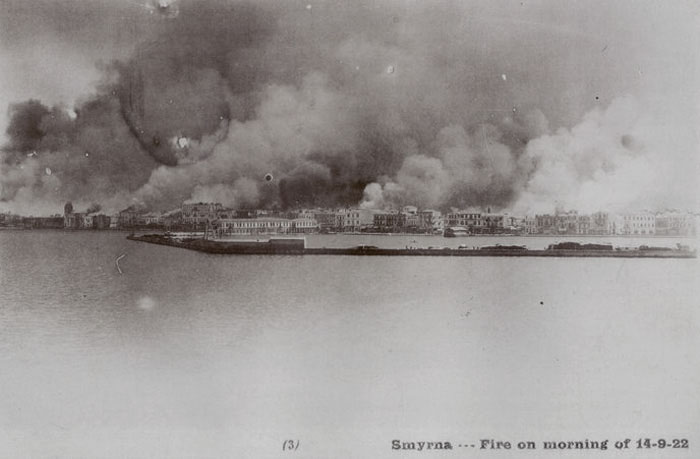
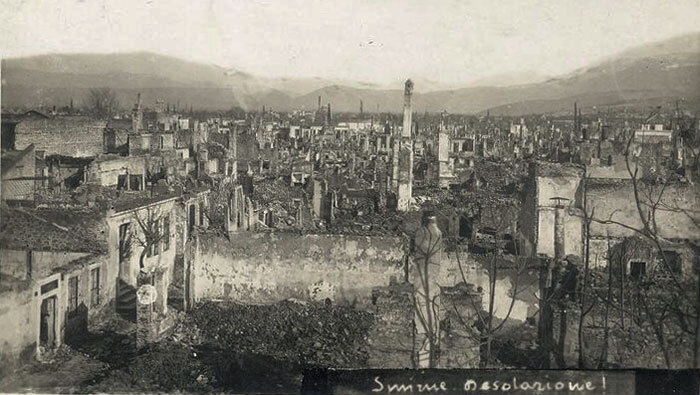
Undoubtedly, the Great Fire of September 1922 was the most destructive event in Smyrna's history, stretching along the Quay for 3200 metres and penetrating as far as five kilometres inside the city. It destroyed nearly 5000 buildings (houses, warehouses, shops, post offices, and consulates), more than 10,000 residential buildings were abandoned, and the local economy nearly collapsed.Footnote 16 The fire not only destroyed the commercial centre but completely erased the cosmopolitan social fabric of the city and its non-Muslim Ottoman majority. (Figs. 1 and 2)
Smyrna on fire, a view from the sea (Source: Levantine Heritage Foundation).

Post-fire debris (Source: Levantine Heritage Foundation).

With the fire, this port-city lost virtually any connection to its past. On 18 September 1922, Nureddin Pasha, the military governor of the province, proclaimed the forced deportation of Ottoman Christian men who could not leave to work in labour battalions in the interior.Footnote 17 A large number of Ottoman Christians residing in Smyrna had already left the city by September 1922 due to rumours of the defeat of Greek troops in the interior.Footnote 18 Smyrna's Christian population plummeted from 36% during the pre-war period to 1.2% in 1927,Footnote 19 with only 548 Orthodox Christians and nineteen Armenians left in the city.Footnote 20 No other Ottoman city experienced such a precipitous demographic shift.Footnote 21
In spite of a veneer silence in political discourse and literature regarding the Great Fire and ethnic cleansing campaigns incited by nationalist elites, occasional voices broke this silence even during the course of these events. The earliest example of this agitated testimony came from Fâlih Rıfkı, a close friend of Mustafa Kemal and one of the most significant journalists of the early Republican period, who went on to become a member of parliament after 1923. He visited the still-burning Smyrna on 14 September and wrote his impressions for the daily Akşam in Istanbul; his valuable descriptions of the first days of the ‘liberation’ of Smyrna were published on 22 September. The prominent theme in these articles is the city's destruction and the horror it aroused in the author's imagination:
We left Istanbul on Monday 11 September. The Lamartine, which left Çanakkale on Tuesday morning, followed the Anatolian coast. Occasionally we see the smoke of burning villages behind the mountains. All the way to the end of the island of Midilli [Lesbos], hundreds of small and large sailboats carry the remains of the Greek army to the islands. . .
I pointed to a ghostly white city far to the left.
–What is that place?
The captain replied:
–Izmir.Footnote 22
On 1 November 1922, a few weeks after the Great Fire, the moderate conservative Âhenk newspaper published a long editorial by Mehmet Şevkî entitled ‘To Dante.’ Th e author alleged that this was in fact a republication of a column published on 14 May 1922, on the eve of the third anniversary of the Greek occupation, which used imagery from Dante's Inferno to predict the desolation of Smyrna. This editorial reprobated the war that had just ended and the suffering experienced—more than a million Ottoman citizens killed on the fronts and more than a million Ottoman citizens perished in death marches—by wandering through the descriptions of Dante's Divine Comedy. It is worth quoting this editorial at length, as the author had envisaged the fire and his prophecy had been fulfilled:
You are the one who hears the voices of the mortals who come to the doors of your grave and bring you the troubles and pain of the world. I wonder how many times you may have wanted to feel the sun of life on your eyelids and the wings of air in the last five centuries. Who knows how many times you have tried to throw off the marble covers of your grave in order to level lightning on the heads of the oppressors of the world with the fire you brought from the gates of hell?. . .
I come unto you to make the Lord's wrath, justice and revenge known to the greedy and the arrogant who do not believe in the hell of my Muhammad. And I am bringing unto you the crimes of the guilty centuries I have lived in and those of a murderous association. I bring the bones and arms of a land of blood and fire; I bring their imprecations and curses.
. . . And for this reason, o Dante, I have come unto you. Come out of your grave and come to my hometown; and I will show you a new world from a divine hilltop in the Orient. Yes, a new world! A world whose temples are more emptied out than anywhere else, whose tombs are filled, whose noisy towns are silent, and whose deserted wildernesses are screaming! A world where people die, monsters live, fires cool down, and waters catch fire! A world whose dawns weep, whose springs moan, whose evenings laugh, and whose autumns sing songs!Footnote 23
If this editorial was really printed first in May 1922, it then reveals the flexible boundaries of the ongoing censorship under the Greek administration, which started in May 1919. This long quotation raises the question whether the Muslims of Smyrna considered the expelled as aliens or as alienated—just as Dante sees his Florentine enemies since he was sentenced to perpetual exile from his homeland Florence in 1302 and started writing the Inferno in exile. In itself, this striking but enigmatic editorial by Mehmed Şevkî gives us no clue as to his point of view.
The phrase ‘murderous association’ together with the intense depictions of violence in the background surprises the reader. It might seem a bold critique that this phrase can scarcely be understood as other than referring to the Committee of Union and Progress. Given that the Turkish press in Smyrna, however, was divided into two hostile camps (supporters of the Unionists and those of the Freedom and Accord Party), columnists were able to take advantage of this atmosphere of relative freedom in their criticism of the Unionists up to the autumn of 1922. For example, Hasan Tahsin, a columnist for the daily Hukuk-ı Beşer, was able to publish a rather harsh article addressing Haydar Rüştü, a Unionist mouthpiece in Smyrna, in which he underlined that ‘the Unionist spirit’ protecting profiteers was almost the same as ‘the rhetoric of bandits’ that ‘address[ed] the Greeks and Armenians with swear words, and the Arabs with insults’.Footnote 24
Themes of apocalyptic destruction
The composition of the Smyrna sanjak's population was affected by the nationalist transformation in 1922–23 more than any other settlement. In the following decade, a common theme prevailed in the writings of both Christian inhabitants who were forced to leave and the remaining Muslim and other non-Muslim individuals who witnessed the apocalyptic destruction of their city and the forced migration of their Christian neighbours.Footnote 25
Although Ottoman Smyrna had in the past hosted thousands of Balkan Muslims who came after the Russo-Ottoman War in 1877–78 and the outburst of the Balkan Wars (1912–13),Footnote 26 the mass violence that forced almost the entire Christian population to leave the city was still devastating for the local Muslim residents. Aside from regular newspaper reports on conditions in the burned-out part of the city populated by vagrants and of Ottoman Greeks who hid in mountain caves to evade the population exchange, travelogues and other popular literature described the haunted atmosphere of abandoned sacred springs, burned churches, and pilgrimage sites. Three words which predominated in local Turkish publications in the post-Catastrophe period, reflecting the sorrow of destruction and the paranoia of invasion were: revenants, debris, and cavemen. As can be understood from all these macabre themes, not only those who were forced to leave the city, but also those who remained believed that they were living in the end times.
As part and parcel of the process of Turkification of the topography, Christian places of worship were quickly repurposed as public buildings and their distinctive features replaced by new architectural additions.Footnote 27 Such buildings remained recognizable from the outside, and at least in the memory of the residents of the area, but any building which was once a church was no longer considered a living church, and emerged as haunted places in local discourse.
Through the lens of the post-Catastrophe era imagination in Turkified Izmir, both the city's buildings and its people were haunted by revenants. In post-Catastrophe narratives, the imagery of revenants manifested itself in two different depictions: in the architectural change through demolition or alteration of Christian communal buildings and cemeteries, and in individual identities through conversion. Furthermore, systematic alteration of buildings, such as removing church bells to museums, plastering lime over Christian ornamentation, and the use of church buildings as school ceremony venues, added to the multi-layered process of conversion, resulting in an uncanny relationship with these buildings for both former and present inhabitants.
Catholic and Anglican churches under the auspices of European states and attended by the local Levantine populations were left relatively unharmed, while churches of Ottoman Christians were completely wiped out. The usurpation and systematic destruction by nationalist authorities of communal buildings belonging to Ottoman Christian communities started immediately in the autumn of 1922.Footnote 28 Various testimonies reveal that the reaction against this unwanted past turned into a wave of hatred towards Ottoman Christian and what remained of them. A certain nun from the Petites Sœurs des Pauvres in the city reported this situation to Gaston Jesse-Curely, the French High Commissioner in Constantinople:
Alongside the state of mind which is temporarily favourable to foreigners and in particular to the French, the Turks have not yet renounced their fierce hatred of everything Greek or Armenian. They are fiercely attacking the Greek churches. That of Bournabat was destroyed eight days ago with dynamite.Footnote 29
Falih Rıfkı too offered a frank account of the Great Fire and this sense of hatred towards the Ottoman Christian communities in his memoirs: ‘Why were we burning down Smyrna? Did we fear that we would not be able to get rid of the minorities if the villas, hotels, and clubs of the Quay had remained?’Footnote 30
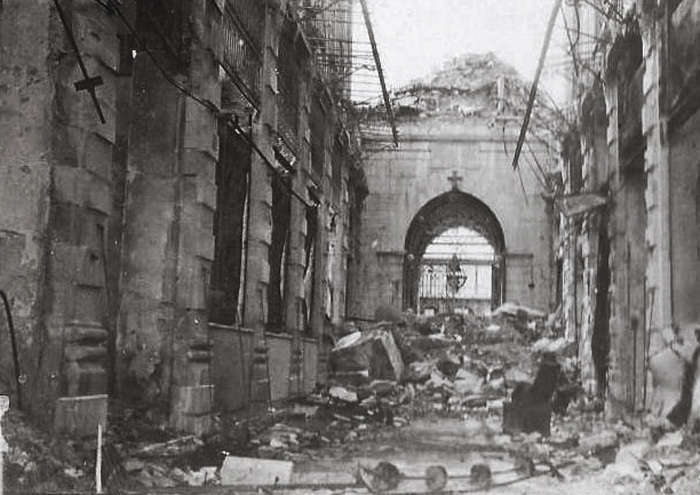
A later example of this kind of transformation was the plan to move the bell of Agia Fotini, the demolished Greek Orthodox cathedral of Ottoman Smyrna, to the elegant Hamidian-period clock tower in the Konak neighbourhood. In an optimistic note in January 1925, the Ministry of Finance inquired of the objects collected from this cathedral, including a marble statue and an ancient heraldry as artifacts, and mentioned this bell as ‘the massive bell of the Aya Fotini church that was presumably made of gold and donated by Russian Tsar Nicholas II in 1906’.Footnote 31 Nonetheless, this enquiry seemed to come to nothing. On another occasion, the Directorate of Abandoned Properties (Emval-i Metruke Müdüriyeti) applied to the Ministry of Finance to obtain the bell. However, in early August 1929 this plan was dropped on the grounds that the transfer would be extremely costly.Footnote 32 (Fig. 3)
Destruction of the Orthodox Cathedral Agia Fotini, late 1922 (Source: Les Archives de la Planete Albert Kahn).

The remaining Orthodox Christians and those who converted to either Roman Catholicism or Islam during the ethnic cleansing campaigns were themselves considered revenants from the past.Footnote 33 The converts cast their shadows over the nation's existence like a ghost—a shadow that was recognized but rarely mentioned. Because of the Great Fire, the subsequent violence against Ottoman Christians, and their expulsion, the Christian presence in the region became nearly invisible, living under severe restrictions—whether they were citizens of the new Republic or not. Local Christians were further stigmatized in the new political structure by the antagonistic discourses of the Turkish nationalists towards them during the Greco-Turkish War of 1919–22. After the Catastrophe in September 1922, the Orthodox population in the city was very small and well hidden. Feigning to be Catholics, many of them married Levantine Catholics or other foreign passport holders so they could be exempted from the compulsory population exchange.Footnote 34
Beginning in January 1923, hundreds of petitions written by citizens of European countries and of the defunct Ottoman Empire wishing to return to Izmir began to pour in through the neutral Dutch Embassy in Athens to the representative of the Ministry of Foreign Affairs of the Ankara government in Constantinople.Footnote 35 The Embassy of the Netherlands in Athens, which was determined as the sole representative of Turkish interests in Greece, informed the Greek government that the subjects of Greece, ex-Ottoman subjects of Greek origin, and Russian subjects would not be allowed to return to Turkey.Footnote 36
There is an obvious gender dimension regarding those who were married to local members of the European colonies and Levantines and were therefore permitted to stay. It is doubtful that a Greek Orthodox male would have been permitted to stay in Izmir even if he had a non-Rum spouse. One of the rare but pressing issues for Turkish authorities during the implementation of the population exchange was the status of Greek Orthodox women who had been forced to marry or voluntarily married to Muslim men. One of the first signs that this group would be exempt from the population exchange came with a government decision in February 1924.Footnote 37 This exception was extended to all women who had ‘married non-Muslim men not subject to the population exchange’; that is, women married to Christians of other denominations as well as Jews, before the day of the signing of the exchange convention by another cabinet decision on 26 August 1925.Footnote 38 Nonetheless, the available documents do not give any clues about Greek Orthodox men married to women from groups not subject to the population exchange.
The question of female silence is raised by the fact that the majority of female figures in archival records concerning the population exchange are Islamized Greeks. Especially in rural areas, some Greek Orthodox women were exempted from the population exchange due to their marriages to Muslim men. While such large-scale destruction did not completely put an end to the Christian presence in the region, it did transform Christians into vestiges of the past that would now be depicted in written materials merely as converts or orphans.
Although archival materials reveal the suppressed sentiments surrounding the converts, the abysmal stories of these individuals have no clear conclusion. In one example, in an inquiry sent from the General Directorate of Settlement (İskan Müdüriyet-i Umumiyesi) to the Ministry of the Interior in March 1926, it was stated that two people residing in Izmir, a certain Vangeli and Mehmed, son of Abdullah (the latter did not reveal his Greek name), should be exempt from the population exchange on the grounds that they had converted to Islam before the Treaty of Lausanne. After their request was rejected by the ministry due to lack of documentation, the note attached to the second application sent from Izmir suggests leniency: ‘Hasan Bey, there was a fixed period (bir müddeti vardı); let's examine it carefully.’ In the second attempt, answered by the Ministry on 19 April 1926, their exemption was approved under the pretext that they were ‘people who had received Islamic education’ (İslam terbiyesi alan). This case illustrates how terms of the population exchange could be bent on an individual basis. Apparently, some converts who were somehow supported by local authorities or who provided them some financial benefit were given exceptional permission by the central government to stay in their hometowns.Footnote 39
On a second note, reports of murder, assault, gambling, and prostitution were published in many local newspapers, such as Âhenk and Anadolu, almost daily in Izmir in the late 1920s.Footnote 40 Most of these events took place in central neighbourhoods destroyed by fire in September 1922. After the Great Fire and the compulsory population exchange, the general themes in the columns of Turkish newspapers in Izmir consisted of stories about vagrants clustered in the burned areas of the city, murders caused by disagreements over plots of land, substance use, gambling, prostitution, and acts of bravado.
The agony caused by the debris and large deserted plots, such as Christian cemeteries, left by the fire in the middle of the city, and the lack of coordination among local authorities, may also be noticed in official correspondence. To illustrate, after the vast abandoned Greek Orthodox cemeteries in the Mortakia district had been occupied by vagrants for a decade, these lands were finally transferred to the municipality in November 1931 on the condition that the headstones would not be sold.Footnote 41 Local newspapers regarded the twin projects offered in the late 1920s by the Kemalist elites of the city—a Republic Square around a newly projected massive statue of the founder of the republic, Mustafa Kemal, and the construction of Kültürpark, an urban park—as the culmination of the genuine liberation from vagabonds of the burned areas.Footnote 42
Discussions on debris and the surrounding area as well as other burnt towns, such as Bergama and Urla, exposed the transfer of wealth from the Ottoman Christians to local profiteers and the corruption that accompanied this process. Starting in late 1922, the local Turkish press in Izmir provided indications of the transfer of wealth from Ottoman Christians, who were considered missing persons, to local Muslim notables.Footnote 43 The general pattern of the notices in the newspapers was clear: missing Greek or Armenian individuals were unable to pay their fictitious or real debts, and their properties were auctioned off by the debt enforcement offices. For example, on 1 April 1923, apparently a busy day in the office, there appeared five such advertisements in the daily Âhenk. The goods of Nikola's daughter Eleni in return for her debts to Mustafa Hikmet Efendi, the goods of the merchant Dimitrakopoulos residing in Mortakia district in return for his debts to Ahmed Nuri Efendi, and the goods of the drapery merchant (manifatura tüccarı) Kirkor Karabakyan in return for his debts to Ömerzâde Mustafa Efendi were announced to be available for sale.Footnote 44
As Onur Yıldırım has argued, the property rush which began after the ethnic cleansing of Ottoman Christian communities disturbed property configurations throughout the former Ottoman territories, particularly in western Anatolia.Footnote 45 Since property ownership problems were not easy to resolve, the nationalist government formed the Ministry of the Exchange, Reconstruction, and Resettlement (Mübadele, İmâr ve İskân Vekâleti) to arrange the arrival of Muslim migrants from Greece and redistribute property to them in October 1923. Muslim migrants from Greece were mainly settled in adjacent but devastated settlements, particularly along the Aegean coastline. Before their arrival, many houses, commercial enterprises, workshops, and factories left by Ottoman Christians had been occupied by a diverse group of profiteers, mostly bureaucrats, officers, and local notables, who usurped the properties through the help of their contacts in Ankara.
The nonchalant attitude of the provincial press towards the problems of refugees facilitated the local magnates’ seizure of abandoned properties. According to a letter signed by Mahmud Celâl (Bayar), the Minister of Exchange, Reconstruction and Resettlement, and dated 12 April 1924, it was decided that the abandoned properties belonging to Armenians could no longer be used for exchangees coming from Greece as of 13 March 1924.Footnote 46 Upon this decision, the local press can be seen openly siding with war profiteers, especially during the property rush, against the demands of the exchanged persons, to the point of being their advocate when it comes to the redistribution of large farms. To illustrate, as late as 3 February 1930 the headline of Anadolu depicted as a scandal the allocation of a large farm formerly belonging to Peştemalcı, an Ottoman Armenian, to Nailbeyzade Avni and Mükerrem, exchange persons from Katerini, in Bergama, the northernmost town of Izmir province, where property redistribution still continued. Emphasizing that the exchanged persons did not have any right to abandoned Armenian properties, the daily claimed that they had taken over this farm fraudulently and that the exchangees in Bergama as a group usurped the rights of the local Turkish villagers.Footnote 47
Republican authorities ignored Ottoman Christians’ demands concerning their properties from the very beginning. In August 1923, Armenian refugees in Athens, led by a merchant named Essayan, sent letters to the General Assembly of the League of Nations in Geneva in order to retrieve their deposits, valuables and money kept in the foreign banks of Smyrna, such as Imperial Ottoman Bank, Credit Lyonnais, and Credit Foncier d'Algérie et de Tunisie, whose building would remain in rubble for decades.Footnote 48 However, the Turkish representatives had already announced in the Lausanne negotiations in July 1923 that the nationalist government, having initiated attempts to nationalize the capital in the region, would not only regard these demands as illegitimate and expropriate the assets in those banks, but also would not permit the return of Armenians to the region.Footnote 49
It took nearly a decade for the workshops, factories and warehouses formerly belonging to Ottoman Christian merchants to be able to operate again. For example, the Tuzakoglou factory, the largest flour factory in the city operated by an Ottoman Greek entrepreneur before 1922, and appropriated by the municipality on the pretext of its being in the debris area, was able to resume service only after the summer of 1929, following the visit of a European specialist who was invited by the municipality to give instructions on the cleaning and maintenance of the mills.Footnote 50
Occasionally, cautionary tales of Orthodox Christians who refused to re-settle in Greece and took refuge in mountain caves to escape the population exchange appeared in newspaper columns. In February 1932, such a story stood out in the Istanbul-based newspaper Son Posta, recounting the story of an anonymous Ottoman Christian who refused to participate in the population exchange, and was presented as a cave-dwelling wild man:
There has been a remarkable event recently. Even though it has been ten years since Edremit was liberated, a Christian from the village of Zeytinli who did not escape unlike the others at that time and hid in a bear den on Mount Ida was caught by hunters by chance and brought to Edremit.
According to what he said, this Christian had been sleeping in a bear den in the Mount Ida for ten years and had been making a living by stealing from two mills in the vicinity. When this man was brought to Edremit, it was seen that his hair and beard were tangled, his nails had grown very long, his clothes were shabby, and, in short, he was in a completely wild state.Footnote 51
Although there is currently no available secondary document, such as archival material or memoir, to test the truth of this piece, it is hardly a coincidence that the journalist chose Edremit, a rural region beyond the northern border of Izmir province, for his probable fiction.Footnote 52
The narrative of ethnic cleansing and man-made destruction that are either denied or not confronted treads a thin line between the imaginary/fictional and the real. The word ‘loss’ indicates what is apprehended by the imagery and discourse of mourning, trauma, sadness, and nostalgia.Footnote 53 In Turkish print media in the late 1920s and early 1930s, post-Catastrophe Izmir is often described as an intimidating, mysterious, and isolated border zone. Muslim residents of the city witnessed the disappearance of Ottoman Smyrna in smoke and the loss of co-existence with their neighbours. Unruly Muslim voices against the ethnic violence directed at their Christian neighbours hovered around the mourning, a feeling of self-assertion that must come from within, and acknowledged a certain narration of loss. Nonetheless, this sense of loss was endured in silence due to fear and intimidation owing to the two waves of Kemalist purges against the political opponents—the first against the Ottomanist elites and loyalists who continued their political activities in Smyrna until the autumn of 1922 and the second against the former Unionists in 1926—and was later transformed into an awestruck reticence.
Conclusion
Deriving on Michel de Certeau's assumption that a group of revenants ‘spreads out its ramifications, penetrating the entire network of our everyday life’, Maria del Pilar Blanco and Esther Peeren argue that everyday life is haunted by things that are no longer in it, by something more than meets the eye.Footnote 54 In a similar way, metaphysical and mystical assumptions came to the fore in many archival and literary texts from the early Republican period in terms of the interpretations of violence and property transfer experienced in the period spanning from 1914 to the late 1920s as in the case of Aegean littoral.
Despite the silence about the Great Fire of Smyrna and the accompanying ethnic violence, there have been occasional moments that interrupted this silence. However, not all of these moments were geared towards confronting the past and revealing the destruction in the transitional period from Empire to nation-state. Turkish-speaking Muslims in Izmir experienced their own trauma of the Greek occupation as well as the loss of an urban identity shared with the expelled Ottoman Greeks, and a sense of remorse associated with the bloodshed orchestrated during the fire. Nonetheless, this feeling of remorse did not transform into feelings of forgiveness and mercy towards their former neighbours—the Ottoman Christians—in print media throughout the 1920s and 1930s. From this standpoint, such discourses that did not involve a conscientious grief have not led to a substantial social recovery. As most personal narratives of this period are usually penned in response to the circumstances of the Catastrophe, that is, the fire and its aftermath, this particular kind of trauma narrative was rooted in a shared sense of guilt at best or indifference to the fate of long-gone Christian neighbours.
The Great Fire and ethnic cleansing campaigns continued to predominate in the city's memory for nearly a quarter of a century. As Peter Burke points out, a pertinent question in the study of collective memory is the following: ‘Who wants whom to remember what and why? Who wants whom to forget what and why?’Footnote 55 The fractured structure of memory is striking in the writings of this period. The authors’ ethnic and religious identities, as well as their gender and social class, were factors in how they remembered the fire and the destruction, the ethnic cleansing campaigns against Ottoman Christians, and the general refugee experience in the region. In the print media produced by the local Muslim population in Izmir, the prevailing sentiment among them about the Great Fire and the compulsory population exchange radiated a sense of now belonging to a strong and encompassing centralist state. The longing for the shared life experienced with Christian neighbours can only be read between the lines, and appears rather as part of a literature of random oddities. However, all these recollections were veiled with a sense of awe: a Dantesque destruction as an everlasting moment which has rarely been remembered with a genuine sign of remorse by the Muslim residents of the city.
Acknowledgments
I am grateful to Professor David Ricks, Talat Ulusoy, and the anonymous reviewers of BMGS for their insightful comments.
Umit Eser received his PhD in History from the School of Oriental and African Studies (SOAS), University of London in 2016, specializing in the Late Ottoman and Early Republican periods. His articles focusing on late Ottoman ethno-religious pluralism and lost homelands in narratives post Asia Minor Catastrophe have appeared in Diyâr: Zeitschrift für Osmanistik, Türkei- und Nahostforschung, Journal of Modern Greek Studies, and British Journal of Middle Eastern Studies. His revised dissertation Ethnic Cleansing in Western Anatolia, 1912–1923: Ottoman officials and the local Christian population was published by Edinburgh University Press in 2024. He currently teaches at Necmettin Erbakan University.