Introduction
People with mental health problems often have relapses or mental health crises, which may result in psychiatric admissions, often involuntarily. Planning for such situations is one of the hallmarks of good clinical practice (Department of Health, 1999) and may in fact reduce future crises (Henderson et al. Reference Henderson, Flood, Leese, Thornicroft, Sutherby and Szmukler2004). In 1991, the Care Programme Approach (CPA) (Department of Health, 1991) was implemented to provide a framework for integrated mental health care in England. It is directed at the most vulnerable mental health service users including those at risk for suicide and self-harm, and those with a history of relapses requiring urgent intervention. The main components of the CPA are: the systematic assessment of the health and social needs of people accepted into mental health services; the formation of a care plan identifying the care required from a variety of providers; the appointment of a key worker or ‘care co-ordinator’ to monitor and co-ordinate care; and, regular review, and where necessary, agreed changes to the care plan. In 1999, the National Service Framework for Mental Health (Department of Health, 1999), among other guidance, emphasized the place of detailed crisis and contingency planning as a key element of the CPA care plan:
‘The Mental Health National Service Framework requires that care plans should specify the action to be taken in a crisis for all people on enhanced CPA. Crisis plans should set out the action to be taken based on previous experience if the user becomes very ill or their mental health is rapidly deteriorating… To reduce risk, the plan, as a minimum, should include the following information: who the user is most responsive to; how to contact that person; and previous strategies which have been successful in engaging the service user. This information must be stated clearly in a separate section of the care plan that should be easily accessible out of normal office hours’.
Crisis planning was re-emphasized in further official guidance in 2008 and in particular, the need for detailed, individualised plans that are targeted at the needs of the service users (Department of Health, 2008). Furthermore, following the enactment of the Mental Capacity Act 2005 (Department of Constitutional Affairs, 2005), the need for service user choice in care planning was also stipulated in these guidelines, including the provision for advance refusals of treatment in a crisis situation. Research in crisis planning suggests that detailed and individualised plans for future crises may improve outcomes for service users including reduced coercive treatments (Henderson et al. Reference Henderson, Flood, Leese, Thornicroft, Sutherby and Szmukler2004), and that this approach is valued by service users (Watts & Priebe, Reference Watts and Priebe2002; Gilburt et al. Reference Gilburt, Rose and Slade2008; Henderson et al. Reference Henderson, Flood, Leese, Thornicroft, Sutherby and Szmukler2009). There is also some preliminary evidence to suggest that more individualised crisis plans are associated with improved therapeutic relationships (Swanson et al. Reference Swanson, Swartz, Elbogen, Van Dorn, Ferron, Wagner, McCauley and Kim2006).
Our own previous experience suggests that crisis plans are poorly done. An unpublished audit by one of us (G.S.) on a consecutive series of 50 patients known to a London mental health trust in 2007 and who presented in crisis found that only 6% had an individualised crisis plan (that is, a plan that mentioned more than one specific need or relevant circumstance of the patient). The CPA remains a cornerstone of the government's mental health policy and compliance with this process is regularly assessed through audits. However, these tend to focus on the presence or absence of the overall care plan, attendees at the meetings where the contents are discussed, and other process issues (Wolfe et al. Reference Wolfe, Gournay, Norman and Ramnoruth1997; Schneider et al. Reference Schneider, Carpenter and Brandon1999). We found no published investigations of the quality of crisis planning in routine care. The three aims of this study therefore were to investigate:
-
• The level of individualisation of crisis planning in routine mental health care.
-
• Whether clinician exposure to an example of individualised crisis planning led to improvements.
-
• Whether a history of crises, such as involuntary hospitalizations and harm to self or others, was associated with more individualised care planning.
Methods
Setting and sample
The sample for this study is drawn from the CRIMSON trial, which has been described in detail elsewhere (Thornicroft et al. in press; Thornicroft et al. Reference Thornicroft, Farrelly, Birchwood, Marshall, Szmukler, Waheed, Byford, Dunn, Henderson, Lester, Leese, Rose and Sutherby2010). Briefly, CRIMSON was a multi-site randomized controlled trial of Joint Crisis Plans (JCPs), compared with treatment as usual, for individuals with psychotic disorders. The JCP contains the service user's views on past treatments and preferences for care in the event of a future relapse or crisis and allows for a highly individualised crisis plan containing detailed personalized information. In this sub-study, we were interested in the level of individualisation in crisis planning at baseline and whether there was an impact of exposure to the JCP intervention at follow-up. In this context, to be included in this study, CPA crisis plans at baseline and follow-up needed to be available for rating.
Development of the CPA crisis plan assessment tool
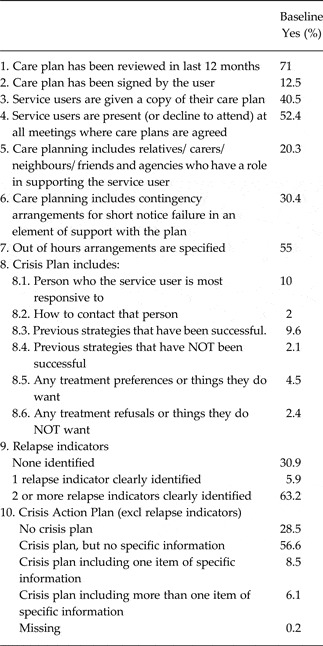
An assessment tool was developed to examine the quality of the CPA crisis plan. Items were selected from the Department of Health Audit Pack for the Monitoring of the CPA audit tool (Department of Health, 1996) and Care Programme Approach Association (CPAA) audit tool. In addition, several items were added to assess the degree of individualisation of the plan (see Table 1 for all items of the assessment tool). A score was calculated for the crisis planning aspects of the assessment tool, with higher scores indicating a more individualised care plan. All ratings were made by S.F. (a non-clinician). A randomly selected sample of 20 care plans were co-rated with a clinician (C.H.) at baseline to ensure clinical relevance and understanding – these co-ratings had a κ value of 0.77 indicating excellent agreement.
Performance on the CPA Crisis Plan Assessment Tool (n = 424)

Procedure
At baseline and follow-up, the CPA crisis plan was collected by research assistants (RAs), anonymized and rated for individualised content by S.F. Socio-demographic and psychiatric history (including hospital admissions and harm to self and others) were collected by RAs at interview and from clinical records. Other measures relevant to this study were:
-
• Functioning: Blind ratings on the Global Assessment of Functioning (GAF) were made by RAs.
-
• Engagement: It was measured by the Service Engagement Scale (Tait et al. Reference Tait, Birchwood and Trower2002). This is a 14 item scale producing four subscales measuring ‘availability’, ‘collaboration’, ‘help seeking’ and ‘treatment adherence’ and a total score. Higher scores on this measure indicate poorer engagement. This measure was rated by the care coordinator.
-
• Therapeutic relationships: The Working Alliance Inventory short form (WAI-S) (Horvath & Greenberg, Reference Horvath and Greenberg1989; Busseri & Tyler, Reference Busseri and Tyler2003) modified for use in psychiatric samples (Neale & Rosenheck, Reference Neale and Rosenheck1995) was rated by service users and clinicians at baseline and follow-up.
The CRIMSON Trial, funded by the Medical Research Council (MRC), had ethical approval from King's College Hospital Research Ethics Committee (ref no. 07_H0808_174) and signed consent from mental health service users and care coordinators.
Data analysis
To ascertain the level of individualisation in routine care at baseline for the entire sample of 424, summary statistics for each question in the CPA Crisis Plan Assessment Tool were compiled. A sum score for ‘crisis planning’ was calculated (sum of items 6–9). Our second aim was to investigate the impact of exposure to the JCP intervention. We did not include the JCP intervention group in this analysis as their CPA crisis plans may have included content from the JCP and would thus be difficult to interpret. For example, if crisis plans were devoid of detail, this could be explained by the presence of a JCP and the wish to avoid duplication. If there were an improvement after the JCP, this could be interpreted as a transcription of information from the JCP into the crisis plan. We therefore used control group (n = 221) participants only to investigate whether care coordinators who had been exposed to the JCP intervention made more individualised CPA crisis plans than care coordinators who had no exposure to a JCP. Owing to the non-normal distribution of crisis planning scores, non-parametric tests (Kruskall–Wallis and Wilcoxon rank sum) were used. Our final aim was to examine the clinical history and risk associations of an individualised plan. A binary variable for ‘individualisation’ was developed from question 10 of the CPA Crisis Plan Assessment Tool. Plans with one or more items of specific information were coded as ‘individualised’. To ensure that highly individualised plans did not differ from individualised plans (thus ensuring validity of our binary variable), we conducted univariate tests between the two groups and found no difference. All variables were entered into a logistic regression. The model was adjusted for trial design features of site and exposure to intervention.
Results
424 (74.5%) of the overall CRIMSON sample (n = 569) had CPA care plans available at both baseline and follow-up assessments. We were unable to obtain records from one trust (n = 48) and the remaining missing data were because of: not being able to locate a care plan at baseline or follow-up (n = 52); participants being discharged at follow-up (n = 22) or downgraded to care support and thus no care plan (n = 8); deaths (n = 5); and refusing access to records (n = 10). Service users had an average of 40 years of age, 15 years in contact with mental health services, 60% were of white ethnicity and 74% had non-affective psychotic disorders. Care coordinators had an average of 13 years of practice in mental health services, 63% were community psychiatric nurses and 33% were social workers. The average length of relationship between service users and care coordinators was almost 3 years (32.9 months).
Individualisation in crisis planning in routine care
The quality of routine crisis planning at baseline is shown in Table 1. Relapse indicators were routinely well reported; however, aspects of individualisation were poorly recorded. For example, treatment refusals were recorded in only 2.4% of plans and past successful interventions and treatments were recorded in 9.6%. At baseline, only 15% of crisis plans were individualised (i.e., one or more piece of specific information). Site had a significant effect on crisis planning scores at baseline with one site, Trust 3, scoring lower than the other two sites (χ 2 = 58.93, p = 0.0001).
Impact of exposure to the JCP crisis planning intervention
To establish the effect of the JCP intervention on care plans at follow-up, we compared the CPA crisis plans of control group service users written by care coordinators who had been exposed to the JCP intervention (n = 67) with plans written by care coordinators who had not been exposed (n = 149). We found no difference in the crisis planning scores between ‘exposed’ care coordinators and ‘non-exposed’ care coordinators (‘non-exposed’ mean (s.d.) = 2.63 (1.68); ‘exposed’ mean (s.d.) 3.01 (1.59). Mann–Whitney z = −1.329, p = 0.18). To address the possibility of differences in practice between sites influencing these results, we repeated the comparison while adjusting for site, and again found no difference between exposed and non-exposed care coordinators (B = 0. 102, p = 0.57 (95% CI −0.26–0.46).
Associations of individualised crisis plans
For the control group participants, 25% of crisis plans at follow-up were rated as ‘individualised’ (i.e., at least one item of specific information). We investigated the following predictors of ‘individualisation’ at follow-up: diagnostic group, length of relationship between service user and care coordinator, baseline working alliance, baseline levels of functioning and engagement and past crisis such as recent compulsory treatment under the Mental Health Act and harm to self or others. In this sample, 16% reported incidences of self-harm, 17% had made a suicide attempt and 9.5% reported harming others in the 2 years prior to baseline assessment.
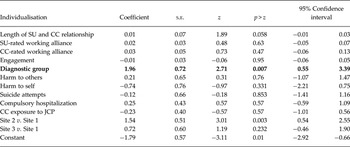
The coefficients for each predictor variable from the adjusted multivariate analyses are shown in Table 2. Only diagnosis was associated with individualisation in the final model. Longer relationships between service users and care coordinators approached significance, but clinical risk histories indicated by experience of sectioning under the Mental Health Act, past suicide and self harm attempts were not significantly associated with individualised crisis plans.
Predictors of individualisation for control group

SU, service user; CC, care coordinator; JCP, Joint Crisis Plan.
Discussion
This study represents the first attempt, to our knowledge, to quantify the quality of the current crisis planning under the CPA for a large sample of service users from three distinct geographical locations in England. There are three principal findings. First, 85% of the crisis and contingency plans of 424 mental health service users at baseline did not contain any individualised information about the service user, such as: interventions that have or have not been helpful in the past; who to contact in an emergency; preferences or refusals for treatment in crisis; or practical arrangements (for securing a flat, looking after children, pets or plants etc.) if admission were to be necessary. Second, the level of individualisation was not improved following care coordinators' exposure to the JCP intervention. Last, prior experience of crises including experiences of harm to self or others, and experience of compulsory treatment were not significantly associated with individualised crisis plans. These are important findings as the mental health service users in this study had a high risk of relapse with a recent history of psychiatric admissions and involuntary treatment. In addition, self-harm, suicide attempts and harm to others were reported by 16, 17 and 10%, respectively of the control group in the 18 months preceding the analysis of their care plans. Such a significant risk would warrant detailed care plans in the event of a future crisis or relapse; however, in this sample that did not happen. The poor development of crisis plans represents a missed opportunity to prepare the service user and the team for potential relapses that otherwise might require more serious interventions such as hospitalization. It is also of interest to note that there were few treatment refusals or Advance Decisions (3% at follow-up for the overall sample) despite the Mental Capacity Act being introduced in the study period. This suggests that more work is required to educate both service users and clinicians about the opportunities for facilitating and documenting service user choice in treatment planning.
There are several possible explanations for these findings. It is possible that clinicians may lack the training or experience to produce clinically relevant care plans; the evidence is against this explanation as exposure to ‘best practice’ in the form of the JCP intervention did not improve performance. It is also possible that care coordinators believe that they know what should be done in a crisis and therefore do not need to record it in detail. However, in the event of a relapse or crisis situation, the lack of detailed information could hinder responses of other clinicians who are not involved in routine care. Moreover, as copies of the care plans are given to the service users, they might be uncertain about how to proceed due to the lack of specific information.
A second hypothesis is that the overall care planning process is not valued by clinicians. This explanation is consistent with previous research that suggests that care planning is experienced by clinicians as an overly bureaucratic process with little clinical benefit (Simpson et al. Reference Simpson, Miller and Bowers2003; Hampson, Reference Hampson2007). This perspective is also consistent with qualitative data collected for the CRIMSON trial (Farrelly, Reference Farrelly2013) in which care coordinators described how care plans were not valued or referred to by service users, and rather than being clinically useful, care coordinators believed care plans provided them with medico-legal protection in the case of an adverse event with the service user. If this is the case, our findings are of wider significance and are best seen in the context of the tension between governance – initiated centrally and aiming to improve quality through reducing variation in care and increasing the accountability of care providers – and professional ‘autonomy’ (Flynn, Reference Flynn2002; Gray, Reference Gray, Gray and Harrison2004). Commitment by clinicians to the CPA may be compromised since it was imposed without significant consultation with those professionals providing the care, seen by them as driven by political pressures to reduce risk, and, in their view, prescribed without sufficient regard to a philosophy of care that could be shared within multidisciplinary teams. That is, the wider context of the CPA implementation and ongoing monitoring may have had a negative effect on practice.
Despite clear government guidance regarding the importance of individualised crisis planning, this study illustrated that its implementation in practice has been poor. Further research is therefore required to determine the most effective manner in which to introduce new guidance and to monitor its impact and to assess how far it implemented and whether this confers patient benefit (Tansella & Thornicroft, Reference Tansella and Thornicroft2009; Thornicroft et al. Reference Thornicroft, Lempp and Tansella2011). How to best implement practice guidelines is still unclear (Grole & Grimshaw, Reference Grole and Grimshaw2003) whereas the introduction of a more complex programme, the CPA perhaps being an example, may require a broader-based approach, for example, as set out in a ‘Theory of Change’ framework (Funnel & Rogers, Reference Funnel and Rogers2011). Issues such as the relative advantage of the new programme, its compatibility with existing values and practices, and the simplicity of use may be considered. Factors associated with the service user experience of care planning including satisfaction and factors promoting use of care plans may provide much needed guidance on how to make this process more clinically relevant.
There are several limitations to this research. The analysis described in this paper was originally devised to control contamination of the intervention within the trial. The analyses reported in this paper were therefore not planned a priori; and as an unplanned analysis, no power calculations were conducted. There were a number of care plans that were not available at both time points, in particular, as we were not able to collect records from one site, and as site was an independent predictor of individualisation, these missing data points may limit the generalizability of the findings of this study. Despite these limitations, we believe that this study provides an overdue assessment of one of the key pillars of the government's mental health policy and illustrates the pitfalls of unmonitored top-down mental health policy implementation.
Acknowledgements
We would like to thank Morven Leese for her review of the statistical aspects of this paper. We would also like to thank the service user and clinician participants in the CRIMSON trial. We would also like to thank the: JCP Facilitators: Melanie De Castro, Betina Reid, Rangeni Zinyama, Anita Davies; and the CRIMSON Research Assistants: Katie Selwood, Liz Doherty, Sam Treacy, Nicola Wright, Sarah Davis, Julia Cook, Gemma Clark, Catherine Finnecy, Gill Brown, Adrine Woodham.
Financial Support
This work was conducted as part of the CRIMSON trial. The CRIMSON trial was funded by the UK Medical research Council (grant number G0601660). GT is funded in relation to a National Institute for Health Research (NIHR) Applied Programme grant awarded to the South London and Maudsley NHS Foundation Trust and in relation to the NIHR Specialist Mental Health Biomedical Research Centre at the Institute of Psychiatry, King's College London and the South London and Maudsley NHS Foundation Trust. CH is funded by a grant from Guy's and St Thomas's Charitable Trust and a grant from the Big Lottery Fund and Comic Relief. MB is part-funded by the National Institute for Health Research (NIHR) through the Collaborations for Leadership in Applied Health Research and Care for Birmingham and Black Country (CLAHRC-BBC).
This report is independent research funded by the MRC and managed by the NIHR on behalf of the MRC-NIHR partnership. The views expressed in this publication are those of the authors and not necessarily those of the MRC, NHS, NIHR or the Department of Health.
Conflict of Interest
None.
Ethical Standards
The authors assert that all procedures contributing to this work comply with the ethical standards of the relevant national and institutional committees on human experimentation and with the Helsinki Declaration of 1975, as revised in 2008.