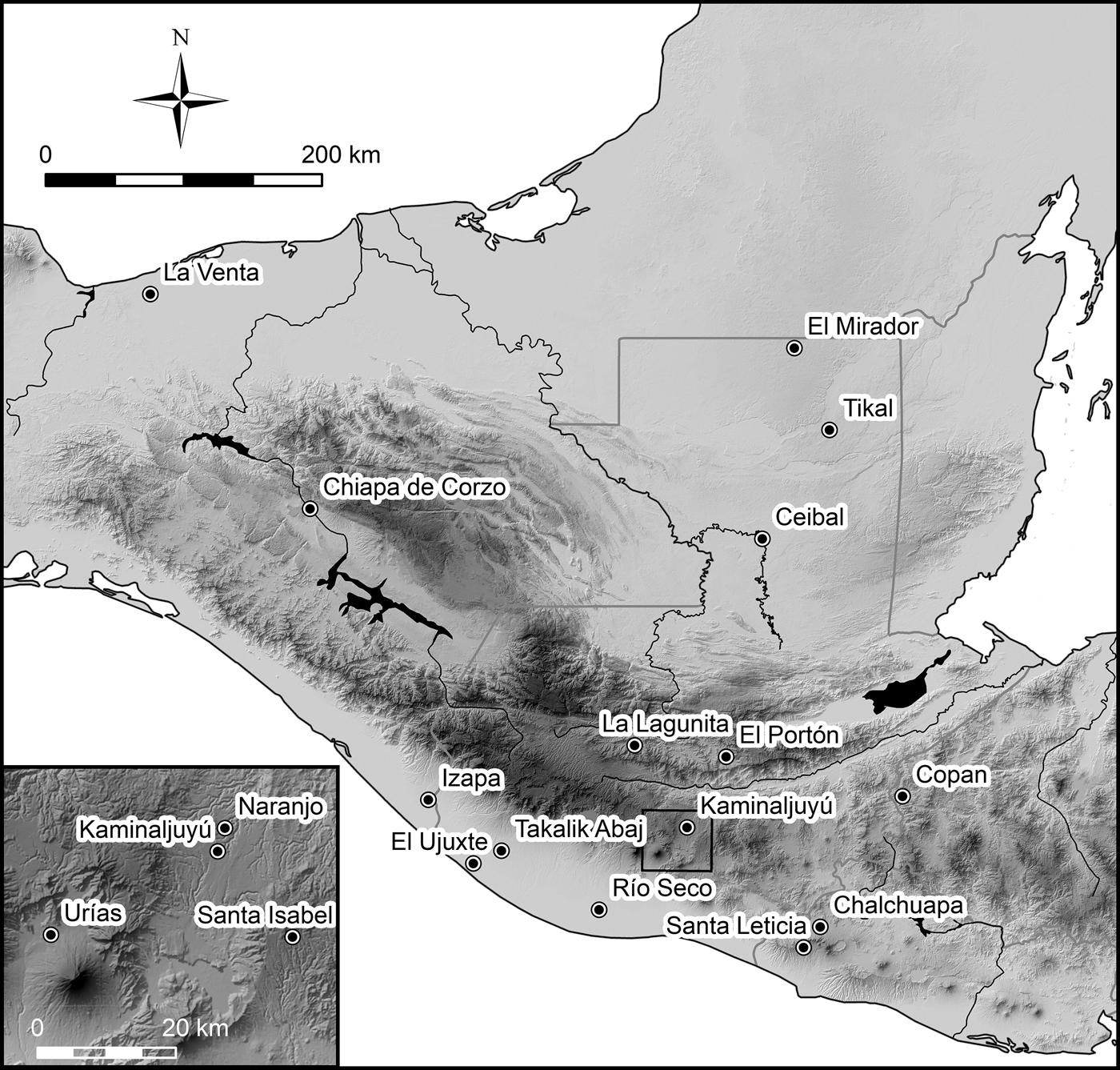
The history of Kaminaljuyu, located in the Maya highlands, presents profound implications for the understanding of social processes not only for the highlands but also for the entire Maya area and beyond (Figure 1). Unfortunately, the chronological study of Kaminaljuyu has been fraught with confusion and scholarly disagreement. Many researchers have presented different versions of chronology, and debates continue. These disagreements derive from various factors. First, this is a complex urban site with a long occupation that involved the migrations of people, the destruction of old buildings, and the recycling of construction materials. Second, because of the rapid expansion of Guatemala City, the majority of excavations have been rescue operations. Many of these projects never published their results. Third, scholars have used different approaches and concepts regarding ceramic analysis, which makes the comparison of data challenging.
Map of southern Mesoamerica with the locations of the sites mentioned in the text.

Over the past few decades, the chronology proposed by Edwin Shook and Marion Popenoe de Hatch (Reference Shook, de Hatch and de Hatch1999) has been considered the most authoritative sequence for Kaminaljuyu by many scholars. In 2014, however, Inomata and colleagues published a revised chronology, which shifted a major part of the Preclassic period roughly 300 years later in time. This proposal generated a new stage of debate.
In this article, we analyze 108 radiocarbon dates, including newly obtained dates and the previously published ones that were measured after 2000. These data support Inomata and colleagues’ (Reference Inomata, Ortiz, Arroyo and Robinson2014) revision of the Preclassic sequence (Figure 2). In addition, we examine possible interpretations of the Early Classic chronology. Our chronology provides a reference sequence for other sites in the Southern Maya Region, the term we use to refer to an area including the Maya highlands and the southern Pacific Coast, without assuming the ethnic or linguistic identities of its past residents (see Love Reference Love, Love and Kaplan2011). We then discuss the implications of our chronology for social processes involving the Maya lowlands and other parts of Mesoamerica.
Chronologies of Kaminaljuyu (based on Model A) and related sites.

Background
History of the Debates on Chronology
The first systematic research of Kaminaljuyu was carried out by the Carnegie Institution between 1935 and 1952 (for a full review of this research, see Inomata et al. Reference Inomata, Ortiz, Arroyo and Robinson2014). The project was directed by Alfred V. Kidder, who had successfully developed a chronology for the American Southwest at Pecos Pueblo. The sequence of Kaminaljuyu, however, turned out to be highly challenging. The first sets of radiocarbon dates from Kaminaljuyu, measured at Willard Libby's lab at the University of Chicago and at the Geochronometric Lab at Yale University, were inconsistent. In retrospect, the younger Yale dates were fairly accurate (Inomata et al. Reference Inomata, Ortiz, Arroyo and Robinson2014), but Edwin Shook, a member of the Carnegie Project, decided to place the Preclassic phases significantly older than the Yale dates.
Some scholars expressed skepticism of Shook's chronology. Susan Miles (Reference Miles1958), for example, questioned his stratigraphic interpretations. In the 1970s, the Pennsylvania State University Project at Kaminaljuyu developed a chronology similar to our 2014 and present versions (Michels Reference Michels1973; Wetherington Reference Wetherington1978). Various scholars, however, criticized the Penn State researchers’ use of obsidian hydration dating and disregarded the resulting chronology. From 1991 to 1994, the Tobacco and Salt Museum in Japan obtained additional radiocarbon dates (Ohi Reference Ohi1994). They used new phase names unconnected to previous studies, and their work contributed little to the ongoing debate (for a detailed historical review, see Inomata et al. Reference Inomata, Ortiz, Arroyo and Robinson2014).
In 1999, Shook, in collaboration with Popenoe de Hatch (Reference Shook, de Hatch and de Hatch1999), published an updated version of his chronology. Inomata, however, observed that this chronology did not align well with the ceramic sequences of western El Salvador or of the Maya lowlands. To evaluate this problem, Inomata and coauthors (Reference Inomata, Ortiz, Arroyo and Robinson2014) reviewed all existing radiocarbon dates from Kaminaljuyu and compared them with those from other regions. Their Bayesian analysis of radiocarbon dates from various projects, as well as those from the nearby sites of Naranjo and Urías, yielded consistent results. In their revised chronology, Inomata and his colleagues (Reference Inomata, Ortiz, Arroyo and Robinson2014) did not substantially alter the relative sequence of the Shook–Popenoe de Hatch (SP) chronology, except to remove the Arévalo and Majadas phases. They noted that more data were needed to evaluate the validity of those phases. The main points of their revision were to move the absolute dates of the Preclassic phases roughly 300 years younger and to correct their correlations with other regions (see Love [Reference Love2018] for a criticism of this revision and Inomata et al. [Reference Inomata, Arroyo and Robinson2019] for a response).
Implications for Social Processes
Debates regarding the Kaminaljuyu chronology are tied to broader questions in Mesoamerican archaeology. First, the SP chronology implies that Maya-style carving appeared first in the Southern Maya Region, nearly three centuries before securely dated counterparts in the lowlands. Following Lucia Henderson (Inomata and Henderson Reference Inomata and Henderson2016, Reference Inomata and Henderson2019), we use the term “Maya style” to refer to a subset of bas relief carvings from the Southern Region that are characterized by stylistic and iconographic elements found in Maya lowland art. The revised chronology places those sculptures in the south and the lowlands nearly in the same period. Second, in the framework of the SP chronology, there was a smooth transition from the so-called Olmec-style sculpture to the Maya style in the Southern Region around 400 BC; however, the revision suggests that some time lapsed between the end of the Olmec style around 400 BC and the emergence of the Maya style around 100 BC (Inomata and Henderson Reference Inomata and Henderson2016). Third, in the revised chronology, the major tombs of Kaminaljuyu are roughly contemporaneous with the earliest recognizable royal burials in the Maya lowlands. These issues present profound implications for understanding the emergence and development of rulership in the Maya area.
Another important issue is the chronology of the Early Classic period, in which Teotihuacan-related objects and symbols appeared at Kaminaljuyu. In an influential paper, Clemency Coggins (Reference Coggins, Hammond and Willey1979) suggested that Teotihuacan-style ceramics and iconography found at Tikal originated from Kaminaljuyu. This scenario assumed that the Esperanza phase at Kaminaljuyu started before the introduction of Teotihuacan-related elements at Tikal in the late fourth century AD. Nonetheless, by reviewing available radiocarbon and archaeomagnetic dates, Geoffrey Braswell (Reference Braswell and Braswell2003) suggested that talud-tablero buildings of the Kaminaljuyu Acropolis did not start until the sixth century. In evaluating this issue, we should recall that the talud-tablero architecture appeared at Kaminaljuyu after the Teotihuacan-style ceramics that define the beginning of the Esperanza ceramic phase (Cheek Reference Cheek, Sanders and Michels1977). Charles Cheek also noted that early versions of Mounds A and B exhibited only partial elements of talud-tablero architecture, consisting of taludes and cornices. To resolve this problem, we need to securely date both the beginning of the Esperanza phase and the sequence of tatud-tablero architecture at this site.
Moreover, a reliable chronology is essential for a comparison of an archaeological sequence with paleoenvironmental data. Important environmental data were provided by Maria Velez and coauthors’ (Reference Velez, Curtis, Brenner, Escobar, Leyden and de Hatch2011) analysis of sediment cores taken from Lake Amatitlan, located 16 km south of Kaminaljuyu. Their correlation with the SP chronology, however, made the interpretation of social processes problematic. Jon Lohse and colleagues (Reference Lohse, Hamilton, Brenner, Curtis, Inomata, Morgan, Cardona, Aoyama and Yonenobu2018) presented a refined age model for Amatitlan cores; this model's comparison with the revised chronology by Inomata and coauthors (Reference Inomata, Ortiz, Arroyo and Robinson2014) provided critical insights, including a population decline after the Las Charcas phase and the rapid growth during the Verbena and Arenal phases, followed by a population collapse.
Data and Methods
In this article, we present the results of the Bayesian analysis of 108 accelerated mass spectrometry (AMS) radiocarbon dates. In addition, we report three radiocarbon dates from the Pacific Coast site of Río Seco (Supplemental Table 1). The core of this analysis consists of 65 radiocarbon dates obtained after 2014 from recent excavations at Kaminaljuyu, Naranjo, and Santa Isabel. We also include four new dates obtained from samples collected by earlier projects. These radiocarbon dates were analyzed at Beta Analytic (Beta) in the United States and Paleo Labo (PLD) in Japan. We include an additional 39 assays measured after 2000, which were among the radiocarbon dates previously discussed by Inomata and coauthors (Reference Inomata, Ortiz, Arroyo and Robinson2014).
Excavations
The majority of radiocarbon samples for the Las Charcas phase came from the site of Naranjo located 3 km north of Kaminaljuyu. Bárbara Arroyo (Reference Arroyo2010, Reference Arroyo, Brown and Bey2018) directed a rescue project at this site from 2005 through 2007, followed by additional rescue operations in 2017 and 2018. Naranjo was the primary ceremonial center in the Valley of Guatemala during the Las Charcas phase when the population of Kaminaljuyu was still small. At the end of the Las Charcas phase, Naranjo was abandoned, and the focus of ceremonial and elite activity shifted to Kaminaljuyu. Excavations by Lorena Paiz (Reference Paiz2014) at the site of Santa Isabel, located 25 km southeast of Kaminaljuyu, provided additional Las Charcas samples, as well as samples for the Providencia phase.
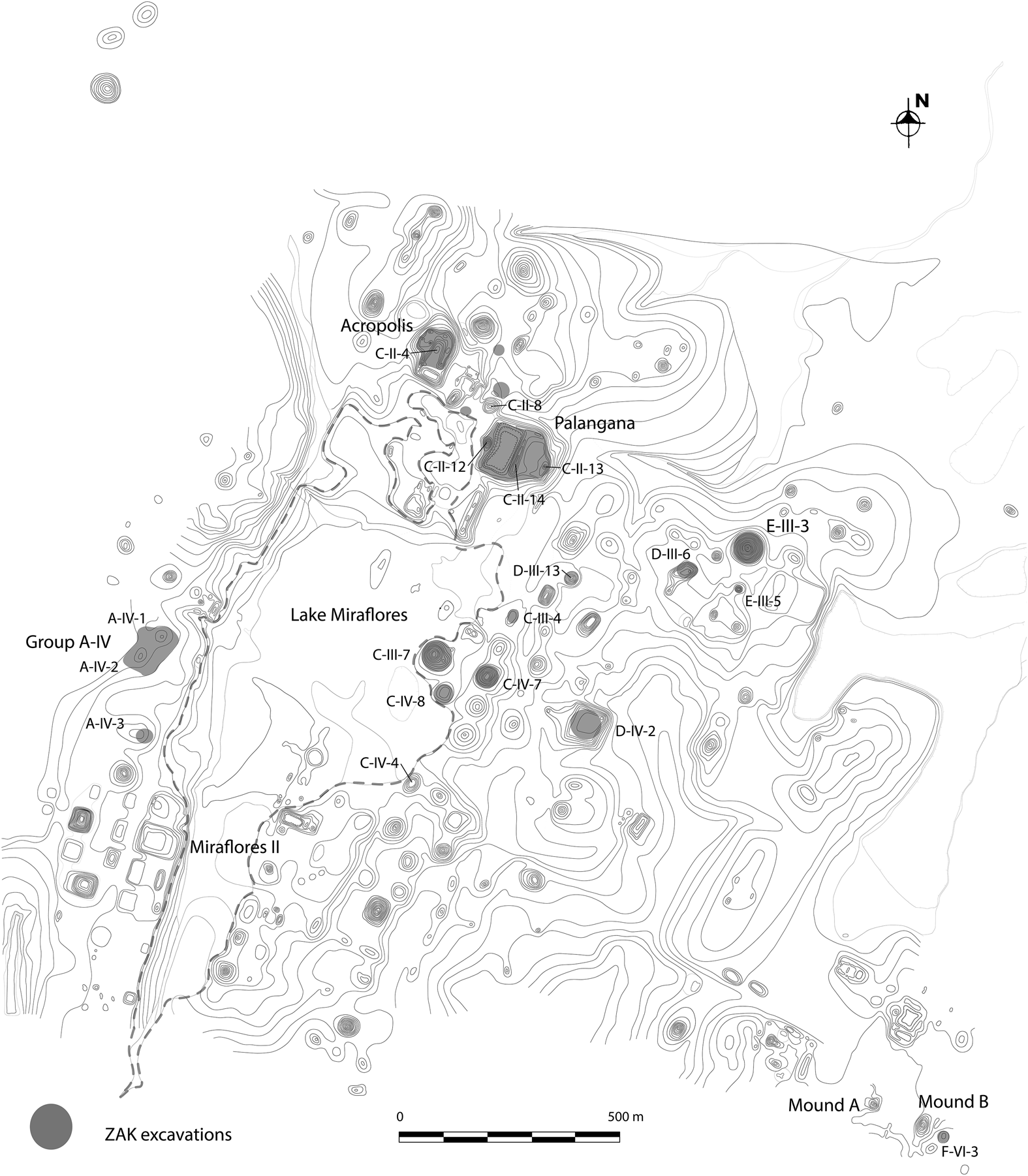
Fifty-four new dates were obtained from Kaminaljuyu by the Proyecto Zona Arqueológico Kaminaljuyu (ZAK), which has been conducting investigations at Kaminaljuyu since 2009 under the direction of Arroyo (Figure 3). Critical Providencia samples came from Mound E-III-3, the largest building at Kaminaljuyu, which housed two rich Verbena-phase burials, Tombs I and II (Shook and Kidder Reference Shook and Kidder1952). Although the mound above ground level was destroyed by modern development, rescue excavations by ZAK uncovered a dense deposit of the Providencia phase underlying the mound (Estrada Reference Estrada2017). Additional Providencia samples, along with those for the Verbena and Arenal phases, came from Group A-IV. ZAK, as well as several rescue projects, investigated this area, documenting possible granaries of the Verbena and Arenal phases, as well as constructions of the Classic period. As part of a rescue operation, we also collected a radiocarbon sample for the Verbena and Arenal phases from an area around Mound C-IV-4.
Map of Kaminaljuyu with the locations of ZAK excavations.

ZAK excavations in the protected Kaminaljuyu Park, including the Acropolis and the Palangana, produced samples for the Santa Clara phase and later periods. The Acropolis probably served to accommodate the palaces of ruling groups during the Early Classic period. Previous investigations in this complex had revealed a series of talud-tablero buildings. The Palangana, an extensive complex that also includes talud-tablero buildings, appears to have been an area for public ritual. Another critical location for the study of the Early Classic period is the area around Mounds A and B, where Carnegie researchers documented talud-tablero architecture and tombs containing Teotihuacan-style objects (Kidder et al. Reference Kidder, Jennings and Shook1946). Although Mounds A and B had been destroyed by modern development, ZAK excavation of the nearby Mound F-VI-3 provided samples for the Aurora and Esperanza phases.
Bayesian Analysis
We analyzed these radiocarbon dates through Bayesian statistics, incorporating information on ceramic phases and stratigraphic relationships (Supplemental Figure 1). Bayesian analysis produces a refined probability distribution for each calibrated radiocarbon date and estimates the initial and terminal dates of each ceramic phase (Bayliss Reference Bayliss2009; Bronk Ramsey Reference Bronk Ramsey2009; Buck et al. Reference Buck, Cavanagh and Litton1996; Inomata et al. Reference Inomata, Ortiz, Arroyo and Robinson2014:Supplemental Text). For this study, we used the OxCal 4.3 computer program, which incorporates IntCal 13 calibration data (Bronk Ramsey Reference Bronk Ramsey2019; Reimer et al. Reference Reimer, Bard, Bayliss, Beck, Blackwell, Ramsey, Buck, Cheng, Edwards and Friedrich2013).
Bayesian analysis generally narrows the probability distributions of individual radiocarbon dates. This means that the range of a modeled radiocarbon date (a date processed by Bayesian analysis) is usually positioned within the range of its unmodeled date. In other words, the analysis does not significantly alter radiocarbon dates. Nor does Bayesian analysis rectify errors resulting from external factors, such as sample contamination and stratigraphic mixing. At Kaminaljuyu and other Mesoamerican sites with long occupation, problematic samples are often introduced through the recycling of wooden construction materials, the use of wooden heirlooms, and the transposition of charcoal pieces from old contexts to new construction fills. Anomalous dates resulting from such samples need to be identified through comparisons with other radiocarbon dates. When a date is not consistent with other dates in the same stratigraphic context or ceramic phase, or when a date does not fit in the orders of stratigraphic or ceramic sequences with other dates, the inconsistent date may be called an outlier, which is excluded from the final Bayesian analysis. We should emphasize that the Bayesian modeling of valid radiocarbon dates, in most cases, does not transform chronologies by 300 years. Thus, the magnitude of the chronological revision presented by Inomata and coauthors (Reference Inomata, Ortiz, Arroyo and Robinson2014) is largely the result of excluding anomalous old dates and identifying problems in the logic of previous chronologies.
The identification of problematic dates is possible without the use of Bayesian analysis. In other words, conventional analyses of radiocarbon dates, not involving Bayesian statistics, should also lead to results close to those of Inomata and his colleagues, as long as problematic dates are identified in a reasonable manner. The advantage of Bayesian analysis with the OxCal program is that, through the statistical likelihoods of outliers (agreement indices) and visual presentations of probability distributions, it makes the process of identifying problematic dates logical. Agreement indices, however, do not automatically identify outliers. Researchers need to identify problematic dates by considering various factors, including stratigraphic integrity, the presence of old ceramics in the contexts, and the quality of the dated materials. In this process, investigators need to test multiple Bayesian models with different sets of outliers before reaching the most plausible solution. In this study, we present two possible Bayesian models.
Michael Love (Reference Love2018) and Robert Rosenswig (Reference Rosenswig2019) criticize Inomata and colleagues’ incorporation of ceramic data in Bayesian models. Nonetheless, the use of relative chronologies based on artifact typologies is considered to be a valid and effective approach by scholars specializing in Bayesian analysis (Buck et al. Reference Buck, Cavanagh and Litton1996:217–232). More importantly, the primary objective of Inomata and coauthors’ analysis was to estimate the dates of ceramic phases, which required the association of radiocarbon dates with specific ceramic phases. While not using Bayesian analysis, Love and Rosenswig also date ceramic phases by associating radiocarbon dates with specific ceramic phases. Bayesian analyses make the assumptions involved in this process more explicit and their results more logical and replicable.
We generally identify problematic dates based on the following assumptions. First, when there is no contamination, the radiocarbon date of a charcoal sample indicates the moment of incorporation of atmospheric carbon by a plant. This is older than the date of its final deposition in its archaeological context by an unknown length of time: the time lapse may be a few years in some cases but can extend to several hundred years. As we try to determine deposition dates in most cases, we always need to be aware of these potential time lapses. Second, charcoal pieces substantially older than their deposition dates may result from the use of old fill materials in new constructions or the recycling of old wood. Such occurrences are common at Kaminaljuyu and other Mesoamerican sites (Pendergast Reference Pendergast2000). Third, radiocarbon dates younger than the deposition dates of their matrices may happen because of the stratigraphic mixing of younger charcoal pieces through animal burrows or contamination with younger carbon. Such occurrences, however, are significantly less frequent at most Mesoamerican sites than the numbers of older radiocarbon dates. This reasoning accords with the patterns of ceramic data familiar to many scholars. Excavated contexts commonly contain ceramics older than their deposition dates, whereas the inclusion of younger ceramics occurrs less frequently. In most cases, ceramic analysts use the latest ceramics among those that have meaningful quantities to date the contexts, assuming that older ceramics resulted from the use of older fill materials and the presence of heirlooms. The same logic should be applied to the analysis of radiocarbon dates.
Results and Interpretations
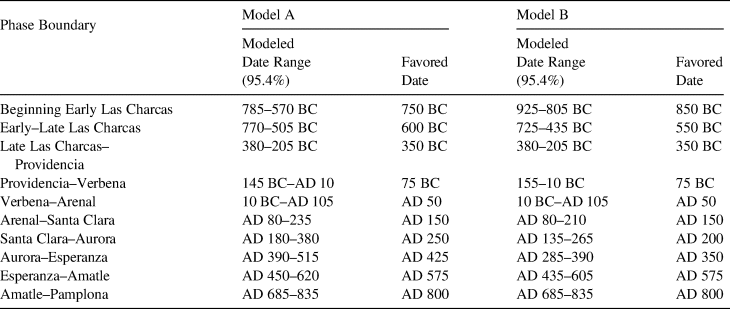
In our Bayesian analysis, we tested multiple models with different assumptions on outliers and stratigraphic relations. In the following discussion, we present the Bayesian model that we think most likely as Model A (Table 1). We discuss Model B, which reduces the number of outliers, as an alternative possibility (Supplemental Figure 2).
Bayesian-Modeled Dates for Ceramic Phases at Kaminaljuyu.

Note: All dates are calibrated.
Early Las Charcas
Early Las Charcas pottery includes short-necked globular jars and bowls decorated with feather-like applications (Emplumado type), some with elongated tripod supports (Supplemental Figure 3j, 3k, 3n). These vessels have red slip on the interior necks, the lips, and a thin strip on the exterior rims. Some have handles that connect from the lips to the neck–body junctures. Other popular types include globular bowls with convex bases; these are slipped red on buff and decorated with incisions that form abstract designs. Pumpkin-shaped bowls with black slip (Supplemental Figure 3f)—some with open spouts—are also common. Other characteristic traits include streaky brown slip on vessels of various forms (Supplemental Figure 3f–i). Related ceramics are found in the Colos phase in western El Salvador and in the Late Xox phase in the Salamá Valley.
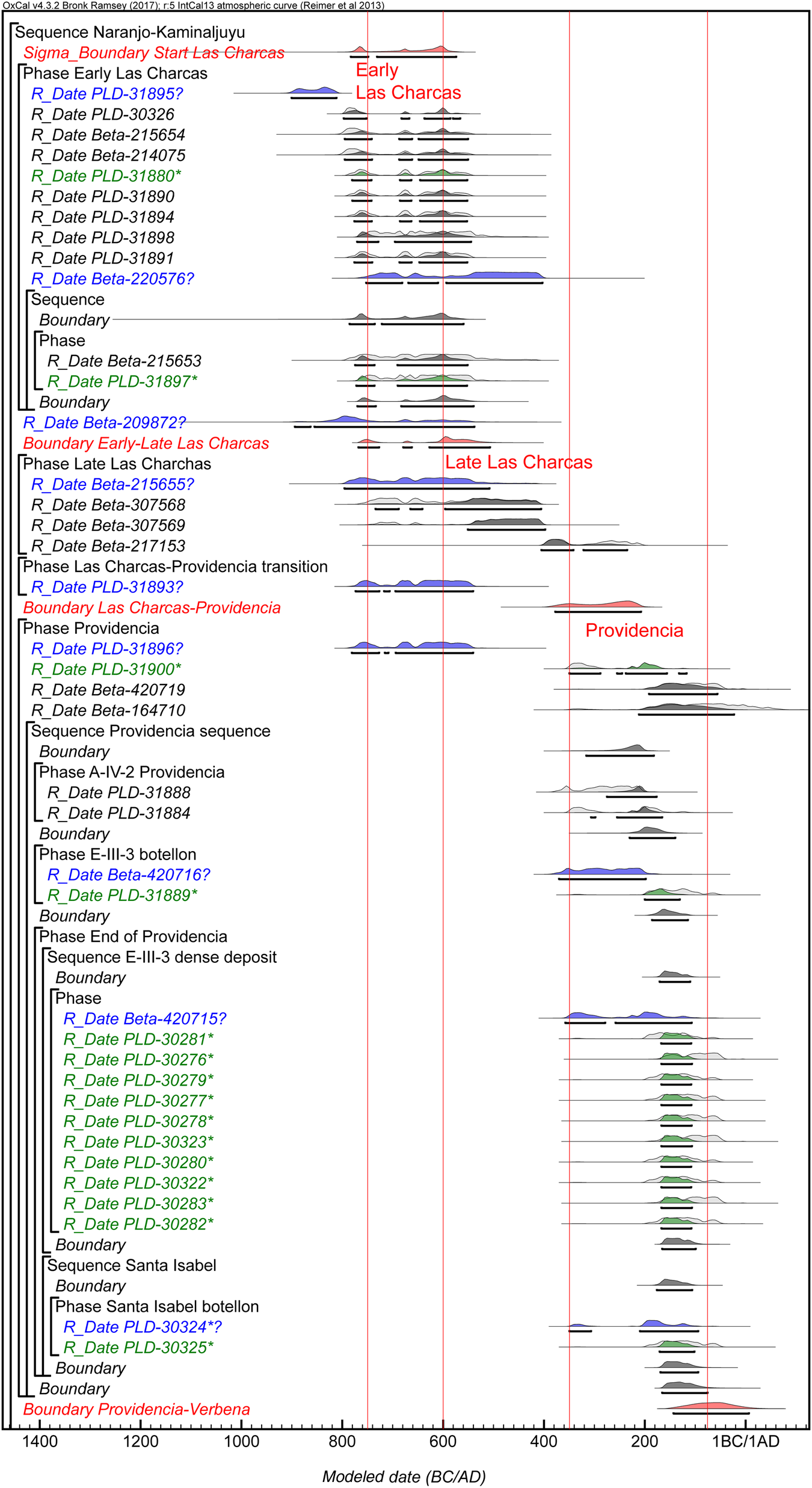
Our analysis adds eight new radiocarbon dates from the Early Las Charcas phase to the ones reported by Inomata and coauthors (Reference Inomata, Ortiz, Arroyo and Robinson2014). In Model A, which considers PLD-31895 to be an outlier, a larger number of dates pull the beginning of this phase later than the one proposed by Inomata and colleagues (Figure 4). In the bimodal distribution of probabilities indicated by this model, we favor the older peak, which corresponds roughly to 750 BC (all dates are calibrated). Model B includes PLD-31895 as a valid date, which leads to a beginning date of 850 BC (Supplemental Figure 2a). Regardless, it does not appear that there was a substantial ceramic-using population in the Kaminaljuyu region before 900 BC.
Bayesian Model A for the Las Charcas and Providencia phases. Bars under probability distributions represent 95.4% probability ranges. Outliers are indicated by “?” at the end of their labels. Dates measured on seeds or corncobs are indicated by “*” at the end of their labels.

Model A places the Early to Late Las Charcas transition around 600 BC, whereas Model B points to 550 BC. Model A considers Beta-220576, which is younger than other Early Las Charcas dates, to be an outlier, whereas Model B includes it as an acceptable date. Unfortunately, this period around 600–550 BC corresponds to a flat area on the radiocarbon calibration curve, which makes it almost impossible to obtain a more precise date. These dates generally agree with the ceramic sequences of other regions, including Chiapas, the northern Maya highlands, and the Maya lowlands.
Late Las Charcas
The Late Las Charcas phase is characterized by globular jars with higher necks than those from the preceding phase. Some have sections of their bodies decorated with punctations and large, smooth handles that connect the lips and the upper bodies (Supplemental Figure 3q), which tend to be thinner than those of the earlier phase. Coarsely finished deep bowls with thin orange slip are also common, as are Pilar bowls with red slip on buff surfaces (Supplemental Figure 3p). Straight-walled dishes with smudged black slip and coarse incisions begin at this time (Supplemental Figure 3t). These types, along with those of the Early Las Charcas phase, are dominant ceramics at Naranjo, indicating that the main occupation of this ceremonial center occurred during the Las Charcas phase. These ceramics tie the Late Las Charcas complex to the Kal complex of western El Salvador.
Inomata and colleagues suggested a Las Charcas–Providencia transition of 350 BC, but Models A and B in the present study show wider ranges, between 380 and 200 BC (Figure 4 and Supplemental Figure 2a). This is mainly because we obtained a substantial number of new radiocarbon dates from the end of the Providencia phase, which pull the beginning of the Providencia phase later in time in Bayesian statistics. We still prefer the Las Charcas–Providencia transition date of 350 BC, which is supported primarily by Beta-217153 of the Late Las Charcas phase. The period between 410 and 350 BC corresponds to a steep slope of the calibration curve. Because Beta-217153 falls within this range, it gives a highly precise calibrated date for the end of the Late Las Charcas phase. The transition date of 350 BC is also consistent with dates from other regions, including Urías in the Antigua Valley and the Maya lowlands (Inomata et al. Reference Inomata, Triadan, MacLellan, Burham, Aoyama, Palomo, Yonenobu, Pinzón and Nasu2017). Given these data, it is highly unlikely that the Providencia phase starts around 700 BC, as suggested by the SP chronology. Except for one clear outlier, PLD-31896, the 95.4% probability ranges of 20 of the 21 Providencia dates fall completely after 400 BC, providing solid evidence for our dating.
Providencia
Providencia ceramics include small bowls with long, solid supports, similar to the Emplumado type of the Early Las Charcas phase, but these later vessels are generally smaller and lack applied feather-like decorations. Diagnostic types include Sumpango (Supplemental Figure 4a, 4b), Polished Red (Supplemental Figure 4c), Kaminaljuyu Black-brown with postslip coarse incisions (Supplemental Figure 4e, 4f, 4l), Terra, Sacatepéquez Red (Supplemental Figure 4m), Izote, Monte Alto Red, and Xuc with characteristic white pastes and surfaces (Supplemental Figure 4g). Diagnostic forms and modes include faceted bowls (Supplemental Figure 4k) and dishes with flaring walls and flat bottoms, some with labial and medial flanges. These types and modes align the Providencia phase with the Chul phase in western El Salvador (see Demarest Reference Demarest1986; Demarest and Sharer Reference Demarest and Sharer1982), the Tol phase in the Salamá Valley, the Noguta 1 phase at La Lagunita, and the Early Chicanel phase in the Maya lowlands (the Cantutse phase at Ceibal).
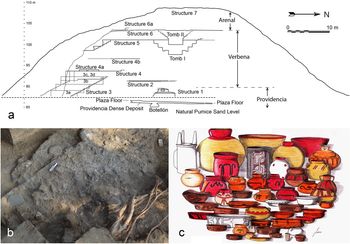
The transition from the Providencia phase to the Verbena phase has been the main focus of debate (Love Reference Love2018). The best evidence for the end of the Providencia phase comes from a dense deposit that we partially exposed underneath Mound E-III-3 (Figure 5). This large mound underwent a series of construction episodes, and a large part of it, from Structure 2 to Structures 5 and 6, which housed Tombs I and II, dates to the Verbana phase (Shook and Kidder Reference Shook and Kidder1952). Kidder (Reference Kidder1961:566) noted that the earliest version of the mound, Structure 1, contained ceramics different from those from upper layers. His team named materials from Structure 1 “Providencia.” The dense deposit that we excavated was placed in a dedicatory or mortuary ritual immediately before the construction of Structure 1 (Estrada Reference Estrada2017). It was sealed by a solid earthen floor, eliminating the possibility of stratigraphic mixing from upper layers. This stratigraphic sequence leaves no doubt that the deposit underlying Structure 1 dates to the Providencia phase.
Dense deposit found underneath Mound E-III-3: (a) North–south section of Mound E-III-3 (redrawn from Shook and Kidder Reference Shook and Kidder1952:Figure 56) and the deposit; (b) dense deposit during excavation; (c) reconstructions of vessels found in the dense deposit (drawing by Javier Estrada; courtesy of ZAK). (Color online)

In the excavation of this deposit, we uncovered 150 fragmented vessels, some of which could be partially reconstructed. Vessels were smashed and thrown into the deposit, which was then burned as indicated by abundant remains of carbon and ash. These materials can be securely dated to the end of the Providencia phase. Sumpango jars, characteristic of this period, comprised roughly 70% of the ceramic fragments found in this deposit. Kaminaljuyu Black-brown vessels with coarse postslip incisions were common, whereas those with fine incisions—markers of the following Verbena phase—were absent. The deposit also contained Sacatepéquez Red, Izote, Terra, Rofino, Xuc, and Morfino ceramics, all diagnostic of the Providencia phase (Figure 5c).
A roughly contemporaneous deposit was found in a botellón (a truncated, conical-shaped pit) excavated at Santa Isabel (Paiz Reference Paiz2014). In addition to the diagnostic Providencia types discussed earlier, this deposit contained a dish with nubbin feet. These supports are characteristic of the following Verbena and Arenal phases, but otherwise, Verbena ceramics were nearly absent in this deposit.
Ten of the 11 radiocarbon samples obtained from the Mound E-III-3 deposit, consisting of charred avocado seeds, provide highly consistent dates around 100 BC (Figure 4). These dates present unambiguous support for Inomata and colleagues’ chronology. Only Beta-420715, measured on carbonized wood, is somewhat older, most likely resulting from the use of old wood. Providencia dates from other contexts are consistent with these results. PLD-30324 and PLD-30325, for example, taken from avocado seeds found in the Santa Isabel botellón, present dates similar to those of the E-III-3 deposit. Another botellón was found below the Mound E-III-3 deposit. A carbonized seed collected from this pit produced a date close to those recovered from the dense deposit above it (PLD-31889). Although a wood charcoal sample from this botellón yielded a somewhat older date (Beta-420716), this is likely due to the deposition of old wood. The earlier part of the Providencia phase is represented by a deposit in Mound A-IV-2. Two charcoal samples from this context provided dates somewhat older than those of the E-III-3 samples (PLD-31884 and PLD-31888).
Model A assumes a temporal sequence from the A-IV-2 deposit to the botellón and dense deposit of Mound E-III-3, as well as the contemporaneity of the E-III-3 deposit and the Santa Isabel botellón. In Model B, the A-IV-2 deposit and the Santa Isabel botellón are placed in the general Providencia phase (Supplemental Figure 2a). Whereas PLD-30324 is considered to be an outlier in Model A, it is included as an acceptable date in Model B. The results of the two models are similar, pointing to the highest probability for the Providencia–Verbena transition to be around 75 BC. This date corresponds to the transition from the Late Preclassic to the Terminal Preclassic/Protoclassic period in the Maya lowlands. It is also consistent with the ends of the Chul phase in western El Salvador and of the Tol phase at El Portón in the Salamá Valley. In sum, 12 samples from secure Providencia contexts date to around 100 BC, effectively refuting the 400 BC end date for the Providencia phase proposed by the SP chronology.
Verbena
Diagnostic Verbena ceramics include Usulutan and Verbena White ware (Supplemental Figure 5d, 5k). Kaminaljuyu Black-brown ware continues, but Verbena vessels exhibit fine incisions (Supplemental Figure 5d, 5g), which distinguish them from the coarse-incised vessels of the preceding phase. Characteristic modes include tetrapods with either nubbin supports or small to medium hollow supports (Supplemental Figure 5k). At Chalchuapa (Sharer Reference Sharer1978) and Santa Leticia (Demarest Reference Demarest1986) in western El Salvador, nubbin supports appear at the end of the Providencia–corresponding Chul phase. It is possible that they begin to be used at the end of the Providencia phase in the Kaminaljuyu region as well.
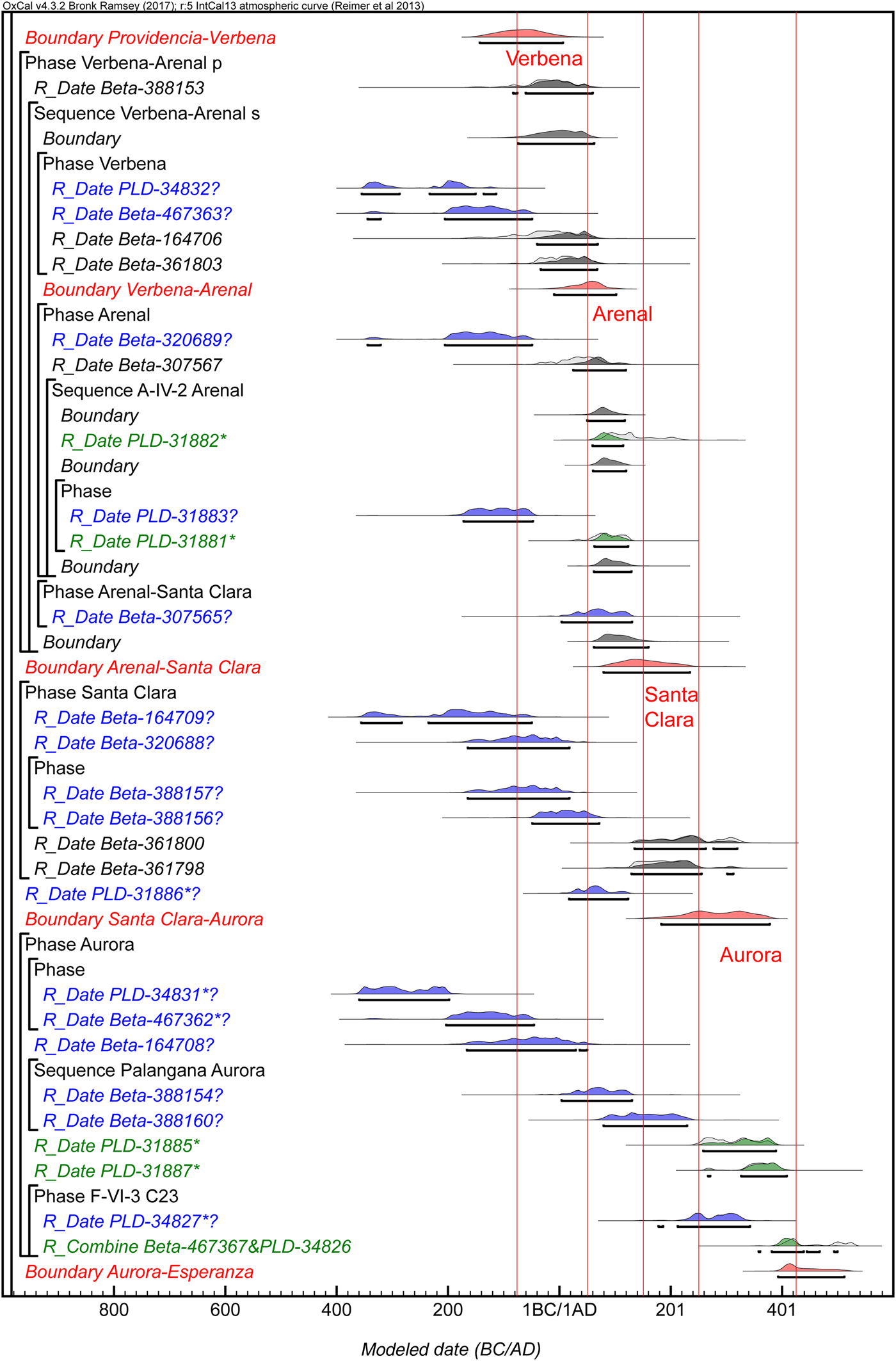
Two Verbena dates are older than the Providencia dates of the E-III-3 deposit and are most likely outliers (Figure 6). They were measured on a piece of carbonized wood, which was collected from Tomb II of Mound E-III-3 by the Carnegie Project (Shook and Kidder Reference Shook and Kidder1952) and stored in the National Museum of Archaeology and Ethnology (MNAE). We divided the sample into two pieces and sent one to Paleo Labo and the other to Beta Analytic. The resulting dates (PLD-34832 and Beta-467363) are slightly older than those from the dense deposit underneath the mound, suggesting that the sample represents old wood or was contaminated with insecticide or other chemicals during storage.
Bayesian Model A for the Verbena, Arenal, Santa Clara, and Aurora phases.

Arenal
Ceramics of the Verbena and Arenal phases share many characteristics. Various Verbena types, including Kaminaljuyu Black-brown with fine incisions and Usulutan (Supplemental Figure 5n), continue into the Arenal phase. Although nubbin feet continue from the previous phase, larger supports also appear. Diagnostic types that distinguish Arenal from Verbena include Rofino bowls, Arenante vessels with coarse incisions (Supplemental Figure 5l, 5m), and effigy vessels.
We collected radiocarbon samples from Arenal storage facilities near Mound A-IV-2 (Figure 6). We consider the dates obtained on a corncob (PLD-31881) and a seed (PLD-31882) to be valid, whereas one sample obtained from wood (PLD-31883) appears to be an outlier. Beta-307565, collected from a late Arenal context at the Acropolis, returned a date slightly older than the samples from Mound A-IV-2. Model A considers it to be an outlier, whereas Model B includes it in the general Arenal phase as a valid date. Both Models A and B date the Verbena–Arenal transition to around AD 50, which accords well with the ceramic sequences of other regions, particularly that of western El Salvador.
Santa Clara
Many ceramic types from the Arenal phase continue into the Santa Clara phase, although vessels tend to be larger and often have coarser decorations. Kaminaljuyu Black-brown vessels begin to have supports with rattles, and their incised designs become cruder (Supplemental Figure 6a–d). Santa Clara diagnostic modes include mammiform supports (Supplemental Figure 6g), although they tend to be smaller than those of the subsequent Aurora phase.
The recycling of construction fills from earlier buildings becomes more prevalent during the Santa Clara and subsequent phases, which resulted in the frequent presence of old ceramics and old charcoal pieces in those layers. Of seven Santa Clara samples, five returned dates older than the Arenal dates and are thus excluded as outliers (Figure 6). One of them (PLD-31886) was measured on a seed, but the sample may have been redeposited. Bayesian models indicate Arenal–Santa Clara transition dates ranging between AD 80 and 240, with the highest probability around AD 150.
The Santa Clara phase was a turbulent time at Kaminaljuyu. Investigations by ZAK revealed numerous Santa Clara deposits containing broken objects, traces of extensive burning, and in some cases mutilated burials (Arroyo et al. Reference Arroyo, Ajú, Estrada, Rojas, Arroyo, Méndez Salinas and Ajú2016). They appear to represent termination rituals associated with political disruptions. The Santa Clara phase generally corresponds to the fall of lowland centers, such as El Mirador. Nonetheless, we need more precise dating to determine the timing of these events.
Aurora
Many Aurora vessels seem to follow the same canons as those of the previous Santa Clara phase. There are some important changes, however: they include the appearance of annular bases in Llanto vessels and examples of “Proto Esperanza” ceramics, such as certain jar forms (Supplemental Figure 7l) and thick bowls. Berlin-type plates with black slip and four small supports are also common (Supplemental Figure 7f). Mammiform supports become large, aligning this phase roughly with the so-called Protoclassic period of other regions.
Five of the 10 Aurora dates in Model A are older than the valid Santa Clara dates (Figure 6). PLD-34831 and Beta-467362, for example, were taken from one of the charred beans that were obtained in the 1950s by Heinrich Berlin (Reference Berlin1952) and stored in paper matchboxes in the MNAE. We cut it in half, sending one half to Paleo Labo and the other to Beta Analytic. These gave inconsistent results, indicating that the sample was contaminated. The four valid Aurora dates were all measured on seeds.
In Model A, the Santa Clara–Aurora transition date shows a wide range from AD 180 to 380, with the highest probability falling around AD 250. Model B includes the youngest date among the outliers in Model A (Beta-388160) as an acceptable date (Supplemental Figure 2b). It pushes the beginning of Aurora earlier, to around AD 200. We need more reliable radiocarbon dates to more precisely date the end of the Santa Clara phase.
Esperanza
The Esperanza phase is characterized by the presence of Teotihuacan-related architecture and artifacts. Teotihuacan-style ceramics include imported Thin Orange, as well as tripod cylinder vessels, many of which appear to be locally made. Dos Arroyos polychrome dishes with basal flanges were imported from the Maya lowlands (Reents-Budet et al. Reference Reents-Budet, Bishop, Valdés, Blackman, Laporte, Arroyo and Mejía2006). Although these foreign styles are traditionally used to identify the Esperanza phase, studies by Popenoe de Hatch (Reference Popenoe de Hatch1997) and, more recently, by ZAK members have defined utilitarian types, allowing researchers to date non-elite contexts that lack Teotihuacan-related objects. Common vessels include thin-walled Esperanza Flesh bowls with annular bases (Supplemental Figure 8i) and Prisma vessels with brown slip and square supports.
The transition date from Aurora to Esperanza is particularly difficult to determine. Critical in this analysis are radiocarbon samples obtained in the recent ZAK excavation near Mound F-VI-3 (Beta-467367, PLD-34826, and PLD-34827). They were collected from a ritual deposit placed before the construction of Mound F-VI-3, which contained only Aurora ceramics. PLD-34827 was measured on a bean, whereas Beta-467367 and PLD-34826 were obtained from a carbonized avocado seed, which we divided into two pieces. The two avocado dates are consistent, underscoring the reliability of these measurements, whereas the bean date is older. The deposit was sealed by a floor, and it is unlikely that charcoal samples, particularly a large avocado seed, were mixed from layers above it.
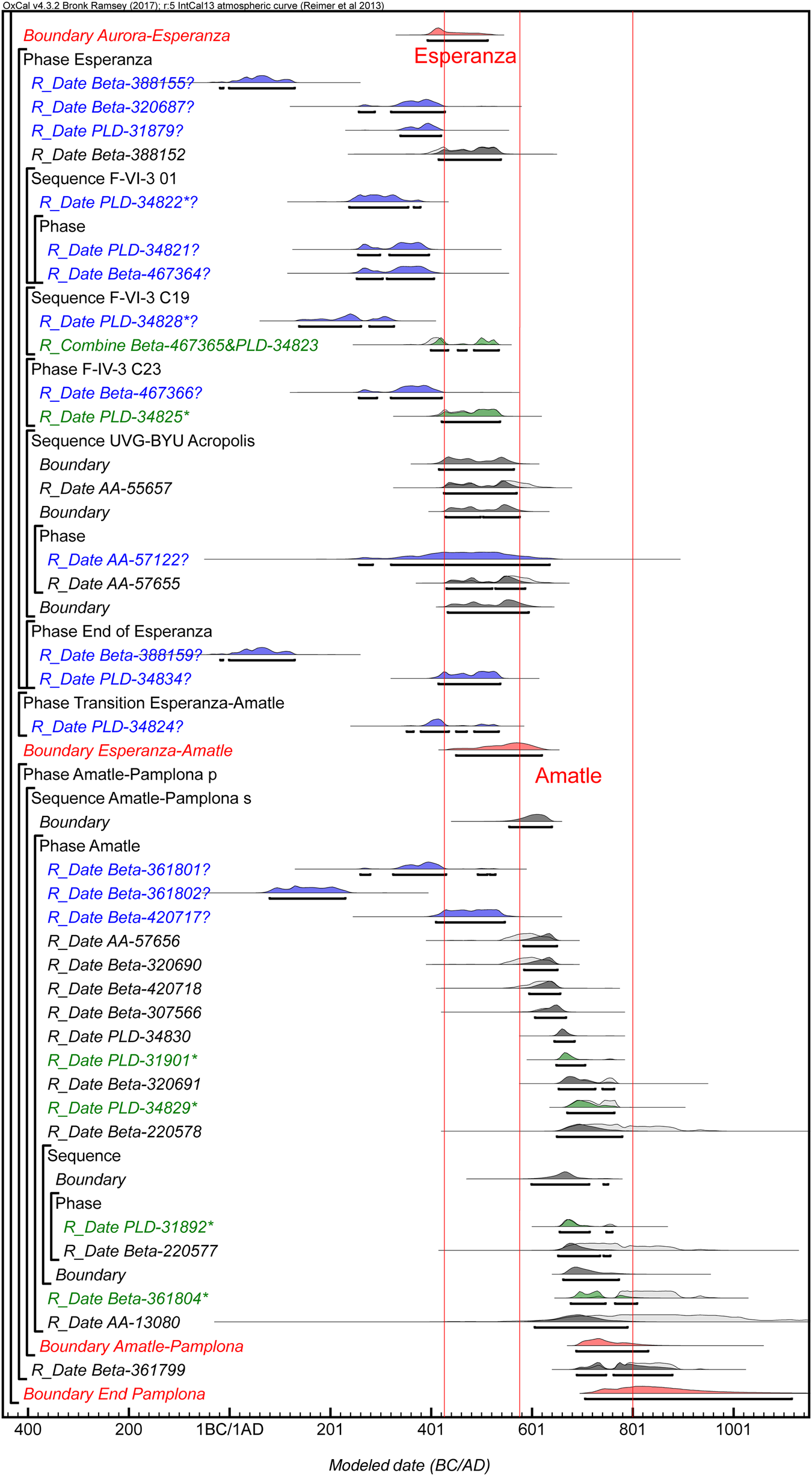
Model A considers Beta-467367 and PLD-34826 on the avocado seed to be valid dates for the Aurora phase (Figure 6). The bean date, PLD-34827, is assumed to be an outlier, resulting from the redeposition of old material. In addition, nine Esperanza dates older than the avocado dates, as well as two dates that are out of sequence, are excluded as outliers. These anomalous dates probably resulted from the recycling of construction fills, which was common during this period (Figure 7). Two of them (PLD-34822 and PLD-34828) were measured on a seed and a corncob, but they may also have been redeposited. Model A gives the highest probability for the Aurora–Esperanza transition around AD 425.
Bayesian Model A for the Esperanza and Amatle phases.

Model B assumes that the avocado dates, Beta-467367 and PLD-34826, belong to the Esperanza phase instead (Supplemental Figure 2c). It is possible that utilitarian vessels characteristic of the Aurora phase continued to be used at the beginning of the Esperanza phase after the introduction of Teotihuacan-style ceramics. In this scenario, Beta-320687, PLD-31879, PLD-34821, and Beta-467364 are no longer considered outliers. Model B places the Aurora–Esperanza transition around AD 350.
An important question is when talud-tablero buildings first appear at Kaminaljuyu. Relevant dates were obtained through the investigation of the Acropolis by the Universidad del Valle-Brigham Young University (UVG-BYU) Project (Houston et al. Reference Houston, Nelson, Chiriboga, Alvarado, Escobedo, Taube, Laporte, Arroyo and Mejía2005). The researchers state that AA-55657 was taken from the layer on top of Structure E, the earliest talud-tablero building in the Acropolis. Our Bayesian Models A and B add adjustments to the model published by Inomata and coauthors (Reference Inomata, Ortiz, Arroyo and Robinson2014). We now assume that AA-57122, taken from another talud-tablero context and older than AA-55657, is an outlier. We also place AA-57656, which was taken from the matrix above the final talud-tablero layer, in the Amatle phase. Model A produces a bimodal distribution for AA-55657, concentrated around AD 430–480 and AD 550. Considering that Structure E had two versions of talud-tablero buildings (Houston et al. Reference Houston, Nelson, Chiriboga and Spensley2003) and that there was some time lapse between the beginning of the Esperanza phase and the emergence of talud-tablero architecture, we might place the construction of the first talud-tablero building in the Acropolis between AD 450 and 540. Model B gives the highest probability for AA-55657 around AD 440 (Supplemental Figure 2c). The beginning of talud-tablero structures at Kaminaljuyu needs to be examined with more data.
Amatle
During the Amatle phase, Teotihuacan-related ceramics and artifacts disappear. There is, however, some continuity in utilitarian pottery. Esperanza Flesh appears to develop into the Amatle type (Supplemental Figure 8o–q), which is characteristic of this period. Construction methods change from the earthen architecture of the preceding period to the common use of river cobbles on building surfaces.
Bayesian analysis suggests an Esperanza–Amatle transition date of AD 575 (Figure 7). It is likely that the use of talud-tablero buildings at Kaminaljuyu ends around this time. ZAK excavations at the Acropolis confirm that talud-tablero buildings, Structures K and W, were in use until the Esperanza–Amatle transition when their upper portions were razed and covered by later buildings of a different style. A radiocarbon date obtained by the UVG-BYU Project, AA-57656, also points to the end of talud-tablero around AD 575–600. This accords generally with Daniel Wolfman's (Reference Wolfman, Eighmy and Sternberg1990) archaeomagnetic dates, as well as the interpretation of existing data by Braswell (Reference Braswell and Braswell2003).
As to the end of the Amatle phase, Models A and B both point to the highest probability around AD 740 and give somewhat low agreement indices to Beta-361804. We, however, think that Beta-361804 is a valid date and favor an Amatle end date around AD 800. In any event, because there are no data for the subsequent Pamplona phase and because this period corresponds to a flat part of the calibration curve, this date has a large error range.
Discussion
Preclassic Period
Newly obtained radiocarbon dates provide solid support for the revision of the Preclassic chronology proposed by Inomata and colleagues (Reference Inomata, Ortiz, Arroyo and Robinson2014). Particularly important are 15 dates taken from secure deposits that contain late Providencia ceramics. These dates firmly place the beginning of the Verbena phase around 75 BC. Our Preclassic chronology for Kaminaljuyu aligns well with the sequences at other southern sites, including Chalchuapa (Sharer Reference Sharer1978), Santa Leticia (Demarest Reference Demarest1986), the Salamá Valley (Sharer and Sedat Reference Sharer and Sedat1987), and La Lagunita (Ichon and Arnauld Reference Ichon and Arnauld1985; Ichon and Viel Reference Ichon and Viel1984). New radiocarbon dates obtained from Takalik Abaj have also led to a revised chronology for this piedmont site, which correlates well with our Kaminaljuyu sequence (Schieber de Lavarreda et al. Reference Schieber de Lavarreda, Inomata, Claudio, Medina, Orrego Corzo, Aoyama, Nasu, Arroyo, Salinas and Álvarez2019).
A remaining issue is the correlation with the sequence at El Ujuxte. Love (Reference Love2018) criticized Inomata and colleagues’ (Reference Inomata, Ortiz, Arroyo and Robinson2014) chronological revision, citing radiocarbon dates and ceramic data from this Pacific Coast site. Kaminaljuyu, however, now has a substantially larger number of AMS dates. If the radiocarbon dates from El Ujuxte are reliable, we need to reconsider the ceramic cross-dating between Kaminaljuyu and El Ujuxte proposed by Love (Inomata et al. Reference Inomata, Arroyo and Robinson2019). Kaminaljuyu exhibits stronger ceramic affinities with western El Salvador, particularly during the Late and Terminal Preclassic periods, than with the western Pacific Coast. Ceramic correlations with the latter region require careful evaluation.
The revised chronology of Kaminaljuyu aligns well with the sequence of the Maya lowlands. The correlation of the Verbena and Arenal phases with the Terminal Preclassic/Protoclassic period in the lowlands is indicated not only by the shared ceramic traits listed by Inomata and coauthors (Reference Inomata, Ortiz, Arroyo and Robinson2014) but also by the presence of Usulutan vessels and a Kaminaljuyu Black-brown vase with fine incisions in Tikal Burial 85 (Culbert Reference Culbert1993). For many years, the SP chronology led some scholars to believe that Maya-style bas-relief sculpture found in the Southern Maya Region developed seamlessly out of the earlier Olmec style around 400 BC. Our chronological revision, however, suggests that both Maya-style carving and rich royal tombs appeared roughly contemporaneously in the Southern Region and the Maya lowlands around 100 BC.
This revision leaves a gap of roughly 300 years in our knowledge of the sculptural sequence in the Southern Maya Region—from the cessation of Olmec-style carving around 400 BC to the common use of Maya-style sculpture after 100 BC. This period appears to have been dominated by locally developed forms, including niche figures, potbellies, zoomorphic altars, pedestal sculptures, and bench figures (Inomata and Henderson Reference Inomata and Henderson2016; Inomata et al. Reference Inomata, Ortiz, Arroyo and Robinson2014). Critical to this discussion is the dating of Maya-style bas-relief monuments at Izapa. John Clark and Ajax Moreno (Reference Clark, Moreno, Clark, Lowe, Lieske and Moreno2018) and Rosenswig (Reference Rosenswig2019) recently defended the traditional placement of these sculptures between 300 and 100 BC. Inomata and Henderson (Reference Inomata and Henderson2016, Reference Inomata and Henderson2019) suggest instead that many of the Izapa monuments may have been carved between 300 and 100 BC, but that some may date to around 100 BC or later. The dates of Izapa monuments need to be further evaluated with more data.
In the Maya lowlands, too, the dates of Preclassic monuments need to be carefully reevaluated. Many Preclassic monuments found in the lowlands do not have secure contexts, and their dates have often been estimated through stylistic correlations with Kaminaljuyu sculptures. With the revision of the Kaminaljuyu chronology, the dates of those lowland monuments also need to be reconsidered. More secure chronological evidence is provided by the San Bartolo murals, dating to 300–100 BC (Saturno et al. Reference Saturno, Taube and Stuart2005; Taube et al. Reference Taube, Saturno, Stuart, Hurst and Skidmore2010). These murals exhibit iconography closely tied to that found in the Maya-style sculptures of the Southern Maya Region, especially Kaminaljuyu Sculpture 10. We probably need to consider the possibility that the lowland Maya made significant contributions to the development of Maya-style sculpture and associated symbols of authority.
Early Classic Period
Some ambiguity remains regarding the date of the Santa Clara–Aurora transition. During the Santa Clara phase, the governmental system based on divine rulership at Kaminaljuyu probably collapsed. The timing of this political change, whether or not it occurred simultaneously with the fall of lowland centers, presents critical implications for the understanding of social processes in broader areas.
The Early Classic chronology of Kaminaljuyu also remains problematic. We consider two scenarios. One version places the beginning of the Esperanza phase around AD 425, as suggested by our Bayesian Model A. The other places it around AD 350, as indicated by Model B. These dates affect the validity of Coggins's (Reference Coggins, Hammond and Willey1979) theory that Teotihuacan-related elements were transmitted from Kaminaljuyu to the lowland center of Tikal. The AD 425 date postdates the Teotihuacan entrada at Tikal in AD 378 and is contemporaneous with the accession of Yax K'uk’ Mo’ at Copan in AD 426 (Stuart Reference Stuart, Carrasco, Jones and Sessions2000), making Coggins's interpretation unlikely. In this scenario, the appearance of fully developed talud-tablero architecture at Kaminaljuyu is even later, possibly around AD 450–540. In contrast, Model B, which dates the beginning of the Esperanza phase to around AD 350, may accord better with Coggins's proposal. Nonetheless, even in this model, the beginning of talud-tablero buildings at Kaminaljuyu postdates AD 400.
It is important to note that the stable isotope analysis of human remains in the Esperanza phase tombs found in Kaminaljuyu Mounds A and B indicates the presence of individuals originating from the lowlands (Wright et al. Reference Wright, Valdés, Burton, Price and Schwarcz2010). Recent studies also show that the use of lime in construction at Kaminaljuyu did not begin until the Esperanza phase, implying that this technique was introduced to Kaminaljuyu along with talud-tablero architecture. These data encourage us to consider the possibility that Teotihuacan-related elements were brought to Kaminaljuyu through the Maya lowlands or other regions, such as Veracruz.
Social Change and the Environment
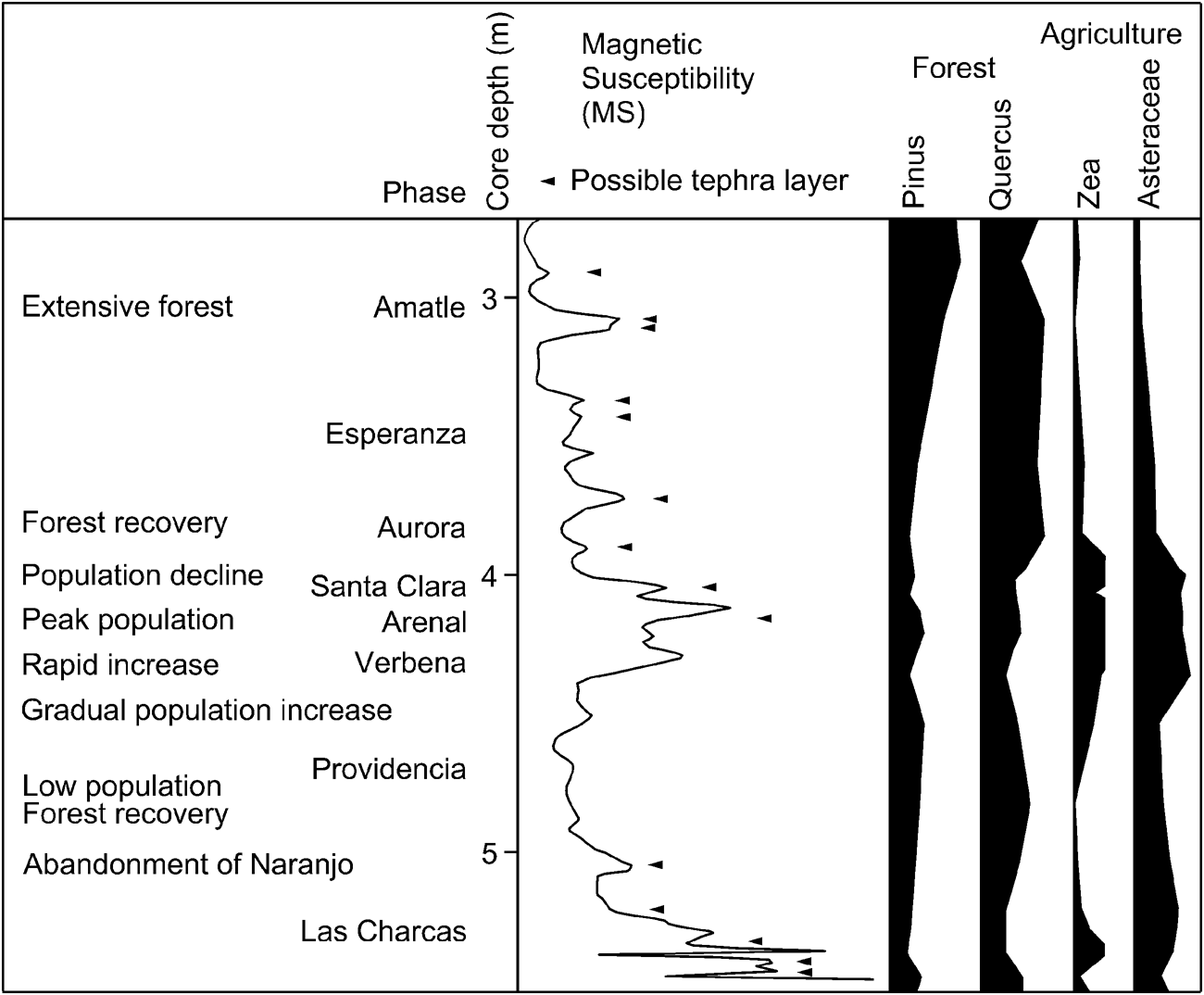
The chronological revision also compels us to reexamine demographic trends and their relationships to environmental change. The recent analysis of sediment cores from Lake Amatitlan by Lohse and coauthors (Reference Lohse, Hamilton, Brenner, Curtis, Inomata, Morgan, Cardona, Aoyama and Yonenobu2018) provides important data in this regard. To summarize, the magnetic susceptibility (MS) of sediments reflects both the degree of soil erosion caused by deforestation and the depositions of materials from volcanic eruptions (tephra; Lohse et al. Reference Lohse, Hamilton, Brenner, Curtis, Inomata, Morgan, Cardona, Aoyama and Yonenobu2018:Figure 7). MS values decline from the Early Las Charcas phase to the end of the Late Las Charcas phase (Figure 8). After reaching their minimum value during the early Providencia phase, they gradually rise during the late Providencia phase, followed by a rapid increase in the Verbena and Arenal phases. Pollen data also show that the recovery of forest taxa during the early Providencia phase was followed by deforestation during the Verbena and Arenal phases. Although many scholars have assumed that the population of the Kaminaljuyu region grew in a constant manner from the Las Charcas phase to the Providencia phase, culminating in the Verbena and Arenal phases, these data suggest that the process was not so straightforward.
Magnetic susceptibility (MS) and pollen data from Lake Amatitlan. The core depths of the pollen data from the 2000 core are adjusted to those of the MS data from the 2011 core (redrawn from Lohse et al. Reference Lohse, Hamilton, Brenner, Curtis, Inomata, Morgan, Cardona, Aoyama and Yonenobu2018:Figure 7 and Velez et al. Reference Velez, Curtis, Brenner, Escobar, Leyden and de Hatch2011:Figure 6).

The collapse of Naranjo around 350 BC was probably accompanied by regional population decline caused by political and social disruptions. This period also corresponds with the collapse of La Venta and political disruptions at some Chiapas and southern centers. The cessation of Olmec-style monuments hints at political change in a broad area, including the Southern Maya Region and the Isthmian area. The early Providencia phase may have been a period of low population at Kaminaljuyu, but it is necessary to test this possibility with a more refined ceramic chronology. The population of the region and construction activity appear to have gradually increased during the late Providencia phase, leading to explosive growth during the Verbena and Arenal phases. The growth rate of the latter periods was probably even greater than previously suspected.
A drastic decline in MS values appears to correspond to the Santa Clara phase, although the chronology of the core in this part is not precise. If this interpretation is correct, a significant population decline may have resulted from the social upheaval of this period, which is suggested by the presence of massive termination deposits. The destruction of numerous Preclassic monuments may also have occurred during this period. An intriguing question is whether this social change at Kaminaljuyu is related to severe droughts hinted at by data from the Maya lowlands and the Cariaco Basin (Haug et al. Reference Haug, Günther, Peterson, Sigman, Hughen and Aeschlimann2003; Wahl et al. Reference Wahl, Roger Byrne, Schreiner and Hansen2007). Unfortunately, in the Amatitlan data, strong anthropogenic effects appear to mask evidence of climate change.
During the Aurora and Esperanza phases, MS levels remain low, and forest taxa increase in the pollen record, indicating low levels of population and of agricultural activity in the Kaminaljuyu region. During the Amatle phase, MS values continue to be low, except for a few spikes caused by volcanic eruptions. Pine pollen reaches its highest level, indicating that there were broad expanses of forest. These data suggest that the population level of the Kaminaljuyu region was low during this period. This interpretation contrasts with the proposal made by Penn State Project researchers that Kaminaljuyu reached its highest population during the Amatle phase (Sanders and Murdy Reference Sanders, Murdy, Carmack, Early and Lutz1982). Investigations by ZAK suggest that constructions of the Amatle phase were more limited than those of the Verbena and Arenal phases. Previous studies may have underestimated the population of the Verbena–Arena phase and overestimated that of the Amatle phase.
Conclusions
Our analysis makes it clear that, at a Mesoamerican site with a long occupation, old charcoal pieces are often incorporated in later contexts. At Kaminaljuyu, this problem becomes particularly serious during the Classic period. In such a setting, it is necessary to obtain a significant number of radiocarbon dates from secure contexts and to combine them with detailed ceramic studies.
Recent investigations have significantly advanced the diachronic study of Kaminaljuyu. The 108 AMS radiocarbon dates obtained after 2000 presented in this study, combined with radiocarbon dates reported by earlier projects, make Kaminaljuyu the best-dated site in the Southern Maya Region. These data and refined ceramic studies strongly support the revision of the Preclassic chronology proposed by Inomata and coauthors (Reference Inomata, Ortiz, Arroyo and Robinson2014), although the chronology of the Early Classic period continues to be a vexing problem. This chronology provides a solid basis for the study of key issues in Mesoamerican archaeology, including the nature of political disruptions at the end of the Middle Preclassic period, the development of divine rulership in the Maya highlands and lowlands, and the political collapse at the end of the Preclassic period.
Acknowledgments
ZAK's research was carried out with permits given by the Instituto de Antropología e Historia de Guatemala, with financial support from the Alphawood Foundation. Additional funds for new radiocarbon dates were provided by the MEXT KAKENHI 26101003 and the JSPS KAKENHI 2630025. Inomata's analysis of radiocarbon dates was supported by the Agnese Nelms Haury Program of the University of Arizona. We thank Lorena Paiz for sharing her research data. Lucia Henderson read an earlier draft and improved our argument and writing. Jon Lohse provided helpful comments on the interpretation of the Amatitlan cores. We thank John Clark, Michael Love, and three anonymous reviewers for their comments on an earlier manuscript.
Data Availability Statement
All relevant data are presented in the article and supplemental materials.
Supplemental Materials
For supplemental material accompanying this article, visit https://doi.org/10.1017/laq.2020.49.
Supplemental Text 1. OxCal code.
Supplemental Figure 1. Matrix indicating the stratigraphic relations and ceramic phases of radiocarbon dates.
Supplemental Figure 2. Bayesian Model B.
Supplemental Figure 3. Ceramics of the Las Charcas phase (courtesy of ZAK).
Supplemental Figure 4. Ceramics of the Providencia phase (courtesy of ZAK).
Supplemental Figure 5. Ceramics of the Verbena and Arenal phases (courtesy of ZAK).
Supplemental Figure 6. Ceramics of the Santa Clara phase (courtesy of ZAK).
Supplemental Figure 7. Ceramics of the Aurora phase (courtesy of ZAK).
Supplemental Figure 8. Utilitarian ceramics of the Esperanza phase and ceramics of the Amatle phase (courtesy of ZAK).
Supplemental Table 1. List of Radiocarbon Dates.