Introduction
Medically unexplained physical symptoms are highly prevalent in the general population (Hiller et al. Reference Hiller, Rief and Brahler2006) and in primary care (Fink et al. Reference Fink, Sorensen, Engberg, Holm and Munk-Jorgensen1999). However, their diagnostic conceptualization apparently differs, and has been subject to discussion since the introduction of somatoform disorders in the Diagnostic and Statistical Manual of Mental Disorders (DSM)-III (APA, 1980). With the implementation of the DSM-5 (APA, 2013), the category of somatoform disorders was basically revised and a new prototype was introduced, somatic symptom disorder (SSD). With this new diagnosis, the distinction between medically explained and medically unexplained symptoms was eliminated, which is in line with recent research addressing this issue (Leiknes et al. Reference Leiknes, Finset, Moum and Sandanger2006; McFarlane et al. Reference McFarlane, Ellis, Barton, Browne and Van Hooff2008; Klaus et al. Reference Klaus, Rief, Brahler, Martin, Glaesmer and Mewes2013). Moreover, in addition to somatic symptoms, the diagnosis of SSD includes psychological features, which were suggested to further enhance validity (Rief et al. Reference Rief, Mewes, Martin, Glaesmer and Braehler2010; Voigt et al. Reference Voigt, Wollburg, Weinmann, Herzog, Meyer, Langs and Lowe2012; Wollburg et al. Reference Wollburg, Voigt, Braukhaus, Herzog and Lowe2013; Klaus et al. Reference Klaus, Rief, Brahler, Martin, Glaesmer and Mewes2015). At the same time, the new concept has some limitations and has accordingly been criticized (Hausteiner-Wiehle & Henningsen, Reference Hausteiner-Wiehle and Henningsen2012; Mayou, Reference Mayou2014; Rief & Isaac, Reference Rief and Isaac2014; Rief & Martin, Reference Rief and Martin2014). For instance, it was questioned whether the new diagnosis targets the common underdiagnosis in some countries of disorders characterized by impairing somatoform symptoms (Rief & Martin, Reference Rief and Martin2014). Furthermore, conceptual shortcomings have been pointed out. These include the heterogeneity of the various conditions (chronic pain; somatic symptoms in the context of medical diagnoses, i.e. cancer, diabetes) that are subsumed under the diagnosis of SSD, as well as the division of the rather homogenous construct of hypochondriasis into either illness anxiety disorder or SSD (Rief & Isaac, Reference Rief and Isaac2014).
Nevertheless, the revision of the International Classification of Diseases (ICD)-10 is still underway and will ultimately result in the publication of the ICD-11 by the World Health Organization (WHO), expected in 2018. Proposals concerning the revision of the concept of somatoform disorders in this classification system are still under debate (Gureje, Reference Gureje2015). Specifically, the so-called bodily distress disorder (BDD; Fink et al. Reference Fink, Toft, Hansen, Ornbol and Olesen2007) is considered a promising candidate in the current search for criteria upon which to base the revised category (Fink & Schroder, Reference Fink and Schroder2010; Gureje, Reference Gureje2015). Diagnostic criteria for BDD include at least three symptoms from one of four symptom clusters (i.e. gastrointestinal, cardiovascular/autonomic, musculoskeletal, and general) or four or more symptoms of different kinds. Other researchers suggested additional psychological features as a relevant criterion for the classification of physical symptoms as a mental disorder (Rief et al. Reference Rief, Mewes, Martin, Glaesmer and Braehler2010). The operationalization of the polysymptomatic distress disorder (PSDD) focuses on such characteristics (Rief et al. Reference Rief, Mewes, Martin, Glaesmer and Brahler2011). Criteria for PSDD are fulfilled if persons present at least two medically unexplained symptoms from two different body regions as well as one psychological criterion.
In order to review new classification proposals, validation criteria that are typically used in the context of somatoform disorders and related constructs include the distinction between people reporting somatic symptoms who need healthcare and those who do not, as well as the identification of people who feel impaired (Rief et al. Reference Rief, Mewes, Martin, Glaesmer and Brahler2011). In this regard, the long-term perspective is of pivotal relevance for forming the prognosis and predicting the further development of affected individuals (Lowe et al. Reference Lowe, Mundt, Herzog, Brunner, Backenstrass, Kronmuller and Henningsen2008; Dimsdale et al. Reference Dimsdale, Creed, Escobar, Sharpe, Wulsin, Barsky, Lee, Irwin and Levenson2013). Subjective impairment and healthcare utilization can be considered as essential prognostic variables for classification criteria in the context of somatoform disorders (Escobar et al. Reference Escobar, Rubiostipec, Canino and Karno1989; Rief et al. Reference Rief, Mewes, Martin, Glaesmer and Braehler2010, Reference Rief, Mewes, Martin, Glaesmer and Brahler2011). Increased healthcare utilization and resulting higher direct and indirect costs have consistently been associated with subjects reporting multiple somatic symptoms (Khan et al. Reference Khan, Khan, Harezlak, Tu and Kroenke2003; Al-Windi, Reference Al-Windi2005), thereby emphasizing the relevance of the symptomatology for the healthcare system. Accordingly, the number of symptoms might be another crucial factor in terms of prognostic validity.
Consequently, the comparison of the different classification proposals concerning their long-term prognosis of disorder-relevant factors is of special interest. The current study investigates the three proposals (SSD, BDD, and PSDD) with regard to their respective course over time and prognostic validity with a medium- and long-term design. The aim of the study was twofold: (1) to examine which of the concepts distinguishes best between subjects with high v. low or average (a) healthcare utilization, (b) number of somatic symptoms, and (c) impairment; and (2) to identify the most successful classification proposal with regard to prognostic validity, i.e. predicting increased healthcare utilization, the presence of somatic symptoms, and impairment after one and four years. Due to a lack of longitudinal studies, hypotheses are based on previous cross-sectional evidence: In a prior study, classification proposals were inspected with regard to their ability to identify impaired persons and persons in need for treatment (Rief et al. Reference Rief, Mewes, Martin, Glaesmer and Brahler2011). The authors investigated a former version of SSD [the so-called complex somatic symptom disorder (CSSD)]. It was demonstrated that CSSD as well as BDD and PSDD were successful at identifying subjects with high v. low healthcare utilization resulting in large effect sizes (CSSD: Cohen's d = 0.95; BDD: d = 0.92; PSDD: d = 1.01). With regard to impairment, again all three proposals revealed large effect sizes (between d = 0.81 and d = 1.03) confirming substantial abilities to identify persons with a high level of impairment. Based on these results, it is hypothesized (1) that SSD, BDD, and PSDD will be similarly favourable in distinguishing between persons with high v. low or average healthcare utilization over time, and (2) that SSD, BDD and PSDD will be successful at distinguishing between persons with high v. low or average impairment over time. Moreover, in a recent study, BDD was investigated in a primary-care sample and it was demonstrated that more than half of the subjects fulfilling BDD at a baseline assessment still displayed the diagnosis after a 2-year follow-up (Budtz-Lilly et al. Reference Budtz-Lilly, Vestergaard, Fink, Carlsen and Rosendal2015). Given these results, it is hypothesized that (3) BDD criteria will be better at predicting a high number of reported symptoms over time than SSD and PSDD.
Method
Sampling procedure
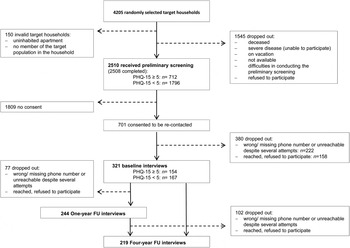
With the assistance of a demographic consulting company (Usuma, Germany), approximately 4000 German households were randomly selected. Of these, 2510 persons representative of the German general population (regarding age and education, cf. German Federal Statistical Office, 2007) participated in a preliminary screening and completed self-rating questionnaires (participation rate: 62% of valid addresses, see Fig. 1). Eligibility criteria included a minimum age of 14 years as well as the ability to read and understand German.
Response rate throughout the recruitment and interviewing process (adapted from Klaus et al. Reference Klaus, Rief, Brahler, Martin, Glaesmer and Mewes2015). FU, Follow-up; PHQ, Patient Health Questionnaire – 15. Figure adapted and reproduced with permission.

In this sample, the percentage of female participants was slightly higher than in the general population (54.4% v. 51%). The initial screening included the somatic symptom subscale (15 items) of the Patient Health Questionnaire (PHQ-15; Kroenke et al. Reference Kroenke, Spitzer and Williams2002), which was completed by 2508 participants. Of these, 712 (28%) fulfilled the criterion for increased somatic symptom severity (score of ⩾5). Of the 2510 participants who received a preliminary screening, 701 (28%) subjects consented to be re-contacted for consecutive investigations. Then, two subsamples were randomly selected of those participants who agreed to be re-contacted (and who then agreed to further participate), that is, one subsample of participants reporting low scores for somatic symptoms (PHQ-15 score < 5, n = 167) and one subsample reporting high scores (PHQ-15 score ⩾5, n = 154). Thereby, we ensured two comparably sized subgroups with either increased or decreased risk for somatoform disorders (cf. previous studies: Rief et al. Reference Rief, Mewes, Martin, Glaesmer and Braehler2010, Reference Rief, Mewes, Martin, Glaesmer and Brahler2011; Klaus et al. Reference Klaus, Rief, Brahler, Martin, Glaesmer and Mewes2015).
In a second step, telephone interviews were conducted which included a somatic symptom interview and assessment of psychological features, allowing criteria for various disorder proposals (i.e. SSD, BDD and PSDD) to be checked. N = 321 subjects (67% of those that were reachable, see Fig. 1) completed this baseline assessment (T1). Subsequently, two follow-up assessments were performed with N = 244 (76% of the T1 sample) persons who participated in the 1-year follow-up [T2; time (in months) between T1 and T2: mean = 13, s.d. = 2] and N = 219 persons (68% of the T1 sample) who were re-interviewed at the 4-year follow-up [T3; time (in months) between T1 and T3: mean = 49, s.d. = 2]. A financial incentive was offered for each completed study section to minimize dropout rates.
Participants were asked for permission to gather information from their general practitioner (GP), especially regarding healthcare utilization. At T1, N = 141 patients (43.9% of N = 321) allowed us to contact their GP and accordingly N = 141 GPs (every patient had a different GP) were contacted. Valid information was received for N = 112 patients (79.4%). At T2, N = 77 GPs (54.6% out of N = 141 GPs who we were allowed to contact) and at T3, N = 71 GPs (91.0% out of N = 78 who were allowed to be contacted) provided the required information.
The study protocol was approved by the ethics committee of the German Psychological Society (DGPs) and the local institutional review board of the Department of Psychology, University of Marburg.
Measurements
Telephone interviews
At all three time points, structured diagnostic interviews were conducted by telephone in order to assess somatic complaints that were present during the previous twelve months. To this aim, a list of 49 symptoms was derived from various diagnostic instruments (e.g. DSM-III-R, DSM-IV, ICD-10, CIDI/DIA-X). In the case of reported symptoms, participants were asked to further specify the degree of subjective impairment due to the symptom, the symptom duration, first occurrence of the symptom, whether a medical doctor was consulted, and whether a medical explanation was detected. Every single symptom was rated by a trained and closely supervised interviewer as medically explained or as not better explained by a medical condition (i.e. somatoform symptom). This was done due to a list of common medical diagnoses and following a precisely defined algorithm. Guidelines for categorization of symptoms were based on the opinion of an expert committee consisting of members with high expertise and experience in dealing with somatoform disorders. The guidelines used allowed coding symptoms as medically unexplained when the reported explanation was not satisfactory from a medical point of view, e.g. when ‘labels’ were used (e.g. ‘lower back pain’) or when the features of the symptom (duration, body part, onset, etc.) did not match the criteria of a medical diagnosis. If necessary, interviewers made the distinction after conferring with the expert committee. For instance, back pain was categorized as medically unexplained if the provided explanation was ‘lumbago’ while it was coded as medically explained if the medical doctor had diagnosed ‘osteoporosis’. Studies in primary care have demonstrated the validity of this procedure (Körber et al. Reference Körber, Frieser, Steinbrecher and Hiller2011; Steinbrecher et al. Reference Steinbrecher, Koerber, Frieser and Hiller2011).
Impairment caused by each symptom was rated on a 5-point Likert scale (from 0 = no impairment to 4 = very severe impairment). Additionally, psychological features that are considered crucial regarding somatoform disorders, i.e. cognitive, affective, and behavioural characteristics, were assessed by an 18-item scale which has shown good reliability (for details, cf. Klaus et al. Reference Klaus, Rief, Brahler, Martin, Glaesmer and Mewes2015).
Moreover, participants were asked how often they had consulted their GP during the previous 12 months (in the following the term GP consultations refers to any clinic or office visits to the GP) and on how many days they had been unable to go to work or to perform usual domestic activities due to medical conditions (days of incapacity to work), which were used as indicators of healthcare utilization.
General practitioners’ information
Due to substantial disagreement in data derived from GPs and their patients (Schumacher et al. Reference Schumacher, Rief, Brahler, Martin, Glaesmer and Mewes2013), GPs' information was included in the current study to complement the self-reported data of the participants. Therefore, GPs provided copies of the electronic patient record including information concerning patients' healthcare utilization.
Operationalization of classification proposals
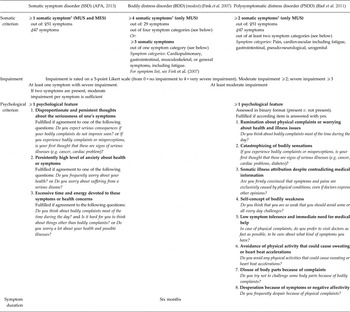
Details on the operationalization can be found in Table 1. SSD was operationalized according to the criteria published in DSM-5 (APA, 2013). BDD can be divided into three classes, namely non-bodily distress, modest bodily distress and severe bodily distress (Fink et al. Reference Fink, Toft, Hansen, Ornbol and Olesen2007). In the present study, no participant fulfilled criteria for severe bodily distress, therefore we only operationalized the modest bodily distress disorder as well as non-bodily distress (see Table 1). PSDD was operationalized according to Rief et al. (Reference Rief, Mewes, Martin, Glaesmer and Brahler2011). For the diagnoses of BDD and PSDD, only somatoform symptoms were included, whereas for the diagnosis of SSD, any somatic symptom (i.e. medically explained or unexplained) was considered. For all proposals, a symptom duration of at least six months was expected. For further details, see Table 1.
Operationalization of the three different classification proposals

MUS, Medically unexplained symptoms; MES, medically explained symptoms.
a Presence of symptoms during the last 12 months with either repeated appearance on more than 1 day or prolonged duration of at least 1 day.
The baseline sample (T1) was divided into three independent pairs of groups, i.e. with diagnosis or without diagnosis, respectively (SSD v. non-SSD, BDD v. non-BDD, PSDD v. non-PSDD).
Statistical analyses
Before statistical procedures were applied, normal distribution of data and homogeneity of variance were tested using Kolmogorov–Smirnov and Levene's tests, respectively. For analyses of group differences regarding sociodemographic data, χ2 tests (categorical variables) or independent samples t tests (continuous variables) were conducted.
Since analysis of variance (ANOVA) is considered more powerful than non-parametric tests, and since it is quite robust against violations of the assumption of normality, general linear model-based analyses were used despite deviation from normality in some variables. Therefore, mixed repeated-measures analyses of variance (rm-ANOVAs) were calculated in order to investigate variations of the dependent variables: healthcare utilization (number of self-reported GP consultations during the previous 12 months, number of days of incapacity to work), impairment (sum score of impairment by symptoms during previous 12 months), and number of reported symptoms, respectively. To this end, separate analyses using a 2-factorial design with time as within factor (T1 v. T2 v. T3) and group as between factor (baseline SSD v. non-SSD; baseline BDD v. non-BDD; baseline PSDD v. non-PSDD, respectively) were conducted. Mauchly's test was employed to determine potential violations of the assumption of sphericity, in which case the Greenhouse–Geisser correction was applied. For results of ANOVAs, f (small effect: ⩾0.10; medium effect: ⩾0.25, and large effect: ⩾0.40) is reported as a measure of effect size (Cohen, Reference Cohen1992). Contrasts are reported for analyses of within factors, while post-hoc analyses with regard to group comparisons were conducted using the Mann–Whitney U test due to non-normally distributed variables. Effect sizes for post-hoc analyses are reported as Cohen's d (small effect: ⩾0.20; medium effect: ⩾0.50 and large effect: ⩾0.80). In the case of multiple testing, p values were Bonferroni-corrected.
For all statistical analyses, the significance level was set at α = 5%. All results shown are means ± standard deviations (s.d.).
Information obtained from the GPs is reported on a descriptive level due to small group sizes that did not allow statistical analyses.
Results
Sample characteristics
Based on data obtained at the baseline assessment (T1), participants who fulfilled the diagnostic criteria for SSD were grouped into a SSD group (n = 108), while all other subjects, who did not fulfil the criteria, were allocated to a non-SSD group (n = 213). In a second analysis, participants were checked for criteria for modest bodily distress and were thus were assigned to a BDD group (n = 30) v. subjects with non-bodily distress who formed the non-BDD group (n = 291). Likewise, in a third analysis, subjects were allocated to a PSDD group (n = 37) or non-PSDD group (n = 284) according to the corresponding criteria.
Of the 321 patients, the number of subjects who met criteria for all three disorders was n = 10 (3.1%); for SSD and BDD n = 17 (5.3%), for SSD and PSDD n = 29 (9.0%), for BDD and PSDD n = 15 (4.6%), for SSD only n = 72 (22.4%), for BDD only n = 8 (2.5%), for PSDD only n = 3 (0.9%), and for none of the disorders n = 197 (61.4%).
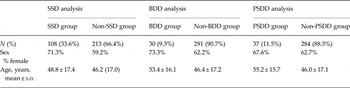
The SSD and non-SSD group did not differ with regard to age (n.s.). However, participants fulfilling the criteria for BDD were significantly older than subjects without BDD (t 319 = −2.2, p = 0.032, d = 0.24). This effect was also found concerning PSDD, with significantly older participants in the PSDD group compared to the non-PSDD group (t 319 = −3.1, p = 0.002, d = 0.35). The SSD group consisted of significantly more females than the non-SSD group (χ2 1 = 4.5; p = 0.033). No significant sex differences were found in the BDD v. non-BDD group or the PSDD v. non-PSDD group (all n.s., see Table 2).
Sample characteristics of participants allocated to the groups with or without diagnosis at baseline (T1, N = 321)

SSD, Somatic symptom disorder; non-SSD, persons without SSD diagnosis; BDD, bodily distress disorder; non-BDD, persons without BDD diagnosis; PSDD, polysymptomatic distress disorder; non-PSDD, persons without PSDD diagnosis.
Medium- and long-term prognosis of healthcare utilization
GP consultations
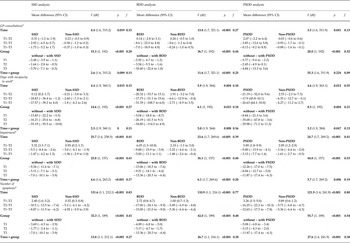
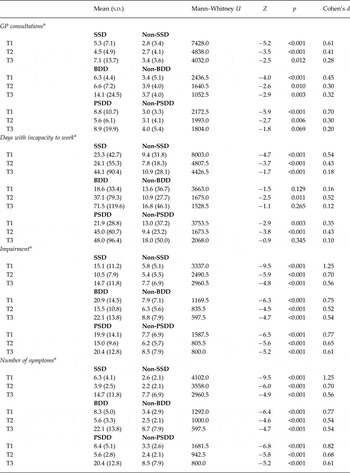
Elevated numbers of GP consultations in the SSD group resulted in a significant group effect of medium size (i.e. more GP consultations in the SSD group than in the non-SSD group at all three time points; see Tables 3 and 4). Likewise, the PSDD analysis revealed a significant group effect of medium size, whereas a large-sized group effect was determined in the BDD group (compared to the non-BDD group).
Effect of time (baseline v. 1-year follow-up v. 4-year follow-up), effect of group (with v. without diagnosis) and interaction effect on three different classification proposals

CI, Confidence interval; SSD, somatic symptom disorder; BDD, bodily distress disorder; PSDD, polysymptomatic distress disorder; GP, general practitioner.
a Based on patient's self-report.
Group comparisons (with v. without diagnosis) according to the three different classification proposals

T1, baseline assessment; T2, 1-year follow-up; T3, 4-year follow-up; SSD, somatic symptom disorder; non-SSD, persons without SSD diagnosis; BDD, bodily distress disorder; non-BDD, persons without BDD diagnosis; PSDD, polysymptomatic distress disorder; non-PSDD, persons without PSDD diagnosis.
a Based on patient's self-report.
While no significant time × group interaction was determined in the SSD or PSDD analyses (i.e. the size of the differences between persons with the respective diagnosis v. without were stable over time), a significant time × group interaction of medium effect size was detected in the BDD analysis due to varying courses of the number of consultations over time (stable in non-BDD v. increasing especially from T2 to T3 in BDD).
Days with incapacity to work
A significant medium-sized group effect was found on the reported number of days with incapacity to work for SSD (with increased numbers found in the groups with the respective diagnosis). More days with incapacity to work in the BDD group compared to the non-BDD group and in the PSDD group compared to the non-PSDD group resulted in a group effect of small size (see Tables 3 and 4), respectively.
Furthermore, significant time × group interactions of small effect sizes were determined in all three analyses (SSD v. non-SSD, BDD v. non-BDD and PSDD v. non-PSDD) indicating constant numbers of days with incapacity to work in the groups without the respective diagnosis and rising numbers over time in the groups with diagnosis (SSD: rise from T2 to T3; BDD: constant increase from T1 to T3; PSDD: increase from T1 to T2).
Medium- and long-term prognosis of impairment and number of symptoms
Impairment
The reported subjective impairment was significantly elevated in all persons fulfilling criteria for a diagnosis (SSD, BDD, or PSDD), which was reflected in large-sized group effects (see Tables 3 and 4).
Moreover, subjects with diagnosis displayed varying impairment over time (decreases from T1 to T2 and increases from T2 to T3) while subjects without diagnosis reported a stable level of impairment, resulting in significant interactions for time × group in all three analyses with small-sized effects.
Number of symptoms
As could be expected, a higher number of symptoms was reported in all three groups with diagnosis in comparison to the groups without diagnosis, resulting in large group effects in all three analyses (see Tables 3 and 4).
Additionally, significant time × group interaction effects of medium size were found in all three analyses (SSD v. non-SSD; BDD v. non-BDD; PSDD v. non-PSDD): groups without the respective diagnosis reported a stable number of symptoms over time whereas groups with the diagnosis presented a rise in symptoms from T2 to T3.
GP information
GP consultations
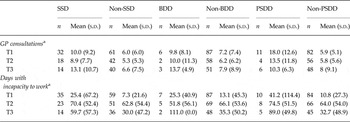
At all three time points (T1–T3), GPs reported nominally more consultations of persons in the SSD group than the non-SSD group, of persons in the BDD than the non-BDD group, and persons in the PSDD compared to the non-PSDD group (see Table 5). On a descriptive level, these results were comparable to the self-reported data, which revealed that individuals allocated to groups with a diagnosis (SSD, BDD, PSDD) had more consultations than the groups without a diagnosis.
General Practitioner information concerning patient's healthcare utilization

SSD, Somatic symptom disorder; non-SSD, patients without SSD diagnosis; BDD, bodily distress disorder; non-BDD, patients without BDD diagnosis; PSDD, polysymptomatic distress disorder; non-PSDD, patients without PSDD diagnosis; GP, general practitioner.
a Based on GP records.
Days with incapacity to work
Numerically, GP information revealed a higher number of days with incapacity to work for the SSD group than the non-SSD group as well as for the PSDD group than the non-PSDD group at all three measurement time points (see Table 5). Furthermore, GPs reported more days for the BDD group at T1 and T3, but not at T2. The subjects' self-reported data showed that groups with a diagnosis (SSD, BDD, PSDD) reported more days with incapacity to work than those without a diagnosis at all three time points.
Discussion
In the light of the upcoming ICD-11, three classification proposals, namely SSD, BDD, and PSDD, were investigated with respect to their discrimination of disorder-relevant factors (healthcare utilization, impairment, number of symptoms) between subjects with or without diagnosis, and their medium- and long-term prognosis regarding these factors.
Distinction between individuals with and without diagnosis
According to our hypotheses that were based on cross-sectional data, it was expected that all three classification proposal would be successful at identifying persons with high v. low healthcare utilization and impairment. Our results show that in terms of subjective impairment and the number of somatic symptoms, all three proposals were comparable in distinguishing between persons with strong impairment and an increased number of symptoms and persons without. However, effect sizes for the discrimination between respective groups (with diagnosis or without) in regard to healthcare utilization revealed that criteria for BDD at baseline were more successful in identifying persons with higher numbers of GP consultations over time (1- and 4-year follow-ups) than SSD or PSDD, but SSD was superior regarding days with incapacity to work. In conclusion, all three proposals were favourable concerning the distinction between subjects who fulfilled the diagnostic criteria and those who did not, with a slight advantage for BDD and SSD with regard to healthcare utilization.
Medium- and long-term prognosis of healthcare utilization, impairment, and symptoms
Confirming the general prognostic validity of all three classification proposals, persons with the respective diagnoses at baseline showed higher healthcare utilization, stronger impairment, and more somatic symptoms even up to four years later than persons without the respective diagnoses. Similarly, for subjects fulfilling the criteria for one of the three diagnoses at baseline, changes over time resulting in a general rise in the numbers of days with incapacity to work, in impairment, and in the number of symptoms was found up to four years later. At the same time, the variables remained relatively stable in individuals without the respective diagnoses resulting in interaction effects of small sizes. This is in contrast to our hypothesis and previous evidence reporting BDD criteria to be more successful in predicting a higher number of reported symptoms over time than SSD and PSDD (Budtz-Lilly et al. Reference Budtz-Lilly, Vestergaard, Fink, Carlsen and Rosendal2015). In our data, the only difference between proposals was found with regard to the medium- and long-term changes in the number of GP consultations, where persons without BDD at baseline showed stable numbers over time whereas the number rose in persons with BDD. This variation resulted in a medium-sized interaction effect that was not found for SSD or PSDD.
Information obtained from GP records
Objective data regarding healthcare utilization, which were derived from GP practices, confirmed increased healthcare utilization for persons who fulfilled criteria for a diagnosis compared to those who did not for all three proposals. Since persons presenting medically unexplained symptoms tend to underestimate their healthcare utilization (Schumacher et al. Reference Schumacher, Rief, Brahler, Martin, Glaesmer and Mewes2013), the approach of gathering GP information is very valuable in regard to our study aim. However, due to a small number of cases and a consequent lack of power for statistical analyses, the differences were only presented on a descriptive level and need to be interpreted with caution.
Suggestions in regard to the current proposal for ICD-11
Our data support the use of BDD as a basis for the recent draft version of the WHO group working on changes to the section on somatoform disorders for the ICD-11 (Gureje, Reference Gureje2015). It also indicates that proposals including psychological features show equally well prognostic validity. In accordance with this, the proposal for the ICD-11 can be regarded as an extension of the BDD concept which was originally suggested by Fink et al. (Reference Fink, Toft, Hansen, Ornbol and Olesen2007). Based on the available evidence, the new disorder should not be characterized by simple symptom counts (which has been criticized before: Rief & Isaac, Reference Rief and Isaac2014), but implies excessive attention given to the symptoms (possibly resulting in increased healthcare utilization) as well as substantial impairment in various areas of functioning, e.g. family, occupational, or social (Gureje, Reference Gureje2015). Thus, with factors such as healthcare utilization and impairment, the current ICD-11 suggestion contains two essential factors regarding a high validity of the diagnosis. Moreover, and in contrast to the SSD criteria, the ICD-11 proposal contains clear behavioural features, such as repeated contact with healthcare providers. It can be assumed that the inclusion of other psychological features would further increase the validity of the diagnosis, and would also justify the classification as a mental disorder. Only recently, we confirmed the relevance of psychological criteria in the context of somatoform disorders and their predictive value (Klaus et al. Reference Klaus, Rief, Brahler, Martin, Glaesmer and Mewes2015).
Another crucial aspect is the substitution of the term somatoform. It has been criticized that this term overemphasizes mind-body dualism in the sense that it can be interpreted as indicating that ‘everything is just in the mind’ (Rief & Martin, Reference Rief and Martin2014). It was argued that clinicians in some countries find it unacceptable for their patients to receive this diagnosis, especially in primary care. Therefore, the label of the disorder could be considered to be a relevant aspect. While the use of the term somatic symptom disorder in DSM-5 has been criticized (Creed et al. Reference Creed, Guthrie, Fink, Henningsen, Rief, Sharpe and White2010; Rief & Martin, Reference Rief and Martin2014), the term bodily distress disorder has been chosen as the most suitable for the new category in the current proposal for ICD-11 (Gureje, Reference Gureje2015). It was claimed that it might, for the most part, be acceptable for patients and clinicians, might prevent the dualistic thinking of mind and body, and might facilitate multidisciplinary handling across cultures.
Besides the labelling, the question arises which concept may be best accepted and easy to use in clinical practice, for example concerning primary care physicians, who are often confronted with this patient group. The concept of SSD might be considered advantageous in this regard since it only requires one (or more) impairing somatic symptom(s) of any aetiology in conjunction with one of only three psychological features. On the other hand, SSD was criticized most importantly for being over-inclusive by throwing together several diagnoses into one for the sake of clinical utility (Frances, Reference Frances2013; Rief, Reference Rief2013). The concept of BDD is based on multiple bodily symptoms, but does not involve psychological criteria. This might be of advantage for non-psychiatrist clinicians who are generally not used to assessing psychological conditions. The concept of PSDD might be considered more difficult for use in primary care due to its focus on psychological features. However, provision of training packages (which might be useful for a successful introduction of any new concept) has been suggested in this context (Rief & Martin, Reference Rief and Martin2014), so that healthcare providers are enabled to diagnose and to explain these diagnoses to the patient in a way he/she can accept it. So far, the question which concept might be best accepted in clinical practice remains to be investigated and empirical data is needed before conclusions can be drawn. These open issues should play a prominent role in the development of the ICD-11 (Rief & Isaac, Reference Rief and Isaac2014) in order to increase its acceptance in medicine and to counteract the underdiagnosis of somatoform disorders. In this regard, expectations for respective changes to the ICD-11 are high (Frances & Nardo, Reference Frances and Nardo2013; Mayou, Reference Mayou2014).
Limitations
The results of the current study need to be considered in the light of some shortcomings. Most prominently, our data heavily relied on self-report of participating individuals, which might have been subject to bias. Persons with somatoform disorders have been found to show biased memory recall regarding health information (Martin et al. Reference Martin, Buech, Schwenk and Rief2007), and healthcare utilization is often underestimated by patients in general (Schumacher et al. Reference Schumacher, Rief, Brahler, Martin, Glaesmer and Mewes2013). However, by including information from the electronic patient record obtained by GPs, we tried to involve another, rather objective, data source. Given that health or medical data are usually considered as private and sensitive information, we only received permission to access this information from part of the sample. Accordingly, power for statistical analyses was lacking and a larger sample regarding GP information would be preferable. Furthermore, to facilitate subjects' correct recall of health information in the telephone interview, we inquired about each somatic symptom and resulting healthcare utilization separately for the previous 12 months.
It has to be taken into consideration that our data only refer to subjects who fulfil the modest form of bodily distress (BDD group). Therefore, it is not possible to draw conclusions regarding the manifestation of severe distress. Additionally, our operationalization of BDD criteria was based on the original proposal of Fink et al. (Reference Fink, Toft, Hansen, Ornbol and Olesen2007). Since the current draft for BDD of the WHO working group presents a modified version and differs from the original one, our results may not be fully applicable to the new BDD proposal.
With regard to SSD, it has to be noted that criteria for somatic symptoms also included medically explained symptoms. Accordingly, it is possible that a certain amount of healthcare utilization and impairment in subjects fulfilling SSD might be due to well-defined medical conditions which, for example, make regular doctor consultations necessary.
Conclusion
The present study contributes to the current debate concerning the revision of the category of somatoform disorders in the ICD-11. We provide evidence regarding general prognostic validity of all three classification proposals with a slight advantage of BDD distinguishing best between persons with and without diagnosis with regard to future healthcare utilization. Although the current draft version for the ICD-11, which is based on the BDD approach, took up some criticism that was raised in response to the DSM-5, there might still be some potential for further discussion and improvements.
Acknowledgements
The study was funded by grants from the German Research Foundation (Deutsche Forschungsgemeinschaft) to Rief, Brähler and Martin (DFG RI 574/14-1) and to Mewes (DFG ME 3773/1-2).
Declaration of Interest
None.