1 Introduction
Let
 $k$
be a field, and let
 ${\mathcal{C}}$
be a
 $k$
-linear,
 $\operatorname{Hom}$
-finite triangulated category with split idempotents and suspension functor
 $\unicode[STIX]{x1D6F4}$
. We denote the split Grothendieck group of an additive category
 ${\mathcal{A}}$
by
 $K_{0}^{\text{sp}}({\mathcal{A}})$
and the Grothendieck group of an abelian or triangulated category
 ${\mathcal{B}}$
by
 $K_{0}({\mathcal{B}})$
.
We first present two previous results, one by Xiao and Zhu and the other one by Palu, which in some sense are the base case of our results. Note that both Xiao and Zhu and Palu assume that
 $k$
is an algebraically closed field. However, this assumption is not needed for our higher versions and
 $k$
is a general field in our setup.
Previous results. Xiao and Zhu presented triangulated analogues of results of Auslander [Reference Auslander2, Theorems 2.2 and 2.3] and Butler [Reference Butler5, Theorem in introduction]. In particular, they proved in [Reference Xiao and Zhu18, Theorem 2.1] that if
 ${\mathcal{C}}$
is a triangulated category of finite type, then
 $K_{0}({\mathcal{C}})$
is isomorphic to
 $$\begin{eqnarray}\displaystyle K_{0}^{\text{sp}}({\mathcal{C}})/\langle -[A]+[B]-[C]\mid C\in \operatorname{Ind}{\mathcal{C}}\text{ with Auslander{-}Reiten triangle }A\rightarrow B\rightarrow C\rangle . & & \displaystyle \nonumber\end{eqnarray}$$
We can think of the
 ${\mathcal{C}}$
appearing on the right side as the only possible
 $1$
-cluster tilting subcategory of
 ${\mathcal{C}}$
. In this paper, we are interested in higher cluster tilting subcategories.
The first higher case occurs when
 ${\mathcal{C}}$
has a (
 $2$
-)cluster tilting subcategory. Palu studied this case, in a more specific setup, in [Reference Palu15]. In fact, Palu assumes that
 ${\mathcal{C}}$
is the stable category of a Frobenius
 $k$
-linear category with split idempotents and that
 ${\mathcal{C}}$
is
 $2$
-Calabi–Yau with a (
 $2$
-)cluster tilting subcategory
 ${\mathcal{T}}$
.
Given an indecomposable
 $M$
in
 ${\mathcal{T}}$
, let
 $\widetilde{{\mathcal{T}}}$
be the additive subcategory of
 ${\mathcal{T}}$
whose indecomposables are the same as
 ${\mathcal{T}}$
, excluding those isomorphic to
 $M$
. Then, up to isomorphism, there is a unique indecomposable
 $M^{\ast }\not \in {\mathcal{T}}$
such that
 $\operatorname{add}(\widetilde{{\mathcal{T}}}\cup M^{\ast })\subseteq {\mathcal{C}}$
is (
 $2$
-)cluster tilting. Moreover,
 $M$
and
 $M^{\ast }$
appear in two triangles with certain properties, called exchange triangles, of the form
 $$\begin{eqnarray}M^{\ast }\rightarrow B_{M}\rightarrow M\rightarrow \unicode[STIX]{x1D6F4}M^{\ast }\qquad \text{and}\qquad M\rightarrow B_{M^{\ast }}\rightarrow M^{\ast }\rightarrow \unicode[STIX]{x1D6F4}M,\end{eqnarray}$$
where
 $B_{M}$
and
 $B_{M^{\ast }}$
are in
 $\widetilde{{\mathcal{T}}}$
. Palu proved in [Reference Palu15, Theorem 10] that
 $$\begin{eqnarray}K_{0}({\mathcal{C}})\cong K_{0}^{\text{sp}}({\mathcal{T}})/\langle [B_{M^{\ast }}]-[B_{M}]\rangle _{M}.\end{eqnarray}$$
Note that if the Auslander–Reiten quiver of
 ${\mathcal{T}}$
has no loops, then the indecomposable
 $M\in {\mathcal{T}}$
has Auslander–Reiten
 $4$
-angle
 $M\rightarrow B_{M^{\ast }}\rightarrow B_{M}\rightarrow M$
in the sense of [Reference Iyama and Yoshino10, Theorem 3.8]. Hence Palu’s theorem is a higher version of Xiao and Zhu’s theorem.
We present “higher cluster tilting” versions of Xiao and Zhu and Palu’s results. Moreover, we present a “higher angulated” version of Palu’s result.
Higher cluster tilting versions. Let
 $n\geqslant 2$
be an integer and assume that
 ${\mathcal{C}}$
has a Serre functor
 $\mathbb{S}$
and an
 $n$
-cluster tilting subcategory
 ${\mathcal{T}}$
; see Definition 2.5. Let
 $\operatorname{Ind}{\mathcal{T}}$
be a full subcategory of
 ${\mathcal{T}}$
containing precisely one object from each isomorphism class of indecomposables in
 ${\mathcal{T}}$
and assume that
 $\operatorname{Ind}{\mathcal{T}}$
is locally bounded; see Definition 4.1. Recall that the functor
 $\mathbb{S}_{n}:=\mathbb{S}\unicode[STIX]{x1D6F4}^{-n}$
and Auslander–Reiten
 $(n+2)$
-angles in
 ${\mathcal{T}}$
were introduced in [Reference Iyama and Yoshino10, Section 3].
Theorem A. We have that
 $K_{0}({\mathcal{C}})$
is isomorphic to

The arguments we use to prove Theorem A rely on
 $n\geqslant 2$
. However, note that when
 $k$
is an algebraically closed field, the case
 $n=1$
is still true and it is an instance of Xiao and Zhu’s theorem.
If we add certain extra assumptions, we obtain the following because
 $\mathbb{S}_{n}\cong \operatorname{id}$
.
Corollary B. Assume that
 $n\geqslant 2$
is an even integer and
 ${\mathcal{C}}$
is
 $n$
-Calabi–Yau. Then

When
 $n=2$
and the Auslander–Reiten quiver of
 ${\mathcal{T}}$
has no loops, then Corollary B and Palu’s theorem coincide.
Higher angulated version. Let
 $d\geqslant 1$
be an integer and assume that
 ${\mathcal{C}}$
has a
 $d$
-cluster tilting subcategory
 ${\mathcal{S}}$
such that
 $\unicode[STIX]{x1D6F4}^{d}{\mathcal{S}}={\mathcal{S}}$
. Note that
 ${\mathcal{S}}$
is a
 $(d+2)$
-angulated category with
 $d$
-suspension
 $\unicode[STIX]{x1D6F4}^{d}$
, by [Reference Geiss, Keller and Oppermann7, Theorem 1]. Similarly to the way
 $K_{0}({\mathcal{C}})$
is defined, one can define the Grothendieck group of the
 $(d+2)$
-angulated category
 ${\mathcal{S}}$
as

see [Reference Bergh and Thaule4, Definition 2.1]. We prove that this is isomorphic to the Grothendieck group of
 ${\mathcal{C}}$
.
Theorem C. We have that
 $K_{0}({\mathcal{C}})\cong K_{0}({\mathcal{S}})$
.
Let
 $n=2d$
. We now add the assumptions that
 ${\mathcal{C}}$
has a Serre functor
 $\mathbb{S}$
and that there is an
 $n$
-cluster tilting subcategory
 ${\mathcal{T}}\subseteq {\mathcal{C}}$
such that
 ${\mathcal{T}}\subseteq {\mathcal{S}}$
and
 $\operatorname{Ind}{\mathcal{T}}$
is locally bounded. By [Reference Oppermann and Thomas14, Theorem 5.26], we have that
 ${\mathcal{T}}\subseteq {\mathcal{S}}$
is an Oppermann–Thomas cluster tilting subcategory, that is, the corresponding concept in a
 $(d+2)$
-angulated category of a cluster tilting subcategory in a triangulated category. Theorems A and C have the following immediate consequence.
Theorem D. We have that
 $K_{0}({\mathcal{C}})\cong K_{0}({\mathcal{S}})$
and

Corollary E. If
 ${\mathcal{C}}$
is
 $n$
-Calabi–Yau, then

When
 $d=1$
, we have that
 ${\mathcal{S}}={\mathcal{C}}$
is a triangulated category with (
 $2$
-)cluster tilting subcategory
 ${\mathcal{T}}$
and, adding the extra assumption that the Auslander–Reiten quiver of
 ${\mathcal{T}}$
has no loops, Corollary E becomes Palu’s theorem. For higher values of
 $d$
, Corollary E proves a higher angulated version of Palu’s theorem.
We conclude our paper by illustrating our results in two examples: one for each of the higher versions of Palu’s theorem. Let
 $q$
and
 $p$
be integers and
 $q$
be odd. Consider the triangulated
 $q$
-cluster category of Dynkin type
 $A_{p}$
, denoted
 ${\mathcal{C}}_{q}(A_{p})$
, and note that this is a
 $(q+1)$
-Calabi–Yau category. Since
 $q+1$
is even by assumption, we can apply Corollary B to show that
 $$\begin{eqnarray}K_{0}({\mathcal{C}}_{q}(A_{p}))\cong \left\{\begin{array}{@{}ll@{}}0\quad & \text{if }p\text{ is even},\\ \mathbb{Z}\quad & \text{if }p\text{is odd}.\end{array}\right.\end{eqnarray}$$
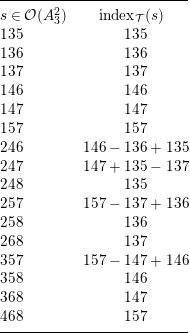
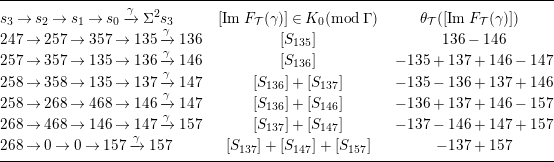
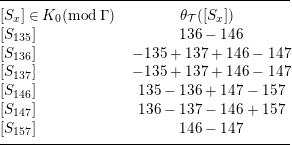
We then consider a higher Auslander algebra
 $A_{3}^{2}$
of Dynkin type
 $A$
and its Amiot cluster category
 ${\mathcal{C}}^{4}(A_{3}^{2})$
, to find an example of categories
 $$\begin{eqnarray}{\mathcal{T}}\subseteq {\mathcal{O}}(A_{3}^{2})\subseteq {\mathcal{C}}^{4}(A_{3}^{2})\end{eqnarray}$$
such that
 ${\mathcal{C}}^{4}(A_{3}^{2})$
is triangulated and
 $4$
-Calabi–Yau,
 ${\mathcal{O}}(A_{3}^{2})$
is closed under
 $\unicode[STIX]{x1D6F4}^{2}$
and
 $2$
-cluster tilting in
 ${\mathcal{C}}^{4}(A_{3}^{2})$
and
 ${\mathcal{T}}$
is
 $4$
-cluster tilting in
 ${\mathcal{C}}^{4}(A_{3}^{2})$
. Applying Theorem C and Corollary E to this example, we find that
 $$\begin{eqnarray}K_{0}({\mathcal{C}}^{4}(A_{3}^{2}))\cong \mathbb{Z}\oplus \mathbb{Z}.\end{eqnarray}$$
The paper is organized as follows. Section 2 recalls some definitions and results and presents our setup. Section 3 introduces some morphisms between Grothendieck groups that will be useful in the rest of the paper. Section 4 proves Theorem A. Section 5 proves Theorem C. Section 6 presents Corollary E. Finally, Sections 7 and 8 illustrate our two examples.
2 Setup and definitions
Definition 2.1. Let
 ${\mathcal{A}}$
be an essentially small additive category, and let
 $G({\mathcal{A}})$
be the free abelian group on isomorphism classes
 $[A]$
of objects
 $A\in {\mathcal{A}}$
. We define the split Grothendieck group of
 ${\mathcal{A}}$
to be
 $$\begin{eqnarray}K_{0}^{\text{sp}}({\mathcal{A}}):=G({\mathcal{A}})/\langle [A\oplus B]-[A]-[B]\rangle .\end{eqnarray}$$
When
 ${\mathcal{A}}$
is abelian or triangulated, we can also define the Grothendieck group of
 ${\mathcal{A}}$
as
 $$\begin{eqnarray}\displaystyle & \displaystyle K_{0}({\mathcal{A}}):=K_{0}^{\text{sp}}({\mathcal{A}})/\langle [A]-[B]+[C]\mid 0\rightarrow A\rightarrow B\rightarrow C\rightarrow 0\text{ is a short exact sequence in }{\mathcal{A}}\rangle \text{or} & \displaystyle \nonumber\\ \displaystyle & \displaystyle K_{0}({\mathcal{A}}):=K_{0}^{\text{sp}}({\mathcal{A}})/\langle [A]-[B]+[C]\mid A\rightarrow B\rightarrow C\rightarrow \unicode[STIX]{x1D6F4}A\text{ is a triangle in }{\mathcal{A}}\rangle , & \displaystyle \nonumber\end{eqnarray}$$
respectively.
In a similar way, one can define the Grothendieck group of a
 $(d+2)$
-angulated category
 ${\mathcal{S}}$
as follows.
Definition 2.2. Let
 $d$
be a positive integer. The Grothendieck group of a
 $(d+2)$
-angulated category
 ${\mathcal{S}}$
with
 $d$
-suspension functor
 $\unicode[STIX]{x1D6F4}^{d}$
is defined to be
 $$\begin{eqnarray}K_{0}({\mathcal{S}}):=K_{0}^{\text{sp}}({\mathcal{S}})/\langle \mathop{\sum }_{i=0}^{d+1}(-1)^{i}[S_{i}]\mid S_{d+1}\rightarrow \cdots \rightarrow S_{0}\rightarrow \unicode[STIX]{x1D6F4}^{d}S_{d+1}\text{ is a }(d+2)\text{-angle in }{\mathcal{S}}\rangle .\end{eqnarray}$$
Remark 2.3. The definition of the Grothendieck group of a
 $(d+2)$
-angulated category
 ${\mathcal{S}}$
we just introduced is different from the original one; see [Reference Bergh and Thaule4, Definition 2.1]. However, the two definitions are equivalent. In fact, since we define
 $K_{0}({\mathcal{S}})$
as a quotient of
 $K_{0}^{\text{sp}}({\mathcal{S}})$
, the relation
 $[0]=0$
holds. On the other hand, in [Reference Bergh and Thaule4],
 $K_{0}({\mathcal{S}})$
is defined as a quotient of the free abelian group on the set of isomorphism classes of objects in
 ${\mathcal{S}}$
and the relation
 $[0]=0$
has to be manually added when
 $d$
is even.
Definition 2.4. Let
 ${\mathcal{U}}\subseteq {\mathcal{C}}$
be a full subcategory. A
 ${\mathcal{U}}$
-precover of
 $C\in {\mathcal{C}}$
is a morphism of the form
 $\unicode[STIX]{x1D707}:U\rightarrow C$
with
 $U\in {\mathcal{U}}$
such that every morphism
 $\unicode[STIX]{x1D707}^{\prime }:U^{\prime }\rightarrow C$
with
 $U^{\prime }\in {\mathcal{U}}$
factorizes as

A
 ${\mathcal{U}}$
-cover of
 $C$
is a
 ${\mathcal{U}}$
-precover
 $\unicode[STIX]{x1D707}:U\rightarrow C$
of
 $C$
, which is also a right minimal morphism, that is, if
 $\unicode[STIX]{x1D711}:U\rightarrow U$
is a morphism such that
 $\unicode[STIX]{x1D707}\circ \unicode[STIX]{x1D711}=\unicode[STIX]{x1D707}$
, then
 $\unicode[STIX]{x1D711}$
is an isomorphism. The dual notions of precovers and covers are preenvelopes and envelopes, respectively.
The subcategory
 ${\mathcal{U}}$
of
 ${\mathcal{C}}$
is called precovering if every object in
 ${\mathcal{C}}$
has a
 ${\mathcal{U}}$
-precover. Dually, it is called preenveloping if every object in
 ${\mathcal{C}}$
has a
 ${\mathcal{U}}$
-preenvelope. If
 ${\mathcal{U}}$
is both precovering and preenveloping, it is called functorially finite in
 ${\mathcal{C}}$
.
Definition 2.5. [Reference Iyama and Yoshino10, Section 3]
For
 $m\geqslant 1$
an integer, an
 $m$
-cluster tilting subcategory of
 ${\mathcal{C}}$
is a functorially finite, full subcategory
 ${\mathcal{U}}$
of
 ${\mathcal{C}}$
satisfying
 $$\begin{eqnarray}{\mathcal{U}}=\{C\in {\mathcal{C}}\mid \operatorname{Ext}_{{\mathcal{C}}}^{1\cdots m-1}({\mathcal{U}},C)=0\}=\{C\in {\mathcal{C}}\mid \operatorname{Ext}_{{\mathcal{C}}}^{1\cdots m-1}(C,{\mathcal{U}})=0\}.\end{eqnarray}$$
Remark 2.6. Note that when
 $m=1$
in Definition 2.5, the conditions
 $\operatorname{Ext}_{{\mathcal{C}}}^{1\cdots m-1}({\mathcal{U}},C)=0$
and
 $\operatorname{Ext}_{{\mathcal{C}}}^{1\cdots m-1}(C,{\mathcal{U}})=0$
are empty and
 ${\mathcal{C}}={\mathcal{U}}$
is the only possible
 $1$
-cluster tilting subcategory.
Setup 2.7. Let
 $m\geqslant 2$
be an integer and
 ${\mathcal{U}}$
an
 $m$
-cluster tilting subcategory of
 ${\mathcal{C}}$
.
Definition 2.8. [Reference Iyama and Yoshino10, Definition 2.9]
A
 ${\mathcal{U}}$
-module is a contravariant
 $k$
-linear functor of the form
 $G:{\mathcal{U}}\rightarrow \operatorname{Mod}k$
. Then
 ${\mathcal{U}}$
-modules form an abelian category denoted
 $\operatorname{Mod}{\mathcal{U}}$
. We say that
 $G\in \operatorname{Mod}{\mathcal{U}}$
is coherent if there exists an exact sequence of the form
 $$\begin{eqnarray}{\mathcal{U}}(-,U_{1})\rightarrow {\mathcal{U}}(-,U_{0})\rightarrow G(-)\rightarrow 0,\end{eqnarray}$$
for some
 $U_{1},\,U_{0}\in {\mathcal{U}}$
. We denote by
 $\operatorname{mod}{\mathcal{U}}$
the full subcategory of
 $\operatorname{Mod}{\mathcal{U}}$
consisting of coherent
 ${\mathcal{U}}$
-modules.
Definition 2.9. There is a homological functor
 $$\begin{eqnarray}F_{{\mathcal{U}}}:{\mathcal{C}}\rightarrow \operatorname{mod}{\mathcal{U}},\qquad C\mapsto {\mathcal{C}}(-,C)|_{{\mathcal{U}}}.\end{eqnarray}$$
Remark 2.10. Note that a priori the target of
 $F_{{\mathcal{U}}}$
should be
 $\operatorname{Mod}{\mathcal{U}}$
. However, since
 ${\mathcal{C}}={\mathcal{U}}\ast \unicode[STIX]{x1D6F4}{\mathcal{U}}\ast \cdots \ast \unicode[STIX]{x1D6F4}^{m-1}{\mathcal{U}}$
by [Reference Iyama and Yoshino10, Theorem 3.1], any object
 $C\in {\mathcal{C}}$
appears in a triangle of the form
 $$\begin{eqnarray}\unicode[STIX]{x1D6F4}^{-1}B\rightarrow A\rightarrow C\rightarrow B,\end{eqnarray}$$
where
 $A\in {\mathcal{U}}\ast \unicode[STIX]{x1D6F4}{\mathcal{U}}$
and
 $B\in \unicode[STIX]{x1D6F4}^{2}{\mathcal{U}}\ast \cdots \ast \unicode[STIX]{x1D6F4}^{m-1}{\mathcal{U}}$
. Applying
 $F_{{\mathcal{U}}}$
to this triangle, we obtain the exact sequence
 $$\begin{eqnarray}0\rightarrow F_{{\mathcal{U}}}(A)\xrightarrow[{}]{\cong }F_{{\mathcal{U}}}(C)\rightarrow 0,\end{eqnarray}$$
where
 $F_{{\mathcal{U}}}(A)\in \operatorname{mod}{\mathcal{U}}$
by [Reference Iyama and Yoshino10, Proposition 6.2(3)] and so
 $F_{{\mathcal{U}}}(C)\in \operatorname{mod}{\mathcal{U}}$
.
Definition 2.11. If
 ${\mathcal{A}}$
and
 ${\mathcal{B}}$
are full subcategories of
 ${\mathcal{C}}$
, then
 $$\begin{eqnarray}{\mathcal{A}}\ast {\mathcal{B}}=\{C\in {\mathcal{C}}\mid \text{there is a triangle }A\rightarrow C\rightarrow B\rightarrow \unicode[STIX]{x1D6F4}A\text{ with }A\in {\mathcal{A}},B\in {\mathcal{B}}\}.\end{eqnarray}$$
We will often use towers of triangles, as defined below. These were first introduced in [Reference Iyama and Yoshino10, Notation 3.2], see also [Reference Jørgensen12, Definition 3.1].
Definition 2.12. A tower of triangles in
 ${\mathcal{C}}$
is a diagram of the form

where
 $l\geqslant 1$
is an integer, a wavy arrow
 signifies a morphism
 $X\rightarrow \unicode[STIX]{x1D6F4}Y$
, each oriented triangle is a triangle in
 ${\mathcal{C}}$
and each nonoriented triangle is commutative.
Definition 2.13. [Reference Jørgensen12, Definition 3.3]
By [Reference Iyama and Yoshino10, Corollary 3.3], for
 $C\in {\mathcal{C}}$
there is a tower of triangles in
 ${\mathcal{C}}$
of the form

where
 $U_{i}\in {\mathcal{U}}$
and
 $\unicode[STIX]{x1D707}_{i}$
is a
 ${\mathcal{U}}$
-cover for each
 $i$
. In particular, the
 $U_{i}$
are determined up to isomorphism. The index of
 $C$
with respect to
 ${\mathcal{U}}$
is the following element of the Grothendieck group
 $K_{0}^{\text{sp}}({\mathcal{U}})$
:
 $$\begin{eqnarray}\operatorname{index}_{{\mathcal{U}}}(C)=\mathop{\sum }_{i=0}^{m-1}(-1)^{i}[U_{i}].\end{eqnarray}$$
Remark 2.14. Note that
 $\operatorname{index}_{{\mathcal{U}}}:\operatorname{Obj}({\mathcal{C}})\rightarrow K_{0}^{\text{sp}}({\mathcal{U}})$
induces a homomorphism
 $K_{0}^{\text{sp}}({\mathcal{C}})\rightarrow K_{0}^{\text{sp}}({\mathcal{U}})$
which we also denote by
 $\operatorname{index}_{{\mathcal{U}}}$
.
Remark 2.15. Note that we work in a more general setup than [Reference Jørgensen12], as we dropped the assumption that
 ${\mathcal{U}}=\operatorname{add}U$
for some
 $U\in {\mathcal{C}}$
, or in other words that
 ${\mathcal{U}}$
has finitely many indecomposables up to isomorphism. The arguments from [Reference Jørgensen12] can be easily adjusted in this more general setup and the main results still hold. In particular, we state the corresponding definition of the homomorphism
 $\unicode[STIX]{x1D703}$
from [Reference Jørgensen12, Definition 4.1] and [Reference Jørgensen12, Theorem 4.5] in our setup.
Definition 2.16. There is a homomorphism
 $$\begin{eqnarray}\unicode[STIX]{x1D703}_{{\mathcal{U}}}:K_{0}(\operatorname{mod}{\mathcal{U}})\rightarrow K_{0}^{\text{sp}}({\mathcal{U}}),\end{eqnarray}$$
defined by
 $$\begin{eqnarray}\unicode[STIX]{x1D703}_{{\mathcal{U}}}([F_{{\mathcal{U}}}N])=\operatorname{index}_{{\mathcal{U}}}(\unicode[STIX]{x1D6F4}^{-1}N)+\operatorname{index}_{{\mathcal{U}}}(N)\end{eqnarray}$$
for
 $N\in {\mathcal{U}}\ast \unicode[STIX]{x1D6F4}{\mathcal{U}}$
.
Remark 2.17. Note that the fact that
 $\unicode[STIX]{x1D703}_{{\mathcal{U}}}$
from Definition 2.16 is well defined can be proved using the equivalence of categories
 $({\mathcal{U}}\ast \unicode[STIX]{x1D6F4}{\mathcal{U}})/[\unicode[STIX]{x1D6F4}{\mathcal{U}}]\cong \operatorname{mod}{\mathcal{U}}$
from [Reference Iyama and Yoshino10, Proposition 6.2(3)] and the general versions of [Reference Jørgensen12, Lemmas 4.3, 4.4], see [Reference Jørgensen12, Remark 4.2].
As mentioned in Remark 2.15, the argument proving [Reference Jørgensen12, Theorem 4.5] can be adjusted to prove the same result in our setup. We state it here for the convenience of the reader.
Proposition 2.18. [Reference Jørgensen12, Theorem 4.5]
If
 $A\xrightarrow[{}]{\unicode[STIX]{x1D6FC}}B\xrightarrow[{}]{\unicode[STIX]{x1D6FD}}C\xrightarrow[{}]{\unicode[STIX]{x1D6FE}}\unicode[STIX]{x1D6F4}A$
is a triangle in
 ${\mathcal{C}}$
, then
 $$\begin{eqnarray}\operatorname{index}_{{\mathcal{U}}}(B)=\operatorname{index}_{{\mathcal{U}}}(A)+\operatorname{index}_{{\mathcal{U}}}(C)-\unicode[STIX]{x1D703}_{{\mathcal{U}}}(\operatorname{Im}F_{{\mathcal{U}}}(\unicode[STIX]{x1D6FE})).\end{eqnarray}$$
3 Morphisms between Grothendieck groups
Definition 3.1. There are surjective homomorphisms given by the quotient maps
 $$\begin{eqnarray}\unicode[STIX]{x1D70B}_{{\mathcal{C}}}:K_{0}^{\text{sp}}({\mathcal{C}})\longrightarrow K_{0}({\mathcal{C}}),\qquad \unicode[STIX]{x1D70B}_{{\mathcal{U}}}:K_{0}^{\text{sp}}({\mathcal{U}})\longrightarrow K_{0}^{\text{sp}}({\mathcal{U}})/\text{Im}\,\unicode[STIX]{x1D703}_{{\mathcal{U}}},\end{eqnarray}$$
and injective homomorphisms given by the inclusions
 $$\begin{eqnarray}\unicode[STIX]{x1D704}_{{\mathcal{C}}}:\operatorname{Ker}\unicode[STIX]{x1D70B}_{{\mathcal{C}}}\rightarrow K_{0}^{\text{sp}}({\mathcal{C}}),\qquad \unicode[STIX]{x1D704}_{{\mathcal{U}}}:\operatorname{Ker}\unicode[STIX]{x1D70B}_{{\mathcal{U}}}\rightarrow K_{0}^{\text{sp}}({\mathcal{U}}),\qquad \text{and}\qquad j_{{\mathcal{U}}}:K_{0}^{\text{sp}}({\mathcal{U}})\rightarrow K_{0}^{\text{sp}}({\mathcal{C}}).\end{eqnarray}$$
Remark 3.2. Consider the diagram

It is clear that
 $\operatorname{index}_{{\mathcal{U}}}\circ j_{{\mathcal{U}}}=1_{K_{0}^{\text{sp}}({\mathcal{U}})}$
and so
 $\unicode[STIX]{x1D70B}_{{\mathcal{U}}}\circ \operatorname{index}_{{\mathcal{U}}}\circ j_{{\mathcal{U}}}=\unicode[STIX]{x1D70B}_{{\mathcal{U}}}$
. We will show that
 $\unicode[STIX]{x1D70B}_{{\mathcal{C}}}\circ j_{{\mathcal{U}}}\circ \operatorname{index}_{{\mathcal{U}}}=\unicode[STIX]{x1D70B}_{{\mathcal{C}}}$
and that there exists a morphism
 $f_{{\mathcal{U}}}:K_{0}({\mathcal{C}})\rightarrow K_{0}^{\text{sp}}({\mathcal{U}})/\text{Im}\,\unicode[STIX]{x1D703}_{{\mathcal{U}}}$
such that
 $$\begin{eqnarray}f_{{\mathcal{U}}}\circ \unicode[STIX]{x1D70B}_{{\mathcal{C}}}=\unicode[STIX]{x1D70B}_{{\mathcal{U}}}\circ \operatorname{index}_{{\mathcal{U}}}.\end{eqnarray}$$
Moreover, adding some assumptions on
 ${\mathcal{C}}$
and/or
 ${\mathcal{U}}$
, we will prove that there exists a morphism
 $$\begin{eqnarray}g_{{\mathcal{U}}}:K_{0}^{\text{sp}}({\mathcal{U}})/\text{Im}\,\unicode[STIX]{x1D703}_{{\mathcal{U}}}\rightarrow K_{0}({\mathcal{C}})\end{eqnarray}$$
such that
 $g_{{\mathcal{U}}}\circ \unicode[STIX]{x1D70B}_{{\mathcal{U}}}=\unicode[STIX]{x1D70B}_{{\mathcal{C}}}\circ j_{{\mathcal{U}}}$
. In this case,
 $f_{{\mathcal{U}}}$
and
 $g_{{\mathcal{U}}}$
become inverse isomorphisms. In the next sections, we consider different sets of extra assumptions under which such a
 $g_{{\mathcal{U}}}$
exists.
Lemma 3.3. We have that
 $\unicode[STIX]{x1D70B}_{{\mathcal{C}}}\circ j_{{\mathcal{U}}}\circ \operatorname{index}_{{\mathcal{U}}}=\unicode[STIX]{x1D70B}_{{\mathcal{C}}}$
.
Proof. Given any object
 $C\in {\mathcal{C}}$
, consider the tower of triangles from Definition 2.13. We have that
 $$\begin{eqnarray}\operatorname{index}_{{\mathcal{U}}}(C)=\mathop{\sum }_{i=0}^{m-1}(-1)^{i}[U_{i}].\end{eqnarray}$$
Using the relations in
 $K_{0}({\mathcal{C}})$
corresponding to the triangles in the tower, we have that
 $$\begin{eqnarray}\unicode[STIX]{x1D70B}_{{\mathcal{C}}}\circ j_{{\mathcal{U}}}\circ \operatorname{index}_{{\mathcal{U}}}([C])=\unicode[STIX]{x1D70B}_{{\mathcal{C}}}\biggl(\mathop{\sum }_{i=0}^{m-1}(-1)^{i}[U_{i}]\biggr)=[C]=\unicode[STIX]{x1D70B}_{{\mathcal{C}}}([C]).\end{eqnarray}$$
Since this is true for arbitrary
 $C\in {\mathcal{C}}$
, we conclude that
 $\unicode[STIX]{x1D70B}_{{\mathcal{C}}}\circ j_{{\mathcal{U}}}\circ \operatorname{index}_{{\mathcal{U}}}=\unicode[STIX]{x1D70B}_{{\mathcal{C}}}$
.◻
Lemma 3.4. There is a homomorphism
 $f_{{\mathcal{U}}}:K_{0}({\mathcal{C}})\rightarrow K_{0}^{\text{sp}}({\mathcal{U}})/\text{Im}\,\unicode[STIX]{x1D703}_{{\mathcal{U}}}$
such that
 $$\begin{eqnarray}f_{{\mathcal{U}}}\circ \unicode[STIX]{x1D70B}_{{\mathcal{C}}}=\unicode[STIX]{x1D70B}_{{\mathcal{U}}}\circ \operatorname{index}_{{\mathcal{U}}}.\end{eqnarray}$$
Proof. There exists a homomorphism
 $f_{{\mathcal{U}}}$
with the desired property if and only if
 $\unicode[STIX]{x1D70B}_{{\mathcal{U}}}\circ \operatorname{index}_{{\mathcal{U}}}\circ \unicode[STIX]{x1D704}_{{\mathcal{C}}}=0$
. Note that
 $$\begin{eqnarray}\operatorname{Ker}\unicode[STIX]{x1D70B}_{{\mathcal{C}}}=\langle [A]-[B]+[C]\mid A\rightarrow B\rightarrow C\xrightarrow[{}]{\unicode[STIX]{x1D6FE}}\unicode[STIX]{x1D6F4}A\text{ is a triangle in }{\mathcal{C}}\rangle .\end{eqnarray}$$
For any generator
 $[A]-[B]+[C]$
of
 $\operatorname{Ker}\unicode[STIX]{x1D70B}_{{\mathcal{C}}}$
corresponding to a triangle
 $A\rightarrow B\rightarrow C\xrightarrow[{}]{\unicode[STIX]{x1D6FE}}\unicode[STIX]{x1D6F4}A$
in
 ${\mathcal{C}}$
, we have that
 $$\begin{eqnarray}\displaystyle \unicode[STIX]{x1D70B}_{{\mathcal{U}}}\circ \operatorname{index}_{{\mathcal{U}}}\circ \unicode[STIX]{x1D704}_{{\mathcal{C}}}([A]-[B]+[C]) & = & \displaystyle \unicode[STIX]{x1D70B}_{{\mathcal{U}}}(\operatorname{index}_{{\mathcal{U}}}(A)-\operatorname{index}_{{\mathcal{U}}}(B)+\operatorname{index}_{{\mathcal{U}}}(C))\nonumber\\ \displaystyle & = & \displaystyle \unicode[STIX]{x1D70B}_{{\mathcal{U}}}(\unicode[STIX]{x1D703}_{{\mathcal{U}}}([\operatorname{Im}F_{{\mathcal{U}}}(\unicode[STIX]{x1D6FE})]))=0,\nonumber\end{eqnarray}$$
where the second equality is obtained by Proposition 2.18. Hence,
 $\unicode[STIX]{x1D70B}_{{\mathcal{U}}}\circ \operatorname{index}_{{\mathcal{U}}}\circ \,\unicode[STIX]{x1D704}_{{\mathcal{C}}}=0$
as desired.◻
Proposition 3.5. Suppose there exists a homomorphism
 $g_{{\mathcal{U}}}:K_{0}^{\text{sp}}({\mathcal{U}})/\text{Im}\,\unicode[STIX]{x1D703}_{{\mathcal{U}}}\rightarrow K_{0}({\mathcal{C}})$
such that
 $g_{{\mathcal{U}}}\circ \unicode[STIX]{x1D70B}_{{\mathcal{U}}}=\unicode[STIX]{x1D70B}_{{\mathcal{C}}}\circ j_{{\mathcal{U}}}$
. Then,
 $f_{{\mathcal{U}}}$
and
 $g_{{\mathcal{U}}}$
are mutually inverse and
 $$\begin{eqnarray}K_{0}^{\text{sp}}({\mathcal{U}})/\text{Im}\,\unicode[STIX]{x1D703}_{{\mathcal{U}}}\cong K_{0}({\mathcal{C}}).\end{eqnarray}$$
Proof. Using Lemmas 3.3 and 3.4 and
 $g_{{\mathcal{U}}}$
with the stated property, we have
 $$\begin{eqnarray}\displaystyle & \displaystyle f_{{\mathcal{U}}}\circ g_{{\mathcal{U}}}\circ \unicode[STIX]{x1D70B}_{{\mathcal{U}}}=f_{{\mathcal{U}}}\circ \unicode[STIX]{x1D70B}_{{\mathcal{C}}}\circ j_{{\mathcal{U}}}=\unicode[STIX]{x1D70B}_{{\mathcal{U}}}\circ \operatorname{index}_{{\mathcal{U}}}\circ j_{{\mathcal{U}}}=\unicode[STIX]{x1D70B}_{{\mathcal{U}}}=1_{K_{0}^{\text{sp}}({\mathcal{U}})/\text{Im}\,\unicode[STIX]{x1D703}_{{\mathcal{U}}}}\circ \unicode[STIX]{x1D70B}_{{\mathcal{U}}}, & \displaystyle \nonumber\\ \displaystyle & \displaystyle g_{{\mathcal{U}}}\circ f_{{\mathcal{U}}}\circ \unicode[STIX]{x1D70B}_{{\mathcal{C}}}=g_{{\mathcal{U}}}\circ \unicode[STIX]{x1D70B}_{{\mathcal{U}}}\circ \operatorname{index}_{{\mathcal{U}}}=\unicode[STIX]{x1D70B}_{{\mathcal{C}}}\circ j_{{\mathcal{U}}}\circ \operatorname{index}_{{\mathcal{U}}}=\unicode[STIX]{x1D70B}_{{\mathcal{C}}}=1_{K_{0}({\mathcal{C}})}\circ \unicode[STIX]{x1D70B}_{{\mathcal{C}}}. & \displaystyle \nonumber\end{eqnarray}$$
Since
 $\unicode[STIX]{x1D70B}_{{\mathcal{U}}}$
and
 $\unicode[STIX]{x1D70B}_{{\mathcal{C}}}$
are surjective, and hence right cancellative, we have
 $$\begin{eqnarray}\hspace{70.0001pt}f_{{\mathcal{U}}}\circ g_{{\mathcal{U}}}=1_{K_{0}^{\text{sp}}({\mathcal{U}})/\text{Im}\,\unicode[STIX]{x1D703}_{{\mathcal{U}}}}\qquad \text{and}\qquad g_{{\mathcal{U}}}\circ f_{{\mathcal{U}}}=1_{K_{0}({\mathcal{C}})}.\hspace{70.0001pt}\square\end{eqnarray}$$
4
 ${\mathcal{C}}$
with Serre functor and
$n$
-cluster tilting subcategory
${\mathcal{T}}$


Definition 4.1. [Reference Jasso and Külshammer11, Section 1.1]
Let
 ${\mathcal{T}}\subseteq {\mathcal{C}}$
be a full subcategory and
 $\operatorname{Ind}{\mathcal{T}}$
be a full subcategory of
 ${\mathcal{T}}$
containing precisely one object from each isomorphism class of indecomposable objects in
 ${\mathcal{T}}$
. We say that
 $\operatorname{Ind}{\mathcal{T}}$
is locally bounded if for every object
 $T\in \operatorname{Ind}{\mathcal{T}}$
, there are only finitely many objects
 $V\in \operatorname{Ind}{\mathcal{T}}$
such that
 ${\mathcal{C}}(U,V)\neq 0$
and only finitely many objects
 $W\in \operatorname{Ind}{\mathcal{T}}$
such that
 ${\mathcal{C}}(W,U)\neq 0$
.
Setup 4.2. Assume that
 ${\mathcal{C}}$
has a Serre functor
 $\mathbb{S}$
. Let
 $n\geqslant 2$
be an integer and let
 ${\mathcal{T}}\subseteq {\mathcal{C}}$
be an
 $n$
-cluster tilting subcategory such that
 $\operatorname{Ind}{\mathcal{T}}$
is locally bounded.
Remark 4.3. Using the same notation as in [Reference Iyama and Yoshino10, Section 3], we define the functor
 $\mathbb{S}_{n}:=\mathbb{S}\circ \unicode[STIX]{x1D6F4}^{-n}$
on
 ${\mathcal{C}}$
. Let
 $M$
be an indecomposable in
 ${\mathcal{T}}$
. By [Reference Iyama and Yoshino10, Theorem 3.10], there is an Auslander–Reiten
 $(n+2)$
-angle in
 ${\mathcal{T}}$
, as defined in [Reference Iyama and Yoshino10, Definition 3.8], given by a tower of triangles in
 ${\mathcal{C}}$
of the form

Note that
 $M,\,\mathbb{S}_{n}(M),\,T_{0},\ldots ,T_{n-1}\in {\mathcal{T}}$
.
Lemma 4.4. Let
 $M\in {\mathcal{T}}$
be an indecomposable with Auslander–Reiten
 $(n+2)$
-angle as in (2). Then
 $F_{{\mathcal{T}}}(\unicode[STIX]{x1D709}_{i})=0$
for any
 $i=1,\ldots ,n-1$
.
Proof. By [Reference Iyama and Yoshino10, Definition 3.8],
 $\unicode[STIX]{x1D70F}_{i}:T_{i}\rightarrow X_{i}$
is a
 ${\mathcal{T}}$
-cover of
 $X_{i}$
. Hence, for every object
 $\overline{T}\in {\mathcal{T}}$
and every morphism
 $\unicode[STIX]{x1D70F}\in {\mathcal{C}}(\overline{T},X_{i})$
, there is a morphism
 $\unicode[STIX]{x1D70F}^{\prime }:\overline{T}\rightarrow T_{i}$
such that
 $\unicode[STIX]{x1D70F}=\unicode[STIX]{x1D70F}_{i}\circ \unicode[STIX]{x1D70F}^{\prime }$
. Then
 $$\begin{eqnarray}((F_{{\mathcal{T}}}(\unicode[STIX]{x1D709}_{i}))(\overline{T}))(\unicode[STIX]{x1D70F})=\unicode[STIX]{x1D709}_{i}\circ \unicode[STIX]{x1D70F}=\unicode[STIX]{x1D709}_{i}\circ \unicode[STIX]{x1D70F}_{i}\circ \unicode[STIX]{x1D70F}^{\prime }=0,\end{eqnarray}$$
where
 $\unicode[STIX]{x1D709}_{i}\circ \unicode[STIX]{x1D70F}_{i}=0$
because two consecutive morphisms in a triangle compose to zero. Since this is true for arbitrary
 $\overline{T}\in {\mathcal{T}}$
and
 $\unicode[STIX]{x1D70F}\in {\mathcal{C}}(\overline{T},X_{i})$
, we conclude that
 $F_{{\mathcal{T}}}(\unicode[STIX]{x1D709}_{i})=0$
for any
 $i=1,\ldots ,n-1$
.◻
Lemma 4.5. Let
 $M\in {\mathcal{T}}$
be an indecomposable and consider diagram (2). Then, as an element in
 $K_{0}^{\text{sp}}({\mathcal{T}})$
, we have
 $$\begin{eqnarray}-[M]+(-1)^{n}[\mathbb{S}_{n}(M)]+[T_{0}]-[T_{1}]+\cdots +(-1)^{n-1}[T_{n-1}]=-\unicode[STIX]{x1D703}_{{\mathcal{T}}}([S_{M}]),\end{eqnarray}$$
where
 $S_{M}$
is the simple in
 $\operatorname{mod}{\mathcal{T}}$
that is the top of
 ${\mathcal{C}}(-,M)|_{{\mathcal{T}}}$
, the projective in
 $\operatorname{mod}{\mathcal{T}}$
corresponding to
 $M$
.
Proof. Consider the exact sequence induced by the rightmost triangle in (2):
 $$\begin{eqnarray}{\mathcal{C}}(-,T_{0})|_{{\mathcal{T}}}\xrightarrow[{}]{F_{{\mathcal{T}}}(\unicode[STIX]{x1D70F}_{0})}{\mathcal{C}}(-,M)|_{{\mathcal{T}}}\xrightarrow[{}]{F_{{\mathcal{T}}}(\unicode[STIX]{x1D709}_{0})}{\mathcal{C}}(-,\unicode[STIX]{x1D6F4}X_{1})|_{{\mathcal{T}}}\rightarrow {\mathcal{C}}(-,\unicode[STIX]{x1D6F4}T_{0})|_{{\mathcal{T}}}.\end{eqnarray}$$
Note that
 ${\mathcal{C}}(-,\unicode[STIX]{x1D6F4}T_{0})|_{{\mathcal{T}}}=0$
and so
 $\operatorname{Im}F_{{\mathcal{T}}}(\unicode[STIX]{x1D709}_{0})=\operatorname{Coker}F_{{\mathcal{T}}}(\unicode[STIX]{x1D70F}_{0})={\mathcal{C}}(-,\unicode[STIX]{x1D6F4}X_{1})|_{{\mathcal{T}}}.$
By [Reference Iyama and Yoshino10, Definition 3.8], we have that
 $\unicode[STIX]{x1D70F}_{0}:T_{0}\rightarrow M$
is minimal right almost split in
 ${\mathcal{T}}$
and so using [Reference Auslander1, Corollary 2.5], we have that
 $$\begin{eqnarray}S_{M}={\mathcal{C}}(-,\unicode[STIX]{x1D6F4}X_{1})|_{{\mathcal{T}}}\end{eqnarray}$$
is the simple in
 $\operatorname{mod}{\mathcal{T}}$
that is the top of
 ${\mathcal{C}}(-,M)|_{{\mathcal{T}}}$
. Then, by Proposition 2.18, we have
 $$\begin{eqnarray}[T_{0}]=\operatorname{index}_{{\mathcal{T}}}(T_{0})=[M]+\operatorname{index}_{{\mathcal{T}}}(X_{1})-\unicode[STIX]{x1D703}_{{\mathcal{T}}}([S_{M}]).\end{eqnarray}$$
Moreover, since
 $\unicode[STIX]{x1D70F}_{1},\ldots ,\unicode[STIX]{x1D70F}_{n-1}$
are
 ${\mathcal{T}}$
-covers, by Definition 2.13 we have
 $$\begin{eqnarray}\operatorname{index}_{{\mathcal{T}}}(X_{1})=\mathop{\sum }_{i=1}^{n-1}(-1)^{i-1}[T_{i}]+(-1)^{n-1}[\mathbb{S}_{n}(M)].\end{eqnarray}$$
Substituting this into (3), we conclude that
 $$\begin{eqnarray}\hspace{25.00003pt}-[M]+(-1)^{n}[\mathbb{S}_{n}(M)]+[T_{0}]-[T_{1}]+\cdots +(-1)^{n-1}[T_{n-1}]=-\unicode[STIX]{x1D703}_{{\mathcal{T}}}([S_{M}]).\hspace{25.00003pt}\square\end{eqnarray}$$
Remark 4.6. Note that Lemma 4.5 can be applied to any indecomposable in
 ${\mathcal{T}}$
. Moreover, since
 $\operatorname{Ind}{\mathcal{T}}$
is locally bounded, then each object in
 $\operatorname{mod}{\mathcal{T}}$
has finite length and
 $K_{0}(\operatorname{mod}{\mathcal{T}})$
is generated by the equivalence classes of the simples in
 $\operatorname{mod}{\mathcal{T}}$
. Since any simple object in
 $\operatorname{mod}{\mathcal{T}}$
has the form
 $S_{M}$
for some indecomposable
 $M\in {\mathcal{T}}$
, see [Reference Gabriel and Roiter6, Sections 3.1 and 3.2], we have

Lemma 4.7. There is a morphism
 $g_{{\mathcal{T}}}:K_{0}^{\text{sp}}({\mathcal{T}})/\text{Im}\,\unicode[STIX]{x1D703}_{{\mathcal{T}}}\rightarrow K_{0}({\mathcal{C}})$
such that
 $$\begin{eqnarray}g_{{\mathcal{T}}}\circ \unicode[STIX]{x1D70B}_{{\mathcal{T}}}=\unicode[STIX]{x1D70B}_{{\mathcal{C}}}\circ j_{{\mathcal{T}}}.\end{eqnarray}$$
Proof. Consider diagram (1) with
 ${\mathcal{U}}={\mathcal{T}}$
. A morphism
 $g_{{\mathcal{U}}}$
with the desired property exists if and only if
 $\unicode[STIX]{x1D70B}_{{\mathcal{C}}}\circ j_{{\mathcal{T}}}\circ \unicode[STIX]{x1D704}_{{\mathcal{T}}}=0$
. By Remark 4.6, we have

Then, for any generator
 $-[M]+(-1)^{n}[\mathbb{S}_{n}(M)]+\sum _{i=0}^{n-1}(-1)^{i}[T_{i}]$
of
 $\operatorname{Ker}\unicode[STIX]{x1D70B}_{{\mathcal{T}}}$
corresponding to the Auslander–Reiten
 $(n+2)$
-angle (2), we have
 $$\begin{eqnarray}\displaystyle \unicode[STIX]{x1D70B}_{{\mathcal{C}}}\circ j_{{\mathcal{T}}}\circ \unicode[STIX]{x1D704}_{{\mathcal{T}}}\biggl(-[M]+(-1)^{n}[\mathbb{S}_{n}(M)]+\mathop{\sum }_{i=0}^{n-1}(-1)^{i}[T_{i}]\biggr) & = & \displaystyle -[M]+(-1)^{n}[\mathbb{S}_{n}(M)]+\mathop{\sum }_{i=0}^{n-1}(-1)^{i}[T_{i}]\nonumber\\ \displaystyle & = & \displaystyle 0,\nonumber\end{eqnarray}$$
where all the terms cancel because of the relations in
 $K_{0}({\mathcal{C}})$
corresponding to the triangles in the tower (2). Hence,
 $\unicode[STIX]{x1D70B}_{{\mathcal{C}}}\circ j_{{\mathcal{T}}}\circ \unicode[STIX]{x1D704}_{{\mathcal{T}}}=0$
as desired.◻
We now prove Theorem A of the introduction.
Proof of Theorem A.
By Lemma 4.7, there exists a homomorphism
 $g_{{\mathcal{T}}}:K_{0}^{\text{sp}}({\mathcal{T}})/\text{Im}\,\unicode[STIX]{x1D703}_{{\mathcal{T}}}\rightarrow K_{0}({\mathcal{C}})$
such that
 $g_{{\mathcal{T}}}\circ \unicode[STIX]{x1D70B}_{{\mathcal{T}}}=\unicode[STIX]{x1D70B}_{{\mathcal{C}}}\circ j_{{\mathcal{T}}}$
. Then, by Proposition 3.5, we have that
 $K_{0}({\mathcal{C}})\cong K_{0}^{\text{sp}}({\mathcal{T}})/\text{Im}\,\unicode[STIX]{x1D703}_{{\mathcal{T}}}$
and, by Remark 4.6, this completes the proof.◻
Remark 4.8. Note that our argument does not apply to the case when
 $n=1$
as it uses some results, such as Proposition 2.18, that rely on
 $n\geqslant 2$
. However, in the case when
 $k$
is an algebraically closed field and
 $n=1$
, Theorem A is an instance of the triangulated analogue by Xiao and Zhu of results of Auslander, see [Reference Auslander2, Theorems 2.2 and 2.3], and Butler, see [Reference Butler5, Theorem in introduction], on certain module categories. In this case, the only choice of
 $1$
-cluster tilting subcategory is
 ${\mathcal{C}}={\mathcal{T}}$
and the tower of triangles (2) is an Auslander–Reiten triangle in
 ${\mathcal{C}}$
of the form
 $$\begin{eqnarray}\unicode[STIX]{x1D6FF}:\mathbb{S}\unicode[STIX]{x1D6F4}^{-1}(M)\rightarrow T_{0}\rightarrow M\rightarrow \unicode[STIX]{x1D6F4}\mathbb{S}\unicode[STIX]{x1D6F4}^{-1}(M).\end{eqnarray}$$
Note that since
 $\operatorname{Ind}{\mathcal{T}}$
is locally bounded, we have that
 ${\mathcal{C}}={\mathcal{T}}$
is of finite type. Then, by [Reference Xiao and Zhu18, Theorem 2.1], we have that
 $K_{0}({\mathcal{C}})$
is isomorphic to the quotient of
 $K_{0}^{\text{sp}}({\mathcal{C}})$
by the elements
 $[\unicode[STIX]{x1D6FF}]:=-[M]+[T_{0}]-[\mathbb{S}\unicode[STIX]{x1D6F4}^{-1}(M)]$
, where
 $\unicode[STIX]{x1D6FF}$
runs through all the Auslander–Reiten triangles in
 ${\mathcal{C}}$
.
Adding the assumptions that
 $n\geqslant 2$
is an even integer and
 ${\mathcal{C}}$
is
 $n$
-Calabi–Yau to Setup 4.2, we prove Corollary B of the introduction.
Proof of Corollary B.
Since
 ${\mathcal{C}}$
is
 $n$
-Calabi–Yau, it has Serre functor
 $\mathbb{S}=\unicode[STIX]{x1D6F4}^{n}$
so this is a special case of Setup 4.2. Note also that in this case
 $\mathbb{S}_{n}=\mathbb{S}\circ \unicode[STIX]{x1D6F4}^{-n}$
is the identity functor on
 ${\mathcal{C}}$
. Hence, since
 $n$
is even, we have that
 $-[M]+(-1)^{n}[\mathbb{S}_{n}(M)]=-[M]+[M]=0$
and the result follows from Theorem A.◻
Remark 4.9. Note that when
 $n=2$
and the Auslander–Reiten quiver of
 ${\mathcal{T}}$
has no loops, Corollary B coincides with [Reference Palu15, Theorem 10]. In this case, if
 $M$
is an indecomposable direct summand of
 $T$
, then its Auslander–Reiten
 $4$
-angle is
 $M\rightarrow B_{M^{\ast }}\rightarrow B_{M}\rightarrow M\rightarrow \unicode[STIX]{x1D6F4}^{2}M$
, where
 $B_{M},\,B_{M^{\ast }}$
are defined as in [Reference Palu15, page 1444]. However, if we do not assume that the Auslander–Reiten quiver of
 ${\mathcal{T}}$
has no loops, some of the Auslander–Reiten
 $4$
-angles in
 ${\mathcal{T}}$
do not come from Palu’s exchange triangles and Corollary B and [Reference Palu15, Theorem 10] are different.
5 A
$\unicode[STIX]{x1D6F4}^{d}$
-stable,
$d$
-cluster tilting subcategory
${\mathcal{S}}\subseteq {\mathcal{C}}$


Setup 5.1. Let
 $d\geqslant 1$
be an integer and
 ${\mathcal{S}}\subseteq {\mathcal{C}}$
be a
 $d$
-cluster tilting subcategory. Assume also that
 $\unicode[STIX]{x1D6F4}^{d}{\mathcal{S}}={\mathcal{S}}$
. Then, by [Reference Geiss, Keller and Oppermann7, Theorem 1], we have that
 ${\mathcal{S}}$
is a
 $(d+2)$
-angulated category with
 $d$
-suspension functor
 $\unicode[STIX]{x1D6F4}^{d}$
.
Lemma 5.2. Consider a
 $(d+2)$
-angle in
 ${\mathcal{S}}$
of the form

By [Reference Geiss, Keller and Oppermann7, Theorem 1], it corresponds to a tower of triangles in
 ${\mathcal{C}}$
:

This tower satisfies
 $F_{{\mathcal{S}}}(\unicode[STIX]{x1D702}_{l})=0$
for any integer
 $1\leqslant l\leqslant d-1$
.
Proof. Let
 $Y_{d}:=S_{d+1}$
. In order to prove that
 $F_{{\mathcal{S}}}(\unicode[STIX]{x1D702}_{l})=0$
, we prove that its target
 $F_{{\mathcal{S}}}(\unicode[STIX]{x1D6F4}Y_{l+1})$
is zero. More generally, we prove that
 $F_{{\mathcal{S}}}(\unicode[STIX]{x1D6F4}^{i}Y_{d-j})=0$
for any integers
 $0\leqslant j\leqslant d-2$
and
 $1\leqslant i\leqslant d-j-1$
.
First note that for
 $j=0$
, we have
 $F_{{\mathcal{S}}}(\unicode[STIX]{x1D6F4}^{i}Y_{d})=0$
for any
 $1\leqslant i\leqslant d-1$
, since
 $Y_{d}=S_{d+1}\in {\mathcal{S}}$
.
Suppose that for some
 $0\leqslant j\leqslant d-2$
, we proved that
 $$\begin{eqnarray}F_{{\mathcal{S}}}(\unicode[STIX]{x1D6F4}^{i}Y_{d-k})=0\quad \text{for any }0\leqslant k\leqslant j\text{ and }1\leqslant i\leqslant d-k-1.\end{eqnarray}$$
If
 $j=d-2$
, then we are done. So assume
 $j\leqslant d-3$
. We need to prove that
 $$\begin{eqnarray}F_{{\mathcal{S}}}(\unicode[STIX]{x1D6F4}^{i^{\prime }}Y_{d-(j+1)})=0\quad \text{for any }1\leqslant i^{\prime }\leqslant d-j-2.\end{eqnarray}$$
Given any
 $1\leqslant i^{\prime }\leqslant d-j-2$
, the triangle
 $S_{d-j}\rightarrow Y_{d-(j+1)}\rightarrow \unicode[STIX]{x1D6F4}Y_{d-j}\rightarrow \unicode[STIX]{x1D6F4}S_{d-j}$
induces the exact sequence
 $$\begin{eqnarray}F_{{\mathcal{S}}}(\unicode[STIX]{x1D6F4}^{i^{\prime }}S_{d-j})\rightarrow F_{{\mathcal{S}}}(\unicode[STIX]{x1D6F4}^{i^{\prime }}Y_{d-(j+1)})\rightarrow F_{{\mathcal{S}}}(\unicode[STIX]{x1D6F4}^{i^{\prime }+1}Y_{d-j}).\end{eqnarray}$$
Note that
 $F_{{\mathcal{S}}}(\unicode[STIX]{x1D6F4}^{i^{\prime }}S_{d-j})=0$
since
 $S_{d-j}\in {\mathcal{S}}$
and
 $1\leqslant i^{\prime }<d-1$
. Moreover,
 $F_{{\mathcal{S}}}(\unicode[STIX]{x1D6F4}^{i^{\prime }+1}Y_{d-j})=0$
by (
 $\dagger$
) with
 $k=j$
and as
 $1<i^{\prime }+1\leqslant d-j-1$
. Hence,
 $F_{{\mathcal{S}}}(\unicode[STIX]{x1D6F4}^{i^{\prime }}Y_{d-(j+1)})=0$
for any
 $1\leqslant i^{\prime }\leqslant d-j-2$
as we wished to show.◻
Remark 5.3. Consider a
 $(d+2)$
-angle in
 ${\mathcal{S}}$
of the form

By [Reference Geiss, Keller and Oppermann7, Theorem 1], it corresponds to a tower of triangles in
 ${\mathcal{C}}$
of the form (4). By Lemma 5.2, we have that
 $F_{{\mathcal{S}}}(\unicode[STIX]{x1D702}_{l})=0$
for any integer
 $1\leqslant l\leqslant d-1$
. Hence,
 $\unicode[STIX]{x1D70E}_{l+1}:S_{l+1}\rightarrow Y_{l}$
is an
 ${\mathcal{S}}$
-precover. If it is not right minimal, then
 $S_{l+1}\cong \overline{S}_{l+1}\oplus S_{l+1}^{\prime }$
and
 $\unicode[STIX]{x1D70E}_{l+1}$
is isomorphic to a morphism of the form
 $(0,\unicode[STIX]{x1D70E}_{l+1}^{\prime }):\overline{S}_{l+1}\oplus S_{l+1}^{\prime }\rightarrow Y_{l}$
, where
 $\unicode[STIX]{x1D70E}_{l+1}^{\prime }$
is an
 ${\mathcal{S}}$
-cover of
 $Y_{l}$
. It is then easy to check that
 $\overline{S}_{l+1}$
appears as a summand of
 $S_{l+2}$
and so it gets canceled when computing
 $[S_{l+1}]-[S_{l+2}]$
. Hence, the morphisms
 $\unicode[STIX]{x1D70E}_{l}$
do not need to be
 ${\mathcal{S}}$
-covers for using the tower (4) to compute
 $\operatorname{index}_{{\mathcal{S}}}(Y_{1})$
. In other words,
 $$\begin{eqnarray}\operatorname{index}_{{\mathcal{S}}}(Y_{1})=\mathop{\sum }_{i=2}^{d+1}(-1)^{i}[S_{i}].\end{eqnarray}$$
Proposition 5.4. When
 $d\geqslant 2$
, we have that

Proof. We prove this by proving that the two inclusions hold.
(
 $\subseteq$
). Given any
 $Y\in {\mathcal{S}}\ast \unicode[STIX]{x1D6F4}{\mathcal{S}}$
, there is a triangle in
 ${\mathcal{C}}$
of the form

where
 $S_{0},\,S_{1}\in {\mathcal{S}}$
. Letting
 $Y_{1}:=\unicode[STIX]{x1D6F4}^{-1}Y\in {\mathcal{C}}$
, we obtain a triangle in
 ${\mathcal{C}}$
of the form

Since
 ${\mathcal{S}}$
is
 $d$
-cluster tilting in
 ${\mathcal{C}}$
, by [Reference Iyama and Yoshino10, corollary 3.3], we can construct a tower of triangles in
 ${\mathcal{C}}$
of the form

where
 $S_{2},\ldots ,S_{d+1}$
are in
 ${\mathcal{S}}$
. Putting this together with triangle
 $\unicode[STIX]{x1D6E5}$
, we obtain the tower of triangles (4) in
 ${\mathcal{C}}$
, which corresponds to the
 $(d+2)$
-angle in
 ${\mathcal{S}}$
:

By Proposition 2.18, we have that in
 $K_{0}^{\text{sp}}({\mathcal{S}})$
,
 $$\begin{eqnarray}[S_{1}]=\operatorname{index}_{{\mathcal{S}}}(Y_{1})+[S_{0}]-\unicode[STIX]{x1D703}_{{\mathcal{S}}}([\operatorname{Im}F_{{\mathcal{S}}}(\unicode[STIX]{x1D702}_{0})]).\end{eqnarray}$$
Moreover, since
 $F_{{\mathcal{S}}}(\unicode[STIX]{x1D6F4}S_{1})=0$
, we have that
 $F_{{\mathcal{S}}}(\unicode[STIX]{x1D702}_{0})$
is surjective and so
 $$\begin{eqnarray}[S_{1}]=\operatorname{index}_{{\mathcal{S}}}(Y_{1})+[S_{0}]-\unicode[STIX]{x1D703}_{{\mathcal{S}}}([F_{{\mathcal{S}}}(\unicode[STIX]{x1D6F4}Y_{1})]).\end{eqnarray}$$
We have that
 $\operatorname{index}_{{\mathcal{S}}}(Y_{1})=\sum _{i=2}^{d+1}(-1)^{i}[S_{i}]$
and so
 $$\begin{eqnarray}\mathop{\sum }_{i=0}^{d+1}(-1)^{i}[S_{i}]=\unicode[STIX]{x1D703}_{{\mathcal{S}}}([F_{{\mathcal{S}}}(\unicode[STIX]{x1D6F4}Y_{1})])=\unicode[STIX]{x1D703}_{{\mathcal{S}}}([F_{{\mathcal{S}}}(Y)]).\end{eqnarray}$$
(
 $\supseteq$
). Given a
 $(d+2)$
-angle in
 ${\mathcal{S}}$
of the form

consider the corresponding tower (4) of triangles in
 ${\mathcal{C}}$
. By Remark 5.3, we have that
 $\operatorname{index}_{{\mathcal{S}}}(Y_{1})=\sum _{i=2}^{d+1}(-1)^{i}[S_{i}]$
. Using Proposition 2.18 on the rightmost triangle in tower (4), namely
 $Y_{1}\rightarrow S_{1}\rightarrow S_{0}\xrightarrow[{}]{\unicode[STIX]{x1D702}_{0}}\unicode[STIX]{x1D6F4}Y_{1}$
, we conclude that
 $$\begin{eqnarray}\hspace{99.00008pt}\mathop{\sum }_{i=0}^{d+1}(-1)^{i}[S_{i}]=\unicode[STIX]{x1D703}_{{\mathcal{S}}}([\operatorname{Im}F_{{\mathcal{S}}}(\unicode[STIX]{x1D702}_{0})])\in \operatorname{Im}\unicode[STIX]{x1D703}_{{\mathcal{S}}}.\hspace{99.00008pt}\square\end{eqnarray}$$
Remark 5.5. By Proposition 5.4 and Definition 2.2, for
 $d\geqslant 2$
, we have that
 $$\begin{eqnarray}K_{0}({\mathcal{S}})=K_{0}^{\text{sp}}({\mathcal{S}})/\text{Im}\,\unicode[STIX]{x1D703}_{{\mathcal{S}}}.\end{eqnarray}$$
Suppose now that
 $\operatorname{Ind}{\mathcal{S}}$
is locally bounded and
 ${\mathcal{C}}$
has a Serre functor
 $\mathbb{S}$
. By [Reference Iyama and Yoshino10, Theorem 3.10], for every indecomposable
 $M$
in
 ${\mathcal{S}}$
, there is an Auslander–Reiten
 $(d+2)$
-angle in
 ${\mathcal{S}}$
of the form

where
 $\mathbb{S}_{d}=\mathbb{S}\circ \unicode[STIX]{x1D6F4}^{-d}$
. Then, by Remark 4.6, we have that

This result agrees with [Reference Zhou19, Theorem 3.7]. Note that there are two differences between ours and Zhou’s result. The first one is that we do not assume that
 $d$
is odd, and the second one is that Zhou’s
 $(d+2)$
-angulated category is not assumed to raise as a
 $d$
-cluster tilting subcategory of a triangulated category.
Lemma 5.6. When
 $d\geqslant 2$
, there is a morphism
 $g_{{\mathcal{S}}}:K_{0}({\mathcal{S}})=K_{0}^{\text{sp}}({\mathcal{S}})/\text{Im}\,\unicode[STIX]{x1D703}_{{\mathcal{S}}}\rightarrow K_{0}({\mathcal{C}})$
such that
 $$\begin{eqnarray}g_{{\mathcal{S}}}\circ \unicode[STIX]{x1D70B}_{{\mathcal{S}}}=\unicode[STIX]{x1D70B}_{{\mathcal{C}}}\circ j_{{\mathcal{S}}}.\end{eqnarray}$$
Proof. Consider diagram (1) with
 ${\mathcal{U}}={\mathcal{S}}$
. Note that a morphism
 $g_{{\mathcal{S}}}$
with the desired property exists if and only if
 $\unicode[STIX]{x1D70B}_{{\mathcal{C}}}\circ j_{{\mathcal{S}}}\circ \unicode[STIX]{x1D704}_{{\mathcal{S}}}=0$
. Note that, by Proposition 5.4, the group
 $\ker \unicode[STIX]{x1D70B}_{{\mathcal{S}}}$
is generated by elements of the form
 $$\begin{eqnarray}\mathop{\sum }_{i=0}^{d+1}(-1)^{i}[S_{i}],\end{eqnarray}$$
for some
 $(d+2)$
-angle in
 ${\mathcal{S}}$
of the form
 $S_{d+1}\rightarrow \cdots \rightarrow S_{0}\rightarrow \unicode[STIX]{x1D6F4}^{d}S_{d+1}$
. Such a
 $(d+2)$
-angle corresponds to a tower of triangles in
 ${\mathcal{C}}$
of the form (4). Then, we have
 $$\begin{eqnarray}\displaystyle \unicode[STIX]{x1D70B}_{{\mathcal{C}}}\circ j_{{\mathcal{S}}}\circ \unicode[STIX]{x1D704}_{{\mathcal{S}}}\biggl(\mathop{\sum }_{i=0}^{d+1}(-1)^{i}[S_{i}]\biggr) & = & \displaystyle [S_{0}]-([S_{0}]+[Y_{1}])+\cdots +(-1)^{d}([Y_{d-1}]+[S_{d+1}])+(-1)^{d+1}[S_{d+1}]\nonumber\\ \displaystyle & = & \displaystyle 0,\nonumber\end{eqnarray}$$
where we have used the relations in
 $K_{0}({\mathcal{C}})$
corresponding to the triangles in the tower (4), for instance
 $[S_{1}]=[S_{0}]+[Y_{1}]$
. Hence,
 $\unicode[STIX]{x1D70B}_{{\mathcal{C}}}\circ j_{{\mathcal{S}}}\circ \unicode[STIX]{x1D704}_{{\mathcal{C}}}=0$
as desired.◻
We now prove Theorem C of the introduction.
Proof of Theorem C.
If
 $d=1$
, then
 ${\mathcal{S}}={\mathcal{C}}$
and the result is clear. So assume
 $d\geqslant 2$
. By Lemma 5.6, there exists a homomorphism
 $g_{{\mathcal{S}}}:K_{0}^{\text{sp}}({\mathcal{S}})/\text{Im}\,\unicode[STIX]{x1D703}_{{\mathcal{S}}}\rightarrow K_{0}({\mathcal{C}})$
such that
 $g_{{\mathcal{S}}}\circ \unicode[STIX]{x1D70B}_{{\mathcal{S}}}=\unicode[STIX]{x1D70B}_{{\mathcal{C}}}\circ j_{{\mathcal{S}}}$
. Then, by Proposition 3.5, we have that
 $K_{0}({\mathcal{C}})\cong K_{0}^{\text{sp}}({\mathcal{S}})/\text{Im}\,\unicode[STIX]{x1D703}_{{\mathcal{S}}}$
and, by Remark 5.5, this completes the proof.◻
6 The case when
$n=2d$
and
${\mathcal{T}}\subseteq {\mathcal{S}}\subseteq {\mathcal{C}}$


Setup 6.1. Let
 $d\geqslant 1$
be an integer and
 $n=2d$
. Assume that
 ${\mathcal{C}}$
has a Serre functor
 $\mathbb{S}$
and
 ${\mathcal{T}}\subseteq {\mathcal{S}}\subseteq {\mathcal{C}}$
are such that
 ${\mathcal{T}}$
is an
 $n$
-cluster tilting subcategory in
 ${\mathcal{C}}$
such that
 $\operatorname{Ind}{\mathcal{T}}$
is locally bounded and
 ${\mathcal{S}}$
is a
 $d$
-cluster tilting subcategory in
 ${\mathcal{C}}$
such that
 $\unicode[STIX]{x1D6F4}^{d}{\mathcal{S}}={\mathcal{S}}$
. Then
 ${\mathcal{S}}$
is a
 $(d+2)$
-angulated category with
 $d$
-suspension
 $\unicode[STIX]{x1D6F4}^{d}$
.
Definition 6.2. [Reference Oppermann and Thomas14, Definition 5.3]
A functorially finite, full subcategory
 ${\mathcal{T}}\subseteq {\mathcal{S}}$
is an Oppermann–Thomas cluster tilting subcategory if:
-
(a)
${\mathcal{S}}({\mathcal{T}},\unicode[STIX]{x1D6F4}^{d}{\mathcal{T}})=0$
; -
(b) for each
$S^{\prime }\in {\mathcal{S}}$
, there is a
$(d+2)$
-angle
$T_{d}\rightarrow \cdots \rightarrow T_{0}\rightarrow S^{\prime }\rightarrow \unicode[STIX]{x1D6F4}^{d}T_{d}$
in
${\mathcal{S}}$
with
$T_{i}\in {\mathcal{T}}$
.


Remark 6.3. The subcategory
 ${\mathcal{T}}\subseteq {\mathcal{S}}$
from Setup 6.1 is an Oppermann–Thomas cluster tilting subcategory by [Reference Oppermann and Thomas14, Theorem 5.25]. Note that in [Reference Oppermann and Thomas14, Definition 5.3 and Theorem 5.25]
 ${\mathcal{T}}$
is assumed to have finitely many indecomposables up to isomorphism. We are not restricting to this case and it can be easily checked that the proof of [Reference Oppermann and Thomas14, Theorem 5.25] still goes through without this restriction.
Proof of Theorem D.
Theorem D of the introduction then follows by combining Theorems A and C, and noting that
 $[\mathbb{S}_{n}(M)]=(-1)^{n}[\mathbb{S}_{n}(M)]$
since
 $n=2d$
is even.◻
Adding the assumption that
 ${\mathcal{C}}$
is
 $n$
-Calabi–Yau, we prove Corollary E of the introduction.
Proof of Corollary E.
Since
 ${\mathcal{C}}$
is
 $n$
-Calabi–Yau, it has Serre functor
 $\mathbb{S}=\unicode[STIX]{x1D6F4}^{n}$
. Then
 $\mathbb{S}_{n}$
is the identity functor on
 ${\mathcal{C}}$
and the result follows from Theorem D.◻
Remark 6.4. When
 $d=1$
, we have that
 ${\mathcal{S}}={\mathcal{C}}$
is a triangulated category with cluster tilting subcategory
 ${\mathcal{T}}$
and, adding the extra assumption that the Auslander–Reiten quiver of
 ${\mathcal{T}}$
has no loops, Corollary E becomes [Reference Palu15, Theorem 10] by Palu. For higher values of
 $d$
, Corollary E is a higher angulated version of Palu’s theorem.
7 The Grothendieck group of
${\mathcal{C}}_{q}(A_{p})$
for
$q$
odd


In this section, we compute the Grothendieck group of the triangulated
 $q$
-cluster category of Dynkin type
 $A_{p}$
for
 $q$
odd. We start by introducing this category, first defined in [Reference Thomas17], and its geometric model, see [Reference Baur and Marsh3, Reference Murphy13] for more details.
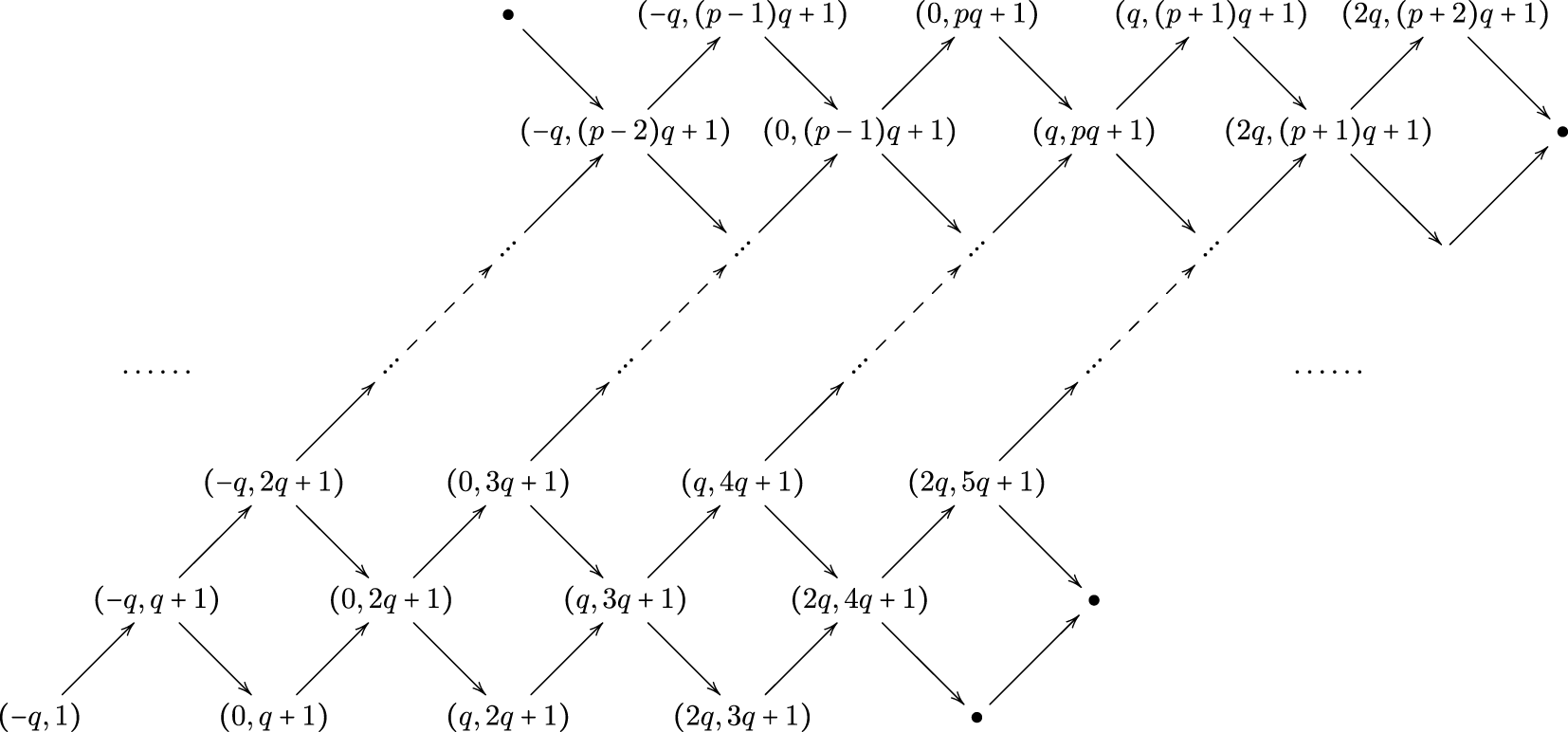
Let
 $q$
and
 $p$
be positive integers and consider the coordinate system on the translation quiver
 $\mathbb{Z}A_{p}$
illustrated in Figure 1.
Coordinate system on
 $\mathbb{Z}A_{p}$
.

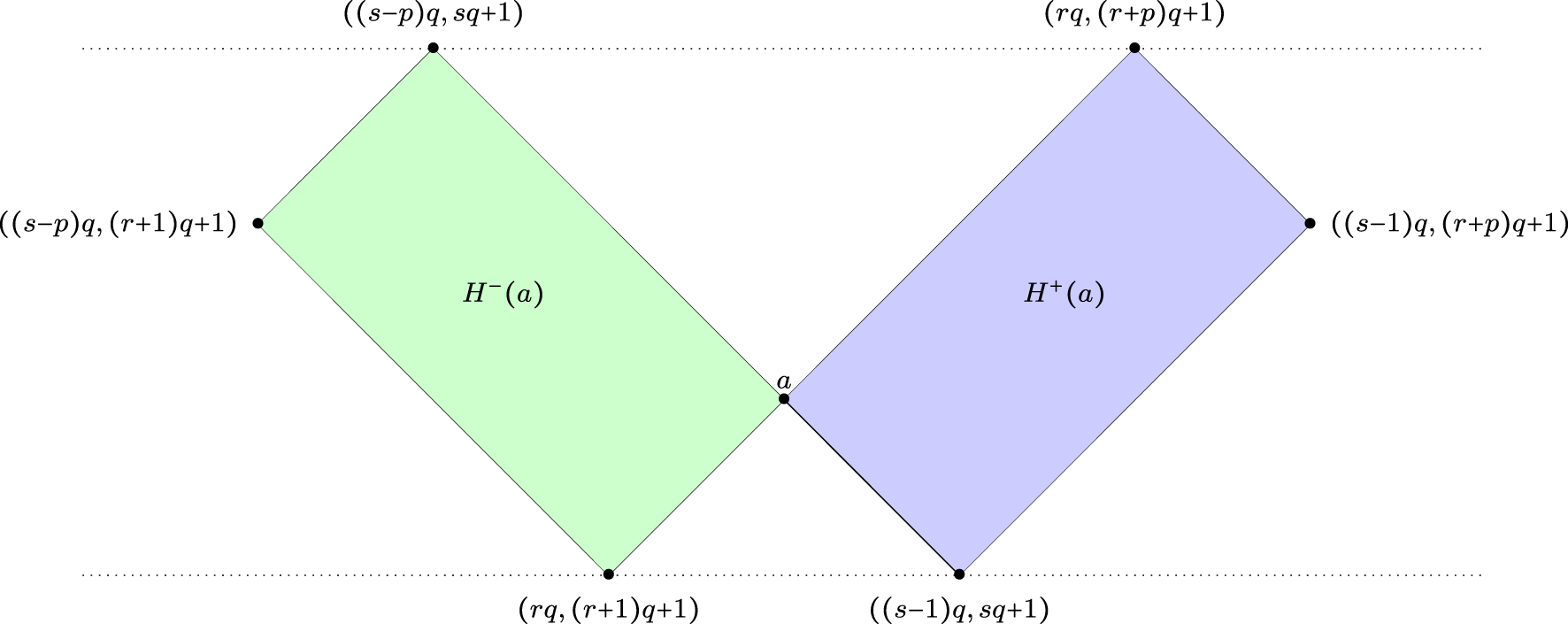
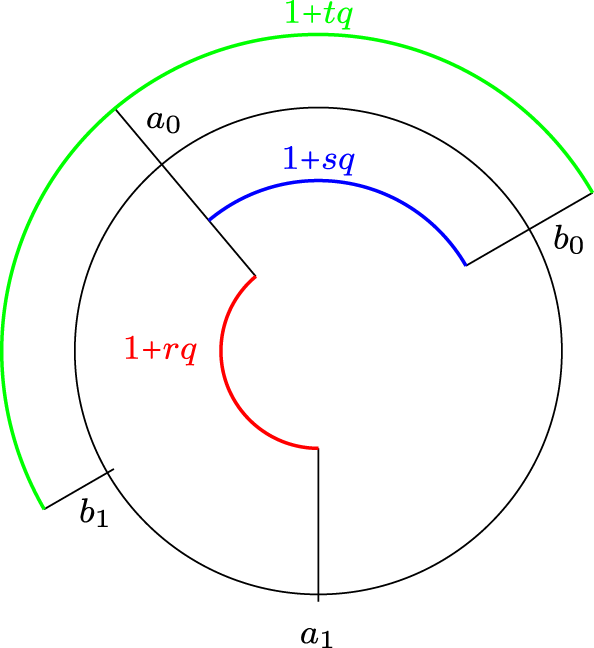
The regions
 $H^{+}(a)$
and
 $H^{-}(a)$
for
 $a=(rq,sq+1)$
.

Definition 7.1. [Reference Murphy13, Remark 2.3]
Define the following automorphisms on
 $\mathbb{Z}A_{p}$
:
 $$\begin{eqnarray}\displaystyle & \displaystyle \unicode[STIX]{x1D6F4}:\mathbb{Z}A_{p}\rightarrow \mathbb{Z}A_{p},\qquad (i,j)\mapsto (j-1,i+(p+1)q+1), & \displaystyle \nonumber\\ \displaystyle & \displaystyle \unicode[STIX]{x1D70F}:\mathbb{Z}A_{p}\rightarrow \mathbb{Z}A_{p},\qquad (i,j)\mapsto (i-q,j-q), & \displaystyle \nonumber\end{eqnarray}$$
and let
 $\unicode[STIX]{x1D70F}_{q+1}=\unicode[STIX]{x1D70F}\circ \unicode[STIX]{x1D6F4}^{-q}$
.
Note that
 $(\mathbb{Z}A_{p},\unicode[STIX]{x1D70F})$
is a translation quiver in the sense of [Reference Murphy13, Definition 2.2]. Hence, there exists a mesh category associated to it. The objects of this category are the vertices of
 $\mathbb{Z}A_{p}$
and the morphisms are linear combinations of compositions of the arrows of
 $\mathbb{Z}A_{p}$
subject to the mesh relations. For each arrow
 $\unicode[STIX]{x1D6FC}:x\rightarrow y$
, let
 $\unicode[STIX]{x1D70E}(\unicode[STIX]{x1D6FC})$
be the unique arrow
 $\unicode[STIX]{x1D70E}(\unicode[STIX]{x1D6FC}):\unicode[STIX]{x1D70F}(y)\rightarrow x$
. The mesh relations are given by
 $$\begin{eqnarray}\mathop{\sum }_{\unicode[STIX]{x1D6FC}:x\rightarrow y}\unicode[STIX]{x1D6FC}\unicode[STIX]{x1D70E}(\unicode[STIX]{x1D6FC})=0,\end{eqnarray}$$
for each vertex
 $y$
in
 $\mathbb{Z}A_{p}$
.
Definition 7.2. Let
 $a=(rq,sq+1)$
be a vertex in
 $\mathbb{Z}A_{p}$
, for
 $r$
and
 $s$
integers such that
 $r+1\leqslant s\leqslant r+p$
. We denote by:
-
∙
$H^{+}(a)$
the set of vertices of
$\mathbb{Z}A_{p}$
of the form
$(iq,jq+1)$
for integers
$r\leqslant i\leqslant s-1$
and
$s\leqslant j\leqslant r+p$
; -
∙
$H^{-}(a)$
the set of vertices of
$\mathbb{Z}A_{p}$
of the form
$(iq,jq+1)$
for integers
$s-p\leqslant i\leqslant r$
and
$r+1\leqslant j\leqslant s$
.


Note that the sets of vertices
 $H^{-}(a)$
and
 $H^{+}(a)$
are those in the “hammocks” spanned from
 $a$
, see Figure 2.
Remark 7.3. By [Reference Murphy13, remark 2.3], the regions
 $H^{-}(a)$
and
 $H^{+}(a)$
describe the set of vertices from which (respectively, to which) the object
 $a$
has a nonzero morphism in the mesh category associated to
 $\mathbb{Z}A_{p}$
.
Remark 7.4. [Reference Murphy13, Section 2]
The Auslander–Reiten quiver of the bounded derived category of finite-dimensional modules
 ${\mathcal{D}}^{b}(kA_{p})$
is isomorphic, as a stable translation quiver, to
 $\mathbb{Z}A_{p}$
. The automorphisms
 $\unicode[STIX]{x1D6F4}$
and
 $\unicode[STIX]{x1D70F}$
from Definition 7.1 are the action of the suspension and the Auslander–Reiten translation in
 ${\mathcal{D}}^{b}(kA_{p})$
, respectively, expressed in terms of the coordinate system from Figure 1. Moreover, the mesh category
 $k(\mathbb{Z}A_{p})$
is equivalent to
 $\operatorname{Ind}{\mathcal{D}}^{b}(kA_{p})$
, that is, the full subcategory of
 ${\mathcal{D}}^{b}(kA_{p})$
whose objects are the indecomposable objects.
The quotient translation quiver
 $\mathbb{Z}A_{p}/\langle \unicode[STIX]{x1D70F}_{q+1}\rangle$
is obtained by identifying the vertices and arrows of
 $\mathbb{Z}A_{p}$
with their
 $\unicode[STIX]{x1D70F}_{q+1}$
-shifts. It is the Auslander–Reiten quiver of
 $$\begin{eqnarray}{\mathcal{C}}_{q}(A_{p}):={\mathcal{D}}^{b}(kA_{p})/\unicode[STIX]{x1D70F}\circ \unicode[STIX]{x1D6F4}^{-q},\end{eqnarray}$$
the triangulated
 $q$
-cluster category of Dynkin type
 $A_{p}$
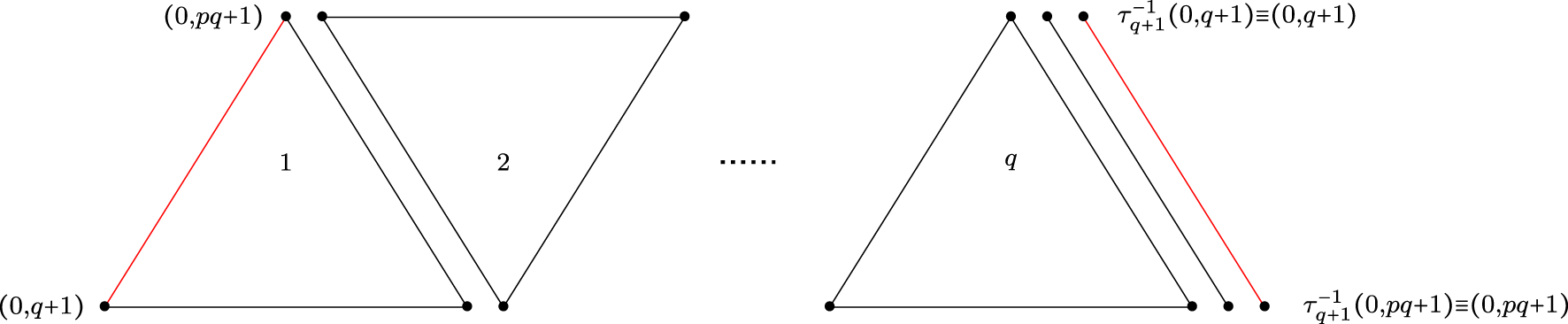
. Figure 3 shows the identification on
 $\mathbb{Z}A_{p}$
when
 $q$
is odd. Note that in this case, the quiver can be drawn on a Möbius strip.
Moreover, note that
 ${\mathcal{C}}_{q}(A_{p})$
is a
 $(q+1)$
-Calabi–Yau category whose
 $\operatorname{Hom}$
-spaces between indecomposables are either zero or one-dimensional over
 $k$
.
The quotient translation quiver
 $\mathbb{Z}A_{p}/\langle \unicode[STIX]{x1D70F}_{q+1}\rangle$
when
 $q$
is odd.

We present a geometric realization of
 $\mathbb{Z}A_{p}/\langle \unicode[STIX]{x1D70F}_{q+1}\rangle$
. Let
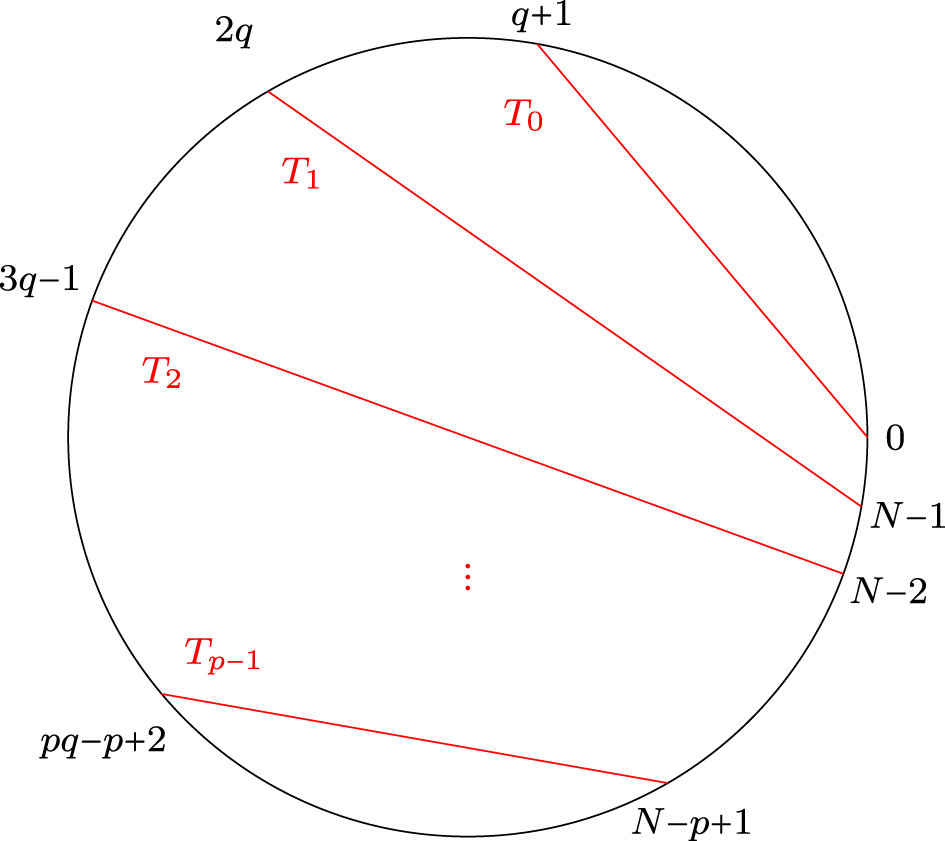
 $N=(p+1)q+2$
and
 $P$
be a regular convex
 $N$
-gon. Label the vertices of
 $P$
from
 $0$
to
 $N-1$
in an anticlockwise direction. We denote the diagonal joining vertices
 $i$
and
 $j$
by
 $\{i,j\}$
.
Definition 7.5. [Reference Murphy13, Definition 2.5]
A
 $q$
-allowable diagonal in
 $P$
is a diagonal joining two nonadjacent boundary vertices which divides
 $P$
into two smaller polygons which can themselves be subdivided into
 $(q+2)$
-gons by noncrossing diagonals. Note that these are the diagonals of
 $P$
spanning
 $1+kq$
vertices, for
 $k$
a positive integer.
Proposition 7.6. [Reference Murphy13, Proposition 2.9]
There is a bijection

given by
 $(i,j)\mapsto \{i\,(\operatorname{mod}N),j\,(\operatorname{mod}N)\}$
.
From now on,
 $q$
-allowable diagonals in
 $P$
and indecomposable objects in
 ${\mathcal{C}}_{q}(A_{p})$
are identified. Hence, it makes sense to talk about morphisms between two
 $q$
-allowable diagonals.
Definition 7.7. A
 $(q+2)$
-angulation of
 $P$
is a maximal collection of noncrossing
 $q$
-allowable diagonals.
Notation 7.8. Given a vertex
 $v$
of
 $P$
and an integer
 $r$
, we denote by
 $v^{r}$
its
 $r$
th successor in the anticlockwise direction if
 $r$
is positive and its
 $(-r)$
th successor in the clockwise direction if
 $r$
is negative. We also use the convention
 $v^{0}=v$
.
Remark 7.9. We can define a cyclic order on the vertices of
 $P$
as follows. Given three vertices
 $u,v,w$
of
 $P$
, we write
 $u<v<w$
if they appear in the order
 $u,v,w$
when going through the vertices of
 $P$
in the anticlockwise direction. Moreover, if we choose two distinct vertices
 $u$
and
 $v$
, we can consider the interval of vertices
 $[u,v]$
and in this “
 ${<}$
” is a total order.
The next two lemmas follow by describing the
 $H^{+}(b)$
, respectively
 $H^{-}(b)$
region from Definition 7.2 in terms of
 $q$
-allowable diagonals in
 $P$
.
Lemma 7.10. Consider a
 $q$
-allowable diagonal
 $b=\{b_{0},b_{1}\}$
in
 $P$
. Then a
 $q$
-allowable diagonal
 $a$
is such that
 $\operatorname{Hom}(b,a)\neq 0$
if and only if there are some nonnegative integers
 $i,\,j$
such that
 $a=\{a_{0},a_{1}\}$
for
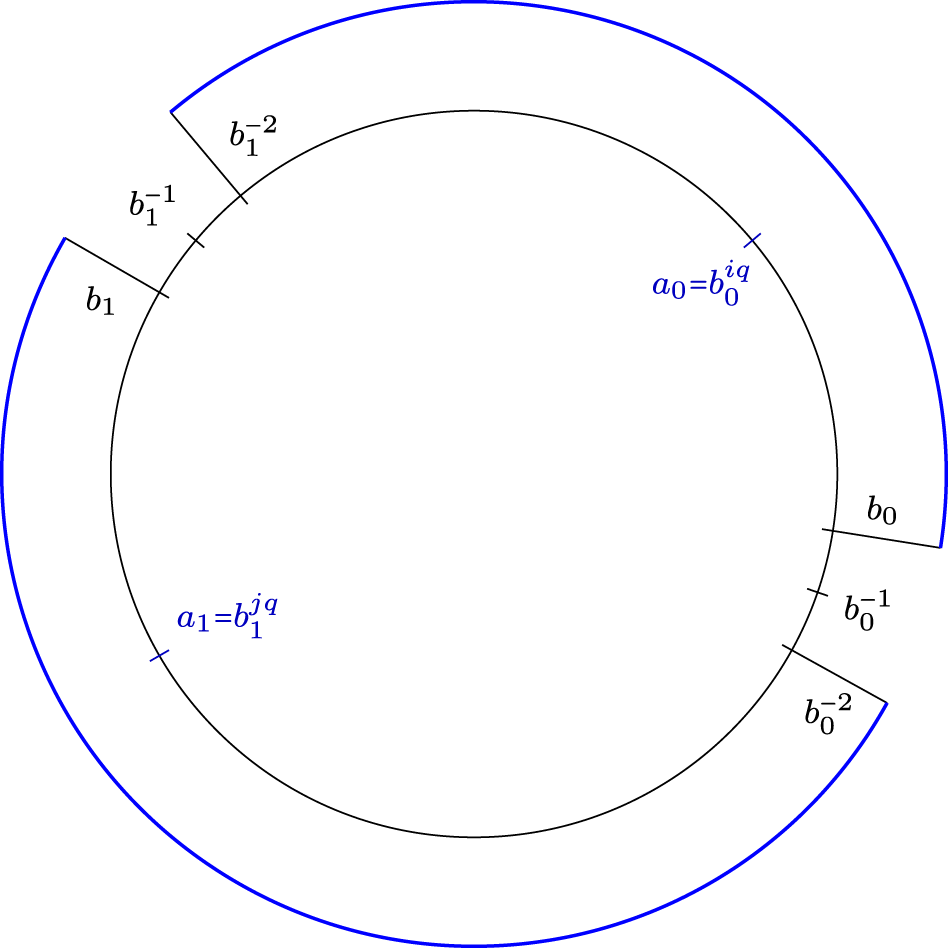
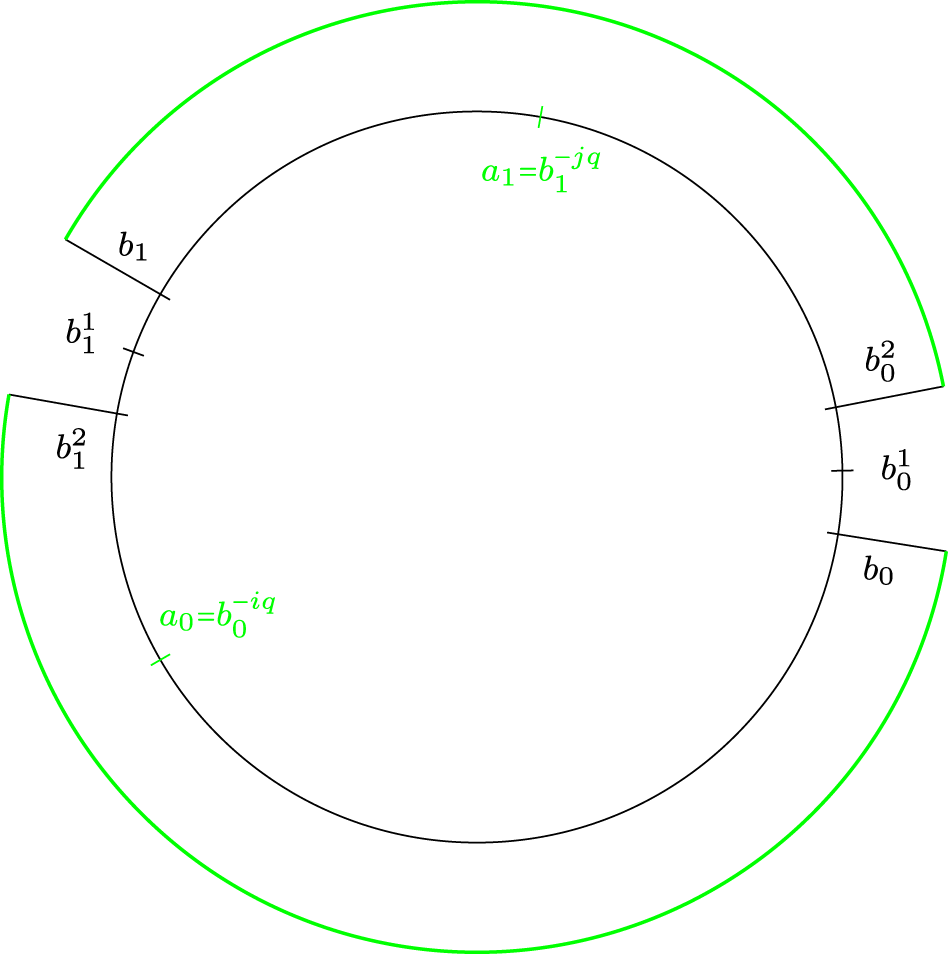
 $$\begin{eqnarray}a_{0}=b_{0}^{iq}\in [b_{0},b_{1}^{-2}]\qquad \text{and}\qquad a_{1}=b_{1}^{jq}\in [b_{1},b_{0}^{-2}].\end{eqnarray}$$
See Figure 4.
There is a nonzero morphism
 $b=\{b_{0},b_{1}\}\rightarrow \{a_{0},a_{1}\}=a$
.

Lemma 7.11. Consider a
 $q$
-allowable diagonal
 $b=\{b_{0},b_{1}\}$
in
 $P$
. Then a
 $q$
-allowable diagonal
 $a$
is such that
 $\operatorname{Hom}(a,b)\neq 0$
if and only if there are some nonnegative integers
 $i,\,j$
such that
 $a=\{a_{0},a_{1}\}$
for
 $$\begin{eqnarray}a_{0}=b_{0}^{-iq}\in [b_{1}^{2},b_{0}]\qquad \text{and}\qquad a_{1}=b_{1}^{-jq}\in [b_{0}^{2},b_{1}].\end{eqnarray}$$
See Figure 5.
There is a nonzero morphism
 $a=\{a_{0},a_{1}\}\rightarrow \{b_{0},b_{1}\}=b$
.

The following is a consequence of [Reference Murphy13, Proposition 2.9].
Lemma 7.12. Two
 $q$
-allowable diagonals
 $a$
and
 $b$
in
 $P$
cross if and only if there exists an integer
 $1\leqslant i\leqslant q$
such that
 $\operatorname{Ext}^{i}(a,b)\neq 0$
.
We describe all the triangles in
 ${\mathcal{C}}_{q}(A_{p})$
with indecomposable end terms in terms of
 $q$
-allowable diagonals in
 $P$
. In order to do this, we use a similar method to the one used by Pescod in [Reference Pescod16, Chapter 4].
The following two lemmas are inspired by [Reference Pescod16, Lemmas 4.1.1 and 4.1.2].
Lemma 7.13. Consider a triangle in
 ${\mathcal{C}}_{q}(A_{p})$
of the form
 $$\begin{eqnarray}\unicode[STIX]{x1D6E5}=a\rightarrow e\rightarrow b\rightarrow \unicode[STIX]{x1D6F4}a,\end{eqnarray}$$
with
 $a$
and
 $b$
indecomposable. If
 $c$
is an indecomposable in
 ${\mathcal{C}}_{q}(A_{p})$
such that there exists an integer
 $1\leqslant i\leqslant q$
with
 $\operatorname{Ext}^{i}(c,e)\neq 0$
, then at least one of
 $\operatorname{Ext}^{i}(c,a)$
and
 $\operatorname{Ext}^{i}(c,b)$
is nonzero.
In terms of
 $q$
-allowable diagonals in
 $P$
, we have that if
 $c$
crosses a direct summand of
 $e$
, then
 $c$
crosses at least one of
 $a$
and
 $b$
.
Proof. The triangle
 $\unicode[STIX]{x1D6E5}$
induces the exact sequence
 $$\begin{eqnarray}\operatorname{Ext}^{i}(c,a)\rightarrow \operatorname{Ext}^{i}(c,e)\rightarrow \operatorname{Ext}^{i}(c,b).\end{eqnarray}$$
Since
 $\operatorname{Ext}^{i}(c,e)\neq 0$
, it follows that at least one of
 $\operatorname{Ext}^{i}(c,a)$
and
 $\operatorname{Ext}^{i}(c,b)$
is nonzero.◻
Lemma 7.14. Let
 $a$
and
 $b\in {\mathcal{C}}_{q}(A_{p})$
be indecomposable and assume that
 $\operatorname{Ext}^{1}(b,a)\neq 0$
. Let
 $$\begin{eqnarray}\unicode[STIX]{x1D6E5}=a\xrightarrow[{}]{\unicode[STIX]{x1D6FC}}e\xrightarrow[{}]{\unicode[STIX]{x1D716}}b\xrightarrow[{}]{\unicode[STIX]{x1D6FD}}\unicode[STIX]{x1D6F4}a\end{eqnarray}$$
be the ensuing nonsplit triangle. Then
 $$\begin{eqnarray}\operatorname{Ext}^{1\cdots q}(e,a)=\operatorname{Ext}^{1\cdots q}(b,e)=0.\end{eqnarray}$$
In terms of
 $q$
-allowable diagonals in
 $P$
, there is no direct summand of
 $e$
crossing
 $a$
or
 $b$
.
Proof. Note that the identification on
 $\mathbb{Z}A_{p}$
to obtain
 $\mathbb{Z}A_{p}/\langle \unicode[STIX]{x1D70F}_{q+1}\rangle \cong {\mathcal{C}}_{q}(A_{p})$
is such that
 $$\begin{eqnarray}H^{+}(\unicode[STIX]{x1D6F4}^{-q}b),H^{+}(\unicode[STIX]{x1D6F4}^{-q+1}b),\ldots ,H^{+}(\unicode[STIX]{x1D6F4}^{-2}b),H^{+}(\unicode[STIX]{x1D6F4}^{-1}b)\end{eqnarray}$$
are all disjoint. See Figure 3 for
 $\mathbb{Z}A_{p}/\langle \unicode[STIX]{x1D70F}_{q+1}\rangle$
when
 $q$
is odd; the case when
 $q$
is even is similar. By Remark 7.3, we have that at most one of
 $$\begin{eqnarray}\operatorname{Hom}(\unicode[STIX]{x1D6F4}^{-q}b,a),\operatorname{Hom}(\unicode[STIX]{x1D6F4}^{-q+1}b,a),\ldots ,\operatorname{Hom}(\unicode[STIX]{x1D6F4}^{-2}b,a),\operatorname{Hom}(\unicode[STIX]{x1D6F4}^{-1}b,a)\end{eqnarray}$$
is nonzero. Equivalently, at most one of
 $$\begin{eqnarray}\operatorname{Ext}^{q}(b,a),\operatorname{Ext}^{q-1}(b,a),\ldots ,\operatorname{Ext}^{2}(b,a),\operatorname{Ext}^{1}(b,a)\end{eqnarray}$$
is nonzero. Since
 $\operatorname{Ext}^{1}(b,a)$
is nonzero by assumption, we have that
 $\operatorname{Ext}^{2\cdots q}(b,a)=0$
. Consider the following exact sequence induced by
 $\unicode[STIX]{x1D6E5}$
:
 $$\begin{eqnarray}\operatorname{Hom}(b,b)\xrightarrow[{}]{\unicode[STIX]{x1D6FD}_{\ast }}\operatorname{Hom}(b,\unicode[STIX]{x1D6F4}a)\xrightarrow[{}]{\unicode[STIX]{x1D6FE}}\operatorname{Hom}(b,\unicode[STIX]{x1D6F4}e)\rightarrow \operatorname{Hom}(b,\unicode[STIX]{x1D6F4}b).\end{eqnarray}$$
Since
 $b$
does not cross itself, by Lemma 7.12, we have that
 $\operatorname{Hom}(b,\unicode[STIX]{x1D6F4}^{i}b)=0$
for any
 $1\leqslant i\leqslant q$
. Then, as
 $\operatorname{Hom}(b,b)$
is nonzero and
 $\unicode[STIX]{x1D6FD}\neq 0$
, we have that
 $\unicode[STIX]{x1D6FD}_{\ast }\neq 0$
. Hence,
 $\operatorname{Hom}(b,\unicode[STIX]{x1D6F4}a)$
is one-dimensional over
 $k$
and
 $\unicode[STIX]{x1D6FD}_{\ast }$
is surjective, so that
 $\unicode[STIX]{x1D6FE}=0$
. Then,
 $\operatorname{Ext}^{1}(b,e)=\operatorname{Hom}(b,\unicode[STIX]{x1D6F4}e)=0$
. For
 $2\leqslant i\leqslant q$
, consider the following exact sequence induced by
 $\unicode[STIX]{x1D6E5}$
:
 $$\begin{eqnarray}\operatorname{Hom}(b,\unicode[STIX]{x1D6F4}^{i}a)\rightarrow \operatorname{Hom}(b,\unicode[STIX]{x1D6F4}^{i}e)\rightarrow \operatorname{Hom}(b,\unicode[STIX]{x1D6F4}^{i}b)=0.\end{eqnarray}$$
For
 $2\leqslant i\leqslant q$
, we have
 $$\begin{eqnarray}0=\operatorname{Ext}^{i}(b,a)=\operatorname{Hom}(b,\unicode[STIX]{x1D6F4}^{i}a),\end{eqnarray}$$
and so
 $\operatorname{Ext}^{2\cdots q}(b,e)=0$
.
A similar argument shows that no direct summand of
 $e$
crosses
 $a$
.◻
Note that the results from [Reference Pescod16, Chapter 4.2] are valid in
 ${\mathcal{C}}_{q}(A_{p})$
since this is a
 $k$
-linear,
 $\operatorname{Hom}$
-finite, Krull–Schmidt triangulated category. We state them again for the convenience of the reader.
Lemma 7.15. [Reference Pescod16, Lemmas 4.2.1 and 4.2.2]
Let
 $b\in {\mathcal{C}}_{q}(A_{p})$
be indecomposable. Assume there exists a nonsplit triangle
 $$\begin{eqnarray}a\xrightarrow[{}]{\unicode[STIX]{x1D6FC}}e\xrightarrow[{}]{\unicode[STIX]{x1D716}}b\rightarrow \unicode[STIX]{x1D6F4}a,\end{eqnarray}$$
then each row of the matrix
 $\unicode[STIX]{x1D6FC}$
has a nonzero entry and each column of the matrix
 $\unicode[STIX]{x1D716}$
has a nonzero entry.
Remark 7.16. Note that since
 $\operatorname{Hom}$
-spaces between indecomposables in
 ${\mathcal{C}}_{q}(A_{p})$
are either zero or one-dimensional over
 $k$
, we can state [Reference Pescod16, Lemma 4.2.3] as follows.
Lemma 7.17. For
 $a$
and
 $b$
indecomposables in
 ${\mathcal{C}}_{q}(A_{p})$
, let
 $$\begin{eqnarray}a\rightarrow e\rightarrow b\rightarrow \unicode[STIX]{x1D6F4}a\end{eqnarray}$$
be a triangle in
 ${\mathcal{C}}_{q}(A_{p})$
. Then,
 $e$
has no repeated indecomposable summands.
Lemma 7.18. [Reference Pescod16, Lemma 4.2.4]
For
 $a$
and
 $b$
indecomposables in
 ${\mathcal{C}}_{q}(A_{p})$
, let
 $$\begin{eqnarray}a\rightarrow e\rightarrow b\rightarrow \unicode[STIX]{x1D6F4}a\end{eqnarray}$$
be a triangle in
 ${\mathcal{C}}_{q}(A_{p})$
. Then
 $$\begin{eqnarray}\operatorname{Ext}^{1}(\unicode[STIX]{x1D6F4}a,e_{i})\neq 0\qquad \text{and}\qquad \operatorname{Ext}^{1}(e_{i},\unicode[STIX]{x1D6F4}^{-1}b)\neq 0,\end{eqnarray}$$
for each indecomposable summand
 $e_{i}$
of
 $e$
.
Lemma 7.19. Consider two crossing
 $q$
-allowable diagonals
 $a=\{a_{0},a_{1}\}$
and
 $b=\{b_{0},b_{1}\}$
in
 $P$
, where
 $b_{0}<a_{0}<b_{1}<a_{1}$
. Then
 $\{a_{0},b_{0}\}$
is
 $q$
-allowable or an edge if and only if
 $\{a_{1},b_{1}\}$
is
 $q$
-allowable or an edge.
Proof. Since
 $a$
and
 $b$
are
 $q$
-allowable diagonals, there are positive integers
 $r,\,t$
such that
 $$\begin{eqnarray}a_{1}=a_{0}^{1+rq}\qquad \text{and}\qquad b_{1}=b_{0}^{1+tq}.\end{eqnarray}$$
Assume that
 $(a_{0},b_{0})$
is
 $q$
-allowable or an edge in
 $P$
. Then
 $a_{0}=b_{0}^{1+sq}$
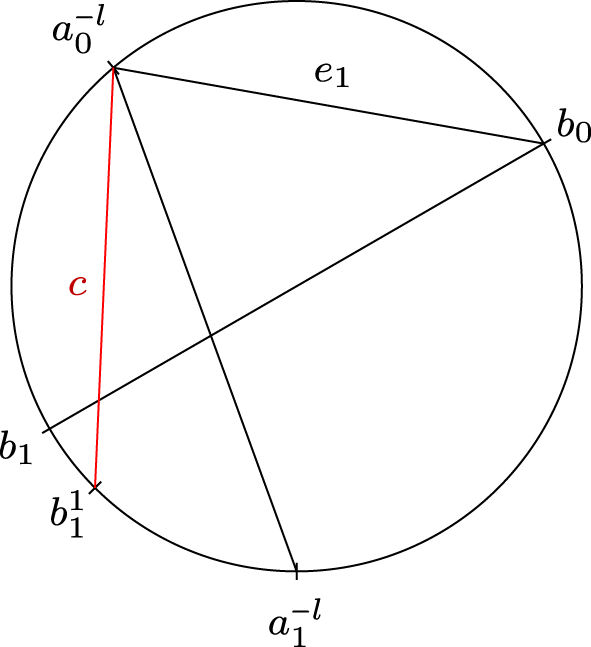
for some integer
 $s\geqslant 0$
, see Figure 6. We have
 $$\begin{eqnarray}a_{1}=a_{0}^{1+rq}=b_{0}^{2+(r+s)q}=b_{1}^{2+(r+s)q-1-tq}=b_{1}^{1+(r+s-t)q},\end{eqnarray}$$
where
 $r+s\geqslant t$
. Hence,
 $(a_{1},b_{1})$
is
 $q$
-allowable or an edge in
 $P$
. The other direction is proved in a similar way.◻
The diagonals
 $\{a_{0},a_{1}\}$
and
 $\{b_{0},b_{1}\}$
are
 $q$
-allowable and
 $\{a_{0},b_{0}\}$
is either
 $q$
-allowable or an edge.

Proposition 7.20. Consider two crossing
 $q$
-allowable diagonals
 $a=\{a_{0},a_{1}\}$
and
 $b=\{b_{0},b_{1}\}$
in
 $P$
, where
 $b_{0}<a_{0}<b_{1}<a_{1}$
.
-
∙ There exists exactly one integer
$0\leqslant l\leqslant q-1$
such that
$\operatorname{Hom}(b,\unicode[STIX]{x1D6F4}^{l+1}a)\neq 0$
. Then the nonsplit triangle extending
$\unicode[STIX]{x1D6FD}:b\rightarrow \unicode[STIX]{x1D6F4}^{l+1}a$
is where
$$\begin{eqnarray}\unicode[STIX]{x1D6E5}=\unicode[STIX]{x1D6F4}^{l}a\rightarrow e\rightarrow b\xrightarrow[{}]{\unicode[STIX]{x1D6FD}}\unicode[STIX]{x1D6F4}^{l+1}a,\end{eqnarray}$$
$e=e_{1}\oplus e_{2}$
for
$e_{1}=\{a_{0}^{-l},b_{0}\}$
and
$e_{2}=\{b_{1},a_{1}^{-l}\}$
.
-
∙ If
$0\leqslant i\leqslant q-1$
is an integer such that
$\{a_{0}^{-i},b_{0}\}$
is a
$q$
-allowable diagonal or an edge in
$P$
, then
$i=l$
.


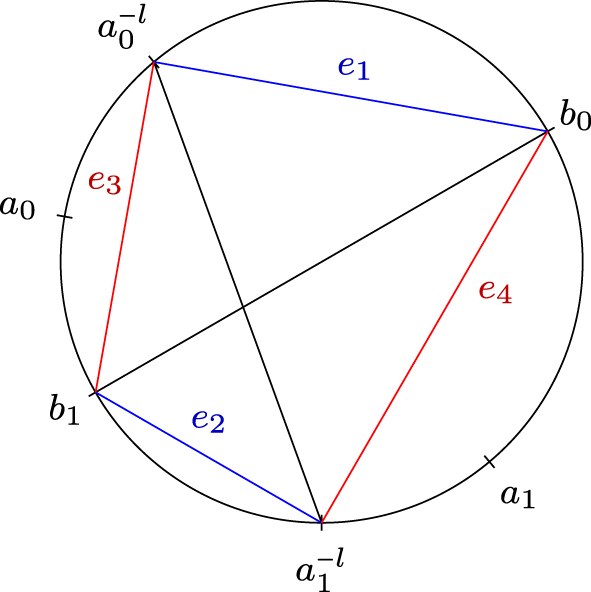
The triangle
 $\unicode[STIX]{x1D6F4}^{l}a\rightarrow e_{1}\oplus e_{2}\rightarrow b\xrightarrow[{}]{\unicode[STIX]{x1D6FD}}\unicode[STIX]{x1D6F4}^{l+1}a$
.

Proof. Assume that
 $\unicode[STIX]{x1D6E5}$
is a nonsplit triangle and let
 $\overline{e}$
be a direct summand of the middle term
 $e$
. By Lemma 7.14, we have that
 $\overline{e}$
does not cross
 $\unicode[STIX]{x1D6F4}^{l}a$
or
 $b$
. Moreover, if
 $c$
is a
 $q$
-allowable diagonal crossing
 $\overline{e}$
, by Lemma 7.13, we have that
 $c$
crosses at least one of
 $\unicode[STIX]{x1D6F4}^{l}a$
and
 $b$
. Hence, the only possibilities for
 $\overline{e}$
are the diagonals
 $$\begin{eqnarray}e_{1}=\{a_{0}^{-l},b_{0}\},\qquad e_{2}=\{b_{1},a_{1}^{-l}\},\qquad e_{3}=\{a_{0}^{-l},b_{1}\},\qquad e_{4}=\{b_{0},a_{1}^{-l}\},\end{eqnarray}$$
see Figure 7. By Lemma 7.18, we have that
 $$\begin{eqnarray}\operatorname{Ext}^{1}(\unicode[STIX]{x1D6F4}^{l+1}a,\overline{e})\neq 0\qquad \text{and}\qquad \operatorname{Ext}^{1}(\overline{e},\unicode[STIX]{x1D6F4}^{-1}b)\neq 0.\end{eqnarray}$$
Hence,
 $\overline{e}$
crosses both
 $\unicode[STIX]{x1D6F4}^{l+1}a$
and
 $\unicode[STIX]{x1D6F4}^{-1}b$
, which implies that
 $e_{3}$
and
 $e_{4}$
must be excluded from the possible summands of
 $e$
. Moreover,
 $e$
has no repeated summands by Lemma 7.17, and so
 $$\begin{eqnarray}e\in \{0,e_{1},e_{2},e_{1}\oplus e_{2}\}.\end{eqnarray}$$
We claim that
 $e=e_{1}\oplus e_{2}$
. We prove this claim by dealing with the cases
 $e_{1}=e_{2}=0$
, one of
 $e_{1}$
,
 $e_{2}$
zero and
 $e_{1}$
,
 $e_{2}$
both nonzero separately. First, note that if
 $b=\unicode[STIX]{x1D6F4}^{l+1}a$
, then
 $$\begin{eqnarray}\unicode[STIX]{x1D6E5}=\unicode[STIX]{x1D6F4}^{l}a\rightarrow 0\rightarrow \unicode[STIX]{x1D6F4}^{l+1}a\xrightarrow[{}]{\cong }\unicode[STIX]{x1D6F4}^{l+1}a.\end{eqnarray}$$
Note that in this case
 $b_{0}^{1}=a_{0}^{-l}$
and
 $b_{1}^{1}=a_{1}^{-l}$
so that
 $e_{1}=e_{2}=0$
and
 $e=e_{1}\oplus e_{2}=0$
. Assume now that
 $b$
is not
 $\unicode[STIX]{x1D6F4}^{l+1}a$
, so that
 $e\neq 0$
. Note that if
 $e_{1}$
(respectively,
 $e_{2}$
) is zero, then
 $e=e_{1}\oplus e_{2}=e_{2}$
(respectively,
 $e=e_{1}$
) is the only option and we are done. Moreover, since
 $e\neq 0$
, we have that at least one of
 $e_{1}$
,
 $e_{2}$
is
 $q$
-allowable or an edge in
 $P$
. But then, by Lemma 7.19, we have that
 $e_{1}$
and
 $e_{2}$
are both
 $q$
-allowable diagonals or edges in
 $P$
. The last case to deal with is when
 $e_{1}$
and
 $e_{2}$
are both nonzero, that is, they both are
 $q$
-allowable diagonals in
 $P$
. Suppose for a contradiction that
 $e=e_{1}$
. Consider the triangle
 $$\begin{eqnarray}e\rightarrow b\rightarrow \unicode[STIX]{x1D6F4}^{l+1}a\rightarrow \unicode[STIX]{x1D6F4}e,\end{eqnarray}$$
and set
 $c=\{a_{0}^{-l},b_{1}^{1}\}$
. Note that
 $b_{1}<b_{1}^{1}<a_{1}^{-l}$
since
 $e_{2}\neq 0$
. Since
 $\unicode[STIX]{x1D6F4}^{l}a$
and
 $e_{2}$
are
 $q$
-allowable diagonals, there are integers
 $s>r>0$
such that
 $$\begin{eqnarray}a_{1}^{-l}=a_{0}^{-l+1+sq}=b_{1}^{1+rq}.\end{eqnarray}$$
Hence,
 $b_{1}^{1}=a_{0}^{-l+1+(s-r)q}$
and so
 $c$
is
 $q$
-allowable. So
 $c$
is a
 $q$
-allowable diagonal crossing
 $b$
but not crossing neither
 $e=e_{1}$
nor
 $\unicode[STIX]{x1D6F4}^{l+1}a$
, see Figure 8, contracting Lemma 7.13. Then
 $e\neq e_{1}$
. By a similar argument, assuming that
 $e=e_{2}$
leads to a contradiction. Hence, we have that
 $e=e_{1}\oplus e_{2}$
.
The
 $q$
-allowable diagonal
 $c$
crosses
 $b$
but does not cross neither
 $e_{1}$
nor
 $\unicode[STIX]{x1D6F4}^{l+1}a$
.

We now prove the second part of the proposition. Assume
 $0\leqslant i\leqslant q-1$
is an integer such that
 $\{a_{0}^{-i},b_{0}\}$
is a
 $q$
-allowable diagonal or an edge in
 $P$
. Then there are integers
 $r,\,s\geqslant 0$
such that
 $$\begin{eqnarray}a_{0}^{-i}=b_{0}^{1+sq}\qquad \text{and}\qquad a_{0}^{-l}=b_{0}^{1+rq}.\end{eqnarray}$$
Then
 $b_{0}^{1+rq}=a_{0}^{-l}=b_{0}^{1+sq+i-l}$
. So
 $i-l=(r-s)q$
.
If
 $0\leqslant l\leqslant i\leqslant q-1$
, then
 $r\geqslant s\geqslant 0$
. Note that
 $0\leqslant i-l\leqslant q-l-1<q$
, so
 $i=l$
is the only option. If
 $0\leqslant i\leqslant l\leqslant q-1$
, then
 $s\geqslant r\geqslant 0$
. Note that
 $0\leqslant l-i\leqslant q-i-1<q$
, so
 $i=l$
is again the only option.◻
Proposition 7.21. Assume that
 $q$
is odd. We have that
 $$\begin{eqnarray}K_{0}({\mathcal{C}}_{q}(A_{p}))\cong \left\{\begin{array}{@{}ll@{}}0\quad & \text{if }p\text{ is even},\\ \mathbb{Z}\quad & \text{if }p\text{is odd}.\end{array}\right.\end{eqnarray}$$
Proof. Consider the
 $(q+2)$
-angulation
 $T=T_{0},\ldots ,T_{p-1}$
, where
 $$\begin{eqnarray}T_{0}=\{0,q+1\}\qquad \text{and}\qquad T_{i}=\{N-i,(1+i)q+1-i\},\quad \text{for }1\leqslant i\leqslant p-1,\end{eqnarray}$$
see Figure 9. Note that by [Reference Murphy13, Proposition 2.14] this corresponds to the
 $(q+1)$
-cluster tilting object
 $T_{0}\oplus \cdots \oplus T_{p-1}$
. Let
 ${\mathcal{T}}:=\operatorname{add}(T_{0}\oplus \cdots \oplus T_{p-1})\subseteq {\mathcal{C}}_{q}(A_{p})$
be the corresponding
 $(q+1)$
-cluster tilting subcategory. We want to find the Auslander–Reiten
 $(q+3)$
-angle in
 ${\mathcal{T}}$
starting and ending at
 $T_{i}$
for
 $0\leqslant i\leqslant p-1$
.
The
 $(q+2)$
-angulation
 $T$
.

Consider
 $i=0$
. By Lemma 7.11 there are no nonzero morphisms
 $T_{i}\rightarrow T_{0}$
for
 $i\neq 0$
, so that
 $\unicode[STIX]{x1D70F}_{0}:0\rightarrow T_{0}$
is a right almost split morphism in
 ${\mathcal{T}}$
. Consider
 $-q+2\leqslant j\leqslant -1$
. Note that since
 $\unicode[STIX]{x1D6F4}^{j}T_{0}=\{-j,q+1-j\}$
, Lemma 7.10 can be used to check that for all indecomposables
 $T_{i}$
in
 ${\mathcal{T}}$
, we have that
 $\operatorname{Hom}(T_{i},\unicode[STIX]{x1D6F4}^{j}T_{0})=0$
. Hence,
 $\unicode[STIX]{x1D70F}_{-j}:0\rightarrow \unicode[STIX]{x1D6F4}^{j}T_{0}$
is a
 ${\mathcal{T}}$
-cover for any
 $-q+2\leqslant j\leqslant -1$
. Moreover, by Lemma 7.11, we have that
 $\unicode[STIX]{x1D70F}_{q-1}:T_{1}\rightarrow \unicode[STIX]{x1D6F4}^{-q+1}T_{0}$
is a
 ${\mathcal{T}}$
-cover. Using Proposition 7.20, the morphism
 $\unicode[STIX]{x1D70F}_{q-1}$
extends to the nonsplit triangle
 $$\begin{eqnarray}\unicode[STIX]{x1D6F4}T_{0}\rightarrow T_{1}\xrightarrow[{}]{\unicode[STIX]{x1D70F}_{q-1}}\unicode[STIX]{x1D6F4}^{-q+1}T_{0}\rightarrow \unicode[STIX]{x1D6F4}^{2}T_{0}.\end{eqnarray}$$
Applying Lemma 7.11 to
 $\unicode[STIX]{x1D6F4}T_{0}=\{N-1,q\}$
, we see that
 $\operatorname{Hom}({\mathcal{T}},\unicode[STIX]{x1D6F4}T_{0})=0$
. Hence,
 $\unicode[STIX]{x1D70F}_{q}:0\rightarrow \unicode[STIX]{x1D6F4}T_{0}$
is a
 ${\mathcal{T}}$
-cover. The Auslander–Reiten
 $(q+3)$
-angle starting and ending at
 $T_{0}$
is then the one corresponding to the following tower of triangles:

In a similar way, we can find the remaining Auslander–Reiten
 $(q+3)$
-angles. These are the ones corresponding to the following towers of triangles:

where
 $A_{i}:=\{(i+2)q-i,(i+1)q-i-1\}$
, for
 $1\leqslant i\leqslant p-2$
, and

Recall that by Corollary B, we have that

Using the Auslander–Reiten
 $(q+3)$
-angles found and the fact that
 $q$
is odd, we obtain that in the quotient group on the right-hand side, we have
 $$\begin{eqnarray}[T_{1}]=[T_{p-2}]=0\qquad \text{and}\qquad [T_{i-1}]=[T_{i+1}]\quad \text{for }1\leqslant i\leqslant p-2.\end{eqnarray}$$
This implies that:
-
∙ if
$p$
is even, then
$[T_{i}]=0$
for all
$0\leqslant i\leqslant p-1$
; -
∙ if
$p$
is odd, then
$0=[T_{1}]=\cdots [T_{p-2}]$
and
$0\neq [T_{0}]=\cdots =[T_{p-1}]$
.


Hence,
 $$\begin{eqnarray}\hspace{114.0001pt}K_{0}({\mathcal{C}}_{q}(A_{p}))\cong \left\{\begin{array}{@{}ll@{}}0\quad & \text{if }p\text{ is even},\\ \mathbb{Z}\quad & \text{if }p\text{is odd}.\end{array}\right.\hspace{114.0001pt}\square\end{eqnarray}$$
8 A higher angulated cluster category of type
$A$

Let
 $p$
and
 $d$
be positive integers. We denote by
 $A_{p}^{d}$
the
 $(d-1)$
-st higher Auslander
 $k$
-algebra of linearly oriented
 $A_{p}$
, see [Reference Oppermann and Thomas14, Section 3]. This is a
 $d$
-representation finite algebra, in the sense that it has a
 $d$
-cluster tilting module and
 $\operatorname{gldim}(A_{p}^{d})\leqslant d$
, see [Reference Iyama and Oppermann9, Definition 2.19]. Let
 $\operatorname{mod}A_{p}^{d}$
be the category of finitely generated
 $A_{p}^{d}$
-modules, and let
 ${\mathcal{D}}^{b}(\operatorname{mod}A_{p}^{d})$
be its bounded derived category. We denote by
 $\mathbb{S}$
its Serre functor and by
 $\unicode[STIX]{x1D6F4}$
its suspension functor.
Definition 8.1. [Reference Oppermann and Thomas14, construction 5.13]
For
 $\unicode[STIX]{x1D6FF}\geqslant d$
, the
 $\unicode[STIX]{x1D6FF}$
-Amiot cluster category of
 $A_{p}^{d}$
is defined to be
 $$\begin{eqnarray}{\mathcal{C}}^{\unicode[STIX]{x1D6FF}}(A_{p}^{d})=\text{triangulated hull of }{\mathcal{D}}^{b}(\operatorname{mod}A_{p}^{d})/(\mathbb{S}_{\unicode[STIX]{x1D6FF}}),\end{eqnarray}$$
where
 $\mathbb{S}_{\unicode[STIX]{x1D6FF}}:=\mathbb{S}\unicode[STIX]{x1D6F4}^{-\unicode[STIX]{x1D6FF}}$
.
Remark 8.2. The category
 ${\mathcal{C}}^{\unicode[STIX]{x1D6FF}}(A_{p}^{d})$
is a triangulated category containing the orbit category
 ${\mathcal{D}}^{b}(\operatorname{mod}A_{p}^{d})/(\mathbb{S}_{\unicode[STIX]{x1D6FF}})$
. We do not give a formal definition of triangulated hull here. Note that by [Reference Oppermann and Thomas14, Theorem 5.14], we have that if
 $\unicode[STIX]{x1D6FF}>d$
, then
 ${\mathcal{C}}^{\unicode[STIX]{x1D6FF}}(A_{p}^{d})$
is
 $\operatorname{Hom}$
-finite and
 $\unicode[STIX]{x1D6FF}$
-Calabi–Yau.
Remark 8.3. Let
 $M$
be the unique
 $d$
-cluster tilting object in
 $\operatorname{mod}A_{p}^{d}$
. Then
 $$\begin{eqnarray}{\mathcal{U}}:=\operatorname{add}\{\unicode[STIX]{x1D6F4}^{\text{id}}M\mid i\in \mathbb{Z}\}\subseteq {\mathcal{D}}^{b}(\operatorname{mod}A_{p}^{d})\end{eqnarray}$$
is a
 $d$
-cluster tilting subcategory by [Reference Iyama8, Theorem 1.21].
Definition 8.4. [Reference Oppermann and Thomas14, Definition 5.22]
The
 $(d+2)$
-angulated cluster category of
 $A_{p}^{d}$
is defined to be the orbit category
 $$\begin{eqnarray}{\mathcal{O}}(A_{p}^{d})={\mathcal{U}}/(\mathbb{S}_{2d}).\end{eqnarray}$$
Remark 8.5. Note that
 ${\mathcal{O}}(A_{p}^{d})$
comes with an inclusion into
 ${\mathcal{D}}^{b}(\operatorname{mod}A_{p}^{d})/(\mathbb{S}_{2d})\subseteq {\mathcal{C}}^{2d}(A_{p}^{d})$
. Moreover, by [Reference Oppermann and Thomas14, Theorem 5.24], we have that
 ${\mathcal{O}}(A_{p}^{d})\subseteq {\mathcal{C}}^{2d}(A_{p}^{d})$
is
 $d$
-cluster tilting and
 ${\mathcal{O}}(A_{p}^{d})$
is
 $(d+2)$
-angulated.
Notation 8.6. Let
 $Z$
be a cyclically ordered set with
 $p+2d+1$
elements. We can think of
 $Z$
as marked points on a circle labeled
 $1$
to
 $p+2d+1$
in the anticlockwise direction. Given three points
 $u,v,w$
, we write
 $u<v<w$
if they appear in the order
 $u,v,w$
when going through the points in the anticlockwise direction. Moreover, given two distinct points
 $u$
and
 $v$
, we can consider the interval of points
 $[u,v]$
and in this “
 ${<}$
” is a total order.
For a point
 $v$
, we denote by
 $v^{+}$
its successor and by
 $v^{-}$
its predecessor in the anticlockwise direction. We say that two points are neighbors if one is the successor of the other.
Lemma 8.7. [Reference Oppermann and Thomas14, Proposition 6.10]
There is a bijection
 $$\begin{eqnarray}\operatorname{Ind}{\mathcal{O}}(A_{p}^{d})\longrightarrow \{X=\{x_{0},\ldots ,x_{d}\}\subset Z\mid X\text{ contains no neighboring points}\}.\end{eqnarray}$$
We will use it to identify the indecomposable objects of
 ${\mathcal{O}}(A_{p}^{d})$
with the sets
 $X$
. For
 $X=\{x_{0},\ldots ,x_{d}\}\in \operatorname{Ind}{\mathcal{O}}(A_{p}^{d})$
, we have that
 $$\begin{eqnarray}\unicode[STIX]{x1D6F4}^{d}X=\mathbb{S}_{d}X=\{x_{0}^{-},\ldots ,x_{d}^{-}\}.\end{eqnarray}$$
Definition 8.8. For
 $X,\,Y\in \operatorname{Ind}{\mathcal{O}}(A_{p}^{d})$
, we say that
 $X$
intertwines
 $Y$
if we can write
 $X=\{x_{0},\ldots ,x_{d}\}$
and
 $Y=\{y_{0},\ldots ,y_{d}\}$
such that
 $$\begin{eqnarray}x_{0}<y_{0}<x_{1}<\cdots <y_{d-1}<x_{d}<y_{d}<x_{0}.\end{eqnarray}$$
Note that in this case also
 $Y$
intertwines
 $X$
.
Lemma 8.9. [Reference Oppermann and Thomas14, Proposition 6.1]
Given
 $X$
and
 $Y$
in
 $\operatorname{Ind}{\mathcal{O}}(A_{p}^{d})$
, we have that
 $\operatorname{Ext}_{{\mathcal{O}}(A_{p}^{d})}^{d}(X,Y)\neq 0$
if and only if
 $X$
intertwines
 $Y$
. In this case,
 $\operatorname{Ext}_{{\mathcal{O}}(A_{p}^{d})}^{d}(X,Y)$
is one-dimensional over
 $k$
.
Lemma 8.10. [Reference Oppermann and Thomas14, Proposition 6.11]
Let
 $X=\{x_{0},\ldots ,x_{d}\}$
and
 $Y=\{y_{0},\ldots ,y_{d}\}\in \operatorname{Ind}{\mathcal{O}}(A_{p}^{d})$
be such that
 $$\begin{eqnarray}x_{0}<y_{0}<x_{1}<\cdots <y_{d-1}<x_{d}<y_{d}<x_{0},\end{eqnarray}$$
so
 $X$
intertwines
 $Y$
. Then there is a
 $(d+2)$
-angle in
 ${\mathcal{O}}(A_{p}^{d})$
of the form
 $$\begin{eqnarray}X\longrightarrow E_{d}\longrightarrow \cdots \longrightarrow E_{1}\longrightarrow Y\longrightarrow \unicode[STIX]{x1D6F4}^{d}X\quad \text{with }E_{r}=\bigoplus _{\substack{ I\subseteq \{0,\ldots ,d\} \\ |I|=r}}\{x_{i}\mid i\in I\}\cup \{y_{j}\mid j\not \in I\},\end{eqnarray}$$
where
 $\{x_{i}\mid i\in I\}\cup \{y_{j}\mid j\not \in I\}$
is interpreted as zero if it contains neighboring points.
Lemma 8.11. We have that
 ${\mathcal{T}}\subseteq {\mathcal{O}}(A_{p}^{d})$
is Oppermann–Thomas cluster tilting if and only if
 $\operatorname{Ind}{\mathcal{T}}$
is a maximal set of nonintertwining elements in
 ${\mathcal{O}}(A_{p}^{d})$
of cardinality
 $$\begin{eqnarray}\left(\begin{array}{@{}c@{}}p+d-1\\ d\end{array}\right).\end{eqnarray}$$
Proof. By [Reference Oppermann and Thomas14, Theorem 6.4], we have that
 ${\mathcal{T}}\subseteq {\mathcal{O}}(A_{p}^{d})$
is Oppermann–Thomas cluster tilting if and only if it corresponds to a triangulation of
 $C(p+2d+1,2d)$
, in the notation of Oppermann and Thomas, see [Reference Oppermann and Thomas14, page 2]. Moreover, by [Reference Oppermann and Thomas14, Theorems 2.3 and 2.4] such triangulations are precisely maximal sets of nonintertwining elements in
 ${\mathcal{O}}(A_{p}^{d})$
of cardinality
 $$\begin{eqnarray}\hspace{154.00017pt}\left(\begin{array}{@{}c@{}}p+d-1\\ d\end{array}\right).\hspace{154.00017pt}\square\end{eqnarray}$$
Remark 8.12. Note that by [Reference Oppermann and Thomas14, Theorem 5.25], an object
 $T\in {\mathcal{O}}(A_{p}^{d})$
is Oppermann–Thomas cluster tilting if and only if it is
 $2d$
-cluster tilting when seen as an object in
 ${\mathcal{C}}^{2d}(A_{p}^{d})$
.
Hence, if we can find
 ${\mathcal{T}}=\operatorname{add}(T)\subseteq {\mathcal{O}}(A_{p}^{d})$
Oppermann–Thomas cluster tilting, we have
 $$\begin{eqnarray}{\mathcal{T}}\subseteq {\mathcal{O}}(A_{p}^{d})\subseteq {\mathcal{C}}^{2d}(A_{p}^{d}),\end{eqnarray}$$
where
 ${\mathcal{C}}^{2d}(A_{p}^{d})$
is triangulated and
 $2d$
-Calabi–Yau,
 ${\mathcal{O}}(A_{p}^{d})$
is closed under
 $\unicode[STIX]{x1D6F4}^{d}$
and
 $d$
-cluster tilting in
 ${\mathcal{C}}^{2d}(A_{p}^{d})$
and
 ${\mathcal{T}}$
is
 $2d$
-cluster tilting in
 ${\mathcal{C}}^{2d}(A_{p}^{d})$
. That is, we are in the situation of Setup 6.1 with
 ${\mathcal{S}}={\mathcal{O}}(A_{p}^{d})$
and
 ${\mathcal{C}}={\mathcal{C}}^{2d}(A_{p}^{d})$
. We now choose specific values for
 $d$
and
 $p$
and, using our results, we find
 $K_{0}({\mathcal{C}}^{2d}(A_{p}^{d}))$
for these values. The following result will be widely used for the computations in our example.
The index of objects of
 ${\mathcal{O}}(A_{3}^{2})$
with respect to
 ${\mathcal{T}}$
.

Proposition 8.13. [Reference Jørgensen12, Theorem 5.9]
If
 $s_{d+1}\rightarrow \cdots \rightarrow s_{0}\xrightarrow[{}]{\unicode[STIX]{x1D6FE}}\unicode[STIX]{x1D6F4}^{d}s_{d+1}$
is a
 $(d+2)$
-angle in
 ${\mathcal{S}}$
, then
 $$\begin{eqnarray}\mathop{\sum }_{i=0}^{d+1}(-1)^{i}\operatorname{index}_{{\mathcal{T}}}(s_{i})=\unicode[STIX]{x1D703}_{{\mathcal{T}}}([\operatorname{Im}F_{{\mathcal{T}}}(\unicode[STIX]{x1D6FE})]).\end{eqnarray}$$
Example 8.14. Let
 $p=3$
and
 $d=2$
, so that
 $|Z|=p+2d+1=8$
. For simplicity, we write the indecomposable
 $\{x_{0},x_{1},x_{2}\}$
as
 $x_{0}x_{1}x_{2}$
. We have
 $$\begin{eqnarray}\operatorname{Ind}{\mathcal{O}}(A_{3}^{2})=\{135,136,137,146,147,157,246,247,248,257,258,268,357,358,368,468\}.\end{eqnarray}$$
Moreover, the object
 $T=135\oplus 136\oplus 137\oplus 146\oplus 147\oplus 157\in {\mathcal{O}}(A_{3}^{2})$
is such that its indecomposable direct summands are a maximal set of nonintertwining elements in
 ${\mathcal{O}}(A_{3}^{2})$
of cardinality
 $\big(\!\begin{smallmatrix}3+2-1\\ 2\end{smallmatrix}\!\big)=\big(\!\begin{smallmatrix}4\\ 2\end{smallmatrix}\big)=6$
. So
 ${\mathcal{T}}=\operatorname{add}(T)\subset {\mathcal{O}}(A_{3}^{2})$
is Oppermann–Thomas cluster tilting.
Using some
 $4$
-angles in
 ${\mathcal{O}}(A_{3}^{2})$
obtained as described in Lemma 8.10 and [Reference Jørgensen12, Lemma 5.6], we find the index of the indecomposables in
 ${\mathcal{O}}(A_{3}^{2})$
with respect to
 ${\mathcal{T}}$
; see Table 1. Brackets
 $[-]$
for classes in
 $K_{0}^{\text{sp}}({\mathcal{T}})$
are omitted both in the table and in the rest of this example.
Evaluation of
 $\unicode[STIX]{x1D703}_{{\mathcal{T}}}$
at some useful values.

Evaluation of
 $\unicode[STIX]{x1D703}_{{\mathcal{T}}}$
at the simple
 $\unicode[STIX]{x1D6E4}$
-modules
 $S_{x}$
.

Consider the endomorphism algebra
 $\unicode[STIX]{x1D6E4}:=\operatorname{End}_{{\mathcal{O}}(A_{3}^{2})}(T)$
. The indecomposable projective
 $\unicode[STIX]{x1D6E4}$
-modules are
 $P_{x}:=\operatorname{Hom}_{{\mathcal{O}}(A_{3}^{2})}(T,x)$
, for
 $x\in {\mathcal{T}}$
indecomposable. The simple top of
 $P_{x}$
is then denoted by
 $S_{x}$
. We compute
 $\unicode[STIX]{x1D703}_{{\mathcal{T}}}([S])$
for every simple
 $\unicode[STIX]{x1D6E4}$
-module
 $S$
. In order to do this, we choose some morphisms
 $\unicode[STIX]{x1D6FE}$
in
 ${\mathcal{T}}$
, extend them to
 $4$
-angles in
 ${\mathcal{O}}(A_{3}^{2})$
using Lemma 8.10, and compute
 $\unicode[STIX]{x1D703}_{{\mathcal{T}}}([\operatorname{Im}F_{{\mathcal{T}}}(\unicode[STIX]{x1D6FE})])$
using Proposition 8.13 and Table 1; see Table 2. Then, since
 $\unicode[STIX]{x1D703}_{{\mathcal{T}}}$
is additive, we can compute
 $\unicode[STIX]{x1D703}_{{\mathcal{T}}}$
at the simple
 $\unicode[STIX]{x1D6E4}$
-modules using Table 2; see Table 3.
Note that
 $\langle \unicode[STIX]{x1D703}_{{\mathcal{T}}}([S])\mid S\text{ is a simple }\unicode[STIX]{x1D6E4}\text{-module}\rangle$
generates
 $\operatorname{Im}\unicode[STIX]{x1D703}_{{\mathcal{T}}}$
since
 $K_{0}(\operatorname{mod}\unicode[STIX]{x1D6E4})$
is generated by the classes of the simple
 $\unicode[STIX]{x1D6E4}$
-modules. Hence, using Table 3, in
 $K_{0}^{\text{sp}}({\mathcal{T}})/\text{Im}\,\unicode[STIX]{x1D703}_{{\mathcal{T}}}$
we have that
 $$\begin{eqnarray}136=146=147\qquad \text{and}\qquad 137=135=157.\end{eqnarray}$$
By Remark 4.6, Theorem C, and Corollary E, we conclude that
 $$\begin{eqnarray}K_{0}({\mathcal{C}}^{4}(A_{3}^{2}))\cong K_{0}({\mathcal{O}}(A_{3}^{2}))\cong K_{0}^{\text{sp}}({\mathcal{T}})/\text{Im}\,\unicode[STIX]{x1D703}_{{\mathcal{T}}}\cong \mathbb{Z}\oplus \mathbb{Z}.\end{eqnarray}$$