I. INTRODUCTION
Ferroelectric SrxBa1−xNb2O6 (SBN, x = 0.25–0.75) single crystals with the tetragonal tungsten bronze (TTB) structure show interesting dielectric, piezoelectric, pyroelectric, and nonlinear optical properties.Reference Neurgaonkar and Cross1–Reference Malyshkina, Movchikova and Ped’Ko4 The macroscopic properties of SBN single crystals are strongly anisotropic, with the strongest dielectric, piezoelectric, and pyroelectric responses along the macroscopic polarization [001] direction. More recently, SBN crystals have been shown to be promising for thermoelectric applications as these materials possess a high carrier density (related to the uniaxial spontaneous polarization in the TTB structure) after annealing at reducing atmosphere and intrinsically low thermal conductivity.Reference Lee, Wilke, Trolier-McKinstry, Zhang and Randall5, Reference Lee, Dursun, Duran and Randall6
TTBs such as SBN share the structural formula (A1)2(A2)4C4(B1)2(B2)8O30.Reference Jamieson, Abrahams and Bernstein7 In this structure, the A1, A2, and C sites are tetragonal (12-fold coordination), pentagonal (15-fold coordination), and trigonal (9-fold coordination) interstices between corner-shared BO6 octahedra. In SBN, the A1 site is occupied by Sr2+, the A2 site is randomly occupied by Ba2+ and Sr2+, the C site is vacant, and the B1 and B2 sites are occupied by Nb5+.Reference Lee and Fang8 The A2 site and surrounding BO6 octahedra form a perovskite subunit, which is connected one-dimensionally along the c-axis. In SBN, only 5/6 of the A sites are filled, resulting in a relatively open structure that can support substantial variation in stoichiometry. Distortion of the SBN structure at room temperature gives rise to ferroelectric switchable polarization along the c-axis, and this material undergoes a relaxor phase transition from this polar tetragonal state (4 mm) to a nonpolar tetragonal paraelectric state (4/mmm) at a temperature dependent on x. Reference Oliver, Neurgaonkar and Cross9
The ferroelectric and thermoelectric properties of SBN are maximized along the crystal c-axis, and are low or nonexistent in other directions.Reference Neurgaonkar and Cross1, Reference Neurgaonkar, Oliver, Cory, Cross and Viehland3–Reference Lee, Dursun, Duran and Randall6 Although SBN crystals can be grown with various compositions, the high cost and limited sizes of these crystals restrict their commercial application. Randomly oriented polycrystalline SBN shows relatively poor properties as only a small fraction of grains show c-axis alignment. The properties of SBN ceramics may be greatly increased by crystallographic texturing, and the resulting ceramics offer substantial processing advantages relative to SBN crystals. Production of [001] fiber texture in SBN results in ∞m/m symmetry and allows separation of directionally dependent properties, potentially yielding crystal-like performance in these materials.Reference Messing, Trolier-McKinstry, Sabolsky, Duran, Kwon, Brahmaroutu, Park, Yilmaz, Rehrig, Eitel, Suvaci, Seabaugh and Oh10
Templated grain growth (TGG) and reactive TGG (RTGG) have been used extensively to produce relatively high texture qualities in many ceramic materials.Reference Messing, Trolier-McKinstry, Sabolsky, Duran, Kwon, Brahmaroutu, Park, Yilmaz, Rehrig, Eitel, Suvaci, Seabaugh and Oh10–Reference Tani14 In each case, texture results in significant enhancement of directionally dependent structural or functional properties. In TGG and RTGG, aligned template particles are used to direct oriented grain growth within a dense, fine-grained ceramics matrix. In TGG, epitaxial growth of the matrix composition on template particles is driven by the difference in the surface free energy between the matrix grains and the larger template particles. In RTGG, epitaxial growth on the templates is driven by the free energy of formation of the desired phase and is facilitated by a reduction in the nucleation energy barrier at template surfaces. This mechanism was originally evaluated in the Bi0.5(Na0.85K0.15)0.5TiO3 (BNKT) perovskite system, in which textured BNKT was grown from a mixture of Bi4Ti3O12 templates and matrix powders of Na2CO3, K2CO3, Bi2O3, TiO2, and BNKT.Reference Tani14 Because both the templates and the BNKT matrix may seed perovskite phase formation, it is unclear to what extent template growth is dependent on the proposed reactive mechanism. In particular, the lack of texture development during phase formation suggests that reactive matrix powders do not strongly affect template growth and that texture results almost entirely from grain growth processes. Although the RTGG terminology is often applied to all systems utilizing reactive matrix compositions, it is likely that texture development in many of these systems occurs via the TGG mechanism. This is especially the case where phase formation occurs well before texture development or where components of the reactive matrix may also epitaxially nucleate the desired phase.
The SBN system is an ideal candidate for studying the relative importance of reactive and nonreactive texture development mechanisms during RTGG. The complexity of this material results in a high energy barrier for nucleation of this phase (554 kJ/mol), and thus formation of SBN may be strongly improved by seeding of the nucleation process.Reference Cheng, Lanagan, Jones, Lin and Pan15, Reference Duran, Messing and Trolier-McKinstry16 During seeding, the formation of a liquid phase by V2O5 doping was found to strongly influence reaction kinetics and to change the sequence of densification and phase formation.Reference Duran, Messing and Trolier-McKinstry16 Textured Sr0.53Ba0.47Nb2O6 (SBN53) ceramics have also been produced from a reactive matrix, and these materials show 69–96% of the single crystal saturation polarization and 76–93% of the single crystal piezoelectric charge coefficient.Reference Duran, Trolier-McKinstry and Messing13 Although Duran et al. clearly show that TTB-structured KSr2Nb5O15 (KSN) templates facilitate epitaxial growth of SBN, it is unclear if this growth results primarily from reactive phase formation (RTGG) or from a combination of reactive sintering and TGG processes. The observation that texture forms before densification suggests that reactive template growth may occur, but the mechanisms and relative importance of this process have not been evaluated in detail.
In this work, textured Sr0.61Ba0.39Nb2O6 (SBN61) ceramics were fabricated by the RTGG process. This composition was chosen based on the high thermoelectric properties of SBN61 crystals.Reference Lee, Wilke, Trolier-McKinstry, Zhang and Randall5, Reference Lee, Dursun, Duran and Randall6 [001] texture was developed in SBN61 ceramics by RTGG using 10 wt% KSN template particles in a reactive SrNb2O6 (SN)/BaNb2O6 (BN) matrix. The objective of this study is to develop a more thorough understanding of RTGG mechanism(s) in SBN and to characterize the relative importance of these mechanisms with respect to TGG mechanisms. Growth mechanisms for SBN were identified by analyzing phase formation, densification behavior, texture evolution, and microstructure in heat-treated and air-quenched samples.
II. EXPERIMENTAL PROCEDURES
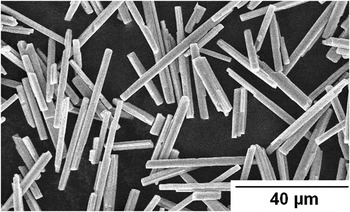
Acicular KSN template particles were synthesized by reacting KCl with an equimolar mixture of SN and Nb2O5 in a 3:2 weight ratio.Reference Yang, Wei, Chang and Liu17 The SN, Nb2O5 (H.C. Starck, 99.9%, Newton, MA), and KCl were ball milled for 24 h in ethanol, dried, and reacted in a covered Al2O3 crucible at 1150 °C for 9 h. KSN template particles with a diameter of 3–5 μm and length of 20–50 μm were obtained by dissolving the excess KCl in deionized water. These templates are shown in Fig. 1.
Morphology of the KSr2Nb5O15 (KSN) template particles used to texture Sr0.61Ba0.39Nb2O6 ceramics.

SN and BN powders were used as reactive matrix powders to synthesize SBN61 textured ceramics. SN and BN were prepared separately by ball-milling SrCO3 (Strem Chemicals, 99.9%, Newburyport, MA) or BaCO3 (Baker Chemicals, 99.9%, Phillipsburg, NJ) with Nb2O5 (H.C. Starck, 99.9%, Newton, MA) in ethanol for 36 h. Dried powders were calcined at 850 °C for 5 h, and phase purity was subsequently evaluated using x-ray diffraction (XRD, Scintag, Inc., PAD V, Cupertino, CA) with CuKα radiation.
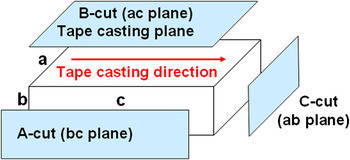
Alignment of the template particles in green sheets was achieved by the gated tape casting approach.Reference Messing, Trolier-McKinstry, Sabolsky, Duran, Kwon, Brahmaroutu, Park, Yilmaz, Rehrig, Eitel, Suvaci, Seabaugh and Oh10 Pseudoplastic tape casting slurries were prepared by dispersing matrix and template powders (23.56 vol.%) in a xylenes–ethanol solution (64.02 vol.%) containing blown menhaden fish oil (2.14 vol.%), polyvinyl butyral (5.35 vol.%), butyl benzyl phthalate (2.39 vol.%), and polyalkylene glycol (2.54 vol.%). SN and BN powders were used in a 57.9:42.1 molar ratio to approximate the SBN61 composition after addition of the KSN templates (10% of the matrix powder weight). Templates were stirred into the tape casting slurries about 3 h before tape casting to avoid damage to the morphology of these particles. Tapes were cast under a gated doctor blade with a gate spacing of ∼1 cm at a casting rate of 2 cm/s. Dried tapes were cut, stacked, and laminated at 75 °C and 20 MPa for 1 h to fabricate green compacts. Green samples were cut in three directions parallel and perpendicular to the casting direction (A, B, and C cuts) to study texture quality as a function of sample orientation. Orientations of these sample cuts are shown in Fig. 2. The organic binder was removed by heating samples at 0.3 °C/min to 600 °C and holding for 6 h in air. After isostatic pressing at 200 MPa, green samples were heated at 7 °C/min to temperatures between 600 and 1350 °C. Once those temperatures were reached, the samples were immediately quenched in air. Additional samples were heated to 1350 °C at 7 °C/min and held isothermally for 0–2 h. A control group of SNB61 samples were fabricated by similar tape casting and sintering methods, but without the use of acicular KSN template particles. The random crystallographic orientation of these samples was confirmed by XRD and was used as a baseline for computing Lotgering factors of textured SBN ceramics.
Schematic showing the orientation of sample directions and cross sections in [001] textured SrxBa1−xNb2O6 (SBN) ceramics.

Phase structure relations for various heat-treated samples were evaluated by XRD (Scintag, Inc., PAD V, Cupertino, CA). For this analysis, quenched samples were ground in a mortar to minimize preferred orientation, and phase fractions were estimated by the relative intensity ratio (RIR) method. In this method, volume fractions of each phase were assumed to be linearly proportional to XRD peak intensity. Phase fractions were calculated by comparing measured intensities with RIRs for each phase, which were computed from samples of known composition. The degree of [001] orientation, characterized by the Lotgering factor F 00l, was determined by XRD on sample surfaces cut perpendicular to the casting direction.Reference Lotgering18 Relative peak heights between 20–50° (2θ) were used for this calculation. The densities of quenched samples were measured by the Archimedes method. Fracture surfaces and thermally etched cross sections of the quenched SBN samples were imaged by scanning electron microscopy (SEM; FEI Quanta 200, Hillsboro, OR) to observe microstructure evolution during the RTGG process. Elemental mapping was performed on selected samples using an energy dispersive spectrometer (EDS) attached to the SEM.
III. RESULTS AND DISCUSSION
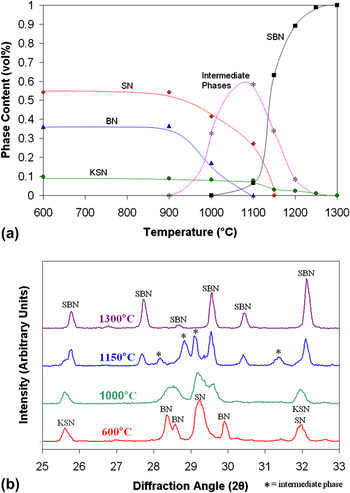
The phase evolution in textured SBN61 is shown as a function of heat treatment in Fig. 3. Samples initially consist of SN, BN, and KSN phases, which do not react until 900 °C. SN (ICDD#28-1243) and BN (ICDD#14-0027) have orthorhombic crystal structures below 900 °C that are not closely related to the TTB crystal structure of SBN61 (ICDD#97-024-0389). The SN and BN phases begin to react at 1000 °C, forming intermediate compounds in the SrO–BaO–Nb2O5 system. At least two intermediate phases were detected, but the identity of these phases could not be confirmed. SBN with the TTB structure begins to form above 1000 °C and accelerates rapidly above 1100 °C at which point the intermediate phases are rapidly consumed. The XRD peaks of SBN and the intermediate phases can be clearly seen at 1150 °C [Fig. 3(b)]. The KSN template particles remain unaffected below 1100 °C but gradually disappear between 1100 and 1300 °C. Reaction of the KSN templates appears to be coincident with SBN phase formation, suggesting the formation of a solid solution between the SBN and KSN phases. As mentioned previously, SBN tolerates substantial variation in stoichiometry, and it is expected that K+ from the KSN template particles may occupy the vacant A1 or A2 sites in the TTB structure.
(a) Sequence of phase formation in the textured SBN system and (b) selected x-ray diffraction (XRD) patterns, showing KSN, SrNb2O6, BaNb2O6, SBN, and intermediate phases. Phase fractions were estimated by the relative intensity ratio method calibrated with samples of known compositions.

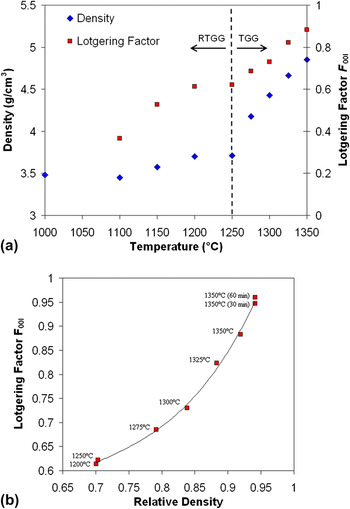
Densification and texture development in SBN61 ceramics are shown as a function of temperature in Fig. 4(a). For reference, the theoretical density of SBN61 is 5.28 g/cm3. The initial reaction of SN and BN matrix powders (1000–1100 °C) results in no densification, but the density increases slightly from 3.5 to 3.7 g/cm3 during SBN phase formation (1100–1250 °C). Between 1250 and 1350 °C, the SBN samples densify rapidly from 3.7 to 4.8 g/cm3 (70–92% RD). Texture development in SBN61 appears to occur in two distinct stages, as shown in Fig. 4(a). First, a substantial increase in Lotgering factor from F 00l = 0.38 to F 00l = 0.61 is observed between 1100 and 1200 °C. F 00l then remains unchanged between 1200 and 1250 °C before again rapidly increasing between 1250 and 1350 °C. A comparison of phase evolution [Fig. 3(a)] and densification behavior [Fig. 4(a)] reveals that SBN phase formation and reaction between SBN and the KSN templates both occur before substantial densification. It can also be seen that the first stage of texture development is coincident with SBN phase formation and occurs before substantial densification is observed. The onset of the second stage of texture development is coincident with the onset of densification at about 1250 °C. As temperature increases from 1250 to 1350 °C, F 00l increases from 61–88%.
(a) Densification and texture development as a function of temperature in SBN ceramics synthesized by reactive templated grain growth (RTGG), and (b) the texture fraction calculated using the Lotgering factor as a function of relative density.

Figure 4(b) shows [001] texture evolution on C-cut samples as a function of relative density between 1200 and 1350 °C. This plot includes texture data for the second stage of texture development, after SBN phase formation is complete, and includes samples held isothermally at 1350 °C. In TGG, texture development results directly from grain growth, and a plot of Lotgering factor versus density is expected to resemble a typical sintering trajectory (a plot of grain size with respect to density). Typically, sintering trajectories show a rapid increase in grain size at relative densities of 85–95% that is attributed to the effects of pore drag on grain growth. In Fig. 4(b), the increasing rate of texture development at higher densities is consistent with this model and suggests that this stage of texture development results from grain growth processes. During this stage, the Lotgering factor increases from F 00l = 0.61 to F 00l = 0.96 as density increases from 70–94% RD. A final F 00l of 96% is obtained after holding for 1 h at 1350 °C, and a final density of 95% is obtained after heating at 1350 °C for 2 h.
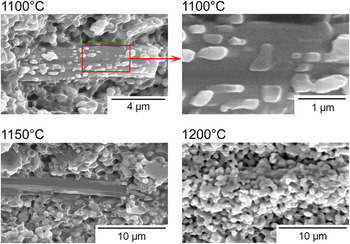
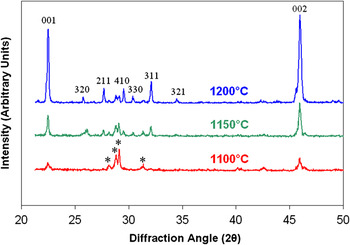
Figures 5 and 6 show fracture surface microstructures and XRD patterns of templated SBN samples during the phase formation stage (below 1250 °C). At 1100 °C, clearly observable SBN crystallites are visible on the surfaces of KSN template particles. These crystallites appear to be epitaxial as they show surface facets parallel to the prismatic surfaces of the underlying KSN crystal. These nuclei are no more than 0.6 μm in size and are preferentially aligned along [001], reflecting the orientation and symmetry of the KSN template. At this temperature, the porous matrix microstructure consists primarily of intermediate SrO–BaO–Nb2O5 phases with a grain size of about 1 μm. Necks have formed extensively between the matrix grains and aligned template particles, but no densification has occurred at this point. The XRD pattern for this sample (Fig. 6) shows that the SBN formed at this temperature is already substantially textured (F 00l = 0.38). As the temperature increases to 1150 °C, the fraction of oriented SBN increases at the expense of both the matrix powder and the KSN template particles. At this temperature, the SBN 00l peaks begin to dominate the XRD pattern, showing that this new growth is largely epitaxial on the growing oriented SBN nuclei. Continued growth of oriented SBN grains results in a nearly single-phase SBN microstructure at 1200 °C. Conversion of the matrix to textured SBN (F 00l = 0.61) results in almost no change in morphology between 1100 and 1200 °C. Most notably, the samples show additional neck formation with the oriented SBN growth forming strong aggregates around KSN templates. The lack of grain growth during this stage confirms that textured SBN is produced entirely from seeded formation of the SBN phase around the oriented KSN template particles. Nontextured SBN also forms during this stage and is presumed to nucleate and grow within the matrix. The increase in Lotgering factor from 1100 to 1200 °C shows that epitaxial growth processes rapidly outpace the growth of nonoriented SBN.
Microstructure evolution of templated SBN ceramics during the RTGG process. Fracture surfaces are imaged along the A-cut plane.

XRD patterns of templated SBN ceramics during the RTGG process. Numbered XRD peaks correspond to the SBN phase, while impurity peaks are marked with asterisks. XRD patterns were taken on C-cut cross sections.

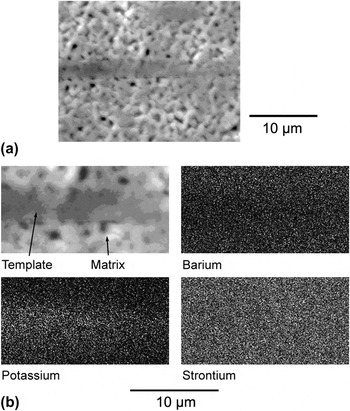
A polished and thermally etched cross section (A-cut) from the 1200 °C sintered sample was analyzed to determine the distribution of Sr2+, Ba2+, and K+ after SBN phase formation. The microstructure of this sample [Fig. 7(a)] shows roughening of the template–matrix interface due to reaction between the SBN and KSN phases. Elemental distribution maps [Fig. 7(b)] show that Sr2+ is homogeneously distributed throughout the templates and matrix, while K+ and Ba2+ are enriched in the template and matrix regions, respectively. Substantial interdiffusion has occurred at this temperature, as evidenced by the diffuse nature of the gradients in K+ and Ba2+ concentration.
(a) Microstructure and (b) elemental distribution maps of textured SBN ceramics heated to 1200 °C and air quenched. Micrographs were taken on a thermally etched A-cut cross section.

It is not immediately clear if the reactive texture development in this temperature range (1000–1250 °C) occurs by solid state or liquid phase transport mechanisms. Lee and FreerReference Lee and Freer19 reported that grain boundaries in SBN60 ceramics are enriched in Nb5+, resulting in a liquid phase above 1260 °C. The temperature at which this liquid phase forms may also decrease, if additional Nb2O5 is added.Reference Carruthers and Grasso20 The most likely source for excess Nb2O5 in textured SBN is reaction of the matrix and template phases as KSN contains excess Nb5+ with respect to the SBN phase (KSN has Sr:Nb = 2:5, while SBN has (Sr,Ba):Nb = 1:2).Reference Duran, Trolier-McKinstry and Messing13 It is unclear to what extent this excess Nb5+ (and associated K+) are incorporated into the growing SBN phase.
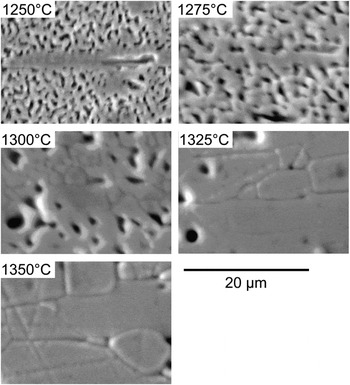
Microstructure evolution during the second stage of texture development in SBN61 (1250–1350 °C) is shown in Fig. 8. At 1250 °C, the SBN matrix has experienced little densification or grain growth and consists of a highly connected framework microstructure with a grain size of ∼1 μm. At this point, the templates have been mostly consumed by growth of oriented SBN and by interdiffusion of K+ and Ba2+ between the SBN and KSN phases. The templates are fully consumed at around 1300 °C and are replaced by equiaxed SBN grains with dimensions smaller than the length of the original templates. At this temperature, the microstructure shows a bimodal grain size distribution as larger oriented SBN grains begin to grow by Ostwald ripening. As the original KSN templates are no longer present, additional texture development results from growth on oriented SBN grains that serve as secondary templates. Between 1275 and 1300 °C, both densification and grain growth processes are evident. At higher temperatures (>1300 °C), grain growth is most rapid along [001], resulting in large grains with a high aspect ratio. Although densification continues, some spherical pores remain entrapped both in large grains and along grain boundaries. EDS mapping of samples sintered to 1350 °C shows that Ba2+, Sr2+, and K+ are distributed homogeneously within the SBN phase.
Microstructure evolution of textured SBN ceramics during the second stage of texture development (templated grain growth). Micrographs were taken on thermally etched A-cut cross sections.

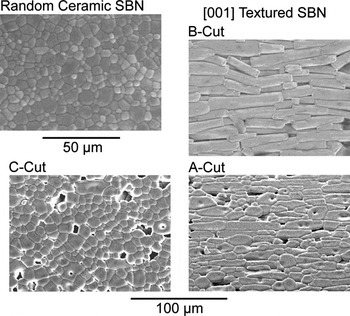
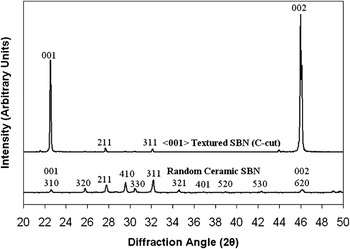
Figures 9 and 10 show microstructures and XRD patterns of randomly oriented and fully textured SBN ceramics, respectively. Textured SBN61 ceramics show a very strong [001] orientation with a Lotgering factor as high as 0.96. The grain orientation distribution is observed to be narrowest between the c and b directions and is somewhat wider between c and a. Alignment differs in these directions because substantially higher shear strains are applied vertically during tape casting (by the doctor blade) than are applied laterally (by the gates in the blade). Average grain sizes of ∼55 μm are observed along [001], and grains have an aspect ratio (length/diameter ratio) of 5–10. The morphological texture in SBN results from anisotropic growth of this phase during the final stages of texture development.
Final microstructures of [001] textured SBN ceramics as a function of sample direction. A microstructure of randomly oriented SBN is shown for comparison.

XRD patterns of randomly oriented and [001] textured SBN ceramics.

IV. CONCLUSIONS
Mechanisms of texture development were evaluated during the synthesis of highly [001] oriented (F 00l = 96%) SBN61 ceramics from a reactive matrix composition. We have learned that oriented growth occurs in two stages and is dependent on both RTGG and TGG mechanisms. In the first stage (1100–1250 °C), SBN forms by nucleation and growth within the matrix and by seeded growth on KSN template particles (the RTGG mechanism). At the onset of phase formation, SBN is partially textured (F 00l = 0.38), indicating both processes occur simultaneously. As temperature increases, RTGG outpaces the formation of nontextured SBN, resulting in F 00l = 0.61 at 1200 °C. The RTGG mechanism is characterized by the formation of strongly textured SBN coincident with phase formation, without substantial densification or grain growth. Texture development also ceases as SBN phase formation is completed, and F 00l remains nearly unchanged from 1200 to 1250 °C. The onset of the second stage of texture development (1250–1350 °C) is coincident with the onset of densification and grain growth. The acceleration of texture development with respect to density at densities of 85–95% is consistent with TGG in which grain growth is limited by pore drag. Because the KSN templates are consumed at 1300 °C, [001]-aligned SBN grains formed during RTGG serve as secondary templates for this TGG process. Eventually, this process results in homogeneous, well-textured SBN ceramics with a high texture quality (F 00l = 0.96). SBN ceramics are found to be a model system for identification and separation of TGG and RTGG mechanisms, and the characteristics of RTGG outlined in this work are expected to aid critical evaluation of texture development in other ceramic materials. Textured SBN produced by this method can be used directly in ferroelectric applications or may be annealed under reducing conditions to achieve high thermoelectric properties.