Implications
Human–animal interactions and animals’ fear of humans are associated with ease of handling, risk of injury and production variables, especially milk yield, milkability and udder health. The importance of positive interactions during milking relative to overall human contact is not known. It is thus essential to investigate ways to improve the animal–human relationship and investigate effects on milk yield, flow and quality. Our results indicate that gentle interactions during milking can reduce cows’ fear of the human but might only be of direct economic benefit if provided by the regular milkers and if the animal–human relationship is good.
Introduction
Cattle’s relationship with humans is a crucial factor regarding their welfare, with the potential to impact on both the animals’ level of fear and other negative emotions (Rushen et al., Reference Rushen, de Passillé and Munksgaard1999; Waiblinger et al., Reference Waiblinger, Boivin, Pedersen, Tosi, Janczak, Visser and Jones2006) and their experience of positive emotions (Bertenshaw and Rowlinson, Reference Bertenshaw and Rowlinson2008; Proctor and Carder, Reference Proctor and Carder2014). Stockpersons can improve their animals’ relationship towards them by providing regular positive and avoiding negative interactions (Rushen et al., Reference Rushen, de Passillé and Munksgaard1999; Breuer et al., Reference Breuer, Hemsworth and Coleman2003; Hemsworth and Coleman, Reference Hemsworth, Coleman, Barnett, Borg and Dowling2011). In addition, the relationship between animals and humans apparently influences productivity: if there are more positive and/or less negative interactions, milk yield is higher (e.g. Breuer et al., Reference Breuer, Hemsworth, Barnett, Matthews and Coleman2000; Hemsworth et al., Reference Hemsworth and Coleman2002; Waiblinger et al., Reference Waiblinger, Menke and Coleman2002). More positive interactions by the milker and a lower avoidance distance were also associated with better udder health (Ivemeyer et al., Reference Ivemeyer, Knierim and Waiblinger2011). There are several possible mechanisms that could explain the findings. First, a good relationship between cows and milkers implicates a reduction in fear and potentially an increase in the experience of positive emotions, which reduce the general stress level of the animals and thus decrease the risk for disease (Waiblinger et al., Reference Waiblinger, Boivin, Pedersen, Tosi, Janczak, Visser and Jones2006; Hemsworth and Coleman, Reference Hemsworth, Coleman, Barnett, Borg and Dowling2011). Second, a good relationship might help to avoid or reduce the occurrence of stress during milking and have a positive impact on oxytocin release, leading to improved milk ejection and better milkability. Supporting this hypothesis, heifers that were brushed for 5 min/week during the last weeks before calving had a better milk letdown than controls (Bertenshaw et al., Reference Bertenshaw, Rowlinson, Edge, Douglas and Shiel2008). Via milk letdown, milk yield and composition can be influenced by the relationship between cows and humans: poor emptying of the udder decreases the milk production rate per hour and induces an increase of somatic cell count (SCC) and a decrease of lactose content (McKeon et al., Reference McKeon, Penry, Endres, de Bruijn, Kleinhans, Reinemann and Hernandez2016). The latter might also vary due to stressful conditions causing a higher permeability of mammary tight junctions, which allow lactose to leak into the blood stream (Stelwagen et al., Reference Stelwagen, Hopster, van der Werf and Blokhuis2000). Even if continuing incomplete milking does not affect the fat content (McKeon et al., Reference McKeon, Penry, Endres, de Bruijn, Kleinhans, Reinemann and Hernandez2016), an adequate alveolar milk ejection may increase the fat yield as the major amount of fat is released towards the end of milking (Lane et al., Reference Lane, Dill, Armstrong and Switzer1970).
The aim of our study was to investigate the influence of gentle tactile and vocal interactions by an experimenter during milking on dairy cows’ fear towards this person as well as milk yield, flow and composition. We predicted a higher occurrence of behaviours indicative of relaxation and a lower occurrence of behaviours indicative of stress during milking; lower avoidance distances; a higher milk yield; improved milkability; and higher percentages of milk fat, protein and lactose as well as a lower SCC in animals that experienced gentle interactions with an experimenter during milking than in animals that experienced only the experimenter’s close presence.
Methods
Animals, housing and management
The experiment was conducted during June and July 2014 using 27 horned black and white German Holstein cows belonging to the research farm of the Institute of Organic Farming, Johann Heinrich von Thünen Institute, Trenthorst, Germany. The herd consisted of 39 animals and was kept in cubicle loose housing (785 m2; 20 m2/animal) with regular access to pasture during summer (about 8 h/day). Two feeding areas were accessible via transponder-controlled selection gates. The cows were milked in a 2×4 tandem milking parlour (GEA Farm Technologies, Bönen, Germany); only one side was used for the German Holstein herd, as another herd was milked simultaneously on the other side. Milking started at 0515 and 1545 h and took about 2 h. Milking routine was not changed for the study: after forestripping, teats and, when necessary, udder were cleaned using a machine washed and tumble dried towel for each cow. Attachment of cluster (IQ Milking Cluster; GEA Farm Technologies, Bönen, Germany) was followed by 40 s vibration stimulation (StimoPuls; GEA Farm Technologies, Bönen, Germany). Vacuum level was 38 kPa and automatic stripping (PosiCare; GEA Farm Technologies, Bönen, Germany) started at a milk flow of 800 g/min. When the milk flow dropped under 300 g/min, milking clusters were removed automatically. The herd had on average a milk yield of 8127 kg/lactation, with 4.12% fat and 3.10% protein. Experimental cows were in their first to seventh lactation, and at the beginning of the experiment, most of them were in mid- to late lactation (median: 259 days in milk, first quartile: 225 days, third quartile: 284 days). Due to a fatal accident one cow was excluded from the experiment, leading to a final sample size of n=26. All experimental procedures applied during the course of this study were discussed and approved by the institutional ethics committee in accordance with guidelines for Good Scientific Practice and with national legislation.
Experimental design
During the week before the start of the experimental treatment, avoidance distance tests were conducted, milk samples were taken and milk flow and yield were measured (Figure 1). Cows were assigned to one of two experimental groups balanced for age, number of lactations, lactation period, milk yield and avoidance distance. During the subsequent treatment phase, the cows experienced either the close presence of the experimenter (control group, n=12) or an experimental stroking treatment (stroked group, n=14). Milk flow characteristics and milk yield were measured during each morning milking. During the week after the end of the treatment phase, avoidance distance was measured, milk samples were taken and milk yield and flow data were recorded again.
Experimental schedule. A=avoidance distance test; M=milk sampling for analysis of milk composition and somatic cell count; F=recording of milk flow and yield; V=video observation during milking. Treatment days are highlighted in grey.

Experimental treatment
On two evenings before the start of the treatment phase, the experimenter (female, 165 cm, dark blond hair, green overall) stood close to each cow for 2 min during milking in order to facilitate habituation. The actual experimental treatment took place during 15 morning and 15 evening milkings over the course of 17 days. When the milker approached a cow for milking, the experimenter addressed the cow verbally and stayed close to her for 2 min. If the cow belonged to the stroked group, the experimenter stroked her mainly at the ventral neck (Schmied et al., Reference Schmied, Waiblinger, Scharl, Leisch and Boivin2008b), irrespective of whether she tried to avoid being touched or not, and talked to her in a gentle voice for 2 min.
Behaviour during milking
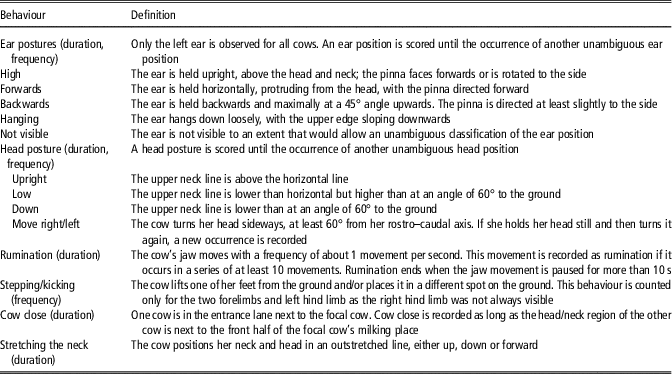
The cows’ behaviour during milking was recorded via a video surveillance system (MOBOTIX AG, Langmeil, Germany). One morning milking at the end of the treatment phase was analysed with the INTERACT® software (version 14.1.4; Mangold International GmbH, Arnstorf, Germany) by a trained observer who was not blinded to the treatment because the experimenter who stroked the cows or stayed close to them was visible in the video. The behaviour was observed for 30 s before the treatment, 1 min during the treatment and 1 min after the treatment. In all, three animals had to be excluded from the analysis of the phase before the treatment because they did not spend sufficient time in the milking stall before the approach of the experimenter. Intra-observer reliability was moderate to substantial (Cohen’s kappa: ear positions 0.55, head positions 0.74; percentage agreement: rumination 100%, stepping 96.5%). The behavioural patterns are given in Table 1.
Behavioural patterns recorded during milking

Description of ear postures modified after Proctor and Carder (Reference Proctor and Carder2014)
Avoidance distance tests
The experimenter who applied the experimental treatment conducted the avoidance distance tests. To avoid sudden avoidance reactions, she moved slowly over the feeding alley and through the herd for about 10 min on the 2nd day before the first tests. Avoidance distance tests at the feeding place (Waiblinger et al., Reference Waiblinger, Menke and Fölsch2003; Windschnurer et al., Reference Windschnurer, Barth and Waiblinger2009) were conducted 1 week before and 1 day after the treatment phase. To assess the avoidance distance, the experimenter approached a standing animal from the front at a speed of 1 step/s until the cows’ withdrawal or until touching her. The distance between the animal’s muzzle and the experimenter’s hand was estimated in steps of 10 cm at the moment of withdrawal. If the cow was touched, an avoidance distance of 0 cm was assigned. Avoidance distance tests were conducted when the cows were locked in the feeding rack after morning milkings (0530 to 0810 h); the experimenter ensured that each cow was standing in the feeding rack for at least 10 min before testing her to control for a potential influence of hunger. Avoidance distance was measured twice per cow at each point in time in order to ensure robustness of data.
Assessment of electrical conductivity, milk composition, somatic cell count, milk yield and milkability
Electrical conductivity was determined from the foremilk of each quarter separately using a Milku Mastitron® plus V device (Milku Tierhygiene GmbH, Uelzen, Germany) during morning milkings 6 days before and 1 day after the treatment phase. A cow was considered to have an increased permeability of udder tissue if the largest difference between the values of two quarters was >0.5 mS/cm. A whole milk sample was taken and on the same day analysed for fat, protein and lactose content as well as SCC by the local milk recording organisation (Landeskontrollverband Schleswig-Holstein e.V.). Milk yield and different criteria of milkability (see below) were measured using LactoCorder® devices (WMB AG, Balgach, Switzerland). LactoCorder® measurements were taken before and after the treatment phase during the two morning milkings following the day of milk sampling, and in addition during each morning milking of the treatment phase. The following data were evaluated: peak flow, latency until reaching the threshold of 500 g/min, duration of the main and plateau phases, occurrence of unusually long durations (>30 s) of machine stripping and occurrence of bimodal milk flow curves.
Data analysis
Data were analysed at cow level and presented graphically using the statistics environment R version 3.2.3 (R Core Team, 2015). Normal distribution of residuals and homogeneity of variance were checked visually. Only effects of the treatment group (stroked/control), the day of sampling (before/after treatment) and their interaction are reported, as any effects of confounding variables are outside the scope of the present study.
Due to non-normal distribution, behavioural data were analysed using Mann–Whitney U tests for comparisons of the two treatment groups during each phase (before, during and after treatment); final sample sizes are given in the corresponding section. Frequencies of ear and head movements were calculated from the frequencies of ear and head postures and, in the latter case, the frequencies of movements to the left or right. Due to the different durations of the observed phases, frequencies are given per 10 s and durations as percentage of the time observed in each phase. The two measures of avoidance distance obtained on each testing day were averaged before analysis. Wilcoxon’s signed-rank tests were calculated to compare avoidance distances within each group and Mann–Whitney U tests to compare avoidance distances between the groups.
Milk composition and SCC were analysed by means of linear mixed models (LMM) using the package nlme (Pinheiro et al., Reference Pinheiro, Bates, DebRoy and Sarkar2013). The dependent variables were fat, protein and lactose content and SCC. The full model always included the treatment group (stroked/control), the day of sampling (before/after treatment) and their interaction as well as lactation number, its quadratic polynomial (lactation number)2, day of lactation at the start of the experiment, its quadratic polynomial (day of lactation)2 and milking interval as fixed factors (df=1 for each). Independent variables (except for the main model factors, treatment and day of sampling, and their interaction) were removed from the model if the removal decreased the Akaike Information Criterion (AIC) of the resulting model. The animal was included as random factor. Lactose content was rank-transformed and SCC was log-transformed to fulfil the model assumptions.
Data on milk yield and flow obtained during the treatment phase, that is with the experimenter stroking the cows or standing close to them, and data obtained before and after the treatment phase, that is without the presence of the experimenter, were analysed in separate models. The dependent variables were milk yield, peak flow, the latency until reaching a milk flow of 500 g/min, the duration of the main milking phase, the duration of the plateau phase, the occurrence of unusually long durations (>30 s) of machine stripping and the occurrence of bimodal milk flow curves. The first five variables were continuous and evaluated using LMM; the latter two variables were binary and evaluated by means of generalised linear mixed models (GLMM) based on the binomial distribution, using the package glmmADMB (Skaug et al., Reference Skaug, Fournier, Bolker, Magnusson and Nielsen2015). The full model always included the treatment group, the day of sampling and their interaction as well as day of lactation at the start of the experiment, its quadratic polynomial (day of lactation)2, lactation number, its quadratic polynomial (lactation number)2 and milking interval as fixed factors (df=1 for each). As cows were milked by three different persons during the treatment phase, an additional fixed factor in the models of the data obtained during that time was milker identity (df=2). Independent variables (except for the main model factors, treatment and day of sampling, and their interaction) were removed if the AIC of the resulting model was lower. The animal was included as random factor. The latency until reaching a milk flow of 500 g/min was rank-transformed and the duration of the plateau phase was square-root transformed to fulfil the assumptions of the LMM. The data on several variables contained outliers producing residuals >3 SD. For these variables, models were calculated with and without the outliers to determine their influence. In general, we present the results of the models including the outliers; if the removal of outliers affected the statistical significance of the main model factors or their interaction, we also present the results without outliers. We recalculated the models for the data obtained during the treatment phase without the data obtained on the 1st day of the experimental treatment to determine whether these data had a strong influence.
Conductivity data (occurrence of between-quarter differences >0.5 mS/cm) were analysed in a similar way as the binary milk flow variables. In one cow, milk ejection had already set in when conductivity was measured; as milk ejection influences conductivity, the cows’ data were removed from analysis, leading to a sample size of 14 stroked and 11 control cows.
Results
Behaviour during milking
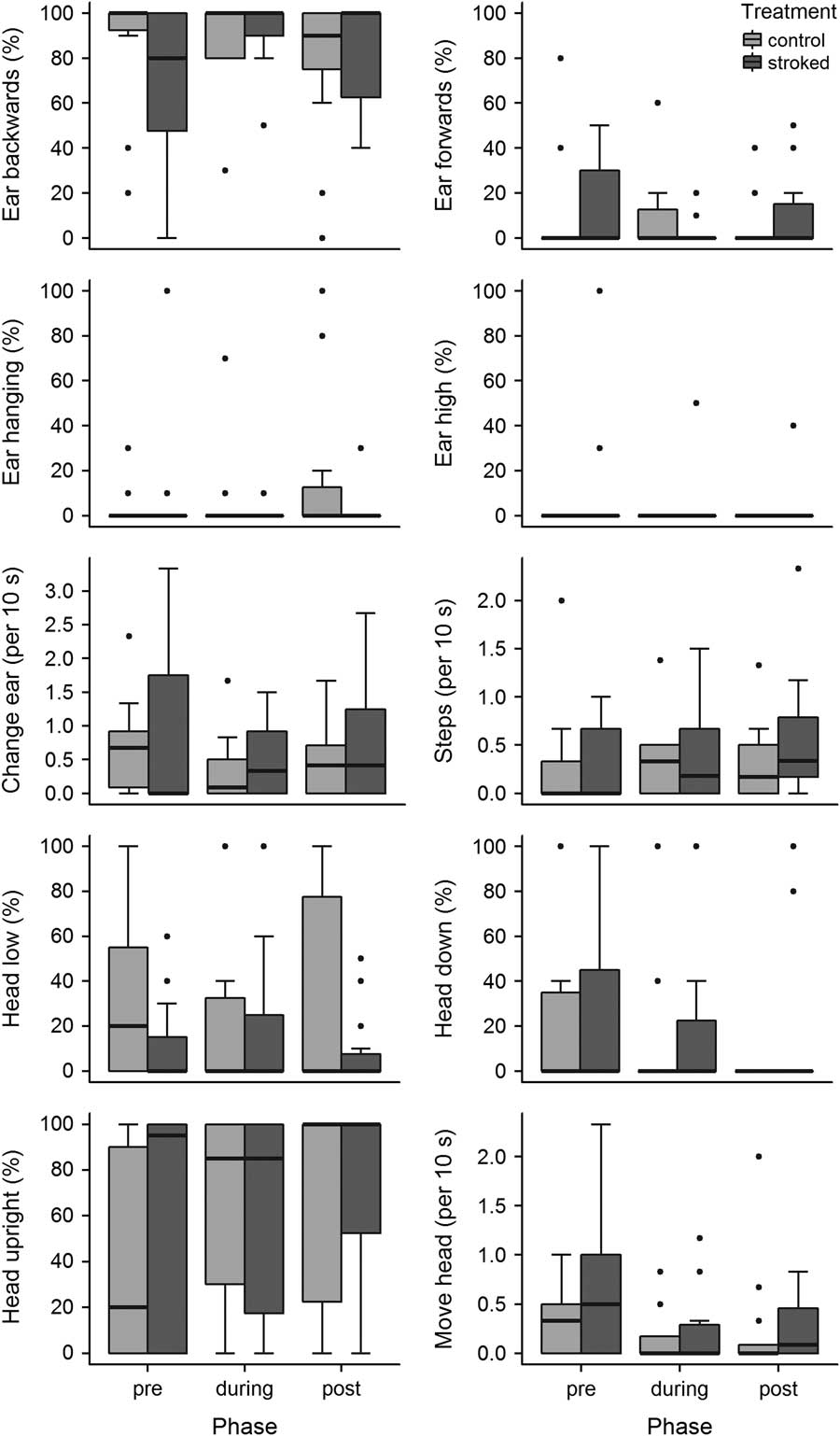
The cows’ ears were mostly directed backwards during all phases, that is before, during and after the treatment, and the head was mainly held upright (Figure 2). Of the 26 cows observed, seven ruminated during all phases and 13 did not ruminate during any observation, indicating that the cows rarely changed between ruminating and not ruminating. Neck stretching was shown only four times, never for longer than 4 s and never during gentle interactions. There were no significant differences in any of the behaviours between the groups within the single phases (Mann–Whitney U test, W=50 to 106, P=0.1 to 1.0).
Behaviour during milking of control and stroked cows before (pre), during and after (post) 2 min of the experimental treatment (gentle interactions in stroked cows, close presence in controls). Ear and head positions are given as percentage of the total observation time for each phase. ncontrol=9 to 12, nstroked=12 to 14, depending on behaviour and phase.

Avoidance distances
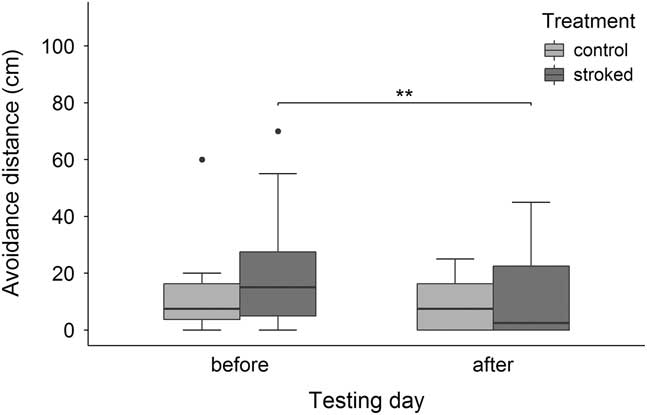
Before the treatment phase, three control and four stroked cows accepted to be touched in at least one of the two avoidance distance tests. After the treatment phase, seven cows from each group accepted to be touched at least once. The avoidance distance at the feeding rack decreased significantly in the stroked but not in the control group (Figure 3; Wilcoxon’s signed-rank test; stroked, n=14, Z=2.8, P=0.006; control, n=12, Z=0.6, P=0.55). There were no significant differences between the groups before or after the test (Mann–Whitney U test; before, W=68, P=0.42; after, W=0.86, P=0.94).
Avoidance distances (cm) at the feeding rack of stroked (n=14) and control (n=12) cows before and after the 3-week treatment (gentle interactions in stroked cows, close presence in controls).

Milk composition and somatic cell count
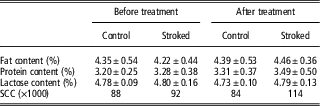
There was no significant effect of treatment or its interaction with day of testing on any dependent variable (Table 2). There was a trend towards an effect of day of testing on protein content (LMM, χ 2=3.08, P=0.08), with a higher protein content after the treatment phase than before.
Means±SD of milk composition and back-transformed means of log-transformed somatic cell count (SCC) of stroked (n=14) and control (n=12) cows before, during and after the 3-week treatment (gentle interactions in stroked cows, close presence in controls)

There was no significant effect of the treatment or the day of testing, or of their interaction.
Milk yield and flow
Before and after the treatment phase
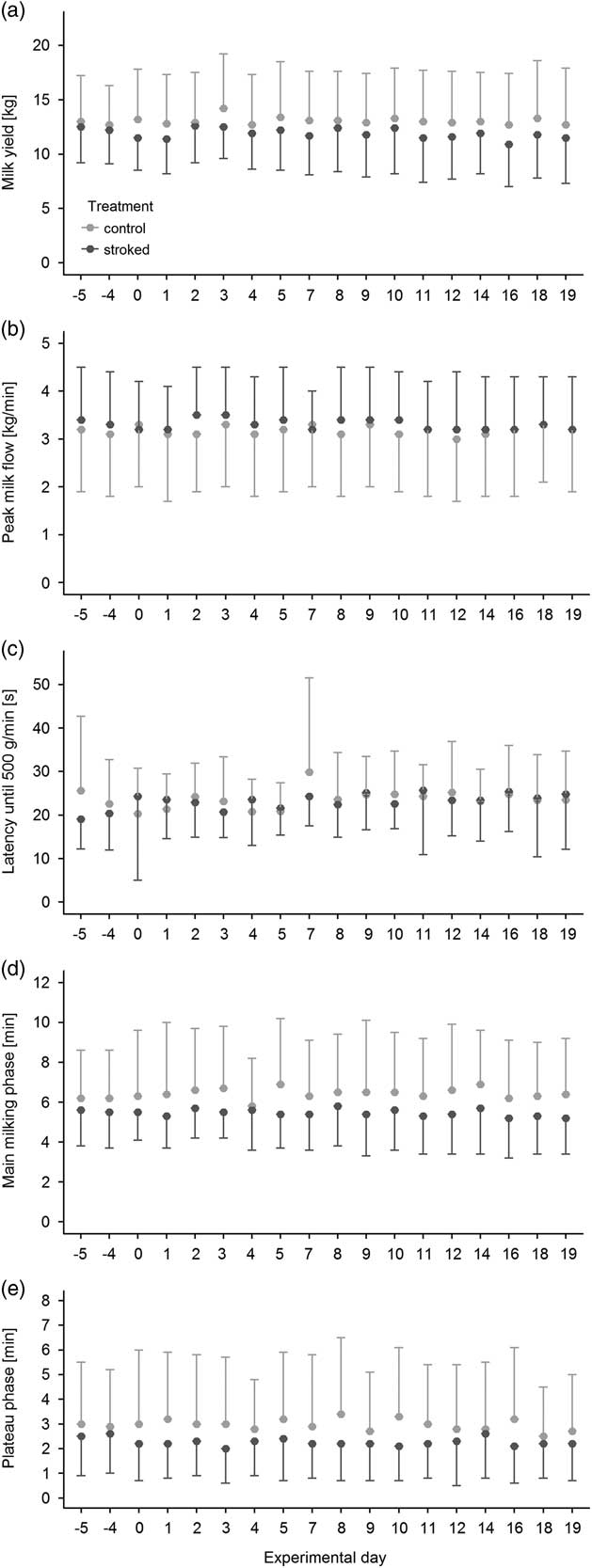
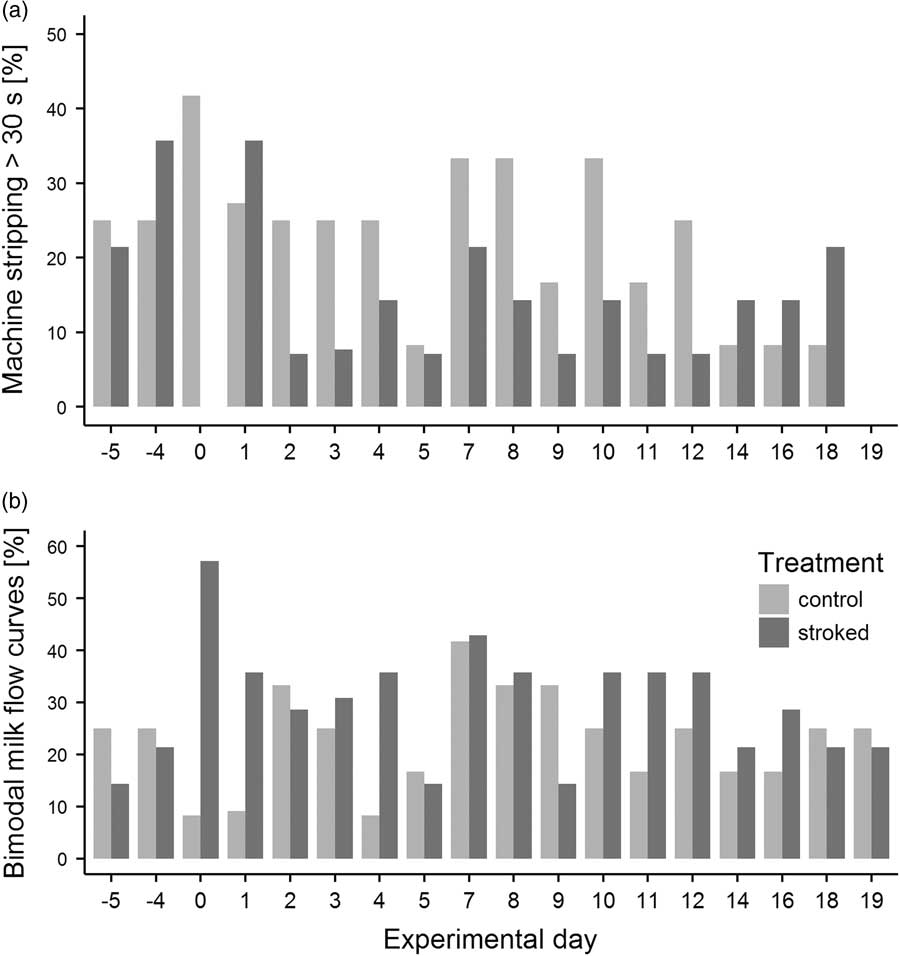
There was a significant interaction effect of treatment and day of testing on the latency until reaching a milk flow of 500 g/min (Figure 4, days −5/−4 and 18/19; LMM, χ 2=4.65, P=0.03): on the days before the start of the treatment, the stroked animals had a lower latency than on the day after treatment as well as a lower latency than the controls, whereas on the day after treatment, their latency was similar to that of the controls. In stroked cows, the main milking phase was significantly shorter (χ 2=4.58, P=0.03) and milk yield tended to be lower (χ 2=3.17, P=0.08) than in controls. There were trends for a lower occurrence of long durations of machine stripping (Figure 5, days −5/−4 and 18/19; GLMM, χ 2=2.90, P=0.09) and a shorter duration of the plateau phase (LMM, χ 2=2.92, P=0.09) after the treatment phase than before. After the removal of three outliers, the latter trend was not present anymore (χ 2=2.30, P=0.13).
Means and SD of milk yield and flow characteristics of stroked (n=14) and control (n=12) cows before, during and after the 3-week treatment (gentle interactions in stroked cows, close presence in controls). (a) milk yield, (b) peak milk flow, (c) latency until reaching the threshold of 500g/min, (d) duration of the main milking phase, (e) duration of the plateau phase. The experimental treatment started on day 0 and ended on day 16.

Occurrence of (a) durations of machine stripping >30 s and (b) bimodal milk flow curves during milking of stroked (n=14) and control (n=12) cows before, during and after the 3-week treatment (gentle interactions in stroked cows, close presence in controls). The experimental treatment started on day 0 and ended on day 16.

During the treatment phase
Stroked cows had significantly fewer occurrences of long durations of machine stripping than controls (Figure 5, days 0 to 16; GLMM, χ 2=3.76, P=0.05). There was a significant main effect of the day of testing, with an increase in latency until reaching a milk flow of 500 g/min (Figure 4, days 0 to 16; LMM, χ 2=9.05, P=0.003) and a decrease in the number of occurrences of long durations of machine stripping over the course of the treatment phase (GLMM, χ 2=4.18, P=0.04). There were trends towards a higher occurrence of bimodal milk flow curves (χ 2=2.91, P=0.09) and a lower milk yield (LMM, χ 2=3.06, P=0.08) in the stroked animals than in the controls. The latter trend was not present anymore after the removal of 5 outliers (χ 2=2.05, P=0.15). There was no effect of the interaction of treatment and day of testing on any dependent variable. To check for an effect of the 1st day of the treatment phase, we recalculated all models after excluding the data obtained on that day. Except for the significant main effect of the day of testing on the latency until reaching a milk flow of 500 g/min, there was neither a significant effect of the day of testing nor of the treatment, indicating that the significant findings during the treatment phase were mainly driven by differences on the 1st day of testing.
Conductivity
Before the treatment phase, four out of 14 stroked cows and six out of 11 control cows had differences in conductivity between two quarters that were >0.5 mS/cm and thus were suspected of impaired udder health. After the treatment, six stroked cows and five controls had values exceeding the threshold. Neither the treatment (GLMM, χ 2=0.49, P=0.48) nor the experimental day (χ 2=0.62, P=0.43) nor their interaction (χ 2=1.44, P=0.23) had a significant effect.
Discussion
In this study, we investigated for the first time a possible influence of gentle interactions (stroking, talking in a gentle voice) with an experimenter during milking on milk yield and composition, SCC and milkability as well as on cows’ relationship with that person. Although avoidance distance at the feeding rack decreased significantly in animals that experienced gentle interactions during milking, there was no consistent influence of stroking on milk yield or composition or milkability.
Behaviour during treatment and perception of gentle interactions
There are several behaviour patterns that have been proposed as indicators of a positive affective state in cattle, for example neck stretching (Schmied et al., Reference Schmied, Waiblinger, Scharl, Leisch and Boivin2008b) and ear hanging (Schmied et al., Reference Schmied, Waiblinger, Scharl, Leisch and Boivin2008b; Proctor and Carder, Reference Proctor and Carder2014). An upright head and erect ears are related to vigilance and fear (Welp et al., Reference Welp, Rushen, Kramer, Festa-Bianchet and de Passillé2004; Proctor and Carder, Reference Proctor and Carder2014). The absence of significant behavioural differences between the stroked and the control group during the treatment indicates that there was no change in affective state caused by stroking. Although there are increasing numbers of studies concluding that cattle perceive stroking or brushing as positive by evaluating the behaviour during the interactions (Schmied et al., Reference Schmied, Waiblinger, Scharl, Leisch and Boivin2008b; Lürzel et al., Reference Lürzel, Münsch, Windschnurer, Futschik, Palme and Waiblinger2015) or assessing the motivation of the animals to interact (Bertenshaw and Rowlinson, Reference Bertenshaw and Rowlinson2008; Schulze Westerath et al., Reference Schulze Westerath, Gygax and Hillmann2014), not every animal may enjoy gentle interactions with humans in every situation. Some studies did not find any indications that calves enjoy to be brushed (Boivin et al., Reference Boivin, Garel, Durier and Le Neindre1998; Jago et al., Reference Jago, Krohn and Matthews1999), which may be due to the experimental design, for example the choice of body regions for stroking. However, even within the same study, there are often some animals that apparently dislike some aspect of the close contact with humans (Windschnurer et al., Reference Windschnurer, Barth and Waiblinger2009; Schulze Westerath et al., Reference Schulze Westerath, Gygax and Hillmann2014; Lürzel et al., Reference Lürzel, Windschnurer, Futschik and Waiblinger2016).
There are several factors that may influence cattle’s reaction to stroking. As already stated by others (Bertenshaw and Rowlinson, Reference Bertenshaw and Rowlinson2008; Windschnurer et al., Reference Windschnurer, Barth and Waiblinger2009), a good relationship with humans is necessary for the animals to perceive stroking as pleasant. Accordingly, cows showed more behavioural signs of enjoyment (neck stretching, ear hanging) during stroking after previous experience of the procedure and associated improvement of their relationship with humans (Schmied et al., Reference Schmied, Boivin and Waiblinger2008a and Reference Schmied, Waiblinger, Scharl, Leisch and Boivin2008b). The cows in our study were not used to being stroked in the milking parlour at the beginning of the treatment phase and except for two animals, none accepted being touched in both avoidance distance tests before the treatment. In addition, they were not familiar with the experimenter although she was not completely novel to them anymore after the two evening milkings used for habituation before the onset of the treatment phase. The familiarity of humans is an important factor influencing the animals’ perception of humans and, accordingly, human–animal interactions (Waiblinger et al., Reference Waiblinger, Boivin, Pedersen, Tosi, Janczak, Visser and Jones2006). We had expected the cows to habituate to the treatment more quickly and to develop a much better relationship with the experimenter over the course of the experimental phase, but these processes may take longer to reach a sufficiently high level for the animals to enjoy the treatment. It has also been discussed previously that a certain degree of perceived control over the situation might be beneficial for a positive perception of gentle interactions (Windschnurer et al., Reference Windschnurer, Barth and Waiblinger2009; Lürzel et al., Reference Lürzel, Windschnurer, Futschik and Waiblinger2016). Stroking in the milking parlour has the advantages that it is a situation where human–cow contact is common and that habituation is facilitated because cows are not free to avoid the experimenter. A disadvantage might be that cows probably do not perceive the interaction to be under their control, which may lead to stress (Koolhaas et al., Reference Koolhaas, Bartolomucci, Buwalda, de Boer, Flügge, Korte, Meerlo, Murison, Olivier, Palanza, Richter-Levin, Sgoifo, Steimer, Stiedl, van Dijk, Wöhr and Fuchs2011) at least in the beginning of habituation, and thus may hinder positive perception of the treatment. An additional explanation could be the suboptimal relationship with the usual handlers and their continued presence, which might have counteracted a positive emotional state in the milking parlour. An animal’s overall perception of humans is influenced by the ratio of positive and negative interactions (Hemsworth et al., Reference Hemsworth, Barnett and Hansen1987) and the cows may have experienced many negative to neutral milkings over their lifetime. Although it would have been interesting to analyse potential effects on affective states using also physiological measures such as heart rate variability and oxytocin, this was not feasible in our experimental setting.
Avoidance distance
The low number of animals that accepted to be touched before the treatment points towards a suboptimal human–animal relationship (compare with Waiblinger et al., Reference Waiblinger, Menke and Fölsch2003), with animals not being used to gentle tactile interactions and at least a certain degree of fear towards humans (Rousing and Waiblinger, Reference Rousing and Waiblinger2004). The decrease in avoidance distance indicates that the stroked cows improved their relationship with the experimenter during the treatment phase, in contrast to the controls. The finding is in line with other studies in cattle indicating that gentle interactions with humans reduce fear towards these specific humans (Schmied et al., Reference Schmied, Boivin and Waiblinger2008a; Windschnurer et al., Reference Windschnurer, Barth and Waiblinger2009) or humans in general (Boivin et al., Reference Boivin, Le Neindre, Garel and Chupin1994; Krohn et al., Reference Krohn, Jago and Boivin2001). The reduction in fear may be person-specific, especially if cows experience different handling by different people (Munksgaard et al., Reference Munksgaard, de Passillé, Rushen, Thodberg and Jensen1997).
Milk yield, milk composition and milkability
In case of a treatment effect on milk and milk flow characteristics, we would have expected an effect of the interaction of treatment and day of testing on several dependent variables. This was the case only for the latency until reaching a milk flow of 500 g/min in the comparison of the data recorded before and after the treatment phase – stroked animals had a lower latency than controls before the treatment phase and reached similar levels as controls thereafter. As the interaction is caused by a difference between the groups that existed before the treatment, it does not support our hypothesis of an improved milk ejection. The numerical decrease in milk yield in the stroked cows may be the underlying cause for this observation, as lower udder fillings lead to a greater time lag between stimulation and alveolar milk ejection (Weiss and Bruckmaier, Reference Weiss and Bruckmaier2005). The stroked cows had shorter durations of the main milking phase than the control cows before and after the treatment phase, which can be explained by their lower milk yield and their slightly better milkability. Milk composition, SCC and electrical conductivity assessed before and after the treatment phase were not affected by the experimental treatment. It should be noted that in the present study, the potentially influencing variables ‘day of testing’ and ‘days in milk’ are highly confounded, which is why we entered only the day of lactation at the beginning of the experiment (and its quadratic polynomial) in the models, as a constant for each cow. All main effects of the day of testing may thus be caused by the changes occurring during the course of lactation.
Regarding the analysis of the data on milk yield and milk flow characteristics collected during the treatment phase, the effect of the day of testing on the latency until reaching a milk flow of 500 g/min is probably founded on the usual changes in udder filling occurring during the course of lactation. It is striking that after the exclusion of the data obtained on the 1st day of the treatment, all other effects were not significant anymore, indicating that the 1st day of treatment had a strong influence on the measures. On the 1st day of treatment, machine stripping did not take longer than 30 s for any of the stroked cows, and over half of the stroked cows had bimodal milk flow curves, which indicate an impaired milk ejection. The novelty of the treatment and, as the animals could not avoid the treatment, a lack of control over the situation might have caused a stress response, leading to a reduced secretion of oxytocin and impaired milk ejection (Bruckmaier and Wellnitz, Reference Bruckmaier and Wellnitz2008). Taken together, the results indicate that stroking during milking in this experiment did not have a beneficial effect on milk yield, milk composition or milkability.
The finding is in contrast to our hypothesis, which is based on a number of studies that found associations between the relationship between animals and humans and milk production measures (e.g. Breuer et al., Reference Breuer, Hemsworth, Barnett, Matthews and Coleman2000; Hemsworth et al., Reference Hemsworth and Coleman2002; Waiblinger et al., Reference Waiblinger, Menke and Coleman2002). However, these studies never tested the effect of an introduction and continuous application of gentle physical interactions between humans and cows during milking on milk and milking characteristics. A reason for the lack of an effect in the present study may be that the animals did not perceive the treatment as positive enough to have an effect on milk yield or composition and SCC or on milk flow due to its novelty, the influence of the already existing, presumably suboptimal animal–human relationship and the influence of the interactions with the milkers. The impaired milk ejection in stroked cows on the 1st day of the treatment indicates that the novelty of the procedure strongly affected the results. Another possibility is that the technical aspects of the milking routine (relatively long stimulation, early start of machine stripping and rather low level vacuum) were ideal, causing a ceiling effect with optimal milk and milk flow characteristics that cannot be further improved.
A further contributor to the difference between the studies is the time it takes to establish a positive relationship between animals and humans. Epidemiological studies provide a snapshot of relationships that have developed over months or years. Similarly, the milkers in the study by Hanna et al. (Reference Hanna, Sneddon, Beattie and Breuer2006) followed the same routine for at least 6 months before the observation, and the effect of a cognitive and behavioural intervention programme was assessed 1 year after its implementation (Hemsworth et al., Reference Hemsworth and Coleman2002). In contrast, the duration of our experiment was less than a month, without an extended habituation period before the start of the treatment. Although Rushen et al. (Reference Rushen, de Passillé and Munksgaard1999) found increased residual milk during milking in the presence of a negative handler after a treatment period of only 5 days, they did not find an effect of the presence of a positive handler on milk production variables. The effects of negative handling may thus appear faster or be more obvious than the effects of positive handling, which may be explained by the higher immediate relevance of negative than of positive emotions for survival and fitness.
For future studies, it would be beneficial to improve the perception of the treatment by the cows. This would be possible by establishing a positive relationship between the experimenter and the cows before the experiment, including avoidance distance tests to prove the success of the procedure. Another way might be to eliminate the effect of novelty of the person, that is instructing the milkers to interact with the cows in a certain way and improve and test the cows’ relationship with the milkers as proposed above; this may prove difficult, as milking is routine behaviour and it takes a sustained effort to change behaviour (e.g. Hemsworth et al., Reference Hemsworth and Coleman2002). Another option might be to exchange the milker for an experimenter and plan for an extensive habituation phase, during which a positive animal–human relationship can be established.
Conclusion
We conclude that gentle interactions during milking can reduce the animals’ fear of the person interacting with the animals, thus improving the animals’ relationship with that person. A possible reason for the absence of an effect on milk characteristics is that cows may not have perceived the interactions as positive, probably due to their novelty, the low level of familiarity of the experimenter and the short duration of the treatment. In addition, the cows’ suboptimal animal–human relationship before the start of the experiment in combination with the continued presence of the usual stockpeople might have played a role. Another possibility is that under the given circumstances, milk characteristics could not further be improved due to optimal milking routine and equipment.
Acknowledgements
The study was funded by the Postdoc programme of the University of Veterinary Medicine, Vienna. We are grateful for the excellent cooperation of the staff of the research farm as well as for the help with data collection by the experimental technicians of the Thünen Institute of Organic Farming, Trenthorst. The authors also like to thank Bettina Budeus for help with R provided to S.L.