Tropical forests play a vital role in the global carbon cycle (Malhi et al. Reference MALHI, MEIR and BROWN2002), protect water and soil resources (Grip et al. Reference GRIP, FRITSCH, BRUIJNZEEL, Bonell and Bruijnzeel2004), and maintain habitat for biodiversity (WRI 2000). Despite their importance, tropical forests are being cleared at an alarming rate for use as pastoral land for livestock grazing (Wassenaar et al. Reference WASSENAAR, GERBER, VERBUG, ROSALES, IBRAHIM and STEINFELD2007). In Central America, only 20% of the original forest remains (Myers et al. Reference MYERS, MITTERMEIER, MITTERMEIER, DA FONSECA and KENT2000), resulting in the urgent need for strategies that support biodiversity, even in agricultural landscapes (Fischer et al. Reference FISCHER, BROSI, DAILY, EHRLICH, GOLDMAN, GOLDSTEIN, LINDENMAYER, MANNING, MOONEY, PEJCHAR, RANGANATHAN and TALLIS2008). Fortunately, many tropical forest species, particularly avifauna, will use agricultural land for foraging and breeding (Sekercioglu et al. Reference SEKERCIOGLU, LOARIE, OVIEDO BRENES, EHRLICH and DAILY2007). In Costa Rica, three quarters of bird species have been observed using fragmented landscapes, but this depends heavily on whether canopy trees are present (Stiles Reference STILES, Diamond and Lovejoy1985). Pasture trees may promote bird visitation by acting as a hub for bird activity (Sekercioglu et al. Reference SEKERCIOGLU, LOARIE, OVIEDO BRENES, EHRLICH and DAILY2007). Pasture trees are, however, increasingly being lost from agricultural landscapes (Gibbons et al. Reference GIBBONS, LINDENMAYER, FISCHER, MANNING, WEINBERG, SEDDON, RYAN and BARRETT2008), resulting in the urgent need to document their influence on bird behaviour and, thus, their potential to promote species persistence.
We investigated bird use of pasture trees for foraging and perching in a tropical montane landscape. We investigated: (1) which bird species used pasture trees; (2) what resources birds used within pasture trees; and (3) the influence of tree characteristics (tree size, epiphyte load, distance from forest edge and basal area of neighbouring trees – a measure of isolation) on number of bird visitors.
We worked in pastures in Monteverde, Costa Rica (~10°20′N, 84°45′W) from May–July 2012. The area is a mixture of primary montane forest and small fields used for agriculture (Haber Reference HABER, Nadkarni and Wheelwright2000). Field sites included three active pastures that averaged 6.13 ± 1.84 ha in size, ranged in altitude from 1460–1520 m asl and were located within 1 km of each other. We restricted our study to the main breeding season of birds in the area, which runs from March to July and is characterized by clear skies in the morning, rainfall during the afternoon, and mean monthly precipitation >250 mm (Clark et al. Reference CLARK, LAWTON, BUTLER, Nadkarni and Wheelwright2000).
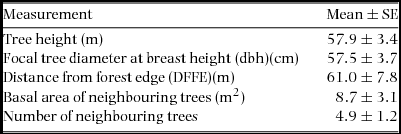
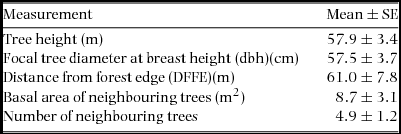
We examined bird visitation to 26 focal trees of Sapium glandulosum (Euphorbiaceae), a deciduous colonizing species with bird-dispersed fruits (Haber Reference HABER, Nadkarni and Wheelwright2000) (Table 1). Sapium glandulosum was not the only tree species in the pastures, but it is one of the most abundant colonizing species in the area and, thus, representative of local pastures (Schroth et al. Reference SCHROTH, DA FONSECA, HARVEY, GASCON, LASCONCELOS and IZAC2004). For each focal tree, we measured tree size as diameter at breast height (dbh). To determine the basal area of neighbouring trees surrounding each focal tree, we first identified all neighbouring trees with a dbh ≥ 12.7 cm located within a 15-m radius from the focal tree. We converted the total dbh of neighbouring trees to basal area of neighbouring trees for each focal tree. We determined DFFE of focal trees by taking GPS coordinates of each tree and measuring distance to the nearest forest edge using Google Earth. We collected ground data on DFFE for over half of the trees to verify the accuracy of estimates. We assigned an epiphyte load index to each tree on a scale of 1–4, with scores corresponding to the percentage of the tree covered with epiphytes (1 = 1–25%; 2 = 26–50%; 3 = 51–75%; 4 = 76–100%). Common epiphytes on trees included Vaccinium sp. (Ericaceae), Clusia sp. (Clusiaceae) and Vriesea sp. (Bromeliaceae).
Table of focal tree measurements. Measurements (mean ± SE) taken for Sapium glandulosum trees (n = 26) from three pastures in Monteverde, Costa Rica. Neighbouring trees are all trees within a 15-m radius of a focal tree that have a diameter at breast height (dbh) ≥ 12.7 cm.
To determine bird use of focal trees, two observers (KSS and E. B. Linck) watched different trees for two 2-h sessions each morning (from either 5h30–7h30 or 8h00–10h00). We restricted sessions to mornings with no rain. Each focal tree was observed three times (two 5h30–7h30 sessions, one 8h00–10h00 session) on three separate days, with the order of days randomized. We sat in chairs at least 30 m from the focal tree. Birds in the area of the focal trees did not visibly respond to our presence.
When a bird arrived at the focal tree, we recorded the species and whether the bird used epiphytes or the focal tree as foraging substrate (i.e. feeding on fruits, nectar or insects). Sapium glandulosum fruits were not ripe during the study, thus we never observed a bird taking fruit from focal trees. If a bird sallied to catch an insect, it was not recorded as a separate visit if the bird returned to the focal tree.
We examined the factors that best predict total number of bird visitors to a tree. Data were analysed using linear mixed effects models with a Poisson error distribution and were fitted using maximum likelihood estimation (R Development Core Team; v2.11.1). Our response variable was number of bird visits. Models included focal tree dbh, DFFE, epiphyte load and basal area of neighbouring trees as fixed effects and tree number as a random effect. We used Akaike Information Criterion (AIC) to choose the best-fit model (Burnham & Anderson Reference BURNHAM and ANDERSON2004). We performed model simplification using likelihood ratio tests (LRTs) between models to test relative fit (p) (Crawley Reference CRAWLEY2007). When two models were not significantly different, we chose the best-fit model based on parsimony (i.e. fewest parameters). To determine if more birds visited trees with higher epiphyte loads, we used multiple comparisons (R multcomp package) to test for differences in bird visits to trees based on epiphyte load. We report all statistics as mean ± SE.
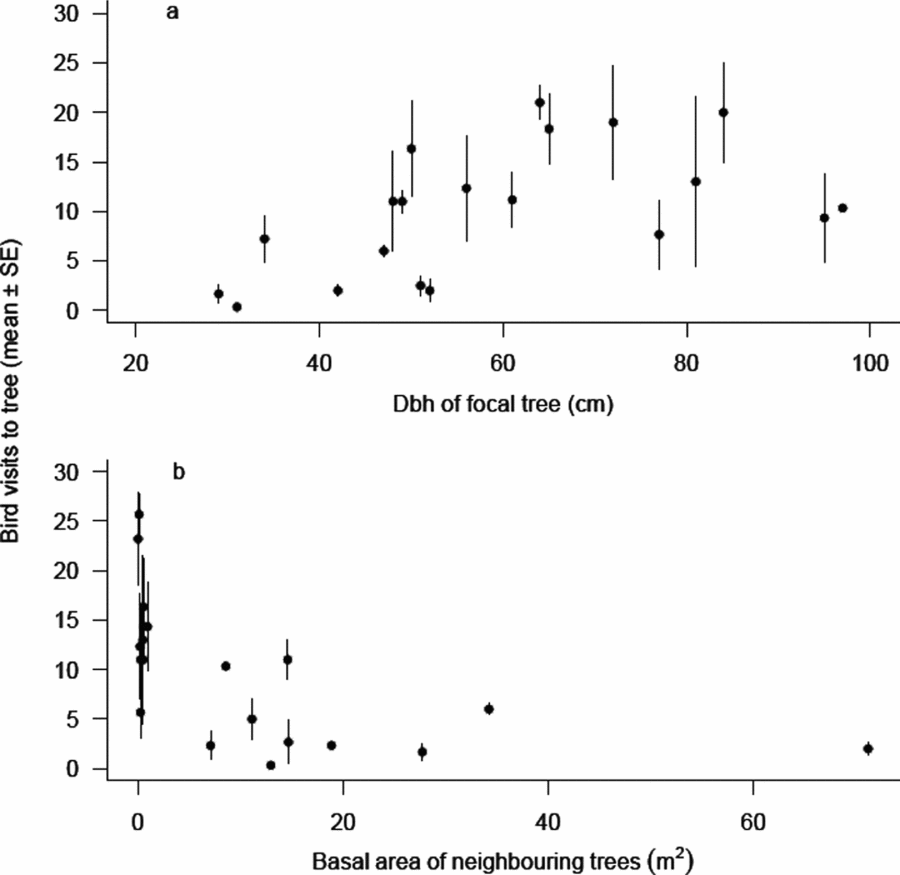
During 156 h of observation, we recorded 52 bird species from 20 families visiting trees. Of the 926 total visits, Psilorhinus morio (brown jay) was the most common visitor (15%). The most parsimonious model that best explained bird visits included focal tree dbh, basal area of neighbouring trees and epiphyte load (compared with null model: P < 0.001). Bird visitation showed a positive relationship with dbh of the focal tree (Figure 1a) and a negative relationship with basal area of neighbouring trees (Figure 1b). Including the DFFE did not significantly improve the model (compared with best model: P = 0.30). Bird visitation was significantly greater to trees with the highest epiphyte load (76–100% of tree covered with epiphytes) compared with trees with lower epiphyte loads (P ≤ 0.04). All other pairwise comparisons of epiphyte load were non-significant (P ≥ 0.2).
Bird visits to Sapium glandulosum trees in Monteverde, Costa Rica, in relation to tree characteristics. Bird visits to focal trees during three, 2-h observation sessions (mean ± SE) is show in relation to dbh of the focal tree (a) and basal area of neighbouring trees (b). Points indicate observations at individual focal trees (n = 26).

Based on foraging behaviours, birds favoured food resources (i.e. insects) from the focal trees themselves (51% of visits) rather than food resources from epiphytes (5% of visits). Birds used both tree and epiphyte substrates during a quarter of all foraging visits (24% of visits). Nearly 20% of visits to focal trees involved perching and no foraging behaviour.
Because larger trees tended to have the highest epiphyte loads, we cannot separate the effects of tree size and epiphyte load on bird visitation. We can conclude, however, that large, mature trees with time to accumulate sizeable communities of epiphytes within their branches are more attractive to birds than smaller trees with limited epiphytes. Birds may be attracted to mature trees with epiphytes because larger plants have a greater abundance of food resources, such as arthropods (Fretz Reference FRETZ2002). Birds may also favour mature trees as they offer greater canopy cover and lower proportions of edges, which may reduce exposure to aerial predators (Suhonen Reference SUHONEN1993).
More isolated pasture trees (i.e. lower basal area of neighbouring trees) received more bird visits (Figure 1b), which supports previous research showing that birds may be insensitive to clustering of pasture trees and will often use isolated trees (Lasky & Keitt Reference LASKY and KEITT2012). This is not to suggest, however, that a higher density of trees is counter-productive for birds. When trees are more common in the landscape, resources may be distributed more evenly, resulting in lower bird use of any particular tree (De Mars et al. Reference DE MARS, ROSENBERG and FONTAINE2010). Despite fewer visits to a given tree, birds are more likely to visit larger patches of trees (Fink et al. Reference FINK, LINDELL, MORRISON, ZAHAWI and HOLL2009) where they may benefit from greater foraging success (Morrison et al. Reference MORRISON, LINDELL, HOLL and ZAHAWI2009).
We found no relationship between bird visits and DFFE of a pasture tree. Though this lack of a relationship has been observed in some studies (Eshiamwata et al. Reference ESHIAMWATA, BERENS, BLEHER, DEAN and BÖHNING-GAESE2006), other studies have shown positive (Lasky & Keitt Reference LASKY and KEITT2012), negative (da Silva et al. Reference DA SILVA, UHL and MURRAY1996) and mixed relationships (Luck & Daily Reference LUCK and DAILY2003). Because the frequency and duration of bird visitation can vary according to tree species (Fink et al. Reference FINK, LINDELL, MORRISON, ZAHAWI and HOLL2009), these mixed results could be due, in part, to the fact that studies did not always control for the species of pasture tree used in observations. Additionally, these studies were carried out at different altitudes, making results difficult to compare in a meaningful way since bird behaviour can shift between lowland and montane sites (Camfield et al. Reference CAMFIELD, PEARSON and MARTIN2010). Finally, though the trees we sampled may have been too close to the forest edge to produce a pattern of bird visitation, previous studies show that bird visitation is not limited at distances even farther than what we examined (Lasky & Keitt Reference LASKY and KEITT2012).
Studies of behaviour and habitat use can help in assessing habitat quality and identifying sites that, if degraed, can still be used by a majority of species (Sekercioglu et al. Reference SEKERCIOGLU, LOARIE, OVIEDO BRENES, EHRLICH and DAILY2007). Behavioural knowledge can also help shape agricultural management practices that promote biodiversity; however, supporting biological diversity in the tropics will benefit most from a combination of reducing deforestation, changing agricultural practices and reforesting degraded lands (Lamb et al. Reference LAMB, ERSKINE and PARROTTA2005, Schroth et al. Reference SCHROTH, DA FONSECA, HARVEY, GASCON, LASCONCELOS and IZAC2004).
ACKNOWLEDGEMENTS
We are grateful to E.B. Linck, The Guindons, M. Campbell, M. Solis, C. Mena, Y. Mendez, J.A. Pounds, S. Vargas and the CCT for logistical support. We thank C. Sekercioglu and two anonymous reviewers for helpful comments. Work was funded by the National Science Foundation (DEB 05-91735, DEB 11-41833) and the University of Utah Biology Department.