The second half of the eighteenth century marked an important turn in the colonial politics of Angola. This moment coincided with the implementation of the Pombaline reforms in Portugal. Sebastião José de Carvalho e Melo, Marquês de Pombal and prime minister under King Dom José I, devised a set of reforms inspired by the political philosophy of Enlightenment. The first generation of Portuguese savants were linked with the fourth Count of Ericeira and were familiar with Cartesian philosophy and Newtonian science, even though their Catholic environment required a certain reserve with regard to these currents, and ‘errors’ were often pointed out in them. The mid-eighteenth century marks a turning point in the reception of other European currents of thought, especially of French encyclopedism. This period also inaugurates a systematic reformist movement which gave rise in the 1770s and 1780s to a body of bureaucrats and military officers trained within a new framework. Be that as it may, it is widely accepted that a diplomatic and intellectual elite connected with the Portuguese Academy of History and linked to intellectuals in other European metropoles were able to read Descartes or Newton.
In this article I propose to understand the Enlightenment as a polycentric movement, based on the circulation of ideas and experiences in which European and colonial actors and spaces participated. Through the example of Angola, I shall suggest that we can conceive of non-European spaces, in this case Central African territories, as real intellectual laboratories.
Pombaline reforms in the colonial context
In this sense, it is appropriate to think of the eighteenth century, with Michel Foucault, as a period
where, instead of a contrast between night and day, one sees something very different: an immense and multiple combat between different knowledges – knowledges at odds with each other through their very morphology, through the opposing forces that held them, as well as through their intrinsic powers.Footnote 1
My own approach to the colonial Enlightenment in Angola follows this perspective. The project of the Marquês de Pombal in itself must be confronted with a set of pre-existing social and political knowledge corpuses. In other words, analysing the new administrative technologies of eighteenth-century colonial Angola requires taking into consideration two other pre-existing matrices of political and social organization which came to intersect with the colonial Enlightenment programme. These backgrounds are the colonial society of the ancien régime, and the African societies themselves.
The colonization of Angola was based on a network of garrisons commanded by a captain-major who had military functions but also served as a judge. The garrisons were surrounded by a Luso-African population. The captain-major exercised jurisdiction over African leaders or sobas, subject to a vassal treaty. But Luanda, the main Portuguese settlement in the region, had limited power over the intermediate space between these fortresses. This space was instead appropriated through a network of terrestrial paths, largely African paths used by colonial agents. The colonial strategy of the ancien régime was based on a network state; there was no territorialized colonial state at all in Angola. At the international level, the Portuguese relied on the invocation of historical rights over coastal Africa. An elite of families of Portuguese origin had founded Luanda. They had strong links with hinterland Luso-African agents and with the Atlantic trade, and thus also with Brazilian merchants. The Portuguese had contact with three main groups of contemporary African societies. To the north of Luanda were the Bakongo, Kikongo language-speakers, in the region around Mbanza Kongo, the capital of the Kingdom of Kongo. The Mbundu, Kimbundu language-speakers, occupied the Luanda's hinterland. Finally the Ovimbundu, Umbundu language-speakers, lived on the Benguela plateau. In what follows, we shall mainly limit ourselves to the Mbundu. Lineage formed the core of their political organization. The chieftaincies assembled different interrelated lineages under the authority of a single leader. In the villages, lineages were associated with specific land whose use was regulated by lineage elders (macota) and chiefs (soba). Ancien régime colonial society in the tropics and African societies in Angola shaped the context in which Pombaline reforms were to take place.
For present purposes, Pombaline enlightened reforms refer to juridical changes, especially to the concept of police as formulated by Nicolas Delamare in Traité de la Police (1705–1738), which was incorporated in Portuguese political and juridical usage. Policing was formally defined as a function of sovereign authority whose objective was to guarantee the common good, public authority and the happiness of the people.Footnote 2 As Emmerich de Vattel, in The Law of Nations (1758), explained,
The end or object of civil society is to procure for the citizens whatever they stand in need of for the necessities, the conveniences, the accommodation of life, and, in general, whatever constitutes happiness, – with the peaceful possession of property, a method of obtaining justice with security, and, finally, a mutual defence against all external violence.Footnote 3
‘Good policing’ required that the sovereign ensure comfort, safety and nutrition to his subjects. The growth of the general power of the state had to contribute to the construction of the common good.
This policy was directed towards Angola as well as the other regions of the Portuguese empire, including Brazil, the Portuguese State of India (as far as Macau), and the other African territories (such as Mozambique). This fact was clearly demonstrated by a proposal for the colony of Angola drawn up by the Marquês de Pombal and his staff. Envisioning a redirection of its destiny, the project for the administration of Angola was based on a set of topoi coinciding with a universal model of governance: the territorialization of the colonial state, increased white settlement and the foundation of cities in the hinterland of Luanda and Benguela to replace the military fortresses in the long term; the development of agriculture and industries; and the bureaucratization of the state and the systematic use of writing and archives.
Pombal imagined the ‘domestication’ of the colonial world, a notion drawn from models articulated in all of the ‘polite and civilized nations of Europe’.Footnote 4 In this scheme, pride of place went to the ideal of a settlement colony (colónia de povoamento); that is, a colony where cities would grow, serving as real ‘seminaries’ for civil society, indeed of ‘civilization’ itself, and which, in the long run, would be equal to the metropolis.Footnote 5 This standardizing model had the long-term aim of inducing the indigenous peoples to abandon their so-called barbarous lifestyles. This is what the Marquês de Pombal meant when he proclaimed, ‘Angola is not a factory [feitoria], it is not only a kingdom but it could be an empire.’Footnote 6
This plan of urbanization represented a significant shift in policy, as Portuguese colonial power had so far been based on a network of fortresses. Angola was thus primarily a space structured by the circulation of Luso-African people. Caravans moved from the slave markets in the hinterland towards the great harbours on the coast. With no defined limits or borders the colony of Angola was mainly a huge web of markets and merchants, with a few garrisons scattered throughout. However, one should also keep in mind that, during the Enlightenment, the role of Angola as the main source of slaves sent from Africa to Brazil was never questioned. Indeed, about seventy percent of the slaves arriving in Brazilian ports came from there.Footnote 7
With Pombal's reforms, the appropriation of territory assumed various forms. Physical appropriation came through a network of new urban settlements, alternatives to the military garrisons, to encourage white settlement; this policy also sparked new wars. Intellectual appropriation came through efforts at description, the drawing of inventories, and representation. Governor Dom Francisco Inocêncio de Sousa Coutinho included both forms of appropriation in his assertion that it was ‘necessary to round out this immense country’. What he meant was that it was imperative to discover Angola's limits, define its borders, close it off, and fill it in; in short, to establish a homogenized space defined by colonization.Footnote 8 My aim is thus to explore the intellectual appropriation of the territory, as well as the conception and planning for implementing a state machinery over the territory. This is where the new administrative knowledge became crucial, as it would allow the further realization of the programme of intellectual appropriation and the production of a new colonial space.
The main subject of this article is, then, the new administrative science and its relationship with Enlightenment statecraft – the use of quantification in the recognition and classification of the state's resources and developmental possibilities, and the reorganization of administrative writing, bureaucratic procedures and technologies of standardization. Strictly speaking, the administrative sciences were really to develop only later, in the nineteenth century.Footnote 9 But I contend that, already in the eighteenth century, and within the Enlightenment conjuncture, it is possible to identify many changes in the conception and performance of administrative activity. In the Portuguese case, as for other European countries, a new administrative science was starting to emerge; it was no longer exclusively judicial, but was increasingly related to other specialized knowledges and practices.Footnote 10 Such is the case of statistics, or other rougher ways of quantifying, systematizing and unifying information; or the case of cartography, or that of the preparation of archives, along with the establishment of a complex bureaucratic culture. These practices enabled the state to define the nature of the reality it intended to manage as well as what was to count as relevant data for managing it. Calling for a certain standardization in their own use, they also made the standardization of that information easier. This possibility of collecting and systematizing information allowed the management of reality, thus assuring its wider control by the state.
Pombal's project was largely drafted on the basis of information gathered in situ – in Angola – in the 1750s. In other words, the reform project was not a neutral and abstract philosophical project divorced from the concrete conditions of the colony. On the contrary, it was largely built on the knowledge of colonial experience through the writings of administrative agents. For example, already in the Carta de doação a Paulo Dias de Novais (Donation Letter to Paulo Dias de Novais) (1571) and in the governor's regimentos of the seventeenth century, one finds very rich information on political organization, taxes and geography concerning the Luanda hinterland. These documents formed a corpus of rules consisting of successive layers of information circulating within administrative networks. At the end of their mandate, governors of Angola returned to Lisbon and usually joined the Overseas Council, where they could provide detailed first-hand knowledge about Africa. For this reason, they were asked to present their recommendations concerning the reports written by the current governors.Footnote 11 The colonial administration in Lisbon was thus based on various types of information in which the practical experience of ex-governors played a significant part.
A more informal kind of knowledge was conveyed orally within these metropolitan councils or offices dealing with overseas issues. The administrators or ex-governors understood the logic of local power, political denominations, and the organization of trade in this part of Central Africa through contacts with Portuguese intermediaries, many of whom were traders with a vast experience of the hinterland. On the other hand, they also had contacts with African ambassadors, African chiefs or sobas, or even with slaves who, at the same time, were themselves conveyors of other forms of knowledge indispensable for colonizers. These Africans were the ‘obscure companions’ of Europeans, although their presence was essential for European agency in this part of the world.Footnote 12 Those who had lived in Africa knew that, in order to survive there, it was necessary to interact with, and often appropriate knowledge from, African people. The example of war speaks for itself: Africans were used in Brazil to make war against the Indian tribes. The learning of warfare knowledge was conveyed within South Atlantic colonial spaces themselves. The administrative institutions were thus aware that they could not dispense with the knowledge of the different colonial contexts and of native peoples themselves, however barbarous they might be considered to be. The colonial administration is a place of intermediation and knowledge production on Africa.Footnote 13
Thus it was no coincidence that in 1753, when this political reformation movement was starting to take shape, the Marquês de Pombal sent a new governor to Angola – Dom António Álvares da Cunha (1753–1758), a nephew of the great enlightened Portuguese, Dom Luís da Cunha (1662–1749) and himself a member of the Portuguese Society of History (Academia Portuguesa de História). He had been in Brazil and was the author of a map of the region between Vila Rica (Minas Gerais) and the Paraguay River. This map was sent by his uncle Dom Luís da Cunha to the French cartographer Jean-Baptiste Bourguignon d'Anville. Already, d'Anville's 1725 maps of Africa and Brazil were largely based on information supplied by the elder da Cunha, attesting to the fact that these men were part of very influential European networks of knowledge and information exchange, especially of colonial spaces.Footnote 14 Pombal also sent with him one of the best-known cartographers of Lisbon, Guilherme Joaquim Pais de Menezes. The simultaneous arrival in Angola of an enlightened governor and of a famous geographer marked a turning point in Portuguese imperial history.
For three years, these two men scoured the Angolan territory, inventorying and describing it through numbers and maps. They collected the most disparate information based on which the extended project for the government of Angola, a document of more than five hundred folios, was eventually drafted in 1760: archives (location, composition, conservation), garrisons (number of habitants, their phenotypes and professions, the conservation status of fortress, artillery), army, slave trade, natural resources, agricultural products, and so on. The creation of this colonial project relied not only on scholarly knowledge circulating within the highest ranks of the European intelligentsia, or at the academic level; it also had to be based on empirical knowledge available about Africa, acquired in situ by men who had been there. This experience was either the result of direct perception or else it came from information garnered through African interlocutors.
Ultimately, the creation of this Enlightenment project of colonization gathered a rather varied range of knowledge, from the scholarly and philosophical knowledge being produced in metropolitan Europe, to the African oral traditions themselves as told by African actors, to the experience of colonial administrators. All these levels of knowledge were collated, confronted and considered by Pombal's office. For instance, in his recommendation presented to the Portuguese king in 1760 on measures to improve agriculture, navigation and trade in Angola, Pombal cites the jurist Samuel de Puffendorf and an African reporter on the localization and production levels of salt in Kissama on the same plane.Footnote 15
For all of this, we need to revisit the relationship between Enlightenment, science and empire, stressing the relevance of the colonial context for the definition of the intellectual and political project of the Enlightenment.Footnote 16 More than a privileged centre of production of Enlightenment ideas, we can identify different spaces and scales related to each other. The circulation of men, ideas and material culture between several centres (metropolitan, European, colonial and African) and various scales (local and imperial) provided the condition for the possibility of Pombal's project for the reconfiguration of Angola. Ultimately, under certain circumstances, the colonial context, and especially the standards of performance of colonized societies, led the colonial state to alter its past projects or else to adapt them to local circumstances.
Administrative devices: quantification, cartography and archive
A new administration was supposed to have new administrators. This, indeed, was a major challenge. The ‘philosopher–administrator’ was a new figure emerging and standing out at this time, synthesizing this modern idea of administration, aiming to found a political praxis based on philosophical principles of general interest.Footnote 17 Administration has a philosophical dimension, as it does not merely depend on a practical exercise but draws as well on principles which outweigh the immediate sense of reality. During the eighteenth century, many governors of Angola considered themselves philosopher–administrators, and declared that they were not mere practitioners. This articulation between the ideal type and empirical knowledge enables us to introduce the first key issue of, on the one hand, the way a new administrative science was projected by the new colonial administrators (philosopher–administrators and engineers) and, on the other, how it was interpreted, reinvented and, in a way, deconstructed and subverted by the ancient colonial administrators (capitães-mores) as well as African actors.
To make this point clear, it is important to ask several questions: which of the new ways of administrative knowledge are at the disposal of the state? What drawbacks do these forms of knowledge suffer from and how are they appropriated when transferred to a specific colonial context? What new skills do these forms of knowledge imply, and who are the new characters that emerge within the framework of the colonial administration? In what way do they threaten other established colonial forms of knowledge? I shall distinguish three levels of this administrative knowledge: quantified and systematized information, maps and archives (organization, storage and retrieval of documents). For each of them I show how they were transformed, made available or appropriated in the colonial context by both colonial and African societies.
In 1766, Francisco Xavier de Mendonça Furtado, Secretary of Overseas Affairs, brought an order to Angola detailing how the governors of the colony should organize the content of the official letters they sent to Lisbon. To better clarify and separate matters, the letters had henceforth to be divided into three types: (i) those pertaining to the affairs of the political state, (ii) those concerning the military state and (iii) those regarding the state of royal finances or revenues. To each of the letters a summary and a map was to be added. In the late eighteenth century, correspondence sent from Lisbon specifically referred to the need for a rational and ‘methodical’ organization of government affairs, insisting that letters and reports be organized into ‘chapters’ which in turn were to be divided into distinct articles. Thus a new rhetoric of administrative speech was beginning to take shape, where standardization through a ‘logical’ order of matters took pre-eminence.Footnote 18 At the same time, printed templates were sent from Lisbon, ‘so clear and so easy that they do not require explanation’, for population statistics – baptisms, marriages and deaths. In this case the information was to be arranged in pre-established categories organized in columns.Footnote 19
Bureaucratic rationalization was produced even at the level of administrative expression itself, as the correspondence on state issues exchanged between the several departments was made uniform according to a common standard. The state's writing followed pre-established rules – of which the ‘reduction to a single method’ was just a part – depending on the order of the questions under review. The mental scheme itself was changing as well as the arrangement of the bureaucratic speech categories. This process of reformatting administrative expression also had a visual dimension. Rationalization was itself produced through the image: tables, lists and other predetermined forms organized information on a page, thus making it possible to capture a wider panorama, beyond the singularities of earlier expressions. Eventually, this process of standardizing the form of the administrative text was adopted by the body of colonial administrators in Angola. This formal ordering of matters enabled access to a standardized interpretation of the colonial world itself. Thus, by means of a uniform reading grid, that distant world, seemingly different and plural, became simultaneously perceptible and manipulable, thanks to methods of normalized description and assessment.
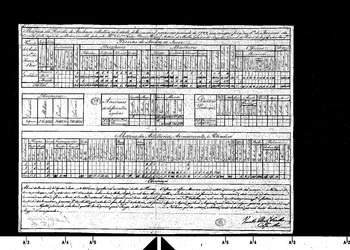
Associated with this subordination of ‘administrative chaos’ to a common method was the systematic use of quantification. It could be said that, from the 1750s onwards, the colony of Angola became readable through numbers accompanying the written reports. The government of Lisbon began to demand censuses from the governors, or even simple tables to systematize information on several matters: population (according to sex, age and social status, including colour, freedom and bondage-related status); countless tables concerning military personnel; the condition of the population inside the fortresses, including handicrafts; the farming resources available; agricultural yields; mineral resources; and so on. Finally, all this information could be scrutinized and presented in tables (see Figure 1).
Table of the Garrison of Ambaca (‘Mappa do Prezidio de Ambaca’, 1799), Arquivo Histórico Ultramarino (Lisbon), Angola, box 89, doc. 88.

Each of these tables comprised an impressive quantity of information concerning some of the oldest fortresses in Angola. Omnipresent to this day in colonial and metropolitan archives, they date from the late eighteenth century and seek to gather on a single sheet of paper all data that gives a general picture of the situation in the fortress (population, methods of agricultural production, types and numbers of craftsmen, military personnel, artillery and so on). However, in order for these methods to function, someone had to enforce them. The Pombaline process therefore stimulated the creation of a new social category – that of the military engineer – who incorporated specific forms of knowledge. From the viewpoint of administrative modernization, the formation of a body of military engineers engendered a disruption, both socially and cognitively, of the structure and methods employed by the existing commanders (capitães-mores), who had been in charge of military and judicial functions in Angola since the late sixteenth century. The introduction of new mental sets within the colonial administration led to a change of the colonial agents present. The capitães-mores constituted the most important part of the imperial administration in Angola, since they were in charge of presidiums or fortresses, located deep in the interior, in order to ensure the supply of slaves, the mainstay of transatlantic trade with Africa. They were military men – Portuguese Luso-African, and sometimes even African – with a rough-and-ready training. Most were illiterate, even though they were in charge of the enforcement of justice within the jurisdiction of the fortress. This seems to be the main reason why they used customary African law instead of Portuguese legislation, thus succeeding in maintaining the integrity of the Angolan colony for two centuries. These administrators could not respond to the new norms of governance, and many of them resisted adapting to the new technologies partly because they were incapable of putting them into practice and partly because they, quite rightly, believed that the reforms threatened their status. It was they who raised the greatest hurdles to the enforcement of Pombaline policy. They would either not respond, or else fill out the required forms unsatisfactorily, in order to maintain the status quo ante.
To train and employ a new generation of men, new institutions were created, one of the most important being the Aula de Geometria de Luanda (the Luanda Geometry Class). The Geometry and Fortification Class introduced a new framework of knowledge into the colonial context. It marked the beginning of a new phase – clearly distinct from the previously dominant pedagogy of the religious orders – in which a state which proclaimed itself as policé, and therefore civilized, incorporated engineering knowledge. The central purpose of this class consisted in training young Luso-Africans, whites and mulattoes, born in Angola and therefore sons of the country (filhos do pais), in order for them to take part in the programme of reform. A twofold benefit was projected: not only would this training take place in Luanda, but its students were sons of the country, naturally adapted to its climatic and local conditions. In fact, some of the youngest members of Luanda's old families opted for military careers and counted among those who actively collaborated in this process. In addition, some of them became military engineers and attained high positions within the new intellectual regime.
The main challenge was to recraft the Luandan elite to make it capable of working with the new forms of knowledge inspired by Enlightenment culture and made available through educational reforms, particularly through the training of engineers. The latter could in turn portray themselves in the role of the state's New Man, the agent of change, systematically implementing a project of colonization that was rational, and thus universalizing. From the 1760s, it became possible to identify a new generation of administrators and military men (referred to as the Geração de 60, or the ‘Sixties Generation’) who implemented the Pombaline reforms and played an important role in the most emblematic moments of the colony's history throughout the next half-century. The character of the Geração de 60 was at once imperial – they circulated throughout the empire between Portugal and Brazil – and local, with a specifically Angolan outlook. The state's New Man was therefore vastly different from the old captain lost in the colony's immense hinterland, closely linked to African aristocracies and forever seeking to lay claim to a share of all trade revenues. The military engineer, ever ready to quantify and map imperial spaces, was nevertheless bound to come into conflict with the long-established figure of the capitão-mor, both because of his forms of knowledge and in the way he understood his mission.
In this context, cartography began to function as administrative knowledge. The mapping of the colony of Angola started with the spaces where the Portuguese were already present, with a number of maps of the city of Luanda and of the fortresses and trading routes in the hinterland situated on the banks of the Kuanza, Bengo, Dande and Lukala rivers. During the governorship of Dom Francisco Inocêncio de Sousa Coutinho (1764–1772), this collection of maps was compiled into a single album, the Atlas de Angola. The new cartographic enterprise, however, sought to go further and identify uncolonized spaces known from the movements of Luso-African traders and a few other travellers. In this sense, eighteenth-century mapping invented an Angolan space going well beyond the politically established colonial structures. In representing a whole continuous space, paper maps anticipated a political reality which was not to be realized until much later, in the wake of the Berlin Conference of 1884–1885.
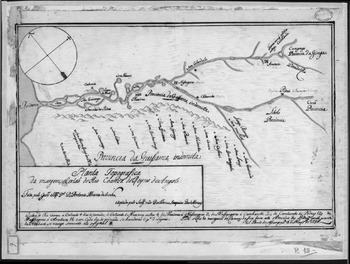
In 1753, the governor of Angola, António Álvares da Cunha, was working on a general map of the whole realm of Angola (see Figure 2). He thought this would be useful to his successors, ‘since it is not possible for them to understand the magnitude of these realms, without having someone working clearly on a geographical map’.Footnote 20 The territory had to become totally visible, transparency being useful in both war and peace. Unfortunately, this map no longer exists or, perhaps it never did exist. Even so, there is a map by Álvares da Cunha which shows the Kwanza and the Bengo rivers; the garrisons of Calumbo, Muxima, Massangano, Pungo Andongo and Ambaca; the Jesuit lands and the locations of some African chieftaincies, vassals of the Portuguese king. This map represents the seventeenth-century path for bellicose incursions as well the oldest spaces of colonial presence. Even if this map testifies to a significant technical grasp of cartography, its measure of distances is throughout expressed in time, as the number of days required to travel between different positions. It demonstrates that Álvares da Cunha was willing and also constrained to integrate an African and experiential reference in his map.
Topographic plan of the banks and hinterland of the River Kwanza, Kingdom of Angola, draft by the governor and General Captain D. Antonio Álvares da Cunha (Planta Topográfica da margem e certão do Rio Coanza do Reyno de Angola feita pelo governador e Capitão Geral D. António Alvares da Cunha), Instituto de Investigação Científica Tropical (Lisbon), Cartoteca, box 18, doc. 6.

However, military engineers were primarily responsible for mapping in this period. Their maps remained manuscripts, unique strategic and administrative documents, with very restricted circulation. They were not adapted to, or even intended for, large-scale dissemination in print. In fact, maps were instruments of government; they were state affairs addressed to governors and the whole of the colonial administrative machine. In this machine, engineers were just a part. However, the knowledge they embodied constituted the bridge between the territory and the possibility of action upon it. They were the experts who rendered this translation possible. The implementation of the Pombaline programme would not have been possible without the military engineers who, with ruler, drawing board, compass, pencil and paper, travelled throughout the colony to make it exist, at least on paper.
The map compiled in 1790 by the engineer Luís Cândido Pinheiro Furtado was paradigmatic of this approach. This map of Angola brought together d'Anville's maps and new information reported by engineers, explorers and practitioners familiar with the littoral and the interior. The regions traversed by traders (sertanejos), for which there was but scant information, were not represented. In the north-east, one already finds the Kwango River, and to the east the domains of the Lunda Empire of Muantiânvua. The routes of expeditions to the south were represented as dotted lines. Some years later, in 1797, however, this map began to be considered less certain with respect to the interior of the territory, as it had been constructed from verbal information and not with mathematical instruments.Footnote 21 Moreover, it showed no eastern frontier – the east was an open space.Footnote 22 It represented only a space where goods arrived and where colonial agents were entirely dependent on the will of local African powers. The territorialization of colonial space was almost nonexistent. In place of toponyms, one read terra incognita.Footnote 23 It was only later that mapping sought to engulf African space into the symbolic system of western European representation. The map was therefore an indispensable instrument of territorial appropriation – organization, management and then exploration.
The attempt to map African space was based on the assumption by eighteenth-century engineers that African political and colonial spaces were similarly organized. In fact, very different conceptions and uses of these entities coexisted and they were hardly reducible to the same logic of representation. In many regions of Angola, African political space was not fixed, but organized through the circulation or mobility of the posts of power within the territory – roads, itinerancy of the mbanza or the villages. The political capitals of the African kingdoms could change with the death of a king, or during the rainy season, for instance, while the colonial political space assumed a fixed, repetitive and uniform pattern of spatial occupation. This meant that when African political geography was mapped by the engineers, they were doing an impossible job. In the event, the mapping of African occupation had a very short lifetime. The map soon became a historical document, and its value as an instrument of governance was lost. This idea is explained in a small text, in which a capitão-mor points out the weaknesses of an allegedly important map of Angola drawn by the engineer Pinheiro Furtado. He argues that the topographic part of the chart was totally fallible: ‘the Blacks move their straw banzas or villages to different places at great distances almost every day, every time it pleases them or whenever they are forced by their superstitions … What in the map might be seen today as a populated area, tomorrow will be deserted, and full of brush inhabited by wild beasts’.Footnote 24 Cartography as an instrument of power was limited by African notions and, therefore, by local uses of space. For an instrument to function one needs not only to know how to use it, but also to have the conditions to use it; these conditions did not exist in the African context, and eventually would make the political usefulness of this instrument of governance impractical.
Finally, we address the question of bureaucratic culture and its relation to the archive. One of the most significant features of the bureaucratic state is that it produced an unprecedented profusion of documentation. From the political point of view, the archive has earned its status in the realm of the instruments of government. The justification and legitimation of the new administrative measures presupposed the gathering and organization of information in repositories which served as administrative memory. The 1750s in Angola were marked by the increasing use of written documentation and the propagation of the idea of the archive among the colonial authorities. The organization of the archives of Luanda and the presidiums mobilized the administration. When Álvares da Cunha arrived in Angola as governor in the early 1750s, he inquired about the material and intellectual conditions of preservation and production of archives. He had the condition of the registry of Luanda and the presidiums assessed through the inventory of every book and paper and he took note of the deplorable condition of the documents. The notaries had not safely stored the documentation for which they were responsible. Thus one of his main measures was to order the reconstruction of the archives and their adequate housing. The separation between public and private spaces required the creation of specialized spaces within the administrative activities themselves.
This transformation of the very idea and status of the archive introduces my third key point, and deals with the colonial context from the point of view of African societies.Footnote 25 Thus I turn to the encounter between the African community and this new administrative culture, to bring to light the innovative and unexpected appropriation of the latter. African societies in contact with colonial power were affected by the idea that a state has a memory, that safeguarding the administrative memory is elemental to the political power itself. As a counterimage of the colonial archive, the Mbundu people eventually created their own state archive. This fact is extraordinary since African societies settled in the Angolan space had no knowledge of writing. And yet many of them created administrative archives of their own, bearing testimony to a skill of writing and an appropriation of the bureaucratic procedures they perceived in the colonial power.
Indeed, in Angola, during the seventeenth century, many African chiefs had signed treaties of vassalage with the governor of Angola, and had the status of vassals of the king of Portugal. The vassalage agreement, a written document, had a whole list of rights and obligations to be fulfilled by both parties. In exchange for peace and protection, the African chiefs would swear loyalty to the king of Portugal, which implied respecting and abiding by the laws of government, paying taxes (the tithe), serving the government in war through military assistance, affording unimpeded and duty-free access to the territory, enabling the free flow of commercial goods, welcoming all government officials and missionaries, extraditing outlaws and living peacefully with the other peoples of the region.
Writing was thus the medium used by the Portuguese crown to maintain official contact with the African chiefs. For instance, the vassal sobas of the Ndembu group found in the written register the legal recognition of their power by the colonial authorities and became aware of the need to consider these documents symbolic of the agreed relationship. The written text would then safeguard for the outside what inside the purely African context was regarded as legitimate by virtue of an oral procedure. Even before learning how to read and write, and indeed recognizing writing as a communication tool, Africans were obliged to consider the uncompromising, unchangeable and everlasting character of what was written on paper. Thus before it became a tool of communication, writing was used and received as a symbol of European political power. Vassal treaties as a form of sovereignty over the African powers of Angola lasted from the seventeenth century to the early decades of the twentieth, at least on a nominal basis. The formulaic language of these vassal treaties remained remarkably stable over the course of time. This textual and institutional continuity led to an intensive practice of vassal culture and contributed decisively to the propagation of the whole political and legal vocabulary with its roots in fee (feudo) vassalage, as well as of writing itself as a means through which to exercise power. The chiefs saw the introduction of a bureaucratic structure as a way of maintaining their political and legal status as vassals. The African state archives clearly show that in the second half of the eighteenth century a part of the African governing elites appropriated a real bureaucratic culture. In addition, all the documentation in the National Historical Archive of Angola reveals an increasingly intensive exchange of correspondence between the sobas and the colonial authorities. The government of Luanda envisioned the involvement of the African chiefs themselves in the new administrative procedures and in the process of the bureaucratization of the state. Yet the relationship continued to be based on treaties of vassalage which were never revised. The government wanted the relationships between states to be conducted through written documents properly organized in archives. It therefore issued regulations to the African chiefs and their secretaries to abide by the rules of protocol and complete the required forms by writing correctly.
A particularly evocative example of the sedimentation of this bureaucratic culture in the relationship between colonial authorities and African powers is that of the African chief Kabuku Kabilu, who in 1811 formally petitioned the capitão-mor of his jurisdiction. This petition was minutely commented on by the Portuguese governor of Angola. The commentary focused in particular on its form, the governor reproaching the chief for not respecting protocol formalities, or the rules of writing. He specially noted
the lack of attention with which you wrote to the capitão-mor, as is shown from the envelope you sent to him, lacking that treatment and civility every chief must use to write to their capitães-mores addressing them formally [vossa mercê] and showing them the utmost respect. Since this protocol has been practised for a very long time by all African chiefs who are vassals of the king of Portugal, it should be practised by you as proof of your obedience and kindness of spirit.Footnote 26
The widespread use of protocols in bureaucracy was so well established by then that the governor could rebuke the soba for his carelessness in writing and presenting a letter. A massive movement to create African state archives in Angola thus occurred during this period, and it was associated with the ever-stronger weight of the bureaucracy within the colonial administration.
On the other hand, African political structures experienced decisive changes, notorious even to the present day. The African realization of a relationship between writing and state, guaranteed by the vassal treaties, seems to have had no immediate consequences in terms of a conflict between the African lineage system and bureaucratic conceptions and political organization of the colonial system. These vassal relationships did not really disturb the structures of the inner political organization of the African states, since they were used as dynamic tools to legitimize African power. Even the colonial political and legal vocabulary was eventually used in the establishment of relationships among African states, while the vassal status paradoxically refurbished itself with an ambiguity equally convenient for both the Portuguese and the Africans, and in some cases very beneficial to the Africans themselves. In spite of their vassal status, the Africans could maintain their political autonomy, surviving in the non-intervening shadow of the tutelary powers. Even more interesting is the fact that the vassal hierarchies were eventually added to the endogenous ones. The repetition of the vassal culture, supported by written protocols and by the state archive, led to its validation and revitalization outside its original context; that is, outside the relationships with the colonial power. It achieved new meanings and efficacy in the African endogenous context, where, as Joseph C. Miller has convincingly demonstrated, any definition of state structures requires considering some aspects of society as inherently ‘non-political’.Footnote 27 This is how in the African documents the theme of vassalage has emerged in perfect articulation with oral speech where traditional hierarchies stand out: hierarchy as determined by seniority, or the definition of personal kinship as a metaphor for political relationships, and so on.
This is precisely the strategy of vassal relationships that enabled Africans to articulate both the oral African political vocabulary and the written word of the colonial political vocabulary. It also reflects the interference in two different ways of understanding and exercising power. The novelty, both in the history of political institutions of the African states in north Angola and in the relationships among African states themselves, lies in the adoption of bureaucratic structures based on a written record and instruction. Thus, in addition to the dembo or the soba and his makota in the traditional state system, a third character emerged: the state secretary. His recognized hierarchical position was equivalent to that of traditional dignitaries, and he was given the role of key intermediary in the development of all diplomatic relationships with the Portuguese authorities. A whole new structure was eventually developed within African political organization, assuming and even requiring the generation of a new status: the secretary could take on a form of power and status outside the personal kinship structures.Footnote 28 In fact, the state secretary appeared side by side with the makota (the council of the most ancient ones) in moments of political significance, such as the signing of peace treaties, or the despatch of embassies to the governor in Luanda. As a result of all this, each of the African chiefs eventually created chanceries that operated as repositories of political memory, where, together with treaties and other documents relating to the colonial presence, documents regarding the inner political management of the Ndembu have survived. Soon, African actors in this region would learn how to organize the state through writing, to identify with the archive and the writing tools themselves (the chancery and all its apparatus). What we have, then, is not only state writing, but also writing that turns out to be the state itself. It is not by chance that in the documents written by the secretaries in the name of the Ndembu the word trastesalio appears.Footnote 29 This word has no meaning in Portuguese or in the Kimbundu language; it is a neologism that serves as a word equivalent to the way the Ndembu used to describe state affairs. Indeed, it refers to the material objects representing the state itself. The Ndembu archives were accorded such importance, equivalent to the status of state insignia, that during wartime they were among the first objects to be confiscated. During the nineteenth century, issues of African policy were discussed in letters exchanged among Ndembu in several contexts: for the election of new Ndembu, for instance; or in the renewal of vassal ceremonies; in the succession process among Ndembu, associated with lineage quarrels; regarding information on the origin of political denominations and their own legitimacy; for discussions on state insignias; for embassy despatches; and so on.
Bureaucratic culture and the administrative knowledge associated with it became a factor facilitating political innovation, operating at the level of the African state structures and establishing themselves as part of the organization and legitimizing procedures that already existed. The writing practices of bureaucratic culture came to coexist alongside traditional oral practices, changing and evolving together. Africans thus appropriated one of the most important weapons of colonial power – writing and the bureaucratic culture associated with it.Footnote 30 They eventually used it in different ways than had the Portuguese bureaucracy. The intellectual appropriation of the territory, through the creation of a network of bureaucratic routes among different administrative instances, was now also serving the assertiveness of the African ruling elites. The relationship with the outside world was assured by ambassadors, who were moving out of the state territory, carrying insignias, such as seals or sealing wax, thus converting themselves into their representatives. In this instance, the state extended itself beyond its own territory. On the other hand, the notion of the state attached to a territory is constantly asserted in African documents. New references to the state were constantly emerging – ‘elect the state’, ‘render the state’, ‘my state’, ‘state's seal and sealing wax’, ‘state's macotas [elders]’ and so on.Footnote 31
To conclude, in analysing the relationship between science and empire, it is important to break free of the centre–periphery model, as local experience always adds new meanings to these processes of export and reception of cultural models.Footnote 32 Regarding the eighteenth century specifically, the asymmetry characteristic of studies of the colonial Enlightenment needs to be overcome, and the relationship between metropole and colony needs to be reassessed in both directions. First of all, instead of granting the colonial administration a hegemonic role, and therefore a one-sided agency in the creation of empire, it is essential to draw attention to the local innovations and the several political arrangements which either pre-dated the colonial context or were created within the framework of the colonial context itself. Through the example of Angola, I suggest that it is possible to view the distant territories of Central Africa as real intellectual laboratories, long before the late nineteenth and the twentieth centuries. The space of Enlightenment, or the formation of an enlightened culture, widened and transformed itself, making Angola a melting pot of an imperial science that could perhaps be exported to other destinations. More importantly, I have pointed to another, and perhaps more important, phenomenon that is more directly in resonance with the theme of this special issue on circulation and locality in early modern science: the Enlightenment project itself was constituted through iterative relations and interactions among metropole, colonial territories and different, local African societies. Pombal's project was the result of successive to-and-fro movements, constructed through interactions and conflicts between different knowledge-bearing actors and groups, an observation which begs the question of the non-European contribution to what is considered to be the very essence of European modernity, the Enlightenment.