


Introduction
Seabirds are among the most endangered groups of birds, with 42% of species globally classified as threatened or near-threatened, and the conservation status of at least 56% of species has deteriorated over recent decades (Croxall et al. Reference Croxall, Butchart, Lascelles, Stattersfield, Sullivan and Symes2012; Phillips et al. Reference Phillips, Fort, Dias, Young and VanderWerf2023). This situation arises from the cumulative exposure of seabirds to threats at sea and on land (Dias et al. Reference Dias, Martin, Pearmain, Burfield, Small and Phillips2019). While marine pressures, including overfishing, bycatch, climate change, and plastic pollution, can impact adult survival, populations are generally considered to be most vulnerable on land during breeding (Spatz et al. Reference Spatz, Newton, Heinz, Tershy, Holmes and Butchart2014). The primary land-based threat is predation by invasive mammals, as most seabird species evolved on oceanic islands in the absence of terrestrial predators and thus have only limited defence or predator avoidance behaviour at breeding sites (Jones et al. Reference Jones, Tershy, Zavaleta, Croll, Keitt and Finkelstein2008; Russell and Le Corre Reference Russell and Le Corre2009). Islands are consequently focal sites for seabird conservation, where management of invasive mammal predators can result in substantial population recovery even when marine threats persist (Borrelle et al. Reference Borrelle, Jones, Richard and Salguero-Gómez2023).
In the tropics, atoll islands are globally important breeding refugia for seabirds, with over 31.2 million birds – approximately 25% of the world’s tropical seabirds – breeding on the Indo-Pacific atolls (Steibl et al. Reference Steibl, Steiger, Wegmann, Holmes, Young and Carr2024b). Where atoll islands remain free of invasive predators, or have been ecologically restored through invasive predator eradications, they can support colonies of tens of thousands to millions of breeding seabirds (e.g. Kappes et al. Reference Kappes, Coustaut and Le Corre2013; Pyle and Pyle Reference Pyle and Pyle2017; Philippe-Lesaffre et al. Reference Philippe-Lesaffre, Thibault, Caut, Bourgeois, Berr and Ravache2023). Despite these conservation opportunities, atolls remain currently underrepresented in active seabird management efforts (Spatz et al. Reference Spatz, Holmes, Will, Hein, Carter and Fewster2022, Reference Spatz, Young, Holmes, Jones, Vander Werf and Lyons2023). Even further, for many atolls basic data are still lacking on seabird occurrence, breeding performance, and population trends that would be needed to inform and prioritise targeted conservation actions.
In the Indian Ocean, the Maldivian atolls comprise over 1,200 individual islands that together constitute c.60% of all islands in this oceanic basin (Coffin and Eldholm Reference Coffin, Eldholm, Alderton and Elias2021). Despite this, the Maldives has received limited international attention as a potentially important seabird breeding region (Anderson and Shimal Reference Anderson and Shimal2020). In 2025, the first national status report on breeding birds in the Maldives revealed that seabirds breed widely, sometimes in large numbers, on islands throughout the archipelago (Steibl et al. Reference Steibl, Zareer, Khaleel, Fox, Zareer and Nidham2025). In line with this emerging picture, a regionally significant breeding colony of White-tailed Tropicbirds ( dhandhifulhu dhooni ; Phaethon lepturus) was recently documented on a Maldivian island (Russell et al. Reference Russell, Steibl and Stevens2024). With an estimated 800 individuals, it is among the largest known White-tailed Tropicbird colonies on atolls globally (Steibl et al. Reference Steibl, Steiger, Wegmann, Holmes, Young and Carr2024b).
Although the White-tailed Tropicbird is classified as ‘Least Concern’ under IUCN criteria, it is considered to be declining throughout its near pantropical range (BirdLife International 2020). White-tailed Tropicbirds are long-lived seabirds, which start breeding four years after hatching. Nesting can occur in a variety of different sites, from rocky terrain in cliffs to tree-nesting in closed canopy forests to nesting on bare rocky or sandy ground (Lee and Walsh-McGee Reference Lee, Walsh-McGee and Billerman2020). In the Indian Ocean, the largest population with c.6,500 breeding pairs was found in the Seychelles (Le Corre et al. Reference Le Corre, Jaeger, Pinet, Kappes, Weimerskirch and Catry2012). Some island colonies in the Seychelles have declined markedly over the last decades, raising concerns about their status and long-term protection in the Indian Ocean (Catry et al. Reference Catry, Ramos, Monticelli, Bowler, Jupiter and Le Corre2009; Burt et al. Reference Burt, Cagua, Sanchez, Calabrese, van de Crommenacker and McClelland2021). The recent documentation of breeding colonies throughout the Maldivian archipelago has therefore potentially important implications for the conservation of this species in the Indian Ocean region (Russell et al. Reference Russell, Steibl and Stevens2024; Steibl et al. Reference Steibl, Zareer, Khaleel, Fox, Zareer and Nidham2025). However, information on breeding phenology, population trends, and reproductive success from Maldivian colonies is lacking, constraining the development of targeted management programmes and action plans.
Here, we present the first detailed assessment of White-tailed Tropicbird breeding, reproductive performance, and colony trends in the Maldives. We monitored a breeding colony on an island in the central Maldives at weekly intervals over 2.6 years (August 2022 to March 2025; 138 surveys), and recorded breeding activity and developmental stage. We quantified temporal patterns in breeding activity and colony occupancy, estimated developmental durations across breeding stages, and assessed overall and stage-specific breeding success including daily nest-survival rates (DSR) to identify periods of elevated vulnerability. Together, the findings provide the first empirical baseline for informing conservation planning for White-tailed Tropicbirds in the largest island archipelago of the Indian Ocean.
Methods
Field surveys
The study was conducted on Finolhas, a 24.13 ha island within the UNESCO World Biosphere Reserve of Baa Atoll, located in the lagoon of South Maalhosmadulu atoll (administratively also known as Baa atoll), Republic of Maldives (5.234°N, 73.114°E) (Figure 1). The Dhivehi name of Finolhas translates to ‘Pisonia island’ (‘finolhu’ + ‘lhos’) (Ragupathy Reference Ragupathy2008) and indicates what was probably a historically large seabird colony formerly present on the island. Pisonia grandis (lhos gas) is a tree species found predominantly on atoll islands and intricately linked to the presence of large numbers of seabirds, which facilitate this tree species’ dispersal to, establishment on, and dominance over atoll islands (Burger Reference Burger2005; Steibl et al. Reference Steibl, Bunbury, Young and Russell2024a). While seabirds can also breed in other vegetation types, the formation of Pisonia forests is considered to be enabled primarily by seabirds. Nowadays, the Pisonia forest no longer exists on Finolhas but, instead, the island hosts the Amilla Maldives Resort and Residences, which launched its facilities in December 2014. Despite resort development and year-round human presence on the island (67 guest villas and 300–400 staff), the coastal vegetation belt and interior forest, primarily Banyan tree ( nika gas ; Ficus benghalensis) and screw pine ( kashikeyo ; Pandanus tectorius), largely remain throughout the island (Supplementary material Figure S1). Invasive ship rats Rattus rattus are present on Finolhas but are being suppressed by island-wide continuous pest control from the resort. One stray cat Felis catus was also present during the study.
Geographic location of the surveyed island. (a.) Location of the Republic of Maldives (red rectangle) in the central Indian Ocean. (b.) Location of South Maalhosmadulu atoll (administrative code: Baa atoll) (red rectangle) within in the Maldives archipelago. (c.) Location of Finolhas within South Maalhosmadulu atoll (red rectangle and arrow). (d.) Location of the n = 43 White-tailed Tropicbird breeding locations (red circles) identified between August 2022 and March 2025 on Finolhas. Light blue indicates extent of shallow lagoon, beige the island footprint.

Figure 1. Long description
The multi-panel map is organized as follows.
Panel a, Tropical Indian Ocean. A large-scale map with a Y axis from 25.0 degrees South to 25.0 degrees North and an X axis from 40 degrees East to 100 degrees East. A red rectangle in the center, between 0.0 and 12.5 degrees North, highlights the Maldives archipelago.
Panel b, Maldives archipelago. A vertical map of the island chain with a Y axis from 1 degree South to 7 degrees North. A red rectangle at approximately 5 degrees North identifies the South Maalhosmadulu atoll.
Panel c, South Maalhosmadulu atoll. A detailed view of the atoll’s ring of islands with a Y axis from 5.0 degrees North to 5.3 degrees North. A red rectangle and arrow in the Northeast quadrant point to Finolhas island.
Panel d, Finolhas island. A high-resolution map of the island footprint in beige surrounded by a light blue shallow lagoon. The Y axis ranges from 5.230 degrees North to 5.238 degrees North, and the X axis from 73.106 degrees East to 73.118 degrees East. Forty-three red circles representing breeding locations are scattered across the island, with a higher density in the central and Eastern regions. A 400 meter scale bar is located at the bottom left.
Weekly surveys for breeding White-tailed Tropicbirds were conducted over a 2.6-year period between 3 August 2022 and 26 March 2025 (138 survey weeks). During each survey, we systematically walked internal paths and accessible openings along the beach to locate new nests and revisit all recorded nest sites. Effort was typically 1–2 hours per survey by one observer. Nests were also reported opportunistically by resort staff, which likely created some detection bias by increasing detection likelihood of nests in proximity to roads and resort buildings.
Each nest was photographed, marked, and assigned a unique identifier, and the developmental stage of the nest was scored at each visit. Stage 1: adult present only (egg presence inferred when egg not directly visible, e.g. when nest located in tree hole); Stage 2: hatchling with complete down feathers; Stage 3: early nestlings with predominantly down feathers and emerging contour feathers; Stage 4: nestlings with approximately equal down and contour feathers; Stage 5: late nestling with full contour juvenile plumage; Stage 6: chick fledged and no longer present in the nest (Supplementary material Figure S2). A nest was classified as successful if it reached stage 6 (i.e. fledged). A nest was classified as failed if a previously recorded egg or chick was missing at a subsequent survey, if an egg was found broken with no chick present, or if a dead chick was observed. For each nest, we also documented breeding sites based on eight categories (Adenanthera tree; Banyan tree; coconut palm; Cordia tree; Pandanus screw pine; Scaevola shrub; Terminalia tree; unidentified deadwood). If a nest was observed as failed but followed by a replacement clutch, this replacement was given a new running identifier number.
Data analysis
All data analysis was conducted in R v4.5.2 (R Core Team Reference Team2025), using the ‘brms’ package for Bayesian regression analysis (Bürkner Reference Bürkner2017). The 2.6-year survey dataset comprised a total of 210 nesting events. This included nests that were not fully monitored because fieldwork ended before fledging or because nests were located >10 m high in trees and were inaccessible for weekly surveys (n = 17); nests that were detected only after hatching, so incubation period data was missing (n = 23), and short-term (<1 week) prospecting visits by adults (n = 78). These subsets were retained or excluded depending on the analyses described below.
Seasonality in nest site arrival was quantified using a circular seasonality index, ranging from zero (i.e. uniform arrival across months) to one (i.e. all arrival concentrated in one month), calculated from monthly counts of first arrivals to tentative nest sites, including both short-term prospecting visits and arrivals that resulted in egg-laying (n = 187). To evaluate temporal dynamics in colony occupancy, monthly counts of active nests (developmental stages 1–6) were modelled with two Bayesian negative-binomial regressions: (1) a linear trend-only model, and (2) a model that additionally included a periodic term to test for the presence of sub-annual oscillations with peak and low breeding activity (Stonehouse Reference Stonehouse1962). Leave-one-out model comparison favoured the periodic model over the linear model (ΔELPD = -3.86), and the periodic model was used for extracting posterior estimates of the linear and periodic parameters.
To quantify breeding phenology, only nests that were monitored completely from egg-laying to successful fledging were included in the analysis (n = 55). For each developmental stage (stages 1–6; Supplementary material Figure S2), and for the incubation period, chick-rearing period, and egg laying to fledging duration, summary statistics (mean ± standard deviation) were calculated at the temporal resolution of the monitoring interval (i.e. 7 days). Estimates for the duration of the prospecting phase and pre-laying exodus were not included in our analysis as birds were not individually ringed, which would be required to determine with certainty whether the same or a different individual returned to a given nest site.
Overall breeding success was calculated as the proportion of monitored breeding attempts that reached fledging (stage 6) among nests with a known final outcome (n = 113). Transition probabilities were calculated as the proportion of nests that progressed from one developmental stage to the next (e.g. if 83 nests were observed in stage 2 and 74 of these later reached stage 3, the transition probability from stage 2 to 3 was 74/83 = 89.2%). Binomial confidence intervals for transition probabilities were calculated using the Klopper-Pearson (‘exact’) method. Daily nest survival rates (DSR) were estimated using a Bayesian nest survival (logistic exposure) model. The occurrence of nest failure between consecutive surveys was modelled as a Bernoulli process with a complementary log-log link. Variation in the time between surveys was accounted for with an offset term, and nest identity was included as a group-level intercept to account for repeated observations within nests. To test whether DSR changed through the breeding period, we fitted a second time-dependent model in which failure probability was predicted by a smooth function of nest age (days since nest detection, which approximately corresponds to nest initiation). Leave-one-out model comparison favoured the time-dependent model over the constant DSR model (ΔELPD = -3.78), and posterior estimates of model parameters were therefore extracted from the age-dependent model. We used the equation in Russell et al. (Reference Russell, Steibl and Stevens2024) to estimate the total number of adults in the breeding population on Finolhas based on our observed values for breeding cycle and egg incubation time.
To test whether the number of successful vs failed nests differed between the eight nest site categories, a Fisher’s exact test was calculated. To test whether failure risk differed among months, we modelled nest failure on a week-to-week basis using a Bayesian Bernoulli regression with a logit link. For each nest, we created one record for every pair of consecutive surveys in which the nest was active at the first visit (stages 1–5). The response variable indicated whether the nest was recorded as failed at the next visit. Month was included as a 12-level categorical predictor, and nest identity was included as a group-level effect to account for repeated observations of the same nest across weeks. All Bayesian models were run with MCMC algorithms, four chains each with 5,000 iterations and a 2,500 burn-in. Model convergence was evaluated using the R-hat metric, effective sample size, and visual examination of trace plots.
Results
Over the 2.6-year study period (August 2022–March 2025), we recorded 132 nesting events of White-tailed Tropicbird (Phaethon lepturus) across 43 nest locations (Figure 1d), alongside an additional 78 short-term prospecting visits lasting less than one week. Breeding occurred mainly in or beneath Banyan trees ( nika gas; Ficus benghalensis – 43 breeding events; 32.6%), Indian almond trees ( madhu gas ; Terminalia catappa – 29 breeding events; 22.0%), screw pines ( kashikeyo ; Pandanus tectorius – 26 breeding events; 19.7%), beach naupaka ( magoo gas ; Scaevola taccada – 13 breeding events; 9.9%), and cordia trees ( kaani gas ; Cordia subcordata – 12 breeding events; 9.1%) (Supplementary material Figure S3a).
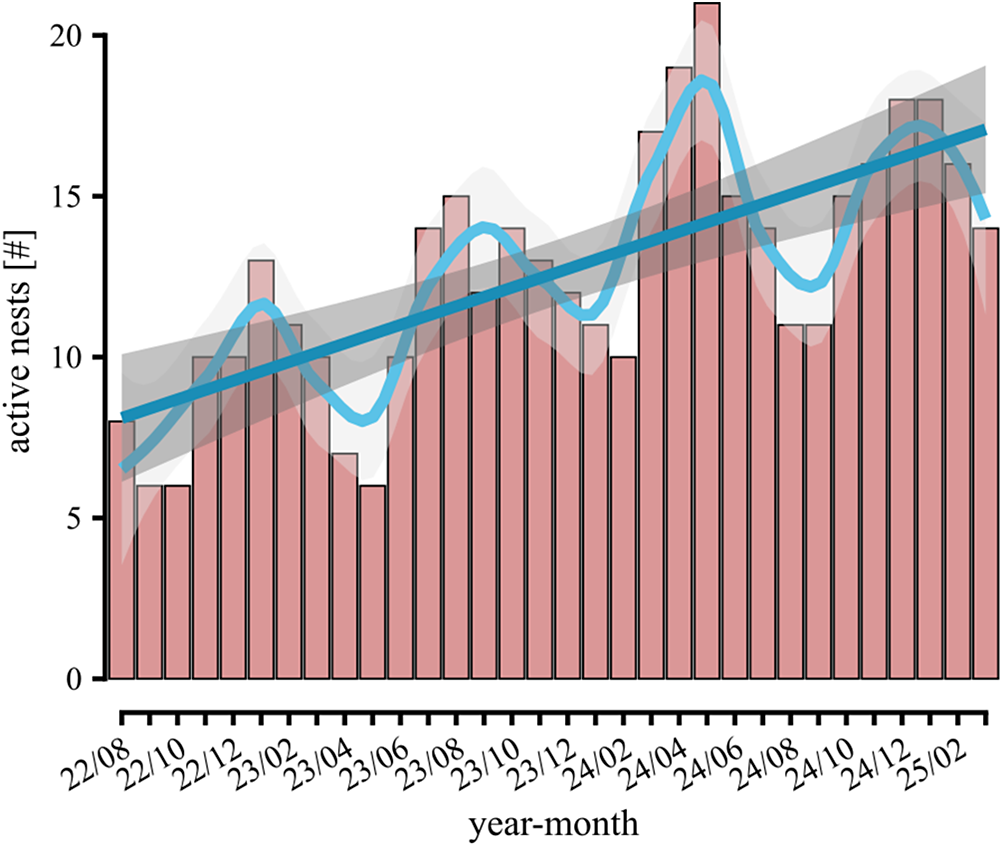
Arrival at nest sites, including prospecting visits, occurred throughout the year with little seasonality (Seasonality Index = 0.072). The number of active nests per month exhibited both a linear increase and periodic changes over the study period. Bayesian regression models estimated an annual increase in the number of active nests of 30% [6–60%] (median and 95% credible interval), corresponding to a 98% [16–235%] increase over the 2.6-year study period (Figure 2). Breeding activity followed an approximately eight-month cycle, with an estimated 2.05-fold [1.16–9.81] difference (i.e. amplitude) between peak and low numbers of active nests (Figure 2). The total breeding population of White-tailed Tropicbirds on Finolhas was estimated at 105–110 birds by the end of the study period, using the equation in Russell et al. (Reference Russell, Steibl and Stevens2024) to calculate total population size based on sub-annual breeding cycles.
Number of active nests over time. Red bars indicate the number of observed active nests (stages 1–5) in each month over the study period (August 2022 – March 2025). The dark blue line indicates the estimated median linear increase in nest numbers over the study period, the light blue line indicates the estimated eight-month periodicity in nest numbers, and grey ribbons indicate the 95% credible intervals. Over the 2.6-year study period, the number of active White-tailed Tropicbird nests on Finolhas increased by 98% [16–235%] (median, 95% credible interval).
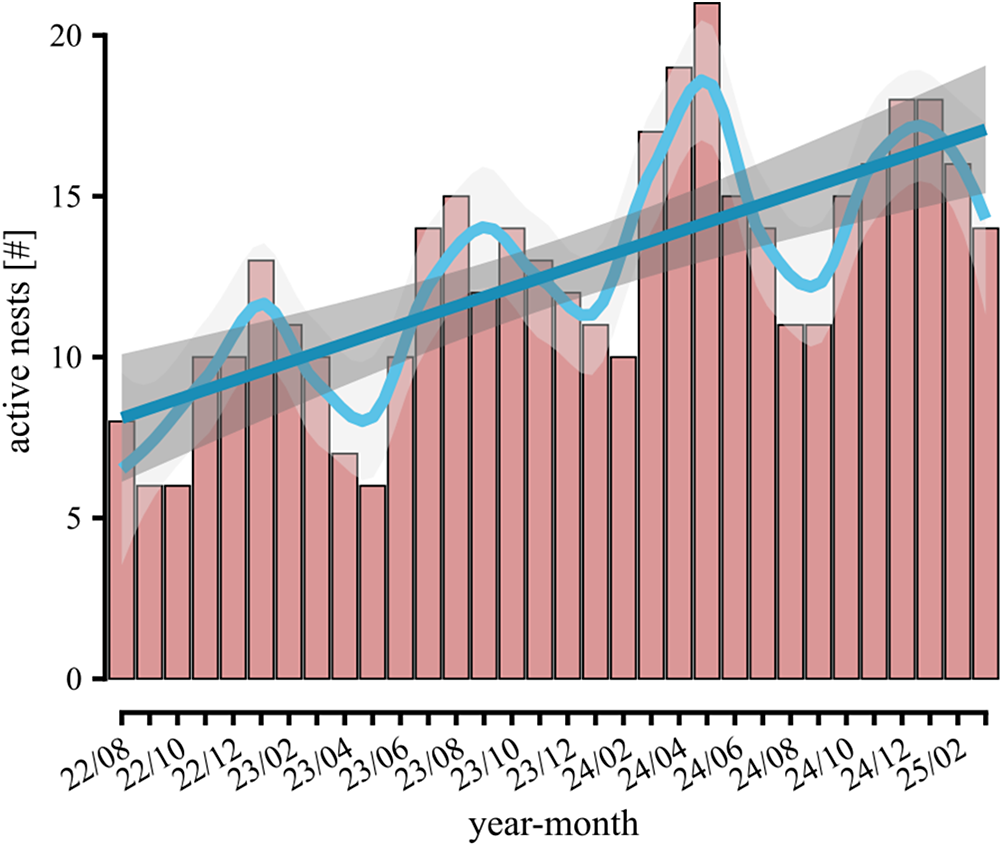
Figure 2. Long description
The vertical Y axis is labeled active nests [#] with increments of 5 from 0 to 20. The horizontal X axis is labeled year-month and spans from 22/08 to 25/02.
* Data Bars: Red vertical bars represent monthly nest counts. They begin at approximately 8 in August 2022, fluctuate between 6 and 13 through 2023, and reach a peak of 21 in mid-2024 before ending at 14 in early 2025.
* Linear Trend: A thick dark blue line starts at approximately 8 on the Y axis and rises steadily at a constant angle to approximately 17 by the end of the period. It is surrounded by a dark grey ribbon representing the 95 percent credible interval.
* Periodicity: A thinner light blue line oscillates in a wave pattern around the linear trend line, showing four distinct peaks and troughs over the study period. This line is also shaded by a light grey ribbon representing its 95 percent credible interval.
* Overall Pattern: The bars show a general increase over time but with significant seasonal or periodic variation that aligns with the light blue oscillating curve.
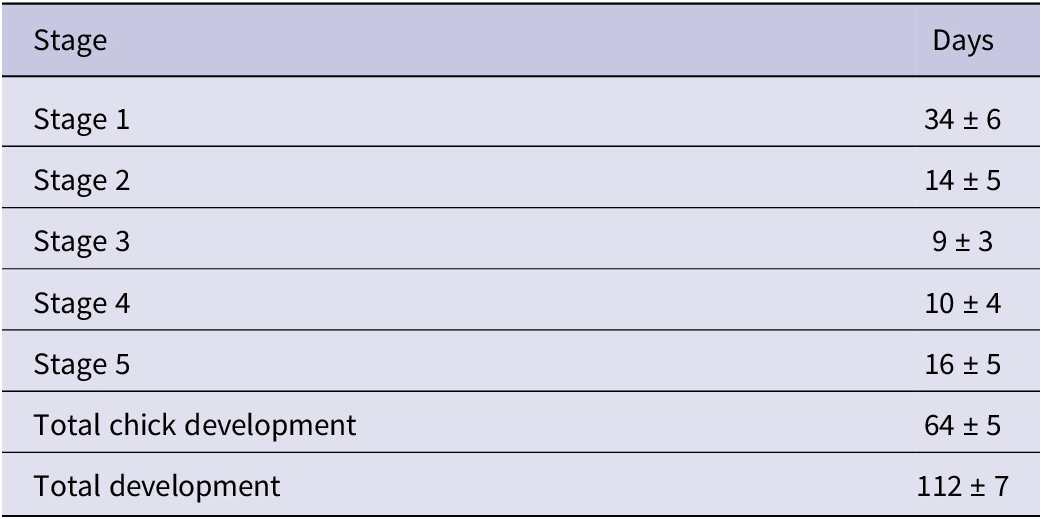
A total of 55 nests were monitored from egg-laying to fledging and were used to estimate breeding phenology (Table 1; Supplementary material Figure S2). The entire period from egg-laying to fledging averaged 112 days (± 7 SD), with the egg incubation period averaging 34 days (± 6 SD), and chick rearing averaging 64 days (± 5 SD).
Breeding phenology. Average ± standard deviation length of the five developmental stages (see also Supplementary material Figure S2), as well as total chick development time (hatching to fledging) and total development time (egg-laying to fledging), based on n = 55 nests that were monitored from egg-laying to successful fledging

Table 1. Long description
The table consists of two columns: Stage and Days. The data is presented as average plus or minus standard deviation.
* Stage 1: 34 plus or minus 6 days.
* Stage 2: 14 plus or minus 5 days.
* Stage 3: 9 plus or minus 3 days.
* Stage 4: 10 plus or minus 4 days.
* Stage 5: 16 plus or minus 5 days.
* Total chick development: 64 plus or minus 5 days.
* Total development: 112 plus or minus 7 days.
Among nests with known outcomes, hatching success was 73.5% (83 out of 113 nests hatched) and fledging success 81.9% (68 out of 83 hatched nests fledged), giving an overall breeding success (hatching × fledging) of 60.2% (Figure 3a). The probability of a nest transitioning from stage 1 to stage 2 was 73.5% [64.3–81.3], from stage 2 to stage 3 was 88.0% [79.0–94.1], from stage 3 to stage 4 was 94.5% [86.6–98.5], from stage 4 to stage 5 was 98.6% [92.2–100], and from stage 5 to stage 6 (i.e. fledging) was 100% [94.7–100] (Figure 3b). Daily nest-survival (DSR) was not constant over the breeding cycle but varied non-linearly with nest age. DSR was lowest at around 40–44 days after egg-laying (DSR = 0.989 [0.981–0.995]), corresponding to the period shortly after hatching (Table 1; Figure 3c). Based on the time-dependent DSR model, the estimated probability of a nest surviving from egg-laying to fledging was 63.4% [34.9–87.6%]. Breeding outcome did not differ between nest sites (Fisher’s Exact P = 0.79) (Supplementary material Figure S3a). The probability for nest failure was also overall consistent between calendar months, with estimated median week-to-week failure probabilities ranging between 0.56% and 6.22% for each month (Supplementary material Figure S3b).
Breeding success, transition probabilities, and daily nest-survival rates. (a.) Fraction of observed successful (blue) and failed (orange) nests. (b.) Estimated median transition probabilities (error bars: 95% CI) for reaching the next developmental stage (e.g. probability of a nest successfully transitioning from egg to hatchling, i.e. stage 1 to 2). (c.) Posterior estimate of the daily nest survival rate (DSR) over time since nest detection, which approximately corresponds to nest initiation. Blue line indicates posterior median DSR, grey ribbon 95% posterior credible interval. Red vertical bar and dashed line indicate the observed timing when hatching occurs (i.e. 34 days (± 6 SD) after nest detection).

Figure 3. Long description
Panel a, titled Outcome, is a stacked bar chart. The vertical axis is fraction of all nests percent from 0 to 100. The bar is divided into a blue bottom section labeled success n equals 68, reaching 60 percent, and an orange top section labeled fail n equals 45, reaching 100 percent.
Panel b, titled Transition probabilities, is a point-and-whisker plot. The horizontal axis is developmental stage with five categories: 1 to 2, 2 to 3, 3 to 4, 4 to 5, and 5 to 6. The vertical axis is transition probability percent from 60 to 100. The data shows a logarithmic increase in probability as stages progress. Stage 1 to 2 starts at approximately 73 percent with wide error bars. By stage 5 to 6, the probability reaches 100 percent with very narrow error bars.
Panel c, titled Daily survival rate D S R over time, is a line graph. The horizontal axis is days since nest start from 0 to 120. The vertical axis is daily survival rate from 0.980 to 1.000. A blue median line starts at 0.998, dips to a trough of 0.990 at day 45, and then rises asymptotically toward 1.000. A light grey ribbon represents the 95 percent credible interval. A vertical red shaded bar and dashed line are centered at day 34, labeled hatching 34 plus or minus 6 days.
Discussion
Atolls can be hotspots for tropical seabird breeding (Steibl et al. Reference Steibl, Steiger, Wegmann, Holmes, Young and Carr2024b). One of the world’s largest atoll archipelagos is the Maldives, yet quantitative information on seabird phenology, reproductive performance, and population trajectories is completely lacking, which currently limits the development of targeted seabird conservation actions for this region. Our study provides the first assessment of phenology, breeding success, and short-term colony trends for any seabird species in the Maldives and adds to only a handful of previous assessments for the entire Indian Ocean region, focusing on the White-tailed Tropicbird. White-tailed Tropicbird in the Maldives bred throughout the year, showed an approximately eight-month cycle in peak activity, achieved high breeding success (60.2%), and increased in breeding activity by 98% over the 2.6-year study period. Daily nest survival was lowest shortly after hatching, indicating a discrete window of elevated vulnerability consistent with predation pressure by invasive small mammal predators during early chick development. The surveyed colony was located on a developed tourist island where invasive ship rats are present but suppressed through ongoing pest control from tourist resort operations. Together, these findings provide the first baseline for seabird colony monitoring in the Maldives and highlight important management levers, i.e. invasive predator suppression/eradication and protection of breeding habitat, which may be relevant as tourism development keeps expanding and accelerating across the Maldivian atolls (Fallati et al. Reference Fallati, Savini, Sterlacchini and Galli2017; Steibl et al. Reference Steibl, Franke and Laforsch2021).
Observations of incubation and chick-rearing periods, year-round breeding, as well as unselective ground-nesting in and around different native tree species were consistent with data reported for other White-tailed Tropicbird colonies across the tropics (Stonehouse Reference Stonehouse1962; Diamond Reference Diamond1975; Prys-Jones and Peet Reference Prys-Jones and Peet1980; Schaffner Reference Schaffner1991; Malan et al. Reference Malan, Hagens and Hagens2009; Leal et al. Reference Leal, Serafini, Simão-Neto, Ladle and Efe2016; Raine et al. Reference Raine, Anderson, Driskill and Tippin2020). Weak breeding seasonality of White-tailed Tropicbirds in other geographies has been attributed to the relatively modest energetic demands of this small-bodied seabird, which allow breeding adults to meet resource requirements year-round despite fluctuating marine food availability (Ricklefs Reference Ricklefs1983; Ramos et al. Reference Ramos, Bowler, Betts, Pacheco, Agombar and Bullock2005). In the Maldives, monsoon seasons drive variations in upwelling, marine productivity, rainfall, and temperature (Su et al. Reference Su, Wijeratne and Pattiaratchi2021), yet we detected no measurable month-specific concentration of breeding initiation, suggesting that tropicbird populations in the Maldives are not constrained by natural fluctuations in marine resources. Instead, the colony exhibited an approximately eight-month periodicity in breeding activity, with approximately two-fold higher numbers of active nests during peak than low months (Figure 2). Similar oscillations in breeding activity ranging from 7 to 10 months have been reported from other White-tailed Tropicbird colonies (Stonehouse Reference Stonehouse1962; Prys-Jones and Peet Reference Prys-Jones and Peet1980; Phillips Reference Phillips1987; Catry et al. Reference Catry, Ramos, Monticelli, Bowler, Jupiter and Le Corre2009). These oscillations are the result of the sub-annual (approximately nine-month) breeding cycle of White-tailed Tropicbirds and are considered indicative of high breeding success (Stonehouse Reference Stonehouse1962; Reynolds et al. Reference Reynolds, Martin, Dawson, Wearn and Hughes2014). In a colony that exhibits high nest failure, tropicbirds can re-lay within weeks to months after a failed attempt, which over time results in an even distribution of breeding activity throughout the year. In a colony that has high breeding success, the oscillation in breeding activity approaches the length of the successful breeding cycle (i.e. approximately nine months) and the oscillation in breeding activity can persist for years (Stonehouse Reference Stonehouse1962). The clear oscillation observed at Finolhas is therefore consistent with a colony experiencing comparatively high reproductive success, although longer time series would be needed to evaluate the persistence of this periodicity.
The observed breeding success of 60.2% lies at the upper end of published values for White-tailed Tropicbird colonies. Reported breeding success ranges from as low as 5.8% on Europa Atoll, Mozambique Channel (invasive predators present; Saunier et al. Reference Saunier, Amy, Barbraud, Pinet, Ringler and Russell2022), 10.5% on Aldabra Atoll, Seychelles (invasive predators present; Fayet et al. Reference Fayet, Sanchez, Appoo, Constance, Clucas and Turnbull2023), 14.3% on Fernando de Noronha, Brazil (invasive predators present; Leal et al. Reference Leal, Serafini, Simão-Neto, Ladle and Efe2016), 30% on Ascension Island, South Atlantic (invasive predators present; Stonehouse Reference Stonehouse1962), 36% on Cousin Island, Seychelles (invasive predators absent; Phillips Reference Phillips1987), 39.1–44.1% on Cayo Luís Pena, Puerto Rico (invasive predators controlled; Schaffner Reference Schaffner1991), and up to 73.7% on Castle Island in Bermuda, North Atlantic (invasive predators controlled; Madeiros Reference Madeiros2008). As our surveys were conducted at weekly intervals, early failures occurring between surveys may have been missed, which could lead to overestimation of breeding success compared with studies using higher-frequency surveys. Nonetheless, the high success observed on Finolhas contrasts with the substantially lower success rates of White-tailed Tropicbirds reported from other Indian Ocean islands (Burt et al. Reference Burt, Cagua, Sanchez, Calabrese, van de Crommenacker and McClelland2021; Saunier et al. Reference Saunier, Amy, Barbraud, Pinet, Ringler and Russell2022). These low breeding successes are observed on islands with invasive predators (rats and, in some cases, also feral cats and/or crows), which are the primary driver for nest failure and population decline (Jones et al. Reference Jones, Tershy, Zavaleta, Croll, Keitt and Finkelstein2008; Russell and Le Corre Reference Russell and Le Corre2009; Saunier et al. Reference Saunier, Amy, Barbraud, Pinet, Ringler and Russell2022; Fayet et al. Reference Fayet, Sanchez, Appoo, Constance, Clucas and Turnbull2023). The high breeding success of the colony on Finolhas compares to that reported from colonies on rat-free islands in Bermuda (Madeiros Reference Madeiros2008). This suggests that the active control of ship rats on Finolhas since the resort opened in 2014 has suppressed the rat population to an extent that White-tailed Tropicbirds can successfully breed with an observed 30% annual growth in breeding activity (Figure 2). This aligns with a recent modelling study showing that suppressing invasive rats can result in White-tailed Tropicbird breeding population recovery, as long as at least 74% of nests were free from rat predation pressure (Saunier et al. Reference Saunier, Amy, Barbraud, Pinet, Ringler and Russell2022).
Despite high overall breeding success, time-dependent nest survival analysis indicated that nests were at a relatively increased risk of failing in the period immediately following hatching (Figure 3). Previous studies indicated similar elevated chick mortality in White-tailed Tropicbirds during the first 10–14 days after hatching, which has been attributed to invasive rat, land crab, and/or crow predation, and to a lesser extent starvation (Schaffner Reference Schaffner1991; Ramos et al. Reference Ramos, Bowler, Betts, Pacheco, Agombar and Bullock2005; Malan et al. Reference Malan, Hagens and Hagens2009; Mejías et al. Reference Mejías, Wingate, Madeiros, Wiersma and Robertson2017; Fayet et al. Reference Fayet, Sanchez, Appoo, Constance, Clucas and Turnbull2023). Even though rats are suppressed by pest control on Finolhas, a residual rat population remains that likely exerts a predation pressure on the White-tailed Tropicbirds. Land crabs are also found naturally throughout Finolhas, and House Crows Corvus splendens occasionally visit Finolhas from neighbouring islands but there is not a permanent population. The absence of a seasonal pattern in chick mortality (Supplementary material Figure S3b) further supports that elevated predation risk for early chicks is the key driver for nest failure, rather than seasonal variation in oceanographic factors, marine resource availability, climate change impacts, or chick mortality when adult birds fight over nest sites (Ramos et al. Reference Ramos, Bowler, Betts, Pacheco, Agombar and Bullock2005). The observed annual 30% increase, corresponding to a 98% or nearly two-fold increase in active nests over the 2.6-year study period, underscores high overall colony success, although this estimate of population growth might be overestimated given changes in detection biases, growing experience by our field team, and growing engagement by the resort staff to report nests over the project period.
Our results underscore that successful breeding and population growth can occur even on developed tourist islands in the Maldives, provided that suitable breeding habitat is retained and invasive predators are actively managed. Finolhas hosts substantial tourism infrastructure, yet portions of the interior native broadleaf forest and the coastal vegetation belt remain that offer suitable breeding habitat for White-tailed Tropicbirds (Burger and Gochfeld Reference Burger and Gochfeld1991). Continuous rat control across the island likely reduces predation pressure to levels compatible with high breeding success and colony increase (Saunier et al. Reference Saunier, Amy, Barbraud, Pinet, Ringler and Russell2022; Russell et al. Reference Russell, Steibl and Stevens2024). Given the considerable and growing number of resort islands in the Maldives (177 in 2025), establishing and enforcing regulatory guidelines and standards for effective invasive rodent management and native vegetation retention could facilitate meaningful conservation co-benefits for seabirds across the archipelago, even though resort operations can also introduce novel threats for nesting seabirds such as collisions with infrastructure or bird strikes from incoming seaplanes. Similar approaches where tourism operations contribute to invasive predator control and island biodiversity recovery have been successfully implemented in the Seychelles and could provide practical templates for the Maldives (Millett et al. Reference Millett, Accouche, van de Crommenacker, van Dinther, de Groene, Havemann, Veitch, Clout, Martin, Russell and West2019).
At the same time, tourist islands cannot substitute for the ecological value of preserving large, predator-free, and undisturbed seabird islands. The rapid acceleration of island development and urbanisation in the Maldives has been named as a main driver for the disappearance of many seabird colonies from the archipelago (Steibl et al. Reference Steibl, Zareer, Khaleel, Fox, Zareer and Nidham2025). While we document a recovering White-tailed Tropicbird colony under invasive predator suppression with an estimated total population size of 105–110 adult birds at the end of our survey, the scale of recovery achievable on developed islands is unlikely to ever approach that of intact seabird islands, where tens of thousands to millions of seabirds can breed (Steibl et al. Reference Steibl, Steiger, Wegmann, Holmes, Young and Carr2024b). The protection and active ecological restoration of uninhabited islands in the Maldives therefore remains the most desirable avenue and direct pathway for impactful seabird conservation in this archipelago. The continued presence of breeding seabirds across the Maldivian atolls, including small but viable populations in managed settings on resort islands, also suggests that restored, uninhabited islands could be recolonised from nearby source colonies (Buxton et al. Reference Buxton, Jones, Moller and Towns2014), either naturally or aided by active seabird translocation or social attraction for more philopatric seabird species (Jones et al. Reference Jones, Appoo, Benkwitt, Borrelle, Dunn and Epstein2025). Establishing predator-free seabird sanctuaries on uninhabited Maldivian islands would potentially generate ecological benefits that extend beyond seabirds themselves, as large seabird colonies on atolls can create positive knock-on effects for nearshore marine systems, ecosystem services, and human livelihoods (Berr et al. Reference Berr, Dias, Andréfouet, Davies, Handley and Le Corre2023; Dunn et al. Reference Dunn, Benkwitt, Maury, Barrier, Carr and Graham2025; Jones et al. Reference Jones, Appoo, Benkwitt, Borrelle, Dunn and Epstein2025). Seabird guano deposition on atolls can enhance coral growth, increase reef fish biomass, influence marine megafauna, and shorten reef recovery times following coral bleaching (McCauley et al. Reference McCauley, DeSalles, Young, Dunbar, Dirzo and Mills2012; Graham et al. Reference Graham, Wilson, Carr, Hoey, Jennings and MacNeil2018; Savage Reference Savage2019; Benkwitt et al. Reference Benkwitt, D’Angelo, Dunn, Gunn, Healing and Mardones2023). At a regional scale, seabird restoration in the Maldives would also diversify and strengthen the network of Indian Ocean seabird refugia beyond current strongholds such as in the Chagos and Seychelles (Le Corre et al. Reference Le Corre, Jaeger, Pinet, Kappes, Weimerskirch and Catry2012; Carr et al. Reference Carr, Trevail, Koldewey, Sherley, Wilkinson and Wood2023). Ecologically restored and fully protected, undeveloped islands and associated wetlands may ultimately also benefit other bird guilds in the Maldives, such as overwintering migratory species of the Central Asian flyway (Steibl and Laforsch Reference Steibl and Laforsch2021).
Conclusion
Our first assessment of reproductive performance and short-term colony trends for a Maldivian seabird colony shows that White-tailed Tropicbirds can breed successfully at any time of the year and that colony activity can increase rapidly under conditions of invasive predator suppression and intact natural vegetation. The estimated breeding success (60.2%) and high daily survival outside a brief post-hatching risk window indicate that early chick vulnerability, most plausibly driven by residual invasive rat predation, represents a clear target for management. Our findings highlight two complementary avenues for seabird conservation in the Maldives. First, well-managed tourist islands can contribute to seabird persistence by retaining native vegetation as breeding habitat and sustaining effective rat control, potentially supporting a distributed network of small but viable colonies across the archipelago. Second, and more importantly for conservation ambitions, protecting and restoring uninhabited Maldivian islands through invasive predator eradication offers the greatest potential to re-establish high-abundance seabird refugia, for which productive colonies like Finolhas may serve as important sources of initial colonisation (Buxton et al. Reference Buxton, Jones, Moller and Towns2014). Our findings on productive, successful breeding in a seabird colony in the Maldives provide valuable baseline data to encourage the initiation of these management avenues in this archipelago.
Supplementary material
The supplementary material for this article can be found at http://doi.org/10.1017/S0959270926100689.
Data accessibility statement
Raw data and statistical code care archived in Zenodo and can be accessed at https://doi.org/10.5281/zenodo.21506898. The corresponding GitHub repository is available at https://github.com/basti-st/wttb_phenology_MV.
Acknowledgements
We thank the Environmental Regulatory Authority (ERA) Maldives for supporting this field study (permit no. EPA/2023/PSR-B01 and EPA.O2.RC.PS.24.UX1044). Amilla Resort Maldives for providing infrastructure and logistical support to conduct the field data collection. Alexander von Humboldt foundation (Lynen fellowship) for financial support to SS. We thank the editorial board and anonymous reviewer for their constructive feedback on our manuscript.
Author contribution
ZFC and WHC designed the survey protocol. ZFC, AMA, and SAA carried out all field survey data collection. JCR and SS analysed the data. All authors contributed to writing and revising the manuscript and have approved upon the final manuscript version for submission.
Competing interests
The authors declare no competing interests.



 Open access

