This article explores the local context of the process through which medieval Sufi masters and holy men put down roots, extended the scope of their physical settings, and imprinted their tangible mark in the spatial frame within which they were embedded. From around the mid-12th/16th century, the Sufi experience became more structured as particular groups of mystics and their disciples identified themselves by the spiritual path (ṭarīqa) that they followed, Sufi establishments proliferated in the central and eastern lands of Islamdom to become an integral part of the urban and rural scene, and the tombs of venerated Sufi shaykhs became a focus of pilgrimage and devotional life. This process was not, of course, monolithic at any point of time or place. Rather, it was molded in a concrete spatial frame in accommodation with local religious and social life and benefited from a specific political order.Footnote 1
In the context of Damascus, Henri Pouzet provided a comprehensive survey of individual and various groups of mystics, ascetics, and holy men who settled in the city and its environs during the 7th/13th century, and were incorporated as a vital component of religious life and structure.Footnote 2 However, questions remain regarding the dynamics and variations of this process and its tangible material manifestations in the religious and sacred topography of the city. Similarly, while the rapid growth of Sufi establishments in Damascus and the entire medieval Syrian region has attracted much interest in scholarship,Footnote 3 the distinctive characteristics of the various establishments that made their appearance in the specific local and regional context warrant further inquiry. Thus, the establishments descibed in the sources pertaining to medieval Damascus differed in nature and functions from the Sufi establishment in Khurāsān as delineated in the ‘rule’ of the khānqāh of the celebrated Abī Saʿīd b. Abī l-Khayr (d. 440/1049), or the ribāṭ of the ṭarīqa-based Sufism that developed in Baghdad due to the tradition associated with the emonyms of the Suhrawardiyya botherhood, Abū Ḥafṣ ʿUmar al-Suhrawardī (d. 632/1234) and his uncle Abū l-Najīb (d. 563/1162).Footnote 4 Moreover, as this article seeks to demonstrate, variations existed in the specific locale in the very nature of spaces and sites that came to be associated with Sufism, their patterns of development and spread, and the symbolic message which they carried.
Focusing on Damascus from the mid-6th/12th to mid-8th/14th centuries under the reign of the Zangids, Ayyubids and early Mamluks, the article offers observations on three parallel developments: the genesis and growth of a local space around masters of the Path, the spread of endowed establishments designed by their founders to support the mystics and their rituals, and the incorporation of the venerated shaykh's tomb and shrine into a growing inventory of regional and local sacred sites. These developments must have entrenched the Sufi master and his group in the urban scene and its surroundings, and expanded the horizons of their ambience and operation. In the context of the entire Syrian milieu of the crusader and counter-crusade period, the dramatic spread of Sufi homes and saintly tombs must also have contributed to anchoring Islamic presence and sustaining its dominance. By the end of this period, these buildings had become characteristic features of Syrian cities and their environs, projecting an overall intense religious attitude and vigour.Footnote 5
The emergence of a prominent Sufi sphere in the entire Syrian region had already become noticeable by the late 6th/12th century. Its visibility and the aura of piety it projected are nowhere more clearly expressed than in a firsthand testimony by the famous Andalusian traveller Ibn Jubayr. Travelling to Syria from Iraq and the East in 580/1184, he describes the Sufi establishments (called khawāniq in his description) that stood in the great cities of Mosul, Aleppo and Damascus, and along the transportation routes connecting them, as magnificent royal palaces, and the affiliates to the Sufi group (al-ṭāʾifa al-ṣūfiyya) dwelling in them as “kings of this land”. In the mind of the famous traveller, this was because God allotted to the Sufis the harvest of this earth and its surplus, having them inhabit places that would resemble heaven on earth.Footnote 6
Damascus of the period under consideration provides an obvious focal point for studying the relationship of the historical dimensions of Sufism to Islamic life and spheres, due to its political centrality and ascendancy into a prime centre of religious learning and piety; the acceleration in the building and re-building of Sufi establishments in the heart of the city, its outskirts and surrounding districts; the high level of support–both material and moral–granted by the powerful and wealthy to the Sufis as one of the groups pursuing and disseminating the truth of Islam and; most importantly, because of the increasing number of mystics, ascetics and holy men who adopted Damascus as their home and centre of activity. Examination of selected testimonies by contemporary and later historians, topographers, travellers and authors of pilgrimage guides on the construction, growth and location of Sufi physical settings and saintly tombs, while not yielding a comprehensive picture, may cast light on the concrete signs of the creation of diverse Sufi spheres and the overall prominent status that Sufism came to hold in the spatial frame of pre-modern Damascus. By highlighting the physical and geographical locations as well as the nature and symbolic meanings of these spheres, we seek to place the various manifestations in a meaningful spatial and chronological framework.
Striking Roots
In a guide to pilgrimage sites in Syria, al-Ishārāt ilā amākin al-ziyārāt, composed in the 16th century, its author, Ibn al-Ḥawrānī, lists the famous saintly tombs in the various parts of the ancient city of Damascus:
In the Bāb Tūmā cemetery is buried the Shaykh, the one who knows God Arslān al-Dimashqī Ibn Yaʿqūb b. ʿAbd al-Raḥmān b. ʿAbd al-Jaʿbarī. He was an ascetic, an exemplar from among the greatest shaykhs of al-Shām and leaders of the gnostics, possessor of high signs, truthful breaths and extraordinary miracles. [. . .]
Shaykh Arslān at first used to worship in a small mosque inside Bāb Tūmā, which is known today as his station (maqām) in the vicinity of his house. He dug the well (biʾr) that is there with his hand. The people of that neighbourhood drink from it and receive blessings from its water (yatabarrakūna bi-māʾihā). Whoever has a stomach ache or any pain and drinks from it will be cured with the permission of God the Exalted. [. . ..] His miracles are many and his glorious traits are famous. He died in 540/1145–46, and was buried in his well-known mausoleum (turba) outside of Bāb Tūmā outside Damascus.Footnote 7
Although his name is seldom included in biographical compilations by medieval Muslim authors there is no doubt that Shaykh Arslān came to be recognised as the most revered Sufi shaykh in the Damascus of his epoch. He left behind a treatise on the key Sufi theme of the unity of God (tawḥid) that attracted many commentaries in later times, and imprinted a lasting mark on the religious and sacred topography of the city. Such was his legacy that Muḥammad b. ʿAlī b. Ṭūlūn, the celebrated 16th-century religious scholar and historian of Damascus, composed a treatise on his saintly life as part of an extensive corpus on the history of the city and its famous figures.Footnote 8
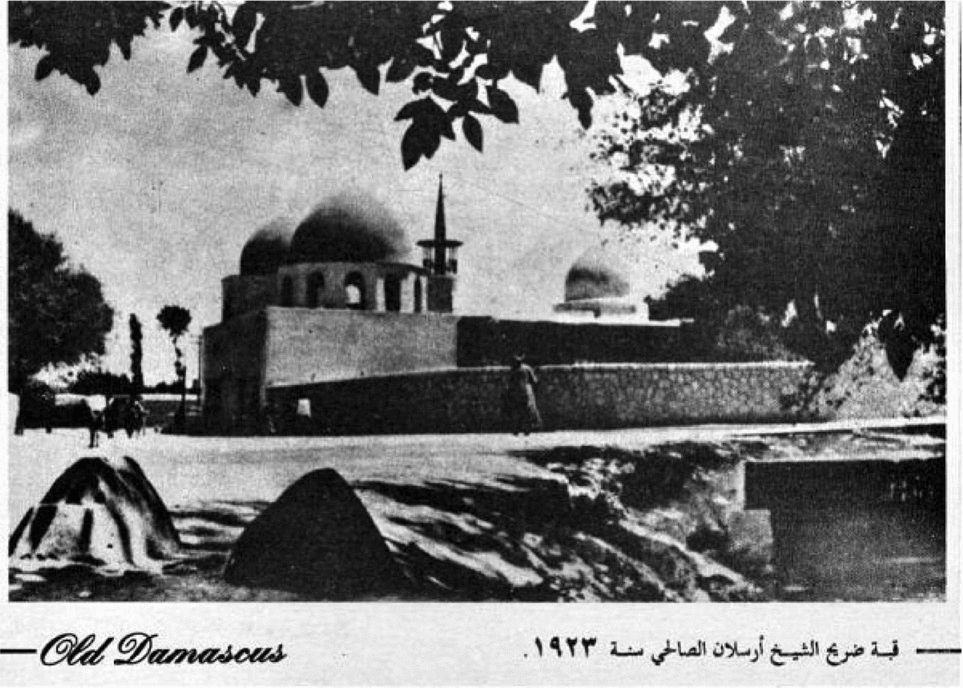
The shrine and mosque of Shaykh Arslān, early 20th century

Born in Qalʿat Jaʿbar in northeastern Syria, Shaykh Arslān moved to Damascus and eventually settled in Bāb Tūmā, a predominantly Christian residential area at the time. To the side of his small house was a shop, where he continued his work as a carpenter. After receiving several signs that called him to the Sufi way of life, he relinquished his work, sat down to worship God in a mosque not far from his workshop, and became a disciple of shaykh Abū ʿĀmir al-Muʾaddib whose spiritual lineage reportedly reached back to the famous Sarī al-Saqaṭī (d. 251/865) of the early Baghdadi school of mysticism. It is related that he handed over a third of his salary to his shaykh, and that he would sometimes starve himself. Having established himself at the mosque of the early military commander Khālid b. al-Walīd, Shaykh Arslān soon attracted his own disciples. As their number increased and the small mosque became inadequate to serve this group, the Zangid prince Nūr al-Dīn bought for him an adjacent house and added a minaret atop the mosque. Regular revenues assured the upkeep of this complex of home and mosque.Footnote 9 Perhaps partly because of his association with this mosque, which was symbolic of holy war during a continuous crusader presence in the region, there arose a remarkably durable popular belief in his sacred power to protect Damascus from external danger. Sometime after his death, his tomb on the outskirts of Bāb Tūmā, outside the city gates, became a site for pious visitation (ziyāra). Several Sufi shaykhs connected themselves to Shaykh Arslān through a spiritual chain (silsila), settled in the vicinity of his tomb, and asked to be buried by his side. Among them was the mystic and poet Najm al-Dīn Muḥammad b. Isrāʾīl (d. 677/1278), a member of an established Damascene family who at a young age received the patched garment of initiation (khirqa) of the early Suhrawardiyya lineage.Footnote 10 Thus, with the passage of time, the tomb developed into a shrine and a central site for pious visitation in a cemetery of righteous figures that became known as al-maqbara al-arslāniyya.
Muḥammad b. Maḥfūẓ Abū al-Bayān (d. 551/1156), known as Ibn al-Ḥawrānī, a contemporary and associate of Shaykh Arslān, gained no less renown in Damascus and beyond. His biographers depict him as a zealous ascetic, and a pious and god-fearing man, as well as a learned mystic of far-flung fame. He composed several works on the mystical states and stations (aḥwāl, maqāmāt), and formulas of invocation of God (adhkār) in rhymed prose and poems. Having established himself in a mosque in the Darb al-Ḥajar neighborhood in vicinity of Bāb Sharqī, which he shared for some time with Shaykh Arslān, he soon formed a local group of adherents to his spiritual path.Footnote 11 Four years after his death, Nūr al-Dīn erected a building adjacent to that mosque and named it al-Bayānī ribāṭ after him.Footnote 12 His nephew, Muḥammad b. Maḥfūẓ al-Qurashī al-Dimashqī - a writer and poet praised for his piety and asceticism - became master (walī) of the shaykhs of ribāṭ al-Bayānī at the beginning of the 7th/13th century.Footnote 13 Although there are no details about the activities that took place in the establishment, we may surmise that apart from being a centre for whoever sought the shaykh's guidance, al-Bayānī ribāṭ served as a hostel providing food and shelter for foreigners and devout poor people – Sufi and non-Sufi alike.Footnote 14
These stories provide us with testimonies of the early formation of an urban site and space around the revered Sufi shaykh. A process of local embedment and growth that began during their lifetime gained stimulus in the course of the late 6th/12th and 7th/13th centuries. Members of Sufi families and groups from various Syrian regions were attracted to the city, while branches of mystical paths and spiritual chains that originated in other parts of the Muslim world — notably Iraq, eastern Iran and Central Asia — began to appear on its soil. Lineage-descendants of such great masters as ʿAbd Qādir al-Jīlānī (d. 561/1166), Aḥmad al-Rifāʿī (d. 578/1182) and ʿUmar al-Suhrawardī diffused their spiritual paths, while representatives of various mystical and ascetic currents made their way from eastern Iran and Central Asia. Some of those drawn to Damascus from adjacent regions and from afar sojourned in the city for a short or longer time, while others adopted it as their home.Footnote 15 Through these figures, their descendants and their own disciples and followers, the horizons of the sphere dominated by the Sufi shaykh were gradually extended.
Accounts of the lives of the Banū Yūnusī afford a glimpse of the stages in the local establishment of a family-based ṭāʾifa that became a commonplace in the Damascene milieu of the late medieval period. Named after its first shaykh, Yūnus b. Saʿīd (d. 619/1222-23), who never left his village of al-Qunayya, in the confines of the Syrian Jazira, the Yūnusiyya was established in Damascus by his grandson Sayf al-Dīn al-Rajīḥī b. Sābiq (d. 706/1306) in the early period of Mamluk rule. He moved to the city, where he was allotted the house of the vizier Amīn al-Dawla inside Bāb Tūma for his lodge (zāwiya), as well as a village in the Ghūṭa Oasis around Damascus. He was an affluent and highly esteemed man. His disciples (aṣḥāb) prayed over him at the main mosque and buried him in his lodge which they named al-Yūnusiyya for their master.Footnote 16 His two sons—first Faḍl (d. 727/1327) and then Yūsuf—succeeded him (waliya mashyakha) at the family zāwiya, where their brother ʿĪsā had been buried (in 705/1305).Footnote 17 Apparently, by their time, the family place of residence included a space where a local group of disciples and followers would gather, with private funds set aside for its upkeep and supervised by the shaykh. As noted by Éric Geoffroy, although small in size and limited in scope, the hereditary zāwiya evolved into the centre of gravity of the familial Sufi tradition that was typical of Damascus in the late Mamluk period. The descendants supervised the activities of the zāwiya, and were also authorised by their fathers to teach and transmit the spiritual method of their ancestors.Footnote 18
With its origins in Baghdad, the Qādiriyya was the most prominent spiritual paths that spread in the entire Syrian region in the course of the late medieval period. Its early lineages were diffused in Syria due to the activities of disciples of ʿAbd al-Qādir al-Jīlānī who moved from Baghdad and Syrian aspirants who came to study under him. It would appear that already during their lifetimes the ṭarīqa stroke roots in Mt. Hakkār (Sinjar Mountains in the Syrian Jazira) and in urban and rural areas, with family branches established locally independently of one another.Footnote 19 One such branch coalesced in Mt. Qāsyūn in the early period of Mamluk rule, due to the descendants of Shaykh Abū Bakr b. Qawām al-Bālisī of the town of Bālis on the upper bank of the Euphrates (d. 658/1260). Tāj al-Dīn al-Subkī wrote an extensive biography of Ibn Qawām in his Ṭabaqāt al-shāfiʿiyya al-kubrā - a biographical collection of the celebrated legal scholars of his Shāfiʿī rite - as well as a treatise about Ibn Qawām's saintly life which he based on an earlier hagiography by his grandson. Authors of biographical dictionaries describe the shaykh of Bālis as a revered friend of God (walī Allāh) and one of the prominent legal scholars of the Shāfiʿī school of law in his epoch. He formed a devoted local group of disciples who orbited round his zāwiya and attracted aspirants from other parts of the Muslim world as far as India.Footnote 20 About twelve years after Ibn Quwām's death, his casket was carried from his hometown to the foot of Mt. Qāsyūn on the bank of the Yāzid River. A zāwiya, named Qawāmiyya Bālisiyya after him, was erected at the location of his grave, which became a famous focus of pious visitation.Footnote 21 His descendants presided over the family lodge and were buried by his side. Noteworthy among them was his grandson Abū ʿAbdullāh Muḥammad (d. 718/1318), who gained fame in Damascene circles of learned and pious men. His disciple Ibn Kathīr, the celebrated historian of Damascus, describes his merits in his al-Bidāya wa-l-nihāya:
Another eminent person who died in the year 718 was the learned, pious, ascetic and god-fearing shaykh, a model for ancestors and descendants alike, Abū ʿAbdullāh Muḥammad [. . .] He was a revered shaykh, well-mannered and dignified, and he possessed the marks of a virtuous and pious man [. . .] People came on pilgrimage to visit him and receive his blessing (baraka). He possessed complete knowledge, firm religious belief, true conviction, loved ḥadīth and the traditions of the ancestors (al-salaf), recited much, and loved seclusion. He also compiled a book with accounts of his grandfather, may God almighty have mercy on him.Footnote 22
Aḥmad al-Rifāʿī, from Iraq, also drew a large number of followers from all over Syria, and the teachings of the ṭarīqa of the alleged founder of the Rifāʿiyya were difused in Damascus and nearby towns and villages through the activities of his lineage descendants.Footnote 23 One group of adherents to the path was established in the city by Ṭālib b. ʿAbdān al-Rifāʿī (d. 683/1284), a native of Damascus who had a zāwiya with his followers located in the neighbourhood of Qaṣr al-Ḥajjāj (south of the walled city on the outskirts of Bāb al-Ṣaghīr) and named Ṭālibiyya after him.Footnote 24 Another group appeared in the village of Qaṭanān (in the vicinity of Damascus) due to Alī al-Qaṭnānī (d. 747/1346), one of the most devout and famous propagandists of the al-Rifā‘iyya in Syria. It is related that in addition to giving lessons to his followers, he arranged for them to recieve their meals and other assistance.Footnote 25
Several Sufi and ascetic groups that chose degradation and life on the margins of society as their preferred spiritual path—notably the al-Ḥarīriyya and the al-Qalandariyya—also sprang up in Damascus and its surroundings and had zāwiyas erected by their shaykhs or directly attributed to them. Shaykh Muḥammad ʿAlī al-Ḥarīrī (d. 645/1248), the foremost representative of antinomian Sufism in Syria in Ayyubid times, was born in the village of Bisr in Ḥawrān and lived a part of his life in Damascus. His disciples were known in the city as “aṣḥāb al-ziyy al-munāfī li-l-sharīʿa” meaning those whose dress runs counter to the regulations of the sharīʿa.Footnote 26 The historian Abū Shāma complains that they were even worse on the inside than on the outside (bāṭinuhum sharrun min ẓāhirihim).Footnote 27 Ibn Kathīr, who devoted a biographical entry to al-Ḥarīrī in his famous chronicle, describes the large following attracted to his path, adopting his unacceptable attire and participating in assemblies of music and dancing and gazing at beardless youth that were convened and presided by him.Footnote 28 Sometime before he was banished from the city by order of the local governor, his close disciples erected a lodge for followers of his path on the southern height (al-sharaf al-qiblī) of the city.Footnote 29
The dervish community of the Qalandars that had its origins in Central Asia and spread to Egypt and Syria was formed in Damascus around the activity of Shaykh Jamāl al-Dīn al-Sāwujī (d. 630/1232). He arrived in the city and took up residence in the zāwiya of Shaykh ʿUthmān al-Rūmī in Mt. Qāsyūn. It is said that he stayed with Shaykh ʿUthmān (d. after 620/1223) for a while until he was overcome with a desire for asceticism and seclusion. So he left the lodge and settled down in Bāb al-Ṣaghīr cemetery as if embodying the radical Sufi maxim “die” [become dead in this world]. Sometime later, he journeyed to Dumyāṭ in Egypt and died there.Footnote 30 After him, his disciple, Shaykh Jalāl al-Dīn Dirkizīnī (d. by the late Ayyubid period), became the shaykh of the local Qalandars. He dwelt in the cemetery area, built a zāwiya there for his followers and attracted many companions.Footnote 31 Thereafter a tomb complex grew up around the Qalandariyya lodge as an extension of it.Footnote 32
An increasing number of shaykhs and aspirants—some affiliating with a particular spiritual path, others with no particular affiliation mentioned in their biographies—moved to Damascus during the late 6th/12th and 7th/13th centuries, not only from the Muslim East but also from Andalusia and the Maghreb—most famously, Shaykh Muḥyī al-Dīn Ibn ʿArabī (d. 638/1240).Footnote 33 Thus with the passage of time Sufi-dominated spheres took shape out of internal dynamics, relatively independent of the official sphere governed by members of the ruling elite. Increasingly, however, the effect of political patronage became apparent. Not only did the Zangids and their Ayyubid and Mamluk successors create a favorable environment for locals and newcomers. By constructing and endowing establishments designed for the “righteous Sufis” in their domains, they helped develop their organisational frameworks and extend the scope of their operation and influence.
Accounts about the Sumaysāṭiyya khānqāh, one of the earliest Sufi establishments in Damascus, well illustrate the role and ramifications of the support granted by the powerful. Its beginning was due to Shaykh ʿAlī al-Sumaysāṭī (d. 453/1061), a ḥadīth scholar and astronomer whose ancestors (or he himself) came to Damascus from the ancient city of Somosata (Sumaysāṭ; on the upper Euphrates, in Anatolia). Establishing himself in the city, he bought a building in the vicinity of the Umayyad Mosque that was originally the palace of the Umayyad caliph ʿUmar b. ʿAbd al-ʿAzīz b. Marwān (r. 717–720), and was buried in this house, which he left as an endowment for use by his Sufi disciples.Footnote 34 In the course of the subsequent two centuries the Sumaysāṭiyya would become one of the most important Sufi establishments in Syria, especially after wealthy individuals and Ayyubid and Mamluk officials dedicated lucrative endowments for its maintenance and upkeep, and for lodgings for a succession of foreign Sufi and scholars coming from eastern Iran and Baghdad. Apparently, the prestige and importance of the Sumaysāṭiyya khānqāh was such that its shaykhs held a formal position known as shaykh al-shuyūkh (shaykh of shaykhs), the Chief Sufi, which would become one of the more prestigious and influential posts within the Ayyubid and early Mamluk polity, carrying a large stipend and wielding influence with the ruling elites.Footnote 35
The Physical Settings: Development and Layout
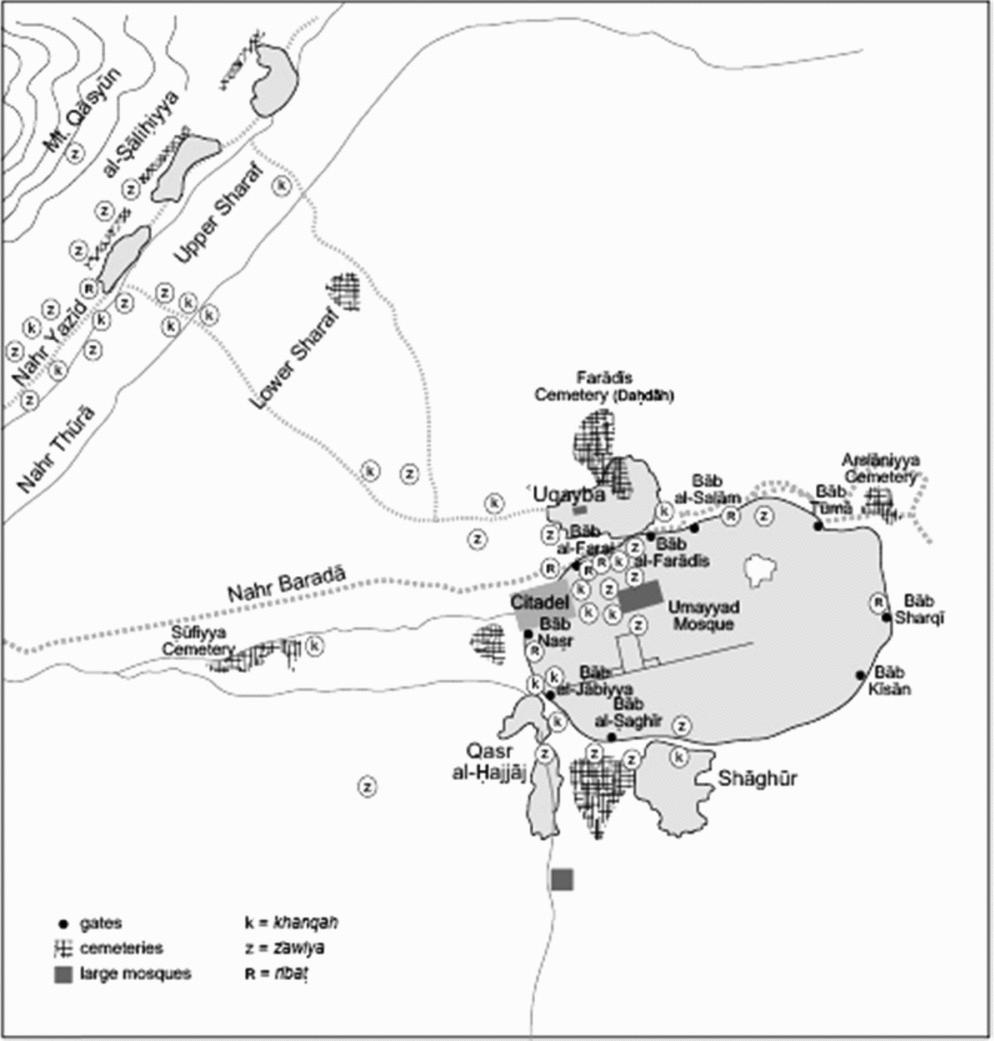
The main source for the development of pious establishments in late-medieval Damascus is al-Dāris fī tarīkh al-madāris by the famous historian and topographer ʿAbd al-Qādir al-Nuʿaymī (d. 951/1514). According to the extensive list he provides, forty-nine establishments associated with the Sufis were founded in and around the city up to the mid-8th/14th century. Several establishments, serving the needs of either unorganised individuals or groups devoted to a particular master, made their appearance prior to Ayyubid times. But it was not before the late 6th/12th century that their rapid growth took place. Over three-quarters of the establishments for which we can determine the period of establishment (listed in the table below) were founded under the reign of the Ayyubids and early Mamluks. Such was the overall increase in their number that by the mid-8th/14th centuries they had become an integral part of the urban scene and its surroundings, alongside the mosques and the madrasas (see map below). Later on–specifically after the death of Sultan al-Nāṣir Muḥammad b. Qalāwūn (d. 741/1341) and his governor of Syria Sayf al-Din Tankiz (died in the same year)–it is noticeable from al-Nuʿaymī and other medieval Islamic sources that the number of new Sufi establishments founded in the city on substantial endowments began to decrease, and the phenomenon of waqf deterioration in Syria in all aspects became increasingly common.Footnote 36
Scholarship on the social and insitutional dimensions of medieval Sufism has noted the differences and similarities of the terms used in the sources to describe particular Sufi establishments and the changes in their meaning over time and from one source to another.Footnote 37 But al-Nuʿaymī clearly distinguishes between three types of establishments –khawāniq, zawāyā, ribāṭāt – each type is separately discussed. Examination of the accounts in al-Dāris and the works by other historians and topographers of the city brings to light significant distinctions in the development and spatial layout between the physical settings that played a prominent role in the overall expansion of Sufism in medieval Damascus: the royal establishment of the khānqāh and the much less institutionalised and more modest zāwiya. These distinctions also manifest their distinctive characteristics, the functions they were designed by their founders to perform and their symbolic message.
Political patronage through the foundation of khānqāhs began under the Zangids. Several establishments were founded by the endowing rulers outside the city and others inside the walls. It is noteworthy that already under the Zangids, khānqāhs were often located in the heart of old Damascus, neighbouring the Umayyad mosque and the citadel. The religious and political centrality of this area can hardly be underestimated. Examples of khānqāhs founded there include al-Najmiyya west of the mosque, al-Andalusiyya north of the mosque and al-Shihābiyya inside al-Faraj Gate north of the citadel.Footnote 38 Although no deeds of endowment or remnants survived that might have allowed us to reconstruct the dimensions and architectural structure of these Sufi establishments, it may be surmised that regardless the density of the area the buildings were sufficiently spacious to house groups of Sufis. Obviously, only people of means and stature could purchase expensive lands in the proximity of the great mosque.
Khānqāhs, zāwiyas and ribāṭs founded in Damascus up to the mid-14th century*

• Z represents a zāwiya, R a ribāṭ and K a khānqāh
Noticeable already during the Zangid reign, the foundation of endowed khānqāhs outside the gates and on the city's outskirts became clearly apparent under their successors. Channels and branches of the Baradā River supplied the Oasis Ghūṭa surrounding Damascus from the south and west with plenty of water for daily use and agriculture. In the fertile and open spaces that extend between the old city and Mt. Qāsyūn, known as al-Sharafayn - the upper and the lower - members of the ruling elite dedicated vast lands as waqf for the foundation of their establishments and situated them close to their palaces, orchards and promenades (mutanazzahāt). Later historians of Damascus describe the beauty of the landscape of al-Sharafayn. In the words of Ibn Kannān al-Dimashqī: “One can find plenty of domiciles and orchards for promenades in al-Sharafayn, as well as several palaces (ghalibu al-Sharafayni kulluhu maqāʿidun wa-maḥāsinun wa-basātīnun lil-tanazzuhi, wa-fīhi baʿḍu quṣūr”)”.Footnote 39 Likewise, Abū al-Baqāʾ al-Badrī descibes at length the merits of each part of al-Sharafayn, with its places for promenading, leisure and amusement, as well as its religious institutions with their bountiful endowments and beautiful landscaping.Footnote 40
The layout of Sufi establishments in mid-14th-century Damascus

Significantly, the khānqāhs, both in Damascus and outside its walls, were often situated close to madrasas of the same endowers and were called after them. This was not simply a matter of spatial proximity; it signified the recognition of Sufis as representatives, alongside jurists, of righteous belief and practice, and the piety and role of members of the ruling elite as benefactors of Sunni establishments of all types. Al-Ḥusāmiyya khānqāh, for instance, was founded by the Ayyubid princess Sitt al-Shām in memory of her son Ḥusām al-Dīn b. Lājīn, and located beside her madrasa–al-Shāmiyya al-Barrāniyya.Footnote 41 Other examples are the Khātūn khānqāh beside al-Khātūniyya madrasa, which was endowed by Khātūn bint Muʿīn, wife of Sultan Nūr al-Dīn (and later of Saladin),Footnote 42 and al-Shibliyya khānqāh opposite al-Shibliyya madrasa al-Barrāniyya of the same donor, the emir Shibl al-Dawla Kāfūr (d. 623/1226).Footnote 43
Regarding the establishments of ribāṭ type in Damascus, normally they were built by members of the ruling elite inside the city gates along the main roads to serve newcomers and resident Sufi and non-Sufi poor people.Footnote 44 Such were ribāṭ al-Bayānī in the neighborhood of Darb al-Ḥajar, inside Bāb Sharqī near the straight road across old Damascus; the Ṣafiyya ribāṭ north of the Umayyad mosque in the road extending from al-Faraj Gate to al-Farādīs Gate; the ribāṭ of ʿAdhrāʾ Khātūn inside al-Naṣr Gate, and the ribāṭ of Bint al-Sallār inside Bāb al-Salām. Some other ribāṭs were located outside the entrances of the city gates, such as Ṭumān ribāṭ out of Bāb al-Faraj in the neighborhood of Taḥt al-Qalʿa.
Already in Ayyubid times some of the endowed Damascene ribāṭs began housing both Sufi rituals and classes in the religious and traditional sciences, especially for the teaching of ḥadīth.Footnote 45 Thus, for example, al-Nāṣiriyya al-Barrāniyya (founded in 654/1256) began as a ribāṭ and later functioned also a centre for the teaching and transmission of ḥadīth (dār al-ḥadīth), as well as a madrasa. Concurrently, it became common for the endowment of the khānqāh to make provision for the support of lessons in Islamic jurisprudence according to one or more legal schools that were normally held in the college of law, or for madrasas to house Sufis and their rituals. Early examples of the functional proximity between the Sufi establishment and the law college in Damascus are the Shibliyya (founded in 623/1226) and Najībiyya (founded in 677/1278).Footnote 46 Constituting a marker of the rapprochement between mystical and juristic Islam, the fusion of educational and devotional activities in the royal establishments founded in Damascus and other great cities ruled by the Mamluks was so complete that by the end of the Mamluk period it had become increasingly difficult to distinguish the establishments that supported the activities of the mystics as opposed to the jurists. Similarly, the terms madrasa, khānqāh and ribāṭ (and sometime jāmiʿ) often appear interchangeably.Footnote 47
The foundation of khānqāhs is a clear indication of the process through which Sufism and Sufis moved to the centre of scholarly and social life to become an integral part of the established social order. These buildings, especially when providing a variety of functions, are physical evidence of the growing integration of Sufis into the centre of scholarly and devotional life. However, the formal institutional framework of the khānqāh could hardly contain the activities and energy of the growing number of Sufi shaykhs and their followers. No less important, it seems, was the wish of Sufis pursuing an ascetic way of life to avoid the patronage of the ruling elite and distance themselves from an establishment founded by the powerful and closely associated with the official sphere. Unsurprisingly, it was around the much more modest and less institutionalised Sufi establishment of the zāwiya that shaykhs and their followers gathered.
Originating as small cells or spaces in large mosques, many zāwiyas during the Ayyubid and Mamluk periods developed into small independent buildings that served as a residence of their shaykhs and a focal point of their activities.Footnote 48 Moreover, unlike the royal institutions of the madrasa and khānqāh, the zāwiya as delineated in the sources pertaining to these periods was constantly associated with an individual venerated shaykh and his successors thereafter.Footnote 49 Accounts about the homes of the shaykhs turned into zāwiyas, serving their descendants and followers thereafter and attracting admirers of various strata, highlights its significance as a local physical setting. Consider, for instance, Shaykh Ṭayy al-Maṣrī (d. 631/1233), master of al-Ṭayiyya zāwiya, whom biographers describe as charming, wise and much sought after by the city's notables. He came to Damascus from Egypt, and dwelt in his home-zāwiya until his death. His funeral was attended by many, and he was interred in his well-known lodge.Footnote 50 Another example is Shaykh Ibrāhīm, son of Shaykh ʿAbdallāh al-Armawī (d. 692/1292), who presided over the Armawī zāwiya after his father. It is related that he attracted many followers, and his funeral was attended by the “king of princes” (malik al-umarāʾ) and distinguished judges, and his corpse was carried on heads.Footnote 51
Making their early appearance in the vicinity of the Umayyad Mosque, soon zāwiyas developed in the residential quarters inside the city and outside its walls (see table above). Some ascetics coming from foreign Muslim lands settled in the city quarters but not far from the gates and the great mosque.Footnote 52 Examples are Ṭayy al-Maṣrī whose home-zāwiya stood near Bāb al-Salām, northeast of Umayyad mosque; and the Egyptian ascetic (al-zāhid al-qudwa) Bahāʾ al-Dīn Hārūn al-Marāghī (d. 764/1362), master of a zāwiya that stood in al-Ṣāgha al-ʿAtīqa quarter south of the mosque.Footnote 53 Other zāwiyas, outside old Damascus, developed close to the main cemeteries and small mosques. Such were the lodge near Jarrāḥ mosque, in the vicinity of Bāb al-Ṣaghīr cemetery, the one near Tankiz mosque west of Bāb al-Naṣr, or the one near al-Tawba mosque, in the vicinity of al-Daḥdāḥ cemetery, north of Bāb al-Farādīs.Footnote 54 Regular visits to the Damascene cemeteries where venerated figures were (or were believed to be) buried – companions (ṣaḥaba) and relatives of the Prophet, leaders, warriors, scholars and God's friends – were probably a strong motive of Sufi shaykhs to settle near them.Footnote 55 An example is Shaykh Shams al-Dīn al-Salsabīlī al-Maṣrī (d. 770/1368), who directed his steps to the cemetery of Bāb al-Ṣaghīr every Saturday.Footnote 56 No less significant seems to be the wish to be secluded and cut off from others as a pious act, alone or with one's disciples, in a zāwiya near a cemetery or even in the graveyard itself, as in the case of the Qalandarī shaykh al-Sāwujī, who settled in the Bāb al-Ṣaghīr cemetery.
Several other zāwiyas were founded in the Oasis of Ghūṭa, east and south of old Damascus. In these fertile and open spaces, far from public spheres and outside of the established social order, some antinomian Sufi and ascetic groups accused of deviant practices and heretic beliefs erected their own zāwiyas.Footnote 57 Such, as we have seen, was the case with the followers of the Ḥarīriyya, as well as with the mendicants of the Qalandariyya-Ḥaydariyya. It is related that when the latter entered Damascus (in 655/1257), with their conical caps (ṭarāṭīr) and shaved beards, they were condemned by the public for violating the established norms, and they eventually left the city to follow their shaykh, Ḥaydar.Footnote 58
Even more conspicuous was the concentration of Sufi establishments of the zāwiya type in the area of Mt. Qāsyūn and al-Ṣāliḥiyya. These included the Armawī zāwiya (north of Rawḍa cemetery), the Dāwūdiyya and ʿImādiyya-Maqdisiyya (on the Mount), the Qawāmiyya Bālisiyya (west of Qāsyūn Mt. on the bank of the Yazīd River) and many others.Footnote 59 Al-Badrī expressed his impression of the beauty and holiness of al-Ṣāliḥiyya, saying: “full of zāwiyas, turbas (mausoleums) and madrasas, it has a straight road without turning in which one can walk among turbas and madrasas housed in beautiful buildings”.Footnote 60 The holiness of Mt. Qāsyūn probably drew many ascetics, both locals and foreigners, seeking to be near its sacred sites.Footnote 61 At the same time, the Mount and al-Ṣāliḥiyya served as a secure refuge from political upheavals, as well as an arena for a variety of religious venues.Footnote 62 To be secluded on the Mount and its slope–devoting one's life to pious acts, spiritual exercises and mystical exertions (mujāhadāt), away from public life and the spaces surrounding the powerful and the wealthy—seems therefore to be another important motivation. Indeed, the shaykhs who made Mt. Qāsyūn their home are typically portrayed as pursuing an ascetic mode of life, disassociating themselves from the rulers and avoiding their patronage. The famous ascetic Shaykh ʿAbdallāh al-Yūnīnī (d. 617/1220), for example, turned down money from the Ayyubid sultan al-Malik al-ʿĀdil and even refused to bestow his blessing (baraka/duʿāʾ) on the governor of Damascus, al-Muʿaẓẓam ʿῙsā.Footnote 63 Likewise, Shaykh Muḥammad b. Qawām al-Bālisī declined a salary from the state and money and gifts by everyone else, and his lodge never received any funds or endowments.Footnote 64
The Tomb and the Sacred Topography
As the realm of the shaykh, a physical symbol of his presence and authority, the zāwiya developed into the prime physical setting of the locally embedded group formed around him. Moreover, with shaykhs usually buried in or near their lodges, the zāwiya-tomb complex evolved into a public place central to the life of the community, as well as a centre around which a local space emerged. This extension of the realm and ambience of the shaykh was closely related to the affinity between Sufism and sanctity. Noticeable as early as the 5th/11th century, this conjuncture found its most salient expression in the incorporation of the tomb (qabr, or ḍarīḥ) of the Sufi friend of God, the walī Allāh, into a growing inventory of local and regional sacred sites – the focus of pilgrimage (ziyāra), to seek the intercession of the holy figures or simply to benefit from close proximity to their remains and the divine blessing that inhered in their graves.
Indeed, the environment in which such revered shaykhs as Shaykh Arslān and Ibn Qawām al-Bālisī lived was statured with old and new sacred sites. Recent scholarship has noted the renovation or transformation of sacred sites (mashhads, maqāms) and the dramatic proliferation of new ones in Bilād al-Shām in the course of the crusade and counter-crusade period that was marked by an overall intense religious attitude and vigour. Studies by Joseph Meri, Daniella Talmon-Heller and Yasser Tabbaa, collected and meticulously employed a wealth of information derived from narrative sources and material evidence that indicates an increasing variation in the nature of funerary and memorial structures and a substantial broadening of the social basis of architectural patronage.Footnote 65 More recently, Stephanie Mulder has shown how changes in religious feelings and patronage created a unified ‘holy land’ in medieval Syria that centered on the shrines of the ‘Alids and cut across sectarian divides.Footnote 66 But while the expansion of the sacred topography in the Syrian milieu of the time has received considerable attention, questions remain open regarding the creation of holy sites around local charismatic figures.
In Damascus, an ancient city rich in sacred sites, righteous figures with no sign of Sufi ideas or practices (apart from a generic ascetic piety) in their hagiographies continued to be viable candidates for popular sainthood. The example of the Ḥanbalī preacher-scholar Abū ʿUmar (d. 606/1210), a member of the Maqdisī family (Banū Qudāma) that established itself in the Ṣāliḥiyya neighbourhood comes to mind.Footnote 67 But the number of Sufi shaykhs celebrated by their fellow believers as God's friends–during their lifetime or after their death–was definitely on the rise, and by the end of the Mamluk period Damascus had become dotted with their tombs. Successive generations of family and individual tombs were built side by side in zāwiyas or in cemetery areas clustering around a venerated shaykh whose tomb became an object of pilgrimage.
Two of the cemeteries surrounding the walls of old Damascus from all sides developed around the burial places of Sufi shaykhs: maqbara al-arslāniyya (on the outskirts of Bāb Tūmā) around the tomb of Shaykh Arslān, and maqābir al-ṣūfiyya, the cemetery of the Sufis. Situated west of Bāb Naṣr near Tankiz Mosque, maqābir al-ṣūfiyya was the only burial ground in medieval Islam that was explicitly associated with the Sufis, though open to all. As Christopher Taylor has pointed out, baraka was a significant consideration for the placement of the dead: to be buried near the grace of a pious figure was a way of securing divine blessing for the person interred, and a place devoted to a whole group of righteous figures such as al-Qarāfa cemetery in Cairo was sure to have great reservoirs of baraka.Footnote 68 It was also for this reason that the Sufi cemetery, which, according to al-Badrī, “is the resting place of many pious religious scholars, Sufi shaykhs and friends of God”,Footnote 69 was a popular burial site in medieval Damascus.
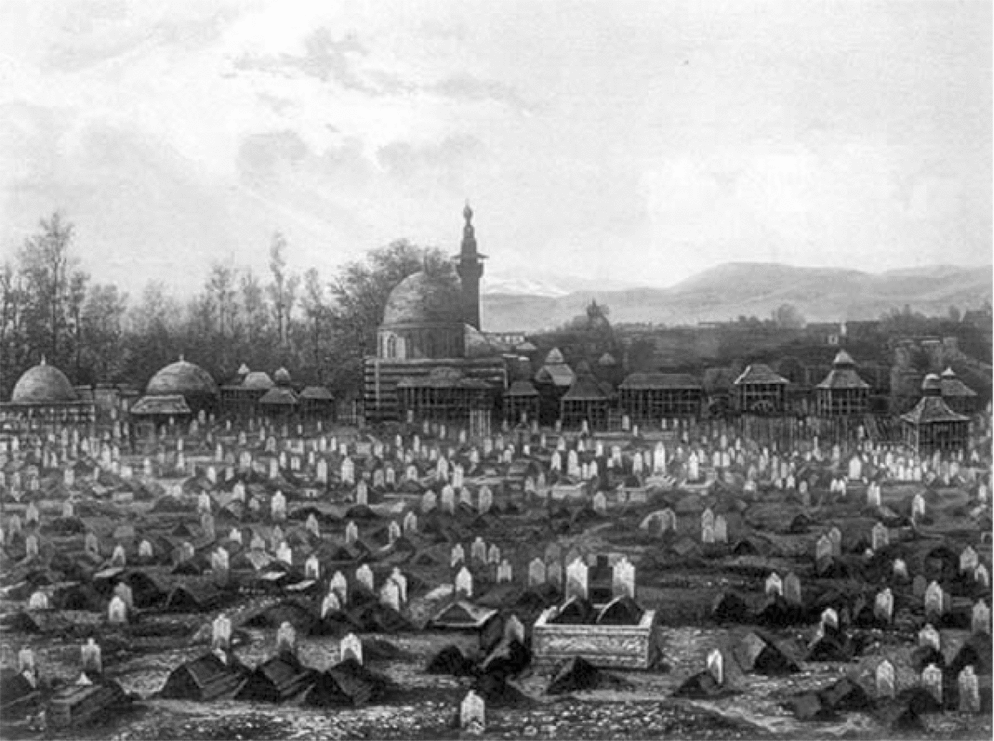
Some other Sufi shaykhs were buried in cemetery areas near graves associated with the Prophet's companions (min al-ṣaḥāba wa-l-tābiʿīn) and relatives, such as al-Mizza (west of the city walls) and, in particular, the cemetery of Bāb al-Ṣaghīr. An example is Abū al-Bayān. About one hundred years after his death, the Syrian historian and topographer ʿIzz al-Dīn Ibn Shaddād lists his tomb in the Damascene cemetery as one of the pilgrimage destinations around the walled city.Footnote 70 Ibn al-Ḥawrānī provides us a later testimony of the significance of the site in the lives of his contemporaries, saying, “his grave is well-known and frequently visited (yuzār), and blessings are sought from it (yutabarrak bihi). It has an endowment for lighting its lamp on a nightly basis.Footnote 71 The antinomian Qalandars also sought to be buried in the sacred graveyard. As noted above, their tomb complex in Bāb al-Ṣaghīr grew up around their lodge, which was located in the vicinity of the domed shrine (qubba) of Sayyida Zaynab bint Zayn al-ʿĀbidīn, a descendant of Imām ʿAlī.Footnote 72
The Bāb al- Ṣaghīr cemetery, late 19th century

Enhanced with lofty sites associated with ancient events and glorious figures, Mt. Qāsyūn and the Ṣāliḥiyya at its foot seem to be no less desirable places for burial. An example is the aforementioned Muḥammad b. Maḥfūẓ al-Qurashī al-Dimashqī, the nephew of Abū al-Bayān and his successor as the master of the Bayānī ribāṭ. He died in 635/1238, and was interred at the side of the erudite divine al-Fandalāwī, who insisted on fighting the army of the second Crusade despite his advanced age, and was killed by the Franks on the outskirts of Damascus (in 543/1148).Footnote 73 Another telling example is that of Ibn Qawām al-Bālisī, who, according to his grandson, asked to be buried in a casket (which is generally considered an unwarranted innovation, bidʿa) so that his remains could be transferred to the holy land (al-arḍ al-muqaddasa). As we have seen, his wish, which was kept a secret, was eventually fulfilled: at the end of the month of Muḥarram of the year 670/1271, his casket was carried from the village of ʿAlam in the region of Aleppo to the foot of Mt. Qāsyūn. Notables and commoners attended his funeral, seeking to be in close proximity to his casket and bid him a last farewell; and “his grave there is visible and people visit it to seek divine blessing and intercession”.Footnote 74
In common with other cultural traditions, a building was made holy in Islamic tradition not only through its association with a righteous figures or a glorious event of the past, but through the practices conducted there–be they private devotional acts or public rituals performed by generations of pilgrims and visitors.Footnote 75 Muslim pilgrims and visitors in medieval Syria, and in the medieval Muslim world as a whole, did not leave behind journey diaries or firsthand testimonies that would enable a reconstruction of their experience of the sacred, as did Christians in late antiquity and in the middle ages. But inventories and descriptions of places of pilgrimage and the rituals and legends associated with them that can be found in travel itineraries like the Riḥlas of Ibn Jubayr and Ibn Baṭṭūṭa and in works by contemporary Syrian historians such as Ibn al-ʿAdīm and Ibn Shaddād, indicate their importance to in the world of their fellow believers.Footnote 76 Information drawn from the available sources suggests that the tombs of the Sufi friends of God in and around Damascus became an integral part of a kind of a map to pilgrimage sites and blessed places (maqāmāt mubāraka) in Syrian regions that took shape from the mid-6th/12th century onwards.
Sharing the belief that special merit comes upon a place when the righteous are buried there and that their graves are never devoid of divine blessing, believers of all strata played a role in the transformation of the shaykh's burial place into a sacred site. They would participate in his funeral procession, frequent his tomb, conduct common rituals there, relate the stories about his life and extraordinary deeds, and donate endowments for its restoration and upkeep. Thus, like other lofty places in the Islamic public sphere, the tombs of the Sufi shaykhs in medieval Damascus were constantly invested in biographical and hagiographical narratives, memories and acts of devotion that reinforced their sanctity.
The significance accorded to the burial place of the Sufi shaykh in both the official and the public sphere is revealed in its brightest light in the accounts of the complex that developed around the tomb of Shaykh Arslān (noted above) and that of Ibn ʿArabī. The views of the great mystic of Islam aroused considerable opposition among Sunni scholars; some even accused him of heresy. Yet his tomb in the Ṣāliḥiyya became a focus of pilgrimage and a prime landmark in the topography of Damascus, especially after it was restored and adjoined a mosque and public refectory at the command of the Ottoman sultan Selim, following his conquest of Syria and Egypt (in 1516–17).Footnote 77 Ibn Ṭūlūn, who served as the first prayer leader (imām) of that mosque, provides details on its halls and places of retreat, the nearby refectory, where bread was served every day to the poor and visitors, and the other adjacent buildings. Called Selīmiyya after its founder, the complex developed into a well-known religious centre. It is related that whenever an Ottoman official or religious scholar arrived in the city he would visit the place to pray and receive the shaykh's blessing.Footnote 78
Conclusion
This article revolves around two central propositions. First, that while it was around particular venerated masters, rather than around institutional frameworks, that a prominent Sufi sphere emerged, the proliferation of Sufi establishments in Ayyubid and early Mamluk Damascus played a significant role in this process. Scattered throughout the city and its surroundings, these buildings constituted the concrete expression of the expansion of Sufism in the specific historical setting and a vital visible mechanism in this process. Second, the patterns of development and spread of the various types of Sufi establishments in and around the city are indicative of their nature as physical settings, the functions they served and their symbolic message.
The best available information derived from the sources studied in this paper shows differences in location between what we have classified as royal institutions and the realms of the shaykhs. In general, khānqāhs that were founded and lavishly endowed by the powerful and wealthy for the benefit of groups of local and foreign Sufis were constructed in open areas outside the city, close to the palaces and promenades of the ruling class and the state-endowed madrasas, or in the heart of old Damascus in the vicinity of the great mosque and the citadel. These buildings thus projected an aura of religious prestige, and highlighted the role of their founders as patrons and supporters of the righteous Sufis alongside other groups pursuing the truth of Islam. Also endowed by members of the ruling elite to provide food and shelter for newcomers and the needy–Sufis and non-Sufis alike–the ribāṭs were normally erected inside the city walls along the main roads or close to its gates.
As the realm of its shaykh, a physical symbol of his presence and authority, the zāwiya developed into a prime physical setting that spread wherever he resided, whether in the residential quarters inside old Damascus or outside the city gates–near cemeteries and on Mt. Qāsyūn—away from the public and the impact of the powerful and wealthy. But while the zāwiyas of masters of the established spiritual paths were for the most part incorporated as an integral part of religious life and structure, the homes and centres of gravity of antinomian Sufi and ascetic groups always developed outside of Damascus and the established communal life and social order.
By the end of the Mamluk period, the khānqāh had lost its initial designation as a state-supported institution housing large numbers of Sufis, and it eventually declined. Sufi homes that were small in size and scale, and lacking sufficient funds for their maintenance and upkeep, were doomed to decline as well. But the graves of the shaykhs next to their zāwiyas or in graveyards around the city, where pilgrims and visitors gathered to learn about the deeds and virtues of the righteous to seek their blessing and power of intercession and perform devotional acts, commemorated the local Sufi friend of God and imprinted his tangible and lasting mark on the religious and sacred topography of Damascus.