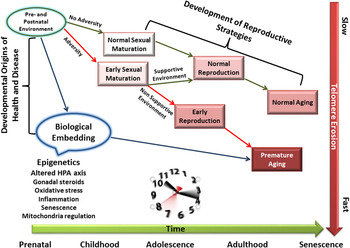
Two independent lines of inquiry suggest that growing up under diverse and/or multiple conditions of contextual adversity (e.g., poverty, household chaos, or harsh parenting) accelerates aging and undermines long-term health. Work addressing the developmental origins of health and disease (DOHaD) highlights accelerated aging effects of contextual adversity on telomere erosion, but that informed by an evolutionary analysis of reproductive strategies highlights such effects with regard to pubertal development (in females). That both shorter telomeres early in life and earlier age of menarche are associated with poor health later in life raises the prospect, consistent with evolutionary life-history theory and outlined in Figure 1, that these two bodies of theory and research are tapping into the same evolutionary–developmental process whereby longer term health costs are traded off for increased probability of reproducing before dying via a process of accelerated aging. Should this be the case, it raises questions about assumptions central to medical and mental-health models of disease and dysfunction. More specifically, what is routinely characterized as disordered functioning may reflect a process of adaptive human development crafted by natural selection because of its correlated reproductive benefits.
(Color online) Contextual adversity, telomere erosion, pubertal development, and health. Overall model highlighting the developmental origins of health and disease, development of reproductive strategies, and the biological embedding via accelerated telomere erosion.

In light of the trade-off thinking central to this paper, it seems notable that a recent review of early and late life trade-offs and the evolution of aging in wild vertebrate populations by Lemaître et al. (Reference Lemaître, Berger, Bonenfant, Douhard, Gamelon and Plard2015) “reveals very good support for the occurrence of such” (p. 5) and that the “aging process is embedded in the evolution of life-history strategies and covaries with other biological processes like growth and reproduction” (p. 7). Here we make the case that much the same is so in humans, while illuminating processes of biological embedding that might instantiate these contextually regulated developmental processes, including epigenetic ones. Figure 1 schematically outlines the conceptual model to be developed, highlighting the distinct developmental constructs that the two models call attention to (e.g., telomere erosion and sexual maturation) and mediating biological mechanisms to be considered (e.g., stress physiology and epigenetics). We begin by outlining the DOHaD framework, along with supportive evidence, and then consider biological embedding processes involving stress physiology and epigenetics. Then we do the same for the development of reproductive strategies. We subsequently qualify all that we have proposed by raising the possibility that the very environmentally induced accelerated-aging process central to this report may apply to some individuals more than others due to differential susceptibility to environmental influences. With regard to this latter point, we highlight issues of both risk and resilience, before proceeding to draw translational implications in a concluding section.
DOHaD
Developmentalists studying the effects of contextual adversity on child well-being (e.g., Evans, Reference Evans2003) and physicians and biologists investigating developmental origins of disease (e.g., Bateson et al., Reference Bateson, Barker, Clutton-Brock, Deb, D'Uldine and Foley2004; Hertzman, Reference Hertzman1999; Hertzman & Power, Reference Hertzman and Power2004) well appreciate that biological and contextual adversity experienced early in life carries risk for poor health later in adulthood. Consider in this regard evidence linking low birth weight with increased risk of metabolic disease in middle age (e.g., Barker, Reference Barker2007; Barker, Eriksson, Forsen, & Osmond, Reference Barker, Eriksson, Forsen and Osmond2002). From a more sociological perspective, consider evidence indicating that low socioeconomic status early in life is associated with poor metabolic (e.g., Lehman, Taylor, Kiefe, & Seeman, Reference Lehman, Taylor, Kiefe and Seeman2005) and immune functioning (e.g., Miller et al., Reference Miller, Chen, Fok, Walker, Lim and Nicholls2009), and adult health more generally (e.g., Melchior, Moffitt, Milne, Poulton, & Caspi, Reference Melchior, Moffitt, Milne, Poulton and Caspi2007; Poulton et al., Reference Poulton, Caspi, Milne, Thomson, Taylor and Sears2002); from a psychological perspective, consider evidence that childhood maltreatment is associated with compromised adolescent and adult health (e.g., Flaherty et al., Reference Flaherty, Thompson, Dubowtiz, Harvey, English and Proctor2013; Wegman & Stetler, Reference Wegman and Stetler2009). Health scientists have also chronicled links between cumulative contextual risk and allostatic load in childhood (Evans, Reference Evans2003; Evans & Kim, Reference Evans and Kim2012) and adulthood (e.g., Brody et al., Reference Brody, Yu, Chen, Kogan, Evans and Windle2013).
It seems especially noteworthy that health-minded scholars have begun to evaluate hypotheses about potentially mediating biological mechanisms or at least biomarkers of the presumed health-deterioration process (e.g., Carroll et al., Reference Carroll, Gruenewald, Taylor, Janicki-Deverts, Matthews and Seeman2013). Thus, they have shown that activity and reactivity of stress physiology (e.g., Chen, Cohen, & Miller, Reference Chen, Cohen and Miller2010), inflammation (Danese, Pariante, Caspi, Taylor, & Poulton, Reference Danese, Pariante, Caspi, Taylor and Poulton2007; Fagundes, & Way, Reference Fagundes and Way2014; Miller, Chen, & Parker, Reference Miller, Chen and Parker2011), immune competence (e.g., O'Connor et al., Reference O'Connor, Winter, Hunn, Carnahan, Pressman and Glover2013; Shirtcliff, Coe, & Pollak, Reference Shirtcliff, Coe and Pollak2009), metabolic functioning (Lehman et al., Reference Lehman, Taylor, Kiefe and Seeman2005), and most recent and most important for purposes of the arguments advanced herein, chromosomal integrity as indexed by telomere length (e.g., Cohen et al., Reference Cohen, Janicki-Deverts, Turner, Marsland, Casselbrant and Li-Korotky2013; Entringer, Buss, & Wadhwa, Reference Entringer, Buss and Wadhwa2012; Kiecolt-Glaser et al., Reference Kiecolt-Glaser, Gouin, Weng, Malarkey, Beversdorf and Glaser2011; Kiecolt-Glaser, Jaremka, Derry, & Glaser, Reference Kiecolt-Glaser, Jaremka, Derry and Glaser2013; Shalev, Moffitt, et al., Reference Shalev, Moffitt, Sugden, Williams, Houts and Danese2013) are all related to physical health.
Telomeres are the protective caps at the end of linear chromosomes, which erode in somatic tissues with each division of a cell. When they reach a critically short length, cells enter a state of replicative arrest called senescence, one of the key hallmarks of aging (López-Otín, Blasco, Partridge, Serrano, & Kroemer, Reference López-Otín, Blasco, Partridge, Serrano and Kroemer2013). The repetitive sequence of telomeres is conserved in all vertebrates, and it is thought to have arisen from a common ancestor over 400 million years ago (Meyne, Ratliff, & Moyzis, Reference Meyne, Ratliff and Moyzis1989). In certain cell types, such as germ cells and stem cells, telomere length is maintained by an enzyme, telomerase, which can add telomeric repeats to the ends of chromosomes. However, most somatic cells lack sufficient telomerase, and consequently telomeres progressively shorten with each cell division. Telomeres are particularly interesting for the argument advanced here, namely, that two separate lines of inquiry might be addressing the same “accelerated aging” developmental process.
In the past decade, shorter telomere length and increased erosion rate have been associated with stress and contextual adversity in humans (Shalev, Reference Shalev2012). Interest in the etiological pathways that mediate the effect of early life stress on physical and mental health has generated increased attention to the role of telomere length. Thus, in addition to being related to poor health, ever increasing evidence links shorter telomeres or accelerated telomere erosion (over time) with adverse contextual conditions. Epel et al. (Reference Epel, Blackburn, Lin, Dhabhar, Adler and Morrow2004) provided the first evidence to this effect, associating chronic psychological stress with shorter telomere length among mothers caring for an ill child. Subsequent research showed that adults who recall childhood adversity had shorter telomere length (reviewed in Price, Kao, Burgers, Carpenter, & Tyrka, Reference Price, Kao, Burgers, Carpenter and Tyrka2012; Shalev, Reference Shalev2012). In the first study of children, greater exposure to (poor-quality) institutional care was associated with shorter telomere length in middle childhood (Drury et al., Reference Drury, Theall, Gleason, Smyke, De Vivo and Wong2011). Reliance in this developmental work on retrospective assessments of stress raised important questions about these findings, however. Subsequent longitudinal research involving repeated telomere measurements by Shalev, Moffitt, et al. (Reference Shalev, Moffitt, Sugden, Williams, Houts and Danese2013) provided critical prospective evidence: that children exposed to multiple kinds of violence between age 5 and 10 years showed significantly more telomere erosion over time (i.e., by age 10) than did other children; for related family-violence evidence, see Drury et al. (Reference Drury, Mabile, Brett, Esteves, Jones and Shirtcliff2014).
That telomeres prove sensitive to adversity and predictive of health has resulted in them being regarded as a biological clock for studying accumulated cellular aging throughout the life course. According to such a medical model, telomere erosion reflects “wear and tear,” which eventually compromises well-being, thus proving predictive of increased morbidity and early mortality. It is intriguing that data from three recent studies suggests that this accelerated aging process begins very early in life. In one small-sample study, Entringer et al. (Reference Entringer, Epel, Lin, Buss, Shahbaba and Blackburn2013) documented a relation between greater prenatal stress and shorter telomere length at birth; in the second, Marchetto et al. (Reference Marchetto, Glynn, Ferry, Ostojic, Wolff and Yao2016) replicated this association using a prospective design over the whole course of gestation; and in the third, larger study, Shalev, Caspi, et al. (Reference Shalev, Moffitt, Braithwaite, Danese, Fleming and Goldman-Mellor2014) linked perinatal complications at birth with two aging indicators in midlife, telomere length and perceived facial aging (independent of family history and social risks present before birth, and of life-course health). Even if these new data and those cited earlier prove consistent with the developmental origin of health and disease model, we challenge this view here, as have others (e.g., Ellis & Del Giudice, Reference Ellis and Del Giudice2014; Ellis, Del Giudice, & Shirtcliff, Reference Ellis, Del Giudice, Shirtcliff, Beauchaine and Hinshaw2013), by casting the findings under consideration in an evolutionary perspective. Before doing so, however, we consider mechanistic processes of biological embedding emphasizing the role of stress physiology and thereafter epigenetic programming.
Biological embedding via stress physiology
Regardless of whether contextual-adversity effects on telomere erosion is best conceptualized in terms of disease or, as we will argue, adaptation, the question arises as to how the former comes to affect the latter (i.e., adversity → shorter telomeres). That is, how does stress “get under the skin”? Evidence linking shorter telomere length and increased telomere erosion with psychosocial stressors (reviewed in Price et al., Reference Price, Kao, Burgers, Carpenter and Tyrka2012; Shalev, Reference Shalev2012) and internalizing disorders (Shalev, Moffitt, et al., Reference Shalev, Caspi, Ambler, Belsky, Chapple and Cohen2014; Simon et al., Reference Simon, Smoller, McNamara, Maser, Zalta and Pollack2006; Wolkowitz et al., Reference Wolkowitz, Mellon, Epel, Lin, Dhabhar and Su2011) calls attention, when trying to understand this process of biological embedding, to the physiological stress systems, in particular the hypothalamus–pituitary–adrenal (HPA) axis with its end product, cortisol. The causal link between stress and cortisol is unequivocal. Although the mechanistic one between systemic dysregulation of the HPA axis and short telomere length is not entirely clear (Shalev, Reference Shalev2012), empirical evidence suggests that chronic stress-induced secretion of cortisol downregulates the activity of telomerase in lymphocyte cells, while increasing oxidative stress through mitochondrial dysregulation, which in turn leads to more rapid erosion of telomeres and, eventually, cellular senescence (Behl et al., Reference Behl, Lezoualc'h, Trapp, Widmann, Skutella and Holsboer1997; Choi, Fauce, & Effros, Reference Choi, Fauce and Effros2008; Picard, Juster, & McEwen, Reference Picard, Juster and McEwen2014; Vartak Deshpande, & Barve, Reference Vartak, Deshpande and Barve2014). In addition to cortisol and oxidative stress, inflammation, as we will see, also appears to play a role in the stress–telomere-erosion process.
The role of cortisol
In line with the mechanistic process just outlined, several studies of humans document significant associations between HPA axis indices, including physiological stress reactivity and shorter telomere length (Epel et al., Reference Epel, Lin, Wilhelm, Wolkowitz, Cawthon and Adler2006; Révész, Reference Révész, Milaneschi, Verhoeven and Penninx2014; Tomiyama et al., Reference Tomiyama, O'Donovan, Lin, Puterman, Lazaro and Chan2012; Wikgren et al., Reference Wikgren, Maripuu, Karlsson, Nordfjäll, Bergdahl and Hultdin2012). In the first such inquiry involving children, higher levels of cortisol in response to a laboratory stressor were associated with shorter telomere length in buccal cells of 5- to 6-year-olds (Kroenke et al., Reference Kroenke, Epel, Adler, Bush, Obradovic and Lin2011). Subsequent research on young daughters of mothers with recurrent episodes of depression linked higher cortisol activity with shorter telomere length (Gotlib et al., Reference Gotlib, LeMoult, Colich, Foland-Ross, Hallmayer and Joormann2014). Indirect evidence that the effect of maternal depression on telomere erosion may have been mediated by insensitive mothering can be found in Asok, Bernard, Roth, Rosen, and Dozier's (Reference Asok, Bernard, Roth, Rosen and Dozier2013) recent work showing that sensitive, responsive parenting protected children growing up under high-risk conditions from the otherwise anticipated effect of early life stress on telomere erosion. These observational findings are consistent with evidence that a preventive intervention involving poor, rural African Americans “ameliorates the prospective association between non-supportive parenting and diminished telomere length” (Brody, Yu, Beach, & Philibert, Reference Brody, Yu, Beach and Philibert2014, p. 1).
The role of inflammation
Another physiological pathway involved in the telomere-erosion process and known to be triggered by stress involves inflammation, resulting in the inflammatory response. Inflammation is associated with increased proliferation of immune and hematopoietic stem cells and, as a consequence, with more telomere erosion (Goronzy, Fujii, & Weyand, Reference Goronzy, Fujii and Weyand2006; Jurk et al., Reference Jurk, Wilson, Passos, Oakley, Correia-Melo and Greaves2014). Evidence from several studies indicates that childhood stress predicts elevated inflammation (Danese et al., Reference Danese, Pariante, Caspi, Taylor and Poulton2007); that individuals with early life stress evince heightened inflammatory response to psychosocial stress (Pace et al., Reference Pace, Mletzko, Alagbe, Musselman, Nemeroff and Miller2006); and that childhood adversity predicts, among older adults, both more inflammatory markers and shorter telomere length in white blood cells (Kiecolt-Glaser et al., Reference Kiecolt-Glaser, Gouin, Weng, Malarkey, Beversdorf and Glaser2011). Of note, an important feature of senescent cells, apart from growth arrest, is the observation of increased secretion of inflammatory factors, such as interleukins 6 and 8, known as the senescence-associated secretory phenotype (Coppé, Desprez, Krtolica, & Campisi, Reference Coppé, Desprez, Krtolica and Campisi2010; Rodier et al., Reference Rodier, Coppé, Patil, Hoeijmakers, Muñoz and Raza2009). Thus, increased senescence rate, as a result of increased telomere erosion rate, increases the level of inflammatory markers, making clear that the inflammation-telomere-erosion relation is reciprocal rather than unidirectional. Over time, chronic levels of inflammatory markers can damage tissues and accelerate aging.
The role of oxidative stress
Oxidative stress is another critical pathway by which contextual adversity can affect telomere erosion and, thereby, accelerate aging. Telomeres are sensitive to damage by oxidative stress due to high guanine-rich content as demonstrated by in vitro experiments showing increased telomere erosion under conditions of high reactive oxygen species (ROS; von Zglinicki, Reference von Zglinicki2002). ROS production is also increased in senescent cells, providing more fuel for cellular damage and telomere erosion (Passos et al., Reference Passos, Nelson, Wang, Richter, Simillion and Proctor2010); in addition, it can impair the self-renew ability of hematopoietic stem cells (Naka, Muraguchi, Hoshii, & Hirao, Reference Naka, Muraguchi, Hoshii and Hirao2008). As mentioned above, oxidative damage is also influenced by stress hormones, in particular cortisol. In animal models, glucocorticoid administration increases the level of ROS and oxidative damage (Costantini, Marasco, & Møller, Reference Costantini, Marasco and Møller2011), as well as decreases the protective effects of antioxidant enzymes in specific brain regions, including the hippocampus (McIntosh, Hong, & Sapolsky, Reference McIntosh, Hong and Sapolsky1998). In humans, Epel et al. (Reference Epel, Blackburn, Lin, Dhabhar, Adler and Morrow2004) discerned a link between greater perceived stress, increased oxidative stress, and shorter telomere length in peripheral blood mononuclear cells. Telomere dysfunction is also associated with mitochondrial impairment, discussed more broadly below, which in turn induces more DNA damage by increased ROS production, leading to faster erosion of telomeres (Picard et al., Reference Picard, Juster and McEwen2014; Sahin et al., Reference Sahin, Colla, Liesa, Moslehi, Müller and Guo2011).
The role of mitochondrial regulation
Mitochondrial regulation by glucocorticoids also needs to be entertained as an important mediating mechanism, because these organelles participate in the stress response, in part by sensing levels of glucocorticoids (Manoli et al., Reference Manoli, Alesci, Blackman, Su, Rennert and Chrousos2007); receptors for glucocorticoids and other stress hormones naturally exist within mitochondria (Picard et al., Reference Picard, Juster and McEwen2014). Furthermore, the protein subunit of telomerase can shuttle from the nucleus to the mitochondria in the face of oxidative stress to protect mitochondrial function and decrease oxidative stress, emphasizing another role for the telomere system in protecting cells from DNA damage response (Sharma et al., Reference Sharma, Reyes, Green, Caron, Bonini and Gordon2011; Singhapol et al., Reference Singhapol, Pal, Czapiewski, Porika, Nelson and Saretzki2013). There is thus reason to expect mitochondrial regulation to play a role in the telomere-erosion process, and recent studies document higher mitochondrial DNA copy numbers and shorter telomeres in individuals with internalizing disorders, as well as individuals with a history of childhood maltreatment (Cai et al., Reference Cai, Chang, Li, Li, Hu and Liang2015; Tyrka et al., Reference Tyrka, Parade, Price, Kao, Porton and Philip2015). These findings are partly attributable to glucocorticoid secretion (Cai et al., Reference Cai, Chang, Li, Li, Hu and Liang2015) and perhaps, as discussed in more detail below, result from epigenetic modification of the glucocorticoid receptor (nuclear receptor subfamily 3, group C, member 1 [NR3C1]) gene and the associated increase in oxidative damage. It is also notable that the results of several other studies document a significant correlation between shorter telomere length and greater mitochondrial DNA copy numbers (Kim, Kim, Ko, Bang, & Lee, Reference Kim, Kim, Ko, Bang and Lee2013; Pieters et al., Reference Pieters, Janssen, Valeri, Cox, Cuypers and Dewitte2015; Tyrka et al., Reference Tyrka, Parade, Price, Kao, Porton and Philip2015), an association that may be mediated by sirtuin 1 gene expression levels, an important enzyme of cellular regulation (Pieters et al., Reference Pieters, Janssen, Valeri, Cox, Cuypers and Dewitte2015). Even more relevant evidence comes from recent research showing that prenatal exposure to endocrine disrupting chemicals is associated with differential methylation of the NR3C1 gene, as well as the mitochondrially encoded cytochrome C oxidase II (MT-CO2) gene in the frontal lobes of rats (Byun et al., Reference Byun, Benachour, Zalko, Frisardi, Colicino and Takser2015).
In sum, empirical evidence suggests that the mechanistic pathways leading from adversity to shorter telomeres, via altered physiological reactivity, involve a complex interaction between glucocorticoids, telomerase activity, inflammation, oxidative stress, and mitochondria regulation.
Biological embedding via epigenetics
Even if telomere length and erosion prove related to contextual adversity and physiological reactivity, including via the biological mechanisms just considered (e.g., glucocorticoids, oxidative stress, inflammation, and mitochondrial regulation), one can further inquire into the genomic processes of biological embedding. One candidate genomic mechanism involves epigenetic regulation, mentioned briefly in the preceding subsection (Gluckman, Hanson, Cooper, & Thornburg, Reference Gluckman, Hanson, Cooper and Thornburg2008; Waterland & Michels, Reference Waterland and Michels2007). DNA can be modified by several epigenetic mechanisms, most notably histone modification and DNA methylation. Modification of histones, the proteins that bind and package DNA, can alter the three-dimensional structure of chromatins and make DNA more or less accessible to transcription factors and other genomic regulators. DNA methylation is the addition of a methyl group to cytosine bases preceding guanines (e.g., cytosine nucleotide–phosphate–guanine nucleotide dinucleotide), by enzymes called DNA methyltransferases.
DNA methylation has been investigated primarily with regard to contextual adversity and the programming of biological systems that may drive later-life physical and mental-health diseases. In general, these epigenetic modifications are important for the regulation of cellular differentiation and development and function to fine-tune gene expression throughout life (Zhang & Meaney, Reference Zhang and Meaney2010). Developmentally induced epigenetic modifications are generally stable, and this early programming potentially regulates growth and sexual maturation, as well as aging. Several human studies document age-related increases or decreases in methylation levels of specific genes (Richardson, Reference Richardson2003), including decreased methylation of the glucocorticoid receptor gene (Madrigano et al., Reference Madrigano, Baccarelli, Mittleman, Sparrow, Vokonas and Tarantini2012). However, it is important to note that the latter was marked with significant heterogeneity in the effect of aging, perhaps as a result of environmental factors. Research suggests that the DNA methylation pattern is responsive to environmental exposures, including the social environment (e.g., Jirtle & Skinner, Reference Jirtle and Skinner2007; McGowan et al., Reference McGowan, Suderman, Sasaki, Huang, Hallett and Menaey2011; Szyf, Reference Szyf2011; Weaver et al., 2004; for review of relevant rodent, nonhuman primate, and human research, see Boyce & Kobor, Reference Boyce and Kobor2015). Having said that, we appreciate that human research on epigenetic modification in response to early life adversity is limited, with the few reported studies detecting relatively small changes in DNA methylation and the biological significance of these changes remaining unclear (Beach et al., Reference Beach, Brody, Todorov, Gunter and Philibert2010; Heijmans & Mill, Reference Heijmans and Mill2012; McGowan et al., Reference McGowan, Sasaki, D'Alessio, Dymov, Labonte and Szyf2009; Tyrka et al., Reference Tyrka, Price, Marsit, Walters and Carpenter2012).
Moreover, because of ethical difficulties in obtaining blood from children, most studies of children have collected buccal cells noninvasively instead of the peripheral blood cells more commonly used in research on adults. However, it should be appreciated that DNA methylation alterations associated with social exposures are not restricted to the brain or blood; they can be detected in buccal cell DNA (Dempster et al., Reference Dempster, Wong, Lester, Burrage, Gregory and Mill2014; Essex et al., Reference Essex, Boyce, Hertzman, Lam, Armstrong and Neumann2011; Roberts et al., Reference Roberts, Lester, Hudson, Rapee, Creswell and Cooper2014). Buccal cell DNA is considered to be a more informative surrogate tissue than blood (Lowe et al., Reference Lowe, Gemma, Beyan, Hawa, Bazeos and Leslie2013), less biased by different subpopulations of cell types as in leukocytes (Zilbauer et al., Reference Zilbauer, Rayner, Clark, Coffey, Joyce and Palta2013), and a more proximal measure of brain processes that regulate the stress response (e.g., McGowan et al., Reference McGowan, Suderman, Sasaki, Huang, Hallett and Menaey2011; Weaver, Cervoni, et al., 2004; Weaver, Diorio, Seckl, Szyf, & Meaney, 2004). This is likely because both buccal and brain cells originate from the same germ layer, the ectoderm. Regardless of limitations, we focus on epigenetic methylation because its measurement is straightforward and theory and evidence suggest that developmental programming and biological embedding occurs very early in life and are mediated by epigenetic modification.
When it comes to the methylation of specific genes that might be involved in biologically embedding the effect of contextual adversity on telomere erosion, as outlined above, there is good reason to focus on epigenetic modification of genes important in HPA regulation and early life adversity, such as arginine vasopressin (Murgatroyd et al., Reference Murgatroyd, Patchev, Wu, Micale, Bockmühl and Fischer2009), FK506 binding protein 5 (FKBP5; Klengel et al., Reference Klengel, Mehta, Anacker, Rex-Haffner, Pruessner and Pariante2013), brain-derived neurotrophic factor (BDNF; Roth, Lubin, Funk, & Sweatt, Reference Roth, Lubin, Funk and Sweatt2009), and particularly the glucocorticoid receptor (NR3C1) gene (Meaney, Szyf, & Seckl, Reference Meaney, Szyf and Seckl2007). This is because methylation-mediated decrease in glucocorticoid receptor gene expression during sensitive developmental periods has been linked with increased HPA responses to stress, which can further impact the accelerated erosion of telomeres (Champagne & Meaney, Reference Champagne and Meaney2006; Ivy, Brunson, Sandman, & Baram, Reference Ivy, Brunson, Sandman and Baram2008). It may be especially important to highlight the NR3C1 exon 1F promoter region, as it is the human orthologous of the rat exon 17. Research reveals epigenetic modifications in the promoter region of the NR3C1 to be an important regulatory mechanism in the maintenance of stress response (e.g., McGowan et al., Reference McGowan, Suderman, Sasaki, Huang, Hallett and Menaey2011). The proposed mechanism is thought to operate via methylation-mediated decrease in glucocorticoid receptor gene expression, most notably in the hippocampus, which reduces hippocampal sensitivity to suppress the HPA axis through negative feedback. Evidence for this cascade is seen in rodents, where prenatal exposure to glucocorticoid decreases the expression of glucocorticoid receptor in the hippocampus and increases the levels of corticotropin-releasing hormone (CRH) in the amygdala (Levitt, Lindsay, Holmes, & Seckl, Reference Levitt, Lindsay, Holmes and Seckl1996; Welberg, Seckl, & Holmes, Reference Welberg, Seckl and Holmes2001). This is in turn associated with increased HPA responses to stress. Over time, exposure to increased levels of stress hormones can result in wear and tear of physiological systems and decreased telomerase activity, while promoting accelerated telomere erosion.
In light of the biological processes just highlighted, recent work linking methylation of NR3C1 with adverse contextual conditions and/or phenotypic development becomes especially noteworthy. Whereas some of this very recent work focuses on the prenatal period and the first months of life, other such research deals with older children and adults. Consider first, then, early-development findings indicating (a) that mother's mood and selective serotonin reuptake inhibitor treatment during pregnancy are associated with increased neonatal NR3C1 receptor methylation in human cord blood, including exon 1F, which is itself associated with elevated salivary cortisol stress responses at age 3 months (Oberlander et al., Reference Oberlander, Weinberg, Papsdorf, Grunau, Misri and Devlin2008); (b) that chronic prenatal stress and war trauma experienced by African mothers predicts greater NR3C1 as well as CRH and FKBP5 methylation in cord blood, which itself predicts lower birth weight (Kertes et al., Reference Kertes, Kamin, Hughes, Rodney, Bhatt and Mulligan2016); and (c) that increased placental NR3C1 methylation is linked to increased infant attention and self-regulation over the first postnatal month (Stroud et al., Reference Stroud, Papandonatos, Huestis, Salisbury, Phipps and Niaura2016).
Turning to childhood, Yehuda et al. (Reference Yehuda, Daskalakis, Lehrner, Desarnaud, Bader and Makotkine2014) report that maternal and paternal posttraumatic stress disorder is linked to offspring methylation of the NR3C1 exon 1F promoter, while Romens, McDonald, Svaren, and Pollak (Reference Romens, McDonald, Svaren and Pollak2014) found that children exposed to physical maltreatment showed greater methylation within NR3C1 exon 1F (including the nerve growth factor induced protein A [NGFI-A] binding site) compared to nonmaltreated children. The results of even more recent work makes clear that such effects can extend to children's behavioral development. Consider in this regard evidence showing that methylation of NR3C1 at exons 1D and 1F mediated effects of early adversity (reflecting maltreatment experience, number of lifetime contextual stressors, and number of traumatic life events) on preschoolers’ internalizing behavior problems (Parade et al., Reference Parade, Ridout, Seifer, Armstrong, Marsit and McWilliams2016).
Research on adults also documents links between a history of maltreatment in childhood and NR3C1 methylation of the exon 1F region in adulthood, ones which were moderated by the severity and type of maltreatment (Perroud et al., Reference Perroud, Paoloni-Giacobino, Prada, Olie, Salzmann and Nicastro2011). Notable, too, is that such increased methylation proves related to HPA reactivity to social stress occasioned by the Trier Social Stress paradigm (Edelman et al., Reference Edelman, Shalev, Uzefovsky, Israel, Knafo and Kremer2012). Parental loss in childhood also proves to be associated with a hypermethylated region of the NR3C1 adjacent to the putative NGF (NGFI-A) binding site (Melas et al., Reference Melas, Wei, Wong, Sjöholm, Åberg and Mill2013). Finally, greater methylation of NR3C1 is also associated with less sensitive mothering among depressed women (Contadt et al., 2016).
The cited works together clarify why the epigenetic regulation of NR3C1 may be critical for understanding how contextual adversity comes to affect telomere erosion and thereby longer term health and well-being. When coupled with the earlier reviewed nonepigenetic mechanisms of biological embedding, one begins to see how adverse developmental experiences and environmental exposures, ranging from prenatal maternal anxiety and depression to postnatal maltreatment, affects both epigenetic processes and stress physiology, including processes involving glucocorticoids, oxidative stress, inflammation, and mitochondrial regulation and thus more telomere erosions and cellular senescence: in other words, accelerated aging. One can also see why such a process is typically conceived in medical-model terms emphasizing wear and tear and disease processes. In the next subsection, we provide the basis for challenging this widely embraced perspective: by recasting adversity-induced developmental process in life-history perspective.
Development of Reproductive Strategies
It is not well appreciated by most human health scientists conducting research on telomeres or addressing more generally the developmental origins of health and disease that the associations highlighted in the opening of this paper between early adversity, biomarkers of health deterioration, and future health are exactly what would be expected from an evolutionary, life-history perspective (Kaplan & Gangestad, Reference Kaplan, Gangestad and Buss2005; Rickard, Frankenhuis, & Nettle, Reference Rickard, Frankenhuis and Nettle2014; Stearns, Reference Stearns1989). This would be especially so if, as we speculate herein, the biological processes involved play a role in regulating developmental rate and thus timing of sexual maturation (Ellis & Del Giudice, Reference Ellis and Del Giudice2014; Ellis et al., Reference Ellis, Del Giudice, Shirtcliff, Beauchaine and Hinshaw2013). From the telomere-length standpoint, longer lived species, from birds to mammals, lose fewer telomeric repeats with age than species with shorter life spans, signifying a causal link between rate of telomere erosion and maximum life span (Dantzer & Fletcher, Reference Dantzer and Fletcher2015; Haussmann et al., Reference Haussmann, Winkler, O'Reilly, Huntington, Nisbet and Vleck2003). Consistent with such a life-history perspective as well is long-standing evidence that earlier timing of reproduction and shorter life spans are related across taxa (Kirwood, 2002; Ricklefs, Reference Ricklefs2010). As mentioned in the opening of this paper, a recent survey of research on early–late life trade-offs and the evolution of aging among vertebrates in the wild by Lemaître et al. (Reference Lemaître, Berger, Bonenfant, Douhard, Gamelon and Plard2015) reveals that most relevant investigations yield “evidence for a trade-off between allocation to body growth and reproduction in early life and allocation to survival or reproduction in late life” (p. 2, emphasis added), indicating “strongly … that high allocation to reproduction or growth early in life is associated with earlier or faster senescence late in life, in accordance with the general principle of allocation” (p. 8, emphasis added).
Thus, even though accelerated development within the human species may prove detrimental to health and even longevity in the longer term, just as evidence linking early age of menarche with adverse health outcomes indicates (for a review, see Ellis, Reference Ellis2004), including breast cancers (e.g., Kelsey, Gammon, & John, 1993; Sellers et al., Reference Sellers, Kushi, Potter, Kaye, Nelson and McGovern1992) and other cancers of the reproductive system (e.g., McPherson, Sellers, Potter, Bostick, & Folsom, Reference McPherson, Sellers, Potter, Bostick and Folsom1996; Wu et al., Reference Wu, Whittemore, Paffenbarger, Sarles, Kampert and Grosser1988), such costs are regarded as ones that natural selection would discount, according to life-history theory, given the primacy placed on reproductive success. Ultimately, the organism adaptively trades off longer term health costs involved in accelerating development for increased probability of reproducing before dying—by maturing early. From this perspective, accelerated aging does not so much represent a disease process, but rather the consequence of a developmental adaptation crafted by natural selection, which serves the ultimate fitness goals of the individual. This framing of the process of human development challenges prevailing notions of abnormal functioning, perhaps mental as well as physical, in suggesting that what are routinely regarded as disorders or dysfunctions may be the result of Darwinian natural selection.
To make this theoretical point perhaps easier to appreciate, consider the following metaphor. In the middle of a sunny day, one finds oneself driving through an affluent part of town, with a quarter of a tank of gas in the car, stopped at a lengthy red light. Now contrast how one might behave under the same driving conditions at 2:30 in the morning in the most dangerous part of town, with a group of young men who had been hanging around the street corner quickly approaching the car. In the first situation, the driver would likely wait for the light to turn green and drive away in a standard, law-abiding manner. In the second, the (wise?) driver might step on the accelerator, run the red light, and drive as quickly as possible away from the perceived threat. As a consequence, in this latter situation, the fuel available would take the car a shorter distance than in the safer situation because of the increased consumption of fuel when driving fast to escape danger. Should this exercise in poor fuel economy prove successful in enabling the driver to escape a seemingly dangerous situation unharmed, few would regard the resulting poor gas mileage and thus limitations on distance that can be traveled before refueling as dysfunctional, disordered, or problematic, even if costly, relative to the first condition. The trade-off of safety for fuel economy would be regarded as strategically adaptive.
This type of analysis is central to the thinking of evolutionary-minded developmental psychologists (Belsky, Steinberg, & Draper, Reference Belsky, Steinberg and Draper1991; Ellis & Del Giudice, Reference Ellis and Del Giudice2014) and biologists (Bateson et al., Reference Bateson, Barker, Clutton-Brock, Deb, D'Uldine and Foley2004; Gluckman, Hanson, & Spencer, Reference Gluckman, Hanson and Spencer2005), who regard children as active agents in their own development, engaging in a process of predictive adaptive response (PAR). That is, the child, even as a fetus, is sensitive to environmental cues pertaining to risk and opportunity and treats these as a “weather forecast” (Bateson, Reference Bateson2008) to regulate development. When contextual conditions are supportive or even just benign, the child, according to PAR thinking, is “programmed” to defer maturation, extend growth, and thereby “embody” (i.e., incorporate or take in) the multiple resources encountered while growing up, whether they are economic, psychological, and/or nutritional. By producing a more robust individual, this evolutionary–developmental process increases, or at least once did, the individual's eventual mating prospects and reproductive success. It is equivalent to waiting for the light to turn green in the safe and secure driving situation described above. In contrast, if contextual cues (e.g., poverty, harsh parenting, and household chaos) indicate that the environment is harsh and unpredictable, and thus infers that the future will be as well, then PAR programming should accelerate development by lowering the age of sexual maturity and, thereby, increase the chance of breeding before dying, and thus passing on one's genes. Because early maturation is associated with increased morbidity and early mortality, at least in females, the developmental process just delineated is akin to the second driving situation described in which poor fuel economy results in less distance traveled.
As it turns out, a now sizable body of evidence has proved consistent with Belsky et al.’s (Reference Belsky, Steinberg and Draper1991) theorizing about psychosocial influences on female pubertal maturation (Belsky, Reference Belsky, Dunbar and Barrett2007, Reference Belsky2012). A decade or so ago a comprehensive review of the evidence related to the puberty prediction led Ellis (Reference Ellis2004, pp. 935–936) to conclude that “empirical research has provided reasonable, though incomplete” support for Belsky et al.’s (Reference Belsky, Steinberg and Draper1991) original theorizing. While noting that “there is converging evidence … that greater parent–child warmth and cohesion is associated with later pubertal development” in females, he went on to observe that “the proposed accelerating effect of parent–child conflict and coercion on pubertal development is yet to be clearly established.”
Subsequent research, including by Ellis himself, altered the evidentiary landscape. Ellis and Essex (Reference Ellis and Essex2007) reported that a composite index of family nonsupportiveness during the preschool years, which included measures of authoritarian parenting and negative family relationships, was associated with females’ advanced adrenarcheal status at age 7 and more mature secondary sex characteristics in fifth grade. More recent research with this same sample reveals that basal levels of cortisol at age 4 partly mediate relations between early adversity, including prenatal stress, and adrenarche (and that earlier adrenarche forecasts poorer self-reported health at age 18; Belsky, Ruttle, Boyce, Armstrong, & Essex, Reference Belsky, Ruttle, Boyce, Armstrong and Essex2015). Additional Ellis research found that family disruption, especially father's social deviance, which was hypothesized to index problematic father–daughter relationships, predicted earlier age of menarche (Tither & Ellis, Reference Tithers and Ellis2008); what made this inquiry especially noteworthy was its reliance on a sib-comparison design that afforded substantial control for genetic effects (potentially masquerading as environmental ones in between-family studies). Consistent with the evidence already cited linking stressful family experiences with pubertal development, Costello, Sung, Worthman, and Angold (Reference Costello, Sung, Worthman and Angold2007) discovered that maltreated girls reached pubertal maturity 8 months earlier than nonmaltreated girls (see Mendle, & Ryan, Reference Mendle and Ryanin press; Negriff, Blankson, & Trickett, Reference Negriff, Blankson and Trickett2014; Trickett, Noll, & Putnam, Reference Trickett, Noll and Putnam2011; Wise, Palmer, Rothman, & Rosenberg, Reference Wise, Palmer, Rothman and Rosenberg2009). Belsky, Steinberg, et al. (Reference Belsky, Bakermans-Kranenburg and van IJzendoorn2007) and Belsky, Steinberg, Houts, Halpern-Felsher, and the NICHD Early Child Care Research Network (Reference Belsky, Steinberg, Houts and Halpern-Felsher2010) extended their own longitudinal work linking maternal harshness at preschool age with earlier age of menarche by showing that this accelerated-aging process fostered greater sexual risk taking in adolescence. Of final note is the work of Pesonen et al. (Reference Pesonen, Raikkonen, Heinonen, Kajantie, Forsen and Eriksson2008), which took advantage of a natural experiment. These investigators observed that young Helsinki girls evacuated from their homeland during World War II and sent to live in Sweden and Denmark reached menarche at a younger age than members of the same birth cohort who remained at home, thereby avoiding the trauma of separation from their families.
Even if the findings just reviewed link adverse contextual conditions within and beyond the family with earlier pubertal maturation in a theoretically anticipated manner, it must be acknowledged that the accelerating effect of rearing on pubertal timing is modest, in the range of 2–8 months (Ellis, Reference Ellis2004). Yet this does not preclude its functional importance vis-à-vis reproduction, given Ellis’ (Reference Ellis2004, p. 936) insightful observation that “the time from menarche until 50% of (menstrual) cycles are ovulatory is approximately one year if menarche occurs before age 12 and 4.5 years if menarcheal age is 13 or older.” In other words, the effects detected are sizable enough to actually affect reproduction. Notable in this regard is that the aforementioned Finish girls separated from their families during World War II grew up to bear more children by late adulthood than their counterparts who were not evacuated to Sweden (Pesonen et al., Reference Pesonen, Raikkonen, Heinonen, Kajantie, Forsen and Eriksson2008).
Despite these observations and the evidence on developmental and contextual regulators of female pubertal development, the PAR thinking on which the cited research was based has not gone unchallenged. Rickard et al. (Reference Rickard, Frankenhuis and Nettle2014; Nettle, Frankenhuis, & Rickard, Reference Nettle, Frankenhuis and Rickard2013) critiqued PAR theorizing, questioning the proposition that natural selection shaped individuals to respond to external cues (e.g., family chaos) early in life due to the potential inaccuracy of such in forecasting adult-life conditions. Instead, they argued, organisms simply monitor their own internal state (e.g., telomere length and inflammation) and regulate their development accordingly. Because many of the internal-state cues or biomarkers these scholars highlight are themselves affected by early developmental experiences and exposures and/or are related to future health, including telomere length/erosion, it would seem problematic to regard seemingly alternative viewpoints emphasizing internal or external cues as mutually exclusive (Belsky, Reference Belsky2014). In any event, the fundamental point to be made is that the PAR analysis of the development of reproductive strategies (e.g., Belsky et al., Reference Belsky, Steinberg and Draper1991; Ellis, Reference Ellis2004) is, like research on telomere erosion, also concerned with “accelerated aging” even if such terminology was not originally applied to it. It seems notable that Ellis (Reference Ellis2004) renamed Belsky et al.’s (Reference Belsky, Steinberg and Draper1991) evolutionary theory of socialization “psychosocial acceleration theory.”
As with the earlier analysis of mechanisms of biological embedding responsible for links between contextual adversity and telomere erosion, there is a need to consider those linking adverse developmental experiences and environmental exposures with accelerated pubertal development. Toward this end, we first consider such biological embedding via stress physiology before turning attention to epigenetic processes.
Biological embedding via stress physiology of pubertal maturation
Even as the aforementioned evidence suggests that the biological embedding of contextual adversity on telomere erosion may operate via dysregulation of stress physiology (i.e., adversity → stress physiology → shorter telomeres), less is known of adversity-related changes in neuroendocrine function of the HPA axis leading to earlier pubertal maturation. Notwithstanding the growing body of literature documenting marked changes in HPA activity during and after sexual maturation, especially in girls (Gunner, Wewerka, Frenn, Long, & Griggs, 2009), as well as protracted HPA axis activity in response to acute stress in prepubertal rats (Romeo et al., Reference Romeo, Bellani, Karatsoreos, Chhua, Vernov and Conrad2006), empirical evidence for adversity-dependent plasticity of the HPA axis leading to earlier pubertal maturation in humans is scarce (Romeo, Reference Romeo2010). Yet, according to Del Giudice, Ellis, and Shirtcliff's (Reference Del Giudice, Ellis and Shirtcliff2011) adaptive calibration model (ACM), and consistent with PAR thinking (e.g., Belsky et al., Reference Belsky, Steinberg and Draper1991), individual response to stress can result in adaptations that enable the organism to “calibrate” its response to current and future environmental conditions in order to survive and, ultimately, reproduce.
Thus, adversity-induced programming of the HPA axis can feed back to affect the organism's behavior and physiological systems in order to prioritize energy allocation for growth, reproduction, and survival, rather than repair. In other words, stressful exposures in early life can shift susceptible individuals onto a course of accelerated development. This is especially relevant during sensitive developmental periods (e.g., prenatal period, first years of life, or transition to puberty). The brain is highly plastic during these early developmental periods, and thus exposure to adversity can program/calibrate the activity of the HPA axis to match the energetic demands of the internal and external milieu, but at the same time set a trajectory that can lead to early sexual maturation. To be appreciated as well is that reproduction is energetically costly and can further accelerate aging via faster erosion of telomeres. This observation has led the authors to propose a “two-hit” model of accelerated aging, one involving the effect of adversity and the other of reproduction on aging processes (Shalev & Belsky, Reference Shalev and Belsky2016).
The reciprocal interactions of the central stress centers with other biological systems and factors can provide the mechanistic foundations to explain how early adversity influences the reproductive system, as well as later-life morbidity. Consider the gonadal system via the hypothalamus–pituitary–gonad (HPG) axis and the immune system via the hypothalamus–pituitary–thyroid axis, as well as other brain regions that influence motivational and decision-making aspects (mesocortical/mesolimbic systems, dorsolateral prefrontal cortex, and anterior cingulate cortex), the regulation of emotions (amygdala), and memory (hippocampus). Circulating gonadal steroids, especially estrogen, exert modulating effects on HPA axis functioning, including HPA axis responsivity and sensitivity to the negative feedback inhibition by cortisol (Young, Reference Young1994). Animal studies consistently reveal a strong stimulatory influence of estrogen on HPA axis functioning (Figueiredo, Ulrich-Lai, Choi, & Herman, Reference Figueiredo, Ulrich-Lai, Choi and Herman2007; Norman Smith, Pappas, & Hall, Reference Norman, Smith, Pappas and Hall1992; Roy, Reid, & Van Vugt, Reference Roy, Reid and Van Vugt1999; Viau & Meaney, Reference Viau and Meaney1991; for a recent review see Handa & Weiser, Reference Handa and Weiser2014), with modulatory effects on mineralocorticoid and glucocorticoid receptors (Burgess & Handa, Reference Burgess and Handa1992; Carey, Deterd, de Koning, Helmerhorst, & de Kloet, Reference Carey, Deterd, de Koning, Helmerhorst and de Kloet1995; Peiffer, Lapointe, & Barden, Reference Peiffer, Lapointe and Barden1991; Redei, Halasz, McGivern, & Aird, Reference Redei, Li, Halasz, McGivern and Aird1994). Moreover, estrogen may directly enhance CRH gene transcription in the hypothalamus through binding to estrogen-responsive elements on the CRH gene (Vamvakopoulos & Chrousos, Reference Vamvakopoulos and Chrousos1993). Further evidence for the positive coupling between the HPA and HPG axes in response to stressful stimuli is seen in human adolescence (Dismukes et al., Reference Dismukes, Johnson, Vitacco, Iturri and Shirtcliff2015; Marceau et al., Reference Marceau, Shirtcliff, Hastings, Klimes-Dougan, Zahn-Waxler and Dorn2014). It is also noteworthy that higher levels of dihydroepiandrosterone, a by-product of both HPA and HPG axes, and a neuromodulator on its own, are positively related to cortisol levels in young adults (Dismukes, Johnson, Vitacco, Iturri, & Shirtcliff, Reference Dismukes, Johnson, Vitacco, Iturri and Shirtcliff2015; Marceau et al., Reference Marceau, Shirtcliff, Hastings, Klimes-Dougan, Zahn-Waxler and Dorn2014).
Thus, gonadal steroids are important modulators of the HPA axis, which suggests a potential route by which (a) estrogen-mediated increase in glucocorticoid levels and (b) enhanced resistance to glucocorticoid-mediated negative inhibition of the HPA axis can influence growth, pubertal maturation, and reproduction. It is interesting that estrogen is also a known modulator of telomerase. Several studies find that the expression and activity of telomerase is increased in the presence of estrogens (Bayne, Jones, Li, & Liu, Reference Bayne, Jones, Li and Liu2007; Misiti et al., Reference Misiti, Nanni, Fontemaggi, Cong, Wen and Hirte2000). As breast and ovary are estrogen-responsive tissues, prolonged exposure to estrogen among early maturing girls may underlie their increased risk of developing ovarian and breast cancers in adulthood (Bernstein, Reference Bernstein2002; Sellers et al., Reference Sellers, Kushi, Potter, Kaye, Nelson and McGovern1992). Given this evidence and line of thinking, it becomes notable that the telomere/telomerase system is associated with both breast and ovarian cancers (Bojesen et al., Reference Bojesen, Pooley, Johnatty, Beesley, Michailidou and Tyrer2013; De Vivo et al., Reference De Vivo, Prescott, Wong, Kraft, Hankinson and Hunter2009; Shen et al., Reference Shen, Terry, Gurvich, Liao, Senie and Santella2007).
Furthermore, the mammalian target of rapamycin (mTOR) protein, which regulates cell growth, proliferation, and survival, has been linked to pubertal regulation and longevity in mice (Harrison et al., Reference Harrison, Strong, Sharp, Nelson, Astle and Flurkey2009; Roa et al., Reference Roa, Garcia-Galiano, Varela, Sanchez-Garrido, Pineda and Castellano2009). The control of pubertal development is thought to operate in the hypothalamus by regulating gonadotropin secretion and kiss1 activity, an important protein involved in pubertal development (Roa et al., Reference Roa, Garcia-Galiano, Varela, Sanchez-Garrido, Pineda and Castellano2009). Moreover, mTOR signaling also regulates mitochondrial metabolism and biogenesis as shown in studies utilizing rapamycin inhibitors, resulting in lower oxygen consumption by the mitochondrion (Schieke et al., Reference Schieke, Phillips, McCoy, Aponte, Shen and Balaban2006), which in turn can influence the rate of telomere erosion. Further studies reveal the modulating effect of mTOR on hematopoietic stem cell function and self-renewal ability, a process that is accompanied by elevated levels of ROS (Chen et al., Reference Chen, Liu, Liu, Ikenoue, Guan and Liu2008). Noteworthy as well is recent work showing that repeated periods of pregnancy and lactation result in higher levels of oxidative stress in postmenopausal women (Ziomkiewicz et al., Reference Ziomkiewicz, Sancilio, Galbarczyk, Klimek, Jasienska and Bribiescas2016). The evidence cited collectively suggests that mTOR signaling may play a critical role, likely via regulation of oxidative stress, in trade-offs between early development/reproduction and aging.
Perhaps some of the most compelling evidence for the biological embedding of stress on pubertal timing, consistent with the developmental origin of health and disease model, comes from research on the long-term effects of perinatal adversity. Early adrenarche and advanced tempo of puberty is seen in individuals with low birth weight, especially when low birth weight is followed by postnatal catch-up growth (Ibáñez, Ferrer, Marcos, Hierro, & de Zegher, Reference Ibáñez, Ferrer, Marcos, Hierro and de Zegher2000; Ibáñez, Jiménez, & de Zegher, Reference Ibáñez, Jiménez and de Zegher2006). According to the ACM and life-history theories, this early maturation will have trade-offs for survival and reproduction. During the postmenarcheal period, low birth weight girls are at increased risk of developing polycystic ovary syndrome, which in turn is associated with a reduction in fertility (Ibáñez, Valls, Potau, Marcos, & De Zegher, Reference Ibáñez, Valls, Potau, Marcos and De Zegher2001). Although the underlying mechanisms leading to early pubertal maturation are not fully understood, theory and evidence suggests that the impact of early life contextual adversity leading to early maturation, via altered stress physiology, may operate via reciprocal interactions involving key stress centers in the brain, resulting in increased glucocorticoids and gonadal steroids level.
Biological embedding via epigenetics of pubertal maturation
As the aforementioned work suggests, and consistent with the ACM, early life adversity can alter the threshold for HPA reactivity in humans and nonhuman animals, thereby making genes related to physiological plasticity of considerable interest. Regulation of these genes by epigenetic modifications can provide mechanistic insight into the complex interaction between nature and nurture that regulates the rate of aging, as well as reproductive strategies. The elegant epigenetic work of Meaney and his colleagues (McGowan et al., Reference McGowan, Sasaki, D'Alessio, Dymov, Labonte and Szyf2009; Weaver, Cervoni, et al., 2004, Weaver, Diorio, et al., 2004) illuminates such mechanistic insight. For example, Weaver, Cervoni, et al. (2004) and Weaver, Diorio, et al. (2004) showed that differential maternal care in rat pups modified the methylation pattern of the NR3C1 exon 17, affecting not only stress responsivity but also reproductive strategy, a fact that remains underappreciated by the many who appropriately herald this groundbreaking work on the contextual regulation of gene expression via epigenetic processes. This is because the developmental cascade chronicled with regard to the effects of differential licking and grooming of rat pups by dams included the timing of pubertal development, sexual behavior, and parenting.
That McGowan et al. (Reference McGowan, Sasaki, D'Alessio, Dymov, Labonte and Szyf2009) found a similar pattern of epigenetic modification of the NR3C1 gene in response to childhood abuse, which it will be recalled is linked to accelerated pubertal development (e.g., Costello et al., Reference Costello, Sung, Worthman and Angold2007; Mendle & Ryan, Reference Mendle and Ryanin press; Negriff et al., Reference Negriff, Blankson and Trickett2014; Wise et al., Reference Wise, Palmer, Rothman and Rosenberg2009), clearly suggests that effects of parental care on rate of development via epigenetic processes are conserved across at least some mammalian species. Hence, if timing of pubertal development in mammals is linked at the genomic level to the rate of aging, this would suggest that both exposure to adversity and parental investment are important factors in determining the rate of development via a process of epigenetic modification.
It is also important to stress that the genomic control of pubertal timing in females likely involves many genes operating in tandem. For example, a meta-analysis of genome-wide association studies including more than 87,000 women identified 30 genes that are associated with age of menarche (Elks et al., Reference Elks, Perry, Sulem, Chasman, Franceschini and He2010). The first direct evidence for epigenetic regulation of female puberty comes from a recent study where epigenetic modifications of specific genes, associated with the Polycomb group (PcG) system, a family of proteins known to regulate chromatin structure, influenced pubertal timing in female rats (Lomniczi et al., Reference Lomniczi, Loche, Castellano, Ronnekleiv, Bosch and Kaidar2013). Note that this work also highlights the importance of the hypothalamus in regulating puberty, as hypothalamic expression of two PcG genes were regulated by increased DNA methylation in their promoters regions before puberty.
As should now be evident, the central proposition of this paper is that what have been two separate areas of inquiry, one dealing with the developmental origins of health and disease and the other of the contextual regulation of reproductive strategies may reflect the same underlying evolved process whereby the negative effects of contextual adversity on health reflect, at least in part, an evolved developmental process whereby longer term health costs are traded off for increased probability of reproducing before dying via a process of accelerated aging. Thus, not only does adversity accelerate telomere erosion but also it does the same with reproductive maturation, at least in females; and many of the same physiological and genetic processes may be involved in each. It should be appreciated that such a proposal does not necessarily imply that telomere erosion functionally mediates accelerated sexual maturation. Even if such a causal process would appear to be the case in a statistical analysis of observational data, it would not necessarily indicate that telomere erosion causally affects pubertal development; after all, the two constructs (telomere erosion and pubertal timing) could be statistically related because both are affected by the same or related underlying biological processes, including many already highlighted, especially epigenetic ones. This, of course, is an empirical question. Experimental work would be ideally positioned to evaluate any causal, mediational role played by telomere erosion in specific tissues. An example of such work can be found in a recent study of fish, in which more fecund animals had both shorter telomeres and reduced life spans, a result investigators interpreted in terms of a core life-history trade-off between telomere maintenance and reproductive effort (Gao & Munch, Reference Gao and Munch2015).
Differential Susceptibility to Adversity Effects on Accelerated Aging
Regardless of whether telomere erosion causally mediates adversity effects on pubertal timing and thereby long-term health, it should be appreciated that there are grounds for presuming that the developmental processes responsible for accelerated aging under consideration do not in all likelihood apply equally, if at all, to all children. This is because extensive theoretical and empirical work indicates that children vary substantially in their susceptibility to many environmental influences, including those cited herein (Belsky, Steinberg, et al., Reference Belsky, Steinberg, Houts, Friedman, DeHart and Cauffman2007; Belsky & Pluess, Reference Belsky and Pluess2009, Reference Belsky and Pluess2013; Ellis, Boyce, Belsky, Bakermans-Kranenburg, & van IJzendoorn, Reference Ellis, Boyce, Belsky, Bakermans-Kranenburg and van IJzendoorn2011). Perhaps the most compelling evidence to this effect comes from intervention research documenting genetic moderation of intervention efficacy; that is, new research reveals that interventions presumed to benefit all children receiving a particular service only benefit some of them (Belsky & van IJzendoorn, Reference Belsky and van IJzendoorn2015). Those most and least affected predictably differ in their genetic makeup (e.g., Cicchetti, Toth, & Handley, Reference Cicchetti, Toth and Handley2015), as documented in a recent meta-analysis (van IJzendoorn & Bakermans-Kranenburg, Reference van IJzendoorn and Bakermans-Kranenburg2015). In other words, those most at risk of succumbing to the negative effects of adversity appear to be those most likely to benefit from support and enrichment. Conversely, those most likely to prove resilient in the face of adversity appear least likely to benefit from support and enrichment.
Although there is no experimental evidence, to our knowledge, showing that adversity effects on either telomere erosion or pubertal development is genetically moderated, observational research does suggest it. With regard to telomeres, Mitchell et al. (Reference Mitchell, Hobcraft, McLanahan, Siegel, Berg and Brooks-Gunn2014) observed that composites of serotonin and, separately, dopaminergic “sensitizing” genotypes conditioned the effects of family disadvantage on the telomere lengths of 9-year-old boys growing up in high-risk communities. The results were consistent with the “for better and for worse” proposition central to differential-susceptibility theorizing. That is, boys carrying more sensitizing genes had longer telomeres when their families were more advantaged, but shorter ones when they were less advantaged, with such contextual effects on telomere length absent in the case of children with no such genes. Here we see the risk-resilience patterning highlighted in the preceding paragraph, with those most at risk in the face of adversity, in this case for genetic reasons, proving most likely to benefit from supportive conditions and those most resilient in the face of adversity being least likely to benefit from such circumstances.
Turning to pubertal development, Manuck, Craig, Flory, Halder, and Ferrell (Reference Manuck, Craig, Flory, Halder and Ferrell2011) found that two single nucleotide polymorphisms (SNPs) of the estrogen receptor-α gene (ESR1: rs9340799 and rs2234693) moderated the effect of family conflict and cohesion on age of menarche, and in a manner consistent with differential-susceptibility theorizing. Women who were homozygous for either of the ESR1 minor alleles, GG for rs9340799 or CC for rs2234693, retrospectively reported quality of family environment predicted retrospectively reported age of menarche, but no such effect emerged in the case of women with other genotypes. Only when women carried particular “plasticity alleles” did less supportive family environments predict earlier age of menarche and more supportive environments later age of menarche. Hartman, Widaman, and Belsky (2015) recently sought to replicate these findings using a prospective research design. The replication effort proved successful in the case of both ESR1 SNPs, but the Gene × Environment interactions principally reflected diathesis stress rather than differential susceptibility: lower levels of maternal sensitivity predicted earlier age of menarche for girls homozygous for the minor alleles of either SNP but not for girls carrying other genotypes (and higher levels of maternal sensitivity did not forecast later age of menarche). Further evidence that adversity effects on pubertal development vary as a function of child characteristics comes from Ellis, Shirtcliff, Boyce, Deardorff, and Essex's (Reference Ellis, Shirtcliff, Boyce, Deardorff and Essex2011) effort to test Boyce and Ellis’ (Reference Boyce and Ellis2005) biological sensitivity to context proposition that children who are more physiologically reactive are more susceptible to environmental influences. This proved to be the case, and once again in a differential-susceptibility-related manner: limited parental supportiveness during the preschool years predicted early onset and faster pace of initial pubertal development, with the reverse being true when parenting was highly supportive, but with such rearing effects proving most pronounced in the case of children who scored high in physiological reactivity.
The recent research just summarized showing that anticipated effects of adversity on both telomere length/erosion and pubertal timing may vary as a function of child characteristics of individuality (i.e., genetic and physiological) raises the possibility that the biological embedding mechanisms under consideration herein, perhaps especially genetic and epigenetic ones, may not always operate as presumed. That is, they may be instantiated in the case of some children, but not others, as a result of their developmental experiences, thereby accounting for variation in risk and resilience. As it turns out, there is some evidence indicating that this is true. While the pertinent work does not implicate the methylation and expression of the specific genes considered earlier, it does provide “proof of principle” that epigenomes are differentially susceptible to environmental influences. Consider first in this regard rodent work showing that processes of methylation presumed by many on the basis of the widely cited Meaney work to be generalizable not just to humans but across rodents are actually genetically moderated by genetic strain; that is, not all strains of the same rodent manifest the same epigenetic response to the same exposures (Kember et al., Reference Kember, Dempster, Lee, Schalkwyk, Mill and Fernandes2012; Uchida et al., Reference Uchida, Hara, Kobayaski, Otsuki, Yamagata and Hobara2011).
Even more compelling, perhaps, of varied developmental response to the same experience or exposure is recent research on humans showing genetically moderated environmental effects on epigenetic processes. Chen et al. (Reference Chen, Pan, Tuan, Teh, MacIsaac and Mah2015) observed that the anticipated effect of prenatal stress on the methylation of the BDNF gene proved substantially greater in the case of newborns homozygous for the methionine allele than for valine carriers. Noteworthy as well is work showing that the effect of cumulative socioeconomic stress on methylation pathways of depression-related genes was moderated by the serotonin transporter linked polymorphic region (5-HTTLPR) polymorphism in a differential-susceptibility related matter (Beach, Brody, Lei, Cul, & Philibert, Reference Beach, Brody, Lei, Cul and Philibert2014). Thus, in this research on rural African American teenagers, those homozygous for the long allele scored highest on methylation when living in adverse conditions but the least when growing up under the most advantaged conditions; the methylation of short allele carriers proved unrelated to socioeconomic stress. Perhaps even more compelling than the work just cited is research showing that a differential-susceptibility related Gene × Environment interaction involving child maltreatment and the FKBP5 polymorphism in predicting posttraumatic stress disorder was mediated by the differential methylation of this gene (Klengel et al., Reference Klengel, Mehta, Anacker, Rex-Haffner, Pruessner and Pariante2013). In sum, while it is surely the case that contextual adversity accelerates aging, as demarcated by telomere erosion and/or early pubertal development, this appears to be more so for some than for others, and differential sensitivity of the epigenome may account for why this proves to be so.
Conclusions and Future Directions
The central premise of this paper is that what have emerged as two separate models of accelerated development resulting from exposure to early adverse experiences may reflect a single one (Figure 1). One framework, it will be recalled, derives from research on the developmental origins of health and disease; this was the one that called attention to telomeres as indices of biological aging. It is based on medical/disease thinking whereby stressful, adverse circumstances generate wear and tear on biological systems over time, including the accelerated erosion of telomeres, the long-term consequences of which are increased morbidity and premature mortality. Epigenetic and other physiological processes are implicated in the biological cascade, though much remains to be illuminated about the mechanisms highlighted herein, thereby setting a goal of future inquiry.
The latter point about unknowns in the epigenetic equation and related physiological processes and thus directions for future research applies perhaps even more strongly to the second model of accelerated development that was considered, this pertaining to the development of reproductive strategies (but see Del Guiudice et al., Reference Del Giudice, Ellis and Shirtcliff2011). In contrast to the first model, this one regards the effects of adversity on accelerated female sexual maturation and its consequent adverse health consequences as reflecting an evolved trade-off between risk of dying before reproducing and living a long and healthy life. It is our contention that this latter way of thinking about environmental effects on human health and development more fully characterizes the phenomena at hand—documented and/or theorized links between early adversity, telomere erosion, reproductive maturation, and morbidity and mortality.
The critical prediction that would seem to distinguish the two frameworks involves the hypothesized, but unstudied and thus undocumented, association between telomere erosion and sexual maturation, thereby highlighting yet another direction of future inquiry. However, we must reiterate that even if greater telomere erosion is found to statistically predict earlier pubertal maturation, it would not necessarily imply, at least in observational research, that telomere erosion causally influences sexual maturation. Both phenomena could be regulated by the same or at least interrelated biological mechanisms, thus resulting in their statistical association. Nevertheless, if it turns out that adversity, telomere erosion, and sexual maturation are statistically related, this will strongly suggest that the prevailing disease model does not fully account for the contextually regulated developmental processes under consideration; and this is because the developmental origins of health and disease framework has nothing to say as yet about sexual maturation and reproduction, processes central to an evolutionary, life-history perspective.
It is interesting to note in this concluding section that evidence of accelerated development in response to adversity is even emerging in neuroscience research on brain development, and specifically in very recent work having to do with brain connectivity. Consider in this regard the results of two new studies. The first, by Gee et al. (Reference Gee, Gabard-Durnam, Flannery, Goff, Humphreys and Telzer2013), finds that children with a history of early adversity resulting from institutional care evince atypically mature connections between the amygdala and median prefrontal cortex. More specifically, and just as in rodent models of maternal deprivation, these regions are negatively associated, which typically does not occur until adolescence, rather than positively related. Given the role of cortisol highlighted earlier in this paper, it is of interest to note that this accelerated linkage in brain connectivity is mediated by cortisol. In the second study, Graham, Pfeifer, Fisher, Carpenter, and Fair (Reference Graham, Pfeifer, Fisher, Carpenter and Fair2015) find that exposure to nonphysical interparental conflict in the first year of life is associated with stronger than expected connectivity between (a) two core default-mode network regions, the posterior cingulate cortex and the anterior medial prefrontal cortex; and (b) the former and the amygdala, links that are not expected to be so strongly associated until later in development. Moreover, in both studies, these brain-connectivity linkages are themselves related to phenotypic measures of anxiety and negative emotionality. What of course remains unclear is the role of epigenetic processes in these contextual induced developmental phenomena. Here again, then, we call attention to a focus for future research.
To our way of thinking and as already made clear, the evidence that diverse developmental subsystems are accelerated in the face of adversity fits nicely with evolutionary life-history theory, even if differential-susceptibility thinking implies that this process of environmentally induced accelerated development may apply to some individuals more than others. If and when the future appears sufficiently risky to raise questions about one's ability to reproduce before becoming impaired or dying, it makes sense to accelerate development even if the long-term consequence of doing so is increased morbidity and early mortality. After all, when it comes to dispersing genes in future generations, it is better to reproduce and die young than to die young and fail to reproduce (or become so compromised that reproduction is limited). To be appreciated is that this life-history way of thinking does not rely exclusively upon PAR thinking. Although there is reason to believe that the process of accelerated development evolved in part because of fitness benefits that accrued when development was adjusted in anticipation of a risky future environment, Rickard et al.’s (Reference Rickard, Frankenhuis and Nettle2014) claim that the basis of forecasting involved monitoring internal bodily cues, like inflammation, oxidative stress, and telomere erosion, also needs to be entertained. This would seem especially sensible because the two perspectives, one emphasizing external environmental cues and the other internal bodily ones, as regulators of development are by no means mutually exclusive (Belsky, Reference Belsky2014).
It is ultimately our contention that thinking about effects of adversity and other environmental exposures from an evolutionary perspective yields original and testable insights, such as that advanced herein regarding telomere erosion, at least in females, and sexual maturation. We believe that developmental and health scientists have viewed human development through a mental- or physical-health lens for too long without sufficient regard for the ultimate goal of all living things, namely, the dispersion of genes in future generations. Thus, both arenas of inquiry are plagued with notions of good and bad ways of functioning for understandable reasons, but without sufficient appreciation that what looks and even feels bad may have evolved as a means of serving nature's ultimate purpose.
What remains unclear to us is whether the evolutionary perspective carries different translational implications than the prevailing health-and-disease model. Both highlight the importance, at least in those most susceptible to environmental influence, of ameliorating early life adversity in order to reduce morbidity and even extend the life span, to say nothing of just making children's lives less stressful, even painful. Both also underscore the importance of doing so early rather than later in life, though a reproductive-strategy orientation suggests perhaps more strongly that developing organisms may be making developmental “commitments” in a time frame that is shaped by reproductive considerations to a degree that disease thinking does not. If this proves to be the case, it would strongly suggest, as many have long claimed, that an ounce of prevention is worth a pound of cure and thus that intervening early rather than later will yield greater returns to individuals and to society more generally.