The institutional origins of the “neo-Europes” are now at the epicenter of debate over the colonial causes of the great divergence between rich and poor countries.Footnote 1 According to the factor endowments thesis of Stanley Engerman and Kenneth Sokoloff, the original factor endowments determined whether colonies would develop coercive labor institutions or free labor and broad ownership patterns. European colonizers set up the latter in sparsely inhabited temperate lands, where they found fewer opportunities to extract rents by exploiting indigenous populations or importing slaves (Engerman and Sokoloff Reference Engerman, Sokoloff and Haber1997). Daron Acemoglu, Simon Johnson, and James Robinson (AJR) propose that such places emerged as neo-Europes because European immigrants in these colonies “demanded rights and protection similar to, or even better than, those they were familiar with in their home countries,” and this made them better prepared to enter the age of industrialization (2001, p. 1370; 2002, p. 1266; 2005, pp. 414–16).
The AJR proposition suggests a fundamental similarity in how institutions of property rights were set up in such diverse places as North America, Australia, New Zealand, South Africa, Argentina, Uruguay, and southeastern Brazil. But how robust is this generalization? Critics of the factor endowments thesis look to the South American southern cone as an anomaly that lends credence to an older view that colonies inherited the institutions of the colonizer (North Reference North1981, pp. 145–46; 1990, p. 102). The AJR explanation opens the door to the “institutional inheritance” among neo-Europes— the colonizing powers, they argue, replicated the institutions of the home country because they saw it in their interest to do so; but did it matter whether the home country was Britain, Spain, or Portugal?
This article investigates a puzzle in the emergence of property institutions when comparing two neo-Europes—the colony of New South Wales (NSW) in Australia and the Province of Buenos Aires in Argentina. The governments in all of the neo-Europes originally claimed vast stretches of unsettled land as public land, which they intended to sell or lease to raise revenue. In NSW, although the local government set up institutions to transfer well-defined de jure private rights to public land, between 1815 and 1835, it lost control of the claims process on the frontier, as settlers ignored legal channels and fees, and, instead, rushed out to squat on de facto claims to land which lacked precise measurement, formal specification or secure legal right. By contrast, the provincial government of Buenos Aires, in the early years of its independence, set up institutions to create a modern de jure specification of property rights, which required claimants to survey and register claims. Claimants of public land on the Pampean frontier tended to comply with these requirements—the original leasehold rights on the frontier were thus originally measured and specified as de jure property rights. This was true despite chronic political instability that put government enforcement of those rights into question.
The puzzle is the following: if British and Spanish colonies each replicated the property institutions of the home country, why did a strong British colonial government permit widespread illegal taking of land? And why would settlers of NSW reject secure property rights institutions from a strong British government when settlers of Buenos Aires accepted them from a weak, recently independent, and unstable government, less able to deliver, and less likely to deliver impartially? The notion that institutions are determined by the identity of the colonizer does not explain it—the institutional inheritance argument, as ordinarily stated, predicts the opposite outcome.
Also contrary to the AJR explanation, historical research shows that the first settlers of neo-Europes were often not eager to have government intervene to provide institutions of private property. John Weaver, in a comparative study of the colonial United States, Australia, New Zealand, and South Africa, shows that local governments often lost control of the settlement process. Rights to land emerged out of the “rule-breaking conduct of land-seeking individuals and consortia,” which met with “a grudging official toleration for [these] defiant acts of land taking” (2003, pp. 5–6). Lee Alston, Edwyna Harris, and Bernardo Mueller find similarly that first possessor rights originated out of the land-taking de facto claims of squatters on the frontiers of the western United States, Australia, and Brazil (2012, p. 744). It may be no surprise that the ex-convicts and bushrangers of NSW chose to evade the law. But why did the fiercely independent gaucho and estanciero of Buenos Aires accede to government control that settlers in other neo-Europes resisted?
Most theories of the emergence of property rights explain the demand for property rights better than the supply. Harold Demsetz' pioneering study, for example, argues that property rights emerge only as the gains from internalizing rent dissipation from open access exceed the costs of defining the property right (1967, p. 350). Alston and various coauthors argue similarly that first possessors on a frontier typically prefer to specify and enforce de facto property rights. In the first phases of frontier settlement, a de jure property right is rarely valuable enough to justify the cost of survey and registration (Alston, Libecap, and Mueller Reference Alston, Libecap, Mueller, Coatsworth and Taylor1998, 1999a, 1999b; Alston, Libecap, and Schneider 1997; Barzel Reference Barzel1997). Alston, Harris, and Mueller (Reference Alston, Harris and Mueller2012) examine the political economy of the transition from de facto to more secure de jure rights as an outcome of rising returns to land.
The theoretical literature begs the question why a strong government would permit the taking of land by squatters if this behavior deprived the government of a revenue source. Weaver (Reference Weaver2003) shows that neo-European governments did try to assert control over the public domain, but they often ended up tolerating squatters' takings. This article develops a model to explain when and why governments chose to assert their claims to public land (and then sell or lease it) in some cases, while, in others, they chose not to assert them.
Two supply considerations, left unaddressed in the literature, matter: (1) the revenue objectives of colonial governments; and (2) the competing prior claims to the frontier. First, before governments could claim a potential revenue stream from the transfer of de jure property rights to frontier land, they had to enforce their prior public claim to the land. When and where they chose to do this, we argue, depended on the costs and benefits of enforcement. If, as Alston, Harris, and Mueller (Reference Alston, Harris and Mueller2012) argue, remote land on the frontier was of little value, government might choose not to enforce its claims, leaving the land free for squatters to move in and assert their own preemptive claims, which could be politically difficult to deny ex post.
Second, first peoples asserted a competing prior claim. The risk of conflict mattered even in the sparsely inhabited regions of NSW and Buenos Aires. Conflicts between settlers and native peoples threatened the security of property rights and the value of frontier lands in both neo-European settlements. The analysis borrows from Douglas Allen's (Reference Allen1991) work on indigenous resistance to homesteading, and offers a contribution to the literature on violence and institutions (Umbeck Reference Umbeck1981; North, Wallis, and Weingast Reference North, Wallis and Weingast2009; North, Summerhill, and Weingast Reference North, Summerhill, Weingast, Bueno de Mesquita and Root2000).
Our model shows that the extent of the threat affected the private substitution of de facto for de jure rights and the government's decision to assert its claims on the frontier. The interaction of the two decisions determined whether property rights originated as de facto or de jure. It explains, first, why in NSW, in the 1820s and 1830s, government chose not to halt an unauthorized land rush, even though it lost revenues from potential land sale or lease and lost control of the settlement process. Second, it explains why a similar rush for land by squatting and claiming rights of first possession was not a prominent theme in the history of Buenos Aires.
THE MARKET FOR PUBLIC LAND
Why would a government permit an illegal land rush of squatters to encroach on public land if it had alternative plans to sell or lease it for revenue? In this section and the next, we build a model that shows how a government's apparent indifference to enforcing remote public claims could be rational, how conditions on the frontier affected this decision, and how differences in the original specification of property rights could be explained by the risk of property loss or violence on the frontier.
THE MARKET FOR PUBLIC LAND ON THE FRONTIER

The remotest lands on the frontier had little market value. Following Alston, Libecap, and Mueller, our model assumes the net present value of land, v(r), derived from the expected stream of earnings, falls with distance from the port, r, as overland transport costs rise and the cost of bringing goods to market increases, as shown in Figure 1 (1999b, pp. 83–87). The price p at which the government sells a property right to land on the frontier depends on v(r), and a price-discriminating government may try to set p = v(r).Footnote 2 The government cannot, however, successfully charge the full rent-extracting price, as prospective buyers have an option to claim the land by squatting.
A squatter forgoes the property rights protection of the state but evades paying for land by, in effect, disputing the state's claim. When left unimpeded, squatters historically have often acquired de facto preemptive rights, since attempts by government to reverse their claims ex post could be politically costly (Alston, Harris, and Mueller Reference Alston, Harris and Mueller2012; Weaver Reference Weaver2003, pp. 74–76). Given the settlers' squatting option, government has an incentive to define a zone of settlement with an official settlement boundary, r E. The government then commits to deploy resources to enforce its claims and provide de jure property rights specification and enforcement inside, but not outside, rE. To sell public land inside rE, the government incurs costs to specify and measure the tracts to be sold and commits to enforce buyers' de jure rights; without enforcement, prospective purchasers would prefer to squat than to buy. We assume e(r), (e′ > 0), bundles these specification and enforcement costs.
Where should government set the official settlement boundary, rE? With v(r) declining and e(r) rising with distance, the net marginal gain from the sale and enforcement of public land rights is negative beyond the point where exceeds the marginal appropriable revenue. Once government sets rE, settlers have two options: They may settle within the zone of settlement and purchase a de jure right to public land at price p, or squat outside the zone, where payment is not enforced. The de jure right is bundled with third-party government enforcement, which offers greater security against the risk of property loss from dispute, encroachment, or theft. In Figure 1, v(r) is drawn assuming de jure rights and effective government enforcement, but government provides this only inside rE. Outside r E, settlers incur a cost, s, to take private measures to enforce their claims and to contribute to cooperative (second-party) measures with other settlers.
We make two critical assumptions regarding the cost and effectiveness of private enforcement by settlers. First, the cost of private and cooperative enforcement activities, s, for firearms, sheepdogs, or private militias is localized and thus unrelated to the location, r, of the settler's claim. Second, private and second-party enforcement are less effective than government enforcement, thereby leaving a residual risk, ρ, of property loss from private security. It follows that the value of privately enforced claims, (1 − ρ) v(r), is lower than the value of governmentally enforced claims, v(r), as shown in Figure 1.Footnote 3
On the frontier, settlers are willing to squat up to the point, rS, beyond which (1 − ρ)v − s < 0, shown in Figure 1. They are unwilling to purchase a de jure right to public land if the net present value of squatted land exceeds the net present value of government enforced de jure land.Footnote 4 Therefore, a necessary condition for a sale is v − p ≥ (1 − ρ)v − s; or stated in terms of the sales price,

The source of the insecurity of settler land claims on the frontier matters. Alston, Libecap, and Mueller assume the risk of property loss falls with distance from the market as land competition from encroaching settlers falls (1999a, 1999b). But this overlooks the risk of resistance from indigenous peoples, which, if significant, is likely to increase as one moves away from the port into remote lands on the frontier. If so, then ρ increases with r and (1 − ρ)v falls more steeply as r rises. In Figure 1, the dotted curve bk represents the value of squatted land if the risk of violence rises with r. Line bd represents the usual assumption of declining risk. Our model accounts for both possibilities.
REVENUE OBJECTIVES
How did governments decide where to draw this boundary, r E? This section derives conditions for setting rE assuming governments maximized revenues subject to equation 1. The government maximizes net revenues from two sources: sales of public lands, L, and taxes, tY(G,rE,rS), where t is the tax rate and Y is the value of production in “taxable sectors.” It provides two types of public services, the specification and enforcement of property rights to land (on the frontier), E, and other government services, G. In a featureless plain, the distance rE along any radius renders the same net revenues from land sales, 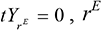 \int p(r) - e(r)]drF transforms the decision margins on each radius, r, into an area; and F > 0. The government's objective function is
![\[
\begin{array}
$\max _{r^E, G} F\left({\int_0^{r^E} {[p(r) - e(r)]dr}} \right) + tY(G,r^E, r^S) - C(G) + R$
\end{array}
\](https://static.cambridge.org/binary/version/id/urn:cambridge.org:id:binary:20160308071059351-0569:S0022050713000831_eqn2.gif?pub-status=live)
![\[
\begin{array}
$R = F\left({\int_0^{r^E} {\alpha (v - p)dr + \int_{r^E}^{r^S} {\beta [(1 - \rho)v - s]dr}}} \right) + \gamma (1 - t)Y$
\end{array}
\](https://static.cambridge.org/binary/version/id/urn:cambridge.org:id:binary:20160308071059351-0569:S0022050713000831_eqn3.gif?pub-status=live)
where the first term in equation 2 is the net revenue from public land sales and the second term is revenue from the taxable sector which is a function of other public services, G, and external benefits from pastoral production in the zone of settlement. External benefits increase with rS and may increase or decrease with rE. The cost of providing other public services, including the transaction costs of collecting taxes, is C(G).
The final term, R, in equation 2, captures the rent-seeking influence of political constituents. Either government might be influenced or captured by a powerful interest group—cattle-raising interests in Buenos Aires or sheep-raising interests in NSW. The model accounts for the influence of a powerful or dominant interest group by combining the government and the interest group into a single “ruling interest” that seeks to maximize the joint income of the government and its supporters. The logic applied here is adapted from the so-called “redistributive model” of government of Martin McGuire and Mancur Olson (Reference McGuire and Olson1996). Its advantage is simplicity as it captures the effect of rent-seeking interests without excessive complication of the model.
The three terms in R, on the right-hand side of equation 3, capture three sources of rents that accrue to the government's supporters. The first term gives the rents appropriated by supporters' purchases of public lands inside r E, where α is the share of public land sales purchased by supporters. The second term is the rents that supporters appropriate by squatting, where β is the share of squatted land occupied by supporters. The third term γ(1 − t)Y is the private post-tax earnings from other activities that supporters appropriate, where γ is the share that goes to supporters.
Assuming an interior solution, a necessary condition for optimal r E is
![\[
\begin{array}
$e = \rho v + s + (\alpha - \beta)[(1 - \rho) v - s] + [t + \gamma (1 - t)]Y_{r^E} /F'$
\end{array}
\](https://static.cambridge.org/binary/version/id/urn:cambridge.org:id:binary:20160308071059351-0569:S0022050713000831_eqn4.gif?pub-status=live)
where  $tY_{r^E} = 0$$Y_{r^E} = {\raise0.7ex\hbox{${\partial Y}$} \!\mathord{\left/). To interpret this condition, we develop four possible cases, reflecting different political economic settings. As a baseline case, we assume that R = 0, that the government may behave indifferently to, or is unconstrained by, political constituents. This corresponds to McGuire and Olson's “autocratic” model of government.
VON THÜNEN SQUATTERS' BAND
The baseline is simply a special case that permits the simplest and most intuitive prediction of how the government determines rE. Upon this baseline, we then identify three other possible cases from the more general model, with nonzero constituent influence. In each case, the logic of the baseline continues to hold, and the influence of political constituents has an incremental (positive or negative) effect on the baseline case.
Case 1. Baseline case. If R = 0, the first-order condition simplifies to  $e = \rho v + s + tY_{r^E} /F'$$tY_{r^E} = 0$ Intuitively, if $tY_{r^E} = 0$, rE is chosen so that the marginal cost of government enforcement, e, is equal to the marginal cost of private enforcement, ρv + s. The model predicts (1) the official settlement boundary, r E, that defines an official zone of settlement, and (2) a Von Thünen band of squatter settlements with de facto claims that forms outside the zone of settlement, as depicted in Figure 2. Although the government forbids settlement beyond rE, settlers choose to squat beyond it as long as (1 − ρ)v ≥ s. Under this condition, settlement from the port to rE is supported by de jure specification and enforcement of property rights; while a band of squatting or de facto claims forms outside the boundary, rE, which does not have government sanction or enforcement. The squatters' band terminates at the distance, rS, where the marginal value of unprotected land (1 − ρ)v is equal to the cost of private security, s.
If there are positive externalities to extending the boundary rE, due to tYrE > 0, government would extend rE farther out to where the marginal net loss from land sales equals the marginal gain from the externality. This might result if tax collection were more effective from de jure owners than from squatters. If, however, there is no difference in tax collection, YrE = 0 is more likely. The latter best suits Buenos Aires and NSW in our period of study, where import duties were the principal non-land source of taxation. Expansion of the squatters' band at rS increases tax revenues, or tYrS ≥ 0; but, with the exception of Case 4 below, the government has no influence on the outer boundary, rS, as it is entirely dependent on how far out squatters are willing to wander.
The last two terms on the right-hand side of equation 4 are, respectively, the marginal rent that supporters receive from an increase in r E (i.e., the net increase in value of a de jure relative to a de facto claim for a given parcel) and the marginal benefit to the ruling interest from externalities of claiming the additional lands, either collected as taxes or provided as net rents to government supporters. The marginal benefit from externalities hinges on the sign of $Y_{r^E} $ as discussed above; it is likely to be zero in the cases we examine. All other terms in equation 4 are nonnegative, except . The sign of this term tells whether the government would choose to extend or contract the enforcement boundary, rE, in response to constituents' or supporters' demands relative to the baseline case. The model predicts three cases beyond the special baseline case.
Case 2. Smaller official zone of settlement. If (1 − ρ)v − s > 0 at r E and α − β, constituent settlers, who prefer de facto to de jure land claims, pressure government to set r E so as to define a smaller official zone of settlement relative to the baseline to leave more land open to squatting, an accommodation of squatters' de facto claims.
Case 3. Larger official zone of settlement. If (1 − ρ)v − s > 0 at r E and α − β, constituent settlers, who expect to benefit from government enforcement of their property claims, pressure government to extend rE beyond the baseline case, which extends the area of de jure specifications and the official zone of settlement.Footnote 5
Case 4. Government-led territorial expansion. If (1 − ρ)v − s > 0 at r E, no squatting would be observed, the opportunity cost from squatting is no longer a binding constraint, and the first-order condition expressed in equation 5 no longer applies. The necessary condition becomes instead: e = p + α (v - p) + [t + (1 − t)γ]YrE/F′. In this case, as settlers encounter strong indigenous resistance, the government is pressed to use revenues from other sectors to subsidize territorial expansion for the benefit of the ruling interest despite an increase in the marginal cost of enforcement at rE.
Three comparative static results are central to the discussion below. First, as the demand for exports of wool or cattle products (hides, salted beef and tallow) rises, land values, v(r), are driven upward, and outer settlement boundary, rS, shifts outward as settlers occupy more land and extend the frontier. Second, the level of risk ρ could have a large effect on the relative size of the squatters' band. A greater indigenous threat on the frontier increases ρ and pulls rS inward and pushes rE outward. A severe threat could keep rS close to rE or cause the squatters' band to vanish, as in Case 4.
Third, independent of changes in ρ, rising land values, v(r), create an incentive for government to shift the enforcement boundary, rE, outward over time. Changing the boundary, however, is not frictionless. Assuming ex ante official zones of settlement are set initially when few settlers were on the frontier (a reasonable assumption in the two cases we examine), ex post after settlers migrate out and claim de jure or de facto rights, governments are no longer free to behave as if preexisting private claims do not exist. As land values rise, governments may desire to reassert the public claim over lands formerly taken by squatters. But if the government tries to redraw rE over existing de facto claims, it is likely to stir up resistance, even violence, from squatters. How the official zone of settlement may be altered ex post depends on the political institutions.
It is beyond the scope of this article to explain how de facto rights were transformed into de jure rights, which is an inherently political process. The model presented here is a one-shot model of the initial stage of settlement, when there are few de facto claims and the government is free to set the boundary unconstrained. A separate online appendix at http://journals.cambridge.org/action/displayJournal?jid=JEH extends the model to consider how, in subsequent stages, the emergence of competing de facto claims on the frontier can constrain the government's ability to redraw the boundary. Alston, Harris, and Mueller (Reference Alston, Harris and Mueller2012) argue that the transition from de facto to de jure rights may be smooth if de facto claimants control the legalization process or if squatting is minimal; but disputes between the government and squatters may provoke political conflict, violence on the frontier, or result in the state's use of force (pp. 748–49).
SETTLEMENT ZONES AND RISK
How consistent is the model with patterns we observe in NSW and Buenos Aires? First, both governments were in need of raising local revenues; both targeted public land as a big potential source of revenue; and land policies in both broadly conformed to the predicted patterns. In particular, in the early stages of settlement, they defined official boundaries and zones of settlement, engaged in de jure transfers of public land within the boundaries, and discouraged settlement or refused third-party protection and enforcement outside the boundaries.Footnote 6
Colony of New South Wales
In NSW, through the early 1820s, the penal colony's settlement was concentrated in the immediate area around Sydney.Footnote 7 Conflicts between Aborigines and settlers and the natural barriers of mountain ranges limited the expansion of farms and stock grazing. Land settlement expanded as new lands were discovered ideal for stock grazing, a breed of merino sheep with wool suitable for export was disseminated, the free population grew, ocean shipping rates declined, and settlers' ability to prevail in conflicts with Aborigines increased.
NEW SOUTH WALES, SHOWING THE NINETEEN COUNTIES AND THE SQUATTERS' DISTRICTS ESTABLISHED BY 1844
The transition from a penal colony with limited demand for Crown land to a colony with thriving wool exports and a growing demand for Crown land was accompanied by NSW government actions to define settlement boundaries and provide de jure specification and enforcement within those boundaries. In 1829 the NSW government specified boundaries for Nineteen Counties and labeled their perimeter as the “Limits of Location.” The Nineteen Counties, shown in Figure 3, centered on Sydney stretching inland from the coast into the grasslands beyond the Blue Mountains.
According to equation 4, the official settlement boundary would be drawn where the marginal cost of government specification and enforcement of de jure property rights began to exceed the marginal opportunity cost from squatting. How did resistance from the Aboriginal bands using these lands affect the government's cost of enforcing de jure rights and its 1827 decision regarding how far out to authorize settlement? Aborigines resisted, but the amount of resistance was constrained by the small size of each Aboriginal band, limited cooperation due to histories of intergroup warfare, and a sparse, declining population.Footnote 8 Aborigines did not organize large-scale forces and avoided direct military confrontation, using, instead, terror tactics against settlers and soldiers. They raided farms and stole food, sheep, and cattle, destroyed resources, and sometimes injured or killed “intruders” stationed on the runs. Hundreds of shepherds and thousands of Aborigines perished in land conflicts.Footnote 9 Aboriginal resistance raised the cost to government of enforcing de jure property rights on any given parcel, as only a limited number of British forces were available to police sheep runs scattered widely over a huge expanse of territory.
The government's decisions in the mid-1820s to set settlement boundaries, to survey lands within the boundaries, and to provide de jure enforcement for those lands were accompanied by a change in how it transferred rights to Crown lands within the settlement boundaries to settlers. Until 1831 the land grant was the primary instrument for privatizing Crown lands, with the grant conditional on improvement and subject to an annual quit rent. Land revenues were small because quit rents were small and often in arrears.Footnote 10 London's dissatisfaction with quit rent revenues in NSW and other British colonies helped to provoke the 1831 Ripon Regulations, which provided for sales of NSW Crown lands.Footnote 11 These regulations standardized how Crown lands were privatized throughout the empire and were expected to generate more revenue from privatization. They required colonial governments to privatize Crown lands within defined settlement boundaries by selling surveyed parcels, selected by a potential buyer, at auction subject to a minimum price of 5 shillings per acre.Footnote 12
The success of public land sales was limited for two reasons. First, the minimum price provided in the Ripon Regulations overpriced much of the land inside the Limits of Location, leading to some squatting on these lands (Weaver Reference Weaver1996, pp. 986–87).Footnote 13 Second, news from a series of exploratory expeditions told of the vast expanse of lands beyond the Limits suited for sheep runs.Footnote 14 Enterprising colonists responded quickly, walking flocks of thousands of sheep hundreds of kilometers to establish new sheep runs. By the early 1830s a full-blown land rush had developed, with settlement spreading far beyond the Nineteen Counties (See Roberts Reference Roberts1975, pp. 135–45; Weaver Reference Weaver2003, pp. 138, 142, and Reference Weaver1996, p. 988; and Rolls Reference Rolls1981, pp. 72–89). Thus, as the expected value of lands beyond the Limits rose, settlers found that it paid to squat beyond the Limits rather than to squat or buy de jure rights inside them.Footnote 15
As the land rush continued through the 1830s, the outer edge of the squatters' band, r S, extended hundreds of kilometers into the grasslands in the interior. From 1835 a second rush emerged to occupy lands in Port Phillip, with the settlement of what became Melbourne on Port Phillip Bay, providing the market outlet. Settlers came from the Northeast, following the tracks of the wagons left by Surveyor General Thomas Mitchell's exploratory expedition of Victoria, and from the south, crossing the Bass Strait from Van Diemen's Land to Port Phillip.
Port Phillip emerged as another major port. Governor Richard Bourke tried to avert the unauthorized land rush, and avoid the preemptive actions of settlers from Van Dieman's Land, by opening a restricted area for official settlement there in 1836, with its own administration. The lands on this protected bay were especially valuable because they were at a site that could emerge as another potential commercial hub, which settlers recognized. These developments are captured in a minor extension of the model to account for multiple ports with official zones and squatters' bands extending from each, which may overlap.
In the squatters' bands, three factors contributed to declining risk of property loss, ρ, and cost of private security, s. First, settlers obtained an advantage in violence over Aboriginals due to drastic declines in Aboriginal populations from exposure to European diseases.Footnote 16 Second, the use of mounted soldiers and settlers on the frontier after 1826 provided an additional advantage in violence to settlers. Third, incumbent squatters developed informal second-party institutions to enforce de facto rights against encroachment from neighbors or newcomers and resistance from Aboriginal groups who also resided on or harvested resources from these lands.Footnote 17 As a consequence, squatters settled farther and farther out; that is to say, the settlement boundary, rS, shifted outward as (1 − ρ)v − s rose on the frontier.
Province of Buenos Aires
The Province of Buenos Aires also maintained an official zone of settlement defined by an official boundary (linea de fronteras), defended by a line of forts to the south to protect the city of Buenos Aires and its surroundings. First built in 1741, before 1810 the line had never extended farther than 100–120 km inland and to the south from the Río de la Plata or the city of Buenos Aires, as shown in Figure 4. Unlike NSW, there was no significant squatting beyond the linea de fronteras primarily because it was the indigenous tribes, not the Spanish, who controlled the territory (Avellaneda Reference Avellaneda1865; Barba Reference Barba1997, p. 25; Cárcano Reference Cárcano1917, pp. 27–30; Carretero Reference Carretero1972; Halperín Donghi Reference Halperín Donghi1963; Infesta Reference Infesta, Bonaudo and Pucciarelli1993, p. 73; Zimmerman Reference Zimmerman1945).
The density of the indigenous population on the pampa, estimated at about 0.07 inhabitants per km2, was less than double that of Australia.Footnote 18 A key difference, however, was the social and economic integration of this population with the Andean civilization to the west where the population density was significantly greater, estimated at 1.45 inhabitants per km2 (Rosenblatt Reference Rosenblatt1954; Pyle Reference Pyle and Denevan1976). The tribes of the pampa descended from the Araucanians of the Chilean Andes, giving a heritage that provided the pampa tribes with a richer institutional foundation, compared with the Australian Aborigines, upon which to solve problems of collective action, including a more effective military organization during times of war (Canals Frau Reference Cárcano1946, pp. 761–66; Cooper Reference Cooper and Steward1946, p. 724).
PROVINCE OF BUENOS AIRES, SHOWING TERRITORY ACQUIRED BETWEEN 1779 AND 1852
By 1810 the line of military defense, rE, had reached no farther south than the Salado River (with some periods of retreat). Throughout its history, the colony was under constant threat of invasion from the nomadic tribes that controlled lands to the south of the Salado River. The colonial and republican governments negotiated many short-lived treaties trying to keep the peace (Muñíz Reference Muñíz1929, p. 93). The greatest threat came from the warlike Pampa and Ranquel tribes, who lived farther to the south and migrated northward in organized expeditions to rustle herds of cattle to be driven and marketed to the Araucanian communities in the Chilean Andes. They routinely conducted raids on horseback in bands of typically 70–100 to raze and pillage isolated haciendas and steal cattle and horses. They ambushed parties of travelers and killed or took prisoners. The frontier was under constant threat (Barba Reference Barba1997, pp. 23–27; Best Reference Best1960, vol. 1, pp. 110–11; vol. 2, pp. 317–53; Tapson Reference Tapson1962, pp. 6–7).
Although common raids were conducted in bands, when European aims at territorial expansion threatened indigenous claims to land on the pampa, the opposing tribes formed military alliances and organized forces numbering in the thousands. They deployed cavalry formations learned from the Europeans in the war of independence and from deserter gaucho military commanders. And they combined these tactics with superior local knowledge and better logistics—intimate knowledge of the desert terrain, ability to move swiftly in large numbers, ability to survive by foraging, and control of routes to the Andes where they could obtain reserves and supplies. They were skillful on horseback with the traditional lance and bola, but also used firearms and an occasional cannon they stole from the haciendas.Footnote 19
The war of independence against Spain had left the new republic cut off from the colonial silver trade. Chronic internecine political struggle and war with Brazil created additional need of revenue for defense and debt service.Footnote 20 The vast “underutilized” land in the interior offered a promising resource for expanding the pastoral economy. One of the first acts of the revolutionary government was to claim the interior tierras realengas of the former viceroyalty as public or “fiscal” lands and authorize the sale of public land on the frontier to raise revenues. On these frontier lands, to strengthen the line of defense, the government granted land to war veterans on the condition that they resided locally and assisted the militia in the district's defense (Cárcano Reference Cárcano1917, pp. 14, 26–30; Coní Reference Coní1956, p. 16; Halperín Donghi Reference Halperín Donghi1963; Irigoin Reference Irigoin, Fradkin and Garavaglia2004).
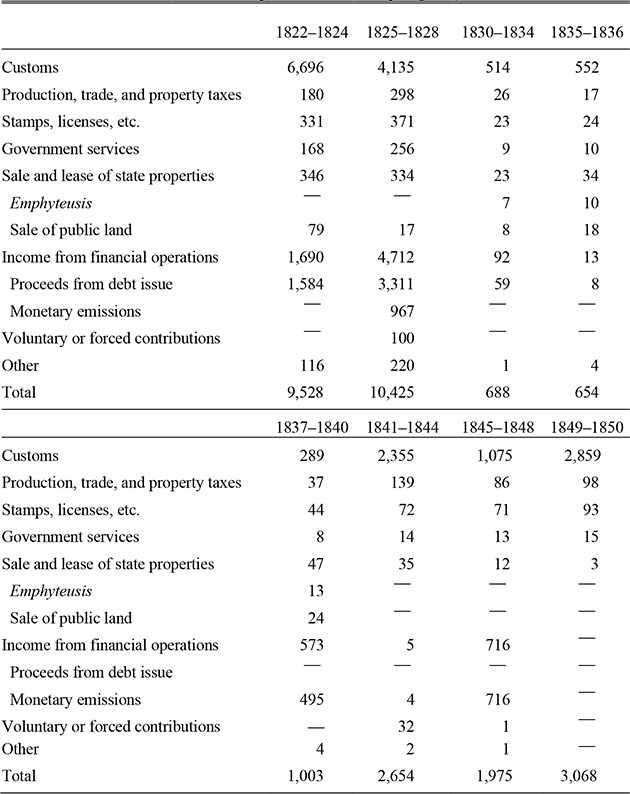
The sale of public lands, initiated in 1813, did not generate much revenue, as the land for sale to the south was exposed to Indian attack (See Table 1).Footnote 21 According to one report, the insecurity caused prices of frontier land to amount to no more than a month's rent (Coní Reference Coní1956, pp. 36, 163). A land grant program was instituted in 1817 to compensate former soldiers for services and fortify the line of defense with armed settlers, and to defend a settlement south of the Salado at Dolores. It was no more successful. Commenting on how properties in the exposed areas were abandoned, Miguel Angel Cárcano remarks: “If they couldn't guarantee the property rights of the land they gave away, how could they possibly sell it?” (1917, pp. 30–31). Before 1826, then, estancias for raising livestock, towns, or villages were built up to the line of defense, which stopped at the Salado River, as shown in Figure 4.Footnote 22
FISCAL REVENUES FOR THE PROVINCE OF BUENOS AIRES, 1822–1850 (annual averages in thousands of gold pesos)
Sources:
These figures are summarized from Halperín Donghi (Reference Halperín Donghi2005, pp. 169–89, 223–44), deflated using peso prices of gold from Burgin (1945, pp. 69, 165, 274).
As the export market for cattle products expanded, political demands intensified not only to defend the border but to secure the land to the south for grazing livestock (Halperín Donghi Reference Halperín Donghi1963; Irigoin Reference Irigoin, Fradkin and Garavaglia2004). In response, successive governors organized military regiments for “desert campaigns” in 1820/21, 1823/24, 1826/27, and 1828–1834 to push back the boundaries of Indian control and extend the line of defense beyond the Salado River to the south. These more aggressive attempts at territorial expansion were met with full-fledged warfare.
Contrary to European stereotypes, before 1833, the indigenous forces often matched or dominated Buenos Aires forces in battle. Most desert campaigns were failures, especially the early attempts. Before the successful campaigns of 1826 and 1833, Rómulo Muñíz remarks, “the opinion existed that it was almost impossible to defeat [the Indians],” a view that did not change until Colonel Federico Rauch in 1826 and General Juan Manuel de Rosas in 1833 used diplomacy to form alliances with local tribes, giving them access to superior knowledge of the terrain and customs of rival tribes, and improved supply links (1929, p. 149).Footnote 23
The absence of squatting on the pampa is, therefore, consistent with Case 4 of the redistributive model—the band of squatters vanished because the threat on the frontier, ρ, was too high for isolated settlers to defend claims using private enforcement. Even for the largest estancieros, organized military protection at sufficient scale was necessary, and local second-party arrangements comparable to those that developed in NSW were not an adequate substitute in the much riskier Buenos Aires frontier. It was not the opportunity cost from squatting that constrained the porteño (Buenos Aires') government's enforcement of public land claims. Rather, it was the cost of military defense of new territorial claims against a large and relatively well-organized indigenous opposition. Therefore, relative to the NSW colonial government, the government of Buenos Aires had a bigger role in securing land for new settlement. Expansion of settlement on the pampa was government-led. When the military succeeded in pacifying new territory, the government first claimed it as public land and then made provisions to transfer rights de jure to private individuals.
PROPERTY RIGHTS SPECIFICATION ON PUBLIC LANDS
Each government attempted to create de jure property rights to privatize public land and raise revenue, but the different challenges they faced caused the emergence of property rights on the frontier to follow a de facto path in one case and a de jure path in the other.
New South Wales
At the inception of the NSW colony, the government allocated land by providing for land grants to retired military personnel, emancipated convicts, freed settlers, and commissioned officers. After eligible recipients selected land for grants, the Surveyor General was to survey the land. Payment of an annual quit rent was specified in the grant. The 1822 and 1823 Bigge reports, commissioned by the Colonial Office to investigate the NSW government, criticized the time required to complete the surveys and the low collection rate of quit rents from previous grants. They recommended ending free selection—lands would instead be surveyed in advance “and laid out in districts” from which selections could be made. The Colonial Office responded in 1825 by issuing the “King's Instructions,” which authorized a comprehensive survey of the colony and the division of surveyed public lands into counties, hundreds, and parishes.
In 1826 the NSW government announced the approximate boundaries of “Nineteen Counties” within which grantees could select land. With the appointment in 1827 of a new Surveyor General, Thomas Mitchell, and the assignment of additional staff, work on both the survey and boundary specification proceeded more quickly. By October 1829 boundaries for the Nineteen Counties with their 23,083,200 acres had been fully delineated, and the Office of the Colonial Secretary published a public notice of the boundaries, known as the “Limits of Location.” Between 1828 and 1834 Mitchell and his staff surveyed virtually all of the 1,946,478 acres of Crown land privatized within the Limits during this period. Just 73 farms remained to be measured as of June 1834 (Cumpston Reference Cumpston1955, pp. 107, 124).
Despite the close attention paid by the London and Sydney governments to the delineation of de jure rights to surveyed parcels within a settlement boundary, settlers' calculus over whether to buy (or be granted) land with de jure rights or to make a de facto claim on land beyond the Limits shifted toward de facto claims while the survey inside the Limits was proceeding. As described on p. 915, after they received new information about the large quantities of land highly suitable for grazing beyond the Limits, squatters rushed out to claim de facto lands. In the meantime, the resistance from the Aboriginal population, decimated by disease, declined.
As the population in NSW increased and the market for wool grew, more squatters looked to establish sheep runs at the frontier. Stephen H. Roberts describes how newcomers and earlier settlers on neighboring holdings negotiated to establish boundaries. As threats of encroachment grew, incumbent squatters often worked together to defend their de facto claims from newcomers (Roberts Reference Roberts1975, pp. 277–84).Footnote 24 By the late 1830s, however, increased competition for land led squatters to use an increasing number of devices to increase the size of their de facto claims and to seek the help of colonial officials to enforce them.
As the value of land increased beyond the Limits of Location (where r > rE), the model predicts that a revenue-seeking government might try to extend rE, although, if it did, existing claimants could resist. These pressures began to appear in the 1830s, as the Colonial Office, Edward Gibbon Wakefield and his supporters, and certain local interests pressed the NSW government to reassert the public claim to land occupied by squatters. Self-interested squatters resisted, and, in response, the NSW government took three measures that progressively reasserted its claims with some accommodation to squatters' claims within certain parameters.
The first measure, an act of 1833, addressed the problem of squatting on public lands within the boundaries of settlement by providing for the lease of Crown land for grazing inside the Limits.Footnote 25 The new law created district commissioners with authority to administer and enforce rent collections (Abbott Reference Abbott1971, p. 137; Buckley Reference Buckley1955, p. 405).Footnote 26 A second measure, an act of 1836, provided for districts and commissioners outside the Limits and required that squatters purchase a license for an annual fee of £10.Footnote 27 The licenses reasserted government's claim to a revenue stream from the Crown lands. While they legitimized squatting, the licenses were not leases and did not transfer de jure rights to land in the conventional sense because they did not specify the boundaries, location, or size of a squatter's claim, which continued to be defined by second-party norms. Licenses were, therefore, of limited value to settlers who desired to establish government specification and enforcement of their de facto claims.
In 1839 a third act provided additional powers to enforce the public claim to land in the squatters' band.Footnote 28 It vested district commissioners with powers to remove a squatter's license without appeal, to remove or destroy stock, to define the boundaries of the sheep run, to investigate charges of violence against Aborigines, and to collect license fees and newly imposed taxes on stock. It provided district commissioners with a small mounted police force to help enforce adjudications.Footnote 29 Squatters complained that the 1839 Act diminished their de facto land rights by giving the government an annual option to terminate their license without compensation for improvements, which rendered second-party-enforced transfers or liens for credit less secure.Footnote 30 Governor George Gipps' decision in 1842 not to renew squatter William Lee's license symbolized the increased insecurity and triggered growing opposition to government encroachments as squatters defended de facto rights on the principle of prior possession.Footnote 31
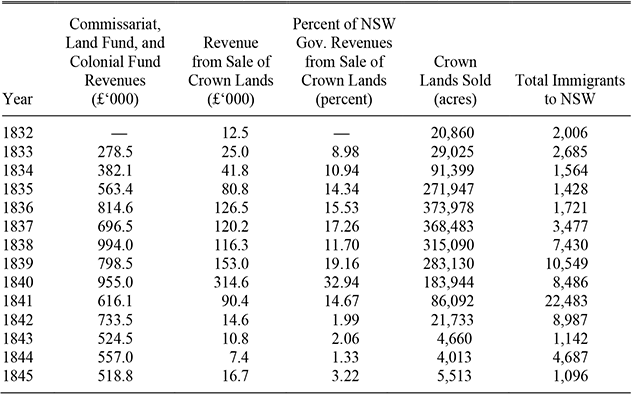
De jure land sales and increased enforcement produced substantial revenues from Crown lands between 1833 and 1841, but very little thereafter. Between 1833 and 1841, the crown sold 2,003,088 acres, with land sales revenue accounting for roughly 16 percent of annual colony revenues.Footnote 32 After 1841 land sales revenues fell to less than 3.25 percent of annual colony revenues due to an increase in the minimum price of land within the Nineteen Counties and depressed economic conditions in NSW's grazing industry.Footnote 33 They were hit hard in 1842 by plummeting wool prices during the global depression and suffered a sharp decline between 1841 and 1845 (See Table 2). This led to suspension of assisted migration and a search for new revenues to resume the program.
The circulation of Governor Gipps' proposed Occupation and Purchase Regulations of 1844 marked a turning point in the nature of political representation in the colony. The proposed Purchase Regulations were, in particular, offensive to squatters' interests. They would have required squatters to purchase 320 acres of each sheep run at £1 per acre as a homestead to qualify for an eight-year license for a fee to obtain the right of use of the remainder of the squatter's run. At the termination of the license, squatters could renew a license with the purchase of another 320 acres. Yet, since blocks for purchase were to be auctioned, an outsider could compete for the right to control the entire run. In short, the Purchase Regulations were aimed directly at reasserting the colonial government's claim to squatters' de facto land claims and revenue from their sale (Abbott Reference Abbott1971, p. 171).
As Gipps moved to implement parts of the Occupation Regulations in 1845, opposition in London to the Regulations increased, as the NSW wool industry gained powerful political support due to rapidly growing imports of Australian wool by the British woolens industry. In 1831 Australian wool imports of £62,333 accounted for just 6.6 percent of the all wool imports into England, but by 1845 they had increased almost tenfold, to £603,764 or 30 percent of the value of wool imported into England.Footnote 34
SALES OF NSW CROWN LANDS, NSW PUBLIC REVENUES, AND NSW IMMIGRANTS
Notes:
Total revenues for the Commissariat Fund (table 4(a)), the Colonial Fund (table 4(c)), and the Land Fund (table 4(e)) were adjusted to remove fund balances.
Sources:
Total colonial revenues and land sale revenues are from Butlin (Reference Butlin1994), appendix 4, tables 4(a), 4(c), and 4(e). Crown lands sold and immigration data are from Burroughs (Reference Burroughs1967), appendices II and III.
Squatters and stakeholders in the wool trade formed alliances to oppose Gipps' regulations. A coalition of colonial grazers and newly formed associations of English and Scottish woolens manufacturers, shipping companies, and bankers, all with linkages to Australian wool production, formed in 1845 to lobby members of Parliament and other influential figures. By mid-1846 the coalition's efforts paid off with Parliament's passage of the Australian Waste Lands Act, which established a set of de jure rights to de facto claims that provided more security of tenure than the Purchase Regulations had proposed. Squatters obtained 14-year leases, a preemptive right to purchase at least 160 acres for £1 per acre, and the right to cultivate the land for subsistence. Only the occupying tenant could purchase a station's land during the term of the lease, and leases in the unsettled interior districts could be renewed. Rights of preemption or compensation for improvements were recognized.Footnote 35
The passage of the Australian Waste Lands Act of 1846 highlights rising political influence of squatters as the government's reassertion of its claims is consistent with a relative shift in shares from α − β ≥ 0 to α − β β 0. This implies a change in the equilibrium outcome of the model from Case 1 or 2 to Case 3, as squatters shifted from resisting government interference with de facto claims to demanding that the government convert their de facto claims into government-enforced de jure rights. This is a transition that occurred progressively from 1833 to 1845.Footnote 36
Buenos Aires
If transition from de facto to de jure specification in some form seems to have been the norm in most neo-Europes, Buenos Aires was an exception. It was also an exception among the newly independent republics of the Spanish Empire. The colony had inherited the Spanish system of defining and recording boundaries, with its many “deformities” that compromised the “security of property, its clarity, and transfer” (Cárcano Reference Cárcano1917, pp. 34, 42, 56; Dye Reference Dye, Bulmer-Thomas, Coatsworth and Cortés Conde2006, pp. 196–97; Zimmerman Reference Zimmerman1945, p. 6). The founding leaders in Buenos Aires moved quickly to modernize the measurement and definition of property rights.
The desire to generate revenue from public land to service government debt was an underlying incentive. After attempts at land sales failed, porteño leaders turned to the institution of the emphyteusis, a transferable 20-year leasehold arrangement, which became by far the most important contractual arrangement for the transfer of public land.Footnote 37 Its adoption originated as part of a financial reform implemented in 1821 and 1822 to consolidate the state's chaotic government debt. To provide security for a bond issue of 6.4 million pesos issued in London by the end of 1824, the government prohibited the alienation of all public land and pledged all its immobile and mobile property as a guarantee.Footnote 38 A few months later, it authorized the emphyteusis of public land to mobilize its long-term use for cattle grazing and to generate revenue.
The early republican leaders understood that, without clear definition of the boundaries and size of claims, the revenue due the government from emphyteusis could be too easily disputed or obscured. The initial steps were taken in 1824 under Governor Martín Rodríguez to set up a Topographical Department to conduct a general survey of land to be opened for emphyteusis and to keep an official land registry of surveys and claims filed. Under the emphyteusis law, claimants were required to survey each claim, which then had to be examined by the courts and filed with the land registry.Footnote 39
What evidence is there that original de jure specification was implemented? First, in the expansion to the south of the Salado, enabling legislation for de jure specification preceded the government's actual taking possession of the land. For example, the enabling law that provided for de jure specification of emphyteusis lands to be acquired in the 1826 desert campaign preceded the launch of the campaign by several months. Second, records show that most claims were filed in the first few years after the military campaigns were completed with accompanying provisions for de jure transfers. Figure 5 shows that over 60 percent of the claims of public land in emphyteusis were made in 1826–1828 and 1833/34. Peaks in 1826 and 1834 coincide with successful campaigns. The 1828 peak reflects a failed campaign, but the territory it encompassed was reclaimed in the 1833 campaign.Footnote 40
Using data from María Elena Infesta, we find that about 76 percent of the public land was transferred originally in emphyteusis.Footnote 41 About 22 percent was in land grants, and only 3 percent was privatized by sale. This is not to say that sales of public land on the frontier were unimportant. Almost half of all land ever held in emphyteusis, about 36 percent of all public land transfers, was later alienated by sale or grant by the Rosas dictatorship between 1836 and 1843, much of it to the holders of emphyteusis contracts. But when considering the specification of property rights in public land, the distinction between the original and subsequent transfers is crucial. In the original transfers under emphyteusis, surveys, formal boundaries, and registration were required by law. The original de jure specification for emphyteusis contracts created initial land measurements which underpinned and facilitated the subsequent sale of a de jure right.
TRANSFERS OF LAND IN EMPHYTEUSIS, BUENOS AIRES, 1823–1840
De jure specification and enforcement were not perfect in an environment of political instability, scarce government resources, and bureaucratic inexperience with modern methods of measurement. Some public land was known to be occupied without title, but many of these claims apparently fell inside the old line of defense and were probably a legacy of the “deformities” of the former Spanish system of defining and recording property rights to land (Amaral 1994, pp. 69–70, 101, 187; Dye Reference Dye, Bulmer-Thomas, Coatsworth and Cortés Conde2006, pp. 195–98). To firm up property rights, the government extended de jure recognition of de facto claims in disputed lands north of the Salado if claimants could demonstrate continuous occupation of the lands. But south of the Salado, it does not seem to have been as necessary. As Governor Juan Manuel de Rosas cracked down in 1835 on rent evasion on emphyteusis lands, other flaws in the survey methods came to light, such as overlapping claims that arose because surveys were often done in isolation. To correct the problem, the governor called for a new general survey of the province in 1835, district by district (Infesta Reference Bonaudo and Pucciarelli2007, pp. 36, 41, 74–75; Coní Reference Coní1956, pp. 34–36, 126, 162–63).
The political instability of the early years created other problems. The books that kept the central land registry were lost in 1827 in the takeover of the provincial government by the Federalists. Governor Manuel Dorrego called upon the Topographical Department to recreate the registry by requiring all emphyteusis claimants to come forward and reregister or forfeit their claims (Infesta 2007, pp. 37–38; Oddone Reference Oddone1967, pp. 50–51). Such incidents reveal certain imperfections in the maintenance of de jure rights, but they underscore the effort and intent of government actors to establish de jure, rather than de facto, specification of emphyteusis rights.
The emphyteusis law was revised in 1826 and 1828 to favor powerful lessees (enfiteutas)—cattle interests—at the expense of revenues. Rental fees were reduced even as land became more valuable. Meanwhile, the government defaulted on its foreign debt and resorted to inflationary finance. With rents made payable in depreciating paper, real rental fees fell to a fraction of their original level. A square league that earned 160 pesos in 1826 paid a real value of only 34 pesos in 1830 (Cárcano Reference Cárcano1917, pp. 67–68).Footnote 42 The preference for inflationary over debt finance reflected cattle interests with assets in land and livestock, which did not erode with inflation, while it hurt investors with assets in government bonds redeemable in depreciating paper (Irigoin Reference Irigoin2000a, p. 198; Reference Irigoin2000b).
Weak governments found rent collection difficult, but their repeated efforts to enforce rental payments on public leases constitute evidence of government asserting its claim (Coní Reference Coní1956, pp. 113–14, 123; Cárcano Reference Cárcano1917, p. 74). But stronger government permitted stronger measures of enforcement. Governor Rosas, who became known as “the Restorer of the Law,” took decisive action against holders of emphyteusis contracts in arrears, decreeing in 1836 that they had two months to purchase their land, after which it would be sold (Infesta Reference Bonaudo and Pucciarelli2007, pp. 41–44; Carretero Reference Carretero1971; Lynch Reference Lynch1981).
Chronic debt led the Rosas government to try to reclaim emphyteusis land as an alternative revenue stream. In 1836 the assembly lifted the prohibition on sales of public land on the condition that Governor Rosas would use all proceeds to amortize government debt, and that land held in emphyteusis could only be sold to the enfiteuta (lessee) (Burgin Reference Burgin1946, p. 176; Coní Reference Coní1956, pp. 118–30, 135, 251–53). When sales proceeds from this act were found disappointing, Rosas in 1838 decreed all emphyteusis contracts in a certain zone unrenewable and targeted for sale. Existing contract holders had a two-month preemptive right to purchase their land. All emphyteusis lands in the zone were subject to sale, even if their contracts were not about to expire.Footnote 43
Rosas is known for wielding the power of the state to enforce laws selectively to favor his political supporters (Adelman Reference Adelman1999, pp. 111, 116). The 1838 decree was used to confiscate the land of political opponents and redistribute it to supporters. It is unknown how much land was confiscated, but warrants for 669 square leagues (4.5 million acres) were acquired in some fashion and reissued to supporters (Infesta Reference Infesta1987, Reference Bonaudo and Pucciarelli2007, pp. 80–92; Sábato Reference Sábato1990, pp. 41–45). As with other predatory regimes, the greater capacity of Rosas to enforce property rights enabled him also to confiscate them. The original form of property rights specification preceded Rosas, but the decline of the rule of law under Rosas meant that de jure specification did not ensure de jure enforcement.
Ironically, orderly public land transfers based on de jure specifications in Buenos Aires became more insecure, whereas the de facto claims in NSW became more secure as provisions for de jure rights replaced or were extended to de facto claims.
CONCLUSION
Whether or not the factor endowments thesis holds, might variation in institutions between neo-Europes be explained by the institutions of their colonizers? The former British colony might have taken the lead in setting up well-defined property rights, whereas former Spanish colonies might have lagged behind in setting up similar institutions. It seems counterintuitive, then, that Buenos Aires set up institutions that provided for de jure specification of property rights on the frontier during the 1820s and 1830s, while NSW, like most other neo-Europes, lost control of the settlement process as squatters rushed out and made unauthorized de facto claims.
Our explanation of this puzzle accentuates the role of government and its revenue objectives, and the role of violence from competing indigenous claimants to frontier land. Previous factor endowments accounts overlook these fundamental elements of frontier settlement. Even though public land disposal ultimately generated little revenue, local governments' attempts to make their vast frontiers a source of revenue guided early public land policies.Footnote 44 Land sales require costly specification and enforcement of de jure property rights and these costs prompted governments to set official settlement boundaries beyond which they refused to support settlement, specification, or enforcement.
Differences in the strength of resistance of first peoples explain differences in settlement patterns and institutions. Typically, if government did not remove them, squatters stood ready to make de facto claims beyond the official boundary. But the threat of violence on the frontier from indigenous confrontation raised the opportunity costs of squatting. In Buenos Aires, the threat was great, making it too risky to settle without military campaigns to secure new land. By contrast, in NSW, the risk from Aboriginal resistance was not as great, and it did not deter squatters from going out and claiming land they had to defend themselves.
The institutional capacity of first peoples to solve problems of collective action affected their ability to mount an effective resistance. The Europeans in NSW had a strict comparative advantage in the use of violence. Bands of Aborginals did not have the political organization or technology to mount an effective resistance. By contrast, Buenos Aires' military forces could not assume a strict comparative advantage. The Pampean Indians were effective at organizing militarily. Tribal alliances combined indigenous skills and organizational capacity with military technology, tactics learned from the Europeans, cavalry, guns, and the occasional cannon to defeat porteño attempts at territorial expansion. Furthermore, recent exposure to European disease weakened and reduced the Australian Aboriginal population but not South American Indian populations who, exposed since the sixteenth century, had developed immunities.
Our findings support a factor endowments explanation, but they warn against oversimplified notions of how property rights emerge in neo-Europes. They are not simply imported because European settlers demand them from government. They may originate from government action, but, as Naomi Lamoreaux (Reference Lamoreaux2011) argues, they sometimes emerge out of illegal takings. In our analysis, how property rights originate depends on the opportunity costs of settlers, who may choose to seek government protection or may chose, instead, to self-enforce a de facto claim. When public, private, and outsider claims collide, how these competing claimants find resolution depends on how the comparative advantage of force is distributed between the parties. Yet ironically, even if a strong government has a monopoly in the use of violence, it may not be able, or willing, to secure control over the institutions of property on a vast frontier. The government's monopoly of force is easily dissipated over a vast territorial claim that is costly to enforce. At greater distances from the seat of government power, property rights depend even more on the resolution of competing claims, including competing indigenous claims, and often, but not always, the substitution of de facto for de jure specification and enforcement of property rights.