INTRODUCTION
There is a growing body of literature in political science that speaks to the importance of religious practice for shaping and defining an individual's political involvement (Verba, Schlozman, and Brady Reference Verba, Schlozman and Brady1995; Smidt Reference Smidt1999; Putnam and Campbell Reference Putnam and Campbell2010). In particular, it has been repeatedly noted that religious attendance is associated with greater turnout in elections and greater levels of civic and political participation more broadly. However, the bulk of this body of literature has been focused on religious traditions with deep roots in the United States, such as evangelical Protestantism, Catholicism, and even Judaism. There is a small, but important, segment of this body of work that has begun to look at other non-Christian traditions in the United States. Islam, in particular, has been a recent focus of academic attention.
However, one weakness of these studies is that they do not tell us much about how religion-qua-religion impacts this political participation. In the cases previously mentioned, the religious traditions scholars have studied have either been a central focus of historical political cleavages within the United States (as with the divide between Catholics and Protestants for much of American political history) or been deeply connected with emerging cleavages within the American electorate (as is seen with evangelical Christianity's place in the more recent growth in the divide between traditionalist and progressive religious forces in the American polity or the spotlight that has been shone on Islam following the September 11, 2001 attacks). Applying these findings to more recent, and less politically salient, religious traditions can give us a better understanding of the innately political aspects of religion, as opposed to those defined by context and framing in the political debate. That is what this article proposes to do.
This article will begin by introducing the literature on political engagement and the impact religiosity plays on it. It will then distill the general consensus from these findings and apply them to a hard test of the existing theories: the American Buddhist community. Given Buddhism's low profile and relative lack of salience in the American political context, practitioners of this religion should find their political participation less defined by the role their faith tradition plays in the American political milieu and more defined by the religion's inherent mobilizing ability.
RELIGION AND POLITICAL ENGAGEMENT
Religion is an essential vehicle for civic engagement in America. Verba, Schlozman, and Brady (Reference Verba, Schlozman and Brady1995) argue that religion plays a primary role in providing individuals, especially individuals from lower socio-economic statuses (SES), the opportunity to develop civic skills. This, in turn, eases barriers to public involvement and advocacy of their interests. Smidt (Reference Smidt1999) further demonstrates that mere attendance is enough to boost political involvement. Of course, Smidt looks only at the relationship between attendance and political participation in the United States and Canada. However, even looking globally, Inglehart and Norris (Reference Inglehart and Norris2003) find a strong and significant relationship between religious attendance and voting. While they find a somewhat quiescent effect for religious attendance on more aggressive forms of political activism cross-nationally (such as supporting boycotts, lawful demonstrations, or unofficial strikes), there is a strong relationship between religious attendance and both electoral participation and support for democracy. Jones-Correa and Leal (Reference Jones-Correa and Leal2001) find that churches function much like other associations in the building of social capital. (However, see Djupe and Gilbert (Reference Djupe and Gilbert2006) for a refinement of this point.) This, along with Smidt, suggests that increases in political engagement are likely tied to the role churches play in information distribution along with the thickening of social networks and facilitation of recruitment. This is in line with Putnam (Reference Putnam2000), who finds that churches are one of the most effective builders of social capital in 20th (and, presumably 21st) century America.
Religious attachments can also motivate individuals to get more involved in their community and can provide them with the civic skills they need to get engaged. However, that is not necessarily the only outcome. Campbell (Reference Campbell2004) finds that involvement in religious organizations can at times serve as an impediment to engagement in the broader society. However, he also finds that the social networks developed in intensive church involvement can also be quickly and intensely mobilized to respond to political stimuli. Furthermore, some religious traditions tend to focus on certain kinds of political action, and engage in them at a denominational level as well as at the individual level (Beyerlein and Chaves Reference Beyerlein and Chaves2003). Thus, it is reasonable to expect that some religious traditions will have greater or lesser impact on voter turnout depending on whether the congregation is focused on political action within or outside the polls.
While religious organizations can and do serve as powerful tools for political mobilization, this is not their primary purpose. Religious institutions exist to serve the spiritual needs of their congregants. As Wilcox and Robinson (Reference Wilcox, Robinson and Wilson2007) point out, there are a number of reasons why religious organizations might mobilize themselves into politics. Some do so in order to advance some belief in the public sphere. Others might engage more out of a negative sense of duty, that is, to work toward a good simply in order to avoid the wrath of God. The type of denomination and the doctrine espoused by the denomination — and even the individual congregation within that denomination — has an influence insofar as what kind and how much involvement we might expect. As such, religious affiliations and religious beliefs can take on the role of an identity as well, with different individuals placing greater or lesser importance on that aspect of their lives. Wald, Owen, and Hill (Reference Wald, Owen and Hill1988) demonstrate the ways in which a church can become a central orienting force in a community. Interestingly, Wald, Owen, and Hill find that “strong” churches that are more stringent and place greater demands upon their adherents generally build up a more unified identity than religious organizations with more porous identities and weaker claims to ultimate truth. Welch and Leege (Reference Welch and Leege1991) complicate this by observing that denominational and belief orientations need not be perfectly in line (they use the case of Evangelical Catholics as an example), and that competing identities weaken the overall power of both denominational and belief attachments. Furthermore, a sense of confidence and efficacy can develop from this increased sense of closeness to the transcendent, which in turn can also reinforce one's belief that they can impact their political environment. This is likely rooted in a sense of divine protection or divine guidance (Harris Reference Harris1999). A standing question stemming from this, of course, is the relative importance of this transcendent sense of efficacy in motivating individual political engagement, especially when compared to the more tangible resources (civic skills and social network strengthening) that a resource-oriented theory of religious-political mobilization. Putnam and Campbell (Reference Putnam and Campbell2010) have recently produced new research that makes a strong case for a theory rooted in the beneficial effect of a community's social capital due to regular church attendance, but other recent work (Schoettmer Reference Schoettmer2010) suggests that we may see different political behavior from faith groups rooted outside the Judeo-Christian religious traditions that have shaped and defined most of American political history and political science research. Thus, it is reasonable to expect that regular religious attendance will lead to greater political involvement and apply it to what might be considered a hard test- American Buddhism.
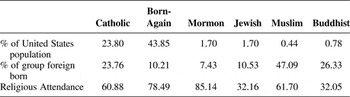
Unfortunately, Buddhism has been the focus of precious little scholarship in the American context. This is certainly true in political science but, as Sharot (Reference Sharot2002) point out, this has also been the case for many strains of research in the sociology of religion — especially for research rooted in rational choice assumptions. Of course, an argument could be made as to the uniqueness of Buddhism and whether this uniqueness limits the ability of this religious group to speak more broadly. Fortunately, though Buddhists are unique in a number of ways, in many of the particulars of interest (particularly size of the population as compared to the whole, percentage that attends religious services at least monthly, and percentage of the group born outside the United States), Buddhists are comparable to other groups of interest to researchers and who have been studied similarly to the way in which the following study proposes to. Table 1 shows how Buddhists compare to other religious minorities in the United States, as well as to Catholics and self-described born-again Christians, who are among the most frequently studied religious groups in the American context.
Comparison of Buddhists on Key Demographic Areas (Pew-RLS, weighted)

Politically, religious minorities generally become salient to the public only when events conspire to place a focus on them. Judaism, given its long intertwined history with Christianity in the West, has long held a place in the study of religio-political engagement. However, outside the Judeo-Christian context, few have received much focus. One religious tradition that fits this description and has received more attention recently is Islam, but this increase in academic interested is linked to the increased interest in the broader society following the September 11th attacks. American Buddhism, on the other hand, is not a religious tradition that has received much, if any, interest in the context of American political science. It is one not considered to be particularly politically salient, at least if one is to judge from the absence of questions related to Buddhist or attitudes toward Buddhism on the American National Election Study (ANES) and other large-scale electoral surveys. Furthermore, the small size of the population makes it difficult to study utilizing cost-effective mass-level surveys. However, a handful of scholars have offered some scholarly analysis of the situation of American Buddhists.
Numrich (Reference Numrich and Numrich2008, 8) writes that the study of American Buddhism has “…the status of a ‘proto-field’ at present” even if one looks at American Buddhism studies from a cross-disciplinary point-of-view. Furthermore, he notes that the large majority of the existent scholarship comes from a humanities perspective. That said, he notes that there is an increasing level of interest in the topic among social scientists, especially in the field of Sociology. Wuthnow and Hackett (Reference Wuthnow and Hackett2003) argue that American Buddhists, like many other minority religious traditions in the United States, enjoy a higher average socio-economic status than do those of the Christian faith. However, he finds that many do not vote — though he argues that this is likely more an effect of ethnicity and immigration than of religion. Interestingly, Wuthnow and Cage (Reference Wuthnow and Cadge2004) find that many Americans have a positive image of Buddhism, and many non-Buddhists report that their religious thinking has none the less been influenced by the tenets of Buddhism. Smith (Reference Smith2006) argues that part of the reason why Buddhism may be successful in exerting some influence over the broader non-Buddhist community in the United States is the unconventional religious affiliation of the tradition. Wolfe (Reference Wolfe2003) gives some deeper insight into the above. In his work on the transformation of American religion, Wolfe notes that American Buddhism is bifurcated between Asian “cradle” Buddhists and native-born converts to the faith. Among the former, Buddhism has become a sort of cultural refuge that serves to reinforce ethnic identity. As such, Asian Buddhists place considerable emphasis on ritual and on communal gathering — much more so that is done in their native countries in most cases. Among native converts, however, Buddhism becomes a sort of rejection of the dominant religious paradigm in the United States and takes on a more spiritual nature. As such, native converts reject traditional modes of Buddhism and align themselves with the most conservative strains of Buddhism, placing considerable emphasis on meditation and little to none on ritual. Buddhist converts also tend to reject traditional authority structures indigenous to Buddhism for a more solitary-oriented practice. Wolfe argues that native-born Buddhists infuse Buddhism with more political meaning than immigrant Buddhists ascribe to it.
Smith and Froese (Reference Smith and Froese2008) argue that Buddhism can play a role in challenging existing paradigms and challenging the assumption of existing models. Its flexibility on issues such as theistic orientation that can allow aspects of religious belief to be teased out that focusing on strictly theistic religious traditions might obfuscate. Buddhism, they argue, presents complications to existing theory that will eventually lead to a wealth of new knowledge. That is a challenge this study has accepted, and will endeavor to explore in the rest of this study.
BUDDHISM IN AMERICA
Buddhism in the United States is a small but growing religious tradition. Indeed, Smith (Reference Smith2009) reports that the American Buddhist community grew 170% from 1990 to 2000, making it one of the fastest-growing religious traditions in the United States. While estimating the scope of a religion in American society is complicated by the fact that the United States Census does not ask for information on religious affiliation, the recent wave of studies conducted by the Pew Research Center (2008) does help shine a clearer light on this problem than previously. Pew's data from the 2007 Religious Landscape Survey suggests that Buddhists make up slightly less than 1% of the entire population. Though small, Pew's numbers suggests that American Buddhism is about as widespread as the Jehovah's Witness tradition and somewhat more common than Islam in the American public.
Furthermore, it is one that, while largely a foreign religious tradition, does not seem to strike many as a particularly threatening religion. The popularity of Buddhist images in American pop culture hint at a benign and non-threatening reputation Buddhism seems to have in mainstream American society (Smith Reference Smith2006). Two Buddhists — Maize Hirono (D-HI) and Hank Johnson (D-GA) — entered the United States Congress in 2006, the same year that the United States saw its first Muslim representative elected to the House of Representatives. One identifiably Buddhist issue (the status of Tibet within greater China) is an issue that at least occasionally becomes the focus of political debate within the Halls of Congress. Furthermore, the popularity, prominence, and credibility that the Dalai Lama enjoys with the American public as an author and spiritual leader as well as a political leader — along with prominent American Buddhist spokespeople such as the actor Richard Gere — suggests that there is a level of political awareness and political engagement among Buddhists themselves.Footnote 1 Despite this, the dearth of scholarship leaves precious little for a scholar to draw on if one desires to evaluate the political context of American Buddhism. Given this relative unfamiliarity among political scientists of American Buddhism, a brief discussion of the community and its demographic features is in order.
As Wuthnow and Hackett (Reference Wuthnow and Hackett2003) observed, Buddhists can fairly be described as belonging to a relatively high socio-economic class. Buddhists are generally highly educated and financially secure. Interestingly, while white Buddhists are somewhat more educated than their Asian co-religionists, the two racial group categories show a rough parity on income. That said, either group is more than twice as likely to have a post-secondary degree as compared to the non-Buddhist segment of American society. Regardless of how one divides the sample, Buddhists much prefer the Democratic Party over the Republican Party. This, in and of itself, is not surprising. Smidt (Reference Smidt and Matthew2007) reports that evangelical and mainline Protestant religious traditions are the only religious traditions in the United States to have Republican majorities, at least as of 2004. What is striking, however, is how decisive the rejection of the Republican Party is among Buddhists. While they do report as more committed to the Democratic Party, the real difference is on the other side of the ledger where white Buddhists in particular are one-fourth as likely to report Republican Party membership as compared to the general public.
What may be surprising to many is both how overwhelmingly Caucasian the faith is as well as how conversion-driven the faith is. 61% of all Buddhists in the sample report being white non-Hispanics. Self-described Asians make up the second-largest segment, at 28% of the sample. Only 24% of American Buddhists were born into the faith, with 25% reporting having been raised as a Catholic and a further 34% report being raised in a Protestant tradition. The religious tradition is also centered on the West Coast. This is likely in part due to initial migration patterns, as more Asian-Americans live in the Pacific Rim states than in other parts of the country. However, it clearly can't explain it all, given the importance of conversion and the majority-white nature of the religious tradition in the United States. Putnam and Campbell (Reference Putnam and Campbell2010) present evidence that religious “nones,” or those without a particular religious tradition, are also more common on the West Coast of the United States. This greater frequency of non-traditional religious affiliations may also create an environment more hospitable to the conversion of non-Western faiths.
While the greater religious attendance described by Wolfe (Reference Wolfe2003) does not show up in the Pew data, religious habits among Asian and white Buddhists do show differences. In particular, private devotion among whites seems to focus on regular meditation, while private worship at family shrines plays a more important role in Asian piety. Interestingly, white Buddhists seem meditate about as frequently as non-Buddhists report praying, while Asian Buddhists are comparable to non-Buddhists in their frequency of meditation. Perhaps most surprising of all is that four-in-10 non-Buddhists do report meditating. Interestingly, this distribution holds up well across religious traditions, with 50% of evangelical Christians, 39% of mainline Protestants and Catholics, 58% of black Protestants, and 60% of Mormons reporting meditating at least weekly.
The religious practice is different among Buddhists than among other faith traditions. As noted by Inglehart and Norris (Reference Inglehart and Norris2003), as well as others who study religious practice cross-nationally, Eastern religious traditions generally have a more private religious practice than those found in the West. In particular, Buddhism does not place the same emphasis upon attending weekly prayer gatherings that Christians, Jews, and (to a lesser extent) Muslims do. Instead, Buddhists emphasize personal devotion, with the occasional retreat into monastic life for those who wish to more deeply explore their faith.
That said, many Buddhist temples in the United States have moved to conform to traditional American religious practice, and offer group meditation or dharma services on Sundays. An analysis of public information available on over 150 Buddhist temples drawn from those listed from across the country on the website Dharmaweb.com found that about 80% of temples offered Sunday morning religious services, often with an emphasis on family or children's religious training. Among those that did not specifically offer Sunday morning services, the vast majority of these temples were of either the Theravada or Vajrayana (Tibetan) traditions. Many of these temples did offer group sessions on days other than Sunday, but many seem to function as cultural centers as much as religious centers. This is, as Wolfe (Reference Wolfe2003) notes, more pronounced for immigrant Buddhists than for converts, as immigrant Buddhists are often turning to Buddhism as a bulwark of cultural identity. As such, immigrants Buddhists often both engage in communal worship more than they did in their country of origin as well as adapting their religious practices to the American norm. Wolfe notes that, in both Buddhist and in other religious contexts, immigrant churches often take on roles similar to American Christian churches — roles that temples do not play in the immigrants' homeland — as well as shed some practices seen as out-of-place in the American context. That said, Gregory (Reference Gregory2001) notes that Americanization has different meanings to different segments of the American Buddhist community, with some elements believing that Buddhism needs to be fully Americanized before it will be truly accepted while others believe that Americanization of the religious tradition could be problematic.
HYPOTHESES AND DATA
Given this Americanization in Buddhist religious practices, it is reasonable to assume that we might see a similar pattern among Buddhists insofar as the relationship between religious participation and political engagement — that is, that those who attend religious services are more likely to get involved in politics, either through the dissemination of politically relevant information, increased opportunities for political recruitment, or improvement in necessary civic engagement skills. Furthermore, the theology of Buddhism implies a personal responsibility for enlightenment, which roughly equates in some ways to the Christian conception of salvation — though it should be noted that this is much more pronounced in the Theravada tradition than in the Mahayana traditions. In the latter, the concept of the “Bodhisattva,” or returned enlightened being, suggests a more communal process as enlightened beings choose to return to the Earth in order to help guide others toward enlightenment. One example of this is the Dalai Lama, who is believed to be the reincarnation of the bodhisattva of compassion (particularly in the Vajrayana, or Tibetan, Buddhist tradition).
Thus, the first theory that will be tested is:
H1:
Attendance at Buddhist group religious services will be positively associated with increased political participation.
This theory is what we might argue extends from the Mahayana tradition of a communal responsibility for the enlightenment of all. If this relationship is observed, that would be a powerful ratification of the generalizability of the Civic Skills model. However, there is reason to believe that Buddhists may be driven just as much, if not more so, by their internal sense of efficacy or from a sense of duty derived from their religious beliefs (Harris Reference Harris1999). Thus, to extend the more individualistic approach to enlightenment inherent in the Theravada tradition, we might also theorize that:
H2:
Personal religious commitment and practice will be correlated with greater political participation.
While some might see this as contradictory to some of the precepts of Buddhism, which could be seen as counseling a withdrawing from worldly concerns, this withdrawal would be more accurately seen in the taking of monastic vows than lay disengagement from effort to improve the world from a Buddhist perspective. Happily, these two main strains of Buddhist thought also match up well with the two major explanations for how religious engagement leads to political engagement. Furthermore, Wolfe argues that Caucasian Buddhists infuse more political meaning into their religious practice, and Caucasians are more drawn to private practice than are Asians. This serves as a second justification for expecting private practice to correlate with political activity.
DATA AND DESCRIPTION
The 2007 Religious Landscape Survey (RLS), conducted by the Pew Research Center, included an over-sample of several traditionally understudied religious traditions, including Buddhists. This comprehensive survey, while focused religious practice itself, does include a number of questions on political matters. Furthermore, there are a number of Buddhists in the Social Capital Benchmark Survey (SCBS) (Putnam Reference Putnam2001) which is the dataset that Wuthnow employed in his examinations of American Buddhism. While much smaller than the sample found within the RLS, the SCBS does serve as a useful tool to confirm the findings and observations contained within the Pew study. Thus, the information reported is that which holds across both surveys.
These two surveys complement each other in numerous ways. As Wuthnow and Hackett (Reference Wuthnow and Hackett2003) point out, the SCBC contains both a large national representative sample as well as numerous smaller samples drawn from various places across the country. While not a truly random national sample, there is considerable reason to believe that the data can be treated as such. (For more information on the sampling methodology, see Putnam (Reference Putnam2001).) The Pew RSL, however, is a genuinely random national sample. Due to the nature of the Pew study, there is considerable depth in the sorts of questions meant to tap religious practice, and has numerous items tailored to minority religious traditions. However, due to that same focus, there is only a limited range of political questions that one can utilize to tap political engagement and, furthermore, virtually no way to measure civic engagement. Due to the nature of the SCBC, these elements can be examined in depth, though the dataset does lack the depth to tap the uniqueness of the Buddhist tradition. However, testing similar models across both studies can both allow the acquisition of a deeper understanding of the mechanics at work among American Buddhists as well as serve as a strong test of the robustness of the finding in one of the surveys.
The RLS was conducted in the summer of 2007, with a follow-up study of Alaska and Hawaii conducted in the spring of 2008. The main survey has a representative sample of 35,556 respondents, with the follow-up samples containing a representative sample size of 200 and 2001, respectively. The study utilized Random Digit Dialing (RDD) telephone interviews, and interviews were conducted in both English and Spanish. An additional over-sample of Buddhists, Hindus, and Orthodox Christians identified during Pew's survey of Muslim Americans were called back and interviewed in order to boost the sample size of these three religious traditions. Pew also conducted 500 cell phone-only interviews (not included in the sample) in order to ascertain that lack of differences between cell phone-only users and those with landlines. The response rate for the survey is 24%.
The national wave of the SCBS was conducted from July thru November of 2000. The national sample has 3,003 observations, with a further 26,230 observations coming from a series of 41 partners polling specific communities. The national sample was collected utilizing RDD telephone interviews. Using the American Association of Public Opinion Research (AAPOR) RR2 formula, the survey reports a response rate of 28.7% for the national sample and an average response rate of 28.9% across the community polls.
The full description of the variables from both surveys included in the models presented in the following sections is included in an appendix. However, it is worthwhile to highlight a few key variables here. Political engagement, the central dependent variable, is a factor scale constructed from items tapping voting, voter registration, self-reported “interest in politics” and partisanship. These variables primarily tap electoral politics, which is substantively different than other forms of political engagement such as participating in boycotts or protest rallies (Verba, Schlozman, and Brady Reference Verba, Schlozman and Brady1995). However, while the drivers of electoral participation seem to be somewhat different than other forms of political engagement, electoral politics is none-the-less the most common form of political participation. The two key independent variables are public and private piety. Public piety is a factor score comprised of the frequency of temple attendance, study group attendance, and the frequency a respondent reports sharing their faith with another person of a different religion, while the personal piety scale is constructed out of questions measuring the respondents' frequency of meditation, how often they pray, and how often they read scripture outside of religious ceremonies. These scales are robust to conventional measures, though tests were also done with additive scales and single-item indicators (temple attendance and meditation frequency). Results were substantively the same. Tables 2 and 3 presented utilizing factor scores, though single-item indicators for the independent variables and an additive scale for the dependent variable are used for the graphic representations so as to make the charts easier to interpret.
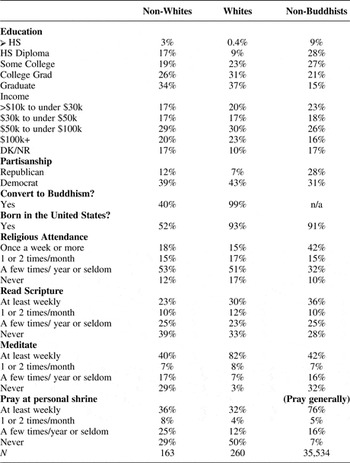
Description of American Buddhists (RLS sample)

Note: The sum of cells within each section may not equal 100% due to rounding.
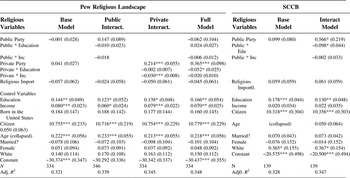
Buddhist political engagement

Standard errors in parentheses00. *** p < 000.001, ** p < 000.01, * p < 000.05
For the bulk of the analysis in this article, we will utilize that old workhorse of social science, ordinary least-square regression. While the data is itself built from categorical variables, there is sufficient range within each main dependent variable to make Ordinary Least-Squares (OLS) tests meaningful. However, to test the robustness of the model, the data was also run as logit and ordered logit models against the main dependent variable as well as the constitutive variables of the electoral politics scale. While there were differences in significance of the variables of interest across these smaller tests, the findings uncovered in the OLS data reported below was generally found in the various logit models as well. However, the sample size is small enough such that questions can be raised in certain models on interpreting the logit results with confidence. Given that, I have chosen to present the OLS models. This is also done to facilitate comparisons across models, which is much easier to do with the standardized and more familiar results of an OLS regression.
ANALYSIS
Buddhists, as noted above, are more privately oriented in their religious habits. Whether one is talking about meditation, praying before a private shrine at home, or reading writings on dharma teachings, American Buddhists are much more likely to engage in solitary practice of their religion than they are to engage in group practice. As can be seen in the figures in Table 2, the primary difference between white Buddhists and non-white believers is the strength of the trend. Whites are much sharper in their private orientation, while non-whites are somewhat more evenly distributed across the scale. However, public piety practices are fairly even across ethnicities. Buddhists, it can be argued, do not place the same emphasis on group religious practices as we see in the Western tradition. The even distribution of group religious habits across ethnic groups could suggest that we could expect the effects to be the same across groups but, as mentioned above, many Buddhist temples and churches seem to serve as much as ethnic cultural centers as much as they do religious centers.
Turning first to the Pew data, the first thing we note is that, interestingly, Buddhists do seem to deviate from the norm. Not only do they attend at lower rates than do their Christian countrymen, but that attendance seems to mean something different to them. It is striking how completely irrelevant group religious practice is for predicting Buddhist political involvement. Likewise, in the base model, we see that private religious practice seems to have no effect on the propensity of a Buddhist to engage with the political process. These findings hold even if the model is run with only one of the religion variables included in the model, or with only public or private piety being tested along with religious importance. This stands in contrast to the general sample: if the same model is applied to the whole sample, all variables (save for gender) are robust positive predictors of political participation. There may be, as Wolfe (Reference Wolfe2003) suggests, something distinctive about the sort of people that choose to become Buddhists. However, the civic skills model posits that SES is an important mitigating factor for the importance of religious engagement — the lower one's SES, the more one will benefit from public religious practices in particular. The theory would argue that the poor, who generally have few opportunities to acquire civic skills applicable to the political realm in their work environment, are more likely to benefit from the opportunity to learn such skills in religious environments than those who have ample opportunity to develop such skills in other settings. Thus, one should look to examine the interaction of religious activity with socio-economic status to better tease out the effects of status and faith on participation in the political process.
Columns two and three examine the interaction of SES on, respectively, public and private religious practice. The interaction of public piety with SES measures does not produce substantive changes to the interpretation of the general model, which is to say that temple attendance still fails to have a statistically significant correlation with the political engagement (or lack thereof) of American Buddhists. That said, while they do fail to attain statistical significance they do at least point in the direction predicted by the theory. Measures of private piety show significant strength once one seeks to tease out SES from religious practice. More frequent religious practice correlates well with greater political engagement while higher SES diminishes the utility of said practice. If both private and public forms of religiosity (and the corresponding interactions) are combined into a full model, the results are even more robust in that private piety coefficients produce a stronger effect. At the same time, while still remaining insignificant, even the directionality of public piety variables fails match the expectations of the first hypothesis.
The Pew data presents evidence that increases in religious practice correlates with an increase in political participation, and this increase is mitigated by a higher SES. However, the effect occurs on the private dimension of religious practice rather than the public dimension. These findings support the second hypothesis being tested, and fail to offer support for the first hypothesis in the case of the Buddhists. While not in and of itself a threat to the civic skills model, it is curious to see participation and income interacting in a manner consistent with the way the civic skills model would predict but in a case where the causal logic underlying the theory would clearly not operate.
Given the size of the sample, testing the hypotheses on a second dataset would help to strengthen the findings. Unfortunately, turning to the Social Capital Community Benchmark Surveys (SCCBS) cannot fully address the issue being raised by the Pew data. While the Segura study offers admirable depth for looking at a number of items, particularly civic engagement writ broad, it lacks the range of religiosity items found in the RLS. The SCCBS lacks items to tap the private aspects of Buddhist religiosity, so models built utilizing the second study will necessarily focus on testing the first hypothesis. Unfortunately, the results from the second study produce somewhat mixed results. The base model shows essentially the same thing that we see in the Pew study — that is, that public religious practice seems to have no particular effect on political participation. Adding in the interaction variables with SES once again produces significance, though this time public piety does show statistical significance. Interestingly, it is education rather than income that proves to be the significant interactor, though education has long been noted as among the most important predictors for electoral participation. (For more on the role of education in political participation, see, e.g., Verba, Schlozman, and Brady (Reference Verba, Schlozman and Brady1995) and Nie, Junn, and Stehlik-Barry (Reference Nie, Junn and Stehlik-Barry1996).) While the level of significance does differ to some extent across datasets, the general directionality holds constant. The lack of comparable private piety measures prevents us from seeing if the similarity continues to hold once private practice measures are introduced, however.
Taking just a moment to examine control variables, it is interesting to note that there is considerable and unsurprising agreement between the two datasets on the importance of particular background variables (especially SES and citizenship, the latter of which is a necessary precondition for political participation). However, the results of the models in the two datasets differ on whether or not race is an important variable for predicting Buddhist civic engagement. The Pew data suggests that there are substantive demographic differences between white and Asian Buddhists, but the differing significance gives us inconclusive evidence as to whether ethnicity truly matters.
The models presented rely on factor scales, which can be difficult to intuitively interpret. Thus, it may be somewhat difficult to say exactly how much these variables truly matter in the grand scale of things. However, utilizing a simpler additive scale and single-item indicators can clarify this.
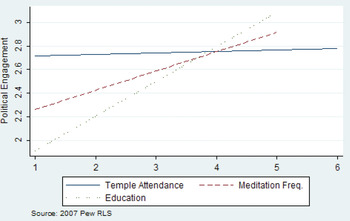
Figure 1 helps to clarify the impact of different kinds of religious engagement on political participation. In the above graph, political engagement is an additive variable that runs from 0 to 4, where each point represents the respondent reporting that they are (1) interested in politics, (2) belong to a political party, (3) are registered to vote, and/or (4) actually report voting in the most recent election preceding the survey. The median score for the variable is 2.76 with a standard deviation of 1.19. What is readily apparent from the first figure is, holding all else constant, the comparability of private practice to education (which, as mentioned previously, is widely held to be one of the most important predictors for political participation) and, conversely, the complete lack of impact for public religious participation. Going from minimally to maximally education (which, in this case, means going from less than a high school education to a graduate degree) in and of itself should, holding all else constant, correlate with an individual to becoming one step closer to full participation in the political process. Going from never meditating to meditating daily for a Buddhist has almost as much impact on an individual's desire to engage politically, with the shift correlating with about 0.7 of a full act closer to full participation. A comparable shift on temple attendance has no significant impact on individual participation in politics.
(Color online) Impact of key variables on political engagement.

CONCLUSION
The Buddhists provide an interesting case study for students of politics and religion in America. The unusual make-up of the religious tradition provides us an opportunity to test some of the conventional wisdom of the sub-field. What emerges both confirms and challenges our established expectations. The data available offers a mixed verdict on the first hypothesis. The data is generally suggestive that public religious participation may not be as important for Buddhist political engagement as it is for other parts of the American religious canopy, while private religious motivations may be comparably more important. While there are some studies, mentioned above, that suggest this may be the case, it does run contrary to the dominant story told in the study of religion and American politics. While some support is found in the older Community Benchmark surveys for the first hypothesis, there is little to be found in the more recent RLS. Furthermore, even the tepid support for the attendance variable is completely swamped in the RLS once private piety is also included in the model. Our inability to test this in SCCBS thus must leave our verdict on the first hypothesis as inconclusive. On the other hand, we can say with some confidence that, once socioeconomic status is accounted for, there seems to be strong support for the second hypothesis.
I would contend that this study suggests the merit in examining religious minority traditions in the United States for their ability to illuminate and challenge our current understanding of how religion operates within the American political system. There is no clear causal logic for why private piety would work among Buddhists in the same way that the Civic Skills model predicts public piety to work. Likewise, there is ambiguity about the applicability of the dominant model for how religious devotion translates into political participation among Buddhists. Buddhists are themselves an interesting case, as they are definitely a distinct religious community with their own religious traditions. Furthermore, the fact that the majority of American Buddhists are themselves converts suggests that Buddhists would themselves attach some normative value to actively embracing a Buddhist identity in contrast to the dominant Abrahamic paradigm than remains the norms in the United States. However, I would argue that, given both the spatial distribution of Buddhists and the relatively low level of religious practice among even many of the white converts, Buddhists also likely share something important with the so-called “religious nones,” a large and growing segment of the American population that, while often retaining religious beliefs, reject identification with belonging to one of the many religious traditions of the United States.
Whether Buddhists will give us greater insight into the “nones” or the limits of our dominant models is something yet to be determined. However, echoing the call made by Smith and Froese (Reference Smith and Froese2008), this study would argue that Buddhists deserve greater study in American politics in particular. Clearly, the unique set of traits brought to the table by Buddhists make them a particularly tough test for some of the theories we rely on, and applying our models to these emergent groups will both help us to develop a broader understanding of the various permutations of faith found in the United States and help give us greater confidence in our theories.
APPENDIX A: DESCRIPTION OF VARIABLES
Political engagement in the Religious Landscape Survey is constructed out of measures tapping whether the respondent voted in the 2004 general election, whether they are registered to vote, whether they express a partisan affiliation, and how interested they report being in politics. The equivalent scale in the SCBS is constructed out of whether the respondent voted in the 1996 general election, whether they are registered to vote, how interested they report being in politics, how knowledgeable they are about politics, and whether or not they read the newspaper. Both scales were constructed as polychoric factor scores so as to standardize and equally weight the various elements of the index. In the RLS models, the electoral politics dependent variable is a 0-centered variable with a standard deviation of 1.038. The additive scale variant of the variable ranges from 0–4, tapping the same variables. It has a polychoric Eigenvalue of 2.237. The equivalent scale in the SCBS produces an Eigenvalue score of 2.365.
The public religiosity scale is constructed out of items tapping the frequency of temple attendance, study group attendance, and the frequency a respondent reports sharing their faith with another person of a different religion. The personal piety scale is constructed out of questions measuring the respondents' frequency of meditation, how often they pray, and how often they read scripture outside of religious ceremonies. Both indices are polychoirc matrix factor scores. The polychoric Eigenvalue of the public religiosity scale is 2.150. The polychoric Eigenvalue for the personal piety scale is 2.067. Both are zero-centered variables with a standard deviation among Buddhists of 1.020 (for public piety) and 1.152 (for private piety). The two variables are correlated with each other at .5182 among Buddhists.
Religious importance is a four-point scale based on the question “How important is religion to your life?” Higher numbers indicate greater importance placed on the religious tradition. The variable has a mean of 3.065 with a standard deviation of 0.902.
Native birth is a dichotomous variable, with 1 indicating that the respondent was born in the United States or its territories. Likewise, white ethnicity is a dichotomous variable where 1 represents that the respondent indicated that they are of Caucasian or European ancestry. Other dichotomous variables are Married and Female, with the higher number indicating a positive report of the trait in question. Summary statistics for nativity and ethnicity can be found in Table 2. The weighted mean for both the married variable is 0.469 and for the female variable is 0.476.
Education is a five-point scale, where higher numbers indicate greater education. Specifically, the categories are less than a high school degree; high school degree; some post-secondary education but no degree obtained or technical, trade, or vocational degree; post-secondary degree; and graduate or professional training. The mean for Buddhists is 3.836 with a standard deviation of 1.088.
Income is a nine-point scale where higher values indicate a higher annual income. Specifically, the categories are: less than $10,000; $10,000-under $20,000; $20,000-under $30,000; $30,000-under $40,000; $40,000-under $50,000; $50,000-under $75,000; $75,000-under $100,000; $100,000-under $150,000; and $150,000 or over. The mean among Buddhist was 5.682 with a standard deviation of 2.414.
Age is an ordinal variable with the following categories: 18–25; 26–35; 36–55; and 56 or older.