Introduction
Genetically modified crops offer a wide variety of agronomic benefits. The use of Roundup Ready wheat could provide the crop producer with flexible and broad-spectrum, post-emergence weed control. Glyphosate, which is the active ingredient in the herbicide Roundup, is one of the most widely used herbicides in the world (Sidhu et al., Reference Sidhu, Hammond, Fuchs, Mutz, Holden, George and Olson2000). Therefore, Roundup Ready wheat (MON 71800) was developed to be tolerant to glyphosate by the Agrobacterium-mediated insertion of a DNA cassette containing the 5-enolpyruvylshikimate-3-phosphate synthase gene from Agrobacterium sp. (Strain CP4; CP4 EPSPS) into the wheat genome of the MON 71900 cultivar.
Studies have been carried out involving the feeding of genetically modified corn (Stanisiewski et al., Reference Stanisiewski, Hartnell and Cook2001; Hyun et al., Reference Hyun, Bressner, Ellis, Lewis, Fischer, Stanisiewski and Hartnell2004) and soybeans (Cromwell et al., Reference Cromwell, Lindemann, Randolph, Parker, Coffey, Laurent, Armstrong, Mikel, Stanisiewski and Hartnell2002) to pigs; however, little research has been conducted with genetically modified wheat. Because finishing pigs consume large quantities of grain, this experiment was conducted to determine whether pigs fed Roundup Ready (MON 71800) and conventional (non-transgenic) wheat have similar performance. Therefore, the objective of this study was to compare growth performance and carcass measurements in growing–finishing pigs fed diets containing either Roundup Ready wheat (MON 71800), the genetically similar non-transgenic wheat (MON 71900), or four commercial varieties of non-transgenic wheat (Hank, Westbred 926, Express and Zeke).
Material and methods
Animals and experimental design
This research was carried out at the University of Illinois Swine Research Center. Experimental protocols were approved by the Institutional Animal Care and Use Committee prior to the start of the study. A total of 240 pigs (PIC 337 sires × C22 dams; Franklin, KY, USA) consisting of equal numbers of barrows and gilts with an initial live weight of 29.5 ± 0.29 kg were used.
The study was carried out as a split-plot design with a 2 × 6 factorial arrangement of treatments in four blocks, based on initial weight. There were two genders (barrows and gilts) and six genetic wheat varieties (a transgenic wheat containing event MON 71800, a non-transgenic genetically similar control wheat (MON 71900) and four non-transgenic conventional wheat varieties (Express, Zeke, Westbred 926 and Hank)). Blocks were located in 12 adjacent pens in the same area of the barn. Within a block, barrows were kept in six adjacent pens with gilts being kept in the next six adjacent pens. Thus, gender was the main plot and wheat variety was the subplot.
Diets
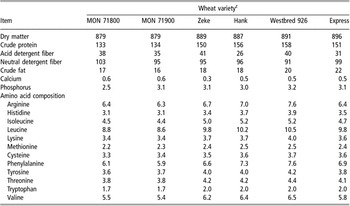
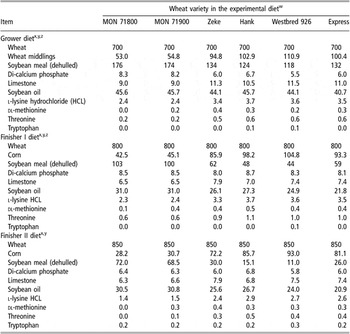
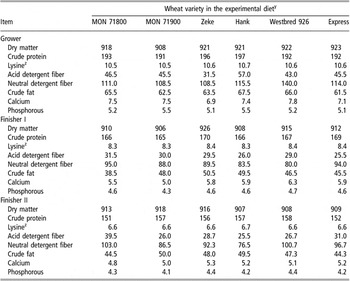
The wheat varieties used in this study were ground using a hammer mill to a target particle size of 700 μm. The nutrient composition of the six wheat varieties and the ingredient composition of the diets used in this study are presented in Tables 1 and 2, respectively. The nutrient composition of the experimental diets is presented in Table 3. The composition of the transgenic test wheat and non-transgenic control wheat was very similar; however, there were differences in composition between the transgenic wheat and the conventional wheat varieties (Table 1), which resulted in different ingredient compositions for the test diets (Table 2).
Chemical composition of the wheat varieties (g/kg fresh matter)

zMON 71800 = transgenic Roundup Ready wheat; MON 71900 = non-transgenic control wheat; Zeke, Hank, Westbred 926 and Express = conventional wheat varieties.
Ingredient composition of the experimental diets (g/kg fresh matter)

wMON 71800 = transgenic Roundup Ready wheat; MON 71900 = non-transgenic control wheat; Zeke, Hank, Westbred 926 and Express = conventional wheat varieties.
xGrower diets were formulated to provide 14.35 MJ/kg ME, 189 g/kg crude protein, 6.3 g/kg calcium, 5.3 g/kg phosphorous and 10.0 g/kg lysine (calculated values).
Finisher I diets were formulated to provide 14.08 MJ/kg ME, 160 g/kg crude protein, 5.2 g/kg calcium, 4.6 g/kg phosphorous and 7.7 g/kg lysine (calculated values).
Finisher II diets were formulated to provide 14.08 MJ/kg ME, 150 g/kg crude protein, 4.6 g/kg calcium, 4.1 g/kg phosphorous and 6.2 g/kg lysine (calculated values).
yA trace mineral premix was added at 3.5 g/kg of the diet and contained 840 g/kg salt and supplied per kg of diet: Zn (as ZnO), 110 mg; Fe (as FeSO4·H2O), 110 mg; Mn (as MnO), 22 mg; Cu (as CuSO4·H2O), 11 mg; I (as Ca(IO3)·H20), 0.22 mg; and Se (as Na2SeO3), 0.3 mg.
A vitamin premix was added at 1.5 g/kg of the diet and supplied per kg of diet: vitamin A (as retinyl acetate), 3088 IU; vitamin D3 (as cholecalciferol), 386 IU; vitamin E (as α-tocopherol acetate), 15 IU; vitamin K (as menadione sodium bisulfite), 2.3 mg; riboflavin, 3.9 mg; d-pantothenic acid, 15.4 mg; niacin, 23.3 mg; choline, 77.2 mg; vitamin B12, 15.4 μg.
zTylan-40 (Elanco Animal Health, Indianapolis, IN, USA) was included in the Grower and Finisher I diets at a rate of 0.5 g/kg.
Chemical composition of the experimental diets (g/kg fresh matter)Footnote x

x Analyzed values.
y MON 71800 = transgenic Roundup Ready wheat; MON 71900 = non-transgenic control wheat; Zeke, Hank, Westbred 926 and Express = conventional wheat varieties.
z Calculated total dietary lysine.
Diets were formulated using the test wheat, wheat middlings, corn, soybean oil and soybean meal and were fortified with vitamins and minerals to meet or exceed the requirements proposed by the National Research Council (1998) for mixed-gender groups of pigs of the weights used in this study. There were three dietary phases (Grower (29.5 to 51.6 kg liveweight), Finisher I (51.6 to 82.4 kg live weight) and Finisher II (82.4 to 114.5 kg live weight)). The inclusion rate of wheat was fixed within each phase (70%, 80% and 85% for Grower, Finisher I and Finisher II, respectively). The inclusion rates for other major ingredients (wheat middlings, soybean meal, di-calcium phosphate, limestone, soybean oil and l-lysine hydrochloride) were adjusted to provide the same levels of metabolizable energy (ME), crude protein (CP), calcium, phosphorus and lysine within each dietary phase. Diet phases were changed when the average weight of all pens in a block reached the designated weight of approximately 50 and 80 kg, respectively.
Housing and feeding
The study was carried out in a controlled environment finishing facility with part-slatted, part-solid concrete floors and used a total of 48 single-gender pens (barrows or gilts) with five pigs per pen, and eight pens per dietary treatment. Pen dimensions (length × width) were 2.6 × 1.8 m, providing a floor space of 0.94 m2/pig. The temperature within the building was controlled by mechanical ventilation linked to a thermostat set at 24°C during the early stages of the study and reduced to 21°C when the pigs had reached an average of 50 kg live weight. Temperature and humidity levels in the building were recorded on a daily basis using Hobo H8 Loggers (Onset Computer Corp., Bourne, MA, USA). The average temperature during the study was 25.9 ± 2.46°C and the average relative humidity was 66.1 ± 10.76%.
Pigs had ad libitum access to feed and water throughout the study, which ended when the average live weight of all the pens of pigs within a block reached 115 kg, at which time all pigs in a block were removed from the experiment.
Experimental techniques
Pigs and feeders were weighed every 2 weeks throughout the study, and the amount of feed added to each feeder was recorded to determine average daily gain, average daily feed intake (as-fed basis) and gain : feed ratio. At the end of every dietary phase and at the end of the study, all pigs were ultrasonically scanned using an Aloka Model 500 B-mode ultrasound scanner fitted with a VST-5021-3 probe (Corometrics Medical Systems, Wallingford, CT, USA). A transverse image was taken over the 10th rib and backfat depth (over the middle of the longissimus muscle) and longissimus muscle area was measured on the scans.
At the end of the experiment, pigs on the transgenic (MON 71800) and non-transgenic control (MON 71900) treatments were sent to the Meat Science Laboratory at the University of Illinois for harvest and to obtain carcass and meat quality measurements. Animals were transported a distance of 2 km to the laboratory on the afternoon prior to harvest where they were held overnight for approximately 16 h, with access to water but not feed. Pigs were harvested on the following morning according to standard procedures. Pigs were weighed immediately prior to harvest. Carcass measurements were taken at 24 h post mortem and included carcass weight, carcass length (measured from the cranial tip of the aitch bone to the cranial edge of the first rib adjacent to the thoracic vertebra), midline fat depths (opposite the first rib, last rib and last lumbar vertebra), 10th rib fat depth (measured over the longissimus muscle at three-quarters of the distance from the midline) and longissimus muscle area at the 10th rib. Subjective color, firmness and marbling scores were taken on the cut surface of the longissimus muscle at the 10th rib (NPPC, 1991 and 2000).
A longissimus muscle sample was taken at the 10th rib from a random sample of 16 pigs per treatment (8 barrows and 8 gilts) to determine composition. Longissimus samples were homogenized and analyzed for protein, fat and moisture using the procedures described by Novakofski et al. (Reference Novakofski, Park, Bechtel and McKeith1989).
Samples from each wheat variety were collected prior to the start of the experiment and samples from the experimental diets were collected during the study and analyzed for nutrient composition (Tables 1 and 3, respectively). Samples were ground through a 1-mm screen before analysis and were analyzed in duplicate for CP (Procedure 997.06; Association of Official Analytical Chemists, 1995), fat (Procedure 996.06; AOAC, 1995), acid detergent fiber (Procedure 973.18; AOAC, 1995), neutral detergent fiber (Procedure 2002.04; AOAC, 1995), calcium (Procedure 927.02; AOAC, 1995) and phosphorus (Procedure 964.06; AOAC, 1995). In addition, amino acid analysis was carried out on the wheat varieties. Samples were hydrolyzed for 20 h using 6N HCl at 107°C before separation of amino acids by ion-exchange HPLC. After elution, amino acids were quantified fluorometrically using o-phthalaldehyde as a derivatization reagent (Procedure 994.12; AOAC, 1995). Methionine and cysteine were determined as methionine sulfone and cysteic acid after cold performic acid oxidation before hydrolysis (Procedure 994.12, alternative 3; AOAC, 2005). Tryptophan was determined after hydrolysis with NaOH for 22 h at 100°C (Procedure 988.15, alternative 1; AOAC, 2005).
Analyses
Data were analyzed as a split-plot design using PROC MIXED of SAS (SAS Institute, Inc., Cary, NC, USA) with gender as the main plot, wheat variety as the subplot and pen being the experimental unit. The effects included in the model were gender (barrow and gilt), wheat variety (MON 71800, MON 71900, Hank, Westbred 926, Express and Zeke), block and the two-way interaction. Least square means were compared using the PDIFF and STDERR options in SAS.
Results
Growth performance
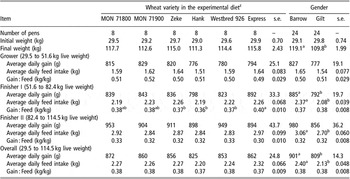
The growth performance of pigs in each dietary phase and overall is summarized in Table 4. There were no wheat variety × gender interactions for any of the growth traits and, consequently, main effect means are presented. The only treatment difference was for the gain : feed ratio in the Finisher I phase, with pigs fed Express having higher (P < 0.05) values than those fed Zeke, Hank and Westbred 926 with MON 71800 and MON 71900 being intermediate. However, there were no treatment differences (P > 0.05) for the gain : feed ratio in any of the other growth phases or overall. Overall growth rates, feed intakes and gain : feed ratios of pigs fed the transgenic and the non-transgenic control wheat were similar (P > 0.05; Table 4).
Least squares means for the effects of wheat variety and gender on growth performance

zMON 71800 = transgenic Roundup Ready wheat; MON 71900 = non-transgenic control wheat; Zeke, Hank, Westbred 926 and Express = conventional wheat varieties.
abWithin a treatment and row, means with different superscript letters differ (P < 0.05).
The effects of gender (barrow v. gilt) on growth performance are summarized in Table 4. Compared to gilts, barrows were heavier (P < 0.05) at the end of the study, had higher average daily gain (P < 0.05) during Finisher I and the overall study period, and had higher average daily feed intake during Finisher I, Finisher II and overall. Gain : feed ratio was not significantly different between gilts and barrows for any phase of the study (Table 4).
Carcass measurements
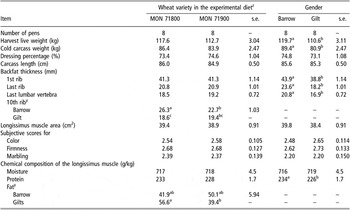
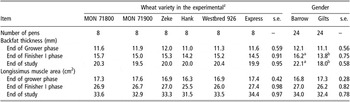
There was no difference (P > 0.05) between the transgenic wheat (MON 71800) and the non-transgenic wheat (MON 71900) for carcass yield, backfat thickness at the 1st rib, last rib, and last lumbar vertebra, and longissimus muscle area (Table 5). Ultrasonically measured backfat thickness and longissimus muscle area measured at the end of each dietary phase during the study were similar (P > 0.05) among the six wheat varieties evaluated (Table 6).
Least squares means for the effects of wheat variety and gender for carcass measurements and the chemical composition of the longissimus muscle of pigs fed diets containing the transgenic Roundup Ready wheat (MON 71800) and the non-transgenic control wheat (MON 71900)

zMON 71800 = transgenic Roundup Ready wheat; MON 71900 = non-transgenic control wheat.
yWheat line by gender interaction (P < 0.05).
abcWithin a treatment and row, means with different superscript letters differ (P < 0.05).
Least square means for the effects of wheat variety and gender for ultrasound measurements

zMON 71800 = transgenic Roundup Ready wheat; MON 71900 = non-transgenic control wheat; Zeke, Hank, Westbred 926 and Express = conventional wheat varieties.
a,bWithin a treatment and row, means different superscript letters differ (P < 0.05).
There was a wheat variety × gender interaction (P < 0.05) for backfat thickness at the 10th rib (Table 5). For barrows, pigs fed the transgenic wheat had higher (P < 0.05) 10th rib backfat than those fed the non-transgenic control, whereas for gilts there was no effect (P > 0.05) of wheat variety on 10th rib backfat thickness (Table 5).
Barrows had heavier (P < 0.05) harvest and cold carcass weights than gilts; however, there was no difference (P > 0.05) between the genders for dressing percentage (Table 5). Barrows had greater (P < 0.05) backfat thickness than gilts at all points of measurement (Table 5). In addition, barrows had greater (P < 0.05) ultrasonic backfat thickness at the end of the Finisher I phase and at the end of the study, but not at the end of the Grower phase (Table 6). Longissimus muscle area measured either on the carcass (Table 5) or ultrasonically (Table 6) was similar (P > 0.05) for the two genders.
Longissimus muscle quality measurements
Subjective scores for longissimus color, firmness and marbling were similar (P > 0.05) for the transgenic and non-transgenic control wheat varieties (Table 5). In addition, there was no difference (P > 0.05) between the transgenic and non-transgenic wheat varieties for longissimus moisture and protein content (Table 5). There was a wheat variety × gender interaction (P < 0.05) for longissimus fat content (Table 5). Gilts fed the transgenic wheat had higher (P < 0.05) longissimus fat content than those fed the non-transgenic control wheat; however, for barrows there was no effect (P > 0.05) of wheat variety on longissimus fat content (Table 5). There was no effect (P > 0.05) of gender on longissimus subjective scores or chemical composition (Table 5).
Discussion
Nutrient composition of wheat varieties and diet ingredient composition
Although there were differences in nutrient composition of the wheat varieties used in this study, all values were in line with published estimates (NRC, 1998). The differences in the formulations of the test diets used for the six wheat varieties (Table 2) were necessitated by the differences in nutrient composition between the wheat varieties (Table 1).
The major difference in composition between the wheat varieties was for CP, which was lower for the transgenic wheat and the non-transgenic genetically similar wheat than for the conventional wheat varieties. Consequently, the inclusion rate of soybean meal was greater for the diets based on MON 71800 and MON 71900 than for those based on the other wheat varieties (Table 2). However, the levels of all essential amino acids were similar across the diets for all of the wheat varieties and were at or above the requirements recommended by NRC (1998). Therefore, the different dietary inclusion levels for soybean meal did not bias the growth responses observed in this study.
Growth performance
There was no evidence from this study of any impact of transgenic wheat on the growth performance of growing–finishing pigs. No other pig-feeding studies have been carried out comparing wheat varieties with this specific genetic event with a near-isogenic control or non-transgenic conventional varieties. A number of studies with growing pigs comparing glyphosate-tolerant corn varieties with the non-transgenic near-isogenic control corn and conventional corn hybrids have shown similar results to those of the present study, with no evidence of any impact of the transgenic trait on pig growth (Stanisiewski et al., Reference Stanisiewski, Hartnell and Cook2001; Hyun et al., Reference Hyun, Bressner, Ellis, Lewis, Fischer, Stanisiewski and Hartnell2004). Also, Gaines et al. (Reference Gaines, Allee and Ratliff2001) showed no difference in the digestible energy coefficients of Roundup Ready corn compared to a genetically similar corn hybrid that lacked the transgenic trait. Studies with Roundup Ready soybean meal containing the same genetic modification as the wheat used in the present study also showed no effect on the growth performance of pigs relative to the non-transgenic genetically similar control soybean meal (Cromwell et al., Reference Cromwell, Lindemann, Randolph, Parker, Coffey, Laurent, Armstrong, Mikel, Stanisiewski and Hartnell2002). A number of other studies with a range of species that have compared the growth performance of animals fed Roundup Ready corn or soybean meal with that of animals fed the non-transgenic genetically similar or conventional commercial varieties have shown no negative impact on growth. This included studies with broiler chicks (Sidhu et al., Reference Sidhu, Hammond, Fuchs, Mutz, Holden, George and Olson2000; Stanisiewski et al., Reference Stanisiewski, Hartnell and Cook2001; Taylor et al., Reference Taylor, Hartnell, Riordan, Nemeth, Karunanandaa, George and Astwood2003a and Reference Taylor, Hartnell, Riordan, Nemeth, Karunanandaa, George and Astwood2003b), and with rats, catfish and dairy cows (Hammond et al., Reference Hammond, Vicini, Hartnell, Naylor, Knight, Robinson, Fuchs and Padgette1996). The differences in growth performance observed between the genders in the current study are similar to those of most other studies that have compared barrows and gilts (Labroue et al., Reference Labroue, Gueblez, Sellier and Meunier-Salaun1994; Hahn and Baker, Reference Hahn and Baker1995; Hyun and Ellis, Reference Hyun and Ellis2001).
Carcass measurements
The lack of an effect of transgenic wheat on carcass measures is similar to the findings of a number of studies that have evaluated Roundup Ready corn and soybean meal in pigs (Stanisiewski et al., Reference Stanisiewski, Hartnell and Cook2001; Cromwell et al., Reference Cromwell, Lindemann, Randolph, Parker, Coffey, Laurent, Armstrong, Mikel, Stanisiewski and Hartnell2002; Hyun et al., Reference Hyun, Bressner, Ellis, Lewis, Fischer, Stanisiewski and Hartnell2004) and broiler chickens (Hammond et al., Reference Hammond, Vicini, Hartnell, Naylor, Knight, Robinson, Fuchs and Padgette1996; Taylor et al., Reference Taylor, Hartnell, Riordan, Nemeth, Karunanandaa, George and Astwood2003a and Reference Taylor, Hartnell, Riordan, Nemeth, Karunanandaa, George and Astwood2003b), and was to be expected given that there was no effect of the transgenic variety on growth performance in any of these studies.
The wheat variety × gender interaction for 10th rib backfat thickness is difficult to explain, particularly as there was no wheat variety × gender interactions and no difference (P > 0.05) between the transgenic and non-transgenic wheat varieties for any of the other backfat thickness measurements. Therefore, the treatment interaction for 10th rib backfat thickness is most likely a random chance observation that is not biologically meaningful.
The difference in backfat thickness between barrows and gilts was similar to the results of Cromwell et al. (Reference Cromwell, Cline, Crenshaw, Crenshaw, Ewan, Hamilton, Lewis, Mahan, Miller, Pettigrew, Tribble and Veum1993) and Hahn et al. (Reference Hahn, Biehl and Baker1995); however, in those experiments gilts had greater longissimus muscle area than barrows. The study of Hyun et al. (Reference Hyun, Bressner, Ellis, Lewis, Fischer, Stanisiewski and Hartnell2004), which used a similar approach to the current study with barrows and gilts being taken off the test at the same time but at different weights, also showed no effect (P > 0.05) of gender on the longissimus muscle area. This suggests that, in the current study, the lack of a gender effect on the longissimus muscle area and the significant gender effect on carcass weight was a consequence of taking whole replicates off the test at the same time and the resulting difference in slaughter live weight between barrows and gilts.
Longissimus muscle quality measurements
The lack of an effect of the transgenic wheat compared to the non-transgenic control wheat on subjective longissimus muscle quality measures and muscle moisture and protein content suggests little if any effect of this genetic event on fresh pork quality. This is similar to the results of other studies that have investigated the impact of feed ingredients with this genetic event on quality attributes (Hyun et al., Reference Hyun, Bressner, Ellis, Lewis, Fischer, Stanisiewski and Hartnell2004).
The wheat variety × gender interaction observed for longissimus fat content (Table 5) is unexpected particularly as there were no treatment effects or interactions for subjective marbling scores (Table 5). In addition, the fat content of the longissimus is closely related to the overall fat content of the carcass and there was no effect of wheat variety on backfat thickness in gilts (Table 5).
Conclusions
The results of this study show that the Roundup Ready wheat variety evaluated (MON 71800) when included in diets for growing–finishing pigs gives equivalent animal performance to diets formulated with either the non-transgenic genetically similar variety (MON 71900) or any of the four conventional commercial wheat varieties tested in the present study (Hank, Westbred 96, Express and Zeke). Based on these results, it is concluded that the transgenic wheat variety evaluated is both as safe and as efficacious for growing pigs as conventional wheat.