


In the midst of civil wars in such diverse countries as Serbia, Somalia, Iraq, and Indonesia analysts have asked whether peace would be more secure and democracy would be more likely to flourish if we partitioned those countries rather than attempted to keep them whole. The debate is shaped by our diverging readings of past instances of partition and our counterfactual speculations about better outcomes if some alternative solution had been found. For example, would politics in the British Isles, South Asia, or Palestine have been more peaceful if Britain had avoided partition of the United Kingdom of Great Britain and Ireland, British India, and the Palestine Mandate and, instead, created unitary states in each region or negotiated regional autonomy arrangements for the Irish, Muslims and Hindus, and Arabs and Jews? Would democracy have flourished more widely under these alternative arrangements? The conclusions that we draw from such historical cases in turn have shaped our prescriptions for policies concerning current nationalist conflicts. For example, would partition of Chechnya and Russia, the Basque Country and Spain, Serbia and Kosovo, or even Serbian and Albanian regions within Kosovo itself bring more peace and democracy than an attempt to hold these together under unitary states or regional autonomy arrangements? Would an Iraq divided among autonomous Kurdish, Shiite, and Sunni regions be more peaceful and more likely to sustain democracy than an Iraq divided into three sovereign states?
Scholarly and policy communities typically reject partition as an option for managing nationalist disputes. Schaeffer (1990, 3–4) summarizes the warnings of many critics of this option when he writes, “the division of countries into separate states has been a singular failure” and “not only… an immediate failure; it has proved to be an enduring problem.” First, the skeptics warn, partition undermines the prospects for democracy (Etzioni 1992–1993, 21) because partition leads newly empowered majorities to disfranchise newly created minorities in the successor states. Even in partitioned states that are “born democratic,” democracy is unlikely to survive because partition creates weak civil institutions that are unable to maintain order (Kumar 1997, 26) and that become subject to political challenges such as military coups (Schaeffer, 170, 253). Second, the skeptics add, partition leads to escalating ethnic conflict and violence (Etzioni, 21). The disfranchisement of minorities and weak civil institutions contribute to this. Moreover, partition spawns still more independence movements inside the successor states that seek another round of partition and secession (Schaeffer, 186). And partition does not resolve the original dispute but simply transforms a civil war within a single sovereign state into an international war between sovereign states (Christie 1992, 70; Schaeffer, 204).
We challenge this skepticism. We propose a model of escalation of nationalist conflict under alternative institutional constraints and put forward substantial statistical evidence that points in the opposite direction: after nationalist conflicts, particularly after civil wars involving competing nation-state projects, partition is more effective than alternative institutions at reducing the likelihood of a recurrence of violence among the parties to the dispute and increasing the prospects that all will live under democratic rule. Yet this is true only when partition is implemented fully through creation of separate sovereign states. Half-measures short of full partition and independence, which seek to keep these lands and peoples together, are less likely to result in peace and democracy. In particular, our model and evidence suggest that autonomy arrangements, which are frequently proposed as compromises with partition, actually have just the opposite effects from partition, increasing the likelihood of recurring violence and failure to democratize.
A DIALOGUE OF THE DEAF
The debate over partition has brought contributions from scholars from diverse specialties, but the attempt to bridge across the subfields of political science—in this instance between comparative politics and international relations—has introduced conceptual muddle because we often have not been careful to define key concepts and to identify intellectual assumptions, theoretical links, and operationalizations. First of all, the heated debate over partition has produced only a limited accumulation of insights because participants in this debate offer different definitions of the remedy and of the problem it should solve. Concerning the remedy, the debate over partition has come to address the relative merits of four different institutional arrangements, three of which separate parties at the end of a civil conflict: (1) partitions that result in separate sovereign states; (2) de facto separations, typically following ceasefires or truces, that establish few, if any, new institutional arrangements for governance but leave the secessionists in effective control of their region and population and keep the central government out; and (3) autonomy that grants self-rule to a region or population but preserves the boundaries of the original sovereign state and the authority of its government over the autonomous region and its population. These are typically opposed to a fourth institutional arrangement—(4) unitarism that embraces both parties to the previous conflict under a government that is common to both (see Table 1). These four arrangements provide for alternative allocations of decision rights between, on one side, a common government for the entire state that existed prior to the civil war and, on the other, a separate government for the disputed territory and population: these arrangements range from nearly all decision rights over the disputed territory and population allocated to the common government under unitarism, many decision rights under autonomy, few under de facto separation, and virtually none under partition (compare Milne 1989, 40–44; Rothschild 1981, 150–59).

This distinction among three institutional forms of separation is consistent with many taxonomies of ethnic management strategies offered by scholars of comparative politics, but typically not by scholars of international relations. In particular, comparativists have seen sharp distinctions among the strategic logics behind partition, autonomy, and de facto separation. For example, according to O'Leary (2001, 28–29), partition, along with decolonization, genocide, expulsion, and homogenization, belongs to the grand strategy of eliminating ethnonational differences, but autonomy, along with control, arbitration, and consociation, belongs to the grand strategy of managing ethnonational differences (also see Coakley 1992; Etzioni 1992–1993, 33; Singh 1997, 56–57). In this view, de facto separation after a ceasefire differs from both of the other strategies because it is only a transitional arrangement. Alternatively, international-relations scholarship often brackets all three institutional forms of separation with the label “partition” (Kuperman 2004). For example, Kaufmann (1996, 160–61; 1998, 121, 125–26) supports his argument that “separation of groups is the key to ending ethnic civil wars” with examples of regional autonomy for minority groups, partition in which new sovereign states were created, and ceasefires in which there was no formal agreement on sovereignty. Sambanis (2000, 445–46) distinguishes narrow and broad definitions of partition and chooses the broad definition that brackets all three forms of separation (see Sambanis's Table 1 on pp. 447–49). Even though Kaufmann and Sambanis draw very different conclusions from their empirical investigations, they share in common a convention that has emerged in the recent empirical international-relations literature on civil wars. This convention conflates important distinctions among different domestic political institutions that shape post-settlement political processes inside states. These processes in turn affect the prospects for peace and democracy.
A second conceptual muddle in the debate concerns the problem to be solved by partition. This in turn defines the universe of cases to be examined and compared. First, the original comparative-politics literature addresses settlements to nationalist disputes—that is, conflicts in which ethnopoliticians claim that their group constitutes a separate nation with a right to a sovereign state of its own. This comparison set excludes ethnic wars that have not become secessionist conflicts, but includes nationalist conflicts that have not escalated to the level of a civil war. Second, the recent international-relations literature typically addresses the problem of settlements to civil wars. This comparison set typically excludes cases of nationalist conflict that have not escalated to civil wars, but includes ideological wars as well as ethnic civil wars that have not become conflicts over competing nation-state projects in which the parties seek separate states of their own. Third, the realist tradition has focused on problems of creating order in situations of a security dilemma that arises under anarchy “when proximate groups of people suddenly find themselves newly responsible for their own security” (Posen 1993, 27). The comparison appears to embrace all failed states, all newly independent states, or both. These comparison sets cut across one another. To frame a constructive debate research projects must make clear which of these problems partition is supposed to solve.
DOMESTIC INSTITUTIONS AND REESCALATION OF CONFLICT
In addition, the heated debate over partition has produced only limited accumulation of insights because participants seldom elaborate the theoretical links from alternative institutional remedies to outcomes; theory is often replaced by a hunch and a hypothesis about partition alone. In order to situate our argument within these debates we begin with a model of nationalist conflicts. Our model focuses on (1) bargaining among ethnopoliticians claiming to speak on behalf of a group with a purported right to a state of its own and leaders of the government that claims authority over all groups within an existing state (labeled as a shorthand the presettlement common-state), (2) in which the parties to the bargaining process may attempt to induce the other side to concede on substantive issues by escalating conflict in ways that increasingly threaten the peace and violate democratic procedures, and (3) in which the parties have escalated conflict to the level of a civil war just prior to the settlement that established the current institutional arrangement. Our theory stresses the domestic politics created by the institutional arrangements established in peace settlements (see Chapman 2003; Roeder 2007; Roeder and Rothchild 2005). Our model permits us to make comparisons of the likelihood (frequency) of renewed escalation that threatens peace and democracy under different institutional constraints. (In some relationships discussed next, we hypothesize a direct effect of institutional arrangements on peace and democracy; in others the effect of institutional arrangements on democracy is indirect through the effect on peace.) We compare these different institutional constraints in the difficult circumstances at the end of a civil war. Thus, we ask whether one institutional arrangement is more likely than the others to decrease, leave unchanged, or increase the likelihood of reescalation.
The likelihood of reescalation of conflict between ethnopoliticians and common-state leaders and failure of democratization are constrained by a conjunction of factors that different theories have identified as identities (Connor 1972; Huntington 1996), grievances (Gurr 1970) and greed (Collier 2000), resources (Zald and McCarthy 1987), and political opportunity (Tarrow 1989; Tilly 1978). Our analysis challenges the view that we can focus on just one of these factors to the exclusion of the others. Our model identifies the ways in which different institutional arrangements affect each of these factors—for which we will sometimes use the shorthand labels of identities, motivations, means, and opportunities.
Identity Incompatibility
Reescalation of conflict and failure of postsettlement democratization are more likely when there are incompatible national identities (Christie 1992, 69; Wood 1981). (When we use the term national we refer to attachments to a nation-state project—that is, a claim that a particular population has a right to a state of its own; see Gerth and Wright-Mills 1948, 179.) These incompatibilities most commonly emerge when (1) members of a population (often an ethnic minority) share a national identity that unites them to one another and the identity distinguishes them from the common-state leaders. Incompatibility of identities, however, also requires that either (2a) the common-state leaders hold a national identity that embraces the disputed territory and population or (2b) the common-state leaders reject the disputed population as members of their nation but identify the territory occupied by the population as part of the common-state's jurisdiction. In sum, the dangerous conjunction is incompatible identities—typically where the disputed population rejects membership in the larger nation-state that the common-state leaders seek to maintain. For example, conflict escalated between Georgians and the Soviet government prior to 1991 in part because Moscow maintained that Georgians were part of the Soviet people and Georgia was a part of the Soviet state, but Georgian leaders and their constituents rejected these claims in increasing numbers. The conflict of the Georgian government with its own Ossetian minority escalated when Georgia's new president Zviad Gamsakhurdia suggested that Ossetians were not parts of the Georgian nation-state (despite more than a century and a half of residence in the region of South Ossetia) and that they should return to their homeland north of the Caucasus mountains (Jones 1997, 512).
Civil wars typically harden national identities and increase incompatibility (Byman 1997, 5; Downes 2001, 69; Kaufmann 1996, 137). For example, the distinct national identities of Azerbaijanis and Georgians came to focus on specific state projects during the Russian civil war and the brief struggles to preserve the quasi-independence of Azerbaijan (1918–20) and Georgia (1918–21). The effect of peace settlements on the incompatibility of national identities depends on the institutional arrangements created in the settlement. Partition is more likely than autonomy or de facto separation to reduce the incompatibility of national identities. On the secessionist side, partition typically strengthens or reinforces the unity and distinctiveness of the group that is now constituted as the titular nation of a successor state (such as the Ukrainians in independent Ukraine). On the common-state side, however, that is among leaders and populations of the former common-state that is now reconstituted as a rump state (such as the leaders of the independent Russian Federation), partition typically leads to a decline in their identity with the population and territory of the lost successor state (see Dunlop 1997, 54–56). Thus, after 1991 Russian government officials in growing numbers abandoned any claims to sovereignty over the near abroad. In the Presidential Administration and State Duma, after brief flirtation with irredentism by such leaders as Aleksandr Rutskoi, support for claims on areas like Crimea (Ukraine), Ust-Kamenogorsk (Kazakhstan), and Narva (Estonia) declined rapidly. Our claim about the effect of partition is comparative: on average, identity incompatibilities are more likely to fade under partition than under alternative institutional arrangements.
De facto separation and autonomy typically leave in place the identity incompatibility that existed at the end of a civil war and often reinforce this. Both empower the ethnopoliticians as national leaders within an autonomous homeland or a de facto entity on one side of the ceasefire line. Like partition, de facto separation and autonomy provide ethnopoliticians with resources to preserve and even strengthen the separate identity that existed within their constituency at the end of the civil war; they are empowered to invent histories, build memorials, school children, and rally citizens behind their specific definition of statehood (Byman 2000, 186; Cornell 2002; Roeder 1991). For example, in the autonomous regions created after the Russian civil war, such as the Ukrainian and Belorussian soviet socialist republics, the policies of the new regional governments solidified distinct national identities that had not crystallized during the civil war. As the more recent examples of Abkhazia, Nagornyi Karabakh, and Transdniestria show, even ceasefires may empower leaders to consolidate identities (King 2001). Yet, unlike partition, both sustain the claim of common-state leaders to jurisdiction over the secessionist population and territory. Often the parties to a ceasefire, like the leaders of Georgia and Abkhazia, disagree whether they are separate states or parts of a common-state and, if the latter, whether the secessionists will have autonomy or be subordinate to a unitary state in a final resolution; all this deepens the identity incompatibility. Thus, identity incompatibilities are least likely to decline and are even likely to increase under de facto separation and autonomy as more members of the population are socialized into the nation taking shape within the autonomous or breakaway region and as the common-state leaders continue to press their claim to sovereignty over the would-be nation-state.
Between these two extremes, unitarism sustains and even reinforces identities that support the common-state government's claim to the disputed territory, but provides relatively unfavorable conditions for ethnopoliticians to keep alive nationalist identities in opposition to the existing state. Certainly, at the end of a civil war national identities that preclude continued membership in the previous common-state are likely to be strong enough among national minorities to survive the absence of supporting political institutions for some period of time, but under a unitary government these separatist sentiments are less likely to survive, less likely to deepen, and more likely to decline than under the conditions created by alternative institutional arrangements. For example, even among Israeli Arabs, as Byman (2000, 175) notes, “the lack of independent institutions or control over education… hindered Israeli Arab efforts to create a strong identity independent of that proposed by the Israeli state.” The claim of the common-state leaders to authority over the population and territory under dispute is reinforced by unitarist institutions that are privileged in the propagation of a national identity. Thus, under unitarism identity incompatibility is likely to remain unchanged at first, but to decline with time.
Zero-Sum Conflicts of Greed and Grievance
Reescalation of conflict and failure of postsettlement democratization are more likely where grievances and greed focus on a zero-sum conflict over the allocation of decision rights over disputed territories and populations (Dion 1996, 271; Emizet and Hesli 1995, 498–99; Horowitz 1985, 259). Civil wars among parties with competing nation-state projects focus on just such zero-sum divisions of power as common-state governments and secessionists assert competing claims to sovereign authority over the same populations and territories. At the end of the civil war secessionists are likely to see control of a sovereign state as the best solution to many problems, including any return of the insecurity that they experienced during the civil war (Downes 2001, 62; Kaufmann 1996, 147; Posen 1993, 28).
The institutional arrangements differ in the extent to which they preserve and privilege this zero-sum conflict after the settlement. These vary in this effect to the extent each (1) requires more decisions to be reached jointly between the parties to the previous civil war and (2) subsumes these issues in a dispute over the allocation of decision rights among governing authorities. Autonomy provides the combination that is most likely to privilege the path of reescalation of conflict in postsettlement politics. Many decisions must be decided jointly under the new constitutional prescriptions; many policy issues come to be redefined in terms of the rights of the autonomous homeland. As Christie (1992, 75) notes, “all political problems, however diverse, will tend to be sucked into the morass of the ethnic conflict.” In the last years of the Soviet Union and the first years of the Soviet successor states, for example, diverse issues, such as economic reform and taxation, became subsumed in zero-sum conflicts over allocation of decision rights between the central and republic governments (Roeder 2007, 206–208). This led to deadlock in democratizing common-state institutions and escalating conflict between central and republic governments.
Partition does the most to limit the number of decisions that must be made jointly. Conflicts over the allocation of decision rights between the two sides become fewer after partition because many decisions such as the allocation of taxation authority, balancing of seats in the national cabinet, or appointment powers in the bureaucracy no longer need to be made jointly. Disputes over the allocation of decision rights are more likely to become limited to a subset of issues, such as border control, that existed during the civil war. Unitarism and de facto separation create decision-making environments that fall between these two poles. De facto separation reduces only a little the number of decisions that must be reached jointly, but privileges issues relating to the decision rights of the authorities in the secessionist entity in all joint decision-making. For example, although Georgia and Abkhazia today make fewer decisions jointly than they did under the earlier autonomy arrangements, in those areas where a common policy must be established, such as decisions about the property rights of Georgians in Abkhazia or the management of communications networks, the dispute over the sovereignty issue frames all discussions. Unitary institutions do not reduce the number of decisions that must be reached jointly, but unlike autonomy, unitary institutions do not privilege disputes over ethnic or homeland decision rights over cross-cutting claims such as worker or farmer rights. Thus, fewer issues are framed for all participants as questions of allocating decision rights between the common-state government and agencies of the (former) secessionists.
Empowerment with the Means of Escalation
Reescalation of conflict between the parties to the previous civil war and the failure of postsettlement democratization are more likely when the political institutions created in a settlement empower the parties with more organizational resources that can be deployed for the purposes of coercing the other parties. These means include not only capabilities for sustained military operations against the other, but also many means short of overt violence such as the organizational capacity to organize threatening demonstrations of military might; to mobilize protests, strikes, and demonstrations against the other side; to embargo tax revenues that are needed by the other to fund its governmental operations; and to force deadlock in joint decision-making. The postsettlement peace and democratization are most at risk when the institutional arrangements provide both sides with many incremental escalatory options (“salami tactics”) so that each escalatory step can be taken at relatively low cost. These are less at risk when there is a very costly threshold that must be surmounted to initiate re-escalation (Kahn 1965, 214–15; Schelling 1966, 135).
Compared to the alternative institutional forms of separation, partition is more likely to remove many low-cost escalatory options on both sides of the old divide and to leave both sides with only costly options such as organizing a blockade, intervention, or warfare across international borders. For example, since the partition of the Soviet Union Moscow's leaders have found it much harder to stage protests and demonstrations in the streets of cities like Tblisi (Georgia) and Vilnius (Lithuania), compared to the tumultuous days prior to the breakup. Since partition Moscow has found it more costly to achieve a complete shutoff of energy to Georgia, which has diversified its suppliers and expanded its diplomatic allies. Since 1991, Georgian and Lithuanian leaders find it much more difficult to threaten to force a deadlock in Moscow's decision-making or to withhold revenues needed to fund Moscow's governmental operations. Partition has shortened the menu of escalatory options on both sides and made these more costly to coercers. At the other extreme, autonomy does the most to preserve and even expand the menu of escalatory options available to both sides, who can now force deadlock in common-state decision-making by artful use of mutual vetoes, organize protests and demonstrations on the doorsteps of the other, and withhold revenues necessary to sustain government on the other side (also see Byman 1997, 24). Between these two extremes, de facto separation falls short of full partition in limiting intermediate escalatory options short of warfare, but unlike autonomy it creates few new escalatory options such as threats of deadlock in common-state decision-making. Under unitarism ethnopoliticians experience a rapid decline in escalatory options, but common-state leaders are empowered with more capabilities to coerce ethnopoliticians than at the end of the civil war.
Opportunities for Escalation Due to a Failure of Deterrence
The opportunity to escalate depends on expectations on both sides that escalation will produce a net expansion of decision rights. These expectations are shaped not only by the coercive capabilities discussed in the previous section but also by the defensive and retaliatory capabilities of the other side that make any attempt to coerce more or less costly to the coercer. The balance of capabilities created by alternative institutional arrangements has a complex relationship to the survival of peace and democracy. Reescalation of conflict is more likely when the distribution of means to escalate conflict—both offensive and defensive capabilities—supports incompatible expectations of victory among both ethnopoliticians and common-state leaders (Filson and Werner 2002; Smith and Stam 2004). Failure of democratization is more likely not only where the distribution of means supports incompatible expectations of victory but also where the distribution of means supports mutual expectations of victory by one side; democracy is most secure only when neither side expects victory.
To the extent that both sides rely on the empirical evidence of the current distribution of coercive capabilities in forming their expectations of victory, equality in coercive capabilities between sides has a seemingly paradoxical effect: it is the point of equality at which institutions, including democratic institutions, are most stable (safe from peaceful predation by a more powerful side), but the likelihood of costly escalation in the means of conflict, such as escalation to violence, is greatest (Roeder 2005). On one hand, as much bargaining theory predicts, the ability to reach agreement on a compromise and sustain it is constrained by the presence or absence of common expectations about the outcome of a contest in escalating conflict. At the point of equality, when neither side expects victory, neither is likely to challenge the status quo, and so institutions should be stable. Predominance by one side that is known to both should lead to a peaceful shift toward greater hegemony by that side (compare de Figueiredo and Weingast 2002); democracy but not peace is in danger. For example, in the current decade, since the establishment of Vladimir Putin's predominance in Moscow, there has been an escalating recentralization of authority previously given to autonomous governments and with the exception of Chechnya this has proceeded peacefully because republic leaders know resistance would be futile. On the other hand, the likelihood of escalation beyond peaceful means increases when both expect to win in a contest of escalating conflict or one side expects victory and the other expects to be able to fight to a draw. (Incompatible expectations of victory emerge because each side's expectations of victory are randomly distributed about the “true” likelihood of victory due to the effects of misperception and miscalculation.) It is at the point of equality in coercive capabilities that incompatible expectations of victory are most common and it is most likely that there will be a conjoint decision to escalate as one side challenges the status quo and the other resists (compare Benson and Kugler 1998). Peace is in danger and this threatens democratization as well.
At the end of a civil war, as Sambanis (2000, 442–43) notes, “the war should have resolved any uncertainty about relative resolve and power that might have led to war in the first place.” Yet, uncertainty about the outcome of any subsequent contest of coercion will grow again with any institutional change imposed by the settlement at the end of the civil war. In addition, as Posen (1993, 29, 34) warns, associated with this institutional change “uneven progress in the formation of state structures will create windows of opportunity and vulnerability.” It should also increase uncertainty and raise the chances of miscalculation and incompatible expectations of victory. Thus, institutions created in peace settlements constrain the reemergence of incompatible expectations of victory through two institutional consequences: first, these institutions shape the balance of offensive capabilities and defenses that is the primary empirical evidence on which expectations of victory are calculated. Second, changes in institutions introduce new uncertainties about the outcome of renewed conflict.
Partition and de facto separation are more effective than the other two institutional arrangements at deterring reescalation, but each contains it own unique weakness. Partition into sovereign states is more likely than the other institutional arrangements to balance capabilities, to create new, visible defenses, and so to establish the empirical basis on both sides for lower expectations of victory in any reescalation of conflict (Kaufmann 1996, 1998). Yet, by introducing major institutional changes partition creates considerable new uncertainty about victory. De facto separation leaves unchanged the offensive capabilities and defenses that created a deadlock without victor at the end of the civil war and so maintains the low expectations of victory that existed at the end of the civil war. Because it makes fewer institutional changes than the other settlements, de facto separation introduces relatively little new uncertainty and relatively fewer opportunities for miscalculation. Yet, de facto separation creates fewer new defenses than partition and so does less than partition to lower expectations of victory.
By comparison, unitarism following a civil war is more likely to put democratization in jeopardy and to create intense, short-term pressures for reescalation of violence by the ethnopoliticians. The transition to unitarism after a civil war leads to a sharp decline in coercive capabilities of the ethnopoliticians. The defenses of former secessionists in particular decline rapidly and so the rights of minorities and democracy are likely to become vulnerable to predation by the common-state leadership. Thus, secessionists are likely to feel strong pressures to preempt with escalation before their ability to resist further erosion of their rights is taken away. The extensive and complex institutional changes necessary to demobilize the secessionists and reestablish common-state control are likely to lead to considerable uncertainty about the likelihood of victory. Autonomy is likely to create an equally volatile combination by maintaining coercive capabilities, increasing vulnerabilities, and raising uncertainty on both sides. As the secessionist region is reintegrated in the common-state, autonomy lowers the costs of coercing the other side because it dismantles the defenses both sides had erected during the civil war. These institutional changes in defenses introduce new uncertainties about the likelihood of victory in a contest of escalating coercion. Where uneven institutional development in the central and autonomous governments creates uncertainty about relative institutional strength, miscalculation becomes more likely (see Lake and Rothchild 2005).
Bringing the Pieces Together
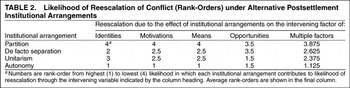
According to the model developed so far, different institutional arrangements affect the likelihood of reescalation of conflict and failure of democratization through their impact on the intervening variables of identities, motivations, means, and opportunities. The model stresses that the usual international-relations focus on the last of these omits important elements of domestic politics that are equally important in the explanation of how alternative institutional arrangements affect the prospects for post-conflict peace and democracy. The model leads to predictions of the form: a change in institutions (from the situation at the end of the civil war) leads to changes in the four intervening variables (from their level at the end of the civil war) and these in turn lead to changes in the likelihood of renewed violence and failure of democratization. A simple average of these intermediate effects that assigns each equal weight yields predictions of how alternative institutional arrangements affect the relative likelihood of re-escalation of conflict that may subvert democracy and threaten the peace (see Table 2). In these predictions, partition stands apart from the other institutional arrangements with the lowest likelihood of reescalation. Partition is followed by de facto separation and unitarism, which are ranked very closely together, and then autonomy.

International-relations research has tended to privilege the balance of offensive and defensive means by either dismissing variation in the other intervening variables or treating this variation as endogenous to the balance of means. The critical-factor approach asserts or assumes that the other factors are always in a state that permits escalation or have no effect; variation in the distribution of means alone determines the outcome (e.g., Posen 1993, 29). The endogeneity approach asserts or assumes that the other factors are determined by the balance of means (e.g., Kaufmann 1998, 122). These approaches that privilege the balance of means lead international relations specialists to expect that partition will be indistinguishable in its affect on the likelihood of reescalation of violence and the failure of democratization from at least one of the other forms of separation (see the “opportunities” column in Table 2).
A FIRST TEST
Because the strongest empirical case against partition is made by Sambanis (2000), we begin with his data as the hardest test of these predictions. The question we address concerns the consequences of alternative institutional arrangements adopted at the ends of civil wars to solve nationalist conflicts. Replicating Sambanis' tests, we measure outcomes two years after the ends of civil wars. We drop 8 cases from Sambanis' dataset that did not end before 2002 and another 44 cases that Sambanis classifies as nonethnic conflicts and did not involve disputes over competing nation-state projects. We update Sambanis' list of cases by adding two nationalist civil wars that began and ended after 1997. The result is 72 civil wars of nationalism.1
All data used in this article are posted on dss.ucsd.edu/~proeder. In verifying, updating, and recalibrating variables we discovered a few instances of apparent coding error in the original data and corrected these.
Specification
The dependent variables indicate whether the civil war settlement resulted in postwar peace and democracy. In developing indicators of postwar peace we ask whether the parties avoided reescalating their conflict with one another for at least 2 years after the end of the civil war. We use two operationalizations—a dichotomous indicator that there was no renewal of violence during the 2 years (Survival of peace) and a three-level index of the extent of the peace that distinguishes survival of peace with no resumption of violence (Extent of peace = 2), survival of peace marred by violence short of a civil war (Extent of peace = 1), and breakdown of the peace with a new civil war (Extent of peace = 0). We use a 2-year rather than longer interval in order to limit the number of exogenous and possibly confounding shocks that may intercede between a peace settlement and our measurement of consequences. We extend this interval in a survival analysis that we report in a subsequent section of this article. In developing indicators of postwar democracy we ask whether the population lived under a democratic government 2 years after the end of the civil war. Yet, the variety of institutional arrangements identified earlier means that we must somehow measure the extent of democracy in units of governance that actually vary with the type of postwar arrangement as follows: a single postwar common-state government under unitarism, separate rump-state and successor-state governments under partition, subordinate autonomous governments and a superordinate common-state government under autonomy arrangements, and multiple de facto governing authorities empowered by ceasefires. We summarize the level of democracy under these complex arrangements with three alternative operationalizations: (1) metropolitan democratization measures the extent of democracy—the Polity score (Marshall and Jaggers 2005)—associated with the government of the original common-state, even if reconstituted as a new rump-state government. (2) Segment democratization measures the extent of democracy (Polity score) for the group that pressed its own nation-state project during the civil war, but after the war was governed by a separate successor-state, autonomous-region, or de facto government or, where unitarism was adopted, by the common-state government.2
Where Polity scores are missing for a case—particularly for regions that were not recognized as sovereign states—we estimated the Polity score (calibrated to range 0 to 20) from the Freedom House scores for political liberties for that same year.
The Segment democratization score is also correlated with Metropolitan democratization (r = 0.70) and with Median democratization (r = 0.74). There are missing data for eight observations on Segment democratization that cannot be estimated from independent measures.
The key independent variables indicate alternative postwar institutional constraints on the likelihood of peace and democracy. The distinctions among institutional arrangements established in the peace settlement concern not the formal terms of a treaty or truce agreement, but the actual arrangements implemented (contrast, e.g., Hartzell and Hoddie 2003). We use three dichotomous operationalizations: (1) Partition resulted in establishment of independent states, each of which maintained diplomatic relations with at least one of the great powers (the permanent members of the Security Council). (2) Separation provided for no formal institutional arrangement but effectively excluded the common-state government from the secessionist region and denied it sustained access to the segment population. (3) Autonomy established a state and government for the secessionists, but also reestablished the authority of the common-state government over the segment territory and population. Unitarism constitutes the baseline category.
In addition, the independent variables include constraints that Sambanis (2000) found to have a significant effect on the survival of peace and on democratization: (1) Prewar democracy is the Polity score of the common-state 5 years prior to the onset of the civil war. (2) War duration is the number of years from the start to the end of the civil war. (3) War deaths is the natural logarithm of the number of military and civilian lives lost in the civil war. (4) Armed forces is the number of troops (in millions) commanded by the central government at the beginning of the civil war. (5) GDP per capita is measured in thousands of constant dollars and purchasing power parity at the start of a short war or at the end of a longer war. (6) Peace operations is a dichotomous indicator of the presence of a third party that provided armed forces to enforce a settlement. We use Sambanis's data, correcting for any coding errors that we encountered.
Results
The results are consistent with the expectations that partition stands apart from institutional arrangements designed to keep the parties together; compared to these other arrangements partition increases the prospects for post-settlement democracy and peace. The coefficient estimates for Partition are consistently significant at the .05 level or better. The pattern of results is also consistent with the expectation that the attempt to reincorporate a rebellious segment through an autonomous state within the common-state may create the least favorable conditions for democracy and peace. Yet, despite the expected central tendency, only one of the five coefficient estimates associated with Autonomy is significantly different from unitarism at the .05 level.
In equations for postconflict democracy—using the three alternative operationalizations of democracy— the magnitude and statistical significance of the coefficients for the Partition indicator underscores that this institutional arrangement stands apart from the alternatives by increasing the likelihood that citizens of both the common-state reconstituted as a rump-state and the secessionists reconstituted as a new successor state would live under less oppressive regimes (see Equations 1, 2, and 3 in Table 3). In addition, the rank orders of coefficients in all three equations are consistent with the expectation that partition is followed by de facto separation and unitarism (the baseline), and that autonomy may even have a negative effect on postwar democratization. In particular, autonomy substantially increased the likelihood that the autonomous region's population would live under a more repressive regime (Equation 3). Yet only the Partition coefficient is consistently significant at the .05 level in all three equations.

In Equations 4 and 5 for the Survival of peace and Extent of peace, the magnitude and statistical significance of the coefficients for Partition once again are consistent with the expectation that—among the four alternatives identified—partition is the best institutional arrangement for preserving the peace. The coefficients for Partition are significant at the .05 level or better. (A multinomial logit reestimation of Equation 5, not presented here, shows Partition is significant at the .05 level for both 0–2 and 1–2 comparisons.) Again the rank order of the coefficients suggests that de facto separation is like partition in doing better than unitarism and autonomy in preserving the peace. Autonomy ranks at the bottom, even below unitarism. None of the coefficient estimates associated with these other institutional arrangements is statistically significant at the .05 level, however.
Endogeneity and Correlates
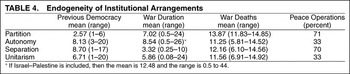
Closer examination of cases reveals that Pre-war democratization, War duration, War deaths, and Peace operations are related to the choice of institutional arrangements (see Table 4). The international community imposed partition only on the most oppressive regimes and certainly never on a democracy. Partition was imposed only in civil wars that had the most extreme loss of life, but not in civil wars of moderate or low casualties. Alternatively, de facto separations took place only after wars of shorter duration and not after longer wars. Partition and de facto separation were more than twice as likely as either unitarism or autonomy to be associated with peace operations. The significance of the Partition variable, despite inclusion of these other variables, is consistent with our claim that this institutional arrangement has an independent effect. Still, we must look more closely at the relationship of institutional arrangement to outcomes where this relationship may be endogenous to one of these other variables.

In particular, there is a complex relationship between preconflict democracy, postsettlement institutions, and postconflict democracy. The expected level of postconflict democracy rises with the level of preconflict democracy. Using the −10 to +10 Polity scale in a simple bivariate regression, the predicted level of postconflict democracy is 0.547x–4.812, where x is the level of preconflict democracy. Partition after civil war only occurred in cases where there was little democracy prior to the civil war; no country with preconflict democracy greater than −4 was partitioned. Nonetheless, all seven states that were partitioned were subsequently above the predicted level of democracy. Alternatively, in the same range of preconflict democracy (less than or equal to −4), only 2 of the 5 states divided by de facto separations, 2 of the 6 states with autonomy arrangements, and 4 of 28 unitary states were above the predicted level of postconflict democratization. In short, even holding constant the effect of prewar democratization, partition is more likely than other institutional arrangements to lead to postconflict democracy.
Peacekeepers may have had an effect on resumption of violence, but the coefficient estimates for Peace operations are not significant at the .05 level in any of the equations. Closer inspection of the cases in which peacekeepers were supposed to maintain the peace after a civil war shows that partition apparently increased the likelihood that peace would survive still further. In cases in which peacekeepers were present but the presettlement common-state was kept whole, peace survived in 64% of the cases. This rose to 71% with Separation and to 80% with Partition. Caution is in order, however, because the number of cases in these two categories is too small to make precise estimates of the independent effects of these institutional constraints when peacekeepers were present.
The severity of the previous civil war—measured by its duration and the loss of life in the civil war—affected the likelihood of a subsequent escalation of conflict. Longer and costlier wars reduced the chances of a resumption of conflict (Luttwak 1999; contrast Sambanis 2000). As predicted by a substantial body of literature, GDP per capita had a significant positive effect on the level of post-conflict democracy. Yet, this relationship appears to be primarily an effect on the likelihood that the common-state government will be democratic. Because measures of the GDP per capita for the disputed regions are unavailable, we cannot determine whether the insignificance of the coefficient estimate in the regional democracy equation is due to the absence of a relationship or the imprecision of the measurement when we use the national GDP figure as a surrogate.
Why Do Our Results Differ?
These results are associated with a particular respecification of Sambanis' statistical model that refocuses on nationalist or secessionist conflicts; in addition, the model employs redefined and recoded variables and an updated list of cases that adds settlements from 1999 to 2001. In order to discern whether these methodological changes—and not our theory—account for the differences between our statistical results and those of Sambanis, we reestimated Equations 1 and 4 in Table 3 with two alternative specifications of the model. A first alternative specification includes all civil wars—whether secessionist or not—but uses the re-defined and recoded variables and the updated observations. A second includes all civil wars, uses Sambanis's original definitions and operationalizations of variables, but includes the updated cases. In all four reestimated equations the coefficient estimates associated with Partition remain positive and significant at the .05 level or better. These reestimations provide evidence that the differences in our results are not the consequence of different measurement or different case selection. The differences in our results are the consequence of the theory that shapes our analysis in four ways. First, our theory focuses our analysis on the problem that partition was originally supposed to resolve—nationalist disputes among politicians with competing nation-state projects. Partition may simply be irrelevant as a solution to other civil conflicts, such as most ideological wars and many wars of communal contention over control of the same government. Second, our theory distinguishes partition from alternative institutional arrangements often bracketed under the same label. The institutional form of separation has significant consequences for the subsequent domestic politics of the affected states. Third, our theory of a complex causal process balances multiple causal chains (leading through identities, motivations, means, and opportunities) from our primary cause (institutional arrangements) to the consequences of interest (peace and democratization). We began with the “naïve” assumption that each causal link was of equal importance and this gave us greater predictive accuracy than assuming that the balance of means alone should be privileged. (With further evidence we might update our “naïve” assumption and begin to weight the relative importance of each causal chain.) Fourth, our theory focuses our predictions and tests in a comparative analysis, so that assessments of the consequences of each cause, such as different institutional arrangements, are framed as comparisons of the relative consequences of explicit alternatives.
OTHER TESTS
We should be cautious in drawing strong conclusions from a single retest using a modified dataset. First, these findings must be corroborated by other tests using independent datasets if we are to avoid the suspicion that we have found significant results through simple “data mining.” Of course, our respecifications were driven by theory (Collier, Brady, and Seawright 2004, 238–40; King, Keohane, and Verba 2004, 174). Second, partitions after civil war constitute only a small subset of all partitions and the skeptics' claims concerning the consequences of partitions are not limited to those undertaken at the end of civil wars. Schaeffer (1999) and Etzioni (1992–1993) contend that all secessionist states carved from existing states are much more likely than states created by other means to suffer domestic violence and democratic failure. Third, the civil wars dataset does not permit us to address the international consequences that the skeptics contend follow from partition. The skeptics claim that, because states created by partition are inclined to transform their former intrastate conflicts into new inter-state conflicts, they are unusually disruptive of international peace (Christie 1992, 70; Schaeffer 1990, 204). Such claims against partition in effect challenge us to expand our comparison set and to juxtapose states created by partition—whether after a civil war or not—to states created by other means. These tests do not model the relationship specified in our theory as precisely as the first test, but they are ways for us to challenge our own first results. The finding of a positive relationship between partition and either democratic failure or resumption of violence in these challenges should raise a warning about our results in the first test.
Between 1900 and 2002, one hundred forty-four new nation-states with a population over 250,000 joined the international system. Partition created 46, decolonization—91, unification of independent states—4, incorporation of new areas—2 (Afghanistan, Saudi Arabia), and resumption of independence—1 (Haiti).4
This is based on the country list in Gleditsch and Ward 1999. Schaeffer (1999) counts 37 successor states created from 13 countries partitioned after 1920, including China, Germany, Korea, Vietnam, India, Pakistan, Palestine, Yugoslavia, Soviet Union, Czechoslovakia, Ethiopia, Ireland, and Cyprus.
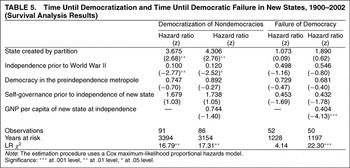
Concerning the fate of postpartition democracy, three findings emerge from analyses of the Polity 4 dataset (Marshall and Jaggers 2005). (We examine all states in the dataset with population over 250,000 created from 1900 to 2002; n = 144.) First, states created by partition were more likely to be “born democratic” and to enjoy more years of democracy. In the first year of independence, exactly half of the new states (23 of 46) created by partition were classified as democratic (with a Polity score above 5 on a −10 to +10 scale), but less than a third of the states (30 of 98) created by decolonization, unification, or other means were so classified. For the states created by partition 42.3% of their years after independence were years of democratic rule, but for the other new states this was only 25.9 years (n = 142). Second, new states created by partition that were not “born democratic” were more likely to democratize subsequently. If we analyze the survival of nondemocratic regimes in new states “born non-democratic,” we find that a quarter of the nondemocracies created by partition had democratized within 27 years, but it took the nondemocracies created by other means 40 years (n = 91). States created by partition were approximately four times as likely to democratize in any time period. This estimate of time until democratization is derived by survival analysis using a Cox proportional hazards model reported in Table 5. The analysis includes a dichotomous variable for states created by partition; dichotomous variables to indicate that the state gained independence prior to World War II, that the government of the metropolitan government governing it prior to independence had been a democracy in the year before independence (source: Marshall and Jaggers 2005), and that the state had been a self-governing jurisdiction prior to independence (source: Statesman's Yearbook, 1899–2002); and an estimate of the GNP per capita immediately prior to independence (source: World Bank 2005). (Because some countries must be dropped from the analysis when the GNP variable is included, we estimated the equations twice and show both results.) The results also show that the likelihood of democratization (a failure of nondemocracy) was significantly lower before 1939. Alternatively, democracy in the pre-independence metropolitan government, self-governance prior to independence, and GNP per capita did not have statistically significant effects. Third, among the new states that had been “born democratic” partition had no effect on whether democracy would survive. In the survival analysis shown in Table 5 partition does not yield a statistically significant coefficient. Indeed, consistent with the findings of Przeworski et al. (1996), the only significant effect on democratic survival is GNP per capita.

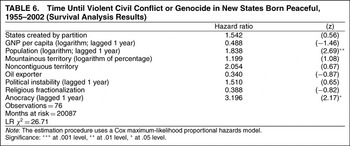
Despite the fact states created by partition were more likely than other new states to emerge from ethnic conflict, states created by partition did not show significantly higher levels of postindependence ethnic violence. Analysis of data in the State Failures project (Marshall, Gurr, and Harff 2002) permits us to examine the time from independence until an outbreak of ethnic war or genocide. Partitioned states created between 1955 and 2002 were more likely to be the result of societies already at war with themselves: 14.8% of the states (4 of 27) created by partition were experiencing ethnic violence or genocide at the time of their creation, but only 2.6% of states (2 of 69) created by other means were experiencing such conflict (n = 96). Yet, contrary to the claims of the skeptics, among states “born peaceful”—that is, they were not experiencing ethnic violence at the moment when they achieved independence—states created by partition were no more likely to see outbreaks of ethnic violence: 20.0% (5 of 25) saw conflicts with casualties compared to 22.4% of states (15 of 67) created by other means. Table 6 shows the results of a survival analysis of time from independence until an outbreak of ethnic violence or genocide among states created after 1954. In this Cox proportional hazards model the dependent variable is any outbreak of ethnic war or genocide that resulted in at least 100 fatalities in a year. In addition to a dichotomous variable for states created by partition, this model also controls for all variables found to be significant for ethnic civil wars by Fearon and Laitin (2003)—that is, GNP per capita, population size, mountainous territory, noncontiguous territory, oil exports, political instability, religious fractionalization, and anocracy. We should expect that states created by partition would enjoy shorter periods of postindependence peace, particularly in light of their inauspicious beginnings, and there is a hint of this in the coefficient that is greater than 1, yet this coefficient for states created by partition is far from statistical significance at any normal confidence interval. Only population size and anocracy yield statistically significant coefficients.

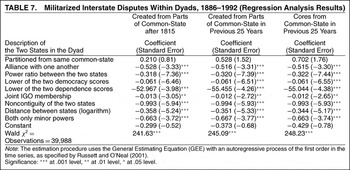
The potential for transforming old intrastate conflicts into new interstate conflicts did not make relations among the states created by partition any more likely to escalate to militarized interstate disputes. The data of the Correlates of War project permit us to examine whether successor states created from the same preindependence common-state were more likely than other states to go to war against one another. Russett and O'Neal's (2001) equation for the effects of democracy and economic interdependence on militarized interstate disputes for the years 1886 to 1992 includes variables describing the two members of each dyad—specifically, whether they were in an alliance with one another, the ratio of their capabilities, the democracy score of the less democratic of the two, the trade dependence on the other by the less dependent of the two, joint membership in intergovernmental organizations, states that were not contiguous to one another, the distance between their capitals or major ports, and mutual status as minor powers. Into this equation we insert a dichotomous variable for dyads in which both states had been parts of the same previously sovereign state prior to their independence. These are states created after 1815, within 25 years of one another, and from parts of the same common-state. For example, by this definition Poland was the result of partition of the Russian, Austro-Hungarian, and German Empires, and so is identified as having a common-state origin with all other states, such as Czechoslovakia and Lithuania, created within 25 years of 1918 from parts of these common-states. Reestimation of the Russett–O'Neal equation (shown in Table 7) yields a coefficient that is small in magnitude and not statistically significant. Only by limiting the definition of the partition effect does this coefficient increase in magnitude and approach statistical significance. First, we limit the effect to the first 25 years after independence so that each successor state is no longer coded as having a common origin with others after 25 years of independence. (The results appear in the second column of numbers.) Second, we limit the definition of common origins so that only the location of the core (capital) region of each successor state defines its previous membership in a preindependence sovereign state. For example, by this definition, Poland is only a successor state of the Russian Empire. (These results appear in the third column of numbers.) Try as we may, we cannot produce results that provide statistically significant support for the claim that successor states were likely to escalate their preindependence ethnic conflicts into international disputes to such an extent that they were more likely than other states to go to war against one another.

CONCLUSION
In our predictions and empirical findings, partition emerges as a better solution to nationalist wars than the alternatives of unitarism, de facto separation, or autonomy insofar as it increases the prospects for post-conflict peace and democracy. After 72 nationalist civil wars between 1945 and 2002 only 14% of the parties to de jure partition experienced a resumption of violence within 2 years, but this frequency rose to 50% for the parties to a de facto separation, 63% for the parties bound in a unitary state, and 67% for the parties to an autonomy arrangement. And sovereign states created by partition are no more likely to go to war against one another than states created by other means.
Parties to partition were more likely to see a substantial rise in the level of democracy. After civil wars of nationalism parties to partition all saw a rise in postconflict democracy from preconflict levels (measured as a positive change in their Polity scores) and for 71% this was a substantial rise of 6 or more on the 20-point scale. For parties to de facto separation all saw a rise, but for only 20% was this rise substantial. For parties kept together in a unitary state, 37% saw a rise; but 35% saw a decline, and only 9% saw a substantial rise. And for the parties to autonomy arrangements, only 22% saw a rise, and 56% saw a decline in levels of democracy. States created by partition were more likely than other new states to be born democratic and to enjoy more years of postindependence democracy.
We should underscore that our empirical theory has avoided any normative claims such as a purported right to national self-determination for the parties to nationalist disputes. We offer only prudential claims based on an empirical theory and evidence from all recent partitions; in many circumstances these advise peacemakers to favor partition over alternative institutional arrangements when confronting the challenge of competing nation-state projects. Moreover, we do not make the claim that partition is an inherently good solution, but that in specific circumstances—particularly after civil wars of nationalism—partition is better than de facto separation, autonomy, or unitarism at preserving the peace among the parties to the previous conflict and fostering democratization.
Beyond the conclusions about the consequences of partition, our study has three broad implications for the study of nationalist conflicts. First, our study highlights the primacy of political institutions, which shape identities, channel greed and grievance, create and distribute means of coercion, and open or close opportunities for escalating conflict. This approach rejects simple claims that the whole story of nationalist conflict can be told with just one of these intervening factors, such as greed focused on “lootable” resources. Our focus on institutions leads us to optimism in that policymakers can choose among institutional arrangements, but it leads us to only cautious optimism because policymakers cannot easily change the consequences of these institutional options. Selecting an institutional arrangement, such as regional autonomy in Iraq, without thoroughly considering the evidence concerning its consequences, can be a path to undesired outcomes.
Second, our study underscores the need to identify carefully the problems that we seek to resolve with different institutional arrangements. We have examined partition as a solution to conflicts in which the agenda focuses on contending nation-state projects that would draw the boundaries of an existing state in different ways. Where so-called ethnic conflict focuses on contention among groups such as Tutsis and Hutus for control of the same state, partition may have the consequences we outlined in this article, but in confronting this problem of communal contention alternative institutional arrangements may be still more effective. And in a complex conflict where some groups press nation-state projects (like Kurds in Iraq) and other groups contend with one another for control of the same state (like Sunnis and Shiites in Iraq) we must undertake careful weighing of the consequences of a single institutional arrangement for all parties against the consequences of a mixed strategy of partition for some but alternative institutional arrangements that will keep the others together within a common state.
Third, our study challenges future studies of nationalist conflicts as well as policymakers to bring together theory and evidence. Extant theoretical treatises and statistical studies have made important contributions to the debate over partition. Yet we are able to draw a unique conclusion by bringing together and building on both. Our study derives its findings by defining concepts more precisely, making more explicit the theoretical assumptions and development that yield hypotheses, and designing hypothesis tests with these concepts and theories clearly in sight.





Comments
No Comments have been published for this article.