Implications
Finding solutions to rear entire male pigs without drawbacks on the meat quality and welfare during fattening are essential for the EU pig industry that is engaged in a process of stopping surgical castration. The present study evaluates the housing system and the season as two possible sources of variation of pubertal development, behaviour and boar taint. We found a positive effect of enriching the environment on the number of skin lesions but not on the other parameters. Decreasing day length seems to accelerate the pubertal development. The mechanisms underlying the pubertal variations in testicular activity and behaviour appear more clear.
Introduction
In numerous countries, male piglets are routinely castrated to avoid the problems of sexual odours (=boar taint) in the meat (Fredriksen et al., Reference Fredriksen, Lium, Marka, Mosveen and Nafstad2008). In addition, rearing entire male pigs may induce welfare problems during the fattening period in relation to mounting behaviour and presumed aggressiveness (von Borell et al., Reference von Borell, Baumgartner, Giersing, Jäggin, Prunier, Tuyttens and Edwards2009). However, surgical castration has numerous economic, environmental and ethical drawbacks (EFSA, 2004). Surgically castrated pigs have a lower feed efficiency, which increases the cost of production and the environmental impact. Fat deposition is favoured at the expense of protein deposition, which decreases carcass leanness and hence its value. Furthermore, surgical castration is ethically questionable because it generates severe physiological and behavioural signs of pain (Hay et al., Reference Hay, Vulin, Génin, Sales and Prunier2003; Prunier et al., Reference Prunier, Mounier and Hay2005). Therefore, surgical castration is highly debated in the European countries, and numerous stakeholders in the pig industry have committed themselves to abandon this practice by 2018, provided that solutions regarding the boar taint problem are found.
Boar taint is mainly due to two compounds, androstenone and skatole, in which concentrations of fat increase during the pubertal development (Zamaratskaia and Squires, Reference Zamaratskaia and Squires2009). Both compounds are under the control of genetic and environmental factors that may influence the pattern of pubertal development (acceleration or retardation) or the level of testicular androgen production for a given stage of pubertal animals. Of the environmental factors, only the influence of season or light duration and the influence of the social environment have been studied to the best of our knowledge. Even if some results demonstrate the opposite (Berger et al., Reference Berger, Mahone, Svoboda, Metz and Clegg1980), most studies lead to the conclusion that decreasing day length and short days stimulate puberty attainment and testicular activity of the mature boars (Claus et al., Reference Claus, Schopper and Wagner1983; Andersson et al., Reference Andersson, Rydhmer, Lundstrom, Wallgren, Andersson and Forsberg1998). However, no clear effect of season or artificial light regimen was found on the fat levels of androstenone in the peripubertal boars (Andersson et al., Reference Andersson, Rydhmer, Lundstrom, Wallgren, Andersson and Forsberg1998; Zamaratskaia et al., Reference Zamaratskaia, Babol, Andersson and Lundstrom2004). In addition, unexpected lower levels were observed during short days than during long days (Fredriksen et al., Reference Fredriksen, Lium, Marka, Heier, Dahl, Choinski and Nafstad2006).
The social environment may also influence these compounds. The influence of the contacts with females or with only males has been evaluated. Rearing boars with gilts resulted in an increased fat concentration of androstenone compared with rearing only male boars, but this effect depended on the age/live weight of the male boars at slaughter probably because its effect is mediated by an acceleration of the pubertal development and not by an increased production of androstenone by the testes for a given stage of pubertal development (Patterson and Lightfoot, Reference Patterson and Lightfoot1984; Zamaratskaia et al., Reference Zamaratskaia, Babol, Andersson, Andersson and Lundstrom2005). Social stress by mixing unfamiliar entire male boars during rearing seemed to increase fat androstenone at slaughter (Fredriksen et al., Reference Fredriksen, Lium, Marka, Heier, Dahl, Choinski and Nafstad2006). Variations in the level of fat androstenone between pens were shown to be positively related to those in aggression level and variations within pens to the social rank, with the dominant pigs having higher levels of androstenone (Giersing et al., Reference Giersing, Lundstrom and Andersson2000). Therefore, any way of reducing the aggression and competition levels between pigs could also lead to a decrease in fat androstenone. As reviewed by de Weerd and Day (Reference Van de Weerd and Day2009), the presence of large amounts of enrichment materials may reduce competition and aggression in the stable groups of pigs. Therefore, an impact of enriching the environment on boar taint can be expected. These hypotheses have not been tested in male pigs.
Consequently, the aim of the present study was to determine the effects of season and housing on the pubertal development (plasma levels of testicular hormones, sexual behaviour, weight of the testes), number of skin lesions and fat levels of boar taint compounds (androstenone and skatole). The skin lesions were used as a measure of aggressions performed by individual pigs as developed by Turner et al. (Reference Turner, Farnworth, White, Brotherstone, Mendl, Knap, Penny and Lawrence2006). We hypothesized that season influences the pubertal development, and enriching the environment (space, outdoor run, straw) decreases the aggression and competition levels and hence reduces boar taint.
Material and methods
Animals, housing and experimental design
The experiment was conducted following the French guidelines for animal care and use. The scientist responsible for the experiment (A Prunier, INRA France) had an agreement (level I) delivered by the veterinary services of the French Ministry of Agriculture (licence no. 04742). People taking care of the animals or collecting the samples had an agreement (level II) delivered by the veterinary services of the French Ministry of Agriculture (Veterinary School, 44307 Nantes, France). The protocol was examined by an ethical committee (Comité régional d'Ethique en Expérimentation Animale de Bretagne) and received the authorization b-2009-AP01.
A total number of 40 intact (uncastrated) male pigs (Large White×Landrace dams inseminated with Pietrain semen) were studied at the experimental farm of PEGASE (35590 Saint-Gilles, France). The experiment was conducted in two trials corresponding to two seasons, from March to June for the spring trial and from September to December for the autumn trial (n=20/season). The male pigs originated from 11 (spring) and 12 (autumn) litters. At 26.0±0.8 days of age (mean±standard deviation), animals were weaned, selected and housed in separate pens according to their future housing system. The selection was done to balance the live weight and litter origin. The animals were transferred to the experimental unit at 75.0±0.8 days of age. In the experimental unit, the pigs were housed in two independent rooms (one per housing system), each consisting of two pens separated by a corridor (see details in Tallet et al., Reference Tallet, Brillouet, Meunier-Salaün, Paulmier, Guérin and Prunier2013). In each system, one pen was occupied by 10 experimental pigs and the other pen by 10 non-experimental contemporary castrated male pigs. Therefore, the experiment included 10 pigs/season/housing. The conventional (C) pens had a concrete slatted floor (1.0 m²/pig) and a temperature fixed at 23°C. The enriched (E) pens were on a straw bedding (1.3 m²/pig) with an access to a roofed outdoor run (solid concrete without straw, 1.2 m²/pig). The minimal and maximal ambient temperatures were recorded daily. In C pens and in the indoor part of E pens, artificial light was provided between 0800 h and 1700 h. In the outdoor area, the light duration increased from 1133 to 1552 h for the spring trial, whereas it decreased from 1239 to 0827 h for the autumn trial (values are calculated from the time of sunrise and sunset in Saint-Gilles located 48.108°N). The pigs had free access to water and received ad libitum standard diets for growing and finishing pigs. The animals were slaughtered at the abattoir of the experimental unit at 160.1±1.2 days of age. From weaning to slaughter, the pigs did not undergo any social mixing in order to limit the agonistic interactions. For a sanitary reason independent of the experience (lameness), one pig in the E housing was excluded from the experiment at 110 days of age.
Behavioural and body recordings
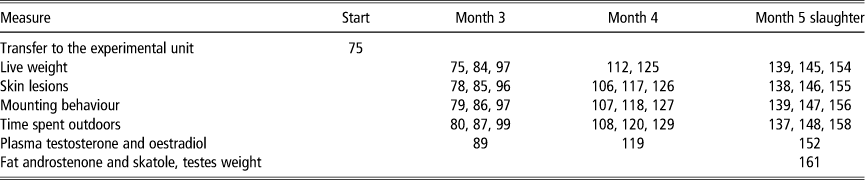
Live weight was measured at the transfer to the experimental building, regularly during the experimental period (Table 1) and the day before slaughter. The time spent in the outdoor run for E pigs was recorded using a telemetric apparatus for 24 h at about 10-day intervals, choosing days with no intervention on the animals (Table 1). The pigs were identified by a transponder (HDX Texas Instrument Allflex BRO) implanted in the right ear before entry into the finishing pens. A receptive antenna (Panel Reader Allflex) was located in the passage between the indoor pen and the outdoor run and connected by a telemetry to a computer (Bobillier, INRA internal development). The location of each pig (outdoors or not) was recorded every 5 s allowing the calculation of the time spent indoors/outdoors by each animal for each observational day.
Time schedule of the experiment indicating age (mean±1 day) of the pigs at each event or measure
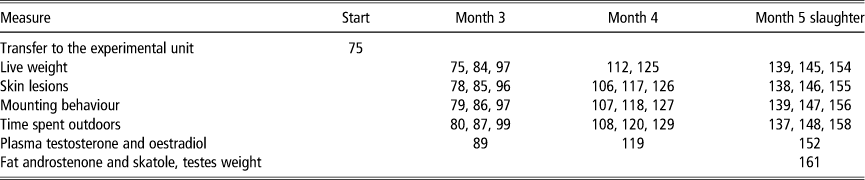
Skin lesions were counted every 10±2 days from 3 days after the transfer in the experimental unit, that is, three times per month of age for each pig (Table 1). A trained observer inspected both sides of the pig’s body. All skin lesions with a length above 2 cm were counted. Round lesions (diameter>2 cm) were counted separately, but none of them were depicted. A group of at least three small lesions (length<2 cm) within a diameter of 2 cm was counted as one lesion. Means concerning the same month of age were calculated for statistical analysis.
The mounting behaviour was observed the day after the skin lesions were counted. One mounting behaviour was counted when the pig had its front legs on another pig irrespective of the position of the pig performing the behaviour. Two trained observers carried out the observations. Before the observations, the animals were marked with a number (0 to 9 in each group) on their back using a special pen. At 0845 am, each observer entered a room and walked slowly in the corridor in front of the pens for 5 min so that the animals could get used to her presence. Then, each pen was observed for 1 h, alternatively during the 5 min periods. After 1 h, the observers exchanged the rooms and started the same protocol again. A total of 1 h of observation was carried out for each pen. Each observer noted (PsionWorkabout, Psion PLC, London, UK) the occurrence of each mounting behaviour on a hand-held PC and identified the performer of the behaviour and the receiver. As the outdoor area of the enriched housing was not visible, the pens were videotaped using cameras (SONY PC25-2230 P 1/3, Tokyo, Japan) linked to a multiplex (Advanced Technology Video DPX9 PAL, Washington, USA) and to a recorder (Panasonic TL 500, Osaka, Japan). The videotapes were then analysed for sexual behaviour with the same time schedule. Data were transferred to The Observer XT9 (Noldus, The Netherlands) to calculate the total number of actions performed by each animal for each series of observation. Taking into account that the mounting behaviour is a rare event, all data (i.e. 9 h of observation per pen) were summed up for the statistical analysis.
Sample collection and measures
Blood was collected with EDTA from the anterior vena cava at about 3, 4 and 5 months of age in the home pen (Table 1). The sampling procedure took less than 2 min. Additional blood samples were collected at slaughter during exsanguination. After centrifugation, plasma was collected and stored at −20°C until the analysis. Testosterone and oestradiol were assessed by the I125 radio-immunoassays (testosterone: Immunotech, Prague, Czech Republic; oestradiol: ORION Diagnostica Corporation, Espoo, Finland). For testosterone, the detection threshold was 0.3 nmol/l, intra-assay CV was 4.1% at 2.6 nmol/l and inter-assay CV was 9.4% at 1.7 nmol/l. For oestradiol, the detection threshold was 9.2 pmol/l, intra-assay CV was 5.0% at 1020 pmol/l and inter-assay CV was 9.7% at 1800 pmol/l.
At slaughter, the testes of the male pigs were collected, freed from the surrounding tissues and weighed. The samples of subcutaneous fat were taken at the level of the last rib for determination of androstenone and skatole concentrations. They were measured using an HPLC according to the procedures described by Batorek et al. (Reference Batorek, Škrlep, Prunier, Louveau, Noblet, Bonneau and Čandek-Potokar2012). Concentrations were expressed per gram of the lipid fraction from the adipose tissue. The detection limits were 0.24 μg/g for androstenone and 0.03 μg/g for skatole, and these values were assigned to the pigs with levels below those limits.
Statistical analyses
For all analyses, the animal was considered as the statistical unit. Normality of the data was checked with the Shapiro–Wilk test using the SAS® software (SAS 8). When necessary, a log transformation was applied to normalize the data (P→log(P+1)) for mounting behaviour and skin lesions, (P→log(P)) for androstenone, testosterone and oestradiol at most ages. The influence of age on the time spent outdoors for E pigs was analysed within the season using the Mixed procedure of SAS®, with animal as a random effect and age as a fixed effect. The influence of season (influence of the trial=fixed effect) on the time spent outdoors was analysed within the ages using the GLM procedure of SAS®. Live weight, testicular weight, mounting behaviour, fat level of androstenone, number of skin lesions within each month of age and plasma levels of hormones within each month were analysed by analysis of variance using the GLM procedure of SAS®. The model included the fixed effects of season and housing and the season×housing interaction. Whenever possible, live weight was introduced as a covariate. When the season×housing interaction was not significant (P>0.1), it was removed from the statistical model. A similar procedure was applied to live weight. As it was not possible to normalize the skatole levels for analysing the housing or season effects, a non-parametric test was applied (Mann–Whitney test using the Anastat software). For the same reason, a non-parametric test for a related series (Friedman test using the Anastat software) was applied to analyse the influence of stage at sampling on hormones. To test the existence of relationships between parameters, the Pearson correlations were calculated using the Corr procedure of SAS®.
All results were presented as arithmetic means±standard errors even when a logarithmic transformation or a non-parametric test was used for the statistical analysis. They were calculated from raw data using Excel®.
Results
Minimal and maximal ambient temperatures measured indoors displayed more variations in the E than in the C housing (Figure 1). Overall, the minimal and maximal temperatures measured indoors during 24 h were lower in the E than in the C housing. Temperatures observed outdoors in the E housing demonstrated even more pronounced variations with an overall trend for an increase over time during the spring trial and for a decrease over time during the autumn trial (Figure 2).
Variations in daily minimal (T min) and maximal ambient temperatures (T max) for both the housing systemsand seasons (spring, autumn) recorded indoors. E=enriched, C=conventional.

Variations in daily minimal (T min) and maximal (T max) temperatures recorded outdoors and in time spent outdoors (hours out, means±s.e.m.) in the enriched system for both seasons (spring, autumn).
Within each age, the time spent outdoors was higher (P<0.05) in the autumn than in the spring trial, except for the last observation (P>0.1). In addition, the time spent outdoors increased with age in both the seasons (P<0.001), but the increase occurred later in the spring than in the autumn trial (Figure 2). Indeed, the E pigs spent more than 12 h/day outdoors and were exposed to the natural light from 129 days of age in the spring and from 87 days of age in the autumn trial.
Live weight was slightly higher (P<0.05) in the autumn than in the spring trial at transfer to the experimental unit (spring: 30.8±1.2, autumn: 34.4±0.8 kg) and during the experimental period until 154 days of age (spring: 113.1±2.2, autumn: 119.0±1.8 kg). However, the difference was no more significant at slaughter (spring: 120.5±1.6, autumn: 123.4±1.3 kg, P=0.33). In contrast, live weight did not differ between the housing systems.
Testicular hormones, testis development and boar taint compounds
Irrespective of the parameter, the interaction between housing and season was never significant (P>0.05). Plasma oestradiol and testosterone did not differ between the housing systems at any age (P>0.1, data not shown). At 3 months, the concentrations of both hormones were higher in the autumn than in the spring trial (testosterone: 8.3±1.5 v. 3.9±0.5 nmol/l, P<0.05; oestradiol: 12.0±1.7 v. 9.2±0.0 pmol/l, P=0.07, Figure 3), but the difference was no more significant at older ages (P>0.1). The influence of live weight was significant only at 5 months and for testosterone: the hormone concentration decreased with live weight (P=0.01). There was an effect of the stage of sampling (Figure 3) on both hormones (P<0.01), with a significant increase (P<0.05) between M3 and M5 for both hormones, between M4 and M5 for oestradiol and between M5 and slaughter for both hormones.
Influence of the season (spring v. autumn) on plasma concentrations of testosterone and oestradiol at various ages and at slaughter (means±s.e.m.). *, †Difference between means is significant at P<0.05 and P=0.07, respectively.
Weight of both the testes increased with live weight at slaughter (P<0.02). It did not vary between the housing systems (C: 539±25 g v. E: 561±27 g, P>0.1) but was higher in the autumn than in the spring trial (587±27 v. 512±22 g, P<0.05). Similarly, the ratio between testis weight and live weight was higher in the autumn trial (4.76±0.20 v. 4.24±0.17 g/kg, P<0.05).
Fat androstenone was not influenced by any factor of the model (P>0.1) and averaged 1.85±0.34 µg/g. Skatole was not influenced by the housing system (P>0.1) but was higher in the autumn than in the spring trial (0.124±0.044 v. 0.043±0.005 µg/g, P<0.03).
Mounting behaviour
About 60% of the pigs performed at least one mounting behaviour during the 9 h of observation, with a maximum of 46 mounting behaviours in one pig (Figure 4). The distribution of the number of pigs among behavioural classes was not normal (P<0.05). The distribution of pigs receiving mountings was more evenly distributed (Figure 4). Indeed, about 80% of the pigs received at least one mounting behaviour; the distribution of pigs between the classes was normal (P>0.1) and the maximum number of received mounting behaviours was 22.
Distribution of the pigs according to the number of mounting behaviours that they have performed or received.
The live weight (mean calculated from the weights at transfer into the experimental building and at slaughter) introduced as a covariate as well as the interaction between housing and season had no significant effect on the given or received mounting behaviours (P>0.2). The mounting behaviours that were performed (data not shown) tended to be more frequent in the E than in the C housing system (P=0.10) but were similar in both the seasons (P=0.88). The number of received behaviours (Figure 5) was higher in the E than in the C housing system (P<0.003) and tended to be lower in the spring than in the autumn trial (P<0.08).
Influence of the housing system (enriched v. conventional) and of the season (spring v. autumn) on the number of mounting behaviours that were received by the pigs (means±s.e.m.) **, †Difference between means is significant at P<0.01 and P=0.10, respectively).
Skin lesions
Irrespective of the age, the interaction between housing and season was never significant (P>0.1). The influence of live weight (mean calculated from the measures during each month of observation) was significant at M3 (P<0.0006) and M4 (P<0.02); the number of lesions increased with live weight. The lesions were significantly more numerous in the C than in the E housing at M4 (P<0.005) and M5 (P<0.02), whereas the seasonal effect was significant at M3 (P<0.003) and M4 (P<0.02) with less skin lesions in the spring than in the autumn trial (Figure 6).
Influence of the housing system (enriched v. conventional) and of the season (spring v. autumn) on the number of skin lesions at various ages (means±s.e.m.) **, *, †Difference between means is significant at P<0.01, P<0.05 and P=0.10, respectively).
Relationships between variables
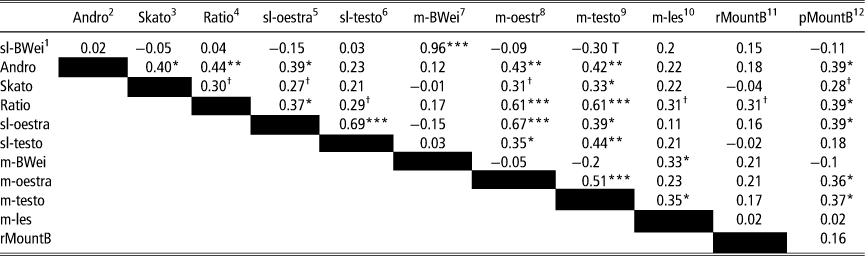
Correlations (Table 2) were calculated between the measures at slaughter and means calculated from M3 to M5. Fat skatole was significantly correlated only with fat androstenone and with the mean plasma testosterone. Fat androstenone and the number of performed mounting behaviours were significantly correlated between each other and with numerous indicators of the pubertal development: ratio of the testicular weight to the live weight, plasma oestradiol at slaughter, mean plasma testosterone and oestradiol calculated during the rearing period (from M3 to M5). The mean number of skin lesions was significantly correlated with the mean live weight and with the mean plasma testosterone.
Pearson correlations between parameters measured at slaughter or means calculated for the 3 months of observation
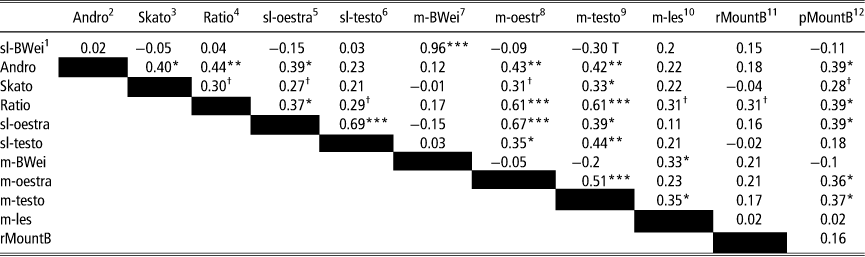
1 Body live weight at slaughter.
2 Log(fat androstenone at slaughter).
3 Log(fat skatole at slaughter).
4 Testis weight/live weight at slaughter.
5 Log(plasma oestradiol at slaughter).
6 Log(plasma testosterone at slaughter).
7 Mean body live weight (=(live weight at transfer to the experimental building+live weight at slaughter)/2).
8 Log(mean plasma oestradiol between M3, M4, M5).
9 Log(mean plasma testosterone between M3, M4, M5).
10 Log(mean number skin lesions between M3, M4, M5).
11 Log(number of total received mounting behaviours).
12 Log(number of total performed mounting behaviours).
***, **, *, †Correlation between parameters is significant at P<0.001, P<0.01, P<0.05 and P=0.10, respectively.
Discussion
To the best of our knowledge, this experiment is the first one to integrate physiological and behavioural indicators of the pubertal development and to demonstrate simultaneously the influence of the season and housing system. Although the number of groups of pigs is relatively low, our results suggest that season has a slight effect on the pubertal development that seems to be accelerated during autumn compared with spring but without clear consequences on boar taint. The experiment also suggests that enriching the environment stimulates sexual behaviour but decreases the occurrence of skin lesions, especially at older ages. In addition, our data indicate, for the first time to our knowledge, a large use of the outdoor run when available and a sharp increase in the plasma sexual hormones at slaughter.
Use of the outdoor run
From about 130 days of age in the spring trial and 90 days of age in the autumn trial, pigs from the enriched environment spent more than 12 h per day outdoors. This is surprising as there was no straw for foraging or sleeping in the outdoor run. Pigs increased the time spent outdoors with age, but this was delayed in the spring compared with the autumn trial probably because of a lower ambient temperature at night. When pigs are growing, their body reserves and the levels of external fat increase so that they can adapt more easily to low ambient temperature and the lower critical temperature of the zone of thermo-comfort decreases. Therefore, our finding emphasizes the preference of growing pigs for fresh air and natural light once they have no difficulty to maintain their internal temperature.
Indicators of the pubertal development
It has been demonstrated that the ratio between the testis and body weight increases rapidly during the pubertal development of male pigs to reach a plateau value of about 5 mg/kg live weight in mature boars (Allrich et al., Reference Allrich, Christenson, Ford and Zimmerman1982; Prunier et al., Reference Prunier, Caritez and Bonneau1987). This value is reached at about 5 months of age in the European breeds of pigs and coincides with the onset of sperm production, the maximal number of Leydig cells, and the maximal concentrations of plasma testosterone and oestradiol (Allrich et al., Reference Allrich, Christenson, Ford and Zimmerman1982; Lee et al., Reference Lee, Diekman, Moss and Allrich1987). Therefore, the ratio of the testis weight and body weight can be considered as a good indicator of the pubertal development. Our data show high correlations (>0.60) between this ratio at slaughter and the mean concentrations of oestradiol and testosterone during the rearing period, suggesting that those concentrations could be used as the predictors of the stage of pubertal development reached some weeks later. Correlations between the testis weight/body weight ratio and hormone concentrations measured at slaughter are much lower, especially for testosterone (r=0.29). This phenomenon may be explained by the fact that stress has a great impact on the testosterone level at slaughter (see below) and that differences in the level of stress perceived by the pigs may mask differences because of pubertal development.
Influence of the season on pubertal development and skin lesions
We found seasonal differences for some parameters: higher plasma concentration of testosterone (significant) and oestradiol (tendency) at 3 months of age, higher number of mounting behaviours performed during the rearing period (tendency) and higher weight of the testes at slaughter (significant) in the autumn compared with the spring trial. This suggests that the pubertal development of the animals was accelerated during the second trial. Of the factors that could explain such difference between the trials, variation in the light duration may play a key role. Indeed, it was demonstrated that decreasing day length has a positive influence on the testicular activity of domestic (Claus et al., Reference Claus, Schopper and Wagner1983; Weiler et al., Reference Weiler, Claus, Dehnhard and Hofacker1996) and wild boars (Mauget and Boissin, Reference Mauget and Boissin1987). In our experiment, the earlier pubertal development was not accompanied by higher levels of fat androstenone as expected from most of the literature (Andersson et al., Reference Andersson, Rydhmer, Lundstrom, Wallgren, Andersson and Forsberg1998; Zamaratskaia et al., Reference Zamaratskaia, Babol, Andersson and Lundstrom2004).
Our data show that skatole was higher in the autumn than in the spring trial. As androstenone and skatole fat levels are both dependent on the pubertal development and are positively correlated (e.g. Lundstrom et al., Reference Lundstrom, Malmfors, Malmfors, Stern, Petersson, Mortensen and Sorensen1988; Zamaratskaia et al., Reference Zamaratskaia, Babol, Andersson and Lundstrom2004), similar effects of environmental variations on both compounds were expected. However, it is often not the case (e.g. Fredriksen et al., Reference Fredriksen, Lium, Marka, Heier, Dahl, Choinski and Nafstad2006) probably because of some particularities of skatole: half-life in fat is short (some hours instead of some days for androstenone), production is highly dependent on nutritional factors and the substance can be reabsorbed from faeces through the skin in contrast to androstenone (EFSA, 2004). In our experiment, the effect of season on fat skatole could be related to a difference in the level of cleanliness, which is known to influence the skatole levels (Hansen et al., Reference Hansen, Larsen and Hansenmoller1995).
The fact that the seasonal influence was similar in both the housing systems is surprising as exposure to light was very different in the two housing systems. Boars in the enriched environment were largely exposed to the natural day light, especially during the last 40 days, as they spent most of their time in the outdoor run, whereas boars in the conventional environment were exposed only to the artificial light in which the duration was fixed to 12 h during the whole experimental period. Therefore, the difference between seasons should be attributed, at least partly, to a difference existing before the entry of the animals into the experimental building, which was lit by the natural light through a window. Such phenomenon emphasizes that the environment of the male pigs before 3 months of age may be very important for the time course of the pubertal development.
We observed a higher number of skin lesions in the autumn trial during the experiment, although the difference was not significant during the last month of the experiment. Such difference may be due to, at least partly, the earlier pubertal development, as the sexual hormones stimulate aggressive behaviour (see discussion below).
Influence of the housing system on pubertal development and skin lesions
The housing system had no clear effect on either the plasma hormone levels or the testis weight or boar taint compounds. However, our results show that the number of skin lesions was influenced by the housing system. It was reduced in the enriched environment during the experiment, although the difference was not significant during the third month of age. Previous results showed that enriching the environment, especially with straw bedding, allows a reduction in aggressive behaviours and in skin lesions (Van de Weerd and Day, Reference Van de Weerd and Day2009). Observation of the agonistic behaviour of the pigs from the same experiment did not confirm a reduction in those behaviours in the enriched housing compared with the conventional one (Tallet et al., Reference Tallet, Brillouet, Meunier-Salaün, Paulmier, Guérin and Prunier2013). However, it should be emphasized that all types of agonistic behaviours were included in our observations and that the environment may influence only the more severe acts (biting) leading to lesions.
Enriching the environment had a significant effect on the number of received mounting behaviours. This may be detrimental to the welfare as pointed out by Rydhmer et al. (Reference Rydhmer, Zamaratskaia, Andersson, Algers, Guillemet and Lundstrom2006) who found more bites at the skin inspection in pigs being mounted and who suggested a higher risk of leg problems. The reason for the higher number of mounting behaviour in the enriched environment is not known but may be related to an overall higher level of activity that was observed by Tallet et al. (Reference Tallet, Brillouet, Meunier-Salaün, Paulmier, Guérin and Prunier2013). It is likely that more space and the presence of straw had stimulated the behavioural activity in the enriched environment (Van de Weerd and Day, Reference Van de Weerd and Day2009). We did not observe a significant effect of the environment on the number of performed mounting behaviours probably because of the very high variability of this parameter. Such variability between pigs was already shown by Rydhmer et al. (Reference Rydhmer, Zamaratskaia, Andersson, Algers, Guillemet and Lundstrom2006) who observed that almost half of the pigs did not perform mounting behaviours, whereas the average number calculated in the others was higher than two.
Relationship between live weight, pubertal development and skin lesions
Our data do not show any significant correlation between live weight during rearing or at slaughter, and any indicator of pubertal development, suggesting that live weight per se is not an important determinant of the pubertal development when animals are fed ad libitum.
Our results demonstrate the existence of a significant positive correlation between the number of skin lesions and the live weight in accordance with the previous data in pigs (Olesen et al., Reference Olesen, Nygaard, Friend, Bushong, Knabe, Vestergaard and Vaughan1996; Turner et al., Reference Turner, Farnworth, White, Brotherstone, Mendl, Knap, Penny and Lawrence2006). We also observed a significant positive correlation between the skin lesions and plasma testosterone. This is in agreement with a positive influence of male sexual hormones on aggressiveness, provided that male pigs with the highest levels of aggressiveness are also those that received the highest number of aggressions in response to their own attacks. This is in good agreement with the lower levels of aggressive behaviours in groups of pigs after suppression of the testicular hormones due to surgical castration (Cronin et al., Reference Cronin, Dunshea, Butler, McCauley, Barnett and Hemsworth2003) or due to vaccination against GnRH (Cronin et al., Reference Cronin, Dunshea, Butler, McCauley, Barnett and Hemsworth2003; Baumgartner et al., Reference Baumgartner, Laister, Koller, Pfutzner, Grodzycki, Andrews and Schmoll2010). Such relationship between androgens and aggressive behaviour has been demonstrated in numerous species including humans (Soma et al., Reference Soma, Scotti, Newman, Charlier and Demas2008).
We also observed significant positive correlations between performed sexual behaviours and rearing levels of plasma oestradiol and testosterone. This is consistent with the role played by oestradiol and testosterone in controlling the sexual behaviour of male pigs (Hemsworth and Tilbrook, Reference Hemsworth and Tilbrook2007). We did not observe any relationship between the received sexual behaviours and rearing levels of plasma steroids as should be expected.
Increase of sexual hormones at slaughter
Our data show an increase of about four times in testosterone and two times in oestradiol between the last blood sample in the home pen and the blood sample at slaughter, 9 days later. Such variation cannot be explained by pubertal maturation, which is associated with increases of much lower amplitude for similar ages (Allrich et al., Reference Allrich, Christenson, Ford and Zimmerman1982; Martin et al., Reference Martin, Baker, Miller and Kellogg1984). This might have been induced by the stress around slaughter. Indeed, exposition to a stressor such as an unknown boar (Liptrap and Raeside, Reference Liptrap and Raeside1978) or an injection of ACTH (Bilandzic et al., Reference Bilandzic, Simic and Kmetic2012) is able to induce a rapid increase in testosterone of similar amplitude. Therefore, caution is needed to interpret the concentrations of testosterone and oestradiol from the blood samples drawn at slaughter or in any stressful situation.
Relationship between boar taint compounds and other parameters
Androstenone is produced by the testes in an increasing amount during pubertal development (Zamaratskaia and Squires, Reference Zamaratskaia and Squires2009). It is stored in the fat tissue and its concentration increases during the pubertal development. Our data show significant correlations between fat androstenone and the plasma levels of oestradiol measured during rearing and at slaughter as well as the plasma level of testosterone measured during rearing in agreement with the previous experiments (Zamaratskaia et al., Reference Zamaratskaia, Babol, Andersson and Lundstrom2004; Grindflek et al., Reference Grindflek, Meuwissen, Aasmundstad, Hamland, Hansen, Nome, Kent, Torjesen and Lien2011). Low correlation between plasma testosterone at slaughter and fat androstenone in our data may be explained by the high impact of stress on plasma testosterone, whereas a potential impact of stress on fat androstenone might be delayed, taking into account the delay in the increase between plasma and fat as shown after hCG stimulation (Bonneau et al., Reference Bonneau, Meusydessolle, Leglise and Claus1982).
Conclusion
Our experiment suggests that pubertal development is accelerated when animals grow during autumn. Interestingly, this difference was not accompanied by a difference in fat androstenone, despite a positive correlation between the levels of sexual hormones during rearing and the levels of boar taint compounds at slaughter. Therefore, the variability in the time course of pubertal development was sufficient to influence boar taint, but the amplitude of the variation due to the seasonal effect was probably not sufficient for influencing androstenone at slaughter. In addition, the housing environment did not seem to clearly influence the pubertal development and boar taint.
Our results suggest a dual effect of enriching the environment on the welfare of entire male pigs. It should have a positive effect in reducing the number of skin lesions, especially in older pigs, but a negative effect in stimulating the mounting behaviour, and hence increasing the risk for leg problems. Furthermore, the variation in the time course of the pubertal development owing to season could be sufficient to influence the number of skin lesions during the third and fourth months of age.
Acknowledgements
This research was funded by two projects: the blank agronomy project ANR-09-BLAN-0083 ANDROPIG (French National Research Agency) and the EC project ALCASDE (DG SANCO). We thank M. Génissel, F. Guérin, M. Lefèbvre, C. Guérin, E. Bobillier, A.M. Mounier, H. Demay, B. Carrissant, M. Alix, J. Liger and J.F. Rouaud for their technical help.