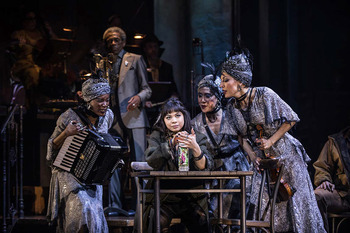
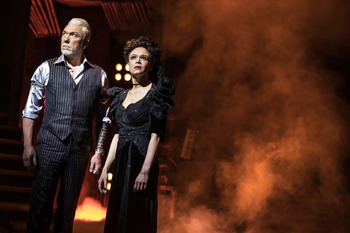
“It’s a tale of a love from long ago,” says Hermes (André De Shields) standing between Eurydice (Eva Noblezada) and Orpheus (Reeve Carney) in the Broadway production of Hadestown. (Photo by Matthew Murphy)

Introduction
Hadestown by Anaïs Mitchell, directed by Rachel Chavkin, went through a number of variations before opening at the Walter Kerr Theatre on Broadway in April 2019. There were performances in Vermont and Massachusetts in 2006 and a concept album in 2010 before Chavkin got involved. Chavkin directed versions of Hadestown in 2016 at the New York Theatre Workshop, in 2017 at Edmonton’s Citadel Theatre, and in 2018 at the National Theatre in London. This interview took place in May 2019 in New York City.Footnote 1
RICHARD SCHECHNER: So how did you meet Anaïs Mitchell, the playwright, composer, and lyricist of Hadestown?
RACHEL CHAVKIN: She got in touch with me. She’d started six years prior, in 2006, making this work with a bunch of friends up in Vermont as a DIY community theatre group.
SCHECHNER: A do-it-yourself?
CHAVKIN: Mmm-hmmm. They were doing it in town halls and around. They began getting a bunch of attention in the music world, so they made the 2010 studio album with Todd Sickafoose, produced by Righteous Babe Records.Footnote 2 Anaïs and I ended up working together because in 2012 after the show had lived in the music world for six years, touring with Michael ChorneyFootnote 3 and his band — he’s one of our orchestrators — as, like, “Santa Monica Sings Hadestown” or “Denver Sings Hadestown,” with local guest singers, she was seeking a director to work on a full theatre production. At that point Anaïs began working with producer Dale Franzen at The Broad StageFootnote 4 where Hadestown had been presented in concert form. Anaïs was in New York and she saw Comet.Footnote 5
SCHECHNER: So that’s how the two of you met?
CHAVKIN: Yes. A mutual friend put us in touch and we sort of began dating, trying to get to know each other over the fall of 2012 and the spring of 2013 before we like really pulled the trigger in June 2013.
SCHECHNER: When you began working on it, Hadestown was a concert, not a stage work. How did you change it during rehearsals? How did you handle the politics, the strong critique of neoliberalism?
CHAVKIN: Anaïs came to me with the 2010 album. I couldn’t access the original performances, what happened in Vermont. But the album was in place. She wrote the “Why We Build the Wall” song in 2006. A bunch of the music, maybe three-fourths, was already written — it was on the album. There were traces of characters certainly already present on the album. So in terms of the neoliberal Hadestown and Hades for example? I would say the zygote was there but no, the meat of the characters really evolved through me feeding back to her what I already saw happening on the album and then going further, telling Anaïs, OK these are the holes that have to be flled in…
from “Why Do We Build the Wall?”
HADES
Why do we build the wall?
My children, my children
Why do we build the wall?
[…]
WORKERS, FATES & PERSEPHONE
Because we have and they have not
Because they want what we have got
The enemy is poverty
And the wall keeps out the enemy
And we build the wall to keep us free
That’s why we build the wall
We build the wall to keep us free
[…]
SCHECHNER: Tell me a little about that. Let’s take one of the really big differences between the myth and the production. In the myth, there’s no politics, certainly nothing about neolib-eralism. Eurydice and Orpheus fall in love, marry, and then for unclear reasons a snake bites Eurydice. She dies instantly. Overcome with grief and driven by love, Orpheus descends to the underworld to recover Eurydice. Hades tells him, “You can have her if you don’t look back to check if she’s following you out.” Orpheus obeys, but just before emerging into the light, he looks back, losing Eurydice forever. But in Hadestown the underworld is a fordist assembly line where the condemned are forever enslaved by capitalism. As the Hadestown script says: “Down in the river of oblivion / You kissed your little life goodbye / And Hades laid his hands on ya / And gave you everlasting life / And everlasting overtime / In the mine / In the mill / In the machinery / Your place on the assembly line / Replaces all your memories” (Mitchell Reference Mitchell2019).Footnote 6
In Hadestown, Eurydice has a lot more agency than in the myth. She chooses “behind closed doors” to sign away her rights for security. When Orpheus tells Hades, “I’m not going back alone. I came to take her home,” the basso-profundo god replies, “You’re not from around here, son. If you were, then you would know that everything and everyone in Hadestown, I own! But I only buy what others choose to sell. Oh didn’t you know? She signed the deal herself and now she belongs to me.” Eurydice confrms, “I did. I do.” Tell me how these big changes come about?
CHAVKIN: Yeah totally yeah yeah yeah… That is a big one. Anaïs had already begun doing that on the 2010 studio album in the song “Gone, I’m Gone” where Eurydice sings, “Orpheus my heart is yours / Always was and will be / It’s my gut I can’t ignore / Orpheus I’m hungry / Oh my heart it aches to stay / But the fesh will have its way / Oh, the way is dark and long / But I’m already gone. I’m gone.” So already on the album, Eurydice chooses to go to Hades — it’s a subversion of the classical myth where Eurydice just gets bitten. And during our time together, Anaïs did a ton of work to fesh out Eurydice as a survivor vs. a victim. We worked really hard to fnd a sweet spot between Eurydice needing Orpheus to come through as a partner in a harsh world, and simply complaining that Orpheus wasn’t protecting her. Eurydice, like Hades, sees the world through the lens of doubt, and concerns about fnancial security, and housing, and food security. It’s her focus in “Wedding Song”: “Who’s gonna buy the wedding bands?” and “Who’s gonna lay the wedding table?” and “Who’s gonna make the wedding bed? / Times being what they are / Hard and getting harder all the time.” Eurydice is very practical-minded. You get that right off the bat. Then Anaïs wrote “Any Way the Wind Blows,” a song the Fates alone sang in the first production at New York Theatre Workshop about how bad the world is, about surviving in a harsh world. Eventually Eurydice sang it with them and it became her anthem.
from “Any Way the Wind Blows”
EURYDICE
Weather ain’t the way it was before
Ain’t no spring or fall at all anymore
It’s either blazing hot or freezing cold
Any way the wind blows
FATE 1
And there ain’t a thing that
FATES
You can do
FATE 3
When the weather takes a
FATES
Turn on you
’cept for hurry up and hit the road
Any way the wind blows
[…]
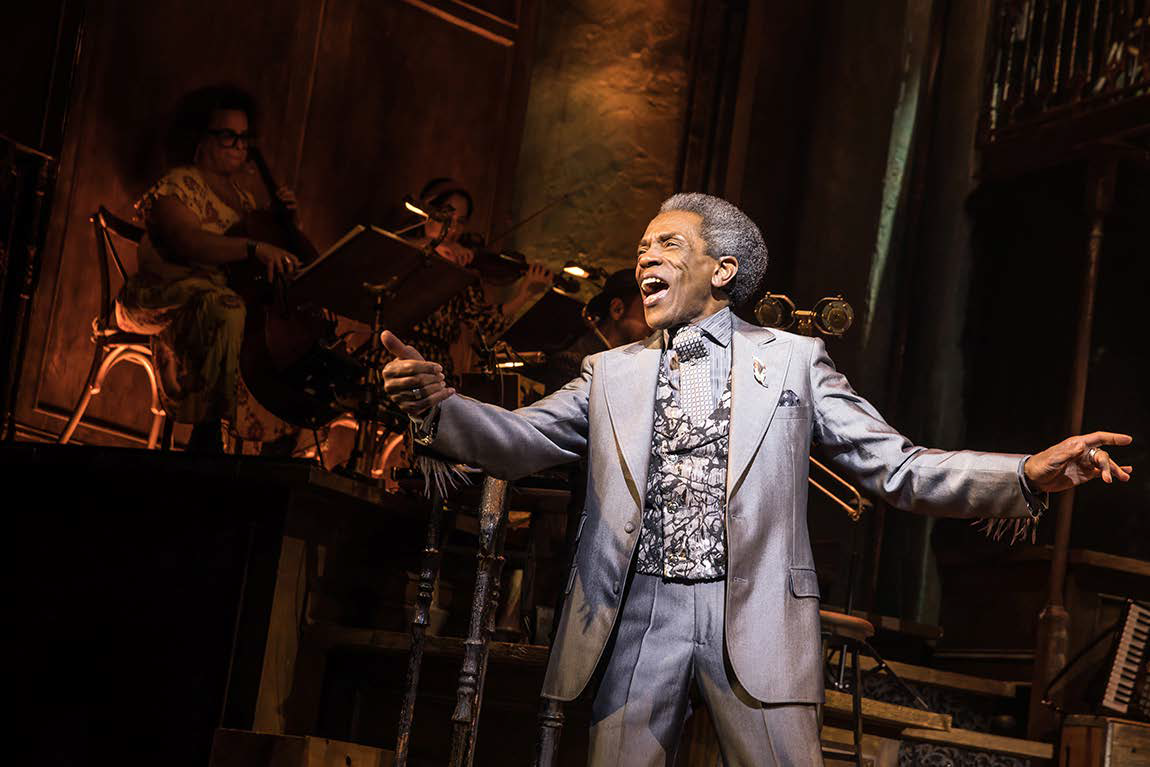
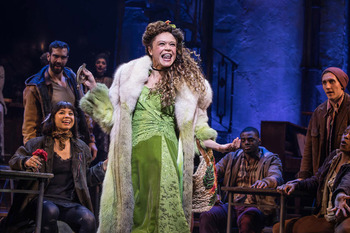
The very first thing Anaïs said to me was that this is a poetry piece, not a prose piece. And she meant many things: Certainly she meant that it had to rhyme, and indeed Anaïs is one of the most exquisite rhyming poets I know, with a talent for slant-rhymes and other unexpected rhymes that have been profoundly underappreciated by a lot of male critics who seem to value symmetry above many other things. And there are other signifcant implications for “poetry vs. prose.” I think of a poem as the densest amount of meaning one can ft in the most concise footprint, or the fewest number of words. And what that means directorially is you don’t stage 5,000 different choices. You have to pick one and make it as clear as possible. In Hadestown, the costumes are maybe the easiest thing to point to: At the New York Theatre Workshop, costume designer Michael Krass and I had a number of different worlds happening as we fgured out how to manifest these mythological characters, and as Anaïs was still early in the writing process. When we went to Canada, as the writing got more specifc about the world, we also got more specifc in the costuming, but everything sort of became too literal and earnest. We even put Persephone in a beautiful green Grecian dress, and yeah, it felt too literal, too much the classic idea of a Greek goddess. So then we were trying to create space between the idea and the manifestation, and I brought up Dolly Parton to Michael. And then he pulled out pictures of mob wives, which were amazing. Michael had always been attracted to Huey Long as a model for Hades, so there was this wonderful overlap of the mob bosses and their wives and Dolly Parton’s sparkly Nashville.Footnote 7 This lightbulb went off. The gods as royalty in silver and black and green. Then as André De Shields came into the role of Hermes, we harmonized him with the Fates in a kind of silvery etherealness. And the workers became the earthen counter-part to this. We trimmed the color palette. By the time we got to Broadway, the workers are in rustbelt colors and shapes. The Fates and Hermes in silver. Persephone pops out in her green. We put Reeve [Orpheus] in the Hermes/workers pallet, a light rust-colored shirt and wearing Hermes’s old gray pants. And stumbling into all this is Eva [Eurydice] in her black slip, tying her to Hades. The one piece of color other than Persephone’s green dress is Eurydice’s flower. Suddenly that flower resonates. That’s what I mean by poetry. Tighten your palette, so the one deviant thing, that flower, gets to really really pop.
SCHECHNER: When you worked with Eva Noblezada playing Eurydice, how did you help her develop her character when so much is determined by the music and the lyrics? Her performance — all the performances — was full of emotion. I was drawn into the story and so were other people.
CHAVKIN: Eva is an extraordinary performer in part because she has such emotional fuid-ity. All of our actors are incredible vocal and physical technicians, and also capable of playing emotions on the operatic scale that this myth requires. And certainly emotion and characterization are already in the music; it’s a conversation between Anaïs’s original composition, the orchestrators — Michael Chorney and Todd Sickafoose — myself, the performers, and then our music director/vocal arranger Liam Robinson. I haven’t worked in traditional opera — both Great Comet and Hadestown are sung-through, but they live in the musical theatre world — but my understanding is that this resembles the way a conductor and singers in the opera world shape the emotional unfurling of the score.
SCHECHNER: What is that conversation precisely? Because here, unlike classical opera, where I would say the music drives the emotion, here I feel the emotion drives the music, the music could go in almost any direction, it’s beautiful to listen to, but it’s not like Verdi where the music tells you what the emotion is. In Hadestown your performers have to work to get that emotion — just as they would if they were performing Chekhov.
CHAVKIN: I don’t agree with that assessment. I think that Anaïs’s music has a huge amount of built-in emotion which I’m responding to, and the orchestrators are responding to, and then we’re all thinking about shaping the beats of the story itself. Sometimes I said to the orchestra-tors and Anaïs, “I need extra time in these measures for X piece of choreography” or “for X scenic transformation” or because Orpheus cannot make his decision that fast. When Anaïs wrote the recitatives, which are all through the score, we went back and forth constantly about meter and where we needed to take more time or less time. Anaïs’s impulses tended to be more spacious, and often me or the performers would be like, “This has to go quicker.” It was a healthy tension between satisfying meter and emotional authenticity, and every actor who has performed those recitatives can tell you they are incredibly diffcult and delicate to perform for that reason.
Hermes (André De Shields) radiating his “silvery etherealness” from the stage of Broadway’s Walter Kerr Theatre in Hadestown. (Photo by Matthew Murphy)

Persephone (Amber Gray) in a dress as green as spring while Eurydice (Eva Noblezada) holds a red flower of love, the only colors popping out from Hadestown’s dark, industrial set. (Photo by Matthew Murphy)

SCHECHNER: What about the actors, what do you say to them?
CHAVKIN: I might suggest a piece of staging to help fll a moment, something in response to the text. Sometimes it’s as simple as a head bow. And ultimately in the fnal production, almost every moment is choreographed in some way large and small — some of which were staging ideas, some of which came from David Neumann and team choreography, and some of which the actors generated. I defnitely think of staging choreographically, meaning it’s all set to or driven by the music in some way.
SCHECHNER: Can you tell me about your role as both director and dramaturg for Hadestown?
CHAVKIN: Yeah, there’s a huge amount of give and take between me as a director in the room and me as dramaturg, because that’s actually a huge a part of my directorial job on a new play. On Hadestown, I worked very closely with the show’s dramaturg, Ken Cerniglia, in supporting Anaïs. A ton of our time was spent on email because she would send us — she’s very female in this way — 10 different versions of a single stanza. She’s so meticulous, and sensitive to the implications of a single tense shift, for example. We’d have a lot of conversation back and forth, and there might be 50 emails in a day about this stanza.
SCHECHNER: Can you give an example?
CHAVKIN: I can give you a lot of examples, and she does so in the beautiful book she’s publishing, which has a bunch of the lyrical variations [Mitchell Reference Mitchell2020]. Layered into all this were macro-conversations about story architecture, and how moment-to-moment lyric nuance affected larger questions of character intent or theme.
SCHECHNER: Let’s talk some more about the music. The play is set in New Orleans’s Preservation HallFootnote 8 and the trombone is such a strong jazz sound.
CHAVKIN: The trombone was always a part of the score. Both our orchestrators, Michael Chorney and Todd Sickafoose, are jazz cats. And from the very earliest development in 2006 Michael used trombone in the orchestrations, and some of the tracks — like “Way Down Hadestown” especially — feel pretty iconically jazz. And this made me and others think about New Orleans, and early on I think Chris Sullivan, who played Hermes downtown, had the idea to use an umbrella in that number, and suddenly it was like, “Oh right, it’s a Second Line — it’s this funeral ritual that sends Persephone back down to Hades at the end of summer.”
Our set at New York Theatre Workshop was essentially this warm, vibey cross between a Greek amphitheatre and a barn. All wood. Scenic designer Rachel Hauck and props designer Noah Mease chose each chair by hand, 199 distinct wooden chairs. And there was this beautiful, gnarled tree that overhung the whole space. So the original design had the feel of being custom-made, handcrafted, mythic. There was a sense of intimacy, but not really a sense of New Orleans’ visual life, just hints. That’s because the show was really far from done. We didn’t have the Workers Chorus, even though by that point we knew we needed them. We couldn’t afford them at the New York Theatre Workshop, so we focused on the storytelling around the two central couples — Eurydice and Orpheus, Persephone and Hades. Hades and Persephone were always easier to write for than Orpheus and Eurydice. And to problem-solve the missing ensemble, all the principals remained basically onstage the whole time, singing choral sections. So the whole event had this very community-driven feel — I’ll talk more about this in a bit.
Then we moved to Canada, and had the challenge of transforming the show for proscenium. We kept the big tree. We had the idea that Orpheus was sort of a farm boy and Eurydice was a migrant worker — all the Workers were migrants. As the writing crystallized, it felt like the design needed to get more specifc too, but the way we went about it for the Canadian production turned out not to be the right impulse. The big problem was we ended up literalizing the metaphor, the “railroad line on the road to hell,” with this beautiful silver tree and silver grass and this silver railroad track. We got turntables and spun the set around. We did nice things. The tree levitated, it rose out of sight pulling a whole bunch of roots up behind it as Orpheus went underground into the act 2 set. So there were defnitely the seeds of a good idea about physical transformation from above-ground act 1 to Hadestown act 2. But when we got into tech with this in Canada, it felt wrong. I was crying every day. It felt joyless, heavy, self- serious in a way that, when layered with Anaïs’s writing, which is very earnest, became absolutely deadly to me — and I shared this concern with Anaïs and David, the designers and the producers, and everyone shared similar concerns.
And so between the first and second preview, with Rachel Hauck’s blessing and with a lot of pushing, nearly half the set from the top of act 1 got slaughtered. We cut the railroad track, the grass; the tree we kept but cut the roots underneath. And Amber Gray talked about how much she missed being onstage the whole time from the NYTW run, and so I put a cafe table for Hades and Persephone stage left, and I told them, “You guys just chill there and drink, and eat oysters until you enter.” This eventually became the idea behind what we still call “the Oyster Platform” on the Broadway set. Writing-wise the big change between the New York Theatre Workshop and Canada…there were many many many small changes, but it probably was the addition of the Workers Chorus.
Since the New York Theatre Workshop, Anaïs had wanted a Workers Chorus. In fact, there is this lyric that remains but at that time was making up for what was lacking: “Now in Hadestown there were a lot of souls / Working on a wall with all their might / Ya see, they kept their heads down low / You couldn’t quite see their faces right / But you could hear them singing.”
The “You couldn’t quite see their faces right” was Anaïs taking care of the fact that basically the actor playing Hermes and those playing the three Fates doubled as the Workers Chorus at the New York Theatre Workshop. The Fates were backlit, you couldn’t see their faces, they were singing but we weren’t manifesting the Workers in any way. And as I mentioned, Amber in the role of Persephone even joined in. We had a music culture where everyone sat in on the session, lots of sharing and overlapping. But when we got to Canada, we cast Workers and everything changed. Suddenly Amber as Persephone, and the Fates and Hermes just needed to do their own roles. But when we began following that through, again, it became too literal and life was sucked out of the show. Just like with the big beautiful literal set. So ultimately Canada was super rich with hard-earned lessons about balancing the production between a musical event and a dramatic event, such as: Let everyone stay onstage singing backup for each other, but storytelling-wise we’re gonna feature the actors who are playing the Workers.
SCHECHNER: It works very well. But how do you get from that to New Orleans?
CHAVKIN: The thing that we did well in Canada was act 2, with its heavy heavy industrial look, and integrating a turntable into the choreography. So we wanted to hold onto that, but we missed our warm wooden amphitheatre. So Rachel Hauck brought it back; I think literally at one point she cannibalized elements of the downtown set within the model-box for the proscenium version. And indeed, the Broadway set is a fancier version of it.
SCHECHNER: Have either of you been to New Orleans?
CHAVKIN: Oh yeah. And we did a lot of visual research of Preservation Hall and other incredible music venues. I mean, Hadestown invokes New Orleans where you have a vast swath of humanity. And what we did, just to take the Broadway cast, is go to this incredible elder, André De Shields, along with this young abandoned white boy, Orpheus. And Eurydice — Eva Noblezada is Mexican-Filipina descent. New Orleans is a holder for these things. Without them, it becomes a fatter place.
SCHECHNER: Was it always set in New Orleans?
CHAVKIN: Immediately after Canada, we began sending images to each other of places where we thought the show would be more fun to take place. I am giving you the very long drawn out version but the short way to think about all this is that in Canada, we got very representational, and that was wrong. We realized we’d lost the vibe. The vibe was the great victory at the New York Theatre Workshop. So we went to the vibiest places in the world, Preservation Hall, Napoleon House, another great New Orleans bar, and other awesome music venues. The fnal design was entirely about getting the vibe back, while not losing the idea of a major scenic transformation from act 1 to act 2 and the visual storytelling we’d discovered in Canada.
SCHECHNER: When I lived in New Orleans in the 1960s, I spent a lot of time at Napoleon House.
CHAVKIN: The wife of our lighting designer Bradley King is from New Orleans and they’ve spent a lot of time there. So that’s how we got here, through a variety of steps. There’s more. We had a curtain for a while, and we killed it. There’re so many steps with the design — we went back and forth about whether to keep the corrugated steel. There was a tree for a while because we wanted to hold on to the tree, but ultimately it became the spiral staircase…the whole thing is really a testament to the importance of a long development process.
SCHECHNER: Let’s turn to the acting. I was struck by André De Shields, Hermes. What a presentation of self. The suit, the strutting. His acting is both electric and eclectic, it can’t be essentialized into a single style. His style is uniquely his own. Tell me how you got to work with him.
CHAVKIN: At New York Theatre Workshop, Chris Sullivan, who is also a remarkable actor and singer, and is a big dude, much younger than André, played Hermes.
SCHECHNER: Black also?
CHAVKIN. No, white. It’s super interesting — I mean it feels like he stepped off a different New Orleans street. Same city, but maybe a different club. Sully plays the harmonica, very gruff voice, felt much more working class. One day when we were discussing costumes during tech, Sully said, “You know, I have this beautiful suit made for me while I was on a television gig playing a mobster; there’s something about Hermes as the go-between of the underworld and the above world, and the idea that he can be bought, that makes me think of this suit.” So he brings in this beautiful brown pinstripe three-piece suit, we combined it with these fnger-less gloves that were needed to protect Sully’s hands while he moved around these massive pieces of metal grating — which was part of the staging — and it was perfect. There’s a bit of a trickster to Hermes. When we moved forward, Sully got cast on This Is Us Footnote 9 on television. Wonderful for the world, but sad for us. But it also gave us a golden opportunity to think about who’s going to play Hermes. That’s a juicy directorial moment. We knew we needed a storyteller as iconic as Sully, who can be emotional but not get so wrapped up in their own pathos that they overtake the two central love stories. André De Shields was the top of that the list.
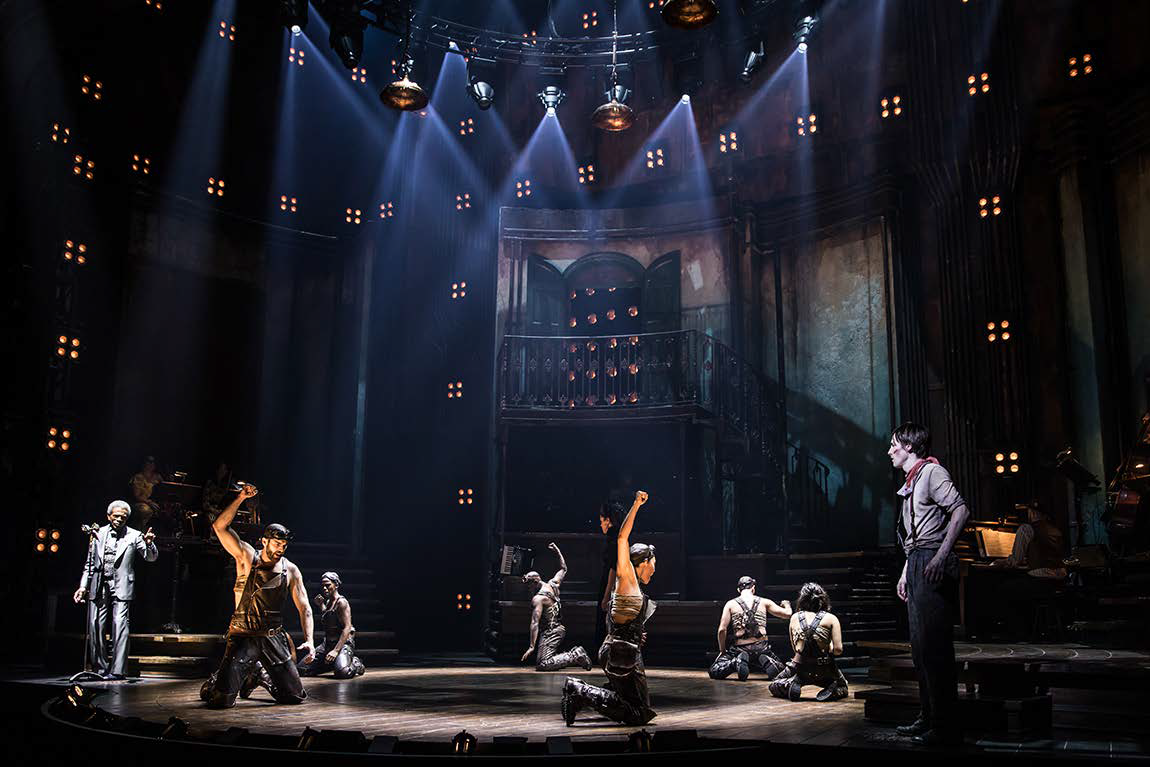
Between Hermes (André De Shields) on the left and Orpheus (Reeve Carney) on the right, the Workers dance their toil on the spinning turntable of Hadestown on Broadway. (Photo by Matthew Murphy)

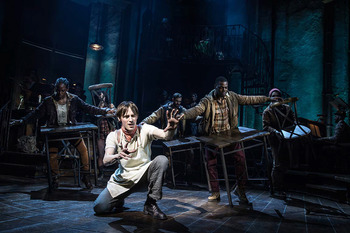
Orpheus (Reeve Carney) tells his story, backed by the Broadway cast of Hadestown. (Photo by Matthew Murphy)

SCHECHNER: Did you know him?
CHAVKIN: Oh yeah, I mean André is a legend, he was The Wiz.Footnote 10 I didn’t know him personally, I had never worked with him. Actually, wildly, André did a Hadestown workshop with Anaïs and a different director before I joined the show. So Anaïs knew André a little bit already, and I got very excited about André in the role as did Mara Isaacs, one of our lead producers. So the next workshop we did after the New York Theatre Workshop version had Reeve Carney as Orpheus and André as Hermes. We loved both of them. André couldn’t come to Canada but he joined us again for London and then Broadway.
SCHECHNER: In terms of casting, Hadestown is very diverse racially and ethnically. Is that intentional or did it just turn out that way?
CHAVKIN: A mixture of both. I’ve been woefully behind in ensuring my creative teams are as racially diverse as the casts I help assemble. And I have to acknowledge that this production has an entirely white-identifying creative team, all of whom I adore, but which I’ve committed publicly to being my last entirely white team. Hadestown has featured casts that are quite diverse in terms of both race and age. And for Hadestown in London we were honored to have a performer with a physical disability who was raucously good, and are still seeking performers for the Broadway production with physical disabilities who can take on the choreography, which does require fairly extreme athleticism. So yes, I am conscientious about asking, Who isn’t yet represented in the room? I believe you have to be. And also, the humans who are onstage right now are the best humans for this show, absolutely. Heterogeneity is not separable from the artistic integrity. And this is something we can always be more rigorous about; for example our band and subs have not refected the racial and gender diversity featured in the acting company, and that is a big area we are working to improve.
SCHECHNER: I don’t mean to be aggressive about this, but Hadestown is about two heterosexual couples. It would be a different show if one or both were gay or trans. In terms of race, Hades has to be white, right?
CHAVKIN: No. Hades was played by both Patrick Page, who is a white performer, and then by J. Bernard Calloway, a remarkable black artist, during the last week at NYTW. J. Bernard was breathtaking in the role, both terrifying and really moving.
SCHECHNER: But given Hades’s capitalism, his social position?
CHAVKIN: But look at Kanye West.
SCHECHNER: I stand corrected. What I was going to ask about diversity includes gender. Up the street Glenda Jackson’s doing LearFootnote 11 and Hadestown’s chorus includes both male- and female-identifying artists, but the Fates were three women, as usual.
CHAVKIN: We almost had a trans performer for one of the Workers or Fates. They ultimately weren’t available.
SCHECHNER: Hadestown is not a group-devised work; it comes with a score and a script. What’s the difference between working on Hadestown and with the TEAM?Footnote 12
CHAVKIN: It’s radically different. The TEAM spends about 80% of its time writing. I am making up an arbitrary percentage, but one based on a good guess. Only in recent years, when my freelance life began taking off and became the majority of my professional life, did I begin to realize, “Oh, my gosh, the TEAM should rehearse more versus always writing.” We were spending so much of our time rewriting — it was so easy for us to rewrite — that we weren’t using our skills as directors and actors nearly as much as we could. And we were making the writing overly clear in ways that I didn’t think served, because ultimately I fnd it much more interesting in the theatre if there’s a tension between the script and the production. In the freelance world, although I encourage the writer to revise, for the most part I consider it my job and the actors’ jobs to riff off what the writer has already done. And if I don’t fundamentally like what the writer has done, I don’t say yes to that project.
SCHECHNER: These days, do you have time to work with the TEAM?
CHAVKIN: It is much more limited than what I had when I was 23 and 24. But yeah absolutely. We are mid-development now on a massive new show called Reconstruction (Still Working but the Devil Might Be Inside). I’m extremely excited about it, including the fact that I am codirecting the work with an extraordinary artist and organizer, Zhailon Levingston. We’re creating it with a phenomenal, large group of artists — I think there’s over 20 collaborating writers on the piece now! Including the design team. The room is fairly evenly split between black artists, white-identifying artists, and artists of color, and we have and continue to work with care to center black taste in the editing process. This is a piece that is about intimacy, and specifcally IF, and if so, HOW, intimacy can be achieved between black and white folx within the context of a violently anti-black America. We have someone who we call our “process chaplain,” a facilitator named Milta Vega-Cardona who worked for years with the People’s Institute for Survival and Beyond developing and teaching a workshop called Undoing Racism. Milta is helping us, along with all the artists in the room, to create what she calls a “liberated space.” The work on this project has quite radically changed and expanded and deepened every part of the TEAM’s practice as an organization. One of the mantras, which we’ve carried over from our previous work, Primer for a Failed Superpower, is: HOW we make is as important as WHAT we make.
SCHECHNER: How do you put these worlds together?
CHAVKIN: Well, I have a schedule helper.
SCHECHNER: Not just the time. I mean emotionally.
CHAVKIN: I don’t try to put my freelance and my TEAM work together. I am a different person in a TEAM room versus a freelance room. Freelance is hierarchical and the TEAM is horizontal. The TEAM is where I am able to most thoroughly live my politics, which are towards an aggressively inclusive and an aggressively ineffcient anticapitalist model. I used to think that the TEAM was where I did “my work” and freelance was where I was more doing other peoples’ work. But actually it’s the reverse. In my freelance life I am profoundly empowered to choose what projects I want, and to really go full bore towards my artistic vision. With the TEAM, I am responsible not just to myself but to the artistic voices of…the team. During the first weeklong workshop for Reconstruction, we spent the last afternoon of the week reading the collaborative contract together, paragraph by paragraph, sentence by sentence. A group of 25 artists discussing words like “exploit” and “percentages” and how we would defne who’s a writer and what the TEAM’s percentage should be. In my freelance life, I’m never gonna do anything like that because of time and agents and all sorts of systemic factors that get in the way of that kind of collaborative business-dealing. I try to make sure I am not working in an environment where anyone is mistreated and I have failed sometimes and caused hurt to artists, and in turn I work to be better at leading a truly antiracist, antimisogynist, antiableist space. It’s a constant, daily practice vs. any sort of achieved state.
“There ain’t a thing that you can do, when the weather takes a turn on you,” the three Fates tell Eurydice (Eva Noblezada) in the Broadway production of Hadestown. (Photo by Matthew Murphy)

SCHECHNER: Did your authority increase from Comet to Hadestown?
CHAVKIN: Absolutely.
SCHECHNER: What’s the progression?
CHAVKIN: The main progression is I feel much more at home on Broadway. I certainly felt at ease in the tech for Comet because I had already tech’ed it four-and-a-half times before we got to Broadway, so I knew the show backwards and forwards, and I felt trusted by our production managers. On Hadestown, we were again working with Hudson Scenic, run by guardian angel Neil Mazzella, and I already knew a bunch of the humans who work at Hudson Scenic, including the equally glorious Sam Ellis. The embrace of the crew — both the Hudson scenic crew and the Walter Kerr house crew — was so deep. At one production meeting after our first run-through, Neil said in tears to everyone: “I wanna thank you in advance for making something so special for us to work on, because it is very rare.” That was profound to hear from the guy who has built half of Broadway’s sets.
SCHECHNER: At many levels the Kerr is a fabulous theatre. First of all, it’s a close-in theatre rather than a barn. And then of course you’ve got all of that gold in the lobby.
CHAVKIN: And a picture of Pan!
SCHECHNER: Well, it’s beautiful but it’s also ironic. How long did you have to load into the Kerr?
CHAVKIN: We started loading in at the end of January [2019] and we started tech at the beginning of March.
SCHECHNER: How long did you get with the full set?
CHAVKIN: We rehearsed at New 42 [New 42nd Street Studios] for four weeks prior to tech. Then we loaded into the Kerr, where we had two full weeks of tech. With Comet I only had one week. Nightmare. That was due to both me not knowing enough to argue, but also due to the vast differences between my lead producer for Comet, and my producers for Hadestown.
SCHECHNER: So you were two weeks in the Kerr and then full dress rehearsal before previews?
CHAVKIN: Oh yeah, multiple multiple dress rehearsals.
SCHECHNER: So you had a lot of time?
CHAVKIN: Yes. We’d already tech’ed the show in London. But the show had changed some from London and we had an entirely new ensemble. The triple turntables alone required days of cueing and refnement, and they can be very nerve-wracking for the actors, if you’re not used to them. It helped that the cue structures for lighting and sound were generally the same as London.
SCHECHNER: I don’t know how much you are involved in Broadway culture but one of the questions is, do you see a change in what Broadway has become? I see an enormous change. Broadway is a much more variegated and interesting place than it was in the Neil Simon days. Now there a bunch of younger artists, Ivo van Hove —
CHAVKIN: — Ivo is not exactly a younger artist.
SCHECHNER: I mean his kind of work and your kind of work are not the same as what Broadway used to be. Musicals have changed. Think of the difference between Hadestown and Hamilton, for example, and The Sound of Music. How does one of the founders and directors of the TEAM see Broadway?
CHAVKIN: I don’t know enough about Broadway history to speak usefully. I do know of some instances in which ensemble-driven experimental work was presented on Broadway, like the Wooster Group’s The Hairy Ape,Footnote 13 or more whimsically Emma Rice and Kneehigh’s Brief Encounter, and far-out plays like Jeremy O. Harris’s Slave Play and Taylor Mac’s Gary. There have been formally groundbreaking musicals like Hair and A Chorus Line.Footnote 14 And I am hopeful that, when Broadway returns with the rest of the American theatre, we will see a proliferation of new voices, particularly black artists, artists of color, and female-identifying artists, all of whom have been historically underrepresented in the Broadway/commercial arena. The white, cisgen-dered, able-bodied, male-driven narrative still dominates.
SCHECHNER: Persephone’s a very peculiar character. On one level she’s spring while on another level she’s a drunk and she’s obscene. She can bump and grind, she’s not what you expect. How did you come with this kind of New Orleans club woman?
CHAVKIN: Anaïs began crafting this complex character long before I got involved, or Amber Gray, who developed the role throughout the entire process, starting in 2014. In the DIY theatre version, which became the studio album, Persephone sings, “Gimme morphine in a tin / Gimme a crate of the fruit of the vine / Takes a lot of medicine / To make it through the wintertime.” And in “Our Lady of the Underground” there was always that glorious, raunchy trombone, and Persephone encouraging insurrection amongst the workers through self-medication.
SCHECHNER: She also suggests that to live with Hades, you need a lot of help. It’s an extremely complex role.
CHAVKIN: Amber Gray is astonishing.
SCHECHNER: Where did you fnd her?
CHAVKIN: “Find” feels so paternalistic. Amber and I met when she was mid-graduate school at NYU, where she got her MFA. And then she joined the TEAM when we were making Mission Drift. We’ve been working together pretty much nonstop since 2008.
SCHECHNER: Any other members of the TEAM in the show?
CHAVKIN: Well André De Shields has been working with us on Reconstruction, around his other many work commitments.
SCHECHNER: Can you compare raising money for the TEAM to working with producers?
CHAVKIN: It’s no better or worse, it’s just different. It depends entirely on the producer. My producer for Comet was radically different than my producer on Hadestown.
SCHECHNER: Do they come in and say “We don’t like this, you gotta do this or that, money talks.” And is the theme of Hadestown, capitalist exploitation, mirrored in the producer-to-show structure?
CHAVKIN: Happily, our Hadestown producers are very deeply ingrained in the artistic process. Mara Isaacs comes from 17 years of running the McCarter TheatreFootnote 15 so she’s no stranger to nonproft and artist-driven models. She came to design meetings, and so did To m Kirdahy, Dale Franzen, and Hunter Arnold occasionally. They’d ask questions. Why this, did you think about this? They had notes during previews, and they were really great.
SCHECHNER: One more artistic question. The story’s a tragedy, Eurydice has to stay in hell, but Anaïs writes it as an endless cycle.
CHAVKIN: It’s a cyclical tragedy, with the potential for a breakthrough each time.
SCHECHNER: But at the curtain call, you toast the audience. On top of the circular structure there is this other more positive thing.
CHAVKIN: “Road to Hell” at the top of the show, and its reprise at the end, were written late in the rehearsal process for the New York Theatre Workshop version. They didn’t open or close the show at the Workshop, and were really just zygotes of songs, barely music events in and of themselves yet and just shadows of what they’ve become on Broadway. At NYTW “Any Way the Wind Blows” opened and “I Raise My Cup” closed. But “Road to Hell” addresses the spe-cifc question of who everyone is and what does this all mean. And so when we got to Canada, Anaïs said “Road to Hell” needs to open and close the show. That began a whole series of changes in the structure. “Any Way the Wind Blows” became part of the storytelling but “I Raise My Cup” was left hanging. Anaïs was ready to cut it. I argued very strongly for the song to exist as our encore. Also, “Our Lady” which is the entr’acte of act 2 almost got cut at one point when we were fguring out if and where to place intermission. And early on this idea arose to play “Our Lady” as an entr’acte, sort of welcoming the audience back, and kind of half-in/ half-out of the plot. To me it felt very good to have these nods to concert logic. Encores are a custom in concerts, although Anaïs is suspicious of them, even when touring as a musician. And the question of a choreographed encore was something we continued to go back and forth on, right up until Broadway — and I think we’re all pretty happy for the chance to have this quiet, bittersweet refection with the audience at the end of show. I believe it was Anaïs in Canada who had the beautiful idea to perform the song without any amplifcation, which adds a special intimacy to the toast.
SCHECHNER: So what does it do from a dramaturgical position?
CHAVKIN: For me, “Cup” acknowledges the bitter sweetness of life. It’s not that we forget the story ends sadly. We fnd joy in the face of, in spite of, the sad ending. We gather around the campfire to hear a sad story and through that community, that shared cup raising, we fnd healing.
Amidst Hadestown’s smoke and fire, Hades (Patrick Page), with Persephone (Amber Gray) dressed for winter, oversees his domain. (Photo by Matthew Murphy)

SCHECHNER: So why have the circular thing? The circular thing says it ends sad but it doesn’t really end sad because it is going to start over again. It undercuts the tragedy.
CHAVKIN: I disagree. The tragedy, the story, is based in seasonal cycles. And the seasons do continue. Orpheus brings the spring time back again via changing Hades’s heart. Persephone asks, “Are we gonna try again?” And Hades answers, “It’s time for spring / We’ll try again next fall.” And “Cup” is outside the confnes of the story — it’s the performers more than the characters — which is part of why the unamplifed organic sound feels so good.
SCHECHNER: I love that.
CHAVKIN: It is an acknowledgment that we are now back in the theatre. Because honestly people, including myself and other members of the creative team, leave “Road to Hell 2” so emotionally devastated by the weight of tragedy that it felt lovely to both own the encore tradition of the music world and to keep this very bittersweet song: “Some flowers bloom where the green grass grows / Our praise is not for them / But the ones who bloom in the bitter snow / We raise our cups to them.”
That’s the grim sentiment. We raise our cup to the failures, the half-sown. We do it as a living theatre community.