Implications
Housing and milking technology, health status and way of handling of animals influence the well-being of animals in intensive dairy farming. Non-invasive methods of assessing stress include heart rate and heart rate variability measurements that involve the monitoring of the autonomic nervous function by digital, high frequency, 24 h multi-channel electrocardiographic recorders. As high-producing cattle breeds are very sensitive to environmental factors, monitoring and decreasing stress is of major importance in terms of both animal welfare and production.
Introduction
In intensive dairy farming, housing and milking systems are main factors in determining the welfare of animals, as adaptation to environmental changes can be challenging for high-producing breeds.
Important aspects in the improvement of dairy cattle management systems in respect of animal welfare are the recognition and evaluation of stress. The stressfulness of the technological environment has been examined in many different contexts. Certain welfare studies proved that for intensively farmed cattle, the milking technology (Rushen et al., Reference Rushen, Munksgaard, Marnet and Passillé de2001; Wenzel et al., Reference Wenzel, Schonreiter-Fischer and Unshelm2003), fear from given routine treatments (Holst, Reference Holst1998) and pain (Broom, Reference Broom1991; Mellor et al., Reference Mellor, Cook and Stafford2000) mean such load that may cause stress (Dantzer and Mormède, Reference Dantzer and Mormède1983; von Borell, Reference Borell von2001) having a negative impact also on milk production (Rushen et al., Reference Rushen, Munksgaard, Marnet and Passillé de2001). Effects of technology and of social interactions can be described not only by classical descriptive behavioural observations (e.g. Milmann, Reference Milmann2013; Theurer et al., Reference Theurer, Amrine and White2013), but with physiological measures as well (Hopster and Blokhuis, Reference Hopster and Blokhuis1994; Rietmann et al., Reference Rietmann, Stauffacher, Bernasconi, Auer and Weishaupt2004). Most dairy cattle studies have focused on the stress reactions of animals expressed in neuroendocrine changes that are considered to be reliable indicators of stress and pain in livestock species (Dantzer and Mormède, Reference Dantzer and Mormède1983; Matteri et al., Reference Matteri, Carroll and Dyer2000; von Borell, Reference Borell von2000).
However, stress affects many physiological systems that are controlled by the autonomic nervous system, including the cardiovascular system. Monitoring the autonomic nervous system activity in farm animals has recently gained considerable interest worldwide. In farm animals, the vagal component of the autonomic nervous system plays a key role in regulating heart rate (HR) in response to stress (Hopster and Blokhuis, Reference Hopster and Blokhuis1994; Hansen and von Borell, Reference Hansen and von Borell1998). Certain parameters of heart rate variability (HRV) give information about cardiac vagal tone and the sympatho-vagal balance (van Ravenswaaij-Arts et al., Reference Ravenswaaij-Arts van, Kollée, Hopman, Stoelinga and Vangeijn1993). Consequently, besides traditional ways of measuring stress – assay of cortisol in plasma or serum and measuring HR – HRV has also been investigated in dairy cattle in veterinary, behavioural and applied animal research (Konold et al., Reference Konold, Bone and Simmons2011; Kovács et al., Reference Kovács, Nagy, Szenci and Tőzsér2012b).
HR measurements have been first introduced in the early 1950s in relation with increased feed intake in dairy cattle (Thomas and Moore, Reference Thomas and Moore1951). Recently, several HR studies focused on the effect of an altered emotional state of the animals related to separation (Boissy and Le Neindre, Reference Boissy and Le Neindre1997), weaning (Hopster et al., Reference Hopster, O’Connell and Blokhuis1995), veterinary procedures (Waiblinger et al., Reference Waiblinger, Menke, Korf and Bucher2004), early handling (Stewart et al., Reference Stewart, Shepherd, Webster, Waas, McLeay and Schütz2013), social interactions (Laister et al., Reference Laister, Stockinger, Regner, Zenger, Knierim and Winckler2011) and human contact (Rushen et al., Reference Rushen, Passillé de and Munksgaard1999; Schmied et al., Reference Schmied, Boivin and Waiblinger2008a and Reference Schmied, Waiblinger, Scharl, Leisch and Boivin2008b).
In the last 15 years, the use of HRV analysis for examining welfare has become prominent in livestock species. In dairy cattle, an increasing number of studies used parameters of HRV to indicate stress caused by diseases (Mohr et al., Reference Mohr, Langbein and Nürnberg2002; Pomfrett et al., Reference Pomfrett, Glover, Bollen and Pollard2004; Konold et al., Reference Konold, Bone and Simmons2011), milking (Hagen et al., Reference Hagen, Langbein, Schmied, Lexer and Waiblinger2005; Neuffer, Reference Neuffer2006; Gygax et al., Reference Gygax, Neuffer, Kaufmann, Hauser and Wechsler2008; Kovács et al., Reference Kovács, Nagy, Szenci and Tőzsér2012b) and painful procedures in calf rearing (Stewart et al., Reference Stewart, Stafford, Dowling, Schaefer and Webster2008a and 2008Reference Stewart, Webster, Schaefer and Staffordb and Reference Stewart, Verkerk, Stafford, Schaefer and Webster2010).
Although HR and HRV measurements are not untouched fields in dairy cattle welfare studies, large areas are still left for future research. von Borell et al. (Reference Borell von, Langbein, Després, Hansen, Leterrier, Marchant-Forde, Marchant-Forde, Minero, Mohr, Prunier, Valance and Veissier2007a) reviewed the methodology related to HRV measurements. In this paper, we aimed to sum up the recently published results and current knowledge in technique, data processing, analysis and evaluation of HR and HRV measurements in dairy cattle – highlighting their efficiency in welfare assessment – and a prospect of the possible areas of future research.
Significance of HR and HRV as non-invasive stress parameters in dairy cattle research
A potential indicator of animal welfare is the presence or absence of stress (Moberg and Mench, Reference Moberg and Mench2000). According to von Borell (Reference Borell von2001) the adjustment to stress induces a broad range of physiological and behavioural changes. These two classes of responses have mostly been dealt with separately, despite the fact that they are closely related.
In the past, housing technologies and management practices for dairy cattle were mainly assessed by descriptive behavioural methods. Studying the relationship between behaviour and the hypothalamus–pituitary–adrenal (HPA) axis activity (Cole et al., Reference Cole, Camp, Rowe, Stevens and Hutcheson1988; Mitchell et al., Reference Mitchell, Hattingh and Ganhao1988) allows a more precise detection of stress than mere observation (Möstl and Palme, Reference Möstl and Palme2002). Till date feedback-free sampling methods for cortisol assays have been developed and validated for milk (Fukasawa et al., Reference Fukasawa, Tsukada, Kosako and Yamada2008), saliva (Pérez et al., Reference Pérez, García-Belenguer Laita, Illera del Portal and Palacio Liesa2004; Weston, Reference Weston2009), faeces (Morrow et al., Reference Morrow, Kolver, Verkerk and Matthews2002; Kahrer et al., Reference Kahrer, Möstl and Baumgartner2006) and urine (Morrow et al., Reference Morrow, Kolver, Verkerk and Matthews2000).
These non-invasive techniques provide reliable results (Cook, Reference Cook2012), however, sample collections limited in loose housed cows (Möstl et al., Reference Möstl, Maggs, Schrötter, Besenfelder and Palme2002) and long-term data collection with short sampling intervals is often difficult to carry out.
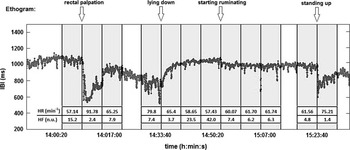
In the last decades – complementary to behavioural and physiological stress measures – HR and HRV enable continuous data recording by monitoring autonomic nervous system activity (Marchant-Forde et al., Reference Marchant-Forde, Marlin and Marchant-Forde2004; von Borell et al., Reference Borell von, Langbein, Després, Hansen, Leterrier, Marchant-Forde, Marchant-Forde, Minero, Mohr, Prunier, Valance and Veissier2007b). Rapid changes in HRV parameters allow a precise identification of stressors therefore HR and HRV are often viewed as more detailed and immediate stress indicators than HPA measures (Stewart et al., Reference Stewart, Stafford, Dowling, Schaefer and Webster2008a; Mialon et al., Reference Mialon, Deiss, Andanson, Anglard, Doreau and Veissier2012). Although the suitability of using HRV parameters to estimate sympathetic nervous system activity is still controversial, HR and vagal tone indices of HRV seem to be reliable indicators of both technological stress and the level of the animal’s activity (Figure 1). As supported henceforth, recent HR and HRV studies proved that stress responses can be quantified by the relative changes in vagal activity, which allows the monitoring of stress levels and coping mechanisms in different situations of dairy management and the comparison of technologies and handling methods in terms of animal welfare.
Changes in interbeat intervals (IBI, ms), heart rate (HR, min−1) and the high frequency component (HF, normalised units (NU)) of HRV during short-term stress (rectal palpation) and during different activities of a lactating dairy cow. HRV was analysed in 5-min time windows following recommendations of von Borell et al. (Reference Borell von, Langbein, Després, Hansen, Leterrier, Marchant-Forde, Marchant-Forde, Minero, Mohr, Prunier, Valance and Veissier2007b) using Kubios 2.0 HRV analysis software.

Interpretation of HR and HRV: the relation of autonomic regulation of the cardiovascular function and stress
HR is defined as the number of heart beats per min and used widely to explore inner short-term events occurring parallel to behavioural changes (Lefcourt et al., Reference Lefcourt, Erez, Varner, Barfield and Tasch1999). Interpretations have often been based on the assumption that HR reflects the activity of the sympathetic branch of the autonomic nervous system and therefore it is an indicator of the stress response (Hopster et al., Reference Hopster, O’Connell and Blokhuis1995; Sgoifo et al., Reference Sgoifo, Koolhaas, Musso and De Boer1999) and the animal’s emotional reactivity (Wolf, Reference Wolf1970; Obrist, Reference Obrist1981). However, it provides little information on the underlying physiological mechanisms that govern its modification in many behavioural situations (Sayers, Reference Sayers1973). Increased HR can occur in a state of pleasure or in response to a negative stimulus (Waiblinger et al., Reference Waiblinger, Boivin, Pedersen, Tosi, Janczak, Visser and Jones2006). The complex interplay of the two branches of the autonomic nervous system is not always comprehensible when cardiac activity is measured only by HR (Porges, Reference Porges1995; Marchant-Forde et al., Reference Marchant-Forde, Marlin and Marchant-Forde2004), as a rise in HR is due to an increase in sympathetic activity (Hainsworth, Reference Hainsworth1995), the decrease of vagal tone or the simultaneous changes in both regulatory systems (von Borell et al., Reference Borell von, Langbein, Després, Hansen, Leterrier, Marchant-Forde, Marchant-Forde, Minero, Mohr, Prunier, Valance and Veissier2007b). In a physiologically and neurally intact heart, successive cardiac cycles (R–R intervals) are non-uniformly separated in time domain (Lewis et al., Reference Lewis, Kingsley, Short and Simpson2007). This beat-to-beat variability is referred to as HRV. With certain parameters of HRV, the sympathetic and vagal activity can be monitored separately at the same time (Malik et al., Reference Malik, Bigger, Camm, Kleiger, Malliani, Moss and Schwartz1996), moreover it is possible to measure the balance between the two (Porges, Reference Porges2003; von Borell et al., Reference Borell von, Langbein, Després, Hansen, Leterrier, Marchant-Forde, Marchant-Forde, Minero, Mohr, Prunier, Valance and Veissier2007b).
Alterations in HRV derive from the dynamic interplay between the multiple physiologic mechanisms that regulate the instantaneous HR (Kleiger et al., Reference Kleiger, Stein, Bosner and Rottman1995). The sympathetic and the parasympathetic nerves of the heart constantly modulate electrical dynamics mediated by the pacemaker cells of the sinoatrial (SA) node (Levy and Martin, Reference Levy and Martin1979). The vagus nerves provide rich innervations to the SA node, atrio-venticular conducting pathways, the atrial myocardium (Hainsworth, Reference Hainsworth1998) and possibly the ventricular myocardium (Johnson et al., Reference Johnson, Gray, Lauenstein, Newton and Massari2004). When both vagal and sympathetic inputs are blocked pharmacologically, HR is higher than the normal value at rest (Cacioppo et al., Reference Cacioppo, Berntson, Binkley, Quigley, Uchino and Fieldstone1994). This fact supports the Poly-Vagal theory of Porges (Porges, Reference Porges1995 and Reference Porges2003), namely that HRV is predominantly determined by the vagus.
Both left and right vagus nerves stimulate the SA node (in 0.2 to 0.6 s) and tend to decrease HR within 5 s (Hainsworth, Reference Hainsworth1995) but overall effects are relatively short lived (von Borell et al., Reference Borell von, Langbein, Després, Hansen, Leterrier, Marchant-Forde, Marchant-Forde, Minero, Mohr, Prunier, Valance and Veissier2007b). Response to sympathetic activity is relatively slower (few seconds), followed by an increase in HR lasting for ∼20 s (Berntson et al., Reference Berntson, Bigger, Eckberg, Grossman, Kaufmann, Malik, Nagaraja, Porges, Saul, Stone and Molen van der1997). Activity within the right Ansa subclavia (right sympathetic nerve) mainly influences HR, whereas left A. subclavia activity impacts stroke volume (Levy and Martin, Reference Levy and Martin1979). According to von Borell et al., Reference Borell von, Langbein, Després, Hansen, Leterrier, Marchant-Forde, Marchant-Forde, Minero, Mohr, Prunier, Valance and Veissier2007b, besides several anatomical disparities between the autonomic branches the differences in response times are a consequence of the differences between the release times of sympathetic-regulator noradrenaline (slower) and vagal regulator acetylcholine (faster).
Besides the non-additive activity originating from the individual branches of the autonomic nervous system and the tonic changes in the central nervous system activity (mainly from the medulla oblongata), HRV is also affected by several physiological control and feedback mechanisms that can provide quick reflexes (von Borell et al., Reference Borell von, Langbein, Després, Hansen, Leterrier, Marchant-Forde, Marchant-Forde, Minero, Mohr, Prunier, Valance and Veissier2007b). Both sympathetic and parasympathetic activities are influenced by baroreceptor stimulation through the four pathways of the arterial baroreflex (Rompelman, Reference Rompelman1993). The Bainbridge reflex acts in a reciprocal way and as the baroreflex. The increase in HR caused by the Bainbridge reflex is followed by an increase in arterial pressure, which stimulates the baroreceptors of the carotid sinus and aortic arch that in turn trigger the baroreflex mechanism to decrease HR (Lanfranchi and Somers, Reference Lanfranchi and Somers2002). The renin–angiotensin system (Kanters et al., Reference Kanters, Hojgaard, Agner and Holstein-Rathlou1996), the thermoregulation (Akselrod et al., Reference Akselrod, Gordon, Madwed, Snidman, Shannon and Cohen1985; Malliani et al., Reference Malliani, Pagani, Lombardi and Cerutti1991), the sympathetic vasomotor tone, the cyclic variation in intrathoracic pressure and the Hering–Breuer reflex (van Ravenswaaij-Arts et al., Reference Ravenswaaij-Arts van, Kollée, Hopman, Stoelinga and Vangeijn1993; Cerutti et al., Reference Cerutti, Bianchi and Mainardi1995) are also taking part in HR regulation.
Methods of measurement and analysis of HR and HRV in dairy cattle
Data collection
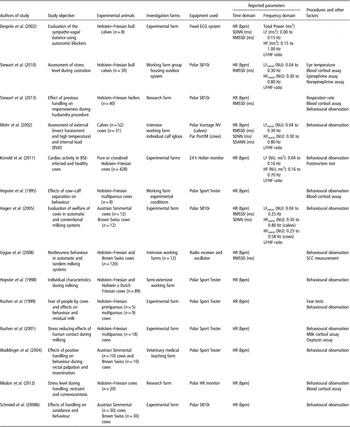
Measuring HR is based on electrocardiography (ECG) or the count of the arterial pulse, as in human medicine. Different types of Holter recorders (Konold et al., Reference Konold, Bone and Simmons2011) and fixed (Little et al., Reference Little, Julu, Hansen, Mellor, Milne and Barrett1996; Pomfrett et al., Reference Pomfrett, Glover, Bollen and Pollard2004) or telemetric systems (Lefcourt et al., Reference Lefcourt, Erez, Varner, Barfield and Tasch1999) as well as portable HR monitors have been used to investigate HR and HRV in dairy cattle (Table 1). The latter ones were originally developed for human athletes and sport medicine research (von Borell et al., Reference Borell von, Langbein, Després, Hansen, Leterrier, Marchant-Forde, Marchant-Forde, Minero, Mohr, Prunier, Valance and Veissier2007b) but these models do not record and store the whole electrocardiogram, only the interbeat intervals (IBIs) (Hopster and Blokhuis, Reference Hopster and Blokhuis1994). It was shown that a portable HR monitoring system is valid and reliable in measuring HR in animals compared with ECG (Essner et al., Reference Essner, Sjöström, Ahlgren and Lindmark2013). Twenty-four hour recordings are also possible with the newest models (Polar R–R Recorder and Polar Equine) in field studies (Marchant-Forde et al., Reference Marchant-Forde, Marlin and Marchant-Forde2004; Kovács et al., Reference Kovács, Nagy, Szenci and Tőzsér2012b).
Summary of selected HR and HRV research in dairy cattle

In dairy cattle practice, the recording of IBIs is carried out with two separate electrodes with a specific transmitter and a HR monitor. It is recommended to place one of the electrodes next to the sternum, on the left side of the chest (cardiac area) and the other one on the right scapula (von Borell et al., Reference Borell von, Langbein, Després, Hansen, Leterrier, Marchant-Forde, Marchant-Forde, Minero, Mohr, Prunier, Valance and Veissier2007b). In some cases, electrode sites were shaved before attaching the electrodes (Després et al., Reference Després, Veissier and Boissy2002; Mohr et al., Reference Mohr, Langbein and Nürnberg2002), whereas others did not consider this important (Hagen et al., Reference Hagen, Langbein, Schmied, Lexer and Waiblinger2005; Schmied et al., Reference Schmied, Boivin and Waiblinger2008a; Kovács et al., Reference Kovács, Nagy, Szenci and Tőzsér2012b). The contacting surface was cleaned before attaching in every case. In one experiment, electrode sites were dampened with 38°C salt water for better conductivity (Janžekovič et al., Reference Janžekovič, Muršec and Janžekovič2006). However, especially in experiments longer than 2 h using ample electrode gel is essential (Kovács et al., Reference Kovács, Nagy, Szenci and Tőzsér2012b) not only because of the optimal electrode–skin contact, but for the adhesion of the electrodes to the skin surface (Després et al., Reference Després, Veissier and Boissy2002; Hagen et al., Reference Hagen, Langbein, Schmied, Lexer and Waiblinger2005; Schmied et al., Reference Schmied, Boivin and Waiblinger2008a).
In calves, electrode belts can be easily fixed around the thorax with an elastic strap (Després et al., Reference Després, Veissier and Boissy2002; Mohr et al., Reference Mohr, Langbein and Nürnberg2002; Clapham et al., Reference Clapham, Fedders, Swecker, Scaglia and Fontenot2007; Stewart et al., Reference Stewart, Stafford, Dowling, Schaefer and Webster2008a and 2008Reference Stewart, Webster, Schaefer and Staffordb), whereas in cows strong girths must be used (Minero et al., Reference Minero, Canali, Ferrante and Carenzi2001; Hagen et al., Reference Hagen, Langbein, Schmied, Lexer and Waiblinger2005, Gygax et al., Reference Gygax, Neuffer, Kaufmann, Hauser and Wechsler2008; Kovács et al., Reference Kovács, Nagy, Szenci and Tőzsér2012b). Signal receivers are usually fixed on the outside of girths. Another method is to fix receivers on the site of the observation, instead of the animals. It has the advantage of continuous monitoring of data collection, yet, in case of uncoded signal transmission it often occurs that the studied animal move too far from the signal receiver and the receivers start to record the signals of the closest animals. Also, implanted devices were used in a recent experiment (Warren et al., Reference Warren, Martinez, Sobering and Andresen2008), but their application is not widespread.
When interaction of animals and crowding cannot be avoided, especially in the milking parlour and in the pre-milking waiting area in loose housing systems, girths have to be set tight enough to prevent the shifting of electrodes (Kovács et al., Reference Kovács, Nagy, Szelényi, Szenci and Tőzsér2012a) because, checking the device’s position and fastening is difficult to implement further on. However, sudden pressure on the cattle’s chest can also induce bradycardia (Clabough and Swanson, Reference Clabough and Swanson1989). Therefore, an adaptation period of 1 h is needed for the animals to get accustomed with the equipment (Rushen et al., Reference Rushen, Munksgaard, Marnet and Passillé de2001; Mohr et al., Reference Mohr, Langbein and Nürnberg2002; Wenzel et al., Reference Wenzel, Schonreiter-Fischer and Unshelm2003; Waiblinger et al., Reference Waiblinger, Menke, Korf and Bucher2004; Stewart et al., Reference Stewart, Stafford, Dowling, Schaefer and Webster2008a), whereas others recommended 5 days in calves (Clapham et al., Reference Clapham, Fedders, Swecker, Scaglia and Fontenot2007) or 7 days in cows (Janžekovič et al., Reference Janžekovič, Muršec and Janžekovič2006). However, after fixing the girth, visible reactions occur only occasionally for about 5 to 10 min (Mohr et al., Reference Mohr, Langbein and Nürnberg2002) and cows show no obvious signs of being hampered by the equipment (Kovács et al., Reference Kovács, Nagy, Szenci and Tőzsér2012b).
To eliminate biases in results, it is also recommended that preparations on animals shall be done by the same person each time to avoid stress that might influence results (Minero et al., Reference Minero, Canali, Ferrante and Carenzi2001; Mohr et al., Reference Mohr, Langbein and Nürnberg2002). On working farms, the protocol should fit into the daily operations of the farm and it is important to avoid conditions that would overly distort data recordings (Kovács et al., Reference Kovács, Nagy, Szelényi, Szenci and Tőzsér2012a).
The periodicity of HR must also be taken into consideration during recording. Several authors found that HR shows a circadian rhythm. A lower peak in the morning hours (0600 to 0800 h) and a higher peak in late afternoon (1630 to 1800 h) were demonstrated (Yamamoto, Reference Yamamoto1989; Aharoni et al., Reference Aharoni, Brosh, Kourilov and Arieli2003; Brosh, Reference Brosh2007). Others reported HR increase in the early evening hours (Wenzel et al., Reference Wenzel, Schonreiter-Fischer and Unshelm2003; Hagen et al., Reference Hagen, Langbein, Schmied, Lexer and Waiblinger2005; Kovács et al., Reference Kovács, Nagy, Szenci and Tőzsér2012b), which was most likely caused by increased metabolic activity in the evening. These findings suggest that it is advised to record baseline HR parameters close to (30 min) the event to be studied or calculate an average HR value at rest from data recorded at different times of the day.
The movements of free ranging animals has to be controlled – especially when elastic belt is used – to prevent the shifting of the electrodes on the body surface, as much as possible (Rushen et al., Reference Rushen, Passillé de and Munksgaard1999; Mohr et al., Reference Mohr, Langbein and Nürnberg2002), as the non-sufficient skin–electrode conductance may cause errors in IBI signals (Minero et al., Reference Minero, Canali, Ferrante and Carenzi2001; Hagen et al., Reference Hagen, Langbein, Schmied, Lexer and Waiblinger2005), most often because of the electrodes getting dry (Gygax et al., Reference Gygax, Neuffer, Kaufmann, Hauser and Wechsler2008).
The noises caused by the action potential of the muscles, environmental electromagnetic interference, stress-related sinus arrhythmia (Bernston and Stowell, Reference Bernston and Stowell1998) or misidentification of R-peaks of the ECG and ectopic beats (Kamath and Fallen, Reference Kamath and Fallen1995) can also lead to artefacts.
HRV parameters are highly sensitive to measurement errors (Marchant-Forde et al., Reference Marchant-Forde, Marlin and Marchant-Forde2004); therefore, selection of IBI data and correction criteria must be rigorous. Each 5-min time window of the recordings involved in HRV analysis must be inspected separately for artefact correction (Kovács et al., Reference Kovács, Nagy, Szelényi, Szenci and Tőzsér2012a). It is recommended to exclude data segments if the error rate is larger than 5% or it contains three or more consecutive erratic IBIs (von Borell et al., Reference Borell von, Langbein, Després, Hansen, Leterrier, Marchant-Forde, Marchant-Forde, Minero, Mohr, Prunier, Valance and Veissier2007b). IBI correction is usually done automatically by special algorithms of the software installed. IBI data are transmitted wirelessly in an encoded form, for undisturbed recording of data deriving from different animals. The IBI signals are stored by the HR monitor and can be downloaded onto a computer wirelessly for later analysis (Niskanen et al., Reference Niskanen, Tarvainen, Ranta-aho and Karjalainen2004).
Traditional methods of HRV analysis
Among several methods, conventionally the linear dynamics of HRV is assessed using time-domain and frequency-domain techniques. Time-domain measures are simple descriptive-statistical procedures, whereas with frequency-modeling approaches the total variability of IBIs is attributed to a spectrum of different frequency components.
The most informative parameter in time-domain analysis is the root mean square successive differences (RMSSD) in milliseconds (ms). The RMSSD is determined by calculating the difference between consecutive IBIs before squaring and after summing them the values are averaged and square root obtained (von Borell et al., Reference Borell von, Langbein, Després, Hansen, Leterrier, Marchant-Forde, Marchant-Forde, Minero, Mohr, Prunier, Valance and Veissier2007b). This reflects the short-term variability of cardiac activity and represents vagal tone (Kleiger et al., Reference Kleiger, Stein, Bosner and Rottman1995; Kanters et al., Reference Kanters, Hojgaard, Agner and Holstein-Rathlou1996; Malik et al., Reference Malik, Bigger, Camm, Kleiger, Malliani, Moss and Schwartz1996).
The standard deviation of the normal-to-normal intervals (SDNN, ms) and the standard deviation of the average normal-to-normal intervals (SDANN, ms) reflect the long-term variability and are typically measured over 24 h. The SDNN is the standard deviation of all IBIs over a 24-h period or the standard deviation of IBIs of a single 5-min period, whereas the SDANN is the standard deviation of all the 5-min IBI means (von Borell et al., Reference Borell von, Langbein, Després, Hansen, Leterrier, Marchant-Forde, Marchant-Forde, Minero, Mohr, Prunier, Valance and Veissier2007b). The pNN50 calculates the percentage of differences between successive IBIs over 24 h that are >50 ms and measures short-term HRV. These parameters are highly correlated with each other and their values are determined by both sympathetic and parasympathetic regulation (Malik et al., Reference Malik, Bigger, Camm, Kleiger, Malliani, Moss and Schwartz1996; von Borell et al., Reference Borell von, Langbein, Després, Hansen, Leterrier, Marchant-Forde, Marchant-Forde, Minero, Mohr, Prunier, Valance and Veissier2007b).
Various spectral methods have been proposed for the calculation of cardiovascular measures of sympathetic and parasympathetic control in frequency domain, which can be used to separate the constituent band-limited components of the IBI signal (Stein et al., Reference Stein, Bosner, Kleiger and Conger1994).
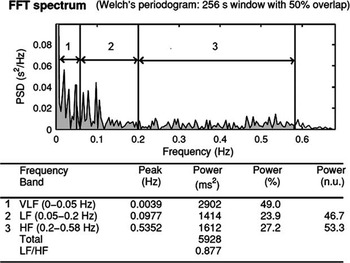
A fundamental hypothesis supporting the use of various spectral methods in HRV studies postulates that the two branches of the autonomic nervous system influence HR in a frequency-dependent way. Power spectral analysis provides basic information of how power (i.e. variance of IBIs) is distributed in function with frequency (Akselrod et al., Reference Akselrod, Gordon, Ubel, Shannon, Berger and Cohen1981). The ‘power’ of a signal can be estimated within a finite frequency range by calculating its power spectral density (PSD) that may be integrated to determine the power within a defined bandwidth (Lewis et al., Reference Lewis, Kingsley, Short and Simpson2007). In dairy cattle research, spectral analysis – as developed by Akselrod et al. (Reference Akselrod, Gordon, Ubel, Shannon, Berger and Cohen1981) – is used, in which the PSD estimation is carried out using the Welch’s periodogram method (Welch, Reference Welch1967) based on Fast Fourier Transformation (FFT; Cooley and Tukey, Reference Cooley and Tukey1965; Figure 2).
Power spectral density (PSD) of heart rate variability (HRV) performed by Fast Fourier Transformation (FFT) using the Welch Periodogram method corresponding to the 256 values of analysis selected previously. Spectral frequency bands are obtained at very low (VLF: 0 to 0.05 Hz), low (LF: 0.05 to 0.20 Hz) and high (HF: 0.20 to 0.58 Hz) frequencies, in absolute (ms2) and normalised units (NU). LF/HF is expressed as the ratio between the absolute areas of low and high frequency bands. Data were calculated with Kubios HRV analysis software.

The FFT’s algorithm separates the HRV to its harmonic components and describes it in frequency domain, making it possible to assign the power of different bands to different physiological functions. The accuracy of the R-wave occurrence time estimates is often required to be 1 to 2 ms and, thus, the sampling frequency of the ECG is recommended at 500 to 1000 Hz (Malik et al., Reference Malik, Bigger, Camm, Kleiger, Malliani, Moss and Schwartz1996). If the sampling frequency of the ECG is <500 Hz, the errors in R-wave occurrence times can cause critical distortion to power spectrum analysis results (Merri et al., Reference Merri, Farden, Mottley and Titlebaum1990).
Short-term variability of the IBI signals can be described by three spectral bands of the HRV spectrum.
The high frequency (HF) band is regulated by the vagus, because it can be almost completely abolished by parasympathetic blockade with atropine (Akselrod et al., Reference Akselrod, Gordon, Madwed, Snidman, Shannon and Cohen1985), whereas the administration of β-blockers (Aronson and Burger, Reference Aronson and Burger2001) or rennin–angiotensine blockade (Pomeranz et al., Reference Pomeranz, Macaulay and Caudill1985) had no effect on HF component. Consequently, HF is a reliable measure of the parasympathetic activity (Akselrod et al., Reference Akselrod, Gordon, Madwed, Snidman, Shannon and Cohen1985; Porges, Reference Porges1995; Slangen et al., Reference Slangen, Out, Janssen and Peeters1997).
It has been shown that the modulation of SA node activity via respiratory frequency and volume is the main mechanism influencing the fast periodicities in the HF range of HRV (Porges, Reference Porges1986; Fleisher, Reference Fleisher1996; Malik et al., Reference Malik, Bigger, Camm, Kleiger, Malliani, Moss and Schwartz1996); therefore, species-specific respiratory rates must be taken into account when locating the HF band during HRV analysis (Slangen et al., Reference Slangen, Out, Janssen and Peeters1997). In mature cattle, according to von Borell et al. (Reference Borell von, Langbein, Després, Hansen, Leterrier, Marchant-Forde, Marchant-Forde, Minero, Mohr, Prunier, Valance and Veissier2007b) HF power is defined as 0.20 to 0.58 Hz (corresponds to a respiratory rate between 12 and 35 min−1) while in calves as 0.5 to 0.83 Hz (corresponds to a respiratory rate between 30 and 50 min−1).
The other characteristic oscillation in HRV spectrum is the low frequency (LF) band, which is thought to be closely associated with the fluctuations of the peripheral vasomotor tone and reflects the 10-s periodicities, or so-called Mayer waves of the blood pressure (Berntson et al., Reference Berntson, Bigger, Eckberg, Grossman, Kaufmann, Malik, Nagaraja, Porges, Saul, Stone and Molen van der1997; Hamner et al., Reference Hamner, Morin, Rudolph and Taylor2001) because of the baroreflex regulating the slow, respiratory-induced blood pressure oscillations (Kitney et al., Reference Kitney, Fulton, McDonald and Linkens1985; Kardos and Gingl, Reference Kardos and Gingl1994).
In cattle LF, power is defined as 0.05 to 0.20 Hz (von Borell et al., Reference Borell von, Langbein, Després, Hansen, Leterrier, Marchant-Forde, Marchant-Forde, Minero, Mohr, Prunier, Valance and Veissier2007b). Although, some researchers have suggested the LF component to be mainly of sympathetic origin (Malliani et al., Reference Malliani, Pagani, Lombardi and Cerutti1991) – in horses it is used as the indicator of sympathetic outflow (Physick-Sheard et al., Reference Physick-Sheard, Marlin, Thornhill and Schroter2000; Rietmann et al., Reference Rietmann, Stauffacher, Bernasconi, Auer and Weishaupt2004) – in cattle it does not represent the changes in sympathetic activity (Després et al., Reference Després, Veissier and Boissy2002; Mohr et al., Reference Mohr, Langbein and Nürnberg2002; Hagen et al., Reference Hagen, Langbein, Schmied, Lexer and Waiblinger2005). It has been confirmed, that the LF component – besides other physiological mechanisms (Malik et al., Reference Malik, Bigger, Camm, Kleiger, Malliani, Moss and Schwartz1996; Kuwahara et al., Reference Kuwahara, Hiraga, Kai, Tsubone and Sugano1999) – arises from the interaction of sympathetic and vagal responses (Akselrod et al., Reference Akselrod, Gordon, Madwed, Snidman, Shannon and Cohen1985; Houle and Billman, Reference Houle and Billman1999) and can be reduced with either sympathetic or parasympathetic antagonists (Cacioppo et al., Reference Cacioppo, Berntson, Binkley, Quigley, Uchino and Fieldstone1994). These findings are consistent with the observations in humans that the parasympathetic nervous system is able to modulate HR effectively at all frequencies between 0 and 0.5 Hz, whereas the sympathetic modulates HR only below 0.1 Hz (Berntson et al., Reference Berntson, Bigger, Eckberg, Grossman, Kaufmann, Malik, Nagaraja, Porges, Saul, Stone and Molen van der1997).
It has been suggested that the relative power of the LF and HF components (LF/HF ratio) characterises the sympatho-vagal balance (Solan et al., Reference Solan, Shapiro, Bagiella, Myers, Bigger and Steinman1994; Malik et al., Reference Malik, Bigger, Camm, Kleiger, Malliani, Moss and Schwartz1996) – a concept reflecting the dual opposing effect of the two autonomic systems on heart activity – and is an accurate indicator of increased sympathetic activity (Yamamoto et al., Reference Yamamoto, Hughson and Peterson1991; Marchant-Forde and Marchant-Forde, Reference Marchant-Forde and Marchant-Forde2004).
The very low frequency (VLF) band (⩽0.05 Hz) represents sympathetic or sympathetic plus vagal activity (Cerutti et al., Reference Cerutti, Bianchi and Mainardi1995) associated with the thermoregulation of vasomotor tone and with the renin–angiotensin–aldosterone system (Akselrod et al., Reference Akselrod, Gordon, Madwed, Snidman, Shannon and Cohen1985), however, its physiological relevance is not fully clear in cattle.
Instead of the absolute values (ms2) of each power, generally the normalised units of LF and HF power are reported in dairy cattle studies, describing the relative value of each power in comparison with total power minus VLF power. Normalisation tends to minimise the effect of the changes in total power (Malik et al., Reference Malik, Bigger, Camm, Kleiger, Malliani, Moss and Schwartz1996) and inter-individual differences (von Borell et al., Reference Borell von, Langbein, Després, Hansen, Leterrier, Marchant-Forde, Marchant-Forde, Minero, Mohr, Prunier, Valance and Veissier2007b).
Non-linear characteristics of HRV
The non-linear components of HRV are determined by hemodynamic, electrophysiological and humoral interactions (Giuliani et al., Reference Giuliani, Piccirillo, Marigliano and Colosimo1998). Since the first publication of the HRV standards (Malik et al., Reference Malik, Bigger, Camm, Kleiger, Malliani, Moss and Schwartz1996), a number of non-linear methods has been proposed to quantify HRV, which are derived from chaos theory and non-linear system theory (Voss et al., Reference Voss, Schulz, Schroeder, Baumert and Caminal2009). Non-linear measures differ from the conventional HRV methods as they are not designed to assess the magnitude of variability but rather the quality, scaling and correlation properties of the HR dynamics (Cervantes et al., Reference Cervantes Blasquez, Rodas Font and Capdevila Ortis2009; Melillo et al., Reference Melillo, Bracale and Pecchia2011). Human HRV studies focus on mainly non-linear methods that are implemented in Kubios, a free software for HRV analysis (The Biomedical Signal and Medical Imaging Analysis Group, Department of Applied Physics, University of Kuopio, Finland).
Till date, a series of mathematical approaches have been applied for the estimation of non-linear characteristics in various physiological time series data (Theiler et al., Reference Theiler, Eubank, Longtin, Gadrikian and Farmer1992).
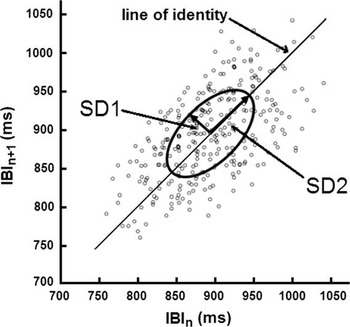
The Poincaré Plot is a graphical representation of the correlation between successive IBIs, where each interval in the time series (IBIi+1) is plotted against its successor (IBIi). A common approach to analyse the Poincaré plot of RR series consists in fitting an ellipse oriented according to the line-of-identity and computing the standard deviation of the points perpendicular to and along the line-of-identity, referred to as SD1 and SD2, respectively (Figure 3).
The Poincaré plot, in which each dot represents the duration of an interbeat interval (IBI) in milliseconds (ms), plotted against the duration of its preceding IBI. SD1 (ms) and SD2 (ms) are the standard deviations of the points perpendicular to and along the line-of-identity, respectively.

SD2 reflects intermediate-term variability and sympathetic activity, whereas SD1 reflects short-term variability and parasympathetic activity (Minero et al., Reference Minero, Canali, Ferrante and Carenzi2001).
The procedure of recurrence quantification analysis (RQA) was developed by Zbilut and Webber (Reference Zbilut and Webber1992) and ideally suited for physiological systems characterised by non-homoeostatic transients and state changes (Zbilut et al., Reference Zbilut, Thomasson and Webber2002). This method was performed for the measurement of the complexity of the time series in a symmetrical K-dimensional square matrix, which is calculated by computing the Euclidean distances of each vector Xi from all the others (Trulla et al., Reference Trulla, Giuliani, Zbilut and Webber1996) The vectors represent the RR interval time series as a trajectory in m dimensional space. The recurrence plot (RP) is the representation of the matrix as a black (for ones) and white (for zeros) image (Niskanen et al., Reference Niskanen, Tarvainen, Ranta-aho and Karjalainen2004) in which L max is the longest diagonal line segment in a continuous row within the plot. A shorter L max is a hallmark for a large amount of chaos in time series data (von Borell et al., Reference Borell von, Langbein, Després, Hansen, Leterrier, Marchant-Forde, Marchant-Forde, Minero, Mohr, Prunier, Valance and Veissier2007b).
The percentage of recurrent points forming upward diagonal lines in the RP referred to as %Determinism (%DET), whereas the percentage of recurrent points in the RP as %Recurrence (%REC). Both %REC and %DET are parameters of the regularity of HRV (von Borell et al., Reference Borell von, Langbein, Després, Hansen, Leterrier, Marchant-Forde, Marchant-Forde, Minero, Mohr, Prunier, Valance and Veissier2007b). The Shannon entropy (Entropy, Ent) of the deterministic line segment length distributed in a histogram and corresponds to the richness of deterministic structuring of the series (von Borell et al., Reference Borell von, Langbein, Després, Hansen, Leterrier, Marchant-Forde, Marchant-Forde, Minero, Mohr, Prunier, Valance and Veissier2007b).
A detrended fluctuation analysis (DFA) enables the detection of long-range correlations within the signal and reflects the amount of randomness in the HR time series (Voss et al., Reference Voss, Schulz, Schroeder, Baumert and Caminal2009). According to Kleiger et al. (Reference Kleiger, Stein and Bigger2005), the IBI time series usually comprise two distinct areas of scale invariance, covering short-term (DFA1, computed for 3 to 11 IBIs) and long-term fluctuations (DFA2, computed for 12 to 20 IBIs).
The complexity and irregularity of HR fluctuations can be calculated by several methods of non-linear HRV. Approximate entropy (ApEntr) and its improved version, sample entropy (SampEntr) quantifies the unpredictability of HR time series (Richman and Moorman, Reference Richman and Moorman2000), while correlation dimension (D2) gives information of the strangeness of the time series (Niskanen et al., Reference Niskanen, Tarvainen, Ranta-aho and Karjalainen2004).
Although a series of human studies described that DFA, ApEntr, SampEntr and D2 are promising approaches for measuring non-linear characteristics of HRV (Tulppo et al., Reference Tulppo, Kiviniemi and Hautala2005; Casties et al., Reference Casties, Mottet and Le Gallais2006; Blasco-Lafarga et al., Reference Blasco-Lafarga, Martínez-Navarro, Sisamón, Caus, Yangüez and Llorens-Soriano2010), the physiological relevance of these measures is not well understood in animals.
In dairy cattle research non-linear HRV has been described by Poincaré plot (Minero et al., Reference Minero, Canali, Ferrante and Carenzi2001; Kovács et al., Reference Kovács, Kézér and Tőzsér2013) and RQA, demonstrating differences in connection with lactation (Mohr et al., Reference Mohr, Langbein and Nürnberg2002), breed or bodyweight (Hagen et al., Reference Hagen, Langbein, Schmied, Lexer and Waiblinger2005).
HR and HRV as indicators of stress in dairy cattle in applied animal research
Recent publications on HR and HRV outline four main topics of research activity in dairy cattle: (1) disease-induced pathological loads; (2) stress caused by husbandry and veterinary procedures; (3) animal’s behavioural and physiological stress reactions during milking and (4) short-term cardiac responses to fearful situations (novelty, weaning and isolation). Each set of literature is relatively small in number but demonstrates an increasing interest in the area of HR and HRV measurements within the last 15 years (Table 1).
Effect of pathological disorders
Relatively few studies have used HRV as a measure of the effect of pathological conditions in dairy cattle. Research demonstrated a significant shift in the activity of the autonomic nervous system reflected in HRV in relation with certain infectious diseases. Studies detected the predominance of the vagal tone experiencing the radical increase of RMSSD (Pomfrett et al., Reference Pomfrett, Glover, Bollen and Pollard2004) or HF power (Little et al., Reference Little, Julu, Hansen, Mellor, Milne and Barrett1996), whereas others described bradycardia (Winter et al., Reference Winter, Aldridge, Scott and Clarke1989; Austin et al., Reference Austin, Pawson, Meek and Webster1997) in cows positive for bovine spongiform encephalopathy (BSE).
In contrast, there was a study that did not find any disease-related changes in HRV (Konold et al., Reference Konold, Bone and Simmons2011), which suggests that the BSE agent has an effect on the dysfunctions of both the sympathetic and the parasympathetic nervous system at the same time.
Results in calves indicated a loss of complexity in HRV in response to pathological load (Mohr et al., Reference Mohr, Langbein and Nürnberg2002). All non-linear parameters calculated with RQA were significantly higher in calves infected with bovine viral diarrhoea (BVD) compared with healthy calves. In the BVD-infected group, both parasympathetic (lower RMSSD and HF power) and sympathetic activity decreased (lower SDNN and SDANN), which suggests that a strong pathological load decreases both vagal and sympathetic tone. Furthermore, in this study researchers determined that parameters calculated both in frequency or time domain are more affected by pathological load, than heat stress or disturbance by external parasites.
Studies on diseases underline the efficiency of HRV in measuring the effects of pathological loads. The decrease in HR associated with an increased parasympathetic tone in case of BSE highlight the impact of chronic stress on cardiac activity. Parallel decline of both sympathetic and vagal activity and a rise in overall non-linear HRV parameters in case of BVD indicate a severe impairment in animal welfare.
Effect of pain
As pain experienced in specific circumstances can induce a stress response when the animals are re-exposed to those circumstances (Boissy and Bouissou, Reference Boissy and Bouissou1994), increases in HPA axis activity (i.e. cortisol levels) have been widely used for indicating stress associated to pain in calves during treatments such as disbudding (Stafford and Mellor, Reference Stafford and Mellor2005 and Reference Stafford and Mellor2011) or castration (Coetzee, Reference Coetzee2013).
Recently, the physiological effects of painful husbandry procedures causing tissue damage have been studied by using HR and HRV in dairy calves and in cows focusing on the test the efficacy of analgesics.
In adult cattle, a painful veterinary procedure (rumenocentesis) was found to be no more stressful than restraint preparatory to the intervention (Mialon et al., Reference Mialon, Deiss, Andanson, Anglard, Doreau and Veissier2012). No changes in HR and behaviour were found during surgery carried out either with or without local anaesthesia.
These results were recently confirmed by other authors who evaluated the effects of local anaesthesia during handling procedures in dairy calves. Increased HR after ear-tagging was found in calves (Stewart et al., Reference Stewart, Shepherd, Webster, Waas, McLeay and Schütz2013) similarly during the 5 min following hot-iron disbudding both with and without local anaesthesia (Stewart et al., Reference Stewart, Stafford, Dowling, Schaefer and Webster2008a). However, in the latter case, prolonged HR elevation was found only without local anaesthesia (up to 3 h) and sympathetic measure (LF/HF ratio) only increased following disbudding without local anaesthesia suggesting the efficiency of analgesia.
Contradictory, in another experiment Stewart et al. (Reference Stewart, Webster, Schaefer and Stafford2008b) found no effect of local anaesthesia on the autonomic nervous system proved by calves’ acute HRV response to pain. In this research, following disbudding with local anaesthesia reduced vagal tone (lower HF power) and increased sympathetic activity (higher LF power and LF/HF ratio) was detected verifying that stress stimuli cause a progressive rise in sympathetic tone along with a decrease of parasympathetic tone, especially when accompanied by pain (Porges, Reference Porges1995).
Using no local anaesthetics, parasympathetic indices (HF power and RMSSD) increased after surgical castration in dairy calves compared with baseline period, opposite to sympathetic HRV parameters (LF power and LF/HF ratio) that were lower following surgery (Stewart et al., Reference Stewart, Verkerk, Stafford, Schaefer and Webster2010). HR increased during the first 2 min following castration and then declined rapidly to baseline levels. These data suggest that somatic pain from disbudding caused acute sympathetic responses and prolonged HR elevation, whereas following castration a deeper visceral pain conveyed by parasympathetic nerves from the testicles caused a short-lived increase in HR and in vagal tone parallel with a decrease in sympathetic activity.
In general, reports support that pain caused by surgery can be reduced poorly by using local anaesthesia, which may have major implications for animal welfare. However, studies clearly demonstrate that pain-evoking husbandry procedures clearly had an effect on HR and HRV both in calves and cows.
Short-term cardiac responses to fearful situations
An increasing number of studies using HR and HRV suggest that not only pain, but also fear during routine handling and management procedures reduces animal welfare in dairy cattle (Boissy and Bouissou, Reference Boissy and Bouissou1995 and Reference Boissy and Bouissou1998; Rushen et al., Reference Rushen, Passillé de and Munksgaard1999). Investigations have been mainly focused on the examination of factors affecting welfare, including emotional states based on their novelty or irregularity for animals.
Hopster et al. (Reference Hopster, Joop, Werf van der and Blokhuis1998) described individual characteristics in cows under challenging conditions. Cows showing side preference in a tandem parlour reacted with a 1-min increase in HR and associated decreases in HRV to milking in their non-habitual side. These individual characteristics of cows showing side preference were explained with the restlessness of animals. This short-term effect did not reduce the milk yield in this particular study, opposite to other experiments (Bruckmaier et al., Reference Bruckmaier, Schams and Blum1993; Rushen et al., Reference Rushen, Munksgaard, Marnet and Passillé de2001), in which lower milk yield and reduced oxytocin release were detected in cows milked in novel milking stalls separated from their herd mates. However, in those experiments social isolation could also increase stress accompanied by an increase in HR (Bruckmaier et al., Reference Bruckmaier, Schams and Blum1993; Rushen et al., Reference Rushen, Munksgaard, Marnet and Passillé de2001).
Another study found, that the way cattle are handled can also affect HR during milking (Rushen et al., Reference Rushen, Passillé de and Munksgaard1999). When an aversive handler was present during milking, HR was higher than in the presence of a gentle handler. These effects were most obvious among the cows that could best distinguish the two handlers showing that cows that can recognise individual people are more affected by stress caused by fear. Sutherland et al. (Reference Sutherland, Rogers and Verkerk2012) report a relationship between exit speed and parasympathetic activity during milking in a familiar and a novel environment. Novelty caused a decrease in RMSSD in high responder cows, but not in low responder ones (defined based on exit time from a restraint device); however, this difference was not distinguished regarding HR suggesting that vagal tone is more representative in determining stress level in challenging situations than HR. However, a higher basal HR of high responder cows compared with low responder cows suggested that basal HR can be used to distinguish between different temperaments in dairy cows.
It has been proven that human-animal relationship has an impact on animal stress (Hemsworth and Barnett, Reference Hemsworth and Barnett2000) and welfare (Hemsworth and Biovin, Reference Hemsworth and Boivin2011). Recent studies suggest that handler–cow relationship can be improved by gentle human interaction. Stroking the neck before examination decreased HR (Schmied et al., Reference Schmied, Boivin and Waiblinger2008a) and flight distance of an approaching person (Schmied et al., Reference Schmied, Waiblinger, Scharl, Leisch and Boivin2008b). A 4-week period of positive handling before the test period has resulted lower HR compared with untreated control cows during transrectal palpation and artificial insemination (Waiblinger et al., Reference Waiblinger, Menke, Korf and Bucher2004) demonstrating that handling does have positive effects in reducing stress during veterinary procedures. The stress-moderating effect of contact with a familiar person, as shown by decreased HR following removal from the herd, was also reported by Rushen et al. (Reference Rushen, Munksgaard, Marnet and Passillé de2001). With no human contact, social isolation in both Holstein–Friesian heifers (Boissy and Le Neindre, Reference Boissy and Le Neindre1997) and cows (Hopster and Blokhuis, Reference Hopster and Blokhuis1994; Hopster et al., Reference Hopster, O’Connell and Blokhuis1995) caused a rapid and prolonged increase in HR possibly due to stress evoked by separation anxiety (Forkman et al., Reference Forkman, Boissy, Meunier-Salaün, Canali and Jones2007).
Significant stress was found in calves also in a weaning-model study by Clapham et al. (Reference Clapham, Fedders, Swecker, Scaglia and Fontenot2007) using HRV. Following isolation from the mother, yet maintaining visual contact, calves showed decreased parasympathetic tone (lower RMSSD) lasting for a 12-day period. Weaning on the 3rd day after calving – without contact with the calf – caused only moderate HR increase lasting only for 1 min in cows (Hopster et al., Reference Hopster, O’Connell and Blokhuis1995), suggesting that isolation of the calf does not mean long-term stress for the cow.
Overall, results from these researches suggest that novelty and separation can impair emotional state both in cows and calves. HR and short-term HRV are effective to assess welfare implications of human–cattle relationship and its possible stress reducing effects.
Emotional challenges caused by milking
HRV analysis in cattle appears to be a sensitive measure of stress responses to milking process. Most HRV studies evaluated conventional and automatic milking systems in terms of animal welfare. Some experiments have compared different milking technologies, whereas others have compared different phases of a technology.
We recently found no difference in HR – neither in Poincaré measures (SD1 and SD2) – between the different phases of milking process (udder preparation, milking and waiting in the milking stall after milking) in a parallel milking parlour (Kovács et al., Reference Kovács, Kézér and Tőzsér2013).
Contradictory, in our earlier work we found that despite parasympathetic predominance (increase in HF power) during milking, reduced HRV and elevated stress level was exhibited by cows during waiting to exit from the milking stall in a herringbone milking parlour (Kovács et al., Reference Kovács, Nagy, Szenci and Tőzsér2012b). Results let us to conclude that a rise in vagal tone during milking was possibly the consequence of the release of oxytocin during udder preparation (Bruckmaier, Reference Bruckmaier2005) being in association with increased parasympathetic activity (Uvnäs-Moberg and Petersson, Reference Uvnäs-Moberg and Petersson2005) which decreased with time spent in the milking stall and by anticipation to be released resulting in lower vagal activity.
While previously published research have documented no considerable stress on the basis of HR in conventional milking parlours during milking (Hopster et al., Reference Hopster, Joop, Werf van der and Blokhuis1998; Rushen et al., Reference Rushen, Passillé de and Munksgaard1999), in cows milked in an automatic milking system HR increased significantly during a 5-min period before entering the milking stall, but rapidly decreased in the first 5 min of milking (Wenzel et al., Reference Wenzel, Schonreiter-Fischer and Unshelm2003). Becoming adaptated to the novel milking environment, this pattern could not be observed as proved by HR (Hopster et al., Reference Hopster, Bruckmaier, Werf van der, Korte, Macuhova, Korte-Bouws and Renen van2002; Weiss et al., Reference Weiss, Moestl and Bruckmaier2005) and HRV studies as well (Neuffer et al., Reference Neuffer, Hauser, Gygax, Kaufmann and Wechsler2004; Neuffer, Reference Neuffer2006; Gygax et al., Reference Gygax, Neuffer, Kaufmann, Hauser and Wechsler2008). Results suggest that automatic milking did not cause a higher load than conventional milking. However, vagal activity were lower (lower RMSSD and HF power) and LF/HF ratio was higher during lying in cows milked in an automatic milking system compared with those milked in a herringbone milking parlour (Hagen et al., Reference Hagen, Langbein, Schmied, Lexer and Waiblinger2005) reflecting higher levels of stress. Yet, in the same study, there were no differences in the HRV parameters of animals during milking. It indicates that the difference in parasympathetic tone detected during lying can be attributed not to the difference in the milking system; but rather to the housing conditions.
Furthermore, Gygax et al. (Reference Gygax, Neuffer, Kaufmann, Hauser and Wechsler2008) showed that the physiological reactions of cows measurable in HRV could be different in different types of automatic milking systems. The findings of Ketelaar-de Lauwere et al. (Reference Ketelaar-de Lauwere, Hendriks, Metz and Schouten1998) suggested that cows in automatic milking systems with forced cow traffic (used by Hopster et al., Reference Hopster, Bruckmaier, Werf van der, Korte, Macuhova, Korte-Bouws and Renen van2002) spent less time lying in the cubicles than cows in systems with partially forced cow traffic (Hagen et al., Reference Hagen, Lexer, Palme, Troxler and Waiblinger2004 and Reference Hagen, Langbein, Schmied, Lexer and Waiblinger2005) or free cow traffic (Wenzel et al., Reference Wenzel, Schonreiter-Fischer and Unshelm2003; Gygax et al., Reference Gygax, Neuffer, Kaufmann, Hauser and Wechsler2008).
It seems that the relationship between HR and HRV reactivity to milking is extremely complex. According to the afore mentioned research findings, cow traffic strategies may have measurable effects on HR and HRV. However, due to the different methods and functions of the milking robots used in these studies the comparison of the results is hardly possible.
Summary of research findings
The studies in dairy cattle suggested that: (i) the effects of technological stress and pathological loads on the autonomic nervous system are predominantly manifested by changes in the activity of the nervus vagus as represented by RMSSD and HF parameters in calves and in mature cattle; (ii) the index of sympatho-vagal balance (LF/HF ratio) has been found to be a reliable indicator of external stress; (iii) the effect of disease-induced physiological challenge in calves was obvious in non-linear HRV parameters, especially in L max; (iv) short-term stress caused by pain-evoking interventions in calves are detectable in HRV parameters; (v) HR proved to be effective in detecting short-term stress (isolation, fear of veterinary or husbandry procedures, rough or aversive handling and novelty); (vi) stress-reducing effects of regular and positive handling were confirmed by HR; (vii) conventional and automatic milking are both acceptable in terms of animal welfare.
Further opportunities in HR and HRV in dairy cattle research
Pathological conditions, pain, fear and technological stress – especially milking – have been the most commonly investigated factors affecting HRV in dairy cattle. Hereinafter we tried to identify some areas for further research in order to enhance the better understanding of cardiac activity in relation to stress and welfare of dairy cattle providing guidelines on how HR and HRV measurements might be enhanced.
Improvement of evaluating milking as a source of stress
Although several studies have shown an effect of milking technology on HRV (e.g. cow traffic and management), differentiating between the potential sources of stress seems to be difficult as research failed to find exact explanations of their results. Contradictory findings could be partly explained by the fact that handling and technological processes around milking may have also an effect on stress load of animals. Studying the phases before (and if relevant, after) the main milking itself helps to make reliable comparisons between different milking systems, and reveal possible influential effects of pre-milking events on the cardiac activity measured during milking. Evaluating HR and HRV during the whole milking process may allow optimisation of the milking systems and reduction of stress and consequently the improvement of dairy management and cow’s welfare.
Contradicting results in comparing stress levels induced by conventional and automatic milking systems suggest that chronic stressors may influence the cardiac function of animals (Kovács et al., Reference Kovács, Nagy, Szelényi, Szenci and Tőzsér2012a) and the reliability of linear parameters of HRV in assessing acute stress. Moreover, chronic stress induced immunosuppression could also reduce tolerance to stressful situations cows experience during milking (Moberg, Reference Moberg2000). Evaluating factors that interact in the stress-related changes in cardiac activity lead to a more precise identification of the technological sources of stress and make the comparison between different milking technologies easier.
Attention on the role of chronic stress
As mentioned above, research on HRV in dairy cattle has generally focused on acute stressors, whereas chronic stress, which is more likely to be encountered in intensive housing conditions, has received little attention.
Although many reports have proved HRV to be an effective tool in studying certain infectious diseases, less attention was given to measuring autonomic nervous system responses to non-infectious metabolic diseases (Forslund et al., Reference Forslund, Ljungvall and Jones2010) or painful claw horn disorders and leg injuries (Walker et al., Reference Walker, Smith, Jones, Routly and Dobson2008) inducing chronic stress, which can suppress reproduction and decrease milk yield (Dobson and Smith, Reference Dobson and Smith1995; von Borell et al., Reference Borell von, Dobson and Prunier2007a) and possibly leads to a pathological condition (Moberg, Reference Moberg2000).
Although stressors rarely occur unaccompanied and only once, and chronic stress resulting from experiencing a series of acute intermittent stimulation is thus more frequent (Dantzer and Mormède, Reference Dantzer and Mormède1983), information regarding the acute stress sensitivity of chronically stressed animals is still lacking. Therefore, considerably work is still necessary to concerning the questions of chronic stress and its interactions with acute stress manifesting in changes in HR and HRV. However, the advance in this field is hampered by the lack of suitable physiological criteria to assess long-term physiological changes in the animal body.
In humans, recently developed non-linear techniques have revolutionised the evaluation of the effects of chronic stress exposure. Research mainly focused on understanding the changes in HRV related to long-term stressors on autonomic nervous system activity. Schubert et al. (Reference Schubert, Lambertz, Nelesen, Bardwell, Choi and Dimsdale2009) reported that certain non-linear HRV parameters were useful to detect chronic stress while others found that chronically stressed individuals show decreased HR (Furlan et al., Reference Furlan, Barbic, Piazza, Tinelli, Seghizzi and Malliani2000; Lucini et al., Reference Lucini, Di Fede, Parati and Pagani2005).
The study of Mohr et al. (Reference Mohr, Langbein and Nürnberg2002) involving dairy calves suffering from BVD showed that RQA parameters in describing the response to a pathological load.
The application of the above mentioned non-linear parameters is promising, however, further research is required to better understand the welfare impact of chronic stress and disease-indicated loads by finding clearer relations with non-linear HRV.
On the base of associations of suppressed immune state and chronic stress, another way to interpret long-term effects of challenged situations is the study of HRV together with, for example, somatic cell count (SCC) investigation and immunological tests, hereby chronic stress may be more extensively studied. Consequently, a more integrated view of stress reactions in farm animals is needed for the expansion of approaches how chronic stress can be conceptualised in research on HRV.
HRV in characterising individual traits
Previous research presumed HRV-related temperamental differences between Austrian Simmental and Brown Swiss cows (Hagen et al., Reference Hagen, Langbein, Schmied, Lexer and Waiblinger2005). Till date, few studies have evaluated temperament in parallel with cardiac responses in cattle. As behavioural responsiveness to humans and milking technology can affect the behaviour, physiology and productivity of dairy cows (Sutherland et al., Reference Sutherland, Rogers and Verkerk2012), it can be an important area of further research. An HRV-based selection of animals adapting better to the daily occurrence of challenging technological factors could improve management and farm profitability as well.
There is evidence that behavioural characteristics – similarly to temperament – are also consistent over time and individual animals exhibit different coping styles towards a stressor (Koolhaas et al., Reference Koolhaas, Korte, De Boer, Van der Vegt, Van Reenen, Hopster, De Jong, Ruis and Blokhuis1999). Changes in the autonomic nervous system activity of animals differing in stress reactivity are suggested to be highly different (Koolhaas et al., Reference Koolhaas, Boer de, Coppens and Buwalda2010); therefore, HR and HRV may effectively represent immediate autonomic responses of animals differing in natural individual variation in quantitative (stress reactivity) and qualitative (coping styles) dimensions in respect of stress. Studying HR and HRV in relation with stress reactivity and coping might also provide more detailed information on the physiological background of the human–cattle relationship as well, the importance of which has been shown earlier by several studies, on health and welfare (Rousing et al., Reference Rousing, Bonde, Badsberg and Sorensen2004) and milk production (Breuer et al., Reference Breuer, Hemsworth, Barnett, Matthews and Coleman2000; Dodzi and Muchenje, Reference Dodzi and Muchenje2011).
Final conclusions
On the strength of their sensitivity, HR and HRV measurements may improve our ability to assess and interpret autonomic nervous system responses to short-term and chronic stress and have significant potential to provide valuable insight also on pathological conditions of dairy cattle.
In summary, HR and HRV may have benefits when investigating acute responses to environmental challenges constituting an immediate and detailed index of stress and welfare in dairy cattle. Studying long-term effects of stress focusing especially on the non-linear components of HRV can be a suitable procedure to complement classical behavioural and HPA activity measures.
Following this integrative utilisation of HRV focusing on the aspects of stress that are most relevant to the animal’s welfare may provide valuable information on how dairy cattle handling and housing can be improved in the near future.
Acknowledgements
This research was supported by the European Union and the State of Hungary, co-financed by the European Social Fund in the framework of TÁMOP 4.2.4. A/-11-1-2012-0001 ‘National Excellence Program’. The author’s work was supported by TAMOP Project (TÁMOP l–4.2.1.B–11/2/KMR–2011–0003) and Research Centre of Excellence – 17586-4/2013/TUDPOL project. The authors are grateful to Prof Miklós Mézes for his valuable comments on the manuscript.