Introduction
In 1901, Austrian biologist Karl Landsteiner confirmed the existence of distinct human blood types, laying the foundation for modern serology and revolutionizing medical science. This heralded a transformative moment that marked the beginning of blood-type research worldwide. By the end of the First World War in 1918, blood transfusion had become a widely accepted treatment for severe blood loss in major trauma.Footnote 1 However, Imperial Japanese military physicians were interested in more than merely applying blood-group knowledge for transfusion purposes. Early efforts also focused on investigating a potential link between blood type and human temperament, with the aim of using blood-type analysis to optimize military efficiency. Blood-type knowledge thus played a crucial role in defining military medicine in modern Japan.
Much of the existing, albeit scant, literature on the topic of blood-type research in the Imperial Japanese military discusses how the military apparatus attempted to apply blood type-related knowledge across various domains, ranging from the design of military training curricula to aspects of war-related psychology.Footnote 2 In particular, Ōmura Masao’s work on the history of blood-type research in the Imperial Japanese military offers a thematic roadmap for understanding the military’s engagement with blood-type studies. His research complements the scholarship of anthropologist Jennifer Robertson, who examines the nexus of blood, eugenics, gender, and nationalism during the formative years of Japanese modernity. Robertson argues that blood, in both its imaginary and tangible forms, provides a powerful metaphor in the conceptualization and articulation of modern Japanese identities, a phenomenon she labels ‘hemato-nationalism’.Footnote 3 Together, their work provides valuable perspectives into how blood-type research was situated within broader sociopolitical and ideological frameworks, revealing the complex ways in which scientific studies of blood intersected with military, nationalistic, and eugenics discourses in Imperial Japan—insights that have greatly informed my research. However, my focus is specifically on the scientifically inflected discourses surrounding ‘blood type’ in Imperial Japan as employed by the Imperial Japanese military medical establishment.
The first section charts how blood-type research was initially embraced by Japanese military doctors in the 1920s, highlighting its early utility in medical and operational contexts. The narrative then moves to 1927, when the concept of blood type as a determinant of personality was introduced. The second section explores this pivotal moment, tracing how blood-type research moved beyond the biochemical analysis of blood samples to incorporate a qualitative dimension focused on psychological traits. This shift becomes the subject of the next section, which investigates the military’s embrace of serological discourses to enhance operational efficiency, a process I term ‘sero-rationalization’. The final section contends that the exigencies of war, coupled with the inconclusive results of biopsychological investigations into blood types, eventually forced the military medical establishment to confront the limitations of the ABO blood-group system, departing from the very ideals it had initially promoted. The conclusion reflects on the intricate interplay between war and medical innovation, highlighting the importance of blood-type knowledge in shaping medical practices and ideologies in wartime Japan.
Drawing on military medical journals and other publications authored by military medical professionals, I analyse how military doctors in Imperial Japan, particularly those affiliated with the Army and Navy, applied blood-type knowledge in military medicine from the 1920s until the end of the Asia-Pacific War in 1945.Footnote 4 This article also complements recent scholarship that offers new perspectives on how East Asian societies responded to the introduction of Western medicine as part of their modernization processes.Footnote 5 By emphasizing the adaptable nature of medical, especially blood-type, knowledge, this study offers a nuanced perspective on how medical knowledge and practices were reshaped and repurposed to serve various agendas during wartime. Progress made in blood-type knowledge was not simply for science’s sake but also in accordance with the call of the times. Although blood-type studies eventually lost much of their earlier lustre within the military medicine institution, this article highlights the historical exigencies in explaining the unlikely amalgamation of a flamboyant popular medical subculture with the austere mainstream ambitions of the Imperial Japanese military institution.
Blood-type research and the Imperial Japanese military
In October 1919, Polish serologists Ludwik Hirszfeld and his wife Hanna Hirszfeld published their findings on the hitherto largest number of blood samples with the most ethnically varied sources that was ever collected and analysed. The Hirszfelds observed significant differences in the blood-type proportion of the various ethnicities and invented the Biochemical Racial Index (BRI; G. biochemische Rassenindex),  $\frac{{A\% + AB\% }}{{B\% + AB\% }}$. Based on the resultant value from the BRI calculation, the Hirszfelds proposed that humanity could be classified into three distinct groups: the European type (2.5‒4.5), the Intermediate type (1‒2), and the ‘Asio-African’ [sic] type (1 or less).Footnote 6 Despite Ludwik Hirszfeld’s assertion that the BRI was ‘unsuitable to characterize one population with only one trait’, the 1919 medical report ultimately revealed his belief in the existence of biological differences between nationalities. Hirszfeld himself acknowledged his role in creating the ‘notion of serological race as an analogy to that of biological race’, where blood type gave a new twist to the understanding of population differences.Footnote 7 This game-changing report revolutionized blood-type research. A clear indication of this shift was observed in the January 1922 edition of the authoritative reference work Index Medicus, in which articles on blood-type research were listed under the distinct subheading ‘grouping’.Footnote 8 This classification reflected the rapid consolidation of blood-type research as a distinct scientific field, increasingly recognized as an independent domain of enquiry within the global medical and scientific communities. The exponential growth of global literature on blood types between 1920 and 1930 further underscored this development.Footnote 9
In fin-de-siècle Europe, fears over the possibility of race degeneration inspired scholars to turn to the science of biologically improving mankind: eugenics.Footnote 10 Fuelled by societal concerns about heredity, race, national identity, and population health, trajectories of eugenics and blood-type studies became closely interconnected, gaining traction across national borders and reflecting broader anxieties and ambitions related to biological and social engineering. Fears of race degeneration further heightened interest in race and blood, especially among racial hygienists who perceived blood as the biological basis of demarcation and blood types as a function of race. In particular, völkisch German scientists recognized the potential of using blood-type distribution data to support their racial theories. Blood-type studies thus moved beyond the traditional medical realm and became integrated into other disciplines, such as anthropology. This interdisciplinary approach contributed to the rapid growth of a relatively new branch of medicine that combined serology and anthropology, known as seroanthropology. By leveraging blood-type research, these scientists sought to establish biological markers that could reinforce their ideas of racial difference, giving seroanthropology a foothold in the broader discourse of racial hygiene and eugenics. In inter-war Germany, racial hygienists believed that by combining eugenics ideals with blood-type data, they could potentially find a solution to address contemporary social concerns over the perceived degeneration of the Aryan race.Footnote 11 For example, one of their contentious propositions was that blood type B individuals belonged to ‘inferior stock’ as they observed a relatively high proportion of such individuals among convicted criminals as well as Asian populations, in stark contrast to the high proportion of blood type A among the Germans and other European populations.Footnote 12
Similarly, in Imperial Japan, intellectuals, including social activists and medical specialists, were appealing to their government to adopt eugenics policies as a means of dealing with the perceived degeneration of the Japanese race. Ideas of protecting the integrity of Japanese blood by eliminating ‘racial poisons’ were common themes evoked to highlight the urgent need for Japan to keep up with the West or suffer the disastrous fate of Western colonization.Footnote 13 ‘Eugenics,’ as aptly described by Robertson, ‘constituted a synergism of theory, ideology, and practice that blurred and even fused any hypothetical boundary between the street and the laboratory.’Footnote 14 This was best exemplified by the prospect of blood-type research allowing researchers to advance racial theories based on medical evidence. Blood-type testing offered medical specialists an opportunity to delve into previously unseen and uncharted aspects of the human body and psyche, facilitating discourses that explained physiological and psychological human differences using the statistical evidence of ABO blood-group distribution data. The discovery of blood types provided new avenues for examining the human body, as physicians, particularly military doctors, now had a new entry point for collecting data to assess soldiers’ health conditions.
Blood-type studies were deeply embedded within the discourses of nation-building and social control, providing valuable insights into the ideological currents that motivated the military’s use of this research. In the first blood-type distribution survey conducted within the Imperial Japanese military in 1926, Army Surgeons (1st Class) Hirano Hayashi and (2nd Class) Yajima Tomita aimed to challenge the racially discriminatory attitudes embedded in contemporary Western blood-type theories, particularly German research, which propagated the stereotype of ‘the inferior blood type B’. Hirano and Yajima argued that most of their high-ranking soldiers were of blood type B, and deliberately highlighted that blood type A individuals were not among those listed with favourable physical conditions (for example, the tallest or the least susceptibility to diseases).Footnote 15 In their bid to contest racial hierarchies and stereotypes prevalent in the West, Hirano and Yajima had also relied on data rather than any specific biochemical examination into pathological conditions, setting the precedent for military doctors to investigate possible correlation between blood type and variations of the human constitution. Their report thus became the template for future articles investigating the different implication of blood types, specifically the inclusion of the BRI value in the analysis of one’s sample size, which was featured in almost every other blood type-related article that was published in military medical periodicals ever since. Differences in blood-type distribution were now translated into differences beyond human physiques.
Since the introduction of compulsory military service in 1873, which mandated health examinations for all Japanese male recruits, blood samples were routinely collected as part of the standard protocol.Footnote 16 However, even after Hirano and Yajima’s pioneering blood-typing survey in 1926, junior doctors reported that obtaining the conscripts’ consent remained a prerequisite for using their blood samples for blood-typing purposes. Moreover, this process could only be conducted during the doctors’ free time, outside the official period designated for medical examinations, indicating the informal and voluntary nature of early blood-typing practices within the military.Footnote 17 Nonetheless, it was common for military doctors stationed in the various military medical centres, such as the garrison hospitals, to engage in blood-type analysis of their uniformed patients. A detailed modus operandi of blood-type testing—outlining the logistical preparation and methodology of the process—was included in most, if not all, research articles on blood-type testing published in military medical periodicals.Footnote 18 As blood-type analysis gained popularity within the military medical establishment in the early 1930s, it was not long before calls for a standardized testing protocol appeared in these periodicals.Footnote 19 While blood type emerged as an important determinant for medical examination, the collection of blood-type distribution data carried a wider implication beyond just analysing the individual human body. The ability to amass data from warded patients in their respective garrison hospitals thus allowed the military physicians to compile information on the distribution of blood types among patients with various medical conditions.Footnote 20
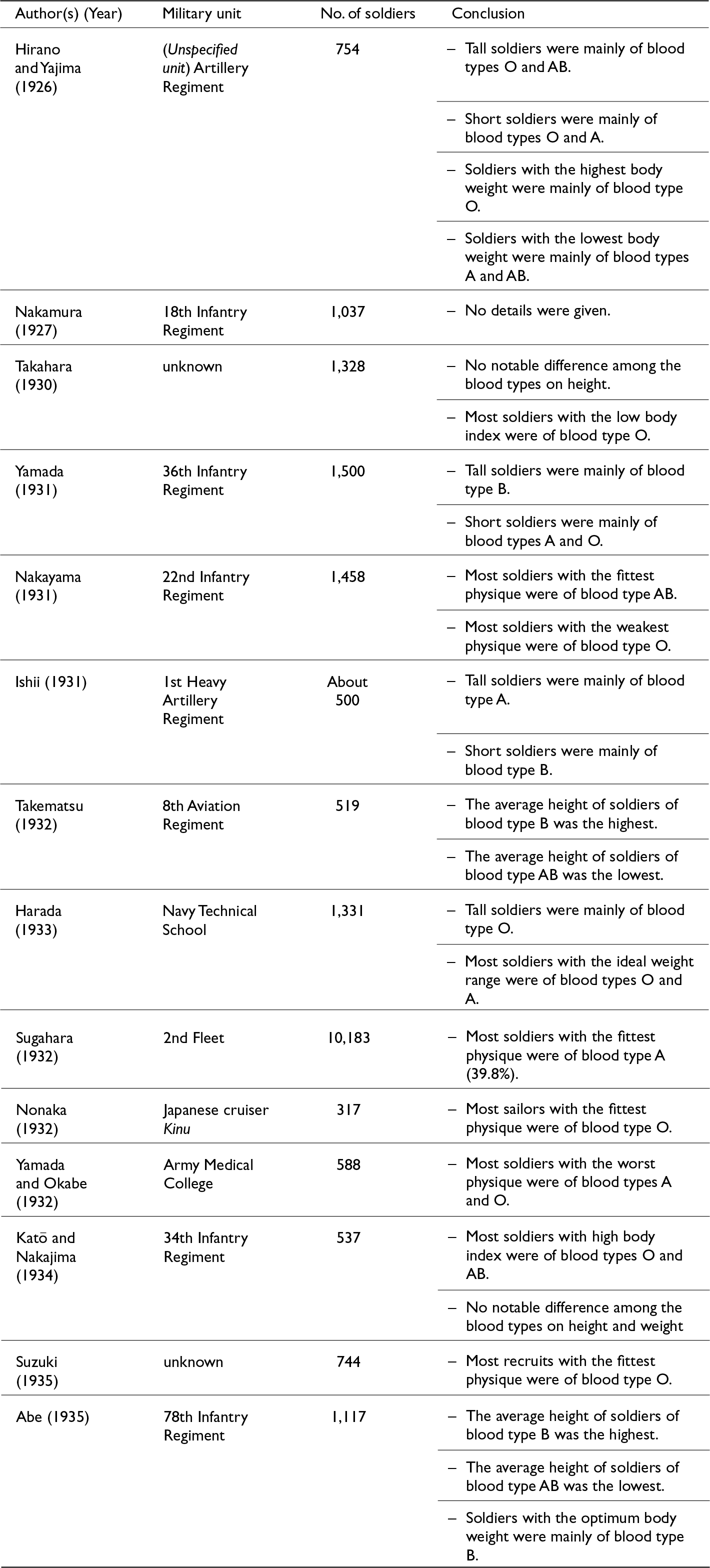
The ease of accessing physiological measurements enabled military doctors to investigate if there was an ideal blood type associated with the optimum body physique. These included various reports comparing blood-type distribution with the different height and weight divisions and body indexes (for example, one index used the division of one’s weight by height). However, as noted in Table 1, the conclusions reached by the various investigators were mixed and sometimes conflicting, and failed to establish any clear linkage between these factors. However, the disappointing results did not discourage physicians from pursuing similar investigations; on the contrary, such research gathered momentum, reflecting the physicians’ optimism about blood-type research as a legitimate scientific method in understanding the soldiers’ state of health. The act of religiously collecting data—detailing the proportion of blood types to other physical measurements—was a knee-jerk reaction by the researchers to compensate for their unproven hypotheses. More significantly, this persistence also revealed the holy grail fuelling these medical specialists’ search for medical knowledge: their faith in collecting data as statistical evidence.
Military medical studies on physical measurements and blood types.

Source: Compiled from the listed primary materials.
As sourced from Abe Shin’ichi, ‘Kekkei to taihei taishitsu to no kankei ni tsuite’, GZ, no. 270, 1935, pp. 1445–1448; Harada Fukuzō, ‘Ketsuekigata yori mitaru kaigunhei no kishitsu taikaku ribyō gakugyō seiseki narabi kikanka kakushu renshūsei no tekisei ni tsuite’, Part 2, Yūseigaku, vol. 10, no. 10, 1933, pp. 6–7; Hirano and Yajima, ‘Jinkekkyū gyōshū hannō ni tsuite’, pp. 155–156; Ishii Kaname, ‘Ketsuekigata to taikaku kishitsu shippei to no kankei ni tsuite’, GZ, no. 224, 1931, p. 317; Katō and Nakajima, ‘Sōtei ni okeru ketsuekigata ni tsuite’, pp. 1957–1959; Nakamura Keizō, ‘Ketsueki shuzoku to heisotsu no kosei ni tsuite’, GZ, no. 169, 1927, p. 868; Nakayama Masayuki, ‘Ehime-ken shusshin hohei dainijūni rentai heiin no ketsuekigata ni tsuite’, GZ, no. 220, 1931, pp. 2093–2094; Nonaka Miroku, ‘Yūryō taikei to ketsuekigata’, KZ, vol. 21, no. 5, 1932, pp. 117–118; Sugahara Sahei, ‘Daini kantai jōin no ketsuekigata kensa seiseki ni tsuite’, KZ, vol. 21, no. 4, 1932, p. 75; Suzuki Kiyoshi, ‘Seijō oyobi byōteki jōken ni taisuru ketsuekigata no taido to kosei ni tsuite’, GZ, no. 262, 1935, pp. 316–317; Takahara, ‘Taihei no ketsueki shuzoku’, pp. 289–291; Takematsu, ‘Ketsuekigata ni kansuru ni, san no kenkyū’, pp. 483–486; Yamada and Okabe, ‘Ketsuekigata yori mitaru taihei no kansatsu’, pp. 934–935; Yamada Heizō, ‘Ishikawa Fukui ryōkenka taihei no ketsuekigata ni kansuru kenkyū hōkoku’, Hanzaigaku zasshi, vol. 4, no. 2, 1931, pp. 33–34.
It was common for military medical journals to feature a section on the latest development in serological studies overseas, in their bid to promote the practice of blood typing within the military establishment. Remarking on a routine blood-testing exercise for syphilis and blood-type analysis at the Tempelhof Military Hospital in Berlin, the editors stressed the need to carry out blood-type analysis even in the most difficult terrain, such as the battlefield, in order to ‘minimize time loss’ in administering the appropriate medical treatment. ‘It would be ideal if we could conduct blood-type analysis on all our soldiers,’ the editors remarked, ‘but unlike the German Army which did not have the limitation of a one-year conscription period, it was impossible for us [the Japanese Army] to do so.’Footnote 21 Instead, the editors suggested decentralizing the testing process by providing every military unit with the necessary equipment. This might sound too optimistic, but it revealed the military physicians’ aspirations to proliferate the application of blood-type analysis and its related knowledge within the military. Hence, in this interlude of experimenting with the different possible methods of blood-type analysis, military physicians were zealous in their search for a more efficient way to conduct blood-type analysis in mass medical examinations. The process of standardizing and monitoring military males through the ritual of mandatory health checks provided institutional support that enabled military physicians to investigate the possible effects of blood types.Footnote 22 This marked a significant step towards the medical rationalization of the Imperial Japanese military.
Blood-type research in modern Japan thus came under the influence of contemporary intellectual trends such as eugenics and rationalization, which played a significant role in shaping its formative development in the decades following its introduction to the country. A year later, a noticeable intellectual shift in blood-type studies—from the analysis of physical measurements to the prediction of personality traits through the quantification of one’s blood type—occurred within the military medical establishment. This was one of the most well-known and perhaps most controversial hypotheses in blood-type research: the notion that blood type and human personality are linked.
Furukawa Takeji’s Blood Type–Temperament Correlation Theory
In August 1927, an article suggesting the relationship between blood type and temperament was published in the Japanese Journal of Psychology Research, triggering much discussion within the Japanese academic community.Footnote 23 Known as the ‘Blood Type–Temperament Correlation Theory’ (ketsuekigata kishitsu sōkansetsu 血液型気質相関説), Furukawa Takeji (1891–1940), a high school lecturer at the Tokyo Women’s Normal High School (present-day Ochanomizu University), proposed that one’s temperament, defined as the inherent characteristics of one’s personality, could be diagnosed by analysing one’s blood type.Footnote 24 He later expanded his theory, bestowing significance on the aggregation of an individual’s blood type, by arguing that blood-type distribution data reflected ‘national character or temperament’.Footnote 25 Furukawa invented the Active-Passive Index (API),  $\frac{{O\% + B\% }}{{A\% + AB\% }}$, arguing that the aggregation of an individual’s data could be used to understand the attributed characteristics of the collective. This was based primarily on his theory of how the different temperament characteristics were determined by the respective blood types: individuals with blood types O and B were classified as the ‘active’ type, while those with blood types A and AB were considered the ‘passive’ type. If the API value fell below 1.0, the community was considered ‘passive’ and conservative; if it equalled 1.0, it meant social equilibrium; anything above 1.0 meant that the collective characteristic was ‘active’.Footnote 26 Furukawa explained that, because blood type O individuals possessed an egoistic character, they were less likely to be influenced by others. Contrastingly, Furukawa described communities with a high proportion of blood types A and AB as ‘submissive to power’ and ‘subservient to authority’, a disposition that allowed them to ‘stay united’.Footnote 27 Furukawa’s announcement sent reverberations across the Japanese medical community, especially due to the racial connotations underlying it, which struck a chord with the racial hygienists in the country.
Although Furukawa’s primary focus was on applying his Blood Type–Temperament Correlation Theory to enhance elementary school education, he became entangled in a public scandal that disrupted his research plans. On 21 June 1928, major newspapers across the country reported on the unhygienic practices of a blood-extraction exercise that took place in an elementary school in Tokyo.Footnote 28 Furukawa, who was named as one of the main organizers of the event, had no choice but to shelve his research plans. In a serendipitous turn of events, Furukawa’s neighbour, who was an active-duty Army officer, introduced him to the medical staff of the Cavalry Officer School. Known to be relatively more ‘progressive-minded’ as compared to the other military units, the school administrators permitted 325 soldiers to participate in Furukawa’s research study in the summer of 1928.Footnote 29
However, there were serious discrepancies between Furukawa’s predictions and reality. First, the proportion of recruits with blood type A was highest among the first-year officer cadets, at 53.4 per cent, significantly surpassing the national average of 38.2 per cent. This was contrary to Furukawa’s assertions, since blood type A individuals possessed traits that were not those expected of someone in leadership. Furukawa’s response was that the high proportion reflected the ‘blood type A individual’s characteristic traits of steadfast loyalty and perseverance’. He went on to claim that among the existing 75 senior officers who took part in the research, blood type O was of the highest frequency at 38 per cent, which was in line with his framework where blood type O individuals were considered ‘active’ and thus most suited for leadership positions. The second anomaly was the mediocre performance of blood type A individuals in fulfilling administrative tasks. According to Furukawa’s framework, the reserved personality of blood type A individuals was supposedly an advantage when performing administrative duties. However, when assessing their administrative abilities, the results indicated that a group of blood type A individuals had the lowest score. Furukawa brushed off this anomaly, explaining that ‘whether this is due to the deliberate mistake of the blood type A individuals, or a consequence of the military education, it should not be seen as a serious issue’.Footnote 30 The mixed results were poorly received by the school authorities. The research division of the Cavalry Officer School later issued a statement that Furukawa’s findings ‘were somewhat of a disappointment’ to the school authorities, and their collaboration ended abruptly.Footnote 31
However, even though traces of Furukawa’s Blood Type–Temperament Correlation Theory all but disappeared from the military medical establishment, medical specialists from other military units began investigating the validity of Furukawa’s blood-type analysis framework. Army physicians were the first, presenting their findings of blood-type distribution among the soldiers stationed in the Chūgoku region during the Eighth Military Medical Conference held at Osaka from 2–3 April 1930.Footnote 32 Then, in the following May, Senior Navy Surgeon Ōiwa Hiromasa published his findings on the investigation of the correlation between blood types and the mental state of 606 naval personnel.Footnote 33
Some of the military doctors believed in Furukawa’s theory, taking his recommendations seriously while emphasizing the need for further research to validate the scientific authenticity of the theory. Driven by their belief that analysing blood-type data could allow them to propose improvements to the existing military training curriculum, these military physicians expanded the scope of their research to include the lifestyle habits and formative environment of individuals, in an attempt to prove even the most remote possible correlations between blood types and temperament. The factors of enquiry included previous employment, hobbies, as well as smoking and drinking habits.Footnote 34 Inspired by the inheritability trait of blood types, one even recorded information such as whether the soldier’s parents were still alive and the number of siblings he had, as a means to ascertain whether the soldier had inherited the healthiest body in terms of longevity and fertility.
Despite the initial mixed reception from the medical staff at the Cavalry Officer School, military physicians did not dismiss Furukawa’s hypothesis outright. Instead, they worked diligently to establish its scientific legitimacy. As one of the Japanese military physicians put it, ‘Blood typing soldiers is not only necessary for medical treatment in both wartime and peacetime, but the partial insight it yields into their personalities can also be used as a reference material in military education’Footnote 35 Medical management of the armed forces began assuming the objectives of the American ideology of Taylorism in its evolution towards the sero-rationalization of the military. Blood-type analysis was thus promoted as a scientific method to enhance efficiency within the military institution, enticing several military physicians to take Furukawa’s ideas seriously. This marked the beginning of a research boom, sparking a surge of interest in blood-type studies within the Imperial Japanese military medical establishment.
Sero-rationalization
In his analysis of the motivations behind the Imperial Japanese military’s decision to take up blood-type analysis, historian Ōmura Masao identifies three: first, to determine the most ideal collective behaviour of soldiers; second, to assess the health conditions of the soldiers; and third, to create the most combat-efficient military unit based on the soldiers’ temperament by adhering to the traits outlined in Furukawa’s Blood Type–Temperament Correlation Theory.Footnote 36 In this section, I highlight that a common desire shared by military medical doctors was to rationalize the institution by deploying soldiers according to their abilities, using blood-type analysis, which I have conceptualized as ‘sero-rationalization’.
Rationalization was a familiar term to the Japanese population. The amorphous notion of ‘industrial rationalization’ (sangyō gōrika 産業合理化) was proof of how scientific management of Japanese industries was not simply an adoption of the American ideology of Taylorism, but an indigenization of foreign ideas that took place in the 1920s and 1930s.Footnote 37 Within the Imperial Japanese military, doctors proposed designing an education programme based on Furukawa’s Blood Type–Temperament Correlation Theory. This was in line with Article 9 of the Military Education General Provision which outlined the military’s special consideration of the soldier’s psychological well-being and personality traits in its training regimen and education curriculum. Here blood-type research could be employed to achieve an efficient vocational deployment of the soldiers based on one’s personality compatibility with the particular job requirements. Differing from the existing notions of ‘scientific management’, the sero-rationalization of the military incorporated both physiological and psychological factors. This approach closely resembled the emerging field known as the ‘science of labour’ (rōdō kagaku 労働科学) that was proposed by scientist Teruoka Gitō in the early 1920s.Footnote 38
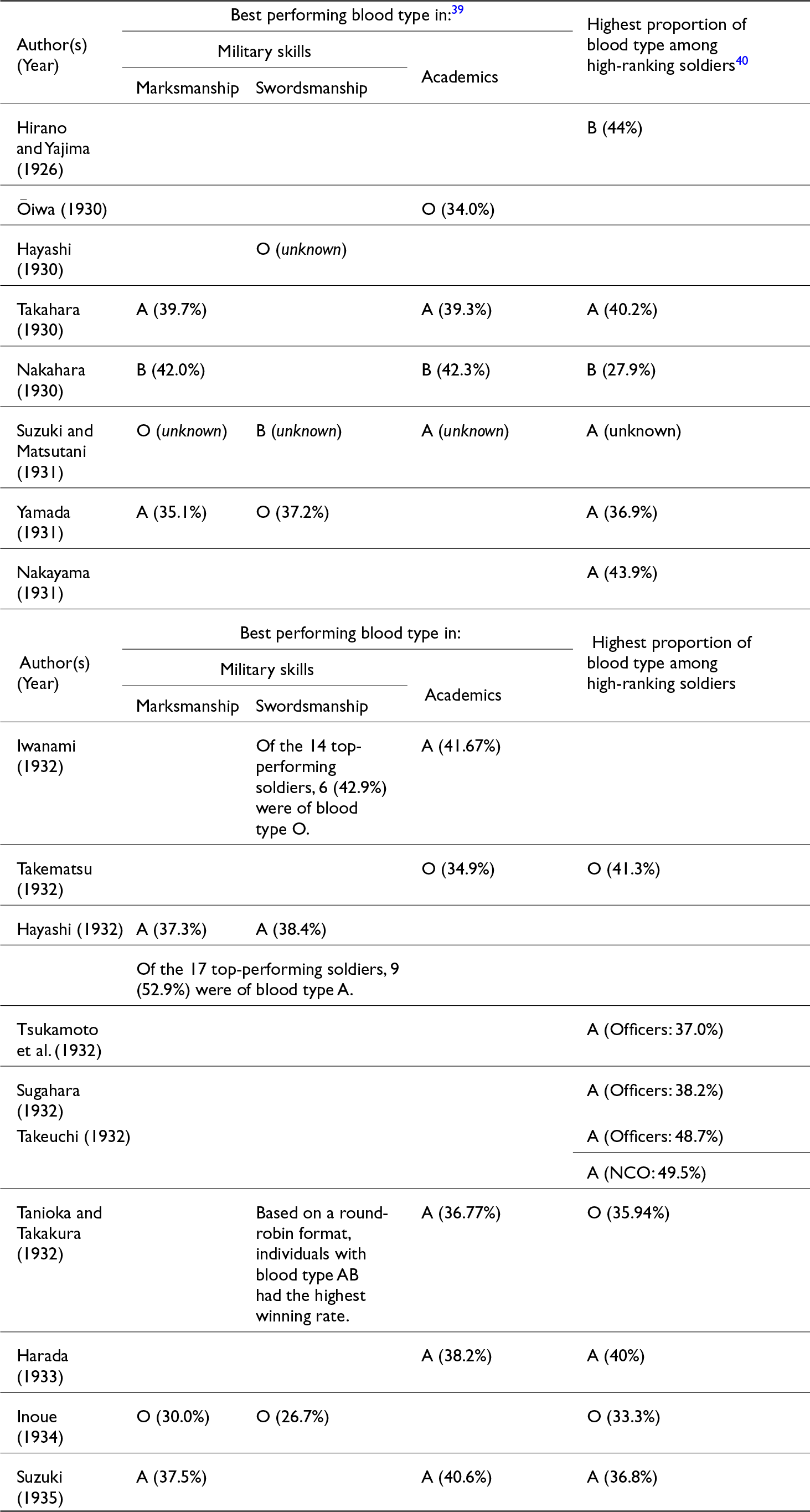
Military doctors first took the approach of sorting physical measurements such as height and weight according to blood type. This was the most straightforward method to investigate links between physiques and blood types to facilitate the deployment of soldiers, including assessing one’s suitability for training as an officer. To the proponents, blood type could reveal at a glance one’s military potential, thus helping the military authorities to design the most effective curriculum in training the beau idéal soldier. Hence, military doctors surveyed soldiers’ blood types and attempted to link these with other factors such as their career performance, military ranks, and results in routine tests such as marksmanship and swordsmanship (see Table 2). However, the mixed results raised more questions than they answered. The analysis of the growing data revealed the complexity, and probably the impossibility, of finding a biological determinant to denote an individual’s ability.
Military medical studies on performance, ranks, and blood types.

Source: Compiled from the listed primary materials.
As sourced from Harada Fukuzō, ‘Ketsuekigata yori mitaru kaigunhei no kishitsu taikaku ribyō gakugyō seiseki narabi kikanka kakushu renshūsei no tekisei ni tsuite’, Part 3, Yūseigaku, vol. 10, no. 11, 1933, pp. 9–10; Hayashi Magaku, ‘Ketsuekigata to guntai seiseki ni tsuite’, GZ, no. 202, 1930, p. 480; Hayashi Magaku, ‘Sendai rikugun kyōdō gakkō gakusei no ketsuekigata to ni, san no tōkeiteki kansatsu’, GZ, no. 228, 1932, p. 834; Hirano and Yajima, ‘Jinkekkyū gyōshū hannō ni tsuite’, p. 159; Inoue Nichiei, ‘Ketsuekigata ni kansatsu shitaru guntai kyōiku no seika ni tsuite’, GZ, no. 256, 1934, pp. 1586, 1588; Iwanami Hiroshi, ‘Kaigunhei gakkō seito no ketsuekigata to shokansatu’, Part 2, Hanzaigaku zasshi, vol. 6, no. 1, 1932, pp. 18–50; Kakuta Shin’ichi and Nagayama Tarō, ‘Ketsuekigata to kojin kishitsu to no kankei narabi ni daikyū shidan kanka ni okeru ketsuekigata no chihōteki bunpu no gaikyō’, GZ, no. 208, 1930, p. 1544; Nakahara, ‘Ketsuekigata to sono tōkeiteki kansatsu’, p. 408; Nakayama, ‘Ehime-ken shusshin hohei dainijūni rentai heiin’, p. 2095; Ōiwa, ‘Ketsuekigata to seishingata to no kankei’, p. 37; Sugahara, ‘Daini kantai jōin’, pp. 74–75; Suzuki, ‘Seijō oyobi byōteki jōken’, pp. 307–309; Suzuki Kiyoshi and Matsutani Hirotsugu, ‘Guntai kyōiku jinshishin toshite no kekkei to kosei ni tsukite’, GZ, no. 217, 1931, p. 1212; Takahara, ‘Taihei no ketsueki shuzoku’, pp. 291–292; Takematsu, ‘Ketsuekigata ni kansuru ni, san no kenkyū’, pp. 486–487; Takeuchi Bunji, ‘Rikugun hōhei no ketsuekigata ni tsuite’, Part 1, Ketsuekigata kenkyū, vol. 1, no. 12, 1932, p. 2; Tanioka and Takakura, ‘Hohei daisanjū rentai heiin’, pp. 17–55; Tsukamoto Sō et al., ‘Gunkan Yakumo join no ketsuekigata ni tsuite’, KZ, vol. 21, no. 1, 1932, pp. 92–93; Yamada, ‘Ishikawa Fukui ryōkenka taihei’, pp. 31–35.
Nonetheless, some medical reports argued that the distribution of blood types across different vocations suggested that soldiers with certain blood types tended to cluster in specific roles, as predicted by the traits outlined in Furukawa’s theory.Footnote 41 In particular, Naval Surgeon-Commander Harada Fukuzō conducted a survey of 1,331 soldiers from the Navy Technical School and presented a detailed report on the blood-type distribution across various roles, including sailors, medics, logistical support, and administrative and technical support staff. ‘[B]ased on existing studies and current indices of the various deployment of the sailors,’ Harada wrote, ‘it [his research data] would serve as future reference for the improvement of the deployment of new recruits according to the best of each ability.’Footnote 42 Harada proposed the Emotional Index (kanjō keisū 感情系数)  $\frac{{A\% + B\% + AB\% }}{{O\% }}$, modelled after Furukawa’s API framework, to assess the collective emotional control of a community. Neither referring to any existing blood-type research literature nor explaining the mathematics behind his formula, Harada simply stated that the ‘Orients had a value above 2.0, while the Europeans had a value below 2.0; where the former were easily swayed by their emotions’.Footnote 43 Notwithstanding its lack of methodological clarity, this example underscores the lengths to which proponents were willing to go in exploring and advocating for Furukawa’s Blood Type–Temperament Correlation Theory. Their advocacy reflected a belief in using blood-type differentiation to reinforce social ideologies, evident in their efforts to publish in widely circulated periodicals, such as Yūseigaku (Eugenics). By promoting the application of Furukawa’s ideas, these military physicians sought to align military practices with broader socio-political agendas, thereby legitimizing the use of blood-type knowledge within both the military and society at large.
In a 1933 study on a new procedure adopted by the Japanese Imperial Army to assess the suitability of recruits as signallers, the medical investigators included a section examining the compatibility of each blood type with the duties of the signallers. In addition to subjecting the recruits to routine physical examinations such as the Mantoux test for latent tuberculosis and mental tests to assess their intelligence, military physicians recorded their blood types as well.Footnote 44 This practice highlighted the physicians’ intention to investigate the potential influence of biological characteristics, such as blood type, on an individual’s abilities. In the same fashion, Army Surgeon (1st Class) Suzuki Kiyoshi compiled data presenting the highest blood-type distribution within the vocations of signallers, trumpet soldiers, cavalry soldiers, and medics, arguing that it was due to the soldiers’ temperamental compatibility with the demanding job requirements that resulted in this blood-type distribution within the vocations. This reflected the popularity of statistical methodologies among physicians in the 1930s as ‘statistics are indispensable in supplying the factual ground’ for the science of blood types.Footnote 45 Suzuki observed that blood type A signallers were ‘attentive to details, performed the best in academics and thus accounted for the largest proportion within the vocation’.Footnote 46 His argument rested on the assumption that there was a ‘natural tendency’ for those of the same blood type to congregate in the same roles, as supported by Furukawa’s theory.Footnote 47 Suzuki also declared his support for blood-type studies in the military, stating that it was ‘in accordance with the Imperial Army’s original mission of training the soldiers’.Footnote 48
Perhaps the most innovative development of blood-type analysis in the armed forces took place in January 1932, when Army Surgeon (1st Class) Inoue Nichiei initiated the formation of a military unit organized specifically according to Furukawa’s API. Unprecedented in the history of the Japanese Imperial Army, 134 first-year recruits from the 16th Logistics Battalion were arranged equally into two companies—those of the same temperament type based on Furukawa’s theory were grouped in the First Company. At the same time, the Second Company was organized with the aim of ‘complementing the soldiers’ strengths and weaknesses in their various vocation’.Footnote 49 In other words, within the Second Company, if the section leader belonged to the ‘active’ blood types O and B, soldiers of the complementary, ‘passive’ blood types A and AB would be assigned to him, and vice versa.
The formation of the 16th Logistics Battalion marked the first and only instance where the principles of blood-type differentiation were integrated into the military drafting process, epitomizing the peak and final surge of enthusiasm for blood type-temperament analysis within military circles. Historian Ōmura Masao aptly identified several reasons for this outcome: the 1931 Mukden Incident, which diverted attention away from less urgent military matters; the breach of military tradition by excluding senior soldiers from the formation of the unit; and the lack of conclusive scientific evidence in Inoue’s report.Footnote 50 However, I emphasize another critical factor: years of unproductive research had further disillusioned many military physicians, ultimately discouraging continued investigation into blood-type analysis. Even Inoue himself would later express doubts over the validity of Furukawa’s theory. After nearly three years of observation, Inoue published his findings in September 1934, acknowledging that although significant differences in the API values were observed between the two companies, it remained ‘difficult to ascertain the impact of blood type or education due to the abstract nature of the assessment’.Footnote 51 In other words, like many military physicians before him, Inoue’s new initiative did not produce any conclusive results that would prove Furukawa’s propositions. Inoue continued:
We should not blindly follow the predictions of Furukawa’s theory but take it as a valid reference to train the soldier’s mind and body and understand that the mental affects the body, and vice versa. It is by undertaking serious observations and putting in a bit of creativity into our pedagogical approach that we would be able to maximize the impact of the training.Footnote 52
This encapsulated the medical specialists’ loss of confidence in applying Furukawa’s Blood Type–Temperament Correlation Theory in future military initiatives.
By 1934, the earlier enthusiasm for blood-type analysis had begun to wane within the military medical establishment.Footnote 53 While military physicians did not entirely reject Furukawa’s theory, they were also reluctant to endorse it enthusiastically. Military discussions of the theory soon faded into obscurity. From that point on, it was primarily low-ranking medical officers who continued to investigate the links between blood type and personality. This suggested that blood-type studies were no longer a priority for the establishment. For example, Army Surgeon (1st Class) Ikeda Naeo collected and analysed blood samples of 2,256 individuals (1,634 males and 622 females) employed at a local ammunitions factory. Ikeda’s approach was markedly different from that of his predecessors, who had focused solely on studying the blood of male soldiers. Ikeda built upon Furukawa’s paradigm by arguing that an individual’s personality influenced their work behaviour, including factors such as long-term job retention and the preference for either solitary or communal work environments. Ikeda’s research indicated that blood type B individuals were more likely to leave their jobs within a decade, whereas blood type A individuals were deemed more suited to factory work, a tendency attributed to their serological predisposition for thriving in communal work environments.Footnote 54 Inspired by contemporary ideas of ‘science of labour’, Ikeda drew links with one’s susceptibility to incidents in the workplace, arguing that ‘it was possible to seek a logical explanation by investigating one’s personality to understand the apparently random occurrence of accidents’.Footnote 55 Furthermore, in these reports by junior military doctors, a section was included to specifically justify Furukawa’s assertion by investigating if the projections based on his framework had matched the subjects’ personalities: Inoue reported a 60 to 80 per cent accuracy rate, while Ikeda claimed a rate of 90 per cent.Footnote 56 This deliberate confirmation suggested an ideological shift among the military medical specialists as they became more doubtful of the research value of investigating the relation between blood types and human psychology, especially the human behaviour aspect—proving that the Cavalry Officer School medical staff might have been right in the first place to dismiss Furukawa’s theory.
By 1940, growing doubts over the scientific legitimacy of Furukawa’s theory could no longer be overlooked. In his critique of Furukawa’s theory, Lieutenant Commander Arai Katsumi, an instructor at the Imperial Japanese Navy Medical College, unabashedly claimed that the results of the existing research on blood types and military performance were ‘merely a matter of chance that can occur relatively easily by accident’.Footnote 57 Not only did Arai repudiate the statistical significance of the sample size chosen by these researchers, he also questioned the methodological credibility of Furukawa’s API in defining the ‘ambiguous notion of collective temperament traits’.Footnote 58 Arai highlighted that in previous studies, ‘researchers drew inferences that were more favourable to their arguments than the data actually supported’, thus revealing the methodological flaws in these investigations.Footnote 59 The cracks in the already unstable process of sero-rationalization had deepened. As the war escalated, the urgent need to save lives on the frontlines intensified, shifting military doctors’ research focus on blood types from the speculative realm of personality prediction to more practical applications, such as blood transfusion procedures, which could directly address wartime needs.
Overcoming blood types
What Landsteiner’s discovery of the ABO blood-group system did for blood transfusion was comparable to what German microbiologist Robert Koch’s discovery of the bacterial causes of wound sepsis did for surgery.Footnote 60 The important role of blood type in blood transfusion was not fully appreciated until the late 1920s, more than two decades after the discovery of blood types. It was after the end of the First World War in 1918 that the techniques of transfusion and blood typing were perfected and proliferated across the global medical community.Footnote 61 As early as 1928, all active personnel in the Japanese military, much like their Nazi counterparts who were required to carry their blood-type information at all times, had to undergo mandatory blood-type testing in both the Army and Navy, with the results recorded in their health records upon enlistment.Footnote 62 With the escalation of a full-blown invasion of China by July 1937, blood transfusion became a real concern for frontline medics. Nonetheless, Japanese military doctors were not alone in facing logistical challenges; their Chinese counterparts also encountered difficulties in performing delicate medical procedures, such as blood transfusions, on the frontlines.Footnote 63 Despite the diverse and challenging climatic conditions—from the harsh cold of northern China to the hot, humid jungles of British Malaya—Japanese military doctors recorded numerous successful blood transfusions using a variety of sources, including stored, dried, animal, and fresh human blood, often without significant adverse effects.Footnote 64 However, identifying a suitable donor under wartime conditions was often a formidable task. In one instance, a frontline doctor in northern China reported having to test over 20 soldiers before finding a compatible donor.Footnote 65 Thus, the challenge was not merely the time and effort required to verify blood types, but rather the need to broaden the pool of available resources for transfusions in emergency situations.
Amid the exigencies of war, Japanese military doctors were compelled to find ways to overcome the technical limitations of the ABO blood-group system in administering transfusions, while also experimenting with various methods of blood procurement and improvising the delivery of viable blood to the frontlines. It became common practice for frontline medical personnel to utilize blood from different types when necessary, reflecting the urgent need to adapt to the constraints of wartime conditions.Footnote 66 Military physicians even conducted human medical experiments such as investigating the effect of blood transfusions of different blood types, in which the researcher used the term maruta (wooden logs) to refer to the human subjects from Nanking, China.Footnote 67 In their bid to push the boundaries of medicine, Japanese military doctors imperilled the lives of their human subjects, dehumanizing them as objects of experimentation despite possessing the knowledge that mixing incompatible blood types would significantly increase the risk of life-threatening side effects.Footnote 68 The Imperial Japanese military doctors went so far as to challenge and break down traditional boundaries between living species, including the controversial practice of transfusing animal blood into humans.
Japanese soldiers participated in research studies investigating the compatibility of using animal blood in blood transfusions, in an attempt to circumvent ABO blood-group considerations. In one instance, 200 soldiers from the Hokkaido 25th Infantry Regiment took part in an investigation of the haemolysis strength of goat blood cells in human blood serum.Footnote 69 Additionally, rabbit and horse blood, which were known to most closely resemble human blood in terms of biochemical composition, had been widely used within the military medical establishment since the late 1920s.Footnote 70 While rabbits were a regular staple for laboratory medical experiments, horses were a valuable medical resource on the frontlines, especially in the northern China expeditions. Japanese military doctors administered blood transfusions using an immunized serum derived from horse blood, which had been processed and packaged using the ‘Lyovac’ method—a technique developed by American scientists that involved rapid freezing followed by rapid dehydration under high vacuum for serum preservation. This serum was successfully transfused into two patients suffering from shigellosis, a form of bacillary dysentery.Footnote 71 Not only could horse blood be used for transfusion in times of emergency, but horses’ urine could also be used as a substitute for citron acid due to its anti-coagulant property.Footnote 72 While other blood substitutes—such as Ringer’s solution, Gum Arabic solution, and the most easily available of these isotonic solutions, saline solution—were also considered safe, their effectiveness remained disputed, as Japanese doctors would only prescribe them in cases where human blood was unavailable.Footnote 73 Thus, the use of animal blood was not uncommon within the Japanese military medical establishment.Footnote 74 However, in 1933, news of another blood substitute sent shockwaves across the international community: cadaver blood. This development transgressed not only the boundaries between blood types but also the profound and macabre divide between the living and the dead.
At the Inaugural Soviet Serology Association Meeting in December 1933, Russian surgeon Sergei S. Yudin announced his successful experiment with cadaver blood transfusion.Footnote 75 A Japanese researcher named Dodo Yoshio, who worked at the Sklifosovsky Institute where Yudin was based, wrote about the breakthrough after returning to Japan in 1935.Footnote 76 Yudin’s reports were later translated into Japanese and proved instrumental in enabling Japanese military doctors to perform cadaver blood transfusions on the battlefield.Footnote 77 In a rare instance of blood transfusion on the frontlines in northern China, Army Surgeon 2nd Lieutenant Nishimura Toshio and an apprentice, Sakakibara Shigeru, documented in vivid detail their experience of transfusing cadaver blood.Footnote 78 On 22 July 1938, Japanese forces faced a surprise skirmish attack by Chinese troops at an undisclosed location in Shanxi province. Three hours after the attack, one of the wounded soldiers began to exhibit the effects of severe blood loss from a gunshot wound to his thigh. After confirming a blood-type match, the attending doctors decided to use the blood of a comrade who had been killed in a grenade explosion. The doctors’ subsequent observations aligned with Yudin’s findings, and they became convinced of the ‘vitality’ (seikatsu nōryoku) of cadaver blood, proclaiming that ‘transfusing blood from corpses have the same effect as that of live blood’.Footnote 79
Even though frontline military doctors were in the best position to comment on the use of cadaver blood, few mentioned its actual use under war exigencies, suggesting that the aforementioned example was likely an isolated case.Footnote 80 While mainstream Japanese medical publications mentioned cadaver blood as an alternative for fresh blood in transfusions, the medical community remained divided on this subject. Those in favour of using cadaver blood cited the advantages outlined in Yudin’s research, as well as their own internal investigations, to advocate for its logistical benefits on the warfront. These included the ability to avoid adding anti-coagulants, as blood taken from individuals who died in shock would not coagulate within the first ten hours, and the reduced risk of infectious diseases in cadaver blood when stored at 0°C.Footnote 81 In the rare instances of death—only two out of over a thousand cases in Yudin’s research—proponents attributed the fatalities to surgical mishaps resulting in bacterial infections, rather than the use of cadaver blood itself. They asserted that ‘there is no sufficient reason to oppose the use of cadaver blood in transfusion’.Footnote 82 One even made an emotional appeal by urging a change in existing social norms to perceive taking blood from the dead as the ‘individual’s last service to the living’.Footnote 83
Some of the most vocal critics raised doubts on the practicality and research value of cadaver blood transfusion, highlighting that this procedure was practised exclusively in the Soviet Union and had not been adopted elsewhere.Footnote 84 In fact, American doctors in the Chicago vicinity had been experimenting with blood transfusion using cadaver blood since 1935, a clandestine project that was only revealed after the war.Footnote 85 However, one of the most common critiques of the use of cadaver blood was the simple fact that it was not common practice to use the blood of fallen comrades in blood transfusion, despite the deaths of many soldiers on the frontlines.Footnote 86 Such aversion was understandable, as even in neighbouring wartime China, historian Wayne Soon describes how the traditional ‘deep conviction that the act of donating blood would sap them of critical strength’ impeded local blood donation initiatives. Within the Japanese military, some advanced highly incredulous arguments, citing differing cultural norms and national characteristics to condemn the practice of cadaver blood transfusion. In his book on war medicine, Takemura Bunshō noted that the widespread adoption of cadaver blood use by the Soviet enemy was due to the ‘proliferation of atheistic Leninism’. Takemura continued:
Any race that treats the bodies of the dead with respect would hesitate in using the blood that remains in corpses, even from those condemned to death. However, the Soviet Union is a nation made of dull grey composite steel whose people, when asked to turn their heads to the right, turn their entire bodies to the right. Moreover, they have an atheistic ideology that considers religion to be an opiate [of the masses]. The medical science that has developed there is truly unique. To us it feels like the revival of magical formulae from the Middle Ages.Footnote 87
Describing Soviet medical science as ‘unique’ was a mockery of its research standards, as Takemura drew parallels between the use of cadaver blood and the unscientific practices of magic from an archaic past, highlighting the regressive nature of such developments. He also disparaged the people of the Soviet Union, calling them inhumane and describing them as possessing machine-like mannerisms. Takemura was not alone in discouraging such practices. One military doctor made a culturalist argument, arguing that ‘The spiritual belief of our nation, in which the deceased are venerated as gods, does not easily accommodate such practices within the mindset of the pure and sacred people of the divine land.’Footnote 88 Another even drew links to Japanese cultural notions of death, in which the visible change of the darkening of the color tone of cadaver blood—a natural phenomenon caused by the breakdown of blood proteins such as fibrinogen and fibrin, which are responsible for clotting—established a cognitive association with cultural norms of impurity and uncleanliness. Such sentiments were shared among other specialists who preferred to use placenta or animal blood instead of cadaver blood for transfusion purposes.Footnote 89 Therefore, even as the Japanese empire sank deeper and quicker into the quagmire of total war, the military medical establishment remained averse to adopting this macabre method, which was perceived as a transgression of their cultural norms and national identity. It became evident that there was an implicit consensus among military doctors to use only live human blood for transfusions, raising the critical question: how should human blood be transfused?
Hailed as ‘the best alternative to blood for transfusion in times of outfield operations’, stored blood was perceived as a potential life-changer for the Imperial Japanese military medical establishment.Footnote 90 Most importantly, promoting the use of stored blood was to overcome complications involved in the testing for blood-type compatibility in times of war. At the Twenty-Fifth Japan Surgical Association General Conference in April 1935, Professor Kiguchi Naoji of Kyoto Imperial University announced a ground-breaking method to preserve blood serum in powdered form, which he claimed was the first of its kind in the world.Footnote 91 This represented a major breakthrough for Japanese medical academics in overcoming blood-type compatibility challenges in transfusion medicine. Having conducted clinical trials on rabbits and humans, Kiguchi concluded that there were no adverse side effects, and blood stored for 600 hours remained safe for human blood transfusion. He outlined a detailed method in his preparation of stored blood, as follows: first, remove the human cell components by defibrination (the addition of agglutinate elements such as citron acid and then removing the agglutinated parts), hemolysis (the breaking down of blood cells), and centrifugation (the separation of the liquid and sediment components). Next, freeze and heat the subtenant (the liquid portion)—a combination that Kiguchi believed would enhance the overall quality of the product as the heating would break down the proteinoid structure of the poisonous elements and thus reduce the toxicity. This was followed by vacuum compression and drying of the resultant product, enabling it to be stored in ampoules. According to Kiguchi, the stored blood powder could be dissolved in a saline solution, making it ready for transfusion within ten minutes.
Starting in 1934, the Army Medical Affairs Agency had commissioned a project in which military doctors were tasked with experimenting with various chemical formulations and refining their concentrations to create prototypes of stored blood for transfusion. Unsurprisingly, its chief, Koizumi Chikahiko, was a key sponsor of Kiguchi’s work.Footnote 92 The project generated detailed reports documenting changes in the levels of their subjects’ blood components, such as haemoglobin, and their avidity. Although the military physicians observed a higher incidence of side effects with stored blood compared to fresh blood, they highlighted its significant advantages in reducing the risks of excessive blood loss and disease transmission. Consequently, they concluded that stored blood was just as effective as fresh blood in replenishing body fluids, antibodies, nutrients, hormones, and enzymes, while also promoting the production of blood components such as red and white blood cells in the recipients.
With the technology developed, the next step was to test its practicality. In September 1938, while en route to attend the Korean-Manchurian Medical Conference, Kumamoto Medical University Professor Azuma Yōichi, accompanied by his Korean assistant, announced the successful transportation of stored blood from his laboratory to a local hospital at Shinkyō, Manchukuo. After preserving the stored blood for 11 days, Azuma placed the ampoules in eight small refrigerators and travelled over 2,000 kilometres in two days. Eventually, six patients at the local hospital successfully received stored blood transfusions, with only one experiencing a minor side effect. This outcome demonstrated the feasibility and practicality of using stored blood to address wartime contingencies.Footnote 93 Soon after, in 1939, the Japanese Army developed the technology to produce vacuumed, dried serum that could be stored in a vial with a maximum capacity of 10 cc with a shelf-life of about a year.Footnote 94 Later, researchers at the Army Medical College announced a frozen-dried version with a shelf-life of five years and a two-minute reaction time to dissolve in saline solution for transfusion application.Footnote 95
This optimistic advancement in dried blood technology represented a strategic step forward for both the military and its medical institutions. Renowned serologist Ogata Tomio declared, ‘Dried blood is now considered the newest weapon, and is proving to be very successful in playing a major role in blood transfusions on the frontlines.’Footnote 96 Moreover, Azuma argued eloquently that it would be impractical to expect frontline soldiers to assume the dual role of both combatants and blood donors.Footnote 97 However, the reality was that blood transfusion, not to mention stored blood transfusion, remained a challenging task to carry out. This reflected an evident disparity between technological advancement and its implementation in the field. What then accounted for this gap?
In comparison with the developments in the United States, the dilemma faced by the Japanese military became increasingly apparent. American blood scientists’ entrepreneurship in developing new techniques to isolate blood plasma, coupled with timely collaboration with industrial partners to mobilize for the war machinery, were key to the success of the American military in mass-manufacturing dried plasma packets that could be used for blood transfusion at the warfront.Footnote 98 Looking back at Imperial Japan, the suffocating academic climate of the Japanese medical community in dealing with the materialization of innovative ideas, as pointed out by leading blood specialist Furuhata Tanemoto, was striking. Furuhata urged Japanese medical specialists to be more receptive to new developments, emphasizing the need to accelerate their capacity for innovation to effectively adapt and address the ongoing war crisis.Footnote 99
Furuhata’s words were also directed at the general conservative attitude towards using stored blood in the Japanese medical community. Notably, side effects were frequently observed in field blood transfusions, even in the relatively few cases involving matching blood types. As a result, military doctors were cautious about employing this relatively new medical technique, given the lack of absolute certainty in its effectiveness. Even in direct blood transfusions, they preferred donors with the same blood type as the recipients, despite the well-established medical fact that blood type O possesses universal donor properties. Similarly, in the rare instances of using stored blood serum for transfusion, military doctors favoured blood type O, despite existing reports indicating that blood compatibility need not be a concern.Footnote 100 Notwithstanding all the written evidence regarding the ease and advantages of blood transfusion, reservations remained over its safety and potential side effects. By advocating for greater boldness in the application of cutting-edge techniques, Furuhata sought to shift the medical community’s mindset towards innovation, recognizing that such risks could potentially yield significant breakthroughs in the treatment of wounded soldiers.
Another factor contributing to the slow progress of stored blood techniques in Imperial Japan was an academic dispute between two leading blood specialists, Azuma and Kiguchi, which emerged shortly after the latter announced his improvised blood storage method in July 1942. Azuma identified a critical limitation in Kiguchi’s stored blood, noting the absence of the erythrocyte component, such as red blood cells, which significantly restricted its medical utility. He further criticized Kiguchi’s method as impractical, contending that the dried blood powder was an imperfect substitute for real blood.Footnote 101 In response, Kiguchi dismissed Azuma’s criticisms as ‘a heretical discourse’ based on his personal ‘unsystematic thinking and uncritical intuition’.Footnote 102 This intense dispute between two of the most brilliant minds in serology most likely polarized opinions within the Japanese medical community, complicating efforts to advance research on stored blood during the pressures of total war.
Perhaps the decisive factor in the impeded development of stored blood techniques was the acute shortage of critical resources in wartime Japan. There were several logistical complications involved in the preparation of stored blood. As it turned out, Kiguchi’s method was a tedious and arduous process, one that the Germans commented on as ‘not easy but not impossible’.Footnote 103 However, it was the only reliable method that was recognized by the Japanese military establishment. Other frontline Japanese doctors had been unsuccessful in creating their own versions: one reported that his dried blood powder prototype took half an hour to dissolve in saline solution, three times longer than that of Kiguchi.Footnote 104 Despite the Army’s development of frozen, dried plasma, it had to be kept frozen at −30°C by dried ice, which rendered transportation logistics nearly impossible. Besides, the American embargo on the export of scrap metal, oil, and aviation fuel in July 1940 further exacerbated the nationwide scarcity of resources, with its impact acutely felt by the Japanese medical community.Footnote 105 Unlike their Chinese adversaries who could tinker with imported American blood bank machinery for war deployment, the Japanese received no such assistance.Footnote 106 Notwithstanding their novel invention of freeze-dried blood plasma, the Japanese medical industry was also facing difficulties in meeting production demands. In contrast to their American counterparts, who predominantly used disposable syringes for blood transfusions, Japanese military doctors relied on equipment traditionally made from metal due to hygiene concerns. However, as metal became a scarce resource during the war, the mass production of such equipment was hindered by delays in acquiring metal supplies.Footnote 107
The Imperial Japanese military were not oblivious to their enemies’ advancements in blood transfusion technology. American military-manufactured dried blood plasma packets were discovered among the war supplies left behind by American forces in the recently occupied territories of Wake Island and Manila in December 1941 and January 1942, respectively. Additionally, witness testimonies from individuals involved in the second Japan-US exchange of civilians and prisoners of war further corroborated these findings.Footnote 108 Regardless of the Japanese state’s full mobilization of resources for total war, it was undeniable that the Allied war machine was far more resourceful and efficient in dealing with the ongoing war demands. It was not until January 1944 that the Japanese Army finally began the mass production of dried blood plasma at the Shibuya laboratory of the Army Medical College. Fully funded by the military, elaborate plans were drawn up for the laboratory operations to serve as the first blood bank facility in the empire. The military intended to use 60 per cent of the donated blood to produce dried blood, while the remaining 40 per cent would be stored for deployment to local medical institutions during emergencies.Footnote 109 Regrettably, this development proved too little and too late. By the end of the Asia-Pacific War in August 1945, the Japanese had failed to overcome the limitations posed by blood-type considerations in their efforts to advance blood transfusion technology. It was beyond doubt that the Americans had surpassed the Japanese in terms of blood science research and medical supplies production levels—an advantage that proved crucial in determining the outcome of the war.
Conclusion
By examining the deployment of blood-type studies in the military medical history in modern Japan, this article reveals the progression of the symbiosis between the military and medicine, a phenomenon that corroborates historian Mark Harrison’s proposition that the modernization of medicine would eventually weaken the boundaries between armies and societies.Footnote 110 Military physicians with an interest in blood-type theories were in a privileged position to conduct medical examinations on healthy Japanese male bodies, gather extensive biodata, and carry out large-scale experiments in controlled environments such as Army barracks and naval ships, allowing them to explore the potential correlations between blood types and various medical conditions, as well as the psychological states of Japanese soldiers. This illustrated the pivotal role of the Japanese military medical establishment in raising the standards of medicine and public hygiene within the empire, with one historian referring to it as a ‘catalyst in modernizing Japanese hygiene’.Footnote 111 As the war progressed in Imperial Japan, societal perceptions of blood types became increasingly intertwined with the agendas of the military medical institution. Furthermore, as Harrison predicted, the weakening of the boundaries between the military and civilian spheres most likely accelerated under the conditions of total war, leading to the swift adoption and subsequent abandonment of blood-type research within the Imperial Japanese military medical establishment.
Blood type provided a discursive framework for military physicians to assess an individual’s health and determine their suitability for military deployment, enabling a deeper understanding of individual differences and allowing for recommendations to enhance the overall efficiency of the military. Blood-type studies were thus initially welcomed with much fanfare by the Japanese military doctors, who perceived it as a promising innovation for understanding human psychological and physiological conditions across a wide range of applications. Despite the early associations of blood-type research with racial differentiation, military doctors were eager to explore the broader implications of blood analysis, leading to widespread blood typing among soldiers. In their pursuit of the sero-rationalization of the military, military physicians relentlessly conducted research to establish the scientific validity of blood-type studies. However, this effort was consistently met with disappointing results, ultimately leading to the abandonment of further investigations into the metaphysical implications of blood-type research.
In his insightful book on the history of blood, Douglas Starr observes that, like Germany, ‘Japan similarly crippled herself with xenophobic ideas about foreign science, and employed only the most primitive arm-to-arm transfusions near the front, and rarely at that.’Footnote 112 While this article concurs with Starr’s proposition that Japan lagged behind in serological development during the war, it contends that the trajectory of blood science research in Imperial Japan was shaped not by a deliberate rejection of foreign ideas, but by the exigencies of war. As the demands of war escalated, the initial momentum behind the sero-rationalization process within the military began to falter, marked by a volte-face from the military doctors’ initial prioritization of blood typing as they now sought to overcome the technical limitations imposed by the ABO blood-group system. Japanese military doctors embarked on a different research trajectory, focusing on improving transfusion techniques and experimenting with various types of blood, transgressing the boundaries between living species—and even between the living and the dead. The context of war had legitimized medical practitioners’ use of unorthodox and untested methods to save lives, approaches that would not have been permissible under peacetime conditions. Even as the priority shifted to overcoming the limitations of blood-type compatibility for blood transfusion, wartime Japan lacked the necessary resources to implement this change effectively. Total war conditions had complicated the process of collecting, preparing, and transporting adequate amounts of blood, making it an impossible task for military doctors to even carry out blood transfusion on the frontlines in the first place. Ironically, while the prospect of total war might have impelled the military medical establishment to attempt the sero-rationalization of the military, it was also the exigencies of war that doomed this enterprise to failure.
Acknowledgements
I am deeply grateful to the two anonymous reviewers of Modern Asian Studies for their constructive feedback and careful reading, which have greatly helped me improve the manuscript.
Competing interests
The author declares none.