Introduction
The number of healthy or unhealthy years lived, as well as the type of health problems experienced by older people, have a crucial influence on health-care utilisation. Mortality indicators and their derivatives, such as average life expectancy at a given age, do not adequately represent ‘healthiness’, since information is needed not only on the total duration of life but also on people's health status at different ages (Portrait, Maarten and Degg Reference Portrait, Maarten and Degg2001). Healthy life expectancy, which is total life expectancy weighted or adjusted for some measure of health-related quality of life, has been used as an indicator (Jagger Reference Jagger1999). The advantages of healthy life expectancy are that it combines information on morbidity and mortality in a single indicator and is readily understood (Valkonen, Sihvonen and Lahelma Reference Valkonen, Sihvonen and Lahelma1997).
Subjective or self-reported health is often used in epidemiological and social research and in health professionals' questionnaires as a proxy for health. The term can be defined as the individual's personal evaluation of his or her overall health condition. The individual is expected to integrate all dimensions of health without special reference to any one component, such as physical, mental, social or functional health (Baron-Epel and Kaplan Reference Baron-Epel and Kaplan2001). Research interest in self-reported health has grown since it was shown to predict health outcomes including deaths (Kaplan and Camacho Reference Kaplan and Camacho1983; Idler and Benyamini Reference Idler and Benyamini1997), and several studies have established the validity of the measure as an indicator of overall health condition (Baron-Epel and Kaplan Reference Baron-Epel and Kaplan2001; Martikainen et al. Reference Martikainen, Aromaa, Heliövaara, Klaukka, Knekt, Maatela and Lahelma1999; Bailis, Segall and Chipperfield Reference Bailis, Segall and Chipperfield2003; Appels et al. Reference Appels, Bosma, Grabauskas, Gostautas and Sturmans1996). Subsequently, methods have been developed to estimate healthy life expectancy from data on the prevalence of self-reported ‘good’ and ‘poor’ health (Ofstedal et al. Reference Ofstedal, Zimmer, Cruz, Chan and Lin2003).
There is considerable evidence from mortality statistics that on average women live longer than men but that they experience more illness (Langley Reference Langley2003; United Nations Organisation 2002). As a result, sex differences in average healthy life expectancy are much smaller than sex differences in average total life expectancies (Weidner Reference Weidner2000). It is reasonable to expect that self-perceived health associates with health variables such as ‘dependence’ and the number of chronic diseases. Previous studies in Brazil have shown that schooling and income, among other factors, are also associated with self-perceived health (Alves and Rodrigues Reference Alves and Rodrigues2005). Studies of self-perceived health should therefore take these socio-economic attributes into account.
This paper reports estimates of average healthy life expectancies in old age by age and sex for the City of São Paulo, Brazil in 2000–01. São Paulo is the largest city of Brazil and has received many internal and international migrants since the 19th century; in comparison to most other cities in Brazil, its heterogeneous population reflects that of the nation as a whole (Machado Reference Machado2002). The paper also presents analyses of the factors that were associated with variations in self-perceived health by gender and in three age groups (60–69, 70–79, and 80 or more years).
Methods and materials
The data
The data required by Sullivan's method for estimating healthy life expectancy are: (1) population and deaths by ages for the construction of a life table and the calculation of age-specific mortality rates, and (2) a schedule of age-specific health state prevalence rates. In the present study, the morbidity information came from the Health, Well-being and Aging in Latin America and the Caribbean Project (SABE) that collected information on older people in seven Latin-America and Caribbean countries: Argentina, Barbados, Brazil, Chile, Cuba, Mexico and Uruguay (Pelaez et al. Reference Peláez, Palloni, Albala, Alfonso, Ham-Chande, Hennis, Lebrão, Leon-Diaz, Pantelides and Pratts2003). In Brazil, home interviews were conducted with 2,143 older people between January 2000 and March 2001, all in the City of São Paulo. Elderly people living in institutions were not included in the sample (Lebrão and Duarte Reference Lebrão and Duarte2003). The oldest age group (85 or more years) was over-sampled, with 643 informants or 30 per cent of the sample. Overall population estimates therefore required age-weights. Age-specific mortality rates by sex and age groups were provided by the Departamento de População e Indicadores Sociais, Instituto Brasileiro de Geografia e Estatística (DEPIS, IBGE) [Department of Population and Social Indicators, Brazilian Institute of Geography and Statistics].
The Sullivan method of estimation
The expectancy of healthy life reflects the state of health of a population adjusted by the level of mortality and, as in a life table, is not affected by the population age structure (Romero, Leite and Swarcwald Reference Romero, Leite and Swarcwald2005). Sullivan proposed that healthy life expectancy at a given age x (HLEx) can be estimated by adapting the traditional life table (Sullivan Reference Sullivan1971; see also Imai and Soneji Reference Imai and Soneji2007). In this study, healthy life expectancies were estimated by sex, since health states vary considerably between sexes, especially in old age (Jagger Reference Jagger1999). Healthy life expectancy (HLEx) is estimated with the formula:
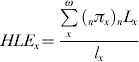
where:
l x is the number of survivors at the exact age x;
nπx represents the prevalence of the healthy state among individuals aged from x to x+n;
nL x is the total number of years lived by a cohort in the age group (x, x+n);
ω represents the highest (or oldest) age category.
The method makes use of two independent measures of health. The first refers to a measure of the healthy state (nπx), that is the specific rate of being healthy by age group; and nL x which is the survival component. The model thus removes from the total life expectation of a cohort the proportion lived that is unhealthy (or estimates the time spent healthily for a given cohort). For an indicator of healthy life, the present study used ‘self-perceived health’ dichotomised into ‘poor’ and ‘good’. ‘Poor’ health was attributed to those who said that their health was ‘poor’ or ‘fair’; ‘good health’ attributed to those who said that their health was ‘good’, ‘very good’ or ‘excellent’. The specific rate of being healthy by age group was established by the proportion of individuals with good self-perceived health in each quinquennial age group. Before aggregating the ‘poor’ and ‘fair’ categories into the ‘poor’ category, it was verified that the pattern of responses was the same as if the ‘fair’ response was excluded from the analysis. This was done since, as noted by Pelaez et al. (Reference Peláez, Palloni, Albala, Alfonso, Ham-Chande, Hennis, Lebrão, Leon-Diaz, Pantelides and Pratts2003), the observed age-schedules of the prevalence of ‘poor’ or ‘fair’ health are similar for males and females, but the schedule for those reporting only ‘poor’ health has a steeper age profile. In the present study it was found that, in terms of percentage of time spent in the two states, there were no evident differentials across ages or between sexes. To allow a larger sample, it was therefore decided to aggregate the ‘fair’ and ‘poor’ categories. It is important to note that the estimates made in this study were based on self-reported prevalence data and mortality rates for the year 2000, and that it is assumed that these rates would not change.
Applying the method
The life table used for the estimation was organised by five-year (or quinquennial) age groups and an open-ended uppermost category, 85 or more years. The schedule of death rates was applied to the mid-2000 population estimates for the City of São Paulo that were derived from the population censuses of 1991 and 2000 (the reference dates were 1st September 1991 and 1st August 2000) using the population exponential growth formula (Preston et al. Reference Preston, Heuveline and Guillot2000). To provide the best estimate of person years of the study period, it was necessary to obtain an estimate for 1st July rather than 1st August 2000 (Preston et al. Reference Preston, Heuveline and Guillot2000). The death statistics were obtained from the Fundação Sistema Estadual de Análise de Dados [State System Foundation for Data Analysis, SEADE Foundation], and the average number of deaths were estimated for the triennium 1999–2001 by sex and age groups.
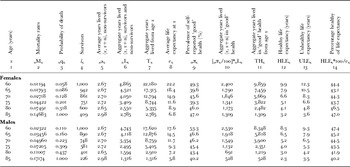
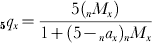
Table 1 shows the application of the Sullivan method separately for males and females. The percentage of individuals in each quinquennial age group with self-rated ‘good’ health was converted into an age-specific rate of being healthy (Romero, Leite and Swarcwald Reference Romero, Leite and Swarcwald2005). The first column represents the lower age of the age group, for which the amplitude (or range) is five years, except for the oldest open age group. The six columns to the right show the life-table measures that are required to estimate average life expectancy. In the second column are the age-specific mortality rates (5Mx). Based on the specific mortality rate, the probability (5qx) of an individual with exact age x dying before surviving x+5 years was calculated by the formula (Preston et al. Reference Preston, Heuveline and Guillot2000):
Since in the oldest age group with an open interval, every individual will die, no calculation is needed; the probability of death in this interval (wq85) is 1.0. Given these probabilities of death, the number of survivors reaching the initial age of the following age group can be calculated (l x+5). Thus in Column 4:

The partial life table starts at age 60 years and assumes a starting population of 1,000. Column 4 of Table 1 indicates that 942 females survive to 65-years-of-age (l 65). Column 5 shows 5ax, the aggregate number of years lived between ages x and x+5 for those who died during the interval. To calculate the total number of years lived between ages x and x+5, the aggregate 5ax is added to the aggregate years lived by those who survive the interval. The average number of years lived by those who die before reaching the age of x+5 is derived from nax using Jagger's formula (Reference Jagger1999). Thus:

It is important to note that, for the oldest, open-ended age-group, it is assumed that those who survive to age 85 years will on average live 2.98 years until they die (∞ax=2.98, where ∞ is infinity). Column 6 indicates that 1,000 females aged 60 years will in aggregate live 4,865 years during the subsequent five years, and those who survive to 85 years will in aggregate live a further 2,785 years. Column 7 presents the total number of years to be lived by the survivors in age group x until all die. This is done by accumulating the lived years in each interval:

The 1,000 females in the partial life table will altogether live 22,180 years. The life expectancy is calculated by dividing the numbers of years a person is expected to live from a certain age by the number of survivors to the reference age:

The 2000–01 life table indicates that females aged 60 years would live an additional 22.2 years (Column 8). The percentages declaring self-perceived ‘good’ health are presented in Column 9, and Column 10 shows the aggregate of healthy years lived in each age group. By cumulatively summing these values, the number of people-years that will be lived healthily from a given age x is obtained (Column 11). For females, of the 22,180 years expected to be lived from the age of 60 years, 9,859 would be lived in a healthy state (TH60).
Sullivan estimates of healthy life expectancy based on self-perceived health status by sex, City of São Paulo, Brazil, 2000–01

Notes: Columns 1–8 are as in a conventional life table. Column 9 is the prevalence of self-reported good health. Columns 10–11 are the aggregate years lived by all survivors in ‘poor’ and ‘good’ health. Columns 12–13 are the estimated Healthy and Unhealthy Life Expectancies, and Column 14 the percentage of total life expectancy that is Healthy. The notation is explained further in the text.
Sources: Health, Well-being and Ageing in Latin America and the Caribbean (SABE) project database (Pelaez et al. Reference Peláez, Palloni, Albala, Alfonso, Ham-Chande, Hennis, Lebrão, Leon-Diaz, Pantelides and Pratts2003). State System Foundation for Data Analysis (SEADE) 1999, 2000, 2001; Brazilian Institute of Geography and Statistics 1991, 2000.
To summarise, as in the traditional life table, healthy life expectancy (HLEx) is calculated by dividing the number of person-years lived in a healthy state from a certain age x by the number at the starting age. As shown in Column 12 of Table 1, at 60-years-of-age healthy life expectancy for females is 9.9 years and unhealthy life expectancy 12.3 years (Column 13). It follows that it was expected that of the aggregate of years lived beyond 60 years, 44.4 per cent would be healthy (Column 14).
Logistic regression analyses
Logistic regressions were run to analyse the factors that were associated with variations in self-perceived health. The dependent variable was a dichotomy with a value of ‘1’ for ‘poor’ self-perceived health and ‘0’ otherwise. The explanatory variables were classified following Alves and Rodrigues (Reference Alves and Rodrigues2005) as: (1) demographic (living arrangement and marital status); (2) socioeconomic (schooling and income), (3) functional disability; and (4) number of chronic illnesses. The aim was to observe the association between (3) and (4) and the response variable controlling for (1) and (2). Marital status had four categories: single, married or in consensual union, separated or divorced, and widow(er). Living arrangements had two categories: living alone, and living with someone. Schooling was dichotomised between ‘0–4 years’ and ‘5 or more years’ schooling. The household income categories were: less than one minimum wage; one to three minimum wages; and more than three minimum wages. The number of chronic illnesses (of individuals) were categorised as ‘none’, ‘one’ and ‘two or more’. Functional disability was classified as ‘dependent’ or ‘independent’. After categorising the variables, indicator variables were created with a value ‘1’ if the individual had the attribute and ‘0’ otherwise.
Six logistic regression models were run to assess the independent contribution of each covariate to the odds of poor self-perceived health. The models applied to: (1) men aged 60–69 years; (2) men aged 70–79 years; (3) men aged 80 or more years; (4) women aged 60–69 years; (5) women aged 70–79 years; and (6) women aged 80 or more years. The significance of the odds ratio was established by the Wald test. For the analysis, there were 2,138 cases (five cases were excluded because of non-response for self-perceived health and marital status). For consistency with the life expectancy analysis, age-group weights were also used. The software used was Stata 8.0.
The estimates of healthy and unhealthy life expectancy
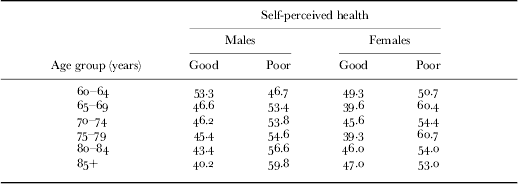
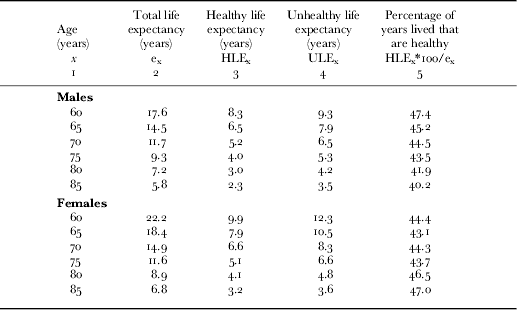
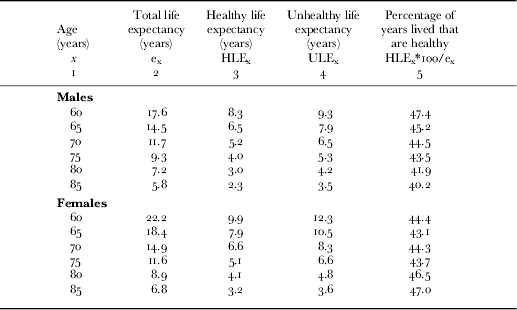
Table 2 shows that for men, the prevalence of ‘poor’ self-reported health increased monotonically with age, and at 85 or more years attained 59.8 per cent. For women, the relationship with age oscillated and the highest prevalence (60.7%) of ‘poor’ health was among those aged 75–79 years. At ages younger than 80-years-of-age, a higher percentage of men than women reported ‘good’ health; at older ages the opposite applied. Table 3 compares the total, healthy and unhealthy life expectancies for males and females at the given ages. The estimates suggest that in 2000, the life expectancies of women in the City of São Paulo were greater than those of men. At age 60 years, for example, the respective figures were 22.2 and 17.6 years. The sex differential was about five years at age 60 years, but decreased with age to about one year at age 85 years. At every age, the women could expect more years of healthy remaining life than men, but among those aged less than 75 years, a lower percentage of their remaining years would be in self-perceived ‘good’ health (Column 5). With increasing age, this percentage steadily decreased for men but oscillated for women (Table 3).
Self-perceived health status by sex and age group, City of São Paulo, Brazil 2000–01
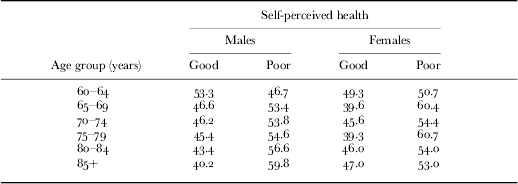
Notes: Good health is notated in this paper nπx, and ‘poor’ health as (1−nπx); see text.
Source: See Table 1.
Estimates of average life expectancy by self-perceived health and sex, City of São Paulo, Brazil 2000–01
Sources: See Table 1.
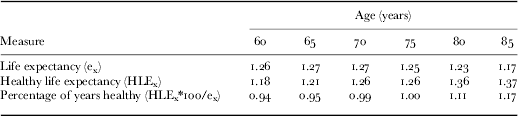
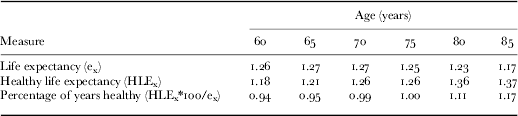
Table 4 shows the female-to-male ratios of average life expectancy, healthy life expectancy, and the percentage of life expectancy as healthy. Since women live longer than men, the ratios of total life expectancy ratios are all greater than 1.0. The ratios are around 1.25 from 60 to 75-years-of-age and decline at older ages to 1.17 at age 85 years. The sex ratios for healthy life expectancy, by contrast, increase with age, from 1.18 at 60 to 1.37 at 85-years-of-age. The third ratio is the percentage of expected remaining life spent healthily. It increases steadily from 0.94 at 60 to 1.17 at 85-years-of-age.
Female-to-male ratios for average life expectancy, average healthy years of expected life, and percentage of years healthy by age, City of São Paulo, Brazil, 2000–01
Sources: See Table 1.
Results of the multivariate analysis
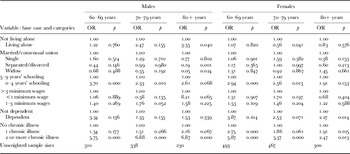
Table 5 presents the odds ratios (OR) for self-perceived ‘poor’ health estimated by the multivariate logistic regressions. The living arrangement measure, living alone, produced significantly low ORs among women aged 70–79 years, and significantly high ORs among men aged more than 70 years. Turning to the marital status categories, for which the base category was married or in a consensual union, among men, being single did not significantly alter the likelihood or reporting ‘poor’ health, but among women it was associated with a significantly high OR among those aged 70–79 years and a significantly low OR among those aged 80 or more years. The oldest age groups of separated and divorced men and women had significantly low ORs. Being widowed did not significantly alter the likelihood of reporting ‘poor’ health among women, but produced significantly low ORs among men aged more than 70 years. Level of education had more pervasive effects. The base category was more education (over four years). Having less education produced highly significant ORs for all groups except the oldest women.
Risk factors for ‘poor’ self-perceived health among older people in the City of São Paulo, Brazil, 2000

Notes: OR Odds ratio. The base case for a variable begins the sequences of categories.
Sources: See Table 1.
The other socio-economic status measure also produced many significant results but of less consistent direction, partly no doubt because it is a household rather than an individual indicator. The base category was that the household income exceeded three minimum wages. Being in a household with intermediate income (1–3 minimum wages) significantly raised the likelihood of reporting ‘poor’ health for all age-sex groups, but being in a low income household had inconsistent effects (see Table 5). The functional disability measures produced more significant effects for women than men, most of all among the oldest two age groups. Not surprisingly, the number of chronic illnesses very strongly associated with reporting ‘poor’ health, and among those aged 80 or more years, the ORs for men were considerably higher than those for women.
Discussion
There is accumulating international evidence that at all ages, women live longer than men in the unhealthy state (see Ofstedal et al. (Reference Ofstedal, Zimmer, Cruz, Chan and Lin2003) for Asia, Bossuyt et al. (Reference Bossuyt, Gadeyne, Deboosere and Van Oyen2004) for Belgium, Agree (Reference Agree1999) for the United States, and Martinez-Sánchez et al. (Reference Martínez-Sánchez, Gutiérrez-Fisac, Gispert and Regidor2001) for Spain). In the City of São Paulo, Brazil in 2000–01, men aged 60, 65 and 70 years could expect to live a higher percentage of years in a healthy state than women, but at ages 75, 80 and 85 years the opposite held. In fact, for women the percentage of expected years spent in an unhealthy state did not increase with age. This may be the most important result of this estimation, since it contradicts previous studies of Cambodia (Zimmer Reference Zimmer2005), the United States (Agree Reference Agree1999), and Indonesia, Philippines, Singapore and Taiwan (Ofstedal et al. Reference Ofstedal, Zimmer, Cruz, Chan and Lin2003). The multivariate analysis indicated that as women age, having one chronic disease as compared with none decreased in significance, but for men the opposite applied. On the other hand, being dependent became increasingly significant for women as they aged, but less significant for men.
These findings are however consistent with the evidence that older men and women use different information and criteria when making an overall assessment of their health status (Jylha et al. Reference Jylha, Guralnik, Ferrucci, Jokela and Heikkinen1998, Prager et al. Reference Prager, Walter-Ginzburg, Blumstein and Modan1999). Earlier work has also shown that women take more account of health dimensions that are not related to mortality, such as mild diseases and overall quality of life, while men's self-assessments are more strongly influenced by serious conditions (Benyamini, Leventhal and Leventhal Reference Benyamini, Leventhal and Leventhal2000; Alves and Rodrigues Reference Alves and Rodrigues2005). Increased age, which is expected to be associated with higher mortality and morbidity in both men and women, is more strongly associated with a higher percentage reporting poor health among men than women.
The differential perception of health between the two sexes is probably related to differentiated gender roles throughout the life span. From an evolutionary standpoint, it may be adaptive for women, as the principal carers of their families, to be responsive to all familial events and any disruptive health problems. Men, by contrast, are expected to be more concerned with health conditions that reduce their ability to manage external tasks and threats (Benyamini, Leventhal and Leventhal Reference Benyamini, Leventhal and Leventhal2000). In the City of São Paulo in 2000–01, the percentage of life spent in poor perceived health did not change as much for women as for men with increasing age. It was hypothesised that women tended to adapt more easily to new realities and to be more distracted in relation to serious health threats than men. This was supported by the multivariate analysis, for dependence was a stronger predictor of a poor health self-assessment for women than men, while multiple chronic diseases had a stronger effect for men. Since functional disability can be considered less related to mortality than the number of chronic diseases, the percentage of life spent in poor self-perceived health was more strongly correlated with mortality for men than for women, and therefore a more valid measure of health outcomes.
Limitations of the study
It is important to note that the SABE database does not include older people resident in institutions, who are likely to be sicker and frailer than the non-institutional population. This may be another reason why the results for women revealed no age gradient in unhealthy years. On the Sullivan method, it does not allow the assessment of transitions from one health state to another, and its estimates have been criticised on these grounds. To analyse data on transitions from one state to another would require a multi-state life table, which, in turn, requires longitudinal incidence data. A previous study using various simulation models and possible scenarios showed, however, that if there are no sudden changes over time in prevalence and mortality rates, Sullivan's method provides robust estimates for monitoring changes in healthy and unhealthy life expectancies (Mathers and Robine Reference Mathers and Robine1997).