


Introduction
Although around for 40+ years, co-production is still a relatively new concept that is developing across a whole range of different sectors including economics, governance, management, research and more recently, in mental health care (Filipe et al., Reference Filipe, Renedo and Marston2017; Norton & Swords, Reference Norton and Swords2021). Since Elinor Ostrom devised the term in the 1970s, co-production has grown from a concept that distinguishes a congruency between the physical presence of police and lowering crime rates to an empirical concept that is a driver for recovery within mental health service provision (Boyle & Harris, Reference Boyle and Harris2009; Stott & Johnson, Reference Stott and Johnson2018; Norton Reference Norton2019; Smith et al., Reference Smith, Budworth, Grindey, Hague, Hamer, Kislov, van der Graaf and Langley2022). Although its growth is positive, it has also caused the concept to become a buzzword with no clear definition evident within the literature (Norton Reference Norton2022; Smith et al., Reference Smith, Williams and Bone2023). However, it is clear that co-production is different from other types of participation currently available as it involves mutuality, where all stakeholders are viewed as assets to each part of mental health service provision (Cahn Reference Cahn2000; Fisher et al., Reference Fisher, Balfour and Moss2018). Consequently, for the purpose of this paper, Norton’s (Reference Norton2022) definition of co-production will be used, which suggests that co-production involves:
the creation and continuous development of a dialogical space where all stakeholders, including service users, family members, carers, supporters and service providers enter a collaborative partnership with the aim of not only improving their own care but also that of service provision. (Norton, Reference Norton2022, pp. 27)
The concept’s use within mental health services has been enhanced firstly through policy and later towards systemic practices. In an Irish context, ‘A Vision for Change’ provided the basis for systemic changes through addressing the recovery concept and the introduction of peer support work (Department of Health, 2006). Since then, as a result of the implementation of recovery-orientated services, co-production as an empirical concept and as an integral component of recovery also grew. This growth in Irish services came in the form of a guidance document (Health Service Executive, 2018) and its identification as a principle of recovery within ‘A National Framework for Recovery in Mental Health’ (Health Service Executive, 2024). Today, as part of recommendation 27 of Ireland’s new policy document: ‘Sharing the Vision’, the Office of Mental Health Engagement and Recovery are planning to create a co-production policy to help further integrate this way of working within traditional mental health service provision (Department of Health, 2020; Health Service Executive, 2023). This work is set to be completed by the end of the current policy period [2030].
Co-production is imperative in the creation of a recovery-orientated service as it recognises the strengths of all stakeholders involved in the process – both learned and experiential knowledge (Norton, Reference Norton2019). This meaningful involvement from all parties, including service users and family members, has been noted to lead to positive outcomes including improved well-being, inclusion, social connectedness and empowerment (Guarino et al., Reference Guarino, Negrogno, Compare, Madeo, Bolognini, Esposti, Filippi, Lamberini, Morrone, Masetti, Serra and Albanesi2024). All factors that are important for both personal and social recovery of an individual (Leamy et al., Reference Leamy, Bird, Le Boutillier, Williams and Slade2011; Norton & Swords Reference Norton and Swords2020). Within Irish services, it has been an integral part of the creation of recovery-orientated services starting with Advancing Recovery in Ireland and later through the Office of Mental Health Engagement and Recovery (Brogan & Ryan Reference Brogan and Ryan2017).
Although there is a clear policy and service incentive to implement co-production in mental health services, there are still several blocks or challenges to its implementation. These include the capacity of services to embed genuine collaboration (Soklaridis et al., Reference Soklaridis, Harris, Shier, Rovet, Black, Bellissimo, Gruszecki, Lin and Di Giandomenico2024), the current inability to measure co-production through empirically validated instruments (Norton Reference Norton2022; Nordin et al., Reference Nordin, Kjellstrom, Robert, Masterson and Josefsson2023), the concept’s empirical challenge to existing hierarchical imbalances and epistemic injustices (Mannell et al., Reference Mannell, Washington, Khaula, Khoza, Mkhwanazi, Burgess, Brown, Jewkes, Shai, Willan and Gibbs2023) and finally the use of co-production in crisis situations (Norton & Swords, Reference Norton and Swords2021). All of which are concerns expressed practically and empirically still today. Additionally, due to the use of co-production within different disciplines and as a result of a lack of consensus regarding its definition, principles and processes, it is also difficult to philosophically place co-production within a particular paradigm that reflects its mechanism of action within all facets and disciplines it is used within. In terms of mental health service provision, both Norton (Reference Norton2021) and Norton & Swords (Reference Norton and Swords2021) have attempted to answer this. Here, both papers present an argument that co-production is not a positivist concept as it means different things to different people. Plus, currently, it cannot be measured empirically. Instead, both papers suggest that it is a concept or principle that is constructed by multiple actors from different factions of the social world. This construction of various elements from various social actors stipulates that co-production philosophically sits within a social constructionist paradigm. However, this requires further investigation through a philosophical lens in order to prove or disprove this suggestion. This current review is now necessary to ascertain what exactly we know about the concept of co-production, particularly in mental health care so as to shape future research and policy directions for recovery-orientated practice in this area.
Rationale for scoping review
The requirement for this paper stemmed from two publications carried out by the reviewer in this area of empirical research. In 2021, Norton published a systematic review of the concept within child and adolescent mental health. During this review, after a rigorous and systematic search, only two articles were found to meet the inclusion criteria, which at the time was quite rigorous (Norton, Reference Norton2021). This led to a detailed discussion leading to recommendations including a recommendation to truly identify the breadth of literature on co-production in mental health (Norton, Reference Norton2021). To do this, a scoping review was necessary as it allowed reviewers to examine the breadth of literature on a specific subject whilst also utilising a mechanism that allows the reviewer to be as clear and transparent as possible whilst utilising less rigorous methods (Norton, Reference Norton2022). Subsequently, an important text published in this area was ‘Co-Production in Mental Health: Implementing Policy into Practice’ (Norton, Reference Norton2022a), which further highlighted the need for a scoping exercise to be conducted in order to support the further development of co-production in mental health service provision. Since commencing writing this paper, two reviews have also been published regarding co-production in mental health. One, a realist review examining co-production in child and adolescent mental health (Jones et al., Reference Jones, Waring, Wright and Fenton2024), the other, a systematic review exploring co-production in mental health research (Hopkins et al., Reference Hopkins, Verlander, Clarkson and Jacobsen2024). Although welcome, they still do not answer the burning questions asked by Norton in his earlier works. As such, this led the present reviewer to produce a protocol for a scoping review into this subject (Norton, Reference Norton2022), which was subsequently published by BMJ Open in May 2022. The purpose of the protocol was to provide a plan for conducting a scoping review that allows for transparency, like in systematic reviews, whilst utilising a less rigorous mechanism for finding included papers.
Aims and objectives of scoping review
The purpose of this paper is to present a scoping review examining the recovery concept and principle of co-production within mental health service provision (Norton, Reference Norton2022). In order to do this, the protocol for this review identified a number of objectives that are seen as imperative to achieve in order to adequately review this concept. As such, these objectives are:
-
To scope out and examine the breadth of literature on co-production within mental health service provision.
-
To identify the various definitions, types and models of co-production evident from mental health service provision and documented within the peer-reviewed and grey literature.
-
To describe the advantages and disadvantages of the concept within mental health service provision.
-
To identify and describe what is known about the implementation of co-production within mental health settings.
-
To demonstrate the practice of co-production whilst also identifying the gaps within mental health suitable for future study.
(Norton, Reference Norton2022).
Methods
In following best practice in the reporting of scoping reviews, this present scoping review will be structured based on the Preferred Reporting Items for Systematic Reviews and Meta-Analyses guidelines for Scoping Reviews [PRISMA-ScR] [Supplementary Material 1] (Tricco et al., Reference Tricco, Lillie, Zarin, O’Brien, Colquhoun and Levac2018). Additionally, the present review was further informed methodologically by Arksey & O’Malley’s (Reference Arksey and O’Malley2005) framework for conducting scoping reviews, which stipulates a five staged process including (i) identifying the research question, (ii) identifying relevant studies, (iii) study selection, (iv) charting the data and finally (v) collating, summarising and reporting the results. A protocol for this scoping review has been registered with the Open Science Framework [OSF] repository in February 2022 [https://doi.org/10.17605/OSF.IO/PK98R] and was then published by BMJ Open (Norton, Reference Norton2022) in May 2022. The following presents how the present reviewer utilised the five stages of Arksey and O’Malley’s methodological framework in this scoping review.
Stage one: identifying the research question
Due to the broad focus of a scoping review, the research questions for investigation were also made broad in scope, but specific enough so that the search would only gather evidence regarding co-production within mental health service provision. There are a number of mechanisms that can be applied to create one’s research questions including SPIDER [sample, phenomenon of interest, design, evaluation research type] (Methley et al., Reference Methley, Campbell, Chew-Graham, McNally and Cheraghi-Sohi2014) and PICO [population, intervention, comparison, outcome] (Fineout-Overholt et al., Reference Fineout-Overholt, Melnyk, Stillwell and Williamson2010). However, in line with the protocol for this scoping review, the PICO method was used as PICO can be used universally for any scientific endeavour, including scoping reviews of the literature (Nishikawa-Pacher, Reference Nishikawa-Pacher2022). [Please see Aupplementary Materials 2 and 3 for the application of PICO to form the research question.] As a result, the two research questions constructed for investigation are: (1) what is co-production and (2) how is co-production implemented within mental health service provision?
Stage two: identifying relevant studies
In accordance with the review protocol, the following databases were searched for papers to include in this review: CINAHL, Cochrane Online Library, Jstor, Ovid SP, PsycINFO, PsycTESTS, PubMed, RCNi, Science Direct, Web of Science and Wiley Online Library. Additionally, due to the scoping nature of the review and to take into account that most research on co-production comes from the grey literature currently (McLean et al., Reference McLean, Carden, Aiken, Armstrong, Bray, Cassidy, Daub, Di Ruggiero, Fierro, Gagnon, Hutchinson, Kislov, Kothari, Kreindler, McCutcheon, Reszel, Scarrow and Graham2023), ETHos, nz.research.org.nz, ProQuest, National ETD Portal and Repositories, ResearchGate, Google and Google Scholar were also searched. This search was undertaken twice. The first from inception of concept to January 01st 2022. The second search was undertaken from 01 January 2022 to 31 August 2024. See Supplementary Materials 2 and 3 for both complete search strategies.
Stage three: study selection
Also, in accordance with the protocol, the above databases and repositories were searched using the following search terms:
‘co-production’ OR ‘co-design’ OR ‘co-delivery’ OR ‘co-evaluation’ OR ‘co-producing’ OR ‘engagement’ OR ‘inclusion’ OR ‘involvement’ OR ‘participation’ OR ‘co-creation’ OR ‘co-innovation’
AND
‘mental health’ OR ‘mental illness’ OR ‘mental ill health’ OR ‘mental well-being’ OR ‘mental wellness’ OR ‘psychiatric health’ OR ‘psychiatric illness’ OR ‘mental’ OR ‘psychiatry’
AND
’service provision’ OR ’service design’ OR ’service delivery’ OR ’service evaluation’ OR ‘design’ OR ‘delivery’ OR ‘evaluation’ OR ‘acute inpatient’ OR ‘inpatient’ OR ‘acute’ OR ‘community’ OR ‘outpatient’
AND
‘implement’ OR ‘implementation’ OR ‘employ’ OR ‘employed’ OR ‘apply’ OR ‘application’ OR ‘effect’ OR ‘impact’ OR ‘effectiveness’ OR ‘outcome’
AND
‘definition’ OR ‘define’ OR ‘meaning’ OR ‘understanding’ OR ‘understand’ OR ‘interpret’ OR ‘interpretation’
AND
‘service user’ OR ‘patient’ OR ‘client’ OR ‘consumer’ OR ‘psychiatric survivor’ OR ‘family member’ OR ‘brother’ OR ’sister’ OR ’sibling’ OR ‘parent’ OR ‘mother’ OR ‘father’ OR ‘carer’ OR ’supporter’ OR ’service provider’ OR ‘mental health professional’ OR ’staff’ OR ‘health professional’ OR ‘mental health staff’.
From the combined totals of the two searches, the databases incurred 722 publications, whereas the repositories searched incurred 1019 publications. Once duplicates were removed, 185 citations were brought forward for round two screening. Once the abstracts were read and compared to the inclusion/exclusion criteria, after which 17 citations were brought forward to the next stage of the search strategy: the reference screening carried out through a process of citation chaining. This resulted in a further 9 citations being brought forward for round three screening. After the reading of each citation included for round three screening and the comparison again to the inclusion/exclusion criteria, a final total of 10 studies were included in this scoping review. See Fig. 1 for a visual depiction of this process through the updated 2020 PRISMA flow chart. Additionally, please see Supplementary Materials 2 and 3 for a detailed search strategy for both search points.
PRISMA 2020 flow diagram for new systematic reviews that included searches of databases, registers and other sources. *Consider, if feasible to do so, reporting the number of records identified from each database or register searched (rather than the total number across all databases/registers). **Ifle automation tools were used, indicate how many records were excluded by a human and how many were excluded by automation tools. From: Page MJ, McKenzie JE, Bossuyt PM, Boutron I, Hoffmann TC, Mulrow CD, et al. The PRISMA 2020 statement: an updated guideline for reporting systematic reviews. BMJ 2021;372:n71. doi: 10.1136/bmj.n71.

Stage four: charting the data
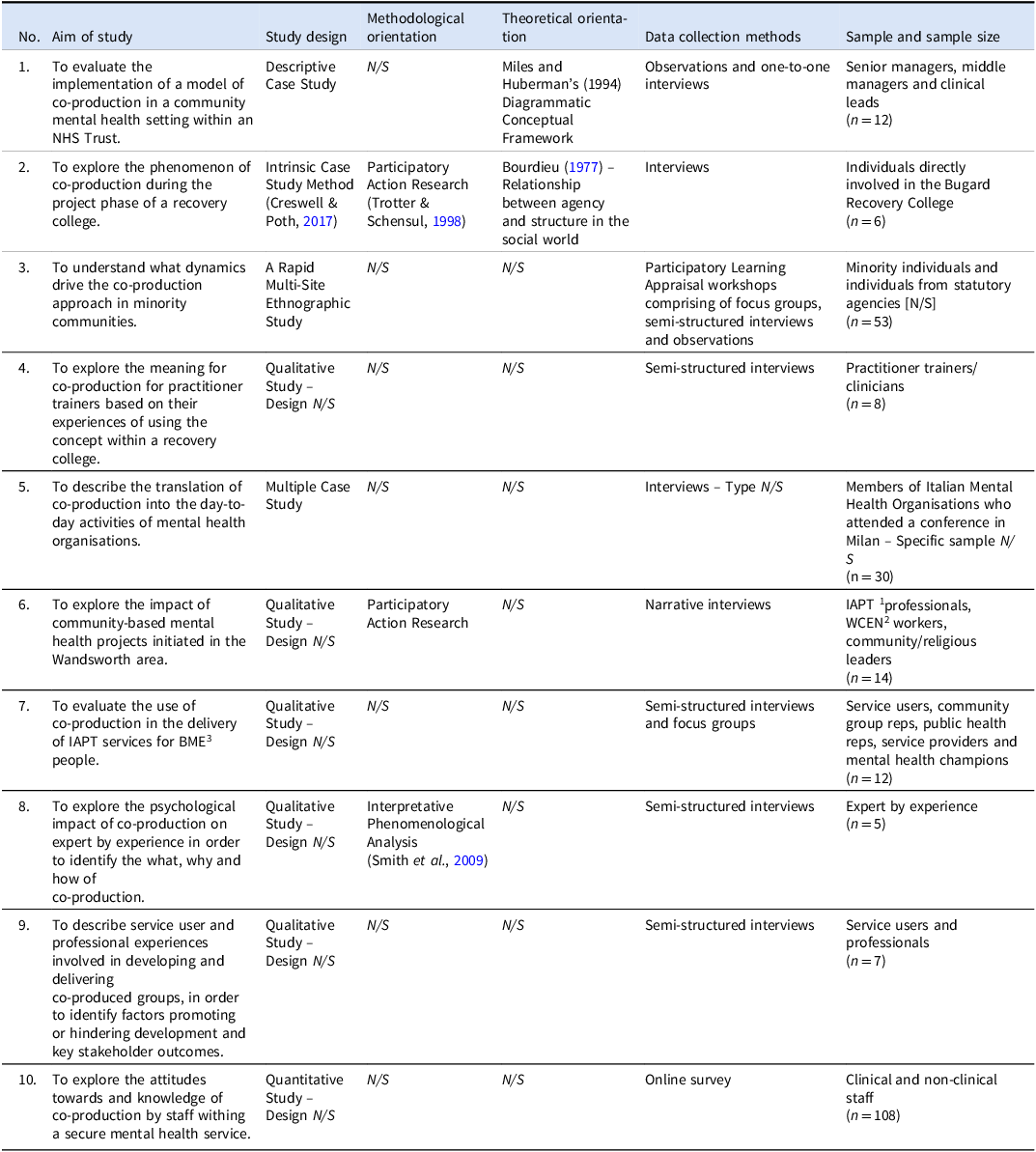
Based on the protocol for this scoping review (Norton, Reference Norton2022), appropriate, relevant information from each paper included was extracted and presented in a suitable format as per Arksey and O’Malley’s methodological framework. The information collected was gathered electronically and presented using the following stated headings as proposed in the protocol:
-
Authors,
-
Year of publication,
-
Country where the study was conducted or the affiliation of the first author,
-
Journal,
-
Target audience,
-
Format of paper – dissertation, empirical or report,
-
Setting – acute, community or residential,
-
Aim of study,
-
Study design,
-
Methodological orientation,
-
Theoretical orientation,
-
Data collection methods,
-
Sample and sample size,
-
Co-production definition used,
-
Stated advantages of co-production,
-
Stated disadvantages of co-production,
-
Co-production types/models,
-
Implementing co-production – how co-production is implemented within the study service context,
-
Strengths of the study
-
Limitations of the study,
-
Recommendations.
See Table 1a-d for the presentation of this stage of Arksey and O’Malley’s methodological framework. Additionally, within the protocol for this review, reference was made to connectedpapers.com in order to create visual graphs of the literature field based on the most cited included paper in this review. This was suggested in order to ensure that all relevant papers are included in this review. However, unfortunately it was not possible to use connectedpapers.com as it is a subscription based service. As this review is a self-funded endeavour, the reviewer did not have the resources available either personally or institutionally to pay the subscription fee in order to enable the use of this service and as such this aspect of the study was abandoned and not reported in this scoping review.
Charting of included papers in this scoping review

Stage five: collating, summarising and reporting the results
Within the protocol, it was stated that as a result of the review methodology used, a data synthesis will not occur (Norton, Reference Norton2022). The reviewer is aware of Levac et al.’s (Reference Levac, Colquhoun and O’Brien2010) update to Arksey and O’Malley’s methodological framework, allowing such synthesis to occur along with the measurement of quality and risk of bias. However, it was determined that this review should follow Arksey and O’Malley’s methodological guidelines, solely given the rise in other reviews that measure quality and bias and allow synthesis to occur in recent years. See, for example, Norton (Reference Norton2021), Hopkins et al. (Reference Hopkins, Verlander, Clarkson and Jacobsen2024) and Jones et al. (Reference Jones, Waring, Wright and Fenton2024). As such, a descriptive narrative of results will be presented using Hsieh & Shannon (Reference Hsieh and Shannon2005) summative content analysis. Summative content analysis involves the identification of key words based on the stated headings captured during stage 4 of Arksey and O’Malley’s methodological framework, in order to create a narrative of results based on what these headings capture from included papers (Cuskelly et al., In Press).
Results
This section presents a descriptive narrative of results based on Hsieh & Shannon’s (Reference Hsieh and Shannon2005) summative content analysis. Key words were generated by the protocol for this scoping review and applied to the included studies through multiple readings of the full text (Srivastava & Hopwood, Reference Srivastava and Hopwood2009). In line with Arksey and O’Malley’s methodological framework, an evidence synthesis did not occur. Instead, the focus remained on summarising and presenting the data uncovered through a matter of highlighting the commonalities across included studies. From which, the results of this review fall under four headings: Co-Production Definition Used, Stated Advantages of Co-Production, Stated Disadvantages of Co-Production, Co-Production Types/Models and finally, Implementing Co-Production. The results of the scoping review are now presented under these headings below.
Co-production definition used
Out of the ten included studies, two studies (Lwembe et al., Reference Lwembe, Green, Chigwende, Ojwang and Dennis2016; Gheduzzi et al., Reference Gheduzzi, Masella and Segato2019) did not provide a definition for the term co-production. The remaining studies, although examining various aspects of service provision and providing a variety of different definitions for the term, also highlighted similar characteristics that should be part of a definition for co-production. For example, a common aspect of co-production was this idea of all stakeholders working together towards a shared goal (Bamber, Reference Bamber2020; Hatzidimitriadou et al., Reference Hatzidimitriadou E. Mantovani and Keating2012; Thorneycroft & Dobel-Ober, Reference Thorneycroft and Dobel-Ober2015; Burgess & Choudary, Reference Burgess and Choudary2021; Webb et al., Reference Webb, Girardi and Stewart2021). These shared goals were not altruistic in nature; rather, they were focused on communities (Hatzidimitriadou et al., Reference Hatzidimitriadou E. Mantovani and Keating2012; Burgess & Choudary, Reference Burgess and Choudary2021) and on items that can facilitate recovery within individuals (Webb et al., Reference Webb, Girardi and Stewart2021). Within one study that focused on co-production within recovery education (Dalgarno & Oates Reference Dalgarno and Oates2018), the idea was to harness an individual’s strengths within a workshop in order to optimise the learning experience of the collective group. This harnessing of strengths requires the redistribution of power, which was also highlighted as a necessary component in defining co-production by some of the included papers (Bamber, Reference Bamber2020; Mayer & McKenzie, Reference Mayer and McKenzie2017; Boyle Reference Boyle2019). Another essential component of defining co-production was the multidisciplinary component of the stakeholders involved in the process (Bamber, Reference Bamber2020; Hatzidimitriadou et al., Reference Hatzidimitriadou E. Mantovani and Keating2012; Thorneycroft & Dobel-Ober, Reference Thorneycroft and Dobel-Ober2015; Mayer & McKenzie, Reference Mayer and McKenzie2017; Burgess & Choudary, Reference Burgess and Choudary2021; Webb et al., Reference Webb, Girardi and Stewart2021). Boyle (Reference Boyle2019) expands on this, suggesting that this multidisciplinary approach is not bipartite – involving just service users and providers, but is a tripartite process whereby multiple stakeholders outside of the traditional therapeutic relationship can become involved in the process.
Stated advantages of co-production
From the ten included articles in this scoping review, only one study (Gheduzzi et al., Reference Gheduzzi, Masella and Segato2019) did not state advantages of the co-production concept. Of the studies that did speak of the advantages of co-production (Bamber, Reference Bamber2020; Hatzidimitriadou et al., Reference Hatzidimitriadou E. Mantovani and Keating2012; Thorneycroft & Dobel-Ober, Reference Thorneycroft and Dobel-Ober2015; Lwembe et al., Reference Lwembe, Green, Chigwende, Ojwang and Dennis2016; Mayer & McKenzie, Reference Mayer and McKenzie2017; Dalgarno & Oates, Reference Dalgarno and Oates2018; Boyle, Reference Boyle2019; Burgess & Choudary, Reference Burgess and Choudary2021; Webb et al., Reference Webb, Girardi and Stewart2021), most of the benefits suggested differed within each study. However, there were some similarities between studies. For example, Burgess & Choudary (Reference Burgess and Choudary2021) and Dalgarno & Oates (Reference Dalgarno and Oates2018) both spoke about co-production allowing a platform for difficult experiences to be discussed. However, the population this benefits differs between studies with Burgess & Choudary (Reference Burgess and Choudary2021) examining service users and Dalgarno and Oates (Reference Dalgarno and Oates2018) examining mental health professionals. In addition, Burgess & Choudary (Reference Burgess and Choudary2021) and Hatzidimitriadou et al. (Reference Hatzidimitriadou E. Mantovani and Keating2012) both discussed how practicing co-production allowed for the voice of minority groups to be heard, thereby co-creating more culturally appropriate services. This flexibility to adapt services to cohort needs is also discussed in Lwembe et al.’s (2017) study, which examined mental health services in West London.
However, the remaining studies also identified a number of different advantages of co-production that were not co-operated by the other studies included in this review. Bamber (Reference Bamber2020) discussed how practicing co-production reduced the risks associated with some mental health settings like acute, inpatient settings. Boyle (Reference Boyle2019) suggests that co-production introduces and promotes democracy within services where all stakeholders are involved in decision-making. Along with the above, Burgess & Choudary (Reference Burgess and Choudary2021) also discuss how co-production can reduce barriers to service user involvement within mental health discourse. Along with allowing for the disclosure of mental health difficulties by clinicians, Dalgarno & Oates (Reference Dalgarno and Oates2018) also suggest that the influence of co-production goes beyond personal to that which also influences a clinician’s clinical practice. Hatzidimitriadou et al. (Reference Hatzidimitriadou E. Mantovani and Keating2012) suggest that co-production allows for a sense of being understood and a sense of belonging. It also empowers individuals to build capacity for community involvement in the delivery of public services. In addition, Hatzidimitriadou et al. (Reference Hatzidimitriadou E. Mantovani and Keating2012) identified that co-production not only is useful for reducing stigma but also has logical economic gain for the organisation as well. Mayer & McKenzie (Reference Mayer and McKenzie2017) add to what has been discussed previously by highlighting how co-production can cause mutuality within service systems but also can create a new, more positive, normal identity due to the paid aspect of co-produced work. This new identity, according to Thorneycroft & Dobel-Ober (Reference Thorneycroft and Dobel-Ober2015), helps increase confidence and self-esteem, which leads to the likelihood of more co-operative relationships occurring where the service user’s voice is ultimately heard (Webb et al., Reference Webb, Girardi and Stewart2021).
Stated disadvantages of co-production
From the studies included in this review, three papers (Lwembe et al., Reference Lwembe, Green, Chigwende, Ojwang and Dennis2016; Gheduzzi et al., Reference Gheduzzi, Masella and Segato2019; Burgess & Choudary, Reference Burgess and Choudary2021) did not state a disadvantage of co-production within mental health service provision. Out of the studies that did discuss disadvantages of the concept, the narrative seems to centre on two points – organisational culture and the capacity of the service user to co-produce (Bamber, Reference Bamber2020; Hazidimitriadou et al., Reference Hatzidimitriadou E. Mantovani and Keating2012; Thorneycroft & Dobel-Ober, Reference Thorneycroft and Dobel-Ober2015; Mayer & McKenzie, Reference Mayer and McKenzie2017; Dalgarno & Oates, Reference Dalgarno and Oates2018; Boyle, Reference Boyle2019; Webb et al., Reference Webb, Girardi and Stewart2021). Bamber (Reference Bamber2020) first raises the barrier of organisational culture in their UK-based study. Here the organisational culture led to the inappropriate use of the term, which in turn resulted in tokenistic practices forming. Boyle (Reference Boyle2019) and Dalgarno & Oates (Reference Dalgarno and Oates2018) added to Bamber’s discussion by stipulating an internal war for power that resulted from co-productive practices. Boyle suggests that this battle is against the traditional system but also more empirically through the battle with evidence-based practice itself. One such battle, noted by Boyle, is the evidence-based requirement to measure co-production, with the inability, thus far, to do the same, causing debate amongst positivist-led clinicians. Contrary to this, Dalgarno and Oates further suggest that this battle is not against the traditional system or philosophically with evidence-based practice, but is instead one that centres around the distribution of power and the fact that co-production requires some stakeholders to relinquish some of their perceived power given to them by their professional standing within the organisation. This has the added disadvantage of creating conflicting agendas, which, as noted by Hatzidimitriadou et al. (Reference Hatzidimitriadou E. Mantovani and Keating2012), results from Boyle’s (Reference Boyle2019) and Dalgarno & Oates’ (Reference Dalgarno and Oates2018) war to gain as much power and control as possible.
The organisation inflicts a time-limited culture on its staff, which filters down to those actually using the service on the ground. This is not just limited to time but also relates to inadequate staffing and the lack of vital resources required to run a recovery-orientated service. Indeed, this seems to be the case when it comes to co-production, with both a lack of time (Hatzidimitriadou et al., Reference Hatzidimitriadou E. Mantovani and Keating2012), staffing and other resources (Webb et al., Reference Webb, Girardi and Stewart2021) noted as a stated disadvantage of co-production. Such a lack of resources includes a lack of standardised training on co-production to support actors in their co-productive work (Webb et al., Reference Webb, Girardi and Stewart2021). This leads to a lack of confidence to carry out co-production (Thorneycroft & Dobel-Ober, Reference Thorneycroft and Dobel-Ober2015), which in turn leads us to our second point regarding the capacity of the service user to co-produce (Hatzidimitriadou et al., Reference Hatzidimitriadou E. Mantovani and Keating2012; Thorneycroft & Dobel-Ober, Reference Thorneycroft and Dobel-Ober2015; Dalgarno & Oates, Reference Dalgarno and Oates2018; Webb et al., Reference Webb, Girardi and Stewart2021). This lack of capacity to co-produce leads the individual to feel like they are dealing with uncertainty when it comes to utilising the concept (Mayer & McKenzie, Reference Mayer and McKenzie2017), which can cause an inability of the individual to maintain a safe working environment (Bamber, Reference Bamber2020). All of which are noted disadvantages of co-production within the literature included in this review.
Co-production types/models
The majority of studies included in this review did not identify or discuss a type or model of co-production within mental health service provision (Bamber, Reference Bamber2020; Hatzidimitriadou et al., Reference Hatzidimitriadou E. Mantovani and Keating2012; Thorneycroft & Dobel-Ober, Reference Thorneycroft and Dobel-Ober2015; Lwembe et al., Reference Lwembe, Green, Chigwende, Ojwang and Dennis2016; Mayer & McKenzie, Reference Mayer and McKenzie2017; Dalgarno & Oates, Reference Dalgarno and Oates2018; Gheduzzi et al., Reference Gheduzzi, Masella and Segato2019; Burgess & Choudary, Reference Burgess and Choudary2021; Webb et al., Reference Webb, Girardi and Stewart2021). Boyle (Reference Boyle2019), the only study that did mention a type and/or model of co-production, discussed the idea of introductory co-production. According to Boyle, introductory co-production occurs when no stakeholder/party knows of the type of knowledge and experience in the room at any one time.
Implementing co-production
Only five of the included studies (Thorneycroft & Dobel-Ober, Reference Thorneycroft and Dobel-Ober2015; Lwembe et al., Reference Lwembe, Green, Chigwende, Ojwang and Dennis2016; Mayer & McKenzie, Reference Mayer and McKenzie2017; Dalgarno & Oates, Reference Dalgarno and Oates2018; Boyle, Reference Boyle2019) did not provide a description of how co-production is implemented in their specific service setting as part of the wider mental health services. From the five remaining studies that do, they do not provide a clear consensus as to how co-production can be implemented. Instead, what is presented is a list of necessary components to support the implementation of the concept in mental health service provision. Bamber (Reference Bamber2020), Gheduzzi et al. (Reference Gheduzzi, Masella and Segato2019) and Hatzidimitriadou et al. (Reference Hatzidimitriadou E. Mantovani and Keating2012) note the requirement for training in order for co-production to be effectively implemented. Hatzidimitriadou and colleagues note how such training should serve to build the capacity of each stakeholder to engage in co-production. For Gheduzzi et al. (Reference Gheduzzi, Masella and Segato2019), this is through training professionals in co-production principles and the community in mental illness itself. Bamber (Reference Bamber2020) suggests that buy-in from the service is crucial for co-production to be successful. Hatzidimitriadou et al. (Reference Hatzidimitriadou E. Mantovani and Keating2012) elaborate on Bamber’s suggestion, stating that such buy-in can only occur through an iterative process of building social capital and building relationships based on trust. The need for trust between actors was echoed by Burgess & Choudary (Reference Burgess and Choudary2021). Bamber add to this, suggesting that trust, if nourished correctly, can become a catalyst to allow for the redistribution of power so no hierarchy remains. This is further echoed by Gheduzzi et al. (Reference Gheduzzi, Masella and Segato2019) and Hatzidimitriadou et al. (Reference Hatzidimitriadou E. Mantovani and Keating2012). Finally, Bamber (Reference Bamber2020), Hatzidimitriadou et al. (Reference Hatzidimitriadou E. Mantovani and Keating2012) and Gheduzzi et al. (Reference Gheduzzi, Masella and Segato2019) and Webb et al. (Reference Webb, Girardi and Stewart2021) all allude to suggesting that actively and meaningfully listening to all stakeholders involved is paramount for the successful implementation and sustainment of co-production within mental health service provision.
Discussion
This paper presents the first considered effort to explore the breadth of literature on co-production specifically within mental health service provision. As a result, a number of items were raised; some new, whilst some are in line with previous literature in the field. Firstly, this review asked: what is co-production? From the results identified, like in previous literature, there is no consensus regarding the definition of co-production (Marks, Reference Marks2008; Salisbury, Reference Salisbury2020; Beresford et al., Reference Beresford, Farr, Hickey, Kaur, Ocloo, Tembo, Williams, Beresford, Farr, Hickey, Kaur, Ocloo, Tembo and Williams2021). Instead, the included studies highlighted necessary characteristics that should form part of a definition including (1) working together towards a shared goal (Bamber, Reference Bamber2020; Hatzidimitriadou et al., Reference Hatzidimitriadou E. Mantovani and Keating2012; Thorneycroft & Dobel-Ober, Reference Thorneycroft and Dobel-Ober2015; Burgess & Choudary, Reference Burgess and Choudary2021; Webb et al., Reference Webb, Girardi and Stewart2021), (2) harnessing a person’s strengths (Dalgarno & Oates, Reference Dalgarno and Oates2018), (3) redistributing power (Bamber, Reference Bamber2020; Mayer & McKenzie, Reference Mayer and McKenzie2017; Boyle, Reference Boyle2019) and (4) a tripartite process of multidisciplinary working (Bamber, Reference Bamber2020; Hatzidimitriadou et al., Reference Hatzidimitriadou E. Mantovani and Keating2012; Thorneycroft & Dobel-Ober, Reference Thorneycroft and Dobel-Ober2015; Mayer & McKenzie, Reference Mayer and McKenzie2017; Boyle, Reference Boyle2019; Burgess & Choudary Reference Burgess and Choudary2021; Webb et al., Reference Webb, Girardi and Stewart2021). Norton’s (Reference Norton2022a) definition of co-production also resulted from an extraction of characteristics described in the literature. This demonstrates that the definitions of co-production currently being constructed are dependent on what scholars deem the characteristics of co-production to be and not on the concepts’ philosophical and theoretical underpinning. When examining these essential components in defining co-production, they seem to align with some of the principles of co-production, which was first constructed by the work of Edgar Cahn in his seminal 2000 work and further developed by other scholars including Fisher et al. (Reference Fisher, Balfour and Moss2018), Salisbury (Reference Salisbury2020) and Lokot & Wake (Reference Lokot and Wake2021). As a result of the use of characteristics of co-production to define the concept, we are potentially losing meaning to what it truly is about, whilst also inadvertently reshaping it for a service context. This suggests that more theoretical research is required in order to construct a definition of co-production that is not reliant on such characteristics and more so reliant on its theoretical ideals. A good starting point in this enquiry is to explore, agree and finalise its philosophical foundations.
The included studies in this review discussed some advantages of co-production. Once again, some are well known whilst others appear for the first time. For instance, flexibility is a known advantage of the co-production (Lokot & Wake, Reference Lokot and Wake2021), which is often attributed to the lack of consensus in terms of the concept’s definition (Willis et al., Reference Willis, Almack, Hafford-Letchfield, Simpson, Billing and Mall2018). However, what is new is the suggestion that practicing co-production in acute inpatient care actually reduces the risks normally associated with these settings. This further builds upon the earlier works of Norton & Swords (Reference Norton and Swords2021), who first discussed how co-production could occur within an acute, inpatient environment. Additionally, when individuals were paid for their time working in co-production with other stakeholders, this payment acted as a catalyst for the creation of new positive, more normal identities (Mayer & McKenzie, Reference Mayer and McKenzie2017). This finding is new and suggests that although co-production by service users in Ireland is generally not renumerated, it is an issue which needs to be addressed urgently as it can have a negative impact both in terms of economics but more importantly in terms of a person’s identity, which is a noted factor for personal recovery unique to mental health settings (Leamy et al., Reference Leamy, Bird, Le Boutillier, Williams and Slade2011).
One cannot speak of the advantages of co-production without raising the associated disadvantages of the term, with this review being no different. However, where this review differs from that of other reviews conducted so far is that it has identified two major disadvantages of co-production – organisational culture (Bamber, Reference Bamber2020) and the capacity of the service user to co-produce (Hatzidimitriadou et al., Reference Hatzidimitriadou E. Mantovani and Keating2012; Thorneycroft & Dobel-Ober, Reference Thorneycroft and Dobel-Ober2015; Dalgarno & Oates, Reference Dalgarno and Oates2018; Webb et al., Reference Webb, Girardi and Stewart2021). In terms of organisational culture, this is a result of several factors including the inappropriate use of the term by services, resulting from the lack of consensus in terms of a definition. This review suggests that services need to work on organisational culture in order to ensure that co-production is successfully implemented within mental health services. This has started in an Irish context with the publication of a co-production guidance document (Health Service Executive, 2018) and later work on developing a co-production policy. However, this review also highlighted an internal philosophical battle that only occurs within the realm of mental health service provision – that of the battle between co-production as an interpretivist, socially constructed and as-of-yet unmeasurable concept and that of the largely positivist notion of evidence-based practice/medicine itself (Boyle, Reference Boyle2019). Evidence-based practice relies on subjects or phenomena being observable and measurable. However, currently this is not possible for the concept of co-production for a number of reasons including its invisibility – as it is a conversational, abstract space rather than something tangible and observable. This abstractness does not allow positivist notions currently to note it as evidence. As such, a battle ensues resulting from the as-of-yet unmeasurable construct of co-production. This need for measurability is noted as a future requirement for the sustainability of the concept within this environment and as such is a noted subject for further future investigations arising from this review. This piece of research will also be essential in supporting organisations and services in monitoring their organisational commitment to co-production and indeed recovery itself. Additionally, the need for training in this area has been noted as a disadvantage in this review (Bamber, Reference Bamber2020; Gheduzzi et al., Reference Gheduzzi, Masella and Segato2019; Hatzidimitriadou et al., Reference Hatzidimitriadou E. Mantovani and Keating2012). This is also extremely pertinent to rectify in the near future as this lack of training particularly limits the service user’s ability to co-produce effectively (Bamber, Reference Bamber2020; Mayer & McKenzie Reference Mayer and McKenzie2017). Although recovery colleges across the world have devised their own training for recovery education staff and volunteers in regard to co-production, no universal training is yet available and needs to be constructed as a matter of urgency so that the co-production practiced across the world is the same and is practiced to the highest standards possible. Creating a training programme for co-production could be supported by the creation of a monitoring/measurement tool for co-production. Therefore, adding more fuel to the fire for the need for future research in this area.
To the best of the reviewer’s. knowledge, this particular review was the first to also note the types/models of co-production in the literature thus far. Interestingly, out of the 10 included papers in this review, only one paper (Boyle, Reference Boyle2019) discussed types/models of co-production used in their study context. This is of concern as it is unknown what type of co-production was explored in included studies, which may limit the intended impact of this review as the type of co-production examined may not be true, transformative co-production – the most authentic type of co-production noted in the empirical, theoretical literature on the subject (Cahn & Gray, Reference Cahn, Gray, Pestoff, Brandsen and Verschuere2012). This lack of disclosure into the type of co-production evident in studies needs to be rectified moving forward if we, as a scholarship, are ever to progress the concept forward both empirically and practically within mental health service provision.
Finally, this review also explored the implementation of co-production within mental health service provision. Of concern here is that only half [n = 5] of the included studies suggested aspects of how to implement co-production in this review (Bamber, Reference Bamber2020; Gheduzzi et al., Reference Gheduzzi, Masella and Segato2019; Hatzidimitriadou et al., Reference Hatzidimitriadou E. Mantovani and Keating2012; Burgess & Choudary Reference Burgess and Choudary2021; Webb et al., Reference Webb, Girardi and Stewart2021). Of considerable note is that none of these studies could provide a consensus as to how to implement co-production. This is not a new finding, as in Norton’s (Reference Norton2022a) text, the process of implementing co-production is not clear, with the topic in this text needing two chapters to discuss the implementation of the same, given the lack of clear consensus. However, despite this lack of consensus, there are a number of key factors to consider when implementing the concept in a mental health context including the clear requirement for training for all stakeholders, particularly services users (Bamber, Reference Bamber2020; Gheduzzi et al., Reference Gheduzzi, Masella and Segato2019; Hatzidimitriadou et al., Reference Hatzidimitriadou E. Mantovani and Keating2012;), the buy in of the service it is being implemented in (Bamber, Reference Bamber2020; Hatzidimitriadou et al., Reference Hatzidimitriadou E. Mantovani and Keating2012) – this includes valuing service users through economic payment for co-produced work done and the necessity for those engaging in co-production to meaningfully listen (Bamber, Reference Bamber2020; Hatzidimitriadou et al., Reference Hatzidimitriadou E. Mantovani and Keating2012; Gheduzzi et al., Reference Gheduzzi, Masella and Segato2019; Webb et al., Reference Webb, Girardi and Stewart2021). However, the need to clearly document how to implement co-production as a practice within mental health settings requires further investigation so that a template standard can be reached to support each area in implementing the term in their service context. This is beginning to happen in an Irish context through the publication of ‘A National Framework for Recovery in Mental Health 2024–2028’ (Health Service Executive, 2024), but this review proves that more work is required to truly embed this concept in mental health services globally.
Strengths and limitations of scoping review
Like with any review, regardless of type, there are a number of strengths and weaknesses associated with this review. This review is the first scoping review of its kind to focus on co-production solely within mental health service provision. Given the nature of utilising a scoping review methodology and the utilisation of the appropriate PRISMA guidelines, this scoping review represents a comprehensive attempt to gather and report on the current literature base on co-production specifically as it relates to mental health. However, despite this, there are several limitations that readers should be aware of. Firstly, this review was only carried out by one reviewer. This, as noted in the protocol (Norton, Reference Norton2022), is a weakness because it may inadvertently limit the rigor and intended impact of this paper. In addition, as only one reviewer was involved in this review, a librarian was not involved in the development of the search strategy, which may negatively impact the rigor of this review even further. Additionally, the results of this review could be subject to bias as papers were not screened for quality or risk of bias. Consequently, papers were also not screened out from inclusion based on a quality assessment. Although Levac and colleagues’ paper allows for such assessments to occur, the reviewer felt that this should not happen in order to (1) be as true as possible to the published protocol and (2) because there are already a number of reviews that have examined the co-production literature in terms of quality and bias, for example, Norton (Reference Norton2021). Finally, the protocol for this review suggested the use of a third-party software: connectedpapers.com in order to map the literature base and ensure that no papers were missed through the screening process. However, as noted in the methods of this paper, this was not possible as it was a subscription-based service. The lack of use of this resource may have caused the reviewer to have missed papers that would otherwise have been included in this review, and as such, this should be noted as a potential limitation of the same. In addition, given the subject matter explored, no patient and public involvement input was incorporated into this review. This may also weaken the intended impact of this review as the review itself was not a result of co-production and could be construed as tokenistic given that the lack of multi-stakeholder involvement in the conduct of this scoping review.
Conclusion
This review presents the first known scoping review of the literature as it pertains to co-production within the specific context of mental health service provision. Despite the review revealing some similar ideas to those of other literature, it did also present new ideas, specifically relating to issues regarding acute care as well as a lack of consensus regarding a definition for and the implementation of co-production within this specific service context. Additionally, the review is the first to suggest that there is a philosophical battle occurring between co-production and that of evidence-based practice itself, which stems from a lack of ability to measure co-production in this context. All of which require further philosophical and practical investigation in the future in order to enhance and strengthen co-production further as a recovery principle within mental health service provision.
Charting of included papers in this scoping review cont

Charting of included papers in this scoping review cont

Charting of included papers in this scoping review cont

Supplementary material
The supplementary material for this article can be found at https://doi.org/10.1017/ipm.2025.16.
Data availability statement
The datasets analysed for this study can be found in the OSF repositories and is available through the following link: https://archive.org/details/osf-registrations-pk98r-v1.
Financial support
The correspondence received no specific grant from any funding agency, commercial or not-for-profit sector.
Competing interests
The author declares that there are no conflicts of interest.
Ethical standards
The author asserts that all procedures contributing to this work comply with the ethical standards of the relevant national and institutional committee on human experimentation with the Helsinki Declaration of 1975, as revised in 2008.




 Open access

