Introduction
A mass gathering can be defined as an event where a group of people come together for a common purpose within a particular space or venue. Further, a mass gathering is an event “where there is the potential for a delayed response to [health] emergencies.”Reference Arbon 1 A number of challenges in providing adequate health care exist at a mass gathering, primarily related to the environment and patient egress.Reference Ranse and Zeitz 2 Health providers aim to maximize their efficiency in responding to health emergencies within the mass-gathering environment, while minimizing the disruption to the normal operational capacity of the health service in the surrounding community or region. As such, a detailed health plan for mass gatherings is vital to ensure adequate health outcomes for participants, spectators, and the broader host community. As the science underpinning mass-gathering health is developing, so are specific ways of measuring and evaluating care at these events. In 2012, a minimum data set (MDS) was proposed to facilitate the systematic data collection across events,Reference Ranse and Hutton 3 leading to international dialogue on this issue.Reference Ranse and Hutton 4 However, this data set was developed by the authors with an Australian focus and without significant contribution from the existing literature. Others have highlighted the need for consistency in the collection and reporting of data from mass gatherings.Reference Lund, Turris and Amiri 5 Given this, the purpose of this paper is to continue the discussion regarding the development of the biomedical aspects of an MDS, with contributions from the literature and applications in international settings.
To assist in planning the medical support for mass gatherings, a predictive model of patient presentations that estimates the health workload has previously been reported in the literature.Reference Arbon, Bridgewater and Smith 6 However, this model originated from one country and applies to events with ≥ 25,000 participants or attendees. The model has not yet been extensively tested and is now more than a decade old. Arguably, a predictive model is one way to build situational awareness of the health needs at a mass gathering, particularly when historical information pertaining to an event is not available.Reference Zeitz, Zeitz and Arbon 7 However, a predictive model needs to be refined to ensure a narrow confidence interval that will enhance accuracy and reliability. When validated, the predictive model could be used by event planners and health providers to increase their situational awareness of health needs when planning for a mass-gathering event.
The multitude of factors that may influence health outcomes at mass gatherings should be considered in a comprehensive, all-factors approach to a larger, more comprehensive MDS. Biomedical characteristics of participants and attendees, as well as environmental, psychosocial, and health resources/support, are the broad categories that should be included. Within the above-mentioned categories, it is important to explore each in detail to ensure that the larger, more comprehensive MDS is inclusive. Such data will ultimately support the development of a sophisticated, reliable, and accurate predictive model. In 2012, an MDS clearly defined for the collection of specifically biomedical data for mass-gathering health research and evaluation was proposed.Reference Ranse and Hutton 3 Since this publication, the international mass-gathering community, led by members of the World Association for Disaster and Emergency Medicine, have continued a dialogue to create a comprehensive data set.Reference Ranse and Hutton 4 , Reference Turris and Lund 8
This research aims to enhance the existing biomedical aspects of the Ranse and Hutton MDS proposed for mass-gathering research and evaluation in the international context.Reference Ranse and Hutton 3 The desired outcome of this work is to arrive at a common language for reporting on events in order to enable data pooling which will permit analysis that crosses national boundaries, event types, and event sizes. Variability in the reporting of mass-gathering patient level characteristics is currently an impediment to meta-analysis. The prospective convergence in data variables collected through an MDS approach, or similar consensus document, would be a valuable step forward in the development of mass-gathering theory, predictive models and risk assessment, and clinical support tools. These concepts are important, but are beyond the scope of this research. Instead, this research provides a valuable step in the bigger agenda of mass-gathering theory development and understanding.
Methods
Design
This research used an integrated literature review methodology which aims to construct new knowledge about a given topic or issue from existing literature.Reference Torraco 9
Data Collection
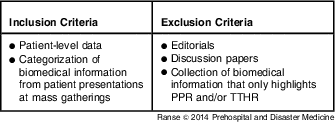
To conduct the integrative review, manuscripts were obtained from the journal Prehospital and Disaster Medicine (PDM), inclusive of the period 2003 through 2013. Prehospital and Disaster Medicine is the premier journal for publications relating to mass-gathering health. A search of PDM using keywords such as “event” and “mass gathering” was conducted in the first instance. However, it was evident early in the data collection process that using these keywords did not capture relevant manuscripts regarding the reporting of biomedical patient data to support the development of an MDS. As such, the search strategy evolved to include a review of the table of contents for each issue of PDM during the review period. This step yielded 41 manuscripts suitable for review. Each manuscript was read in full, while specific inclusion and exclusion criteria were applied to determine the appropriateness of each manuscript (Table 1). Using these criteria, 22 manuscripts were excluded. A total of 19 manuscripts were deemed suitable for data analysis.
Inclusion and Exclusion Criteria

Abbreviations: PPR, patient presentation rate; TTHR, transport to hospital rate.
Data Analysis
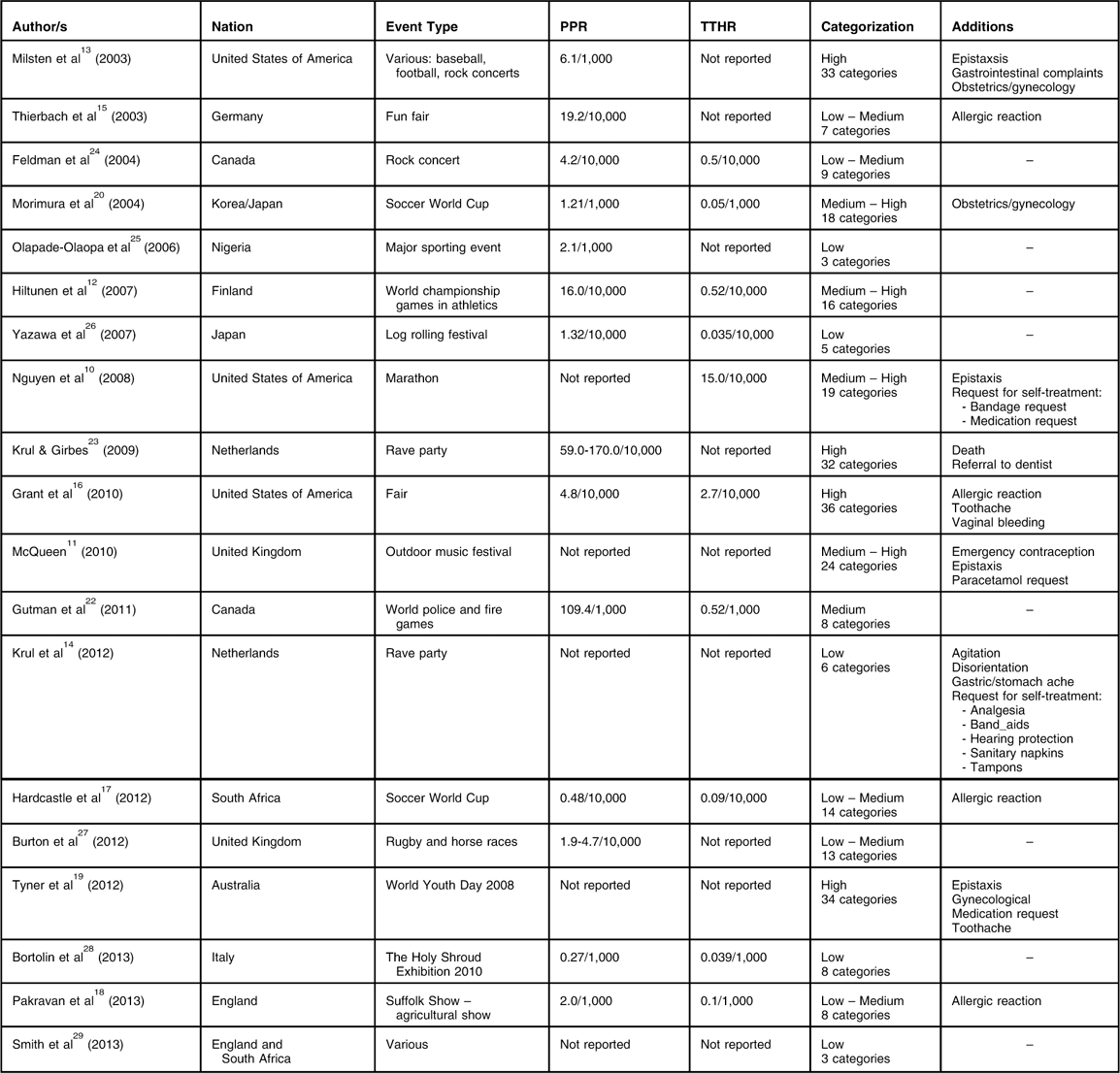
Information from each manuscript identified was entered into a Microsoft Word 2010 table (Microsoft Corporation, Redmond, Washington USA). This information included: author(s), year of publication, country where the mass gathering took place, specific type of mass-gathering event, reported patient presentation rate (PPR), reported transfer to hospital rate (TTHR), and the number of categories or variables used to describe the presenting chief complaint of primary presenting problem.
The manuscripts were further classified as using “low,” “medium,” or “high” levels of categorization. Ranse and HuttonReference Ranse and Hutton 3 argued that categorization exists on a continuum ranging from high (ie, very detailed) to low level (ie, general). Specifically, they proposed that high-level patient data is specific and detailed in nature (eg, “chest pain”). In contrast, low-level patient is nonspecific and not of a detailed nature (eg, “major illness”).
Data from the 19 manuscripts were compared with the Ranse and Hutton MDS.Reference Ranse and Hutton 3 The “addition” column of the Microsoft Word 2010 table included any identifiable differences in the biomedical patient-level categorization between the manuscripts included in this research and the MDS previously proposed by Ranse and Hutton.Reference Ranse and Hutton 3
Results
The findings from the first phase of data collection and analysis are highlighted in Table 2. In total, 19 manuscripts were identified that met the inclusion criteria. Variation in the patient presentation types was described in the literature from the mass-gathering papers reviewed. Patient presentation types identified in the literature review were compared to the 2012 MDS. As a result, 16 high-level patient presentation types were identified that were not included in the 2012 MDS.
Review of the Literature

Abbreviations: PPR, patient presentation rate; TTHR, transport to hospital rate.
Discussion
This review highlights that research pertaining to mass gatherings is being reported internationally, by a number of different researchers and research groups, at a variety of event types. It is reasonable to argue that if an author has included a patient-level category in the literature, it could be assumed that it is included because of clinical or medico-legal significance for that particular event or jurisdiction, and as such, may be applicable to other events.
Categorization
Patient-level information reported at a high level of detail provides insight into the types of patient presentations.Reference Ranse and Hutton 3 High-level categorizations reduce nonspecific categories such as “other,” “minor,” or “major,” which have limited usefulness to the planning of health workload.
A number of manuscripts reviewed in this research incorporated categories not previously outlined in the Ranse and Hutton MDS;Reference Ranse and Hutton 3 these are highlighted in the “additions” column of Table 2. As such, the authors of this research propose to enhance the original Ranse and Hutton MDSReference Ranse and Hutton 3 by including these additions. However, it should be noted that when authors included descriptors or categories such as “dehydration”Reference Nguyen, Milsten and Cushman 10 or “panic attack,”Reference McQueen 11 they were omitted from the study as these focus on diagnostic-related classification rather than a presenting problem. Similarly, categories such as “assault”Reference Hiltunen, Kuisma and Määttä 12 are not included, as this relates to a mechanism of injury rather than an injury itself. Interestingly, the diagnosis and underlying mechanism of injury or illness at mass gatherings is scantly reported in the literature.
From the reviewed literature, amendments to the category of “illness” can include: “abdominal pain,”Reference Milsten, Seaman and Liu 13 , Reference Krul, Sanou, Swart and Girbes 14 “allergic reaction,”Reference Thierbach, Wolcke and Piepho 15 – Reference Pakravan, West and Hodgkinson 18 “epistaxis,”Reference Nguyen, Milsten and Cushman 10 , Reference McQueen 11 , Reference Milsten, Seaman and Liu 13 , Reference Tyner, Hennessy, Coombs and Fizzell 19 and “toothache (not resulting from injury).”Reference Grant, Nacca, Prince and Scott 16 , Reference Tyner, Hennessy, Coombs and Fizzell 19 Additionally, a number of manuscripts included categories related to obstetric and/or gynecological-related presentations. As such, obstetric and/or gynecological-related presentations ought to be included as an additional medium-level classification, with higher level data including “vaginal bleeding”Reference Grant, Nacca, Prince and Scott 16 and “other,”Reference Milsten, Seaman and Liu 13 , Reference Tyner, Hennessy, Coombs and Fizzell 19 , Reference Morimura, Katsumi and Koido 20 as obstetric categories have not been included before.
“Agitation”Reference Krul, Sanou, Swart and Girbes 14 and “disorientation”Reference Krul, Sanou, Swart and Girbes 14 should be added within the mental health categories. Mental health-related presentations are infrequently reported in the literature from mass-gathering events. However, the inclusion of these categories is important as on occasion, appropriate patient management requires a specific response from specific health professionals, and this should be considered in health planning for mass gatherings. Furthermore, the more specific categories relating to mental health presentations at mass gatherings will enhance the understanding of the patrons with mental health care needs.
The Ranse and Hutton MDSReference Ranse and Hutton 3 does not include information pertaining to requests for “self-treatment” items. Self-treatment items that existed in the reviewed literature included: adhesive bandage strip/bandaids,Reference Nguyen, Milsten and Cushman 10 , Reference Krul, Sanou, Swart and Girbes 14 emergency contraception,Reference McQueen 11 hearing protection,Reference Krul, Sanou, Swart and Girbes 14 simple analgesia and over the counter medications,Reference Nguyen, Milsten and Cushman 10 , Reference McQueen 11 , Reference Krul, Sanou, Swart and Girbes 14 , Reference Tyner, Hennessy, Coombs and Fizzell 19 and feminine hygiene products (such as tampons and sanitary napkins).Reference Krul, Sanou, Swart and Girbes 14 Additionally, from clinical experience, the authors of this review suggest the addition of sun cream/sun protection and the provision of water to be added to the list of self-treatment items. While these items seem trivial at first, they constitute a large part of the work of clinicians at mass gatherings.Reference Turris and Lund 21 Additionally, the provisions of self-treatment items provide insight into the event participants’ own health preparedness. Prospectively, it would be reasonable to develop and evaluate strategies targeted at event participants who request items for health promotion and self-treatment. As such, the inclusion of this data would assist in the planning of these health promotion strategies and evaluation of the promotional strategy effectiveness.
Referral
Of the literature reviewed, the referral to hospital rate (RTHR) had been included in one previous study.Reference Gutman, Lund and Turris 22 This rate was previously proposed by Ranse and HuttonReference Ranse and Hutton 3 as an indicator for hospital workload, in addition to the frequently reported PPR and TTHR which reflect onsite and ambulance/prehospital workload, respectively. Additionally, a number of categories should be added to the referral section of the MDS that were identified in this literature review, such as: “referral to dentist”Reference Krul and Girbes 23 and “death/deceased at the event.”Reference Krul and Girbes 23
Minimum Data Set
The newly proposed components of the MDS for mass-gathering research and evaluation (Table 3) should form the biomedical parameters within a larger, broader, and comprehensive MDS. The comprehensive MDS will include, in detail, the other factors predicting health workload and requirements at mass gatherings, such as the psychosocial, environmental, and health workforce/resources. However, this integrative literature review has highlighted several issues for future consideration. For example, how might the current categories and classification evolve to address acuity and reduce subjectivity? Perhaps a burn might be classified in the “minor” category, or might belong in the “major” category if involving 20% of body surface area. Additionally, how might the MDS evolve to encompass mechanism of injury? The authors of this review acknowledge that moving forward, illness prevention and health promotion will continue to be highly relevant considerations for both event planners and health providers. As such, information regarding mechanism of injury may be an invaluable addition to the MDS.
Patient data set and entry codes. Items in italic relate to items that have been added as a result of this literature review.

Limitations
This research reports on the literature that was published in PDM during the review period. Other journals were considered for inclusion; however, any search strategy resulted in a hap-hazard discovery of papers. In the future, further strategies, including a broader search of the literature, should be considered to enhance this revised MDS. This may be more appropriate to the larger, broader, more comprehensive MDS. Finally, the literature reviewed is written primarily by researchers in developed nations (n = 13). Commonly, developing nations do not have equivalencies in health infrastructure, economic resources, or trained health professionals when compared with developed nations. As such, this MDS might not apply in the context of developing nations.
Conclusion
This manuscript reviews the Ranse and Hutton MDSReference Ranse and Hutton 3 for biomedical data collection for mass-gathering health research and evaluation, to ensure it is contemporary, comprehensive, and complete. As a result of this literature review, 16 high-level additional patient categories have been added to the original data set. As a result, this new proposed MDS is more comprehensive and is recommended as the new standard as a MDS for biomedical research and evaluation at mass gatherings. It is emphasized that this MDS forms one factor within a larger, broader, more comprehensive MDS, to predict health workload at mass-gathering events. The other factors of this more comprehensive MDS should include psychosocial, environmental, and health workforce/resources.