1.0 INTRODUCTION
The aviation industry is an environment that has to comply with many regulations and contractual obligations while continuing to meet customer expectations. Continuing airworthiness management organisations have several requirements, systems, management tools and cross-departmental collaboration that add complexity to their business processes. Managing these processes is key to maintaining a competitive business while continuing to meet the customer expectations.
One of the ways to understand and improve these processes is Lean. Lean is a philosophy of eliminating waste and maximising value in processes. The principles of Lean are primarily focused on production lines and shop floors; but it can be applied to all aspects of an organisation, including business processes. The term “Lean” was coined by Womack, Jones and Roos in their book called “The Machine that Changed the World”, in which they compared the better Japanese automotive manufacturers to their American counterparts and discussed the Toyota Production System (TPS)(Reference Womack, Jones and Roos1).
Continuing airworthiness as defined by ICAO is ‘The set of processes by which an aircraft, engine, propeller or part complies with the applicable airworthiness requirements and remains in a condition for safe operation throughout its operating life’(2). Continuing airworthiness records may be kept in a paper format or computer system or a combination of both. They should remain legible throughout the retention period and be kept safeguarded against fire, flood, theft and alteration. When an owner/operator wishes to transfer the aircraft to another, they remain responsible for transferring the records as well(3). The ability to retain, retrieve and present records in an acceptable way is required to demonstrate compliance with regulations and to ensure asset value for transfers. Airworthiness records are accessed and collaboratively processed by multiple parts of an aircraft engineering organisation, such as line and base maintenance, technical records, maintenance planning and quality assurance. Maintenance activities represent 15% to 20% of the life cycle cost of an aircraft(Reference Lee, Maa and Verstraeten4). A system which provides actionable information for reliability analysis and early detection of failure patterns could be beneficial in improving safety and reducing unscheduled maintenance and costs.
Management of airworthiness records for internal and external customers can be analysed using Lean principles to achieve better quality standards at lower costs. The flow of information to this aspect can be improved by application of Lean principles. This paper introduces the concept of software solutions with the Lean philosophy to improve and streamline the processes for airworthiness management.
2.0 LEAN AIRWORTHINESS MANAGEMENT
Before proceeding to examine the impact of implementing a software system for a Lean airworthiness management, it is instrumental to look at Lean concepts in the context of airworthiness management. Like the case of using a wrong tool for a job, a software that is not designed with the concept of Lean management and reasonable domain knowledge in airworthiness management can have undesirable results. The overall efficiency of the organisation would be reduced if the staff has to resort to workarounds for accommodating system limitations.
2.1 Lean principles
Lean philosophy is focused on bringing value to the customer in an efficient and productive manner by understanding the system process, elimination of waste and continuous improvement. The concept of Lean was more extensively explained by five key principles by Womack and Jones (1996)(Reference Womack and Jones5). They could be applied to airworthiness management as described in the following subsections.
2.1.1 Specify value
This principle concerns identification of customers and focusing on the value provided. A “customer” does not have to be the person to whom the product is sold; it could be internal customers such as quality assurance departments or regulatory authorities. The value provided in such cases would be actionable information for maintenance processes, planning, reliability analysis and compliance with airworthiness regulations. The information provided in such cases must be appropriate, accurate and up-to-date for it to be valuable.
2.1.2 Identify the value stream
The value stream consists of all the steps involved to provide value to the customer. Each step can be sorted into three categories: (1) those that add value; (2) those that add no value but are currently necessary and (3) those that add no value and can be eliminated(Reference Womack and Jones5). The third category must be eliminated to make the stream efficient. In the context of airworthiness management, the value stream can be considered to be the series of processes that are required to make the necessary information for maintenance and continuing airworthiness management departments. This includes the capture, representation, exchange, organisation, retrieval of records and information that is relevant for such customers to make decisions.
2.1.3 Flow
Once the value stream is identified, it should be made to flow smoothly without interruptions, delays or bottlenecks. Airworthiness management is a multi-departmental collaborative process. Strategies to improve flow involve a critical examination of all the steps involved in the value stream across departments and customers, and amending it to avoid the share of wasteful activities. By eliminating waste, the necessary tools and valuable information shall be made available to its users in an actionable form and timely manner.
A reasonable approach to tackling these issues is to implement a software solution that facilitates automatic data exchange, real-time analysis and secure remote access to information. The function of a system as such with regards to the Lean paradigm is described in greater detail in Section 2.0 of this paper.
2.1.4 Pull
Value or product should be created only when there is a pull or demand from the customer. Value created without a need for it will be obsolete. In terms of airworthiness management, this could be expressed in terms providing only the relevant data that is of value to the customer. An internal customer must be able to easily retrieve the airworthiness records that is relevant at that time to them. The system should be able to respond to pull from activities downstream.
2.1.5 Perfection
Achieving perfection is a continuous process. It involves measurement and regular review of all the activities in the value stream. This is to be done on a regular basis, incrementally making the process leaner. This activity is also an opportunity to incorporate new technologies available. It is important to optimise the communication of changes in business processes and providing necessary training to the stakeholders involved. Extended implementation time may generate more waste than gains. In a software-based system, this can be achieved by having built-in interactive training and user-friendly interface.
2.2 Waste
Waste in a value stream can be understood as an activity which does not provide value, by reducing them the process can be made more efficient and simpler. Muda or Waste based on Ohno's(Reference Ohno6) analysis of the Toyota Production System can be summarised as follows:
1. Transport
Unnecessary transportation of materials consumes resources and does not create value. Higher transport activity rate may also lead to higher chances of delays, defects and loss. An instance of this in airworthiness management is the transport of hard copies of airworthiness records such as completed maintenance record across multiple departments. The transport waste with paper-based processes can be mitigated by switching to an electronic process.
2. Waiting
This waste happens when a downstream activity has to remain idle or underutilised due to a delay from an upstream activity. This issue may also hint towards imbalance in resource allotment of different activities. An example for this is if data validation employees are to remain idle, waiting for the records to be input into the system by a short-staffed data entry group.
3. Motion
This refers or extra steps taken by man or machine due to limitations in a process, such as inefficient layout, defects or reprocessing(Reference Hicks7). Manual records transfer from one system to another due to their lack of ability to exchange data automatically is an example of this.
4. Inventory
Work-in-progress or finished results that are tied up in a queue might become obsolete by the time it is delivered to a customer. An instance of this is tasks initiated but kept on hold waiting for other stakeholders.
5. Over-processing
Extra work or additional effort that is caused due to other waste like defects, over-production or inventory(Reference Hicks7). It is the extra effort and resources spent for rework of defects or reprocessing of obsolete inventory.
6. Over-production
It can be described as work being done without a customer demand for the value. An excess of products or products being made too early may lead to increased inventory(Reference Hicks7) and disruption of the flow. A strategy to avoid this is to re-allocate resources to other parts of the activity which are constrained, in order to improve the flow.
7. Defects
Finished results that do not meet requirements. For example, physical records being damaged during transport, incorrect data entry, general miscommunication, incorrect work procedures resulting erroneous results or any other output of a process which does not meet specification and cause dissatisfaction & rework.
2.3 5S
The 5S is a Lean tool that helps to reduce non-value adding activities, improve productivity and quality(Reference Bello-Pintado, Bayo‐Moriones and Merino‐Díaz de Cerio8). This technique can be applied in the design of systems or processes. They can be summarised as:
1. Sort – Remove all unnecessary things and organise to keep only the essential items for easy retrieval.
2. Set in order – To specify where everything should be stored. Everything in its right place would eliminate the need for its searching.
3. Shine – Keep everything clean and neat.
4. Standardise – Ensure all procedures are defined and rules are set.
5. Sustain – Commitment to follow the defined processes and form a habit of continuous improvement.
Having discussed the principles and tools of Lean, the following section of this paper moves on to describe in greater detail the application of these Lean concepts via a software-based system for airworthiness management.
3.0 SOFTWARE SYSTEM FOR LEAN AIRWORTHINESS MANAGEMENT
As was pointed out in the previous section of this paper, the principles of Lean also apply to the reduction of waste in the flow of information(Reference Francis9), not just physical material. Switching from paper to electronic mode of communication is arguably a good method to gain immediate benefits in document management. However, managing documents electronically does not mean only the use of a computer to transfer files. A generic system that is not purpose-built may lead to additional resources being spent to overcome process limitations, workarounds and undocumented norms. For a system to be effective, it must be designed with a customer-centric approach, taking into account the needs of an airworthiness management organisation. For organisations of all sizes, a cross-functional records management system is needed to improve the flow of information value stream(Reference Mead and Whitman10).
Another benefit of providing a user and process friendly system is an improvement in overall morale and motivation of employees. Reduction in the cumbersome manual and repetitive tasks through automation gives staff more time to focus on challenging activities.
3.1 Information accessibility
In a software system-based process, the distances between steps are reduced or completely eliminated. Different activities shall be concurrently performed by employees at different locations as airworthiness records are made available across physical boundaries without significant additional effort. Waste such as waiting and transport reduces as a result, and also reduce the cycle time.
In addition to having instant access to the records itself, software-based systems provide instant access to the information derived from its analysis. For instance, in defect monitoring, information such as a specific pattern of defects occurring repeatedly or a rogue component causing delays may be actionable as soon as it is known, and the earlier it is brought to the attention of decision makers, the more value it provides. In a scenario where the defects are recorded in paper-based logs, this data is written by an engineer on the ramp in a paper technical log. The physical log page makes its way across multiple departments, while the information in it does not provide any value. However, by making use of an electronic technical log system, the data is made instantly on a real-time dashboard with contextual information about past occurrences.
Considering the application of one of the 5S of Lean, set in order -to specify where everything should be stored; a predefined structure for storage of records reduces the effort needed to search. Instead of a file and folder file management system, a standardised structure of records is used across all assets of a similar type. This enables everyone across cross-functional departments to access newly added information in the system without additional reference material on how to browse the system.
A search feature that is simple to use, while encapsulating sophisticated functionality to index and search contents of all records in the system within moments contributes to reducing motion waste. The capability to search an index of electronically entered records and scanned images indexed with optical character recognition provides time savings to various records retrieval activities such as compliance audits. Integration of structured data storage and metadata to tag and classify all records within the system provides even better search capabilities. An example of this would be to retrieve compliance records for a specific airworthiness directive (AD). One would need to browse different sections for each aircraft and locate the task card, but with metadata on records, this is done with just the input of the reference such as an AD number and click to search across all assets.
3.2 Workflow
A workflow system supports coordination among cross-functional employees to achieve completion of a complex business process. It is done by controlling a series of activities, their distribution, and allocation in the process life cycle. Tasks are electronically assigned to a specific work queue of a person or team, based on predefined rules or manual intervention.
A well-defined workflow relates to standardise, one of the 5S, ensuring the desired series of activities to be performed in the right order every time. For an airworthiness record or document, a workflow system enables the definition of business process flows to control and route the record within the organisation. The routing of records across departments may depend on multiple variables and get complex. Changes to the flow in a software system is achieved by the definition of rules with dependent variables and the tasks are rerouted automatically. Without this functionality, process changes will have comparatively higher implementation time and will depend heavily on the effectivity of the training given to employees.
The workflow system permits parallel flow of records, compared to a paper-based workflow where one record is available exclusively at one physical location. This results in reduction of the wastes such as motion in the value stream by reducing non-value adding activities such as emailing each task, communicating over phone lines, using post-it notes and spreadsheets to track the status of work etc. . . As the flow of records is digital, it is possible to restore the previous version of records, further mitigating defects and transport wastes.
3.3 Tasks management and performance indicators
While a workflow system controls the path of records within the organisation, it is also necessary to have a task management system to ensure timely execution of activities in the workflow. A tasks dashboard specific to the user displays only the records on which his action is required and only when it is required. This results in fewer wastes as an employee doesn't have to try to determine which of the records require their immediate attention. Lean 5S concepts, sort – display only the essential items for easy retrieval and set in order – everything in its right place eliminates the need for searching, applies here. This task list is also displayed on the priority of activities to completed.
To monitor overall performance, the system is able to provide status visualisation of the transient state of activities in workflows on a real-time basis. This gives the organisation tools to identify bottlenecks early with better actionable information regarding the performance of business processes. In an airworthiness management organisation where employees are capable of performing more than one activity, the work distribution across the organisation can be restructured dynamically to ensure normalised flow. This dynamic task reallocation can be automated by defining the roles or activities that an employee is certified to perform. Different tasks can also be reprioritised without the additional overhead of communicating to employees directly over other mediums such as emails or phone calls. The task management system abstracts complexity from the users and helps ensure business continuity, whether the case is as simple as an employee absent on leave or as complex as an unexpectedly large amount of unbalanced workload.
Having the same performance analytics data summarised and visualised for a longer period of time supports continuous improvement (sustain and perfection) activities by providing metrics for all activities involved. This helps the management analyse history to eliminate bottlenecks and allocate resources for efficient utilisation.
3.4 Process management
The process of presenting records for compliance audits or asset transfer includes multiple compiled records that are ‘current’ – such as the list of deferred maintenances, service life limited components, compliance with the maintenance program, the status of airworthiness directives tasks etc. . . These ‘current’ records are to be updated regularly and pass through a workflow for certification by appropriately qualified staff.
For instance, the component records to be provided during aircraft lease return or sale -Certified Listing of Components and their approved Component Release to Service Certificate(11). It is a compilation of different records received into records system at different times, often at different receipt desks. Moreover, the list of components installed at any time on an aircraft is transient. Whether it is being done in a manual filing system or an electronic file storage system, creating a certified listing with its supporting documentation for a multitude of components is a cumbersome process which involves a cross-referencing list of current components against maintenance records manually.
The waste of extra processing and motion are evident upon examining the process of a person searching a records system against a list of references, making copies, combining them and taking each through a multi-step review process.
The records management system that is designed with the Lean philosophy has the constituent records stored in standardised methodology with necessary metadata references. A software algorithm is then able to automatically generate such derived records set in order for review by appropriately qualified personnel. When such records are revised to its current status, a Lean records system enables its users to pull only the data that has changed and needs review, further reducing extra processing and rework on a recurring basis. The utility of compiled records generated for transfer to an external system or organisation is improved by providing it in a standardised format that is easily imported into a recipient's system.
3.5 Audit trail & digital signature
Critical tasks overlooked, skipped or delayed can lead to a state of non-compliance. Software features such as process management and workflow tasks contain built-in validation methodologies to alert when a task is missed. With a database structure that is capable of retaining the version history of all airworthiness records in the system and logging of any actions performed on it, the system is able to provide full accountability of the data, promoting transparency and responsibility.
Electronic signature capability for airworthiness records and other workflow processes is a critical component to achieve a completely paperless process. Furthermore, Electronic signatures can be of different standards depending on the regulatory requirements. They must uniquely identify and authenticate a specific person as the signatory and be associated with the particular electronic record being signed. A digital signature based on Public and Private key infrastructure incorporate secure encryption technology that ensures its security. The record is unalterable without an additional signature and it protects the integrity of the records in the system.
3.6 Information exchange
In order to realise the full benefits of the Lean system, the records being received or sent from it must be in a form that is readily used. In a large organisation, various processes are handled by systems that are developed by different vendors which often have incompatible data formats and do not communicate data between each other readily. An organisation also needs to communicate records with other stakeholders such as part manufacturers, lessors and regulatory authorities. Records are exchanged in large quantities when an aircraft received into the fleet or transferred to another organisation. If current software platforms are unable to communicate electronically to each other as platform vendors build their own data formats, any communication between two modules will require a custom designed middleware for information exchange or manual intervention and data entry. To enable electronic data transfer, reduce defects, motion and transport waste, there needs to be a better communication mechanism that enables this collaborative and efficient approach.
The format of such a data exchange model must be such that all the data parameters and the digital signatures are recognised for compliance by all the systems involved. While there might be premium standards that exist at this point by different organisations, there needs to be one that that is truly open, which follows an open governance or the “Fork and Contribute” ideology of modern open source software projects. This will enable the aviation industry to have a much more collaborative approach and helps change-makers such as other organisations researching in data science or artificial intelligence be open to bringing innovation to the aviation industry. Moreover, this will pave the ways to implement large-scale data analytics and predictive maintenance systems as data is much more transitional in open data exchange format.
3.7 Implementation
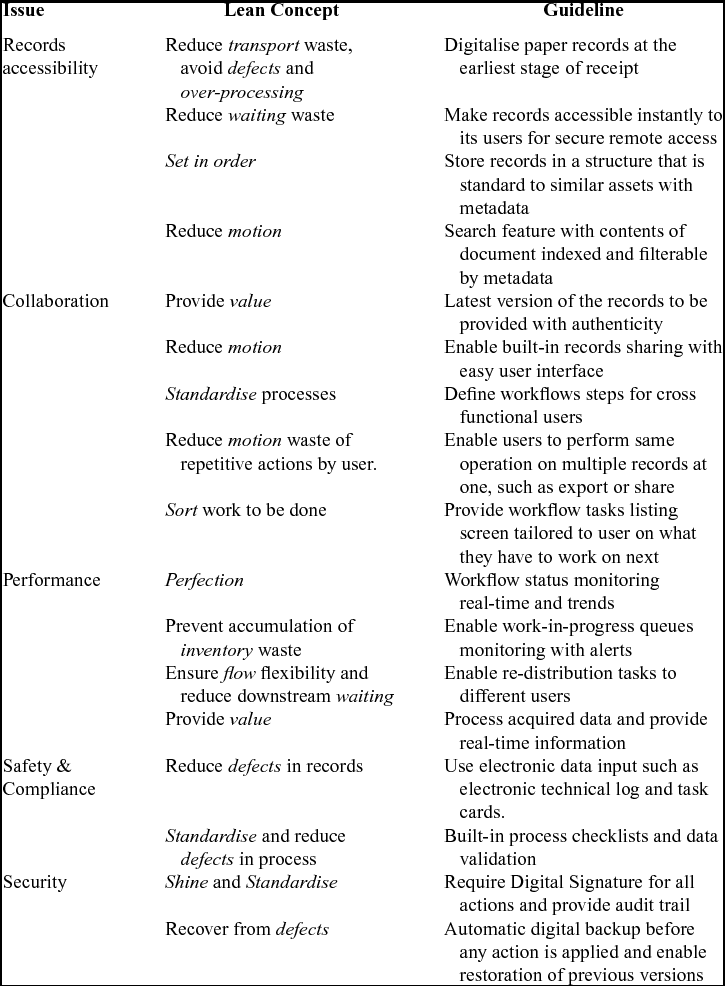
Thus far, the previous sections discuss the application of Lean concepts to airworthiness management, specifically the aspects of airworthiness records management; they are summarised in Table 1.
Lean concepts application on airworthiness records management

The effectiveness of the guidelines discussed for application of Lean concepts with a software-based airworthiness records system can be further understood by considering its implementation in airworthiness review process as an example. Airworthiness review process for an aircraft is to be carried out periodically to ensure the validity of an aircraft airworthiness. Part of the airworthiness review process is a documents review of multiple aircraft records(12), such as the list of deferred defects, work packages, modification and service-bulletin status, list of service life-limited components etc. The requirement for this process could include 15 categories of documents(12). These documents are prepared and reviewed by multiple groups within a continuing airworthiness management organisation before it is submitted to airworthiness review staff. As it is a process that involves collaboration across multiple departments, there is an opportunity to improve the flow of documents and reduce communication overheads.
In a traditional work environment which does not utilise purpose-designed workflow tools, handling multiple airworthiness review projects at the same time involves communication and work processes that are cumbersome; such as email follow-ups, phone calls and miscommunication. This can be replaced with a software-based workflow system.
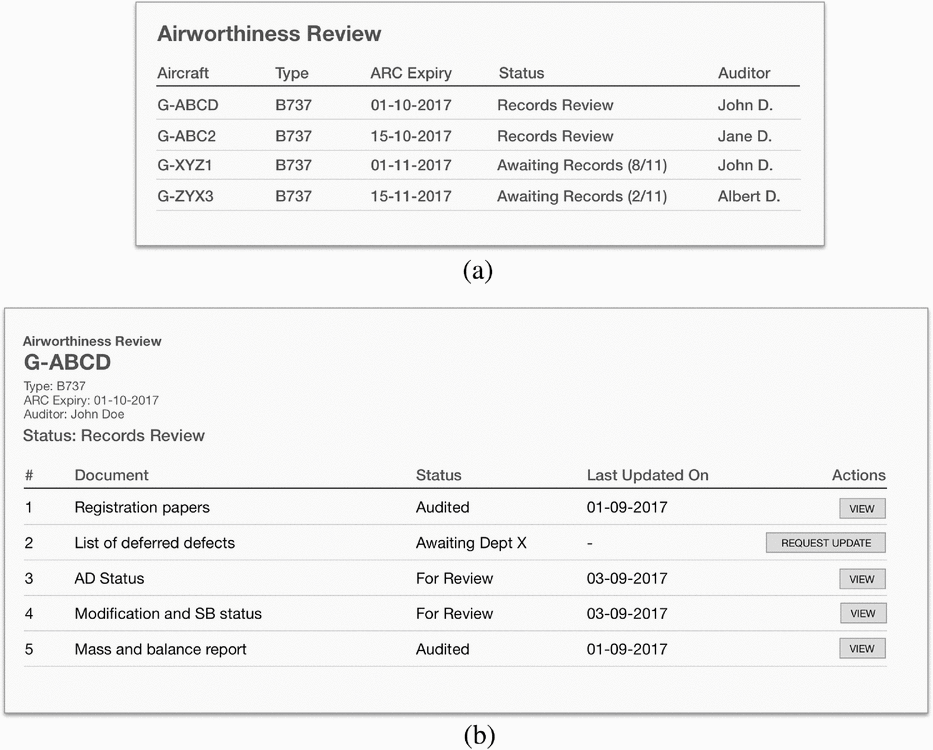
As illustrated in Fig. 1, airworthiness review staff can see the on-going review projects and their real-time status with ease. Firstly, new review projects for another aircraft can be initiated with a couple of clicks and secondly, a new project is created based on the list of documents requirements for this process defined in this system. The process is standardised and the repeated motion of specifying the same list repeatedly is avoided. The requirement for each document from their respective department is added to their queue, this is an apt instance of Lean principle pull being applied. Furthermore, the status of each document requirement is displayed to the airworthiness review staff, where they can be reviewed and feedback provided to the originator if required.
Example (a) list of airworthiness review projects in progress, selecting an item from the list opens (b) detail view of records list for airworthiness review project.

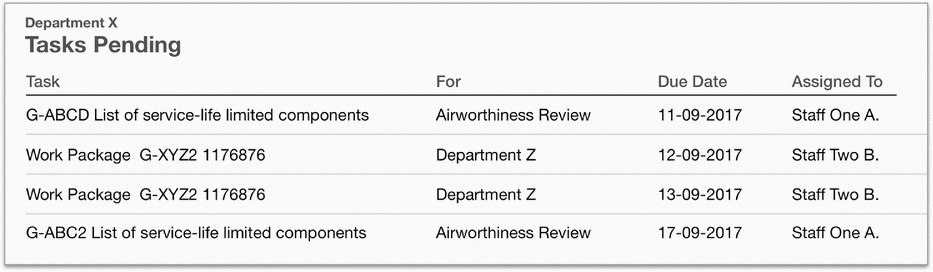
The departments involved in providing the necessary documents has various other functions and tasks to be completed for various other customers as well. When the process is initiated, the task for specific document requirement in this airworthiness review project is added to the department's task list with specific due date, as seen in Fig. 2. The tasks can now be allocated within the department to specific personnel and status can be tracked. This aids in viewing the pending work and planning resources accordingly. The system can also automatically alert when the task is closer to the due date or past its due date.
Example list of tasks assigned to a department.

Further benefits can be achieved by using digital signatures for the documents being submitted. This will help to ensure that latest review copy is available at all times to airworthiness review staff without the additional overheads of printing, physical transport of paper copies. With seamless integration of the workflow system into airworthiness review process or other such document related process, employees can focus on the core competencies, collaborate easily and spend less time on dealing with communication overheads. The metadata regarding workflow activities can be used as performance indicators and further aid continuous improvement activities.
4.0 CONCLUSION
Perceived lack of tangible benefits and the assumption that many processes are at its optimum efficiency are challenges to introducing Lean(Reference Melton13). By digitalising the airworthiness management process, document-based business process can be made efficient by reduction of wastes associated with physical documents. Utilising a system with workflow management and real-time data flow makes the exchange of information more efficient, improves accountability and transparency. Such a software system with Lean philosophy adopted for its design and implementation would allow proper handling of records, reduced human errors, improved compliance, safety and productivity through an intuitive interface and clearer task allocations. With the implementation of software systems with appropriate instrumentation for performance monitoring and logging, organisations will have the resources to analyse the airworthiness management processes and improve them using performance indicators to identify process inefficiencies at a larger scale. As information is being generated and stored in an electronic state they can be made available to other systems via open data exchange standards. Information which would have otherwise been limited to silos can be utilised by software systems in other domains such as business intelligence, machine learning, and predictive analytics and open up opportunities for further cost and safety benefits.