


INTRODUCTION
Toxoplasma gondii is a worldwide protozoan that causes benign and self-limited disease in immunocompetent individuals infected after birth, but severe complications in immunocompromised individuals or in cases of congenital infection. The infected newborns can manifest a wide range of symptoms depending on the gestational age, parasite load, parasite strain, and immunological status of both mother and fetus [Reference Remington, Remington and Klein1].
The prevalence of congenital toxoplasmosis (CT) in humans ranges across regions and according to a number of factors, such as: number of susceptible pregnant women, parasite presence and persistence in the environment, cultural habits, food preparation and cooking practices, as well as sanitary practices [Reference Petersen2]. In Europe, high prevalence of the disease has been usually associated with the ingestion of raw or under-cooked meat. In Central America and other developing countries, including Brazil, infection is usually associated with ingestion of oocysts and particularly affects young, poorly educated people living under low socioeconomic conditions. However, low levels of education and low socioeconomic conditions are presumably inter-related and possibly associated with other risk factors [Reference Bahia-Oliveira3].
It is well known that determinants based on individual measurements are insufficient to explain the distribution of diseases affecting populations [Reference Proietti4]. This implies that it is necessary to analyse a wide range of risk factors associated with toxoplasmosis, including biological specificities, lifestyles, as well as socioeconomic and demographic characteristics of the surrounding environment. Ecological studies make use of aggregated data, assuming a given geographical region as the smallest unit of analysis. This type of study can reveal highly predictive demographic, socioeconomic and environmental risk factors associated with the diseases, as people within a community tend to gather together in a systematic way and be influenced by their local environment [Reference Elliott and Wartenberg5]. With regard to toxoplasmosis, the sources of infection are numerous and range according to region. In such cases, ecological studies can be very informative.
In November 2006 a multidisciplinary research group (UFMG Congenital Toxoplasmosis Brazilian Group) started a survey named ‘Newborn Screening of Congenital Toxoplasmosis in the State of Minas Gerais'. Under the coordination of one of the authors of this paper (G.M.Q.-A.), the research group found high prevalence of the disease in the state [Reference Vasconcelos-Santos6]. This result motivated the present study, aimed at assessing the distribution of CT in the state of Minas Gerais, and describing the demographic and socioeconomic profiles of the municipalities associated with the occurrence of the disease.
METHODS
Design
This is an ecological study using the prevalence of CT in municipalities in the state of Minas Gerais as an outcome variable and municipal demographic and socioeconomic characteristics as explanatory variables.
Study setting
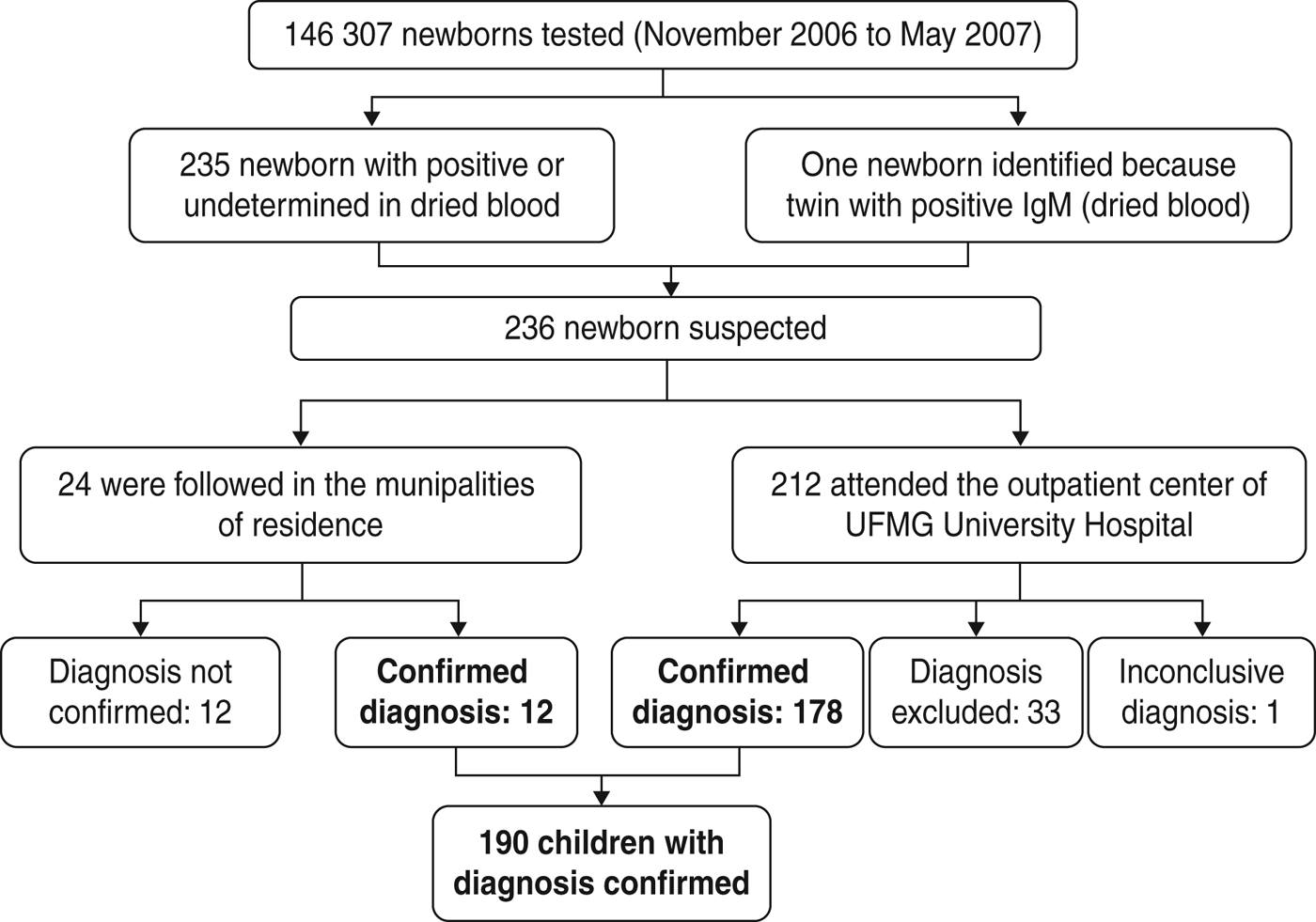
Minas Gerais is a southeastern state in Brazil, comprising 853 municipalities with a total of 19 497 330 inhabitants spread over an area of 586 520 km2 [7]. According to a very recent review about the burden of toxoplasmosis in Brazil [Reference Dubey8], the most accurate estimate on CT prevalence was provided by a study conducted in Minas Gerais by our group. A total of 146 307 live newborns were screened from 1 November 2006 to 31 May 2007, within the scope of the Minas Gerais State Programme of Newborn Screening (PETN-MG). CT was confirmed in 190 children corresponding to a prevalence of 1·3/1000 live births [Reference Vasconcelos-Santos6]. At the time of the study, this programme regularly provided free testing for four diseases (i.e. congenital hypothyroidism, sickle cell disease, phenylketonuria, cystic fibrosis) and covered about 95% of the live newborns in the state. The programme is coordinated by the Center for Newborn Screening and Genetic Diagnosis, a research centre of the School of Medicine at the Federal University of Minas Gerais (UFMG; Portuguese acronym) [9].
Diagnosis of CT
Under parental consent all live newborn infants participating in PETN-MG in the period under scrutiny had dried blood samples collected on filter paper for analysis of anti-T. gondii IgM (Toxo IgM Q-Preven®, Symbiosis, Brazil). Infants with positive or undetermined results were tested with anti-T. gondii IgA (enzyme-linked immunosorbent assay) and with anti-T. gondii IgG and IgM (enzyme-linked fluorometric assay, bioMérieux SA, France), and their results were further compared with their mothers. The infants were also followed up in the outpatient units of UFMG University Hospital until diagnosis confirmation. The data relating to infants followed up in their home municipalities (7%) were later forwarded from the clinics to the research group.
The criteria for confirmed CT were: (1) positive anti-T. gondii IgM and/or IgA and positive IgG up to age 6 months; (2) negative anti-T. gondii IgM/IgA and positive IgG associated with retinochoroidal lesions within the first 3 months of life; (3) persistence of positive anti-T. gondii IgG results up to age 12 months.
All confirmed cases of CT were included in the study (Fig. 1). The UFMG Review Board Committee gave approval for the study (ETIC 510/07).
Flowchart of the serological survey of congenital toxoplasmosis conducted in the state of Minas Gerais, Brazil.
Demographic and socioeconomic profile of the municipalities
Minas Gerais, the fourth largest state in Brazil, has the third largest gross domestic product (GDP) of the country, but is hampered by stressed socioeconomic and geographical heterogeneity [10].
In order to verify the possible association of CT in Minas Gerais with socioeconomic indicators, a preliminary analysis was performed using the human development index (HDI). We found that toxoplasmosis was more prevalent in municipalities with the worst performance in global HDI and its components – life expectancy, literacy and educational attainment, and per capita GDP.
Based on these findings, we opted to assess the vulnerability to CT in the socioeconomic sphere of municipalities of Minas Gerais, using indicators built on the 2006 software package Minas Gerais State Index of Social Responsibility (MGSSRI) [11], which consists of a database developed by the Centre for Public Policy Studies at Fundação João Pinheiro with a view to depicting the level of development of the municipalities in the state. The software package includes 47 social, administration and health indicators of all 853 municipalities in the state. These indicators were converted into indexes, considering the standards of weights and references, resulting in values from 0 to 1, where they represent, respectively, the worst and best situation of the municipality in relation to the indicator. The indexes were grouped in seven dimensions that constitute the synthetic global index (global MGSSRI): healthcare; educational attainment; housing and environment; employment and income; culture, sports and leisure; public security; and financial performance. The issues selected to constitute the dimensions represent both municipality conditions and public administration [11].
The demographic data correspond to the census carried out by the Brazilian Institute of Geography and Statistics (IBGE) in 2000 [7].
Statistical analysis
To analyse the correlation between prevalence of CT and municipality performance as measured through the MGSSRI indexes, Spearman's correlation coefficient was used for those municipalities with at least one case of the disease. As the response variable, prevalence of CT, represents a count in a given time-frame, Poisson's regression was regarded as the most adequate model [Reference Böhning, Dietz, Schlattmann, Rost and Langeheine12]. Nevertheless, because 712/853 (83·5%) municipalities registered no cases of the disease in the period under scrutiny, there was over-dispersion that violated the assumptions of the Poisson model. Some developments of the Poisson model have been suggested for such circumstances, such as the negative binomial modal or the zero-inflated Poisson model [Reference Faddy13]. The latter is the most adequate for the present study and has been widely reported in the literature as effective in accounting for the distribution of additional zeros [Reference Böhning, Dietz, Schlattmann, Rost and Langeheine12, Reference Faddy13]. The theory suggests that the excess zeros are generated by a separate process from the count values and that the excess zeros can be modelled independently. Thus, the zero-inflated Poisson (ZIP) model has two parts, a Poisson count model and the logit model for predicting excess zeros. Therefore, in fitting the ZIP model, two separate models were generated and then combined. First, a logit model was generated for municipalities with zero prevalence rates, predicting whether or not a municipality would be in this group. Then, a Poisson model was generated to predict the counts for those municipalities with no zero prevalence rates. Finally, the two models were combined. This model is performed by the command ‘ZIP’ of the statistical package Stata v. 10.0 [14].
Therefore, the ZIP model was used as a means of including all municipalities for univariate and multivariate analyses. For multivariate analysis, we included variables with P ⩽0·20 in the univariate analysis, adopting a model in blocks, with the construction of models for the items of each of the seven dimensions separately. Significant variables were entered one by one, according to the ‘forward’ criterion. After adjusting the seven models, a multivariate analysis was performed with new input variables in a hierarchical way. The order in which groups were defined by the significance of each dimension on the MGSSRI in the univariate analysis were: (1) culture, sports, and leisure; (2) public security; (3) employment and income; (4) housing and environment; (5) financial performance of municipalities; (6) educational attainment; and (7) health.
The final model was adjusted according to municipality population, given the strong association of this variable with the response variable and the other explanatory variables. The final model included only the variables significant at P ⩽0·05, and quality of fit was assessed through deviance [Reference Böhning, Dietz, Schlattmann, Rost and Langeheine12].
The software package MapInfo 8·5 was used to build a choropleth map with the prevalence distribution of CT over the state of Minas Gerais. Both univariate and multivariate analyses were run by statistical software package Stata v. 10.0.
RESULTS
Toxoplasmosis distribution over the state of Minas Gerais
The overall prevalence of CT in Minas Gerais state of 1·3/1000, ranged from 0·78 to 2·77 by 13 macro-region divisions (Fig. 2) and from 0 to 76·9/1000 according to the 853 municipalities. Figure 3 a shows the distribution of CT in the municipalities of Minas Gerais according to quartiles of prevalence, and Figure 3 b shows the performance of municipalities in quartiles of MGSSRI. When stratifying the municipalities according to the number of inhabitants, it was observed that the prevalence increased as the population declined, reaching 1·9/1000 live births in municipalities with <20 000 inhabitants (Table 1).
Map showing the prevalence of congenital toxoplasmosis (per 1000 live births), determined from November 2006 to May 2007 by screening of newborn infants, over the macro-regions of Minas Gerais, Brazil.

Choropleth map showing (a) the prevalence distribution of congenital toxoplasmosis over the 853 municipalities in the state of Minas Gerais, Brazil, from November 2006 to May 2007 and (b) the global indexes of the municipalities.

Prevalence of congenital toxoplasmosis (CT) in the state of Minas Gerais from November 2006 to May 2007 stratified according to municipality population as IBGE census, reference year 2000
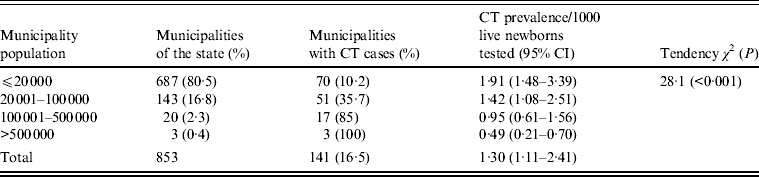
CI, Confidence interval.
Correlation of prevalence of CT with demographic and socioeconomic characteristics of the municipalities
The prevalence of CT correlated inversely with the global MGSSRI, i.e. highest rates were found in the municipalities with the worst performance. Concerning the dimensions that compound the global MGSSRI, the correlation was direct only for ‘public security’, i.e. highest rates of CT were found in the municipalities with better performance. An inverse correlation was found for others dimensions such as: ‘educational attainment’, ‘employment and income’, ‘housing and environment’, ‘culture, sports and leisure’, and ‘financial performance of municipalities'. No correlation was found for the health dimension. Considering the indexes of dimensions, several correlations were observed with prevalence of toxoplasmosis in the municipalities (Table 2).
Univariate analysis to assess the correlation between prevalence of congenital toxoplasmosis in the state of Minas Gerais from November 2006 to May 2007 and the socioeconomic and demographic characteristics of the municipalities
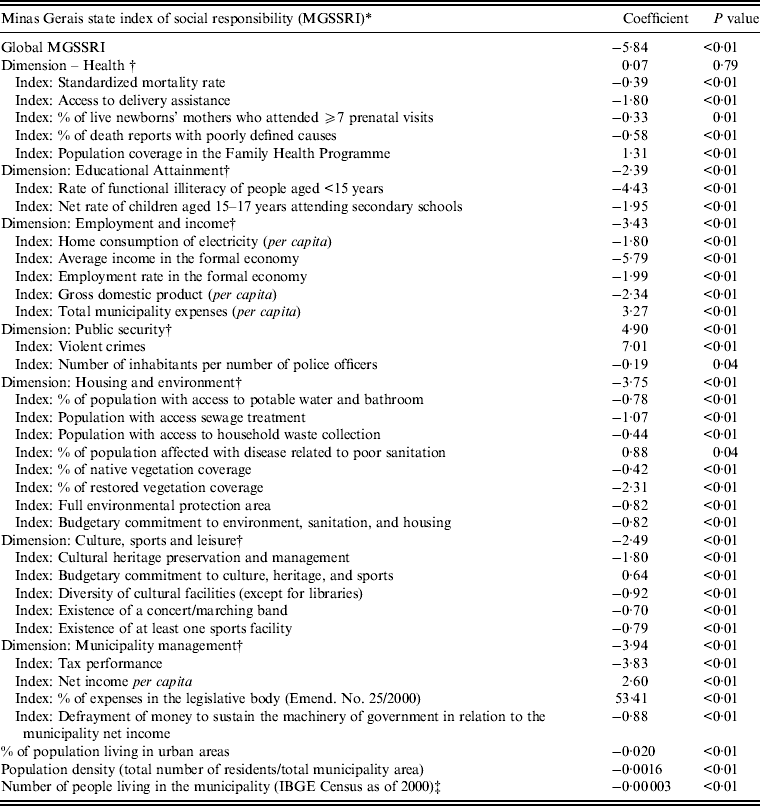
* Indexes vary from 0 to 1, with closeness to 1 indicating the better situation of the municipality in relation to the indicator.
† The following indexes were not statistically significant: Coverage of tetravalent vaccine in infants aged <1 year; net rate of children aged 7–14 years attending primary schools; education quality index; investment efforts; area for sustainable use; expenses per capita on environment, sanitation and housing in the municipality; rate of public debt; and percentage of expenses on public servants.
‡ IBGE (Brazilian Institute of Geography and Statistics) (http://www.ibge.gov.br/home/estatistica/populacao/censo2000/defaulttabmunic.shtm).
A multivariate analysis performed to model the nature of the several correlations observed, resulted in a final model with nine parameters (Table 3). The parsimonious final model showed a good fitness with a deviance test (P = 0·999).
Description of variables associated with prevalence of congenital toxoplasmosis in the municipalities of Minas Gerais from November 2006 to May 2006 that remained in the final model after the multivariate analysis
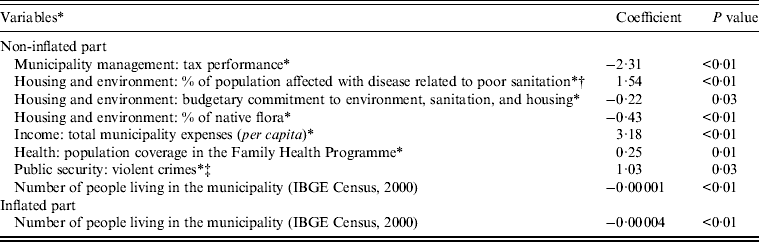
* Indexes vary from 0 to 1, with 0 being the worst and 1 being the best situation of the municipality concerning the indicator.
† The higher the index, the lower the percentage of population affected with disease related to poor sanitation.
‡ The higher the index, the lower the rate of violent crimes.
P value in deviance test = 0·998.
To assess the correlation between the variable municipality population and the others that remained in the final model, the municipalities were categorized in four strata according to the number of inhabitants. The strata with the more populous municipalities tended to have better mean values for the indexes ‘tax performance’, but worse mean values for the indexes ‘violent crimes' (data not shown).
DISCUSSION
The prevalence of CT in the state of Minas Gerais was high, and was higher in municipalities with worse indexes of economic development. Despite several ecological studies showing associations between infectious disease and local vulnerability indexes [Reference de Mattos Almeida15, Reference Ribeiro16], no study has, to the best of our knowledge, investigated the association between prevalence of CT and socioeconomic indexes at an ecological level.
The variables associated with the prevalence of congenital disease that remained in the final model can be analysed from two perspectives. First, from the perspective of the association between the indexes and the parasite transmission cycle, as evident in the municipality variables. The percentage of population affected with disease was related to poor sanitation. Second, from the perspective of the indexes that reflect the socioeconomic disadvantages of the municipalities and inequalities of access to healthcare services. However, inter-relationship should be assumed in all variables.
Poor housing and sanitation conditions expose the population to several infectious diseases, including toxoplasmosis [Reference Bahia-Oliveira3]. In Natal, capital of the state of Rio Grande do Norte, Brazil, a study conducted to assess risk factors associated with toxoplasmosis in students at public and private schools from ages 5–21 years revealed a higher rate of seropositivity in those living in areas without access to treated water and sewage [Reference de Amorim Garcia17]. In the present study, the univariate analysis indicated higher prevalence of CT in municipalities with poorer access to treated water, sewage and garbage collection services. The multivariate analysis indicated higher prevalence of CT in the municipalities with a lower budgetary commitment to environment, sanitation and housing, which suggests low investment in this area.
Notwithstanding that toxoplasmosis is a disease able to be transmitted through ingestion of contaminated water, and whose transmission is facilitated by poor hygiene [Reference Bahia-Oliveira3], the present study highlighted its highest prevalence in municipalities with a better performance in the index ‘percentage of population affected with diseases related to poor sanitation’. This indicator measures the percentage of hospitalizations due these diseases [11]. People who live in regions with poorer sanitary infrastructure coexist endemically with several infectious agents, but do not necessarily require hospitalization. This is a possible explanation for the association observed in this study.
Another intriguing result is the higher prevalence of CT in municipalities with smaller native vegetation coverage. A plausible explanation for this association may be that deforestation and demographic expansion could have caused climate change, ecosystem disturbance and eventually promoted adequate conditions for parasite survival and dissemination, as described previously [Reference Meerburg and Kijlstra18]. Although plausible, it is far from the scope of this work. We understand that this hypothesis should be explored in other studies with designs better suited to answer this question.
We found a higher prevalence of toxoplasmosis in municipalities with poor access to prenatal care and delivery assistance, which once again suggests negligence in providing basic health services to the population. This finding is especially relevant, because prenatal care is a valuable opportunity for educative actions aimed at the prevention of health problems both to the pregnant women and their fetus. The literature has strong evidence that providing adequate guidance to pregnant women is a crucial prophylactic measure against CT [Reference Pawlowski19, Reference Breugelmans, Naessens and Foulon20].
To understand the finding of higher prevalence of CT in municipalities with larger coverage in the Family Health Programme, it might be necessary to understand the implementation background of this programme in Brazil. The programme began in 1994, financing preferentially the small municipalities with lower income and higher epidemiological and social risk. The expansion of the programme to municipalities with >100 inhabitants started in 2003, and the programme is still developing in large urban centres [Reference de Sousa and Hamann21]. Consequently, the higher prevalence of CT in municipalities with larger coverage of the Family Health Programme – which has historically catered for the more vulnerable groups – may be the reflection of the reverse causality underlying the cross-sectional nature of this study design.
With regard to the indexes related to the economic conditions of the municipalities, the univariate analysis indicated higher prevalence of the disease in those municipalities with lower average income, lower formal employment rates, and lower GDP. The final model pointed to higher prevalence of the disease in the municipalities with worse tax performance. This index is calculated by the sum of municipal revenue (rates, taxes, and contributions for improvements) with the value-added tax on sales and services transferred to municipalities by the state using two criteria: (1) proactive criteria – actions directed to public policies in education, health, environment, etc., and (2) reactive criteria – minimum quota, regardless of the proactive criteria. The higher the index the greater is the municipality development and public administrative capacity to manage its financial activities and revenues [11]. The higher prevalence of CT in municipalities with worse tax performance corroborates the results of other studies that also found an association – at the individual level – between toxoplasmosis seropositivity and poor socioeconomic conditions [Reference Bahia-Oliveira3, Reference de Amorim Garcia17, Reference Lopes22]. For instance, in the municipality of Londrina, state of Paraná, a study of 489 pregnant women showed that women with T. gondii antibodies were usually from the lower income group [Reference Lopes22]. Bahia-Oliveira et al. found that the best predictor for toxoplasma seropositivity in the 1436 people tested was ‘worst socioeconomic situation’, even after adjustment for participants' age [Reference Bahia-Oliveira3].
Total municipality expenses per capita correlated with prevalence of toxoplasmosis positively. This result attracted attention because the biggest expense observed was not accompanied by satisfactory results neither in those indexes concerning the quality of the services provided in the municipalities nor in the global MGSSRI index. Studies conducted to assess municipality administration of public resources have proved that efficient administration is not necessarily associated with large expense, but the adequate use of resources [Reference Rezende, Slomski and Corrar23–Reference Vieira and Zucchi25]. Similar to the situation in the state of Minas Gerais, Rezende et al. did not find direct correlation between investment and HDI in the 503 municipalities they assessed in the state of São Paulo [Reference Rezende, Slomski and Corrar23].
Initially, the finding of higher prevalence of CT in municipalities with better performance in the index of violent crimes contrasts with the above-mentioned results, as the literature has consistently reported the association with criminality, violence, social disorganization, and poverty [Reference Szwarcwald26–Reference Caiaffa28]. However, in relation to criminality, it is known that, social inequality contributes more than poverty to the growth of criminality in a community. Therefore, even though we found a higher prevalence of CT in smaller municipalities with lower levels of human development, they also had less inequality than the large urban centres, and consequently lower rates of criminality. Indeed, the variable ‘violent crimes' in the univariate analysis showed a coefficient of 7·01, which fell to 1·04 after multivariate analysis adjustment that included population size. This finding suggests the presence of a residual confounding because the population size does not cover the extent of poverty and inequalities in cities. An ecological study performed to identify the determinants of criminality in the municipalities in the state of Minas Gerais indicated higher rates of violent crimes in the most populous municipalities with better human development indexes, probably because of social inequality [Reference Beato29].
Several studies have shown an association between toxoplasmosis and mothers' level of education at the individual level [Reference de Amorim Garcia17, Reference Jones30, Reference Barbosa, de Carvalho Xavier Holanda and de Andrade-Neto31]. In the state of Minas Gerais higher prevalence of CT was found in the municipalities with worst performance in the educational attainment dimension and some of its indexes. Nevertheless, this and other important epidemiological variables were not influential in the multivariate model.
In 2008 Brazil hosted a world meeting to celebrate the 100th anniversary of the discovery of T. gondii. Parallel to the advances in biological, genetical and immunological research, have been the highlighting of gaps in the areas of prevention and treatment of CT, which has been systematically underestimated in relation to the disability-adjusted life years (DALYs), and which should be included in the list of neglected diseases. From this conference a letter was drafted by a group of professionals dedicated to the study of disease, containing a proposal for the control of toxoplasmosis in Brazil and suggesting the inclusion of toxoplasmosis in the list of neglected diseases in that country [32].
The World Health Organization (WHO) classifies diseases as neglected when they are prevalent in unprivileged people who have little political expression and priority in public health actions [Reference Morel33]. In September 2000 the United Nations members agreed on the Millennium Development Goals (MDG) Declaration, which gave a commitment to have extreme poverty eradicated by 2015 [34]. Following suit, the Pan American Health Organization Board issued a resolution in 2009 extending this commitment specifically to the eradication of neglected diseases [35]. One decade after the MDG declaration, a preliminary report on neglected tropical diseases estimated that 149 countries are endemically affected with such diseases. Currently, there is an international alliance (Global Network for Neglected Tropical Diseases) and a specific department within the WHO that is specifically engaged in solving the problems related to such diseases [36, Reference Feasey37].
The WHO and the Doctors without Borders have recently proposed a new classification categorizing the neglected tropical diseases as ‘global’ when they affect the world as whole; ‘neglected’ when they are more prevalent in developing countries, and ‘more neglected’ when they are exclusive of developing countries [Reference Morel33]. The neglected diseases are more common in underprivileged groups and affect children's growth, undermining their productive capacity and maintaining the cycle of both poverty and infection [Reference Hotez38]. Hotez and colleagues have published a series of papers analysing the geographical distribution of the major neglected infectious diseases worldwide and emphasized the economic burden of such diseases in the countries where they are prevalent [Reference Hotez38–Reference Hotez and Gurwith40]. Of such diseases, these authors particularly highlighted the congenital infections because of their potential to lead to cognitive, hearing and ophthalmological disorders in the long term. CT was particularly found to prevail in the poorest and most segregated groups living in regions of the Mississippi Delta, South America, Mexico–USA border and Central and Eastern Europe [Reference Hotez38, Reference Hotez and Gurwith40].
According to the results reported herein, CT is a neglected disease in the state of Minas Gerais, as the prevalence of the infection is high and usually affects municipalities with poorer MGSSRI indexes, i.e. municipalities with higher social and economic vulnerability. We understand that the findings cannot be derived at the individual level, but point to the need of testing further hypothesis taking into account both individual and contextual hierarchical levels.
Some limitations of the present study should be noted. The first refers to the unit of analysis. Although the municipalities in general had some characteristics associated with more or less occurrence of toxoplasmosis, they do have internal heterogeneity that could not be captured in this study given its ecological design. However, this type of study is valid and crucial to assess the impact of environmental, demographic and socioeconomic determinants on how the population is likely to become ill [Reference Proietti4].
Moreover, the database used for characterizing the municipalities, the MGSSRI index, was not originally created to measure risk factors related to the occurrence of any disease, infectious or not. The process of determining the indexes involved a number of management records of city halls with different levels of organization and therefore subject to inaccuracy [11]. Although acknowledging this limitation in the use of a public database, the MGSSRI index was used with the intent of approaching, as much as possible, the determinants under scrutiny with the actual conditions of the municipalities in the state of Minas Gerais. The year 2006 was chosen because that was the year when the serological survey took place, and the 2000 Census was chosen because it was the only demographic data available at the time of data analysis.
Despite the limitations outlined herein, the study shows the highest prevalence of CT in the municipalities for which the MGSSRI index attests the worst life conditions. This suggests that policies should aim at human and socioeconomic development as a means of reducing the prevalence of the disease. The results also point to the need of broadening the surveillance system for this disease and to the importance of further studies focusing on both individual and contextual risk factors associated with the distribution of CT in the state of Minas Gerais.
APPENDIX
UFMG Congenital Toxoplasmosis Brazilian Group (UFMGCTBG)
Daniel Vitor Vasconcelos-Santos, MD, PhD; Danuza O. Machado Azevedo, MD, PhD; Wesley R. Campos, MD, PhD; Fernando Oréfice, MD, PhD; Gláucia M. Queiroz-Andrade, MD, PhD; Ericka V. Machado Carellos, MD, MSc; Roberta M. Castro Romanelli, MD, PhD; José Nélio Januário, MD, MSc; Luciana Macedo Resende, MSc; Olindo Assis Martins-Filho, MSc, PhD; Ana Carolina de Aguiar Vasconcelos Carneiro, MSc; Ricardo W. Almeida Vitor, MSc, PhD; Waleska Teixeira Caiaffa, MPH, PhD.
ACKNOWLEDGEMENTS
The authors are particularly grateful to the Center for Newborn Screening and Genetic diagnosis (NUPAD), School of Medicine, Universidade Federal de Minas Gerais (UFMG), Observatório de Saúde Urbana de Belo Horizonte (OSUBH–FM/UFMG). W.T.C. has been awarded productivity research grants from the Brazilian National Council for Scientific and Technological Development (CNPq).
This work was supported by grants from Fundação de Amparo à Pesquisa do Estado de Minas Gerais (FAPEMIG, No. APQ-00 058-09), and by the Secretaria do Estado de Saúde de Minas Gerais, Brazil.
DECLARATION OF INTEREST
None.



