Kwa kujenga amani, inabidi kujua vita
(To build peace, one must understand war)
—Congolese maximIn the past decade alone, many seemingly concluded conflicts have fallen back into patterns of cyclical violence and civil war. Renewed fighting has overshadowed reconstruction and peace-building efforts in countries as diverse as Afghanistan, Burundi, East Timor, Iraq, and South Sudan. In the Democratic Republic of Congo (DR Congo), the provincial capital of Goma in the country's North Kivu province fell under the control of insurgent forces in November 2012. The city's occupation was the fourth in the country's recent history, and the second since a peace accord officially ended the war in 2003. DR Congo is not unique. Countries that experienced civil wars in the second half of the twentieth century were almost twice as likely as their counterparts to experience violence, provoking some to declare civil war a chronic condition.Footnote 1 In some of these contexts, hostilities resumed despite billions of dollars in postconflict development aid and sometimes years of institution building by international actors.
Why have institution-building efforts supported and promoted by the international community so frequently failed to produce robust institutions that can deter and withstand resurgent conflict? Extant theory predicts that peace breaks down because wartime adversaries cannot credibly commit to lay down arms.Footnote 2 In theory, at least, stable and impartial institutions help overcome commitment problems by reducing uncertainty in inherently uncertain environments.Footnote 3 This logic guides the funding priorities of global donors and policy-makers in weak and conflict-prone states. Yet, despite vast sums of money spent worldwide, the relationship between warring factions and postconflict institutions remains strikingly underexplored.
I argue that institution-building projects in fragile states can be limited in their ability to contribute to durable peace because, rather than reducing uncertainty as intended, they can offer warring factions new venues for consolidating military and political power. Since the concerns of wartime elites in the postconflict period often resemble the concerns that motivated their behavior during conflict, elites are incentivized to subvert postconflict institutions for strategic or conflict-related ends. Where such incentives persist, institution-building programs have the potential to exacerbate rather than stave off conflict-related insecurity. I show that postconflict institutions promoted by international stakeholders—for instance, bolstering rule-of-law infrastructure to prosecute perpetrators of wartime violence—present opportunities for armed factions to further their political, economic, and military agendas behind the scenes while maintaining the outward appearance of cooperating with peace-building efforts for the benefit of domestic and international audiences. Institutions have thus offered new arenas for elites to maximize positions of political advantage, thereby eroding rather than fostering conditions of trust.Footnote 4 These dynamics shed light on why institution-building projects specifically designed to overcome commitment problems in the aftermath of intractable violence so often prove incapable of or even detrimental to doing so.
To elucidate the complex relationships between conflict-era dynamics, postconflict institutions, and prospects for resurgent violence, I present findings from a qualitative research project in a single geographical case: eastern DR Congo. The backstage nature of much political interaction necessitated an in-depth examination of the micro-dynamics of elite behaviour.Footnote 5 Eastern DR Congo offered a useful site for scrutinizing these relationships since institutional reform has been at the forefront of international efforts to end the conflict.
I undertook a detailed analysis of which rule-of-law programs were successfully implemented and which fell by the wayside. I found that rule-of-law projects were typically stymied when they threatened the conflict-era interests of powerful wartime elites who subsequently withdrew their cooperation. Accountability efforts were successful, on the other hand, when they served to advance the strategic military interests of elites or when elites could utilize institutional platforms to pursue pre-existing conflict-related agendas. When wartime elites co-opt postconflict institutions in these ways, their capacity to contribute to durable peace may be compromised.
This research thus demonstrates that international efforts to stave off resurgent violence through institutional reform not only tend to overlook local dynamics of conflict as Autesserre, Englebert and Tull, and others have observed but, in doing so, can also entrench and reproduce conflict-era fissures.Footnote 6 To date, policy-makers have largely failed to recognize these trends, which have a number of important implications for the broader study of peace and conflict.
First, through a micro-analysis of the behavior of wartime elites vis-à-vis postconflict institutions, this article advances the field's empirical and theoretical knowledge of the complex and multidimensional ways in which contemporary civil conflicts are fought. With notable recent exceptions,Footnote 7 the literature on civil conflict resurgence has traditionally assumed that the key choices facing armed groups in the aftermath of war are cooperation or defection. This assumption obscures the multi-layered calculations made by elites and armed groups that shape the viability of postconflict peace. Rather than choosing dichotomously between honoring or spoiling negotiations, this analysis reveals that elites often opt for a third way, preserving the outward appearance of cooperation with international peace-building while working behind the scenes to consolidate local fiefdoms and, in some cases, readying themselves for an imminent return to war.Footnote 8
Second, the research underscores the need to consider intra- as well as intergroup dynamics when examining calculations made by armed factions in the aftermath of conflict. Rather than treating armed groups as unitary actors engaging in internally consistent decision-making processes, this study emphasizes the need to disaggregate the interests of individual decision makers.Footnote 9 Civil conflicts increasingly involve myriad stakeholders with diverse and often competing preferences, interests, and agendas. Sometimes elite interests cohere with the interests of the group they are affiliated with but at other times they diverge in significant ways.Footnote 10 Importantly, influential elites are not only concerned with maximizing the survival and influence of their unit, but also with maximizing their own personal survival—within their armed unit and externally, and under conditions of continued peace or a return to war.Footnote 11 The ways that threats to personal or intra-group survival structure the strategic calculations of decision-making elites in conflict and postconflict periods colors how we approach commitments to peace by respective parties to the conflict.
Finally, the research warns against taking the apparent successes of postconflict peace-building initiatives at face value. While it remains tempting to celebrate incremental advances toward peace and justice, scholars and practitioners should be wary of institutional reforms that are too readily embraced by warring factions. In scrutinizing the underlying dynamics of local power that motivate elites to support specific peace-building projects, as well as examining why projects are implemented with varying levels of resistance, we become better placed to identify exercises in political maneuvering. These factors help us to evaluate the potential for postconflict institutions to contribute to their stated objectives.
The Postconflict Peace
Resolving Civil Conflict in the Midst of Uncertainty
One of the major obstacles to durable peace in the aftermath of armed conflict involves a security dilemma wherein the major parties to the conflict cannot credibly ensure that opposing sides will honor the agreements they have committed to.Footnote 12 This commitment problem poses a considerable challenge—both to ending civil wars in the first instance and to sustaining peace once ceasefires have been reached. This is because, at precisely the time when there are no independent or stable institutions to ensure contract enforcement or implementation, adversaries are asked to enter into high-risk agreements that require they disarm and demobilize.Footnote 13 Negotiations often fail because parties to the conflict cannot credibly commit to abide by the high-risk terms often demanded of them.
Commitment problems are most pronounced in environments of fragmented authority, where no side decisively destroys the combat capacity of any other, or where organizational autonomy remains intact after the conflict's apparent cessation.Footnote 14 It is in these cases—most common in contexts of negotiated settlements or marginal victories—that risks of defection remain high and incentives to renege on the terms of the peace remain strongest.
Scholars theorize that the specific institutional arrangements of peacekeeping agreements,Footnote 15 combined with third-party monitoring,Footnote 16 can be crucial for reducing incentives to return to violence. Firmly institutionalized settlements overcome a variety of distinct security concerns: they share power to prevent spoilers from gaining exclusive control of economic resources or the coercive apparatus of the new state; they create formal avenues for resolving grievances to avoid resorting to violence; and they incentivize actors to comply with new rules by institutionalizing sanctions for transgressions. By the same logic, efforts to build the rule of law prove critical for transforming the postconflict landscape from an environment of so-called anarchy to one of predictable rule-governed behavior.Footnote 17 While much of the literature on firmly institutionalized civil war settlements focuses on the specific terms of peace agreements, investment in the rule of law is equally crucial for strengthening the credibility of any period of peace.
This logic has guided the funding priorities of global donors in many postconflict states. Both academic and policy circles have linked building a robust rule of law in the aftermath of conflict to the reduced likelihood of further violence.Footnote 18 Proponents of legal reform emphasize the potential for legal institutions to teach elites and masses that the appropriate means of resolving conflict is through formal legal channels rather than through violence. Moreover, robust and impartial institutions, firmly grounded in a strong rule of law, reduce overall uncertainty in the postconflict period by institutionalizing sanctions—potentially in the form of criminal prosecutions—for noncompliance with established rules. Given this, peace agreements reached in environments where the rule of law is strong, or where legal institutions are supported by external stakeholders, should be most effective in bolstering confidence among warring parties.Footnote 19 International donors have thus invested heavily in building legal capacity in postconflict contexts around the world. They train local lawyers, judges, and prosecutors, strengthen legal infrastructure, and support prosecutions against perpetrators of conflict violence.
Given these fairly lofty expectations for institutional reform in postconflict states, close scrutiny of the realities of legal capacity building on the ground is urgently needed. While the theoretical mechanisms motivating rule of law development are clear, the de facto interactions between costly institution-building efforts and potential spoilers in volatile conflict-prone states remain undertheorized in existing literature.
Understanding Elite Behavior During and After Violence
To understand resurgent violence, scholars must take seriously the fact that conflict dynamics can play out across multiple arenas at once and can assume different characters at different points in their life cycles. Ongoing conflictual interactions between groups and elites off the battlefield, as well as deals, collaborations, and negotiations struck in political or economic spheres, form part of conflict and postconflict political orders. These relationships are likely to prevail long after groups have formally disarmed.Footnote 20 Where nascent institutions offer new arenas in which to consolidate the destabilizing power of highly fragmented armed factions, and for disruptive warlords to pursue conflict goals in periods of apparent peace, scholars are forced to reconceptualize the spatial and temporal boundaries of war. It is well-established that contemporary civil conflicts are increasingly characterized by a multitude of predatory or “low-tech” militias operating in environments of extreme state weakness or collapse.Footnote 21 Activities undertaken by armed groups in such settings are far more likely to involve military self-protection, the collection of illicit taxes, and other small-scale struggles over access to land, resources, or personal power than the singular pursuit of a discrete or indivisible policy goal.Footnote 22 In what have been called “symmetric non-conventional civil wars,”Footnote 23 the state's monopoly on violence has typically broken down. Multiple armed contenders for power coexist with one another, and governments prove either unwilling or unable to deploy military force against myriad poorly equipped and disorganized armed factions. Individuals may exploit the fragmentation of political authority to assume control over local politics or lucrative business opportunities through illicit channels. They may exert military force in one realm and coercion or informal negotiation in others. Rather than assuming a sequential relationship that moves from politics to violence,Footnote 24 therefore, we see that violence and nonviolence often co-exist in tandem as part of the broader landscape of postconflict political order. Conflicts may be characterized by indiscriminate shelling at one point in their life cycle and by tacit cooperation at others. Moreover, factions may explicitly collaborate to smuggle or exchange goods, arms, and resources in one sphere while clashing militarily in another.
The confluence of these dynamics leads us to two broad expectations concerning institution building in areas of pervasive uncertainty. First, elites will pursue strategic cooperation across groups, or engage in conflictual or divisive interactions within groups, when such behaviour serves to bolster their individual and/or group survival. Decisions pertaining to inter- and intragroup relationships of cooperation and conflict will depend on the level of internal and external threat posed to an elite's survival and the relative opportunities that arise to advance a particular policy goal or further their position of power.Footnote 25
Second, and relatedly, wartime elites will seek to maximize their conflict-era interests in the postconflict period. They will do so with the goal of maintaining a position of personal and organizational advantage in the case of continued peace or in a return to war. They will use postconflict institutions as new venues through which to realize these goals, while signaling an outward commitment to peace.
This study examined one particular aspect of postconflict institution building deemed essential to long-term peace and stability: efforts to build the rule of law through prosecuting instigators of human rights abuses and conflict-related violence. This gives rise to one further prediction: elites will cooperate with accountability efforts (even against allies, subordinates, or unit peers), and obstruct justice processes against others (even including apparent wartime adversaries), when doing so bolsters their position of individual or organizational advantage. Incentives to cooperate arise when accountability efforts facilitate the removal of a potential challenger, internally or externally, or when an opportunity emerges to broker a mutually productive deal.Footnote 26 Incentives to thwart accountability might arise when a rival faction can offer something valuable in return, when doing so will secure a future military or political ally, when an opportunity to repay a personal or organizational debt emerges with the view to future potential collaboration, or when elites wish to shield and protect valuable subordinates. Such processes fundamentally determine who ends up facing trial for conflict-related violence. These backstage interactions explain why some postconflict peace-building efforts are met with surprisingly little resistance from local elites, even when cooperation appears costly.
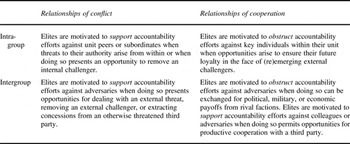
Wartime elites thus support and obstruct investigations in ways that crosscut armed group affiliations when it proves politically or militarily expedient for them to do so. Table 1 depicts two crosscutting dimensions that explain, in general terms, why elites are likely to support postconflict institution-building efforts in some instances and not in others. First, Table 1 presents incentives to advance intragroup interests versus those that advance intergroup interests. Second, it presents dynamics that pertain to relationships of cooperation within and across armed groups versus those that pertain to dynamics of conflict.Footnote 27 Taken together, these two types of relationships elucidate the conditions under which wartime elites can be expected to lend their support to postconflict accountability efforts. Specifically, they explain how and why some high-profile human rights atrocities have moved seamlessly through the Congolese legal system while others have disappeared without a trace. The ways in which these crosscutting relationships pertain to institutional reform efforts in eastern DR Congo are summarized in Table 3 of the empirical case study.
Crosscutting relationships of conflict and cooperation explaining why elites support or subvert institution-building efforts

Since many civil wars are resolved with no clear winners and losers, elites from all sides benefit from presenting the appearance of cooperating with the terms of the peace to maintain a strategic advantage over their adversaries. International observers typically promote, implement, and oversee institution-building programs and seek to incentivize elites to cooperate with them.Footnote 28 Thus, elite manipulation of legal processes is most likely to occur out of sight of third-party monitors. Backstage negotiations between groups and elites—determining who faces investigation and who does not—are far more likely to shape legal accountability efforts than the manipulation of the legal process once a case has moved forward to trial. Given that international observers and program implementers promote strict fair-trial standards, trials may afford due process in the courtroom while elite manipulation at the pre-trial stage remains rife. This context gives rise to one final expectation: elites will exert influence over legal processes at the investigative or pre-trial phase, rather than at trial, to maintain outward appearances of cooperation for the benefit of domestic and international audiences.
While scholars have criticized legal accountability efforts for undermining possibilities for political settlement;Footnote 29 unevenly targeting one particular political or ethnic group;Footnote 30 reifying the violence of the state;Footnote 31 and failing to deter future violence,Footnote 32 these critiques have typically focused on the promises and pitfalls of trials themselves. However, looking at due process among only cases that enter the legal system, without examining those that fall out in early stages, obscures the myriad ways in which postconflict institutions in sites of pervasive uncertainty can be manipulated by elites in pursuit of conflict-related ends. The extent to which the types of interference I identified undermine contributions to the rule of law over the long term remains an open question.
The Congo Wars: Institution Building in a Case of Pervasive Uncertainty
International assistance has resulted in legal accountability for a surprising number of war crimes, crimes against humanity, and other grave human rights abuses in recent years. These prosecutions have been hailed as major steps forward for peace and reconstruction in eastern DR Congo.Footnote 33 However, to date, we know little about why some accountability efforts have been successful and others not, or which individuals have faced justice and why.
The Conflict
Eastern DR Congo represents a case of recurring civil conflict in which no single party has secured a decisive victory. While DR Congo is unique for its large number of operative armed groups, other features of the conflict are more broadly representative of protracted low-intensity armed conflicts. As the site of one of the most expensive and sustained peace-building interventions in history, DR Congo offers a useful case through which to analyze why institution-building efforts in fragile states have so often failed to create durable and robust institutions.
Because of the many dimensions of DR Congo's ongoing conflict, any brief summary will fail to fully capture the intricacies of the various micro-, meso-, and macro-level struggles over power, political representation, land, and resources. Many attribute the ongoing violence to the mass displacement that followed Rwanda's genocide and civil war in the early 1990s. In the aftermath of the Rwandan genocide, armed groups backed by Rwandan and Ugandan forces led a march on Kinshasa to overthrow President Mobutu Sese Seko. After the Alliance des Forces Démocratiques pour la Libération du Congo-Zaïre (AFDL) took power in 1996, the new President Laurent Désiré Kabila ordered all Rwandan and Ugandan troops to leave the country, angering Kabila's former Rwandan and Ugandan allies. In 1998, the emergence of the Rwandan-backed Rassemblement Congolais pour la Démocratie (RCD) and the Ugandan-backed Mouvement de Libération du Congo (MLC) provided the catalyst for the Second Congo War, which involved nine African countries and a host of smaller armed groups.
The Congo wars officially ended in 2003, but fighting continues to destabilize the eastern provinces. The RCD officially became a political party at the war's conclusion, and many former affiliates integrated into the Congolese army. Factions have periodically defected to create or join new insurgencies—most notably in the form of the Tutsi-dominated Congrès National pour la Défense du Peuple (CNDP) and later, the Mouvement de 23 mars (M23). During their height, both the CNDP and the M23 controlled sizeable territories in North Kivu. Periodically, their struggles have mobilized elite interests along ethnic, regional, national, or political lines. Yet it would be mistaken to assume that the Congolese conflict can be understood solely in terms of the periodic resurrection of RCD elements. Dozens of other fragmented and often highly localized armed groups, including various Mai Mai self-defense militias and the Forces Démocratiques de Libération du Rwanda (FDLR), control land and resources in the Kivus. Some political and military grievances can be traced to specific moments in the country's history, while others emerged in response to the mobilization of elite interests over issues including citizenship, political power, and mining concessions.
Low-intensity conflict was exacerbated by decades of poor governance under former head of state Mobuto Sese Seko and his successors. Such poor governance became evident in the popular phrase débrouillez-vous, roughly translating as “fend for yourselves,” which referred to the widespread belief that civil servants could use positions of public office to recoup livelihoods lost in unpaid salaries.Footnote 34
This landscape of unrest has been further complicated by periodic integration and defection from the Congolese national army.Footnote 35 Frequent desertions have led to an environment of highly fragmented local control exacerbated by the fact that the armed forces of today are heavily engaged in revenue-generation activities and contain parallel power networks that interact with the formal hierarchy. Often, armed groups have been integrated into the FARDC in their entirety, increasing the bargaining power of integrated belligerents through the plausible threat of defection by an entire group. Informal FARDC command structures have thus been likened to DR Congo's many illicit armed groups, and have been implicated in similar types of activities as their nonstate counterparts. While the Congolese armed forces as a whole does not always appear as a cohesive entity, parallel chains of command can act extremely cohesively, often retaining strong political, ethnic, or group loyalties.
The conflict can best be understood, therefore, through geo-political master cleavages overlaid against a collection of micro-level conflicts involving a multitude of discrete interests.Footnote 36 The humanitarian costs of these struggles have been grave. Extreme poverty combined with political and economic frustration has led to the looting of civilian populations by all groups. Assaults by armed actors have resulted in widespread loss of life, displacement, and the frequent destruction of property.
Since the 2003 peace accord formally ended the war, the international community has directed attention and resources toward building institutional capacity to prosecute those responsible for acts of violence. Vast sums have been spent to this end. Activities include building and refurbishing courts and police stations, appointing and assisting investigative teams, advising prosecutors, coordinating trials and hearings, constructing and staffing prisons, and training and equipping justice sector personnel, among many other activities.Footnote 37 DR Congo's rule-of-law programs boast a number of considerable successes. For instance, DR Congo became one of the very first countries in the world to use the Rome Statute of the International Criminal Court to prosecute international crimes through its domestic courts in 2005.Footnote 38 Despite the fact that DR Congo's courts are severely under-resourced, decisions have combined elements of the Congolese Penal Code with some of the most up-to-date international human rights jurisprudence to arrive at sophisticated judgements in extremely complex areas of international criminal law.Footnote 39 Investigations have been pursued against members of multiple different parties to the conflict. Convictions have been reached against several high-ranking officers in the national army, as well as against notorious commanders of powerful local militias.
Given this record, DR Congo does not easily succumb to the accusations of “victor's justice” that have been levied at other flawed accountability efforts.Footnote 40 On the surface at least, legal accountability has crosscut ethnic or group divisions and transcended battleground allegiances, giving the impression of relative impartiality. Early criminal convictions were hailed as major stepping stones in the fight against impunity and the quest to build a stable and equitable rule of law in DR Congo's war-torn east.Footnote 41
The Data
In an effort to understand whether and in what ways internationally supported accountability efforts disrupt or reinforce local dynamics of power, I analyzed the micro-processes determining which individuals faced justice for which crimes and why. I compiled a data set of every incident involving a potential war crime or crime against humanity in North and South Kivu reported by NGOs or news outlets between 2005 and 2012. Drawing from three data sources,Footnote 42 I worked with military prosecutors and other legal experts to document which recorded incidents were investigated by DR Congo's military courts, which proceeded to criminal charges and trial, which did not, and why.
Examining these cases in depth allowed me access to data that a multi-country analysis would not have permitted. I worked with legal experts over six weeks of intensive in-country fieldwork in May and October 2013. This work built on multiple short visits to the region over the preceding five years, as well as nearly a year of in-country fieldwork between 2012 and 2013. This embedded approach allowed me to build trust among informants and gain access to highly sensitive information. Because of the politically delicate nature of the research topic, which often required intricate details about conversations that took place behind closed doors involving deals struck between powerful wartime elites, it was necessary to gain the confidence of a wide variety of interlocutors with insights into Congolese politics, law, and military operations.
I draw from approximately forty targeted interviews and over one hundred informational interviews conducted between 2011 and 2014. Informants included court officials, prosecutors, defense counsel, clerks, insurgents, FARDC officers, security service employees, defendants, and local politicians. I also gathered data from civil society representatives, human rights organizations, witnesses, and international in-country experts. All identifying information has been anonymized. To ameliorate potential risks to informants, I deliberately employ vague terminology such as “informants disclosed” or “some interviewees noted” throughout the text where I summarize sentiments expressed by credible interlocutors. I do not cite interview dates or other attributions that could be traced back to particular individuals. I do not disclose any confidential details about sensitive cases that are not already in the public domain. Case narratives containing nonconfidential details can be found in the online appendix.
Phase 1 of the research involved the compilation of a data set of 392 reported incidents of mass violence that occurred in North and South Kivu between 2005 and 2012 that could have conceivably been investigated as international crimes.Footnote 43 I restrict my analysis to international crimes rather than ordinary criminal offenses because the international community has emphasized accountability for conflict-related violence as a core pillar of peace-building.
ACLED, CrisisWatch, and UCDP use their monitoring of local and international human rights organizations and media sources over extended periods of time to document violent events. Their data sets include occupation or expansion into new territory, ordinary criminal offenses such as carjacking or robbery, and isolated incidents of violence. While it is possible that many of these could constitute war crimes or crimes against humanity if perpetrated as part of a systematic attack, I restricted my analysis to events that explicitly mentioned specific war crimes or crimes against humanity in the media report. For instance, if rape, pillage, looting, displacement of people, forced slavery, abduction, murder of civilians, or any other clearly identifiable Rome Statute crime was mentioned in the report, I included it in my analysis. I did not include exchange of territory, battleground deaths in which no specific party to the conflict was explicitly accused of violating acts prohibited by the Geneva Conventions or the Rome Statute of the ICC, protests, or isolated robberies or attacks against individuals by unidentified or unaffiliated perpetrators.
There are undoubtedly shortcomings associated with using conflict events data for such a project, given the various challenges associated with reporting human rights violations. I do not assume that these data are representative of the universe of war crimes or crimes against humanity that occur in the Kivu provinces. On the contrary, they are likely to exclude incidents occurring outside of populated areas or those that were slow to reach the attention of NGOs or local media outlets. The reasons these data sources were appropriate for this study are addressed in the online appendix.
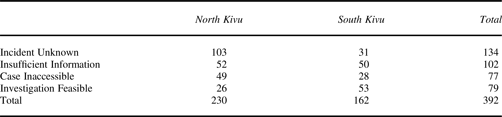
After collating each of the events for which data were available and removing repeats across the different sources, phase 2 of the research involved working with legal experts in North and South Kivu, including prosecutorial staff, to document which of the 392 incidents (230 in North Kivu and 162 in South Kivu) had received attention from justice-sector institutions. I documented whether each incident of violence was known to the courts and what its current status was. During these discussions, I identified that the 392 incidents fell into four categories: those that had never reached the attention of prosecutors in any form (134); those for which there was insufficient information to link a particular perpetrator or perpetrator group to the attack (102); those for which investigations were stalled or dropped because the case was inaccessible to prosecutors for perceived logistical reasons (77); and those in which prosecutors deemed the incident in question to feasibly constitute the basis for a dossier, case file, or further investigation (79). These four categories were developed through extended discussions with in-country legal experts and prosecutorial staff and are discussed in detail in the online appendix. Table 2 summarizes the breakdown of these categories in North and South Kivu.
Summary of 392 incidents of mass violence examined by military prosecutors

I focus on the seventy-nine incidents in the data set for which legal experts and prosecutorial staff deemed that formal investigations were feasible. Political dynamics undoubtedly influenced cases outside of this sample, including, importantly, cases coded as “inaccessible” for which amnesties and other agreements protected individuals from investigation. We gain the greatest analytic leverage in understanding the progression of cases through the legal system, however, by examining those incidents that military prosecutors did not immediately reject as “out of the question.” That is, those that could not reasonably be dismissed, stalled, or discarded for legal or logistical reasons.
In phase 3, I turned to qualitative interviews to map whether the seventy-nine incidents of mass violence reported in the data set were formally registered with the prosecutor's office. In some cases, multiple incidents of violence pertained to the same overarching case. For example, multiple attacks were carried out by the FDLR in Bunyakiri over a period of days. These appear as separate incidents in the data set, but pertain to a single overarching investigation by courts and NGOs. I thus use the terms “case file” “case,” “dossier,” and “investigation” interchangeably to refer collectively to a series of related incidents. Of the seventy-nine incidents, the twenty-six in North Kivu pertained to sixteen separate case files.Footnote 44 The fifty-three in South Kivu pertained to twenty separate case files.Footnote 45 Together, these thirty-six cases account for seventy-nine separately recorded incidents of violence that made up the universe of potential war crimes and crimes-against-humanity investigations that could feasibly have been addressed by DR Congo's courts. Only eight of these resulted in trial in the time frame of the study.
For each of the thirty-six case files, I mapped whether, when, and against whom warrants were issued and arrests made, whether dossiers were opened and transferred from the prosecutor's office to the court, and whether a trial ever took place. To assess the influence of conflict-era politics over institutional responses to mass violence, I interviewed a wide range of individuals with knowledge of each case. These included prosecutors, NGOs, and where possible and relevant, unit commanders, intelligence officers, military police, civil society representatives, or UN personnel. The interviews, designed to solicit information about the various factors that influenced whether or not cases moved forward, unveiled which groups and individuals were implicated in the incident in question, who was arrested or charged, who issued and executed warrants, who was implicated in the incident but not arrested (and why), how quickly developments were processed by the courts, and whether certain allegations, charges, or warrants were dropped or abandoned.
Once the interviews were complete, phase 4 involved coding and analysis in multiple stages. Information about each dossier was examined with particular attention to the factors that facilitated the progression of a case to trial and the factors that obstructed investigation and prosecution. I documented the ways in which military elites of different armed group affiliations behaved toward reports of mass violence and how this behavior shaped institutional processes. I used these data to compile complete narrative histories of each incident, paying close attention to contradictory accounts and the credibility of different sources. I drew from my prior experience working with the Congolese justice system, as well as the opinions of trusted local sources, to triangulate across testimonies and assess the validity and reliability of each claim.Footnote 46
Coding and Analysis
Analyzing each case narrative in turn, I identified any statement pertaining to my outcome of interest: the progression of that case toward trial. Statements of interests included any reference to the formal registration of a case with the Auditorat Militaire, the issuance of a warrant or mandat d'amener, investigations or witness interviews, site visits, arrests, the transfer of a case to the Cour Militaire, and, finally, the scheduling and occurrence of a trial. I then assessed each case history against the overarching expectations outlined earlier to evaluate the conditions under which wartime elites across factions cooperated with or obstructed efforts to ensure legal accountability for wartime violence.
Four types of interactions pertaining to elite behavior emerged from this analysis, determining whether and how a case ended up in court. I refer to these four categories of interactions as distinct mechanisms that produced an outcome of interest.Footnote 47 These four mechanisms do not necessarily reveal an exhaustive typology, nor are they mutually exclusive. Multiple mechanisms were often at work in a single case file, especially given that elites might support investigations against certain individuals while obstructing investigations against others implicated in the same case. Together, the mechanisms serve to illustrate how conflict-era elites support or obstruct accountability or other institution-building efforts in the service of their own conflict-related agendas.
Two clear mechanisms determined why cases moved forward through the justice system: removing challengers or adversaries and deflecting attention from acts of violence. One mechanism determined why cases were discarded—protecting loyalties—and one mechanism, brokering deals, could either propel or obstruct cases. Two of these mechanisms—deflecting attention and protecting loyalties—pertained exclusively to intra-group dynamics. Deflecting attention most commonly represented relationships of intra-group conflict whereby one influential elite or coalition of elites facilitated an investigation against a subordinate within their ranks in a bid to escape investigation themselves. Protecting loyalties most commonly represented relationships of intra-group cooperation, as unit commanders or former unit commanders sought to obstruct cases against subordinates or allies. The remaining mechanisms, removing potential challengers and brokering deals, pertained to both inter- and intra-group dynamics. Some of these interactions were born out of relationships of cooperation, as actors forged allegiances or struck mutually beneficial deals with one another, while others engendered relationships of conflict as elites sought to scapegoat subordinates or target adversaries.
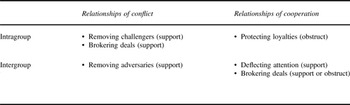
The four mechanisms, which pervaded the majority of case files, can be understood conceptually—and can generalize to postconflict institutions more broadly—using the typology of elite interactions developed earlier. The typology presented in Table 1 anticipated the conditions under which wartime elites are likely to lend support to accountability initiatives based on evolving relationships of inter- and intragroup relationships of conflict and cooperation. Table 3 presents the frequently occurring patterns of elite interaction that emerged from the interviews and case histories within the framework of this typology. The mechanisms do not fit perfectly into each quadrant. Sometimes similar dynamics can give rise to multiple mechanisms, and sometimes the same mechanism can emerge from different types of relationships. Nevertheless, they serve to illustrate the importance of different crosscutting dimensions of elite politics in determining local cooperation and support for specific rule of law projects.
Within- and across-group relationships of conflict and cooperation motivating elite behaviour

1. Protecting Loyalties
The mechanism I call “protecting loyalties” refers to influential elites obstructing human rights prosecutions by intervening in proposed arrest warrants to protect the loyalties of groups or individuals within their units or broader patronage networks. In eastern DR Congo, this mechanism most often involved members of the FARDC, since the Congolese military retains exclusive jurisdiction over approving and executing military warrants.Footnote 48 When FARDC elites wish to ensure that trusted groups or individuals remain by their side, they may intervene to prevent investigations against those individuals from moving forward. In the cases analyzed, powerful FARDC elites often had close personal relationships with those implicated in mass violence, leading them to stand in the way of investigations, arrests, and trials. Influential figures within the national army also assisted members of their patronage networks in escaping from prison or across the border to obstruct a legal case from proceeding. This mechanism pertained predominantly to intragroup relationships of cooperation.
2. Brokering Deals
The mechanism I refer to as brokering deals can involve both inter- or intragroup dynamics and may involve relationships of cooperation or of conflict. Deals may be brokered between apparent adversaries in the conflict to support cases moving forward through the legal system or obstruct them from going to trial. In positive cases, individuals in one unit may be handed over to elites by their superiors in exchange for some benefit or good from another group. Such deals may involve indictments against lower-ranking combatants with the promise that accusations against higher-ranking indictees be dropped. In negative cases, armed actors may persuade political and military elites within the government to obstruct or abandon all investigations against them in exchange for a payoff such as committing troops to assist in renewed combat or facilitating the pursuit of a particular political or economic objective. Deals may involve committing troops to an insurgency; offering to mobilize support for a particular policy position; or allowing access to resource-rich territory under the control of another group. While deals can give rise to dynamics of intra-group conflict when subordinates are handed over by their superiors as political, military, or economic exchange, these types of scenarios are typically motivated by a desire on the part of elites to forge relationships of intergroup or intra-group cooperation.
3. Removing Challengers or Adversaries
This mechanism affects both intra- and intergroup dynamics of conflict. Internally, it involves support for investigations in the form of turning allies or subordinates over to legal institutions as part of an internal effort to remove potential dissidents, troublemakers, or challengers to authority from within the ranks of the group, network, or unit in question. This mechanism serves the purpose of advancing an elite's personal survival and influence within a group by using legal institutions to remove potential threats to their power and authority. Externally, the mechanism involves support for accountability efforts in the form of removing adversaries from the battlefield. This usually takes the form of one party to the conflict—typically a FARDC network, sometimes in collaboration with another party—launching a military offensive against an adversary or a member of a rival faction in the name of executing an arrest warrant issued by a military prosecutor. Such cases perhaps resemble the most direct examples of utilizing new institutions as sites of continued or ongoing warfare. In such cases, one party to the conflict continues in its efforts to destroy the organizational autonomy of another through removing leadership figures from the battlefield to the courtroom.
4. Deflecting Attention From Other Activities
This mechanism involves elites from one group offering support to investigations by scapegoating junior officers as part of outward-looking efforts to deflect attention away from crimes, abuses, or other political and military activities being carried out in other spheres. Rather than constituting an explicit deal with another group, this mechanism serves as an implicit deal whereby elites cooperate with accountability efforts to deflect attention away from abuse or misconduct they are implicated in elsewhere. Although it can also generate dynamics of intra-group conflict (since it usually involves elites turning over their lower-ranking colleagues to the international community or the FARDC), the mechanism is primarily born out of a desire to foster intergroup cooperation so that the pursuit of other economic, political, or military agendas can proceed without interference.
At least one of these four mechanisms was confirmed in all but two of the cases analyzed. In those two, Kalundu and Katasomwa, the legal process appeared to proceed unimpeded by virtue of the individuals in custody lacking anything of value to bargain over. Both Kalundu and Katasomwa involved individuals who were poorly networked with other armed groups in the region. In the first, suspects were voluntarily turned over after arrest warrants were issued, and in the second they were captured and transferred into military custody by FARDC intelligence.
Support for human rights prosecutions thus often serves a dual purpose for wartime elites. They can signal their cooperation with peace-building efforts in one sphere while pursuing conflict-related agendas in others. Postconflict institutions therefore offer spaces where deals and negotiations can be brokered, and powerful armed elites can dispose of adversaries or potential challengers in ways that reinforce their military power and advance their strategic interest. Where these dynamics are present, they may foster rather than diffuse a climate of insecurity and distrust.
In what follows, I highlight my analysis from South Kivu. Other than one narrative history discussed later, I do not discuss the North Kivu cases here. This is because in November 2012, all records held by military prosecutors in North Kivu were destroyed during M23's occupation of Goma. The destruction of court records, and the high turnover of military personnel during the occupation, meant that the depth of analysis possible in South Kivu could not be replicated to the same level of detail in the North Kivu study. The narrative evidence from North Kivu serves to illustrate that similar dynamics were present in both provinces.
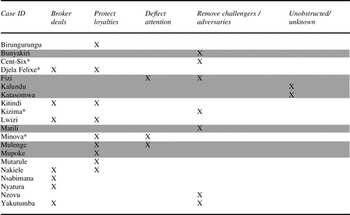
Table 4 therefore summarizes the dynamics at play for the twenty South Kivu cases. Gray shading is used to identify cases that eventually resulted in trial for at least one individual during the study's time frame. Boxes that remain unshaded represent cases that did not go to trial, either because they were obstructed or because they were delayed awaiting trial at the time of writing. Many cases, such as Minova, Mupoke, and Djela Felixe, resulted in trials against some individuals while investigations into others were obstructed.
Summary of mechanisms at work across twenty cases in South Kivu

Notes: Gray shading indicates cases that resulted in trial in the time frame of study. An asterisk denotes that a trial occurred after the time frame of study.
In addition to Kalundu and Katasomwa, only five cases resulted in trial during the time frame of study (shaded in gray). These five cases illustrate the importance of the mechanisms in driving cases to trial. In the case of Fizi, the legal process moved forward because the prosecution of Lieutenant Colonel Kibibi and his accomplices was used to justify increased militarism by the FARDC in other areas and as a way for the FARDC military elite of the time to remove a potential troublemaker from their ranks. In two further cases, Bunyakiri and Matili, arrests were made as part of a FARDC effort to remove military adversaries from the battlefield. In the remaining two cases, Mulenge and Mupoke, the cases reached trial only following considerable interference and obstruction against certain indictees. In Mulenge, accomplices of the accused attempted to block the legal process by helping the defendants escape, although they were eventually recaptured and tried; and in Mupoke, FARDC officers assisted three of the four accused in escaping across the border to Rwanda, so that only one of the accused (the one who was not allied politically or militarily with any influential FARDC elites), ended up facing trial.
Four of the remaining cases, Cent-Six, Djela Felixe, Kizima, and Minova, concluded only after field research for this article was complete. In two of these cases, Cent-Six and Kizima, FARDC adversaries were targeted by the national army and with the support of local communities to remove hostile elements from the battlefield. Trials were held as soon as sufficient funds had been procured. For Djela and Minova, the progression of the legal process was possible only as a result of the scapegoating of junior officers in deals made to protect their superiors. In both cases, lower-ranking individuals faced trial as a direct result of negotiations to protect their superiors and other individuals implicated in the incidents in question.
Of the cases that were not dismissed by military prosecutors on logistical grounds, nine never made it to trial at all. In one of these, Nzovu, the legal process proceeded unobstructed after the accused was in custody, but the case was stalled awaiting trial by the time the study was concluded. Of the remaining eight, five involved protecting loyalties. In three of those five (Kitindi, Lwizi, and Nakiele), deals were also brokered explicitly to protect the accused from prosecution. In Birungurungu and Mutarule protecting loyalties was the only mechanism at work. In two of the remaining three cases for which investigations were continually obstructed, Nyatura and Yakutumba, deals were brokered protecting specific individuals from prosecution in exchange for committing troops to the FARDC in its offensives against other armed groups. The case of Nsabimana was obstructed by Generals Makenga and Ntaganda when they exerted influence over the FARDC's military command but, since Nsabimana defected with M23, he was no longer in the country at the time of writing. In many cases in which deals were brokered, the outcome of the deal was to serve the military objectives of powerful armed factions in anticipation of renewed outbreaks of violent conflict.
War and Politics in North and South Kivu
South Kivu: Brokering Deals in the Case of Nakiele
On 10 June 2011, FARDC Colonel Kulimushi (alias Kifaru) and approximately 150 of his troops entered the village of Abala in South Kivu. The soldiers were hungry and thirsty and were looking for food, water, or other valuables. As they entered the village, the soldiers began looting houses, stealing food, money, and other possessions from villagers, and committing sexual attacks against local populations.Footnote 49 As Kifaru and his troops continued their journey through the eastern mountains of South Kivu's high plateau, similar attacks were reported in the nearby villages of Nakiele and Kanguli.Footnote 50
Colonel Kifaru had deserted his military base south of Nakiele on 8 June to express his dissatisfaction with an army reshuffle under which he and many of his close allies were about to be denied influential positions within the national army.Footnote 51 Previously the overall commander of several brigades, Kifaru had learned that he was likely to be replaced by a colonel from a rival armed group, the predominantly pastoralist Forces Républicaines Fédéralistes. Colonel Kifaru was a former member of the PARECO group, elements of which were integrated into the national army in 2009 following peace agreements with the government.
The attacks around Nakiele gained a great deal of media attention in the Kivu provinces.Footnote 52 Government spokesperson Lambert Mende announced that his forces were actively looking for Kifaru and DR Congo's justice minister confirmed that he had given orders for a special tribunal to initiate criminal proceedings against Kifaru and his troops, accused of mass rape, looting, and other crimes against humanity.
Realizing that he would be unable to remain in hiding, Kifaru surrendered to the national army in early July, with 191 men and a stockpile of heavy weapons.Footnote 53 Lieutenant Colonel Kazarama, the army spokesperson for operations in South Kivu at the time, announced that Kifaru and his men would stay at an army base in Luberizi until South Kivu's military prosecutor and MONUSCO completed joint investigations into the mass rape allegations. In addition to mass rape, Colonel Kifaru and his troops were charged with stealing goats, chickens, and other property, and setting up illegal toll stations around Fizi.
Months later, little progress had been made in the investigations, despite the fact that Kifaru had been detained in UN and FARDC custody. Later the same year, all charges against Kifaru were abandoned indefinitely when he was made commander of South Kivu's 111th regiment.
Reports differ regarding the sequence of events that followed Colonel Kifaru's reemergence from hiding. Some indicated (verified by UN representatives and FARDC army spokesperson Vianney Kazarama) that as of 7 July 2011, Kifaru was detained in military custody by the 10th Military Region of the FARDC, and investigations against him were ongoing.Footnote 54 However, others informed me that Kifaru had entered into negotiations with regional FARDC commanders, General Masunzu and Sultani Makenga. As a result of these negotiations, Generals Masunzu and Makenga ultimately acknowledged that “mistakes had been made” in the charges levied against Kifaru.
Interviewees reported that General Makenga had brokered a deal with Kifaru, giving him the opportunity to reintegrate into the national army without further investigation. This sequence of events can be better explained by a closer examination of the military command structure in South Kivu in mid-2011.
At the time of the initial investigation, ex-CNDP commanders Bosco Ntaganda and Sultani Makenga commanded immense power and influence in South Kivu's military hierarchy. Thus, any military or political decision at the time had to go through them.Footnote 55 In the same period, Colonel Kifaru maintained considerable influence over a number of ex-PARECO troops who were formerly integrated into the national army. Interviewees noted that Kifaru refused to mobilize support for ex-PARECO reintegration into the FARDC's 105th and 111th regiment until the charges against him were dropped. However, this was not the end of the story. While Lieutenant Kibibi and the officers implicated in the case of Fizi some months prior were considered to be “small fish” and thus dispensable to Colonel Makenga, Kifaru was incredibly valuable to a variety of local elites, given the influence he held over his ex-PARECO troops.
In mid-2011, Generals Sultani Makenga and Bosco Ntaganda were engaged in efforts to build broad-based support within the rank and file of the FARDC and beyond. Soon after, they would spearhead the defection of the M23 movement in 2012. Generals Makenga and Ntaganda thus strongly welcomed the opportunity to broker a deal in the form of a military alliance with Kifaru and the ex-PARECO troops loyal to him. As a result of Makenga and Ntaganda's enormous influence over the activities of the 10th Military Region, General Masunzu was willing to agree that local Bembe populations had likely manufactured reports of mass rapes for political reasons and thus there was no further need to pursue investigations into the alleged attacks in Nakiele.Footnote 56
On 4 April 2012, Sultani Makenga and Bosco Ntaganda led a mass defection from the Congolese army, under the name of the Mouvement de 23 mars (M23), taking with them approximately 300 ex-CNDP soldiers.Footnote 57 In the weeks and months that followed, increasing numbers of ex-CNDP troops, as well as units from other previously integrated armed groups, joined the M23 movement. Interviewees commented that Colonel Kifaru had brokered a deal with Generals Makenga and Ntaganda—that he would defect with the M23 movement on the condition of stalling or obstructing his prosecution and arrest. As a result, Kifaru had been present at a number of M23's late planning meetings immediately prior to the defection.
For reasons unknown, Kifaru did not defect with the M23 movement. Instead, he remained with the FARDC and immediately re-entered into negotiations with General Masunzu. Given that he was now privy to important national security information (in the form of M23's defection plans and military strategy), Kifaru now served as a critical resource to the FARDC's counter-intelligence strategy against the newly formed insurgency. Kifaru was thus able to enter into a new round of negotiations with Masunzu in which he would continue to provide information and support to FARDC's military intelligence in exchange for remaining sealed from prosecution. Between 2011 and the disarmament of the M23 movement in late 2012, international organizations made efforts to pressure the military justice system to resume investigations into Colonel Kifaru. These efforts were largely unsuccessful, although pressure mounted after the threat posed by the M23 insurgency subsided.Footnote 58
North Kivu: Brokering Deals and Removing Challengers in Walikale
In July and August 2010, several armed groups were implicated in mass rapes and lootings that took place in thirteen villages in Walikale territory, North Kivu. A UN investigation documented 387 rapes, the looting of 965 shops and houses, and the abduction of 116 civilians.Footnote 59 The attacks were carried out over a five-day period by a coalition of combatants from the Mai Mai Sheka militia, the Democratic Forces for the Liberation of Rwanda (FDLR), and troops loyal to Lieutenant Colonel Emmanuel Nsengiyumva, a former CNDP officer integrated into the national army who defected after the arrest of Laurent Nkunda. The UN investigation found that the attack was ordered by Captain Sérafin Lionso of the FDLR, Lieutenant Colonel Emmanuel Nsengiyumva, and Ntabo Ntaberi Sheka, the commander of Mai Mai Sheka, at a meeting in the village of Wango, at the time a stronghold of the Mai Mai Sheka group. The operation was intended to weaken Congolese army positions and punish local populations accused of collaborating with government forces.
In response to the attacks on the Walikale axis, on 30 August 2010 the Congolese judicial authorities opened an investigation into Captain Sérafin Lionso, Lieutenant Colonel Emmanuel Nsengiyumva, Commander Ntabo Ntaberi Sheka, Lieutenant Colonel Sadoke Mayele, and four others implicated in crimes against humanity in the attacks, including the crimes against humanity of rape, looting, and abduction of civilians. North Kivu's military prosecutor, with support from the UN Stabilization Mission to DR Congo (MONUSCO) and the UN Development Program, visited Walikale territory to interview over 150 victims and witnesses to the attack.Footnote 60 Attorneys and psychologists associated with an ABA legal aid clinic in North Kivu took testimony and provided assistance to 147 survivors in the affected areas, and filed 108 related cases with the Military Prosecutor's Office.Footnote 61
Following these investigations, on 6 January 2011, provisional arrest warrants were issued against Commander Ntabo Ntaberi Sheka, Lieutenant Colonel Mayele, Captain Lionso, and four Congolese army deserters.Footnote 62 Lieutenant Colonel Nsengiyumva died before the warrant was issued. Lieutenant Colonel Mayele was taken into custody and faced legal proceedings in December the following year.Footnote 63
To the casual observer, the proceedings against Sadoke Mayele was a major milestone for human rights and the rule of law in North Kivu. An important rebel combatant, commanding a unit implicated in a series of grave human rights atrocities, was arrested and brought to justice for war crimes and crimes against humanity carried out against civilian populations. While it was not feasible to expect every individual implicated in the attacks to be identified and brought to trial, the arrest of a high-ranking officer responsible for leading his foot soldiers into battle just a few months after the incident occurred was touted as a major victory for those working toward building a culture of legal accountability for violent crime.
Yet on closer inspection, the trial of Lieutenant Colonel Mayele was the result of a complex process of negotiation among the various groups competing for authority and access in Walikale. Rather than representing a valiant effort to promote the rule of law, the arrest and trial formed part of an effort to remove challengers who had fallen out of favor with their superiors and to broker political and economic deals among different sets of armed actors. Attention to the micro-politics of armed groups in Walikale clarifies how the broader landscape of conflict shaped the dynamics of Mayele's trial.
Because of limited state authority in Walikale territory, several armed groups, including Mai Mai Sheka, FDLR, and troops loyal to Lieutenant Colonel Nsengiyumva, established bases in the forests of Walikale.Footnote 64 Although mining concessions have been granted to companies operating in the region, economic enterprises are largely controlled by armed groups who have also assumed authority over various other governance activities. A number of these groups, including the three implicated in the 2010 attacks, joined forces in early 2010 with the aim of demonstrating their combined power to secure concessions from private businesses and the Congolese armed forces.Footnote 65 Civilians are regularly required to negotiate protection from these groups in exchange for a monthly “security tax.”Footnote 66
Sadoke Mayele had vocally opposed Commander Ntabo Ntaberi Sheka's close collaboration with the FDLR, and had fallen somewhat out of favor with his superiors as a result. Just prior to the 2010 attacks, Mayele had been detained and allegedly tortured under orders from Commander Sheka. Mayele professed that Commander Sheka had deliberately turned him over to the military courts to punish him for his dissent and lack of loyalty. In this sense, Sheka used the veneer of impartial criminal justice as a smokescreen to discipline, punish, and ultimately remove a potential challenger from his ranks.
Credible sources confirmed that Commander Sheka himself handed over Sadoke Mayele to UN and Congolese army officials as part of a political deal to allow Commander Sheka to continue his activities in Walikale unobstructed. Despite a warrant for his arrest, Commander Sheka registered as a candidate in the 2011 national assembly elections to represent the mineral-rich territory of Walikale.Footnote 67 As a result, he has made numerous public appearances in Goma from 2010 onward. His frequent public appearances, as well as meetings with FARDC officials, serve as evidence that no serious efforts have been made to execute the warrant of arrest against him; instead, it is clear that he has been explicitly protected.Footnote 68 Although the arrest warrant against him was never formally lifted, the trial for events in Walikale territory continued without further mention of Sheka himself. As a result, attacks by members of Mai Mai Sheka against civilian populations have continued. Mai Mai Sheka's military operations along the Walikale axis have expanded, often under direct instructions from Commander Sheka himself and, at times, with implicit permission from Congolese military and political elites who benefit financially from collaborating with Sheka's business operations.Footnote 69
Conclusion
The Nakiele and Walikale cases persuasively demonstrate the ways in which wartime elites have used legal institutions to consolidate power and shore up for the continuation or return to violence and extortion. The strategic manipulation of the justice system to surrender dissidents in exchange for access to illicit mining concessions, and to rally troops for insurgency, is emblematic of the ways in which elites pursue conflict-related agendas through institutional as well as military channels. These complex webs of interaction make up the on- and off-battlefield dimensions of protracted civil conflict.
DR Congo is certainly not the only site where postconflict institutions have complicated transitions to peace. Radin demonstrates that elites in East Timor utilized the creation of a supposedly impartial police force by the United Nations Transitional Administration in East Timor (UNTAET) to cement formal and informal wartime networks in ways that proved invisible to international stakeholders.Footnote 70 Wartime elites often outwardly accepted demands placed on them by UNTAET while using private obstruction to maximize positions of political advantage and block more inclusive political reforms.Footnote 71 More recently, military elites in South Sudan have built postconflict networks that reward loyal combatants, and have used nascent political institutions to build patronage-based political fiefdoms. This has ensured the rapid and easy mobilization to violence whenever political bargaining breaks down.Footnote 72 The strategic manipulation of postconflict institutions is not limited to these cases or to the rule of law. Cross-nationally, Flores and Nooruddin show that electoral institutions in fragile or unstable political environments can exacerbate insecurity by allowing conflict-era elites new venues to reward allies and punish wartime adversaries. This has raised the specter of resurgent violence in nascent postconflict democracies by fostering mistrust among factions and incentivizing a return to arms.Footnote 73
Postconflict institutions are perhaps most vulnerable to damaging backstage manipulation following conflicts where no single party has secured a decisive victory. This is because the threat of resurgent violence looms largest over political reforms where the organizational autonomy of respective factions remains intact after the conflict's apparent conclusion.Footnote 74 When uncertainty introduces incentives for wartime elites to maintain positions of strategic advantage in case of a return to war, they are led to advance political and military goals in multiple arenas simultaneously.Footnote 75 The temporary transfer of military grievances to nonmilitary realms creates a vicious cycle of violence, compounding commitment problems by further eroding trust and thereby undermining the very purpose for which new institutions were created. Yet, it is precisely in these most volatile of settings that the international community has deemed institution building most necessary.Footnote 76 International stakeholders should be wary of supporting institution-building projects that play directly into the conflict-related agendas of powerful warring elites.
One important outstanding question concerns whether or not the intermittent relocation of conflicts over land, power, and resources from the battlefield to institutional realms will lead to an incremental shift away from military violence over time. Kathryn Sikkink's work offers an important interjection on this point. Sikkink suggests that the prosecution of perpetrators of conflict-related violence by impartial courts of law will have positive effects for human rights and rule-of-law outcomes overall, regardless of the specifics of case selection.Footnote 77 Yet Sikkink also observes that when legal processes are manipulated or unfairly used to punish losers, the potential for long-term positive outcomes is diminished. When postconflict institutions are used as platforms to consolidate parallel authority structures and prepare for renewed violence as they have been in the Congolese case, or when cooperation is used in a tacit bid to deflect attention away from continued military incursions, the ability for those institutions to contribute to a reduction in violence certainly appears to be compromised. Further research, drawing from additional cases, is needed to understand whether backstage or pre-trial manipulation of the type documented here is likely to threaten the long-term positive externalities that derive from independent and impartial legal processes.Footnote 78
The Congolese case thus offers a number of powerful lessons for scholars of postconflict peace. Advancing our knowledge of complex multiparty conflicts, it demonstrates that conflict and cooperation can co-exist within and among armed groups, and transgress military, political, and economic realms. These conflictual and collaborative interactions construct the broader landscape of wartime political orders and do not dissipate simply because formal hostilities cease. The quest for personal as well as organizational power helps explain why elites are likely to lend their support to certain peace-building efforts but not others. These dynamics have important consequences for how elites navigate decisions to commit to peace. Finally, when elites use institutional channels to maximize positions of military, political, and economic advantage within their group and externally—so that they are well placed to advance conflict-era goals in a variety of possible future scenarios—postconflict institutions can exacerbate the security dilemma and heighten conditions of mistrust over time. Without sufficient attention to these dynamics, scholars and policy-makers remain ill equipped to understand the fluid character of many contemporary civil conflicts, and the role institutional reform is able to play in their prevention.
Supplementary Material
Supplementary material for this article is available at https://doi.org/10.1017/S002081831700008X.