Introduction
The teaching of mathematics has undergone profound changes internationally throughout the twentieth century. We will study these changes in two countries that played prominent roles in these developments, France and Germany. We will show how mathematical education is dependent on time and place and how the processes of conceptual and methodological changes in the teaching of mathematics were intimately tied to structural reforms of the entire educational systems. Both countries strove to achieve modernity at each period of the century according to their respective social and cultural values. At the same time, these changes were intimately tied to those epistemological views that were dominant in the mathematical communities during the various periods throughout the century.
In the first phase, the emphasis of the reforms we examine here concern only the secondary grades. The primary grades, partially preceding them and partially paralleling them, for the lower social classes, proved, however, to constitute the key element after World War II when the emphasis, in principle, turned from elite education to general education for all, and there was a profound restructuring of school systems and their curricula, particularly for mathematics, too. Our analysis will show that – much more than usually assumed – methodological and pedagogical approaches succeeded in transforming mathematics teaching and thus elucidate the impact of social demands and changes on mathematics education.
In order to analyze these reforms, therefore, we need to take into account the contexts in which these reforms took place. Furthermore, we seek to show how these reforms reveal the social stakes attached to mathematics in each country, at each period. We shall examine, in particular, the rhetoric of the respective discourses, which, at any moment, make extensive use of the terms “modernity,” “modernization,” or “modern.” As we shall show, the polysemy of these words, when qualifying mathematics, altogether indicates the social and economical modernity to which mathematics should “naturally” belong, a cultural and educational modernity (classic studies versus modern ones), a mathematical and epistemological modernity, and even a pedagogical one. All these issues represent, to our minds, a valuable contribution of the history of education to the history of mathematics.
I. Period of Reform and Cooperation 1900–1914: Enter Modernity
For this very first period, a common reflection and cooperation on reforms in mathematical curricula were developed all over Europe, including our two countries. More general institutional educational features and mathematical issues at stake were also largely common. Nevertheless, we shall try to show how these common issues were specifically managed in the German and the French context.
Germany: a historical compromise and a genuine reform movement
The situation of mathematics education in the German states by 1900 was an evident outcome of its development during the nineteenth century and an answer to the problems revealed during this development. One should emphasize two of its major characteristics that are essential for the further evolution of the history.
In all German states, the key structural problem of secondary schools had been how to opt for classical, literary studies, which would typically lead to university studies on the one hand, and for preparing for “civil,” non-academic professions and careers on the other hand. The two competing tendencies expressed the social and cultural conflicts between the elite Bildungsbürgertum and the economically active social strata, the Wirtschaftsbürgertum. Separate school-types providing more practical, or more “modern” teaching, lasted a shorter time than the Gymnasien and did not provide the Abitur, the university entrance degree. Actually, this more practical orientation was claimed by these social classes to be “modern” in the sense of preparing for life in the present world. By the end of the nineteenth century, these originally complementary schools had been expanded in duration and qualifications offered so that there arose marked conflicts between the different competing partial systems. And in 1900, eventually, these conflicts were resolved by what one might call a historical compromise. All three types of secondary schools were granted the right to hold the Abitur exam, and thus give access to higher education. The three types were defined by the kind of classical learning they provided: the classical school type, humanistisches Gymnasium, with Greek and Latin; and the two realist school types: Realgymnasium, with Latin; and Oberrealschule, with none of these languages.
An essential feature of this compromise was that mathematics constituted a major teaching subject in any of these three types, however according to different views of mathematics. And one has to know that this structural compromise, which corresponded to different social strata in German society, persisted for a very long time, until 1972 at least. It provided the constitutive structure for the greater part of the beginning century. Streaming used to constitute, in fact, a major means in Germany for settling social and structural conflicts.
The historical compromise at the level of secondary schooling had been complemented the same year by an analogous one for higher education: the two likewise competing types of higher education, the universities and the technical colleges (Technische Hochschulen). These newcomers – as polytechnical schools originally of a secondary school status – were granted the same academic status, by the same year, 1900. Before, there had been no free choice between these two types for the graduates of the three school types. Originally, the Oberrealschulen graduates were restricted to the technical colleges and a few disciplines of the university. Hence, there was the danger of a culturally segregated guidance cementing barriers between classicality and modernity. And it was particularly mathematics that had been affected by this split.
What was at stake for mathematics, therefore, was a problem of transition from secondary schooling to higher education. The problem was all the more acute as the technical colleges, due to their origin as polytechnical schools, provided a large portion of basically elementary mathematics. When young mathematics professors, formed in the spirit of the new Weierstrassian rigor in analysis, used them for presenting rigorous foundations of mathematics, this not only annoyed their students but even provoked the emergence of an anti-mathematical movement among engineers (see Schubring Reference Schubring, Rowe and McCleary1989, 180ff.).
The second pivotal feature of mathematics teaching in secondary schools by the end of the nineteenth century was its outdated nature: despite the needs of the by now industrialized country for adapted modern education, mathematics instruction everywhere was dominated by elementary teaching goals, focussing on classical, Euclidean geometry and enhancing the formation of logical thinking as a key function. The teaching of variables was banned as not being elementary in that sense, and therefore the teaching of functions was banned, too. Consequently, conic sections were to be taught only via the synthetic method, i.e. as geometrical loci, but not by means of the analytical method.
In 1891, an association of mathematics and science teachers had been founded – the Förderverein association for the promotion of the teaching of mathematics and science. It did not yet initiate actions for modernizing teaching mathematics and changing the structural problems. As a matter of fact, it was a university mathematician who became active from 1900 on and who initiated reforms: Felix Klein. Actually, his original concern was the first issue, the transition from secondary to higher learning. But upon reflecting how the problem might be solved, he became aware of the fact that an enormously more extensive and more complicated problem had to be tackled: the second issue, the reform of the syllabi for secondary schools.
A decisive support to realize such reforms came from France. Thanks to the good services of L'Enseignement Mathématique, the first international journal dedicated to mathematics education, Klein learned of the 1902 reforms in France where elements of the calculus were introduced into the syllabus of the highest grades. Such an introduction in Germany would resolve the problem of the curriculum at the technical colleges, but lest an alien, novel element be presented in the upper grades, it should be systematically prepared and appear to be merely the logical closing of a consequently organized new syllabus.
Having familiarized himself with some of the main problems facing mathematics teachers in the schools, Klein proceeded to coin the key phrase that would hereafter serve as the slogan for his reform program. This was the famous notion of functional reasoning, or the idea that the function concept should pervade all parts of the mathematics curriculum. With this slogan of functional reasoning in hand, Klein began in 1902 to gather support for this reform movement from below. He succeeded in forging an extraordinarily broad and powerful alliance of teachers, scientists, and engineers that was to advocate a series of reforms for the mathematics and sciences curricula.
In fact, at the basis, in the schools, mathematics teachers were enormously active towards realizing the program of functional reasoning, including the elements of the calculus, at all three school types. And there was a “modern” textbook, published by two teachers from Göttingen, which corresponded to Klein's program: Otto Behrendsen and Eduard Götting, Lehrbuch der Mathematik nach modernen Grundsätzen (Teubner, Leipzig).
A committee established in 1904 in Breslau, reflecting this broad movement in its composition, the so-called Breslauer Unterrichtskommission, was able to present a year later, in 1905 at Meran, at the annual meeting of the association of German mathematicians, a profoundly revised syllabus for a modernized course, based in fact on that idea of functional reasoning and ending with the elements of the calculus. This was later the famous Meran program. The Meran text contained but one shadow: due to the resistance of some functionaries, in particular from the Förderverein, the calculus was recommended for both realist school types, but was just optional for the humanistisches Gymnasium. For Klein's conception of free transition, it should apply likewise to the realist and to the classical school types – and, hence, contribute to overcoming, at least for mathematics, the split along contrasting views of culture or cultures. It was this reform movement that enabled the curricular basis for mathematics teaching ensuring the realization of the historical compromise at the levels of secondary and higher education for mathematics.
The 1902 reform in France: “more life and more sense of reality”
Regarding the situation during the nineteenth century, the key structural problem was altogether identical and yet different from that of Germany. There were three different types of school, three different schoolings, referring to different social strata and to a different status of mathematics. A first type, for the learned élite – even the scientific one – were the lycées classiques, which provided, first and foremost, classical and humanist education. Mathematics education was on the fringe of this secondary training, postponed to the very final year of the lycée, even for the scientific élite, who, as we have said, continued their studies in Grandes écoles like the Ecole polytechnique where mathematics was so essential.
The second and third types of school trained technological and industrial staff. Both of them, Écoles primaires supérieures for lower classes, and modern (i.e. without Latin and classical studies) secondary colleges for upper classes, gave a key role to mathematics and to science education, which were taught according to practical aims, and focused on practical applications. This dichotomy in the goals of education, and this monopoly of classical humanities in the lycées became more and more untenable for the economic and political élites of the Third Republic. In 1899, the French parliament initiated a comprehensive inquiry all over the country to discuss the educational question of this time: Which training, for which élites in a modern country? What modernity, what humanities does the country need (see d'Enfert Reference d'Enfert, Gispert, Hulin and Robic2007)?
As for mathematics and science, different positions were maintained, and sometimes complementary values were argued for: cultural values as part of new modern humanities – the “scientific humanities,” together with other sciences, living languages, and French modern literature – versus utilitarian values, mathematics seen as an applied and practical subject, its applications being another part of the modernity. The discourses on modernity reveal here their whole complexity, emphasizing an intellectual modernity or an economical one by means of complementary, but also contradictory, arguments.
As a consequence of this enquiry, a deep reorganization of the structures and the contents of secondary instruction was undertaken in 1902 at a national level,Footnote 1 taking into account new goals and new audiences. They were explained by Georges Leygues, minister of Public Instruction, presenting his reform of secondary instruction to the parliament, in these words: “In France of nowadays, we have to face a double problem concerning secondary instruction. We can not be satisfied any more with preparing young men to liberal careers, grandes écoles, and teaching; it has also to prepare them for economical life and for action.”Footnote 2
The 1902 reform had considerable impact:
• the unification, in a unique secondary level structure, of the modern and classical secondary course, considered – at least in principle, if not symbolically – as equal;
• the establishment of two cycles in the curriculum: a first cycle corresponding to the first four forms of the lycée for boys from 12 to 15 years, after which students might leave secondary instruction – and that prospect was absolutely new; a second cycle corresponding to the last three forms which ended with the baccalauréat;
• the end of the monopoly of classical humanities and the development of “modern” subjects as languages, science, and mathematics.
Regarding the structure of mathematical curricula, we have to note several convergent factors: firstly, the growing place of mathematical education, in particular of geometry, in the first forms of the lycée; secondly, the effects of the diversification of the goals of secondary education; and lastly, the effects of a third factor, from outside the educational world, the new conceptions mathematicians had then about geometry; in fact, geometry was understood as “a physical science” as said by Jacques Hadamard (quoted in Gispert Reference Gispert, Gispert, Hulin and Robic2007, 211) following thus Henri Poincaré who asserted that geometry is the study of the group of the movements of solid bodies (Poincaré Reference Poincaré1904, 273).
All these factors led to new content and new methods for all the mathematical curricula. In a pedagogical conference for mathematics teachers held in 1904 in Paris to promote the 1902 reform, Émile Borel presented the logic of the reform in these terms: “We have to introduce more life and more sense of reality in our mathematics education” (Borel Reference Borel1904, 436). Here is indeed the very specific contribution of sciences and of mathematics to the scientific humanities that the reform aimed to promote.
The 1902 mathematical programs had very innovative parts (cf. Belhoste Reference Belhoste1995, 58–60). The most important was the introduction, since the beginning of the second cycle, of the concepts of function, of continuity, derivative, graphical representation, and links to physics and to applications. This study of functions, influenced by its physicist origins, was practical and quasi-experimental. There were no general and abstract definitions, the goal being to draw graphs of a few simple functions. In the very final year of the lycée, notions of function and derivative were specified in the algebra part of the program.
But the 1902 programs did not affect the purely deductive teaching of Euclidean geometry which actually remained an exception to the proclaimed coherence of the reform. Geometry programs of the first cycle (the first four years of the lycée) were not modified in 1902. It was only in 1905, following the 1904 pedagogical conferences already mentioned and after a strong protest among mathematics teachers, that the first-cycle programs were changed, particularly in geometry. The very first sentence of the official instructions for the 1905 first-cycle programs of geometry reveals a change in the teaching prospect with regard to Euclidean geometry: “Teaching of geometry has to be primarily concrete.”Footnote 3 This delay of three years shows that it is obviously easier to innovate in introducing a new subject – namely functions – than to try to renovate in tackling established traditions, as here in the case of geometry.
This intention to introduce more life into the teaching of mathematics complied not only with epistemological and pedagogical requirements. In his 1904 conference already mentioned, Borel in fact pointed out societal stakes which echoed Georges Leygues's speech on the new missions of secondary instruction. Borel noted that this was “the only way to prevent that mathematics be one day suppressed because of budgetary economy”; nevertheless he asked then a crucial question about such an instruction intended for the intellectual and social elite: “Don't we risk diminishing this great educative value [of secondary instruction] when making mathematics education more practical and less theoretical?”Footnote 4 If Borel's answer was without any ambiguity, praising the merits of practical exercises in secondary mathematics teaching, it was not the case for all the actors engaged in the implementation of these new programs and new pedagogical methods in their classrooms. This has been a serious limitation to the range of the transformations that this 1902 reform provoked in mathematics education, as we shall see in the following section.
Entering the international level: the International Commission on Mathematics Instruction
Additional impetus for the reform movement in Germany came from outside, with the establishment of the first International Commission on Mathematics InstructionFootnote 5 in 1908. Felix Klein was elected president and he used this position not only to extend international cooperation beyond the limits envisaged by the International Congress of Mathematicians when creating IMUK, but also to complement the compilatory official task by a reformist agenda disseminating the ideas of curricular change. An important means for that were international trend reports on some key problems of mathematics teaching. The cooperation between France and Germany signified one of the essential reasons for the success of CIEM/IMUK work until 1914, the onset of World War I.
The pivotal point for the launching of the first international reform movement in mathematics education was, in fact, the decision of the Comité Central to complement the (more or less descriptive) national reports submitted by the national sub-committees with international comparative reports on a few key topics representing the major concerns of reform. These topics, perhaps unsurprisingly, reflected the fact that the viewpoints of higher education were indeed dominant in the first CIEM/IMUK. Of the eight topics for written reports, only three corresponded to the level officially designated as CIEM/IMUK responsibility, i.e. the level of secondary schools, whereas the majority of five topics concerned either the transition from secondary to higher education or related exclusively to higher education (see the analysis in Schubring Reference Schubring, Coray, Furinghetti, Gispert, Hodgson and Schubring2003, and the contributions by Kahane Reference Kahane, Coray, Furinghetti, Gispert, Hodgson and Schubring2003, and Nabonnand Reference Nabonnand and Coray2003).
Actually, this reform movement had its focus on secondary school teaching and on the transition between secondary and higher education. This is well understandable, given that almost all of the national delegates elected as members of CIEM/IMUK were affiliated with higher education (see Schubring Reference Schubring, Coray, Furinghetti, Gispert, Hodgson and Schubring2003, 64). The only exception was Germany, where Felix Klein showed a rare perspicuity. He was aware that the kind of formation of mathematics teachers at secondary schools did not meet pedagogical needs and pleaded therefore that primary school teachers should be employed in the lower grades of secondary schools. Moreover, he was aware that teaching in primary and in secondary schools should constitute an organic unity and achieved therefore that in the famous series of highly qualitative reports on the state of mathematics teaching in the German states, as part of the international CIEM/IMUK work, the relevant aspects of teaching in primary schools received due attention; numerous reports were published on these aspects.
II. Between Two World Wars. Germany 1920–1933 / France 1920–1940. Separate Histories
World War I profoundly changed international relations, including mathematics teaching. France obliged the other Allied Powers to exclude Germany and Austria from all international agencies, institutions, and associations. An immediate consequence was the forced dissolution of CIEM/IMUK in 1920. Only in 1928, when even fewer countries continued to adhere to the boycott policy, did CIEM/IMUK revive – at a less active level, however. On a national level, too, the commotions caused by the War contributed in both countries to pose the questions of teaching mathematics in new terms.
Germany 1920–1933: crisis, but new social impact
After the end of World War I, the entire political, social, and economic situation changed. For Germany, France now was an enemy, even the “hereditary enemy” (Erbfeind). German scientists were internationally isolated and boycotted. And the precondition for Klein's activities to have mathematics acknowledged as a key moment of culture was no longer fulfilled: due to the horrors of the War, the sciences had lost their legitimacy to a considerable extent and had to act from a defensive position. There was a cultural crisis of mathematics and the sciences. Subjects now valued in the school context were of a quite different, nationalist character: kulturkundliche subjects, i.e., German language and literature, geography, and history were favored, at the disadvantage of mathematics and the sciences. The weekly hours for the latter subjects were reduced in all types of secondary schools. A fourth, new type of secondary school was established that characterized the political trend: Deutsche Oberschule – German secondary school.
A few positive trends can be named, however. Firstly, the application of mathematics was more valued in the syllabi and had to be taught more extensively. And secondly, the new Prussian syllabus of 1925 now officially enacted what had for a long time been practiced by mathematics teachers: the Klein program with the elements of the calculus in all the three types of secondary schools.
And there were profound changes in the school system, thanks to the Revolution of 1918, the only true revolution in German history: as decided by the new constitution in 1919 and concretized by the Reichsschulkonferenz in 1920, the social separation between a primary school system for the lower classes (Volksschule) and a system of secondary schools with separate preparatory schools was abolished, and replaced by an obligatory consecutive system where children from all social classes had to attend the first four years of restructured primary schools. And the formation of teachers for these new primary schools became attributed to institutions belonging to higher education: the Pedagogical Academies,Footnote 6 admitting only students provided with an Abitur – whereas the earlier seminaries had as students graduates of the Volksschulen so that the formation of these instructors and the Volksschulen had constituted a closed system. The professorships established there for the methodology of teaching reckoning and geometry (Raumlehre) paved the way for seriously studying pedagogical conditions for learning – and teaching – (elementary) mathematical knowledge, thus first steps toward what would later become didactics of mathematics in Germany.
Clearly, after the tronc commun of four years of primary school, there was not only streaming into the three types of secondary schools leading to the Abitur and hence to higher education, but also into lower types of schools, like the upper primary school. Students were subjected to entrance exams to decide which school they were admitted into after the first four years (Zymek Reference Zymek, Langewiesche and Tenorth1989, 167 ff.). Yet, the syllabi for the new primary schools, included for its upper grades, were upgraded in its mathematical level. While focusing for the first grades on arithmetic, teaching should not enhance rote learning but the development of intellectual qualities. For the upper grades, elementary geometry (Raumlehre) should enhance spatial intuition (Richtlinien 1923).
The restructuring of the school system was accompanied by a reform of pedagogical methods with a deep impact, best exemplified by the method of so-called Arbeitsunterricht: i.e., replacing old formalist teaching addressing only memory and the head by active methods, claiming proper activities by the students themselves, and emphasizing in fact manual occupations. In a number of textbooks, one finds, in the Weimar period, examples of nationalistic content in exercises given to the students.Footnote 7
After-War France 1920–1940: The revenge of classical humanities
Here, political events dramatically influence the subdivision into periods for the two countries. The convenient period of study for France will be the two decades between the World Wars. The years just after the war were marked, in France, by a strong nationalism, a manifest consequence of World War I. French politicians, French élites, and among them some mathematicians, desired then to promote classical humanities, a tradition which they called to be specific to “Latin” nations as France, as opposed to German practical culture. In that period, the 1902 reform was accused of having greatly weakened classical humanities – the pretended French identity – by imitating German approaches. And, in 1923, a conservative parliament voted a new reform. This reform excluded modern secondary instruction from the lycée – Latin became again compulsory in the first forms; it cancelled the organization in two cycles; prescribed the monopoly of classical humanities values, the only goal of the lycée being once again, unlike in 1902, to educate minds and hearts of an intellectual and social élite; and lastly imposed the égalité scientifique, that is, imposed the same curricula in science and mathematics for all students till the very last form. The consequences were that there was less instruction in science and in mathematics than just after the 1902 reform,Footnote 8 and that treating nearly all mathematical notions was postponed to the last scientific form (as before 1902). For example, teaching the notions of function and graphical representation were postponed till the last of the seven years of lycée, rudiments being taught the year before. Their introduction, as early as the fourth year of the modern curriculum in 1902 programs, had been one of the emblems of the mathematics reform, in France as abroad.
Nevertheless, even before World War I, some of the trends and instructions of the 1902–1905 programs had been questioned. In 1912, answering an inquiry initiated by the Parliament on the results of 1902 reform, the French association of mathematics teachers of public secondary instruction, Association des professeurs de mathématiques de l'enseignement secondaire public (APMEP), just created, expressed reticence with regard to “the concrete method” in mathematics. The association warned of the potential dangers of this method, mathematics having to keep their deductive nature and to use mathematical notions linked by the sole logic. Students ought not to be deprived of the advantage they can get from the study of mathematics, which has always been considered a school of logic.Footnote 9
This reign of égalité scientifique and classical humanities as the model for the training of the élite persisted during the entire inter-war period, even when the compulsory Latin was abolished as early as 1925 (by a left-majority parliament) and modern secondary instruction reinserted into the lycées. Thus, the predominance of humanities and the reduction of mathematics and science teaching were maintained even under the leftist government of the Front populaire (1936) when a soft re-organization of enseignement moyen Footnote 10 was undertaken. These features remained the distinctive sign of the specificity of this secondary instruction – cultural, liberal, and disinterested –, which excluded all practical and concrete aims.
This is all the more noticeable considering the efforts carried out by Jean Zay, minister of Public Instruction of the “Front populaire” government, who tried to bring the programs of the two schoolings of the enseignement moyen closer, the popular one and the élite. This political initiative, which sought to open more widely the secondary schooling of the lycées, had its roots in the post world war aim to enlarge the social basis of the French élites. Lycée mathematics teachers contested the harmonization of arithmetic programs of the first year of this enseignement moyen. When the minister sought to “eliminate all abstract ideology” from the programs, these teachers protested against such a program “without any new contribution to initiation to mathematical culture” (see “Introduction” in d'Enfert Reference d'Enfert and Kahn2010). In 1938, their association announced in its bulletin that “mathematical teaching in the first cycle has to keep on being only inspired by methods fitted to secondary schooling aiming mind training and culture,” remarks that official instructions of the time did not deny (ibid.). Therefore, during the whole interwar period, the two schoolings remained marked by their respective social aim. We should mention, since it became important in the aftermath, the growing success of the competing model proposed by the primary structures in charge of the popular part of this enseignement moyen which attributed great importance to science and mathematics, and to their practical applications, in their curricula.
III. Fascism – World War II
Germany 1933–1945: Mathematics for Self-Mobilization
It is remarkable and characteristic that the nationalist overtones during the Weimar period were directly transformed in Nazi times into militaristic, anti-Semitic, and eugenic indoctrination.
Immediately after the seizure of power by the Nazi Party, the two organizations for mathematics teaching – the Förderverein and the Reichsverband deutscher mathematischer Gesellschaften – decided for themselves their Gleichschaltung, i.e. adoption of key principles of the Nazi system: replacing elections for the presidency by the Führerprinzip, i.e. a permanent authoritarian presidency; and changing their statutes by adopting the so-called Aryan paragraph (i.e. excluding so-called Jews from membership). And it was this Reichsverband who had decided to compose a handbook for mathematics teachers which was to help or guide them to accommodate their teaching to the Nazi system: “Mathematics in the service of national political education, with examples of application to sociology, topography, and natural sciences” (Mathematik im Dienste nationalpolitischer Erziehung mit Anwendungsbeispielen aus Volkswissenschaft, Geländekunde und Naturwissnschaften), edited by Adolf Dorner. The handbook, published in 1935, was recommended for use in schools by the ministries and reedited several times. It contained a collection of ideologizing, indoctrinating, and discriminating exercises. It did not meet refusal.
How was the rapid adaptation possible? On the one hand, the methodology of Arbeitsunterricht allowed for a number of textbook writers and didacticians to be already near to romantic and irrationalist tendencies so that they would easily become adherents of Blut und Boden ideology. On the other hand, it is clear that no instance in the state or in the National Socialist Party had given orders to write textbooks in this sense. What one observes can be characterized as – according to the terms used in history of science – “self-mobilization.” Instead of awaiting orders or the elaboration of a respective policy, the functionaries and activists in the respective field – here: the textbook writers – engage themselves in elaborating a policy in their field, which they judge to please the Führer and to contribute to Nazi policy.
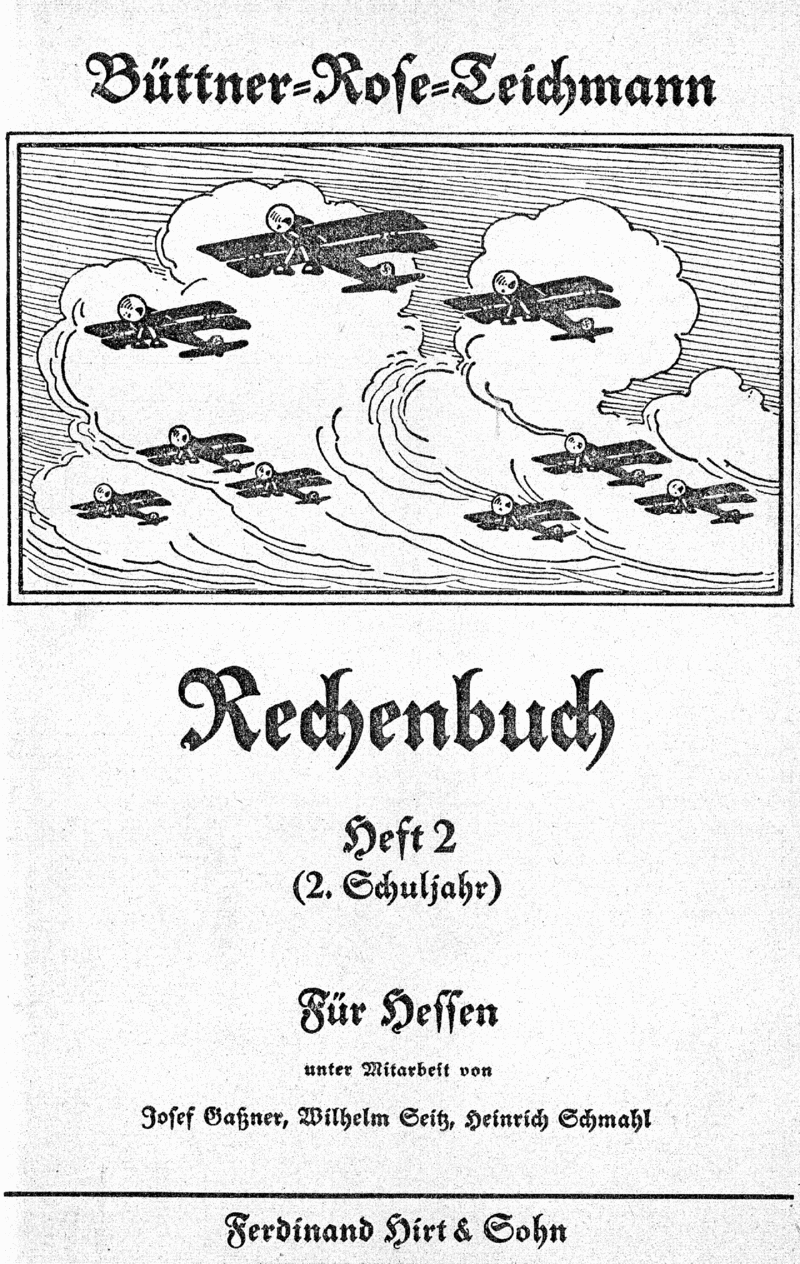
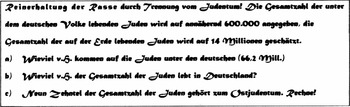
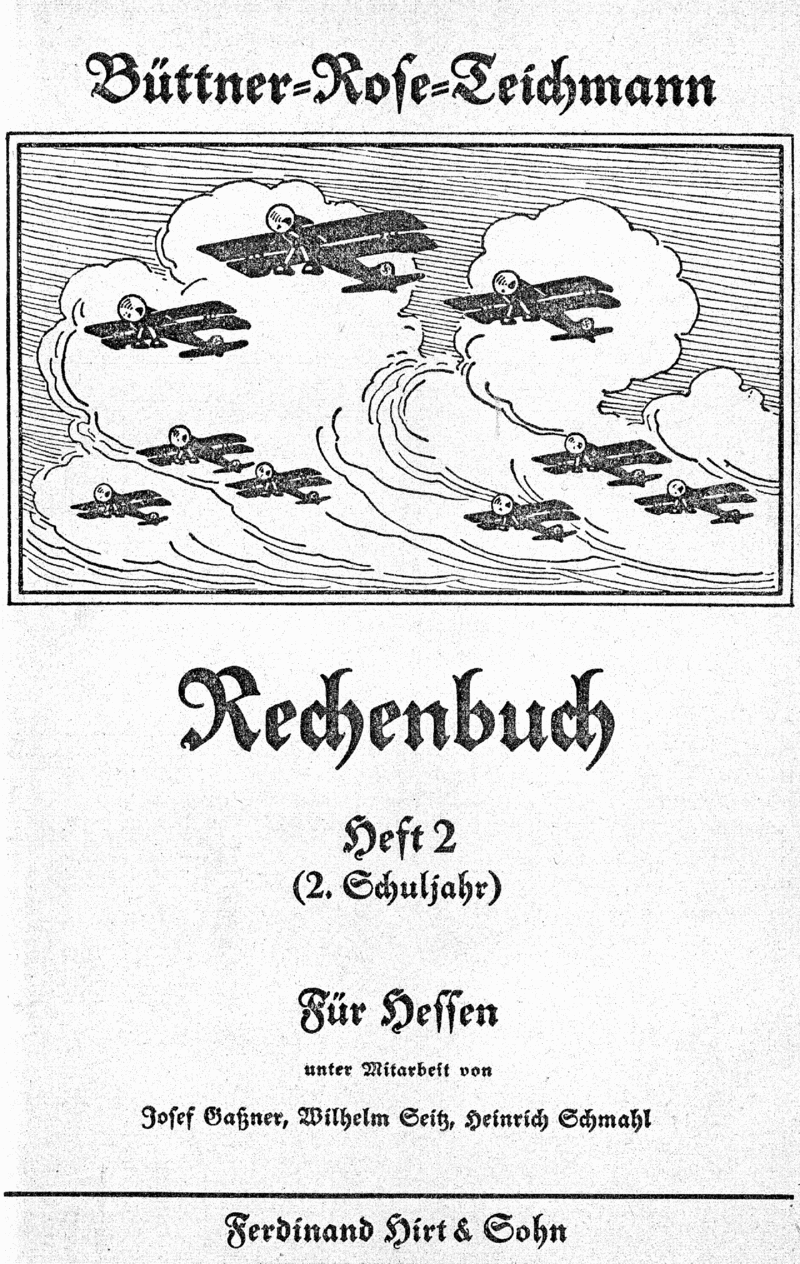
The schoolbooks even for primary grades are full of examples of such self-mobilization: the illustrations feature a militarist context for playing youngsters; exercises for multiplication are visualized by showing SA troops marching – in groups of four, six, etc. Already the title pages serve as indoctrination for air battle war (see fig. 1). Most horrifying is how word problems on percentage calculations was used for propagating elimination of Jews (see fig. 2). World War II was led by the German state in particular again against France. Germany's goals included not only occupation of large parts of the French territory, but also collaboration of the Vichy Regime allegedly governing the remaining territory.
Cover of the arithmetic textbook, second grade, for primary schools in the region of Hessen, in the textbook series edited by Büttner, Rose, and Teichmann, published by Ferdinand Hirt, circa 1942 (collections of the IDM Bielefeld).
Merging anti-Semitism with Mathematics. This example is to be found in Büttner's Rechenbuch. Ergänzungen. Ausg. E, Heft 4 (Büttner's Arithmetic Book. Supplements. Edition E, exercise book 4), quoted from Radatz Reference Radatz1984, 202.Footnote 11

France and the régime de Vichy (1940–1944): a paradoxical period
If nothing very specific took place for mathematics education during these years, this period is nevertheless important, since the Vichy régime took some structural measures, which affected the evolution of the French educational system even after the war.
In great part for political reasons, Vichy tried to destroy the very independent, homogeneous and strong world of the primary schooling – that is primary school and écoles primaires supérieures (higher primary level) and écoles normales (institutes for the training of young people 15 to 18 years old who intended to become primary teachers) – constituting thus the alternative model to the secondary élite schooling. This “primary world” had been, till the beginning of the Third Republic, the soil for middle class republican élites. It was very much attached to republican ideas and against the collaboration of the Vichy régime with the Nazi occupation authorities.
First, Vichy abolished the écoles primaires supérieures in order to integrate them into secondary level instruction, creating a new “modern college,” less valuable than the lycée where, once again, Latin became compulsory.
Second, Vichy having abolished the institutes of teacher training, students intending to become teachers had since then to attend the new modern colleges and take the modern baccalauréat. But, unlike secondary mathematics teachers in the lycées who were trained in the Écoles normales supérieures after their secondary studies, these teachers, intended for enseignement moyen only, were trained to become professors of science and not exclusively of mathematics. In this primary world mathematics was practiced bound up with the other scientific subjects; in the secondary order, on the contrary, professors stressed the peculiarity of mathematics of which the teaching had not to imitate physics teaching. In spite of the new institutional proximity of a part of the primary and of the secondary schooling orders, differences of cultures, aims, and pedagogical methods of both mathematics schoolings still lasted.
IV. Different Ideological Stakes in the Post-World War II Reality, 1945 to circa-1965
New Agents at an International Level, for new contexts in economy and teaching
The re-founding assembly of the International Mathematical Union (IMU), which occurred only in 1952 in Rome, put teaching questions directly at the forefront of its agenda. The president of IMU, Marshall Stone, from Chicago University, declared, first, that the Union had to “support activities which could contribute to the development of the mathematical science in any of its dimensions: pure, applied or pedagogical.”Footnote 12 After developing quite trite and un-new arguments and mentioning the numerous problems caused by the need of a mathematical teaching better fitted to the requirements of a world where science and industry are developing, Stone pointed out a major change for societies of his time confronted with the challenge of transforming élite teaching into mass teaching:
Many countries where school instruction has been till now reserved for a privileged few will observe that instruction for the entire population is becoming compulsory. In this new educative system, the place of mathematics teaching has to be rightly fixed, taking into account needs of the modern industrial society, which is substituting for ancient agricultural shapes of social organization in the whole world. . . . In the frame of compulsory schooling for all, neglecting to care that students acquire this mathematical instruction, would be like refusing to the young man or young girl any chance to take up any career.Footnote 13
Position, content, and methods of mathematics teaching have to be reconsidered for an industrialized and much more complex society in which democracy has to make sense, concluded Stone. About methods, he added that “our attempts to teach mathematics as a part of an instruction for all have been till now a total failure owing to our ignorance and our too complaisant satisfaction with regard to the art of teaching.”Footnote 14
IMU accepted the application of the former CIEM/IMUK to become an IMU committee. CIEM resumed the tradition of great international studies on mathematics education it had raised before World War I. Considering that “mathematics teaching at a given period is closely linked to the role that mathematics and mathematicians play at this very period,” CIEM started an international study on “the social role of mathematics and mathematicians in the present time,” and the results of the study were submitted at the 1954 international congress of mathematicians in La Haye (see Kurepa's report for the ICME study, Kurepa Reference Kurepa1955). Georg Kurepa, who had reported the results of this study, pointed out one of the facts that emerged from the answers of the national committees of CIEM: the war years greatly influenced the evolution of mathematics, both in the nature of knowledge and in its social embedding. This fact was documented not only by the high number of mathematicians, including engineers who are applied mathematicians, but foremost by the unprecedented existence of mathematical laboratories that were established in big industrial and commercial enterprises. The fundamental new achievements of mathematics in fields as diverse as structures, logic, optimization, calculators and numerical analysis, statistics, computer science, caused him to assert that mathematics played a key role in the industrialized society (ibid.). “In the crossing of human activities,” mathematics became the way for the “human being to get a whole organized view in the creative chaos of the infinitely various nature.”Footnote 15 In the beginning of the 1950s, CIEM stated in these terms the question of the transformation of mathematics teaching. But CIEM stressed the necessity to go beyond the prevailing idea that secondary teaching had to restrict itself to pure mathematics and to purely deductive reasoning, this latter being unavailable in the different fields of applied mathematics (see Gispert Reference Gispert, Coray, Furinghetti, Gispert, Hodgson and Schubring2003).
Concurrently, as early as the beginning of the 1950s, a new international organization appeared, the Commission internationale pour l'étude et l'amélioration de l'enseignement mathématique (CIEAEM) which invested in the ground of mathematics teaching reforms. Its founder, Caleb Gattegno, then settled in England, was ambitious to ally mathematical and pedagogical modernities. The intended interlocutors he wanted to bring together at the meetings he organized for mathematical educators during the 1950s, were the Swiss philosopher and psychologist Jean Piaget on the one hand and French Bourbakistes mathematiciansFootnote 16 on the other. The link between them was the notion of structure, mental structures on the one side, mathematical structures on the other. Piaget and the French mathematician Gustave Choquet became respectively vice-president and president of the CIEAEM, which counted two Germans and four Frenchmen and -women among its 25 founding members.Footnote 17 CIEAEM worked altogether to acculturate teachers to this new mathematics and to develop the reflexion and the experimentation of new pedagogical methods focused on students’ activity. As such, CIEAEM considered the matter of the transformation of mathematics teaching from a completely different point of view than CIEM: the societal dimension, strongly present in CIEM's reflexion, was far less noticeable in that of CIEAEM.Footnote 18
These two trends would converge at the end of the 1950s. On the one hand, CIEM reoriented its studies towards specific questions concerning more technical or didactic aspects of the content of mathematical teaching; on the other hand, the economical and social dimension was taken over by new actors who arrived at the international stage of reforming mathematics teaching. However, in this new period, the action for the reform of mathematics education would also occur at the political level.
The idea that reform in mathematics education was needed to meet the new economic demands of the 1950s was shared not only by mathematicians, but in particular by agencies for economic development. In fact, the initiatives undertaken by the OEEC (Organisation for European Economic Cooperation) later renamed as OECD (Organisation for Economic Cooperation and Develoment), since the late 1950s and the beginning of the 1960s, were to become the motor for the second international movement of curricular reforms.
In 1958, a few months after the launch of the soviet Sputnick which played an essential role in the rhetoric for the necessity of educational reforms, the OEEC opened an office in Paris in order to “make science and mathematics education more efficient” and to promote a reform of the contents and the methods of mathematics instruction for 12-to-19-year-old students. OECE appealed to mathematicians, from IMU and CIEMFootnote 19 as from CIEAEM, and convened groups of experts in charge of outlining the general orientations of a modern program of mathematics teaching. The meetings of experts organized by OEEC/OECD initiated what has been named the “new math” movement.
The first one took place in 1959 in Royaumont (France) and was organized by Marshall Stone, then president of ICMI; Choquet and the Belgian William Servais, respectively CIEAEM president and CIEAEM secretary, participated in the meeting with two other French members of the commission, Lucienne Félix, a math teacher at a lycée, and Jean Dieudonné, from Bourbaki.Footnote 20 This first meeting was followed by two others, in Dubrovnik in 1960 and in Athens in 1963, organized by Howard Fehr, director of the department of mathematical education at Columbia University, and at the same time involved in the activity of ICMI and consultant for OCDE.
These meetings resulted in publications, among them, a book issued in 1963 both in French and English and entitled in French Mathématiques modernes: guide pour enseignants (OCDE 1964). This book presented recommendations for new programs of mathematics for the secondary instruction of young (15–18 years) students intending to become scientists. The list of items recommended expresses both trends we have evidenced in the concerns of CIEM and CIEAEM during the 1950s. We can find there theories and topics which had gained great importance either for the way they could unify the presentation of mathematics or for the special interest they could present for applications to other sciences, in particular the physical sciences. Among these theories and topics are sets, relations and functions, fundamental algebraic structures, vectorial spaces and linear algebra, differential calculus, probability and statistics, mathematical theories connected to electronic computers. On a pedagogical level, the importance of treating altogether logical structures and problems was emphasized.
France: new epistemological paradigms and institutional reformsFootnote 21
In France, the “new math”Footnote 22 movement was nurtured in particular by the epistemological context according to the specific impact of the mathematical achievements of Bourbaki. They familiarized the new central role of the notion of structure in mathematics, which would become the core of what was usually called “new math.” As we have seen, several famous French mathematicians were engaged in the activities of CIEAEM and were requested as experts at the OEEC and OECD meetings. On a national level, from the beginning of the 1950s, French mathematicians and French mathematics teachers were quite mobilized, individually and collectively in their association, APMEP, to think, experiment, and promote reform in content and methodology in mathematics education.Footnote 23 APMEP organized and published conferences on “new math” for the teachers and took part in the general movement for pedagogical renovation that focused on the adoption of active methods that spread out in France at that time, and for widening the allotment given to mathematics in the secondary curricula. The acknowlegment and the promotion of the main role of the notion of structure in France spread far beyond the sphere of mathematicians. Mentioning the French anthropologist Claude Levi-Strauss will remind the reader of the decisive importance of structuralism, which constituted the philosophical trend that dominated France at that time in all sciences – including the human and social sciences. “New math” and its structure were generally understood as the essential scientific tool and language to access any knowledge. At the same time, the dominant political and economic circles had been also convinced of the strategic necessity of reform in the teaching of mathematics explicitly inspired by this new mathematics. All this took place in the context of dramatic institutional changes in the French educational system; the stakes concerning postwar societies had been stated by M.H. Stone in his 1952 conference at IMU: to transform teaching for an élite into teaching for the masses.
Two important institutional reforms took place in these years in France, the Berthoin (1959) and the Fouchet (1963) reforms, establishing for all children from ages 12 to 16 compulsory instruction in a more or less complicated system of various écoles moyennes which – and this was new – all belonged to secondary instruction. This meant two essential things: firstly, primary instruction became the first stage of an extended school attendance for all children in the secondary system – hence, forty years later than in Germany; secondly, the first cycle of this secondary system had then new aims and a new public that differed from earlier periods, providing education to children whose educational and social futures would continue differently: by long and general studies on the one hand, and by practical studies or apprenticeship on the other hand. As for mathematics teaching, it meant that a reform of the curricula had to be considered, not only for the traditional secondary system and its public, as in 1902 for example; it had also to take into account this new system of various écoles moyennes and its new publics and even primary instruction.
But we have to say that these institutional reforms were understood either as a factor of democratization of the educational system or as a factor of its “massification,” that is, of quantitative growth without any strong qualitative social change – and this had huge political consequences, as we shall see, in the way associations and teachers unions considered the results and the carrying out of these reforms in the 1970s. In favor of this second interpretation was the fact that the French state had planned in the 1970s to maintain a range of 60 per cent of the active population without any degree nor secondary training.
At the same time, the baby boom which followed the years of war, provoked an enormous growth in the number of students at this secondary level and, related to that, especially for mathematics, a decisive lack of “qualified teachers” as diagnosed by the secondary mathematics teachers association APMEP. The term “qualified” appeals, however, to different dimensions of the situation: it could mean that most of the mathematics teachers were either teachers who had not achieved their mathematical studies, or teachers who had served before as teachers in the Écoles primaires supérieures and were as such trained in a “primary tradition” linked with science in general and not only mathematics, and totally disconnected and unfamiliar with the new trends in mathematics.
The logics of action of the different actors, from bottom to top, teachers, mathematicians, politicians, converged in the middle of the 1960s. The concluding event for this 1945–1965 period in France was the creation, in December 1966, of a “ministerial study committee for mathematics teaching” (Commission ministérielle d'étude pour l'enseignement des mathématiques). Its president, the mathematician André Lichnérowicz, was distinguished by embracing altogether scholarly legitimacy as a member of the French Académie des sciences, educational legitimacy being president of ICMI and member of the CIEAEM, and political legitimacy having been scientific counsellor at the governmental level several times from the midfifties.
Conservatism and Passivity of the West-German Society
While France constituted, as we have just seen, the center for the elaboration of key mathematical and didactic conceptions for what was to become “modern mathematics,” Germany lagged behind and played no active role during this period.Footnote 24 After World War II, a conservative stabilization was effected by a return to the pre-Nazi period; in particular, the segregated school structure was reinforced. Ideologically, a backward-oriented conservatism ruled and emphasized the values of an allegedly “Christian West,” thus establishing a cultural distance from the barbaric East. In fact, this ideological orientation expressed militant anti-Communism. On the other hand, this policy intended to integrate the FRG into Western Europe, and therefore not only the first structures of integrated European institutions began to emerge, but also the Franco-German Youth Exchange Program. Paradoxically, Anti-Sovietism, thus, helped to overcome the traditional hate of the French arch-enemy, and to enhance a new friendship between the two nations.
The conservatism of West-German society directly affected the teaching of mathematics and the sciences. This is illustrated by a fact unique to Western countries. In 1960, while other Western countries had already been profoundly affected by the Sputnik-shock and had reinforced mathematics and science teaching, and while the OECE was strongly active in modernizing mathematics teaching, the KMK (Kultusministerkonferenz), the body of the federal education ministers, decided to reduce the weekly hours for mathematics and the sciences in the secondary schools, in favor of the humanities, convinced that they would thus be able to save the Abendland, the West, – the so-called Saarbrücker Rahmenvereinbarung.
One will not be surprised to hear that in such a conservative situation the separated education of boys and girls in secondary schools was maintained, but one might be astonished to hear that there were separate mathematics schoolbooks for girls in the 1950s and 1960s: Mathematik für Mittelschulen. Für Mädchen. Geometrie und Stereometrie, published by Ernst Klett at Stuttgart.
Regarding curricular change, there was nothing comparable to France. Only a few, relatively isolated discussions were held, since 1953, and these concerned exclusively the Gymnasium. One of the exponents of this group was Hermann Athen, director of a Gymnasium and an influential schoolbook writer. When the group presented, in 1965, its proposals for a moderate reform within the Gymnasium, the Nürnberger Lehrplan, to the Förderverein annual meeting, it met flat refusal by the mathematics teachers (see “Nürnberger Lehrpläne MNU 17 (1965/66), S.433-439.Nuremberg Curricula” 1965/66). Criticizing the 1960 Saarbrücker Rahmenvereinbarung, it alluded to the reform intentions of OECD and UNESCO and to the structuralist conception, based on set theory. It emphasized specific German mathematical structures in the spirit of Felix Klein, too: Abbildungsgeometrie and the principle of application in geometry and algebra; vector and topological spaces and even probability theory (see Athen Reference Athen1966).
Regarding the primary schools, there were no significant reform discussions: neither among the teachers, nor among the teacher educators, at the Pedagogical Academies. Yet, in a vote on general guidelines for syllabi, the KMK had outlined a coherent program of “Mathematikunterricht,” for all school types, developing the contents from primary to the secondary schools and conceiving of the subject as a common one – as “mathematics” (25 March 1958).
When external agencies like the OECE began to look for supporters for curricular changes, they met difficulties in finding active and willing German personalities. In 1959, for the decisive first international meeting, at Royaumont, the OECE – which had looked for two to three representatives from each of its member countries – had invited the same Hermann Athen and Heinz Schoene, a functionary of the education ministry of Rheinland-Pfalz who was later to become one of the most active personalities among the German Länder governments. For the next international meeting, at Dubrovnik in 1960, there were no active German promoters of reform: the participants were the famous mathematician Emil Artin (Hamburg), and two less known teachers: O. Botsch and B. Schöneberg.
Also in 1963, at the important international conference in Athens, with a great number of participants, there were only two Germans: still Hermann Athen and now Hans-Georg Steiner who was later to become so important for the national and international development of mathematics education. The participation of Germans within the meetings of the CIEAM proved to be more productive; several mathematics teachers and educators participated regularly; particularly noteworthy are Franz Denk, editor of the journal Archimedes; Richard Stender for the Gymnasium context; and Friedrich Drenckhahn for mathematics education at the Pedagogical Academies.
V. The Explosion of Modernity: “Modern Mathematics” – circa-1965 to circa-1985
Germany: the Paradox of Seeming Failure
The overly long stagnation of West-German society and its educational system built up pressure for modernization to such an extent that eventually an even more radical explosion of modernizing policy at all levels burst through. Prepared in the early 1960s by apocalyptic prophecies about an imminent catastrophe of education and society if the nation did not change its policy (Bildungskatastrophe) as depicted by Georg Picht, the second half of the 1960s brought a profound turn-about: the educational system became massively expanded, hitherto underdeveloped regions and marginalized sections of the population received largely improved access to education, and the institutional system was improved and upgraded. For instance, the Pedagogical Academies that had been inherited from the Weimar period as institutions for teacher training for primary and middle school types were “upgraded” to Pedagogical Colleges (Pädagogische Hochschulen), raising the former lecturerships for the Methodik of teaching subjects to the level of professorships for the Didaktik of these subjects – thus giving scientific status to the discipline of teacher training. Thus, as a result of many innovations enacted now, the world of schooling for lower classes (primary) became definitely united with the world of schooling for middle and upper classes (secondary).
The by now peremptory curricular reforms were likewise radical and followed the universal structuralist spirit of the epoch. Unlike France, where the reform initiatives concerned almost all school subjects, the West-German reforms concentrated on mathematics. And for mathematics, due to the refusal of an internal reform in 1965 by the teachers (at least for parts of the Gymnasium), all reform initiatives came to be imported from abroad and not grown within the respective communities. Thus, the decisive document became a text voted in 1968 from above, by the KMK, without any contact or consultation with teachers and mathematics educators, decreeing a profound reform, which was to be enacted from 1972 on. Much more consequently than in those relatively isolated 1958 regulations, primary and secondary schooling were seen as a unity, subject to a common curriculum developing the key thematic issues of mathematics over the school years, from first grade on – despite the maintained system of streaming within the secondary schooling. These issues, organized in thematic areas, should range from sets, magnitudes, positional systems, to congruencies, real numbers and trigonometry – in fact, a less revolutionary reform than it became accused of later on (see Keitel Reference Keitel and Bildungsbericht1980).
These reform decisions from above fell on teachers and educators who were entirely unprepared. There were didacticians (teacher educators) for primary teaching, but they had in no way been involved in the preparation by the KMK. And for secondary teaching, rather than didacticians, there were only practitioners of teacher training. Executing the reform decision was thus taken over by the textbook industry, which quickly produced numerous, but poor, textbooks which grossly exaggerated the importance of the set language.
Soon, organized public resistance concentrated on the alleged set theoretical nonsense. The public uproar led in 1975 to a backlash in which the syllabi were replaced by new ones free of sets. This was then understood as a return to basics. In the long run, this was not confirmed. Rather, the main effect of a common curricular structure of the entire school mathematics, developing the fundamental concepts of mathematics, was maintained. And a consensus emerged in all syllabi of the federal states, which established a few conceptual fields as constituting school mathematics for primary and lower secondary grades: number; figure and form; magnitudes; functions; data. The growing consensus was also due to the eventual constitution of a discipline Didaktik der Mathematik investigating the learning of mathematics at all school grades, enhanced by the international work of the IDM (Institut für Didaktik der Mathematik) at Bielefeld, founded in 1973, and the merging of the two different traditions of teacher training into scientifically based teacher training by didacticians at university level, and a growing international cooperation in mathematics education.
France: Reforming from Nursery School to University – “Mathématiques Modernes” and Massification
This last period in France was the time of the official reform led by the ministerial committee. The reform was first desired and supported nearly unanimously in France. The agenda of the committee was clear. Firstly, it had to work on new options for primary and secondary curricula, experimenting and testing them. Secondly, it had also to work on in-service training for teachers and on the establishment of new institutes devoted to it – later named the IREM. As soon as 1968, the Lichnérowicz Commission was asked to do more; it had to elaborate official programs for the whole curriculum, which were gradually implemented in the classrooms from 1969 to 1971.
The major options of this reform were similar to those promoted by the international conferences of OCDE for secondary mathematical instruction, which we can find, for instance, in the guide edited after the 1963 OCDE meeting in Athens (see OCDE 1964). We can mention, for example, the importance given to modern algebra and set theoretical concepts which, in the French case, were taken into account in the whole curriculum, from primary level to baccalauréat and not only for secondary instruction as in Athens. Nevertheless, reformers of the Commission applied in a very radical way the new epistemological conceptions of the time in elaborating new programs of mathematics. First of all, it was said that mathematics was a deductive science and not an experimental one. A logical presentation of the different mathematical notions had to be put forward as a priority in order to eliminate everything that relied on intuition, which could be obvious for some students and not for others. Secondly, mathematics was seen as a theory which had to reassemble scattered knowledge under a same structure; notions that did not comply with this scheme were therefore excluded from the syllabus.
The difference between these epistemological conceptions and those of the mathematicians who inspired and supported the 1902 reform, are striking indeed. While, in the 1960s, mathematical modernity is conceived of against any experimental or physical dimension of mathematics and intuition, the corresponding modernity resides on the contrary – at the beginning of the century shortly after the Erlangen program for geometry – in the link established for mathematics with the physical world, hence with reality including intuition.Footnote 25
To illuminate the effects of such trends in the programs that came out of the works of the Commisson, for example, students aged 13 to 14 were invited to learn deductive reasoning methodically and to clearly differentiate the concrete world from its mathematical model. The following advice can be found in a proposal for a syllabus the Commission elaborated: “We will have to make sure, each time that risks of confusion would appear, that a different terminology will be used for concrete objects and their mathematical model.”Footnote 26 The first geometrical model taught to students was affine geometry, taught one year before the Euclidian model, for it was said to be simpler from a mathematical point of view: it is a form of geometry featuring only point alignments, parallelism, and intersections of straight lines. Thus, it is geometry without circles and right angles; that is, a geometry without a compass and a set square. It was only one year later that students had mathematical tools at their disposal – intellectual, but also drawing tools – enabling them to render an account of the physical world. The fact that affine geometry is, at the same time, the most irrelevant model of the real world and everyday life did not at first appear as a problem.
This example stresses two key points of the reform, which turned out to be two major difficulties (see d'Enfert and Gispert Reference Gispert, d'Enfert and Kahn2010). This reform had to be for all students whatever their future, at school or in society, and it had to comprise the entire range from pre-elementary school to university. What results could be expected from such programs of geometry for the training of students aiming at practical studies or apprenticeship at fourteen? What could teachers do with them, who did not know any modern mathematics and had been trained in the former primary tradition?
The procès verbaux of the meetings of the Commission Lichnérowicz show the objective difficulty and the altogether goodwill, but in fact the inability and unpreparedness of the committee to deal with the “democratization” issue and to think of anything but secondary-long training necessarily followed by university studies. Evoking, in a meeting of the commission the question of the curricular reform for these filières courtes, this part of the first cycle which trains for vocational life, one of the members said, in resuming the issue: “Do we have to teach obsolete mathematics to less clever children?”Footnote 27
We have to consider the coincidence of the institutional reforms to address on the one hand massification and the reform of modern mathematics on the other hand. It was the first time that identical mathematical curricula had to be considered for both students entering vocational studies – which was still the case for more than 40 per cent – and for those entering long curricula. Ideas on educational democratization, inherited from the inter-war period, supposed as not even disputed neither by mathematicians nor by any educator, that the model of the secondary long training – which had been the model for the intellectual élite – was, in spite of its weaknesses, the best of all. It had to be adhered to for the education of all children, no matter the merits of the former primary order training and culture of which educators involved in the reform movements were most of the time unaware. As it was the case for the members of the Lichnérowicz Commission, the mathematical and pedagogical traditions of the former primary system have been forsaken and replaced with those of the secondary long training.
At the beginning of the 1970s, dissension among the members of the Commission exploded, and the unanimity of the beginning collapsed. First, some of the mathematicians and some physicists inside the Commission, then outside, criticized the formal and abstract dominant side of the mathematical programs. It was not fit, they said, for the training of future physicists nor scientific researchers, nor for that of future engineers. Some of them joined a new association just created by a lycée teacher, a union declared for “teachers and users of mathematics,”Footnote 28 which violently fought altogether against these programs and against any renovation inspired by modern mathematics. Criticism came just as heatedly from the mathematics education community, such as APMEP or even the IREM which objected to the feasibility of these programs but did not object at all to the very principles on which they were based: they were not fit for the greater part of teachers and students, too poorly prepared for it. The academic community, professional societies or the Académie des sciences itself took part in the heated debates and criticism of these new programs, as well as economic and industrial circles. In June 1973, Lichnérowicz resigned without any comment; the Commission ceased its work some months later when the actualization of the different programs and some other works were still unfinished.
The Committee's orientations and choices did not disappear, however, even if the programs, which it had elaborated for the entire schooling, from nursery school to the last forms of the lycée, and which were effective during the first half of the seventies, were rapidly abandoned. This abandonment was due to institutional issues and not, at first, to mathematical or pedagogical ones. In 1975, a new and significant institutional reform took place, carried out by a new minister René Haby; the establishment of the collège unique Footnote 29 completed the process of reform of the first cycle of the secondary schooling which had begun fifteen years before.
This last reform concerned both the organization of the schooling as well as the content that had to be taught. The first point aroused quasi-unanimous opposition, including that of unions and specialists’ associations. The fact that this reform did not have the means to bring about any real democratization of the educational system was one of the arguments put forward by some of them. In spite of the massification of access to secondary studies, they denounced it as something that would lead to exacerbating the social inequalities at school.
As for the second point, Haby's reform undertook new programs for all school subjects. The new process to realize the reform programs had nothing to do with what had been done in the 1960s. Firstly, it was directly driven by the ministry, though Haby settled working groups chaired by teaching inspectors and tried to associate academic scholars and specialists’ associations. Secondly, the reforms of disciplinary content had to submit to general instructions that would fix priority goals particularly to this collège unique where students, whatever their future at school or in society, would attend the same classrooms.
Concerning mathematics programs, the major obstacles that the Commission Lichnérowicz encountered were still present, more than ever, we might say, with the collège unique. However, debates took a new turn with the Haby reform. Surprisingly, in spite of Haby's declarations promoting concrete mathematics (mathématiques du concret) – “simple and for every one” as he said – opposed to modern mathematics – abstract and hence intended only for those who had the intellectual capacity (see Haby Reference Haby1975), the conclusions of the mathematics working group did not propose reconsidering in depth the former programs, but only correcting what were considered shortcomings. It had not been the time for revenge against modern math reform, since the counter reformers who supported UPUM were largely a minority. For example, the drafts of the programs for the collège unique concurrently mention the necessity to fight against excessive formalism and maintain the same curricular organization between affine and Euclidean geometry as in the 1971 programs, that is a progression which gives priority to mathematical axiomatics rather than to concrete experience for the students.Footnote 30 APMEP could not but appreciate that these proposed programs did not put an end to modern math reform; however, the association clashed with the ministry. It launched a petition “Against a worrying ministerial project” (Contre un projet ministériel inquiétant) about the part mathematics played in education. Among other points, it stressed cuts in the time devoted to mathematics – “it is only with an adequate number of hours that teaching can be not-dogmatic, based on students’ activity and open to the world.”Footnote 31 It also stressed the lack of any prior experimentation of the programs and the pedagogical organization recommended for these new classes of the collège unique, which prevented any differentiation of learning sequences. In three months, APMEP collected 30,000 signatures.
At the same time, due to this new reform and Haby's declarations, the media launched a movement of opinion against modern mathematics. It denounced their “imperialism,” their “intellectual colonialism,” social problems caused by their not adapting to short schooling and the selection they induced.Footnote 32 In this perspective, Haby's reform was then considered a way to withdraw modern mathematics reform, even as a counter-reform, which was not at all the case, as we have seen.Footnote 33 The programs that were officially passed were, in no way, a war machine against modern mathematics.
During the 1970s, the IREM became an important actor on the mathematical scene altogether among mathematicians and mathematics educators. By starting and developing research in didactique, based on the critical thinking of the programs elaborated by the Commission Lichnérowicz and of the following programs, the IREM initiated new perspectives for thinking and acting in mathematical teaching. Didactical research developed firstly upon primary mathematical teaching, then extended to the collège unique level and to the second cycle of the lycée. It was during the 1980s that didactics of mathematics proved to have a real impact at the institutional level: once more at the occasion of a new general reform of all programs launched since 1985 by a new leftist government, mathematical programs were set up by the work and experimentations that the IREM had led during the seventies and the beginning of the 1980s.
During this last period – hardly more than a decade – the French mathematics schooling landscape was particularly restless; it became deeply transformed several times: the institutional transformations amplifying the effects of the mathematical transformations. It is, hence, not so easy to judge the lasting effects of the “new mathematics” and the work of the Lichnérowicz committee since these two types of transformations are so closely linked. We can note, however, a new ambition for primary schooling, which, entering a new institutional world, entered altogether a new mathematical area. For the last years of secondary schooling, programs were deeply renewed with an important place given to analysis. The very word “analysis” entered the programs in 1960, even though the key to get into these programs was no more abstract structures but approximation and solving problems (see Artigue Reference Artigue, Belhoste, Gispert and Hulin1996). We have also to notice, as a consequence of this period for the world of mathematics teaching, the growing importance gained by both the traditional actor that was APMEP and the new one, the IREM.
Conclusion
Our parallel history of mathematics teaching in France and Germany has highlighted two key moments shared by the two countries, that is the two great moments of reform – the first one at the very beginning of the century, the second one in the 1960s and the 1970s. These moments were also shared at the international level by numerous countries, first over Europe and then all over the world. Although they took place in specific ways in France and in Germany, for both countries we can note general features of reform in the process of teaching and its evolution from the beginning until the last third of the century.
One aspect of evolution that is common to France and to Germany that is particularly striking and enlightening deals with the nature and the role of the actors who have been engaged in these two different moments of reform. For each of these moments we can make out three distinct – but not necessarily separate – spheres of actors whose motivations, strengths, roles, and temporalities have been different. The first one is the sphere constituted by the holders of the knowledge at stake in the reforms, let's say the experts; the second is the sphere of the actors in policy and economy; and the last one is the professionals’ sphere, professionals who have concrete experience of the field, here the teachers. Clearly, the role of the respective actors changed considerably during this period.
At the beginning of the century the sphere of experts was made up of academic people, of university mathematicians. In the 1960s, this sphere of actors expanded to secondary mathematics teachers, psychologists, and didacticians in mathematics. Academic mathematicians, though now a minor party, remained dominant in influence, even among the didacticians. The broadening of the type of knowledge at stake in the 1950s and the 1960s that we have described in our paper, can explain this broadening in the type of experts. It explains also the stronger role that primary and secondary mathematical teachers and their associations played in the second moment of reforms as well as the emergence in France of the IREM and in Germany of the IDM. Therefore, the experts’ sphere and the professionals’ sphere had a much larger intersection during these years than at the beginning of the century, the role and the legitimacy of the mathematics teachers and their associations having thus increased.
The composition and the role of the economical and political sphere as well have changed from one reform to another. By the beginning of the century, the role of policy and economy were rather marginal. While the reform movement in Germany was basically a movement concerning the first and the third sphere, while policy entered as an active variable just since the inter-war period, in France, due to its centralist structure, parliamentary decisions were necessary to legitimate the reforms. As we have seen, international organizations such as OECE then OCDE became active agents in this sphere in the case of the new math reforms. They developed close links with the political administration and with reformers of the experts’ sphere as shown, for instance, with the Royaumont and Athens meetings. On the other side, reformers have taken advantage of the declarations and initiatives of these organizations in order to promote the need of the reform they intended.
What is most striking, however, is that the genuine professionals, the teachers, and in particular their associations, were not necessarily – to say the least – at the forefront of the reform movements, as we saw. Thus, in Germany, the Förderverein even opposed Klein's reform agenda; and yet in the 1960s – still representing Gymnasium teachers – its successor flatly refused modern mathematics. In France, at the beginning of the century, the association of mathematics teachers reacted against the new pedagogical propositions to emphasize concrete teaching aids; in the inter-war period, it continued to foster the formative aspects of deductive reasoning. Since the 1960s, however, when representing another social composition of the teachers, the association APMEP became one of the prominent actors of the new mathematics reform, on the epistemological side as well as on the social one, promoting new ideas in mathematics, in pedagogical methods, and in the necessary democratization of schooling. Teachers, hence, seem to be a revealing indicator of the dominant social and epistemological trends within a country.
This question of educational reform, of their actors and their issues, which involves the history of mathematics at the very heart of society, has enabled us, thanks to new approaches, to deal with twentieth century's mathematical modernity, which, has just become a topic for discussion in historiography again (Mehrtens, Gray, Corry, and Epple). We have qualified each of our two key moments using this term “modernity”: “Modernity entering” for the first one, “Explosion of modernity” for the second one. But we have to emphasize that this term, “modernity,” does not refer in both cases to the same reality. In 1902, mathematics, like mathematics teaching, asserted itself first as an element of an economical and cultural modernity of nations, whose elite had to take up the challenges of the second industrial revolution and of the international competition between colonial empires. Mathematics, as a part of scientific humanities, should educate these elite by teaching them to form an exact vision of things and to discriminate between the real and the unreal. Contrary to a conception of mathematical modernity, which asserts itself by abstraction and by autonomy of its subject (Mehrtens, Gray), reformers at the beginning of the century proposed another way to mathematical modernity. In the sixties, the reformers located the explosion of modernity first of all in the advance of “new” mathematics and not in societies’ modernity. Mathematics was understood as a universal language that enables economy in thinking. Being thus like a reservoir of abstract forms for all the other fields of knowing, this mathematics was then a tool of economical, industrial, and social modernity – a position discrediting the conception of mathematics of the reformers of 1902.
We have also observed profound, but largely parallel changes regarding the status of mathematics teaching within the school systems of both France and Germany, changes neatly related to socio-political re-shapings in both countries. Generally speaking, the curricular foci of each school type correspond to definite class structures of a society and to its dominant cultural and economic orientations. By the beginning of the twentieth century, the position of mathematics within secondary schools was not unquestioned: it had to fight to achieve or maintain a certain status as against the classical languages, which still enjoyed the dominant position. These represented still best the cultural values of the social elites – in France and in Germany of the Bildungsbürgertum, the administrational elite. In France, the domination by the humanités classiques, somewhat pushed back by 1902, returned to its strong position in the inter-war period and maintained it to the early 1960s. Likewise, in the Federal Republic of Germany, due to the origins of its creation, this Bildungs-elite was able to lead a last running fight in the 1950s and the early 1960s for upholding the classical values. Soon thereafter, these disciplines were swept away by a new demand for modernity and relegated to a secondary or even marginal status. Since then, mathematics and the sciences represent cultural and economic modernity, no longer rivalled by other curricular foci. Mathematics instruction, usually regarded as politically neutral, reveals clear indications for the socio-economic situation of a country.
We even saw that methodology and syllabi of mathematics teaching depended in some instances directly on political configurations. Moreover, also the cooperation in reforming mathematics teaching between the two countries – and beyond that on a larger international scale – depended on political instances, which could be favorable for some periods but obstructive for other periods.
Although the dependence of mathematics instruction on the embedding social system is a complex process and hence not easy to analyze, one dimension has emerged as particularly revealing: the change of status of primary schooling. As the dominance of the traditional social elites has faded away, the separation of the children of the elite from those of the lower classes, thanks to a separate system of preschools that prepare students for secondary schools, could no longer be maintained. Earlier (in Germany) or later (in France), primary schools became the common first schools for children from all social classes and hence the first member in a common consecutive structure. As a consequence of this, the syllabus for primary schools could no longer be claimed to constitute a separate body of knowledge: of practical reckoning and some measuring – conceptual and epistemological worlds apart from the realm of logical thinking as enhanced by classical learning school types. The secular process meant therefore to understand the syllabus also a consecutive one, developing over the entire period of school attendance.
As also evidenced, it was the wealth of pedagogical and psychological experiences regarding cognitive abilities in childhood collected within this originally closed educational system of primary schooling, which enabled eventually – upon the approximation of the likewise separated systems of teacher formation – a convergence of pedagogico-psychological and content-oriented approaches in teaching mathematics. This should provide the basis for the emergence of genuine didactical research in the teaching and learning of mathematics and for the establishment of institutional structures for such research, securing thus some stability for curricular reform.