INTRODUCTION
Advance care planning (ACP) involves discussions between patients and healthcare providers to clarify patients' wishes in the event of an inevitable deterioration in health, and before they lose the mental capacity to make decisions or the ability to communicate wishes to others (NHS End of Life Care Programme, 2008). With the patient's agreement, friends and family may be included in discussions that should be documented, regularly reviewed, and communicated to key caregivers (NHS End of Life Care Programme, 2008). Topics covered may include the person's concerns, values, or personal objectives; understanding of illness and prognosis; and preferences for future care or treatment. Discussions may lead to documentation of preferences for future healthcare decisions, and anyone who has capacity may invoke a “Lasting Power of Attorney” by choosing someone to make decisions on their behalf should they subsequently lose capacity (NHS End of Life Care Programme, 2008). Recent guidelines recommend that ACP discussions should be voluntary and occur at a time appropriate for patients. They should not be initiated without careful consideration of patients' wishes or in response to outside influences such as pressure from their families (Royal College of Physicians, 2009).
The incorporation of ACP into healthcare for cancer and other advanced progressive diseases is a sensitive process that should be based upon evidence of utility and effectiveness (Department of Health, 2007, 2008; Gold Standards Framework, 2010). Although the current literature is limited, and most research has been conducted in the United States, there is some evidence that patients dislike being approached with checklists, and prefer a discussion approach for ACP, based on their values and experiences of illness (Connors et al., Reference Connors, Dawson and Desbiens1995; Brown et al., Reference Brown, Grbich and Maddocks2005). There have been at least two systematic literature reviews of interventions to increase use of a documented advance decision approach (Jezewski et al., Reference Jezewski, Meeker and Sessanna2007; Bravo et al., Reference Bravo, Dubois and Wagneur2008). Both suggest that didactic methods, such as provision of information through education, are inferior to interactive, person-to-person communication, which is preferred by patients (Horne et al., Reference Horne, Seymour and Shepherd2006). Further research is needed to determine the components of ACP that are welcomed by patients and their families, how it is best delivered, and whether it is effective.
PRELIMINARY WORK
Before the trial reported in this article, our group conducted a qualitative phase I study of the views on ACP of patients in oncology and palliative care, their carers, and members of the service user group North London Cancer Partnership Group (Barnes et al., Reference Barnes, Jones and Tookman2007). Four to six participants in each of eight focus groups reviewed a draft ACP discussion schedule, derived from pilot work (Shah et al., Reference Shah, Blanchard and Tookman2006), and explored the suitability of such discussions, their timing and nature, and any fears raised. Conclusions were that ACP should take the form of ongoing discussions about end-of-life issues. Discussions should not be initiated too early, but after recurrence of disease or when the prognosis became poor. They should be conducted by a knowledgeable professional who was independent of the clinical team, tailored to meet the needs of the individual, and delivered in an atmosphere of trust with sufficient time available to talk through issues as they are raised. Participants found it helpful to talk with others in the focus groups, and some were prompted to reflect further on their own circumstances and talk with relatives about their wishes (Barnes et al., Reference Barnes, Jones and Tookman2007). In this article, we present the results of phase II work, in which we tested an ACP discussion schedule developed from this qualitative work, delivered by an independent mediator in an exploratory patient preference randomized controlled trial.
MATERIALS AND METHODS
Aims and Objectives
Our specific research questions were:
1. What is the acceptability and feasibility of a patient preference randomized controlled trial of an intervention to facilitate planning for end-of-life care?
2. Which outcomes are appropriate to assess the effectiveness of this intervention?
Study Design and Setting
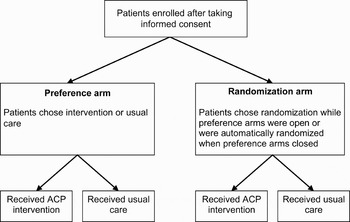
Because of the sensitive nature of ACP, we used a patient preference randomized controlled trial design in which patients could choose whether they would like to receive the ACP discussion in addition to usual care, continue with usual care only (no intervention), or be randomized. Phase II trials of this exploratory nature are not designed to demonstrate effectiveness, and numbers are chosen on pragmatic grounds, usually aiming for a total of 40 in each of the control and intervention arms. This approach is recommended by guidelines from the Medical Research Council on the development and evaluation of complex interventions in healthcare, and has recently been updated (MRC Complex Intervention Guidance, 2000, 2008). Prior to starting recruitment, we decided to limit entry of patients into each of the preference arms of the trial to a maximum of 20, after which both preference arms of the trial were closed and subsequent potential participants were offered only randomization (Figure 1). This resulted in four comparably sized groups: (1) preference intervention, (2) preference usual care, (3) randomized intervention, and (4) randomized usual care. The study was conducted between February 2007 and October 2008 in outpatient oncology clinics in two inner London NHS Trusts and a nearby Marie Curie Hospice. The study received ethical approval from the Royal Free Hospital and Medical School Local Research Ethics Committee.
Study schema – patient preference trial.

Inclusion Criteria
Eligible patients had completed a primary course of treatment for cancer, but still had clinically detectable, active, progressive disease; were considered well enough by the referring health professional to complete the ACP intervention; were >18 years of age; were able to give informed consent; had no psychiatric diagnosis; and had sufficient English language skills.
The ACP Intervention
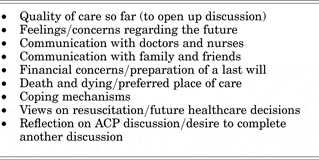
The intervention consisted of a one-to-one conversation with a trained care planning mediator using a checklist of topic domains, derived from phase I work (Barnes et al., Reference Barnes, Jones and Tookman2007). Discussions explored patients' perceptions of their current situation, their communication with health professionals and significant others, and their hopes and fears for the future and about making future healthcare decisions (Table 1). Each discussion lasted up to one hour and two further sessions were offered. In order to ensure that the intervention was patient focused, family members or friends were not invited to attend the initial session, however, they could be present at subsequent sessions if the patient wished. For those who wished to document future healthcare decisions, Living Will documents were used (Terrence Higgins Trust & King's College London, 2000). All discussions were audiotaped and transcribed for thematic content analysis. Results of this analysis are reported in Barnes et al. (Reference Barnes, Barlow and Harrington2011).
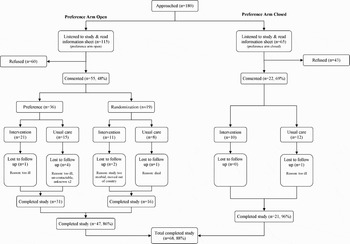
Consort diagram of flow of participants through the trial.

Main domains covered in ACP discussion

The Advance Care Planning Mediator
Informed by the findings from phase I, the two mediators taking part were independent of the clinical team (Barnes et al., Reference Barnes, Jones and Tookman2007), but had significant clinical experience. The first was a research nurse in oncology and palliative care who had been trained in the Department of Health's advanced communication skills course, and the second was an experienced palliative care physician. Both mediators were trained for the study using extensive role play. Neither mediator divulged the nature of their professional backgrounds to trial participants, nor did they at any time give clinical advice.
Procedure
Researchers who were not in any way involved in the care of patients joined pre-clinic meetings where clinical staff briefly discussed patients due to attend. This allowed clinicians to identify patients that met the criteria for inclusion in the study. The researcher then approached patients with a brief outline of the study and gained informed consent to participate. If convenient, the patient completed baseline questionnaires while in the clinic; if not, alternative arrangements were made, usually to visit the patient at home. All data were collected by the same researchers.
For those in the preference and randomized intervention arms, the mediator arranged for ACP discussions to take place at a time and place of the patient's choice. Patients were later contacted by the research team to arrange for the completion of the follow-up questionnaires eight weeks after baseline, either during a home visit or a routine clinic appointment. Patients were recruited from February 2007 to the end of August 2008, with the last follow-up completed eight weeks later.
Randomization and Masking
We randomized participants who had no strong preference for either trial arm after baseline measures had been completed. The trial statistician assembled a randomized sequence of allocations, constrained in blocks of between four and six, in order to keep each trial arm approximately the same size. When a participant in the randomized cohort had given informed consent, the researcher passed their contact details to the care planning mediator who contacted the central administrator. The administrator opened the next envelope in the sequence and informed the mediator of the group allocation. The mediator contacted participants to inform them of their group allocation and arranged the first ACP discussion for those in the intervention group. The study statistician and the researchers were masked to allocation. Patients were asked not to reveal group allocation at follow-up, at which data were collected by the researcher.
Measures
Data Collected at Baseline Only
Demographic details collected were: age, sex, ethnicity, social class, education, religious affiliation, diagnosis, and duration of disease.
Preference scale: Prior to trial arm allocation, patients' preferences were measured on a visual analogue scale (VAS) scored from −5 (strong preference not to receive the ACP intervention) to +5 (strong preference to receive the ACP intervention). 0 was no preference either way.
Data Collected at Baseline and at the 8-Week Follow-up
Measures prepared for the study
As there were no published measures available to assess the outcomes after ACP discussions, we developed 14 statements to which participants could respond using VAS (see Appendix). The content of these measures was informed by the literature, and attempted to reflect pragmatic outcomes that were expected to arise from a discussion-based rather than document-based approach to ACP. We considered that information derived from these measures would inform which areas would be most appropriate to investigate further in a larger trial. We used five statements that concerned the primary outcome, namely discussion with professionals, family, and friends about the future (three concerned discussion with health professionals and two with family and friends). Our secondary outcomes were (1) happiness with the level of communication with health professionals, family and friends (two measured levels of communication with professionals and two with family and friends); and (2) degree of satisfaction with healthcare (five statements). Each statement was scored on VAS 0–10 in the direction of increasing discussion, happiness with communication, and degree of satisfaction.
Standardized measures
The standardized measures used were the Hospital Anxiety and Depression Scale (HADS) (Zigmond & Snaith, Reference Zigmond and Snaith1983), which measures anxiety (seven items) and depression (seven items) with good reliability and validity; and the Karnofsky Performance Status Scale (Karnofsky & Burchenal, Reference Karnofsky, Burchenal and Macleod1949), an observer-rated scale of physical functioning covering 11 points, from normal health to death, scored as a percentage with “normal health” scoring 100% to “death” scoring 0%. It has good reliability and validity (Schag et al., Reference Schag, Heinrich and Ganz1984).
Trial Outcomes
Primary Outcome
Our earlier qualitative work indicated that the primary outcome should be the degree to which participants had discussed end-of-life planning with primary and secondary care professionals, and family and friends.
Secondary Outcomes
Our secondary outcomes were a patient's (1) happiness with the level of communication with health professionals and family or friends, (2) satisfaction with healthcare, and (3) HADS anxiety and depression scores.
Statistical Analyses and Power
The statistical analyses were performed using Stata v. 10.0. Descriptive statistics of all baseline measures were generated stratified (1) by whether patients chose the trial arm or were randomized and (2) by intervention (usual care or ACP). We used Cronbach's α to estimate the internal consistency of VAS scores for each domain (discussion about the future, happiness with communication, and satisfaction with healthcare) and subdomain (professionals vs. family and friends). The scores from the scales belonging to each domain were summed and summary scores were used in the analysis. The distributions of the data were sufficiently normal for parametric tests to be used. Analysis of Covariance (ANCOVA) models of each outcome measure at follow-up (HADS depression and anxiety scores, and VAS domain and subdomain summary scores) were fitted with the baseline score and treatment group as covariates. Further adjustment for possible confounding variables was investigated. Analyses were conducted separately for (1) the randomized cohort, (2) the preference cohorts, and (3) both cohorts combined. Analyses were performed on an intention-to-treat basis. As this trial was exploratory, a formal power calculation was not required. We aimed to recruit 20 participants to each of the preference arms and 40 participants to the randomized cohort. We considered 80 participants would be sufficient to (1) assess whether a larger phase II trial was feasible and (2) examine trends in outcome that would inform the calculation of the sample size required for a main trial.
RESULTS
Response and Patients' Characteristics
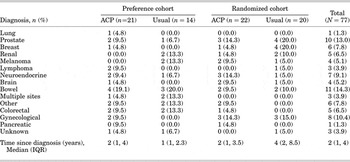
Seventy-seven participants were recruited, 36 into the preference arms and 41 into the randomized arms (Figure 2). Sixty-eight (88%) participants completed follow-up, whereas nine were lost to follow-up (Figure 2). Patients had been diagnosed with a variety of cancers but the most common were bowel (14.3%), prostate (13%), and gynecological (10.4%) (Table 2). Response was higher once the preference arms were closed (Figure 2) and attrition was lower in the randomized than in the preference cohorts.
Patients' diagnoses and time ill by treatment group

Preferences and Characteristics of Patients in Each Trial Arm
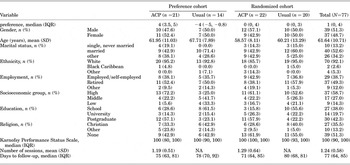
Thirty-eight participants (51%) recorded a preference for receiving the ACP intervention, 26 (35%) recorded no preference, and 11 (15%) recorded a preference for receiving usual care. All participants who preferred a specific trial arm chose to be allocated to that arm, except for one participant who, although preferring the ACP intervention, nevertheless chose usual care. Participants allocated to the randomized cohort had on average no preference for either trial arm. Participants were well balanced on most demographic factors between treatment arms in both the preference and randomized cohorts (Table 3). However, in the preference cohort, those who chose usual care tended to be older, in the low socioeconomic group, and have only school education compared to those who chose the ACP intervention (Table 3). In the randomized cohort, those randomized to usual care had on average been ill for longer (Table 2), and had lower educational attainment than those randomized to the ACP intervention (Table 3).
Summary statistics of baseline demographics by cohort and treatment arm

Intervention
Forty patients, 19 women (47%) and 21 men (53%), median age 60.8 years, completed at least one ACP discussion. Of these, 29 (73%) completed one discussion, 10 (25%) completed two and 1 (2%) completed three discussions. Fifty-two ACP discussions were available for qualitative analysis. Discussions took place in a location of the participants' choice, usually their own homes. Although the average duration was ~1 hour, discussions varied in length from 25 minutes to 2 hours.
Outcomes
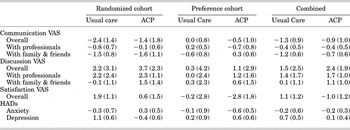
Cronbach's α was >0.6 for all VAS domains and subdomains, indicating sufficient internal consistency for scores to be summed. As expected, the results from the ANCOVA models of treatment effect were not statistically significant; however there were trends in a number of important areas (Table 4).
Mean differences (and standard errors) between baseline and follow-up (follow-up-baseline) VAS domain and subdomain, and HADs scores by cohort and arm

Primary Outcome
Discussion with Professionals and Family and Friends
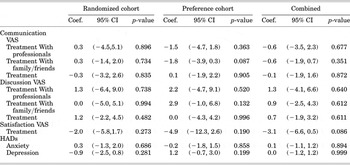
In the randomized cohort, discussion about the future at follow-up was higher in those randomized to the ACP intervention (coefficient of 1.3, 95% CI from −6.4 to 9.0). This appears to be because of more discussion with friends and family, as there was no difference between treatment arms in discussion with professionals. In the preference cohort, discussion about the future was also higher in those who chose the ACP intervention (coefficient of 2.2, 95% CI from −4.7 to 9.1). In contrast to the randomized cohort, this appears to be because of more discussion with professionals, as there was no difference between treatment arms in discussion with friends and family. Combining the two cohorts showed a trend to discussion about the future being higher in those assigned to the ACP intervention.
Secondary Outcomes
(1) Happiness with Communication with Professionals and Family
After adjustment for baseline scores and cohort, there were no major trends in happiness with communication between the ACP and usual care groups at follow-up in the randomized cohort. In the preference cohort however, happiness with the level of communication at follow-up was lower for those who chose the ACP intervention than for those who chose usual care (coefficient of −1.5, 95% CI from −4.7 to 1.8). This appears to be because of lower happiness about communication with professionals, as there was no difference between treatment arms in happiness in communication with friends and family. Combining the two cohorts also showed that those assigned to the ACP intervention were less happy with their communication with others than were those choosing usual care.
(2) Satisfaction with Care
Satisfaction with healthcare at follow-up was lower for those assigned to the ACP intervention in both the randomized and preference cohorts, although the effect was greater in the preference cohort (coefficient of −4.9, 95% CI from −12.3 to 2.6).
(3) Anxiety and Depression
There was very little difference between treatment arms in depression and anxiety scores at follow-up, although depression was slightly higher in the usual care arm of the preference cohort (coefficient 1.2, 95% CI −0.7 to 3.0) (Table 5).
Treatment coefficients of ANCOVA models for effect of ACP intervention over usual care on VAS domains and HADs scores, adjusting for baseline score and cohort (in the combined models), with 95% confidence intervals and p-values

Attrition and Potential Adverse Effects
Nine participants were lost to follow up, three in the randomized cohort. One participant moved away from the area, one died, three became too ill, one was unable to be contacted; one stated that they found the study too “morbid” to continue, and two withdrew for unknown reasons.
DISCUSSION
We have demonstrated that asking patients with recurrent progressive cancer to take part in a trial to evaluate the effectiveness of ACP does not cause undue anxiety or depression, that attrition is low, and that the majority of participants show interest in and preference for the intervention. A recent randomized trial in Australia, which evaluated a list of prompts to encourage cancer patients near the end of life to ask questions about prognosis and end-of-life care, also reported acceptability of such an intervention (Clayton et al., Reference Clayton, Butow and Tattersall2005). Our main barrier to recruitment was the reluctance of clinical staff to introduce the research to patients, because of an understandable wish not to approach patients with a challenging study unless they were sure that patients were not likely to react adversely to the concept of ACP and its implications for future prognosis and care. Although not reaching statistical significance, our primary outcome, participation in discussion about the future (either with health professionals or family and friends), increased in the ACP arms relative to the usual care arms, whether randomized or preference. However, happiness with communication was unchanged or worse and satisfaction with services decreased in the ACP versus the usual care groups. Why might the offer of ACP result in a higher likelihood of having had ACP discussions with professionals but less happiness with communication with those same professionals and lower general satisfaction with healthcare? One possibility is that the ACP discussion raised expectations in the group receiving it, so that they were made aware how much communication might be improved.
There are a number of limitations to our study. Although we achieved our overall sample size, we had fewer participants in the randomized than in the preference arms. Furthermore, attrition was lower in the randomized than in the preference cohorts. This has been reported in other patient preference trials (King et al., Reference King, Sibbald and Ward2000) and confirms that patients who have preferences for one particular intervention in a trial are generally more highly educated and more assertive about their needs (King et al., Reference King, Nazareth and Lampe2005). In this trial we did not record whether patients had returned for further outpatient appointments between the ACP intervention and follow-up, which may have affected their responses to questions on communication with clinicians. The time scale may have allowed for patients with a poorer prognosis to do so, and planned appointments for those less sick may also have occurred, but these data were not collected. Finally, research of this nature is limited in that the intervention occurs in a more standardized and less fluid fashion than any ACP discussions would do in usual clinical practice.
The policy documents regarding ACP in the United Kingdom suggest that ACP should be performed by a professional who usually looks after the patient whether a nurse or doctor in primary care, secondary care, oncology, or the hospice. Patient participants in our phase 1 work advised that ACP should take place over a number of sessions by an appropriately trained professional independent of their usual clinical team, with sufficient time to talk through the issues raised (Barnes et al., Reference Barnes, Jones and Tookman2007). Most participants said that their consultant would not be appropriate, because of time constraints in a clinical setting, and some participants thought that having ACP discussions with their doctor might alter the doctor–patient relationship in which a positive approach to outcomes is usually invested (Barnes et al., Reference Barnes, Jones and Tookman2007). Although we accept that it may seem to be preferable in a real-world setting to enable robust discussions between patients and their clinicians about options and fears for future care, current evidence that this is what patients wish for is lacking.
A recent study looking at barriers to ACP in patients with chronic obstructive pulmonary disease acknowledges that there is a range of complex issues surrounding who should be delivering ACP, and that these issues are not easily addressed (Gott et al., 2009). Our approach is further supported by a study of views of oncology patients in the United States in which only 23% were willing to discuss ACP with their oncologist in contrast to 48% who were prepared to have similar discussions with a physician less directly involved in their care (Dow et al., Reference Dow, Matsuyama and Ramakrishnan2009).
This study has built on earlier work conducted in the United Kingdom (Horne et al., Reference Horne, Seymour and Shepherd2006) by evaluating an ACP intervention in a randomized trial. The considerably larger sample size obtained overall and the substantial number of ACP discussions conducted provides rich data on the ACP process. Our work, however, agrees with Horne's findings that patients' responses to the offer of ACP can be varied and unpredictable.
The response to the study and levels of attrition in the preference and randomized arms suggest that a straightforward randomized trial to evaluate ACP is possible and does not cause distress, and that ACP can be delivered relatively briefly. However, we have shown mixed results in terms of our three main outcomes, which fact limits our ability to recommend suitable measures for assessing outcome in further work. Most important, discussion about the future tended to be more frequent at follow-up in patients randomized to the intervention. Given that the mean score on VAS for discussion in the randomized usual care arm at outcome was 34 (SD = 6), in order to demonstrate a two-point advantage for ACP at 90% power and a 5% level of significance in a phase III randomized trial we would require ~190 patients in each arm. However, since this work was conducted, a number of new outcome instruments have been published, which might be used as standardized measures to address in more detail some of the outcomes that this trial attempted to capture (Heyland et al., Reference Heyland, Allan and Rocker2009; Mack et al., Reference Mack, Block and Nilsson2009; Melbourne et al., Reference Melbourne, Sinclair and Durand2010; Schiff et al., Reference Schiff, Shaw and Raja2009). Although guidance for ACP is currently available (NHS, 2008; Royal College of Physicians, 2009), our work provides new evidence, both to underpin any future policy documents and to challenge widely held assumptions in this area.
ACKNOWLEDGMENTS
The authors thank Karon Ornadel for her role as an advance care planning mediator, Marilyn Jones of the North London Cancer Partnership Group for her contribution to study design, and the clinicians who referred patients for this study. We also express gratitude to the patients who generously volunteered to participate in this work during a difficult time in their lives. L.J., A.T., K.B., and M.K. were responsible for study concept and design. L.J., A.T., K.B., and M.K. secured the funding. J.H. and C.B. liaised with the consultant oncologists, recruited and gained written informed consent from the patients, collected the data, and managed the trial on a daily basis. K.B. was one of two advance care planning mediators. R.D. performed the statistical analysis and interpretation of the results. L.J., J.H., and R.D. produced the first draft of the manuscript. L.J., J.H., C.B., A.T., R.D., K.B., and MK contributed to subsequent revisions. Critical revision of the manuscript for important intellectual content was done by all authors. Final approval of the article was done by all authors. All authors had full access to the data and can take responsibility for the integrity of the data and the accuracy of the data analysis. L.J. is the guarantor. This research was supported by a grant from Dimbleby Cancer Care. The research team were independent from the funders.