Introduction
Erectile dysfunction (ED) is a significant public health issue affecting the quality of life of millions of predominantly older men and their partners in the U.S.A. (NIH Consensus Panel on Impotence, 1993) and internationally (Prins et al., Reference Prins, Blanker, Bohnen, Thomas and Bosch2002). Age-associated medical problems, such as diabetes, prostate cancer, and vascular problems increase risk of ED (Rosen et al., Reference Rosen, Wing, Schneider and Gendrano2005). Because these medical issues increase with age, many older adults are susceptible to reduced ability to obtain and maintain erections (Hackett, Reference Hackett2009).
According to the 2000 U.S. Census, two-thirds of men aged 65 years or older were military Veterans, with a total of 9.7 million older Veterans in the U.S.A and Puerto Rico (U.S. Census Bureau, 2000). The Veteran population in particular is at high risk for ED because many are older and have multiple medical and psychiatric problems (Shabbir et al., Reference Shabbir, Mikahilidis and Morgan2004). In one study, Veterans seeking treatment for sexual dysfunction from 1990 to 1996 were characterized as predominantly older, medically ill, and more likely to be prescribed a medical treatment, such as medication or a vacuum constriction device compared with other treatment options such as psychotherapy (Beaudreau et al., Reference Beaudreau, Litz and Kaufman2000). Because the focus of that study was to describe the typical patient and provide recommendations for the operation of an andrology clinic, it did not provide a systematic analysis of the effects of age differences on specific psychological and medical diagnoses, psychosocial and health behaviors, and endocrinological data.
Some research suggests that older Veterans seeking treatment for sexual dysfunction may be at decreased risk for psychiatric problems compared with middle-aged cohorts. According to a recent literature review, distress commonly associated with sexual dysfunction was less prevalent among older individuals (Derogatis and Burnett, Reference Derogatis and Burnett2008). Moreover, in a nationally representative survey of Vietnam Veterans, mental health problems were less frequent in older compared with middle-aged Veterans (Brooks et al., Reference Brooks, Laditka and Laditka2008). To date, we are unaware of any studies that have compared age differences in the prevalence of psychiatric issues among male Veterans seeking treatment for sexual dysfunction. We are also unaware of studies examining age differences in the frequency of sexual activity of Veterans and provision of formal treatment recommendations for Veterans seen at andrology clinics. Although focused on American military Veterans, these data may also be informative about the international community of older adults seeking treatment for their sexual problems.
Using clinic data collected over a 21-year period, we examine the age-related clinical characteristics and treatment outcomes of a predominantly middle-aged to older cohort of male patients seen as part of a national health care system for military Veterans. We also provide clinical recommendations for providers working alone or as part of an interdisciplinary team with older Veterans.
Methods
Participants and procedure
In this retrospective cohort study, with prior Institutional Review Board approval from both the Palo Alto Veterans Affairs (VA) Medical Center and Stanford University School of Medicine, we conducted an extensive chart review of 1,315 male Veterans seeking treatment for erectile dysfunction between 1982 and 2003 at the Palo Alto VA Andrology Clinic. The VA Andrology Clinic was an interprofessional clinic which focused, from the initial visit, on a comprehensive evaluation of the patient and the presenting complaint, most frequently ED. Typically, at the initial visit a patient would receive a comprehensive physical examination, a review of laboratory findings (including an endocrine panel, usually completed in advance of the visit), and a psychosocial review of the presenting complaint and its history. The presence or absence of medical and psychiatric disorders was based on current clinical diagnoses listed in the patient's health record. Of this sample, 1,250 participants completed a comprehensive, face valid, semi-structured interview with a psychology intern (supervised by a licensed psychologist) or with a licensed psychologist during the initial clinic visit. Performance anxiety was assessed as part of the semi-structured interview; final determination of the performance anxiety was based on clinical judgment of the clinician conducting the interview. The interprofessional treatment team determined a DSM sexual diagnosis (American Psychiatric Association, 1980; 1994) and treatment plan through comprehensive evaluation of both physical and psychological findings.
Statistical analysis
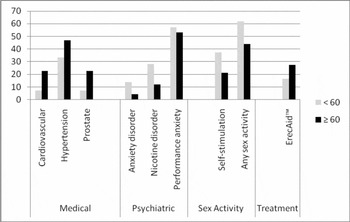
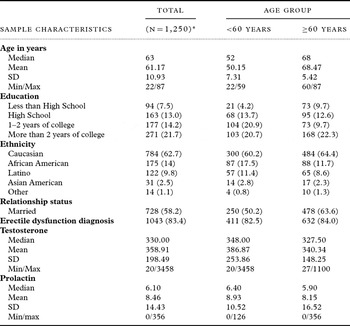
Analyses were conducted in SPSS 16.0 (SPSS Inc., Chicago, IL). Age was categorized into “middle-aged” and “older” using a median split of 60 years in the descriptive statistics (see Table 1 and Figure 1), but entered as a continuous variable in the regression models. We conducted five simultaneous linear regressions, grouping common variables by domain in each of the analyses: medical and endocrine risk factors; psychiatric and psychosocial risk factors; engagement in sexual behaviors; self-reported and objectively measured erectile function; and treatment recommendations. To decrease the risk of a Type 1 error, we used a conservative α of p < 0.01 before regressing the variables on age (in years), our dependent variable.
Age differences in medical, psychiatric, sexual behavior and treatment variables associated with erectile dysfunction (results are in percentages).

Descriptive data for men seeking treatment for erectile dysfunction

Note: Results for categorical variables are reported as N (%). Age is categorized using a median split of 60 years in these descriptive analyses only, but was entered as a continuous variable in the five regression models.
* Descriptive statistics are based on smaller sample sizes for education, ethnicity, relationship status and erectile dysfunction due to missing data.
Results
Demographics
As shown in Table 1, participants were generally older (median age = 63.0 years, SD = 10.9), in a relationship (58.2%), high school or college educated (48.9%), and Caucasian (62.7%). Erectile dysfunction was the predominant diagnosis (83.4%).
Regression analyses
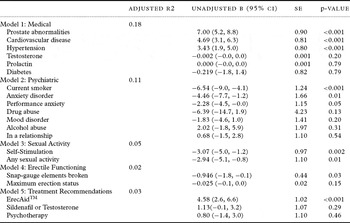
As shown in Figure 1, medical and psychiatric comorbidities were common among both middle-aged and older patients. Linear regression models are shown in Table 2. Results for the five regression models are shown in Figure 1.
Linear regression models for variables associated with age in men with erectile dysfunction

Note: Statistical significance set at p < 0.01.
Medical comorbidity
Despite a high degree of medical comorbidity in patients of all ages, Model 1 indicated that older patients presented more often with several medical risk factors for ED (F = 26.48, df = 6, 711, p < 0.0001); in order of significance, these were prostate abnormality (t [717] = 7.78, p < 0.0001), cardiovascular illness (t [717] = 5.82, p < 0.0001), and hypertension (t [717] = 4.29, p < 0.0001). Levels of testosterone, levels of prolactin, and the presence of diabetes were not significantly associated with age. Values for testosterone and prolactin for the total sample and by middle-aged vs. older are presented in Table 1.
Psychiatric and psychosocial risk factors
In Model 2, younger (middle-aged) Veterans seeking treatment for ED were more likely to have specific psychiatric risk factors for ED (F = 8.24, df = 7,386, p < 0.0001): nicotine abuse disorder (t [393] = −5.26, p < 0.0001), an anxiety disorder (t [393] = −2.69, p = 0.007), or performance anxiety (t [393] = −1.98, p = 0.048). No age differences were found for illegal drug or alcohol abuse, mood disorders, or relationship status.
Engagement in sexual behavior
Regarding sexual behaviors in Model 3, middle-aged Veterans endorsed having engaged in a sexual behavior during the past month (yes/no) more often than older Veterans (F = 20.35, df = 2,727, p < 0.0001): self-stimulation (t [729] = −3.17, p =0.002) and any sexual activity (t [729] = −2.70, p =0.007).
Erectile functioning
In Model 4, erectile functioning was significantly associated with age (F = 1.56, df = 2,363, p = 0.006). Specifically, older adults obtained less firm erections compared with middle-aged Veterans on an objective measure of nocturnal penile tumescence (number of snap-gauge elements broken during the night), (t [365] = −2.14, p = 0.03). Despite this objective difference, however, the percentage of self-reported maximum erection during self-stimulation or during manual, oral or genital stimulation with a partner did not significantly differ between older and middle-aged Veterans.
Treatment recommendations
With regard to age differences in clinical treatment recommendations in Model 5 (F = 6.79, df = 3,526, p < 0.0001), older patients were more likely to be prescribed a vacuum constriction device (ErecAid™) compared with middle-aged patients (t [529] = 4.50, p < 0.0001). Clinician recommendations for Sildenafil/testosterone, or sex therapy were not significantly associated with age in the model, despite age differences in medical and psychiatric risk factors, and sexual activity.
Discussion
These results provide evidence of unique age-related presenting issues and treatment needs of a large cohort of male patients seeking treatment for sexual dysfunction through an andrology specialty care clinic. Consistent with previous investigations, some medical risk factors were more common in older patients compared with middle-aged patients (Beaudreau et al., Reference Beaudreau, Litz and Kaufman2000). Specifically, prostate problems, cardiovascular illness, and hypertension were more common in older patients. Psychiatric risk factors, such as nicotine abuse, performance anxiety and anxiety disorders, were less common in older patients than in middle-aged patients. Although patients of all ages benefit from an interdisciplinary team approach to the treatment of male sexual dysfunction, our findings suggest that older patients in particular may benefit from screening and treatment for prostate problems and hypertension if they are not already treated for these conditions. Among middle-aged Veterans, a particular focus on smoking cessation or relaxation skills to reduce current anxiety might be warranted beyond the psychiatric interventions typically provided to these patients.
Regardless of age, the majority of patients were in a relationship at the time of treatment (58.2%); thus therapeutic approaches for couples are relevant for the majority of patients seeking treatment for ED.
Consistent with prior studies (Araujo et al., Reference Araujo, Mohr and McKinlay2004; Ginsberg et al., Reference Ginsberg, Pomerantz and Kramer-Feeley2005), older adults reported less frequent self-stimulation and sexual activity compared with middle-aged adults. This fits with previous research demonstrating that middle-aged adults view self-stimulation as a more acceptable sexual activity compared with older adults (DeLamater and Moorman, Reference DeLamater and Moorman2007). Psychoeducation aimed at normalizing the choice to engage or not engage in self-stimulation may be particularly useful for older patients. The benefits of self-stimulation should also be reviewed for those willing to discuss this option, as many new treatments, such as the ErecAid™ pump, require practice for successful use.
Despite age differences in erectile functioning on an objective measure of nocturnal tumescence, older adults did not report significantly less maximum erectile capacity than middle-aged Veterans across sexual contexts alone or with a partner. The lack of significant results may be due to adjusted expectations about erectile ability in older adults due to more chronic problems with erectile dysfunction, or alternatively, higher expectations among middle-aged adults for strong natural erectile capacity.
Older men in our study, many of whom take multiple medications and have multiple medical problems, may have been recommended the vacuum pump more often compared with middle-aged men because it has fewer negative side effects (Chen et al., Reference Chen, Mabjeesh and Greenstein2001) and contraindications (Fazio and Brock, Reference Fazio and Brock2004) compared with pharmacological treatments.
Strengths of this study include its large sample size and diverse age representation. These results are likely to generalize to middle-aged and older adults with multiple medical and psychological comorbidities who seek treatment for erectile dysfunction, but they may not generalize to non-treatment seeking men. This study is also limited to retrospective data collected over 21 years; variability among providers over this timeframe and the limitations inherent in using retrospective rather than prospective data apply to this study. Cut-scores for diagnosing hypertension remained consistent over this timeframe – 140/90 mm Hg based on the Joint National Committee on Detection, Evaluation, and Treatment of High Blood Pressure (JNC) guidelines (1984; 2003); however, more cases of hypertension may have been identified during the late 1990s onward as physicians from VA and other settings started diagnosing hypertension at lower cut-offs in patients with other medical comorbidities, such as diabetes or cardiovascular disease. In addition, it is possible that fewer hypertension cases were identified in the earlier years of the clinic data due to historical differences in instrumentation, such as manual vs. automatic blood pressure readings or other differences in JNC guidelines.
Many of our older patients were World War II Veterans utilizing clinic services during the 1980s and early 1990s, whereas middle-aged patients were typically from the Vietnam Veteran cohort seen in our clinic during the 1990s or later. Due to these service utilization patterns and the cross-sectional design, age and cohort differences cannot be dissociated. Additionally, many of the Veterans in this study have a history of combat service and may have subsequent psychiatric risk factors (e.g. depression, anxiety, or post-traumatic stress disorder) less often seen in civilian older adults. Results from analyses on treatment recommendations must also be interpreted with caution because the only physiological treatment available for the early cohort of patients was ErecAid™. Sildenafil was not available until 1998, when it clearly established a new approach to physiologically based treatment. In addition, because the study is cross-sectional, significant associations should not be interpreted as causal. Longitudinal studies are needed to determine how patient characteristics, sexual functioning, or treatment options change over time. Sophisticated physiological measures of sexual functioning, such as penile blood flow and response to arousal, would further enhance this longitudinal research.
In conclusion, these results illustrate that sexual needs are important to adult men regardless of age. In spite of declining erectile capacity, the ability to engage in sexual activity in later life is often intact at some level and is often a concern for the older adult presenting for treatment of ED. As such, it should be addressed and treated in patients who present with sexual difficulties. These results are important as they may serve to clarify the treatment needs of older and middle-aged Veterans who seek help for ED. Although older Veterans are more likely to have medical risk factors for ED compared with middle-aged Veterans, we urge health care providers working with older adults to consider psychoeducation and individual or couples therapy, as well as physiological interventions.
Conflict of interest
None.
Description of authors’ roles
S. Beaudreau designed the study, supervised data management, conducted the statistical analysis and wrote the paper. T. Rideaux managed the data and contributed to writing the paper. R. Zeiss contributed to the writing of the paper.
Acknowledgments
The writing of this paper was partly supported by the Office of Academic Affiliations, VA Advanced Fellowship Program in Mental Illness Research and Treatment, Department of Veterans Affairs.