Introduction
Cardiac rhabdomyoma, a benign hamartomatous tumour of striated muscle, is the most common childhood primary cardiac tumour, accounting for approximately 70% of cases. Reference Verhaaren, Vanakker, De Wolf, Suys, François and Matthys1 Rhabdomyomas typically reach their maximal size in fetal life and often regress spontaneously after birth, likely due to decreasing postnatal oestrogen levels, with complete disappearance reported in approximately 50% of cases. Fetal cardiac rhabdomyomas are associated with tuberous sclerosis in 43–60% of cases, and tuberous sclerosis is diagnosed in most cases of multiple fetal cardiac rhabdomyomas. Reference Ekmekci, Ozkan, Yildiz and Kocakaya2
Although the majority are asymptomatic, a significant proportion develop symptoms or haemodynamic compromise depending on the size, number, and location of rhabdomyomas. Complications include intracardiac obstruction (35%), arrhythmias (16%), heart failure (10%), and, rarely, sudden death (11%). Spontaneous regression becomes less common with age. Complete resolution beyond two years of age is rare, and approximately 22% of patients older than four years have persistent tumours. Reference Chen, Wang and Zhang3 Cardiac rhabdomyomas are most often diagnosed in fetal life or infancy and frequently undergo spontaneous regression; however, occasionally persistence into adolescence or adulthood has been described, with lesions identified incidentally or following presentation with arrhythmia or cardiac obstruction. Reference Aktoz, Tatli and Ege4–Reference Nati-Castillo, Quintero, Molina, Arias-Intriago, Melgar Muñoz and Izquierdo-Condoy6
Dysregulation of the mammalian target of rapamycin signalling pathway is central to tuberous sclerosis pathobiology and drives the formation of hamartomas in multiple organ systems. Mammalian target of rapamycin inhibitors such as sirolimus and everolimus suppress the mammalian target of rapamycin pathway and are approved for tuberous sclerosis-associated subependymal giant cell astrocytomas and renal angiomyolipomas. Reference Franz, Belousova and Sparagana7–Reference McCormack Francis, Yoshikazu and Joel9 Their use in cardiac rhabdomyomas has expanded in recent years, with case reports and small series demonstrating rapid tumour shrinkage, improvement in obstruction and arrhythmias, and reduced need for surgical intervention. Reference Kotulska, Larysz-Brysz and Grajkowska10 However, the optimal treatment duration, response to therapy, and recurrence patterns after discontinuation are poorly defined. Therefore, we conducted a retrospective study evaluating treatment response, arrhythmia outcomes, recurrence patterns, and safety of sirolimus in symptomatic neonates and infants with cardiac rhabdomyoma.
Methods
Following approval from the Institutional Ethics Committee (AIIMSA2037/06.09.2024), the medical records were screened for patients with cardiac rhabdomyoma. Infants with echocardiographically confirmed cardiac rhabdomyoma with symptoms or tumour-related haemodynamic compromise were included. Haemodynamic compromise was considered present in the presence of any of the following: left or right ventricular outflow tract obstruction with a gradient >20 mmHg, ventricular dysfunction, heart failure, or life-threatening arrhythmias. Infants with a large tumour (>20 mm) were also included. Patients without symptoms or haemodynamic compromise were excluded. Data collected included demographics, tuberous sclerosis genetic status, clinical presentation, imaging, details of sirolimus therapy, and outcomes.
Sirolimus was started at a dose of 1 mg/m2/day taken orally, with the dose adjusted to keep a serum trough level of 5–15 ng/mL. Baseline evaluation included electrocardiography, echocardiography, blood investigations, and genetic testing for TSC1/TSC2 mutations. On follow-up, patients underwent complete blood count, lipid profile, liver and renal function tests, electrocardiography, and echocardiography. The echocardiography was performed monthly for the first three months and then once every three months. Sirolimus levels were measured on day 4, day 15, and day 30, followed by monthly assessments up to three months and then every three months. The adherence to sirolimus therapy was monitored by clinical follow-up and serum sirolimus levels.
Sirolimus was discontinued once the tumour regressed by more than 75% of the original size, along with resolution of arrhythmia, normalisation of left ventricular function, and substantial relief of intracardiac obstruction. The patients were subsequently monitored clinically with echocardiography every three months to detect any recurrence of symptoms or tumour regrowth. The time at which sirolimus therapy was stopped was considered the final follow-up.
Definitions
Tumour regression was defined as a decrease of >50% in the maximal diameter of the largest tumour compared with its baseline size while on sirolimus therapy. Tumour disappearance was defined as complete echocardiographic resolution of the tumour. Complete clinical response was defined as resolution of all tumour-related haemodynamic and rhythm abnormalities present at baseline in a given patient, including any combination of shock, right or left ventricular outflow tract obstruction, heart failure, and clinically significant arrhythmias, without the need for surgical or catheter-based intervention. Tumour recurrence was defined as regrowth of the largest tumour to >50% of its baseline diameter after discontinuation of sirolimus.
Statistical analysis
Data was collected in a predefined proforma. The variables were recorded in a Microsoft Excel sheet and were exported to IBM SPSS v23 software (IBM, Armonk, NY, USA) for analysis. Continuous variables were summarised as mean ± standard deviation or median (range), and categorical variables as counts and percentages.
Results
Patient characteristics
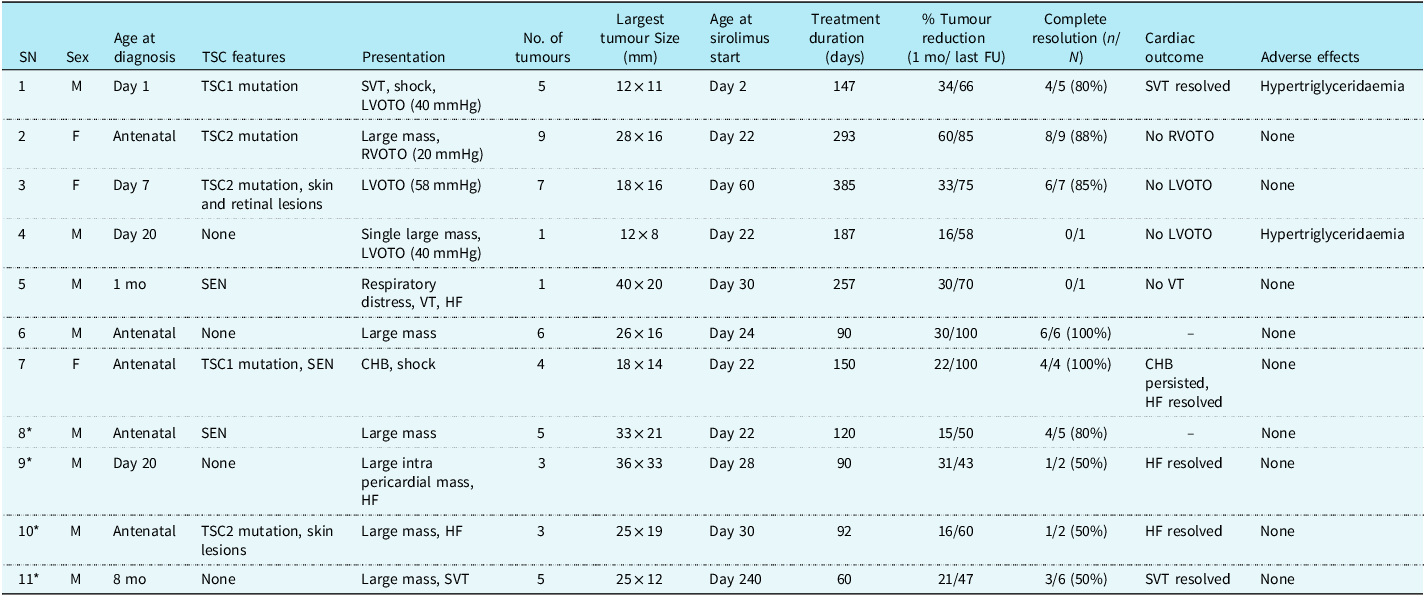
A total of 11 patients (9 neonates and 2 infants) were treated with sirolimus (Table 1). In five patients, cardiac rhabdomyoma was diagnosed during the antenatal period. Five patients had genetic confirmation of tuberous sclerosis, while five others had non-cardiac features of tuberous sclerosis (seizures, ash leaf macules, retinal hamartomas, and subependymal nodules). Sirolimus therapy was started for heart failure (n = 5), ventricular outflow tract obstruction (n = 4) (Supplementary Figure 1), arrhythmias (n = 4), or a large tumour (n = 7) (Supplementary Figure 2). Two patients had supraventricular tachycardia with pre-excitation (Figure 1A), while one had ventricular tachycardia (Figure 1C). One neonate had complete heart block.
Electrocardiogram of case 1 at presentation (Panel A) showing short PR and pre-excitation, best seen in leads I, III, aVL, and aVF, which normalised at 1 month of follow-up (Panel B). Panel C shows a 12-lead ECG of case 5 showing ventricular tachycardia with superior axis and right bundle branch block morphology, indicating its origin from the posteromedial papillary muscle or left posterior fascicle of the left ventricle, matching the location of cardiac rhabdomyoma.

Patient characteristics, clinical and management details (n = 11)

CHB = complete heart block; FU = follow-up; HF = heart failure; LVOTO = left ventricular outflow tract obstruction; RVOTO = right ventricular outflow tract obstruction; SEN = subependymal nodules; SVT = supraventricular tachycardia; AVRT = atrioventricular reentrant tachycardia; TSC = tuberous sclerosis complex; VT = ventricular tachycardia.
* Sirolimus therapy is ongoing.
Rhabdomyoma size and distribution
All patients had multiple masses, predominantly in the left ventricle, interventricular septum, or right-sided chambers. All but one patient had at least one mass in the left ventricle. One patient (case no. 9) had the tumour located at the left ventricular apex, mimicking a pericardial mass, which was later diagnosed on MRI as rhabdomyoma with pericardial extension (Figure 2). Concurrent brain MRI in this patient revealed multiple subependymal nodules, consistent with tuberous sclerosis complex.
Echocardiographic image from case 9, in apical four-chamber view (Panel A) and parasternal short axis view (Panel B) showing 2 unusually located hyperechoic, homogenous masses (*) adjacent to the LV free wall and apex, mimicking a pericardial mass. Panel C showing regression of masses with sirolimus at 2-month follow-up. Panels D, E, F show cardiac MRI from case 9 demonstrating two masses in the lateral aspect of the LV apex. The masses were isointense on the T1-weighted image (Panel D) and mildly hyperintense on the T2-weighted image (Panel E), with no late gadolinium enhancement (Panel F). These findings are characteristic of rhabdomyoma. LA = Left Atrium; LV = Left Ventricle; RA = Right Atrium; RV = Right Ventricle.

Sirolimus therapy and monitoring
Sirolimus therapy was started at a mean age of 19.4 ± 8.9 days (1 day to 8 months). The mean therapy duration was 215 ± 103 days, with the longest being 385 days. Therapeutic sirolimus levels were achieved in all patients, with a mean trough level of 10.6 ± 4.4 ng/mL. The mean time to achieve complete clinical response was 19.3 ± 3.98 days of sirolimus therapy. All except 1 patient with complete heart block, who did not come for review after 3 months, were on regular follow-up.
Outcome
The baseline mean largest tumour size was 19.4 ± 6.3 mm (maximum 36 mm), which was reduced by 6.9 ± 4.7 mm (32%) at 1 month, 9.9 ± 3.7 mm (51%) at the second follow-up, and 15.4 ± 6.8 mm (77%) at the final follow-up. The mean largest tumour size at final follow-up was 7.2 ± 5.7 mm. The mean number of tumours that disappeared was 2.14 ± 1.95 (32%) at first follow-up, 3.71 ± 2.91 (52%) at second, and 3.71 ± 2.75 (64%) at final follow-up.
In infants with left ventricular or right ventricular outflow tract obstruction, the obstruction resolved at the first follow-up (Supplementary figure 1). The pre-excitation as well as arrhythmias resolved with sirolimus therapy (Figure 1A and B). The neonate with complete heart block showed no improvement but was asymptomatic and had a ventricular rate of 84/min. Hence, pacemaker implantation was deferred. This child did not visit after the first 3 months of follow-up.
Three children experienced tumour regrowth to 75% of the baseline tumour size 9 months after stopping sirolimus. Notably, the case with ventricular tachycardia (case no. 5) had a recurrence of tumour as well as arrhythmia, requiring cardioversion and oral amiodarone therapy. All patients responded favourably to re-initiation of sirolimus therapy, with a >25% reduction in tumour size after 3 months of the re-initiation of sirolimus therapy. Two patients developed transient hypertriglyceridaemia, which was successfully managed by reducing the sirolimus dose by 15%. No other adverse effects or organ dysfunction were noted.
Discussion
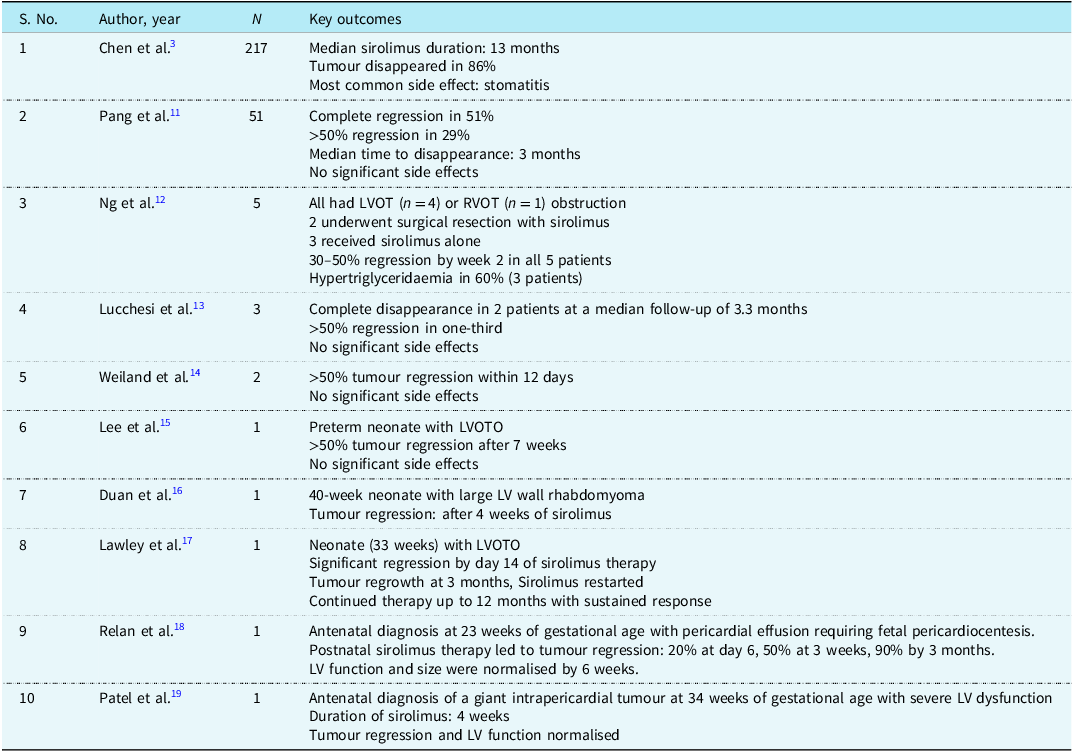
Cardiac rhabdomyomas in tuberous sclerosis exhibit increased mammalian target of rapamycin signalling, providing a biologic rationale for targeted mammalian target of rapamycin inhibition. Reference Kotulska, Larysz-Brysz and Grajkowska10 Accordingly, mammalian target of rapamycin inhibitors such as sirolimus and everolimus have been used to exploit this vulnerability and have demonstrated beneficial effects, including tumour regression and improvement in obstruction-related and arrhythmia-related clinical sequelae. While studies comparing sirolimus and everolimus are lacking, both medications seem to have similar efficacy. Reference Chen, Wang and Zhang3,Reference Ng, McGuinness and Prendiville12,Reference Sugalska, Tomik, Jóźwiak and Werner20 The efficacy of sirolimus, a potent mammalian target of rapamycin inhibitor, mirrors its benefits in other tuberous sclerosis-related tumours. Reference Franz, Belousova and Sparagana7 Our findings of 77% average tumour size reduction and 64% complete resolution align with prior reports (Table 2). We prefer sirolimus for its lower cost, easy availability of the drug, and serum level monitoring. Sirolimus is metabolised in the liver and intestine by the cytochrome CYP3A4 enzyme system. Reference Li, Zhan and Wu21 Sirolimus is primarily eliminated through bile, with only a small portion (approximately 2–5%) being excreted unchanged in the urine. While well tolerated in the majority, careful dose adjustment is critical in neonates due to immature CYP3A4 metabolism, with activity 30–40% compared to infants, children, and adults. Reference Serio, Gattoline, Collier and Bustin22 Monitoring sirolimus levels and lipid profiles is essential. Reference Lucchesi, Chiappa, Giordano, Mari, Genitori and Sardi13–Reference Duan, Sundararaghavan, Koh and Soh16
Case series and case reports of sirolimus use in cardiac rhabdomyoma
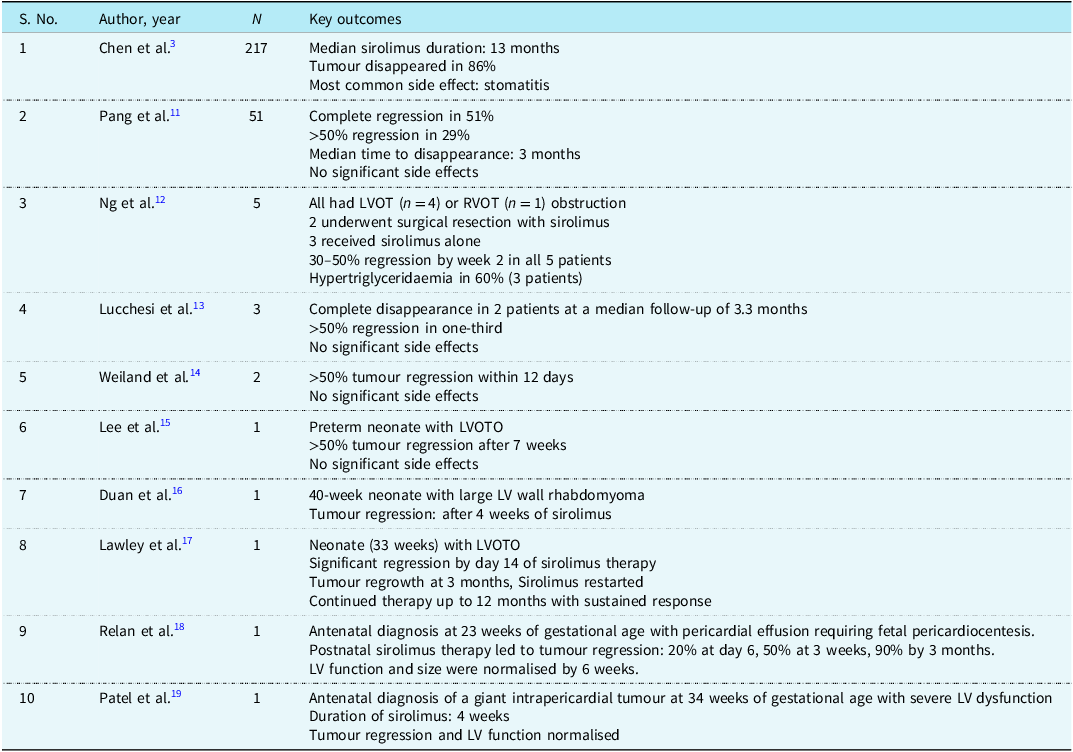
Tumour regression was evident within weeks, emphasising its utility in urgent clinical situations. Only two (18%) patients developed mild hypertriglyceridaemia, which normalised following a reduction in sirolimus dosage. This observed rate is notably lower than that reported in previous studies, where hypertriglyceridaemia has been documented in up to 60% of infants. Reference Ng, McGuinness and Prendiville12 None of the patients had any other adverse effects, such as stomatitis, hypercholesterolaemia, neutropenia, infections, or transaminitis.
Cardiac rhabdomyoma is known to cause a variety of arrhythmias even in adulthood. Reference Ng, McGuinness and Prendiville12,Reference Lee, Song, Cho, Choi, Ma and Cho15,Reference Nir-David, Brosilow and Khoury23–Reference Hofmann, Syrbe and Hebe26 Pre-excitation is the most common mechanism, seen in 80% of patients with arrhythmia. Reference Wacker-Gussmann, Strasburger, Cuneo, Wiggins, Gotteiner and Wakai25 In a series of 106 rhabdomyoma cases reported by Miyake et al., Reference Miyake, Del Nido and Alexander27 clinically significant arrhythmias were identified in 17 (16%) patients. These include ten patients with manifest pre-excitation, 6 patients with ventricular tachycardia, three patients with ectopic atrial tachycardia, and 2 patients with supraventricular tachycardia (due to a concealed pathway). The anti-arrhythmic benefit of sirolimus is likely due to the elimination of tumour-mediated accessory pathways and electrophysiologically stabilising tumour-affected myocardium.
Regrowth after discontinuation of sirolimus has been reported, but the majority remain asymptomatic. Reference Lawley, Popat, Wong, Badawi and Ayer17,Reference Sugalska, Tomik, Jóźwiak and Werner20 Most clinicians discontinue sirolimus after relief of obstruction or symptoms or after a 50–70% reduction in tumour size. Reference Ng, McGuinness and Prendiville12,Reference Winkie, Gelman, Verhoeven and Chaudhuri28 However, current literature lacks consensus on optimal treatment duration, with most reports suggesting 3 to 24 months. Reference Chen, Wang and Zhang3,Reference Lucchesi, Chiappa, Giordano, Mari, Genitori and Sardi13,Reference Dong, Li, Xu, Han and Zheng29 In some cases, especially with recurrence of arrhythmia and outflow tract obstruction, re-initiation of sirolimus is warranted. The exact mechanism of this regrowth is not well understood. Three (27%) patients in our case series had tumour regrowth after stopping sirolimus, warranting re-institution of sirolimus therapy. The risk of recurrence mandates long-term monitoring after discontinuation of sirolimus therapy.
Limitations
This retrospective study is limited by its small sample size, absence of a comparator arm, and non-uniform duration of sirolimus therapy.
Conclusion
Sirolimus is safe and effective for the management of symptomatic cardiac rhabdomyoma in infants, producing rapid clinical improvement and tumour regression. Tumour regrowth after stopping therapy requires long-term monitoring. More studies are needed to determine the optimal duration of therapy and follow-up.
Supplementary material
The supplementary material for this article can be found at https://doi.org/10.1017/S1047951126113286.
Acknowledgements
None.
Author contribution
AH and SK contributed equally as co–first authors. NVF helped in data collection. LK performed the statistical analysis and assisted in data interpretation. PJ provided cardiac radiology expertise, interpreting imaging findings and contributing to image-based analysis. SR contributed to patient management and critical review of the manuscript. SKG served as the principal investigator overseeing the project, supervising clinical management, and coordinating manuscript preparation and submission.
Financial support
This research received no specific grant from any funding agency, commercial or not-for-profit sectors.
Competing interests
None.
Author’s statement
Consent for publication of images was granted by the patient’s parents.