Late in life, after establishing himself as an ardent critic of the steam era, Joseph Conrad came to love the power of oil. Consider a letter from 1913 in which Henry James congratulated Conrad on acquiring a used Cadillac. James described the automobile, nicknamed “the puffer” by the Conrad family, as “the most dazzling element for me in the whole of your rosy legend.”Footnote 1 Conrad took to driving through his neighborhood at Kent with visitors who recounted his love for the road in no less evocative terms. “I got into flivver [or cheap vehicle],” another acquaintance recalled. “It was not acting well. Conrad at the wheel … jabbing levers of the machine that went this way and that and seemed more inclined to go eastern than forward, was a revelation.”Footnote 2 The ensuing decade saw Conrad acquire a procession of even more lavish vehicles including a Ford Model T, Daimler, Humber, Studebaker, and Panhard, which he drove at then-alarming speeds of sixty miles per hour. These purchases confirmed Conrad's status as a novelist belatedly pursuing the good life that had long eluded him. Insofar as Conrad understood his age as “an age of mechanical propulsion, of generated power,” as he wrote in 1912, the displays of petroleum power marked his status at its zenith.Footnote 3
Such a triumphal understanding of Conrad's creative “legend,” however, remains hard to square with the orientations of his fiction. It is true that Conrad's embrace of car culture was widely shared among affluent Edwardians at the time.Footnote 4 But the enthusiasm seems surprising given the political commitments of fictions like Lord Jim (1900–1901), Heart of Darkness (1899), and Nostromo (1904), which recoil against the excesses of modern resource removal and particularly lament the Global North's dependencies on coal. Again and again, his fictions decry an advancing steam era while memorializing an antiquated age of wind, as Allen MacDuffie and Jessie Oak Taylor have observed.Footnote 5 Against the turn to “mechanical propulsion” in industrial culture, which darkened London's skies and augured a waning of older seafaring rituals, Conrad's novels nostalgically affirm the craft of sailing that typified his youth with the merchant marine. Yet notwithstanding these commitments, in his twilight years Conrad celebrated his accomplishments by joining the Royal Automobile Club, becoming a card-carrying member of the new technocultural elite. Having long reviled the coal age, Conrad crowned his ascendancy as a novelist by learning to love oil.
We see in Conrad's passion the outlines of a larger logistical transformation in British politics, as administrators identified foreign petroleum as an alternative to the nation's domestic coal beds. Heading the Admiralty in 1912, Winston Churchill converted the navy to oil-fired warships, initiating a sequence of policies that historians have dubbed Britain's “fateful plunge” into oil.Footnote 6 Churchill's mandate marked petroleum's emergence as an indispensable geopolitical resource, as it required a stable supply chain to be built across the modern world system. At this juncture, reserves of overseas oil became vital to the nation's defense and economic security, forming an equation between petroleum and political power that has only intensified in our own era of waning oil reserves and what Michael Klare calls “the race for what's left.”Footnote 7 The age of hydrocarbon power, however, has yet to be understood through the transformations in Victorian culture that created its possibility. Virtually without exception, narratives about the rise of British oil emphasize a handful of watershed events: the outcomes of technological cunning (diesel-driven engines), imperial prospecting missions (gushers in the Middle East and the Caucasus), and official edicts (Churchill's fateful plunge), presented as epochal actions of the few.Footnote 8 But these explanations have blocked an account of oil's historical incipience in nineteenth-century culture. The story of the less dramatic transformations that fostered the Anglo-oil trade remains untold from the vantage of writers who imagined petroleum as alluringly like coal but better: cleaner, more concentrated, and more portable than conventional carbon fuels. While extolling petroleum's virtues, moreover, these writers stopped short of embracing it as an absolute alternative to coal and projected a range of now negated social futures.
Conrad's freewheeling love of oil, I argue, reflects a shared conceptual transition in Victorian Britain when one future fuel gained significance in ideologically productive relation to the old. In developing this claim, I advance a method of reading attuned to the Victorian preconditions of the petro-era: a set of interpretive practices that I term transitive reading. Transitive reading attends to the myriad modalities of energy that include but are not necessarily confined to direct, referential representations of a given substance in literature. Its aim is to tease out the symbolic economies—the wealth of images, concepts, and perceptual practices—that make transitions between energy eras seem simultaneously novel and uncannily familiar.Footnote 9 The term riffs on transitive verb constructions, whose object is gleaned as one reads through the total sentence structure; the object is not dictated by the verb itself. (One can write a poem or music score; one can paint a canvas or mural.) In the same spirit, transitive reading restores attention to oil's provisional identity in Victorian writing as a substance still in the process of finding significance as a unique and uniquely valuable fuel. Transitive reading presumes that substances such as oil and coal find legibility through the iterative processes of speech, writing, and representation; those substances are not pregiven as resources waiting to be consumed en masse. A material metric of international development and prosperity, in the post-1945 world system, emerges here as an artifact of fiction: oil's meanings were free-floating. To read transitively is to balance between these two divergent foci. On one hand, it means maintaining an awareness of how one resource came to seem superior within the total spectrum of emergent, dominant, and residual possibilities. On the other hand, it means retrieving intransitive histories: prospective futures that never came to exist, canceled but never entirely erased in the way we live now.
My approach builds on recent criticism that designates the long nineteenth century as the coal age, although I break from its taxonomical norms. “Instead of divvying up literary works into hundred-year intervals,” scholars such as Patricia Yaeger ask, “what happens if we sort texts according to the energy sources that made them possible?”Footnote 10 We gain much by ordering historical periods into a sequence of encompassing “energy regimes,” which can reveal creative constellations that transcend neat demarcations of time and space: correspondences between Émile Zola's beleaguered colliers in Germinal (1885) and Upton Sinclair's coal miners in King Coal (1917), or between Walter Pater's “hard, gemlike flame” in The Renaissance (1873) and Ray Bradbury's kerosene-lit Fahrenheit 451 (1953).Footnote 11 But I wish to avoid the reification of energy regimes into isolated units within which particular texts fit; instead, I investigate the formal protocols that enable energies to become possible to apprehend as energies. My gambit is that in addition to reading in indexical terms—cataloging diegetic, a priori illustrations of coal in novels of the coal era—scholars might more expansively examine the imaginative, infrastructural, and commercial innovations at the threshold before big oil, so as to reassess our assumptions about how new energies are born. In this sense, I aim to open the formal preconditions of language and literature that attend past, present, and future fuels, unboxing the relations between what we might misconstrue as a stable succession of epochs.
To read for the transitive is “to resurrect alternative discourses of openness, permeability, and indeterminate relation,” as Deanna Kreisel and Devin Griffiths write, shifting from “traditional systems thinking” to open ecologies of interaction between coal and petroleum.Footnote 12 In introducing such an approach, my work joins that of Imre Szeman, Stephanie LeMenager, Jennifer Wenzel, and others who highlight “the saturation of our culture and aesthetics in the energy of fossil fuels”: the creative, commercial, and institutional formations that have fostered oil's dominance and that might motivate a transition to alternatives.Footnote 13 Particularly vital are the resources of literature. “Transition,” Szeman comments, “requires a framing of a future toward which we are moving” and demands narratives that break from our oil-soaked present.Footnote 14 We shall see that these alternative vistas haunted petroleum even before its inception as a widely adopted fuel and social substrate. In interwar culture, oil began to enable modes of subjectivity that seemed freed from politics: the thrill of the road (gasoline), the euphoria of flight (diesel), the allure of indoor illumination (kerosene). Imported through a new nexus of pipelines and supertankers, oil inspired innovations from cheap food fertilizers to the suburban dream of the good life, which continue to animate a particularly vexed version of Northern individualism. But those protocols of character began in incremental, fugitive terms within nineteenth-century culture. Transitive reading reveals how innovations in narrative aesthetics anticipate an emergent subject of oil, while also revealing alternative possibilities for personhood; it identifies counterhistories of development at the aperture between energy epistemes, excavating the rich literary logics that underwrite them: the formal play of perspectives and affects, deep semiotic codes, descriptive surfaces, and developmental trajectories that constitute a poetics of narrative no less than a poetics of transition.
To be clear, transitive reading names a set of portable practices, a means of interpreting historical phenomena that transcend the petro-imaginary itself: the symbolic suturing of fiction and cinematic media, for instance, or of goods such as wood and plastic.Footnote 15 But my approach has particular stakes in the environmental humanities and its nominalist notions of energy transition. Through the decades I examine, oil functioned as something like a transitional object, occupying a phantasmic position in the liminal realm of fantasy and introjection before coming to seem simply real. From this vantage, the question to ask of novelists like Conrad is not whether they participated in “the coming oil age,” as one Victorian booster put it, but how: how writers variously consolidated, confirmed, and recast assumptions about petrocarbon in narrative and as narrative.Footnote 16 The first sections engage this question by assembling a neglected corpus of discourses on oil: a petro-archive that spanned the Atlantic as writers fostered novel ontologies of fuel. A cardinal feature of oil's political possibilities, I show, was the familiar aura that these writers gave it. Coming in and out of focus as a singular substance, oil's advent as a fuel was imaginatively conjoined with coal and to a lesser extent tar, vegetable and animal oils, and even ink itself. After addressing the political economics of oil, the essay's second half turns to Conrad's best-selling Victory (1915), conceived at the moment of Churchill's plunge between 1912 and 1913. As Conrad's final novel set in Southeast Asia, Victory registers the onset of oil extraction enterprises in Indonesia through the 1880s. But oil pervades the novel less as a named resource than as lower-level features of characterization, dialogue, and narrative discourse, each of which turn upon the topos of “liquid coal.” Through that conceit, I show, the novel voices the hero's wish for freedom from carbon power, while nevertheless binding that desire to a world where liquid coal was becoming increasingly—if incompletely—constitutive of the self.
Little Oil: A Brief History of “Liquid Coal” in Victorian Britain
The conceptual conflation of petroleum and coal underwrote a range of material transformations in Victorian Britain. I begin with two examples. Exhibit A. In 1847 reports reached James Young—Scottish chemist, entrepreneur, and expert on voltaic batteries—of a curious incident in a small Derbyshire town, where a sudden flood of petroleum had “burst out in a coalmine.” When workers had been mining cannel coal (in fact oil shale, or petroleum at an early stage of formation), the mine's roof was “crushed and broken, and from the cracks oozed and dropped the petroleum,” Young later explained.Footnote 17 From this seepage, Young distilled a thin fluid for use as an alternative to dwindling whale oil. Young's Paraffin Light and Mineral Oil Company was western Europe's first commercial petroleum venture, though its success was not tied to oil's singular nature. Rather, Young's vision of petroleum bursting out of coal illustrates the striking thesis he promoted: petroleum and coal were intertwined, indeed identical in origin.Footnote 18 When the company exhausted its initial petroleum supplies, Young began distilling fluid from other shale beds nearby, thus adding to the myth of an oil–coal continuum. Parallel developments were occurring abroad. A year before oil erupted from Young's mine, the Canadian geologist Abraham Gesner began refining oil shale into a liquid he named kerosene. Coal, it seemed, could turn into oil, and vice versa, both through natural accidents and applied human labors.Footnote 19
The topos of liquid coal, implicit in the story of Young's oil works, saturated texts through the century's close, thus reinscribing a mostly foreign substance as one of wondrous availability on English shores. Exhibit B. In 1907 J. D. Henry published his seminal history of oil tankers and pipelines, Thirty-five Years of Oil Transport. “Petroleum,” he wrote, “is a liquid coal, and as such its use should be unlimited and the extension of its consumption purely an artificial business.”Footnote 20 Henry's act of familiarization accords with his desire to boost British oil, having advised the Shell syndicate through the 1890s before testifying to governmental committees on the need for an imperial supply chain. Fantasizing that oil is just another form of coal minimizes issues in forming such a chain. Problems at the production end—of finding overseas oil beds, developing territorial enclaves, and securing them against accidents, strikes, and sabotage—are reimagined as a problem of consumption alone: the “artificial business” of marketing and investment.
How did “liquid coal” emerge as a common conceit in Britain? What conditions underwrote its spread between Young's discovery of oil and Edwardian-era boosterism? In part, the concept's prevalence has an etymological explanation. What Victorians often called “rock oil” picks up on the Latin petra and oleum, also meaning rock oil. The traces of that meaning remain in the word “petroleum,” although those traces had heightened intelligibility in nineteenth-century discourse due to their alignment with geological convention. James Hutton's landmark Theory of the Earth (1795) speculated in detail on the terrestrial ties between petroleum and coal. Noting that “the strata of fossil coal are found in almost every intermediate state,” he drew attention to “fossil coal which melts or becomes fluid” in a tradition that extended through the writings of John Playfair, Charles Lyell, and other leading commentators.Footnote 21 Consider John Holland's observations on what was called “coal oil” or “coal tar” in The History and Description of Fossil Fuels (1835). Holland detailed the manufacture of “a black odorous liquid” from coal.Footnote 22 When coal was warmed in a vacuum to create coke, two byproducts resulted: a combustible gas (used for indoor illumination from the 1830s) and the viscous fluid that became known as coal tar. For Holland, this tar confirmed the existence of a petroleum–coal continuum. The geological creation of petroleum “has been usually ascribed to some subterranean process of charring and combustion undergone by the coal,” notes Holland, who adds that “in the laboratory of nature, as well as in the crucible of the experimenter,” “one lump of coal” can result in “petroleum” and other liquid fuels.Footnote 23 Distilling oil from coal is not only like refining petroleum but replicates the process at an accelerated scale of human industry.Footnote 24 The oil–coal connection extends from the lingo of “liquid coal” to assertions of ontological equivalence.
No Victorian consensus emerged on the ties that bound coal, petroleum, and their derivatives, although assumptions about a continuum were prevalent. Gesner contributed to this tradition in his Practical Treatise on Coal, Petroleum, and Other Distilled Oils (1865), which became a standard international reference, a key to all fossil fuels. “The discovery of coal oils,” he wrote, “has led, no doubt, to the discovery of the value of petroleum.”Footnote 25 As manufacturers of “hydrocarbon oils,” Gesner and Young are said to have inaugurated a promising petro-market: “the attention of the business world” was first captured by “the oils derived from the distillation of coal,” Gesner writes, from which “a series of homologous compounds” could be derived. He cites several such by-products including kerosene, lubricating oil, and paraffin wax, which could ostensibly be refined from petroleum and coal alike.Footnote 26 Listing “homologous compounds” reinforces modes of homologous thinking in which coal and petroleum assume a common conceptual unity, as resemblance slides toward correspondence.Footnote 27 For Gesner, the new manufacture of fossil fuels attests to a shared substratum of carbon relations.
And so, long before the 1859 discovery of oil in Pennsylvania launched a global prospecting scramble, British writers imagined oil as an axiomatically familiar form of coal. But an unanswered question followed. If coal and petroleum shared basic affinities, what defined oil's uniqueness? In the decades following the Pennsylvanian oil rush, British writers observed oil's thermal superiority to coal, wood, and peat.Footnote 28 But the ontology of oil itself remained enigmatic. While chemical profiles of oil and coal confirmed the mutual presence of hydrocarbons, they failed to reveal the distinctions in molecular structure that subsequent scientists established. Thomas Sterry Hunt's widely cited 1875 Chemical and Geological Essays (1875) exhibits this incoherence in a chapter titled “Origin and Source of Petroleum,” which observes that “petroleum … impregnates certain rocks, from which it flows spontaneously,” adding that a “false distinction” separates coal from petroleum.Footnote 29 Hunt concludes that oil and coal share common but little understood origins, a position reiterated by boosters at the fin-de-siècle such as William Booth and E. H. Craig, who noted that “coalfields give evidence of oil and oilfields,” and theorized the existence of “transitional stages” without wagering a statement on their precise relation.Footnote 30
This was an indistinction that British legal and administrative regulations reflected at length. Between 1868 and 1881, a sequence of petroleum acts and amendments were ratified to collect tariffs and to ensure oil's safe storage and transportation. But these laws failed each time to isolate petroleum's constitutive properties. The problem proved difficult because crude oils have very different colors, weights, and chemical characteristics depending on their origin and refinement method. The 1871 Petroleum Act defined its subject so broadly as to include within the total set of petroleum “any rock oil, Rangoon oil, Burmah oil, oil made from petroleum, coal, schist, shale, peat, or other bituminous substances, and any products of petroleum, or any of the above mentioned oils.”Footnote 31 Later attempts to define petroleum in terms of its flash point proved more effective, but the testing methods remained imperfect. Reflecting on these definitional issues in 1895, the eminent petro-expert Sir Bovington Redwood observed that “the position of the petroleum-testing question in England was by no means promising” and lacked precision.Footnote 32 The more petroleum emerged as a locus of commercial interest, the more it eluded empirical description, deflecting attempts at clarity as if absorbing all light.
The Sap of Nations: “The Petroleum Question” in British Political Economy
But oil's ontological elusiveness, in scientific, commercial, and legal arenas, had singular stakes in political economic writings, as British investigators considered how prime power sources—above all, cheap inputs of fossil fuel—shaped the wealth of nations. The exemplar here is William Stanley Jevons. Jevons pointed out in The Coal Question (1865) that coal, “the mainspring of modern material civilization,” was a finite resource, not a boundless gift of nature.Footnote 33 Central to Jevons's account was his thesis that coal could serve as an ultimate economic baseline since it stood “not beside but entirely above all other commodities.”Footnote 34 As a limited resource that structured social relations, its value seemed to dictate all others. Yet this first principle left Jevons unwilling to accept alternatives to coal, and so he rejects the notion of an oil transition. “What is Petroleum,” he writes, “but the Essence of Coal, distilled from it by terrestrial or artificial heat? An artificial supply can only be had by the distillation of some kind of coal at considerable cost. To extend the use of petroleum, then, is only a new way of pushing the consumption of coal.” The creation of petroleum is a zero-sum game that turns the dream of an oil-fired future into “a fool's paradise,” in Jevons's words, “more likely to be an aggravation of the drain than a remedy.”Footnote 35 The question on which he holds his tongue, named “The Petroleum Question” in 1886, is that of overseas oil.Footnote 36 What if foreign petroleum could substitute for British coal?
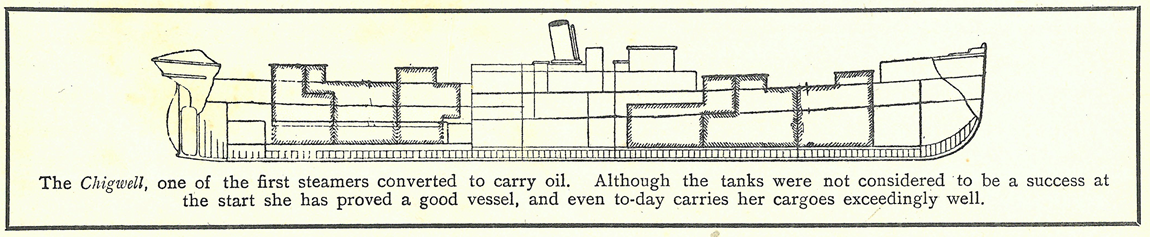
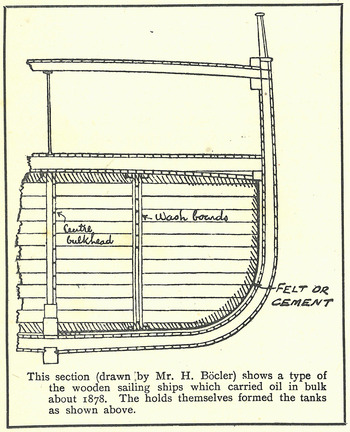
The Coal Question appeared when oil's main applications involved illumination and mechanical lubrication, though commentators widely observed its potential for transportation. In the early 1860s, the Nobel oil conglomerate developed hybrid train engines that alternated between coal and petroleum, inspiring the British navy to test petroleum-powered ships in 1865. These tests confirmed oil's superiority to coal in all respects but one: an absence of cheap supplies, in contrast to Britain's proven coal reserves.Footnote 37 Thus only in 1901 did the Admiralty revive its inquiries, spurred by the conversion of U.S., German, and Russian fleets to oil. The merchant marine made greater inroads as shipbuilders in Manchester and London began to dominate the global manufacture of oil tankers from the 1880s. The Shell Transport and Trading Company, for instance, transformed the global movement of oil by replacing inefficient oil barrels with a single cargo “shell” in their ship beds. By 1898, Shell began to showcase tankers with hybrid furnaces for representatives of the British navy, the London Fire Brigade, and Lloyd's of London who witnessed the spectacle of oil's future (figs. 1 and 2).Footnote 38
Horizontal diagram of an early oil tanker. Unsigned pencil drawing in J. D. Henry, Thirty-five Years of Oil Transport: The Evolution of the Tank Steamer (London: Bradbury, Agnew, 1907).

Detail of an early oil tanker cistern. Unsigned pencil drawing in Henry, Thirty-five Years of Oil Transport.

And so if economic experts failed to represent oil as a future fuel, then that work was carried out by private interests instead—a tendency that continued in a new wave of petro-boosting through the 1880s. Many proselytizers trained as engineers and chemists before working for oil corporations, and most maintained ties with syndicates such as Shell and Anglo-Persian Oil (later renamed BP). But if they were more sanguine about oil's future than Jevons, then their predictions stopped short of imagining a major oil market in Britain. Instead, they warned that the nation might miss its chance to exploit “the fuel of the future” or “our future fuel,” as two writers called it, sans special administrative encouragement.Footnote 39 Even among the truest believers of liquid fuel, the future remained in doubt.
Taken together, these contributions make it clear that the Victorians did more than tap oil fields in Persia, Burma, Borneo, and India. They also opened oil's temporal fields, imagining a collection of what Reinhard Koselleck calls “futures past” or “superseded futures” at a time when oil's practical potential remained dubious.Footnote 40 Attempts to turn oil into a locus of national debate began with “The Petroleum Question” in the mid-1880s: “Who,” simply put, “is to boss the coming oil age?”Footnote 41 This was the problem posed by Charles Marvin, an English emissary to Alexander II who had risen to popular prominence by documenting the Russian oil trade. Convinced that petroleum would soon supersede coal in developed nations, Marvin issued a flurry of writings warning that Britain might lose its chance to control the trade. His best-selling The Region of Eternal Fire (1884), which surveyed oil production in the Caucasus, explained that “every year the petroleum industry becomes more and more important. … England cannot complain that she was not warned in time. While English merchants have been sleeping … enterprising rivals promise to control the whole of the petroleum carrying trade at no distant date.”Footnote 42 Marvin developed this position in a section entitled “Apathy of the British Petroleum Industry.” In the coming geopolitics of oil, Britain might remain relegated to inferior coal stocks, he warned—a prognosis echoed by J. D. Henry and Charles De Thierry, who wrote on “the potentialities of petroleum” in venues like the Morning Post.Footnote 43 Devoid of oil, revanchist nations would “break up our empire as it has already broken up and sucked the sap out” of its colonies, De Thierry cautioned.Footnote 44 Metaphorical “sap” naturalizes the problematic of transition, transforming it from a second-order issue of expanding economic markets to a first-order imperative of survival; British life is sustained by its invigorating veins of oil.
Here and elsewhere, confident forecasts of an Anglo-oil era sit uneasily alongside alternative possibilities. Consider Booth's Liquid Fuel and Its Combustion (1904), which concludes that “the future of petroleum is thus more or less uncertain” and adds “that it will supersede coal in countries where coal is cheap and oil is dear, may be doubted.”Footnote 45 Such doubts could be biting. In imagining “the possible future field for the use of crude petroleum,” J. D. Henry's Oil Fuel and the Empire (1908) rehearses the nation's myriad failures to secure oil lands in North America and Burma. Ending with a cautionary tale about Borneo in the 1890s, he writes, “we have missed our opportunities there, so far as petroleum is concerned, just as we have in the Empire proper.”Footnote 46
In short, all oil was tough oil for Britain: elusive, expensive, and risky. Whereas oil's superabundance aided the industry's expansion in Russia and the United States, Britain's geological fortunes made the transition from coal a relatively bad bet.Footnote 47 These uncertainties were intensified after Britain lost its petro-rich holdings in Borneo. Strategically located between Japan and Australia, and opened by the Suez Canal (which began allowing oil tankers in 1892), Borneo was widely identified as a location for refineries that would allow Britain to compete with the Nobel and Standard Oil oligopolies. “Borneo,” Henry wrote, “is a first-class oil island and possesses the undoubted advantage that it is in the center of a ring of liquid fuel markets.”Footnote 48 Such speculations increased when prospectors working for Standard Oil, Shell, and Royal Dutch seized several oil beds in the 1890s. But Britain lost control of regional production after the Shell syndicate went bankrupt and forcibly merged with the Netherlands-based Royal Dutch in 1907. British boosters mourned the debacle in the general press, turning it into a shared source of lament. If the petroleum question articulated a new need for oil, the vital sap of nations, then these events left the future uncertain.
Toward a Dialectics of Fuel: Conrad, Contrapuntalism, Oil
It has been argued that “the study of oil does not uncover a large trove of important old literature”; oil eludes the representational reach of “old literature,” it seems, as an axiomatically modern good.Footnote 49 But below the level of manifest content, oil spans an ample historical field of literary production, including Conrad's novels. Headlines about oil's potentialities formed the immediate milieu in which Victory was written, a time when writers actively discussed petro-developments in 1890s Borneo. The novel's 1890s setting on the imaginary island of Samburan, a composite of Borneo and adjacent islands, locates it precisely within this state of affairs.Footnote 50 Conrad had witnessed the development of the petroleum trade firsthand in his travels with the merchant marine through the 1880s, having sailed through major ports which were newly “ringed by storage tanks for … petroleum,” as Maya Jassanoff notes.Footnote 51 He documented the industry's incursions into England in his autobiographical The Mirror of the Sea (1906), where the presence of oil tankers on the Thames seemed so familiar as to need no explanation:
The sea reach of the Thames is straight, and, once Sheerness is left behind, its banks seem very uninhabited, except for the cluster of houses which is South End, or here and there a lonely wooden jetty where petroleum ships discharge their dangerous cargoes, and the oil-storage tanks, low and round with slightly-domed roofs, peep over the edge of the fore-shore, as it were a village of Central African huts imitated in iron.Footnote 52
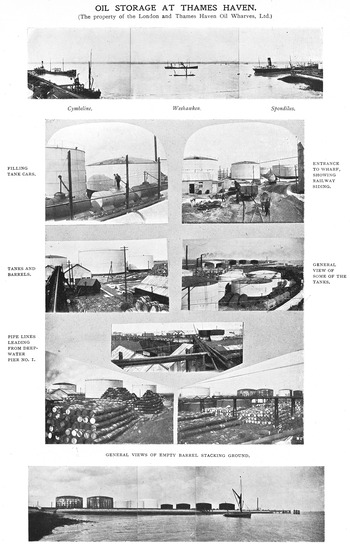
The “sea reach” where the Thames meets the Atlantic is bordered by Sheerness and South End at its southern and northern points. It marks a transitional space into England, though the voyage inward is ironic. In keeping with the contrapuntal aesthetics of Heart of Darkness, the national interior carries a trace of foreign resource removal; an aperture between land and sea signals the empire's transoceanic paths of circulation. In this site of uncanny returns, the tankers’ course recapitulates the course of “petroleum ships” into Africa. The infrastructure of petroleum—its nondescript storage silos and rickety landings—is said to “imitate” indigenous village settings. Commercial sites mimic Africa in the process of nourishing a Britain that then disavows its imperial others. In this sense, what makes petroleum “dangerous” for Conrad is its status as an artifact of global despoliation. As if to give material form to the “shadows” that Marlow sees suspended over London and Africa alike, Conrad makes the darkness of empire congeal in oil (fig. 3).
“Oil Storage at Thames Haven.” Images of oil tankers and oil infrastructure in and around a London dockyard, circa 1900. Unsigned halftone photographs in Henry, Thirty-five Years of Oil Transport.

Thus the circulation of resources is intelligible through a pair of open transitions: the spatial transition between borders, and the temporal transition between coal and petroleum economies. But it would be imprecise to read Conrad as offering an intentional allegory of fuel. For the history of Anglo-African oil began soon after this time. In June 1907 the Nigerian Bitumen Corporation began prospecting missions that led to oil's discovery. Henry Campbell-Bannerman's government then issued licenses to English-owned companies to start drilling, reinforced through a policy of indirect rule over Nigeria's coastal regions. Certainly Conrad might have known about oil's protohistory in Nigeria dating to the colonial palm oil trade (when Britain opened up the “Oil Rivers Protectorate” in 1885).Footnote 53 Yet he could hardly have anticipated the region's subsequent saga of petro-violence after Shell struck massive oil deposits in 1956. As a commentary conceived avant la lettre, the anticipatory power of his writing resides in its form: its descriptive details, impressionistic perspectives, and contrapuntal aesthetics all presage the realities of Britain's oil era. In what we might call Conrad's dialectics of fuel, an aestheticized rendition of contemporary circumstances suggests a future beyond the steam age, as the formal and stylistic structures of his prose conjoin what is and is not yet actual. These sorts of transitional formalisms are what make the turn between energy eras imaginable, reminding us that the material history of oil is incomplete without its associated archive of literature. A larger question in Conrad's fiction, and the question central to “The Petroleum Question,” concerns the precise transition between carbon regimes. What will follow after coal extraction ends: of what does “liquid coal” consist?
A Natural History of Liquidation: Victory's Poetics of Energy
Conrad often organized his novels around the raw materials of empire, though Victory exhibits a singular interest in liquid coal. The fictions from his major period each center upon a distinct mineral resource: the scramble for ivory (Heart of Darkness), guano (Lord Jim), and silver (Nostromo). These novels map the global networks within which a resource is isolated, extracted, and finally made to seem sui generis. In every case, foreign extraction sites are tied to a transoceanic network of ships, trains, refinement facilities, banks, and advertising firms, looping toward collective realities whose elements are hidden in plain sight. Such panoramic perspectives define Conrad's “planetary consciousness,” as Jesse Oak Taylor writes, in which “the metropolis cannot be perceived outside an awareness of the planetary networks linking it with distant reaches of the globe.”Footnote 54 Yet Victory announces a curious inversion. For it begins with the end of coal—more precisely, with the liquidation of the hero's Tropical Belt Coal Company. From this point, there can be no panoramic mapping of resources from imperial Indonesia to European shores. Instead, Victory traces the path of coal's “liquidation” itself, heightening the term's material meanings as a locus of interest.Footnote 55
The plot takes an elliptical form. It begins when the protagonist, a Swedish drifter named Alex Heyst, meets a British trader named Morrison in the region.Footnote 56 After Heyst helps him out of a quarrel with local officials, the two found a coal company, the Tropical Belt Coal Company or T.B.C. Co. But Morrison dies before the company can begin its extractive enterprise, leaving Heyst as the de facto manager. The company's investors flee from rumors of purloined wealth, when it is falsely whispered that Heyst murdered Morrison, and the T.B.C. Co. goes under. Afterward, Heyst lives on the unnamed island where the company had begun and forswears social attachments; all this happens before the novel's action begins. As the plot unfolds, Heyst's isolation proves untenable, starting when he rescues a musician named Lena from her enforced employment on a nearby island. Heyst and Lena cultivate an Edenic life on the company's grounds. But in retaliation for rescuing Lena, her employer hires three “desperadoes” to return her and to take the T.B.C. Co.’s rumored wealth (85). Heyst and Lena defeat them, but Lena dies in the confrontation, driving Heyst to suicide by fire.
The tale begins obliquely: rather than introducing individual characters in context, the narrator rehearses the science of carbon energy in general. He comments:
There is, as every schoolboy knows in this scientific age, a very close chemical relation between coal and diamonds. It is the reason why some people call coal “black diamonds.” Both these commodities represent wealth; but coal is a much less portable form of property. There is, from that point of view, a deplorable lack of concentration in coal. Now, if a coalmine could be put in one's waistcoat pocket—but it can't! At the same time, there is a fascination in coal, the supreme commodity of the age in which we are camped. … And those considerations prevented Axel Heyst from going away.Footnote 57
What defines coal is its continuity with more “portable” carbon forms. Using a common comparison, he explains that coal and diamonds have a family resemblance made material through the slow alchemy of time, pressure, and heat. These chemical connections set up the fantasy of another, more concentrated carbon fuel. “This scientific age” is an age of coal; but as the narrative advances, it anticipates an era of liquid coal, a “coming oil age.”Footnote 58Victory defines its historical setting—“the age in which we are camped” in the 1890s—through the prospect of future decampment leading to the novel's publication.
Minimal as the introduction is, it sets up the interlocking transformations of character, carbon power, and global capitalism running through the plot's central core. Never does petroleum emerge as an empirical good. Instead, Victory figures it in narrative-aesthetic terms, through the novel's action and extradiegetic discourse, its complex characterizations, and its allusive lexicons, which a transitive reading may motivate. The rhetoric of liquefaction is pivotal:
The Tropical Belt Coal Company went into liquidation. The world of finance is a mysterious world in which, incredible as the fact may appear, evaporation precedes liquidation. First the capital evaporates, and then the company goes into liquidation. These are very unnatural physics, but they account for the persistent inertia of Heyst.Footnote 59
Conrad's hydro-discourse returns literal meaning to financial abstractions, opening them to a more generalized understanding of ecological relations. “Liquidation” suggests both the selling of assets and another, lower-level process of chemical change: a continuing movement of resources through and between bodies after the T.B.C. Co.’s demise. By the 1870s, the lexeme “go into liquidation” had become synonymous with financial dissolution.Footnote 60 But Victory clarifies that the loss of wealth is no neat vanishing act. It is an “unnatural physics” encompassing European banks and investment firms, tariff fees, and legal regulations (as the narrator subsequently observes). By formulating the T.B.C. Co.’s liquidation in scientific terms, the passage also evokes the natural physics of hydrocarbon creation for Conrad's educated readers. The original manuscript reinforces this point by noting that coal can be “melted” or “evaporated” en route to taking other manifestations.Footnote 61 And although the printed edition leaves the conceit more muted, so as to heighten its referential range, it remains under the sign of “what every schoolboy knows”: petroleum is liquefied coal. If liquidation is a financial fiction, an abstraction that obscures material relations of production and exchange, then Victory returns to what “liquidate” might mean as an action: “to liquefy, melt.”Footnote 62
Liquidation's double meanings are nowhere more marked than in Heyst's characterization as a drifter. As the coal company's former manager and representative, he embodies a protean impulse toward “drifting,” “floating,” and “swim[ing],” both before and after its meltdown. To drift, for Heyst, is to surrender assertive action in favor of recessive, unmotivated movement. That impulse is what first brings him to the islands. Only after electing to “become a waif and a stray austerely, by conviction” does he become entangled in Morrison's coal scheme (74). The narrator explains, “for my part I haven't the slightest doubt that he was [an aristocrat]. While he was still drifting amongst the islands, enigmatical and disregarded like an insignificant ghost, he told me so himself on a certain occasion. It was a long time before he materialized in this alarming way into the destroyer of our little industry” (23). Two inversions structure the passage. First, the liquidation of the coal industry appears as an effect rather than the cause of Heyst's drifting disposition. Second, liquidation shifts from figural to literal registers in Heyst's depiction as an ambient being who wades through the islands’ aqueous embrace. And in both respects, the novel upends cultural wisdom through its transitive poetics. Before becoming fixed as intuitive goods, resources such as petrocarbon are born in informal idioms of feeling and mind. A barometer of national wealth and well-being in the post–World War II era, enabling what Timothy Mitchell calls “both the possibility of modern democracy and its limits,” emerges here as an as-yet unnamed artifact of fiction.Footnote 63
Heyst's liquid condition is intimated in his earliest appearance, or rather radical disappearance, as an embodied being. When the reader first encounters him in the flesh, it is through the act of sinking into the T.B.C. Co.’s encompassing environment:
[Heyst] marched into the long grass and vanished—all but the top of his white cork helmet, which seemed to swim in a green sea. Then the hat too disappeared, as if sunk into the living depths of the tropical vegetation, which is more jealous of men's conquests than the ocean, and which was about to close over the last vestiges of the liquidated Tropical Belt Coal Company—A. Heyst, manager in the East. (23)
Heyst dissolves insensibly into the aquascape of “Black Diamond Bay.” The name conjoins carbon wealth with fluid matter, so as to connote a semimaterial order of liquid fuel. This implication follows from a nested set of relations: the drifting individual, the liquefied corporation, the local landscape, and the ocean beyond it. The impressionistic moment dissolves the boundary between actual and figural fluid, and thus develops the narrator's initial observations on liquid coal. While scholars such as Andrew Francis view the novel as documenting mid-Victorian coal interests in Indonesia, when James Brooke opened the region to British trade, Victory’s mimesis is also prescient: flows of liquid carbon, natural as weeds and water, bind the energy developer to the world writ large.Footnote 64
Yet such signatures of liquid coal do more than anticipate an ascendant oil era, when hierarchically integrated behemoths like BP began to shape social practices and institutions in modernity. Far from locating the T.B.C. Co. within a separate sphere of commerce, Victory adduces a more encompassing metabolism: what Jason Moore describes as a “socio-ecological” order. “Capitalism does not develop upon global nature,” Moore writes, “so much as it emerges through the messy and contingent relations of humans with the rest of nature,” whereby human and nonhuman agencies are imbricated though different phases of global capitalism.Footnote 65 Such an understanding gains fictional form through the dynamics of “liquidation,” which immerse individuals in a general economy of energy relations. This is to say that the novel posits an augmented social imaginary, a term often used to mean the entire realm of imaginative significations that structure social relations as a totality.Footnote 66 More expansively, Conrad depicts an inclusive carbon imaginary in which coal, “liquid coal,” and animate characters constitute a shared matrix of associations. Blurring the existential edges between subjects and objects, characters and context, it imagines co-relations across dissimilar scales of being: what Moore calls “nature as us, as inside us, as around us.”Footnote 67 The terrestrial world figures here as the common condition in which our life activity unfolds, as an open ecological assemblage and not as a foundation for the extraction of resources.Footnote 68
The phantasmagoria of carbon fuel encompasses even the materiality of writing itself. Conrad's narrator comments:
In the flood of cold light Heyst could see his immediate surroundings, which had the aspect of an abandoned settlement invaded by the jungle: vague roofs above low vegetation, broken shadows of bamboo fences in the sheen of long grass, something like an overgrown bit of road slanting among ragged thickets towards the shore only a couple of hundred yards away, with a black jetty and a mound of some sort, quite inky on its unlighted side. But the most conspicuous object was a gigantic blackboard raised on two posts and presenting to Heyst, when the moon got over that side, the white letters “T.B.C. Co.” in a row at least two feet high. (8)
As “something” obscurely glimpsed, the coal pile remains an indistinct impression in Heyst's perceptual field, linked through its inkiness to the blackboard bearing the T.B.C. Co.’s name. With this conceit, Conrad's novel underscores how inextricably resources are tied to their discursive inscription. The conceit carries recursive intensity. In Conrad's milieu, a major ingredient in commercial printing ink was “coal black,” which consisted of soot often derived from coal or charcoal and mixed with water to form a pliable, tarlike solvent. Though its use was widespread before the nineteenth century, coal black became the object of vociferous criticism among writers who lamented its tendency to smudge, which threatened the obliteration of historical knowledge. A prominent 1904 treatise critiqued coal black's use among printers by noting that “the numerous color products of coal tar now so largely employed in the preparation of ink … menace the future preservation of pubic and other records.”Footnote 69 In Victory, writing's identification with liquid coal condenses into “a mound of some sort” lodged in the viscera of the eye. The resonance of this association endures even now. The printing ink used in my modern edition of Victory contains petroleum, while a diesel truck carried it into my hands.Footnote 70 To read Victory is to find liquid carbon immanent in language: writing degree zero.
But in at least one respect—its impressionism—Victory stands apart from boosters who warned against literary writing on oil. In Oil-Finding, Craig writes that “short, crisp sentences, without conditional clauses, should be the rule. Graces of style and the neat turning of phrases are to be avoided” since “it is not literature that is required from the geologist, but facts. … Be literal rather than literary.”Footnote 71 We see in Craig's instructions an early instance of oil's divorce from aesthetic representation, in keeping with Amitav Ghosh's point that “a great deal has been invested in ensuring the muteness of the Oil Encounter,” which in Ghosh's view has resulted in an absence of fiction on oil. Ghosh adds that “neither [novelists] nor anyone else really knows anything at all about the human experiences that surround the production of oil” due to the industry's triumphal techniques of obfuscation.Footnote 72 In Craig's treatise, this rule of silence appears as an informal ideology of form: an interdiction against all “style.” I invoke Craig's dictum both as a testament to the oil industry's anti-aesthetic aims and as an instructive contrast to Conrad's novel. For whereas petrocritics like Ghosh highlight how big oil has grown to shape the mystifications of cultural production, Victory finds narrative potential in “liquid coal” at the industry's dawn. And whereas Ghosh posits the totalizing reach of petro-corporations, Victory depicts a more general metabolism that transcends oil's commercial clutches, an open ecology of relations. More than the lifeblood of global capitalism, liquid coal is a foundation from which writing appears, a material that the novel mobilizes, a resource for fiction itself.
Secret Sharers in Oil: Underdevelopment and the Bildungsroman
The fluid dynamics of Conrad's prose are most expansively enacted at the level of plot, which assumes a chiasmic form. Its main impetus is Heyst's rescue of Lena, as the two elope amid the T.B.C. Co.’s ruins. Structurally, those events recapitulate the company's origin story, in which Heyst helped Morrison recover his ship from crooked customs agents. In Lena, as in Morrison, Heyst recognizes a nomadic individual like himself, an orphaned drifter devoid of conventional social bonds. But because she also lacks money or an alternative profession, she has become stranded on an adjacent island with a hotel owner who governs her accommodation, wages, and field of relations. When Heyst helps her flee the hotel, the act appears as an inverted image of what came before. Initially, a bond between men leads to the coal corporation's birth; in the novel's second half, Heyst and Lena's relationship leads to a utopian fantasy of liberation from the marketplace, evoking a world after the dissolution of modern social forms.
Lena and Heyst's existence on the island appears barren but fulfilling. The T.B.C. Co.’s unfinished railway, rusted pipes, and unused engines have returned to the earth, becoming “bones” while Heyst gains new life as another “Adam.” “Tropical nature had been kind to the failure of … the Tropical Belt Coal Company,” the narrator writes, while Heyst adds that “[t]here must be a lot of the original Adam in me, after all,” as if returning to a paradisiacal life among the ruins (133). Far from “prying eyes” no less than the rhythms of the clock and working week, the ruins seem to transcend colonial capitalism's grasp. “This,” he tells Lena, “seemed to be a … refuge, where we could live untroubled and learn to know each other” (265). When the couple make a home of the counting house, it is to reimagine the site of commerce as one of conviviality and domestic warmth illuminated by wood and tallow alone. Having before brought the archipelago into “the age of steam,” here Heyst looks toward an existence freed from its effects (15). The repeated gossip that Heyst is “a ut-uto-utopist” proves more correct than any one character could know (10).
Or so it seems. If this is a utopian moment, an anticipatory illumination of difference, then it remains an evanescent reprieve from the acquisitive tendencies that had inspired the T.B.C. Co.’s birth. In fact, the lovers’ elopement remains implicated in former development projects. Their presence marks the ongoing occupation of indigenous lands, as a displaced community of Alfuros persists around the company grounds. Heyst's servant, Wang, lingers as the vestige of a Chinese workforce that has become marginalized but hardly absent.Footnote 73 And Lena herself views the island less as a euphoric escape from modernity's harms than as a vacuous abyss; the reader learns that the “empty space was to her the abomination of desolation” (159). Perhaps most significantly for the plot, the rumor of Heyst's “hoard[ed]” wealth brings the three pirates to steal it, leading to their final and fatal confrontation (304). The notionally utopian no-place of Samburan remains tied to the thirst for fossil wealth; both from forces outside and within the island, the desire to transcend the ken of energy exploitation is revealed to be a fugitive dream.
Heyst's asocial fantasy of escape remains unrealized. Far from emerging as a sovereign subject, in the end he becomes a material embodiment of liquid coal. The three interlopers are climactically overcome, though in the tussle Lena is shot and Wang disappears into the forest. A passing shipman, operating a Chinese-owned steamer, reports Heyst's subsequent suicide:
I didn't want to intrude on his grief. Later about five in the morning, some of my calashes [drivers of small horse carts] came running to me, yelling that there was a fire ashore. I landed at once, of course. The principal bungalow was blazing. The heat drove us back. The other two houses caught one after another like kindling-wood. (345)
With the terminal erasure of human and nonhuman boundaries, Conrad's hero has become so much fuel, marking an apotheosis in his characterization throughout the narrative. Here the novel turns from the “unnatural physics” of the energy trade to the natural physics of carbon combustion and extends the thematics of fuel to the diegetic core. In one sense, Heyst's self-immolation marks a release from the coal trade, obliterating the last vestiges of the T.B.C. Co.; in another sense, however, it seems to anticipate the birth of a “petrosubject.”Footnote 74 The name articulates a significant suturing of oil and the individual in the Global North, where oil organizes our lifeworlds of transportation, manufacturing, medicine, agriculture, and entertainment. An oil subject is a being whose entire field of wants and needs depends on oil and its notional freedoms. Having been introduced as “the late manager” of the liquidated coal corporation, in his demise Heyst anticipates a world where liquid coal would become central to the self (178). His self-annihilation, as a failed purveyor of coal, appears to confirm his identity as a secret sharer in oil.
Yet it would be rash to label Heyst as a fully formed oil subject. For the novel often and elaborately subverts the conventions of self-formation tout court, in keeping with other antibildungsromans whose heroes stay stunted. A classical bildungsroman might have followed the developer-hero's maturation as an individual who wins wealth and recognition by learning to exploit “the raw material of treasure,” as Conrad wrote elsewhere, and who thereby becomes the representative of a more modern world.Footnote 75 For heroes like Wilhelm Meister and Pip, the transition from youth to adulthood articulates an encompassing social transition: the transition from an ancien régime to a new bourgeois world whose norms the hero eventually embodies. But as Joseph Slaughter, Jed Esty, and Gregory Castle note, the turmoil of modernization (including anticolonial movements in India, Jamaica, Ireland, and Indonesia) weakened the ties between self and social formation, and fostered an alternative poetics of stultification involving “youthful protagonists who die young … refuse social adjustment, or establish themselves as evergreen souls.”Footnote 76 Heyst's condition as a ruined developer tracks this tradition. Like the impeded protagonists of Olive Schreiner, Thomas Hardy, and H. G. Wells, he fails to escape the shadow of a distant, draconian patriarch, who imparts in him “a profound mistrust of life,” and remains an itinerant drifter to the end (76).
Reading in transitive terms, we might note Heyst's failed formation and also observe its pyrrhic cast. For his demise marks more than a breakdown within the logic of growth. If his fate seems unbecoming, that of a failed energy developer, then the failure is recuperated in the story's relentless reorganization of the antinomies between nature and anthropos. It is true that in interwar culture, oil underwrote new norms of individual agency (like driving and flight) and of social growth (like the gross domestic product).Footnote 77 But Heyst's blocked Bildung points to a less instrumental relation between “liquid coal” and character, and stops short of oil's enshrinement as an axiom of personal and political development. His shortcomings mark a transitive time when petroleum's potentialities remained distinctly muted: a time after Jevons announced the decline of coal but before oil's modern emergence as a byword for growth. At this interlude, his failures point to an alternative schema of relations. Precisely through his vocational disappointments and inability to extract economic value from the earth, Heyst dramatizes Conrad's carbon imaginary in general.Footnote 78
Far from a sign of Conrad's cosmic pessimism, then, the ending presents an alternative sort of affirmation rooted in open ecologies of “assemblage and relationality.”Footnote 79 To grasp this point, we need only recall the novel's strategic conflations of character and context, subject and object, foreground and background, which run counter to fantasies of a self-possessed individual who masters an inert Nature: what Simon Gikandi terms the “negative intentions” of Conrad's art, driven by a “desire to level peoples and things, the animate and inanimate.”Footnote 80 Consider the volcanic “smoker” on a neighboring island, whose appearance corresponds to Heyst's initial depiction with a lit cigar. “His nearest neighbor—I am speaking now of things showing some sort of animation—was an indolent volcano which smoked faintly all day. Axel Heyst … made in the night the same sort of glow and of the same size as that other one some many miles away,” the narrator comments.Footnote 81 Thus personified, the threat of volcanic activity appears in innocuously human terms, as if to defuse the landscape's alien menace. Or not: in fact, the distinction between tenor and vehicle—the setting imbued with human attributes, and the subject seeming to possess them—transcends the logic of similitude. The two smokers share “some sort of animation,” an aura of vitality that brings the self and its surroundings into relation across conventional demarcations between being and nonbeing. The image indicates a singular oikos or “world ecology,” as Moore puts it, though that image's specificity within the history of fuel can be best understood through the dynamics of transitive reading I have elaborated.Footnote 82
Relegated to a minor moment at the outset, the conceit continues through the novel's insistent fusion of human and nonhuman scales, as the “smoker” threatens to burst into flames. In language reminiscent of the 1912 Novarupta volcano eruption on the Alaskan peninsula, one of the century's largest, Victory sets up a totalizing natural event.Footnote 83 Interrupting a maudlin moment in the lovers’ elopement, for instance, the narrator cuts from Heyst's vantage to note that a “crimson crack like an open wound zigzagged between [Heyst and Lena], with a piece of dark red sun showing at the bottom,” prompting Lena to exclaim that “this did not look like a sign of mercy.” Such perspectival shifts become most arresting when Heyst confronts Riccardo (the thieves’ leader) in the final chapters. There, the interpersonal drama is suspended in acknowledgment of an encompassing peril:
There was something cruel in the absolute dumbness of the night. The great cloud covering half the sky hung right against one, like an enormous curtain hiding menacing preparations of violence. As the feet of the two men touched the ground, a rumble came from behind it, preceded by the swift mysterious gleam of light on the waters of the bay.
“Ha!” said Riccardo. “It begins.” (281)
These signs of violence add atmospheric gravitas to the interpersonal tension. But the danger exceeds the condition of context; it introduces a scalar shift that reframes the human drama in geological terms. When Riccardo declaims that “it begins,” it is not to announce a Manichean battle between individuals, thrown into relief by a static setting, but a collective event that threatens to erase essential differences of kind.
It is tempting to see this omen as a red herring. The expected eruption never occurs, and the long-deferred inferno is contained to the meager spectacle of Heyst's body. Thus understood, the volcano remains so much exegetical excess: what Fredric Jameson reads as a symptom of repressed political content, whereby internecine social struggles are reduced to natural images in Conrad's fiction.Footnote 84 But it is precisely through the transposition of the human and the geological that the volcanic portents are incorporated into the narrative design. Having tried to make a name and fortune by removing resources from the land, in the end Heyst exemplifies the terrestrial condition of the setting. In its antidevelopmental design, its ornamental lyricism, and its figural framework—in all these ways, Victory pivots from the plot of individual Bildung to a more fusional model of relations. This implication is heightened at the level of form, since the reader learns of Heyst's death after the fact, not as a pyrotechnic burst but as island gossip that circulates long after the embers cool. The fire remains at a narrative distance that makes it inseparable from the semiotics of liquid carbon all along.
Becoming Unconventional: Transitive Reading in the Late Oil Era
We see in Victory’s resolution what Herbert Marcuse once called “the impenetrable resistance of matter.”Footnote 85 Marcuse used the phrase to connote the planet's supreme indifference to capitalist configurations of value. Because the temporal and material orientations of the Earth are not optimized for the limitless growth of wealth, Marcuse wrote, ecological catastrophes could lay bare the artificial logic of capitalism and in doing so stimulate awareness of other possible modes of existence. Externalities including catastrophes and resource scarcities, for instance, could reveal capitalism's contingent relation to the total bios of animal, plant, and mineral agencies, and in doing so suggest a more mutual, open, and ongoing foundation for making new socialities. Marcuse's work appeared just as the anthropogenic mechanisms of climate change were becoming understood, though its relevance has only grown as researchers have documented the exorbitant economic and environmental costs of our fossil fuel dependencies. His work elucidates an idea implicit in Victory as well, where capitalist economies of extraction are shown to have an artificial relation to the world, and where the heroic developer is immersed in an environment extending in nonhuman scales and speeds: “the living depths” of the islands (25).
So if Victory anticipates an oil subject, it also articulates patterns of mind and emotion unmoored from the oil era, less conventional than those that later prevailed. A transitive reading maintains a Janus-faced awareness in both directions. It identifies the cultural processes through which petroleum became both desirable and familiar in Conrad's milieu, while also recovering alternative vistas for the transition from coal, looking askance at the modern equivalence between fossil fuel and freedom (what Dipesh Chakrabarty describes as our “mansion of modern freedoms”).Footnote 86Victory neither represents carbon power as a handmaiden to development nor narrates the hero's triumphal, self-affirming avoidance of that power. More radically, it resists the petro-era's myths of freedom and self-enfranchisement writ large.
The retrieval of these cultural logics has never been more urgent. In our own era of postpeak oil, which Michael Klare has named the “unconventionals era,” liquid coal has found fresh currency.Footnote 87 Semisolid tar sands and oil shale have been touted as cleaner, cheaper alternatives to the world's last conventional crude reserves, while substantial research has been undertaken to manufacture petroleum from coal.Footnote 88 But the rhetoric and marketing methods of the unconventionals era uncannily repeat those developed to sell petroleum itself, when oil was advertised as a less smoky, labor-saving alternative to coal.Footnote 89 Reopening the Victorian petro-archive provides an object lesson in the ways we have grown to understand oil's attractions and affords opportunities for rethinking them amid our present push toward a postcarbon world. The petro-archive suggests that we should recast our messianic faith in narratives of political and technological reform—a fateful leap out of oil, mirroring Churchill's plunge in—given the insidious imaginative, political, and commercial conditions that saturate social life and make oil inextricable from our selves. It also reminds us that the turn to alternative energies—what LeMenager calls an “energy regime change”—is far from an inevitable power transference.Footnote 90 Such moments might be better conceived as thresholds filled with possibilities that, long after their eclipse, can be reactivated again. The petro-archive ultimately invites us to rethink our personal desire for freedom from oil and to ground the project of transforming our attachments in the imaginative redistribution of our sensibilities. Transforming the terms of petro-consciousness, in other words, might begin by returning to the origins of the oil era, with remembrance of our geological condition in a world from which we can never be freed.