INTRODUCTION
Seed quality is a broad topic that encompasses the germinability, genetic potential and biochemical components of the seed, as well as the purity of seed, including absence of undesirable seeds of weeds or other crop species, seed-transmitted pathogens and pests. The management and conditions for growth of the mother plant, seed storage and pre-sowing treatments may all influence seed quality, which has an important influence on the subsequent crop. There has been considerable research on the impact of these seed quality management strategies on germination of bread wheat (Triticum aestivum) (Lisker, Reference Lisker1990; Pedersen et al., Reference Pedersen, Jorgensen and Poulsen1993), but less on later stages of crop development, such as establishment and seedling vigour during mid-vegetative growth or grain yield. Seedling vigour is considered to be an important plant trait in Mediterranean-type environments that occur in the Mediterranean Basin, California, parts of South and Western Australia, the Ethiopian Highlands, the Central Province of Kenya, southwestern South Africa, and in parts of central Chile and west-central Argentina. These environments are characterized by warm, dry summers and cool, wet winters, during which winter cereals are grown. A crop with improved seedling vigour has several potential benefits. Faster growth in winter when air temperatures are cool and vapour pressure deficits are low results in greater transpiration efficiency (Richards and Lucaks, Reference Richards and Lucaks2002). The reduction in soil evaporation through increased leaf area development may increase the amount of soil water available for crop growth later in the season, thereby enhancing yield potential (Asseng et al., Reference Asseng, Turner, Botwright and Condon2003; Botwright et al., Reference Botwright, Condon, Rebetzke and Richards2002; Richards and Lucaks, Reference Richards and Lucaks2002). Other benefits of a more vigorous crop include an increased ability to shade and out-compete weeds (Lemerle et al., Reference Lemerle, Verbeek, Cousens and Coombes1996).
Variation in seedling vigour of wheat has been associated with cultivar (Rebetzke and Richards, Reference Rebetzke and Richards1999) and seed quality parameters such as seed size, age, density and fungicide treatments. Of these, crop management of the mother plant and environmental conditions prior to harvest influence seed size and density. Mediterranean-type environments, in particular, have a high incidence of terminal drought, which results in a increased proportion of small seed or screenings in harvested grain (Sharma and Anderson, Reference Sharma and Anderson2004). Small seed, which contains less seed reserves and hence is not as dense as large seed, is reported to result in poor establishment and seedling vigour (Baalbaki and Copeland, Reference Baalbaki and Copeland1997; López-Castañeda et al., Reference López-Castañeda, Richards, Farquhar and Williamson1996; Richards and Lucaks, Reference Richards and Lucaks2002). Post-harvest seed management practices also influence seed quality and hence seedling vigour. Seed storage is relatively common world-wide as it avoids the annual purchase of new seed for sowing. Aged seed, however, is reported to have poor seedling vigour as seed deteriorates in storage (Pedersen et al., Reference Pedersen, Jorgensen and Poulsen1993). Likewise, seed dressings such as Thiram that are applied to seed before sowing to eliminate fungal infections have also been reported to reduce seedling vigour (Ram and Weisner, Reference Ram and Weisner1988) through shortened coleoptile lengths and delayed emergence (Radford et al., Reference Radford, Strong and Wildermuth1989). There are no reports in the literature on the combined effects of these seed quality parameters on plant stand and seedling vigour of wheat, which may have implications for recommended practices for growers with regard to seed storage and treatments at sowing.
The potential effect of these seed quality parameters on seedling vigour of wheat was evaluated in two experiments with a common seed density treatment. A first experiment examined the effect of seed density, size and cultivar, and a second experiment evaluated the effect of seed density, dressing and age on early seedling vigour of wheat. In both experiments, detailed observations of seedling vigour were undertaken on plants grown in pots in the same controlled conditions of light, temperature and water availability. As the expression of seedling vigour varies in response to environmental conditions, field trials were also undertaken. These included one site in the medium-rainfall central wheat belt of Western Australia for Experiment 1 and two sites with contrasting soil types in the equivalent low-rainfall zone for Experiment 2.
MATERIALS AND METHODS
Experiment 1. Effect of seed density, size and cultivar on early seedling vigour of wheat
The pot experiment and field trial had a 2 × 2 × 2 factorial design, with two seed densities (low v. high), two seed sizes (small v. large) and two bread wheat cultivars (Calingari v. GBA Sapphire). Calingari is a long-season, Australian standard white wheat, with 9.5–11.5% protein. GBA Sapphire is a mid-season, Australian hard white wheat with 11.5% protein and triple rust resistance. Seed of the two bread wheat cultivars was graded into 2.4–3.0 mm (‘small’) and 3.2–4.0 mm (‘large’) sized fractions using a Clipper Seed Cleaner (manufactured by Kimseed International). Low-density seed was separated from high-density seed within each size fraction using a saturated (1.24 g ml−1) solution of ammonium sulphate. Seeds were rinsed thoroughly with deionized water and oven dried at 40 °C for 24 hours. For the pot experiment, nine trays (replicates) (150 mm tall × 300 mm long × 250 mm wide) were filled with a standard potting mix. Seed weight was measured. Average seed nutritional characteristics were: nitrogen (N), 2.05%; phosphorus (P), 0.30%; potassium (K), 0.40%; sulphur (S), 0.41%; copper (Cu), 3.9 mg kg−1; iron (Fe), 53 mg kg−1; manganese (Mn), 62 mg kg−1; zinc (Zn), 29 mg kg−1. Seed was then sown according to the experimental design, described above, with 0.05 m equidistant row spacing at a depth of 25 mm. Plants were grown in a controlled environment room at the University of Western Australia with 20/15 °C day/night temperature, a 10 hour day length and 70% relative humidity. Plants were harvested at 28 d after sowing (DAS; 490 °Cd) by cutting with secateurs at ground level, and main-stem leaf and tiller number, leaf area and above-ground dry matter (DM) were determined.
A field trial was undertaken at Northam (31°39′18″S, 118°40′1″E) in the medium-rainfall, central wheat belt of Western Australia. Treatments were the same as for the pot experiment and arranged as a randomized complete blocks design (RCBD) with four replicates. The soil was a red sandy loam overlying a clay loam to clay and classified as a Calcic Solonetz (Isbell, Reference Isbell1996). The soil had a neutral to moderately acid pH and was well-drained. Average soil characteristics were: electrical conductivity, 5 mS m−1; pH (CaCl2), 3.9; total N, 0.058%; ammonium-N, 1 mg kg−1; nitrate-N, 11 mg kg−1; P, 10 mg kg−1; K, 30 mg kg−1. Wheat was hand sown in four replicates at a rate of 130 plants m−2 at 25 mm sowing depth with 0.20 m row spacing in plots 1 m long on 16 June 2004. Fertilizer was applied at sowing at rates of 100 kg ha−1 of urea (46% N) and 300 kg ha−1 superphosphate plus potash (18.3 kg P ha−1, 48.6 kg K ha−1, 22 kg S ha−1 and 40 kg Ca ha−1). Plant establishment was measured by counting the number of plants in 1 m per row, for two rows per plot. Twenty seedlings per plot were sampled by cutting with secateurs at ground level on 10 August 2004, 55 DAS (609 °Cd) for number of main-stem leaves, tillers (excluding the main-stem) and above-ground DM. Plant samples were separated into leaves and stems and dried at 45 °C for 5 d, the dry weight recorded and N concentration determined.
Data for seed quality from the pot experiment and field trial were analysed for the significance of main effects of seed density, seed size and cultivar and their interactions with the generalized linear model procedure GLM in SAS (SAS, 1990).
Experiment 2. Effect of seed density, age and seed dressing on seedling vigour of wheat
This experiment also had pot and field components and employed a 2 × 2 × 2 factorial design, with two seed densities (low v. high), two seed ages (fresh v. aged) and two rates of applied fungicide (nil v. 100 g Thiram (dithiocarbamic acid) per 100 kg seed) and three replications. Seed of the bread wheat cv. Calingari was graded into small and large fractions, as described in Experiment 1. Seed density fractions of 1.43 g cm−3 (low) and 1.46 g cm−3 (high) were separated using 1.28 g cm−3 and 1.34 g cm−3 solutions of sodium polytungstate in deionized water, respectively. Seeds were rinsed thoroughly with deionized water and oven dried at 40°C for 24 h. Specific gravity of the two seed density fractions was confirmed using an air comparison pycnometer. Seeds were artificially aged by maintaining seed lots in 97% humidity at 45 °C for 6 d in a desiccator containing saturated CaSO4.2H20 and water. Characteristics of the seed lots were assessed as described for Experiment 1.
In the pot experiment, plant cultural details and measurements were essentially the same as for Experiment 1. The only exceptions were that pots (200 mm tall × 175 mm diameter) contained only single plants, which were harvested at 34 DAS (595 °Cd), or 6 d later than in Experiment 1.
Two field trials were undertaken at Merredin (31°29′0″S, 118°16′45″E) in the low rainfall, eastern wheat belt of Western Australia on contrasting soil types. Treatments were the same as for the pot experiment and arranged as a RCBD with four replicates. Site 1 was a loamy sand overlying a mottled sandy clay with ferruginous nodules (‘sandy duplex’), and site 2 a red sandy loam overlying a clay loam to clay (‘red clay’). The sandy duplex is classified as a Calcic Lixisol and the red clay a Calcic Solonetz (Isbell, Reference Isbell1996). The sandy duplex had a neutral to moderately acid pH (Tang et al., Reference Tang, Rengel, Abrecht and Tennant2002) and was well drained, with an upper limit of plant available water of 6.9% and a lower limit of 3.8% on a gravimetric basis (Rickert et al., Reference Rickert, Sedgley and Stern1987). The red clay had a neutral to acidic pH (Hamza and Anderson, Reference Hamza and Anderson2002) and was poorly drained, with an upper limit of plant available water of 9.7% and a lower limit of 5.0% on a gravimetric basis. Average soil characteristics for the red clay were: electrical conductivity, 10 mS m−1; pH (CaCl2), 5.4; total N, 0.09%; P, 69 mg kg−1; K, 440 mg kg−1; and for the sandy duplex: electrical conductivity, 8 mS m−1; pH (CaCl2), 4.3; total N, 0.068%; P, 39 mg kg−1; K, 80 mg kg−1. Plants were sown by hand as described for the field trial in Experiment 1 on 11 July 2006. Fertilizer was applied at sowing at rates of 70 kg ha−1 of urea (46% N) and Agstar (14.9% N, 13.6% P, 10.8% S, 1.1% Ca and 0.04% Zn). Twenty seedlings per plot were sampled on 19 September 2006, at 70 DAS (910 °Cd), and shoot components measured as described in Experiment 1.
Seedling vigour data were analysed as in Experiment 1.
RESULTS
Experiment 1. Effect of seed density, size and cultivar on early seedling vigour of wheat
Seed quality characteristics of low density, small seed were all consistently poorer than large seed. There were significant interactions (p < 0.05) between seed size and density for seed weight and specific gravity. For seed weight, small, low-density seed weighed 24 mg compared with small, high-density seed at 30 mg, while both low- and high-density, large seed weighed an average of 44 mg. Specific gravity of low-density, small seed was 1.13 g cm−3, while low-density, large seed and high-density, small and large seed were all the same, at 1.23 g cm−3. The effects of other treatment combinations on seed specific gravity and seed weight were not significant (p > 0.05).
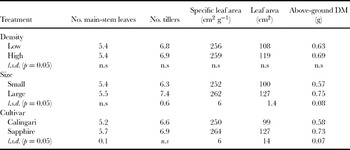
In the pot experiment, seed size and cultivar had significant (p < 0.05) main effects on most seedling characteristics (Table 1). Large seed had more tillers and greater specific leaf area (SLA), leaf area and above-ground DM than small seed. Sapphire had more main-stem leaves and greater SLA, leaf area and above-ground DM than Calingari (Table 1). There were no significant main effects (p > 0.05) in seedling characteristics for seed density, nor significant interactions (p > 0.05) between seed density, size and cultivar.
Effect of seed density, size and cultivar on seedling characteristics of plants grown in pots in Experiment 1 and harvested at 28 DAS (490 °Cd).

DM: dry matter; l.s.d.: least significant difference.
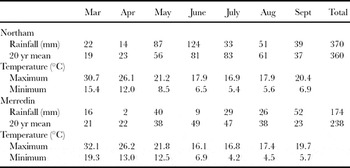
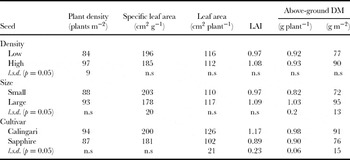
The field trial at Northam experienced close to average growing season rainfall in 2005, with above-average rainfall in May and June but below-average rainfall in July (Table 2). Average maximum and minimum air temperatures were 21.6 and 8.6 °C, respectively. For seedlings, seed size and cultivar had significant (p < 0.05) main effects on some plant characteristics (Table 3). High-density seed had an improved plant stand compared with low-density seed but had no effect on plant vigour (Table 3). Large seed had greater SLA and above-ground DM per plant and per unit area than small seed. Calingari had a larger leaf area index (LAI) than Sapphire (Table 3). There were no significant interactions (p > 0.05) between seed density, size and cultivar.
Climate data from March to September at Northam in 2004 and Merredin in 2006.

Effect of seed density, size and cultivar on seedling characteristics at 55 DAS (609 °Cd) of plants grown in the field at Northam, WA. Data are from Experiment 1.

LAI: leaf area index; DM: dry matter; l.s.d.: least significant difference.
Experiment 2. Effect of seed density, age and seed dressing on seedling vigour of wheat
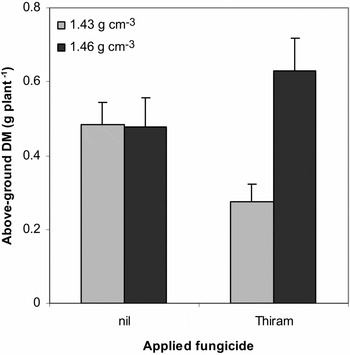
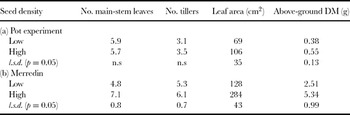
In the pot experiment, there were some significant main effects and interactions associated with seed density and fungicide application, but not seed age. Furthermore, these effects were independent of seed size, which was not significant as a covariate in the statistical analysis. Low-density seed had a smaller leaf area (69 and 106 cm2 plant−1, respectively) and above-ground DM (0.38 and 0.55 g plant−1, respectively) than high-density seed. The application of fungicide to low-density seed almost halved plant above-ground DM, while that of high density seed increased by 25% (Figure 1). Leaf area had a similar response to seed density and fungicide application as for above-ground DM (data not shown).
Effect of seed density and fungicide application on above-ground dry matter (DM). Bars represent the s.e. Data are from Experiment 2.

The field trial at Merredin had 25% less rainfall than average from March to September in 2006 (Table 2). April and June were particularly dry. Average maximum and minimum air temperatures during the growing season were 21.4 and 9.4 °C, respectively.
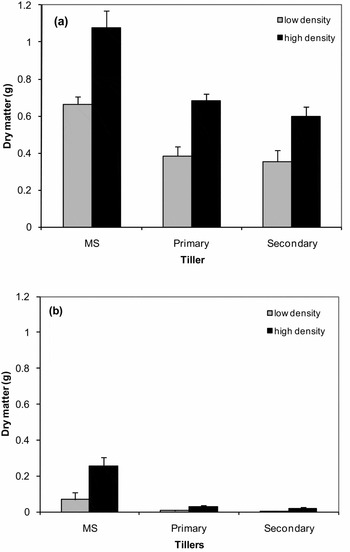
On the red clay soil, plants grown from high-density seed had more main-stem leaves and tillers and produced more than twice the leaf area and above-ground DM per plant than low-density seed (Table 4). Seed age and fungicide application had no effect on seedling characteristics, and the interactions between these and seed density were not significant. Plants from high-density seed had about 40% more DM in the main-stem and in primary and secondary tillers than those from small-density seed (Figure 2).
Effect of seed density on seedling characteristics of plants grown in: (a) pots and harvested at 34 DAS (595 °Cd); and (b) the field at 70 DAS (910 °Cd) on a clay soil at Merredin, WA in 2006. Seed size was used as a covariate in the statistical analysis. Main effects of seed age and fungicide were n.s (p > 0.05). Data are from Experiment 2.

DM: dry matter; l.s.d.: least significant difference.
Effect of seed density on dry matter of the main-stem (MS), primary and secondary tillers of wheat grown on (a) clay; and (b) sandy duplex soil at Merredin, Western Australia. Bars represent the s.e. Data are from Experiment 2.

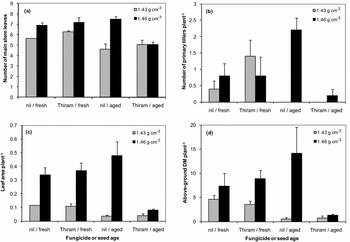
Plants grown on the sandy duplex soil were much smaller than those grown on the red clay soil at Merredin (Figure 2). On the sandy duplex soil, there were significant interactions between treatments for the majority of seedling characteristics measured. Low-density, fresh seed produced more main-stem leaves than low-density, aged seed, regardless of fungicide application (Figure 3a). In contrast, high-density seed produced more main-stem leaves than low-density seed in most treatments, with the exception of high-density, aged seed treated with fungicide (Figure 3a). Low-density, fresh seed produced a few tillers, while aged seed produced none. Application of fungicide to high-density, aged seed significantly reduced the number of tillers per plant (Figure 3b). For leaf area per plant, high-density, fresh seed had three times the leaf area per plant of those from low-density seed, regardless of fungicide application (Figure 3c). The application of fungicide to aged, high-density seed, dramatically decreased leaf area per plant to be the same as for low-density seed (Figure 3c). Above-ground DM per plant had a similar trend in response to seed density, age and fungicide application as for leaf area (Figure 3d).
Effect of seed density, age and applied fungicide (Thiram) on (a) the number of main-stem leaves of plants; (b) leaf area per plant; (c) above-ground dry matter (DM) per plant, of plants grown on a sandy duplex soil at Merredin, WA. Bars represent the s.e. Data are from Experiment 2.

DISCUSSION
Seed quality and seedling vigour
Large wheat seeds, with their correspondingly large embryo size (López-Castañeda et al., Reference López-Castañeda, Richards, Farquhar and Williamson1996) are well-known to produce vigorous seedlings (Richards and Lucaks, Reference Richards and Lucaks2002). Our results were consistent, with the impact of large seed being evident here in increased seedling vigour under both controlled and field conditions (Experiment 1). In addition, we have shown that it is not only seed size that is important, consistent with (Rebetzke and Richards, Reference Rebetzke and Richards1999), but also seed density, although sufficient time was needed for its expression to be statistically significant. In Experiment 1, seed density was not significant in controlled conditions at 28 DAS (490 °Cd), but by 55 DAS (609 °Cd) in the field at Northam, high-density seed increased stand establishment significantly (Experiment 1). Similarly in Experiment 2, high-density seed significantly increased seedling vigour (leaf area and above-ground DM) in controlled environments (34 DAS; 595 °Cd) and under field conditions at Merredin (70 DAS; 910 °Cd). Importantly, this consistent response in improved stand establishment and seedling vigour to higher seed density was independent of seed size.
The production of high density seed depends on the ability of the parent plant to produce and translocate carbohydrates and, in particular, high density proteins (gliadins and glutenins) from vegetative structures to the developing grain (Bewley and Black, Reference Bewley and Black1994). In our study, high-density seed, irrespective of seed size, produced more vigorous seedlings than small, low-density seed. This was consistent with Bewley and Black (Reference Bewley and Black1994), who reported that fresh, high-density seed had a higher germination percentage than low-density seed and contained more N and protein, which were reported to increase the rate of germination (Baalbaki and Copeland, Reference Baalbaki and Copeland1997; Richards and Lucaks, Reference Richards and Lucaks2002) and stand establishment (Sunderman, Reference Sunderman1999). Our results, of improved plant stand with higher seed density in Experiment 1, and of improved seedling vigour with higher seed density in Experiment 2, were consistent with these reports, except significant differences in seed N concentration could not be detected in our study. These results highlight the importance of screening wheat seed to remove small grain so to achieve more uniform and vigorous crop growth. While seed screening is a relatively common strategy used to manage seed quality (Sharma and Anderson, Reference Sharma and Anderson2004), it will also remove the small, dense seed that has good potential seedling vigour if sown. Small, high-density seed may be important for the establishment and growth of a wheat crop in circumstances in which there is a short supply of quality seed. This may occur following a severe terminal drought, which can be common in low rainfall, Mediterranean-type environments, or for smaller landholders particularly in developing countries.
Saturated salt solutions were used to separate seed lots into density fractions. These so-called ‘heavy liquids’ are commonly used in the earth sciences to separate minerals and are non-toxic to humans (Callahan, Reference Callahan1987). Separated seed was washed thoroughly with deionized water, yet still contained greater salt concentration than the untreated control (data not shown). Sodium tungstate has been shown to inhibit ABA biosynthesis (Hansen and Grossmann, Reference Hansen and Grossmann2000), nitrate reductase activity (Gupta et al., Reference Gupta, Disa, Saxena, Sarin, Guha-Mukherjee and Sopory1983) and can reduce the early growth of seedling roots and shoots following germination (Hilhorst and Karssen, Reference Hilhorst and Karssen1989). Regardless, above-ground DM of wheat grown from seed treated with sodium polytungstate to separate density fractions were larger than those treated with ammonium sulphate, despite being harvested 7 d earlier and being grown at a higher plant density. It appears that the residual effect of these heavy liquids on subsequent plant growth and development from treated seed may be minimal, although this would need to be confirmed by leaf tissue analyses for sodium and tungstate. An alternative approach to separate seed density fractions is to use a gravity selector, which removes low-density seed in addition to contaminants such as stones and dust. Use of a gravity selector would avoid any potential problems with seed germination from use of saturated salt solutions and may be more amenable to screening seed density on a larger scale.
Seed storage and fungicide treatment
Long-term on-farm seed storage of wheat may result in some loss in seed germinability as the seeds age, which is exacerbated by moist grain and insect infestation. Here we have shown that an interaction between seed age and the application of Thiram fungicide has a deleterious effect on seedling vigour and potential negative implications for pre-seeding fungicide treatment of stored grain. Low-density, artificially aged seed produced plants with no tillers, few leaves and a small leaf area per plant compared with dense seed. Furthermore, the application of Thiram fungicide to the low-density, aged seed was particularly detrimental to tiller formation compared with high-density seed, which produced more tillers per plant. This finding contrasts with that of Lisker (Reference Lisker1990) who reported that the application of Thiram to artificially aged seed was beneficial to plant growth. The ageing process is reported to reduce the speed of germination and enzyme activity (Pedersen et al., Reference Pedersen, Jorgensen and Poulsen1993; Ram and Weisner, Reference Ram and Weisner1988) and increase membrane permeability, leading to a greater leakage of sugars, amino acids and inorganic solutes from the seed (Abdul-Baki, Reference Abdul-Baki1969). This loss of seed quality through the aging process would appear to be exacerbated by pre-seeding fungicide treatments in low-density seed, which resulted in poor seeding vigour during crop growth. Further research is warranted to assess whether other fungicides recommended for use as seed dressings have a similar affect on seedling vigour of low-density, aged seed.
Seedling vigour is important for sandy soils
Seedling vigour of plants grown in the field compared with controlled conditions can be limited by environmental constraints such as water and N availability in addition to seed quality. Seedling vigour, achieved through either genetic improvement or sowing large seed, has been shown to be an important trait on sandy soils in Mediterranean-type environments (Asseng et al., Reference Asseng, Turner, Botwright and Condon2003; Botwright et al., Reference Botwright, Condon, Rebetzke and Richards2002), as the greater leaf area development (Richards and Townley-Smith, Reference Richards and Townley-Smith1987) and a larger root system (Liao et al., Reference Liao, Fillery and Palta2004) reduce soil evapotranspiration to increase grain yield. There were complex interactions between seed density, age and fungicide application at Merredin on the sandy soil, which were exacerbated by the inherently poor germination of the low density seed lot plus a lack of rainfall from 18 to 37 DAS. In contrast, the red clay soil at Merredin, was generally more fertile, had a higher water-holding capacity and a greater potential yield than the red sandy loam at Northam and the sandy duplex at Merredin. This was reflected in the greater plant DM production on the red clay compared with the sandy soils. Yet on all soil types, low-density seeds resulted in poorer or less vigorous stands than dense seeds. These results provide further support for combined screening for small, low-density seed with grading for seed density, to improve the consistency of early crop vigour.
PRACTICAL IMPLICATIONS
The techniques used here to separate seed into different density fractions are suited only to small-scale experiments, and furthermore reduced germination, particularly in fresh, low density and dense, aged seed. Large-scale separation of seed into appropriate density fractions for commercial purposes could be done using gravity selectors, which would be less expensive and more efficient, without the adverse consequences on germination. Our results indicate that an increase in seed density, particularly in small seed, can potentially increase seedling establishment and seedling vigour independently of seed size and may be especially important on sandy soils. Environmental stresses of terminal drought and high temperature can decrease the size, storage capacity and rate of grain filling, resulting in lighter and less dense seed at maturity. Seed should be sourced from fertile sites with few environmental stresses to ensure dense seed of suitable quality is obtained for planting. Other implications from this study are that growers should be wary when planting old seed from previous harvests, especially if they wish to apply a seed dressing fungicide, because they could be significantly reducing the viability of their seed.
Acknowledgements. Controlled environment rooms were kindly provided by the School of Plant Biology at The University of Western Australia, and field sites by the Department of Agriculture and Food, Western Australia, at their Northam and Merredin Research Stations. B. Ball and D. Meharry conducted this research for their honours projects at The University of Western Australia, and they contributed equally to the paper.