Non-governmental organizations (NGOs) employ a variety of different tactics to promote their climate change policies. For example, Greenpeace International engages in confrontational protests outside major energy companies, while the Union of Concerned Scientists produces carefully researched reports. Likewise, 350.org mobilizes massive street demonstrations, while the World Wildlife Fund raises money to protect forests. These tactical decisions are often consequential for policy outcomes; they also affect an individual organization’s influence, reputation and vitality. How do we explain variation in the tactical choices of NGOs?
Social network theory draws our attention to how interactions among actors shape their behavior. We draw on this literature to identify two potential sources of peer influence on the tactical choices of NGOs embedded in transnational advocacy networks.Footnote 1 First, NGOs may be influenced by the choices of actors to whom they are adjacent in the social network – organizations with which they have direct ties. Secondly, NGOs may be influenced by the choices of actors that have equivalent positions in the network – organizations that occupy similar relational roles. We examine these contrasting sources of influence in a transnational network of NGOs working in the field of climate change politics over a two-year period. We assess how peer choices influence the decision to adopt protest tactics, contrasting our approach with previous work that has focused theoretical attention on contextual-level and organizational-level factors.Footnote 2
This analysis draws on original longitudinal data regarding the attributes of NGOs working transnationally on climate change, their tactical choices, their relationships with one another and the characteristics of the context in which they work. Our research design offers five particular advantages. First, we identify a population of organizations and track their decisions over time, avoiding problems of selection on the dependent variable that plague many studies of social protest.Footnote 3 Secondly, we employ a network autocorrelation model to appropriately test relational hypotheses and account for actor interdependence.Footnote 4 Thirdly, we draw on rich original data that enables us to control for alternative actor- and context-level hypotheses that may affect the outcome of interest, addressing concerns about potential homophily bias, shared environment and the reverse Galton’s problem.Footnote 5 Fourthly, we introduce a time lag between peer behavior and ego behavior in our quantitative models in order to minimize concerns about reverse causality. And fifthly, we complement our quantitative analysis with illustrative cases and qualitative interviews with practitioners to document relational processes that operate at the actor level.
Our results provide evidence that NGOs are influenced by the tactical choices of their peers. We find that NGOs have a strong tendency to match the tactical choices of the organizations adjacent to them in the advocacy network, reflecting a process of social cohesion among partners. We show that this effect operates above and beyond contextual- and actor-level explanations, and persists even when other sources of autocorrelation are accounted for. Our qualitative evidence suggests that actors engage in persuasive communication in networks, altering the perception of costs and benefits for certain types of action. Overall, we find that examining peer influence significantly expands our ability to explain NGO tactical choices, and that traditional explanations are weaker by comparison.
The theoretical and empirical contributions of this article are important for three particular audiences. First, our approach speaks directly to scholars of transnational advocacy networks by expanding our understanding of the international organization of NGO activity. While network themes are implicit in many important studies in this field,Footnote 6 we systematize a relational approach and use it to explore an important empirical puzzle. We find that NGOs are interdependent actors, and that their network embeddedness significantly shapes their tactical decisions. Our results echo the classic work of Keck and SikkinkFootnote 7 by documenting how network ties can serve as channels through which communication and shared principles flow among actors. The findings of this article complement the extensive focus on advocacy campaigns with a detailed look at strategic variation among organizations working within the same sector.Footnote 8
Secondly, our quantitative analysis provides a surprising account of the social processes that generate protest around international institutions. Explanations proffered by existing scholarship and favored in policy communities – such as arguments that protest is the recourse of resource-poor actors or a response to limited opportunities for institutional engagementFootnote 9 – garner only limited support in our quantitative models. Many actor decisions in this sphere cannot be adequately explained without considering the internal politics of advocacy networks. Our results suggest that policy actors concerned about the emergence of ‘waves of protest’Footnote 10 may exert more leverage by engaging directly with influential NGOs than by pursuing traditional institutional and resource interventions.
Finally, our case illustrates how decision making in networks is an underexplored layer of social organization in world politics.Footnote 11 While scholars often study cases in which behavior spreads among actors via processes of diffusion, socialization and isomorphism,Footnote 12 more attention should be paid to developing and testing precise relational hypotheses in other areas of world politics.Footnote 13 The theoretical approach we outline here demonstrates why accounting for two potential sources of peer influence – adjacent and equivalent actors – is critical. In our case we also find that the effect of context and attribute variables is weakened in the presence of network variables, suggesting that the weight of these causal factors may be overstated in existing research that does not account for relational influence. Overall, considering the importance of network embeddedness holds great promise to expand our understanding of the behavioral choices of a wide range of actors.
EXPLAINING ADVOCACY CHOICES
NGOs often make tough calls about how to acquire resources, how to structure their organizations, which issues to support, which allies to work with, how to frame particular issues and which tactics to adopt when engaging in collective action. These choices are consequential for outcomes in international politics as well as for NGOs themselves. To take just a few examples, NGOs decide which countries to criticize for human rights violations,Footnote 14 and this ‘naming and shaming’ influences human rights practices and the likelihood of humanitarian intervention.Footnote 15 NGOs decide which issues to adopt in security politics, and their advocacy increases the likelihood of global agenda setting and rule making on these topics.Footnote 16 NGOs are directly responsible for private aid delivery, and their choices about where and how to conduct these projects influence development outcomes.Footnote 17 NGOs advance moral claims vis-à-vis their own governments, and their advocacy choices guide foreign policy outcomes in some critical cases.Footnote 18
In this article we examine tactical choices of NGOs working transnationally on climate change. We note that even among organizations that share broadly similar values and discourse, there is a great deal of tactical diversity. In our data we observe vigils, hunger strikes, protest puppetry, banner dropping, public letters, score cards, teaching tours, mass phone calls and many other specific forms of collective action. Tactical decisions are often considered ‘high stakes’ because they affect the likelihood of advocacy success as well as the organization’s reputation, ability to recruit and prospects for funding.Footnote 19 How do NGOs decide which tactics to employ?
We conceive of tactical decisions as a choice between protest and more conventional forms of action. This echoes the well-established distinction between what PriceFootnote 20 and Tallberg et al.Footnote 21 refer to as the ‘pragmatic insider strategy versus the principled outsider strategy’.Footnote 22 This tactical decision is consequential, costly and poorly understood. Prakash and GugertyFootnote 23 lament that the existing NGO literature cannot ‘explain how and when NGOs decide to use “insider” versus “outsider” strategies […] or the decisions of some NGOs […] to reorient their strategies’. Similarly, Goodwin and JasperFootnote 24 review the literature on social movements and observe that ‘the actual choice of actions from within the repertoire – not to mention issues of timing and style in their application – has been almost completely ignored’.
In explaining the choice to adopt protest tactics, we follow Keck and SikkinkFootnote 25 in treating NGOs as principled, strategic actors working within a set of opportunities and constraints. These opportunities and constraints are traditionally thought to originate from two sources. First, the characteristics of the context – the contracting environment, the opportunities available to organizations to work with particular institutions, the media environment and the likelihood of repression – may influence an organization’s strategic choices.Footnote 26 For example, Walker, Martin and McCarthyFootnote 27 argue that institutions that are more open and less likely to repress protesters will be targeted more often. Cooley and RonFootnote 28 argue that the nature of the contracting environment should drive organizations to adopt strategies in line with funders’ priorities. StroupFootnote 29 suggests that organizations learn advocacy strategies suited to their national context, making it likely that they will apply the same methods when they engage in transnational advocacy.
Secondly, the attributes of the organization itself – the amount and type of resources it has at its disposal, its organizational ideology or culture, and its internal structure – may be important factors in its decision-making process.Footnote 30 For example, much work in the field of social movement studies suggests that organizations that are older and have larger budgets should be less inclined toward protest action.Footnote 31 Organizations that focus more on direct service provision may also be less likely to engage in protest actions, because their organizational structure is geared toward the delivery of contracted programs rather than advocacy.Footnote 32 Organizations with individual members may be more likely to sponsor protest actions because they have ready access to the needed resources. Organizations may also seek to be consistent in their tactical decision making, building a ‘brand’ reputation for protest tactics that helps them gain recognition and support.Footnote 33
But even when contextual and organizational factors are considered together, there remains a puzzling amount of unexplained variance in tactical choices.Footnote 34 Not all actors respond to their environment in the same way, which poses a challenge to theories at the context level. And many organizations change tactics without altering their other attributes. For example, in our data we observe that 20 per cent of NGOs sponsored at least one protest action in 2008, while 61 per cent did so in 2009.Footnote 35 So while many actors are altering their tactics, challenging organizational-level theory, there is no strategic convergence among groups, which challenges context-level theory. We argue that the origins of this widespread, but not all-encompassing, protest wave in climate politics are not well accounted for in current theory.
We expand on existing work by proposing a third source of opportunities and constraints – the structure of relations within the advocacy network itself.Footnote 36 Because NGOs are embedded in a network of relationships with other groups, their decisions may be affected by relational pressure from their peers. Our approach is novel but anticipated in the theoretical origins of the advocacy network literature. In this foundational work, transnational advocacy networks are traditionally viewed as ‘communicative structures’ through which social influence can flow.Footnote 37 However, with some notable recent exceptions,Footnote 38 existing scholarship has tended to treat advocacy networks as internally undifferentiated in order to better examine the effects of advocacy on external outcomes. Our study advances work in this area by adopting social network analysis to guide the formulation and testing of relational hypotheses.Footnote 39
THE IMPORTANCE OF NETWORK EMBEDDEDNESS
As Hafner-Burton, Kahler and MontgomeryFootnote 40 explain, ‘network analysis permits the investigation and measurement of network structures – emergent properties of persistent patterns of relations among agents that can define, enable, and constrain those agents’. To say that actors are embedded in relational networks highlights the patterns of ties that allocate resources, roles, information and meaning differentially.Footnote 41 NGOs have relationships with other organizations working in the same sphere. Regularity in these relationships defines the structure of the advocacy network and, in turn, the relevant peer groups to which an organization will be exposed. As Marsden and FriedkinFootnote 42 put it, the challenge of social network research is to determine ‘the social relations that provide a basis for the alteration of an attitude or behavior by one network actor in response to another’. Meeting this challenge requires answering two prior questions. First, which sets of actors constitute the ‘peers’ from whom influence flows in the network? And secondly, how will actors respond to peer behavior?
Social Influence and Reference Groups
We draw on a rich tradition in social network analysis that suggests that actors often obtain guidance for their own decisions by considering the actions of a reference group of similar others.Footnote 43 A reference group contains other actors (alters) that are visible to the actor of interest (ego). We note that the only necessary precondition for social influence is that an actor have information regarding the behavior or attitudes of other actors in the system.Footnote 44 As a result, social influence in networks can be intended or unintended, and is not restricted to situations in which actors are engaged in direct persuasive communication. Reference groups define the scope for social influence and can be conceptualized in two main ways.
First, many studies suggest that actors obtain guidance from the behavior of alters with whom they have direct ties – actors that are adjacent to them in their social networks. These ties can be based on a variety of relationships between ego and alter. In our data, we measure adjacency on the basis of two organizations co-sponsoring an event. Other relationships that could produce adjacency between NGOs could include exchanging emails, transfer of resources, turnover of staff or joint participation in a formalized advocacy coalition.
Adjacency can result in social influence through communication, where connected actors share ideas, information and resources with one another. For example, a well-known study by Galaskiewicz and WassermanFootnote 45 argues that a corporation is more likely to make a charitable contribution if it has shared personnel with another corporation that already engages in such practices. The process of social influence through communication with adjacent peers overlaps with the way scholars typically study policy diffusion and constructivist notions of socialization.Footnote 46 In our population, it is reasonable to assume that NGOs commonly communicate with their partners in the process of organizing joint events.Footnote 47 We argue that this communication between ego and alter may become the basis for information sharing, learning and social pressure regarding tactical choices.
A second approach argues that ego should be influenced by a reference group of actors that are equivalent to ego in the social network. Strict structural equivalence describes a situation in which ego and alter have identical patterns of ties to the same other actors. But strict structural equivalence is relatively rare, and in practice most researchers relax the assumptions for strict equivalence to consider the degree to which ego and alter may occupy the same relational role in a social system.Footnote 48 In our data, we consider two organizations to be equivalent to the extent that they have similar patterns of ties to other groups in the network.
For example, our NGO network contains clusters that resemble a ‘hub-and-spoke’ configuration.Footnote 49 In such a network, the ‘hub’ organizations sponsor joint events with many other organizations, while the ‘spoke’ organizations are typically connected to the network only by joint events with a hub group. Substantively, one reason a hub-and-spoke network structure many arise is because many NGOs specialize in different sub-issues within the realm of climate change. These groups may particularly benefit from collaboration with multi-issue ‘hub’ organizations. In this framework we would expect the ‘spoke’ groups to have a high degree of structural equivalence with one another by virtue of similar patterns of ties to the ‘hubs’.Footnote 50
A process of comparison of ego’s behavior to the reference group of equivalent actors can also result in social influence. In this process, ego may ask whether or not the behavior in question is appropriate, desirable, or necessary ‘for actors like me’ or ‘for actors in my position’.Footnote 51 For example, MizruchiFootnote 52 finds that structural equivalence among firms that share a common market position drives similar types of corporate political behavior, including campaign contributions and congressional testimony. Social influence via comparison with equivalent peers is often described in sociological institutionalist and world society approaches that focus on mimesis and isomorphism.Footnote 53
In our case, it is reasonable to assume that NGOs are aware of the tactical choices of peers who occupy a similar position in the network. Such behavior is consistent with the strategic process that many groups use to evaluate the policy environment in order to plan advocacy campaigns; it is also frequently revealed in qualitative interviews with practitioners in our (and other) NGO populations.Footnote 54 For example, in our data the international offices of Friends of the Earth and World Wildlife Fund (two ‘hubs’ in the network) have a high degree of structural equivalence. While these groups do not frequently engage in joint events (giving them low measures of adjacency), it is reasonable to assume that these offices keep themselves generally aware of each other’s tactical choices and may be influenced by one another’s decisions via comparison.
Previous studies in international relations have drawn on both adjacency and equivalence measures to track the influence of networks on actors in different substantive issue areas, including finance, environment and security.Footnote 55 Our study builds on this existing work by considering how social influence via adjacency and equivalence can operate simultaneously. Methodologically, considering the possibility of influence via equivalence requires moving beyond treating network characteristics as actor attributes to be incorporated into standard regression models.Footnote 56 Tackling equivalence requires data and methods to account for the whole social system, which makes autocorrelation models especially relevant.
Behavior of Ego
Previous work establishes that influence can flow from equivalent and adjacent peers at the same time.Footnote 57 But how does information about the reference group affect ego’s behavior? We suggest that there are two possibilities: ego may match the behavior of the reference group, or ego may choose to contrast its behavior with the reference group.
Most network studies have examined the tendency for ego to match the behavior of alter. This assumption has a strong basis in social psychology, as there is a documented tendency for individuals to resolve social conflict in groups.Footnote 58 But in applying the insights of network analysis to NGO behavior, we also consider the possibility that ego may have reasons to contrast its behavior with alter. Recent NGO scholarship advancing a market-oriented approach suggests that NGOs often seek to distinguish themselves from one another in order to compete for rival goods such as attention, supporters and funding.Footnote 59 For example, Barakso documents how organizations working within the US environmental movement stake out a specific position vis-à-vis their peers by adopting distinct tactical profiles that allow them to appeal to supporters with narrow preferences.Footnote 60 The sociological concept of the ‘radical flank’ similarly suggests that some organizations may choose to radicalize their tactics in order to compete with moderates for attention and support.Footnote 61
Complementing this theoretical current in NGO research, our interviews with practitioners suggest that these complex relational dynamics are potentially relevant for our population. Climate change NGOs are acutely aware that other organizations are simultaneously their most important potential partners and their biggest competitors. As one respondent succinctly explained the dilemma:
If you’re working on an issue, there’s only so many foundations or sources of funding to support that work […]. There is this sort of […] trying to make a space for yourself within a certain issue, which frustrates me because I think that we’re all working towards this very big goal and we should be all working together […]. The need for funding and having the recognition for the issues that we work on is a large part of that.Footnote 62
NGOs often need to work together to achieve their desired policy outcomes, but they must also sometimes ‘make a space for themselves’ in order to preserve organizational vitality. As tactics are one of the most visible ‘markers’ of organizational space in the environmental movement,Footnote 63 our research considers the possibility that a change in tactics in the reference group may either produce matching or contrasting choices on the part of ego.
Processes of Peer Influence
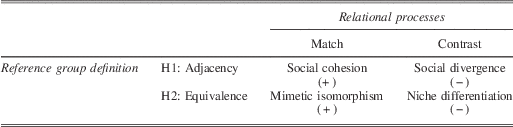
In our analysis we test two hypotheses regarding the influence of adjacent and equivalent peers on the tactical choices of ego. We test these two hypotheses simultaneously: both peer groups could influence ego at the same time. But given the possibility that ego may either match or contrast with the behavior of these two peer groups, we could find evidence consistent with two different relational processes for each set of peers. We map our expectations for the four resulting relational processes in Table 1 and describe each process in detail below.
Reference Group Definition and Relational Processes

We first seek to examine the influence of adjacent peers on the behavior of a particular NGO. We argue that the tactical choices of an organization’s adjacent peers should have a discernable effect on its own strategies.
Hypothesis 1: An organization with more adjacent alters employing protest tactics in 2008 will utilize more (fewer) protest tactics in 2009.
Statistical significance allows us to determine whether adjacent peers have an effect on ego’s behavior. The direction of the results suggests whether ego has a tendency to match or contrast with its adjacent peers: positive significance would be evidence consistent with the process of social cohesion, while negative significance would be consistent with the process of social divergence.
The social cohesion process suggests that organizations that are adjacent to one another should tend to have similar behavior via a process of communication. Many contagion and diffusion of innovation studies fall into this category. For example, Barnett’sFootnote 64 study of global humanitarianism demonstrates how ideas like ‘participation’ and ‘empowerment’ spread among actors in the NGO community, leading organizations to increasingly adopt ‘best practices’ based on widespread social norms. If we are observing a process of social divergence, organizations may adopt strategies that contrast with the efforts of their adjacent peers. For example, ChandlerFootnote 65 discusses how humanitarian and human rights groups may co-operate on many issues but choose very different advocacy strategies when working in difficult political environments, as human rights groups sometimes develop a more contentious posture when they feel that their humanitarian group partners have become complicit in supporting government abuses.
Our analysis also examines the influence of equivalent peers. We argue that the tactical choices of an organization’s equivalent peers should have a discernable effect on its own strategies.
Hypothesis 2: An organization with more equivalent alters employing protest tactics in 2008 will utilize more (fewer) protest tactics in 2009.
Again, statistical significance allows us to determine whether equivalent peers have an effect on ego’s behavior. The direction of the results suggests whether ego has a tendency to match or contrast with its adjacent peers: positive significance would be consistent with the mimetic isomorphism process, while negative significance would suggest the niche differentiation process.
The mimetic isomorphism process suggests that organizations in equivalent positions will tend to have similar behavior via a process of comparison. For example, WongFootnote 66 demonstrates that the political salience of Amnesty International is explained by the organization’s decisions regarding the centralization of its decision making. Her concluding chapter suggests that other big NGOs seeking to be dominant in their fields – like Greenpeace International and Oxfam International – made similar choices, partially due to the perceived success of the Amnesty model.Footnote 67 The niche differentiation process suggests that organizations contrast their behavior with that of their equivalent peers due to competition for resources and attention.Footnote 68 For example, CarpenterFootnote 69 shows how NGOs seek to distinguish themselves from similar others working in the same field by adopting unique issues, which causes important topics to be left off the agenda when their adoption does not create a unique brand identity for a specific organization.
A QUANTITATIVE ANALYSIS
We test these hypotheses by examining an original dataset of transnational climate change NGOs working in the European Union (EU), including information regarding their attributes, the institutions they target and their relationships with one another from 2008 to 2009. This time period is important for two reasons. First, very few climate change NGOs (20 per cent) were employing protest tactics when engaging in transnational action at the outset of the study. As others have documented, climate change advocacy has traditionally revolved around providing scientific information via conventional lobbying strategies.Footnote 70 Thus the adoption of protest tactics for engaging in transnational climate change advocacy was a strategic innovation in this time period about which there was likely to be uncertainty, making the ‘success’ of the tactic unknown at the outset and the choices of the reference group especially salient.Footnote 71
Secondly, a great deal of international climate policy making took place in the EU during this time period. This produced variation in the targets of advocacy, allowing us leverage on contextual hypotheses. The majority of our recorded events targeted either the EU (17 per cent) or the United Nations (UN) (42 per cent). In particular, NGOs were engaged in transnational advocacy targeting EU institutions over the course of developing the EU Climate and Energy Package, as well as during two important UN meetings in Poznan, Poland (2008) and Copenhagen, Denmark (2009). Other events targeted international institutions, transnational corporations or multiple national governments simultaneously.
Data Collection
We began collecting data on the population of actors in January 2008 and tracked their activities through December 2009. This data collection proceeded in three phases. First, we catalogued all transnational collective action that occurred on climate change in the EU from 2008 to 2009. To do so, we conducted an analysis of major news sources, following the tradition of ‘protest event analysis’ popular in the study of social movements.Footnote 72 We searched a variety of news sources in Factiva and LexisNexis to identify relevant collective actions, using broad search terms included in the Appendix. These search terms returned 11,588 articles for the years 2008 and 2009. These reports were then hand coded, and 371 (3.2 per cent) involved a relevant collective action, and referenced 262 unique events. We discuss our strategy for tackling description and selection bias, as well as the concrete criteria for event selection, in the Appendix.
Secondly, we created a database of reported events from the returned news items in 2008 and 2009. We then conducted additional document research on each event, seeking out copies of joint press releases, lists of organizational event sponsors and other primary source materials that were referenced in the news reports. This stage of data collection was essential to gathering accurate network data, as we found that newspaper articles were often inaccurate or incomplete in their reporting of organizations. We used this information to create a database of organizations and the events they sponsor, which we employ for two purposes. First, we construct a one-mode matrix of network ties among 119 organizations in which ties are based on event co-sponsorship in 2008. While there is some data reduction associated with this technique, it is the appropriate strategy for our case because we aim to theoretically examine how organizations (1st mode) interact given their co-sponsorship of events together (2nd mode).Footnote 73 Secondly, we construct a measure of an organization’s tactical profile in 2009, calculating the percentage of its events that were protest events in that year.
Finally, we collected information regarding the attributes of each organization that sponsored a collective action in 2008 by systematically coding the websites of organizations that appeared in the sample. We collected data on the number of staff and age of an organization, as well as whether its mission statement or annual report indicated it engages in service provision activities, and whether it has a structure that permitted individuals to join as members. In most instances, this information was available publicly or through the internet archive.Footnote 74
Measurement
We employ two network matrices to test our relational hypotheses. First, we use an adjacency matrix (Adjacent Peers) to measure how frequently each pair of organizations co-sponsored an event. Following previous network studies, we consider co-sponsorship of an event as a measure of partnership and communication between two organizations.Footnote 75 Secondly, we use an equivalence matrix (Equivalent Peers) to measure how structurally equivalent two organizations are (described below). Following previous network studies, we consider structural equivalence to capture the extent to which organizations occupy similar roles in the network.Footnote 76 We introduce a time lag in our autocorrelation between reference group behavior in 2008 and ego’s behavior in 2009 in order to minimize concerns about reverse causation in our model.Footnote 77
The dependent variable in this study is the percentage of protest events that an organization sponsored in 2009. For example, if an organization sponsored four total actions, two of which were protest events, it would have an overall repertoire of action that was 50 per cent protest events. We also introduce a number of variables to account for alternative explanations of protest tactics, which helps to minimize concerns about homophily bias in our analysis. Specifically, we measure the Age and number of Staff of an organization, the latter of which is commonly used as a proxy for the size of its budget.Footnote 78 We also employ dummy variables to measure whether an organization engages in direct Service Provision activities, such as running international development programs or engaging in land conservation, and whether it has a structure that permits Individual Members to join the organization. In our final model we also include a measure of an organization’s Previous Protest, calculated as the percentage of protest events the organization sponsored in 2008, to capture its predisposition toward protest.
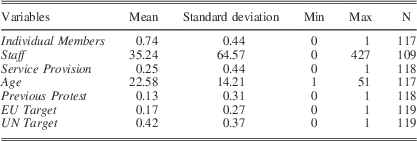
We address contextual hypotheses by including a measure of how often the organization targeted particular institutional actors. As we expect the EU to be exceptionally open to conventional advocacy and to provide funding for this purpose, we expect those organizations sponsoring a large number of actions that have an EU Target more often will be less likely to employ protest tactics. In other analyses (included in the Appendix) we include a measure of UN Target, calculated as the percentage of an organization’s events in 2009 that targeted the UN, in order to capture the idea that the Copenhagen summit was a particularly favorable opportunity for protest. Table 2 contains descriptive statistics for each of these variables.
Descriptive Statistics for Organizational Attributes

In some versions of the analysis we also include an additional matrix to measure the national embeddedness of the NGOs in our dataset. Stroup argues that national origin is an important determinant of both networks and tactics;Footnote 79 indeed, distinguishing the effect of peer networks from the effect of homophily due to shared environment is an important test of our theory. For this matrix we consider organizations to be adjacent if they have their headquarters in the same country. We note that this matrix is highly distinct from the two relational matrices (see Appendix), suggesting that the network is genuinely transnational and that ties are not overly patterned by national origin.
Finally, we formulate a relational matrix in which organizations have ties if they are members of the same umbrella organization, in this case indicating whether the organization was a national office of Greenpeace, Friends of the Earth or the World Wildlife Federation. About half of our organizations are members of a broader umbrella organization. That this matrix is moderately correlated with both the adjacency and equivalence matrices indicates that this connection is an important component of transnational co-operation in the network more generally, but is far from the only source.
As noted above, some of the weight matrices we employ in our models are significantly correlated, but none of the correlations is high enough to warrant multicollinearity concerns (see the Appendix for the raw correlations and significances calculated via permutation tests).Footnote 80 Simulations have shown that very dense weight matrices are problematic for network autocorrelation models because they underestimate the significance of the effect of the given matrices.Footnote 81 These simulation results would indicate that due to the correlation of the matrices, our results might be even more significant than observed.
Methods
Our analysis has two aims. First, we aim to establish whether organizations are influenced by the decision of their peers. We do this by employing network autocorrelation models.Footnote 82 These models allow us to examine the extent of autocorrelation between actors’ behavior and the network distance between them by adding a new covariate to a linear model that represents, for each individual, a linear combination of their alters’ value of the dependent variable and the weighting assigned from the different supplied weight matrices. This attempts to account for autocorrelation in the dependent variable, and is an appropriate strategy even in relatively small samples.Footnote 83
To address the problems of using a proportional dependent variable in a regression, we transformed the proportion of sponsored events per organization that were coded as protest events using a Bayesian transformation. We calculated an estimation of the underlying rate of protest behavior as the posterior mean of a Jeffrey’s prior and the binomial distribution for the number of protests and number of total events sponsored. While many prior distributions are available, the Jeffrey’s prior is theoretically appropriate,Footnote 84 and the selection of the Jeffrey’s prior from a set of similar priors makes little real difference.Footnote 85 A more detailed discussion of the technical aspects of this transformation is provided in the Appendix. We then convert this to the logit scale so that we are able to estimate the log-odds of a sponsored activity being a protest event. The end result of this transformation is an approximately normally distributed variable suitable for estimation via the network autocorrelation model (see Appendix). All models were fit using maximum-likelihood estimation via the lnam routine in the SNA package for R.Footnote 86
Our analysis uses four different matrices in the network autocorrelation model, each of which was normalized to sum to 1 so that the magnitudes of each are comparable. We follow LeendersFootnote 87 in specifying the adjacency matrix using the raw weighted matrix, allowing actors to become more influential if they sponsor events more often with ego. The equivalence matrix was derived first by calculating the hamming distance between each pair of nodes (how many ties would organization A have to change to perfectly mirror organization B), and then converting it to a similarity score indicating the extent to which organization A has similar ties to organization B.Footnote 88 The matrices for country and umbrella organization are identity matrices coded as 1 if two organizations are from the same country or umbrella organization, respectively. These were also normalized by the total sum.
RESULTS
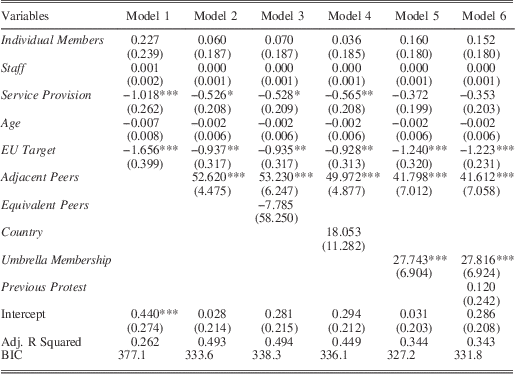
The results of these models are presented in Table 3. Model 1 is a simple linear regression in which we consider only the variables that measure attributes of the organization and its tendency to target particular institutions. In Model 2 we introduce network autocorrelation between ego’s Adjacent Peers and ego’s own behavior. Including the adjacency matrix substantially improves the fit of the model, with a difference in BIC of 43.5. This provides strong support for the claim that considering network embeddedness expands our ability to explain tactical choices. In Model 3 we add the network autocorrelation between ego’s Equivalent Peers and ego’s own tactics. Structural equivalence is negative and non-significant, and the BIC of Model 3 compared to Model 2 worsens by 4.7. This provides support for Hypothesis 1 but not for Hypothesis 2.
Network Autocorrelation Models

Note: *p<0.05, **p<0.01, ***p<0.001
In Model 4 we introduce an additional matrix to capture spatial autocorrelation among actors. Here, organizations are considered to have a tie if they are based in the same country. Including a spatial autocorrelation matrix does not substantively alter our results and is not itself statistically significant. In Model 5 we introduce an additional matrix to capture autocorrelation among organizations that are part of the same umbrella organization. Umbrella Membership is positive and significant, although its magnitude is only two-thirds of the Adjacent Peers term. The overall BIC of Model 5 is improved by 6.4 over Model 2. As a final test, Model 6 examines whether an organization’s previous sponsorship of protest events (Previous Protest) predicts its likelihood of doing so in the future. Previous Protest is not itself significant, and its addition does not change the significance or magnitude of the other terms in the model.
Our results suggest that relational explanations complement explanations that operate at the contextual and organizational levels. We note that several attribute variables, including Staff, Age and Individual Members, are not significant in any of these models, including Model 1. This surprising finding echoes recent survey research on this topic,Footnote 89 and may reflect the fact that organizations operating transnationally are relatively similar in their attribute profiles. Consistent with theoretical expectations, we do find that a tendency to target the EU is significantly associated with a decreased likelihood of employing protest tactics. Whether this is due to the relatively open decision-making structure of the EU or the availability of funding for conventional advocacy in this context cannot be discerned from these data.
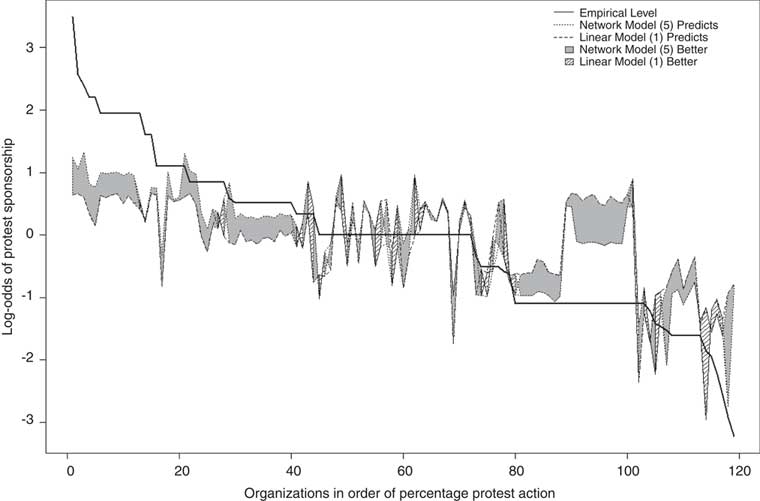
To further demonstrate how the network approach improves our ability to explain tactical choices, we compare the best-fitting network model (Model 5) with the linear model (Model 1) by visualizing the empirical and predicted results for the full range of organizations in Figure 1. This visualization demonstrates that Model 5 outperforms Model 1 for both organizations that often participated in protest events and those that rarely did so.
A comparison of Models 5 and 1

To understand the relative magnitude of the coefficient for Adjacent Peers, we use Model 5 to calculate the difference in predicted probabilities for a sample organization, Ecologistas en Accion (see qualitative evidence below), under two conditions: (1) in the organization’s actual network position in 2008 and (2) in a new network position, where we added one tie between Ecologistas en Accion and an organization with an action profile in 2008 of purely protest events. The end result, after converting from log-odds back to probabilities, was a 3 per cent increase in the likelihood of sponsoring a protest event in 2009. Given that organizations may add multiple ties each year, these results suggest that peer choices can exert a substantively meaningful effect on an organization’s tactical decisions.
In all of our models we find evidence of a similar relational process at play. We find a positive and significant relationship between the tactical choices of ego’s adjacent peers in 2008 and ego’s own tactical choices in 2009, providing evidence of social cohesion. However, we find no evidence of a relationship between ego’s equivalent peers’ behavior in 2008 and ego’s behavior in 2009. While we observe that the coefficient on the term for equivalent peers is negative, consistent with the process of niche differentiation, the relationship is not statistically significant. While we believe relational processes are likely to operate in many populations of actors, we identify two scope conditions that may be relevant for explaining the outcomes we observe in this particular case. First, tactical choices are decisions regarding collective action, and therefore benefit from peer matching. Relational dynamics may play less of a role for other kinds of strategic decisions that have primarily intra-organizational consequences. Secondly, the time period we analyze was a moment of great strategic uncertainty for the groups in the analysis. Relational dynamics may be more important under conditions of uncertainty, where the ‘success’ of a particular strategy cannot be easily observed.Footnote 90
QUALITATIVE EVIDENCE
Our quantitative analysis provides complementary evidence that NGOs are influenced by the tactical decisions of their peers. In this section we select two cases to illustrate the logic of our argument. We also present excerpts from qualitative interviews with practitioners in order to document that relational processes operate at the actor level within this population.
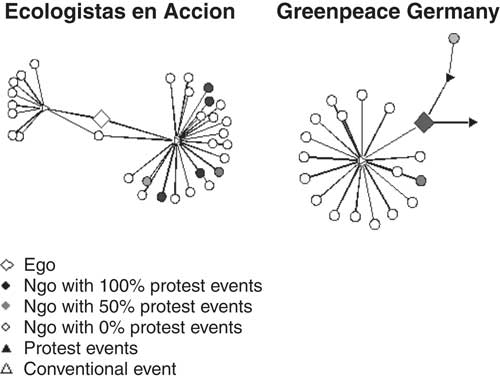
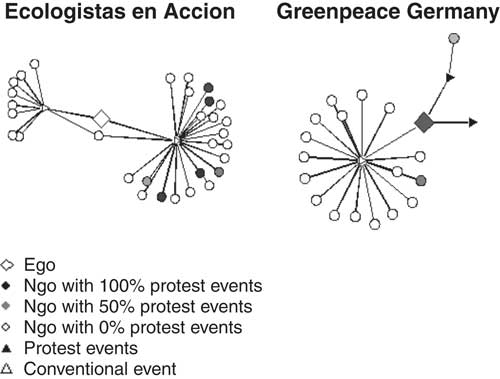
We note that our ability to predict tactical choices is expanded by considering network embeddedness, as visualized in Figure 1. From the total population of organizations we selected two NGOs – Ecologistas en Accion and Greenpeace Germany – to illustrate this argument further. Both organizations are nationally rooted NGOs (in Spain and Germany, respectively) that regularly participate in transnational advocacy. Both organizations also changed their tactics between 2008 and 2009. In 2008, Ecologistas en Accion employed entirely conventional tactics when engaging in transnational climate advocacy. But in 2009 its actions comprised 60 per cent protest events. Greenpeace Germany, however, participated in 67 per cent protest events in 2008. In 2009, the organization decreased to 50 per cent participation in protest events. Neither substantially altered their attributes or the institutions they targeted. Thus from the perspective of existing theory, these are puzzling cases of tactical transformation.
From the relational perspective, these choices are much more explicable.Footnote 91 We illustrate our argument by visualizing the egonetworks of these two organizations in Figure 2. This figure displays the ties between organizations (circles) and events (triangles), where ties are based on joint event participation. Events are shaded according to whether they are protest events (black) or conventional events (white), and organizations are shaded by the percentage of protest action they employ in that year. As we can see, while Ecologistas en Accion participated in no transnational protest events in 2008, six out of their thirty adjacent peers frequently used protest tactics. We argue that participation in these events with groups using protest tactics provided a channel for communication between them (as described below), inducing Ecologistas en Accion to sponsor more protest events in 2009. Conversely, while two-thirds of the transnational events sponsored by Greenpeace Germany in 2008 were protest events, only two of their nineteen alters also participated in any protest events. We argue that joint event participation with more moderate peers served as a channel for communication here as well, ultimately producing a tactical moderation on the part of Greenpeace Germany in 2009.
Ecologistas en Accion and Greenpeace Germany egonetworks in 2008, shaded by percentage protest events
Interview data provides evidence of how relational mechanisms operate in these two cases.Footnote 92 In both interviews, respondents described how their relations with other groups provided opportunities and constraints in their decision making, altering their perception of costs and benefits. In the first case, a staff member from Ecologistas en Accion described a clear process in which the influence of peers created internal pressure for the increased use of protest tactics:
We came together in a new coalition in the past few years and this made us reconsider our approach […] [This is important because] we don’t want to be out on the streets alone [laughs] – we want to be out there with our allies, so they can’t ignore us! Having our allies involved is very important from this perspective (interview, Ecologistas en Accion 2009).
In this case, the organization’s ties with other organizations that had adopted protest tactics provided an opportunity to communicate about planned actions and an eventual social cohesion with the tactical choices of peers. Interestingly, this respondent also described how the absence of peers employing protest tactics could serve as a constraint on the use of this tactic. As the respondent described it, the organization would be unwilling to commit its reputation and resources to protest tactics until it knew that a sufficient number of other organizations would do the same. From this perspective, if peers are not adopting protest tactics, then the cost of doing so rises for the individual organization. At the same time, the likely payoff of such an action declines, as these actions are easily ignored when they occur in isolation. As the respondent explained, peers’ decisions are crucial to weighing the costs and benefits associated with an organization’s tactical options.
In the second case, a campaigner from Greenpeace Germany described how social cohesion with peers influenced the organization’s decision to moderate its tactics in its transnational work. The respondent described a process whereby communication with peers results in carefully negotiated joint actions that often differ from the actions originally preferred by their organization:
When we work with others it changes the way we do things. It has to be that way because otherwise we would never reach an agreement on what we wanted to do. It seems like [when working in a transnational coalition] a lot of large groups set the tune, and we all tend to follow that (interview, Greenpeace Germany 2010).
This quote reveals how the practical need to collaborate with other organizations on advocacy events can constrain an organization’s tactical choices. While Greenpeace is traditionally associated with protest tactics, the respondent describes a situation in which more moderate partners are able to ‘set the tune’ and exert pressure to obtain their preferred advocacy strategy. In this case, the respondent describes how the organization weighs its tactical options when working in a coalition, describing a clear trade-off between the benefits of collaboration and the costs of not using their preferred tactics. In this case, direct communication among frequent collaborators caused Greenpeace Germany to shift its tactics away from protest actions, reflecting a clear process of social cohesion.
Examination of these two illustrative cases provides evidence that embeddedness in transnational advocacy networks influences NGO decisions via relational mechanisms, which complements our quantitative analysis. We find that network structure can serve as both an opportunity and a constraint in the realm of tactical choice. Future qualitative research could explore these relational mechanisms in much greater detail.
CONCLUSION
This article provides insight into three interrelated puzzles. The first concerns the widely acknowledged limitations of existing theory in explaining variation in NGOs’ tactical choices. This article examines how such tactical choices are shaped by NGOs’ embeddedness in transnational advocacy networks. Our careful research design allows us to tackle concerns regarding potential homophily bias, shared environment and reverse causality, providing support for the idea that NGOs tend to be socially cohesive and responsive to the decisions of their adjacent peers. These findings are in line with the expectations of classic work in this field that such networks will serve as channels for communication.Footnote 93 We suggest that future empirical research could examine the impact of network embeddedness on the behavior of actors in different geographical areas, in more or less uncertain time periods, and for other types of strategic choices. More theoretical attention should be paid to examining how organizational characteristics may condition the impact of ties on behavior, how social ties may offset the influence of institutional incentives, and how relationships of adjacency and equivalence may arise under different conditions.
Secondly, we extend previous work on transnational advocacy networks by offering an explanation of the observed tactical diversity among climate change NGOs. As anticipated in the foundational work on this topic, there is a great deal of social cohesion among organizations with direct ties. But organizations generally have a limited number of partner organizations; this creates a situation in which groups may be differentially embedded within the same network.Footnote 94 Because NGOs have different partners in this network, they may be exposed to different kinds of communication from their peers. This communication, in turn, produces disparity in tactical adoption, as our two examples illustrate. We argue that more attention needs to be paid to the structure of transnational advocacy networks in order to understand these kinds of complex social processes.Footnote 95
Thirdly, our study illuminates the surprising social processes by which macro-level collective action outcomes – here, social protest – emerge in world politics. These findings have important consequences for policy making concerning civil society participation in international institutions. Our results suggest that common practices in international institutions – including extending additional participatory opportunities to a greater number of NGOs or providing additional resources to encourage attendance – may not be sufficient to directly affect tactical choices. These results suggest that protest is not primarily a weapon of the weak or solely a response to limited opportunities. On the contrary, protest is seen here as the product of internal social processes that operate within advocacy networks. In this sense, transnational advocacy networks constitute their own spheres of governance in which particular peer organizations may have the power to shape the strategies and behavior of others, with important normative and policy consequences.
Network embeddedness can create pressure toward certain kinds of choices; this by no means fully determines behavioral outcomes or undermines the importance of environmental pressures or actor agency. We stress the importance of relational processes because we believe they have been underemphasized in previous scholarship. Our case demonstrates how accounting for actor interdependence can improve our understanding of important political phenomena, and how the tools of social network analysis can be used to operationalize hypotheses regarding the scope and pathways of peer influence in world politics. Examining the role of relationships in guiding behavior reveals a complex and consequential layer of social organization that we are just beginning to explore.