Significant outcomes
• The levels of serum BDNF and IL-2 were significantly altered in the patients compared with the healthy subjects.
• The severity of the disorders did not correlate with the levels of serum BDNF and IL-2.
• The levels of serum BDNF and IL-2 did not differ between the patient groups.
Limitations
• The small sample size is the major limitation.
• Some clinical determinants such as sex, smoking status, age and storage of the samples can affect serum BDNF levels.
• Some patients in the schizophrenia group were on medication.
Introduction
Depression affects between 19% and 81% of schizophrenic patients (Reference Leff1). Depression is considered to be one of the psychopathological domains of schizophrenia and an independent and stable dimension of the disorder (Reference Leff, Tress and Edwards2,Reference Peralta and Cuesta3). Although depression is a frequently occurring symptom in schizophrenia, the underlying mechanism is still unclear. Brain derived neurotrophic factor (BDNF) and interleukin (IL) are thought to play role in the pathogenesis of depression and schizophrenia (Reference Buckley, Mahadik, Pillai and Terry4–Reference Tuglu and Kara6) and in regulating behaviours such as appetite, libido and sleep regulation (Reference Kronfol and Remick7,Reference Krueger8). Changes in cytokines, cytokine receptors and cytokine activity modifiers have been reported in the blood and cerebrospinal fluid (CSF) of schizophrenic patients; these include decreased serum levels of IL-2 and IL-6 (Reference Shintani, Kanba and Maruo9,Reference Ganguli, Yang and Shurin10), increased serum levels of the IL-2 and IL-6 receptors (Reference Rapaport, Torrey and Mcallister11,Reference Akiyama12), increased CSF levels of IL-2 (Reference Licinio, Seibyl, Altemus, Charney and Krsytal13) and increased serum levels of IL-2 (Reference Kim, Kim and LEE14).
There is also a growing body of evidence that supports an association between BDNF and schizophrenia. Although some studies reported no significant differences in the levels of serum BDNF among medicated patients and normal controls (Reference Huang and Lee15,Reference Reis, Nicolato, Barbosa, Teixeria, Romano-Silva and Teixeria16), the majority of the relevant studies reported decreased serum levels of BDNF in treated and first-episode schizophrenic patients (Reference Pirildar, Gonul, Taneli and Akdeniz17–Reference Rizos, Papadopoulou and Laskose19). Although BDNF has been most extensively studied in relation to depression, there are also some studies that demonstrate increased serum levels of BDNF in medicated (Reference Reis, Nicolato, Barbosa, Teixeria, Romano-Silva and Teixeria16,Reference Gama, Andreazza and Kunz20) and nonmedicated schizophrenic patients (Reference Jockers-Scherubl, Danker-Hopfe and Mahlberg21). Both animal and human studies have demonstrated the involvement of BDNF in the pathogenic mechanism of major depressive disorder (MDD) (Reference Karege, Perret, Bondolfi, Schwald, Bertschy and Aubry22–Reference Aydemir, Yalcin and Aksaray24).
Aims of the study
In this study, we aim to investigate whether BDNF and IL-2 can be biological indicators of depressive symptoms in depressed schizophrenic patients.
Materials and methods
Subjects
The study population comprised patients diagnosed with either schizophrenia (SZ), MDD or schizophrenia with depression (SZD) and a control group of healthy individuals between 18 and 65 years of age.
Patients who have an alcohol or drug addiction, patients diagnosed with depression or a psychotic disorder based on a gen medical condition or substance use, and patients diagnosed with Axis-1 or Axis-2 disorders other than SZ or MDD were excluded from the study.
Sociodemographic information was taken for all the participants. The patients were interviewed on the basis of the Diagnostic and Statistical Manual of Mental Disorders, Fourth Edition (DSM-IV, American Psychiatric Association, 1994). The Positive and Negative Symptoms Scale (PANSS), the Calgary Depression Scale for Schizophrenia (CDSS) and the Hamilton Depression Rating Scale (HDRS) were used for assessment. In this study, the cut-off scores for the HDRS and CDSS were set at 8 (Reference Williams25) and 12 (Reference Oksay, Aksaray, Kaptanoglu and Bal26), respectively.
The study protocols were approved by the relevant ethics committee. All the procedures that contributed to this work comply with the ethical standards of the relevant national and institutional committees on human experimentation and with the Helsinki Declaration of 1975, as revised in 2008. All the subjects gave their written informed consent to participate.
BDNF and IL-2 Enzyme-Linked Immuno Sorbent Assay (ELISA)
Blood samples were taken from the patient and control groups from the antecubital vein after 12 h of fasting between 08:00 and 10:00 a.m. The serums obtained from blood samples taken for the BDNF and IL-2 parameters were preserved in −80°C until they were studied. The blood samples were stored as long as 18 months. The BDNF and IL-2 were studied by using ELISA kits (Boster Biological Technologies, CA, USA). The BDNF and IL-2 values were defined as ng/ml and pg/ml, respectively.
Statistical analysis
The descriptive statistics of the data in the study have been calculated. Whether the data are normally distributed is examined by a Kolmogorov–Smirnov test. The comparisons of the groups are conducted with a Kruskal–Wallis test and/or a Mann–Whitney U-test. A Dunn–Bonferroni test is used for multiple comparisons. A Spearman Correlation test has been used to determine the relationship between the continuous variables. To compare the categorical variables, Pearson's χ2, Fisher's exact and Freeman–Halton tests have been used. The level of significance is set at p = 0.05.
Results
A total of 47 subjects (11 SZ patients, 20 MDD patients and 16 SZD patients) were enrolled in the study. The control group comprised of 20 healthy subjects.
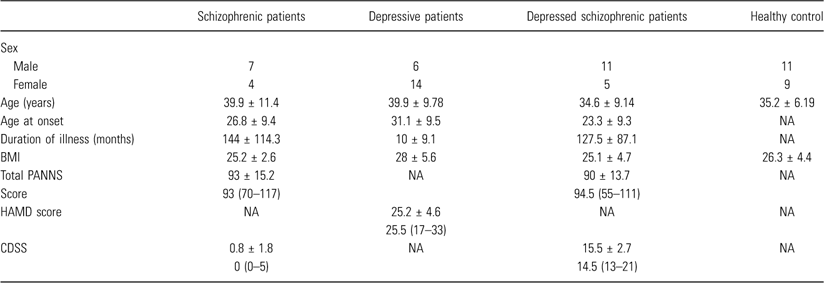
There were no significant differences between the three patient groups and the control group in terms of sex (p = 0.096) or age (p = 0.188). There were no significant differences between the patient groups in terms of the age of onset of the disorders (p = 0.061). However, the duration of the disorders were longer and the relapses were more frequent in the SZ and SZD groups compared with the MDD group (p < 0.001). There were no significant differences between the patient groups in terms of family history (p = 0.583) or suicide attempts (p = 0.065). Sociodemographic information were taken for all the participants (Table 1).
Clinical and demographic features of study subjects

BMI, body mass index; CDSS, Calgary Depression Scale for Schizophrenia; HAMD, Hamilton Depression Rating Scale; PANNS, Positive and Negative Symptoms Scale.
Mean ± SD; Median (Minimum–Maximum).
The SZ and MDD groups were drug-free, but 10 of the 16 SZD patients were under treatment (seven of the patients were undergoing atypical antipsychotic treatment, and three were undergoing atypical antipsychotic and antidepressant combination treatment). The patients were free of extrapyramidal side effects of the antipsychotics.
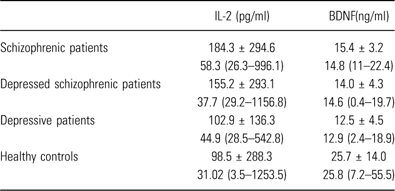
Compared with the control group, the serum BDNF levels were found to be significantly lower in the SZ, MDD and SZD groups (p = 0.049, p = 0.001, p = 0.01, respectively). However, the serum IL-2 levels were found to be significantly higher in the SZ, MDD and SZD groups compared with the control group (p = 0.044, p = 0.003, p = 0.027, respectively). On the other hand, there were no significant differences between the patient groups in terms of their serum BDNF (p = 0.236) and IL-2 levels (p = 0.958).
There were no significant correlations between the serum levels of BDNF or IL-2 and the PANSS or CDSS scores.
There were no significant correlations between the serum levels of BDNF and the PANSS (r = 0.169, p = 0.399) or CDSS (r = −0.208, p = 0.299) scores.
There were no significant correlations between the serum levels of IL-2 and PANSS (r = 0.094, p = 0.647) or CDSS (r = 0.027, p = 0.896) scores.
Discussion
The following are the major findings of the present study: (i) the serum BDNF levels are lower in all three patient groups than in the control group; (ii) the serum IL-2 levels are significantly higher in all three patient groups than in the control group; (iii) there were no significant differences between the patient groups in terms of the serum BDNF and IL-2 levels.
In the medical literature, there are some studies that demonstrate that the serum BDNF levels in schizophrenic patients are lower than those in healthy controls (Reference Ikeda and Yahatan18,Reference Rizos, Michalopoulou and Siafakas27,Reference Chen, Wang and Wang28), but some studies demonstrate higher serum BDNF levels in schizophrenic patients than in healthy controls (Reference Reis, Nicolato, Barbosa, Teixeria, Romano-Silva and Teixeria16,Reference Gama, Andreazza and Kunz20).
In many studies, immune system abnormalities are found to be related to schizophrenia. Changes in the IL levels in immune diseases, such as systemic lupus erythematosus and rheumatoid arthritis, have been detected. Investigators have focused on possible changes in the IL levels of schizophrenic patients because of the similarities in the chronic and episodic courses of schizophrenia and autoimmune diseases (Reference Ganguli, Yang and Shurin10). According to the T helper-2 (Th2) hypothesis, the balance between Th1 and Th2 in schizophrenia is diverted towards the superiority of Th2 (Reference Muller, Hofschuster, Ackenheil and Eckstein29). IL-2, which is the indicator of the Th1 system and IFN-gamma, is found to be decreased in in vitro and increased in in vivo conditions in schizophrenia (Reference Kim, Kim and LEE14,Reference Ganglui, Rabin and Belle30,Reference Arolt, Rothermundt, Wandinger and Kirchner31). IL-6, IL-4 and IL-10, which are the indicators of Th2, are found to be increased in schizophrenia (Reference Frommbergeru, Bauer, Haselbauer, Fraulin, Riemann and Berger32,Reference Na and Kim33). These findings suggest the involvement of cytokines in schizophrenia.
Ganguli et al. (Reference Ganglui, Rabin and Belle30) and Villemain et al. (Reference Villemain, Chatenoud and Galinowski34) demonstrated the decreased levels of serum IL-2 and IFN-γ in vitro in schizophrenic patients. On the contrary and in line with the present study, some studies have demonstrated increased serum IL-2 levels in schizophrenic patients (Reference Lin, Kenis and Bignotti35,Reference Maes, Bocchio and Bignotti36). Increased levels of IL-2 had been associated with treatment resistance and relapses in schizophrenia (Reference Lin, Kenis and Bignotti35,Reference Mcallister, Van Kammen and Rehn37). The heterogeneous nature of the disorder may reflect such contradictory results.
There are many studies that demonstrate that patients with MDD have lower levels of serum BDNF than do control patients (Reference Lee, Kim, Park and Kim5,Reference Karege, Perret, Bondolfi, Schwald, Bertschy and Aubry22,Reference Sen, Duman and Sanacora38). In line with the aforementioned studies, the present study demonstrates decreased levels of serum BDNF in depressed patients.
The hypothesis that there is inflammation and monocytic and T-cell activation in depression is based mainly on the findings of Maes et al. (Reference Maes, Bosmans, Suy, Vandervorst, de Jonckheere and Raus39). The inflammatory response and the increase of monocytic activation in depression have been associated with increased levels of serum IL-1-β, IL-6 and TNF-α. The increase of cell-mediated immune activation has been associated with increased levels of soluble IL-2 receptor and IFN-γ. It is also suggested that the development of depression may be associated with cell-mediated immune activation that impairs serotonin metabolism. Moreover, it is argued that psychosomatic symptoms in depressed patients may be associated with cell-mediated immune activation, because cytokines are affected by stress, their role in depression had been the focus of interest in the pathogenesis of MDD, which is also thought to be an autoimmune disease. Although, Anisman et al. (Reference Anisman, Merali, Poulter and Hayley40) and Pavon et al. (Reference Pavon, Sandoval-Lopez and Eugenia41) reported decreased levels of serum IL-2 in depressed patients, the present study demonstrates increased levels of serum IL-2, which is in line with the studies of Brietzke et al. (Reference Brietzke, Stertz and Fernandes42) and Dowlati et al. (Reference Dowlati, Herrmann and Swardfager43) that reported increased levels of serum IL-6, TNF-α and IL-2.
Xiong et al. (Reference Xiong, Zeng and Wan44) reported decreased levels of serum IL-2 in schizophrenic and depressed patients compared with healthy controls. They speculated that IL-2 levels might be a promising biological indicator for the diagnosis of schizophrenia. The present study demonstrates increased serum IL-2 levels in each patient group compared with the healthy control group.
The accumulated data to date have raised the question of whether the alterations in serum BDNF and IL-2 levels are a part of the pathophysiology of both schizophrenia and MDD. The study by Esen-Danaci et al. (Reference Esen-Danaci, Aydemir, Deveci, Taneli and Taskin45) has a very limited sample size of SZD patients, but this study reported decreased levels of serum BDNF in MDD patients compared with healthy controls and SZD patients. However, the levels of serum BDNF in SZD patients were similar to those in healthy controls. Noto et al. (Reference Noto, Gadelha and Belangero46) reported increased levels of serum BDNF in SZD patients whose CSDD scores were above 7 compared with those whose scores were below 7. They also reported a positive correlation between levels of serum IL-1 and PANSS scores. The present study demonstrates decreased levels of serum BDNF and increased levels of serum IL-2 in the SZD patients compared with the healthy controls.
There are contradictory results concerning the association between the severity of depression and serum levels of BDNF (Reference Karege, Perret, Bondolfi, Schwald, Bertschy and Aubry22,Reference Aydemir, Yalcin and Aksaray24,Reference Fernandes, Gama, Kaunt-Sant'anna, Lobato, Belmonte-de-Abreu and Kapcinski47). In the present study, we found negative correlation between the HDRS scores and the serum levels of BDNF in the MDD group.
Buckely et al. (Reference Buckley, Pillai, Evans, Stirewalt and Mahadik48) reported significant correlation between serum levels of BDNF and positive symptoms. Zhang et al. (Reference Zhang, Tan and Zhou49) and Rizos et al. (Reference Rizos, Rontos and Laskos50) reported a significant correlation between serum levels of BDNF and negative symptoms in their studies. Chen et al. (Reference Chen, Wang and Wang28) reported a positive correlation between serum levels of BDNF and PANSS-P or PANSS-T scores. Noto et al. (Reference Noto, Gadelha and Belangero46) reported a positive correlation between serum levels of BDNF and CDSS scores. In the present study, we did not find any significant correlations between the serum levels of BDNF and the PANSS-P, PANSS-N, PANSS-T, PANSS-G or CDSS scores in the SZ group.
Bus et al. (Reference Bus, Tendolkar and Franke51,Reference Bus, Molendijk and Penninx52) reported some clinical determinants such as sex, smoking status, drinking behaviour and age, which can affect serum BDNF levels. Lee et al. (Reference Lee, Lange, Ricken, Hellweg and Lang53) and Chen et al. (Reference Chen, Wang and Wang28) reported no significant correlation between serum levels of BDNF and age, age of onset or duration of the disorder in schizophrenic patients. Likewise, Xiu et al. (Reference Xiu, Hui and Dang54) reported similar correlations except for the age determinant. In the present study, we did not find any significant correlation between the serum BDNF levels and sex, age, age of onset, duration of the disorder, number of psychotic episode or body mass index in the SZ group.
Sen et al. (Reference Sen, Duman and Sanacora38) reported no significant correlation between serum levels of BDNF and sex or age in depressed patients. Karege et al. (Reference Karege, Perret, Bondolfi, Schwald, Bertschy and Aubry22) and Sözeri et al. (Reference Sozeri-Varma, Enli and Toker-Ugurlu55) reported no significant correlation between serum levels of BDNF and sex or number of depressive episode. In the present study, we did not find any significant correlation between the serum BDNF levels and sex, age, age of onset, duration of the disorder or body mass index in the MDD group.
In the present study, there was no significant relationship between the serum levels of IL-2 and age, sex, age of onset, duration of the disorder, smoking status or body mass index in the SZ or SZD groups. The findings of the present study are in line with the findings of previous studies (Reference Haack, Hinze-Selch and Fenzel56,Reference Erbagci, Herken, Koyluogluo, Yilmaz and Tarakcioglu57). On the other hand, Mahendran et al. (Reference Mahendran, Mahendran and Chan58) demonstrated a negative correlation between duration of the disorder and serum levels of IL-2 in schizophrenic patients. The findings of the present study do not suggest a significant relationship between CDSS or PANSS scores; however, some studies demonstrate significant correlations between serum levels of IL-2 and PANSS scores (Reference Mahendran, Mahendran and Chan58,Reference Bresee and Rapaport59).
Regarding the MDD group, the findings of the present study do not suggest a significant correlation between serum levels of IL-2 and age, HDRS scores, number of depressive episodes, duration of the disorder, smoking status or body mass index. Eller et al. demonstrated similar findings in their study (Reference Eller, Aluoja, Maroni and Vasar60).
This study has several limitations. The small sample size is the major limitation of the present study. Some patients in the schizophrenia group were on antipsychotic medications, which can be interpreted as another limitation because it is known that antipsychotics might have an effect on levels of BDNF and IL-2. However, it is noteworthy that there are some studies (Reference Sen, Duman and Sanacora38,Reference Maes, Meltzer and Bosmans61) that report alterations in serum BDNF and cytokines levels with antipsychotic or antidepressant treatments, but some do not (Reference Akiyama62,Reference Lanquillon, Krieg, Benning-Abu-Sach and Vedder63). In the present study, no serum BDNF or IL-2 level differences were detected between the patients who were undergoing treatment and those who were drug naïve. However, serum levels of BDNF and IL-2 can be affected by hormonal changes (Reference Jezierski and Sohrabji64,Reference Sohrabji and Lewis65), and the female patients’ menstrual cycles were neglected in the present study because the storage time of the samples was no longer than 5 years and the subjects were fasting before the samples were taken, we did not expect any influence of these determinants on the BDNF levels in the present study. Diurnal variation has been reported for plasma BDNF levels, but not for serum BDNF levels (Reference Piccinni, Marazziti and Del66). We also did not expect any influence of diurnal variation on the outcomes of the present study.
Despite its limitations, as far as we know, this is the first study that evaluates serum BDNF and IL-2 levels in schizophrenic patients with depression compared with not only a healthy control group but a schizophrenia and major depression group.
The findings of the present study suggest that plasticity and immune system changes are involved in the pathogenesis of schizophrenic patients with or without depressive symptomatology. However, the data do not clarify whether the depressive symptoms in schizophrenia occur as a dimension of schizophrenia or as symptoms of major depression that is comorbid to schizophrenia. Further studies with larger samples are needed to determine whether BDNF and IL-2 might be useful pathophysiological biological indicators of schizophrenia and depression. Such studies may reveal accurate biological indicators that may help us understand the pathophysiology of psychiatric disorders (Table 2).
The descriptive statistics of serum levels of IL-2 and BDNF in study subjects
BDNF, brain-derived neurotrophic factor; IL, interleukin.
Mean ± SD; Median (Minimum–Maximum).
Acknowledgement
All the authors have contributed to the conception and design of the study or the interpretation of the data, revised the content and gave their final approval.
Financial Support
No support was received from any pharmaceutical company for this study.
Conflicts of Interest
None.