The signing of a comprehensive peace agreement (CPA) in civil war negotiations is the culminating moment in the peace process, and its implementation places a highly legitimized and vetted array of social and political reforms at the center of the national agenda. Multi-year implementation processes of this scale and purpose are largely without historical precedent before 1989. Contemporary peace processes are characterized by lengthy negotiations and a high peace agreement-to-conflict termination ratio in which conflict actors negotiate numerous partial agreements, usually on different sets of issues, over longer time horizons.Footnote 1 For example, in Guatemala, eighteen agreements were negotiated over the course of seven years and finally subsumed under the Accord for a Firm and Lasting Peace signed on 29 December 1996. The sweeping array of socio-political reforms contained in that final agreement were then implemented over the course of the next decade. In the Philippines, the government and the Moro Islamist Liberation Front (MILF) have signed seven agreements since signing a Framework Agreement on the Bangsamoro in October 2012.Footnote 2 On 28 March 2013, the two parties signed the Comprehensive Agreement on the Bangsamoro. In Colombia, it was announced in November 2013 that the government and FARC-EP (Fuerzas Armadas Revolucionarias de Colombia – Ejército del Pueblo) were in negotiations toward a historic final accord. As of September 2015, the two parties have concluded their forty-first cycle of talks, and have produced a number of agreements to be subsumed under a comprehensive agreement expected to be reached within the next six months.Footnote 3
While conflict actors, mediators and other stakeholders in an ongoing negotiation are fully aware that the implementation of most of the terms they have agreed to will not begin until a final agreement is signed, scholars have tended to analyze peace agreements falling within a larger negotiation sequence as having immediate peace-promoting effects upon being signed. In fact, most agreements are not immediately followed by a process in which the agreed upon terms are implemented. This represents a potentially colossal mismatch between ordinary stakeholders’ expectations regarding the purpose of a peace agreement and the timing of its implementation, and the way in which quantitative studies have approached the issue of when peace agreements should begin to produce their desired effects. From a stakeholders’ point of view, the signing of a CPA represents the culmination of all previous negotiations and agreed-upon terms, marking the start of a large-scale process in which the collection of mutually acceptable terms to the underlying conflict issues is implemented. This article provides an important corrective to the way that civil war peace agreements have been modeled in empirical studies by being the first to examine the effects of aggregate implementation on post-accord conflict dynamics.
In the next section, we review existing research on civil war peace agreements – highlighting a lack of recent works focusing on the implementation of agreements. This review is followed by a theoretical argument that describes the possible mechanisms through which the implementation of CPAs contributes to macro-level social and political change that can fundamentally alter a nation’s post-accord trajectory. Following the theory, we provide a brief overview of a new dataset on the implementation of fifty-one different categories of intrastate peace accord content, followed by an analysis that utilizes several survival models to test our expectations. We find that the strongest predictor of whether the signatories of a CPA will return to civil war (or not) is the overall extent that the provisions that were negotiated were subsequently implemented. Our findings also show that the effects of aggregate implementation do not apply only to signatory groups. Factions outside the peace process are also strongly influenced by whether the agreement that is in play is implemented (or not implemented). The results suggest that viable implementation processes pull outside actors in, while failing implementation processes push inside actors out, generating greater overall levels of future civil war. After discussing the findings, we conclude by commenting on some policy implications and areas for further research.
PRIOR RESEARCH ON PEACE AGREEMENT EFFECTIVENESS
There are two primary ways in which researchers have attempted to evaluate the effects of civil war peace agreements. First, peace agreements have been compared and evaluated based on their level of content. Content-based analyses usually refer to particular types of specialized provisions. Secondly, peace agreements have been evaluated based on the degree to which a few particular provisions were implemented in the post-accord period. The first method of comparing agreements – based on their relative content – has produced an explosion of works in the past fifteen years. Scholars have focused on many different types of provisions, the most prominent of which include third-party security guarantees (most notably, peacekeeping operations),Footnote 4 power-sharing arrangements,Footnote 5 verification and monitoring,Footnote 6 security sector reform,Footnote 7 transforming the rebel group into a legitimate political party,Footnote 8 truth commissions and justice/human rights provisions,Footnote 9 and decentralization and autonomy arrangements.Footnote 10
The second method of evaluating peace agreements – based on the extent to which their content is subsequently implemented – has received far less attention. In almost every single study on civil war peace agreements the variation exploited in each analysis relates to whether the text of an agreement mentions a particular type of provision – and not the degree to which the provision of interest was later implemented. We are aware of only two studies in which the authors collected and analyzed data on the implementation of the provision that lay at the center of the analysis.Footnote 11 The findings from these two studies suggested that variation in the degree of implementation has greater explanatory power than the presence of the provision in the agreement.Footnote 12
Despite these intriguing results that suggest that implementation is what ultimately matters most to the sustainability of peace, empirical research on the implementation of intrastate peace agreements has surprisingly advanced very little in recent years. Since Jarstad and Nilsson’s article nearly seven years ago,Footnote 13 only one study has produced new data on the implementation of a particular type of peace accord provision.Footnote 14 Moreover, these three studies that make up the complete body of empirical work on ‘implementation’ are all on the same topic: power-sharing arrangements. No study published to date has explored the concept of ‘aggregate’ implementation, that is, the extent to which an entire negotiated agreement – with all of its provisions – is implemented. This is the topic of the current article. We argue that this is the most likely level of analysis that signatories and stakeholders to the accord would use in their evaluation of the level of commitment that has been devoted to the peace agreement and, by extension, whether the agreement is accomplishing its intended objectives. In the next section, we put forth a general theory that describes how the aggregate implementation of CPAs leads to long-term changes in conflict behavior between the government and the groups that negotiated the accord, as well as between the government and non-signatory groups involved in the conflict.
THEORY: CPA IMPLEMENTATION AS STRATEGIC PEACEBUILDING
We analyze the process of implementing a CPA as a form of strategic peace building – that is, an integrated collection of parallel and reinforcing processes aimed at promoting reconciliation between warring groups, fostering better state-society relations, overcoming fear and insecurity, and addressing the root causes of civil war. We identify three primary ways in which the process of implementing a CPA can forge a constructive break in historically self-perpetuating conflict systems: (1) CPA implementation normalizes political relationships between hostile groups; (2) CPA implementation solves the types of credible commitment problems and information uncertainties that can lead conflict actors to resume violence (often out of fear of a pre-emptive strike) and (3) CPA implementation addresses the root causes of civil conflict that drive rebel recruitment.
Implementation Contributes to the Normalization of Politics
We identify several paths by which the process of implementing a CPA contributes to the normalization of politics between formerly hostile and warring groups. The first has to do with the fact that peace agreements in civil wars, almost by default, are negotiated between groups that hold state power (the government) and groups that are excluded from state power (the opposition). Empirical studies confirm that a leading cause of civil war, globally, is the political exclusion of groups with the capacity to mobilize around identity.Footnote 15 The central thesis of The Logic of Political Survival describes how leaders use mass political exclusion to their advantage by tying their own survival to that of their core support base or minimum winning coalition: the smallest possible group of people whose loyalty is a necessary condition for the current regime to remain in power.Footnote 16 In small coalition systems, governing elites forge strong bonds between themselves and their minimum winning coalition by providing them with disproportionate access to state resources in the forms of military protection and private excludable goods. Leaders of small coalitions have a particular distain for providing public goods that would benefit supporters and non-supporters alike. In return for preferential treatment, coalition members reinvest large sums of resources back into the organizational power structures that sustain loyalty to the leader and that preserve the policy status quo. As might be expected, studies find that small coalition systems have the highest frequency of civil war.Footnote 17 This suggests that: (1) group chauvinism is a root cause of many civil wars and (2) there seems to be something peculiar about small coalition systems that makes them less able to negotiate an ex ante settlement so as to avoid war. It appears straightforward that the benefits of small coalition membership are often times worth the costs of fighting a civil war (for those who benefit).
It logically follows that comprehensive peace agreements will constitute an effort by the opposition group to alter the status quo distribution of political power, and that provisions implemented for that purpose should lead to such changes as increasing the share of the population that could form an alternative coalition (the selectorate). As the size of the politically relevant population increases, so does the likelihood that alternative winning coalitions will form and replace the current coalition in power. As the size of the winning coalition increases, leaders shift spending away from providing exclusively private goods to core supporters and towards providing higher level public goods, which have been shown to be associated with reductions in poverty, repression, discrimination, and civil conflict.Footnote 18
We believe that CPA implementation should lead directly and indirectly to larger-coalition systems and a larger selectorate. Existing studies show that negotiated settlements in civil wars are associated with larger coalition systems – and that those countries with larger coalition systems were less prone to the recurrence of conflict.Footnote 19 CPAs contain, on average, a large number of political and institutional reforms that should lead to larger coalition systems, if they are implemented.Footnote 20 Seventy-six per cent of CPAs contain provisions for electoral/political party reform that are customarily aimed at making the electoral system more open and representative, preparing the country for its first post-accord election and/or supporting the rebel group in their transformation into a legitimate political party.Footnote 21 In addition to electoral reforms, constitutional reforms (found in 55 per cent of CPAs) and political power-sharing arrangements (found in 50 per cent of CPAs) are typically geared toward creating a more accountable, politically inclusive, and representative government to oversee the larger implementation process and elections. The new political parties and seat shares that result from these types of reforms directly increase the politically relevant share of the population.
Where implementation has increased the size of the selectorate, intragroup competition can develop, and rank-and-file members of the opposition have the ability to move and realign themselves politically with new leadership. This option is critical to the actors’ ability to overcome a political impasse or deadlock, which often leads to renewed violence. When an impasse occurs during the implementation process, this represents a ‘turning point’ that can lead to either increased co-operation or increased conflict.Footnote 22 Because military leaders, even great ones, are often poor negotiators, their presence and influence in the immediate aftermath of conflict often results in an unbreakable impasse. Viable implementation processes offer a way out of an impasse that is not available in non-viable implementation settings: the ability to replace ineffective leadership. Implementation, both as an outcome and as a process, creates opportunities and spaces for skilled opposition leaders to represent and promote the preferences of their constituency groups, and to gain legitimate political and financial support from doing so.
There are also less direct ways that implementation, as a process, contributes to a more inclusive polity and normalized political relations between formerly hostile groups. The day-to-day work of implementing a peace agreement requires continued negotiation, renegotiation, sustained dialogue and continuous dispute resolution between members of the warring parties, sectors of the government and population segments affected by implementation. Continuous sustained dialogue is formalized in over 50 per cent of all CPAs in the form of joint dispute resolution bodies. Moreover, every space for dialogue surrounding the core implementation process creates new political and social spaces for former rivals to enter into new forms of competitive negotiations that provide a dynamic platform capable of generating non-violent solutions to problems and episodes of violence as they arise.Footnote 23 The physical process of implementation contributes to the normalization of politics by creating opportunities that situate the actors vis-à-vis each other as legitimate political foes that nevertheless must work together to represent their constituencies and gain recognition for themselves in the process. This, we argue, is the essence of normalized politics.
It is not only the rebel groups that are signatories to the CPA that need to be pulled into the peace process. A viable implementation process also includes paramilitary groups and other rebel factions and splinter groups that initially decided to remain outside the peace process – and that constitute a great hazard to it. Impasses and moments of crisis become focal points for outside factions, splinter groups (and those considering splitting from the main opposition group) who see an opportunity to take advantage of the current breakdown by offering dissatisfied individuals avenues for renewing the struggle. Where splinter groups and factions remain armed in the field, severe impasses in implementation predictably result in a migration of support to one or more outside groups. Conflicts often persist due to the diligence of these outside factions, which seek to derail the peace process. We posit that many of these groups choose to remain on the outside because they do not trust the government to abide by the terms of the peace agreement, and they expect to profit from what they see as the imminent or likely collapse of the agreement.Footnote 24
The most important point concerning these outside groups is that there seems to be a tipping point in a viable implementation process at which their isolationist and obstructionist behavior becomes too costly and the benefits of formally joining the peace process appear too promising to forego. In a viable implementation process, in which high levels of implementation across the agreement are observed, outside groups generally lose support to political leaders now on the inside who are seen as exercising more power in the current political arrangement.Footnote 25 Outside groups that wish to have some influence over the course of national politics (and some role in shaping the country’s political future) must formally join the process, or be left out. A viable implementation process offers outside groups tangible political benefits in exchange for demobilizing and joining a normalized process. Examples from Burundi, the Philippines and Nepal help illustrate some of these dynamics at work.
The implementation of the 2000 Arusha Peace and Reconciliation Agreement in Burundi offers a positive case illustration of how outside groups, which initially reject the peace agreement, become increasingly isolated when a viable implementation process gives rise to a normalized political process. In Burundi, the National Council for the Defense of Democracy–Forces for the Defense of Democracy (CNDD-FDD), one of the largest factions, walked out of the negotiations and continued its war against the government. Two and a half years into the implementation of Burundi’s CPA, as core benchmarks of the agreement were being implemented in preparation for nationwide elections, the CNDD-FDD entered into talks with the government about joining the transitional government as a legal political party. The CNDD-FDD ran candidates in the upcoming elections and won sixty-four out of 118 seats, making it the largest party in Burundi. Shortly after the CNDD-FDD was pulled into the political process, the National Liberation Forces (FNL) and Paliphehutu-FNL, two other factions that had rejected the peace agreement, also entered into bilateral talks with the government and later joined the peace process. These events illustrate that, where the agreement is being implemented and a normalized political process is taking shape, outside groups tend to be pulled in. This generates a new dynamic in which remaining groups try to avoid being the only one left in the field to be targeted in a military campaign by a unified government.
The Mindanao region of the Philippines offers a negative companion case. In September 1996, the Filipino government signed the agreement with the MNLF (Moro National Liberation Front), the main rebel group in Mindanao. Similar to the situation in Burundi, the MNLF had splintered during negotiations, with the more radical wing forming MILF. By almost all accounts, the Filipino government’s commitment to the implementation of the Mindanao Final Agreement has been low. Ten years after the signing of the agreement, the designated external reviewer reported that much of the accord had not been implemented.Footnote 26 Our data for the Mindanao agreement show a similar low level of overall implementation, especially early on (only 16 per cent aggregate implementation by the end of year one).
There was active resistance to the accord’s implementation by certain political factions in Manila, which included successful efforts to block funding for implementation. The Supreme Court also ruled certain provisions unconstitutional. The impasse soon led to increased polarization and threats. Relatively quickly, public perceptions in Mindanao became that the agreement had failed and that the leader (Nur Misuari) was ineffective. Against this backdrop of a failing implementation process, the Autonomous Region of Muslim Mindanao continued to rank last in family income among regions each year.Footnote 27 Instead of being pulled into a viable implementation process, as in Burundi, the MILF faction remained on the outside and greatly increased in strength. Studies have shown that during the first few years of the agreement, a massive shift in support took place from the MNLF over to the MILF.Footnote 28 From 1996 (the year of the accord) to 1999, the troop strength of MILF increased by over 7,000 fighters, making it the dominant rebel group in Mindanao.Footnote 29
Lastly, Nepal is a mixed case with variation in the types of behaviors associated with both implementation progress and breakdown. In November 2006, the government signed a CPA with the Communist Party of Nepal-Maoist (CPN-M), ending a decade-long civil war. Per the accord, the king gave up his executive rule and restored the parliament, and the CPN-M and other major political parties formed a unity government. Following the press coverage of the first twelve months, it is clear that the CPN-M and the other political parties that were part of the negotiations became actively engaged in the implementation of the CPA. We can see these changes reflected in Nepal’s Polity score, which increased from −6 to +6 in the first twelve months of the implementation process. Early on, the major parties actively negotiated in a political process to reach consensus on a large number of important implementation issues – such as the location of cantonment sites for demobilized Maoist combatants, the number of members of the Constituent Assembly, the rules of a mixed electoral system and an interim constitution. After presiding over this period of successful implementation, the Maoists won the first election. After this electoral victory, however, implementation broke down over how the government would be structured. As a result of the impasse, the Constituent Assembly failed to deliver a new constitution, even after extending the tenure of the assembly for an additional two years. The parties tried to reach consensus through the formal dispute resolution mechanism (Nepal Transition to Peace), but no solution was forthcoming.Footnote 30 The impasse led to a split in the Maoist party, with the more radical faction breaking off and an effort was made by the more radical wing of the CPN-M to reassemble demobilized combatants for renewed civil war.Footnote 31
This remobilization effort failed. Surveys and polls conducted at the time provide public opinion data as to why this effort failed. The survey data show a growing displeasure among the Nepalese electorate with hardliners in the Maoist leadership, who they blamed for impeding the implementation of the agreement.Footnote 32 In 2007, 8,190 respondents were asked ‘Who is the most to blame for the current political deadlock?’ Around 60 per cent responded that ‘Prachanda’, the former CPN-M guerrilla leader, was responsible. In 2009, 7,495 respondents were asked about ‘the true objective of the Maoists’, and 80 per cent of those surveyed chose the response ‘total capture of state power’. Only 11 per cent responded that the objective of the Maoists was to become a mainstream political party. In response to these large shifts in public opinion that were informed by observing the implementation process, it was decided that new elections would be held so that the electorate could choose a new government. In the second Constituent Assembly elections held on 19 November 2013, the Maoist party lost massive amounts of support, becoming a third-place party.Footnote 33 The availability of this realignment option is the essence of normalized politics – that is, the institutional capacity of the post-war state to offer non-violent avenues to overcome political deadlock and intergroup disputes. The realignment option would not have been possible without some degree of prior implementation. As we discuss in the next section, whether or not a normalized political process is able to get underway depends in large part on the earliest stages of implementation.
Implementation Solves Credible Commitment Problems
The fundamental problem with attempting to end a civil war by implementing a set of agreed-upon measures is that civil war destroys the usual necessary conditions for the emergence of joint co-operation. Starting a viable implementation process is difficult, even when that is the desired outcome of all parties, due to the reluctance of each actor (especially the rebel group) to be the first to put themselves in a position of vulnerability by participating in disempowering activities. This is especially problematic early in the post-accord environment, when anxiety levels are high, trust has yet to be established, and both sides remain armed and mobilized. Relatedly, the rebels know that there are no absolute guarantees that the government will keep its word and implement the peace agreement once they have disarmed. Overcoming these hurdles requires honest communication between former enemies, which is implausible, and the actors have clear incentives to misrepresent their true positions. Bargaining theorists of conflict and violence refer to these obstacles as problems of credible commitment.Footnote 34 As Walter prominently argued, the main barrier to reaching a civil war settlement is that the rebel group is asked to disarm and give up its territory before the accord is implemented. Her proposed solution involved third-party involvement or ‘any implicit or explicit promise given by an outside power to protect adversaries during the treaty implementation period’.Footnote 35 While third-party enforcement certainty adds a layer of accountability to the immediate post-accord environment, we do not think conflict actors would rely solely on the promises of a third party for their safety and protection.
In The Evolution of Cooperation, Axelrod demonstrated that co-operation will consistently emerge under anarchy if three conditions are met: (1) the long-term gains of co-operating are greater than the short-term gains of defecting or cheating, (2) there is a high probability that the same actors will soon interact with each other again in the future and (3) the process is transparent and the actions of each agent are observable.Footnote 36 There is considerable case evidence that enemies manage the intense on-the-ground security dilemmas of the early stages of implementing a civil war peace agreement via reciprocal implementation.Footnote 37 Extending from negotiations into the post-accord period, rivals build trust by engaging in costly behaviors that each side knows the other side would prefer not to do. If each actor keeps their word with regard to several agreed-upon actions, each side is more likely to agree to the next step, and so on. If one group reneges, however, it is difficult to conceive of further co-operation until the dispute is settled. Mozambique and Angola provide examples of how security dilemmas are gradually resolved (or not) through reciprocal, iterative moves in the implementation process.
The 1992 General Peace Agreement that ended the civil war in Mozambique included twenty-four provisions and established the United Nations Operation in Mozambique. Despite strong third-party intervention, the insurgency (Resistência Nacional Moçambicana, RENAMO) was reluctant to demobilize and give up the large amount of territory it held in the north without additional security guarantees. RENAMO’s President Afonso Dhlakama devised and submitted a four-stage plan of reciprocal demobilization that would start with government troops in Maputo, the capital.Footnote 38 By July 1993, 12,337 government troops had been moved to confinement areas.Footnote 39 After the government agreed, RENAMO balked at some prior points of agreement and insisted that its security depended on maintaining control of its northern territories.Footnote 40 In an unprecedented move, President Chissano set up a five-day talk with Dhlakama in August 1993 – the first ever meeting on Mozambican soil. Among other issues, President Chissano agreed to Dhlakama’s demand for the further demobilization of government troops as a precondition for RENAMO troops to begin to demobilize.Footnote 41 After this further demobilization of government troops, RENAMO began to submit larger and larger numbers of troops to the confinement areas, and then withdrew from some of its northern territories.Footnote 42 In Mozambique, Chissano used the implementation process to establish dialogue and to send costly signals to RENAMO troops regarding his trustworthiness, integrity as a leader and personal commitment to peace. Chissano’s commitment and ability to send the right signals in Mozambique to save a stalled peace process stands in stark contrast to the signaling behavior demonstrated in Angola several years later – to dramatically different effect.
In Angola following the signing of the Lusaka Protocol in November 1994, Jonas Savimbi and other UNITA (National Union for the Total Independence of Angola) leaders were likewise reluctant to leave the field and demobilize the personal forces that protected them. While the Lusaka agreement called for a UN peacekeeping force, their deployment was delayed for security reasons. Four months after the Lusaka Protocol was signed, the secretary-general’s report to the Security Council halted the deployment of peacekeeping troops until their safety could be guaranteed:
[…] it would be difficult to justify the deployment of infantry units unless the following essential initial tasks have been implemented: an effective cease-fire; the full disengagement of Government and UNITA forces; the setting up of verification mechanisms; the establishment of reliable communication links between the Government, UNITA and UNAVEM; the provision to, and verification by, UNAVEM of all relevant military data, including troop itineraries; the designation of all quartering areas; the withdrawal of troops to the nearest barracks; and the early start of de-mining activities […] (S/1995/177).Footnote 43
Like Dhlakama, Savimbi argued that he and his army could not demobilize until the government withdrew its troops and made it clear that UNITA troops would not be killed or arrested. Within days of the signing of the Lusaka agreement, military engagements took place near the town of Huambo. The amnesty bill that was passed only covered actions up until the signing of the Lusaka agreement. UNITA leaders began to push for the rapid implementation of a new comprehensive amnesty bill, the legalization of UNITA as a party and political power sharing (as called for in the Lusaka accord). Power sharing would not be implemented for over two years (no positions were given to UNITA members until 1997), and the implementation of a partial, limited amnesty would become a central issue in the ensuing breakdown.Footnote 44
Within weeks of the Lusaka accord, UNITA leaders argued that the amnesty bill allowed for the civil prosecution of UNITA leaders and only covered the period up until the signing of the agreement.Footnote 45 After five months of impasse, Savimbi put forward several measures claiming publicly that he would ‘reciprocate’ if the government was willing to act first.Footnote 46 UNITA’s representative to the UN, Marcos Samondo, asked President Dos Santos in April 1996 (eighteen months after the accord) to come back to the joint political commission created by the accord for dispute resolution (the government had not been participating in the commission, in violation of the accord). The government later announced that it was permanently dropping out of the joint commission and would strengthen its military offensive to defeat UNITA.Footnote 47 Over the next two years, UNITA leaders made several more pleas for a comprehensive amnesty bill and to legalize UNITA as a political party. By 1998, the conflict had escalated to civil war.Footnote 48 Three years after the signing of the Lusaka accord, the Angolan parliament passed a bill making UNITA a legal political party with Savimbi as chair.Footnote 49 But by this time it was too late to shift behavior onto a path of co-operation, and the war raged on until Savimbi was killed in February 2002. We shift the discussion in the next section to the medium- to long-term challenges facing peace processes and argue that in order for peace to hold for 5 to 10 years, the stakeholders must believe that the CPA accomplished its larger objectives – which requires implementing the reforms negotiated for that purpose.
Implementation Addresses the Root Causes of Conflict
Prior research on the topic of civil war recurrence finds that civil war is a chronic condition for many states. Countries with a recent history of civil war have a baseline risk of a future civil war that is much higher than that of countries with no recent conflict experience. As Collier notes, countries in civil war ‘presumably had risk factors which made it atypically prone to conflict and these are likely to have persisted’.Footnote 50 For many countries, civil war worsens these initial (poor) conditions. On a positive note, existing research on civil war recurrence finds that countries which experience reform and quality of life improvements following a civil war are more likely to avoid renewed conflict than those in which conditions got worse or stayed the same. Studies find strong evidence that civil wars are less likely to recur in countries that were able to increase economic well-being and levels of democratization, as these improvements undermine insurgency recruitment.Footnote 51 Recent studies have found strong empirical connections between the way in which a civil war ends and subsequent improvements in political and economic development. Several works find higher levels of post-conflict democratization in nations where the civil war ended in a negotiated peace agreement.Footnote 52 Similarly, studies have shown that peacekeeping missions tend to be followed by higher levels of economic growth, while government victories tend to be followed by lower levels of economic growth.Footnote 53 Negotiated settlements in civil wars have been found to lead to larger coalition systems compared to government and rebel victories.Footnote 54 This is an important link, given that existing research has already established a strong connection between larger coalition systems and improvements in public welfare and government spending on public goods. A central finding in selectorate theory is that ‘core public goods are substantially promoted by larger-coalition systems and discouraged in polities that depend on smaller coalitions’.Footnote 55 We conclude from these studies that a sensible strategy for breaking the conflict trap is to negotiate and implement a set of mutually agreed upon socio-political reforms in a CPA.
A brief examination of one case of low CPA implementation (Bangladesh) helps illustrate the direct causal connections that can be made between: a non-viable implementation process, the persistence of widespread grievances among the stakeholder population and an acknowledged ‘high risk’ of future civil war.Footnote 56 In Bangladesh, the twenty-five-year-long Shanti Bahini insurgency in the Chittagong Hill Tracts (CHT) ended in 1997 with the signing of a CPA. The main objective of the agreement was to reverse a process of ethnic displacement by putting political control of the region into the hands of the native Jumma population and reversing the ‘Bengalization’ process brought about by government-sponsored migration. To accomplish this goal, the accord called for a sweeping array of reforms including decentralization, electoral reform, police reform, indigenous rights, citizenship reform, ending military occupation and refugee rehabilitation with land restitution. A careful examination of the CHT accord and all of its provisions reveals a failed implementation process from the very start. On the one-year anniversary of the accord, Shantu Larma, the former guerrilla leader, remarked that progress was lacking because a ‘particular quarter in the government is involved in delaying implementation of the peace accord’.Footnote 57 Three and half years later, researchers from the University of Dhaka conducted public opinion surveys of the Jumma people in the CHT region regarding the peace accord.Footnote 58 When CHT residents were asked ‘What is the post-accord situation like?’, 80 per cent indicated that conditions were either ‘worse’ or ‘the same’ as before the peace accord. On the question of refugee rehabilitation, 98 per cent of CHT residents surveyed said that the refugees ‘have not been properly rehabilitated’, and 94 per cent reported that the autonomy arrangement was not working properly. Concluding her interviews, the principal investigator wrote that:
[F]rustration, resentment, anger, and, to a certain extent, feelings of helplessness and entrapment are pervasive among the Hill people in the post-accord CHT […] They widely believe that the government is not sincere about implementing the accord. High-ranking military officials serving in the CHT share similar views and see the chances of peace in the CHT to be nonexistent in the near future.Footnote 59
In 2012, fifteen years following the accord, Shantu Larma warned in an interview about the continued unrest in the region that ‘the Chittagong Hill Tracts may plunge into violence and bloodshed’ once again, because ‘the accord, one of the major points of which is the immediate settlement of land ownership, remains mostly unimplemented’.Footnote 60 We now summarize our three arguments and derive two hypotheses to be tested.
Summary and Hypotheses
In the preceding sections we have argued that the process of implementing a CPA normalizes politics, solves credible commitment problems and addresses the root causes of civil war. Taken together, the arguments and comparative case evidence suggest that when CPAs are properly implemented, the capacity and incentive to resume war will be greatly diminished. Conversely, when implementation does not meet popular expectations, support for the peace process declines and remobilization for war may occur. This leads to the following hypothesis:
Hypothesis 1: Higher annual rates of aggregate implementation lead to longer peace spells between signatories to the accord.
An overlooked dynamic in remobilization processes is that they often include increased support to outside factions that are opposed to the peace process. When the implementation process is seen as viable, outside actors are pulled in as they attempt to avoid both political isolation and becoming the target of a concentrated military campaign. We also argued that CPA implementation leads to a more inclusive and normalized political system and subsequent improvements in quality of life that undermine the recruitment efforts of non-signatory and signatory groups alike. This leads to the final hypothesis:
Hypothesis 2: Higher annual rates of aggregate implementation lead to longer peace spells between the government and non-signatory groups.
RESEARCH DESIGN
The Dependent Variable
Our dependent variable is the duration of peace in country-years following the signing of the peace agreement. We propose two different hypotheses related to the duration of peace and CPA implementation. The first examines the duration of peace between signatories, and therefore we are interested in explaining the survival of peace between the government and the groups that negotiated the accord. We code peace as ending if the signatories return to armed conflict based on the Uppsala Conflict Data Program (UCDP; peace failure is coded as 1, while all other years are coded 0). This coding starts in year 2 and extends through year 10 for each accord.Footnote 61 All accords are allowed to survive the first year, that is, from the date of the accord to 31 December. This ensures that violence that took place before the accord was signed will not be considered post-accord violence and that the case (accord) will not be dropped from the analysis before any implementation could have reasonably taken place. The second dependent variable is the duration of peace between the government and any non-signatory groups within the same UCDP conflict ID that produced the CPA. Across our sample, there were ten instances (29 per cent) of peace failing between signatories (future armed conflict resulting in twenty-five or more battle deaths), and eleven instances (32 per cent) of future armed conflict between the government and a non-signatory group.
The Independent Variable
To test our hypotheses, we use a new dataset on the implementation of CPAs from the Peace Accords Matrix project. The project has identified and collected data on a unique set of agreements that is comprehensive in two respects. A peace agreement is considered ‘comprehensive’ if it resulted from negotiations that included the main conflict actors (that is, either the central rebel group or a majority of groups) and the main issues underlying the conflict (that is, negotiations were not limited to one policy or issue area). These criteria produce a sample of thirty-four CPAs negotiated since 1989. The collection of implementation data took place in several phases. In phase one, content analysis of the thirty-four CPAs produced a typology of fifty-one provisions that make up the corpus of issues found in these agreements. We define a ‘provision’ as a goal-oriented change to the status quo that falls inside a relatively discrete policy domain (for example, police reform, legislative branch reform).Footnote 62 For our sample of thirty-four CPAs, 724 provisions were identified (the average number of provisions per accord was twenty-three). In phase two, for each provision in an agreement, annual historical narratives were written covering the major events that took place in each implementation year for a period up to 10 years.Footnote 63 This process produced several thousand annual qualitative narratives.Footnote 64 In phase three, these narratives were quantified into numerical data using a codebook that provided rules and implementation benchmarks for each type of provision.
We used the concept of a viable implementation rate as a practical way of gauging the pace of annual implementation for each type of provision. Using this concept, each provision was coded on an annual basis according to whether the aggregate level of implementation reached by the end of a given year could be considered minimum [1], intermediate [2], full [3] or not initiated [0]. Minimum was used to describe a non-viable implementation rate, or a rate that contemporary observers (at the time of implementation) would likely perceive as unlikely to produce full implementation if continued at that same rate (based on the specific stipulations in the text of the accord). Intermediate suggests a rate of implementation that could be expected to produce full implementation if continued at the same rate. Full implementation represents a complete or nearly complete process. We also coded reversals in implementation if progress was rolled back at some point (for example, remobilization after demobilization, sacked ministers in a power-sharing government, revoking previously passed legislation).
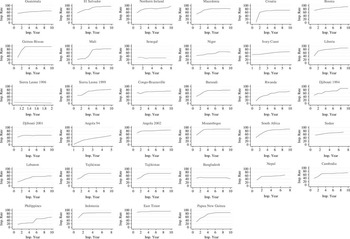
Next, we created an aggregate implementation rate for each peace agreement by summing the annual level of implementation for the provisions contained in each accord.Footnote 65 We calculated the aggregate implementation rate for each accord by summing the actual implementation scores for each provision in an accord each year, and divided that sum by the highest possible score that could have been achieved (that is, full implementation for each provision each year).Footnote 66 For example, the Philippine’s 1996 Mindanao Final Agreement discussed above contained twenty-four provisions. The highest possible score attainable in any given year is 100 per cent (72/72).Footnote 67 The actual aggregate implementation score in year 1 was 16.67 per cent (12/72). The lowest annual aggregate implementation score in the sample is 1.39 per cent (the 1996 Abidjan Peace Agreement in Sierra Leone), and the highest was 93.94 per cent (the 1992 Chapultepec Peace Agreement in El Salvador). Figure 1 shows the aggregate implementation rate for our sample of thirty-four CPAs in the decade following the accord (31 December 2012 is the last day of observation in the dataset).
Annual rate of aggregate implementation for thirty-four CPAs.

As seen in Figure 1, there is a substantial amount of variation in the implementation rate of CPAs. For some accords, like the 1997 CHT Accord in Bangladesh, or the 1996 Mindanao agreement in the Philippines, aggregate implementation is low. For others, like Mali, the implementation rate remained low for several years but took off 5 years into the implementation process. In Bosnia and Northern Ireland, commitment to the implementation of the accord appears to have been quite strong from the start.
The Control Variables
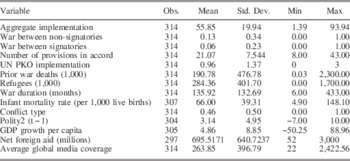
We include several control variables in our analysis that may impact future conflict or the level of implementation. It has been argued that the cost of the previous war could influence the risk of future war.Footnote 68 For the armed conflict that produced the CPA, we use UCDP data on battle deaths and conflict duration. We also control for whether the conflict was fought over territory [1] or the government [0]; this variable is also taken from the UCDP. Out of thirty-four CPAs analyzed in this study, sixteen (47 per cent) were territorial. In the analysis, infant mortality rate (per 1,000 births) is used as a measure of the state’s capacity to deliver basic public goods.Footnote 69 Similarly, we control for GDP growth per capita. Since refugee flows increase the risk of armed conflict, we control for the number of refugees using data from the World Bank.Footnote 70 We also control for democracy using Polity data from the Polity IV Project.Footnote 71 The descriptive statistics for all indicators used in the analysis are presented in Table 1.
Descriptive Statistics

METHOD
We use parametric survival analysis to test the proposed hypotheses. We expect there to be a greater risk of peace failing in the immediate aftermath of a CPA, and for this risk to decrease over time. Parametric survival analysis is the preferred methodological choice for the analysis because the baseline hazard can be specified and the analysis uses information from the entire dataset.Footnote 72 There are different parametric models that govern the shape of the hazard function. Because we expect a higher risk of peace failure early, our expectation is that the Weibull model best describes the data. In fitting the data, the best parametric model can also be chosen by utilizing the statistical results. We used the Akaike information criterion (AIC) to evaluate which parametric models best fit the data. The AIC test statistics rule out the use of the Cox proportional hazard model, and the test statistics are very similar among parametric models. In all Weibull models, the estimated parameter (p) is greater than 1, which suggests that this particular parametric model fits the data very well.Footnote 73
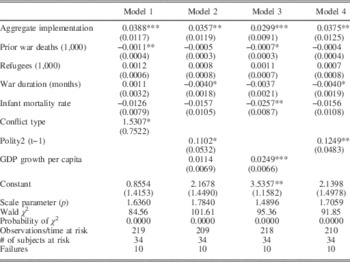
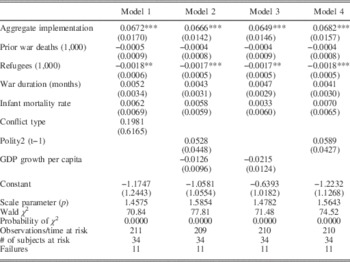
All models presented in Table 2 examine the duration of peace between the signatories of the CPA. The models presented in Table 3 explain the duration of peace between the government and non-signatories. All models are estimated using the accelerated failure-time metric format, which reports estimated coefficients rather than hazard ratios. Across every model, a positive coefficient means that the respective variable increases the duration of post-accord peace (in years). A negative coefficient means that the variable decreases post-accord peace duration. All models use a country-specific cluster and therefore assume statistical independence between clusters, and not between observations.
Aggregate CPA Implementation and Peace Duration between Signatories

Note: robust standard errors in parentheses. *p<0.05, **p<0.01, ***p<0.001
Aggregate CPA Implementation and Peace Duration between Non-signatories

Note: robust standard errors in parentheses. *p<0.05, **p<0.01, ***p<0.001
FINDINGS AND ANALYSIS
Our main theoretical argument is that viable implementation processes normalize political relations between groups, and restructure the incentives faced by rebel leaders and their constituencies in ways that lead to conflict transformation and reduced direct forms of violence (Hypothesis 1). To test Hypothesis 1, we estimated four different models, as seen in Table 2.
The estimated coefficient for the level of annual aggregate implementation is 0.0388, which is equal to 0.953 in terms of hazard ratio
 $$\left\{ {\left[ {\exp ({\minus})\{ [\exp ({\hat{\rm p}\hat{\beta }})]{\equals}\exp ({\minus}1.6360{\times}(0.0388))\} } \right]} \right\}$$
and significant across all models. This suggests that a 1-percentage-point increase in aggregate implementation is likely to increase the survival of peace between the signatories by 6.15 per cent [100×(1-exp(−1.6360×(0.03880)))]. These are substantial effects: an accord that is 80 per cent implemented, for instance, will produce a peace spell roughly two and a half times longer than an accord that is only 40 per cent implemented (on average). For groups that negotiate and sign a comprehensive settlement to end a civil war, a strong predictor of whether they will fight again in the future is the degree to which the terms they negotiated were subsequently put into practice.
Among the controls, we find that a larger number of previous war deaths increases the risk of peace failure, which is consistent with previous findings (significant in Models 1 and 3).Footnote 74 We see that peace is more durable following higher levels of democracy, which is consistent with previous findings (Models 2 and 4).Footnote 75 Lastly, peace is better able to survive in territorially based civil conflicts, even when taking the level of agreement implementation into account. This finding is not surprising since the protagonists in territorially based conflicts are more politically and geographically separated following the war; higher levels of implementation would presumably only add to this degree of separation through autonomy measures.
We also argued that outside factions that were not part of the CPA may decide to join the peace process if they see that implementation is viable and fear becoming isolated. This should lead to less future conflict between the government and non-signatory groups (within the same conflict). To test Hypothesis 2, we estimated four different models. The results in Table 3 provide evidence that implementing the terms of a CPA produces a more durable peace, not only between those who negotiated the accord, but also between the government and other groups outside the accord.
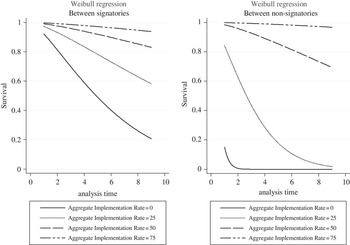
In Table 3, the estimated coefficient for aggregate implementation is positive and significant in every model (p<0.001). In Model 2, the coefficient for CPA implementation is 0.0672, which is equal to 0.9067 in terms of hazard ratio. This suggests that as the level of aggregate implementation increases by 1 percentage point, post-accord peace duration increases by 9.33 per cent. This means, for instance, that an accord that is 60 per cent implemented will produce a peace that lasts three times longer, on average, than an agreement that is 20 per cent implemented. Models 1 through 4 provide strong evidence that governments can use the implementation process to signal their preferences and commitment to outside factions and splinter groups that initially chose not to be part of the CPA. Conversely, the findings indicate that when a government broadly advertises that it cannot be trusted to implement any future deal that might be brokered, potential foes are more likely to abandon such a strategy in favor of an agenda of militancy and armed conflict. As seen in Figure 2, which shows the relationship between aggregate implementation and the risk of peace failing over a 10-year period (while holding all other variables constant), the slope is quite steep for both signatories and non-signatories given low levels of accord implementation (indicating a high chance of peace failing).
CPA implementation rate and peace duration over 10 years.

As for controls, across all the models in Table 3, the number of refugees is negative and significant. This finding is quite robust, and suggests that greater refugee flows greatly increase the risk that the government will fight a non-signatory group in the future. Salehyan and Gleditsch find that greater refugee flows lead to more conflict in neighboring or receiving countries.Footnote 76 Our results suggest that a similar dynamic may apply to outside groups in a multiple-faction conflict: it may be easier for groups on the outside to recruit when there are more refugees. We do not find consistent support for the remaining controls.
ROBUSTNESS TESTS
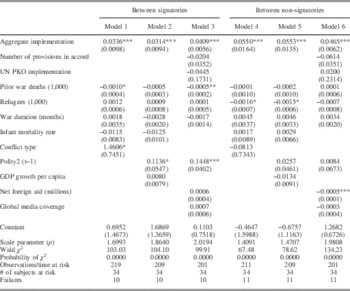
One critique of the way we have constructed our index of aggregate implementation could be that we include the implementation of some provisions that fall under the mandate of third-party actors, while our theory deals with relationships and signaling behavior between domestic actors. While these third-party provisions contribute to a higher overall implementation score, their implementation is not under the direct control of domestic actors. We recalculated a second aggregate implementation rate in which we drop seven provisions that fall under ‘external arrangements’ and use the revised aggregate implementation rate to re-run the first two models from Table 2 for signatories, and the first two models from Table 3 for non-signatories. These results (Models 1, 2, 4 and 5, presented in Table 4) show that our original findings strongly hold both with and without the inclusion of provisions implemented by third-party actors. Following a similar reasoning, we wanted to control for levels of international support to the peace process, which may positively or negatively influence implementation. In Model 3 for signatories and Model 6 for non-signatories, we control for key support variables such as whether a UN peacekeeping force was deployed, the net amount of international aid received by the nation each year and the amount of worldwide media coverage devoted to the implementation of the agreement each year. None of the measures of international support reaches statistical significance when included alongside the degree of aggregate implementation.Footnote 77
Robustness Tests

Note: aggregate implementation excludes the implementation of all provisions falling under a third-party mandate (external arrangements). Robust standard errors in parentheses. *p<0.05, **p<0.01, ***p<0.001
Another possible objection is that we do not control for accord content or the number of provisions in each agreement. Although we have argued that it is more valid to judge each agreement based on the implementation of its provisions (as a stakeholder is likely to do), it may be the case that ambitious agreements are more difficult to implement. To control for accord content, we include the total number of provisions in each CPA in Models 3 and 6 (Table 4). These additional controls do not alter our core findings. Taken together, the findings reported in Tables 2, 3 and 4 provide direct evidence that the degree to which the particular provisions in a CPA are implemented (or not) exerts powerful effects on the trajectory of the post-accord nation.
CONCLUSION
In this article we analyzed a sample of comprehensive intrastate peace agreements (which met several basic thresholds regarding their potential and stakeholder expectations), and found that their impact on subsequent conflict-related behavior was significantly determined by the degree to which they were implemented. Of particular interest is our finding that, given low levels of implementation, a government is more likely to fight a non-signatory group in the future (as seen in Figure 2) than they are a signatory group (within the same conflict within the next decade). This is most likely due to the fact that the rebel leaders that negotiated the ‘failed’ accord are likely to be seen as discredited in light of the low level of implementation achieved, while the outside group deliberately put itself in a position to benefit from a failed implementation process. Ours is the first article to describe these broad signaling effects associated with the extent to which an agreement is implemented.
These findings have some practical policy implications for conflict actors, practitioners and donors. We find strong direct evidence that countries can escape the conflict trap by implementing CPAs. Yet, in contrast to the resources and attention given to negotiations to reach a peace agreement, most agreements do not contain robust implementation support or review structures. Where such structures are included, most are retrospective, allowing no opportunities for intervention and correction. Our results also cast doubt on the notion that by implementing a CPA with one group, a government will be setting themselves up for future conflict with other groups by setting a precedent of willingness to negotiate and implement a solution. The opposite claim appears to have greater support: robust CPA implementation severely damages spoiler groups and factions who hope to capitalize on the lack of implementation and corresponding preservation of the policy status quo.Footnote 78 For international donors, the findings should be seen as evidence that their involvement, insofar as it supports achieving higher levels of implementation, will promote peace-building success. As such, donors should take a leading role in helping to establish an active joint political process at the center, and disbursements should be tied to demonstrated positive engagement and continued implementation progress. Our methodology also provides international governmental organizations and international non-governmental organizations with an objective measure of annual implementation that can be used to evaluate agreements and make systematic comparisons with other agreements on the same types of provisions at similar points in time.
Many important avenues of future research regarding implementation remain open and should be explored. While we have found strong empirical support for the effects of aggregate implementation on peace duration, we have only anecdotal evidence as to why some peace agreements are implemented at much higher levels than others. There is also a substantial literature on sequencing, and how certain processes should be implemented before others because they provide stability or necessary preconditions. These arguments abound, but have not been rigorously tested due to a lack of time-series data on the implementation of the relevant provisions. Related to sequencing is the notion that different areas of accord content exert different effects at different stages of a peace process. Lastly, we theorized that high levels of implementation are needed to produce a real peace dividend with respect to political and economic development, and that this will reduce support to militant groups. We provided some case evidence that ties low implementation to persisting grievances and threats of renewed war, but it was beyond the scope of the article to examine this issue in any depth. Future research should focus on these and many other important dynamics of peace agreement implementation.
Supplementary Material
To view supplementary material for this article, please visit http://dx.doi.org/10.1017/S0007123415000381