In September 2017, Mexico went through several dramatic weeks because of 2 earthquakes that have acquired international notoriety due to the closeness of their occurrence and because of the destruction they caused in 6 states within the country.
The first earthquake occurred on September 7, in the southern part of the country. Its epicenter was in the Tehuantepec zone, and its magnitude (8.2) was the highest reported within the last 100 years in Mexico.1 The Mexican Civil Protection Agency reported 98 deaths and more than 120 000 damaged buildings in 4400 communities in the states of Oaxaca and Chiapas.2 In the face of such event, the national government issued an Extraordinary Emergency Declaration for the states of Chiapas and Oaxaca3 in order to release the resources of the Mexican Natural Disaster Fund4 so that local authorities could be able to attend the alimentary, shelter, and sanitary needs of the affected population.
The second earthquake5 occurred on September 19 (exactly 32 years after the deadly earthquake of September 19, 1985). With an epicenter within the border of the states of Morelos and Puebla, this earthquake had a magnitude of 7.1 and caused 369 deaths as well as major damage to 1000 buildings, which rendered them unsafe for use.2 As a response to this new event, governmental authorities also issued a Disaster Declaration for Mexico City and the States of Mexico, Puebla, and Guerrero.3
As a response to these events, the communities of different cities deployed themselves voluntarily and immediately to help the affected people. Mexicans from all over the country (and from abroad) organized themselves for water, food, clothing, and money collection, among other types of tasks for helping those in need. Furthermore, they organized themselves for the search and rescue of missing persons, showing determination and strength while supporting those affected by the earthquakes.
Several studies reveal that earthquakes are stressful events for the affected communities and have great psychosocial impact.Reference Abeldaño and Fernandez6–Reference Leiva-Bianchi, Baher and Poblete9 However, not all people respond to the stress generated by a disaster in the same manner.Reference Kukihara, Yamawaki and Uchiyama10 Some people face the adverse situations presented after an earthquake without negative effects in their psychosocial functioning.Reference Fu, Leoutsakos and Underwood11 According to Masten,Reference Masten12 the capacity to keep functioning adequately and to be adaptable when facing any kind of adverse event is what is understood as resiliency.
Some recent studies on resiliency when facing earthquakes have focused on explaining which factors relate to the positive results.Reference Xu and Ou13 Thus, it has been observed that support and social participation following disastrous situations (in this case 2 earthquakes) empower resilient responses, because social support contributes to relieve the psychosocial impact of earthquakes on people.Reference Kukihara, Yamawaki and Uchiyama10, Reference Xu and Ou13
Comfort et alReference Comfort, Siciliano and Okada14 have described that in communities that have experienced disastrous events, the initial response is a strong mobilization of resources and people from said communities, in which the rescue tasks are focused on the protection of property and on the satisfaction of immediate needs such as water and food, as seen in Haiti in 2010 and in Mexico in 2017. These acts, in which the social response is organized voluntarily and cooperatively, represent an initial and very important step towards resiliency at the end of the crisis. However, resiliency in disastrous situations tends to conflict with the efficiency of the voluntary efforts. This is because the resources and energy dedicated to the shared effort to satisfy the immediate needs created by an extreme event slowly give way in the face of entropy, or the dissipation of attention, energy, and resources, which results in a loss of efficiency in carrying out support tasks.Reference Comfort, Siciliano and Okada14
In light of the social response of the communities affected, which was visualized through the media, the purpose of this study was to explore social participation strategies and to determine the resiliency of the people affected by the earthquakes in September 2017 in Mexico.
METHODOLOGY
A cross-sectional study was conducted on 1520 participants from Mexico City and the states of Mexico, Oaxaca, Chiapas, Puebla, and Morelos. The study was carried out in November and December 2017, the second and the third months after the earthquakes occurred. These states were chosen based upon the fact that they were the ones most affected by the earthquakes, and all of them, with the exception of Guerrero (which the authors could not reach due to operational difficulties), had Extraordinary Emergency Declarations issued by the federal authorities.
The study was conducted by scholars from the Postgraduate Studies Division of the Sierra Sur University. The principal investigator designed and conducted the project, and 3 collaborators and 2 master’s students have been involved in the field survey process. A nonprobabilistic convenience sample was designed to include voluntary participants who were aged 18 or over and were residents in damaged states at the time of the earthquakes (Table 1).
Sample Stages, Mexico, 2017

The survey included a set of questions for the sociodemographic characterization of the sample, in accordance with the formats used in Chile’s 2010 postearthquake survey.Reference Abeldaño, Fernández and Estario7, 15
In order to measure resiliency in the sample, a Spanish-validated version of the resilience scale (RS-14) was used.Reference Sánchez-Teruel and Robles-Bello16, Reference Wagnild17 The scale was modified to specifically refer to the earthquakes that occurred in Mexico. This scale consists of 14 items that measure the degree of individual resilience, which is considered as a positive personality trait that allows individual adaptation to adverse events. In former studies, this scale showed adequate validity and reliability coefficients.Reference Sánchez-Teruel and Robles-Bello16 Here, the reliability was computed through internal consistency with the Cronbach α coefficient, which resulted in a value of 0.925 for the total items in the scale. This indicates that the scale has high internal consistency and thus is a reliable tool for the measurement of resiliency in the face of disaster for the studied sample.
The 14 items that make up the scale are grouped into 2 factors: factor I, “personal competency,” which is made up of 11 items that refer to self-confidence, independence, decision, ingenuity, and perseverance, and factor II, “self-acceptance and life acceptance,” which is made up of 3 items that refer to adaptability, balance, flexibility, and a stable life perspective.
The total score for the scale of resilience ranges from 14 to 98 points, which can be interpreted as the following categories based on cutoff points established by the authorsReference Sánchez-Teruel and Robles-Bello16:
-
14–30: very low resilience
-
31–48: low resilience
-
49–63: normal resilience
-
64–81: high resilience
-
82–98: very high resilience
Statistical analysis was conducted with descriptive measures for quantitative and categorical variables. After descriptive analyses, in order to find the factors related to resiliency after the earthquakes, an ordinal logistic regression model was defined with the ordinal variable “resilience” as dependent variable, the continuous variable “age” as covariable, and the following factors (categorical variables):
-
1. State of residence: Chiapas, Mexico City, State of Mexico, Morelos, Oaxaca, or Puebla
-
2. Gender: male or female
-
3. Marital status: with partner or no partner
-
4. Belonging to an indigenous group: yes or no
-
5. How did your family face the days following the earthquakes: alone (only with the family) or together with neighbors or friends
-
6. Following the earthquakes, did your family organize itself to participate in any kind of activity to help the community: yes or no
-
7. Following the earthquakes, did your family receive any kind of support from its community: yes or no
-
8. As a consequence of the earthquakes, did the family household suffer any damage: undamaged or damaged
The research project from which this study is derived has the approval of both the Health Research Committee and of the Ethics in Research Committee of the Sierra Sur University of Oaxaca, Mexico.
RESULTS
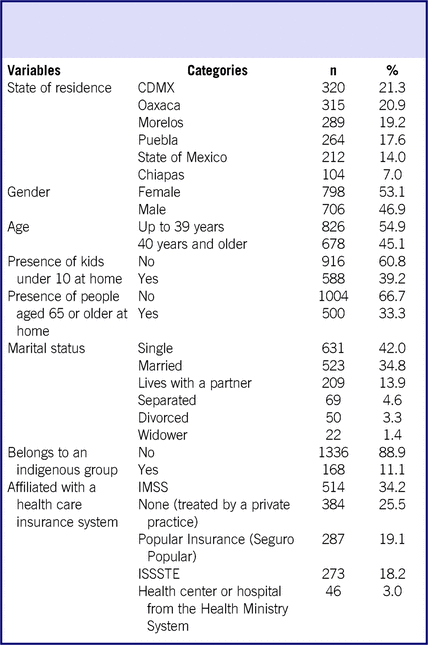
The postearthquake survey was presented to 1520 people, and the response rate was 98.9%. Thus, this study reports results for 1504 people surveyed. Of the total sample, 53.1% was female, 54.9% was younger than 40 when the survey was conducted, 39.2% of the households had at least one child younger than 10 among its members, and 33.3% had at least one person older than 65 among its members. The percentage of respondents who identified themselves as belonging to an indigenous population was 11.1%. The respondents lived in the following states: 21.3% in Mexico City, 20.9% in Oaxaca, 19.2% in Morelos, 17.6% in Puebla, and 14.0% in the State of Mexico. The state of Chiapas was the only one where the minimum of 200 respondents was not achieved; this was due to operative and staff-safety reasons. The remaining sociodemographic characteristics of the sample are presented in Table 2.
Sample Sociodemographic Characterization Variables, Mexico, 2017

Abbreviations: CDMX, Mexico City; IMSS, Instituto Mexicano del Seguro Social; ISSSTE, Instituto de Seguridad y Servicios Sociales de los Trabajadores del Estado.
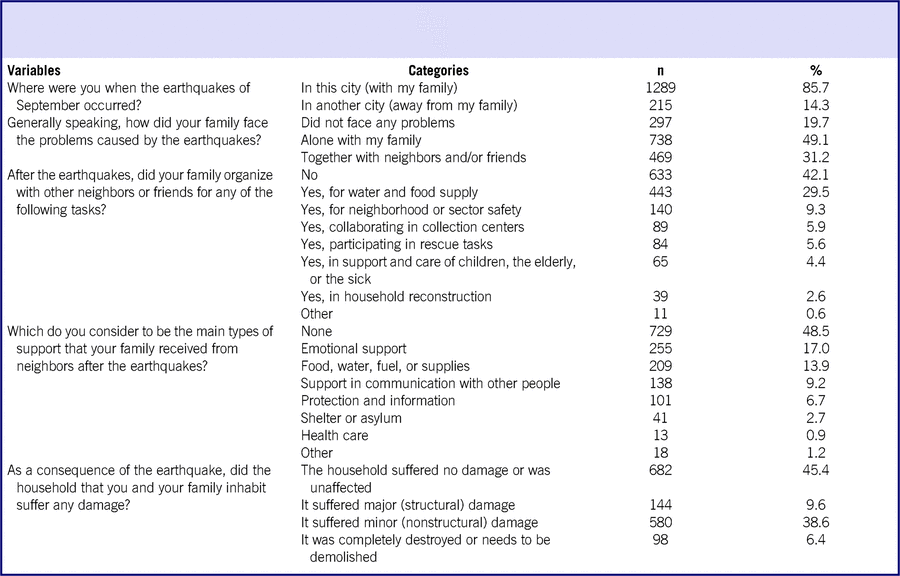
Regarding the participation and postearthquake social capital strategies, 85.7% of the participants stated that at the time of the earthquakes they were living in the same city with their family, 49% stated that they have faced the problems derived from the earthquakes that affected their family on their own and with their family, and 31.2% faced those problems together with a group of close neighbors or with friends.
In the face of the disastrous situation, 58% of the respondents had organized with neighbors and friends to participate in water and food supply tasks (29.5%), to participate in neighborhood and community safety tasks (9.3%), to collaborate in donation collection centers (5.9%), and to participate in rescue tasks (5.6%), among other tasks presented in Table 3. Altogether, 1 out of every 2 persons surveyed had been involved with other collectives in order to participate in some kind of social support task.
Frequency Distribution for the “Postearthquake Social Participation” and “Household Damage due to Earthquake” Variables, Mexico, 2017

In response to the question, “which were the main types of support that you received after the earthquakes,” the most frequent answers were emotional support (16.9%), donation of food, water, fuel, or any other type of first need supplies (13.9%), and support to get in touch with other people during the critical phase of the event (9.2%). It is important to emphasize here, on one hand, the relevance of nontangible support, such as emotional support and help for getting in touch with loved ones, and, on the other hand, tangible support such as the donation of food, water, and other first need supplies.
Finally, 9.6% of the people surveyed stated that their homes suffered major (structural) damage, 38.6% said their homes suffered minor (nonstructural) damage, and 6.5% stated that their homes were completely destroyed or needed to be demolished (Table 3).
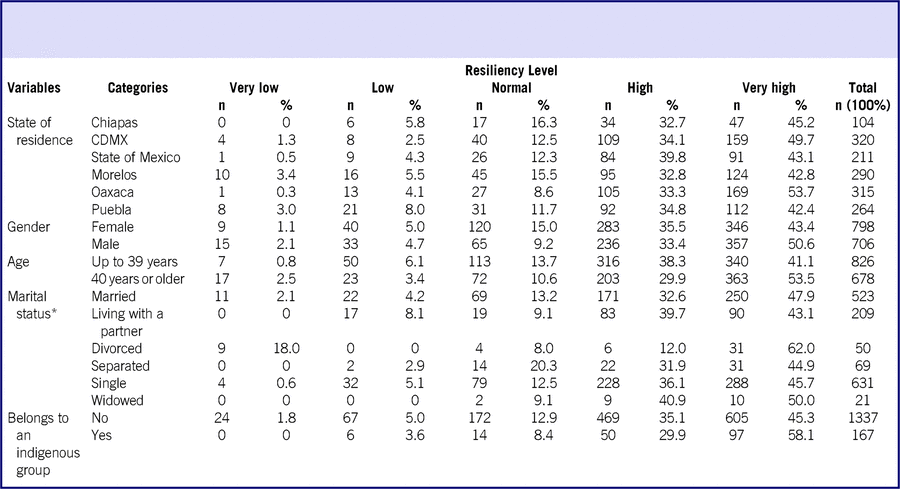
Regarding resiliency, 6.3% of the sample showed low or very low resiliency, 12.2% showed normal resiliency, and 34.7% and 46.8% of the sample showed high and very high resiliency, respectively. This information was acquired through the application of the resiliency scale.
The questions on the RS-14 survey that received the lowest mean scores were those in factor I, personal competency: “I am calm during earthquakes,” “I am a person with adequate self-esteem,” “I feel that many situations can be handled simultaneously during earthquakes,” “I am determined and brave when making decisions during an earthquake,” “I am not afraid of difficulties because I have experienced them before,” and “I am a disciplined person.” The questions with the highest mean scores were those under factor II, self and life acceptance. The mean score of the total sample was 76.9 points, which is indicative of high resiliency (between 64 and 81 points), in accordance with the authors of the original scale.Reference Sánchez-Teruel and Robles-Bello16 Descriptive analysis shows a pattern of high and very high resilience in the sample, as shown with greater detail in Table 4.
Frequency Distribution for Levels of Resiliency Against Earthquake, According to the Sociodemographic Characterization Variables of the Sample, Mexico, 2017

Abbreviation: CDMX, Mexico City.
* Total = 1503. Missing data = 1.
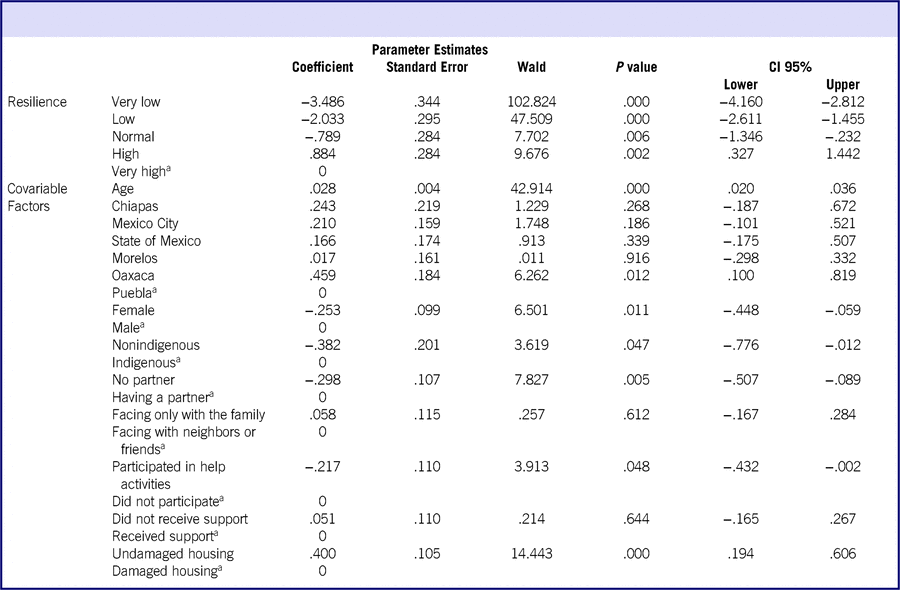
The ordinal logistic regression model was defined including a logit link. The fitting chi-square test had a P < .001, and although the pseudo R-square was 8%, it is assumed that it was a significant model. The parallel lines test had a P value of .181, as expected.
Table 5 shows the ordinal regression coefficients, their standard errors, the Wald test and associated P values, and the 95% confidence interval of the coefficients. For the covariable “age,” we would say that for a 1 unit increase in age, we would expect a 0.028 increase in the log odds of being in a higher level of resilience. The factors included in the model show that being from the State of Oaxaca, male, indigenous, having a partner, did not participate in activities of help to the community, and having no household damage were associated with a very high level of resilience.
Ordinal Logistic Regression Parameter Estimates, Mexico, 2017

a Reference category.
The way the family faced the days following the earthquakes (P = .612) and receiving any kind of support from its community (P = .664) were not associated with a higher level of resilience.
DISCUSSION
This study is the first to address resiliency in Mexico after a disastrous event on a national scale; studies on resiliency in this country are mainly focused on violence-related issues.Reference Reed, Reno and Green18
The observed gender differences in the measurement of resiliency when facing earthquakes are consistent with other findings related to diverse traumatic events in other Latin American and European countries,Reference Ditlevsen and Elklit19–Reference Cofini, Carbonelli and Cecilia21 where the people who were the most affected were women with lower educational levels and income. Research findings about other earthquakes, such as the one in Wenchuan, China,Reference Zhang and Ho22 in 2008, also show that the burden of a greater risk when facing a disastrous situation falls on women. The same pattern was found by CofiniReference Cofini, Carbonelli and Cecilia21 in the L’Aquila earthquake in 2009.
However, a divergence point with the aforementioned study can be found, for in our research greater age was associated with greater resiliency, which can be explained by the accumulation of life experiences which mold personality.Reference Flores Cisternas and Sanhueza Contreras23, Reference González-Muzzio24
Some previous studies on this topic state that the greater vulnerability of women when facing disastrous events could be attributed not only to biological factors but also to differences in socialization between men and women, as well as different formative experiences during childhood.Reference Abeldaño and Fernandez6, Reference Abeldaño, Fernández and Estario7 Also, the increase in vulnerability that women experience during natural disasters, in comparison to that of males, could be influenced by individual factors represented by confrontation skills and personality traits, as well as by social context factors and gender issues that are reproduced and deepened in critical situations such as natural disasters. Another possible explanation for this difference is the frequency of “disaster re-experiencing” that women could face, for they perceive greater fear and anxiety over their own safety and that of their family members.
These differences can also be attributed to cultural mandates and social roles that compromise women within certain social and ethnic environments. In Mexico, this is particularly evident in the communities that emphasize traditional gender roles.Reference Reed, Reno and Green18, Reference Ditlevsen and Elklit19, Reference Rodriguez-Oreggia, De La Fuente and De La Torre25 Despite these arguments, the vulnerability that women show when facing disasters has been demonstrated decades ago and, to this day, reversing it has not been possible. Moreover, these observable social differences in postdisaster resiliency, coupled with the levels of exposition to the disaster, can be decisive for postdisaster recovery or for the emergence of symptoms related with posttraumatic stress.Reference Hackbarth, Pavkov and Wetchler26
Meanwhile, the role of the social network (friends and/or neighbors for this case) was fundamental for the resiliency of the people affected by the earthquakes. In Mexico, social capital (understood as the participation of individuals through groups or networks within the community, as well as the relationships between them and established institutions) and location (which corresponds to the natural and constructed means where the community interacts) contributed to resiliency in the face of a disaster, as shown in other similar events in Latin America such as after the earthquake in ChileReference González-Muzzio24 in 2010. In his extensive study of resiliency against disasters, Louise Comfort has stated that social network structures are more active and abundant in areas with lesser economic resources (as the most affected areas in Oaxaca, Chiapas, Morelos, and other states of Mexico can be categorized). For this author, the lower social strata present a better base resiliency because social support networks are much more consolidated.Reference Comfort, Siciliano and Okada14, Reference Boulos, Huggins and Siciliano27–Reference Comfort29
OzbayReference Ozbay, Johnson and Dimoulas30 has described that social support “can enhance resilience to stress, help protect against developing trauma-related psychopathology, decrease the functional consequences of trauma-induced disorders, such as posttraumatic stress disorder, and reduce medical morbidity and mortality.” This approach was supported by other authors who research resilience from different perspectives.Reference Southwick, Vythilingam and Charney31–Reference Sippel, Pietrzak and Charney36 Similarly, in this study, postdisaster resilience in the communities affected in Mexico could be seen in their initial responses to the earthquake, such as the voluntary organization of groups of people for collaboration in tasks related to donations, feeding, water supply, rescue, and communications. In these situations, new forms of social capital were created through emerging behaviors. For instance, at diverse levels, and with different objectives, the population used the availabel means of communication, such as radio, telephones, and social networks such as Twitter, Facebook, and Whatsapp group chats. The local authorities recognized the role of the social groups that emerged after the earthquake, which eased the distribution of help on the ground. The role of social support networks could have been of great value to the resilience of the Mexican population.
Regarding the affected indigenous population, out of the 612 municipalities affected by the earthquakes, 207 have an indigenous population of 70%, and another 97 have a 40% indigenous population. This implies that the indigenous population was severely affected in the states of Chiapas, Oaxaca, and Puebla.2 Regarding the greater resiliency observed in the indigenous people that belong to the sample of this study, it should be noted that there are some actions carried out by the Pan-American Health Organization which were focused on disaster risk reduction for the indigenous communities, as part of the organization’s commitment to procure welfare for indigenous communities. Furthermore, it can be hypothesized that social cohesion and the links within the indigenous communities in Mexico are much more consolidated due to their millenary traditions.37
It is necessary to specify here that, frequently, the indigenous communities are more vulnerable to disasters than nonindigenous ones because they are deprived of their traditional territories and resources for survival, both physically and culturally. This weakens even more their capacity in the face of disasters. Nevertheless, since indigenous people often come from small and very tight-knit communities with close ties to their lands, they know their environment and apply resilient strategies that have originated within their communities and that have been kept and transmitted for generations, based on their social links.Reference Fuente Carrasco38
A foundational base for the resiliency strategies of the indigenous communities can also be found in the onslaught that has struck these communities for decades. This can be explained on the basis of the strong disturbances generated by the restrictive measures imposed on these communities by capitalist and governmental sectors as part of the acts of exploration and extraction of natural and energetic resources, which have a considerable reservoir in indigenous territories. This has generated emerging responses from the indigenous people based on an important fortification of community links as a key element to resist and overcome such processes with meaningful teachings for the construction of sustainability.
With all the elements stated in this article, the idea that in Mexico the reconstruction processes and the implementation of strategies for disaster risk reduction should include the participation of the social groups spontaneously created during the emergency period is, once again, reinforced. This is due to the fact that these groups have the potential for becoming the basic social capital in the face of the occurrence of future disastrous effects, contributing, hence, to increased resiliency. An advantage should be taken from this potential that the social links within Mexican communities offer so that neighbors become aware of the dangers they are exposed to, as well as the availabel resources in the community that will serve them to face possible difficulties. This way, stronger community links and a better social organization will contribute in the reduction of vulnerability levels in the face of disasters.
The findings of the study have some limitations. First, in the intentional sampling methods, the authors chose the people who were willing to voluntarily answer the survey. Therefore, it is possible that the people who were willing to answer the survey were more likely to participate in activities related to social support in a crisis situation. Thus, the frequencies of participation of support activities might be overestimated. Second, the study design was a cross-sectional study, which did not provide any information about the previous resilience profile of the sample. There was no measure of the predisaster resilience for comparison to that postdisaster.
Finally, it can be concluded from the findings of this study, and of those of previous researchers, that the implications of the strategies of social participation and social support on the resilience of the people affected by the earthquakes of Mexico in 2017 were determined. The states that presented a higher level of resiliency were identified, among them Oaxaca and Mexico City, and factors related to resiliency were found, among which the following stand out: gender, age, did not participate in activities to provide social support (unlike having received some kind of social support from others), and belonging to an indigenous community.
Acknowledgment
This research was supported by the Programa para el Desarrollo Profesional Docente, Tipo Superior, Secretaría de Educación Pública (PRODEP-SEP (MEXICO) [511-6/17-7463]).
Author ORCiD
Roberto Ariel Abeldaño Zuñiga, 0000-0002-2627-278X