An Overview to the Contradictory Nature of Coronavirus Disease 2019 and Earthquake Co-occurrence
A concern has aroused since the onset of coronavirus disease 2019 (COVID-19) pandemic regarding the challenges encountered during emergency response in a natural disaster, such as an earthquake, which usually necessitates evacuation, transportation, or mass gathering in the affected areas. The challenges arise when the assemblies may contrast prevention strategies, including physical distancing and home isolation. Staying at a shelter during the COVID-19 pandemic would likely lead to an outbreak. The occurrence of earthquakes coincident with the pandemic may prevent the effective practice of such measures, and consequently cause an increase in the virus spread. Reference Kanamori, Baba and Weber1,Reference Silva and Paul2 In this context, the impact(s) of the virus spread and disaster management phases are mutual because, apart from the problems pertinent to COVID-19 spread caused by the disaster management measures, the infecting nature of the pandemic can undoubtedly affect the speed and efficiency of the measures.
Yet, the mentioned issues are still pertinent to only the response phase of disaster management activities. More complex issues can also be envisaged with respect to mitigation, preparedness, and recovery phases of disaster management plans with regard to the concurrence of COVID-19 and earthquakes. As different earthquakes have occurred from the onset of the COVID-19 pandemic, a plethora of studies might have been conducted having openly or indirectly dealt with different aspects of the mutual influences of the pandemic and the occurred earthquakes. The current study has endeavored to review these articles to elicit the various areas of the lessons learned having been revealed therein.
Synopsis of the Previous Review Studies
The published review studies on the coincidence of COVID-19 and disasters shows that, in a systematic review, Reference Sohrabizadeh, Yousefian and Bahramzadeh3 the types of health-care responses to coincidence of COVID-19 and all disasters have been probed. Earthquake events constituted only 1 section of the study. Another review study, Reference Ishiwatari, Koike and Hiroki4 has aimed to propose policies and approaches to manage dual disasters of flooding and COVID-19. The idea of Top-Hazard Approach (THA) has been introduced in a review study, Reference Peleg, Bodas and Hertelendy5 as a consolidated alternative framework to ALL-Hazards Approach (AHA), arguing that inherently different events require different planning and mitigation tactics. Finally, another study has reviewed the significance of incorporating contemporary management concept into the traditional disaster management cycle due to the current COVID-19 pandemic. Reference Sawalha6 The idea of One Health multidisciplinary approach supported by the Sendai Framework for Disaster Risk Reduction 2015-2030 has been elaborated in a study claiming that a cooperative approach between human and animal health professionals is necessary to be developed. Reference Kanamori, Baba and Weber1
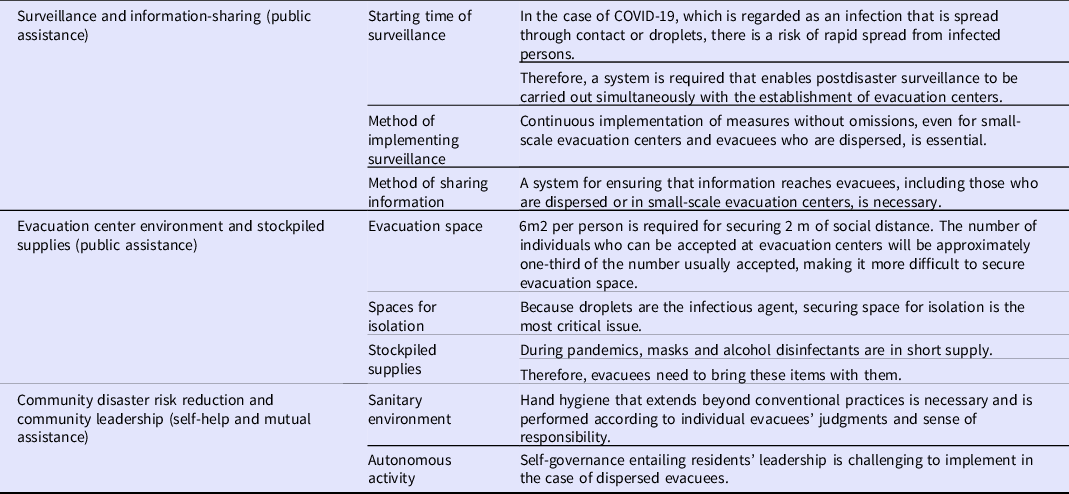
In a review study, Reference Sakamoto, Sasaki and Ono7 the past occurrences of complex disasters entailing a combination of natural disasters and infectious diseases have been compiled and systematically organized. In this study, the evacuation measures that specifically relate to COVID-19 have been discussed. The adapted version of a more detailed table in this study, Reference Sakamoto, Sasaki and Ono7 is seen in Table 1 below. Considering the review studies mentioned above, it seems that the idea of reviewing the mutual impacts of the consequences of COVID-19 and the recent earthquakes has not yet been investigated.
Evacuation status under the condition of the COVID-19 pandemic

Note: Adapted from Sakamoto et al, 2020.
Purpose of the Current Review
The present study is, therefore, a scoping review that has attempted to pinpoint the beneficial findings of the studies focusing on the reciprocal impacts of COVID-19 spread and the concurrent earthquakes or those occurred previously but the consequences of which still affect COVID-19 management and spread and are simultaneously affected by the pandemic. The scoping type of review was adopted in this study due to the reasons that: (1) a scoping study usually maps the key concepts underpinning a research area and the main sources and types of evidence available when an area is complex or has not been reviewed comprehensively before Reference Peterson, Pearce and Ferguson8 ; (2) this type of review provides a mechanism for summarizing and disseminating research findings to policy-makers, practitioners, and consumers who might otherwise lack time or resources to undertake such work themselves Reference Arksey and O’Malley9 ; (3) in the current study, this review type can address current matters and approaches related to the concurrence of earthquake and a pandemic and offer new perspectives on the matter or point out areas for further research. Reference Grant and Booth10
Methods
This scoping review was carried out based on a framework including the following 5 stages Reference Arksey and O’Malley9 : Identify the question; Identify the relevant studies; Study selection; Charting the data; and Collating, summarizing, and reporting the results.
Identify the Question
Based on the purpose of the study, the questions seeking for the lessons learned, as the results of the mutual impacts of the COVID-19 and the earthquakes, were determined to be as follows: (1) What was the nature of the challenges experienced as the results of the mutual impacts of the earthquakes and the COVID-19 pandemic? (2) What was the nature of the successful measures to manage the reciprocal impacts of the 2 disasters? and (3) What is the nature of the recommendations offered to remove/alleviate the challenges?
Identify the Relevant Studies
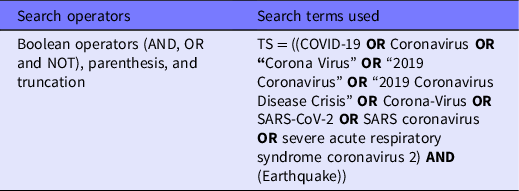
The search strategy was determined to look for studies published between February 1, 2020, and June 9, 2021. The search operators included Boolean operators (AND, OR, and NOT), parenthesis, and truncation and the keywords were the terms associated with “COVID-19,” which are usually found online as well as the term “earthquake” (Table 2).
Search query used to detect the relevant studies

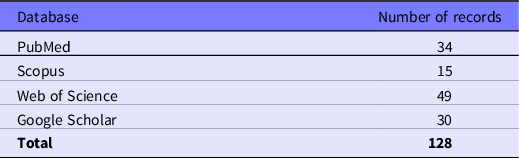
To detect the relevant studies, the databases including PubMed, Web of Science, Scopus, and Google Scholar were searched using their particular searching procedure. A total of 128 studies were retrieved (Table 3).
Databases used and the number of the studies retrieved

Inclusion/Exclusion Criteria
The inclusion criteria to maintain the relevant studies to be reviewed were as follows: the studies that were related to the mutual impacts of a particular known earthquake and the COVID-19 pandemic regardless of the exact chronological co-occurrence of the 2 phenomena. In other words, the studies that had embarked on any mutual impact of COVID-19 pandemic and any past or currently occurred earthquake were included in the review process. Gray literature was not included in this review. Moreover, specific study designs were not considered as an inclusion criterion.
The studies with the following features were excluded from the study: (1) the articles that were related to the earthquakes having occurred during the COVID-19 era, but have not scrutinized any impact of one over the other, Reference Khan and Khan11,Reference Dariagan, Atando and Asis12 and (2) studies related to mass disasters during the pandemic. Reference Sever, Ortiz and Maggiore13 It is worthwhile to mention that, in our study, as any other scoping study, exclusion of the studies was extended to the final stage of data extraction phase.
Study Selection
A total number of 128 studies found as the result of search query underwent the screening process.
Screening Process
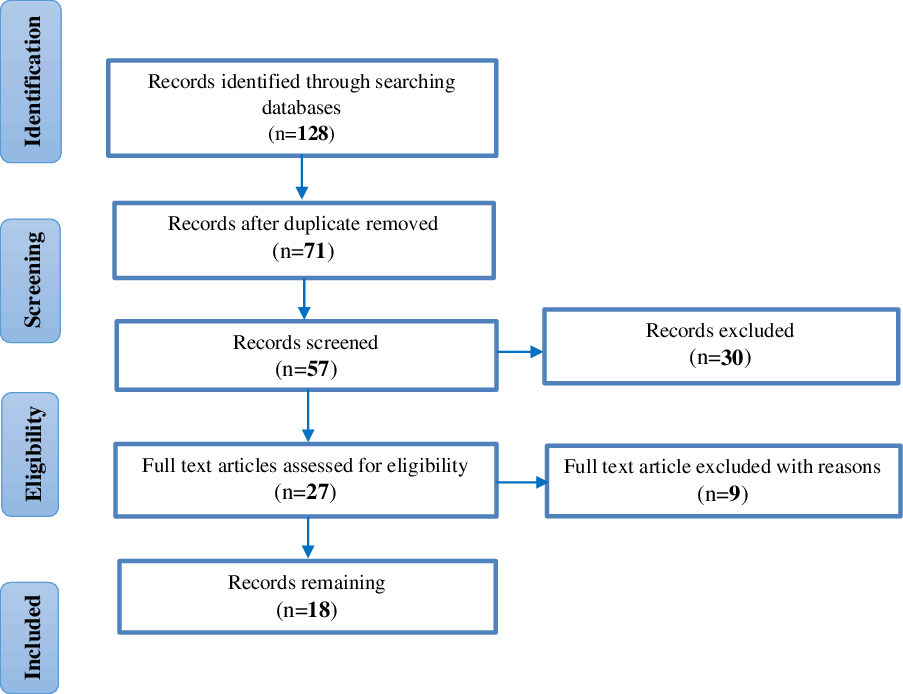
To screen the records found, first, having considered the inclusion and exclusion criteria, the titles and the abstracts of all the records found in Table 3 were reviewed independently by 2 team members to exclude the irrelevant ones. Following their agreement on the included studies, the major researcher performed an in-depth assessment on the articles’ full-texts separately to determine their eligibility. The other members re-checked the eligible studies and discussed the inconsistencies until they were all resolved. According to PRIZMA in Figure 1, after removing the duplicates, applying the exclusion criteria, and assessing the full texts for eligibility, out of the primary 128 records found during search strategy, 18 studies were finally included in the scoping review process.
Review selection process and results based on the PRISMA guidelines.

Charting the Data
Data Extraction
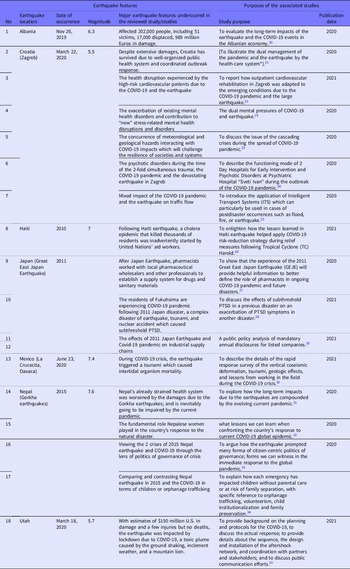
Having read the 18 studies, it was observed that between February 1, 2020, and June 9, 2021, the COVID-19 impacts have been associated with 7 major earthquakes having occurred concurrently with or before the pandemic era. In the selected articles’ texts, these 7 earthquakes have been mostly addressed based on their locations, including (alphabetically) Albania, Croatia (Zagreb), Haiti, Great East Japan Earthquake (GEJE), Mexico (La Crucecita, Oaxaca), Nepal (Gorkha), and Utah State (Magna city). Table 4 below shows the features of the 7 earthquakes underscored in the reviewed studies as well as the purposes of the 18 selected studies illustrating how any particular study deals with the associated earthquake. Table 4, therefore, provides both a familiarization with the included studies and their associated earthquakes as well as delivering a quick access to the required and basic information necessary to follow the results and the discussion of the present study.
Earthquakes’ features pertinent to the COVID-19 era and the purposes of their associated selected studies

* This is an implied purpose; not stated by the authors in the article.
In the next step, a main data extraction form was developed (Appendix 1). The articles were classified based on the 7 earthquake locations for which a brief description as well as all the relevant information units of the articles were inserted in the slots of the table. To increase the rigor of the data extraction process, 2 of the researchers of the current study were involved in the search strategy, but all 3 were engaged in the primary data extraction. The major author was in close contact with the other co-authors in an attempt to resolve any ambiguity arising during the process. When an idea required more inspection or contemplation, it was discussed among the 3 authors to reach agreement. The major author, however, rechecked any data extracted by the other 2 and tried to settle consensus whenever necessary.
Results
Collating, Summarizing, and Reporting the Results
Due to the qualitative and discourse analytic nature of the present study, thematic analysis Reference Braun and Clarke14,Reference Braun and Clarke15 was adopted on the extracted data to derive the codes, categories, and themes. Using the data from the main data extraction form (Appendix 1) as well as reading, pondering, and reflecting on the published articles and the extracted information repeatedly, the major author in collaboration with the corresponding author of the present study embarked on the coding process. Due to the large number of table developed on the coding and category-deriving details of individual studies for each earthquake, it was decided that 2 samples of such details, that is, the coding procedure of the extracted data of the articles related to 2011 Great East Japan Earthquake are shown in Appendix 2. All the derived codes have been incorporated in Appendix 3 based on the earthquakes and the articles.
Categories of the Lessons Learned
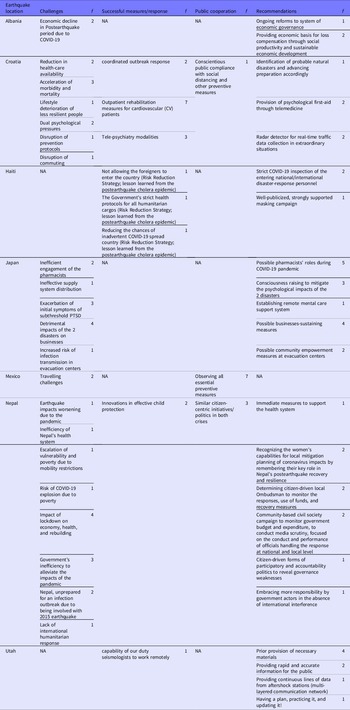
The next step was reviewing the information available in the tables from a broader scope, that is, maintaining the categorical scopes of all topics in terms of each earthquake. A sample of the process of subcategory and category derivation of the same codes of Japan’s Earthquake is also depicted in Appendix 4 to illustrate what was done for the other cases. Through reading, reflecting, and re-reading, the codes of all Challenges, Successful Measures, Public Cooperation, and Recommendations, Table 5 (below) was created presenting all categories of the research question topics with respect to each earthquake, together with the frequency of each information category already detected in the studies.
Information categories and their frequencies presented for each earthquake

To find the general scopes of all the information found in the current scoping review study that are expected to appear as the answers for the 3 research questions, the information in the major columns of Table 5 were supposed to be induced into broader scopes, that is, appropriate themes.
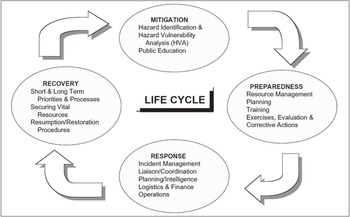
It is necessary to mention that the column of public cooperation, which was originally the topic of the fourth research question, was decided by the present authors to be incorporated into the successful measures topic due to the proximity of the 2 topics. The research questions were, therefore, reduced to 3 as was observed above in the introductory section. The results of the final round of the thematic analysis, showing the answers of the research questions, can be seen in Tables 6, 7, and 8 below. It should further be noted that following incorporation of the 2 topics mentioned above, it was observed that all successful measures are pertinent to the response phase of comprehensive emergency management (Figure 2). The title of this topic was then changed into efficient response measures.
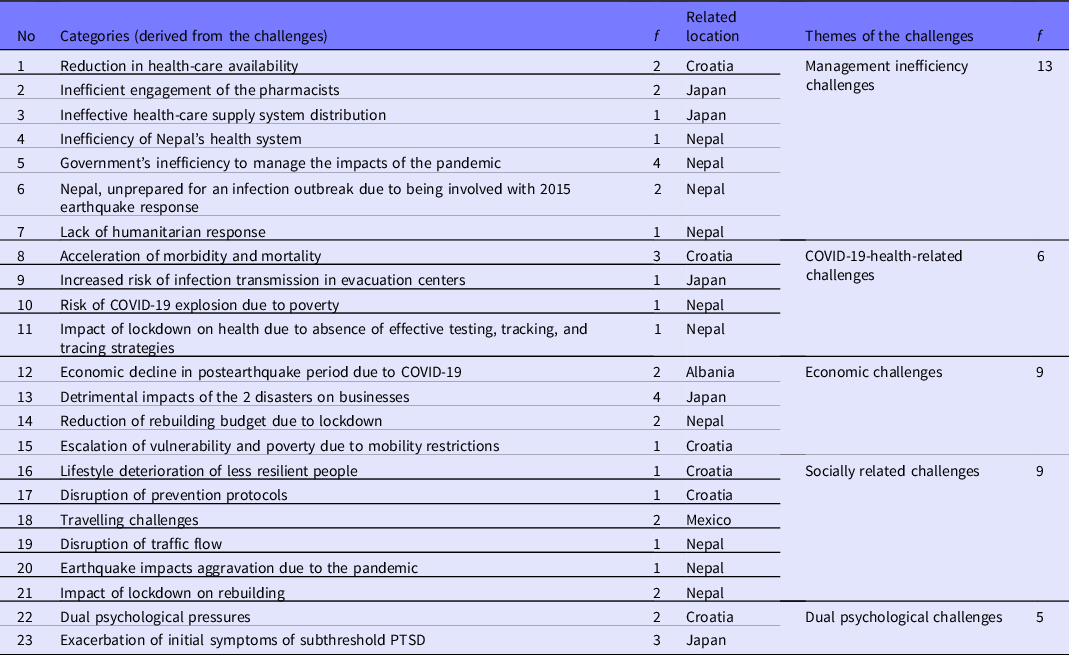
Themes derived from the challenges mentioned in the selected studies with their frequencies and the related earthquake locations

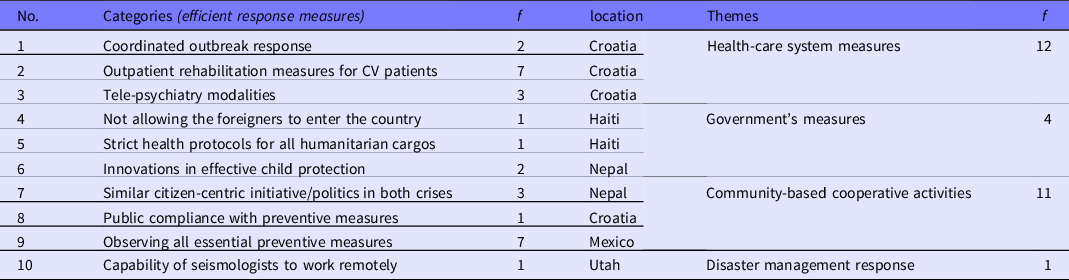
Themes derived from the categories related to the efficient response measures found in the selected studies

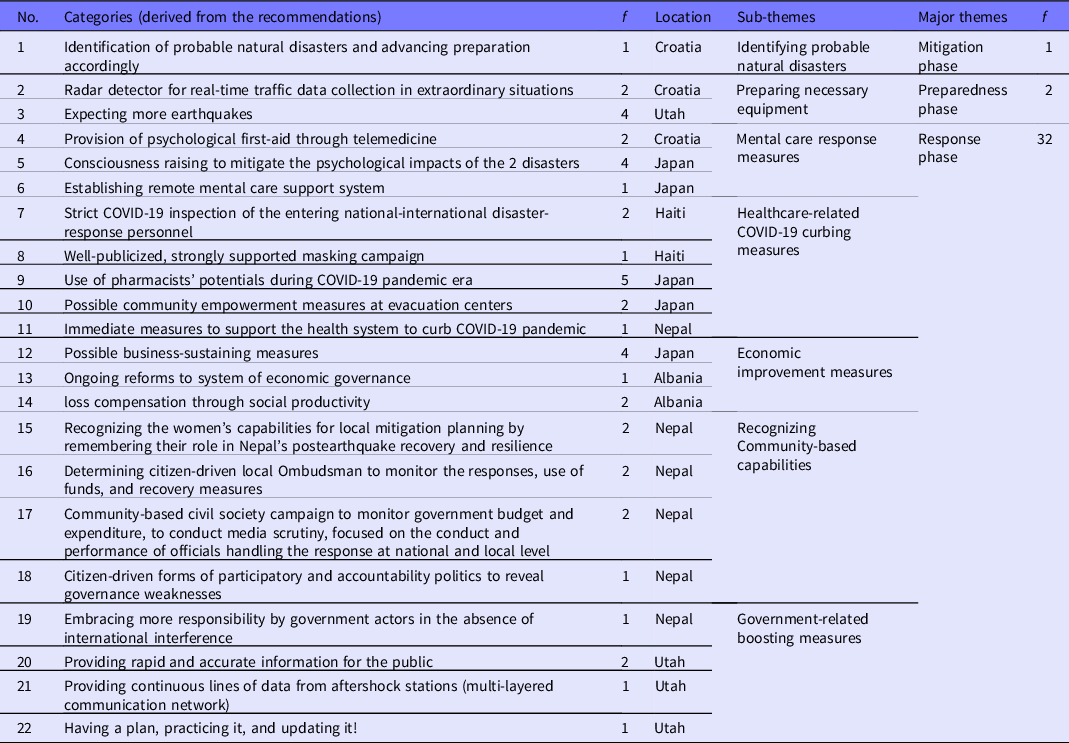
Themes derived from the categories found in the recommendations in the selected studies

The 4 phases of comprehensive emergency management (Hoyle Sr, 2010).

Themes of the Lessons Learned
Research Question 1
What was the nature of the challenges experienced as the results of the mutual impacts of the earthquakes and the COVID-19 pandemic?
To answer the first research question, that is, to discover the nature of the challenges experienced as the result of the mutual impacts of the earthquakes and the COVID-19 pandemic in the selected studies, the 23 categories related to this topic (Table 6) were postulated deeply to find the possible underlying themes. The researchers of this study, finally, agreed on the emerging 5 themes including, management inefficiency challenges, increased life-threatening challenges, economic challenges, socially related challenges, and dual psychological challenges (Table 6) together with their frequencies and the related earthquake locations.
Research Question 2
What was the nature of the efficient response measures to manage the reciprocal impacts of the 2 disasters?
Regarding the second research question, Table 7 depicts 4 themes emerging from the 10 categories associated with the topic of efficient response measures. These 4 themes are: health-care services measures, government measures, community-based cooperative activities, and disaster management response.
Research Question 3
What is the nature of the recommendations offered to remove/alleviate the challenges?
Table 8 provides information to answer the third research question dealing with the nature of the recommendations made in the reviewed studies. The 23 information categories tended themselves to be re-arranged into 3 major themes with 7 sub-themes for the Recommendations including “the mitigation phase” (including, identifying probable natural disasters), “the preparedness phase” (including, preparing necessary equipment), and “the response phase” (including, mental care response measures, health-care-related COVID-19 measures, economic improvement measures, recognizing community-based capabilities, and government-related boosting measures) (Table 8).
Discussion
This section elaborates on the most significant scopes (themes and categories) of the lessons learned in the relevant studies concerning the mutual impacts of the COVID-19 pandemic and the earthquakes.
Significant Scopes of the Lessons Learned by the “Challenges”
It is seen that among the 5 challenges, management inefficiency has been discussed more frequently (f = 13) compared with the other challenges concerning the mutual impacts of COVID-19 and earthquake. These challenges appear to be more pronounced in the Nepal Earthquake because this idea has been debated more frequently (f = 9) in the articles dealing with Nepal’s Gorkha Earthquakes, 2015 (Table 6). The first theme of Table 6 seemingly indicates that, according to the information presented in the selected articles, the frailty of simultaneous management of COVID-19 outbreak prevention and the aftermath of the earthquakes has been due to the “ineffectiveness of health system,” “the government inability to manage the impacts of the pandemic,” “the country’s unpreparedness for an infection outbreak” due to involvement with 2015 earthquake response, and “inability to attract humanitarian response” (Table 6). Conversely, concerning Croatia Earthquake (2020), only “reduction of health care availability” has been attributed to management inefficiency challenge (Table 6).
The increased life-threatening challenges have been more frequently stated for Croatia’s simultaneous entanglement with the pandemic and the earthquake (f = 3) with respect to “acceleration of morbidity and mortality.” The reason might be due to the chronological concurrence of the 2 disasters during 2020 (Table 4). The Economic challenges seems to be more noticeable in Japan because the 2 disasters made “detrimental impacts on the businesses” (f = 4). From the 9 socially related challenges, “travelling challenges” and “impacts of lockdown on rebuilding” have been mentioned 2 times each in the studies related to Mexico and Nepal, respectively. The category of “disruption of COVID-19 prevention protocols” during earthquake occurrence has been addressed by Ishiwatari et al. mainly under the idea of “staying home or going out,” Reference Marko, Košec and Brecic19 arguing that this contradiction can be removed by the government if the evacuation measures are inevitable. Reference Ishiwatari, Koike and Hiroki4 Then, the requirement of social distancing should be lifted “to avoid direct threats to human life on a large scale.” Reference Ishiwatari, Koike and Hiroki4
The fifth scope of the challenges emerged in our study is the pressing psychological challenges including “dual psychological pressures” and “exacerbation of PTSD” during and after the dual disasters of the pandemic and the earthquakes in Croatia and Japan, respectively (Table 6). Psychological aftermath of disasters has frequently been argued in other studies when only 1 disaster had occured. Reference Sohrabizadeh, Yousefian and Bahramzadeh3,Reference Seyedin, HabibiSaravi and Djenab17,Reference Jafari, Heidari and Heidari18
Significant Scopes of the Lessons Learned by the “Efficient Response Measures”
Table 7 denotes that among the 4 response measure types proved to be efficient, the measures undertaken by the health-care system were more probed in the studies (f = 12) while all are related to Croatian health-care system. As far as the information presented in the related reviewed studies are concerned, they have shown considerable coordination in their responses, have provided rehabilitation services for CV patients as well as tele-psychiatry modalities. Reference Čivljak, Markotić and Capak21
Community-based activities are usually triggered by the residents’ internal motivation. That is why these activities are characteristically implemented fruitfully. Table 6 shows that the public’s contribution to efficient response measures during the concurrence of a pandemic and an earthquake is related to their compliance with the preventive measures which was remarkably observed by the residents during Mexico 2020 earthquake and tsunami. Reference Ramírez-Herrera, Romero and Corona30
The idea of focusing on the significance of health system response compared with other responses was also focused in the study by Sohrabizadeh et al. indicating the required attention which should be paid on the 4 phases of emergency management, on the part of the health system policy-makers and administrators. Reference Sohrabizadeh, Yousefian and Bahramzadeh3
Significant Scopes of the Lessons Learned by the “Recommendations”
The recommendation detected in the selected studies (Table 8) can help prevent the challenges of the mutual impacts of the COVID-19 pandemic and the earthquakes in the 3 phases of Mitigation, Preparedness, and Response. The recommendation categories more frequently dealt with in the articles include: “utilization of pharmacists” potentials during COVID-19 pandemic era’ suggested by Hashimoto et al. because pharmacists proved to be very efficient in a variety of services during the 2011 Earthquake, but during the pandemic era there was a lack of full use of their services. They could have established a supply system for drugs and sanitary materials during the pandemic similar to their services during Great East Japan Earthquake, including “helping insightfully the confused on-sight health care professionals with checking the ingredients of the drugs,” “suggesting available alternatives to prescriptions,” and “raising awareness of the evacuees to observe sanitation in the sites.” Reference Hashimoto, Sawano and Ozaki27
Conclusion
Table 4 shows that the number of studies carried out on three earthquakes, namely, Croatia (n = 6) and Nepal as well as Japan (both n = 4) have been more than the other four. This shows the influences these earthquakes still have on different aspects of people’s lives or the lessons which people have learned from the negative or positive features of these disasters. As a scoping review study deals with detecting the general scopes of the information presented and not on the details, several systematic reviews are necessary to be conducted on different aspects of the findings of the present review study. One such study can be investigating the reason(s) behind the fact that from 35 categories offered as Recommendations to enhance the three phases of disaster management cycles, 32 categories are related to the Response Phase.
Supplementary Material
To view supplementary material for this article, please visit https://doi.org/10.1017/dmp.2022.71.