


 serving of fruit,
 serving of vegetables, 8 oz of milk and
 serving of whole grains at lunch. Non-NSLP consumers reported almost no intake of fruit, vegetables or milk, and consumed
 serving of whole grains at lunch. Among NSLP consumers, about 40 % selected and consumed a fruit serving. About two-thirds of students selected a vegetable, consuming about 67 %. Less than 4 % selected a dark green or orange vegetable.
The White House Task Force on Childhood Obesity identified the provision of healthy food in schools as one of the four priority areas in their 2010 report Solving the Problem of Childhood Obesity Within a Generation (1). In the fiscal year 2009, US schools served about 31 million lunches(2) and 11 million breakfasts each day through the US Department of Agriculture's (USDA) school meal programmes(3). Approximately 60 % of these meals were provided for free or at a reduced price(3). The Task Force Report's first school recommendation(1) urged the USDA to adopt the 2009 Institute of Medicine's (IOM) recommendations for new nutritional standards and meal requirements for the federal breakfast and lunch programmes(Reference Stallings, Suitor and Taylor4). The school meal regulations have not been updated since 1995(Reference Ralston, Newman and Clauson5). Currently, students can select one serving of fruit in a breakfast meal and a total of two servings of fruit and/or vegetables in a lunch meal. The use of wholegrain food is encouraged(6). The USDA commissioned the IOM to provide new recommendations that align the federal meal programmes with the US Dietary Guidelines and Dietary Reference Intakes to ensure that the meals promote health and reduce inadequate and excessive intakes(Reference Stallings, Suitor and Taylor4).
The 2009 IOM report provides new meal requirements and a minimum and maximum amount of energy per meal for the first time(Reference Stallings, Suitor and Taylor4). Fruit in the breakfast meal pattern would double and students would be able to select two servings (one cup total). For lunch, students would be able to select two servings (one cup) of vegetables and one serving (half cup) of fruit, which would be one serving more than the current standard of a total of two servings of fruit and vegetables. Starchy vegetables would be limited, and there would be requirements to offer specific servings of dark green and orange vegetables and legumes each week(Reference Stallings, Suitor and Taylor4). Finally, 50 % of grains would have to be rich in whole grains(Reference Stallings, Suitor and Taylor4). These added components should contribute to improve students' dietary intake at school, if selected and consumed(Reference Stallings, Suitor and Taylor4).
The current paper presents the results of a study that compared the lunch consumption of middle-school students in south-east Texas with the new recommendations specified in the IOM school meal report. Lunch consumption was examined among students who consumed at least one item from the National School Lunch Program (NSLP) meal and among those not consuming any NSLP food at lunch. The percentage of students selecting each food group and the mean consumption of those food groups were also assessed.
Methods
Target population
Students from four middle schools in one school district in south-east Texas participated in the present study in the spring of 2008. The schools were participating in a pilot study investigating methods to improve school breakfast participation and three were selected by the school food service director to have high rates of low-income students. The schools were primarily Hispanic (57 %, 78 %, 82 % and 93 %) and the rates of students who were eligible to receive free or reduced price meals were 51 %, 77 %, 84 % and 85 %. Approximately 55 % of Texas students were eligible for free or reduced price meals in 2008(7). The school utilized the offer v. serve (OVS) provision, which allows students to select fewer meal components as long as the meal meets a specified minimum(6). The study was approved by the Institutional Review Board at Baylor College of Medicine.
Procedures
All parents received information about the study and were notified that their child could assent or refuse to complete anonymous lunch food records during lunch. Trained data collectors visited each school cafeteria 2–3 d/week. They selected one to two tables of students at each lunch period and asked students to complete the anonymous lunch food records after eating in order to maximize the self-report accuracy(Reference Baxter, Thompson and Davis8). No data were recorded on refusals. Students could have completed more than one lunch food record during the study period. Students were shown how to complete the record by listing the food items consumed on separate lines, as well as the amount and source of each food (school lunch, snack bar, home, vending and other source). This method of food record data collection was shown to be valid in previous research(Reference Domel, Baranowski and Leonard9).
Data
The weekly average servings of fruit, vegetables (by subgroup) and whole grains on the school menus were calculated. The district used a 6-week-cycle menu. The food records were entered into a nutrition calculation software program (Nutrition Data System for Research 2008; Nutrient Coordinating Center, University of Minnesota, MN, USA) to obtain consumption levels of nutrients (energy, protein, vitamins A and C, Ca, Fe, total and saturated fat) and servings of the food groups from the IOM guidelines for school meal (fruit or juice, vegetables (total, dark green, orange or deep yellow), other vegetables (tomatoes and other vegetables), starchy vegetables (white potatoes, corn and peas), legumes, high-fat vegetables, whole grains, refined/some whole grains, and milk)(Reference Cullen, Himes and Baranowski10). Na and fibre intakes were also calculated.
Statistical analysis
Descriptive statistics (e.g. frequency, mean and sd) were calculated. The average daily intake per person for all the nutrients and food groups identified above was calculated for the NSLP and non-NSLP groups. Wilcoxon's non-parametric one-sample tests were conducted against the standard USDA recommendations (the targeted level) for all listed nutrients and for servings of fruit or juice, vegetables and wholegrain foods for the NSLP consumers. Percentages were used to describe the proportion of students meeting or exceeding both the current guidelines and the new recommendations. Finally, the percentage of students selecting each food group and the amount consumed by those selecting the food were calculated.
Results
A total of 5653 lunch food records were collected. There were 5414 (95 %) records pertaining to students who reported consuming at least one item from the NSLP meal. Of the 239 (4 %) records pertaining to students who reported consuming no items from the NSLP meal, 37 % brought food from home, 54 % purchased food from a snack bar, 2 % received food from ‘other sources’, 6 % brought food from home and also purchased food from the snack bar and <1 % purchased food from the snack bar and/or received food from ‘other sources’.
A variety of fruit and vegetables were offered on the published school district menus. Two fruit choices were offered daily. Over a week, the following servings of vegetable subgroups were offered: two oranges, two starchy foods, one to two dark green vegetables, one legume and six other vegetables. French fries were offered only 2 times/week, as per the Texas Public School Nutrition Policy, which also provides guidelines for foods sold outside the NSLP meal(11). An average of one serving of whole grains was offered per week.
Middle-school students who consumed NSLP meals reported higher lunch intakes of protein, Ca, Fe, vitamins A and C and fibre compared with those who consumed non-NSLP meals (Table 1). However, for both the NSLP and non-NSLP groups, nutrient intakes were significantly different from the recommended levels, except for the percentage of energy from fat and saturated fat in the non-NSLP group (Table 1). Less than one-third of students met the USDA-recommended nutrient intakes, with the exception of protein (90·8 %) and Ca (72·5 %). Approximately 27 % consumed more than the USDA energy recommendation and 50 % of the students exceeded the new IOM energy recommendation (data not shown). Compared with the results for students meeting the current USDA guidelines, fewer students met the IOM recommendations for fat, protein, Ca, Fe and vitamin C and more met the vitamin A value. Very few students met the IOM recommendations for fibre (9·7 %) and Na (18·0 %; Table 1). Na intake was high among students consuming NSLP meals: 1155 mg compared with the IOM target of 740 mg.
USDA and IOM NSLP guidelines, mean and sd of school lunch nutrient intake among students consuming (n 5414) and not consuming (n 239) NSLP foodsFootnote * and percentage of NSLP-consuming students meeting the NSLP and IOM guidelines, from lunch food records completed by students in the cafeteria
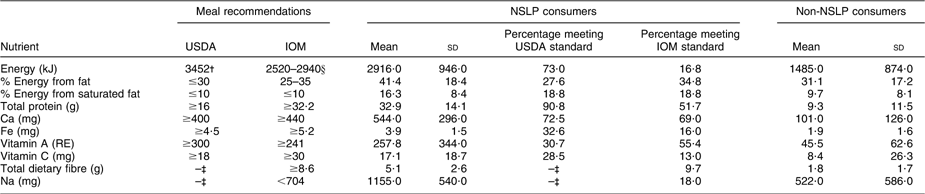
USDA, US Department of Agriculture; IOM, Institute of Medicine; NSLP, National School Lunch Program; RE, retinol equivalent.
* All nutrients and servings for both NSLP and non-NSLP groups were significantly different at P < 0·005 from the recommended levels, except for %fat and %SFA among non-NSLP consumers.
† 825 kcal.
‡ No USDA standard.
§ 600–700 kcal.
Among the NSLP consumers, 19 % met the current recommendations for total consumption of fruit or juice and vegetables (two servings) and 16 % consumed half of their grains in the form of wholegrain food (data not shown). When compared with the IOM recommendations, 28·5 % consumed one serving of fruit or juice but only 10 % consumed two servings of vegetables (data not shown). Overall, NSLP consumers reported intakes of almost  serving of fruit,
 serving of vegetables, 8 oz of milk (96 % low fat or skimmed) and
 serving of whole grains at lunch (Table 2). Non-NSLP consumers reported almost no fruit, vegetables or milk at lunch.
Amount consumed (svg or oz) for all students, percentage of students who selected the food and amount consumed for those who selected the food among students consuming NSLP (n 5414) and not consuming NSLP (n 239) school lunch foods, from lunch food records completed by students in the cafeteria
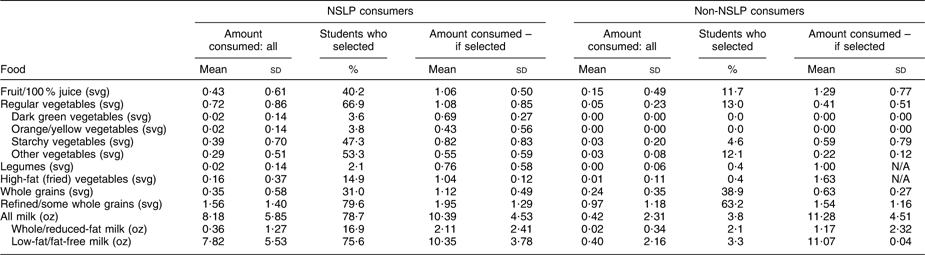
svg, servings; NSLP, National School Lunch Program; N/A, not applicable.
Among those consuming NSLP meals, about 40 % of students selected a fruit and the entire fruit was consumed (Table 2). Whereas almost two-thirds of students selected a vegetable and 67 % of the serving was eaten, <4 % selected a dark green or orange vegetable and only 2 % selected a legume. Consumption among NLSP consumers was less than half for orange vegetables (43 %) but higher for dark green vegetables (69 %) and legumes (76 %). Approximately half of the students selected a starchy vegetable and consumed 82 % of the serving, whereas nearly 53 % selected other vegetables and consumed almost half of the serving. High-fat, fried vegetables were selected by only 15 % of students; however, the entire serving was consumed. Whole grains were selected by about 31 % of students and the entire serving was consumed. Approximately 79 % of students selected milk and consumed 10 oz, on average. Milk was available in a 11 oz container and most milk selections were low fat/fat free.
Only about 13 % of the non-NSLP meal consumers selected a vegetable; 39 % selected whole grains and 63 % selected refined grains (Table 2). Less than  serving of whole grains was consumed, compared with about 1·5 servings of refined grains.
Discussion
Increasing the number of servings of fruit, vegetables and whole grains in the federal school meal patterns to meet the recommendations in the dietary guidelines may not translate into improved dietary intake for students. The results from the present study show that, with the current guidelines, few middle-school students selected legumes, dark green or orange vegetables (<4 %) when they were on the menu. Only 40 % selected fruit at lunch. The good news is that all of the fruit and much of the vegetables (43–100 %) were consumed by those who selected them, endorsing previous research indicating that children have higher preferences for fruit than for vegetables(Reference Domel, Baranowski and Davis12). However, when compared with the new IOM recommendations, about one-quarter consumed one serving of fruit or juice but only 10 % consumed two servings of vegetables.
The percentage of students in the present study who consumed fruit or juice was somewhat higher than the percentage in a national study conducted during the 2004–2005 school year (40·2 % v. 26·0 %), as were the proportions who consumed vegetables (66·9 % v. 45·0 %) and milk (78·7 % v. 65·0 %)(Reference Gordon, Fox and Clark13). Smaller proportions of students in the present study reported consuming high-fat vegetables compared with those in the national study (14·9 % v. 24·0 %)(Reference Gordon, Fox and Clark13). The percentage of students selecting dark green and orange vegetables was similar (∼4 %). No data on food group consumption were published in the national study. In a Texas study, middle-school students reported lunch consumption of 0·89 serving of total vegetables (excluding high-fat vegetables), 0·45 serving of fruit or juice and 6·5 oz of milk in the 2005–2006 school year(Reference Dillon and Lane14). Results from a national study indicated that about 29 % of school lunch menus offered a green or orange vegetable other than potatoes, but <6 % of students consumed them. In all, 50 % of the students were offered fresh fruit, but only 16 % of NSLP participants consumed fresh fruit, and only 20 % consumed a canned fruit on those days(Reference Dillon and Lane14).
The OVS provision is mandatory for secondary schools and optional for lower grades and may influence students’ lunch intakes(6). Although there is limited research on the OVS provision, an Alabama elementary-school study found that 2–46 % of students selected vegetables during a week, whereas 4–53 % selected a fruit(Reference Dillon and Lane14). Unfortunately, vegetable consumption is less than optimal even without OVS. Fourth grade students in Georgia who did not have a choice and were served the fruit and vegetables identified in the menu pattern consumed 84 % of the fruit but only 51 % of the vegetables(Reference Baxter and Thompson17). Methods to improve fruit and vegetable preferences and selection in school cafeterias are needed.
Students consumed few whole grains at school(Reference Condon, Crepinsek and Fox15, Reference Fox, Gordon and Nogales16). National data also revealed low wholegrain food intake. The mean wholegrain food intake of 9–13-year-old children in the 1999–2002 National Health and Nutrition Examination Survey (NHANES) was 0·6 oz equivalent serving, which is 20 % of the recommendation(Reference Stallings, Suitor and Taylor4) but >0·35 oz equivalent serving was reported in the present study. The calculation of whole grains may be responsible for this difference, as the nutrition calculation software used in the present study also produces a variable called refined or some whole grains, whereas the NHANES analysis uses the MyPyramid food equivalent database and captures all whole grains(Reference Stallings, Suitor and Taylor4). However, although wholegrain foods were selected by only 31 % of students, over 1 oz equivalent serving was consumed by those who selected them. Wholegrain foods were on the menu only about 1 time/week. There are some wholegrain products available for use in school food service operations; however, the higher cost of wholegrain foods is an issue(Reference Stallings, Suitor and Taylor4), as is the acceptability by students(Reference Burgess-Champoux, Marquart and Vickers18). A few studies suggest that inclusion of wholegrain foods in school lunches may be well received by children, but acceptance of 100 % wholegrain foods is lower than acceptance of 50 % wholegrain products(Reference Sadeghi and Marquart19, Reference Chan, Burgess-Champoux and Reicks20). In a previous focus group study identifying ways to promote new foods in the cafeteria, children reported that ‘new foods would be accepted if they looked and tasted good and were familiar’ and ‘could be promoted through sampling, peer influence and providing incentives’(Reference Burgess-Champoux, Marquart and Vickers18). Adults who were directly asked how to increase wholegrain food in school meals identified the need for nutritional education and a gradual increase in wholegrain foods in school menus(Reference Burgess-Champoux, Marquart and Vickers18). Increasing the number of affordable and acceptable wholegrain food products in the market place will depend on collaboration with the food industry.
Na deserves special attention, as high Na intake is a significant problem for students, as found in the present study, as well as for most adults(21), and efforts to reduce Na intake have met with limited success. A 2010 IOM report recommended setting mandatory national standards for the Na content in foods that reduce the excess Na content in processed foods as a primary new strategy to reduce Na intake(21). Most Na (75 %) in school meals was from processed foods; the largest Na sources were combination entrees (43 %) and accompaniments (17 %)(Reference Gordon, Crepinsek and Nogales22). Although drastic reductions in Na content in foods might cause reduced student participation, small and gradual reductions in Na content should maintain students’ acceptability and participation(Reference Pfaffman, Bartoshuk and McBurney23). New products and recipes that are lower in Na content, which are acceptable to students, are needed. The food industry will need to be a partner in this process to reduce the Na level in processed foods.
A recent report compared students’ lunch intake collected in 2006 with the new IOM recommendations(Reference Martin, Thomson and LeBlanc24). Among 11–13-year-old students in that study, only 18·0 %, 61·0 % and 29·9 % met the new IOM recommendations for energy and percentage of energy intake from fat and saturated fat, respectively, compared with 16·8 %, 34·8 % and 18·8 % in the present study. Whether the school observed the OVS policy or whether there were state guidelines for foods offered outside the NSLP was not stated and could account for the differences between the two studies.
The results from the present study identified the need for nutritional education and marketing efforts. For example, previous research documented that elementary-school students did not select more fruit or vegetables when a salad bar was introduced(Reference Suarez-Balcazar, Redmond and Kouba25). However, after students received six nutritional classes, more fresh fruit and salad bar items were selected when compared with schools with only a salad bar. The involvement and support of the school community and parents are also critical for success. Promising strategies to promote consumption of new foods include taste testing for parents and students(Reference Fulkerson, French and Story26–Reference Wechsler, Basch and Zybert28), signs on the food line(Reference Fulkerson, French and Story26, Reference Wechsler, Basch and Zybert28), parent meetings(Reference Pfaffman, Bartoshuk and McBurney23) and media campaigns(Reference Fulkerson, French and Story26, Reference Wechsler, Basch and Zybert28)).
The IOM report also recommended training on the new meal patterns for school food service staff for successful implementation. This could include marketing and presentation tips, as well as training for the food service staff to offer positive encouragement about the foods during meal service(Reference Hendy29–Reference Schwartz31).
There are several limitations that should be noted. The entire student data were self-reported, which is limited by memory and ability to estimate portion size(Reference Livingstone, Robson and Wallace32). No comparison between those who did and did not complete food records could be calculated. Students could have provided multiple assessments; to minimize this bias the data were aggregated by week. The study was conducted in four schools in the Houston area, with primarily Hispanic students, limiting generalizability. There could also be bias associated with social clustering at lunch tables, or the possible clustering effect of schools.
The key finding from the present study is that middle-school students’ lunch consumption at school does not meet the recommendations for fruit, vegetables and whole grains proposed in the 2009 IOM school meals report(Reference Stallings, Suitor and Taylor4). Once the legislation with the revised nutritional standards and meal requirements has been approved, it will be critical that the recommendation for technical support and monitoring, evaluation and research be implemented. Intervention with all the stakeholders will be necessary so that appropriate support is provided to improve students’ food and beverage selections when school meal patterns are revised.
Acknowledgements
The present study was funded by the National Institutes of Health (R21HD51661-2). It was also funded in part by federal funds from the US Department of Agriculture (USDA)/Agricultural Research Service under Cooperative Agreement no. 58-6250-6001. The contents of this publication do not necessarily reflect the views or policies of the USDA, nor does mention of trade names, commercial products, or organizations imply endorsement by the US Government. The authors have no conflict of interest to declare. K.W.C conceptualized the study, oversaw implementation and wrote the paper; K.B.W. conducted the data analyses and participated in manuscript preparation; J.M.D. participated in manuscript preparation. We are grateful to the participating schools and students.



