Introduction
The comparative chemistry of volcanic rocks before and after weathering is a key factor in the study of the source magma, the style of volcanic eruption, and tectonic processes in volcanic areas (Irvine & Baragar Reference Irvine and Baragar1971; Winchester & Floyd Reference Winchester and Floyd1976, Reference Winchester and Floyd1977; Pearce et al. Reference Pearce, Harris and Tindle1984; Christidis Reference Christidis1998; Batchelor & Evans Reference Batchelor and Evans2000; Yusoff et al. Reference Yusoff, Ngwenya and Parsons2013; Huff et al. Reference Huff, Dronov, Sell, Kanygin and Gonta2014; Kiipli et al. Reference Kiipli, Kallaste, Nielsen, Schovsbo and Siir2014, Reference Kiipli, Hints, Kallaste, Verš and Voolma2017; Xing et al. Reference Xing, Zhou, Qi and Huang2015; Modabberi et al. Reference Modabberi, Namayandeh, Setti and López-Galindo2019). Moreover, studies on the concentration of trace and rare earth elements (REEs) in volcanic rocks, and particularly their alteration products in sedimentary environments, such as bentonite, are of particular interest and have been addressed by several researchers (Roberts & Merriman Reference Roberts and Merriman1990; Batchelor & Evans Reference Batchelor and Evans2000; Christidis Reference Christidis2001; Foreman et al. Reference Foreman, Rogers, Deino, Wirth and Thole2008; Inanli et al. Reference Inanli, Huff and Bergström2009; Yildiz & Dumlupunar Reference Yildiz and Dumlupunar2009; Hetherington et al. Reference Hetherington, Nakrem and Potel2011; Batchelor Reference Batchelor2014; Kiipli et al. Reference Kiipli, Kallaste, Nielsen, Schovsbo and Siir2014, Reference Kiipli, Hints, Kallaste, Verš and Voolma2017; Caballero & de Cisneros Reference Caballero and de Cisneros2017; Kadir et al. Reference Kadir, Külah, Önalgil, Erkoyun and Elliott2017; Elliott et al. Reference Elliott, Gardner, Malla and Riley2018).
Immobile elements are proper proxies of the source magma because their concentration will remain unchanged during the alteration of volcanic rocks to bentonite, whereas mobile elements provide insight into the diagenetic processes forming bentonite deposits (Christidis Reference Christidis1998; Özdamar et al. Reference Özdamar, Ece, Uz, Boylu, Ercan and Yanik2014; Kiipli et al. Reference Kiipli, Hints, Kallaste, Verš and Voolma2017). In sedimentary environments where volcanic rocks undergo alteration, the mobility of elements is controlled by processes commonly involved in mineral–water interface interactions such as sorption/desorption, dissolution/precipitation, and oxidation/reduction (Brantley Reference Brantley, Brantley, Kubicki and White2008; Chorover & Brusseau Reference Chorover, Brusseau, Brantley, Kubicki and White2008; Rimstidt Reference Rimstidt2014; Schaefer et al. Reference Schaefer, Guo, Gan, Benner, Griffin, Gorski, Wang and Fendorf2017; Namayandeh & Kabengi Reference Namayandeh and Kabengi2019). The study of the mobility of elements during the alteration of volcanic rocks, therefore, sheds light on the nature of the environment in which bentonite is formed.
Because bentonite occurs in various sedimentary environments, a consistent behavior among elements during the alteration is hardly to be expected, so labeling each element as either mobile or immobile for all circumstances is, therefore, inappropriate. Several studies on the mobility of elements during the alteration of volcanic rocks have considered a broad range of elements (from Al, Ti, Zr, and REEs to Sc, Th, Hf, Ta, Fe, Co, Sb, U, Co, Cr, and Ga) to be immobile (Winchester & Floyd Reference Winchester and Floyd1977; Pearce et al. Reference Pearce, Harris and Tindle1984; Zielinski Reference Zielinski1985; Huff et al. Reference Huff, Kolata, Cross and Cross1989; Christidis Reference Christidis1998; Zhou et al. Reference Zhou, Bohor and Ren2000; Inanli et al. Reference Inanli, Huff and Bergström2009; Dai et al. Reference Dai, Wang, Zhou, Hower, Li, Chen, Zhu and Zou2011; Batchelor Reference Batchelor2014; Kiipli et al. Reference Kiipli, Kallaste, Nielsen, Schovsbo and Siir2014), whereas McHenry (Reference McHenry2009) reported that Ti and Zr showed significant mobility during closed-basin saline–alkaline tephra alteration and, by examining the chemical composition of three altered volcanic ash layers, Kiipli et al. (Reference Kiipli, Hints, Kallaste, Verš and Voolma2017) reported that Al, Cd, Ta, Hf, and Th showed small-scale mobility during the conversion of volcanic ash, while in layers with thicknesses <1 cm, Sc, V, Ga, Y, and REEs were significantly mobile. Nb, commonly considered an immobile element, was found to be mobile by Siir et al. (Reference Siir, Kallaste, Kiipli and Hints2015) up to a few centimeters from the parent rock, emphasizing the fact that the geochemical conditions of sedimentary environments such as pH, salinity, temperature, water/rock ratio, and redox conditions govern the mobility of elements during volcanic ash alteration (Bau Reference Bau1991; Chen et al. Reference Chen, Algeo, Zhao, Chen, Cao, Zhang and Li2015; Liao et al. Reference Liao, Hu, Cao, Wang, Yao, Wu and Wan2016; Hong et al. Reference Hong, Algeo, Fang, Zhao, Ji, Yin, Wang and Cheng2019).
The objective of the present research was to determine the distribution pattern and mobility of trace elements and REEs during the transformation of volcanic ash to bentonite in the eastern Iranian bentonite deposits. The behavior of trace elements and REEs are hypothesized to be controlled by the chemical composition of the source magma that formed the parent rocks and the physiochemical conditions of the local environment in which the bentonites were formed. Two papers studying the industrial applications (Modabberi et al. Reference Modabberi, Namayandeh, López-Galindo, Viseras, Setti and Ranjbaran2015) and genesis (Modabberi et al. Reference Modabberi, Namayandeh, Setti and López-Galindo2019) of the eastern Iranian bentonites are believed to be the first research on the chemistry of trace elements and REEs during bentonite formation in this study area, so the present research was designed to augment those studies.
GEOLOGICAL SETTING
The eastern Iranian bentonite deposits are located in the Lut structural zone, close to Sarayan and Ferdows towns and also around Birjand in South Khorasan province. The study area has been influenced significantly by Eocene-Oligo-Miocene magmatism and is made up of basaltic to rhyolitic volcanic and sub-volcanic rocks (Stocklin Reference Stocklin1968; Berberian & King Reference Berberian and King1981; Pang et al. Reference Pang, Chung, Zarrinkoub, Mohammadi, Yang, Chu, Lee and Lo2012, Reference Pang, Chung, Zarrinkoub, Khatib, Mohammadi, Chiu, Chu, Lee and Lo2013).
The geological setting, morphology, and the mineralogical and lithological properties of the eastern Iranian bentonite deposits were described by Modabberi et al. (Reference Modabberi, Namayandeh, Setti and López-Galindo2019) and the same set of groups provided in that paper is used here (Table 1, see Section A of the Supplementary Information for the simplified geological map of the study area). To determine the tectonic setting, source magma composition, and their magmatic series, several geochemical diagrams such as Nb/Y vs Zr/Ti (Winchester & Floyd Reference Winchester and Floyd1977), Ta/Yb, Y/Nb (Pearce et al. Reference Pearce, Harris and Tindle1984), SiO2 vs Na2 + K2O, and AFM (Irvine & Baragar Reference Irvine and Baragar1971) were used by Modabberi et al. (Reference Modabberi, Namayandeh, Setti and López-Galindo2019). The results showed that the parent rocks of the bentonite deposits in eastern Iran were formed in a subduction zone, and their magma sources were found to be mostly acidic in composition, having a calc-alkaline affinity. Based on the X-ray powder diffractometry (XRPD) conducted as part of this research, the main mineralogical phases among the bentonite samples were secondary Na-montmorillonite and opaline silica, with lesser amounts of quartz, feldspars, carbonates, halite, and illite (Table 1). Modabberi et al. (Reference Modabberi, Namayandeh, Setti and López-Galindo2019) also suggested a diagenetic alteration in an aqueous environment with low water/rock ratios, such as a lagoon for the formation of the bentonite deposits, which was evidenced by the large amount of opaline silica and lack of zeolites in the bentonite samples.
Mineralogical and lithological properties of the eastern Iranian bentonite deposits (Modabberi et al. Reference Modabberi, Namayandeh, Setti and López-Galindo2019).

1Seven samples were taken from SG deposit. The sample shown here is that (SG-G) which was in contact with the parent rock. See Modabberi et al. (Reference Modabberi, Namayandeh, Setti and López-Galindo2019) for detailed information about the mineralogical and lithological properties of the other samples.
In all the deposits studied, the parent rocks are in contact with the top of the bentonite layer(s) and in some deposits, a gradual transition from the parent rocks to the bentonites with strata-bound geometry is clearly observed (Fig. 1). In the Chah-Taleb (ST), Chah-Keshmir (SK), Chah-Pirouz (SP), and Chah-Golestan (SG) located in Sarayan, the parent rocks consist predominantly of volcanic ash shards and plagioclase, chalcedony, and calcite. In Kharman-Sar (FKH) and Gholeh-Gelia (FGH), close to the town of Ferdows, the parent rocks were found to be a volcanic sandstone containing quartz, biotite, plagioclase, and Fe oxides. In the Khal-Kooh (FKHS) deposit, the parent rock consists of both volcanic ash shards and volcanic sandstone (Modabberi et al. Reference Modabberi, Namayandeh, Setti and López-Galindo2019).
Representative pictures of the morphology of bentonites and parent rocks in a Khal-Kooh and b Chah-Taleb deposits.

Materials and Methods
Several samples of bentonites and parent rocks were taken along vertical profiles of the bentonite deposit layers from active mines at seven deposits situated in South Khorasan (eastern Iran). In the Chah-Taleb (ST), Chah-Keshmir (SK), Chah-Pirouz (SP), Gholeh-Gelia (FGH), and Kharman-Sar (FKH), only one bed of bentonite was found and it had strata-bound geometry and its parent rock was exposed to the surface, whereas in Chah-Golestan (SG) and Khal-Kooh (FKHS) more alternating beds of bentonites were found at the surface.
Samples of up to 1 kg in weight were collected from the deposits and ground to <20 μm and oven-dried at 65°C.
To determine the major element concentrations, X-ray fluorescence (XRF) analyses were carried out using a commercial wavelength dispersive X-ray fluorescence instrument (Bruker AXS-S4 Pioneer made in Karlsruhe, Germany, installed in Instituto Andaluz de Ciencias de la Tierra (CSIC-Universidad de Granada)) equipped with a Rh anode X-ray tube (60 kV, 150 mA), three analyzer crystals (OVO-55, LiF 200, and PET), and a flow proportional counter for light element detection and a scintillation counter for heavy elements. The fundamental parameters method using software linked to the equipment was utilized to quantify the elemental compositions of bulk samples. The samples were ground to fine powders using an agate pestle and mortar, and 5 g of each sample was then mixed and homogenized with 0.5 g of a binder (Hoechst wax C micropowder). Using a small aluminum sample holder ~4 cm in diameter, an XRF pellet was produced and pressed for 30 s at 90 bar in a Nannetti hydraulic press. Loss on ignition (LOI) was determined from the weight difference between samples heated at 105°C overnight and then heated at 900°C for 1 h. Accuracy was in the 1–2% range, and precision was < 0.3%, depending on the major element.
Inductively coupled plasma-mass spectrometry (ICP-MS) analyses were conducted at AMDEL Ltd. (Bureau Veritas), Australia, to determine trace and REE elements of the samples. Accuracy was in the 1–3% range, depending on the element amount. Two spider diagrams were used to study losses/gains and distribution of trace elements and REEs in the conversion of volcanic ash to bentonite. In the first diagram, REE concentrations of both bentonites and parent rocks were normalized to the concentration of chondrite meteorites, and in the second one, trace elements and REE contents of the bentonites were normalized to the respective parent rocks to assess the degree to which elements were lost or gained. Using SPSS Statistics version 25 package (SPSS Inc., Chicago, Illinois, USA), a bivariate correlation analysis was carried out on all elements to determine the relationship between elements during transformation of the volcanic ash. Binary diagrams of Al against various elements were used to determine the mobility of elements. In the binary diagrams, the samples from a single deposit (SG) were used to decrease the impact of local geochemical and lithological conditions such as slight variation in pH, salinity, temperature, and water/rock ratio in the aqueous environment in which bentonites were formed.
RESULTS AND DISCUSSION
Degree of Weathering in the Parent Rocks
The major, trace, and rare earth elements contents of the studied parent rocks and bentonites were given by Modabberi et al. (Reference Modabberi, Namayandeh, Setti and López-Galindo2019, see Section B of the SI).
Evaluating the degree of weathering of the parent rocks is essential to study the mobility of elements during the alteration of volcanic ash to bentonite because knowing whether their chemical composition is an accurate reflection of the volcanic ash from which the bentonites were formed is imperative. TiO2/Al2O3 ratios of felsic volcanic ash have been used widely to determine the chemistry of source magma and the intensity of physical reworking and chemical alteration of igneous rocks (Spears & Kanaris-Sotiriou Reference Spears and Kanaris-Sotiriou1979; Zhou & Kyte Reference Zhou and Kyte1988; Hayashi et al. Reference Hayashi, Fujisawa, Holland and Ohmoto1997; Burger et al. Reference Burger, Zhou and Ren2002; Hints et al. Reference Hints, Kirsimäe, Somelar, Kallaste and Kiipli2008; He et al. Reference He, Zhong, Xu and Li2014; Dai et al. Reference Dai, Ward, Graham, French, Hower, Zhao and Wang2017; Hong et al. Reference Hong, Algeo, Fang, Zhao, Ji, Yin, Wang and Cheng2019). Despite the ongoing discussions regarding the degree of Al and Ti mobility, they have consistently been found to be the most chemically immobile constituents during volcanic ash devitrification to authigenic bentonite (Nesbitt Reference Nesbitt1979; Slack & Stevens Reference Slack and Stevens1994; Laviano & Mongelli Reference Laviano and Mongelli1996; Hong et al. Reference Hong, Algeo, Fang, Zhao, Ji, Yin, Wang and Cheng2019). The mobility of Al and Ti are not exactly similar, and Ti is relatively more mobile than Al (Nesbitt Reference Nesbitt1979; Arslan et al. Reference Arslan, Abd$įğlu and Kadir2010; Hong et al. Reference Hong, Algeo, Fang, Zhao, Ji, Yin, Wang and Cheng2019), causing the TiO2/Al2O3 ratio to diminish progressively with increasing intensity of chemical and physical weathering. For felsic volcanic rocks, Hong et al. (Reference Hong, Algeo, Fang, Zhao, Ji, Yin, Wang and Cheng2019) allocated TiO2/Al2O3 values of <0.055 to primary ash compositions, values of 0.055–0.140 to moderate secondary overprints, and values of >0.140 to strong secondary overprints.
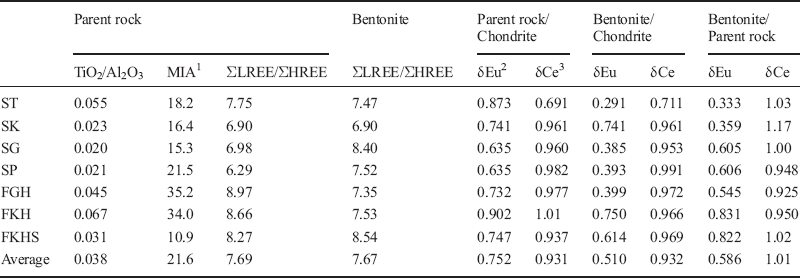
Based on the Nb/Y vs Zr/Ti diagram (Winchester & Floyd Reference Winchester and Floyd1977) created by Modabberi et al. (Reference Modabberi, Namayandeh, Setti and López-Galindo2019), the source magma for the parent rocks was reported to be mostly acidic. Also, the magma series of most of the samples were found to be calc-alkaline (Table 1); therefore, the TiO2/Al2O3 ratio can be used to evaluate the degree of weathering in the parent rocks. In the samples studied and with the exception of FKH, the TiO2/Al2O3 values of the parent rocks are values of ≤0.055 (Table 2), thus representing weakly reworked tuffs with little weathering. The magmatic series of the FKH sample has a tholeiitic composition and its TiO2/Al2O3 ratio is possibly related to the original rock composition rather than the degree of weathering (Table 1).

The δEu ratio is commonly considered to be an indicator of the source magma composition, not influenced by depositional reworking mechanisms (Zielinski Reference Zielinski1982; Sverjensky Reference Sverjensky1984; McLennan Reference McLennan1989). The δEu ratio was calculated using the following formula (Liao et al. Reference Liao, Hu, Cao, Wang, Yao, Wu and Wan2016):

where N denotes chondrite-normalized.
The TiO2/Al2O3 vs δEu diagram was used to evaluate depositional reworking effects (Hong et al. Reference Hong, Algeo, Fang, Zhao, Ji, Yin, Wang and Cheng2019). Most of the samples fall in the zone of primary felsic tuffs, near the rhyolitic composition and, less significantly, andesite rock spots in the diagram. FKH is the only sample which falls in the field of weakly reworked tuffs (Fig. 2).
Discriminant diagram of δEu vs TiO2/Al2O3 of parent rocks (yellow squares) (Hong et al. Reference Hong, Algeo, Fang, Zhao, Ji, Yin, Wang and Cheng2019). Rhyolite, andesite, and basalt data (red stars) are from Laviano & Mongelli (Reference Laviano and Mongelli1996).

In addition, the Mineralogical Index of Alteration (MIA) was used to estimate the degree of mineralogical weathering (Voicu & Bardoux Reference Voicu and Bardoux2002; Yusoff et al. Reference Yusoff, Ngwenya and Parsons2013):

MIA values <20% were proposed to be indicative of incipient, 20–40% of weak, 40–60% of moderate, and 60–100% of intense to extreme weathering (Voicu & Bardoux Reference Voicu and Bardoux2002). The MIA values for parent rocks in Groups 1, 2, and 4 (see Modabberi et al. Reference Modabberi, Namayandeh, Setti and López-Galindo2019 for groupings) are lower than or very close to 20% (none of the samples displayed an advanced degree of depositional reworking), while those of Group 3 (FKH and FGH) are higher (~35.0%) and fall within the weak weathering range (Table 2). These last two samples were formed predominantly from volcanic sandstone, and unlike samples of other groups, especially those around the town of Sarayan (Groups 1 and 2), no volcanic ash shards were observed. Some evidence of sedimentary-diagenetic processes was found, however, suggesting light reworking effects (Modabberi et al. Reference Modabberi, Namayandeh, Setti and López-Galindo2019).
Based on the field observations and because the degree of weathering was weak, even in Group 3 samples, the parent rocks are considered to be accurate representatives of the original composition of the parental volcanic ash.
REEs and Trace Elements Distribution
LREEs vs HREEs
REE fractionation provides useful insight into the composition of the source magma (Christidis Reference Christidis1998; Kiipli et al. Reference Kiipli, Hints, Kallaste, Verš and Voolma2017; Hong et al. Reference Hong, Algeo, Fang, Zhao, Ji, Yin, Wang and Cheng2019), the mineralogical and geochemical characteristics of the altered volcanic ash, and the environmental conditions of the alteration process (Bau Reference Bau1991; MacRae et al. Reference MacRae, Nesbitt and Kronberg1992; Nath et al. Reference Nath, Bau, Rao and Rao1997; Chen et al. Reference Chen, Algeo, Zhao, Chen, Cao, Zhang and Li2015; Liao et al. Reference Liao, Hu, Cao, Wang, Yao, Wu and Wan2016). REE fractionation during the formation of diagenetic bentonites consists of two phases. In the first phase, some REEs, such as Eu and HREEs, are co-precipitated with plagioclases and/or incorporated into the structure of plagioclases in early-stage magma, causing their depletion in intermediate to felsic magma. The second phase of REE fractionation may occur after the deposition of volcanic ash in an aqueous environment where it undergoes alteration. The fractionation of REEs in the second phase is controlled by the pH, temperature, alkalinity, salinity, redox condition, and water/rock ratio in the aqueous environment (dos Muchangos Reference dos Muchangos2006; He et al. Reference He, Zhong, Xu and Li2014; Chen et al. Reference Chen, Algeo, Zhao, Chen, Cao, Zhang and Li2015; Hong et al. Reference Hong, Algeo, Fang, Zhao, Ji, Yin, Wang and Cheng2019). This will be discussed more in the next sections.
The ΣLREE/ΣHREE ratio in the parent rocks varies from 6.29 to 8.97 (mean 7.69, Table 2). Similarly, the ΣLREE/ΣHREE ratio in bentonites showed a somewhat comparable variation, ranging from 6.90 to 8.54 (mean 7.67), indicating the relatively elevated concentration of LREEs in both parent rocks and bentonites.
The chondrite-normalized REE patterns of the parent rocks (P/C) and bentonites (B/C) suggest the same trend of LREEs enrichment relative to HREEs (Fig. 3).
Chondrite-normalized REE patterns of a, b parent rocks and c, d bentonites. Chondrite data are from McDonough & Sun (Reference McDonough and Sun1995).

Despite the small variations in the ΣLREE/ΣHREE, the average of the ratio is almost identical for both parent rocks and bentonites, suggesting relatively equal losses/gains, if any, in the concentration of REEs during the parent-rock alteration to bentonite. As stated, the source magma composition controls the degree of enrichment in LREEs compared to HREEs, so that the larger the silica contents of the magma, the greater the enrichment in LREEs. Modabberi et al. (Reference Modabberi, Namayandeh, Setti and López-Galindo2019) suggested that the initial source magma composition of the studied samples was intermediate to felsic in Groups 1 and 3, and felsic in Groups 2 and 4 (Table 1), thus explaining the depletion of HREEs and Eu in most of the samples.
Because the solubility of HREE complexes is greater than that of LREEs under alkaline pH where bentonite is formed (Christidis & Huff Reference Christidis and Huff2009), HREEs tend to be relatively dissolved in the second phase of REE fractionation (dos Muchangos Reference dos Muchangos2006), which provides an explanation for the depletion of HREEs from parent rocks to bentonites in the samples analyzed here.
Ce and Eu anomalies
REEs occur exclusively in a trivalent oxidation state except for Ce and Eu, which are also found in tetravalent and divalent oxidation states, respectively. Because Ce and Eu are redox-sensitive, Ce4+ and Eu2+ may be fractionated relative to trivalent REEs, causing significant positive or negative anomalies under certain redox conditions (Elderfield Reference Elderfield1988; Bau Reference Bau1991; MacRae et al. Reference MacRae, Nesbitt and Kronberg1992; Nath et al. Reference Nath, Bau, Rao and Rao1997; Chen et al. Reference Chen, Algeo, Zhao, Chen, Cao, Zhang and Li2015). The variation in the anomalies of Ce and Eu can be used as a proxy to study paleo-sedimentary environments and processes involved in the formation of clay minerals (Christidis Reference Christidis1998; Hastie et al. Reference Hastie, Kerr, Pearce and Mitchell2007; Özdamar et al. Reference Özdamar, Ece, Uz, Boylu, Ercan and Yanik2014; Liao et al. Reference Liao, Hu, Cao, Wang, Yao, Wu and Wan2016; Caballero & de Cisneros Reference Caballero and de Cisneros2017; Kiipli et al. Reference Kiipli, Hints, Kallaste, Verš and Voolma2017; Hong et al. Reference Hong, Algeo, Fang, Zhao, Ji, Yin, Wang and Cheng2019). The parent rock-normalized REE patterns of the bentonites (B/P) lead us to expect a further fractionation of REEs during the second fractionation phase (Fig. 4). To achieve a better quantitative insight into the distribution of REEs in the parent rocks, δEu and δCe values were calculated using Eqs 1 and 3, respectively (Liao et al. Reference Liao, Hu, Cao, Wang, Yao, Wu and Wan2016):

where the subscript N denotes chondrite-normalized.
Parent rock-normalized REE patterns of bentonites.

The values of δEu and δCe for P/C, B/C, and B/P (parent rock-normalized REE patterns of bentonites) were also calculated (Table 2). The δEu values for parent rocks ranged from 0.635 to 0.902 (mean 0.752), and from 0.291 to 0.750 (mean 0.509) for bentonites, suggesting a characteristic negative anomaly for Eu in both types of samples. Regarding δCe, with the exception of ST (parent rock and bentonite), all samples showed a very flat pattern, with a very weak negative Ce negative anomaly (1.01 > δCe > 0.953). When bentonites were normalized to parent rocks, Ce did not display any significant enrichment/depletion, showing a short range of δCe values from 0.925 to 1.17 (mean 1.01). Eu, conversely, exhibited a variable anomaly across the samples in B/P, showing a wide range of δEu values, from 0.333 to 0.831 (mean 0.590).
The δEu and δCe values of P/C were inherited chiefly from the source magma, as no advanced degree of weathering was observed in the parent rocks. In general, the δCe values were almost similar from P/C to B/C verified by the Ce values in B/P (~1.00), suggesting a relatively equal Ce loss/gain, if any, in comparison to La and Pr in the second phase of REE fractionation. ST is the only sample showing a different δCe value (0.691) in P/C. Conversely, throughout the second phase of REE fractionation, Eu was variously fractionated relative to Sm and Gd, as indicated by more pronounced negative Eu anomalies in B/C compared to P/C under increasingly oxidizing diagenetic conditions. Ce3+ was transformed to the relatively insoluble Ce4+ and, as such, it may be removed from pore waters, showing a positive anomaly through accumulation in the solid-phase sediments (Elderfield Reference Elderfield1988; Nath et al. Reference Nath, Bau, Rao and Rao1997). Chen et al. (Reference Chen, Algeo, Zhao, Chen, Cao, Zhang and Li2015) proposed that, in marine basins, the δCe value is <0.5 in oxic water (>1.5 in its solid phase sediment), ~0.6–0.9 in suboxic water (~1.1–1.4 in its solid phase sediment), and 0.9–1.0 in anoxic water (1.0–1.1 in its solid phase sediment). In other words, the larger the oxygen content in pore waters, the more Ce is removed from the water to enrich the sediment. The δCe values in B/P, hence, can be used as an indicator to evaluate the redox conditions of the local environment of the studied samples. The δCe average value was ~1.00 in all samples, suggesting a suboxic to anoxic aquatic environment for the transformation of volcanic ash to bentonite.
Eu is another highly redox-sensitive LREE, the trivalent oxidation state of which can be transformed to a more soluble divalent oxidation state under highly reducing conditions, causing the removal of Eu from the solid phase sediment (Elderfield Reference Elderfield1988; MacRae et al. Reference MacRae, Nesbitt and Kronberg1992; Chen et al. Reference Chen, Algeo, Zhao, Chen, Cao, Zhang and Li2015). The depletion of Eu from parent rocks to bentonites in the second phase of REE fractionation can be ascribed to the reducing conditions where volcanic ash underwent diagenetic alteration. This confirms the hypothesis that the local environment of bentonite formation was suboxic aquatic. The depletion of Eu, however, was not the same in all the bentonite deposits, increasing from Group 1 (δEu ~0.333) to Group 4 (δEu ~0.822) as a result of local variations in the redox potential of the diagenetic environments.
Unlike Ce, which can change valence at ambient temperature, high temperature (>200°C) is another critical factor needed for the transformation of Eu3+ to Eu2+ (Nath et al. Reference Nath, Bau, Rao and Rao1997). Bau (Reference Bau1991) calculated the Eu3+/Eu2+ redox equilibrium for temperatures up to 600°C, suggesting that even in low redox potential, Eu exists predominantly in a divalent oxidation state with increasing temperature. Based on field observations and petrographic evidence, two types of volcanic rocks were suggested for the study area: pyroclastic flow and volcaniclastic rocks (Modabberi et al. Reference Modabberi, Namayandeh, Setti and López-Galindo2019) which could provide the high temperature required for the transformation of Eu3+ to Eu2+. Christidis & Huff (Reference Christidis and Huff2009) reported that the alteration process is promoted at high temperatures and 300 to 850°C was suggested as a common temperature range for pyroclastic flows. Although this wide range of temperature is high enough to provide the required temperature for the reductive dissolution of Eu, it might also have a local impact on the amount of Eu3+ that can be transformed to Eu2+.
Trace elements distribution
Similar to REEs, the distribution of trace elements in bentonites is also controlled by their concentration in the parent rocks inherited from the source magma and the physiochemical conditions of the local environment, including the style of volcanic eruptions, pH, Eh, salinity, and temperature (Nesbitt Reference Nesbitt1979; Christidis Reference Christidis1998; Kiipli et al. Reference Kiipli, Hints, Kallaste, Verš and Voolma2017).
The parent rock-normalized trace element diagram was used to determine the distribution of trace elements in the bentonite samples (Fig. 5). Despite some similarities in the loss or gain of trace elements, one cannot, in general, conclude that they show the same behavior in all instances. Some relationship exists, however, among the large ion lithophile elements (LILE). Similarly, the high field strength elements (HFSE) show a significant positive correlation with each other. LILEs are characterized by large ionic radii and low valence (e.g. Ba, Rb, Sr, V, and Tl), whereas HFSEs are differentiated from other trace elements by small ionic radii and high valence states (e.g. Zr, Hf, Nb, Y) (Zielinski Reference Zielinski1985; Summa & Verosub Reference Summa and Verosub1992; Fanti Reference Fanti2009). In the samples analyzed here, the loss/gain of trace elements was relatively equal in HFSEs; unlike LILEs, their concentrations relative to each other did not show any significant changes.
Parent rocks-normalized trace elements patterns of bentonites. Only the patterns of those elements are given that showed a concentration above the detection limit of the method.

Element Mobility
Losses or gains of elements
During the alteration of volcanic ash, variations in the concentration of each individual element in the residual materials are directly related to the concentration of other constituents (Nesbitt et al. Reference Nesbitt, Markovics and Price1980). Because of the dilution effect, the removal of major elements from volcanic ash and/or residual behavior of elements bring about drastic changes in the concentration of immobile materials (Kiipli et al. Reference Kiipli, Hints, Kallaste, Verš and Voolma2017). Residual behavior occurs when elements are essentially immobile so that their concentrations increase through the depletion of mobile elements from the environment (Christidis Reference Christidis1998; Kiipli et al. Reference Kiipli, Hints, Kallaste, Verš and Voolma2017; Hong et al. Reference Hong, Algeo, Fang, Zhao, Ji, Yin, Wang and Cheng2019). Study of the behavior of immobile elements during the devitrification of volcanic ash is imperative, as increases or decreases in their concentrations show the degree to which other elements are lost or gained (Nesbitt et al. Reference Nesbitt, Markovics and Price1980; Christidis Reference Christidis1998; Kiipli et al. Reference Kiipli, Hints, Kallaste, Verš and Voolma2017).
Instead of using the absolute concentration of elements in analyzing their mobility, Nesbitt (Reference Nesbitt1979) suggested use of the element’s ratio to an immobile element, as this ratio is not influenced by the dilution effect. Al has commonly been considered an immobile element during the chemical weathering, transport, diagenesis, and metamorphism of volcanic ash (Nesbitt Reference Nesbitt1979; Slack & Stevens Reference Slack and Stevens1994; Laviano & Mongelli Reference Laviano and Mongelli1996; Christidis Reference Christidis1998; Göncüoglu et al. Reference Göncüoglu, Günal-Türkmenoglu, Bozkaya, Ünlüce-Yücel, Okuyucu and Yilmaz2016; Kiipli et al. Reference Kiipli, Hints, Kallaste, Verš and Voolma2017; Hong et al. Reference Hong, Algeo, Fang, Zhao, Ji, Yin, Wang and Cheng2019) which makes it an appropriate choice for studying the percentage changes in the concentration of elements during the alteration process.
The percentage changes relative to parent rocks were calculated following Nesbitt et al. (Reference Nesbitt, Markovics and Price1980):

where R s and R p are the concentrations of an element in a bentonite and its parent rock, respectively, each of which is normalized to the corresponding Al %. In addition, the absolute concentrations of Al in bentonites and parent rocks were used to measure the percentage change of Al itself to determine whether other elements were lost or gained (Nesbitt Reference Nesbitt1979):

where Al s is the concentration of Al in a bentonite and Al p is the concentration of Al in the corresponding parent rock.
The percentage changes in elements during alteration of volcanic ash to bentonite (Table 3) revealed that the average amount of Al lost was small (~12.5%) among all the deposits and this agrees well with the literature which has reported Al as an immobile to poorly mobile element (Nesbitt Reference Nesbitt1979; Slack & Stevens Reference Slack and Stevens1994; Laviano & Mongelli Reference Laviano and Mongelli1996; Christidis Reference Christidis1998; Göncüoglu et al. Reference Göncüoglu, Günal-Türkmenoglu, Bozkaya, Ünlüce-Yücel, Okuyucu and Yilmaz2016; Kiipli et al. Reference Kiipli, Hints, Kallaste, Verš and Voolma2017; Hong et al. Reference Hong, Algeo, Fang, Zhao, Ji, Yin, Wang and Cheng2019). Although the variation of Al concentration was not significant in most of the samples, the loss of Al was found to be large in a few samples such as SK (–34.1%). The changes observed in Al concentration may be the result of the dilution effect caused by losses or gains of other major elements such as Si, which is the predominant element in both parent rocks and bentonites. The most negative percentage change in Al concentration was observed in SK, where Si showed the most positive percentage change (59.42%). When the percentage changes of Al and Si were plotted against each other (Fig. 6), they exhibited an inversely proportional trend, with R2 > 90, suggesting a significant inverse correlation.
Percentage change of elements during the alteration of volcanic ash.

The inverse correlation between the percentage changes of Al

lthough the concentration of Al is more or less controlled by the variation in the Si concentration, it may not be enough to explain the –34.1% decrease in the Al concentration of the SK sample. The initial volcanic ash from which bentonites formed was deposited in an aqueous environment which increased the water content of the samples during the hydrolysis reaction that converts the volcanic ash to bentonite. The loss on ignition (LOI) increased considerably in all the samples during alteration, but this value was significantly larger in the SK sample (~1909%) (Table 3). Increasing the water content of the samples caused the residual elements such as Al to be diluted, providing another explanation for the decrease in the Al content of the SK sample. The variation in the LOI content of the samples showed that the physiochemical condition during the formation of bentonites was locally different.
The smallest variation in Al concentration was observed in the SG sample (~0.4%). To evaluate the mobility of elements, several samples from this deposit (Chah-Golestan) were used to decrease the impact of local geochemical and lithological conditions. This will be discussed further below.
As stated, Al has been considered consistently as an immobile element and, thus, ∽–35% change, which is the most negative percentage change in Al concentration, can loosely be regarded as a plausible threshold to identify potential immobile elements, as the percentage changes in the Al concentration mostly result from the dilution effect. Similarly, elements showing a positive percentage (residual enrichment) were also proposed by Christidis (Reference Christidis1998) to be considered immobile. For the purpose of the present study, those elements displaying positive percentage changes, or negative changes smaller than –35% in more than half of the deposits (4 of 7), were hypothesized as potential immobile elements, including Si, Al, Na, Mg, Be, Ga, In, U, Y, Zn, Pr, Nd, Sm, Gd, Tb, Dy, Ti, Ba, Cs, Ge, Nb, Pb, Sc, Sn, Th, V, Zr, La, Ce, Eu, Er, Yb, Hf, and Ho. At the current stage of the study, in no case has the immobility of any of these elements been proved. This method was used solely to achieve an understanding of the potential immobile elements, and further analysis is needed to evaluate the mobility of the elements.
Statistical analysis
The results of bivariate correlation analyses (Tables 4 and 5), calculated using the percentage changes provided in Table 3, showed that besides the expected negative correlation with Al (r > –0.953), Si also displayed an inverse correlation with LREEs. A positive correlation (r > 0.900) existed between HFSEs and REEs. Both LREEs and HREEs have positive correlations with other elements of their group (r > 0.950), but the r values fall to <0.850 when LREEs are compared with HREEs. Eu exhibited a less significant correlation with other REEs (R < 0.800), while no significant correlation was found between Lu and HREEs.


Some unexpected elements (e.g. Si and Na) appeared among the potential immobile elements in the previous section, as they have been reported to be actively mobile (Caballero et al. Reference Caballero, Reyes, Delgado, Huertas and Linares1992; Christidis et al. Reference Christidis, Scott and Marcopoulos1995; Christidis & Huff Reference Christidis and Huff2009). The binary diagram was plotted using Chah-Golestan (SG) bentonite and parent rock samples to evaluate the mobility of each of the elements provided in the list of potential immobile elements (Fig. 7a and b). The largest deposit in the studied area was SG, where various layers of bentonite are exposed at the surface. These exposed layers provided numerous samples from this deposit (instead of using samples from different deposits) which were used in the binary diagrams to decrease the impact of local geochemical and lithological conditions, supposedly affecting the mobility of element. Overall, seven bentonites and two volcanic rocks from Chah-Golestan were used in the binary diagrams (see Table B in the SI). The SG2 sample is the parent rock of the samples SG-D, SG-E, SG-F, and SG-G where the gradual transition of SG2 to SG-G could be observed clearly (Fig. 1). The samples SG-A, SG-B, and SG-C (bentonite) and SG3 (volcanic rock) were also taken from other horizons of the Chah-Golestan deposit to increase the diversity of the samples in the binary diagrams and ensure that samples were taken from the different sections of the deposit.
a Representative binary diagrams of Al vs potential immobile elements with R2 values >0.800 for the bentonites and parent rocks of Chah-Golestan deposit. b The representative binary diagrams of Al vs potential immobile elements with R2 values (a, b, c, d) between 0.500 and 0.800, and (e, f, g, h) < 0.500 for the bentonites and parent rocks of the Chah-Golestan deposit. The negative R2 value for the Al vs Si line is because the intercept was set at zero, forcing the line to pass through the origin.


If two different chemical elements of several bentonites are immobile during the alteration of volcanic ash to bentonite, they should show a strong correlation, with the least squares line (R2) passing through the origin of the binary diagram. Two such elements should be considered immobile, as two elements with distinctly different chemical properties are unlikely to be of equal solubility and mobility (Christidis Reference Christidis1998; Kiipli et al. Reference Kiipli, Hints, Kallaste, Verš and Voolma2017).
Based on the correlation of each element with the least squares line, i.e. R2 values (Fig. 8), the mobility of elements was loosely classified into three groups: immobile, poorly mobile, and mobile. Note that the following is merely a qualitative classification because choosing a definitive boundary delineating each group of elements may not be applicable at this stage of the study. The elements with R2 values > 0.800 (80% accuracy) were thus proposed to be considered immobile, as Kiipli et al. (Reference Kiipli, Hints, Kallaste, Verš and Voolma2017) also found the R2 values up to 0.73 to be relatively low. For the purpose of the present study, elements with R2 values between of < 0.500 and 0.800 were also considered to be poorly mobile and those with values < 0.500 were considered to be mobile.
Qualitative estimate of the mobility of elements during the alteration of volcanic ash to bentonite for the eastern Iranian bentonite deposits. The R2 values were obtained from the binary diagrams of Al vs potential immobile elements. For the binary diagram with –R2, the real values are not shown here, and all of them are represented as <0.

The highest R2 values (0.800–1.00) were observed in Ti, Gd, Ga, Pr, Tb, Nd, Sm, Ce, and Nb, all of which were included in the list of potential immobile elements. Along with Al, they were probably immobile during bentonite formation. Regression lines pointing to the origin of the chart for Sc, Hf, U, Dy, In, Zr, La, and Eu show less correlation, with R2 values between 0.500 and 0.800. These elements were also included in the list of potential immobile elements but, because of the lower R2 values, they cannot be verified as being immobile, so they are classified in the poor-mobility group. In addition, the elements (Si, Na, Mg, Be, Y, Zn, Ba, Cs, Ge, Pb, Th, V, Er, and Yb) with R2 < 0.500 were certainly mobile during bentonite formation; therefore, they are listed in the mobile elements group. Most of the elements classified here as immobile or of low mobility agree quite well with those reported in the literature on mobility of elements throughout volcanic ash transformation (Nesbitt Reference Nesbitt1979; Nesbitt et al. Reference Nesbitt, Markovics and Price1980; Zielinski Reference Zielinski1985; Christidis Reference Christidis1998; dos Muchangos Reference dos Muchangos2006; Özdamar et al. Reference Özdamar, Ece, Uz, Boylu, Ercan and Yanik2014; Kacmaz Reference Kacmaz2016; Liao et al. Reference Liao, Hu, Cao, Wang, Yao, Wu and Wan2016; Kiipli et al. Reference Kiipli, Hints, Kallaste, Verš and Voolma2017; Hong et al. Reference Hong, Algeo, Fang, Zhao, Ji, Yin, Wang and Cheng2019).
Major element mobility
The results demonstrate that even elements displaying strong residual enrichment such as Si (up to ~60%) and Na (up to ~80%) may not be immobile, as shown in the binary diagram analysis (Fig. 7b). The release of Si from volcanic ash to the aqueous environment is a critical factor in the formation of bentonite (Christidis & Huff Reference Christidis and Huff2009). Despite the alteration of volcanic ash to bentonite, the Si fraction that was apparently washed off the parent rocks was not leached entirely from the environment, even exhibiting strong residual enrichment in some of the deposits. The mineralogy of bentonite samples in eastern Iran showed that the bentonite samples are not composed entirely of smectite minerals (Na-montmorillonite), and they include up to 39% of opaline silica (i.e. opal-CT and opal-C) as a secondary phase (Table 1). Given this, a fraction of Si was indeed depleted from the volcanic ash but precipitated and subsequently crystallized to opaline silica in situ. Modabberi et al. (Reference Modabberi, Namayandeh, Setti and López-Galindo2019) reported that in the eastern Iranian bentonite zone, the water/rock ratio, which is one of the factors controlling the availability of Si in the system during alteration, was low. At higher water/rock ratios in an open system, the free Si released from the volcanic ash may not precipitate to any great extent, accumulating instead in the fluid phase and leaching out of the environment (Christidis & Huff Reference Christidis and Huff2009). Overall, Si was depleted from the volcanic ash, showing strong mobility, but fluid flow volume was not sufficient to leach it from the environment, i.e. any residual enrichment does not equal immobility. In all instances, the SiO2/Al2O3 ratio is significant (up to 7), and thus, the variation in the concentration of Si has a considerable impact on that of the other elements in general and immobile elements in particular.
The behavior of alkalies during volcanic-ash transformation governs the formation of either smectites or zeolites; if the alkalies are not removed from the system, the (Na++K+)/H+ ratio increases and, instead of smectites, zeolites are formed (Christidis et al. Reference Christidis, Scott and Marcopoulos1995; Yildiz & Kuscu Reference Yildiz and Kuscu2004). The absence of zeolites in the samples studied suggests that alkalies were leached out of the environment to some extent. The changes in K percentage showed substantial depletion in all deposits (up to 97%), while Na seems to be less mobile across the deposits and acts as a counter cation in the structure of Na-montmorillonite, which is the main mineralogical phase in the samples studied (Table 3).
The large (Mg2+)/(H+) ratio and leaching of alkali elements from the aqueous environment promotes the destabilization of the plagioclase structure and provides a suitable pH (~8) for the formation of bentonite instead of zeolite (Christidis Reference Christidis1998; Christidis & Huff Reference Christidis and Huff2009; Modabberi et al. Reference Modabberi, Namayandeh, Setti and López-Galindo2019). Christidis & Huff (Reference Christidis and Huff2009) suggested that in the transformation of acidic parent rocks with a small Mg content, the required Mg is supplied by the fluid phase. The concentration of Mg has increased significantly from the parent rocks to bentonites in all the samples studied with the exception of FKH (Table 3), suggesting the addition of Mg to the bentonite samples from the aqueous environment. Because the FKH sample is not acidic in composition, it did not need to take up Mg from the aqueous environment as its parent rock already had the largest concentration of Mg ( 2.60%) across the samples.
Trace and rare earth element mobility
All the LILEs were listed in the mobile group of the classification provided. The alkaline trace elements such as Rb and alkaline earth metals (e.g. Ba and Sr), known mostly as LILE, are highly mobile in aqueous environments (Zielinski Reference Zielinski1985; Khan Reference Khan1990; Hong et al. Reference Hong, Algeo, Fang, Zhao, Ji, Yin, Wang and Cheng2019). They display pronounced positive correlations (r > 0.950) with K (i.e. alkaline metal) and Ca (i.e. alkaline earth metal) which are geochemically similar major elements (Tables 4 and 5). Biotite, feldspar, and K-feldspar host Ba and Rb in volcanic ash, rapidly releasing these mobile elements during alteration (Renock et al. Reference Renock, Landis and Sharma2016). Although LILEs show a positive correlation with K, their contents are not controlled significantly by K-bearing minerals but by sorption on the surface of bentonite (Nesbitt et al. Reference Nesbitt, Markovics and Price1980; Hodson Reference Hodson2002).
HFSEs are commonly considered less soluble and relatively immobile elements, preserving the characteristics of the source materials (Merriman & Roberts Reference Merriman and Roberts1990; Huff et al. Reference Huff, Merriman, Morgan and Roberts1993; Pellenard et al. Reference Pellenard, Deconinck, Huff, Thierry, Marchand, Fortwengler and Trouiller2003; Calarge et al. Reference Calarge, Meunier, Lanson and Formoso2006). Zr, Hf, and Nb are listed in the immobile to poorly mobile groups, while some other HFSEs, such as Y, Ta, and Th, showed some degree of mobility (Fig. 8). During the diagenetic alteration of volcanic ash, authigenic clay minerals are formed in situ, and, therefore, their immobile contents may not be fractionated and may be mostly inherited from the source magma composition. The physiochemical conditions (pH, Eh, salinity) of the local environment are also important factors controlling the mobility of trace elements and possibly causing some redistribution of immobile elements (Hong et al. Reference Hong, Algeo, Fang, Zhao, Ji, Yin, Wang and Cheng2019). For instance, while Zr and Y are known as immobile elements in the literature (Nesbitt Reference Nesbitt1979; Christidis Reference Christidis1998; Kiipli et al. Reference Kiipli, Hints, Kallaste, Verš and Voolma2017), they were found to be poorly mobile and mobile, respectively, in these samples (Fig. 8). Zr and Y are incorporated into the structure of early-crystallized heavy minerals such as zircon, garnet, and monazite. These minerals are very sensitive to physical sorting in aqueous environments, and hence, susceptible to being leached as colloidal phases thereby removing Zr and Y from the open system (Summa & Verosub Reference Summa and Verosub1992; Wray Reference Wray1995; Hong et al. Reference Hong, Algeo, Fang, Zhao, Ji, Yin, Wang and Cheng2019).
Because of similar geochemical characteristics, REEs are also classified as HFSEs (Zielinski Reference Zielinski1985; Summa & Verosub Reference Summa and Verosub1992; Fanti Reference Fanti2009; He et al. Reference He, Zhong, Xu and Li2014), showing a strong positive correlation with their equivalent trace elements such as Zr and Hf (Tables 4 and 5). All of the LREEs and Gd, Tb, and Dy from the HREEs were found to be either immobile or poorly mobile (Fig. 8). HREEs show a degree of mobility indicating that the heavier the element, the more mobile it is during volcanic ash conversion. LREEs have been proposed to be less soluble and retain their concentration in an alkaline solution, while HREEs favor making complexes in the aqueous phase, causing their removal from the solid phase-sediments (Summa & Verosub Reference Summa and Verosub1992; dos Muchangos Reference dos Muchangos2006). The various dissolution behaviors shown by REEs may explain the greater mobility of some of the heavier HREEs such as Er compared to lighter HREEs such as Gd and Tb. Summa & Verosub (Reference Summa and Verosub1992) stated that the degree to which HREEs accumulate in the fluid phase is controlled by the water/rock ratio such that their mobility increases in dense solutions (i.e. low water/rock ratio). Modabberi et al. (Reference Modabberi, Namayandeh, Setti and López-Galindo2019) proposed a shallow aqueous environment with a low water/rock ratio, such as a lagoon, as the aqueous environment in which the eastern Iranian bentonites were formed, which explains the greater mobility of HREEs.
Conclusions
The present study examined the distribution and mobility of trace elements and REEs during the alteration of volcanic ash to bentonite in the eastern Iranian bentonite zone. The degree of weathering in the parent rocks was evaluated, suggesting that the parent rocks were not influenced significantly by an advanced degree of depositional reworking and, as such, are an accurate representation of the volcanic ash from which the bentonites were formed. The ΣLREE/ΣHREE ratios and the chondrite-normalized REE patterns of both parent rocks and bentonites showed that LREEs were enriched in comparison to HREEs, owing to their concentration in the source magma and the physiochemical conditions of the aqueous environment. The variation in the δCe and δEu values suggests that the diagenetic alteration of volcanic ash probably occurred in a suboxic aquatic environment. In general, trace elements did not display any identical pattern of enrichment/depletion, but both LILEs and HFSEs showed some similar behavior between the elements of their respective groups in the parent rock-normalized trace element diagram.
The percentage changes in the concentration of immobile elements seem to be influenced primarily by the behavior of Si, as it shows a significant negative correlation with Al and LREEs. Furthermore, in the bivariate correlation analysis, LILEs, HFSEs, HREEs, and LREEs displayed a positive correlation between the elements of their respective groups. Based on the results obtained from the binary diagram of potential immobile elements vs Al, a qualitative classification was proposed for different mobility behaviors, consisting of an immobile group, attributed to R2 values of >0.800, a poorly mobile group, with R2 values between 0.500 and 0.800, and a mobile group, corresponding to R2 values <0.500. Accordingly, Ti, Gd, Ga, Pr, Tb, Nd, Sm, Ce, and Nb are considered immobile, and U, Dy, In, Sc, Hf, Zr, La, and Eu are considered to be poorly mobile during the alteration of volcanic ash to bentonite.
Overall, a systematic study of the behavior of trace elements and REEs during the devitrification of volcanic ash has helped to determine the magmatism and tectonic setting of source volcanism, and to correlate the ash layers of different areas. This study showed that the physiochemical conditions of the local environment control to a significant extent the behavior of elements, and, therefore, the diagenetic histories of the area studied should be taken into careful consideration prior to use of trace elements and REEs for study of the source magma.
Electronic supplementary material
The online version of this article (https://doi.org/10.1007/s42860-019-00054-9) contains supplementary material, which is available to authorized users.
ACKNOWLEDGMENTS
This research was partly funded by the Iran National Science Foundation (contract no. 90004849), Spanish Group CTS-946 (Junta de Andalucia), and MINECO project CGL2016-80833-R. The authors acknowledge the School of Geology of the University of Tehran for sample preparation and some geochemical tests. The authors express their gratitude to Shaghayegh V. Navabpour for assisting with the statistical analyses. They also sincerely thank the reviewers for their careful reading of the manuscript and their many insightful comments and suggestions which certainly helped to improve the manuscript.
Compliance with ethical standards
Conflict of Interest
The authors declare that they have no conflict of interest.
Ethical approval
This article does not contain any studies with human participants or animals performed by any of the authors.
Informed consent
Informed consent was obtained from all individual participants included in the study.