Many factors influence resource utilisation and Paediatric Cardiac ICU length of stay, including admitting diagnosis, surgical operation, post-operative complications, and unplanned hospital and Cardiac ICU readmissions.Reference Brennan, Gauvreau and Connor1–Reference Smith, Anand and Banerjee10 Beyond severity of illness, variation in clinical outcomes is driven by individual providers’ perceptions of “optimal care” and the system’s ability to deliver the provider’s construct to the patient. However, the downstream influence of provider perception on care delivery is not routinely assessed.
Strategies to reliably deliver effective care and rid systems of unwanted variation include use of protocols, bundles, or other quality improvement methods. Efforts have been made to identify important quality improvement projects in children with CHD,Reference Jacobs, Jacobs and Austin11,Reference Eghtesady, Brar and Hall12 but quality improvement metrics specific to the Cardiac ICU are lacking. A systematic approach to identifying high impact quality improvement needs, as well as tracking the influence of the initiatives could streamline resource utilisation and provide a greater impact to outcome measures, such as length of stay.
Additionally, in the Paediatric Cardiac ICU, much attention has been given to the high-acuity post-operative period. However, the convalescent phase is less well-described and potentially demonstrates more variability in the way it is understood and care is delivered.
In an effort to address these common issues, we developed a novel metric to measure the Final ICU Need, or the reason a patient required ICU care in the 24 hours preceding ICU discharge. We anticipated that Final ICU Need could be utilised to decrease length of stay by identifying drivers of the final segment of the Cardiac ICU journey and to track the downstream impact of new protocols or research interventions by monitoring changes in the perceived physiology of the final segment. For example, around the time of Final ICU Need development, a nutritional protocol was introduced in our Cardiac ICU. We were concerned that changes in nutritional delivery would lead to patients remaining in the ICU longer for observation. We needed a metric to determine whether the last reason patients were staying in the ICU was shifting to feeding issues or if other issues persisted beyond resolution of feeding issues.
Additionally, because our Cardiac ICU length of stay was already relatively short (median 2 days), we believed that the easiest way to further improve our length of stay would be to examine the final hours in the ICU, as this is naturally the time of lowest acuity and thus potentially more modifiable than earlier perioperative periods. We also believed that by understanding the Final ICU Need, we could begin to define a construct of normal for the convalescent phase at the end of the Cardiac ICU stay.
Therefore, our aim was to determine the Final ICU Need for Cardiac ICU patients by utilising a single-centre survey. We hypothesised that by evaluating provider perceptions of the final segment of Cardiac ICU stay, we could understand provider-specific variation, as well as cardiac-lesion-specific variation to clarify care processes and resource utilisation. Additionally, the Final ICU Need may be used to better inform staff and family expectations and improve the impact and focus of current and future quality initiatives.
Materials and methods
Study population and setting
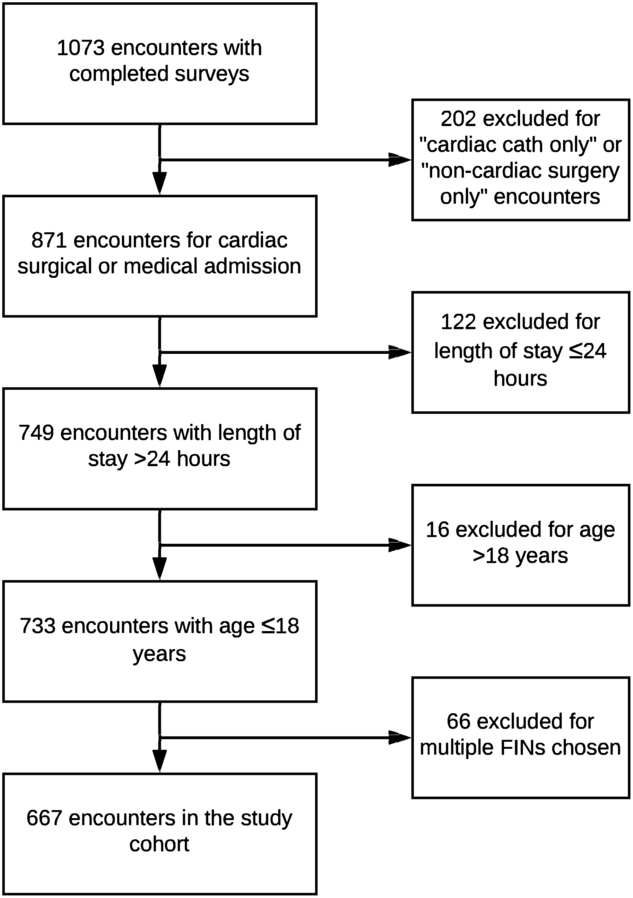
This cross-sectional survey study was designed to determine the Final ICU Need in the 24 hours prior to Cardiac ICU discharge. A one-question survey was sent to the Cardiac ICU attending physician who discharged or transferred children from the Cardiac ICU at a tertiary-care paediatric hospital from April 2016 through July 2018. We excluded patients requiring ≤24 hours of ICU care, encounters for non-cardiac procedures only, patients >18 years of age, and if multiple Final ICU Needs were chosen for a single encounter (Fig 1). Additionally, encounters for cardiac catherisation only were excluded, as expected and actual length of stay is typically <24 hours. Surveys were not sent for Cardiac ICU encounters ending in death. At our institution, patients in the inclusion cohort are typically discharged from the Cardiac ICU to a paediatric cardiac surgical floor unit prior to discharge home; <1% of the studied patients were discharged directly home or to a skilled nursing facility from the Cardiac ICU.
Exclusion diagram.

Data collected included: age (neonate: <29 days; paediatric: 29 days to 18 years), gender, presence of a genetic condition, benchmark operation, Cardiac ICU length of stay, prolonged ventilation, prolonged vasoactive infusion, unplanned Cardiac ICU readmission, cardiac arrest, in-hospital mortality, and survey respondent.
Genetic condition is defined as any patient with a genetic syndrome, chromosomal abnormality, or significant congenital non-cardiac abnormality. Prolonged ventilation and prolonged vasoactive infusion are defined according to the Paediatric Cardiac Critical Care Consortium reporting dictionary for version 2.0 dated July 27, 2016. Prolonged ventilation is defined as Cardiac ICU encounters where total mechanical ventilation time is 7 days or more. Prolonged vasoactive infusion is defined as Cardiac ICU encounters where the use of vasoactive and/or inotropic infusions lasted 3 or more days. Short length of stay is considered a Cardiac ICU encounter lasting >24 hours but <7.9 days, which is the 75th percentile of the available Cardiac ICU length of stay.
Benchmark cardiac operations were categorised according to the Society of Thoracic Surgeons classification system. “Other operation” is a diagnostic category comprised of patients who underwent cardiac surgeries which did not fit within the other benchmark operation categories. Ventricular septal defect was selected as the reference level of benchmark operations because the distribution of Final ICU Need for this lesion most closely matched the overall Final ICU Need distribution. Cardiac ICU encounters in which the patient did not undergo surgery were classified as “medical admissions”.
Survey rationale and development
We chose to utilise a survey to study the Final ICU Need, as it was a natural way to connect mental models by which clinicians practice to care process delivery in order to observe the relationship to outcomes. For example, if we knew the predominant physiology necessitating an ICU bed during the last day was respiratory issues, we could focus our physiology and resource conversations toward that end. Rather than abstracting data from patient charts to determine the Final ICU Need, we opted for a survey model because of the role that provider perceptions play in the timing of transfer. Therefore, as designed, Final ICU Need reflects dominant physiology at discharge as perceived by providers and can be adjusted for clinically important covariates.
This study was approved by the University of Utah Institutional Review Board and Primary Children’s Hospital Private Board. A survey was created within REDCap (Research Electronic Data Capture), a secure software platform designed to support data capture for research studies.Reference Harris, Taylor and Thielke13,Reference Harris, Taylor and Minor14 The survey included the patient name, encounter number, admitting diagnosis, and date of discharge. The survey consisted of a single question asking the responder to use clinical judgement to provide a Final ICU Need category for each patient.
Final ICU Need categories were defined by the authors and included: “Cardiovascular”, “Respiratory”, “Feeding”, “Sedation”, “Systems issue”, and “Other Final ICU Need” (see definitions below). Similar categories have been frequently used in classifying reasons for readmissions in patients with CHD.Reference Mackie, Ionescu-Ittu and Pilote7-Reference Smith, Anand and Banerjee10 Cardiac ICU attending physicians were educated regarding the Final ICU Need definitions in March 2016, prior to initiation of the project in April 2016. Respondents were instructed to select a Final ICU Need based on identified issues, not on underlying diagnosis.
The survey was sent via e-mail to the discharging physician within 3 days of Cardiac ICU discharge. In an effort to increase response rate and ensure survey completion in a timely manner, the survey was automatically resent every other day until completed, up to a total of five times. Free text could be added to further define the Final ICU Need. Initially, respondents could choose more than one Final ICU Need; however, the survey was modified in April 2017 to allow only one Final ICU Need in order to better identify the final need.
Final ICU Need categories
Cardiovascular: Discharge was pending due to hypotension/hypertension, elevated lactate, impaired perfusion, monitoring or treatment for pulmonary hypertension, dysrhythmia causing haemodynamic instability, external pacing, management of fluid balance, or concern for cardiovascular instability.
Respiratory: Patient required high-flow nasal cannula or continuous non-invasive positive pressure ventilation, management of pleural effusions or pneumothorax, and/or observation for work of breathing, tachypnea, or airway obstruction.
Feeding: Discharge was pending resolution or treatment of feeding issues including pneumatosis, necrotising enterocolitis, obstruction, intolerance, concern for aspiration, vomiting, diarrhoea, or weight loss.
Sedation: Patient required sedative infusions within the last 24 hours or there was concern for withdrawal that required Cardiac ICU monitoring or bolus dosing.
Systems Issue: Discharge was pending results or completion of a procedure, imaging, or lab study; or patient was ready for discharge but remained in the unit due to infrastructural insufficiencies including, but not limited to, bed or staff availability.
Other: Free-text response regarding any Final ICU Need that did not fit in any other categories. This included altered mental status, electrolyte disturbances, sepsis (febrile and/or culture positive), bleeding, and complex care coordination.
Statistical analysis
Continuous clinical characteristics were summarised using medians and interquartile ranges at the visit level due to distribution skew. For categorical variables, counts and percentages are reported.
Primary analysis focused on patients with Final ICU Need values of “Cardiovascular” or “Respiratory”, due to limited numbers for the other Final ICU Needs. Univariable mixed-effects logistic regression models were fit to the binary outcome variable “Cardiovascular”/“Respiratory” Final ICU Need for each variable of clinical interest, including: benchmark cardiac operation, age, provider, genetic condition, Cardiac ICU length of stay, prolonged ventilation, prolonged vasoactive infusion, and season at time of discharge. Due to patients having multiple visits, a patient-level random effect was included in each model. A multivariable mixed-effects logistic regression model was fit that included the same set of variables. Interaction effects were examined between age group and length of stay (where length of stay was coded as a continuous variable) because we a priori hypothesised that the effect of length of stay on Final ICU Need differed by age group. A univariable mixed-effect logistic model was used to assess whether “Cardiovascular” Final ICU Need versus any other Final ICU Need at discharge predicted readmission within <72 hours. Due to few events, this model did not adjust for additional variables. Model results are reported as odds ratios and their 95% confidence intervals. Due to a low event rate for mortality, Fisher’s exact tests were used, comparing mortality versus age group, and mortality versus “Cardiovascular” and any other Final ICU Need. Kernel density plots were used to visualise the distribution of ICU visits over a continuous interval of Cardiac ICU length of stay.
Statistical analyses were implemented using R v.3.4.4.Reference Core Team15 Statistical significance was assessed at the 0.05 level, and all tests were two-sided.
Results
Survey response rate was 99%, with 1073 surveys completed by 8 different Cardiac ICU attending physicians between April 2016 and July 2018. Excluded encounters were: 202 for patients undergoing only cardiac catheterisation or non-cardiac surgery, 122 for length of stay ≤24 hours, 16 for age >18 years, and 66 for multiple Final ICU Needs chosen (Fig 1). After exclusions, a total of 667 Cardiac ICU encounters from 535 unique patients were eligible for analysis.
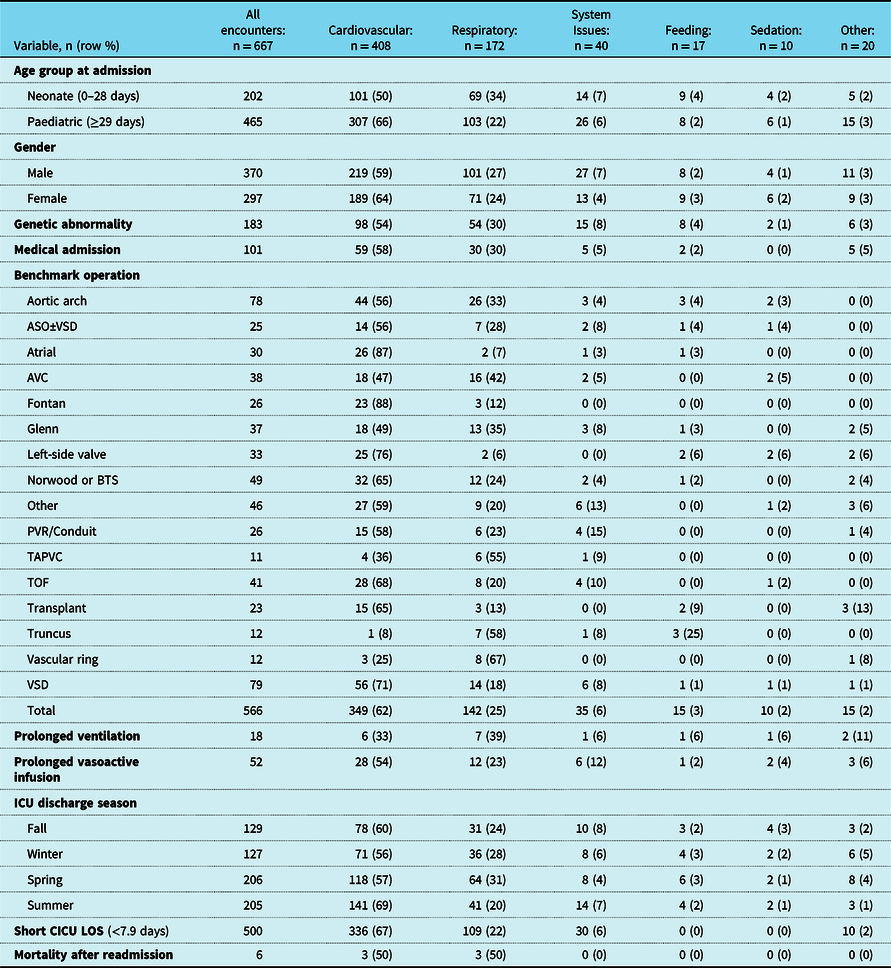
The median survey response time was 4 days (interquartile range: 2.0, 6.9) after Cardiac ICU discharge time. The median age was 4.8 months (interquartile range: 0, 37.2), the median ventilator duration was 14 hours (interquartile range: 0, 86.5), the median length of stay was 3 days (interquartile range: 1.7, 7.9), and the overall cardiac arrest rate was 2% (n = 13). The seasonal distribution at time of Cardiac ICU discharge was 31% spring (206/667), 31% summer (205/667), 19% fall (129/667), and 19% winter (127/667) (Table 1).
Patient characteristics by final ICU need category

ASO = arterial switch operation; AVC = atrioventricular Canal; BTS = Blalock–Taussig Shunt; CICU = Cardiac ICU; LOS = length of stay; PVR = pulmonary valve replacement; TAPVC = total anomalous pulmonary venous connection; TOF = Tetralogy of Fallot; Truncus = truncus arteriosus; VSD = ventricular septal defect.
Patient characteristics summarised across Final ICU Need categories are shown in Table 1. The Final ICU Need prevalence was “Cardiovascular” (408/667, 61%), “Respiratory” (172/667, 26%), “System Issues” (40/667, 6%), “Other” (20/667, 3%), “Feeding” (17/667, 3%), and “Sedation” (10/667, 1%).
Overall 30% (202/667) of the encounters were neonates, of which 50% (101/202) had a “Cardiovascular” Final ICU Need compared to 66% (307/465) of the children. Among males (370/667; 55%), the prevalence of “Cardiovascular” Final ICU Need was 59% (219/370), compared to 64% (189/297) of females. Twenty-seven percent of all encounters had a genetic condition, of which 53% (97/183) had a “Cardiovascular” Final ICU Need and 30% (54/183) had a “Respiratory” Final ICU Need. The most prevalent Final ICU Needs among medical encounters was “Cardiovascular” (59/101, 58%) followed by “Respiratory” (30/101, 30%). The most common season for a medical admission was winter (40/101, 40%) followed by spring (23/101, 23%).
Of the 566 total surgical encounters (566/667, 85%; Table 1), 91% (515/566) received cardiopulmonary bypass. The most common benchmark operations were ventricular septal defect (79/566, 14%) and aortic arch repair (78/566, 14%).
Of the 66 encounters excluded for multiple Final ICU Needs chosen, patient characteristics are described in Supplemental Table 1. “Cardiovascular” and “Respiratory” were chosen together in 27 encounters, “Cardiovascular” and “Sedation” in 10 encounters, and any other combination of 2 Final ICU Needs in 26 encounters. Three Final ICU Needs were chosen in three encounters.
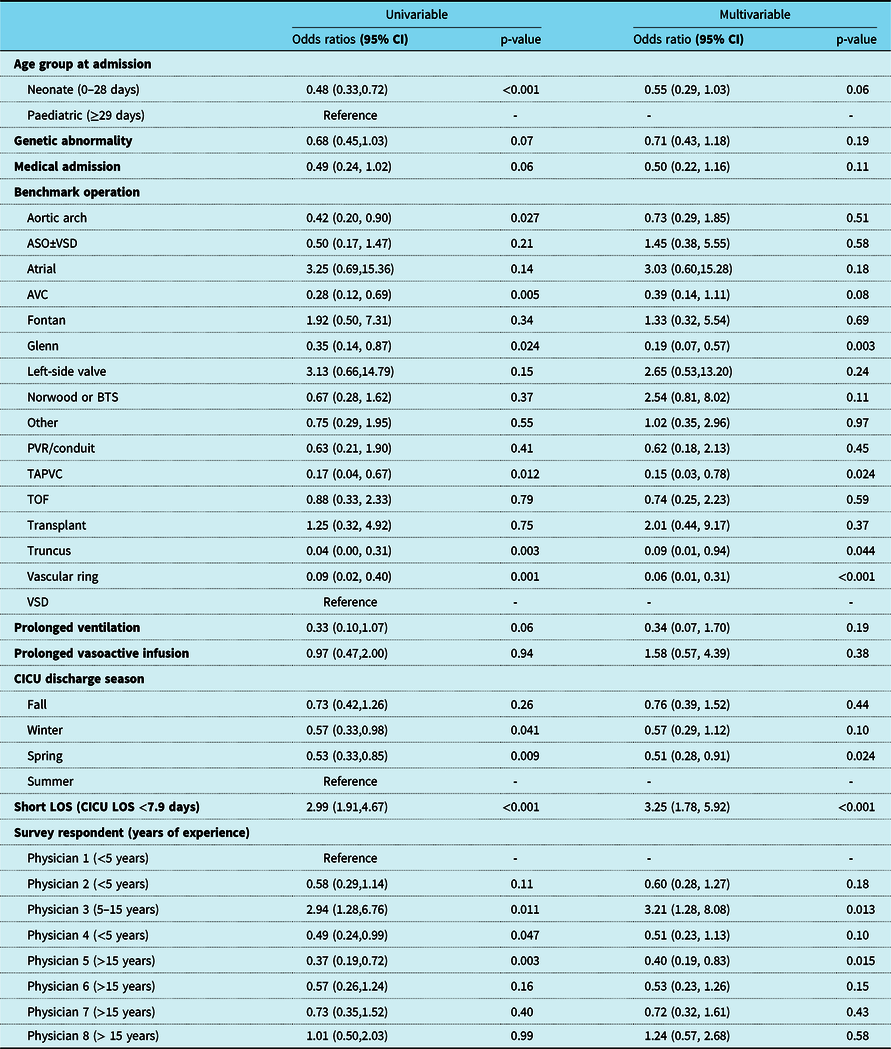
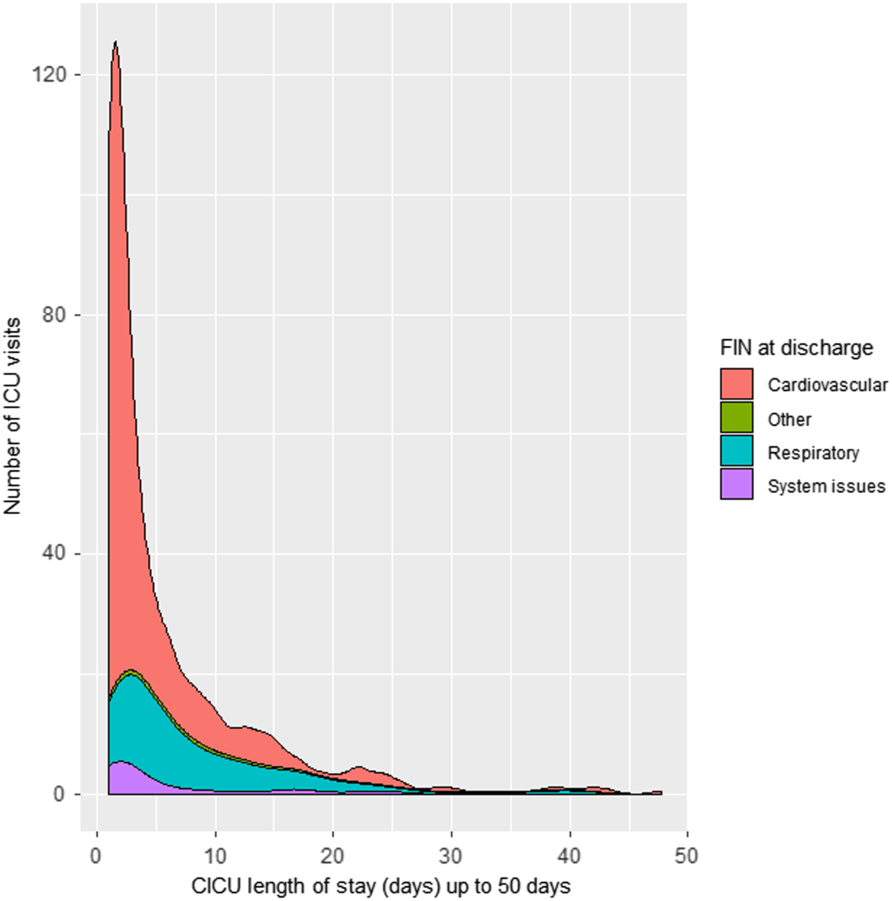
Model fitting was limited to the subset of 580 encounters (488 unique patients) with “Cardiovascular” or “Respiratory” Final ICU Needs due to the low number of encounters in the remaining Final ICU Need categories. The following results pertain to the multivariable model in Table 2, where odds ratio is interpreted as the odds of “Cardiovascular” Final ICU Need relative to that of the reference category, after adjusting for other variables in the model. The odds of “Cardiovascular” Final ICU Need were lower relative to the ventricular septal defect benchmark operation for Glenn palliation (odds ratio: 0.19; 95%CI 0.07, 0.57; p = 0.003), total anomalous pulmonary venous connection repair (odds ratio: 0.15; 95%CI: 0.03, 0.78, p = 0.024), truncus arteriosus repair (odds ratio: 0.09; 95%CI: 0.01, 0.94; p = 0.044), and vascular ring repair (odds ratio: 0.06; 95%CI: 0.01, 0.31; p < 0.001). Spring season was also associated with a lower “Cardiovascular” Final ICU Need (odds ratio: 0.51; 95%CI: 0.28, 0.91; p = 0.024) relative to summer. There were statistically significant differences among the physician respondents. Finally, encounters with a short length of stay (<7.9 days) were over three times more likely to have a “Cardiovascular” Final ICU Need than patients with a length of stay ≥7.9 days (odds ratio: 3.25; 95%CI: 1.78, 5.92; p < 0.001). This is also demonstrated visually in a kernel density plot (Fig 2).
Odds of final ICU need at discharge being cardiovascular

ASO = arterial switch operation; AVC = atrioventricular Canal; BTS = Blalock-Taussig Shunt; CI = confidence interval; CICU = Cardiac ICU; LOS = length of stay; OR = odds ratio; PVR = pulmonary valve replacement; TAPVC = total anomalous pulmonary venous connection; TOF = Tetralogy of Fallot; Truncus = truncus arteriosus; VSD = ventricular septal defect.
Stacked kernel density plot for Final ICU Need by Cardiac ICU length of stay (days).

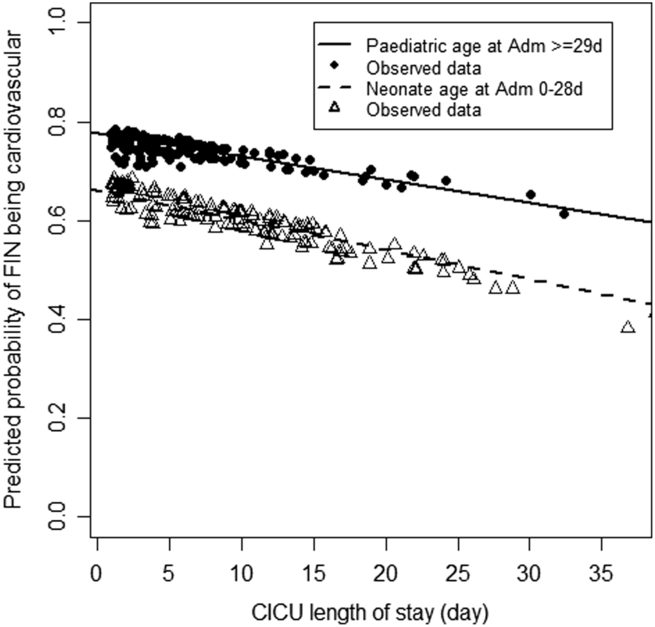
We assessed the interaction between age group and length of stay and found that it was not statistically significant. Thus, as length of stay increased, the odds of “Cardiovascular” Final ICU Need decreased at a similar rate for both neonates and children (odds ratio: 0.99; 95%CI: 0.95, 1.03; p = 0.71; Fig 3). The odds of “Cardiovascular” Final ICU Need for paediatric and neonatal groups was also not significantly different at the average value of length of stay (odds ratio: 0.60; 95%CI: 0.35, 1.03; p = 0.06), nor was the odds of “Cardiovascular” associated with length of stay among the reference children (odds ratio: 0.98; 95%CI: 0.96, 1.00; p = 0.07).
Interaction plot indicating the relationship between age and length of stay in predicting “Cardiovascular” Final ICU Need versus ‘Respiratory’ Final ICU Need.

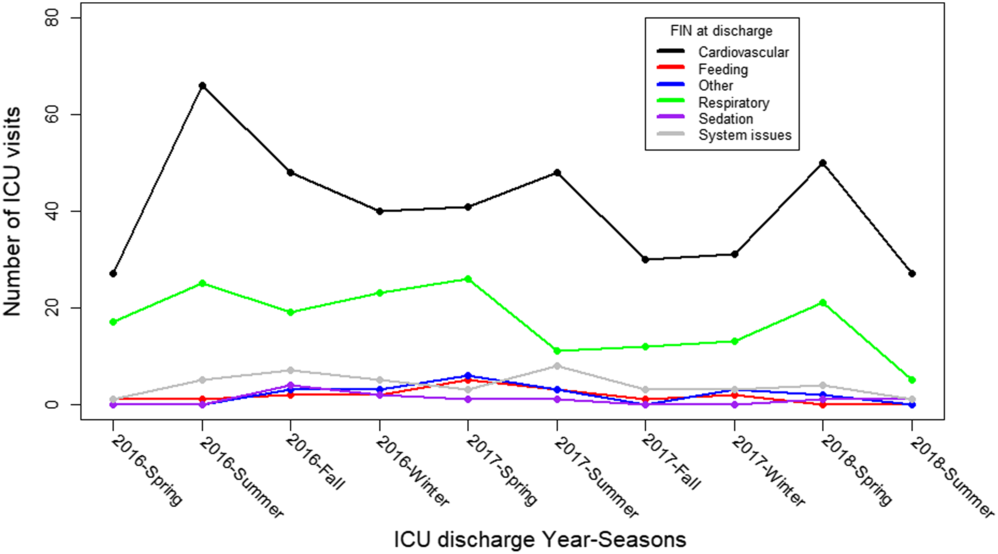
Frequency of Final ICU Need over season at time of Cardiac ICU discharge demonstrates the number of “Cardiovascular” Final ICU Need peaks annually in the summer (Fig 4).
Final ICU Need by season.

The association between Final ICU Need and reason for Cardiac ICU readmission within 72 hours was summarised in 24 eligible readmissions (n = 22 patients) (Table 3). The most common Final ICU Need prior to readmission was “Cardiovascular” (14 readmissions, 58%). The most common reason to be readmitted was respiratory symptoms (14 readmissions, 58%). Distribution of the 24 readmissions across demographic variables was summarised in Supplemental Table 1. The odds of readmission within 72 hours was significantly higher among patients discharged with “Cardiovascular” Final ICU Need than those with any other Final ICU Need (odds ratio: 1.42; 95%CI 1.41, 1.43; p < 0.001).
ICU diagnosis at time of unplanned readmission compared to final ICU need at time of discharge

FIN=Final ICU need.
A total of 81 patients were readmitted to the Cardiac ICU at any time during a hospitalisation, and of those patients, 6 died. Death was significantly associated with age group, with six deaths among neonates and none among children (p < 0.001). There was no association between Final ICU Need at initial discharge [“Cardiovascular” (n = 3) versus any other Final ICU Need (n = 3)] and mortality (p = 0.37).
Discussion
We used a survey to determine the attending physician’s perception of the last reason a patient required Cardiac ICU care and analysed the influence of patient and provider characteristics on the Final ICU Need. Our findings suggest that Final ICU Need is influenced by benchmark operation, length of stay, provider, and season. Final ICU Need as a surrogate for care process delivery and physiology in the final segment of a patient’s ICU stay may be valuable: as a quality improvement metric and research variable, in determining efficient resource allocation, in calibrating provider and family expectations, and in understanding provider mental models.
As expected, “Cardiovascular” Final ICU Need was the most commonly selected category for the majority of benchmark operations, medical admissions, and patients with a Cardiac ICU length of stay of <7.9 days. However, “Respiratory” Final ICU Need was more likely for patients who underwent Glenn palliation and repair of total anomalous pulmonary venous connection, truncus arteriosus, and vascular ring. Respiratory complications and residual respiratory disease have been previously reported for each of these lesions.Reference Baker-Smith, Goldberg and Rosenthal16-Reference Martin, Ross and Alton22 Importantly, unlike atrioventricular canal repair, these operations maintained a “Respiratory” Final ICU Need even after adjusting for genetic abnormalities. We also demonstrated that younger age and longer length of stay trend toward “Respiratory” Final ICU Need. Prior authors have described that neonates with CHD are more likely to have prolonged intubationReference Marwali, Budiwardhana and Sastroasmoro23-Reference Tabib, Abrishami and Mahdavi25 or use of non-invasive positive pressure ventilation following extubation.Reference Romans, Schwartz and Costello26-Reference Gandhi, Mishra and Thosani28 Also, duration of ventilation directly impacts length of stay, as early extubation is associated with shorter length of stay.Reference Harris, Holowachuk and Pitfield29,Reference Alghamdi, Singh and Hamilton30 Spring was also significantly associated with “Respiratory” Final ICU Need, which likely is influenced by the prevalence of respiratory illnesses persisting into the end of April in our region.
Final ICU Need as a quality improvement metric and research variable
Final ICU Need may help facilitate selecting a cohort, based on age, lesion, provider, or season, which would benefit most from an intervention related to each Final ICU Need category. Additionally, Final ICU Need tracked over time may provide insight related to the influence that new or ongoing quality improvement or research interventions have on the final physiology of a Cardiac ICU patient. Final ICU Need may also be a useful variable to improve the discrimination and calibration of length of stay prediction models.
Often unplanned readmissions are attributed to being “rushed out of the unit”; however, we found that the final ICU need was not associated with the reason for returning to the ICU. Although “Cardiovascular” Final ICU Need was significantly associated with readmission, we found that respiratory issues were the most common reason for unplanned readmission. Similarly, recent data demonstrate that unplanned Cardiac ICU readmission is most often caused by respiratory issues.Reference Smith, Anand and Banerjee10 The discrepancy between Final ICU Need and reason for unplanned readmission may be described by the interplay of cardiorespiratory issues in children with CHD, with common reasons for “Respiratory” readmission being hypoxia, respiratory distress, and pleural effusion. To better understand this discrepancy, further investigation is required in a larger cohort.
Final ICU Need for resource allocation
In regards to decreasing length of stay, the Final ICU Need has identified patients with a prolonged Cardiac ICU stay that may be most amenable to earlier transfer to a lower acuity setting. For example, we have identified a cohort of patients based upon benchmark operation, age, and length of stay who achieve haemodynamic stability but continue to require non-invasive respiratory support. These patients could be considered for transfer from the high-acuity Cardiac ICU to a lower acuity unit where respiratory support such as non-invasive positive pressure ventilation or high flow nasal cannula is provided.
Final ICU Need to calibrate provider and family expectations
Providing trajectory and benchmarking data to providers has been found to be independently associated with decreased length of stay and ventilator days.Reference Burns, Yee and Flett31,Reference Schilsky, Michels and Kearbey32 Knowing Final ICU Need for a given cohort from the time of admission may improve a provider’s ability to anticipate the course and strategically deliver therapies that might alter the final physiology requiring Cardiac ICU level care. For example, knowing that a neonate admitted following truncus repair has a higher odds of having a “Respiratory” Final ICU Need may guide a provider to focus earlier upon respiratory needs: directing sedative and diuretic use to maximise timing of extubation, anticipating the need of non-invasive respiratory support after extubation, and managing provider and family expectations regarding the typical post-operative course. The Final ICU Need may also help parents cope by providing information regarding expected trajectories. For example, parental understanding that respiratory support may be anticipated beyond the point of achieving cardiovascular stability may reduce anxiety and calibrate expectations. Future work will also involve further investigation of the impact of Final ICU Need transparency on outcomes.
Final ICU Need and provider mental models
The Final ICU Need is also a novel way of demonstrating variability in providers’ mental models regarding the type of physiology requiring critical care during the final portion of the Cardiac ICU stay. We found that Final ICU Need varied significantly by attending physician even after adjusting for eight patient covariates. Provider variability in perceived need could also contribute to variability in the type of care delivered, including the focus of the family and team. By using the Final ICU Need from the beginning of hospitalisation as a guide to an expected trajectory, providers, staff, and family may be more likely to detect deviations in either clinical course or thought processes. Decreasing practice variation may thereby be achieved by demonstrating differences in mental models across a group of providers. Future work involves investigating how each provider’s choice of Final ICU Need, including the addition of nurses and trainees as respondents, influences patient outcomes such as length of stay and resource utilisation.
Limitations
Our findings are subject to the inherent limitations of a single-centre survey-based study, which include lack of generalisability and respondent bias. Our findings might differ significantly from others as our institution currently does not have a step-down unit, so patients transfer directly from the Cardiac ICU to a cardiac surgical paediatric floor. Also, a small subset of patients managed preoperatively in the Newborn ICU will often transfer back to the Newborn ICU after a period of post-operative stabilisation in the Cardiac ICU. Rarely are patients discharged directly home from our Cardiac ICU. Furthermore, our median Cardiac ICU length of stay is 2 days, which may differ from other units and could influence Final ICU Need. Respondent bias was minimised by training Cardiac ICU attending physicians on the definitions of Final ICU Needs; however, each patient was only categorised by a single respondent, and chart abstraction for objective evidence to support the Final ICU Need was not done. Recall bias could also have influenced Final ICU Need selection; however, this effect was likely minimised by the timely completion of surveys. Validation of the Final ICU Need metric was not attempted with this study, as we felt provider-specific variation was an important point of measurement within our institution. However, for future use at other institutions, validation would be an important step. Exclusion of encounters with more than one Final ICU Need potentially removed some of the more medically complex patients from analysis from the period of time multiple Final ICU Needs were allowed. We recognise that Final ICU Need categories will often overlap in patients, especially “Cardiovascular” and “Respiratory” issues following cardiac surgery. However, Final ICU Need categories were clearly defined in an attempt to best isolate the last issue requiring ICU care, not necessarily the overarching diagnosis. Additionally, our regression analysis did not account for all variables that would influence Final ICU Need choice, and further investigation into the impact of complications on Final ICU Need is warranted. Finally, sample size across some benchmark operations was small as well as across all Final ICU Needs except for “Cardiovascular” and “Respiratory” which limited our analysis.
Conclusions
We describe the use of Final ICU Need as a feasible and novel metric to determine the final reason a patient requires Cardiac ICU care. The Final ICU Need metric has potential application in improving resource utilisation, decreasing length of stay, and enhancing provider, staff, and family expectations, including the ability to demonstrate provider differences in mental models. Final ICU Need is a metric that can be used to target quality improvement and research initiatives, to identify cohorts for and understand the physiologic impact of initiatives on the final Cardiac ICU physiology of a patient, and to provide benchmarking measures and areas for improvement within our institution.
Acknowledgements
None.
Financial support
This investigation was supported by the University of Utah Population Health Research (PHR) Foundation, with funding in part from the National Center for Research Resources and the National Center for Advancing Translational Sciences, National Institutes of Health, through Grant 5UL1TR001067-05 (formerly 8UL1TR000105 and UL1RR025764).
Conflicts of interest
None.
Ethical standards
The authors assert that all procedures contributing to this work comply with the ethical standards of the relevant national guidelines on human experimentation and with the Helsinki Declaration of 1975, as revised in 2008, and has been approved by the University of Utah and Primary Children’s institutional review boards.
Supplementary material
To view supplementary material for this article, please visit https://doi.org/10.1017/S104795112000164X