1. Introduction
India's geographical and climatic conditions make India's coastal states vulnerable to cyclonic disturbances, causing loss of human lives and devastating physical infrastructure. The economic losses due to cyclones account for about 16 per cent of total economic losses caused by all natural disasters, and it is the second costliest category of disaster in India after the floods (Parida et al., Reference Parida, Roy Chowdhury, Saini and Dash2022).
Around six thousand km long, the Indian coastline of India's mainland consists of 96 districts affected by cyclones. The Arabian Sea and the Bay of Bengal annually generate five to six cyclones (Mohapatra, Reference Mohapatra2015). Between 1952 and 2020, 135 cyclones made landfall on India's eastern and western coasts, of which 82 were severe cyclonic storms.Footnote 1 The western coast experienced 14 cyclones, while 121 cyclones crossed the east coast. In this period, cyclones claimed about 52 thousand human lives, affected 140 million people, and caused economic losses of around US$36,400 million (based on the Emergency Events Database (EM-DAT)Footnote 2). The frequent occurrence of cyclones in India has negatively impacted the GDP growth of affected districts (Naguib et al., Reference Naguib, Pelli, Poirier and Tschopp2022).
The economic losses due to the cyclone have increased over time, from US$2,990 million in 1999 to US$14,920 million in 2020. The cumulative economic losses from the cyclones are estimated at around 1.26 per cent of India's GDP (Parida et al., Reference Parida, Roy Chowdhury and Bhardwaj2020). With the frequency and intensity of cyclones going up with climate change, the worldwide economic damages due to tropical cyclones (TCs) are expected to increase substantially (Mendelsohn et al., Reference Mendelsohn, Emanuel, Chonabayashi and Bakkensen2012), which is likely to occur also in India.
There have been several studies on the adverse effect of cyclones on an economy or how particular sectors of an economy, e.g., manufacturing, are impacted. Also, there is broader literature on the economic consequences of climate change. Some of the studies that have dealt with the impact of cyclones on economies or with the economic consequences of climate change include Carleton and Hsiang (Reference Carleton and Hsiang2016), Lenzen et al. (Reference Lenzen, Malik, Kenway, Daniels, Lam and Geschke2018), Elliott et al. (Reference Elliott, Liu, Strobl and Tong2019), Krichene et al. (Reference Krichene, Geiger, Frieler, Willner, Sauer and Otto2021), Kunze (Reference Kunze2021), Naguib et al. (Reference Naguib, Pelli, Poirier and Tschopp2022), Barattieria et al. (Reference Barattieria, Borda, Brugnoli, Pelli and Tschopp2023), and Krichene et al. (Reference Krichene, Vogt, Piontek, Geiger, Schötz and Otto2023).
This paper is concerned with the impact of cyclones (or, more precisely, tropical cyclones) on the sales and assets of Indian manufacturing firms. We also study the effect of cyclones on the risk of business failure among industrial plants. A study of the impact of cyclones on Indian manufacturing assumes significance because manufacturing plays a pivotal role in the Indian economy. Many manufacturing plants are in coastal states, thus, vulnerable to cyclones.
There have been only a few studies on the impact of TCs on manufacturing firms/establishments in emerging economies. Elliott et al. (Reference Elliott, Liu, Strobl and Tong2019) have studied the impact of TCs on Chinese manufacturing plants using a panel dataset. The estimated model allows for the contemporary and lagged impact of typhoons. They find a significant negative effect on plants' sales. The current year's typhoons have a significant effect, but previous years' typhoons do not have a significant effect. Juárez-Torres and Puigvert (Reference Juárez-Torres and Puigvert2021) have analyzed how municipal-level exposure to TCs impacts establishment-level economic activity in Mexico. They find that after a TC, an average manufacturing establishment experiences a short-term, small negative effect on production growth.
Pelli et al. (Reference Pelli, Tschopp, Bezmaternykh and Eklou2023) have analyzed the impact of cyclones on Indian manufacturing firms, using company-level data on about six thousand manufacturing firms from 1995 to 2006. They have identified the location of the establishments belonging to the firms and have computed for each year a firm-specific measure that accounts for the maximum wind exposure at the headquarters and the establishments using storms' best track data from the National Oceanic and Atmospheric Administration. The estimated econometric models allow for several controls, including a set of firm-type fixed effects, postal code fixed effects, yearly growth of district nightlights, and district trends. Based on their analysis, they estimate that cyclonic storms destroy, on average, about 2.2 per cent of a firm's fixed assets and cause about a 3.1 per cent decrease in sales.
Since the study by Pelli et al. (Reference Pelli, Tschopp, Bezmaternykh and Eklou2023) is on the same theme as that of the present study, and since they have used the same database (the Prowess database, discussed later) as we have, a methodological limitation of the study by Pelli and associates (Reference Pelli, Tschopp, Bezmaternykh and Eklou2023) may be briefly discussed here to provide the rationale for the present study and the reasoning for the empirical approach taken. The limitation is that the index of firm exposure to high-speed winds used by Pelli and associates (Reference Pelli, Tschopp, Bezmaternykh and Eklou2023, Annex A.6) is not able to capture the likely difference in the impact of a cyclone on a firm owning a single plant vis-à-vis a multi-plant firm having only one of its plants in the area (postal code) affected by the cyclone.Footnote 3 In our opinion, this methodological issue is not resolved by introducing fixed effects representing a firm-wise count of plants in the econometric models because the slope of the regression line in respect of the firm exposure variable is likely to be steeper for a single-establishment firm than for a multi-establishment firm.
The key points made in this paper and some important empirical findings are as follows: We raise an econometric issue regarding the estimation of the effect of cyclones on industrial enterprises based on firm-level data rather than plant-level (establishment-level) data. We propose and implement a dummy-variable-based approach to estimating the impact of cyclones. Our estimates indicate that cyclones cause a dip in sales and total assets of manufacturing companies in India, and the effect is substantially less for firms with a high trade-technology orientation. We find that cyclones elevate the risk of business failure among industrial plants, more so among relatively small-sized plants, which increases substantially with repeated cyclones.
Our contributions to the literature on the impact of TCs on industrial firms are as follows: (i) highlighting a measurement issue in assessing the effect of TCs based on firm-level data rather than plant-level data, (ii) presenting evidence that indicates that the firms with a high trade-technology orientation are less affected by TCs, and (iii) analyzing the impact of cyclones on the risk of business failure among industrial plants, which is an under-researched area and no study on this topic has been undertaken for India.
The rest of the paper is organized as follows. The next section, section 2, discusses some theoretical aspects of the impact of cyclones. Section 3 deals with the core aspects of the empirical methodology, specifying the period and the cyclones considered, and going into the question of measurement of the impact of cyclones on firms. Sections 4 and 5 describe the data sources used, and the econometric models/ methodology adopted. The former deals with the cyclones' impact on firms' sales and total assets, and the latter deals with the effect on the survival probability of industrial plants. The results of the econometric analyses corresponding to sections 4 and 5 are presented in sections 6–7 and 8, respectively. Finally, section 9 summarizes and concludes.
2. Theoretical aspects of the impact of TCs on industrial firms
There is a sizable amount of literature on the economics of natural disasters, covering theoretical aspects and methods of measurement and analysis (see Okuyama, Reference Okuyama2003; Benson and Clay, Reference Benson and Clay2004; Cavallo and Noy, Reference Cavallo and Noy2010; Hallegatte and Przyluski, Reference Hallegatte and Przyluski2010; Cavallo et al., Reference Cavallo, Cavallo and Rigobon2013; Botzen et al., Reference Botzen, Deschenes and Sanders2019; Coronese and Luzzati, Reference Coronese and Luzzati2022; among others). While some studies consider the impact of natural disasters on the macro-economy, a major segment of this literature is on how firms are impacted by natural disasters and how the firms respond to them, including issues related to the role played by entrepreneurship (Monllor and Murphy, Reference Monllor and Murphy2017) and odds of firm survival after being affected by natural disasters (Brucal and Mathews, Reference Brucal and Mathews2021; Chang et al., Reference Chang, Brown, Handmer, Helgeson, Kajitani, Keating, Noy, Watson, Derakhshan, Kim and Roa-Henriquez2022). This latter segment of the literature is relevant to the present analysis.
Based on the literature, it is helpful to distinguish between the direct effect and the indirect effect of a TC. Similarly, a distinction may be made between the short-term impact of a TC and the longer-term impact.
The direct effect of a TC is the damage it does to assets – structure, equipment, and inventory.Footnote 4 TCs lead to heavy rainfall, gale winds, and storm surge (India Meteorological Department, 2013), causing damages to firms' assets. The impact of high-speed winds may be treated as exogenous (Pelli et al., Reference Pelli, Tschopp, Bezmaternykh and Eklou2023), whereas the effects of floods and surges are conditional on the decision taken by firms' management regarding the precise location of their establishment(s). Through land management, it may be possible to prevent or lessen the damage caused by floods and surges associated with TCs.
The indirect effects of TCs on a firm's production and sales occur through four channels. First, the damage to assets reduces the quantity of the firm's possible output. Second, the firm has to divert its resources, including managerial resources, to the restoration of its capital stock and production capacity, and therefore, during the rebuilding of capital assets, production and sales suffer. Third, even if the structure and equipment of a specific industrial unit are not affected by a TC, the infrastructure available to the industrial unit, such as power supply from the grid and road connectivity, might be seriously hit by the TC, leading to disruption in production. Fourth, a firm may get affected by a TC because of inter-firm linkages. The sales of the firm may go down because (a) the local input supplier has been affected by the TC and is not able to maintain the supplies, or (b) the local buyer firm has been affected by the TC and has reduced the purchases made from the firm in question.Footnote 5 Considering the third and fourth channels of indirect effect, it seems that the average percentage fall in annual sales observed among a set of firms in an area affected by a TC will be higher than the average percentage fall in the year-ending capital stock of the firms.
While the sales of a firm that is affected by a cyclone are likely to fall during the year, this need not happen to the year-ending capital stock. A study on the effect of cyclones on firms in Vietnam shows that while cyclones caused a fall in sales, there was an increase in investment (Vu and Noy, Reference Vu and Noy2016). Therefore, the year-ending capital stock of an industrial firm need not fall even if some of its establishments were affected by a cyclone during the year and some of its fixed assets got damaged/destroyed.
The literature mentioned above tells us that natural disasters often lead to the rebuilding of capital stock with more productive fixed assets (see Hallegatte and Dumas (Reference Hallegatte and Dumas2009), among others). If the new capital assets acquired by a firm are far superior technologically to the assets destroyed due to a TC, the longer-term effect on sales need not be harmful – it could be positive (see Hallegatte and Przyluski, Reference Hallegatte and Przyluski2010). At the industry level, there is a possibility that less productive firms close down due to TCs (discussed below), and new firms are set up with capital assets embodying the most up-to-date technology with the consequence that the aggregate sales of the industry go up in the longer run rather than going down. This phenomenon of creative destruction associated with natural disasters has attracted several empirical studies. Zhou and Zhang (Reference Zhou and Zhang2021) and Cheng et al. (Reference Cheng, Lin and Qiu2022) have studied creative destruction in the context of TCs.
To a certain extent, a firm could contain the impact of TCs by taking out insurance and/ or diversifying, i.e., having production facilities located in different regions. If TCs occur frequently in an area, the firms in such a region would prepare themselves for such events (Chang et al., Reference Chang, Brown, Handmer, Helgeson, Kajitani, Keating, Noy, Watson, Derakhshan, Kim and Roa-Henriquez2022). One preventive option is to acquire advanced technology, as it would help the firm to better withstand the impact of natural disasters, including TCs (Crespo-Cuaresma et al., Reference Crespo-Cuaresma, Hlouskova and Obersteiner2008). Bigger firms with multiple establishments will likely have the advantages of insurance, regional diversification, and advanced technology. Thus, they would be in a better position to contain the effect of TCs than small firms with a single establishment.
A firm deeply embedded in international global value chains (GVCs) must restore production lines quickly to maintain the production activity in the value chain. Hence, it is reasonable to expect that firms engaged in GVCs will take preventive actions (appropriate location decisions, quality of structures, stockpiling of its produce) and remedial actions (quick restoration of lost production capacity and restarting production activity); hence, they would therefore be less affected by cyclones.
In the general case of an industrial firm, implementing preventive and remedial measures to contain the adverse effects of TCs will hinge on the quality of the firm's managerial human resources. Since it is difficult to measure the quality of the management workforce, the technological orientation of the firm may be taken as a proxy. In empirical studies, a higher level of technology orientation is expected to be associated with a relatively lower impact of TCs on the firm because high technology orientation is often associated with superior entrepreneurial capabilities and because a technologically advanced firm has advantages in securing its market even in the face of TCs (following the findings of Crespo-Cuaresma et al. (Reference Crespo-Cuaresma, Hlouskova and Obersteiner2008)). It may be argued that a firm with a high level of technology can create niche markets for itself. Even if there is a temporary disruption in production, the buyers would prefer to wait for supply rather than shift to an alternative supplier. Thus, the loss of sales due to a cyclone will likely be lower for a technologically advanced industrial firm.
Whether the impact of TCs is relatively low for a firm that has a high trade-technology orientation, for the reasons given above, is one of the key research questions addressed in this paper. We measure trade-technology orientation by considering the expenditure on R&D, technology imports, use of imported materials (which may embody more advanced technology) in production, and capital goods imports. We hypothesize that a more trade and technology-oriented firm will show a lower adverse effect of cyclones on its sales. Arguably, firms with relatively better managerial manpower will counter the adverse effect of cyclones on their financial performance by taking various steps. Thus, the year-ending capital stock may not fall or may fall only marginally. Additionally, such management may increase the production level within a couple of weeks or months from the time of the cyclone to make up for the lost business and/ or switch sales to alternate buyers elsewhere in the country in case the local enterprises which they were serving have been affected by the cyclone.
Let us now turn to the impact of a natural disaster such as a TC on the risk of business failures. Since a cyclone leads to a fall in revenue, it may lead to a severe cash balance problem for the affected firms (unable to meet their fixed costs, including interest payment for the outstanding loans), eventually causing some firms to go out of business. This adverse impact of TCs on the survival probabilities of business firms is likely to be greater for small-sized firms. The reason is that small businesses experience greater difficulty in recovering after a natural disaster (Chang et al., Reference Chang, Brown, Handmer, Helgeson, Kajitani, Keating, Noy, Watson, Derakhshan, Kim and Roa-Henriquez2022). This vulnerability of small firms vis-à-vis large firms is traceable to their inability to mobilize resources for rebuilding the assets destroyed and incurring other expenditures needed to bring back the business to the level prevailing before the natural disaster. Small businesses have a relatively more significant presence of young entrepreneurs and female entrepreneurs (Chang et al., Reference Chang, Brown, Handmer, Helgeson, Kajitani, Keating, Noy, Watson, Derakhshan, Kim and Roa-Henriquez2022). Such entrepreneurs are generally less able to mobilize resources for restoration following a natural disaster, e.g., a TC.
3. Core aspects of the study methodology
3.1 Study period and the cyclones covered in the study
The study period for analyzing the impact of cyclones on the sales and assets of Indian manufacturing firms is April 2008 to March 2009 (hereafter written as 2008) to 2019–20 (2019). Data for the years 2013–14 to 2020–21 are used to analyze the impact of cyclones on the survival probability of manufacturing plants. Twenty-three cyclones that occurred during 2008–2019 are included in the study. Details are provided in online appendix A1.
Over the last two decades, there has been an upward trend in India's landfalling (tropical) cyclones. During 2002–2007, there were six landfalling cyclones in India; during 2018–2022, the corresponding number was 17. Analyzing the districts impacted by the 23 cyclones that occurred from 2008 to 2019 that were selected for the study, we find that the districts repeatedly affected are concentrated in the eastern coastal states of India, mainly Andhra Pradesh, Odisha, and Tamil Nadu. However, a shift is underway towards an increasing number of cyclones on the west coast (Deshpande et al., Reference Deshpande, Singh, Ganadhi, Roxy, Emmanue and Kumar2021), which might be connected with climate change.
3.2 Incorporating wind speed as an explanatory variable in the econometric model
If an analysis of the impact of cyclones is undertaken at the establishment level as, for instance, in Elliott et al. (Reference Elliott, Liu, Strobl and Tong2019) and Juárez-Torres and Puigvert (Reference Juárez-Torres and Puigvert2021), then there is a one-to-one correspondence between wind speed and the establishment-level performance variable. Hence, the wind speed variable or a measure of firm exposure to high-speed wind based on wind speed data may be included as an explanatory variable in the econometric models estimated. However, problems arise when one uses data at the firm level, and the firms have multiple establishments located in different parts of the country. The one-to-one correspondence between wind speed and the outcome (performance) variable does not hold. If a firm has n establishments, taking an average wind speed at the n establishments as an explanatory variable in the econometric model is not correct. Forming a measure of exposure to high-speed wind at each of the different establishments and then aggregating these measures at the firm level by simple summation is also problematic.
We address the above estimation issue in two ways. First, we confine our analysis to firms with at most three plants or establishments (see online appendix A2 which explains in detail the rationale for this choice). By restricting the analysis to firms with three or fewer plants, we ensure greater homogeneity in the sample of firms included in the study. Second, for most of the analysis presented in the paper, we capture, for each year, the effect of cyclones by using a dummy variable, C, which represents whether a firm has a plant that was exposed to a cyclone. For each cyclone included in the study, we identify the districts that have been affected and the firms that have one or more plants in those districts. We have collected data on districts affected by different cyclones from diverse sources. These include various annual reports titled Disastrous Weather Events, compiled by the India Meteorological Department, Pune, Government of India. In addition, the Government of Andhra Pradesh provides information on the districts affected by various cyclones (https://apsdma.ap.gov.in/history_of_storms.php). The Government of Odisha also provides information on the estimates of the extent of damage caused by cyclones in different districts (available in various Memorandum on the Very Severe Cyclonic Storm, Government of Odisha). This compiled information helps identify the districts affected. We have also considered the newspaper and media reports on the cyclones in India as additional sources of information. For constructing the aforementioned dummy variable (C) for our econometric analysis, we consider only the districts affected by cyclones and leave out the districts partially affected.
The dummy variable C is constructed at the firm level. The value of this dummy variable for firm i in year t (denoted by ${C_{it}}$ ) is one if any of the firm's plants are located in a district that was affected by a tropical cyclone in year t. The variable is assigned the value of zero otherwise. Although this measure is crude, it has the advantage of simplicity and also has precedence.Footnote 6
Our approach based on a dummy variable for cyclones is a major deviation from the previous studies on the effect of cyclones on firms, which have commonly used wind speed data. Since the econometric estimates based on our approach need verification, we have made alternate estimates based on wind speed.
The International Best Track Archive for Climate Stewardship (IBTrACS) data have commonly been used to measure wind speed to undertake studies on the impact of TCs. We have used a different dataset, namely ERA5, for our analysis based on wind speed data, on several considerations. To our knowledge, this is the first study in which a reanalysis dataset for meteorological variables (ERA5) has been used to study the impact of TCs on the performance of industrial firms.
For constructing the explanatory variable representing TCs, we take the surface wind component at a 10-meter elevation. The analysis is done only for the single-plant firms so that a district is identified for each firm/plant. The maximum wind speed during a cyclone is computed for different districts of the country. If there were two cyclones in a year, the maximum wind speed for the two cyclones is compared for each district, and the higher of the two figures is taken (similar treatment for three cyclones in a year).
The ERA5 dataset has the advantage of having a high spatial (up to 0.25 degrees) and temporal (hourly) resolution, ensuring detailed regional and local wind speed variations. It provides information at various vertical levels, enabling a comprehensive analysis of the vertical profile of wind speed. Its reanalysis nature leads to a more consistent and homogeneous dataset compared to IBTrACS, which relies on best-track information and may have coarser resolutions, especially in data-sparse regions.
A disadvantage in using ERA5 data is that it tends to understate/under-represent the intensity of the TCs (Xiong et al., Reference Xiong, Yu, Fu, Dong and Liu2022; Dulac et al., Reference Dulac, Cattiaux, Chauvin, Bourdin and Fromang2024). To address this issue, the equation for computing firm exposure to wind which we adopt is a modified version of that in Pelli et al. (Reference Pelli, Tschopp, Bezmaternykh and Eklou2023). It may be written as

In this equation, ${w_{dh}}$ is the (maximum) wind speed for cyclone h in district d. ${w^{\textrm{max}}}$
 is the maximum wind speed observed in the entire sample (all cyclones and districts). If there were two cyclones in a year, the values of ${x_{dh}}$
 are computed for the two cyclones, and the higher of the two figures is taken (similar treatment for three cyclones).
The value of $\phi$ is not specified but allowed to be determined by the data. Define ${w^{Q3}}$
 as the third quartile of wind speed observed in the entire sample. The lower limit of $\phi$
 is taken as ${w^{Q3}}$
 . Then, various integer values of $\phi$
 (in meters per second) higher than ${w^{Q3}}$
 are taken as possible alternative values of $\phi$
 , and the econometric models explaining real sales and real capital stock are estimated for each of the values of $\phi$
 . The value of $\phi$
 for which the results for the firm exposure to wind variable is found to be the best in terms of statistical significance (the t-value of the estimated coefficient is the highest) has been finally chosen as the right estimate of $\phi$
 .
4. Data and methodology: analysis of the TC impact on firm performance
4.1 Data sources
The basic data source for the analysis of the impact of cyclones on the sales and total assets of manufacturing firms is the Prowess database of the Centre for Monitoring Indian Economy, Mumbai, India, combined with data on cyclones and wind speed explained above. Our analysis is confined to manufacturing firms, covering 2008 to 2019.
Prowess is an extensive database on the financial performance of companies. It includes listed companies, unlisted public companies, and private companies of different sizes and ownership groups. The data are procured from the companies' audited annual reports and financial statements. This data source has been widely used for research on Indian manufacturing firms.
Manufacturing firms covered in the Prowess database account for about 60–70 per cent of the economic activity of organized manufacturing in India and most of the capital stock of organized manufacturing. This makes an analysis based on Prowess useful for understanding how cyclones impact Indian manufacturing (see online appendix A2). As stated above, we consider only firms with a single establishment (i.e., a plant) or, at most, three establishments.
Prowess provides information (latest) on the district location of plants belonging to manufacturing companies. Using the information on the districts affected by the cyclones and the district location of the establishments of companies, we have constructed the previously mentioned dummy variable representing the incidence of cyclones, which is subsequently used for the econometric analysis. One econometric model is estimated to explain real sales, and another model is estimated to explain the real value of total assets. In the estimated econometric models, the choice of model specification is mainly driven by the consideration of parsimony. Thus, only a few fixed effects have been considered and included.
For one component of the analysis in section 6, the firm-exposure-to-wind variable based on wind speed associated with cyclones is used instead of the dummy variable for cyclones. The purpose of this analysis is to ascertain if the key findings of the analysis based on the cyclone dummy are borne out by the econometric results based on wind speed data.
4.2 Key variables and the specification of econometric models
4.2.1 Real sales and real value of total assets
The key (performance) variables are real sales and the real value of total assets in manufacturing companies. Sales have been deflated by the wholesale price index (price index for the relevant two-digit industry category is used), and the value of total assets has been deflated by the implicit deflator for gross capital formation in manufacturing derived from National Accounts Statistics maintained by the National Statistical Office, Ministry of Statistics and Programme Implementation, Government of India.Footnote 7
The mean values of the two performance variables and standard deviation in different categories of firms are shown in table A2 in online appendix A2. The table shows that the firms not considered for the study are over ten times bigger than the ones included in the study in terms of sales and total assets. Thus, the sample of firms chosen for the study may be considered more vulnerable to the impact of cyclones (refer to section 2).
4.2.2 Model specification
To analyze the impact of cyclones on real sales and the real value of total assets of manufacturing firms, two different specifications of the econometric model have been used. The model estimated for the econometric analysis of real sales, in terms of its core elements, may be written as

In this equation, S denotes the real (i.e., deflated) value of sales. The subscript i is for firm, and subscript t is for time (year). The variable C is a dummy variable to represent the incidence of cyclones (explained earlier). ${C_{it}}$ takes the value of one if the plant (or one of the plants) of firm i is in a district that was affected by a cyclone (or cyclones) in year t; it takes the value of zero otherwise. Y is a set of variables representing firm characteristics that are introduced in the model as controls. The term ${\xi _{it}}$
 is the error term. The model is estimated by applying the fixed-effects model.
For firms with a single plant and for firms with all their plants in a single state, a better specification has been used in which state-by-year dummy variables are introduced. The model may thus be written as

In this equation, subscript r is for State/Union Territory (UT). The term ${\theta _{rt}}$ represents state-by-year dummy variables. Other notations are the same as in equation (2). Sirt denotes the real value of sales of firm i, belonging to state/UT r, in year t. Equations (2) and (3) are estimated by applying the fixed-effects model. For both single-plant firms and for firms with multiple plants in the same state, the specification in equation (3) has been used. For a firm having multiple plants in different states, the estimates are based on equation (2).
A dynamic specification is used to explain total assets (deflated). Since changes in K are determined by investments made by firms, which are likely to be influenced by the level of capital stock prevailing at the end of the previous year, a dynamic specification seems more appropriate. The model may be written as

In this equation, K denotes the real value of total assets. W is a set of variables representing firm characteristics that are introduced in the model as controls. A time trend variable is included whose coefficient is λ. Other notations are similar to that in equations (2) and (3). Since the lagged dependent variable is included in the model as an explanatory variable, the fixed-effects model cannot be applied. Hence, a different approach has been taken for its estimation.
To estimate equation (4), it is transformed into a difference form. Thus, the dependent variable is $\Delta ln{K_t}$ .Footnote 8 The explanatory variables include the lagged dependent variable $\Delta ln{K_{t - 1}}$
 . To estimate the model, $\Delta ln{K_{t - 1}}$
 has been instrumentedFootnote 9 by $\Delta ln{K_{t - 2}}$
 along with another instrument, namely the one-period lagged and two-period lagged values of the expenditure on repair and maintenance and insurance, which is deflated by a price index for fixed assets (using the implicit deflator for gross fixed capital formation in manufacturing which has been computed using data from National Accounts Statistics). Another point to note is that two-period-lagged values of the explanatory variables have been used. Thus, the equation estimated may be written as

The control variables (Y) used for estimating equations (2) and (3) are: (i) the age of the firm, based on year of incorporation; (ii) OFDI (outward foreign direct investment) intensity, that is, investment outside India divided by total assets; (iii) export intensity (ratio of exports to sales), one year lagged; and (iv) labour productivityFootnote 10 (one year lagged). The control variables (W) used for estimating equation (5) are (i) debt-equity ratio (one year lagged), (ii) profitability (PBDITA – profit before depreciation, interest, tax and amortization – divided by sales), and (iii) capital intensity or capital-labour ratio (total assets at constant prices divided by employment), one year lagged.
5. Data and methodology: analyzing the TC impact on survival chances of industrial plants
For analyzing the impact of cyclones on the survival probability of manufacturing plants, we have used the ASI (Annual Survey of Industries) frame for the years 2013–14 to 2020–21 (details in online appendix A3). The frame contains very limited information about the plants: address, industry affiliations, and employment, and therefore these data could not be used for an analysis similar to those that are presented in sections 6 and 7. Yet, ASI frames of different years, taken in combination, provide useful information regarding the survival of plants and their closure, which we use to find out how cyclones impacted the probability of business failures.
We have applied the Cox proportional hazard model to study the impact of cyclones on the probability of a plant getting closed, a methodology used to study firm survival in several earlier studies.Footnote 11 The year in which a plant is dropped from the frame is treated as the year of exit (or closure) of the plant. The plants that were there in the 2020 ASI frame are the cases of data censoring (right). To estimate the parameters, we considered only those plants that employed at least five persons in 2013. A plant that employed one or two persons in 2013 could already be experiencing financial difficulty, and it is better to leave such plants out of the analysis. In the estimates we made using the Cox proportional hazard model, the following covariates are used: (a) dummy variable according to two-digit industrial classification to incorporate the possibility that the rate of business failure could be higher for some industries than others for industry-specific reasons, (b) employment size in 2013, and (c) number of cyclones in the district in which the plant is located in the last five years. For each plant, the last time it is observed in the ASI frame is ascertained, and then the cyclones in the previous five years in the relevant district are considered to obtain the value of the explanatory variable.
6. Regression results based on dummy variable for cyclones
6.1 Impact on sales
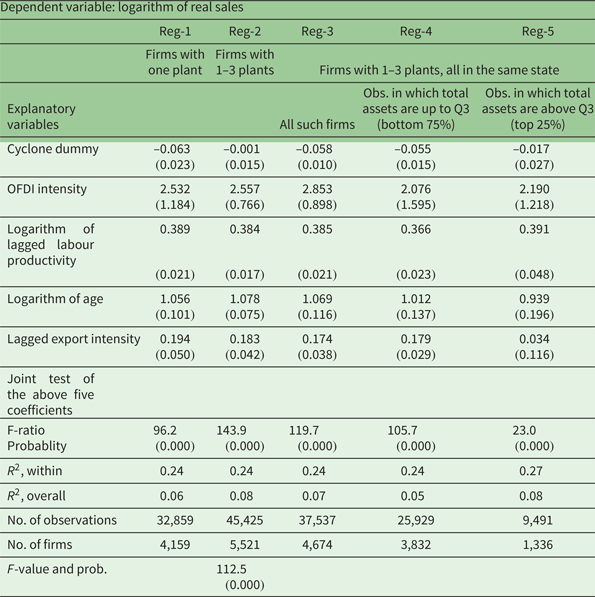
The estimates of equations (2) and (3) are shown in table 1. Regression-1 (hereafter Reg-1) is for single-plant firms. In Reg-2, firms with up to three plants are included. In Reg-1 and Reg-3, equation (3) is estimated, allowing for state-by-year effects using dummy variables. In Reg-2, equation (2) is estimated. The last two columns of table 1 present the results when Reg-3 is re-estimated separately for the bottom 75 per cent of the firms (observations) and the top 25 per cent of the firms (observations) in terms of the real value of total assets. The aim is to find out if the size of the firm makes a difference in the impact of cyclones on sales.
Regression results, explaining real sales, fixed-effects model

Notes: Robust standard errors clustered at the district level for Reg-1, state level for Reg-3, Reg-4, and Reg-5, and at the firm level for Reg-2, shown in parentheses. Reg-1, Reg-3, Reg-4 and Reg-5 include state-by-year dummies. Reg-2 includes only year dummies. Some firms are included in Reg-4 for some years and in Reg-5 for others (because of increased asset size). For the joint test of coefficients, the null hypothesis is that all are equal to zero.
Source: Authors' computations based on the Prowess database.
The signs of the estimated coefficients of the firm characteristics variables are along expected lines, and therefore, the results regarding the control variables are not discussed.Footnote 12 Instead, the focus is on the coefficient of the dummy variable representing cyclones (hereafter called the cyclone dummy variable). The estimated coefficient of the cyclone dummy variable is negative and statistically significant in Reg-1, which is estimated for single-plant firms, as well as in Reg-3, a regression equation estimated for firms that have 1–3 plants, all in the same state/UT. Based on the results obtained, it may be inferred that cyclones reduce sales of single-plant manufacturing firms and firms with up to three plants having all plants in the same state/UT by about six per cent. This finding is broadly consistent with the finding of Pelli et al. (Reference Pelli, Tschopp, Bezmaternykh and Eklou2023).
When the firms with 1–3 plants are considered for the analysis (estimating equation (2), shown in Reg-2), whether or not they have their plants in the same state/UT, the coefficient of the cyclone dummy variable is found to be statistically insignificant.
The firms that have multiple plants are bigger in size than the firms with a single plant (see table A2 in online appendix A2). Firms with two or three plants located in different states are generally bigger than firms with two or three plants in the same state. The finding of a statistically insignificant coefficient of the dummy variables for cyclones in Reg-2 indicates that the sales of big-sized firms are less impacted, or not impacted at all, by cyclones. This claim is supported by the results presented in the last two columns of the table. The results show that the impact of cyclones on sales is negative and statistically significant for the bottom 75 per cent of firms (relatively smaller in size), but the impact is statistically insignificant for the top 25 per cent of firms in terms of total assets. Thus, it may be inferred that for small-sized firms, there is a significant loss in sales due to cyclones, but for relatively much bigger multi-plant companies, especially those with plants in different states, the effect of cyclones on their sales might be small or even marginal (corroborative empirical evidence is presented in online appendix A4).
6.2 Impact on total assets
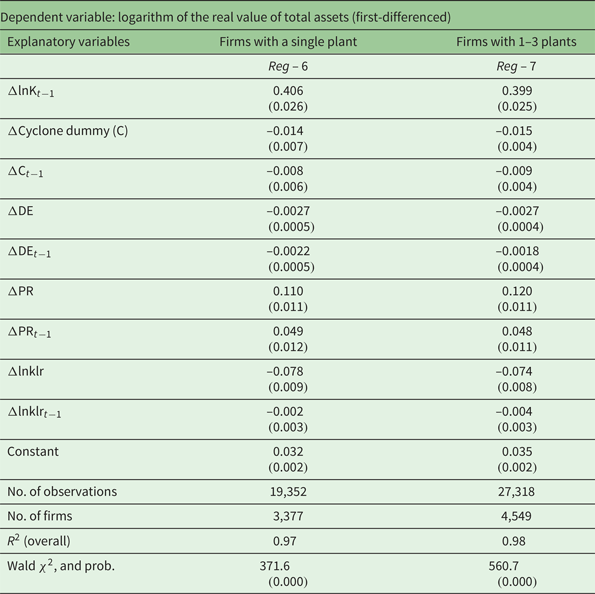
Table 2 presents the estimates of equation (5), which pertains to the impact of cyclones on total assets. The estimates have been made by applying the FD-IV regression. For the explanatory variables, other than the lagged dependent variable, the current difference and the lagged difference are included. Observations in which $\Delta lnK$ is more than 2 or less than (−2) have been dropped, as these are exceptionally high increases or decreases in capital stock in a year, although this does not make much difference to the results.
Estimates of the model explaining real capital stock, first-differenced instrument variable (FD-IV) regression

Notes: Robust standard errors clustered at the district level in Reg-6, and at the firm level in Reg-7, shown in parentheses. Observations in which $\Delta lnK$ is more than 2 or less than (–2) have been dropped.
Variable notation:lnK = log of the real value of total assets; C = Cyclone dummy; DE = Debt-equity ratio (lagged); PR = Profit (PBDITA) by sales; $lnKlr$ = Capital-labour ratio (in logarithms, one year lagged).
Source: Authors' computations based on the Prowess database.
Reg-6 is for single-plant firms, and Reg-7 is for firms having 1–3 plants, whether or not the plants are in the same state/UT.Footnote 13 It is seen in the results that the coefficient of profitability is positive and statistically significant and that of the debt-equity ratio is negative and statistically significant. The signs of these coefficients are as expected.
The coefficient of the lagged capital-labour ratio is negative and statistically significant. A possible interpretation of this finding is that if the ratio of capital to labour was relatively high in the previous year, there is a tendency for a downward adjustment in the current year.
The coefficient of the dummy variable for cyclones is negative and statistically significant in both Reg-6 and Reg-7. The results suggest that cyclones reduce the capital stock by about 1.5 per cent (corroborative evidence is provided in online appendix A5 based on the difference-in-difference estimator). The finding that cyclones cause a fall in total assets is in accord with the finding of Pelli et al. (Reference Pelli, Tschopp, Bezmaternykh and Eklou2023). Considering the impact in the current year and the next year, the total comes to about 2.5 per cent, which is close to the estimate (2.2 per cent) of Pelli et al. (Reference Pelli, Tschopp, Bezmaternykh and Eklou2023).
The estimated model for sales presented above indicated that cyclones adversely affect sales in medium-size and relatively smaller firms, which may not be present among relatively bigger plants. By contrast, in the case of total assets, the results indicate that cyclones cause a reduction in total assets among single-plant firms and relatively bigger multi-plant firms. The effect on bigger firms' assets does not appear to be any less than that for small firms.
6.3 Lagged impact of cyclones on sales and total assets
An interesting question is whether cyclones have a lagged impact on sales and total assets beyond the effect in the current year. This issue has been analyzed, and the results are presented in online appendix A6. For this purpose, equation (3) has been extended by adding two lagged terms of ${C_{irt}}$ , the cyclone dummy variable (i.e., ${C_{ir,t - 1}}$
 and ${C_{ir,t - 2}}$
 are introduced in the regression equation). Similarly, equation (5) has been extended by adding $\Delta {C_{i,t - 2}}$
 and $\Delta {C_{i,t - 3}}$
 .
When the extended version of equation (5) is estimated, which explains the variation in total assets, the coefficients of $\Delta {C_{i,t - 2}}$ and $\Delta {C_{i,t - 3}}$
 are found to be statistically insignificant. When the extended version of equation (3) is estimated, which explains variations in sales, the coefficient for ${C_{ir}}{,_{t - 2}}$
 is found to be statistically insignificant. The coefficient for ${C_{ir}}{,_{t - 1}}$
 is negative and statistically significant in the estimated regression equation for firms with 1–3 plants in the same state/UT, but it is statistically insignificant in the regression for single-plant firms (which dominate our sample). The results disagree, making it difficult to draw a definite conclusion regarding the lagged impact of cyclones on sales. Hence, the inference that may be drawn based on the results reported in online appendix A6 is that there is either no lagged impact of cyclones or, maybe, one period lagged impact of cyclones on sales and assets.
6.4 Influence of firms' trade-technology orientation on the cyclone impact
The next question investigated is whether the effect of cyclones on manufacturing firms is influenced or conditioned by their trade and technology orientation. This aspect was discussed in section 2, and some arguments were given as to why a firm with a high trade-technology orientation will have greater resilience against cyclones.
We have formed an index of firms' trade-technology orientation to investigate the above issue. For this purpose, four variables are considered: R&D intensity, technology import intensity, capital goods import intensity, and materials import intensity. Then, by applying principal component analysis, an index is formed, representing the trade-technology orientation of different firms (see online appendix A7 for details). This measure is hereafter called the trade-technology orientation index.
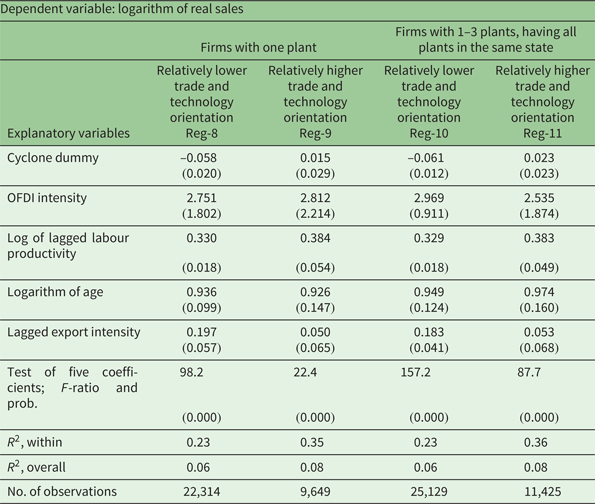
Considering the nature of the distribution of the trade-technology orientation index (L-shaped), the firms (or, to be more truthful to the procedure adopted, the observations) have been divided into two sets or groups. The 67th percentile has been taken as the cut-off. Thus, the bottom two-thirds of the firms (or observations) in terms of the index have been included in one set, and the upper one-third have been taken in the other. Then, equations (3) and (5) have been estimated separately for these two groups of firms (observations). The results of this exercise for sales are shown in table 3, and those for capital stock are presented and discussed in online appendix A8.
Regression results, explaining real sales, fixed-effects model, distinguishing according to trade-technology orientation

Note: Robust standard errors clustered at the district level in Reg-8 and Reg-9 and at the state level in Reg-10 and Reg-11, shown in parentheses. State-by-year dummy variables are included. The measure of trade and technology orientation is discussed in the text. The two groups are formed by taking the bottom 67% and the top 33%.
Source: Authors' computations based on the Prowess database.
In table 3, separate estimates are presented for single-plant firms and multi-plant single-state firms. The coefficient of the cyclone dummy variable is negative and statistically significant in Reg-8 and Reg-10, matching the results in table 1. However, the coefficient is not statistically significant in Reg-9 and Reg-11, which are for highly trade-technology-oriented firms. It appears from these results, therefore, that cyclones lead to a fall in sales of manufacturing firms that do not have much involvement in international trade and technology acquisition activities. On the other hand, firms that are highly trade-technology-oriented may not experience a fall in their sales after a cyclone. A similar pattern is seen when an analysis is undertaken of the effect of cyclones on capital stock; there is an effect for less trade-technology oriented firms, but not for high trade-technology oriented firms (see online appendix A8).Footnote 14
7. Regression analysis based on a measure of firm exposure to wind
A limitation of the analysis presented in sections 6.1–6.4 is that it did not consider that the impact of a cyclone goes up with its intensity in terms of maximum wind speed. This limitation of the analysis is partly addressed by using two dummy variables for cyclones, distinguishing between cyclones of different intensities (see online appendix A9).Footnote 15 The issue is more fully addressed in the analysis presented in this section based on wind speed data.
The model explaining sales (equation (3)) and that explaining total assets (equation (5)) have been estimated after replacing the cyclone dummy with a measure of firm exposure to high-speed winds during a cyclone (as specified in equation (1)). The econometric analysis is confined to single-establishment firms. The purpose of this exercise is to verify two key findings of the above analysis: (a) cyclones cause a dip in sales and assets of the firms, and (b) the effect is relatively lower for the firms that are highly trade-technology oriented.
A dummy variable of high trade-technology orientation has been constructed (the cut-off taken at the 67th percentile of the trade-technology orientation index), and this dummy variable is included in the models (equations (3) and (5)) after interacting it with the firm exposure to high-speed wind variable. Also, to get additional insight, the models explaining sales and total assets have been estimated separately for the firms that do not have a high trade-technology orientation. The estimates of equations (3) and (5) with the change described above are presented in online appendix A10.
The results in online appendix A10 confirm the key findings of the analysis presented in sections 6.1, 6.2, and 6.4 (and online appendix A9). A significant negative effect of cyclones on sales and assets of manufacturing firms is found. There is a clear indication that the effect is much lower or even marginal for firms with a high trade-technology orientation. The results regarding other explanatory variables are like the results in section 6 and, therefore, do not need a discussion.
8. Impact of cyclones on survival probability of manufacturing plants
In this section, we analyze the impact of cyclones on the survival probability of manufacturing plants. Data for the analysis (ASI frames for 2013–14 to 2020–21) and the estimation methodology have been explained in section 5 and online appendix A3. As stated in section 5, we apply the Cox proportional hazard model to study the impact of cyclones on the probability of a plant getting closed.
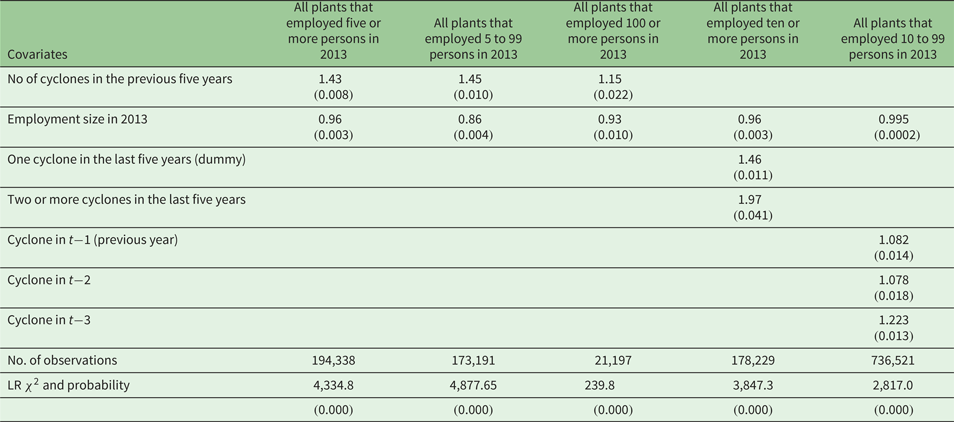
The results are reported in table 4. The results in the first four columns use a single record for each plant, and the results reported in the last column use multiple records for each plant. In the latter case, we consider the observations on each plant till the point of data censoring, i.e., 2020, or till it is dropped from the frameFootnote 16 representing the exit of the plant. Three points emerge from the results obtained: (a) cyclones raise the probability of business failure. As compared to a plant in a district unaffected by cyclones, a similar plant in a district in which cyclones have occurred has about 40 per cent higher risk of getting closed (as indicated by the hazard ratio); (b) the extra risk of business failures due to cyclones among plants employing 100 or more persons is significantly lower than that in plants of relatively smaller size (in the case of plants employing 100 or more persons, the enhanced risk of business failure due to a cyclone is 15 per cent more whereas for plants employing 5–99 workers, the risk is 45 per cent more; compare the second and third set of results in table 4); (c) repeated cyclones hugely increase the risk of business failure.Footnote 17 To explain point (c) further, if there was one cyclone in the district in the last five years where a plant is located, the risk of business failure goes up by 46 per cent relative to a situation of no cyclones, and if there were two or three cyclones, the risk of business failure doubles.
Estimates of hazard ratio, Cox proportional hazard model, explaining business failure among organized sector manufacturing plants in India

Note: Standard errors are shown in parentheses. The estimate in the last column uses multiple records for each plant, as explained in the text.
Source: Authors' computations based on ASI frame, 2013–2020.
A word of caution about the results in table 4 and their interpretation needs to be added here. One problem already noted is that we could not do a complete check of the plants that got removed from the frame on getting closed because we could not wholly match the plants between successive frames for different years owing to changes in ownership, name change, and other such issues. Second, a plant gets deleted from the frame if it is inoperative for three years. However, even if a plant gets closed, it may remain in the frame until it gets covered in one of the annual surveys. In ASI surveys, factories with 100 or more workers in the frame are in the census sector, which get fully enumerated every year. However, the factories with less than 100 workers (applicable to most factories) are mainly in the sample sector, and these get surveyed based on probability sampling. If a plant gets closed and is not selected for the sample survey for several consecutive surveys, it will remain in the frame. With a sampling fraction of about 10–15 per cent ASI for the sample sector, the probability of a plant not being selected for a survey in seven consecutive surveys (our study period) is low but not insignificant. Notwithstanding these limitations of the analysis, the findings in table 4 are robust, and the inferences drawn are reliable.
9. Conclusion
Our analysis of the impact of cyclones on manufacturing firms in India in terms of loss of assets and sales using data for 2008–2019 show that there was about a 4–6 per cent dip in sales (which could even go up to 10 per cent because of lagged impact) and a 2–3 per cent dip in total assets of manufacturing firms, broadly in line with the results obtained by Pelli et al. (Reference Pelli, Tschopp, Bezmaternykh and Eklou2023). While cyclones cause a fall in total assets in both big and small firms, the adverse effect is more significant for relatively small firms, especially single-plant firms.
Cyclones adversely affect sales and assets for the firms that are relatively less trade-technology oriented, and the effect is often small or negligible for firms that are more trade-technology oriented (characterized by a combination of the following features: engaged in R&D or technology imports or both, importing capital goods, having relatively high use of information technology and information technology-enabled services and participating in GVCs). These findings point towards the nature of action needed to build greater resilience against tropical cyclones among industrial firms located in coastal areas in India, which probably has applicability to such firms in other emerging economies.
We found evidence that cyclones significantly negatively affect the survival probability of industrial plants. Our analysis revealed that the extra risk of business failure due to cyclones is much less for relatively big plants. Another finding is that repeated cyclones significantly raise the risk of business failure.
While the focus of the study was on the impact on manufacturing firms, through inter-industry linkages, there would be spillover effects on other industries. Also, through inter-regional linkages, the effects are likely to spread to industries in regions unaffected by cyclones. Thus, the overall impact of cyclones on the economy, considering other sectors and regions, would be much larger.
Supplementary material
The supplementary material for this article can be found at https://doi.org/10.1017/S1355770X24000317.
Acknowledgements
We have immensely benefited from the comments and suggestions of the Associate Editor and two anonymous reviewers of the Journal. Previous versions of the paper were presented at the 15th Annual Conference of the Forum for Global Knowledge Sharing, 16–17 December 2022, and the Second Biennial Conference on Development organized by the Indira Gandhi Institute of Development Research, Mumbai, 21–23 December 2022.
Competing interest
The authors declare none.