Introduction
Neuroticism, characterized by high levels of negative affect in response minor stressors (Costa and McCrae, Reference Costa and McCrae1992), is a complex, clinically significant construct that has been relatively understudied in the context of geriatric depression. People scoring high in neuroticism are generally described as anxious, apprehensive, and prone to experience worry, sadness, loneliness, and dejection (Costa and McCrae, Reference Costa and McCrae1992). Neuroticism predisposes individuals to experience anxiety and major depressive disorders (Hirschfeld et al., Reference Hirschfeld1989; Kendler et al., Reference Kendler, Kuhn and Prescott2004). Among older adults, neuroticism perpetuates major depressive symptoms and negatively impacts cognitive functioning (Steffens et al., Reference Steffens2013).
In younger populations, neuroticism limits response to acute pharmacological treatment for major depression (Bock et al., Reference Bock2010; Fiedorowicz et al., Reference Fiedorowicz2010). Comorbid anxiety and lower functioning variants of the promoter for the serotonin transporter gene are two factors associated with neuroticism that are also linked to lower antidepressant response (Fiedorowicz et al., Reference Fiedorowicz2010). Sensitivity to emotional stressors has also been shown to predict relapse of depression among medication-treated patients (Segal et al., Reference Segal2006). Research on neuroticism and acute treatment outcome among older depressed adults is limited, but consistent with findings in younger cohorts (Steffens et al., Reference Steffens2013; Kim et al., Reference Kim2016). We aimed to examine the effects of neuroticism on acute treatment outcome in a group of older depressed adults initially treated with the antidepressant sertraline in an open-label fashion as part of Neurobiology of Late-Life Depression (NBOLD), a US National Institute of Mental Health (NIMH)-supported study at the University of Connecticut (UConn). Based on our prior research (Steffens et al., Reference Steffens2013), we hypothesized that presence of high total neuroticism and high stress vulnerability (a subscale of neuroticism) would be associated with lower acute remission rates.
Methods
Subjects
All subjects were enrolled in NBOLD, an NIMH funded study at UConn approved by its Institutional Review Board. After reviewing study information, all subjects provided written, informed consent to participate.
Depressed subjects were recruited from clinic referrals and newspaper advertisements. Inclusion criteria for depressed subjects were age 60 or above, ability to read and write English, Mini-Mental State Examination (MMSE) score 25 or greater and meeting criteria for major depression, single episode, or recurrent (DSM-IV-TR). Study exclusion criteria were: current or recent alcohol or drug dependence; conditions associated with brain MRI abnormalities; physical or intellectual disability that may affect completion of self-rating instruments; established clinical diagnosis of dementia; other major DSM Axis 1 psychiatric disorders; and metal or pacemaker in the body or claustrophobia that might preclude MRI. In addition, current treatment with fluoxetine was an exclusion criterion for the depressed group given its long wash-out period.
The screening and assessment procedures used in NBOLD have been reported previously (Steffens et al., Reference Steffens2015). Upon enrollment and completion of baseline assessments, each subject was paid $100 for their participation. The clinical assessment procedures are summarized below.
Baseline assessments
Trained clinical research assistants administered the Duke Depression Evaluation Schedule (DDES) to each participant via computer-assisted data entry. The DDES contains items covering demographic data, social variables, and the Diagnostic Interview Schedule (DIS) sections for depression, mania, generalized anxiety disorder, somatization symptoms, and alcohol use, as well as a self-report measure of Instrumental Activities of Daily Living (IADLs). A study psychiatrist interviewed each subject to establish a clinical diagnosis of major depression and then administered the Montgomery–Ǻsberg Depression Rating Scale (MADRS) and Cumulative Illness Rating Scale (CIRS), as modified for geriatric patients. Each subject completed several self-report measures, including the NEO PI-R (Costa and McCrae, Reference Costa and McCrae1985), which measures total neuroticism and vulnerability to stress.
Treatment protocol
Study psychiatrists followed a treatment protocol that employed both structured and naturalistic components. All depressed subjects were offered open-label treatment with sertraline for 12 weeks. Individuals taking antidepressants at baseline who otherwise met inclusion criteria, underwent a study-related two-week medication washout with weekly telephone contact to assess clinical status and provide in-person assessments as warranted.
For sertraline dosing, subjects younger than 80 years old were started on 50 mg daily for two weeks to rule out drug sensitivity and minimize risk of side effects, then were increased to 100 mg daily. The protocol was flexible, allowing for the dose to be increased by 50 mg every two weeks as clinically indicated, up to a maximum dose of 200 mg daily. In addition, the study physician could start patients on a lower dose based on clinical factors including patient history. Subjects 80 years and older were started on 25 mg of sertraline and were increased to 50 mg daily after two weeks. The dose could be increased by 25–50 mg every two weeks as clinically indicated, up to a maximum 200 mg daily. For subjects who might experience problems with tolerability, the protocol allowed for the dosing to be reduced to a previous level.
Individuals with difficulty tolerating sertraline, leading to discontinuation, were offered a switch to standard doses of bupropion or desvenlafaxine through the study, and if neither medication was appropriate, the study psychiatrist worked with the subject to identify appropriate antidepressant treatment and wrote a prescription for it.
Statistical analyses
Our primary analyses focused on all depressed subjects who initiated treatment with sertraline (N = 43). Descriptive statistics were contrasted between subjects with high and low total neuroticism (raw median value as the cut-point) to elucidate potential demographic and clinical variable differences associated with neuroticism. Continuous variables and categorical variables were compared using two-group t-tests or Fisher's exact test, respectively.
The primary outcome variable is 12-week MADRS score. We employed two approaches to examine the association of neuroticism and stress vulnerability with 12-week MADRS. First, we used logistic regression to find predictors of treatment outcomes by regressing the binary variable of remission (MADRS score < 8 vs. 8 or greater) (Sheline et al., Reference Sheline2010), against neuroticism and stress vulnerability variables. The main explanatory variables were continuous raw scores of NEO PI-R total neuroticism and stress vulnerability, and we included baseline MADRS and CIRS score as planned covariates. In addition, we explored age, gender, education, and IADLs as potential covariates, testing each variable in univariate models of remission and including it in a final model if it was significant at p < 0.10. The second approach examined 12-week MADRS score as a continuous variable, using ordinary least squares regression with the same approach to explanatory variables as well as planned and potential covariates described for the logistic regression model.
We also examined effects of neuroticism and stress vulnerability on treatment outcomes among the subgroup of 32 depressed subjects who remained on sertraline during the entire 12-week period of observation, using the similar methods described above, but, due to small sample size, only including the main explanatory variables, baseline MADRS, and CIRS score.
Finally, we conducted logistic regression analyses examining high versus low neuroticism as a predictor of remission.
Results
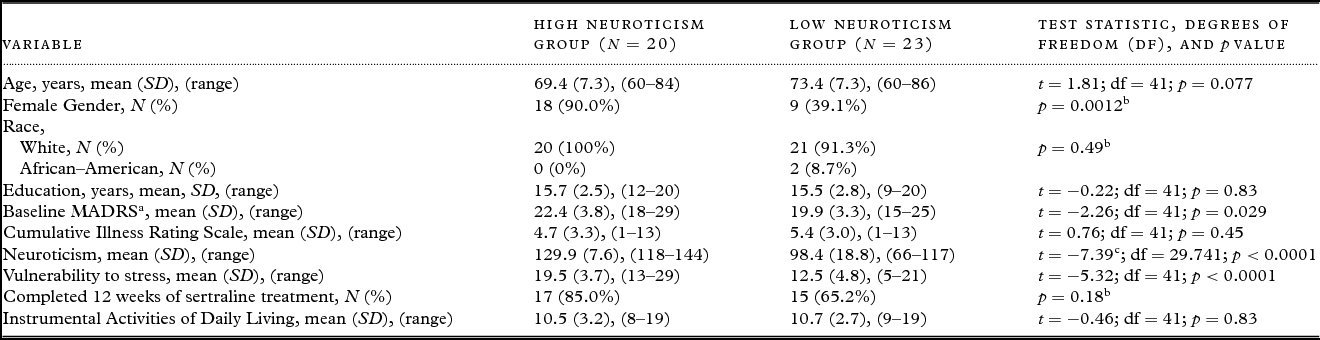
Characteristics of the sample, separated into those with high versus low neuroticism scores based on a median cut-off of 118, are shown in Table 1. The two groups were comparable, except that depressed subjects higher in neuroticism were more likely to be female.
Sample characteristics of the sample based on neuroticism scores above and below the median

a MADRS = Montgomery–Ǻsberg Depression Rating Scale.
b Fisher's Exact Test used due to low cell counts.
c Satterthwaite t-test.
Among the 43 individuals who were initially treated with sertraline, 32 completed 12 weeks of sertraline treatment, while an additional 11 were discontinued from sertraline and started on another antidepressant (two on desvenlafaxine and three on mirtazapine) or were on no antidepressant at 12 weeks (N = 6).
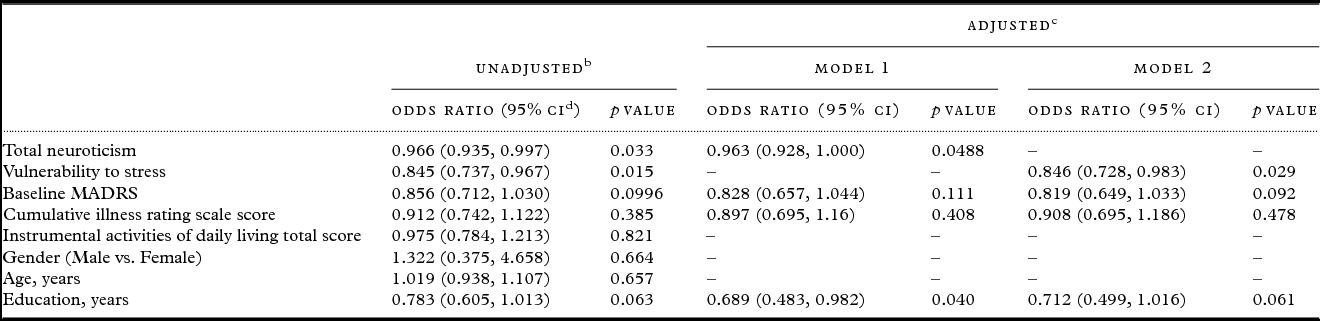
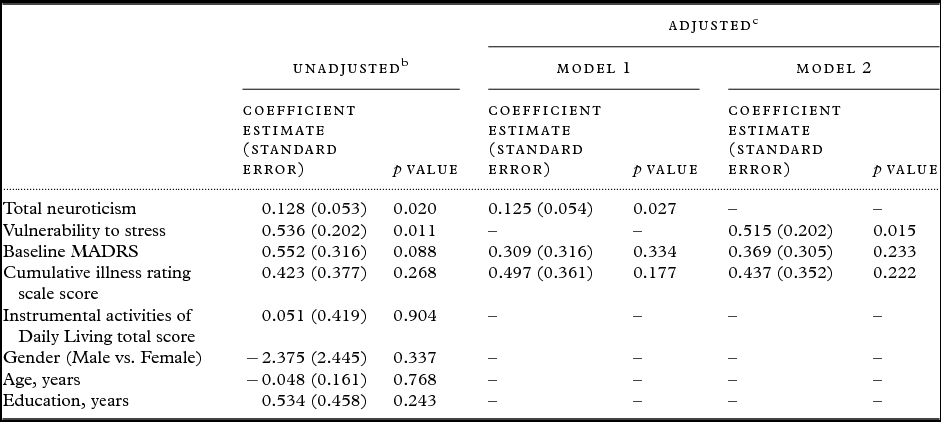
Among all individuals initially treated with sertraline, both neuroticism and vulnerability to stress were associated with remission (Table 2) in logistic regression models controlling for baseline MADRS score, CIRS score, and education. In linear regression models, both neuroticism and stress vulnerability scores were associated with 12-week MADRS score, controlling for baseline MADRS (Table 3). In results not shown, neuroticism as a categorical variable (high vs. low score) was not associated with either remission or MADRS total score at 12 weeks.
Logistic regression models predicting remission (i.e. MADRSFootnote a score below 8) at week 12

a MADRS = Montgomery–Ǻsberg Depression Rating Scale.
b Univariate Logistic Regression showing associations between each of the factors and Remission.
c In adjusted analyses, total neuroticism and vulnerability to stress were the main predictor variables and baseline MADRS and CIRS score were planned covariates; education was significant at p < 0.10 in unadjusted analyses and were therefore included in the final models.
d 95% CI = 95% Confidence Interval.
Linear regression models predicting MADRS score at week 12 (continuous measure)

a MADRS = Montgomery–Ǻsberg Depression Rating Scale.
b Univariate Logistic Regression showing associations between each of the factors and MADRS Score at Week 12.
c In adjusted analyses, total neuroticism and vulnerability to stress were the main predictor variables and baseline MADRS and CIRS score were planned covariates; none of the other potential covariates were significant at p < 0.10 in unadjusted analyses and were not included in the final models.
We also performed a similar set of analyses among the 32 individuals who completed twelve weeks of sertraline treatment. In results not shown, neuroticism was not associated with any of the outcomes of interest (p < 0.08), although the magnitudes of the effect of neuroticism for models of remission and final MADRS score were similar to those in analyses of all individuals started on sertraline (N = 43). On the other hand, vulnerability to stress was significantly associated with both a logistic regression model of remission (odds ratio = 0.851, 95% CI = 0.728–0.995, p = 0.044) and a linear regression model of MADRS score (coefficient estimate = 0.50, standard error = 0.23, p = 0.037), with both models controlling for baseline MADRS and CIRS scores.
Discussion
Our findings are consistent with other studies in geriatric and non-geriatric adult depressed populations. Among 62 older depressed individuals in an outpatient Day Hospital setting, neuroticism, and stress vulnerability were associated with depression outcome (Canuto et al., Reference Canuto2009). In a nine-year follow-up study, Steunenberg found that higher neuroticism predicted worse long-term recovery from depression among 206 depression older adults (Steunenberg et al., Reference Steunenberg2007).
These studies confirm a larger literature among non-geriatric depressed samples demonstrating that personality factors, such as total neuroticism and vulnerability to stress, limit response to short-term antidepressant treatment. It is not clear why this would be so. It could be that these individuals may have a more “reactive” depression that would benefit from emotion regulation and stress management techniques. Another possibility is that depressed individuals high in neuroticism may have comorbid anxiety given the large overlap of anxiety symptoms and components of neuroticism, and treatment should thus target anxiety. Finally, a third possibility relates to the notion that older depressed patients high in neuroticism may constitute a distinct biological depressive subtype that may require different treatment(s).
These possible explanations all point to a clear research gap in the understanding of the role of neuroticism and stress vulnerability in geriatric depression. In particular, more clarity is needed regarding the how the complex relationship between neuroticism and mood disorders affects treatment response in older adults. Future studies should aim to address these knowledge gaps in order to better inform both outcome studies and treatment development in late-life depression.
Our study has limitations, including a relatively small sample size that limited the number of covariates and may have limited our ability to detect a significant difference for neuroticism among sertraline completers, given that the magnitude of the effects of neuroticism across the two samples were similar. Another limitation of the study is that we used a treatment protocol that was not fully standardized, given that NBOLD is not a clinical trial. Future studies of larger sample sizes that incorporate standardized treatment protocols are therefore warranted.
Conflict of interest
None.
Authors’ roles
D. C. Steffens designed the study, supervised the data collection, and wrote the paper. R. Wu was responsible for carrying out the statistical analyses. J. J. Grady was responsible for aspects of the study design and data collection, and he participated in the writing of the manuscript. K. J. Manning assisted in the writing of the paper.
Acknowledgments
Supported by NIH grants R01 MH096725 and R01 MH108578.