INTRODUCTION
Numerous hunter-gatherer archaeological sites are present in the Central Region of Argentina, providing a record of paleoenvironmental change, landscape evolution, and hunter-gatherer strategies in arid and semi-arid environments (Martínez, Reference Martínez2017; Tripaldi et al., Reference Tripaldi, Zárate, Neme, Gil, Giardina and Salgán2017; Heider et al., Reference Heider, Jobbágy and Tripaldi2019; Messineo et al., Reference Messineo, Tonello, Stutz, Tripaldi, Scheifler, Pal, Sánchez Vuichard and Navarro2019; among others). The Central Region stretches from 32–39°S and comprises the Andean Piedmont, the Pampa Plain, and the northern Patagonia Plateau. The region is covered by aeolian sand sheets and dunes from the Cordillera de los Andes to the Atlantic Ocean, through the provinces of San Juan, La Rioja, Mendoza, San Luis, La Pampa, and Buenos Aires. Geomorphic, sedimentologic, and stratigraphic studies in these drylands over the past 15 years have focused on aeolian landforms, sand sheet accretion, dune movement and reactivations, and blowouts genesis (Zárate and Tripaldi, Reference Zárate and Tripaldi2012). Pedogenesis, soil formation, and denudation have also been studied in these sandy successions, which in turn, together with other proxy data, are helping for understand the nature of Holocene paleoenvironmental change more fully and paleoclimatological conditions (Tripaldi and Forman, Reference Tripaldi and Forman2007, 2016; Zárate and Tripaldi, Reference Zárate and Tripaldi2012; Tripaldi et al., Reference Tripaldi, Zárate, Forman, Badger, Doyle and Ciccioli2013; Forman et al., Reference Forman, Tripaldi and Ciccioli2014; Tripaldi and Zárate, Reference Tripaldi and Zárate2016; Mehl et al., Reference Mehl, Tripaldi and Zárate2018). The recognition that the aeolian sedimentary record is discontinuous with significant hiatuses illustrates that aeolian processes play an essential role in the potential preservation of archeological sites in dryland environments.
In many regions of South America, “gaps” or “archaeological silences” in mid-Holocene archaeological records are evident. Different archaeological models propose to explain either the absence or the scarcity of the archaeological record during this lapse. In this sense, “gaps” or “discontinuities” in the archaeological record may be related to climatic factors (aridity), sampling biases, lower population density, bottlenecks, depopulation or abandonment, local extinctions, recolonization, and population replacements, among others (Nuñez et al., Reference Núñez, Grosjean and Cartajena2002; Araujo et al., Reference Araujo, Neves, Pilo and Atui2005; Barrientos and Perez, Reference Barrientos and Perez2005; Neme and Gil, Reference Neme and Gil2009; Barberena, Reference Barberena2015; Méndez et al., Reference Méndez, Gil, Neme, Nuevo Delaunay, Cortegoso, Huidobro, Durán and Maldonado2015; Barberena et al., Reference Barberena, Méndez and Porras2017; Neme et al., Reference Neme, Zárate, Pompei, Franchetti, Gil, Giardina, Seitz, Salgán, Abbona and Fernández2021; among many others). The discontinuities and absence of the archaeological record during the mid-Holocene have also been discussed in terms of population continuity or discontinuity (Barrientos, Reference Barrientos, Barberena, Borrazo and Borrero2009; Politis, Reference Politis, Politis, Guitiérrez and Scabuzzo2014; Martínez et al., Reference Martínez, Prates, Flensborg, Stoessel, Alcaráz and Bayala2015; Mazzanti et al., Reference Mazzanti, Martínez and Quintana2015). Taphonomic and geologic bias (see Beherensmeyer and Hook, Reference Behrensmeyer, Hook, Behrensmeyer, Damuth, DiMichele, Potts, Sues and Wing1992; Surovell and Brantingham, Reference Surovell and Brantingham2007; Fanning et al., Reference Fanning, Holdaway, Rhodes and Bryant2009; Ballenger and Mabry, Reference Ballenger and Mabry2011) produced by geomorphic dynamics may have totally or partially eliminated, substantially modified, or even masked the archaeological record of specific time intervals. In the eastern Pampa-Patagonia transition only Late Holocene sites younger than ca. 3.0 ka have been detected in studies before 2012, and recent surveys on mid-Holocene depositional landforms, both inland and coastal areas, provided the first mid-Holocene sites including Cantera de Rodados Villalonga, Tres Bonetes 1, La Modesta, and Loma de Los Morteros (see Martínez, Reference Martínez2017; Fig. 1). Besides taphonomic and geologic bias, scientific bias (e.g., survey strategies) plays a role in detecting and further investigating mid-Holocene sites. Geologic and taphonomic biases affecting the possibility of preserving mid-Holocene archaeological sites have also been proposed in the Pampas Plains (Favier Dubois et al., Reference Favier Dubois, Massigoge and Messineo2017), northeastern Patagonia (Luchsinger, Reference Luchsinger2006; Favier Dubois, Reference Favier Dubois, Zangrando, Barberena, Gil, Neme, Giardina, Luna, Otaola, Paulides, Salgán and Tivoli2013; Favier Dubois et al., Reference Favier Dubois, Kokot, Scartascini and Borella2016), and the eastern Pampa-Patagonia transition at the lower basin of the Colorado River (Martínez et al., Reference Martínez, Flensborg and Bayala2013, Reference Martínez, Prates, Flensborg, Stoessel, Alcaráz and Bayala2015; Martínez, Reference Martínez2017).
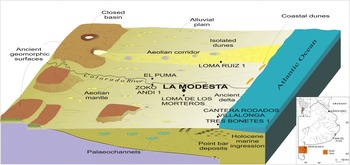
Schematic view of the regional geologic and geomorphic context of the study area, La Modesta site, along the lower course of the Colorado River.
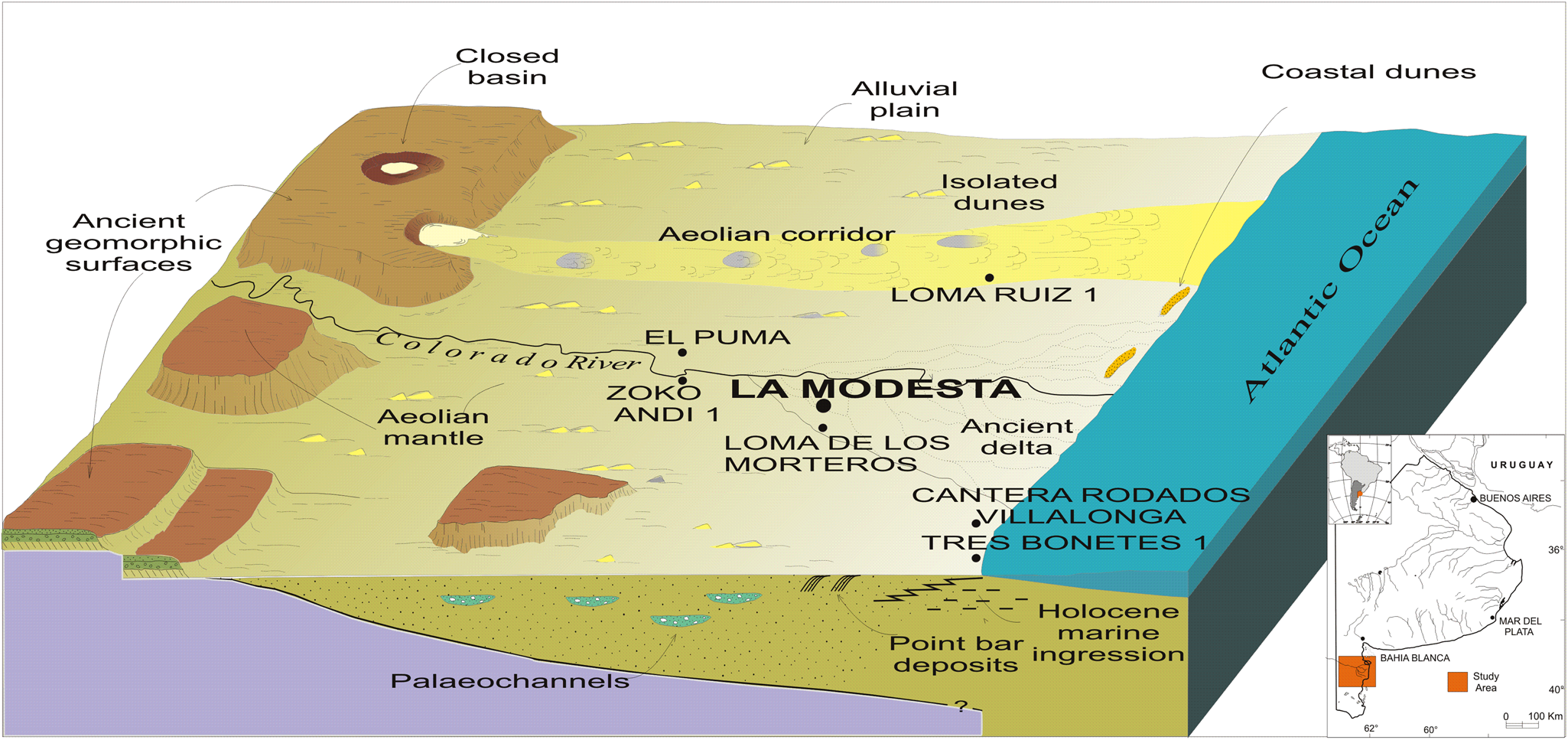
In this study, we examine geoarchaeological and chronostratigraphic aspects of one of the mid-Holocene archaeological sites, La Modesta, in the lower basin of the Colorado River of the eastern Pampa-Patagonia transition (Fig.1). Optically stimulated luminescence (OSL) dating of the aeolian deposits in the Central Region of Argentina is helping define the timing of dune deposition and has been vital in understanding geomorphic processes over the past ca. 50 ka (Tripaldi et al., Reference Tripaldi, Zárate, Forman, Badger, Doyle and Ciccioli2013; Tripaldi and Forman, Reference Tripaldi and Forman2016). Despite the common use of OSL methods in geological studies, OSL studies are almost absent in archaeological research in the Central Region of Argentina (for exceptions, see Messineo et al., Reference Messineo, Tonello, Stutz, Tripaldi, Scheifler, Pal, Sánchez Vuichard and Navarro2019). OSL dating provides an opportunity to examine in more detail the controls on aeolian deposition and erosion on the preservation of the archaeological record. We, therefore, apply OSL dating, together with radiocarbon dating, to define the timing of human occupation and aeolian deposition and deflation, and then reconstruct the nature of paleoenvironmental change. We discuss issues related to site-formation processes, stratigraphic resolution, and integrity of the archaeological assemblage and compare paleoenvironmental conditions determined for nearby regions of northeastern Patagonia with the La Modesta site. Our study also provides insights into the nature of mid-Holocene hiatuses (the “archaeological silences”) in the archaeological records of Central Argentina. Finally, we address the role of taphonomic and geologic biases in explaining gaps and discontinuities in the archaeological record of the eastern Pampa-Patagonia transition of Argentina.
REGIONAL SETTING
The study area is in the Colorado Basin (Zambrano, Reference Zambrano1973), drained by the Colorado River flowing from the Andes to the Atlantic Ocean. The lower reaches of the study area are part of the “Arid Diagonal” (Abraham de Vázquez et al., Reference Abraham de Vázquez, Garleff, Liebricht, Reigaráz, Schäbitz, Squeo, Stingl, Veit and Villagrán2000). The present climate is semi-arid, with an average annual rainfall of 466 mm and average monthly temperatures ranging from 22.2°C in January to 7.5°C in July (González Uriarte et al., Reference González Uriarte, González Martín, Kruger, Lamberto, Arbanesi and de Vercesi1987). The dominant winds are from the west and southeast (Acevedo, Reference Acevedo and Acevedo1981).
Zárate and Tripaldi (Reference Zárate and Tripaldi2012, p. 403) define this region as part of the “Northern Patagonian and southern Pampean sand mantles and dunefields” (PPMD), which they highlight as the least known area of what they call the Aeolian System of Central Argentina. The western part of the area contains a succession of flat-shaped erosional remnants of ancient surfaces whose relative relief ranges between ~10 and 60 m (Cappannini and Lores, Reference Cappannini and Lores1966; González Uriarte, Reference González Uriarte1984; Fig. 1). These buttes are composed of sandstones of the Late Miocene–Late Pliocene Río Negro Formation (Andreis, Reference Andreis1965) and are mantled with “Patagonian pebbles” that have been deposited since the Late Miocene and partially eroded by the Colorado and Negro rivers, producing a series of paleovalleys (González Uriarte, Reference González Uriarte1984; Martínez and Kutschker, Reference Martínez and Kutschker2011). The “Bajos sin Salida” (closed basins) are depressions whose deflation provides large amounts of sand, which is blown down aeolian corridors (Fig. 1) to form dune fields comprising parabolic, barchan, domed, and crescent dunes (McKee, Reference McKee and McKee1979). Many dunes are elongated to the east, parallel to the direction of the winter trade winds, and are composed of fine to medium sands that rise to a maximum height of ~16 m and are active or stable, fixed by vegetation.
The eastern part of the area has extensive Holocene fluvial deposits that form a flat alluvial plain. Littoral sediments deposited during the last Holocene transgressive-regressive cycle (mid-Holocene) reach ~6–7 m above present sea level and cover the alluvial plain along the coast (Fig. 1; Weiler, Reference Weiler1983, Reference Weiler2001). The littoral deposits are covered by fluvial and aeolian deposits along the coastal sectors. Aeolian sand sheets that are 1–2 m thick and low isolated dunes, generated during different denudational periods, are present on the aggradational plains, aligned in the dominant westerly wind direction. Although isolated dunes are less common than sand sheets within the alluvial plain, their morphologies are consistent with westerly winds (Fig. 1). Isolated dunes have rounded to westerly elongated forms ~100–600 m wide and rise to heights of ~1–3 m. Most isolated dunes are vegetated (stabilized) with occasional blowouts.
The characteristic vegetation is shrub-steppe, an open vegetal formation represented by short xeric trees mixed with hard and scarce herbaceous grasses. The dominant vegetation is “Distrito del Caldén” and “Provincia del Espinal,” although vegetal communities of the “Provincia del Monte” are also present in the region (Martínez et al., Reference Martínez, Brea, Martínez and Zucol2021; Zucol et al., Reference Zucol, Martínez, Martínez and Angrizani2022, and references therein). Today, Espinal forests are fragmented and degraded due to agricultural expansion that promotes accelerated soil erosion and deflation (Winschel and Pezzola, Reference Winschel and Pezzola2018).
Systematic archaeological investigations in the lower basin of the Colorado River began in 2001. The research has included studies of geoarchaeology, paleoclimate and paleoenvironment, zooarchaeology, taphonomy, lithic and pottery technology, raw material provenience, bioarchaeology, mortuary practices, stable isotopes, artistic representations on portable goods, and personal ornaments (Martínez, Reference Martínez2017, and references therein). Archaeological sites have been studied in inland and coastal sectors, mainly in dunes and their blowouts where the artifacts appear on the surface and at depth within the aeolian sediment. Mid- and Late Holocene hunter-gatherer occupation date from ca. 6.9 ka to ca. AD 1800 (Martínez, Reference Martínez2017).
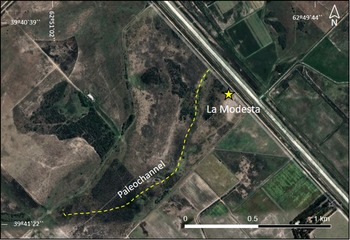
The La Modesta site is situated ~60 km from the Atlantic coast and ~20 km SW of the town of Pedro Luro (Fig. 1). The site is within an ancient dune and has a blowout measuring ~125 m long and ~40 m wide, covering an area of ~5,000 m2, and is adjacent to an ancient paleochannel of the Colorado River (Fig. 2).
Google Earth image of the La Modesta site (star) in close spatial relation with a paleochannel.

PREVIOUS WORK AT LA MODESTA SITE
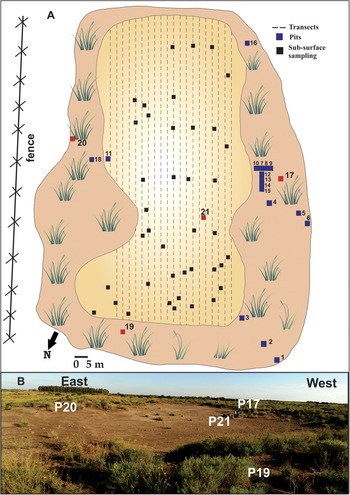
Since 2014, 21 ~1.5–2-m-deep pits were dug along 20 2-m-wide transects that cross along the length of the blowout within the dune (Stoessel, Reference Stoessel2015; Santos Valero, Reference Santos Valero2019; Alcaráz, Reference Alcaráz2020). Furthermore, 40 ~1-m2 subsurface samplings were randomly sampled throughout the blowout (Fig. 3). Diverse and numerous archaeological materials were recovered from the surface (Carden and Martínez, Reference Carden and Martínez2014; Stoessel, Reference Stoessel2015; Santos Valero, Reference Santos Valero2019; Alcaráz, Reference Alcaráz2020; Fig. 4).
La Modesta study site showing (A) plan view of the dune and blowout with the excavated pits (numbered squares; red squares represent the pits where OSL ages were obtained), transects, and sub-surface sampling (unnumbered squares); and (B) view of the blowout and location of the main pits for stratigraphic and OSL studies.

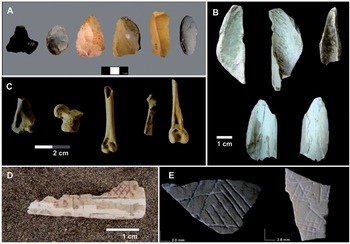
Examples of cultural material from the La Modesta site. (A) Variability of lithic tools; (B) helical fracture debris produced as a byproduct of bone fracture for bone marrow procurement; (C) human-consumed microvertebrate bones from armadillos (burned), rodent, and medium-sized birds; (D) a piece of decorated bone artifact; (E) fragments of engraved Rheidae eggshells.

Four surface bones, including from two humans, a guanaco (Lama guanicoe), and a coypu (Myocastor coypus), from different areas of the dune were dated at the Department of Physics in the University of Arizona and yielded radiocarbon ages of ca. 5900–5600 14C yr BP (calibrated to ca. 6.28–6.79 ka; Table 1; Martínez, Reference Martínez2017). Radiocarbon and stable isotope analyses (δ13C; C/N ratio; %N; %C) of the bones have confirmed the reliability of the radiocarbon dating (Martínez, Reference Martínez2017; Flensborg et al., Reference Flensborg, Martínez and Tessone2020). The dated animal bones had anthropic cut marks and fractures (Stoessel, Reference Stoessel2015; Alcaráz, Reference Alcaráz2020). Zooarchaeological studies on surface assemblages indicate that guanaco (Lama guanicoe), freshwater fish such as perch (Percichthys sp.), small-sized fauna such as coypu (Myocastor coypus), medium-sized birds, and possibly armadillos contributed to the human diet (Alcaráz, Reference Alcaráz2020; Fig. 4). Isotopic analyses (δ13CAp-Col and δ15N) performed on the human bones indicate a preference for terrestrial herbivores and freshwater fish (Flensborg et al., Reference Flensborg, Martínez and Tessone2020). The study of lithics from the surface shows a preference for utilizing local raw materials (e.g., silica, chalcedony, basalt, and andesite), although exotic rocks from neighboring regions were also present. Exotic rocks include orthoquartzite, quartz sandstone, and metaquartzite from the mountain ranges of the Pampa Húmeda subregion, chert from the Pampa Seca subregion, and translucent chalcedony from northern Patagonia (Martínez and Santos Valero, Reference Martínez and Santos Valero2020; Fig. 4). Engraved fragments of Rheidae eggshells (Fig. 4) used as water flasks are present, and their designs are repeated on a macro-regional scale (Carden and Martínez, Reference Carden and Martínez2014). The site functioned as a residential camp of multiple activities located on the dune, which in the mid-Holocene was near an active channel of the Colorado River (Martínez, Reference Martínez2017). The exotic rocks and engraved Rheidae eggshells suggest that mid-Holocene hunter-gatherers had contact and/or exchange mechanisms with people of the regions located north, west, and south of the study area, from ~80–500 km away (Carden and Martínez, Reference Carden and Martínez2014; Martínez and Santos Valero, Reference Martínez and Santos Valero2020). Despite intense aeolian processes, the surficial archaeological materials are well preserved (Fig. 4), which allows detailed analysis and much information on diverse lines of archeological inquiry.
Radiocarbon ages from surface bone specimens at La Modesta site.

METHODS
Building on the framework of previous studies (Carden and Martínez, Reference Carden and Martínez2014; Stoessel, Reference Stoessel2015; Martínez, Reference Martínez2017; Santos Valero, Reference Santos Valero2019; Alcaráz, Reference Alcaráz2020), we excavated four pits (17, 19, 20, and 21) and dated the sediment using OSL methods and to provide a chronostratigraphy to compare with the radiocarbon ages obtained from surface materials. Only isolated small and poorly preserved archeological materials are present in the excavations. Of the 21 pits examined (Fig. 3), only eight had artifacts at depth whose vertical distribution is associated with specific stratigraphic units.
Sedimentologic and stratigraphic analysis
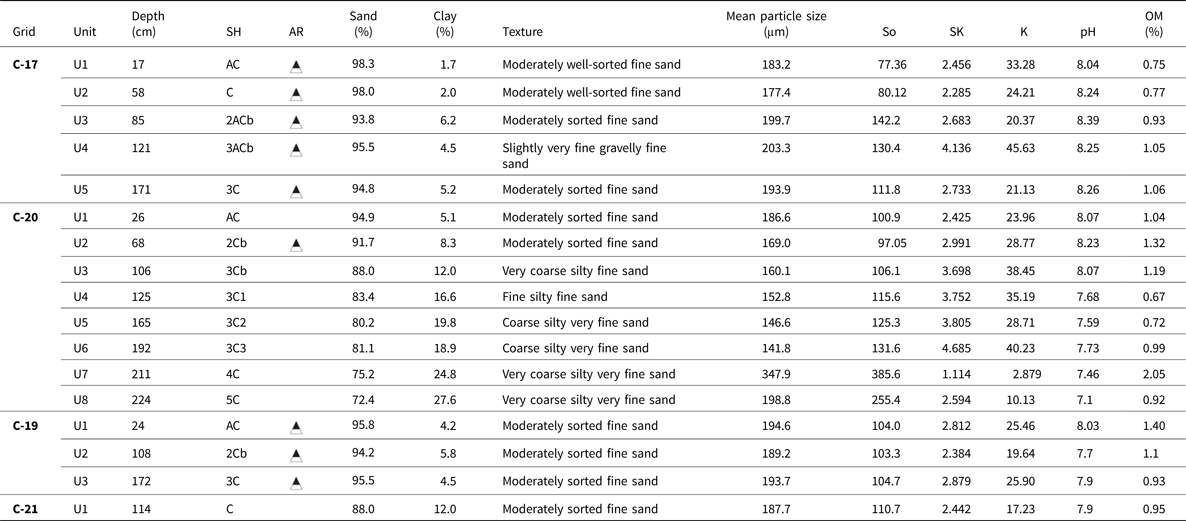
Geomorphic analysis at regional, local, and site scales included the use of Landsat and Google Earth satellite imagery, as well as digital elevation data (SRTM3), building on the field surveys of G. Martínez and G.A. Martínez (Reference Martínez and Kutschker2011), G.A. Martínez and G. Martínez (Reference Martínez, Martínez and Martínez2017), and Martínez et al. (Reference Martínez, Martínez, Alcaráz and Stoessel2019). Allostratigraphic units were defined based on their sedimentary characteristics (e.g., texture, bedding contacts, and structures) and pedogenetic features (Soil Survey Staff, 2010). These are labeled U (unit) with an increasing number with depth (e.g., in Pit 17, these are U1 [youngest] to U5 [oldest]; Fig. 6). Particle size analysis was performed by dry sieving and characterized using Folk and Ward's (1957) statistics using GRADISTAT software (Blott and Pye, Reference Blott and Pye2001). Organic carbon content was determined using the methods of Walkley and Black (Reference Walkley and Black1934), and pH was measured with a pH meter in a suspension with a soil/water ratio of 1:2.5 (Table 2).
Soil and sediment descriptions and particle size analysis for pits at La Modesta site. Folk and Ward (Reference Folk and Ward1957) statistics include sorting (So), skewness (Sk), and kurtosis (k) measured in microns. U = Allostratigraphic Unit; SH=Soil Horizon;  Archaeological remains (AR); OM: organic matter.

Dating
All previously dated 14C ages at this site and those that we reference in other sites of the eastern Pampa-Patagonia transition and northeastern Patagonia are calibrated using Calib Rev. 8.2 (Stuiver et al., Reference Stuiver, Reimer and Reimer2021) and the southern hemisphere calibration curve (SHCal20; Hogg et al., Reference Hogg, Heaton, Huan, Palmer, Turney, Southon and Bayliss2020) as ka with 2σ uncertainty (Table 1).
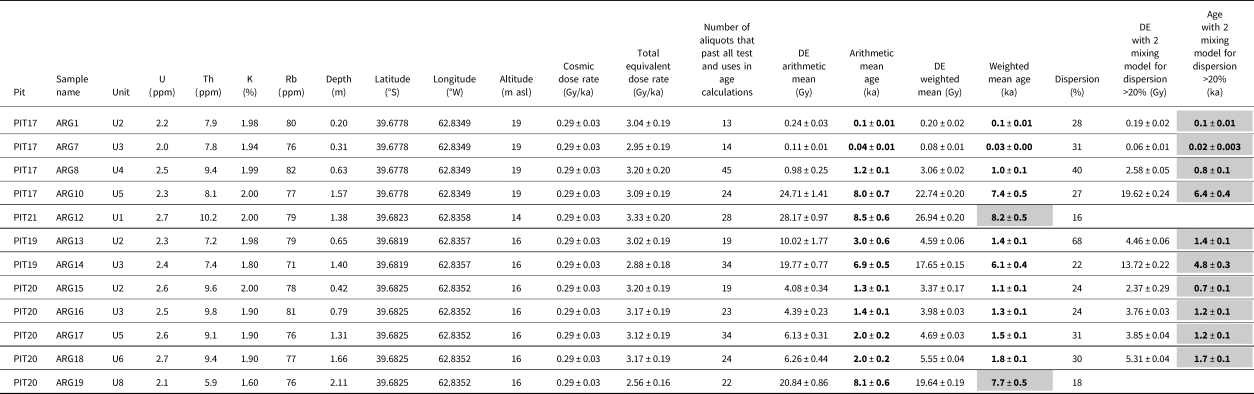
All the OSL samples were collected in 15-cm-long, 5-cm-diameter steel or plastic tubes. The tubes remained sealed until opened in the Luminescence Dating Laboratory at the University of Cincinnati under safelight conditions. A 2.5-cm-thick layer of sediment was removed from each end of each tube to obtain sediment from the center of the tube for processing to reduce the possibility that any sampled sediment was exposed to daylight during the sampling procedure. The sediment from the ends of each tube was dried to determine the present-day water content of each sample. The sediment was then crushed and sent to the Activation Laboratories Ltd. in Ancaster, Ontario, Canada, for Major Elements Fusion ICP/MS/Trace Elements analysis to determine the U, Th, and K concentrations for DR calculations (Table 3).
OSL data and ages. The best estimated ages are highlighted in gray.

The remaining sediment was pretreated with 10% HCl and 10% H2O2 to remove carbonates and organic matter, respectively. The pretreated samples were rinsed in water, dried, and sieved to attract the 90–250 μm particle size fraction. A sub-fraction (~20 g) of the sample was etched using 44% HF acid for 80 minutes to remove the outer alpha-irradiated layer from quartz particles. This treatment also helps dissolve any feldspars present. Any fluorides precipitated during HF treatment were removed using concentrated HCl for 30 minutes. The quartz sample was then rinsed in distilled water and acetate and dried. Next, a low field-controlled Frantz isodynamic magnetic separator (LFC Model-2) was used to separate feldspar and magnetic minerals from quartz, following the methods of Porat (Reference Porat2006), with the forward and side slopes set at 100° and 10°, respectively, within a variable magnetic field. The quartz from samples collected in 2015 was re-sieved to obtain a narrower grain size of 90–155 μm for OSL measurement.
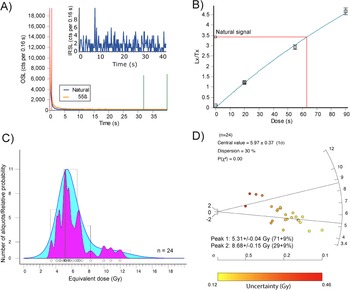
An automated Riso OSL reader model TL-DA-20 was used for OSL measurements and irradiation. Aliquots containing approximately several hundred grains of the samples were mounted onto ~10-mm-diameter stainless steel discs as an ~5-mm-diameter central circle. Aliquots for each sample were first checked for feldspar contamination using infrared stimulated luminescence (IRSL) at room temperature before the main OSL measurements were undertaken (Jain and Singhvi, Reference Jain and Singhvi2001; Fig. 5A). If the aliquots did not pass the IRSL test, the samples were etched in 40% HF for another 30 minutes to remove any feldspar, followed by 10% HCl treatment and sieving again. Samples that passed the IRSL test were used for OSL dating. Aliquots of samples were illuminated with blue LEDs stimulating at a wavelength of 470 nm (blue light stimulated luminescence—BLSL). The detection optics comprised Hoya U-340 and Schott BG-39 color glass filters coupled to an EMI 9235 QA photomultiplier tube. Samples were irradiated using a 90Sr/90Y beta source. The single aliquot regeneration (SAR) method of Murray and Wintle (Reference Murray and Wintle2000, Reference Murray and Wintle2003) was used to determine DE for age estimation using Sequence Editor and Analyst software of Risø (Fig. 5B). Only aliquots that satisfied the criterion of a recycling ratio of ≤10% were used in determining DE. A preheat of 240°C for 10 seconds was used, and the OSL signal was recorded for 40 seconds at 125°C. OSL sensitivity of the samples had a high signal-to-noise ratio. The uncertainty also includes an error from the beta source estimated at ± 5%. Dose recovery tests (Wintle and Murray, Reference Wintle and Murray2006) indicated that a laboratory dose of 10.9 Gy could be recovered to within 10% by the SAR protocol, suggesting that the protocol was appropriate.
Characteristics of OSL samples illustrated using sample ARG16. (A) Typical OSL shine down curves with test IRSL curve; (B) regenerative curves; (C) kernal density estimate (blue), probability density plot (purple), and histogram (transparent) for aliquots (also shown as dots); and (D) radial plot.

Dose rate calculations follow the details highlighted in the footnotes of Table 3 and are confirmed using the Dose Rate and Age Calculator (DRAC) of Duncan et al. (Reference Duncan, King and Duller2015). Dose rates for all samples are very similar, with values between 2.6–3.5 Gy/ka, which is within the normal range for terrestrial sediments (Table 3). Natural water content was <10%, and we assumed a conservative value with a large uncertainty (10 ± 5%) to reflect possible changes in water content over the geologic history.
The natural OSL signal for all aliquots was at least two orders of magnitude greater than the background signal. The shine-down curves (luminescence stimulated in the lab over 40 seconds of exposure to light) for all aliquots showed fast decay patterns that confirmed that the signal is the fast component of luminescence, which is dominant in quartz. This provided confidence that the sample likely would have been bleached quickly if only briefly exposed to sunlight. IRSL “shine down” curves also were used to test that there was no feldspar within the sample. Dose rate recovery tests for the samples showed good recovery within the uncertainty of the laboratory measurement. Most aliquots provided good recuperation and recovery. The dose rate recovery was excellent for all samples (within 5% of the assigned dose), which provides confidence in the suitability of the sediment for OSL dating. The spread of DE was relatively large for some samples (dispersion >20%), suggesting possible partial bleaching for some samples (Table 3), which can result in an overestimate of age (Fig. 5C). For these samples, we assumed a 2-mixing model using RadialPlotter (Vermeesch, Reference Vermeesch2009) and calculated the age based on the younger population (Fig. 5D). For the samples with low dispersion (<20%), we used the weighted mean value for the DE values (Table 3). All OSL ages are before AD 2020 are reported as “yr BP” for ages <1000 years old and “ka” for older ages.
RESULTS
The La Modesta site, located on a dune and its blowout, joins countless case studies that have been treated in different semi-arid and arid environments in which the problems related to surface artifact distributions, site formation processes, and integrity are difficult to address (Lancaster, Reference Lancaster1986; Fanning et al., Reference Fanning, Holdaway, Rhodes and Bryant2009; Coronato et al., Reference Coronato, Fanning, Salemme, Oría, Pickard and Ponce2011; Oría et al., Reference Oría, Coronato, Vázquez, Bártoli, López and Salemme2021; among many others).
Dune formation is primarily controlled by variability in wind regime, sediment, and vegetation extent (Kocurek and Lancaster, Reference Kocurek and Lancaster1999; Lancaster, Reference Lancaster and Shroder2022). In the study area, the dunes are elongated to the southwest, parallel with the winter trade wind direction (Martínez and Martínez, Reference Martínez, Martínez and Martínez2017). The sampled dune sediments at the La Modesta site formed in close spatial association (~210 m) with an old river system represented by a paleochannel (Fig. 2). Most of the stratigraphic successions at the La Modesta site are composed of >80% sand, except for the fluvial levels (U7 and U8) in Pit 20 (Table 2). The aeolian sediment is predominantly fine to medium sand size and is typically moderately sorted to well sorted (Folk and Ward, Reference Folk and Ward1957). The dune sand is mostly massive, with occasional planar and trough cross-stratification, erosional surfaces, paleosols, and bioturbation due to plant roots. Any soil that is present is weakly developed (mostly A/C profile) and has very little (<2.1%) total organic matter (Table 2). Soils are poorly developed and probably represent only a few thousand years.
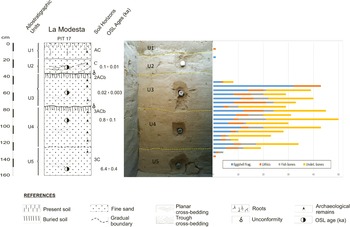
Twelve OSL ages were obtained from Pits 17 and 19–21 (Table 3). Detailed information about the archaeological finds in some pits is summarized elsewhere (Stoessel, Reference Stoessel2015; Martínez, Reference Martínez2017; Santos Valero, Reference Santos Valero2019; Alcaráz, Reference Alcaráz2020). Only the variability in broad artifactual categories (lithics, undetermined bones, eggshells fragments, and bonefish), their quantity, their association to specific stratigraphic units, and their distribution along the sedimentary successions is briefly outlined and graphed as part of the description of each excavated pit (see Figs. 6, 8–10).
Stratigraphic succession of Pit 17 at La Modesta site showing the sedimentary units, soil horizons, vertical distribution of cultural items, and OSL ages.

Pit 17 is in the western part of the dune (Fig. 3). The 1.6-m-deep pit has five units (from oldest to youngest: U5, U4, U3, U2, U1; Fig. 6). Two buried soil horizons were evident at the top of U3 and U4 (2ACb and 3ACb horizons). These incipient pedogenetic horizons were identified based on physical characteristics and color rather than the organic matter content and particle size (Table 2). The particle size of the succession is moderately well-sorted leptokurtic fine sands (Table 2), except for U4, which was a very fine gravelly fine sand. Low-angle (5–20°) cross-stratification is present within the units in this pit.
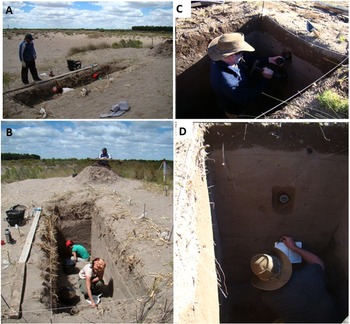
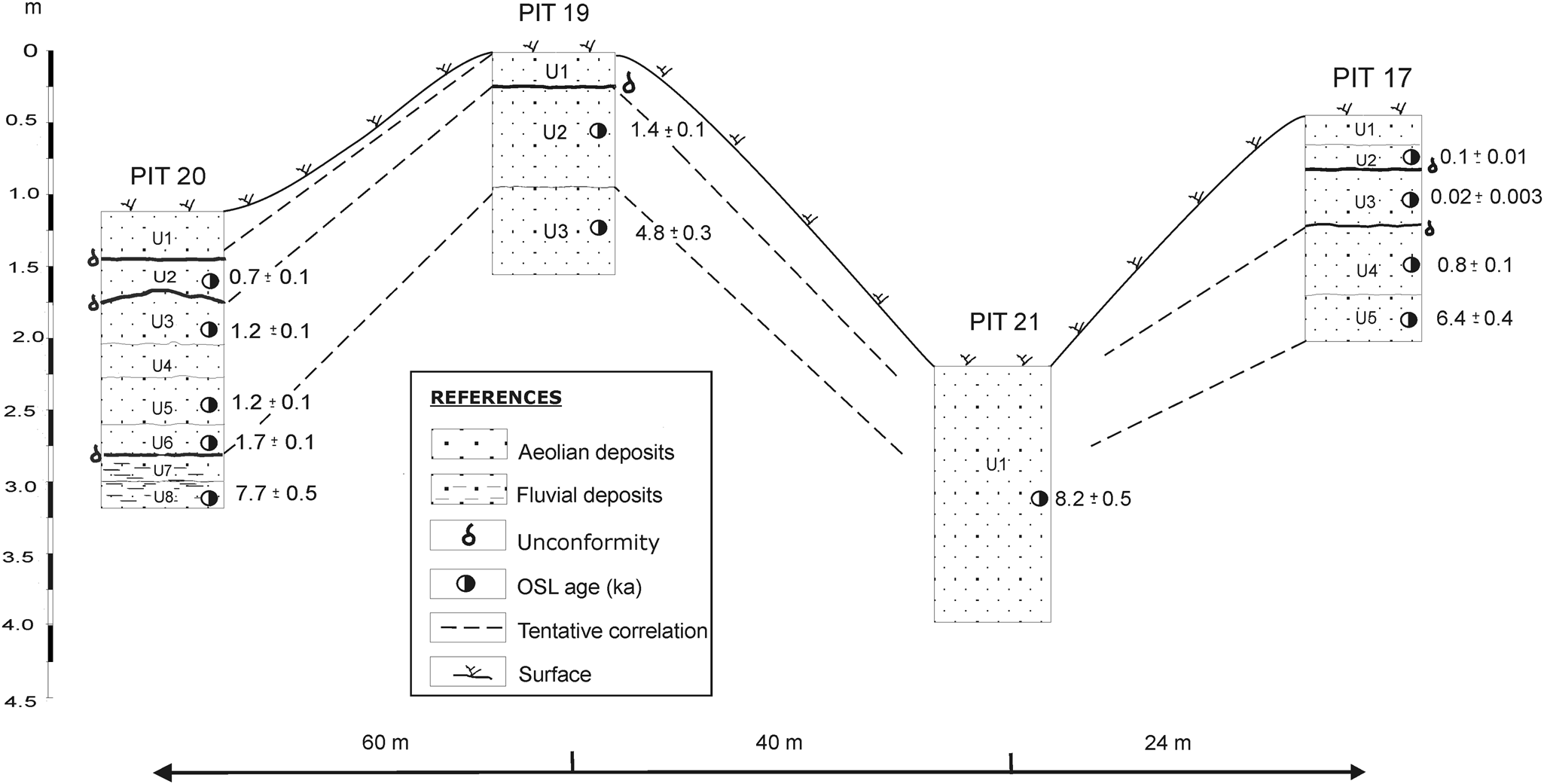
The base of U5 dates to 6.4 ± 0.4 ka. After a transitional contact, the upper part of U4 is dated to 800 ± 100 yr BP (0.8 ± 0.1 ka). An unconformity marked by buried soil (3ACb) is evident in the upper part of this unit. Unit U3 was OSL dated at ca. 20 yr BP and had an unconformity that separates this unit from U2, which was OSL dated to ca. 100 yr BP. Here, the unconformity is marked by buried soil (2ACb). U1 represents modern soil (AC). The apparent age reversal is likely due to the significant uncertainties associated with OSL dating sediment so young. Excavation of this pit yielded the most archaeological materials at the site in stratigraphic position, and a pattern of the continuous vertical distribution of archaeological items was recorded (Fig. 6). Due to this, two adjacent trenches composed of pits 7–10 and 12–15 were excavated (Figs. 3, 7). Despite differences in frequency, small-sized, and fragmentary items of flakes, Rheidae eggshells, armadillo plates, fish vertebrae, and other small-sized faunal remains are present. Large-sized lithics and bones were rare (Santos Valero, Reference Santos Valero2019; Alcaráz, Reference Alcaráz2020).
Views of typical pits and sampling sites. (A, B) Excavation of trenches dug in proximity of Pit 17; (C, D) OSL sampling of Pits 17 and 20.

Very few artifacts were recovered from U1 and U2 in Pit 17 (Fig. 6). Nevertheless, just below the unconformity that separates U3 from U2 (Fig. 6), the archaeological record started to appear continuously, and artifact frequency suddenly increased. The number of artifacts decreases at the bottom of U4, finally disappearing towards its base. Thus, the archaeological remains are mainly in U3, U4, and the uppermost section of U5. Three bone samples (two fish [perch] vertebrae and one Ñandu tibiotarsus) collected for 14C dating come from U3 and U4. The bones lacked the collagen needed for radiocarbon dating and could not be dated (Santos Valero, Reference Santos Valero2019; Alcaráz, Reference Alcaráz2020). OSL dating shows a hiatus from 6.4 ± 0.4 ka (bottom of U5) to 800 ± 100 yr BP (top of U4). The OSL ages for strata that contain cultural materials show a clear sedimentary and chronological gap between ca. 6.4 ka and ca. 800 yr BP. Only the OSL age of ca. 6.4 ± 0.4 ka broadly matches the radiocarbon data obtained from surface samples (ca. 6.3–6.8 ka; see Table 1). Nevertheless, while the age of ca. 6.4 ka is from the lowermost part of U5, archaeological materials are mostly recorded in the top of this unit (Fig.6). These tendencies indicate that the archaeological deposit would have resulted from a secondary context, a palimpsest, a reworked product of intense morphogenesis.
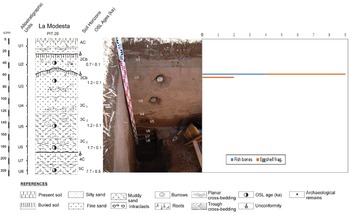
With eight units (U8 to U1), Pit 20 has the largest number of units extending to a depth of ~2.2 m (Figs. 3, 8). The pit also has two partially eroded buried soils (3Cb and 2Cb) at the top of the succession. OSL ages range from ca. 7.7 ± 0.5 ka to 700 ± 100 yr BP. Most of the succession is composed of aeolian coarse silty sand and very fine sand, moderately to poorly sorted, and very fine skewed. U8 and U7 are composed of very poorly sorted, very coarse silty, and very fine sand, with trimodal distribution, which indicates a fluvial environment and is granulometrically different from the upper units (Table 2). U8 is OSL dated to 7.7 ± 0.4 ka, and U7 was deposited above after a transitional boundary. An erosional contact is evident at the top of U7. No soil is present in the middle part of the succession (U6–U3). U6 is OSL dated to 1.7 ± 0.1 ka and is interpreted as aeolian in origin. After a transitional contact, another aeolian unit (U5) is present and dates to 1.2 ± 0.1 ka. The aeolian U3 yielded an OSL age of ca. 1.2 ± 0.1 ka and is unconformably overlain by U2. The same age (1.2 ± 0.1 ka) was obtained from U5, and U3 represents the stability of the setting. The upper units (U2 and U1) contain buried soils (2Cb and 3Cb). Unit 2 yielded an age of 700 ± 100 yr BP and U1 unconformity overlies it. U1 has a distinctive AC horizon and low-angled (5–15°) cross-stratification. Archaeological material was only found in U2 (Fig. 8).
Stratigraphic succession of Pit 20 at the La Modesta site showing allostratigraphic units, soil horizons, vertical distribution of cultural items, and OSL ages.

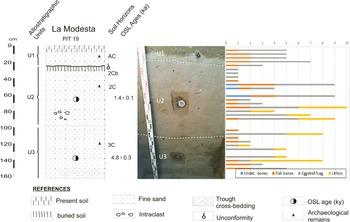
Pit 19, located in the northern part of the blowout, was excavated to a depth of ~1.6 m (Figs. 3, 9). The sediments are moderately sorted fine sand that is fine skewed and leptokurtic. U3 dates to 4.8 ± 0.3 ka and is composed of massive sands with trough cross-stratification at the base. The U2 unconformity, which is overlain by U1, dates to ca. 1.4 ± 0.1 ka. A truncated buried soil is evident in the upper part of U2 (2Cb horizon). The modern soil is developed above this unit. The vertical distribution of archaeological items throughout the sequence and their quantities indicate marked differences that are physically related to the main sedimentary changes, particularly where each stratum begins (Fig. 9). This coincidence indicates that deposition of the archaeological record strongly depended on aeolian dynamics.
Stratigraphic succession of Pit 19 at the La Modesta site showing allostratigraphic units, soil horizons, vertical distribution of cultural items, and OSL ages.

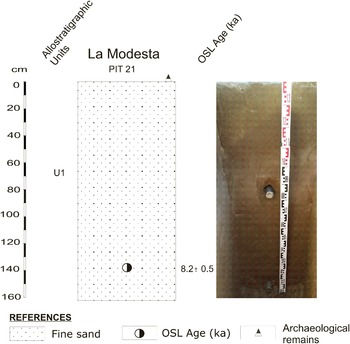
Pit 21 was excavated in the central-western portion of the blowout (Figs. 3, 10). This is a massive unit of aeolian sediment without evidence of soils and without any buried artifacts. The unit comprises moderately sorted fine sands and yields an OSL age of ca. 8.2 ± 0.5 ka near the excavation base. The sedimentary units broadly correlate between each pit based on the unconformities and OSL ages (Fig. 11).
Stratigraphic succession of Pit 21 at La Modesta site showing allostratigraphic unit U1 and OSL age.

Schematic section showing a tentative correlation of sedimentary units among the pits at the study site. The horizontal distances shown are the straight distance between each pit.

DISCUSSION
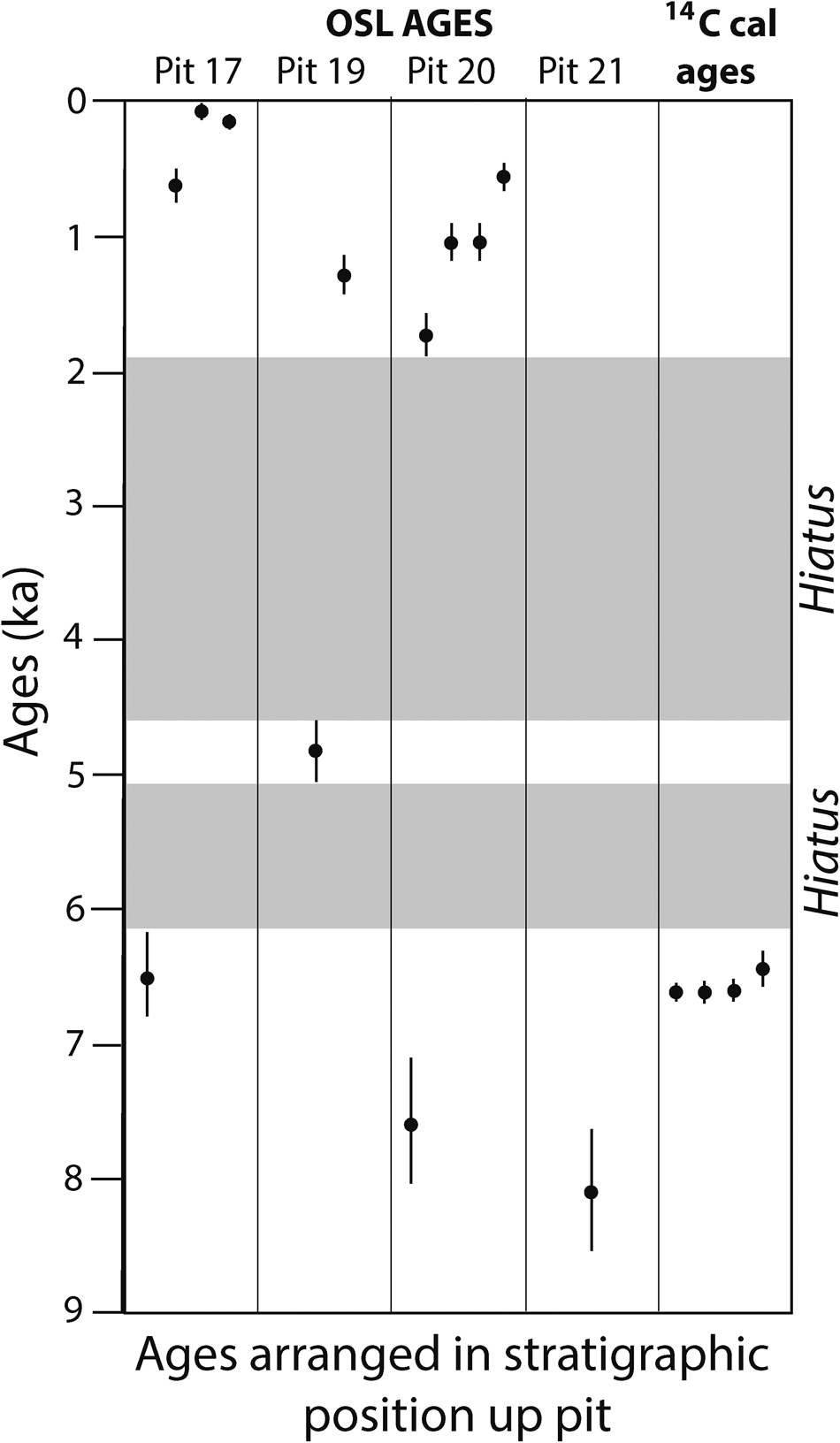
Analysis of the sediments at the La Modesta site shows alternating periods of stability and erosion from ca. 8.2 ± 0.5 ka to the present (Table 3). This is reflected in the OSL ages, which indicate important hiatuses between stratigraphic units. In the case of Pit 17, the adjacent stratigraphic units U5 and U4 define a hiatus of ca. 5.4 ka. The same is true for Pit 20, considering the contiguous U8/U7 (fluvial) and U6 (aeolian) units, where a gap of ca. 6 ka is represented. In Pit 19, there is a hiatus of ca. 3.4 ka. In the case of Pit 21, a single stratigraphic unit was detected, and its lowermost part was dated to ca. 8.2 ± 0.5 ka.
Despite the small study area (~5000 m2), differences in stratigraphic conditions throughout the dune and the blowout are evident. Greater stability of erosion-deposition processes was apparent in the eastern sector of the dune represented by Pit 20. More-developed soils and greater bioturbation occur at the top of the succession (U2 and U3), and two ages of ca. 1.2 ± 0.1 ka were obtained in non-contiguous U5 and U3, suggesting stability of the landscape. This is probably because Pit 20 is on the lee slope (east) of the old dune, formed by the prevailing westerly winds. Conversely, Pit 17, located on the stoss slope, had greater erosion potential. Aggradational processes would have been dominant in the western sector, as in Pit 17. These differences could be because the prevailing trade-wind direction is west-southwest. Fluvial units (U8 and U7) were only present in Pit 20 and represented the ancient substrate of the alluvial plain on which the dune formed.
Representation, quantity, and stratigraphic locations of artifacts notably vary throughout the examined sectors of the dune. The highest concentration of artifacts is in the western sector (Pit 17), including a much more abundant and clear stratigraphic representation of items. Here, a patterned vertical distribution of cultural materials related to specific stratigraphic units was recognized at upper U5, U4, and U3 (Santos Valero, Reference Santos Valero2019; Alcaráz, Reference Alcaráz2020; Fig. 6). There is no consistent chronological pattern due to the chronological gap detected among these units. In the eastern sector (Pit 20), artifacts are only present in U2. In the northern sector at Pit 19, archaeological material is moderate and heterogeneously distributed along the stratigraphic succession in U3, U2, and U1. The presence of artifacts is only superficial due to the lateral deflation of the dune at the surface of the blowout in Pit 21. Although factors related to hunter-gatherer settlement systems cannot be ruled out, these differences in the amount, frequency, and distribution, both surficial and stratigraphic, of archaeological material would have resulted from the unstable conditions of the dune.
OSL ages from the site range from ca. 8.2 ± 0.5 to 6.4 ± 0.4 ka and from 1.7 ± 0.1 ka to recent, with just one age between these two groups of ages (4.8 ± 0.3 ka; Fig. 12). The calibrated radiocarbon ages from the surface record (ca. 6.3–6.8 ka) broadly match the OSL age of ca. 6.4 ± 0.4 ka in Pit 17 for the bottom of U5 (Fig. 11), which has almost no archaeological material (Fig. 6). Only the uppermost part of U5, together with U4 (ca. 0.8 ka) and U3 (ca. 20 yr BP), has the greatest concentration of artifacts. Therefore, there is a mismatch between the OSL ages and the stratigraphic units carrying the archaeological material. After a hiatus of ca. 1.5 ka, the single OSL age of ca. 4.8 ± 0.3 ka is followed by the most significant hiatus at the site, spanning ca. 2.7 ka (Fig. 12). Eight OSL ages dating from ca. 1.7 ± 0.1 ka to ca. 20 yr BP post-date this hiatus.
OSL and radiocarbon ages showing the chronologic “gaps” (gray bars) during the last ca. 9 ka at La Modesta site. The oldest hiatus is inferred for Pit 19 where the depth of the pit does not reveal sediments much older than ca. 4.8 ka. The hiatuses are also inferred for Pit 21 where there is only one OSL age and the sedimentology does not reveal obvious discontinuities. 14C cal ages are shown for the four surface bones collected at the site.

The chronological and sedimentary gaps indicate that during the mid-Holocene and the initial part of the Late Holocene, the portion of the landscape represented by the dune was strongly influenced by aeolian deflation processes and a high rate of erosion under a regime of arid and semi-arid climates at local and regional scales. In this sense, for inland sites within the study area (e.g., El Puma locality; see Fig. 1), geomorphic evidence indicated that, after the deactivation of the fluvial system at ca. 6.3–6.6 ka, important aeolian deposits were deposited above the non-active fluvial landforms. This is interpreted as a byproduct of intense morphogenesis under greater aridity (Martínez et al., Reference Martínez, Martínez, Santos, Stoessel, Alcaráz, Flensborg, Bayala and Armentano2012). These local arid conditions for the studied area are consistent with the paleoclimatic tendencies of northeastern Patagonia, which indicate that since ca. 7.9–7.7 ka, warm-arid conditions and intense aeolian morphodynamic processes prevailed (Schäbitz, Reference Schäbitz1994, Reference Schäbitz2003, p. 297). Monte, Espinal, and Patagonian xerophytic elements indicate arid to semi-arid conditions, with sporadic precipitation and increased temperatures (see Schäbitz, Reference Schäbitz1999, in Mancini et al., Reference Mancini, Prieto, Paez and Schäbitz2008). In particular, the xerophytic shrub-steppe was established under arid climatic conditions in northeastern Patagonia, near the San Matías Gulf, at ca. 6.7–3.0 ka (Marcos and Ortega, Reference Marcos and Ortega2014). Schäbitz and Liebricht (Reference Schäbitz, Liebricht, Garleff and Stingl1998) and Schäbitz (Reference Schäbitz2003) proposed that after a dry phase at ca. 5.0–5.3 ka, the climate became semi-arid, although with precipitation events, which would have been related to weakening of the westerly winds, the influence of humid air masses from the Atlantic, and a greater seasonality. These characteristics intensified during the last ca. 3.3 ka. Under these macroregional paleoclimatic arid to semi-arid conditions, characterized by severe morphogenesis and unstable conditions, the La Modesta site was likely strongly affected during the mid-Holocene and the beginning of the Late Holocene. Geomorphic processes would have severely affected the integrity and resolution of the site that, as suggested by the archaeological record and the radiocarbon ages, should have taken place during the mid-Holocene, at ca. 6.3–6.8 ka. Thus, these sedimentary gaps are interpreted as the result of morphogenetic processes that destroyed or mixed sediments within stratigraphic succession that initially carried the archaeological record. The outcome is a secondary context in which the buried archaeological materials are not well preserved and are associated with Late Holocene sediments. Although the evidence shows the prevalence of important morphogenic processes, secondary contexts, palimpsests, and low resolution and integrity, the consistency of the radiocarbon ages from the well-preserved surface bones likely indicates the recent and simultaneous exposure of these materials (Fig. 4) whose original context still could be found in some sector of the dune not excavated yet.
The last ca. 1.7 ka is represented by a pattern of stratigraphic units that present much more continuous ages and evidence of pedogenesis after ca. 1.2 ka. In the lower basin of the Colorado River, isolated paleosols were dated at ca. 1.9 ka (e.g., at the Loma Ruiz 1 site; see Fig. 1), but more significant evidence of environmental stability is indicated by the presence of a paleosol with a broad areal distribution (coast, ancient delta, and inland settings) dated to ca. 1.0 ka to 400 yr BP (Martínez et al., Reference Martínez, Martínez, Alcaráz and Stoessel2019). Late Holocene soil development is consistent with the paleoclimatic conditions inferred and the presence of microvertebrate species in the archaeological record that suggests warm and humid conditions at the lower basin of the Colorado River and the middle course of the Negro River (see discussion in Martínez et al., Reference Martínez, Brea, Martínez and Zucol2021, and Zucol et al., Reference Zucol, Martínez, Martínez and Angrizani2022). A pattern of buried and/or truncated paleosols is evident at the top of the successions at the La Modesta site (Figs. 6, 8, 9), which is also a pattern noted in other sites within the eastern Pampa-Patagonia transition. This is interpreted as the result of erosion, soil truncation, and reactivation of the landscape that occurred since ca. 400 yr BP (G. Martínez and G.A. Martínez, Reference Martínez and Kutschker2011; G.A. Martínez and G. Martínez, Reference Martínez, Martínez and Martínez2017).
Paleoenvironmental reconstructions suggest that arid and strongly morphogenetic conditions prevailed during the mid-Holocene, and archaeological contexts, such as at the La Modesta site, have suffered important consequences for the integrity and resolution of the archaeological record. These processes generated a dual pattern in the surface and subsurface record, and significantly altered the archaeological context. This proposition is supported by the taphonomic work of Alcaráz (Reference Alcaráz2020) at the site, who proposed two taphonomic histories. On the one hand, based on specific surface bone modifications (e.g., root etchings, abrasion, weathering, manganese oxide, and calcium carbonate), remains of guanacos, medium-sized rodents, birds, and some armadillos with evidence of human exploitation indicate that the original mid-Holocene bone assemblage has been subjected to an alternating process of burial and re-exposure due to the dynamics of the dunes. A similar pattern was found by Stoessel (Reference Stoessel2015) in the case of fish specimens (perch) that also show cut marks. Radiocarbon ages on a coypu (rodent) bone (5846 ± 51 14C years BP/ca. 6.5–6.8 ka) and a guanaco (artiodactyl) bone (5641 ± 66 14C years BP /ca. 6.3–6.6 ka; Table 1) support the mid-Holocene chronology for this assemblage. On the other hand, most of the remains of small rodents, marsupials, amphibians, reptiles, and some armadillo specimens indicate a different situation. The same bone surface modifications suggest they correspond to present-day accumulations (Alcaráz, Reference Alcaráz2020, p. 118). In line with these results, the analysis of the lithic assemblage indicated that wind abrasion among the artifacts' surface alterations reached ~32% (Santos Valero, Reference Santos Valero2019). Thus, besides the information from the stratigraphic successions and the OSL ages, modifications on the surface of cultural material also indicate that strong morphogenetic processes acted on and affected the archaeological record.
Even though we base our arguments on a single site, our results for La Modesta have important implications for understanding temporal discontinuities on regional and macro-regional spatial scales. Before assuming that discontinuities in the archaeological record relate to climate, paleodemography, and mobility, among other causes, there should be a consideration of taphonomic and geological biases when examining the nature and origins of hiatuses in the sedimentological and geoarchaeological records. The recognition of patterns in the structure of the geoarchaeological record at different spatial scales is crucial for sound archaeological interpretations. Fortunately, studies in the Central Region of Argentina and adjacent areas provide additional insights into the preservation of the sedimentary and archaeological records. In the Andean piedmont of northwestern Patagonia (northern Neuquén and southern Mendoza), it has been proposed that most environmental eco-zones possess archaeological discontinuities that encompass most of the entire mid-Holocene (Neme et al., Reference Neme, Zárate, Pompei, Franchetti, Gil, Giardina, Seitz, Salgán, Abbona and Fernández2021). In this region, three archaeological sites located in rock shelters (Salamanca, El Manzano, and Huenul caves) show a discontinuity in the sedimentary and archaeological record during ca. 7.4–2.4 ka (Barberena, Reference Barberena2015; Neme et al., Reference Neme, Zárate, Pompei, Franchetti, Gil, Giardina, Seitz, Salgán, Abbona and Fernández2021). As at the La Modesta, the discontinuity in Cueva Salamanca seems to be chronological and stratigraphical (Neme et al., Reference Neme, Zárate, Pompei, Franchetti, Gil, Giardina, Seitz, Salgán, Abbona and Fernández2021). Research along the middle course of Negro River in Río Negro Province (northeastern Patagonia) has demonstrated that Late Pleistocene and mid-Holocene sediments that might contain archaeological materials are deeply buried under alluvium of braided rivers, which in turn, are covered by aeolian deposits that are mostly loess (Luchsinger, Reference Luchsinger2006). Portions of ancient landscapes were subject to active geomorphic processes, such as channel avulsion, that eventually affected the archaeological record by eroding previously deposited sediment leading to hiatuses in the sedimentary record (Luchsinger, Reference Luchsinger2006). Also, in North Patagonia, along the Atlantic coast at the San Matías Gulf in Río Negro Province, the transgressive mid-Holocene sea-level maximum affected coastal geomorphology and, consequently, the establishment and subsequent discovery of human occupations in different ways. Along the northern coast of the San Matías Gulf, sites located in the coastal inlets (e.g., Bahía San Antonio, Bajo de la Quinta, Bahía Creek-Caleta de Los Loros, among others) have the oldest deposits and the greatest temporal continuity spanning the mid- and Late Holocene, while only Late Holocene deposits are present along the rest of the coast (Favier Dubois, Reference Favier Dubois, Zangrando, Barberena, Gil, Neme, Giardina, Luna, Otaola, Paulides, Salgán and Tivoli2013; Favier Dubois et al., Reference Favier Dubois, Kokot, Scartascini and Borella2016). Furthermore, preservation of archaeological materials varies according to the landform. In this sense, the Late Holocene sites located in dunes on Holocene terraces along coastal stretches are well preserved, while mid-Holocene sites on ancient Pleistocene spits are poorly preserved with only the most resistant archaeological materials such as otoliths and stone fishnet weights surviving (Favier Dubois and Kokot, Reference Favier Dubois and Kokot2011). Along the lower course of the Colorado River, at the eastern Pampa-Patagonia transition in Buenos Aires Province, a pattern of site destruction and loss of organic materials, integrity, and resolution of sites has been proposed for the Late Holocene. Inland sites, ~100–30 km from the Atlantic coast, such as El Puma and El Caldén, have undergone significant erosion. In contrast, those sites located near the delta up to 30 km from the coast, such as El Tigre and San Antonio, are characterized by more stable settings with well-developed soils that allow for greater preservation of archaeological assemblages (Martínez and Martínez, Reference Martínez and Martínez2011). Geoarchaeological analysis of several sites, including Cortaderas, Las Brusquillas 2, Las Brusquillas 3, among others, located adjacent to low-order steams from southeastern Pampas have few mid-Holocene archaeological sites, while the more abundant human occupations are within Late Holocene deposits and buried soils. However, these Late Holocene deposits lie directly over Pleistocene deposits or, occasionally, over Early Holocene ones, indicating an important mid-Holocene stratigraphic hiatus (Favier Dubois et al., Reference Favier Dubois, Massigoge and Messineo2017). The unconformities in the sedimentary record highlight the deep erosion. In short, as Favier Dubois et al. (Reference Favier Dubois, Massigoge and Messineo2017) suggested, the reliability of paleodemographic models based on archaeological information is greatly influenced by the quantity and quality of the available data on the differential preservation of stratigraphic units, both spatially and temporally. These cases indicate that the archaeological record is naturally discontinuous in space and time due to active geomorphic environments (Martínez and Martínez, Reference Martínez and Martínez2011; Favier Dubois, Reference Favier Dubois, Zangrando, Barberena, Gil, Neme, Giardina, Luna, Otaola, Paulides, Salgán and Tivoli2013; Veth et al., Reference Veth, Ward and Ditchfield2017). The recognition of specific taphonomic modes (Behrensmeyer and Hook, Reference Behrensmeyer, Hook, Behrensmeyer, Damuth, DiMichele, Potts, Sues and Wing1992) either in any study area or among regions is essential for dealing with stratigraphic and temporal discontinuities in the archaeological record. As the La Modesta case shows, these taphonomic modes need to be built with well-designed research programs that encompass strong fieldwork and solid geochronologic and stratigraphic approaches.
CONCLUSIONS
Our OSL dating of sediments that contain cultural material provides a chronology dating from 8.2 ka and shows one or more hiatuses from 6–2 ka in the sedimentary succession. We propose that the sedimentological hiatuses described in the case of the La Modesta site are the by-product of morphodynamic processes that produced geologic and taphonomic biases. Nevertheless, despite the intense site-formation processes that took place, a clear and significant signal of mid-Holocene hunter-gatherer occupations is evident at the La Modesta site, and some of the properties of the hunter-gatherer organization (e.g., subsistence, lithic procurement and reduction strategies, decoration on Rheidae eggshells and bones, and human burials) could be inferred.
Gaps and discontinuities in the archaeological record surely do not respond to a single, exclusive cause, but rather are complex processes with regional particularities. We propose that evaluating taphonomic and geologic biases should be understood as an “a priori” step before submitting causes or mechanisms related to human population dynamics (e.g., population discontinuities and replacements, extinctions, bottlenecks, etc.); otherwise, explanations could be misleading. In the case presented here, most of these results and conclusions could not have been achieved without expanding the dating methods. In this case, the application of OSL methods yielded valuable information for discussing several issues, such as the intensity and nature of geomorphic processes and the existence of strong taphonomic and geological bias that imprinted a special stamp on the formational processes that operated at La Modesta.
Acknowledgments
Special thanks to Dr. G. Flensborg for their valuable comments that improved the manuscript. Thanks to the reviewers and editors that improve the paper with key suggestions. Thanks to INCUAPA-CONICET, Facultad de Ciencias Sociales, Universidad Nacional del Centro de la Provincia de Buenos Aires.
Financial Support
This research was funded by the Agencia Nacional de Promoción Científica y Tecnológica (PICT-242-12, PICT-616-15) and the National Geographic Society (NGS 9756-15).